




Abstract
This paper documents and discusses the creation of a performance (dance and song) by 12 sanitation workers in Nepal working with artists Alice Fox (UK) and Ashmina Ranjit (Nepal). This creative work was one element within an international, interdisciplinary research programme that explored shit flow, wastewater and marginality in five rapidly developing off-grid towns. Performed at the Lumbini Peace Park as part of the 2022 Women of the World Festival, an important objective of the work was raising awareness of issues affecting sanitation workers, who are among the most precarious workers in the world. Using photos and artist commentary, ‘we’ (geographers and artists) show how the performance (un)seen (un)clean opened a creative space through which to engage and circulate the lived experiences of workers.
An introduction
Lumbini, Nepal, 2022: Twelve sanitation workers dressed in beautiful pink and green, tailored dresses stand on a tractor trailer, their garments billow in the wind. They stand with a rehearsed strength and dignity in the afternoon heat – hands on hips, elbows out – it is a practiced pose. People stop to look at this colourful, unusual spectacle being towed through their hometown in a landscape surrounded by dust. Women like this, from these caste groups don’t tend to be dressed like this, standing like this. This is significant. These women are meant to be ‘literally above everyone’. This is unusual. These women are often seen bent over sweeping and cleaning toilets.
We are describing the 2022 performance of (un)seen (un)clean, (Figure 1) which was created and performed in Nepal’s Lumbini Peace Park. For Nepalese co-creator Ranjit, the creative collaboration represented a site of ‘artivism’: an opportunity bringing together art and social activism to tell the stories of marginalised sanitation workers. The performance location was itself significant as these women clean the grounds and toilets in Lumbini Park (Figure 2). Their working lives are hard. Cleaning fluids are expensive and not provided by park authorities. There is no soap. Their only pay is tips, and remarkably, while the Lumbini Peace Park receives over 1.5 million visitors per year, it does not have a sewage treatment plant and many of the toilets empty directly onto the fields risking contamination of the local ground water (there has been recent episodes of cholera in the province). Exposure to dangerous pathogens is a daily risk for workers and local residents.
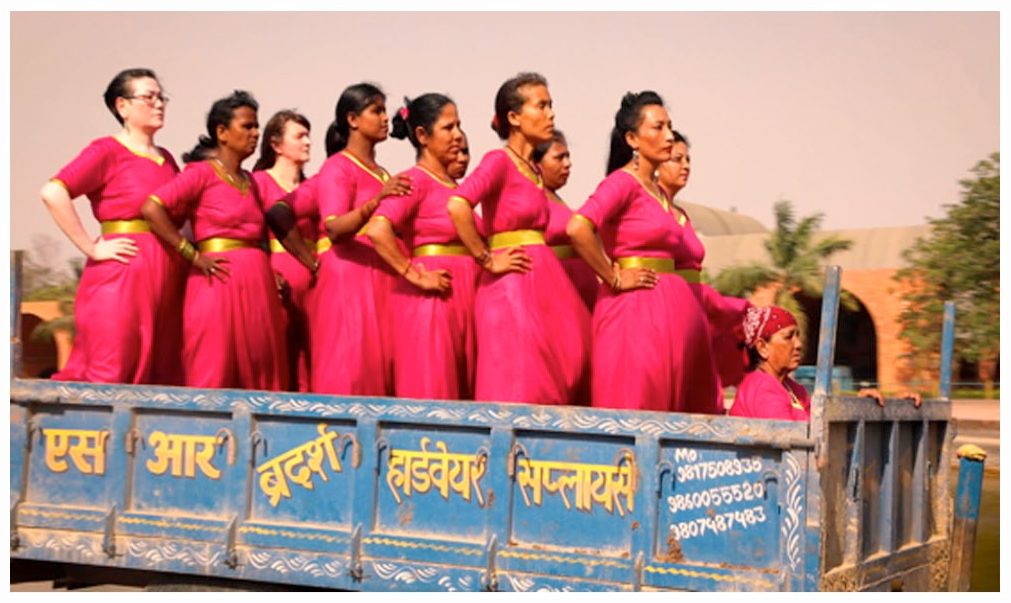
Performers travel to the Women of the World festival by tractor trailer. Photograph by Julian Mayers.
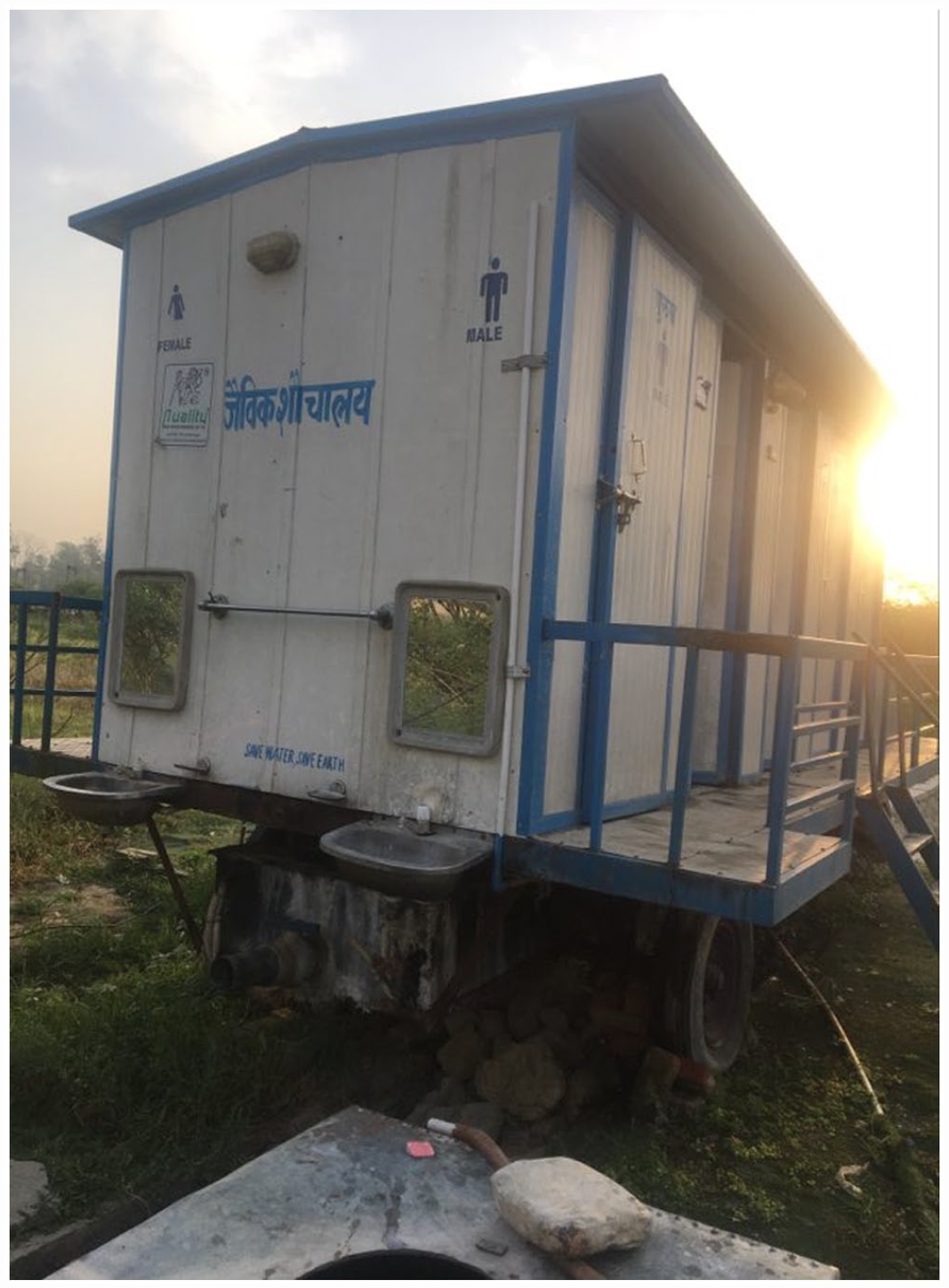
Toilets at Lumbini Peace Park that one of the performers cleans. Photograph by Sabitri Tripathi.
The performing women remain in silent pose for 20 minutes on the slow-moving trailer as they pass the Lumbini Peace Park shops and enter the Women of the World festival site. The British Council has sent a film crew to capture and document these moments. An interested crowd of locals, peace park visitors and international festival attendees gather. As the women move in procession from the tractor to the festival site (Figure 3), they plunge their hands into buckets of mud (Figure 4) and then they begin to sing in Nepali: Ye chhori,
Oh (daughters) / ladies / women
Utpaadan garaula, Dukkha gari papi pet bharaunla
(We) will produce /grow (food /crops) work hard to fill the tommy
Pet ko khetma
Tommy to farm-land
Khetko petma
Farm-land to tommy
Choli mailo bho, maile timlai nabhane matra ho man pare pahilai ho
(My) blouse is dirty, only I did not tell you that I loved you since long (time)
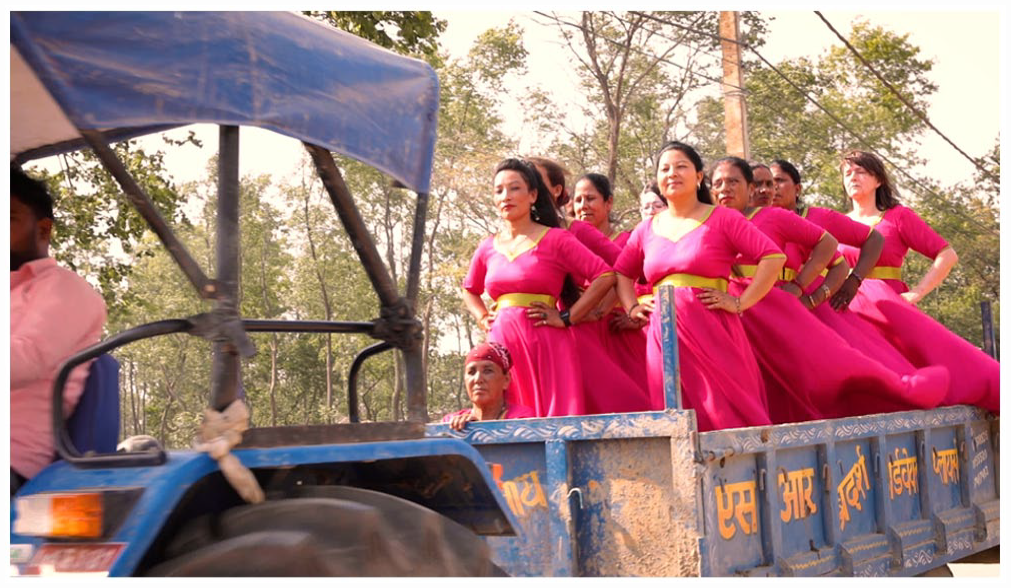
Performers travel to the Women of the World festival site. Photograph by Julian Mayers.
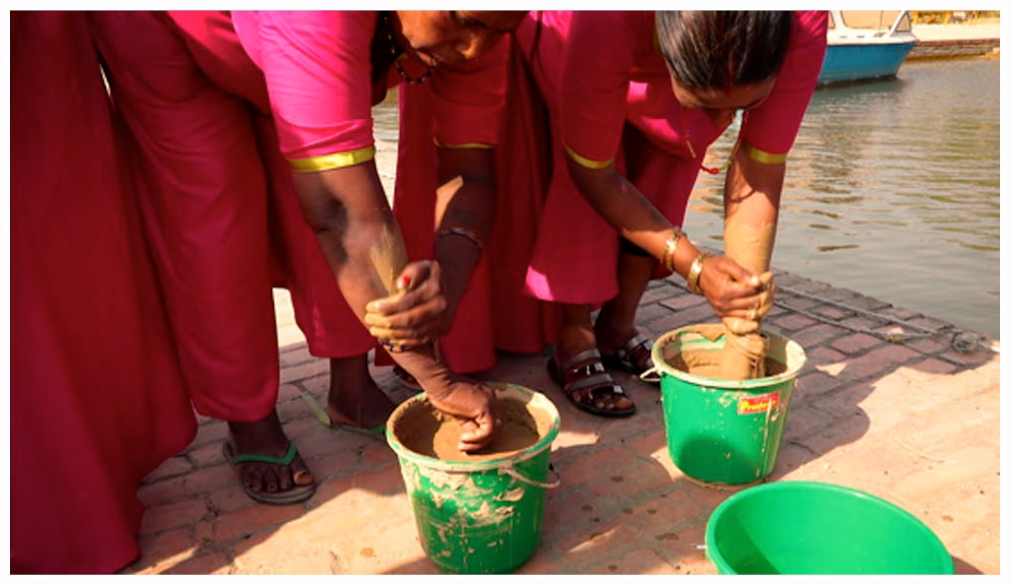
Covering hands with mud. Photograph by Julian Mayers.
Creating and performing (un)seen (un)clean
The performance (un)seen (un)clean was a song, dance and procession developed in a creative collaboration between artists Ashmina Ranjit (Nepal) and Alice Fox (UK) who worked with 12 Nepalese sanitation workers employed in the Lumbini Peace Park. 1 The piece was created for Lumbini’s 2022 Women of the World Festival and part of a longer-term research project examining and reimagining off grid sanitation in rapidly urbanising areas in Asia and Africa. Performing arts are increasingly recognised as a means through which cultural geographers (and others) can examine how people experience and re-present their everyday worlds. 2 However, the process of producing performance and how it is crosscut with long standing institutional and socio-political issues and power dynamics requires reflective interrogation. Sanitation workers are often a marginalised, invisible and precarious labour force. In India and Nepal, sanitation has long been wired into social hierarchies, and is typically the labour of highly stigmatised and racialised castes, such as Dalits, and other so-called ‘lower’ castes that are situated at the bottom of the labour hierarchy. Inadequate sanitation, especially in off-grid areas (those that are not connected to centralised systems) also leaves these workers exposed to unsafe excreta disposal, which poses a serious health risk. 3 In short, in Nepal, sanitation is deeply embedded in processes of uneven development, gender and caste-based forms of discrimination (including practices of untouchability), and cycles of intergenerational poverty and pathogen. No one off performance was going to solve these.
(Un)seen (un)clean was nonetheless designed as a small but meaningful means to increase visibility, dignity and respect for the local female sanitation workforce. We hoped that a public performance might productively raise issues of caste and untouchability and communicate some of the difficult conditions and issues these workers face in their day-to-day lives. The creative process began with a series of four workshops with twelve sanitation workers from Lumbini. Our first day involved building trust. This involved the participating women setting the initial spoken agenda. They were curious about us, wanting to know if we were married, whether we had kids, what work we did and what property we owned. We shared and then listened to what they wanted to tell us about their lives, their homes and their families. We all ate from the same buffet letting them pick first (a novelty given the usual caste-based discrimination they face as we attempted to listen and value their stories). We then shared some singing warm up exercises in a circle (Figure 5), practicing familiar songs to them with a loud voice, small voice, pulling strange faces together to loosen up face muscles, making odd noises and practicing laughing. We turned to massage the person in front’s shoulders in the circle at the end of each session.
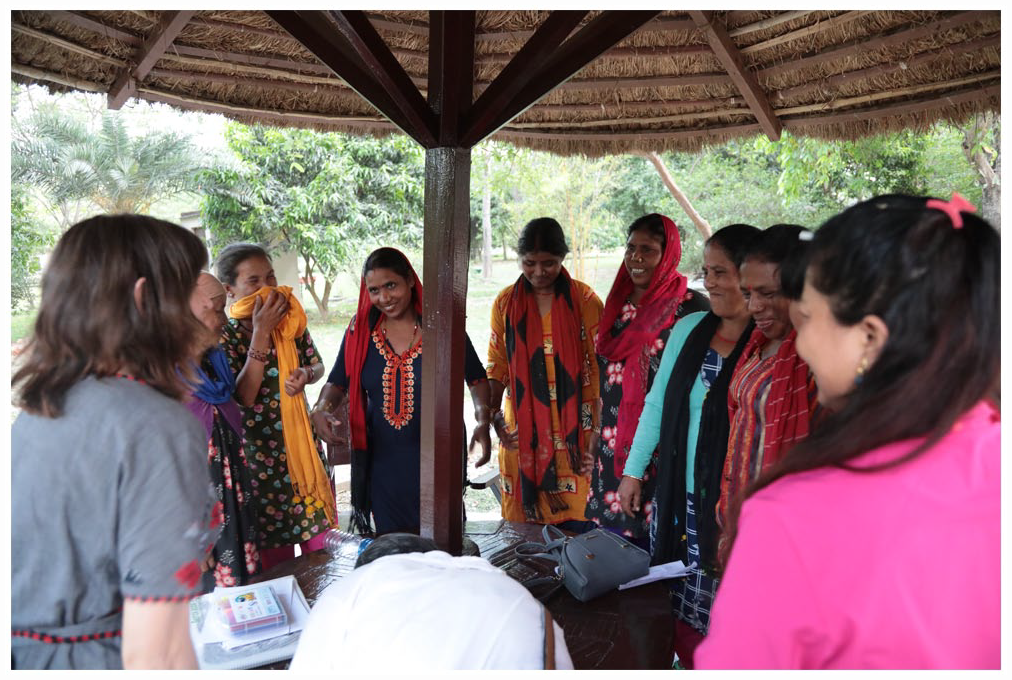
Circle time seeking to establish trust during the preparatory workshops. Photograph by Julian Mayers.
Letting the initial spoken agenda be set primarily by the sanitation workers and sharing familiar topics and songs helped shift power dynamics. After gently introducing some of the sanitation and waste issues that the scientific team had documented in Lumbini, including the importance of sealed toilet pits and safe shit handling, we asked the women to compose a song about sanitation. Singing together with actions was considered by the artists a highly appropriate approach for developing the performance, given these women’s traditions of song and movement-based expression. The artists left the room. The lyrics (above) capture an understanding of the circularity of food, life and waste, they also combined ideas and melody from a popular local pop song ‘New Lok Dohori Song’. 4
Our second day was spent rehearsing the song and adding movement and basic choreography. We explored together how one might embody and stand with strength, dignity and pride. ‘Through the workshops we explored how we express ourselves’, notes Nepalese co-creator Ashmina Ranjit, ‘and how we stand and perform in a way that commands both dignity and self-respect - dignity matters!’ On Day 3 dresses were designed. These were intended to be a gesture towards our alarming research findings concerning the lack of safely managed sanitation. The design and colour for the dresses were based on the researchers’ shit flow diagram which shows that currently only 8% of faecal sludge is safely managed and treated in the Gulariya municipality of Lumbini Province. The dresses proved a highlight for the performers. From Chanarmati Kumhar we heard: ‘When I wore that dress, it made me happy, the way people looked at me – it really changed their perception’. Or from Binita Sen: ‘When I finished the performance I was walking around, and people were saying “oh you are in such a nice dress,” and I was explaining to them it is not just a dress, it is a message’.
The procession, song and dance sought to evoke the realities and ineffable aspects of sanitation work, they were also a subtle act of defiance in the face of caste and occupation-based discrimination. The performance does not present the audience with a clear political chant or solution, rather it was intended to be a gentle provocation that avoided jeopardising the sanitation workers’ jobs (Figure 6). On Day 4, the procession, song and dance movements were refined and rehearsed for the final performance in the afternoon.
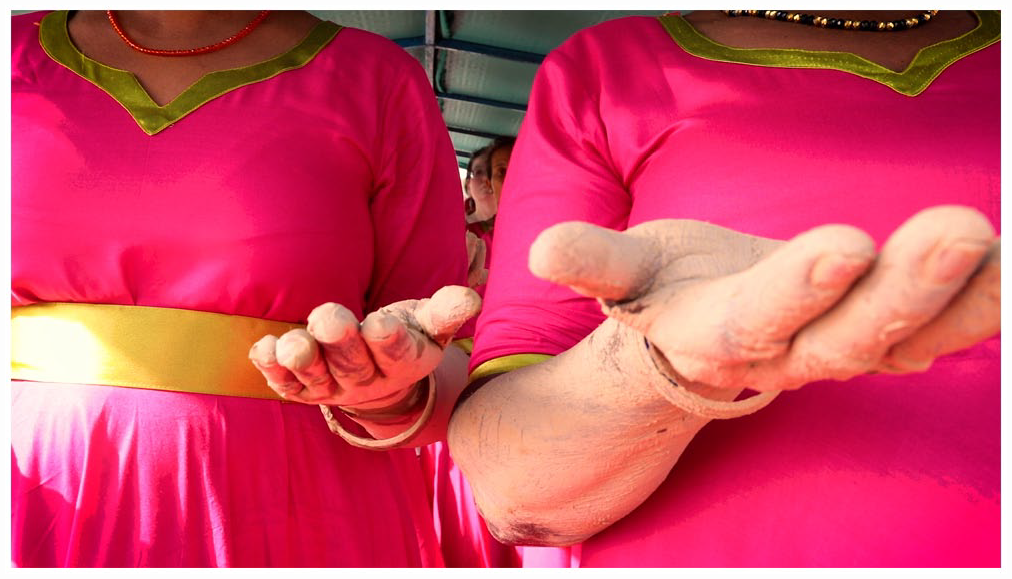
Mud hands silent procession through festival site. Photograph by Julian Mayers.
At the festival site the sanitation workers performed to hundreds of attendees, peace park visitors and over 60 organisations represented at the Women of the World festival. There was audio commentary from the British Council explaining who the performers were and their connection with our festival stall (which housed further information about sanitation and water quality issues affecting Lumbini province). The mud juxtaposed with the tailored dresses is part of the performance. Performing women plunged their hands into the mud to symbolise the literal and metaphorical excrement they must contend with and to draw attention to issues and practices of untouchability. After parading with their mud hands outstretched, the performers embark on a ceremony of shared hand washing (Figure 7). The women’s ‘singing procession’ (Figure 8) then ended at the WOW sanitation information booth (Figure 9).
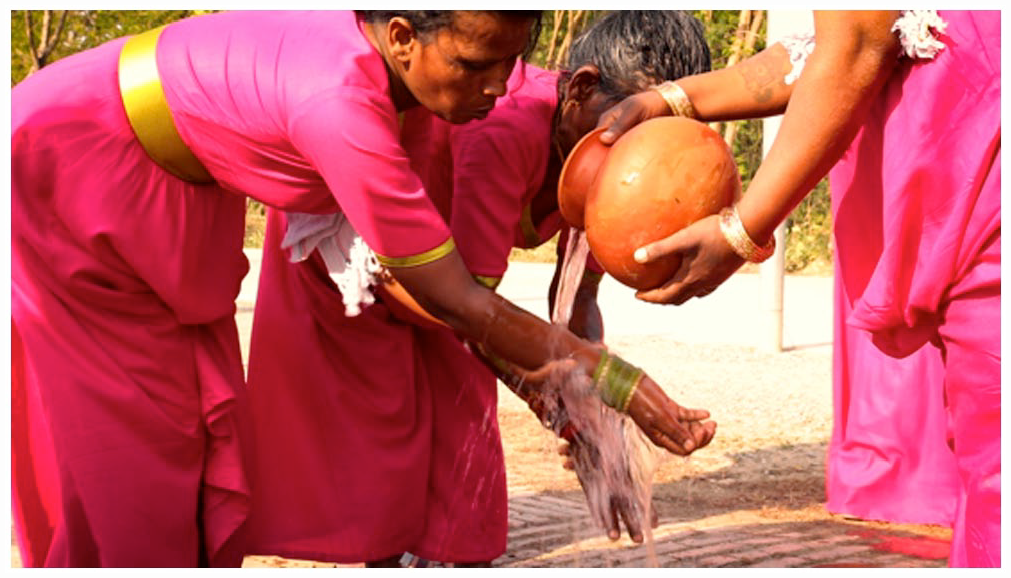
Washing hands in performance. Photograph by Julian Mayers.
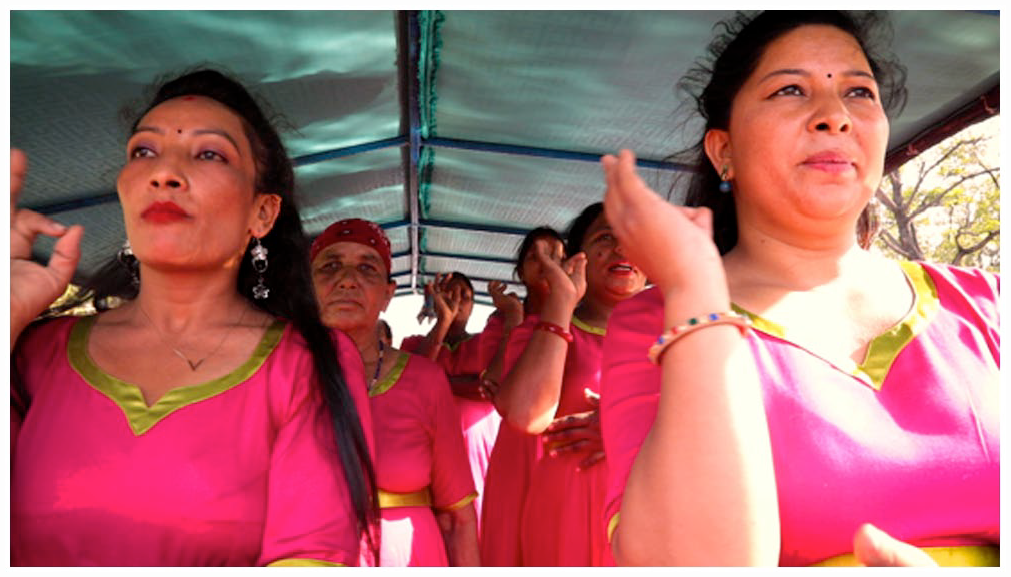
Singing in procession. Photograph by Julian Mayers.
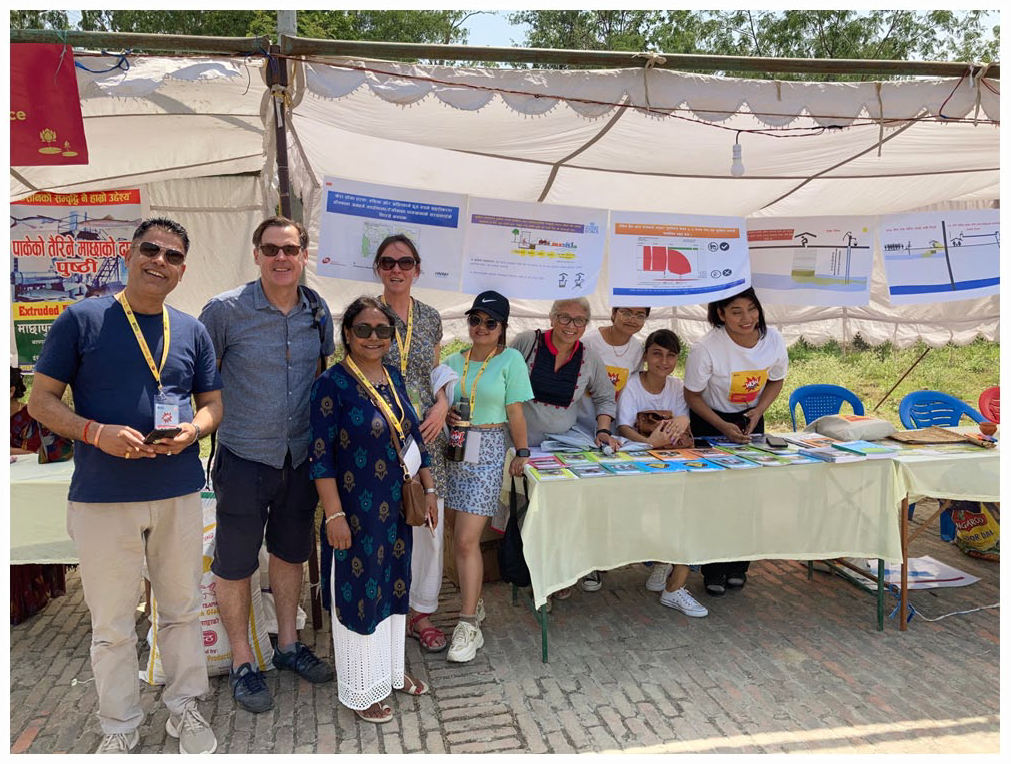
Women of the World sanitation information booth. Photograph by Sanjaya Devkota.
Conclusions
We offer two learnings from the making of this performance. Firstly, the creative workshops created a different space of learning and co-creation than offered by traditional social science techniques. There was no expectation or seeking out of confessional self-disclosure, rather the focus for performers and artists was building trust and then creatively preparing a performance for the Women of the World festival. What we learnt about the lives of participating women and their sanitation work came not through direct questions but through informal conversation during the creative process. Co-creation and using performance as a means of narrating and eliciting lived experiences would seem to offer much methodological potential in the doing of cultural geography.
Secondly, in performance, we hoped to (even momentarily) disrupt the entrenched marginality and stigma of these workers – through song, dance and procession, audiences were offered an opportunity to witness ‘another side’ to these local sanitation workers and their labour. The potential of this creative process and space represented different possibilities and understandings for different stakeholders and participants involved in the project. Some development-focused partners assumed that arts workshops would be mobilised as a health educational tool with measurable outcomes. The impact of the creative work for participating women however seemed to lay elsewhere. The public performance was designed to capture public attention, be a catalyst for audiences to empathise with the lived experiences of local sanitation workers, and to generate further interest in water quality and the need for sewage treatment in Lumbini province, Nepal. Those issues and struggles continue.
Footnotes
Acknowledgements
With thanks to all the sanitation workers at Lumbini Peace Park Nepal, Sanjaya Devkota at IDS Nepal for helping facilitate this work and Caleb Johnston for his patient and supportive guidance in bringing this to publication.
Ethics statement
The Integrated Development Society of Nepal ensured that all participants had their dignity, rights and well-being maintained over the duration of the Towards Brown Gold project and performance. Informed consent was obtained by IDS Nepal for the film and reproduction of the images and statements of participants used here.
Funding
The author(s) disclosed receipt of the following financial support for the research, authorship, and/or publication of this article: Thanks to the British Council, Lumbini Development Trust and Women of the World Nepal, Lumbini 2022 for their support. The research and performance were also funded through Economic and Social Research Council Global Challenges Fund Research grant number: ES/T008113/1 on the project Brown Gold Towards Brown Gold?: Reimagining off grid sanitation in rapidly urbanising areas in Asia and Africa.
