




Abstract
Women’s homelessness is a significant and increasing problem in the UK. Yet, much research on homelessness does not acknowledge the particular gendered issues homeless women face. Furthermore, the small amount of research available on the matter is often restricted to academic and professional audiences. Little Miss Homeless, a culture jammed children’s book, was produced with the intention of making wider public audiences aware and engaged with issues relating to women’s homelessness. This article traces through the process of producing the book and reflects on the emerging interest within cultural geography to use creative methods of research dissemination in order to engage wider public audiences with our research.
Introduction
Homelessness is rising in the UK, and with it, the number of women sleeping rough or accessing homeless services. 1 Geographers have studied how it is represented; experienced; policed and regulated within cities and how these regulations are negotiated. 2 However, many of these accounts neglect the experiences and stories of homeless women. 3 Indeed, their underrepresentation within academic and policy research, often results in their needs being neglected in service provision.
This creative response was inspired by the work of cultural geographers who seek to stretch ‘the limits of established approaches to the. . .dissemination of research’, to work in creative ways that can help us to ‘discuss and think more deeply about the issues and emotions’ our research is trying to convey and thereby to ‘bring academic research to a wider public in an immediate, engaging way’. 4 There is now a substantial body of work in this area including drama; poetry; novel, LEGO art; exhibitions and ‘queer walks’. 5 The Little Miss Homeless book is my experiment with creative, impactful cultural geographies, of the kind now increasingly expected in UK academic research. 6
Creative methods have been used by geographers to convey the experiences of homeless people. Based on his research with homeless people in Italy, Lancione produced an ethnographic novel that enabled a ‘meaningful re-appropriation’ of his research findings in a language and format that was more accessible than his thesis and academic papers. 7 I wanted Little Miss Homeless to engage wider public audiences in the lives of homeless women in the UK.
Creating the story
Little Miss Homeless came into being on a bus journey, as my friend and I were pitching ideas to each for creative geography projects. I wanted to write about my own research interest but in a different way. I was toying the idea of ‘culture jamming’ a children’s book, and so were discussing which book I could re-write. The Mr. Men and Little Miss book series were perfect. These are well-known children’s books that many people grew up on or read to their own children, with characters ranging from Mr. Happy to Little Miss Small. Originating in the UK 1971, they are written and illustrated by Roger Hargreaves and are now available in 28 different countries in 15 different languages. 8 I wanted to add a new character to the collection: Little Miss Homeless. Unlike the ‘happy ever after’ endings of the original series, my book was produced with the intention of shocking a reader with the realities that women experiencing homelessness face.
Creating Little Miss Homeless involved many hours spent drawing, redrawing and editing. After failed attempts with felt tips (like the original books) and acrylic paint, I settled on the Procreate app to add colour to the images I had hand drawn and scanned into my iPad. I wanted the final product to resemble the original books as closely as possible, and so after perfecting the colours and downloading the same font as the original books, I was happy with the result.
The character
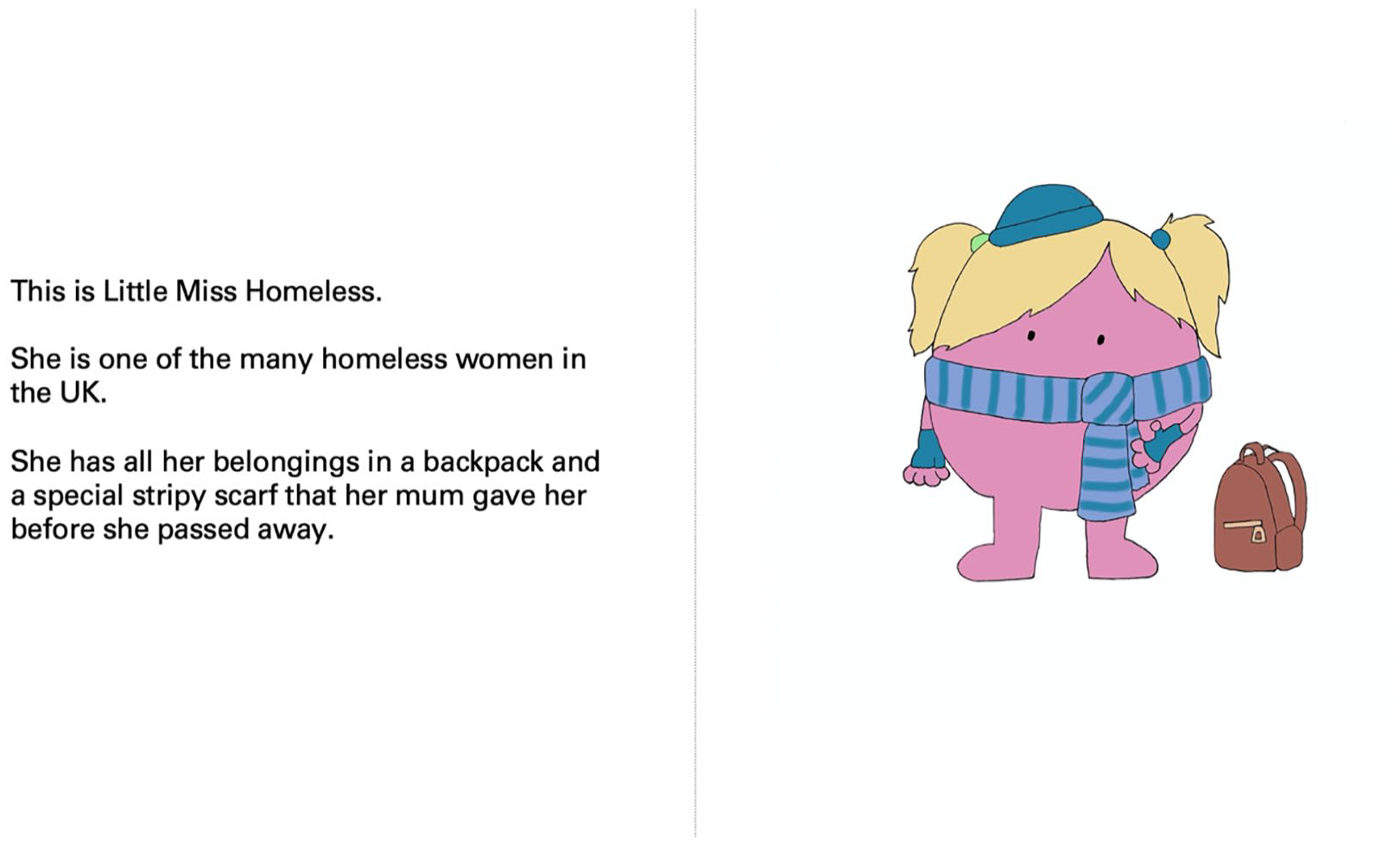
The creation of Little Miss Homeless forced me to pay close attention to how homeless women are perceived and represented alongside thinking through the particular issues they face. I had to think critically about how I could convey these most effectively through the series’ distinctive format of drawing and text. Whilst the term ‘homeless’ can include those who sofa surf, reside in hostels or live in temporary accommodation, Little Miss Homeless was street homeless, because this ‘dominates mainstream understandings of homelessness’. 9 The reader can see in her the lives of the many homeless women they see on the streets every day. Next, in order to produce a character who ‘looked’ like a homeless woman, I had to attend to stereotypes such as the ‘bag lady’: wearing unusual clothes and carrying her possessions in plastic bags. 10 However, this presented a challenge for me, as academic discourse has begun to move away from stereotypes and homogenous imaginations of the ‘homeless woman’, instead drawing attention to the many different ways in which homeless women present and perform their selves, bodies and identities. 11
As a compromise, I based her appearance on real homeless women I have met during my research. As little Miss Homeless was street homeless, she did not have anywhere to leave her belongings. Hence, like many street homeless people, she had to carry them round with her in a bag. I also gave her messy pigtails in recollection of a homeless woman I had met who kept her hair in pigtails to hide her dirty hair as she often lacked access to a shower. Little Miss Homeless’ hair therefore represented one of many tactics homeless women deploy to negotiate the lack of facilities available to them in their daily lives.
It was also important to present a homeless woman who was still very much an individual person. Hence, I added a stripy scarf: an item linked to a previous life which enabled her to express some of her identity. This scarf was inspired by a rainbow cardigan that a homeless woman I had met used to wear. It was her pride and joy. She loved colours and so it enabled her to present this side of herself to the world. Once it was stolen at the drop-in centre and she was devastated. When it was returned several days later, her face lit up as she was reunited with this beloved item. Capturing this was an important way to remind readers that homeless women are individual people with their own likes and dislikes, stories and identities.
Little Miss Homeless had her own story to tell. But she did not represent the teenage or older homeless women. Nor did she represent the disabled or pregnant homeless women. She did not represent the homeless women who live in hostels and halfway houses, nor the homeless women who crop their hair short and reject traditional ideas of femininity. Creating a character who encompasses all these traits would be impossible, as often they contrast with each other. However, the purpose of Little Miss Homeless was not to provide an exhaustive representation of all homeless women, but rather a character that the reader can easily see amongst the many women facing homelessness today.
The story
I wanted to present a true story – nothing exaggerated but equally nothing diluted either. This left me in a challenging position as to what story I wanted to tell – which issues I wanted to draw attention to and how I wanted to present my character. I chose issues which I knew were typical of homeless women – focusing in particular of those faced by street homeless women. My own positionality should be acknowledged here, as there is a particular power I held, as author, in deciding whose stories and experiences counted and were deemed important enough to be included in my book. For instance, I didn’t include the story of a woman who carried baby photos in a carrier bag – reminding her of the child that was taken into care before she was made homeless. Such stories seemed too personal, too individual and including them felt exploitative. Instead, I read through multiple testimonies from homeless women published on Crisis, Shelter and Homeless Link as well as drawing on stories from my own and other academic’s research. I drew together similar stories and experiences recalled by multiple homeless women which felt more representative. Whilst there was still some uncomfortableness about using these stories, this was eased by the hope that this book could have the potential to do good (and as discussed later, I believe it has begun to do so).
The book
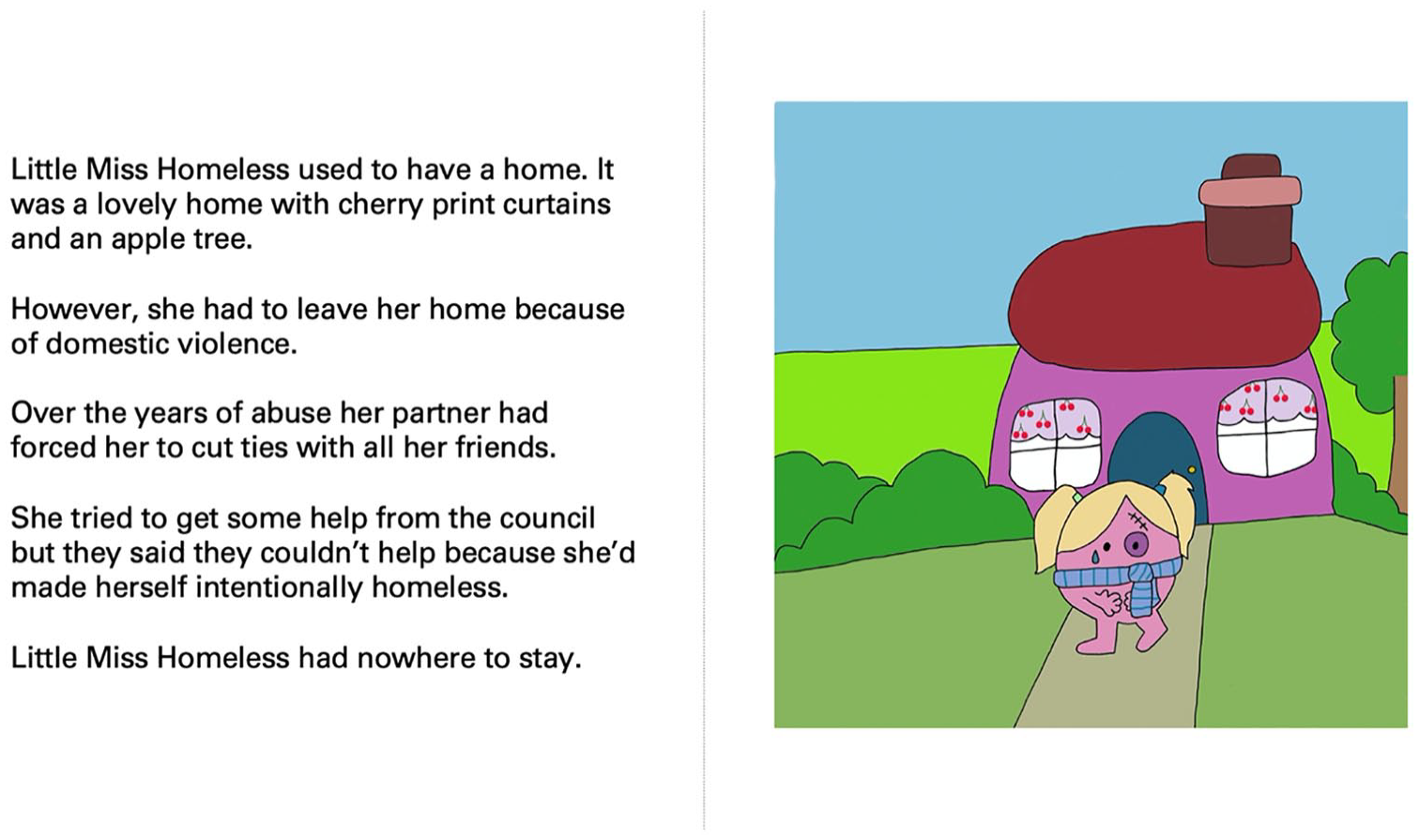
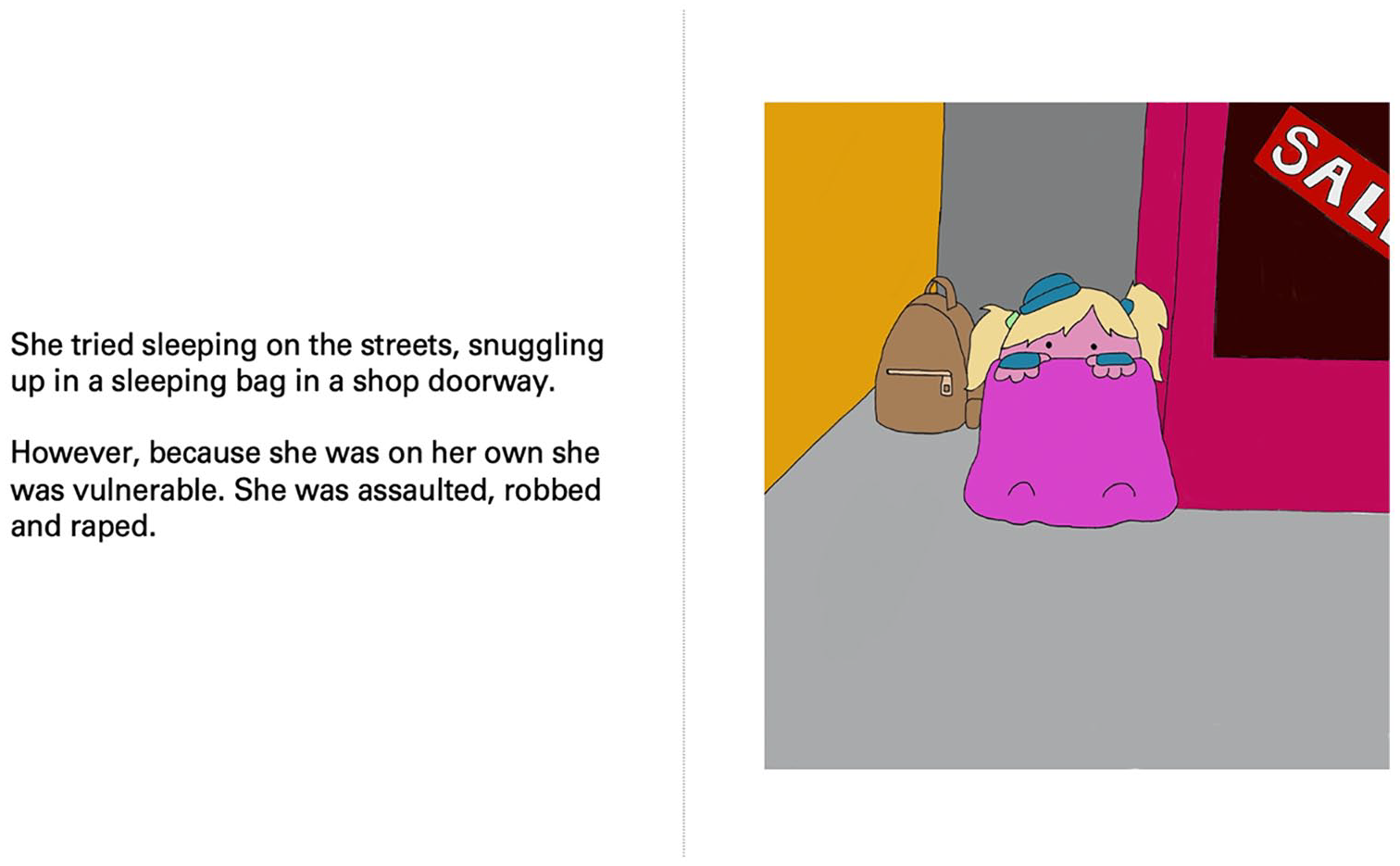
I ask that you take a moment to read the story of Little Miss Homeless (attached 12 ). Like the rest of the Mr. Men series, the book is short and illustrated throughout. It is a full story that needs to be read from start to finish, rather than just offering you a sample of the pages here.
Impact of Little Miss Homeless
Little Miss Homeless provides an alternative means of engaging people outside of academia with the issues faced by homeless women. Creating, finalising and sharing the story has been and continues to be an emotional process for me. Every time I read it, I am led to think about the thousands of homeless women whose underrepresentation in research, policy and homelessness discourse continues to result in their neglect and marginalisation. When I share the story with someone for the first time, I like to watch their facial expressions. The smile as they open up the first page and recognise the familiar style of the Mr. Men and Little Miss series; which quickly fades as they are introduced to the realities of domestic violence. The shock stays with them, and I see the sadness move across their face as they progress throughout the story, before the silence as they read the final page. The book is powerful, and the emotions it elicits from the reader are made possible by this culture jamming of a cheerful and nostalgic children’s book. As I began to share snippets of the book on social media or with small public audiences, the reception was good. At a conference, one woman was shocked as she had overlooked the challenge of managing menstruation whilst experiencing homelessness, whilst another asked how she could make a difference. At a local women’s group, several of the audience members asked questions about how they could support homeless women, wanting to help enable change that very same night.
Yet, sharing this book with others has been no easy feat. As I waited for clearance regarding copyright concerns, reading by wider audiences was limited. Every physical copy I shared with had to be taken back at the end, rather than allowing it to move from person to person and with it, the message I so desperately want to share. However, after running Little Miss Homeless by my university’s Copyright lawyers, I have finally been able to share her and her story with a wider audience. The launch of the book attracted the attention of the media, with local papers covering the book. I spoke on the radio and was interviewed by different journalists, with The Big Issue covering the story in one their magazines. At present, the online version of the book has been read around 3,000 times, with downloads across the world. In addition, 30 physical copies of the book have been purchased and a crowdfunding campaign to support these printed copies hit its target within the first 48 hours. I continue to receive emails from those working in this sector giving me positive feedback about the book, asking for PDF or printed copies to use in their training. The book has also been used by teachers, councils, nurses and even the police. In a year where homelessness has made the headlines, Little Miss Homeless is helping to ensure homeless women are not forgotten in these narratives.
Conclusions and looking to the future
Issues surrounding women’s homelessness are important, with the life expectancy of women who sleep rough averaging at 42, compared to the general population at 81, alongside other issues of mental health, safety, and access to services. 13 However, traditional modes of communicating these issues (such as government reports or academic articles and books) do little to engage wider publics or enact real change. Therefore, utilising a more creative approach towards presenting, discussing and reflecting upon these issues opens up a way to effectively engage a wider audience with the very real issues homeless women face today.
The success of Little Miss Homeless has been unexpected, but welcome. At a time where ‘impact’ is becoming increasingly important in measuring the value of academic research, creative cultural geographers and creative methods of research dissemination are ‘well placed’ in ensuring research is impactful to both the academy and wider society. 14
Footnotes
Acknowledgements
I would like to thank Ian Cook (University of Exeter) for his comments and advice on this article and the ESRC for funding my PhD research.
Funding
The author received no financial support for the research, authorship, and/or publication of this article.
