




Abstract
In this paper landscape painting is developed as a mode of enquiry through which to explore the tensions inherent to landscape. Set on the high street in a small market town and undertaken by individuals with varying artistic experience, this methodological experiment explores the tensions between the non-representational and representational realms of landscape. By using Elizabeth Grosz’s writings on art, I develop this landscape painting methodology through an understanding of art and artmaking as intensifying sensation. Here, Grosz’s ideas become the foundation for a participatory arts method that decentres the human, whilst remaining focused on the presence of pleasure within landscape. It is by drawing together methodological experimentation and feminist theory that I revisit feminist geographies’ already existing interest in pleasure in/through landscapes through a more-than-representational lens.
Keywords
‘Landscape is tension. The concept is productive and precise for this reason and no other’.
1
– Mitch Rose and John Wylie ‘Rather, the landscape emerges from the process of struggle itself’.
2
– Mitch Rose
In this paper I produce and reflect upon a methodology of participatory painting based at the intersection between feminist and non-representational theory. Here, painting is developed as a mode of enquiry through which to explore the tensions that make landscape. John Wylie defines landscape as tension. The set of tensions Wylie describes are between ‘proximity and distance, body and mind, sensuous immersion and detached observation’.
3
These tensions resonate throughout both his numerous and varied writing
4
and the field of landscape studies, where the body and landscape are now broadly reconceptualised as entities that are always already in a state of becoming with one another.
5
It is the complexity of this tension that Wylie returns to in a recent article that explores the possibilities of plein air drawing and painting: So near and yet so far – if I could offer one summation of the sensed spatialities of painting and drawing, that would be it. So near and yet so far, because we live in a world that never coincides with itself, let alone with us.
6
It is these tensions that surface too in other recent artistic explorations of landscape. In these papers art methods become a mode of enquiry through which to grapple with this set of tensions. Brice explains how observational drawing practices act as ‘a particular mode of attunement, a way of opening up new spaces of encounter within a more-than-human world’. 7 For Vickery, her image making allows for her own intervention in the ‘tensions that are landscape, where subjective experience is understood to be directly implicated and emergent’. 8 Together these authors conceptualise art method as a mode of enquiry for exploring the tensions between the non-representational and representational realms of landscape. Each author explores the process of artmaking itself, illustrating how creative practices offer a novel methodological toolkit for attuning the body to the tensions inherent to landscape.
Building on this still emerging area of work and by turning to the work of Elizabeth Grosz, 9 I further elaborate on the nuances of researching landscape by arts method but with a specifically feminist lens. Grosz’s 10 writings complicate notions of tension within landscape because her conceptualisation of art thoroughly decentres the human, collapsing the separation between subject and object or, as Wylie contends, mind and body, observation and immersion. 11 Instead, art enacts and transforms the material forces of the world including its living and non-living inhabitants through the processes of sexual selection. 12 In this paper I explore what Grosz’s arguments can contribute to creative explorations of landscape tensions through an experiment in participatory painting. Here, Grosz’s ontology of art becomes the foundation for a participatory arts method that decentres the human, whilst remaining focused on the presence of pleasure within landscape. By doing so, I seek to contribute not only to work in creative geographies which explores landscape 13 but also to feminist work in landscape studies that has interrogated the politics of pleasure. 14
I develop this research methodology through an exploration of the high street in my hometown Darlington – a small market town in Northeast England. Given the historical perception of landscape art as masculinist, representational and overly focused on the sublime, 15 I sought to create a participatory landscape painting method for researching the everyday based on feminist non-representational theories. Standing before an easel on our high street, twelve participants with varying artistic experience used paints to explore their changing relationship to a well-known yet undeniably mundane part of our hometown (see Figure 1). For the purposes of this paper, I focus on two individuals’ artworks to explore how the processes of sexual selection may impact understandings of landscape painting and participatory method.
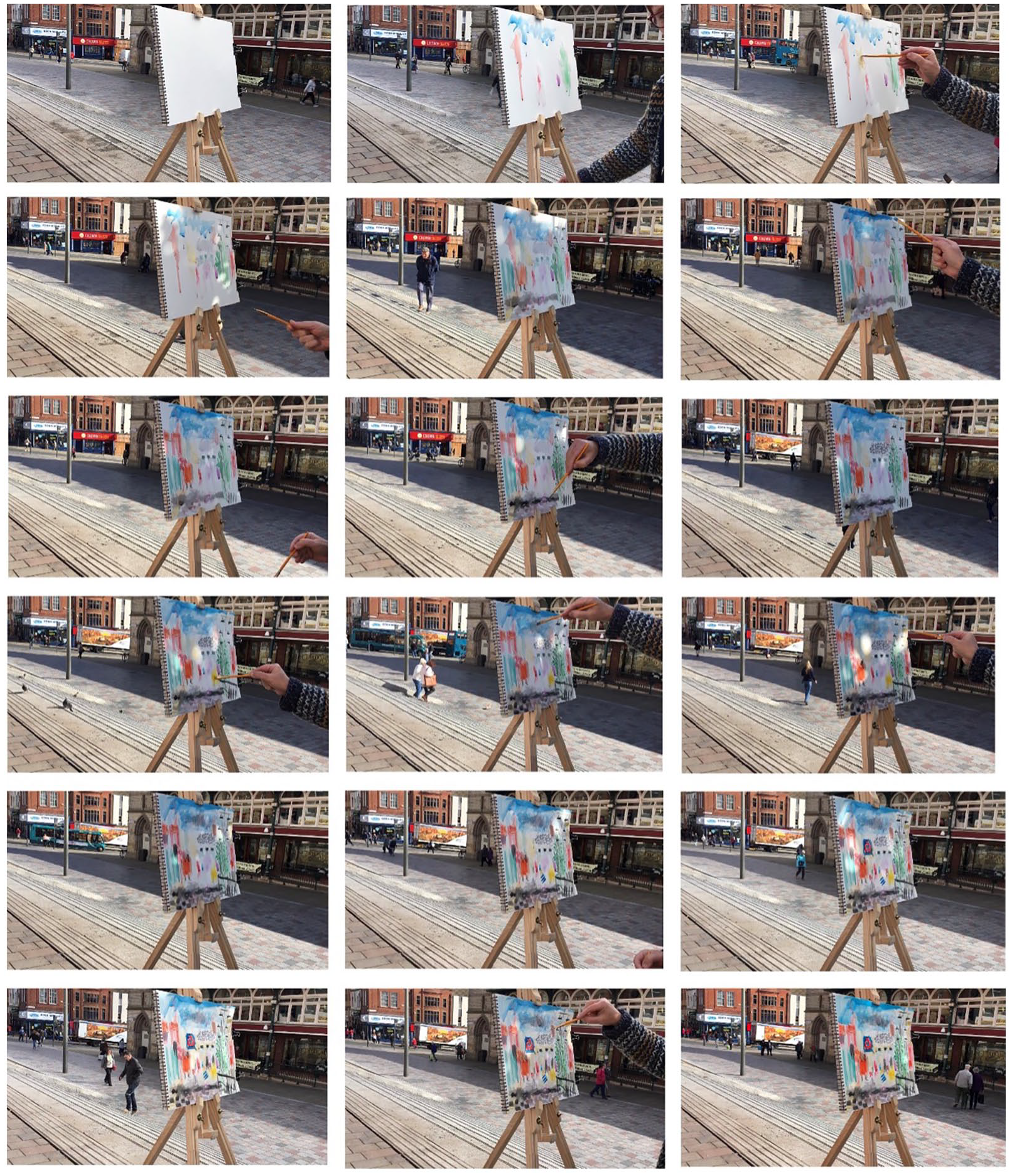
A participant paints Darlington’s high street.
Across its four sections, this paper uses a Groszian perspective to illustrate and reflect the use of painting as a methodological tool for knowing landscapes. As well as speaking to work across cultural geographies, this paper is intended to illustrate how a participatory art method governed by sexual selection may be used by those wishing to explore the more-than-representational. 16 In section one, I reflect upon the intersection of landscape and art in cultural geographies, showing how such a juncture informs Wylie’s notion of landscape as tension. In section two, I outline how a Groszian perspective on art can revisit the issue of pleasure in landscape in light of cultural geographies embrace of nonrepresentational theories. In section three, I develop a how-to guide for participatory landscape painting from a Groszian perspective, intended as a blueprint for others who may wish to fuse sexual selection with the practicalities of research method. In my fourth section, I consider when intensification fails to show how a post-humanist desire illuminates this experiment in landscape painting. Lastly, to conclude I argue that art as sensation disrupts the ‘creative’ in ‘creative method’ as artistic becomes characteristic of all bodies.
Landscape as tension, or an intersection of landscape and art
Integral to Wylie’s notion of landscape as tension is an intertwining of landscape and art that can be traced through cultural geographies and beyond. 17 In particular, Wylie’s references to ‘distance’, ‘mind’ and ‘detached observation’ signals the importance of previous work on iconographic interpretation of landscape paintings. In the late 1980s, when iconographic studies of landscape artworks began to closely align landscape with visual art in cultural geographies, 18 ‘new’ cultural geographies popularised a notion of landscape as inextricably linked to sight. 19 Landscape artworks were understood as the visual representation of systems of meaning, whilst landscape itself became known as a way of seeing. 20 Through its association with the visual arts, for cultural geographers landscape became a gaze – that is a particular way of looking at the world. 21 As Daniels and Cosgrove explain, ‘a landscape is a cultural image, a pictorial way of representing, structuring or symbolising surroundings’. 22 For ‘new’ cultural geographers, it was through the gaze that landscape art visualised class relations. 23 As paintings were often commissioned by landowners, Cosgrove and others argued that landscapes were represented from the perspective of those who exercised control of the land. 24 This fixation on the interpretation of hidden symbolic meaning within landscape art made landscape and art synonymous with sight in cultural geographies. Whilst particular artistic genres, techniques and methods were understood as complicit in the visualisation of power relations. Landscape as tension references the importance of this work to the development of ideas about landscape in cultural geographies today.
The gaze has been a prominent and influential aspect of landscape’s legacy in cultural geography. However, approaches which stress the inescapable presence of bodies in research have questioned the politics of looking. Throughout the 1990s, feminist geographers were critical of the forms of pleasure and desire located within landscape symbolism. 25 In the seminal book ‘Feminism & geography: The limits of geographical knowledge’, Rose illustrates how landscape as a way of seeing is shaped by ‘masculinist fantasies’ that equate femininity with nature. Landscape, just like the female nude, are the passive receptors of an active male gaze. 26 For Rose, both are interpreted as ‘something to own, and something to give pleasure’. 27 Rose makes the wider point that the gaze which looks at landscape conflates femininity and Nature, rendering both the object of male desire. Further building upon this critical engagement with straight male desires, others have explored the presence of alternative forms of pleasure which disrupt the landscape tradition. By focusing on the contextuality and specificity of artworks, Nash illustrates there is no universal gaze that is only ever distanced and controlling. 28 Through an analysis of photography which uses spatial organisation and vanishing points to position the male body as a landscape, Nash shows how bodies are sexualised otherwise when aestheticised differently. 29 Nash argues that both landscape and the gaze may be reworked through the very symbolism and representations which have sought to fix them as oppressive. However, whether pleasure and desire are understood as oppressive or not, these authors – like those original proponents of landscape as looking – locate power in the visual and figure art as representation. Irremovable from landscape as tension then is the centrality of landscape art as an object of analysis. It is when landscape is approached as a tension that the gaze and its critiques can be drawn together without resolving their contradictions. 30 And it is through the analysis of particular paintings, photographs and installations through which this oscillation between mind and body, distance and proximity, unfolds.
Since the arrival of non-representational theories over 20 years ago, cultural geographies have now largely moved away from the interpretation of landscape representation and symbolism. Instead, the affective, embodied and sensual qualities of landscapes have become the focus of many in landscape studies. 31 Such a reorientation from the representational to the nonrepresentational has not stifled geographer’s interest in art. Instead, creative approaches to geographical research are now plentiful. 32 In this area of work, a desire to understand the representational, the nonrepresentational and the relation between the two has often been driven by methodological experimentation. Through a more-than-representational lens, geographers have interpreted artworks, 33 experimented with their own artmaking, 34 devised participatory creative methods 35 and collaborated with practising artists. 36 Experimental approaches to landscape have also been varied, including walking, scuba-diving and train travel, to name but a few examples. 37 However, as Wylie and Webster have remarked, even as practice based explorations of landscape have grown in number, art practices traditional to the landscape genre – such as painting and drawing – remain explored to a much lesser extent. 38 In recent years, there have been a handful of articles which have attempted to reconcile landscape art’s association with visuality. Brice through an experiment with observational drawing and writing forms explores how to ‘hold representational and nonrepresentational logics in tension’ within the telling of landscapes. 39 Vickery similarly experiments with the conventions of landscape painting, showing how within her own artistic processes ‘fractures and slippages allow something else to happen in the spaces in between visuality and landscape’. 40 And, lastly, Wylie and Webster through painting and drawing the Hoopern Valley show how the landscape ‘is at once both near and far, both immersive and relatable, yet also necessarily distant and unreachable’. 41 Across all of these articles, landscape is approached through artistic processes in a way which reckons with the tension between immersive experience and the conventions, techniques and symbolism associated with the landscape tradition. In these articles, creative processes and practices offer the means for attuning the body to tensions within landscapes. However, what remains unexplored in this emerging area of work is a reflection on where pleasure, desire or sexuality is located when landscapes are known as tension. In this article, I am interested in revisiting the issue of pleasure in landscape, given the wealth of work on creativity and affect that now exists since Rose, Nash and others first engaged with the presence of desire through/in landscapes.
Art as intensified sensations, as sexual selection
Given landscape arts historical association with visual pleasure and the more recent popularisation of nonrepresentational theory across cultural geography, in this paper I revisit the issue of desire through a more-than-representational approach to landscape art. If landscape is tension, as Wylie explains, then what becomes of desire?
42
When landscape moves between the representational and nonrepresentational, distance and proximity, looking and immersion, where does pleasure reside? Is it possible to account for more than visual pleasures in/through landscape art? And how might creative methodological exploration of landscape account for pleasures? It is by developing and reflecting upon an experiment with participatory method that this paper uses Grosz’s reflections on art to explore these questions.
43
Grosz’s writings have much to contribute to creative explorations of landscape tensions given that her theorisation of art is inseparable from a post-humanist and affective notion of sexual desire.
44
For Grosz, art is the materialisation of energy and forces, such as that of the cosmos, biology and geology, through the making of sensation.
45
Grosz understands sensation as ‘the zone of indeterminacy between subject and object’, that is not as the subject or the object, but rather the unfolding of both via the body.
46
Artworks, for Grosz, are compositions of sensations. However, and importantly, sensations are not formed in the artwork rather they are the ‘forming forces’ of the artwork.
47
As Grosz explains: Art is how the body senses most directly, with ironically, the least representational mediation, for art is of the body, for it is only art that draws the body into sensations never experienced before.
48
Artworks are therefore not the representation, capture or narration of sensation, but rather they are that which transforms the body through the unfolding of sensation. Art enables the body to experience the universe’s material indeterminacy through sensation. Art doesn’t represent. It provokes, intensifies, resonates and excites.
Understood as a bloc of sensations which affect worlds and bodies, Grosz names art as the ‘indirect consequence’ of Charles Darwin’s concept of sexual selection.
49
Unlike natural selection, which is concerned with the preservation of life, Grosz argues that sexual selection complicates and therefore risks life for the purpose of intensifying sensation.
50
Whilst natural selection is driven by the need for survival, sexual selection is driven by the desire to experience pleasure. Through its orientation to pleasure, sexual selection powers the endless creation of difference.
51
Grosz writes the following on difference powered by sexual energies: Sexual selection can be more explicitly linked to the arts than natural selection to the extent that it functions to highlight, to intensify, the bodies of both the living beings exciting through and the living beings excited by various forms of bodily display . . .
52
Sexual selection is the artistic process through which all life becomes something else – it is a transformation of forces, a becoming-other of life. For Grosz, it is a process that links humans to their ‘animal preconditions’ – ‘the animal becomings that inform and direct human art production’. 53 As part of the evolutionary process, sexual selection intensifies sensation and creates difference across all organic forms, including and beyond the human. Charged by sexual attraction and a desire for pleasure, the intensification of sensation also makes art. 54 This Groszian approach unsettles the idea that pleasure is located exclusively in a gaze – a learned way of looking specific to the Western Art tradition – and its associated symbolism and figuration. Art understood through the lens of intensified sensation complicates ideas about pleasure within landscape art by drawing attention to the presence of affective more-than-human pleasures. Landscape art – like all the arts – becomes more than a representation. Pleasure becomes more than looking. Instead, pleasure transforms bodies through the evolution of the universe’s indeterminate forces.
Pleasure, for Grosz, is tied to the animal.
55
Through sexual selection humans are no longer considered superior or separate from animals.
56
Instead, human differentiation is understood as an ongoing consequence of an evolutionary process, of which art is an unintended effect.
57
The capacity to produce art then runs throughout all living beings as Grosz explains: art is of the animal. It comes, not from reason, recognition, intelligence, not from a uniquely human sensibility, or from any of man’s higher accomplishments, but from something excessive, unpredictable, lowly.
58
Grosz considers the activities or properties of animals which are undertaken or exist for no particular purpose other than for an intensification of themselves as artistic (e.g. birdsong or the bright colours of fish scales) in the same way that human’s artistic endeavours are (such as painting or sculpture).
59
Humans are no longer understood separate from the animal: the animal becomes not that against which we define ourselves but that through which we come to our limits. We are animals of a particular sort which, like all of life, are in the process of becoming something else.
60
This repositioning of the human is disruptive for creative geographies because it produces a new notion of art. Art is no longer a human accomplishment but instead an intensification of sensation driven by an ‘animal precondition’. All humans and nonhumans alike possess artistic capacity, problematising our typical understanding of art and artist. Grosz’s work then prompts us to reconsider the questions which we ask of the arts as cultural geographers. Our attention is turned from questions of who can be an artist? or how can one be an artist? to instead what makes life artistic? Asking a similar question herself, ‘Are animals artistic?’, Grosz offers cultural geographies an answer, ‘Certainly, if by that we understand that they intensify sensation’. 61 Sexual selection as an evolutionary process repositions the human with the animal, showing that all bodies have the ability to produce art – human or not. 62 I use such a repositioning of the human and reconceptualisation of art for my participatory landscape methodology, making it a process accessible for those without experience of painting.
More specifically, the premise on which my landscape painting methodology rests recognises the arts as the transformation of sensation through sexual selection. This process generates an intensity of affect capable of changing both body and cosmos – more specifically for this project, subject and landscape. Such an understanding of art makes this method accessible for those without experience in painting or drawing. Consequently, I position this method within a wealth of work in geography that illustrates the utility of arts processes as appropriate methods for projects with participatory aims. 63 Additionally, as my methodology relies on the potential of sexual selection for attuning bodies to landscapes, I add a critical perspective on pleasure to geographical work which already demonstrates the potential of creative practice for researching landscapes. 64
A how-to guide for Groszian landscape painting
The methodology discussed in this next section relies on an understanding of art as intensified sensation. Using this theoretical basis, for a project which sought to explore peoples’ relations to familiar and mundane landscapes, I asked twelve individuals to complete a landscape painting on Darlington’s high street. To demonstrate the practicalities of harnessing sexual selection for knowledge production most effectively, in this section I focus on one of these landscape paintings – ‘Destruction of the town’ (2017) by Poppy (see Figure 2). The how-to format used here is inspired by the utility and transferability of the format used by Bagelman and Bagleman. 65 It is their accessible format which encourages others to borrow their zines method for other pedagogical experiments. Hoping to inspire other creative geographers to rethink creative method as intensification, this how-to guide offers a blueprint for conducting methods organised around sexual selection. More specifically, by fusing together Grosz’s theory with research technique in this section I outline exactly how I conducted my landscape painting method.
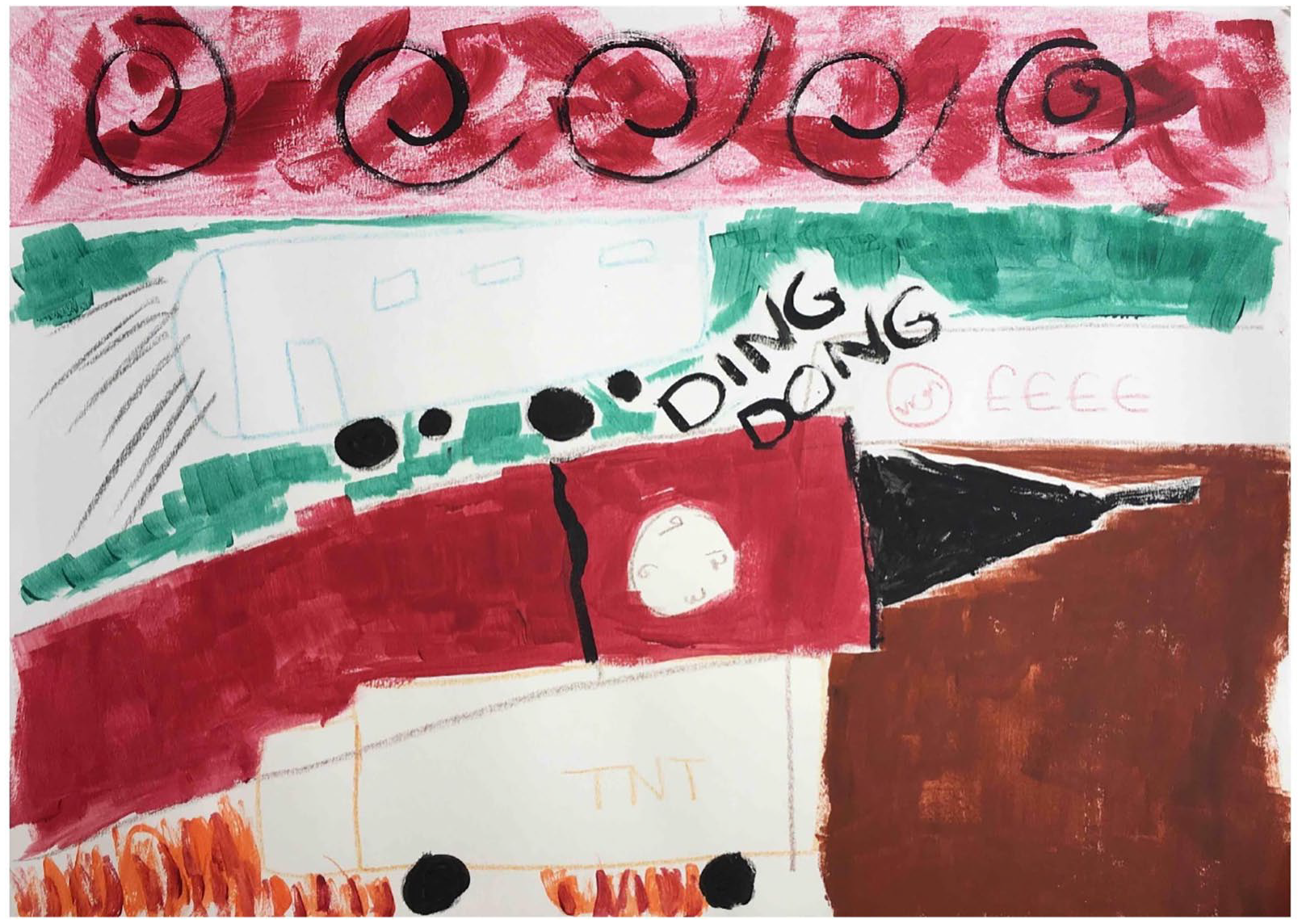
Destruction of the Town (2017). Painting and crayon on paper. Created by Poppy. Photographed by Amy Robson.
Step one: choosing my participants and a landscape
The term ‘participatory research’ can mean a range of things. For some, it means completely sharing ownership of their research with participants, including everything from the design of the project to analysis and publication. 66 For others, it means the participants took a more active role in some but not all of these processes. 67 By ‘participatory’, in this project I mean that my participants had an involved role in research collection, whilst I carried out all other aspects of the research project. I recognise how a more thorough engagement with my participants throughout the project would create an approach better suited to challenge the hierarchical nature of the research process – a primary aim of most participatory action research. 68 However, this project grew from a theoretical interest in exploring the intersection of feminist thought, landscape and creative method in human geography, rather than a desire to navigate power relations throughout a research encounter. Originally, I set out to challenge some of the ways in which cultural geographers have usually explored landscape through art – such as landscape’s association with the Western Art canon, the picturesque, and the sublime. 69 I wondered what it would mean for cultural geographies to consider how ordinary people paint a landscape ordinary to them. I hoped that neither mine or my participants’ lack of artistic knowledge would exclude us from taking part in an artistic exploration of landscape, and I thought Grosz’s work could help with such a concern. I also thought that through Grosz’s writing some of the elitism which stalks landscape might be unpicked and instead those not usually found in the genre might be welcomed in.
With these aims, I asked people I knew well if they’d paint a picture of our local high street. There was no requirement to have painted before, but if they had it also did not matter. Poppy, for example, had only ever painted at school. As was the case with all my participants, Poppy was chosen simply on the basis that she considered Darlington to be home. From Darlington myself, our high street – High Row – is the most prominent landscape I associate with our town. High Row offered an opportunity to explore a landscape which differed from the picturesque scenes often found in work on landscape art across cultural geographies. 70 Reflective of the now broadened sense of the term found within more recent research, 71 High Row allowed a banal, ordinary, and familiar landscape to act as an important artistic scene.
When designing this painting method for this set of amateur artists, it became a delicate balance between two processes. Firstly, the creation of a coherent structure that ensured standardisation across the research process and that would yield relevant research material. And, secondly, leaving space for creative freedom so that participants could express their experiences of the landscape creatively on their own terms. The use of a how-to guide is the first indication of this evolving tension and points to my attempt to harness sexual selection for the purpose of knowledge production. The format of a how-to manual allows for other geographers to understand how they also might design a creative method oriented to the intensification of sensation and sexual selection. By using such a format, I outline a methodological experiment that infuses the practicalities of research technique with feminist thought.
Step two: the beginnings of intensification
To encourage Poppy to begin to see this familiar place as an artistic scene and to ease her into thinking about landscape creatively, we walked a circuit of the high street where she had the opportunity to photograph the landscape. Photography used for research in this way is most often referred to as photovoice. As a research methodology, it’s ability to provide research material from the participant’s perspective is well documented. 72 Leaning in to the capacity of photography to capture my participant’s experiences of the landscape, I left it to Poppy to choose how to use the camera without a discussion of photographic techniques or styles. Photography does have a long and complex past with landscape both within and beyond cultural geographies, 73 where photographic techniques have often been understood as what Wylie would call ‘a set of visual strategies and devices for distancing and observing.’ 74 Feminist geographies have even challenged the dominance of straight male desire in these ‘visual strategies’, showing how the subversion of symbolism can visualise feminist pleasures. However, when considering Poppy’s photography as a moment of sexual selection, 75 photographic techniques became less important for capturing her own engagement with the landscape. Instead, intensified pleasure became the basis for Poppy creatively documenting her experiences.
Poppy’s photographs are the beginnings of intensification guided by sexual selection.
76
They are a selection, complexification and transformation of qualities into sensations. The focus of her photographs are the town clock and market hall (see Figure 3), both gothic style buildings designed by renowned architect Alfred Waterhouse. The town clock would later become the focus of her painting.
77
Looking at these photographs, it is obvious that Poppy does not understand what Nash calls ‘the landscape format’ – artistic conventions which can spatially organise landscapes – but here she doesn’t need to. Like other examples of photovoice which do not require expertise with photography, Poppy’s photos still capture her experiences of our town, and they do so through sexual selection. Her perspective is not captured in: signifying relation, in which the material plane is understood as a chain of signifiers and the aesthetic plane is the field of the signified: rather, it is a relation of eruption and emergence.
78
When Poppy focuses her lens on these particular landmarks there is an attunement of the body to landscape, and landscape to body, that draws the forces of the universe into something new. She is drawn to the landscape through an artistic process which gathers pleasurable aspects of the landscape into a becoming-other. However, the parameters of my research method – in terms of choosing the landscape and the photography exercise myself – do place certain limits on her ability to transform the landscape, herself and her artwork into sensation. There are boundaries placed on this sexual selection, meaning tensions arise when intensification is used a means to collect research material.
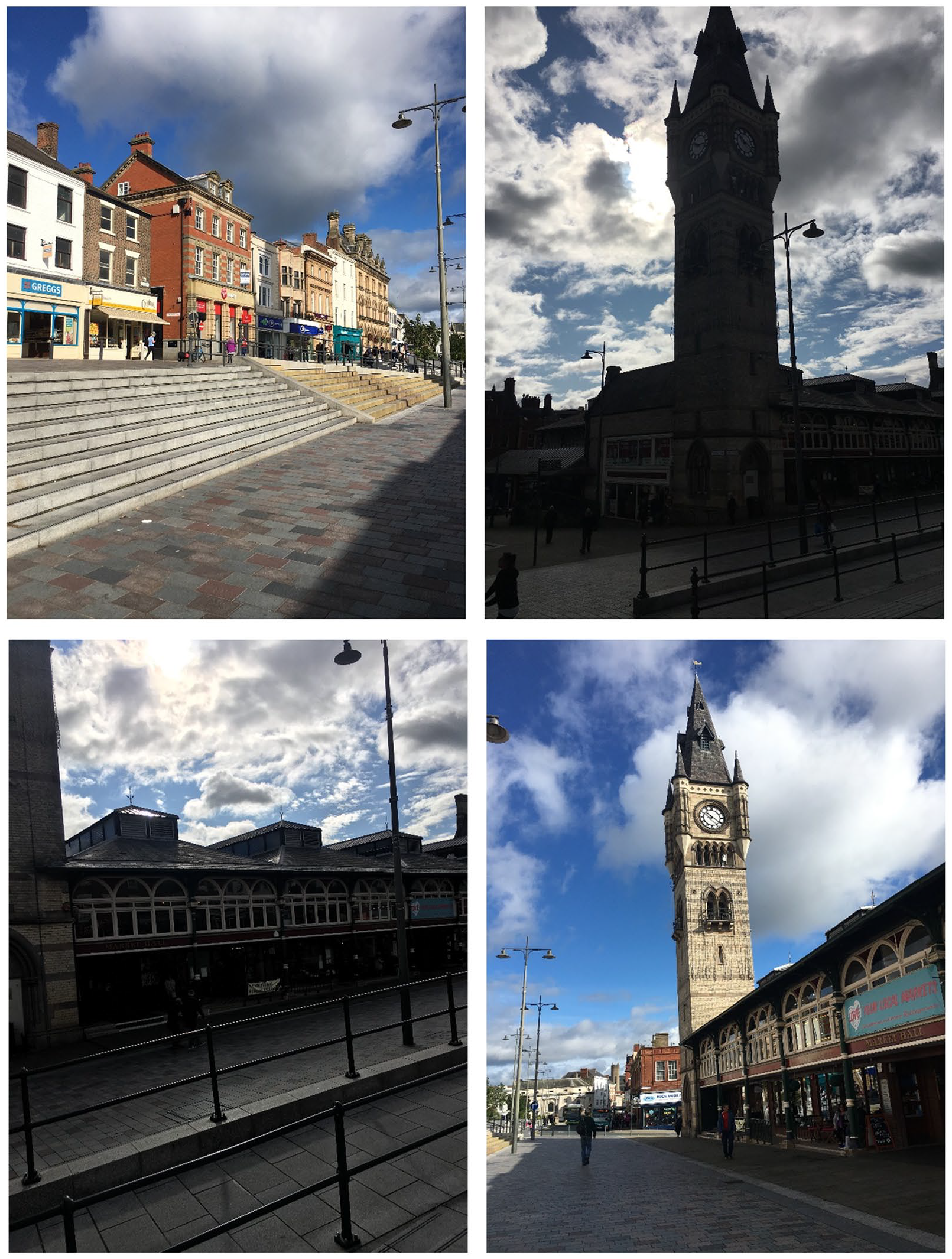
High Row. Photos by Poppy.
Step three: the plane of composition
Poppy like most of my participants was not familiar with landscape painting. I thought it necessary then to give her some reference points to ease any anxieties about what her painting ‘should’ look like. I showed Poppy four different landscape paintings from British Modernist and Contemporary Art: Peter Lanyon’s (1951) ‘Porthleven’ as an illustration of experiential landscape painting; David Hockney’s (1980)
‘Outpost Drive, Hollywood’ as a representation of multiple perspective; Howard Hodgkin’s (2013–4) ‘Indian Waves’ as an example of nonfigurative art; and Paul Nash’s (1936–8) ‘Landscape from a Dream’ as an example of surrealism. These paintings were not intended to act as representations to be reproduced in Poppy’s own painting, but rather as creative prompts that might inspire participants who had not painted previously. For instance, the way Hodgkin’s uses intense colour to express emotional experience appears to influence Poppy’s own painting. By using bright red paints, she hoped to ‘provoke anger’ in those who view her painting (see Figure 3). Poppy did so because she felt angry about the declining state of our town for which she blamed local politicians. At the time of painting, Darlington Borough Council had ended several key services in the town because a shortfall of £12.5 million in the council’s finances. 79 In Poppy’s work then the influence of Hodgkin’s style seems apparent in conveying her feelings about our town, especially in her anger at local politicians.
Despite Hodgkin’s influence in Poppy’s painting, these paintings were not meant to be reproduced representatively by my participants. Rather they acted as examples of what landscape paintings looked like for participants who were feeling unsure about what to do. In my mind, there was no right or wrong way for the participants to paint the high street. However, as most lacked familiarity with painting, there was some concern from participants that they would paint ‘correctly’. Reflecting on this project now 6 years later, I recognise that using all British male painters is a drawback of this method, as it exemplifies a form of landscape painting that isn’t rich in its diversity. In fact, British Modernist and Contemporary Artworks all possess certain visual aesthetic regimes, associated with particular conventions and techniques. However, I originally chose these artists as their artworks differ from the realist style of Renaissance landscape paintings examined traditionally in landscape studies, 80 artworks which have a lingering perception as elitist, masculinist and representational in cultural geographies. 81
Despite the limitations of this particular selection of paintings, it is possible to conceptualise the paintings used here as primarily intensified sensations. When paintings is recognised as sensation, situating my participants’ paintings alongside these famous artworks is what Grosz would call an act of ‘framing’.
82
By which I mean it is a moment where forces are demarcated for their transformation into sensation. When painting Poppy works alongside a genealogy of artistic genres, all of which exist already on the plane of composition. The plane of composition is significant to Grosz’s ontology of art, which she describes as: the field, the plane, of all artworks, all genres, all types of art, the totality of all the various forms of artistic production in no particular order or organization that which is indirectly addressed and transformed through each work of art.
83
When Poppy borrows from Hodgkin, she is positioning her artwork onto the plane of composition. On the plane, indeterminate forces are given order and structure through art, and in relation to various artistic conventions, methods and techniques. Here, I borrow the plane of composition for the purposes of building this method, showing how these various steps exist simultaneously as a mode of research standardisation and as the framing of qualities for intensification of sensation. Through sensation-as-method then new tensions emerge in landscape – tensions between the processes of research collection and the freedom of creative expression, or the processes of sexual selection.
Step four: living sensations
As Poppy finally moves to painting, intensification is structured once more through my attempts to standardise creative method. On the high street, I set up an easel, stool and a small tripod from which I film a time-lapse of Poppy painting. I chose to film the painting process as others have illustrated the efficacy of video for exploring movement, the non-verbal and the bodily. In this way, the time-lapse extended my ability to analyse the affective processes of experience 84 – for example, those moments where Poppy scribbles red crayon in a determined manner. To properly explore the affective, Simpson argues that video should be combined with other ‘fleshy’ methods. 85 Hence, and comparably to the work of other creative geographers, the time-lapse, Poppy’s painting and my own notes combine to offer both painting process and finished artwork as research material. Poppy’s experience of the impacts of austerity on her hometown are expressed in the act of painting and her finished painting. In her artwork, forceful and deliberate brushstrokes depict Darlington’s town clock following over and smashing into the high street – a metaphor, Poppy explains, for the steady deterioration of the town centre.
These artworks, the embodied knowledges which they are productive of, and the methods which allow their collection, are all underpinned by a becoming-other of sensation. Sensation is ‘eternalised’ through art’s becoming-other.
86
The framing of indeterminate forces – their movement elsewhere for artmaking – is the becoming inhuman of pleasure: The sensations produced are not the sensations of a subject, but sensation in itself, sensations as eternal, as monument.
87
The toppling clock tower is a transformation of the numerous forces of pressure exercised on the town – such as the pressures of neoliberal capital, increasing austerity and local/national policy issues – into living sensation. 88 This transformation is guided by the animal urge to intensify qualities for pleasure. Poppy’s painting is then the overcoming of the animal. It is the transformation of herself, the landscape, and the relation between the two through sexual selection. Qualities are transformed into sensations that live beyond the original creative encounter, that can go on to affect and intensify others. Initially borne from an animal impulse, in Poppy’s painting sensations gain autonomy from the creative encounter itself. Nevertheless, they do so as the structures of my method place limits on their form.
When intensification falters: looking through the body
Above, I have outlined the practical steps I took to draw on the processes of sexual selection for creatively exploring landscape. Each step works through a tension between intensifying sensation, for the sake of pleasure alone, and the necessity of structuring such forces into a coherent method for researching landscape. In this section, I consider what happens when intensification falters to further elaborate on how art as intensified sensation can rework landscape pleasures through a more-than-representational lens. To do so, I consider the tensions between intensification and its interruption in Petunia’s painting, titled ‘GrEGGs’ (Figure 4).
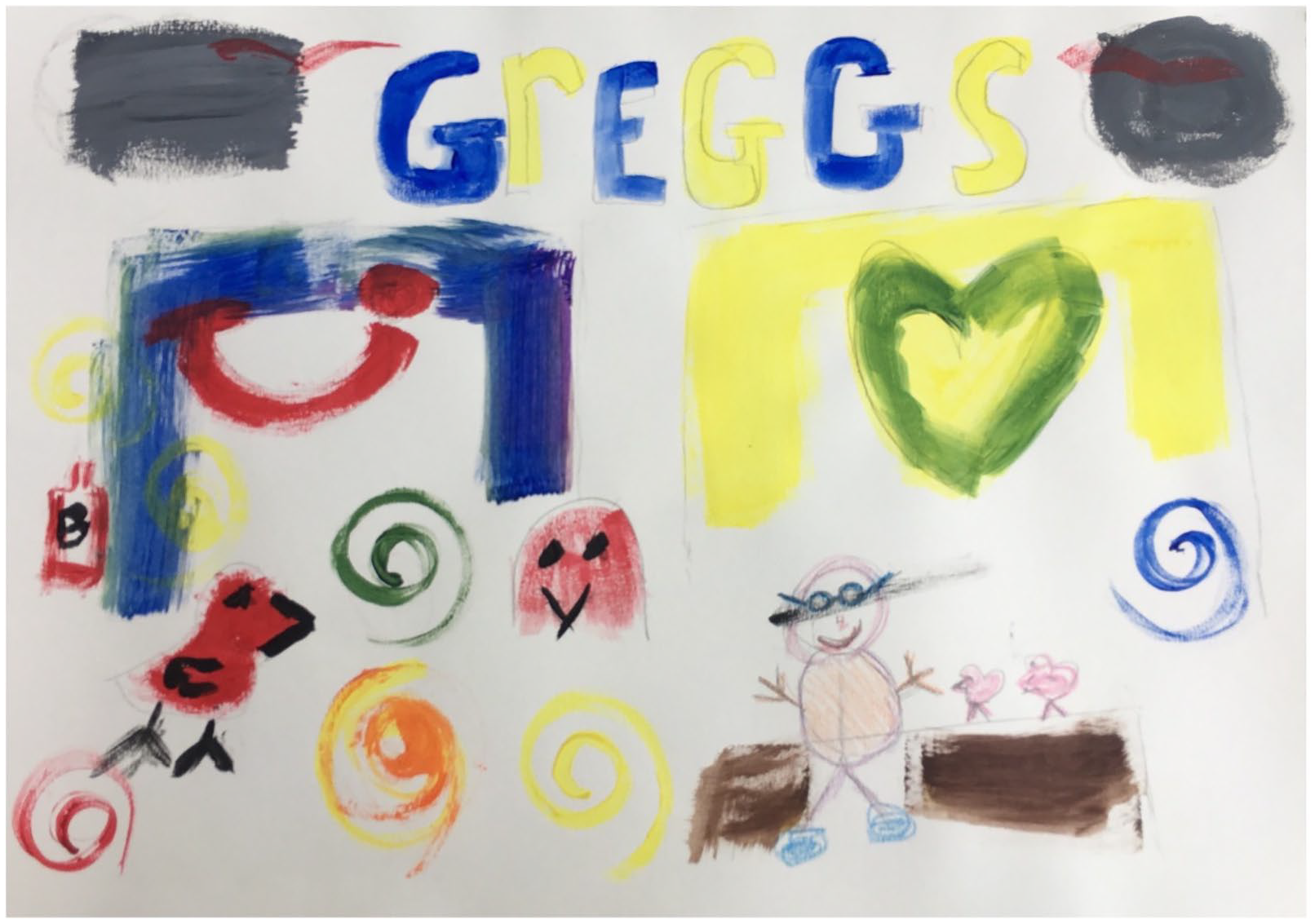
GrEGGs (2017). Acrylic paint, crayon and pencil on paper. Created by Petunia. Photographed by Amy Robson.
For Petunia, someone who had not painted since attending school, the whole process was entwined with unease. Despite the other activities that were undertaken to make the process more structured, Petunia particularly found it hard to begin painting. Her annoyance, at least at first, seems to chime with Wylie’s own frustrations with plein air painting. Wylie reflects on these frustrations through comparison to the professional artist – Catherine Webster – with whom he paints, as he admits not to possess the ‘certain beady eye’ that seemingly Webster holds.
89
His frustration is explained as a symptom of his painting inexperience, which in turn animates the tensions that make landscape. However, if art is understood as intensification and elaboration of sensation, these frustrations become something more. They become necessary to – but also counterproductive of – experiencing landscape pleasures. Intensification falters as excessive becoming-other of sensation is directed towards knowledge creation. Petunia paints for purpose rather than for sexual selection alone. She paints the familiar high street to contribute to my research, not because she is drawn to painting the scene. She paints without an attempt to mimic painting techniques or refine an artistic skill. The reasons behind Petunia’s creativity show through her painting. Clearly very anxious, Petunia stood for a while in front of the easel unsure where to begin. Slowly at first, the page was marked with unsure pencil lines, followed by more confident scribbles of crayon, and then finally bolder brush strokes. Hesitancy, however, always remained, visible in the blank spaces of the page. Expanses of paper left untouched persist stubbornly between more confident marks of paint and crayon. The presence of her anxieties persists through their non-representation. The failure of intensification signals the limits of representation, disrupting signification and illustrating the impossibility of attempts to fully locate meaning.
90
The interruption, failure or nonemergence of sensation is an idea left undeveloped in Grosz’s own work. Following Grosz, art is that of excessive and useless production – production for its own sake, production for the sake of profusion and differentiation.
91
Artmaking is an intensification of sensations guided by sexual selection – a useless activity beyond its elaboration of pleasurable forces. Then, what of production that goes astray? – production that may be considered useful and purposeful? Or attempts at production that fail? Here, landscape painting is developed with the desired purpose of producing a creative method capable of grappling with the more-than-representational elements of landscapes. When Petunia struggles to paint, the elaboration of pleasure is disrupted so intensification falters. Pleasure and it’s frustration, purpose and nonpurpose, the excessive and the functional, develop together in uneasy tension when attempting to paint landscape.
When art is considered as sensation rather than representation, pleasure resonates beyond the field of vision, throughout the whole body and across all the senses. As Grosz writes: painting makes the eye mobile, it places it throughout the body, it renders the visible tangible and audible as well as visible.
92
For instance, Petunia’s frustrations are not only present on the canvas in those expanses of paper left untouched. Instead, they are present in her body as she stands awkwardly before the canvas suddenly so unsure of herself and her abilities. It’s present in her words as she nervously explains she’s unsure how to start. And it’s present in my own frustrations with my inability to guide her more smoothly through the task. These bodily sensations are transformed into the field of vision – before our eyes unsure pencil lines and hesitant splashes of paint slowly materialise. Here, we see that pleasure – that intensification of embodied sensations – is also the generation and elaboration of negative affects, such as anxiety and unease. This approach chimes with Rose’s understanding of landscape pleasure as configuring masculine subjectivities through both fear and desire. Through Rose’s psychoanalytic perspective, landscape as a feminised other becomes objectified through desire but also repressed in fear. 93 The masculine landscape gaze, for Rose, illustrates how ‘cultural geography is seduced despite itself by what it fears’. 94 Similarly, sexual selection then does not only relate to positive affects – such as joy or excitement – but also negative affects – such as fear, pain or anxiety. This conceptualisation of pleasure, like contemporary work in creative geographies, relies on an embodied and affective notion of artmaking. Elsewhere, in Hawkins’ account of drawing she describes the practice as a ‘whole-body feeling attuning me to the particularities of a place’. 95 Whilst, others have considered creative practices ‘as a means for a multisensorial immersion in the landscape and for a perception of our own positionality’. 96 These examples are indicative of broader trend across cultural geography to understand the liveliness of representations – what Anderson refers to as turn from focusing on ‘what representations do rather than what they stand for’. 97 Non-representational theories allow of a renewed account of the contextualities and ambiguities of visuality and visualisation. 98 Our focus moves from what seemingly fixed images represent towards the making of dynamic and shifting relations found between image, image-maker, and audience. Following this turn, intensification itself offers a novel way to think through the multi-sensuous and affective nature of pleasure in landscape painting.
Following Grosz, when art is theorised as intensification, it is an excessive process of becoming governed by sexual selection rather than driven by usefulness or purpose. Petunia’s unease with painting draws us towards the limits of Grosz’s argument, to the limits of intensification and to the limits of pleasure. These limits produce a contradiction in my own creative method. Purposeless excessive pleasure, intensification for intensification’s sake, can only arise in relation to its failure. It is intensification as creative method, intensification redirected towards purpose, that traces this oscillation between intensification and its disappearance. Even in its failure, intensification allows pleasure to exist within and importantly beyond vision. It is when art is considered as sensation that pleasure may multiply beyond the realm of the representational, outside the field of vision and across all of our senses. Pleasure in landscapes is always more than visual, even when it emerges through strategies of visualisation. Wylie asks, ‘is landscape the world we are living in, or a scene we are looking at, from afar?’ 99 Landscape as tension cleverly ties these two approaches together, without resolving their contradictions. As tension landscape is comprehended as bodily immersion within the world and as those visualisation strategies borne from the renaissance era. Landscape art as intensification reworks this tension. Sensation is neither visual distance nor lived experience – even as it uses the qualities of both in its intensification. It is the unfolding of relation between the body and the universe through a post-humanist desire; a desire that emerges from animal instincts but a desire which gains its own autonomy, its own ability to affect and be affected by the body through which it was drawn. Following Grosz, landscape is no longer visual distance or bodily immersion but instead the becoming-other of sensation through sexual selection – a transformation of indeterminate forces that make bodies and landscapes. Through such an understanding of landscape art, pleasure becomes more than visual. Pleasures in landscapes are an affective and post-humanist desire through which the forces of the universe are experienced as never before.
To conclude
Following Grosz, 100 I have proposed art is an effect of the selection and intensification of sexually exciting qualities. Such a process transforms indeterminate forces into sensations, which live on to further excite and transform others. The tensions which usually animate landscape are reworked when art is conceptualised as sensation. If landscape is recognised as the intensification of sensation, the tensions between distance and proximity, immersion and observation, self and other are transformed in the unfolding of the relations between (and which make) subjects and objects. Landscape becomes an oscillation between intensification and the failure thereof – or pleasure and its frustration.
Thinking through sexual selection and its disruption in this methodological experiment has allowed for reengagement with feminist conceptualisations of pleasure in the landscape genre. 101 By thinking of art as sensation, rather than representation, it is possible to move debates in cultural geography about pleasure in landscape beyond previous focus on looking towards the multi-sensuous and affective. By doing so, I have revisited feminist ideas highly influential to the genealogy of landscape in cultural geographies, 102 in light of the wealth of work on affect and nonrepresentational theory that now exists across human geography as a whole. 103 By following Grosz, I understand that which is intensified for the purposes of sexual selection to be the making of pleasure. 104 Intensification as that which resonates throughout all the senses. Intensification beyond positive affects such as joy, optimism, or hope. Intensification reorients cultural geographies to more-than-representational accounts of pleasure that exist beyond modes of visualisation governed by artistic conventions. When art is orientated around intensification, the politics of pleasure reflect a cultural geographies that emphasises the significance of affect and embodiment.
Furthermore, I have contributed to a small but growing body of work which explores the use of artistic processes – such as painting and drawing – for exploring the more-than-representational elements of landscape. 105 In doing so, I have shown that when art is conceptualised as intensification of sensation (and the failure thereof), artistic capacity becomes a quality possessed by all bodies, multiplying the possibilities for creative method. The ‘creative’ in ‘creative methods’ is broadened in such a conceptualisation, as art as sensation diversifies and broadens those who are seen as legitimate practitioners of creative practices. In this paper it is through intensification that landscape painting becomes a participatory method accessible to those who are not trained in artistic practice. By revisioning art as intensification, I have welcomed subjects and places largely missing from traditional landscape art into this creative experiment. Here, a high street in a Northern town gripped by the processes of austerity became an important artistic scene. Whilst those individuals most familiar with this landscape become appropriate creative subjects. Art as the intensification of sensation then offers a new framework for creative geographers to develop participatory creative methods. Sensation makes art accessible. It sexualises and democratises art, showing that art is always much more than a human accomplishment.
Footnotes
Acknowledgements
Huge thanks goes to my supervisors for their endless patience and unwavering support. Both Ben Anderson and Jen Bagelman have provided insightful and encouraging guidance throughout the duration of this research. I would also like to thank all my reviewers and the editor for their constructive feedback, which has made the arguments within this paper much stronger.
Funding
The author received no financial support for the research, authorship, and/or publication of this article.

Notes
Author biography
Amy Robson is an Economic and Social Research Council funded PhD student in the Geography Department at Durham University. In her academic work, Amy creates innovative research methods which are developed with a strong commitment to feminist and queer theories. Elsewhere, Amy’s research uses creative methods to unsettle the temporalities which dominate imaginations of climate crisis.