




Abstract
In this essay, we report on a 2022 creative research collaboration in which we deployed Augusto Boal’s models of Theatre of the Oppressed and Forum Theatre to generate community dialogue and action on issues sparked by ecological crisis in Bolivia’s Chiquitanía. Extremely fragile to anthropogenic action, the Chiquitanía is home to one of the world’s largest dry forests, which is experiencing profound and recurrent wildfires. Responding to this ongoing crisis, the project brought together participants from migrant, Indigenous and campesino communities to share their lived (and sometimes-conflicting) experiences of wildfires. Theatrical techniques and exercises were utilised to elicit narratives and embodied testimonials, which were developed by participants into a series of short Forum Theatre plays performed throughout the Chiquitanía. We posit that Boal’s Theatre of the Oppressed offers researchers and artists dynamic ways of working with narratives and bodies, while Forum Theatre presents a rich public sphere in which communities can not only stage dialogue but also explore, imagine and rehearse collective action.
Smoke rises in the distance. A bell tolls in Santa Elena, Bolivia, to signal emergency. Defence strategies are traced in the sand in the remote Indigenous community of San Lorenzito de la Frontera. These calls to action signal the recurrent wildfire crisis unfolding across Bolivia’s Chiquitanía region (Figure 1). The situation is urgent. In 2019, 6 million hectares burned in one of the largest and best-preserved dry forests in the world. 1 The Chiquitanía is a unique biodiverse terrain extremely fragile to climate change and anthropogenic action. It is also now one of the areas most affected by wildfires in the world and substantively impacted by the expansion of Bolivia’s agrarian frontier, where deforestation is driven by the voracious appetite for new lands supporting livestock production, new infrastructure projects and mechanised and small-scale agriculture. 2 Wildfires are also intensifying a low-level conflict between the communities who share and use this land: Indigenous communities, peasant migrants, Mennonite settlements, urban dwellers, ranchers and others – communities with (sometimes radically) different ways and histories of managing land and resources and with varied cultural practices and visions of the future.
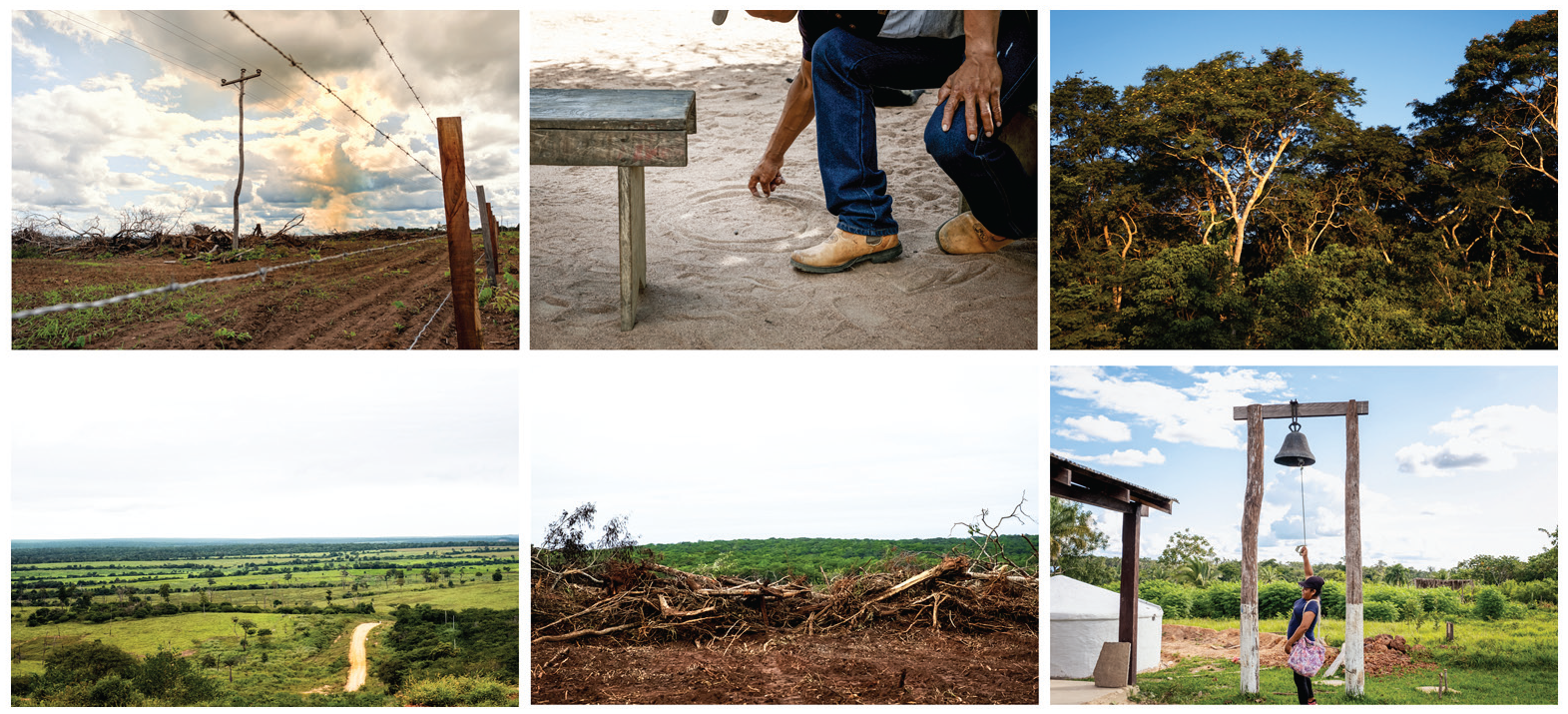
Setting the stage. Photographs by Max Hirzel.
This photo essay shares our recent research collaboration in the Chiquitanía, where we 3 deployed Augusto Boal’s celebrated models of the Theatre of the Oppressed and Forum Theatre to generate community-based dialogue and response to the complex cultural, political and environmental conflicts entangled in the issues sparked by wildfires. 4 We offer a brief behind-the-scenes glimpse into the creation process and performance of Forum Theatre. This visual material sits alongside portraits of project protagonists who participated in the work, sharing their experiences of ecological emergency in the making of Forum Theatre. We include portraits of both people in their communities and the characters they performed in the Forum Theatre plays. We hope these images and text communicate and convey some of the urgency and intensity of wildfires’ entanglement with climate change, land dispossession, rural migration, institutional corruption, lack of basic health services, systemic infrastructure failure, extreme inequality and more. These images also tell stories of survival – of people and communities enduring and weathering difficult, precarious and intensifying circumstances. Finally, we offer this essay as a contribution to the work of cultural geographers and artists whose scholarship and creativity further dialogue and action in this time of shared socio-ecological crisis.
Protagonists
Marta 5 and two of her children stand in their plot of land on the outskirts of San José de Chiquitos. In 2021, their family home burned to the ground. ‘We were left only with the cloths we were wearing’, she recounts. ‘When I got there, I couldn’t do anything, save nothing. Our animals died. I also lost the clay oven that I used to bake goods to sell, as well as the money that I had saved. My daughter was very sad because she lost her crib. I told her, “It’s OK, we will recover the material things.”’ As a single mother, she faces persisting challenges: ‘I am now working in a restaurant. I don’t make much money, but at least my children eat three times a day. They don’t get sick very often anymore. I still need 8000 Bolivianos [over 1000 USD] to repay this parcel of land. I ask for the patience to endure the things that’ve occurred’. As a workshop participant, Marta offered her testimony as the basis for one of the group’s Forum Theatre plays. 6
Yolanda stands in front of the market in San José de Chiquitos. An Indigenous young woman from the Candelaria community, near Concepción, Yolanda played the character of Marta in a Forum Theatre play which ends with Marta’s teenage son deciding to leave for a nearby town in search of work to support his mother and sister. As part of the rehearsal and creation process (and a Theatre of the Oppressed technique), Yolanda was asked to interview her character to glean a better understanding of her life and struggles. Other participants then asked her questions, and she had to answer as if she was her character. It was a moment in which Yolanda felt (really felt) empathy for Marta: ‘As a mother, I felt a deep pain in my chest. I didn’t want him to leave. I wanted to support my children, for them to get all the education they deserve, so that they will be better than me’.
Marta’s house burning is staged with orange cloth, while the children try to comfort their desperate mother (embodied by Yolanda).
Eusebio (top left) and Angelica (mid left), both Indigenous authorities and volunteer firefighters in their communities of Miraflores and Naranjos, pose with their firefighting equipment: fireproof clothes, water backpack extinguisher tanks, shovels and helmets. With scarce available resources in the wake of recurring extreme wildfires in recent years, local authorities, with the support of Non-Governmental Organisations and cooperatives, have responded by providing training and equipment to volunteer firefighters. These community members, both men and women, support professional firefighting teams in controlling a fire, but given the remoteness of many rural communities, volunteer firefighters are often the first and, in certain areas, the only line of defence. Local firefighters’ experiences were the basis of a Forum Theatre play.
Alfonso (mid left) from the Quintunquinquiña Indigenous community poses as a rancher in front of one of the Chiquitanía’s most iconic landmarks. Victor (bottom left), from a Quechua migrant family, stands as a vaquero (cowboy). Deforestation in Bolivia is driven by the ongoing agricultural expansion of pasturelands for extensive cattle grazing. 7 Since 2010, Bolivia has been exporting beef to Ecuador, Peru, Republic of Congo, Hong Kong, Russia, Vietnam and China. 8 In 2020, China consumed 84% of Bolivia’s meat export, and Chinese capital is investing in the expansion of the country’s agricultural infrastructure, including a new inter-oceanic corridor connecting Brazil, Bolivia and Chile. 9 Ranchers have a complex and often-fraught relationship with Indigenous and peasant communities, 10 offering employment to rural dwellers, at the same time that these groups are in competition for land and natural resources (Figure 2).

Forum Theatre participants. Photographs by Max Hirzel.
Creating Forum Theatre
In March 2022, 28 participants 11 from 22 communities came together in Chochis, Roboré municipality for a 5-day creation workshop (Figure 3). Selected from across the Chiquitanía, participants were diverse and varied – women and men from different Indigenous, urban, migrant and campesino communities. Following the method of Boal’s Theatre of the Oppressed, these life experts of wildfires were guided through a series of theatrical games and exercises. Falling back into the arms of strangers, held aloft by others, or being led with their eyes covered, trust was established in the ensemble. Theatre of the Oppressed refers to a range of theatrical forms and performance methods initiated by Brazilian director and activist – Augusto Boal – in the 1970s (e.g. Forum Theatre, Newspaper Theatre, Rainbow of Desire and more). Inspired by the radical pedagogy of Paulo Freire, Boal saw and developed theatre as a powerful mechanism for socio-political revolution and brought together and devised a range of performance techniques, methods and games designed to elicit, glean and transform people’s lived experiences of violence and oppression into theatre. Our work in Bolivia drew centrally on Boal’s theatrical pedagogy, for instance, Image Theatre – a technique and genre in which one participant acts as a sculptor, moulding other participants as ‘intelligent clay’ into an image and transforming that into a ‘frozen’ image. This sculpting is done with as little verbal direction or explanation as possible, and the absence of language is important because it both protects the individual offering the image and enables multiple interpretations within the group. With little language or verbal disclosure, participants physically moulded the bodies of others into frozen images, eliciting spoken and unspoken experiences and testimonials of wildfire crisis: of homes lost, threatened livelihoods, environmental destruction, inter-communal tensions and solidarity, community resilience and survival. 12 These images were gradually given language and formed the basis of four Forum Theatre plays.
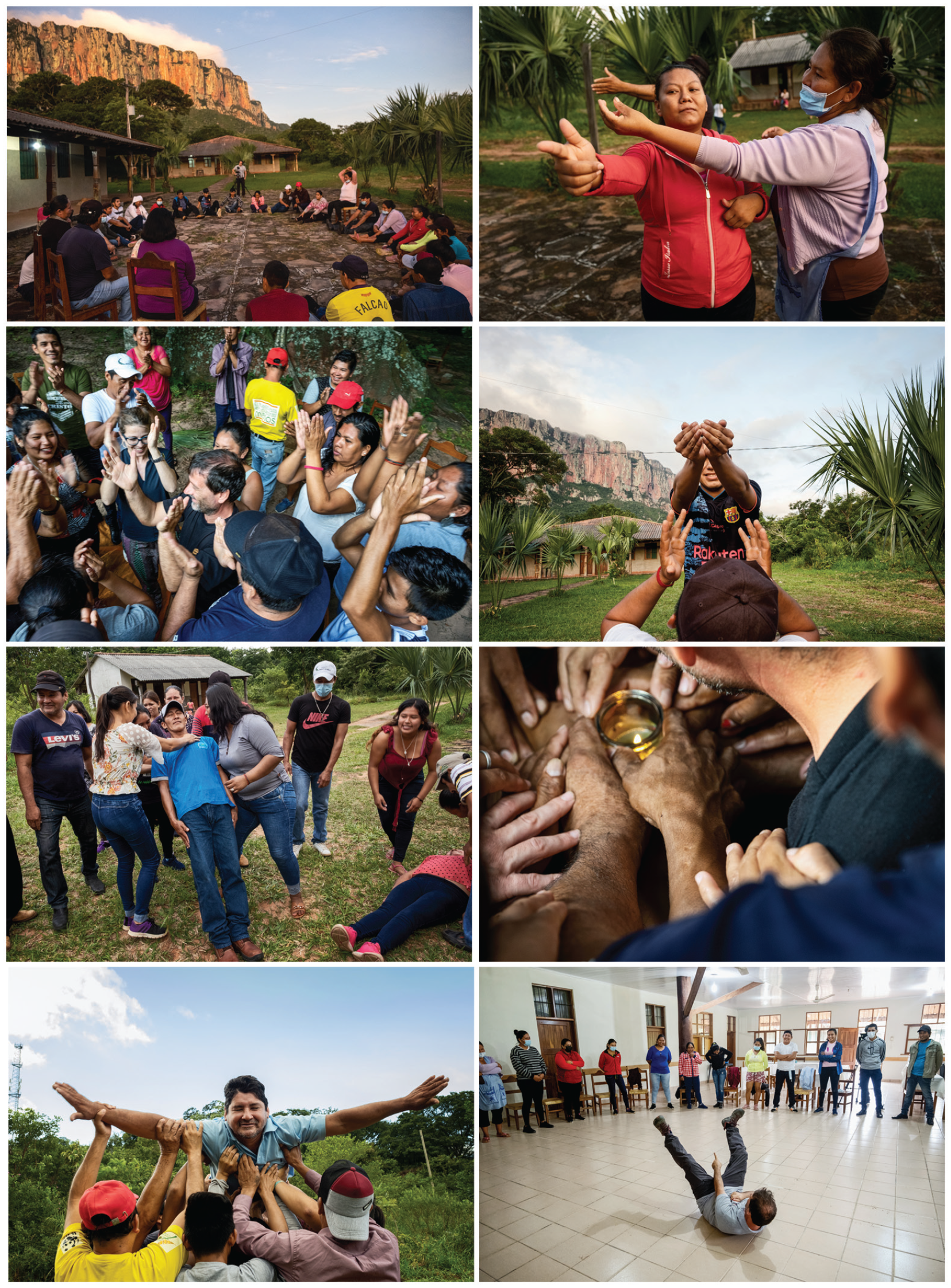
Creative process. Photographs by Max Hirzel.
Performing a public politics
From the workshop ensemble, seven participants were selected to perform two of the Forum Theatre plays constructed from the stories and experiences gathered in the workshop (Figure 4). One story, The Burnt House, was inspired by Marta’s experience recounted above. Another, Pedro and Juanita, retraced the journey of a couple migrating from the Bolivian highlands to the lowlands in search for better land and life opportunities. After occupying the plot assigned to them by the government, they followed imprudent advice from a local rancher and used fire to clear the land during the dry season. The fire got out of control and spread to the nearby forest and cultivated land, provoking the anger of the neighbouring Indigenous community.
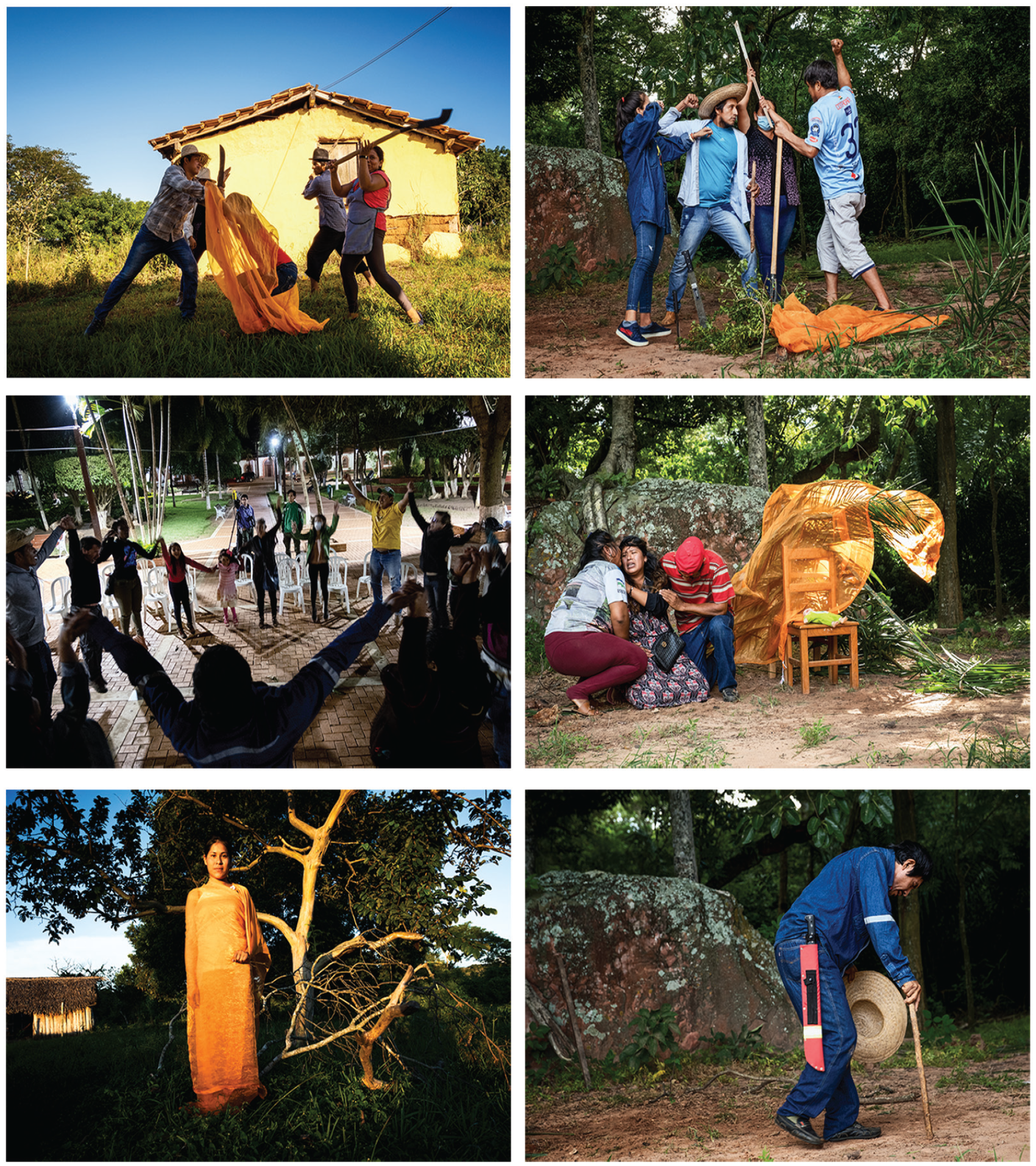
In performance. Photographs by Max Hirzel.
These short plays knit a series of conflicts into a narrative – they all end ‘badly’ with an unresolved issue or confrontation, moments purposely designed as invitations or prompts for audiences to critically reflect on their own circumstances. These moments are calls to action, lived conflicts demanding resolution and the collective imagination of alternative outcomes. Engaging over 800 people in March and April 2022, these Forum Theatre plays were performed 14 times across the Chiquitanía, from the main squares of towns to remote rural Indigenous and peasant communities. Forum Theatre plays are not designed to be watched, but to be changed, and in performance, spectators are not passive watchers of the theatrical event; they are transformers of action. Audience members were empowered to freeze the dramatic action, come up on ‘stage’, replace characters and explore and improvise possible resolutions to the conflicts presented (Figure 5). Forum theatre is not about demonstrating the correct path or resolution but is designed as a space in which possible paths, directions and possibilities are explored. For Boal, Forum Theatre’s radical potential rests in its ability to create space for transgression, space in which to (re)imagine and rehearse collective struggle which seeks resolution and fulfilment in real action. We hoped that spectators might carry these rehearsals of revolution back into their everyday lives.
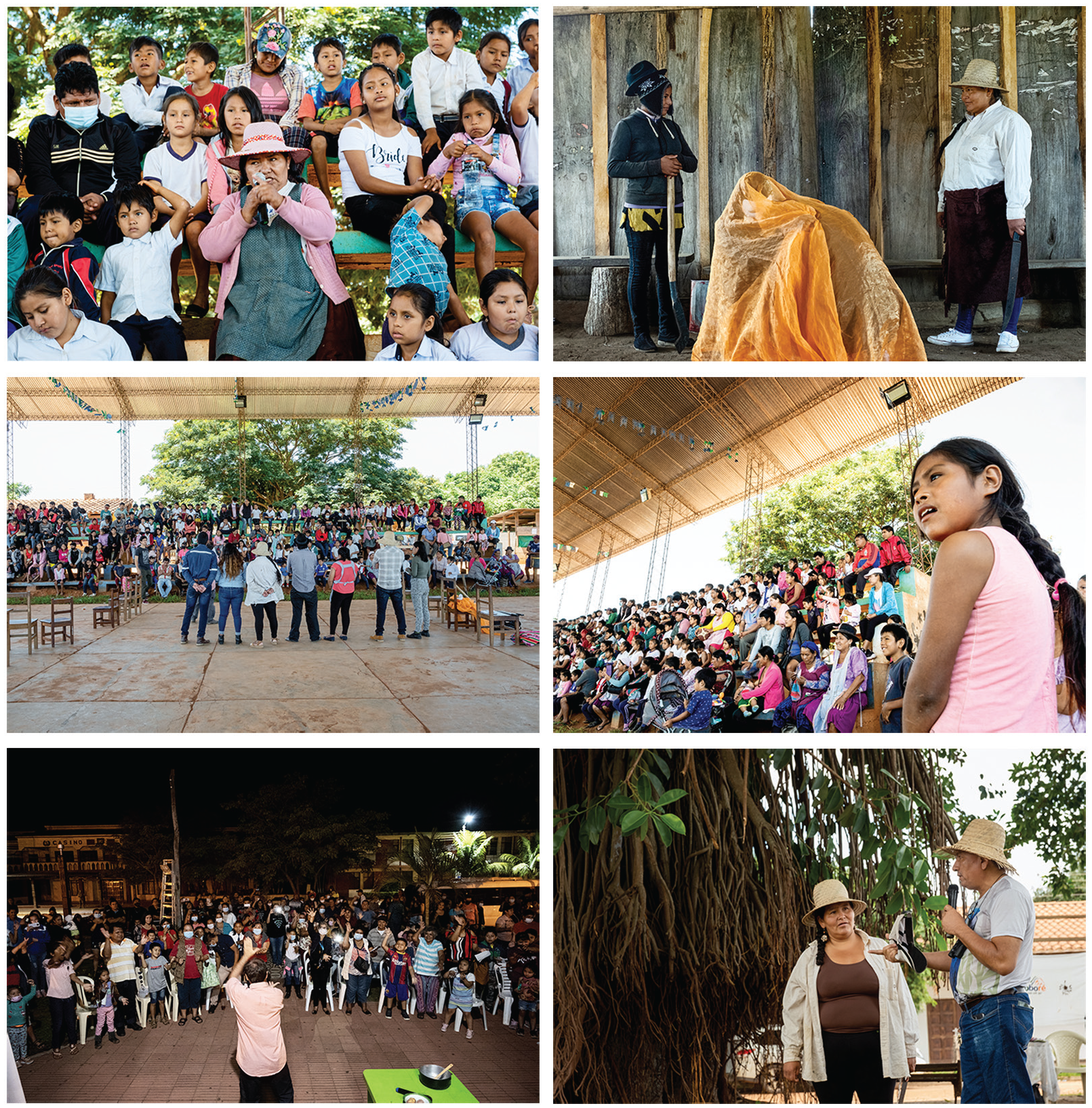
Public dialogue. Photographs by Max Hirzel.
Curtain call
We carry back two learnings from this creative collaboration. First, we see Theatre of the Oppressed as a powerful means of doing research – a set of theatrical techniques and exercises that do not demand the same confessional disclosure often expected in social science research but that can function as a toolkit for distilling experiences and working with bodies and embodied memories of conflict and trauma. We found the method of the Theatre of the Oppressed and the practice of Forum Theatre particularly valuable in contexts characterised by rising social and political tensions to engage different groups and to offer them tools to work together in a respectful, empathic and potentially transformative fashion. We encourage cultural geographers and others across the social sciences to continue exploring theatre’s potential and the methodological opportunity it offers for eliciting, animating and staging people’s stories and embodied testimonials.
Second, our work contributes to theatre as an especially effective space in which to tell difficult stories. Forum Theatre seems especially significant in this regard because it facilitated encounter between people experiencing the fallout of ecological crisis in radically different ways. The method and practice of Forum Theatre not only bring spectators into a closer physical proximity to the issues but ask them to radically transform conflict by entering potentially difficult encounters with others on stage. The potential to do so seems possible precisely because this was a ‘fictive’, liminal theatrical event. 13 We hope that staging lived experiences of wildfire in the Chiquitanía was a way (even a small way) of facilitating more democratic and peaceful encounter and overcoming highly stigmatised narratives and polarising discourse by opening opportunity for community exchange, dialogue and action on issues entangled in recurrent and intensifying socio-ecological crisis.
Footnotes
Funding
The author(s) disclosed receipt of the following financial support for the research, authorship, and/or publication of this article: This work was supported by an Arts and Humanities Research Council/Global Challenges Research Fund grant (AH/T013265/1).
