




Abstract
In this paper we outline an arts-based practice of experimenting with plant growth. Working with hydroponic systems, we describe a means to interact with plants beyond instrumentalism and beyond appreciation at a distance. We present several opening glimpses into a distinctly plant subjectivity that are afforded by technological mediation. This method informs ongoing research into growing liveable worlds with plants and is offered as a novel practice for critical plant studies, vegetal geographies and multispecies studies.
In this paper we outline an arts-based practice of experimenting with plant growth. This approach combines the interests of a cultural geographer of nature with the interests of artist Katy Connor in encounters between bodies and technology. Our collaboration began through the University of Bristol’s Environmental Humanities Centre and the Brigstow Institute, and our mutual admiration for the work of Natasha Myers. Myers argues for creative approaches to ‘seeding planthropocenes’ (more ecologically and socially just worlds than those of the Anthropocene) through engagement with the vegetal. 1 The aim of the paper is, first, to describe the basis for our ongoing collaboration, and second to offer this as a contribution to creativity in vegetal geography and critical plant studies.
In our current epoch a large portion of the planet’s plants are instrumental and instrumentalised players in capitalist world ecology: a result of choreographed co-domestication through deep time between humans and plants (in particular, certain grain species such as wheat, soy, maize). 2 Hydroponic plant systems – growing plants indoors in a water-based nutrient medium with artificial light – is perhaps today’s high point of instrumentalism. Hydroponic systems abstract plants from their ecologies and rhizospheric symbiotes into a simplified, technologically calibrated system. Hydroponics are also touted as a technological solution to the global soil crisis and fraying global agricultural system. Whereas most progressive projects aiming to forge more sustainable human-plant relations grow beyond or in the interstices of capitalist ecology (urban gardening, alternative agricultures), Vegetal HydroPoetics ‘stays with the trouble’ of hydroponic plant systems. 3 Our starting point is that technology is neither the problem nor cause of instrumentalisation: it is the socio-technical relations from which plants emerge that is the problem. Vegetal HydroPoetics plays with these relations, attending to the fact that plants have no ends-for-themselves and experimenting with – to invoke Lynn Margulis – technosympoiesis. 4
Katy Connor began experimenting with hydroponics in 2021. These experiments began as tactile and sensory engagements with plants as living sculptural materials, where sculpture is a form of emergent making through hands-on engagement and letting be, rather than imposing artistic vision on to materials. Using plants means a constant deferral of the finished artwork; rather than representing the living (as might be seen in arts-science collaborations in a laboratory setting), the process requires working with plant duration and growth – attuning to life. Practically, Katy’s studio housed several small, all-in-one (lighting, timers, pump) 5 l systems, two larger modular systems (a 25-l nutrient film technique and a 120-l ebb-and-flow system) and several fans. These were used to grow typical hydroponic species including cucumbers, tomatoes, peppers, spinach, chard, as well as herbs and edible flowers such as lavender, calendula, cornflower, sage, chamomile, lemon balm and basil. Where mainstream hydroponic plant systems grow crops for profit (within this category we would include illicit use of hydroponics to grow cannabis), HydroPoetics enacts a form of rewilding the studio by letting plant growth take its own course without goal or telos. Vegetal HydroPoetics seeks playfully to conjoin plants, technology and studio space (Figure 1). In the rest of this article, we outline how this practice engages recent ideas in plant philosophy, critical plant studies and vegetal geographies. Our collaborative endeavour therefore aims to generate conversation and novel forms of knowledge in line with the ethos of creative geographies. We develop four themes: substrates, the automation of care, sun and growth.
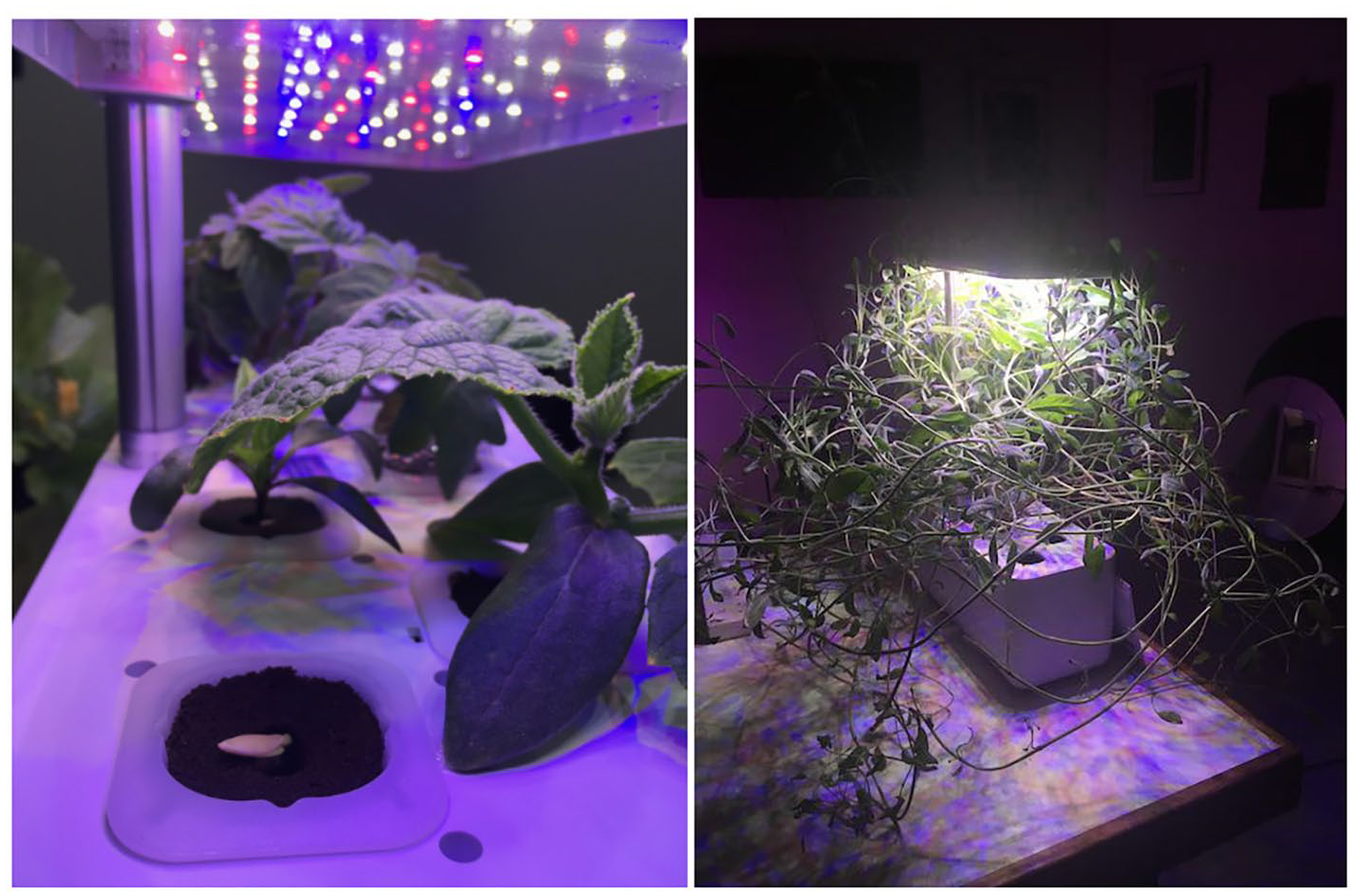
‘System 2’, cucumber seedlings and wild sage, photograph by Katy Connor.
Rewilding the studio
Germinating seeds and the subsequent plants need some substance to structure roots and stems. In the absence of soil, which provides not only a matrix for plant structure but also nutrients, the most common material used in hydroponics is rockwool, or similar types of mineral wool. With the consistency of candy floss, rockwool allows oxygenated water to circulate around the roots without becoming mouldy or clogged. Ebb and flow systems use clay pebbles. These substrates have their own environmental implications – rockwool is a harmful substance banned from landfill, while other available substrates are usually made of plastic (often coloured brown to mimic soil). There is a growing range of sustainable alternatives (such as moss). As Eugene Thacker writes of the relationship between data and materials, ‘The medium does in fact matter. A given pattern of relationships will take on significantly different characteristics given a different material substrate or technical context’. 5 Vegetal HydroPoetics is therefore less of an experiment with plants, and more with the way that plant bodies and processes of plant signalling respond to the substrates (and technical relations) through which they grow. HydroPoetics grows plants that are different versions of how they might grow elsewhere. Normally hidden by soil, root growth becomes visible: roots smell, they also release smell when water is added; they are tactile, extending beyond their own system and – if allowed – enmeshing with other roots systems. This requires the studio space to attend to vegetal temporality and propensities. But these are individualised plants. Artificial substrates mean orders of magnitude fewer microbial organisms are present; there are no pollinators, mycorrhizal associations are absent and only an impoverished version of the complex, little-understood-but-vast below-ground world of plant communication is enabled. But from the plant’s perspective, there are no normative implications of this technological ecology. All systems circulate oxygenated, running water and a nutrient solution, so plants have a constant stream of nutrients running available. Plants are indifferent, but also creative and adaptive, flourishing in their own HydroPoetic way.
Care for plants is automated in the HydroPoetic studio. Lighting strips give adequate energy in the form of red, blue and daylight to enable photosynthesis. Along with water and feeding pumps, these lights are set on timing cycles set for 8/12/16 hours, reducing the need for direct oversight of smaller systems to very 3–4 days, and 10–14 days for the larger systems. As a key concept in geography, multispecies studies and the environmental humanities, care has multiple dimensions, but simply put is a form of work/labour and affective engagement within a wider set of relations. 6 Our interest here is in how care between species is changed by automation. The technics of hydroponics – which create different, more individualised plants whose needs are tended by automated systems – do not mean there is less care (indeed, automated systems might do a better job meeting plant needs than a busy human!). These technologies are not ‘mediations’ between bodies, but are ‘infoldings’, compounding forces across bodies. 7 That is, the technology is not getting in the way but is part of the relation: technology cannot be said to qualitatively worsen nor quantitatively lessen flows of care. HydroPoetics welcomes technological beings in the creation of plant/studio worlds: we also speculate that through observation and data, perhaps we can discover new plant needs that body-to-body care work would overlook.
Plants are planetary agents: through photosynthesis they create a breathing planet energetically indebted to the sun. Plants’ mattering lies at the heart of our agricultural and economic systems, a key life process in the long durée of capitalist ecology. What happens when a technical system interposes itself between plants and the sun? In industrial hydroponics artificial light is used to force plant growth beyond its natural diurnal and seasonal rhythms, supplying at accelerated rate cucumbers, tomatoes, peppers, leafy greens (spinach, chard, lettuce and so on) to the just-in-time industrial food distribution and consumption system. This figures novel Anthropocenic forms of agriculture. It also prefigures visions of post-apocalyptic making-do: extracting plant labour under darkened skies, or through desperate subterranean subsistence. In Vegetal HydroPoetics, rather than supply abundant light energy for maximum crop output, the patterns of light are designed to mimic diurnal and seasonal rhythms: plants are allowed to grow, harvesting is not done, the studio is ‘rewilded’. HydroPoetics enacts a technology-enfolding elemental rearrangement in which supplanting the sun (cosmic mattering) is not done in a spirit of instrumental maximisation, but instead in a spirit of curiosity and companionship (Figure 2). What forms of partnership, what new forms of plant being might emerge?
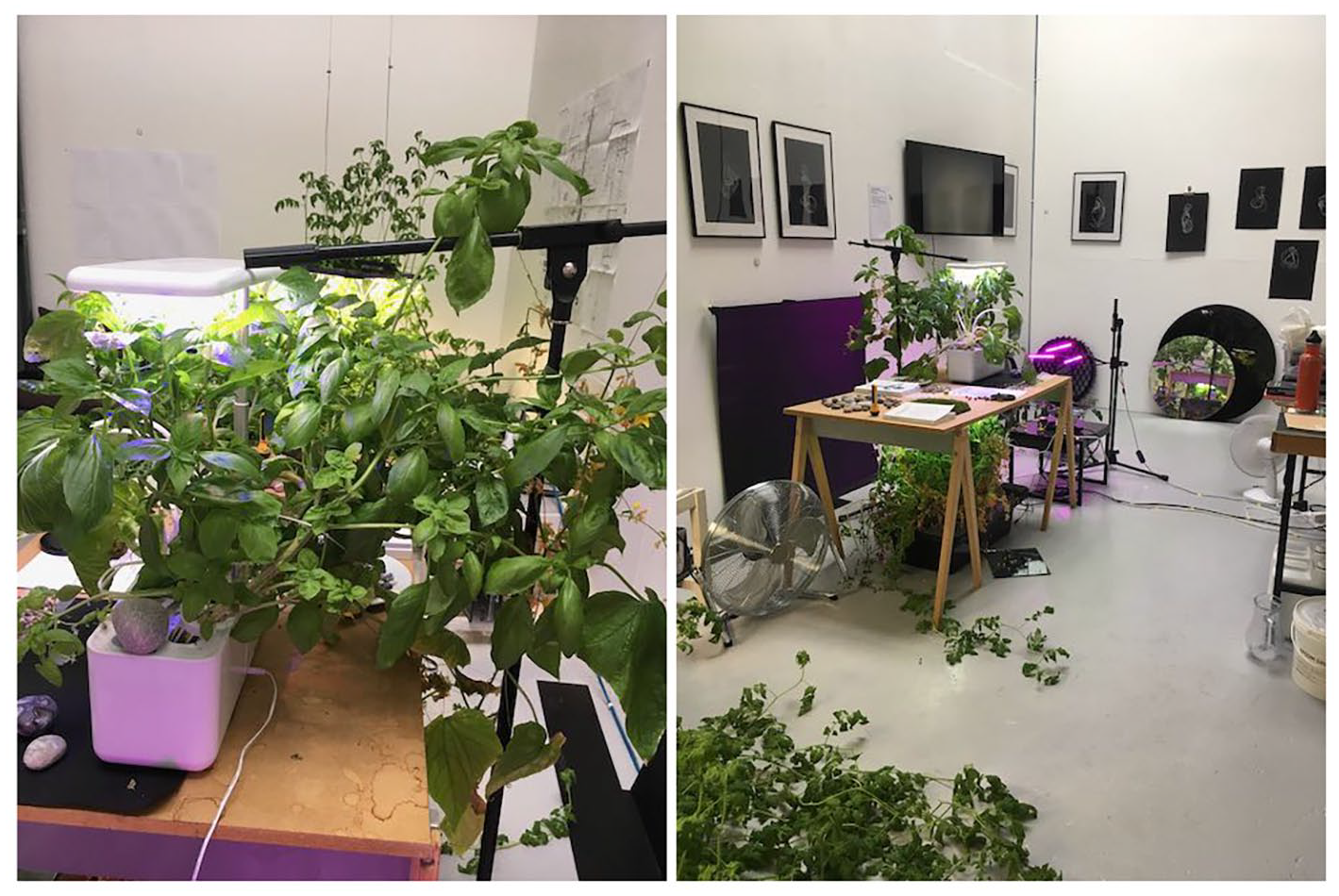
‘System 4’, HydroPoetic systems in studio: wild basil and tomato plants, photograph by Katy Connor.
Although plants become enmeshed in relations of care in the HydroPoetic studio they remain profoundly indifferent. As plant philosophers have argued, plants have a distinct mode of being and becoming – growth without purpose, growth without desire. Plants move, sense, communicate, make complex judgements within their own bodies and in sets of cross-kingdom affiliations, but they do so in ways which are not driven by internal differentiation: plants are multiple, non-individuated beings. 8 Against this conception of vegetal life, contemporary capitalist practices seek to individualise and compartmentalise plants in simplified ecologies, to harness their propensity for growth. We cannot say ‘exploit’, given plant life’s profound indifference to human desires. But these forms of plant are certainly different. Vegetal HydroPoetics plays with the multiple and non-individuated nature of plants. They seem cocooned in hydroponic systems, but root tips quest across floor and table, communicating with fellow roots (Figure 1). Tomato plants grow without any possibility of fruiting (no pollination), striving for growth without purpose. This offers a glimpse of plant subjectivity adapting, becoming different to itself. We can witness this, affectively engage with it, but yet the plant-as-subject is always withdrawn, its ‘unique mode of life’ bringing ‘into sharp relief the limitations of human capacities and faculties’. 9
Conclusions
We have opened several speculative lines of inquiry in this short article by combining an arts-based studio practice with recent ideas in plant philosophy. In our collaborative work we will be extending this practice beyond the studio into spaces where different publics can engage with vegetal HydroPoetics through sensory immersion, creative writing and drawing and tea ceremonies. We offer this practice as a contribution to methodological creativity in the fields of critical plant studies, vegetal geographies and speculative posthumanism, arguing that there are insights to be gained from staying with the trouble of technosympoieitic experiment. We point to three specific contributions. 10 First, HydroPoetics points to modes of engagement beyond instrumentalism and beyond appreciating plants at a distance. Instead, it is a mode of playful elemental experimentation. Second, Vegetal HydroPoetics plays with the gaps between the artist-grower’s agency and intention and the never-fully-predictable alterity of plant life. Third, this mode of artistic engagement has plants as participants, with the intention of letting the plants experiment for themselves.
Footnotes
Funding
The author(s) disclosed receipt of the following financial support for the research, authorship, and/or publication of this article: Growing liveable worlds: Ethical encounters between human and plant life was funded by Research England and University of Bristol’s Brigstow Institute.
