




Abstract
Creative practice is frequently being deployed in research by cultural geographers. This article explores one such deployment, centering on a participatory community art exhibition titled ‘Wheelability’. The exhibition was organized by non-disabled geographers for people who use powered mobility devices in the Northern Rivers region of New South Wales, Australia. The article illustrates the distinctive contribution art can make to disability mobility justice. It uses the personal stories and mobile creative expressions of one co-researcher and their carer to explore how engaging in creative activities provides opportunities to understand the emotional aspects of everyday mobility challenges and what emotions can do. Thinking through the emotional geographies of a mobile form of creative practice allows us to illustrate how dominant social norms are confirmed, ruptured, and reconfigured by the co-researcher. In conclusion, we discuss the implications of creative practices for conducting geographical research that promotes justice for individuals with mobility disabilities.
Introduction
To augment understandings of mobile disability politics, this article offers a critical analysis of and reflection on the authors’ experience of organizing a participatory community arts exhibition. Titled ‘Wheelability’, the exhibition was for the visual artworks of mobility-disabled individuals and held in August 2022 at the Ignite Gallery, Northern Rivers, New South Wales, Australia. The exhibition was prompted by enthusiasm among cultural geographers for creative practice-led methods (video and photography), as part of a larger qualitative project on everyday mobility experiences and meanings of people reliant upon powered-assisted devices. 1 People who consented to participate in the larger project were positioned as co-researchers, rather than research subjects, and actively involved in tailoring the research design, co-trained in participatory sensory ethnography, and engaged through conversation in participatory data analysis. Building on the success of creative practice methods within the participatory sensory ethnography we conducted, each co-researcher was invited to produce artwork that reflected on the sensations of powered wheelchairs/scooters in their local community.
The researchers helped with the practical elements of organizing the art exhibition (finding an accessible gallery, booking the gallery, advertising, promotion, etc.) and learned more about co-researchers’ creative practices and disability activism through ongoing conversations guided by open interview questions circulated by e-mail. Two themes structured the dialogue. The first explored creative practice, including mediums, inspiration, aim, and training. The second investigated the composition process, including selection of materials, aspects of disability represented, and the desired emotions evoked in the viewer. Co-researchers were invited to continue these voluntary conversations online with the researchers, spanning 6 months after the exhibition. This article emerged from an ongoing dialogue with two co-researchers – Andy and his carer/wife, Cath.
In this article, we conceive of creative practice as a socio-spatial force, an affectual economy, in which ‘emotions do things, and they align individuals with communities — or bodily space with social space — through the very intensity of their attachments’. 2 We explore disability activism for mobility justice by examining the affectual economy of creative practices. Our research contributes to the transformative potential of ‘disability aesthetics’ in re-imagining an abled-bodied world through artwork that generates reflection by making the familiar unfamiliar. 3 Building on previous studies, our article focuses on the politics of creative intervention and collaboration with art practitioners to offer insights into personal experiences of disability oppression and inclusion. 4
We present our interpretation of Andy’s artwork through two vignettes based on his written reflections on our interview schedule and subsequent conversations. These vignettes offer valuable insights into the politics of emotion and how mobility (in)justice is navigated. We have paraphrased sections of Andy’s reflections and provided interpretive text to connect them. Each vignette presents significant insights for understanding the role of creative practice in disability geographical research.
Andy’s photography life narrative and self-portraits
At the time of our conversations, Andy was in his 40s, had a postgraduate degree, and had been diagnosed in his early 30s with primary progressive multiple sclerosis. A former adventure tour operator and surfer, he had lived for the last decade with his partner, Cath, and two teenage sons in the coastal community of Brunswick Heads, 40 km north of Ballina, New South Wales. Andy used a range of power-assisted mobility devices, paid for by the National Disability Insurance Scheme.
A photography life narrative
Andy reflected on his decision to use photographic self-portraits for the exhibition, highlighting his experience of working with photography for more than three decades. He discussed how the value of photography evolved throughout his life, starting from technical aspects in school, transitioning to documentation during higher education and work, and eventually becoming a political tool after meeting his partner and receiving a multiple sclerosis diagnosis. Andy’s narrative underscored how picturing practices were learned and involved a specific way of ‘looking’. He emphasized how after meeting Cath, his picturing practices changed focus from technical to political, as he realized the potential of the felt dimensions of artwork to connect with viewing audiences. Andy shared how he came to understand that an artwork is not complete until the viewer responds to it.
Up to this point, I had never been exposed to appreciation of artistic expression and meaning. I understood what part I played in the viewing of an artwork. It was active, not passive, and that is why we like or dislike works of art. They talk to our souls.
Andy reflected on the way that perception of visual art is an individualized experience, as it requires the viewer’s interpretation based on their prior experience and a deeper appreciation of art to evoke emotional responses. According to Andy, he learned from Cath ‘the power in artistic expression’ that allowed him to mobilize emotion in his disability political advocacy by encouraging the viewer to reflect upon how they responded to his artwork.
For me it is important not to provoke emotions of pity. I think that the challenge for those who put themselves into the public gaze is to advocate, inform, encourage, and hopefully engender empathy for equitable inclusion.
Andy noted that the intention of his artwork was not to evoke pity but to connect to a viewer’s sense of empathy while also calling attention to and encouraging greater perception of what ableism means.
Alongside learning about the role of prior experiences in the appreciation and processing of visual art for political advocacy, Andy went on to explain how his personal experiences in documentary clinical settings also prompted a re-evaluation of disability representation. Through his voluntary disability advocacy work with Cath, they often became the subject of filming and photography, including clinical contexts.
What eventuated through all the volunteer groups that we’re part of is that we ended up on film. Cath and I were filmed by the hospital group for an educational video that will be seen by all trained healthcare staff.
Here, medical knowledge frameworks on multiple sclerosis were replicated and distributed through the filming and photography of Andy’s body, including friction points, pressure sores, and fungal patches. Andy reflected on his participation as a wheelchaired individual in these sessions, noting that these experiences led to his increased assertiveness and comfort in being photographed. According to Andy, ‘The important takeaway is that my comfort in front of the camera improved’. From their creative practice and documentary clinical experience, Cath and Andy understood how affects and emotions arise from photographs of wheelchaired bodies. Because of first-hand experience with social norms that produce stigma and exclude a disabled identity, Andy narrated artwork as an effective way to generate moments of disability advocacy by encouraging a greater reflection on what ableism means.
Emotional geographies and photographic self-portraits
Cath and Andy accepted our invitation to participate in the community art exhibition and spent a month documenting the powered wheelchair (im)mobilities of their everyday life in Brunswick Heads. Their creative dialogue generated two self-portrait photography series: ‘Out and about in the community’ (Figure 1) and ‘At home’ (Figure 2). Andy explained that the disability politics underpinning ‘Out and about in the community’ meant to disrupt how disability was produced through discourses of tragedy
5
and to claim public space through enjoyment: My first reaction is to take images demonstrating my ability to get out and about in my community using the parcel of equipment I have. I think this conveys the joy I have for life and the pride I have for my community. The first images achieve this brief and reflect the joy Cath and I feel together.
‘Out and about in the community’ illustrates how an affective politics of happiness and pride may help transform understandings of disability inherent in western society when navigating community spaces. For example, one photograph showed how Andy’s wheelchaired bodily pleasures of journeying with Cath and his dog through the neighborhood were enhanced by chance encounters with others, which resulted in shared smiles and intensified pleasures. This experience of being out and about filled Andy with joy and pride, strengthening his social connections and roles as a dog owner, local resident, and husband. The photograph highlights the interplay between happiness, power, and spatial dynamics. By rolling through the neighborhood with his wife and dog, Andy’s actions became a form of activism, reclaiming spaces typically dominated by able-bodied individuals. For Andy, the production of disability was grounded in a joyful affective economy that dismantled ableism and able-bodiedness. Yet his production of disability was also embedded in reconfiguring conventional ideas, processes, and practices of a desirable suburban lifestyle as the ‘natural’ order of things centered around normative heterosexual families, homeownership, and coastal living. 6
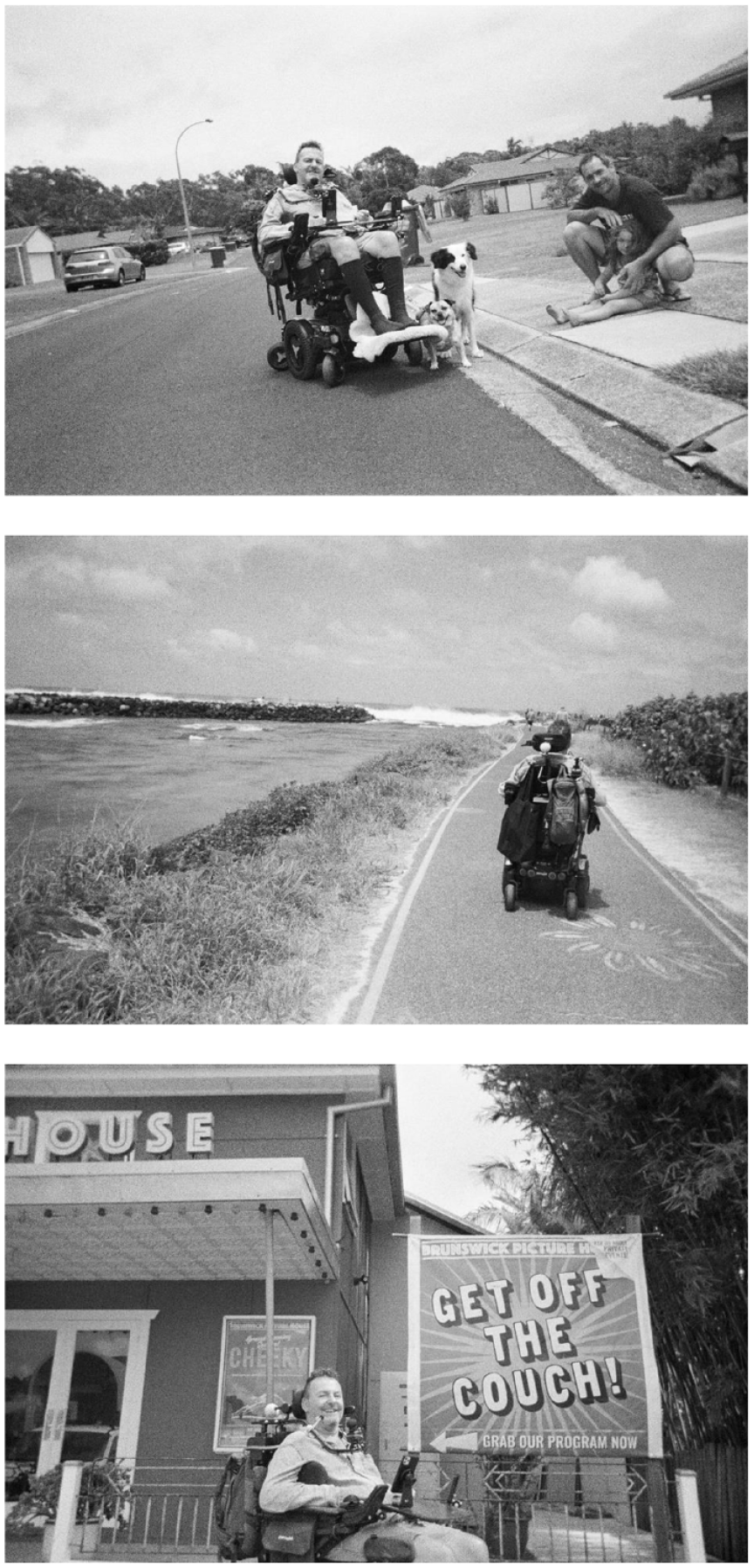
‘Out and about in the community’. Photo by Andy Graeme-Cook.
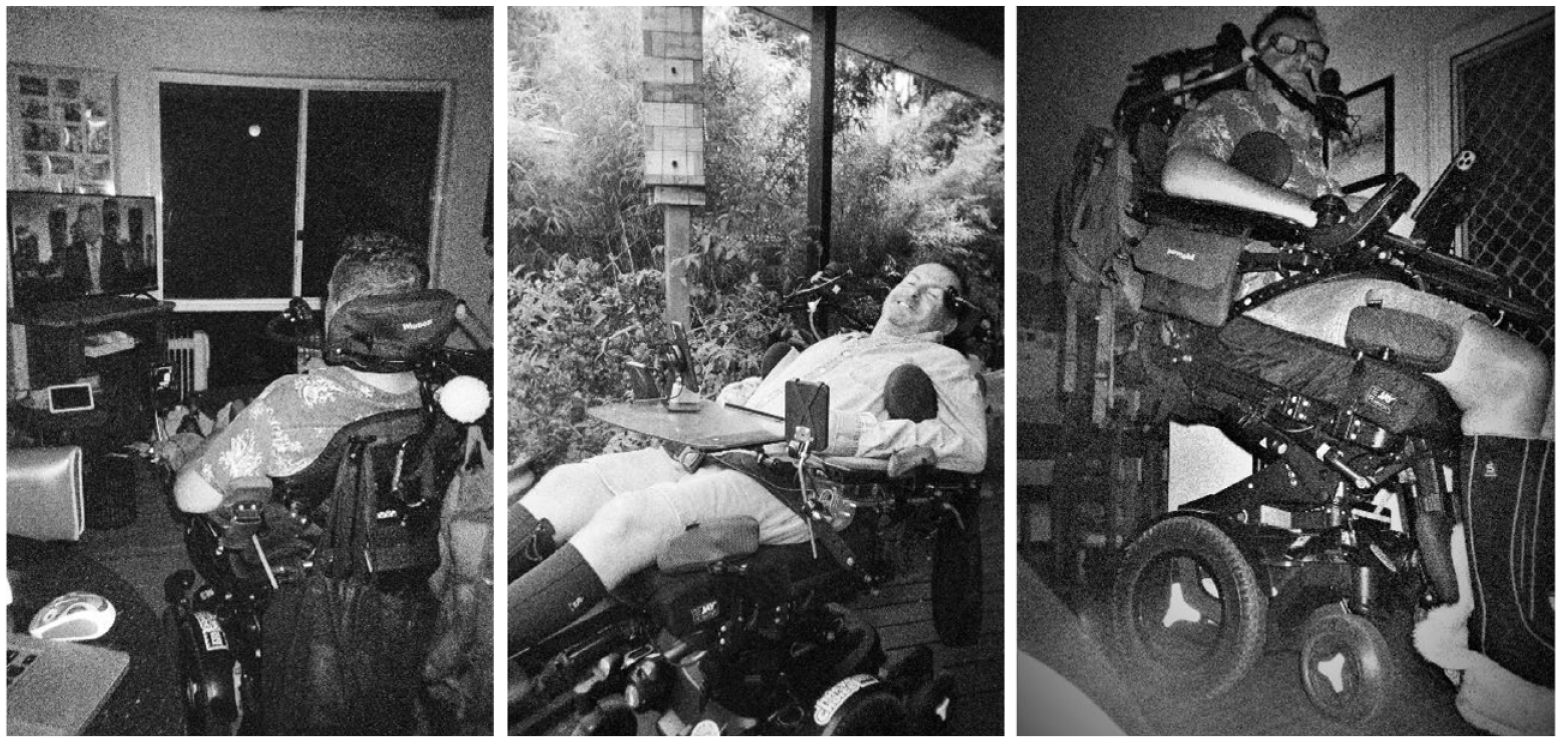
‘At home’. Photo by Andy Graeme-Cook.
The ‘At home’ series shows how photography can capture and convey personal experiences related to disabilities and the use of powered wheelchairs. These photographs explore the movement and physicality of powered wheelchairs within the context of Andy’s home and his relationships with family members. According to Andy, these photographs reflected his own understanding of family life and the emotional connections formed at home, as felt through the embodied understandings of powered wheelchairs. In his own words, With the remaining images we went introspective, and I think here is where we find the gold in conveying the experience of disability. The gold is what the technology is allowing my life to be. I get to live in a home, in my community, in my suburbia. These simple pleasures are gold to me, as I am able to be a family member and not a forgotten disabled man in a room. Technology is a part of my life and allowing my life to be what I make it, all at once.
The ‘At home’ series captures how Andy’s social and physical mobility was affected by mobility aids which required him to adapt his movements, actions, thoughts, emotions, and interactions with others and with places and reflects different perspectives on disability. This self-portrait photography series explored the use of power-assisted technologies within the home, highlighting their positive emotional impact on not only health and well-being but also intimate familial relationships. It also revealed patterns of micro-mobility, such as leg raising, tilting, reclining, and rising. As Andy explained, At home the focus was more on my equipment and what it could do for me. Cath captured images of me doing what I do best (watching telly, listening to radio). Mundane maybe, but facilitated by and with autonomy using my wheelchair. One image has me lying in recline in front of my beloved native bees whilst listening to my favourite radio National podcasts. Another has me attentive in front of the television sitting posturally correct. Cath also had me demonstrate some of the powerful tools my wheelchair provides. In standing mode, I access a powerful therapeutic tool of lymphatic drainage. These modes. . . are essential to my physical health and wellbeing while living this sedentary life.
Andy suggested that his embodied experience of everyday power-assisted micro-mobilities facilitated happiness through independently doing mundane home-making activities. Furthermore, these micro-mobilities helped sustain a sense of self and enabled familial relationships: knowing, caring for, and loving others as a friend, father, and husband. 7
For Andy, the ‘At home’ series was an important lens to rupture the ‘normal’, taken-for-granted abled body within domestic life and understandings of disability.
I want people to see me. I am not ashamed to be me, ‘I like me, I like being me’ - Woody Allen. I guess I just want people to see me and not how different I may appear in my technology. Community is filled with all kinds of diversity; mine includes tech and takes up room. Can’t get off some kerbs or get on airplanes. But I am here.
Andy and Cath aimed to address issues of difference and marginalization at the intersection of art and politics. They explored the dynamics of pride and shame associated with wheelchaired bodies by rendering private places public. By showcasing the everyday movements and activities made possible by powered wheelchair micro-mobilities, they aimed to challenge stigmatizing views of disability. Yet, at the same time, the photographs portray a normative heterosexual family life, depicting Andy’s happy, healthy, and proud engagement in intimate relationships and the organization of family time and space within the home. Andy embraced his disability and refused to be shamed by a society that stigmatized disabilities. The ‘At home’ series incorporates the emotional and affective aspects of pride and positive disabled identities to provoke the viewer to reflect on their encounters with powered wheelchair-assisted bodies to promote new ways of embracing difference both within and beyond the family home.
Conclusion
Andy’s photographic self-portrait series illustrates how the visual arts provide a vital contribution to those working at the intersection of disability studies, mobility studies, and cultural geographies. The photographic self-portraits made visible daily personal routines and intimate micro-mobilities. Furthermore, creative mobility practices, by sharing the emotion of joy invested in the powered wheelchair by Andy, may help non-disabled people understand more fully how ableism operates through everyday journeys and micro-mobilities. In this way, creative practice can play an important part in addressing the social inequalities of ableism by not only representing but also encouraging moments of reflection on what ableism means via connection with a viewer’s sense of empathy.
For Andy, the two photographic series convey how the powered wheelchair was part of a politics of happiness caught up maintaining normative assumptions of an independent, suburban, heterosexual family life. For instance, one source of happiness for Andy conveyed in ‘Out and about in the community’ was the routine of everyday powered wheelchair journeys with his partner and dog through which the neighborhood became a place of social inclusion. Andy told of the significance of powered wheelchair journeys in addressing shame configured by ableism. However, it is important to recognize that Andy’s happiness and inclusion in the community were underpinned by certain social norms related to a happy life. Andy illustrated how powered wheelchairs are already invested with positive value, in this case his orientation toward medical technological advances overcoming disability and coastal suburban family life as the good life.
Similarly, the ‘At home’ series showcases how Andy found happiness in the micro-mobilities enabled by his powered wheelchair within the familiar spaces of his home. He expressed joy in how the wheelchair facilitated independence to conduct everyday activities like watching television and outdoor radio listening. These micro-mobilities formed the foundation of his engagement with the family home, where he felt healthy and relaxed. Andy’s creative practice illustrates how powered mobility devices can be imbued with joyful emotions. While challenging the ways in which disability is produced through pity, his creative practice illustrates how disability is tangled up in conceptions of medical progress, technologically advanced bodies, autonomy, heterosexual family life, and suburbia that work toward particular forms of inclusion. Acknowledging the embodied dimensions of creative practice opens a future research agenda that is alive to the politics of emotion in producing disability at the intersection of independence, technology-enhanced bodies, sexuality, family, and advocacy.
Footnotes
Funding
The author(s) disclosed receipt of the following financial support for the research, authorship, and/or publication of this article: Financial support for the research was received from the Australian Research Council, LP180100913. Ethics approval was given by the University of Wollongong Human Research Ethics Committee, reference number 2019/502, for the project titled ‘Integrated Futures for the use of Mobility Devices.’
