




Abstract
In 2019, we collaborated with German theatre artists to co-create Between Worlds: Outsourcing Dementia Care, an immersive, multi-media piece performed in Newcastle and Berlin. This performance work animated and staged our interviews conducted with the owners of and caregivers working in private care facilities recently built in northern Thailand to provide dementia care for overseas guests from across the Global North. This creation process also drew from interviews we conducted with the family members who had chosen this option for their loved ones with dementia. Incorporating elements of documentary theatre, movement and cinematic projection, Between Worlds was designed to bring audiences into an intimate space, drawing them close to the complexities of the outsourcing of dementia care in order to prompt public conversation and reflection on dementia care in both Thailand and the Global North. Here, we consider the performance of the play and the method that our theatre collaborators used to render transparent the process of translation within performance. We critically assess the outcome to question the possible betrayals implicit in creative and social science work and in the doing of cultural geography.
The house lights are up. Enter and take a seat. Immerse yourself within a filmic panorama of an inviting turquoise ocean rolling onto a white sandy beach (Figure 1). Enjoy the soothing sounds of jazz. Where is this place? Who are the three people wandering in front of this projected paradise? The lights fade to black, and the cresting waves rise. The scene cuts. Two older white Americans appear on screen, larger than life at 15 feet high, sitting stiffly with their dog on a living room couch. Speaking directly into the camera, Trudy tells us that after just 5 years of marriage, she began to notice that ‘things were a little off with Jack’. She looks towards him, her words projected into German surtitles: ‘You weren’t understanding what I was saying, sometimes’. Jack nods. ‘It seemed stranger and stranger’, she said. The images fade. Three performers take centre stage to address the assembled audience.
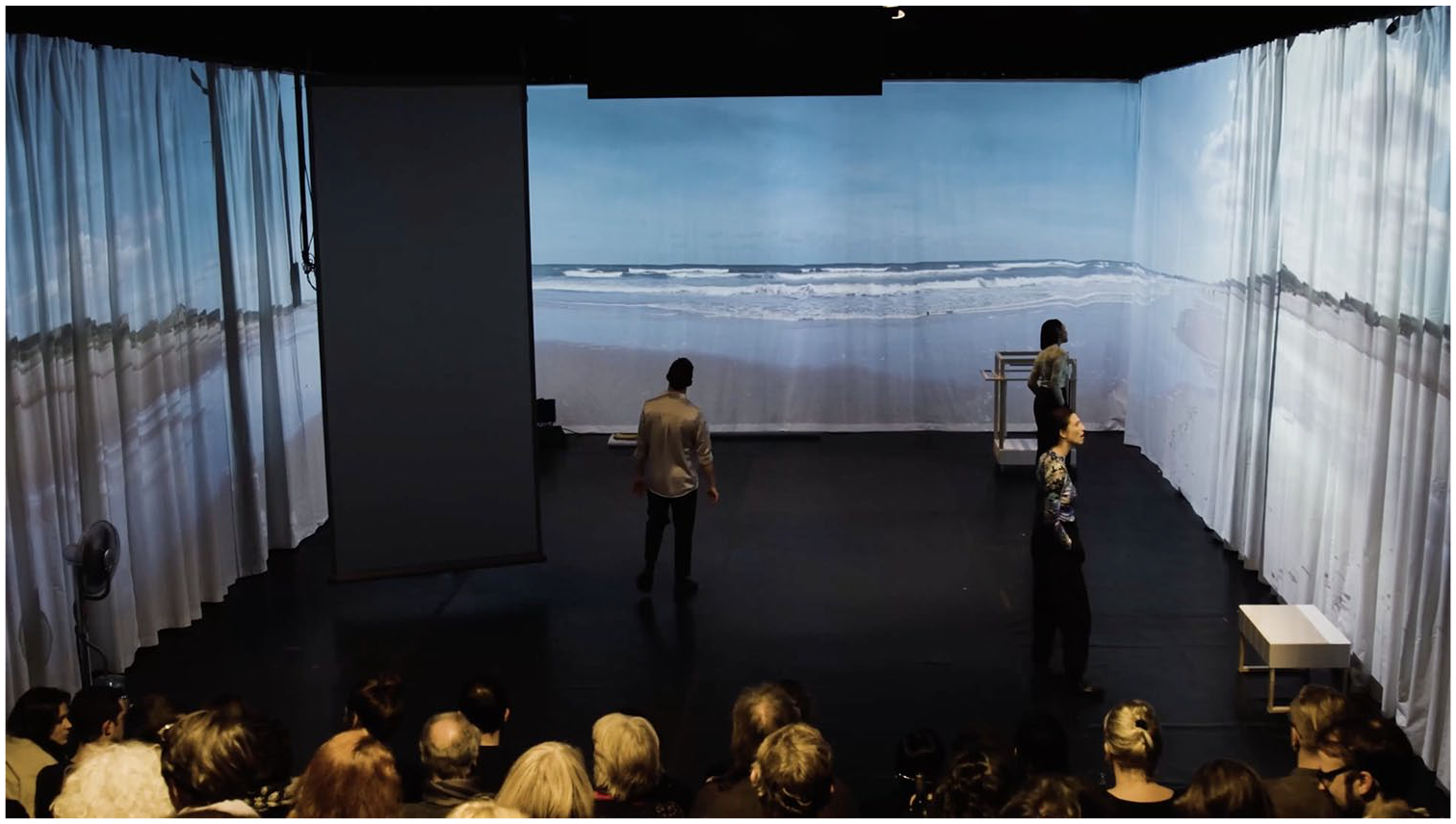
Immersive staging. Photograph by authors.
The audience was watching Between Worlds: Outsourcing Dementia Care in its debut in Berlin, Germany, in November 2019 before the show travelled to Newcastle in the UK. In 2017, we sought out Costa Compagnie, a Berlin-based theatre company, to collaborate on a research-performance process that would lead to a work of cinematic theatre examining dementia facilities that are being created in Chiang Mai, Thailand, by British and Swiss entrepreneurs, to provide care for persons with dementia coming mostly from Switzerland, England, the United States and Germany. These facilities are both responding to and generating a type of palliative migration. We, the researchers, made our first 3-week field trip to Thailand in January 2019, living, observing and interviewing at two facilities, for 1 week at each, and visiting and interviewing at three other care facilities as well. We returned for 3 weeks during Summer 2019 with the theatre director, a camera person and a sound artist (Felix Meyer-Christian, Philine von Düszeln and Marcus Thomas, respectively), retracing this research itinerary to conduct and film formal interviews with the owners, managers, and workers at three care facilities, as well as with family members who had sought out this care for their loved ones (Figure 2). Together, we selected the performance piece’s main protagonists: an American couple, Trudy and Jack; a British woman whose husband had advanced dementia; a Swiss owner; and Nan, a Thai caregiver, with cameo appearances from many other actual interviewees (Figure 3). (The video footage is of actual interviews, not performers representing them.)
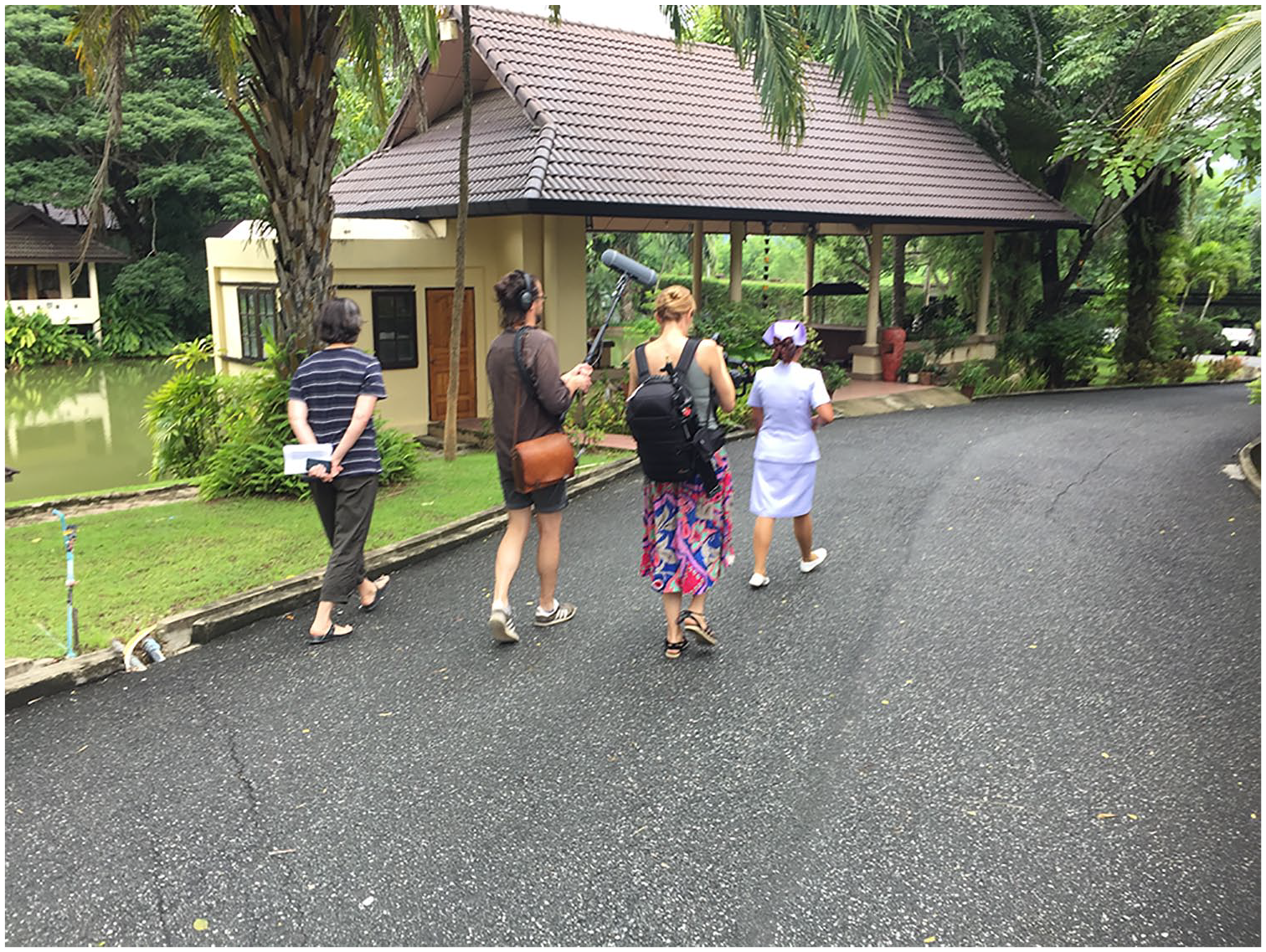
Collecting stories. Photograph by authors.
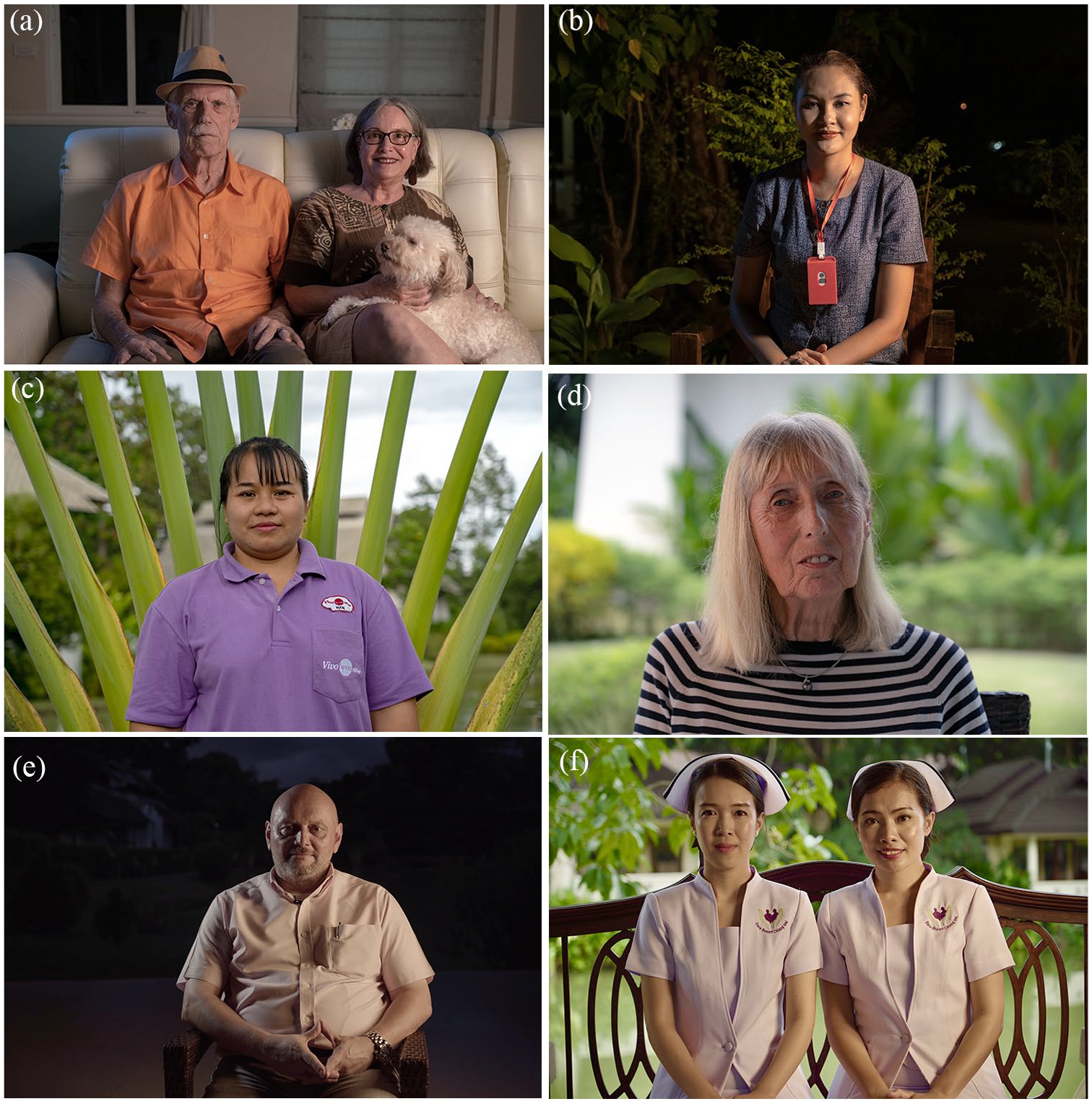
(a–f) Protagonists. Photographs by Philine von Düszeln/Costa Compagnie.
We sought out the collaboration with Costa Compagnie to generate an intimate, public and transnational conversation on dementia care, the need for which has become all too evident during the coronavirus pandemic, with the disturbingly high death rates in long-term care facilities across the Global North. We wanted to use multi-media performance to bring audiences, who come with their own varied and complex relations to care and family, close to others who are dealing with dementia, both on the stage and in the audience, to stimulate self-reflection and to enter into public conversations with one another (and us) in the discussions and symposia staged before and after the multi-media performances. 1
For many, the idea of this palliative migration to Thailand for dementia care seems too improbable to be believed. Once considered, however, well-established narratives of labour exploitation and sex tourism across Global North and South have been deployed, for instance, when one of Germany’s largest daily newspapers described it as gerontological colonialism. 2 But what if the care provided in Thailand is not so easily dismissed as exploitative? What does it say about dementia care in the United States, Britain, Germany and Switzerland that family members feel pressured to seek out care so far away from home? What does it say about priorities in the Global North that we – not as individuals, but as communities and societies – take such poor care of those living with dementia that individual families must seek out care in Thailand? These are the questions and conversations that we wanted to force and facilitate through performance.
What follows is our reflection on the creation and performance of Between Worlds, beginning by describing a methodology that renders transparent the process of translation from research to performance. We then unravel this uncomplicated rendering of our process by asking questions about the possibly inevitable betrayal that occurs in creative and social science work. 3 We invite, rather than resist, this unravelling, with the hopes of learning from it. Our collaboration with theatre artists involved multiple layers of translation. Following Carlos Rojas, we consider that ‘just as translational method may ultimately be most interested in moments of translational failure, an approach that views analysis as a itself a form of translation will be similarly attuned to the possibility of failure 4 including the potential inability of analysis to engage with the marginalised voices with which the [artistic] works in question are in potential dialogue’. 5
Dramatising interpretation
Costa Compagnie works with a performance methodology that they have developed to make transparent the act of interpretation. The performance script of Between Worlds was created through a process wherein the director and performers (as individuals, rather than as actors) engaged on a personal level with the video material that we had gathered in Thailand. They were interpreting this material from their own location and had not been part of the research process in Thailand. The performers’ words are theirs; they are not acting a script written by others but performing a script that uses their own words and that they helped develop while engaging the recorded video interviews with research participants. And so, let us introduce the performers/interpreters. David Pallant is a British dancer whose movement work brought an interesting orientation for exploring embodied ways of understanding dementia. Anna Rot is an Austrian actor, and Irene Laochaisri is a Thai graduate student living in Germany with a history in the arts. All were, at the time of this project, relatively young, in their 20s and 30s, with limited experience with dementia, mostly in relation to their grandparents, but without the responsibility of providing or arranging care directly.
The play’s narrative structure was anchored in a series of vignettes in which performers dramatised their empathy for those whose experiences we recorded in Thailand. Presenting a segment from Julia’s interview through empathetic imagination (Figure 4), David said:
So, now I’m imagining being back somewhere in the south of England, where, due to the postcode lottery, there’s next to no Alzheimer’s care. I’m imagining trying to cope alone, driving whilst terrified of him opening the door or putting on the handbrake. I’m trying to imagine losing my husband in a shopping centre or at a train station. I’m trying to imagine moving again, this time to Yorkshire, upending everything again to be closer to some good care facilities. I’m trying to imagine trying two different care homes and having to give up on them both after only a couple of days.
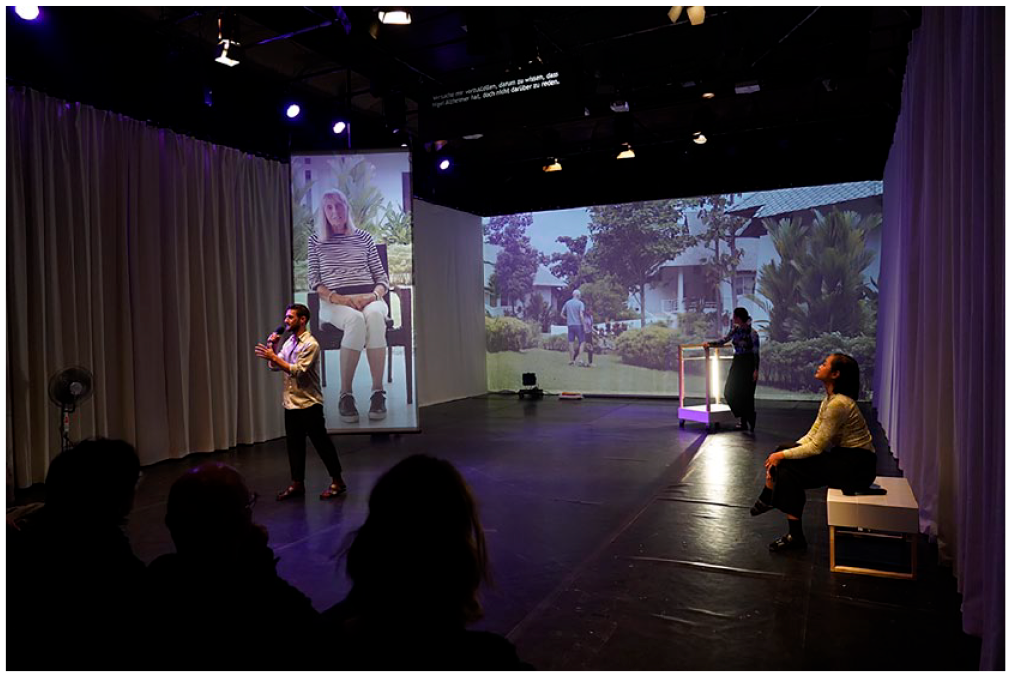
Interpreting Julia. Photograph by Philine von Düszeln/Costa Compagnie.
A little further along in the performance, David ventured his own opinion, interleaving it with information that he gleaned through the interview materials:
I find it incredible that here, in the UK, a [care] home can cost £900 a week and they’re unable to properly care for all of their residents. That the staff can be good, caring people who want to do their jobs properly, but they simply don’t have the time. That even when the family wants to find the best care possible, and the caregivers want to provide it, and you’re able to pay £900 a week, it can still prove an impossibility in this country.
Or later, having identified as queer, he told the audience that:
It worries me to think that in the UK, elderly and ill people aren’t getting the help they need. Because what about those who don’t have savings to fall back on? Or children to help out? Or a partner who can take care of them? What about, for example, a queer person who for most of their life has been denied many of these family structures by the state which is now denying them affordable care?
Irene’s interpretation was often rooted in her experiences of growing up in Bangkok and a strong critique of social and political conditions in Thailand, not so risky when performed in Berlin but exceedingly so in Thailand. At one point in the performance, she led the audience in karaoke to learn the Thai words to a pop song, implicating them – and, by extension, those using the dementia centres in Chiang Mai – in their privilege as potential tourists to Thailand. The light-hearted karaoke session took a dark turn when Irene moved into her rendition of the rap song Prathet Gu Mee [My Country] that criticises, and implicitly situates the growth of medical tourism as development strategy within, the Thai government’s corruption. She performed this rap against enveloping images of civilian protest and military brutality (Figure 5):
A country where no one dares to challenge the government
A country that has laws so the police can use them to threaten people
A country where those who think critically have to pretend to be sleeping
And if you don’t want to be here, if they force you to stay, you have to stay
A country where people don’t read, especially the leaders
A country that tells you to stay silent if you don’t want to sleep in jail
A country where the highly ranked always get away with corruption
My country fucking has this. My country fucking has this.
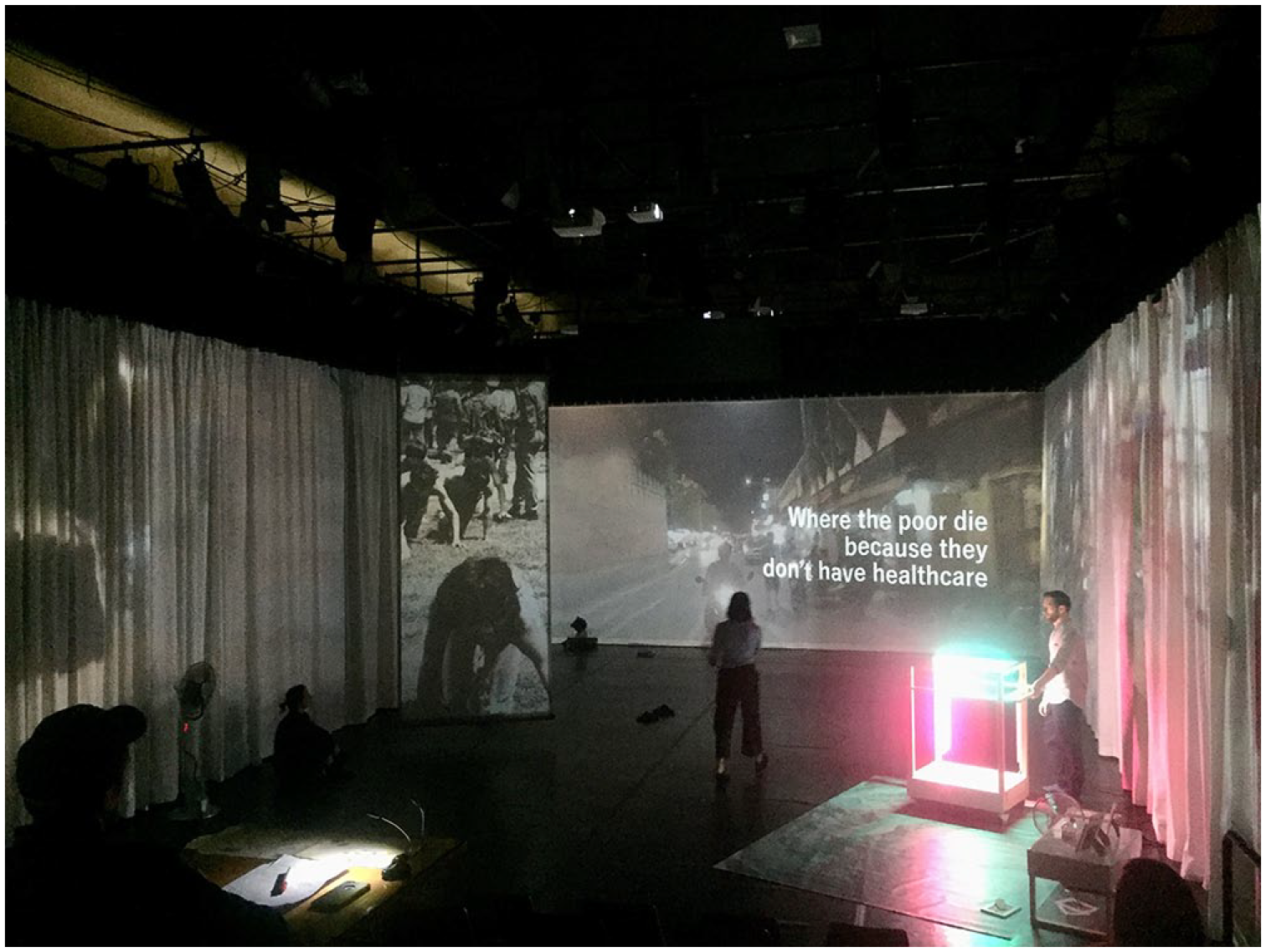
Irene performs. Photograph by authors.
There were also moments when mistranslation is performed and made evident to the audience, for instance, when Anna tried out a few words in Thai to ask a question of a Thai caregiver, Nan. Using video footage in which Nan did in fact look puzzled by a question posed to her, Anna attempted again. And again. She then asked her question in English, which Nan immediately (appeared to) understand because of her competence in English (Figure 6). The multiple layers of interpretation, translation and mistranslation were thus fully on view, including in the surtitles, which moved between German and English, as the performed language shifted between Thai, German and English.
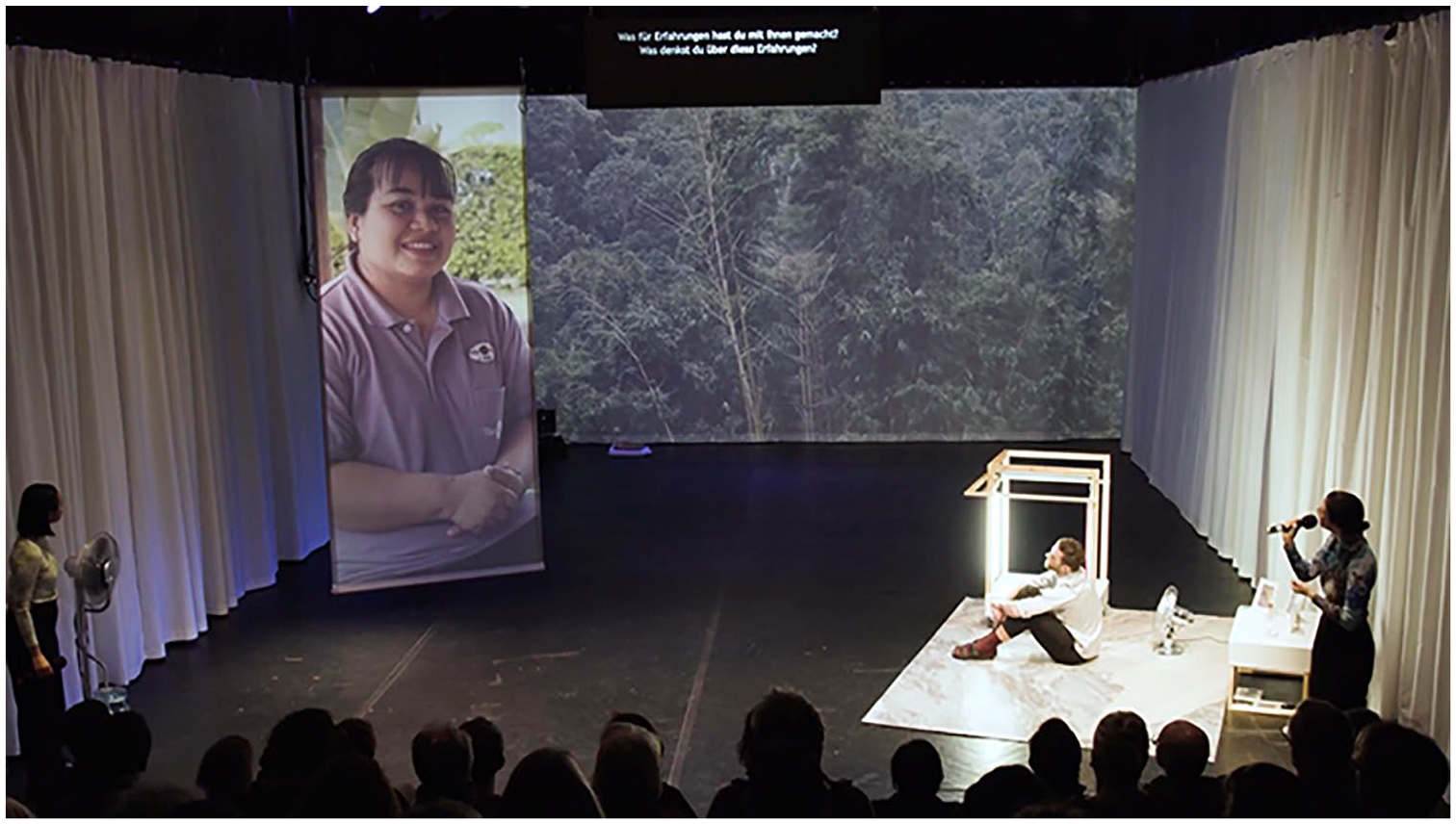
Mistranslation. Photograph by authors.
There were also a number of indications throughout that the video interviews are staged or constructed. In an awkwardly improvised but instructive sequence (from an actual interview in which they were asked to stage this improvisation), two caregivers demonstrate how they have been trained to work with distressed dementia patients by entering their world to calm them down. There is no doubt that they are acting this improvisation out for the camera (Figure 7). A number of the video sequences also end with an extended still portrait of the person who has been speaking, holding the viewer and viewed in a suspended moment of silence and contemplation.
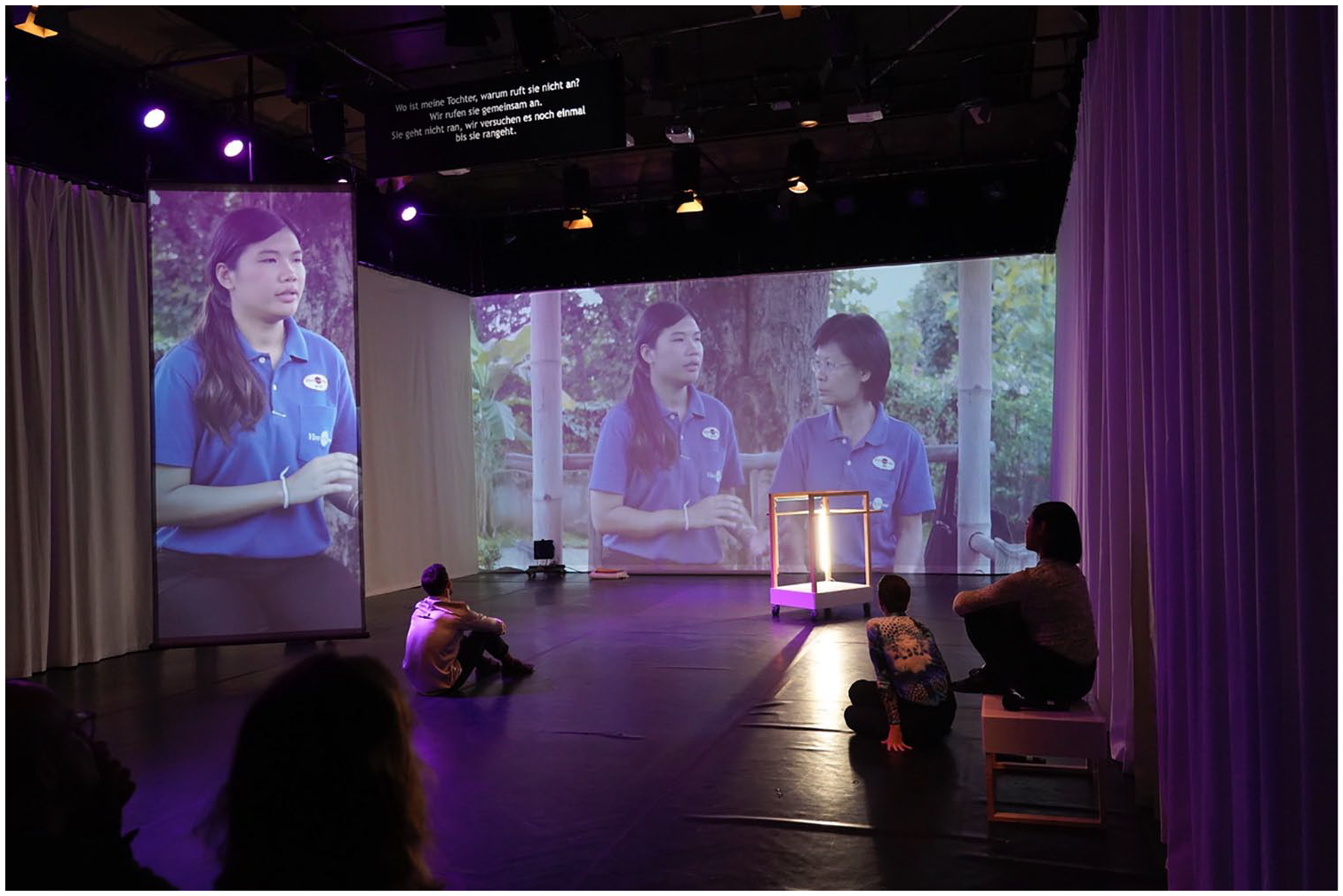
Role-playing dementia care. Photograph by Philine von Düszeln/Costa Compagnie.
Translation and betrayal
Performers’ dramatic interpretation was rooted in their subjectivity and often translated through their own experiences. ‘It is unclear’, Judith Butler has written, ‘whether translations can ever be other than “bad” or, at least, have some badness in them, since the original has to be crossed, if not partially mutilated, with the emergence of the translation itself’. 6 Representation and analysis of any kind – by actors within a performance or field researchers in their scholarly writing – are acts of translation and always have some badness within them as experience is inevitably mutilated, in different ways and to different extents, through translation.
Kamala Visweswaran frames this badness as a kind of betrayal, which she takes as an allegory for a feminist practice repositioned along various lines of intersectionality and difference. 7 Watching interpretation being performed in Between Worlds was a master class for thinking about analysis as a form of translation. We betray here moments of our own discomfort with the interpretations performed in the play, our discomfort another act of translation and a betrayal perhaps of the performers’ vulnerability as they put their interpretations so publicly on stage.
Consider three scenes of interpretation, three different moments in which the performers brought themselves into relation with those we interviewed in Thailand.
Scene 1
So again, I am looking at Julia, and I am trying to imagine myself in her situation – if I were in need of help, to care for my husband living with dementia. What if I had already been let down by the care systems in place in the UK. What if I met a carer in Thailand, who’d already lived and studied in England and wanted to move back to the UK.
Would I see it as a generous offer to bring her back to the UK to help care for my husband? Would the worries about exploitation, and unjust structures, and general white Western guilt change if someone like that nurse was standing in front of me saying that she wanted to help me, and for me to help them?
And if I were that carer, how would I feel about the terms being offered in order for me to move to the UK?
It would be more money than I as the carer was earning in Thailand, but less money than someone British would earn for the same work. Would I mind? It’s a huge thing to move halfway across the globe in order to get someone the care they need.
Exactly! A few weeks ago when my boyfriend, my real boyfriend, had an accident and they had to call an ambulance. I was pissed off when I found out that they took him to a hospital in Lichtenberg. I mean, outside the ring. So outside the continent? That’s a whole other kettle of fish.
But Julia’s request to bring a Thai nurse back with her to the UK to care for Rupert involves many complicated intersections. Thailand and England. “The West” and “the Global South.”
Friendship and business.
Carer and cared-for.
Loved ones and paid ones. Migrants and ex-pats.
So what about when they found out it wasn’t possible to get a visa for the Thai nurse? When they were told it wasn’t even worth trying to apply. Wouldn’t they both feel upset, disappointed, unfairly treated, helpless? Are we able to rank people’s pain? As though at the next Olympics they’ll introduce competitive suffering.
Scene 2
We are still so shaped by the patriarchy, we do not even question it. [Switching to German] “When I think of Mary Welsh Hemingway, who cared for her husband Ernest for the last ten years of his life. He was ten years older than her, heavily addicted to alcohol, obese, and paranoid. Why do I find it so hard to imagine the opposite? A younger man sacrificing himself for his famous partner? Or Oona Chaplin, Nancy Reagan, or the 50 years younger women around Picasso. When we think about care at home, at least here in the West, it is mostly the women and daughters who sacrifice themselves. And that is a structural problem. An exploitative patriarchy that has existed for thousands of years. And it is still social and anchored in our minds. That in private and professional life, it’s women who care, wash, cook, clean – who are there for someone. The one in charge when it comes to intimacy. It is someone who said: ‘Illness can open a new kind of devotion and self-sacrifice.’ Well then, let the husbands, the sons, and the lovers sacrifice themselves. Or care. I wonder if life in these resorts is not especially pleasant for men. The care and the revitalizing society of young women (Figure 8).
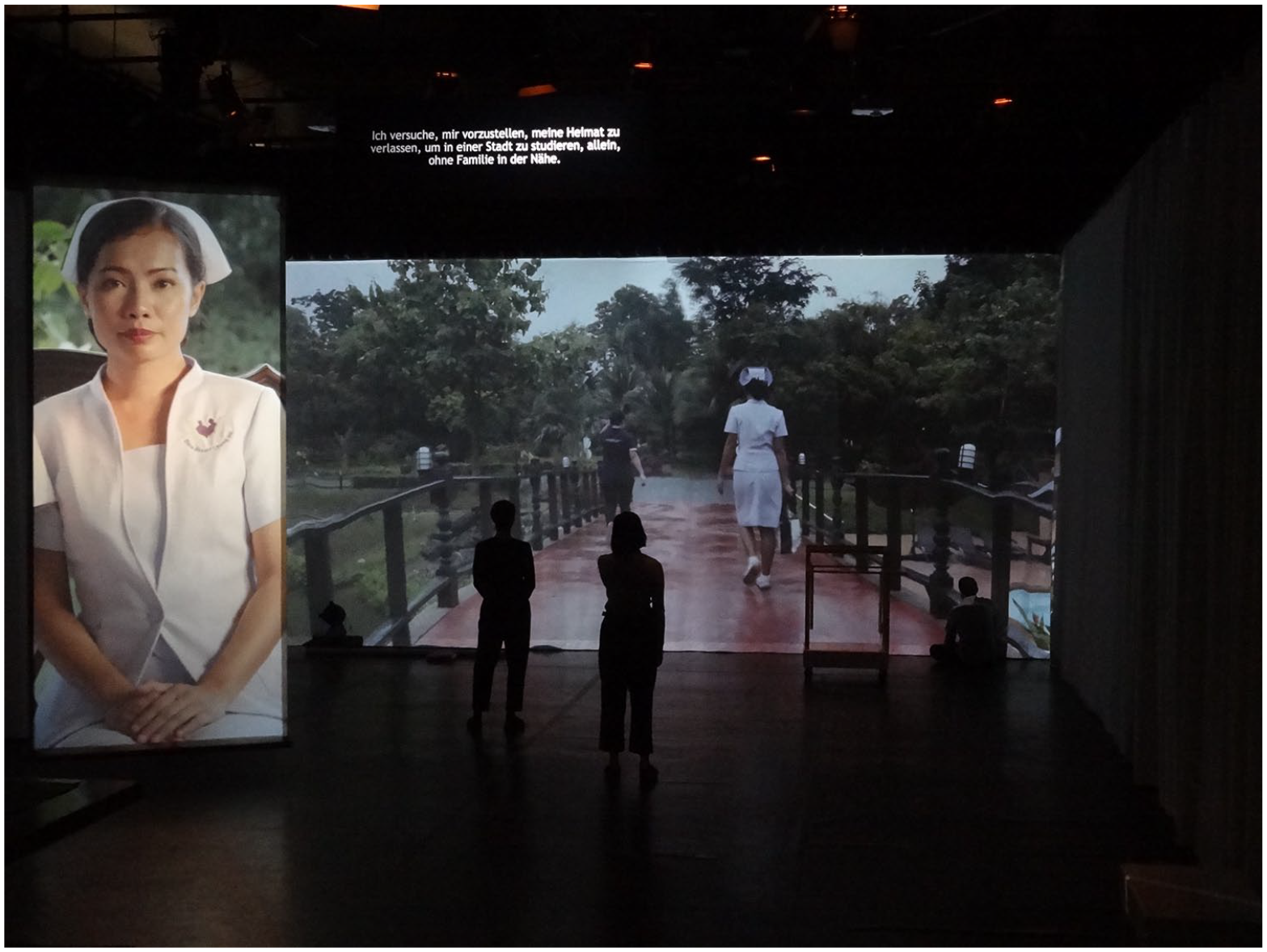
Apinya. Photograph by authors.
Scene 3
In the video, Julia tells of her and her husband’s decision for him to partake in a clinical trial of an experimental Alzheimer’s drug in the hopes of slowing the progression of his Alzheimer’s disease. It was ineffectual, and she expresses taking some comfort in the fact that their sacrifice will potentially enable future medical treatment. Reflecting on Julia’s testimony, David equated that decision with the experience of his mid-30s female friends who ‘every time they start dating a man, they’re putting all their eggs into his basket. Their finite number of eggs’. David then drew parallel between the ‘wasted time’ of the drug trial and watching a losing cricket match: ‘That’s the thing about drug trials and cricket. . . sometimes they’re a complete fucking waste of time’.
Three acts of interpretation, all situated within the performers’ experience. One open-ended and questioning; one arguing from within an elite western experience; one interpreting by analogy (which to us is questionable, but likely not to younger audience members). We can recognise ourselves, uncomfortably in the latter two, in all three interpretative modes. Together, and especially the latter two, these examples make highly visible the potential betrayals and pitfalls in acts of analysis and translation.
The cinematic nature of the multi-media performance, the staging of which centred around the projection of recorded interviews within an immersive space, likely amplified the tensions created by the performers’ interpretations. This staging, a compelling feature of the performance, rendered subjects highly visible and the performing environment brought audiences very close, perhaps demanding more intimacy than research participants would have consented to (Figure 9). There was nowhere for participants to hide. Their lives were laid bare on larger-than-life screens. At the same time, the videos are fixed and static. The speakers’ words are witnessed and interpreted as if in relationship with the performers, but the relationship between the performers and the interviewees is shown to be a fiction, a one-way exchange to which the interviewees have no capacity to respond.
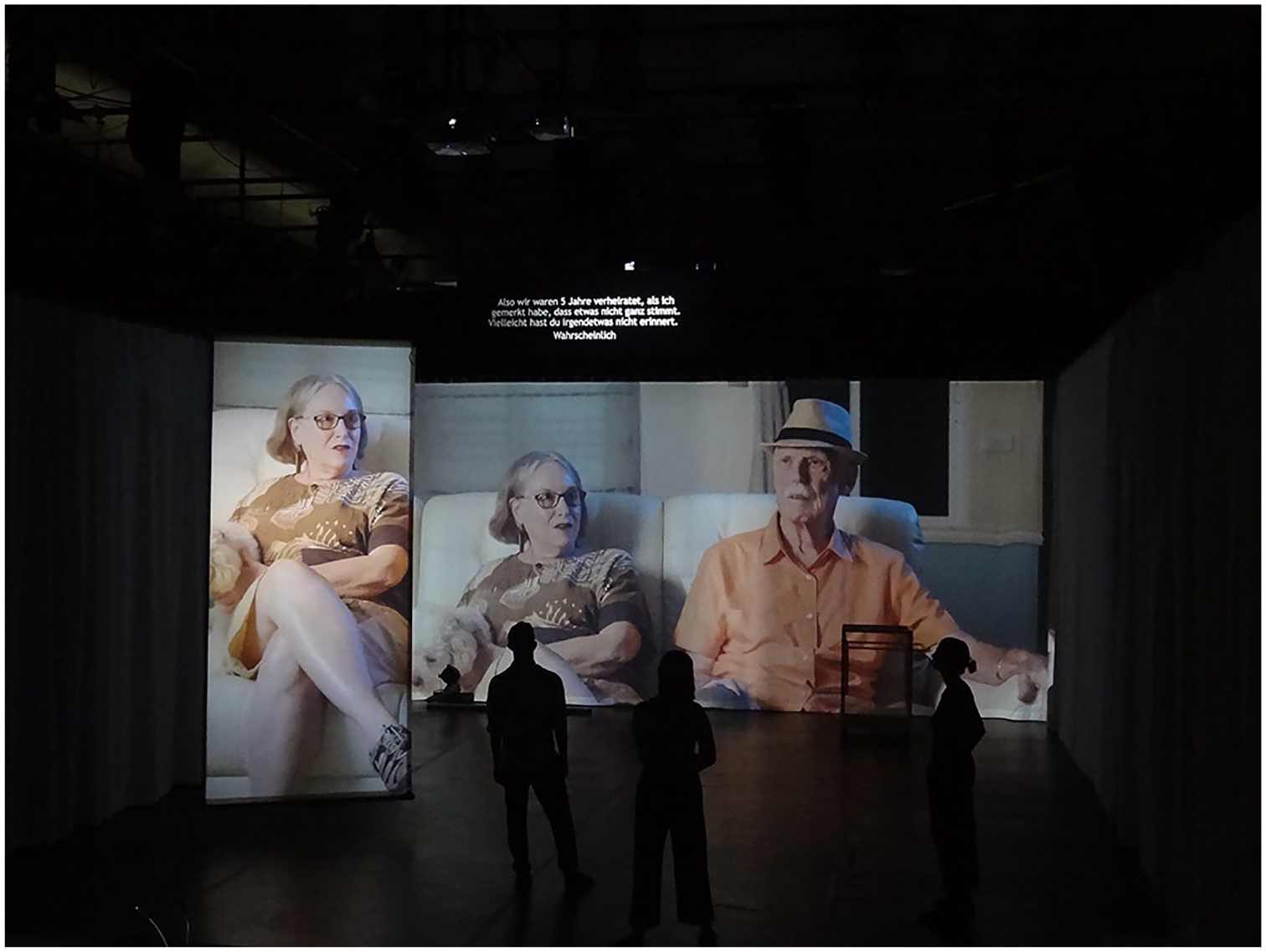
Trudy and Jack. Photograph by authors.
We are grateful for the collaboration and the risks taken, not only by those interviewed in Thailand but also by the performers. It is in part through writing this reflection that we have come to better understand their risks and our difficulty letting go of authorial and interpretive control. When we express our interpretive discomfort with Anna calling up Mary Walsh Hemingway or Nancy Reagan as victims of patriarchy, for instance, we also betray her trust in a process in which she was invited to express her views. When we chafe against David’s comparison of Julia and her husband’s decision, to take their chances with a drug trial that failed, to a cricket match and then characterise both as a ‘fucking waste of time’, we could feel only the pain of such a characterisation from Julia’s perspective. We lost sight of the fact that David was speaking only as himself, putting himself on stage as a potential object of critique. His views were never presented as other than his own, views that are vulnerable to interpretation and critique. And our interpretation is open to interpretation. Responding to a draft of this paper, David and the director felt we had not fully grasped the creative process.
We are grateful for what we have learned through the collaboration and perhaps most especially to be left, not with answers, but with doubts, worries and pressing questions about the work of analysis and translation. Is making obvious the situatedness of interpretation enough? Whose situated interpretation should get centre stage? How do we build the ethic of response-ability, theorised by Kelly Oliver as affirming the capacity of the testifier – rather than the witness – to respond, into our writing and art making? 8 Is it enough to create space for response into symposia and public discussions that follow performance? How do we create interpretive modes in which those we study are not frozen in time, with our interpretive agency given priority? Can we bring audiences too close to those who testify? Do conventional modes of research transmission through journal articles keep readers too far away? Feminist and decolonial theory tells us that the possibility of intrusive and grasping intimacy is a constant risk and that ethnographic refusal is an ever-present responsibility. It tells us that enduring responsible relationships with those we represent is central to ethical research. It tells us that we must learn and relearn these lessons, think about them and then think about them again, through creative experiments, such as the one offered in our collaboration with Costa Compagnie. Our general societal reluctance to face dementia and the challenges of such complex care suggests that experimenting with representation to generate public discussion is well worth the risk of not always agreeing or getting it right. The questions that we ask of Between Worlds are ones that transcend the play. They are questions of the ethics and politics of translation and interpretation that dog all cultural geographers.
Footnotes
Funding
The author(s) disclosed receipt of the following financial support for the research, authorship, and/or publication of this article: Canada Research Chair funding, German Federal Cultural Foundation, Newcastle University Global Challenges Research Fund, Economic and Social Research Council.
