




Abstract
In this article we explore how the English post-industrial canal has gone from enclosed and abandoned urban ruin to thriving but contested urban landscape. We contend that canals deserve closer social scientific attention in and of themselves but also as a creative entry point for understanding the instabilities and ambivalences of contemporary urban life. We probe at three dynamics in the English context: uneven cycles of attention from state, capital and civil society that ‘revealed’ the canal over the course of the 20th century; how the contemporary canalscape is made ‘from below’ and how its unique materiality as a stretched, socio-natural waterway has been mobilised, latterly, in biopolitical ways. We note how the cultivated meaning of these previously enclosed industrial relics is now deeply entwined with the mood and mobility of urban dwellers. Methodologically, we excavate these three dimensions through a synthesis of phenomenological attunement and analysis of historical, literary and social scientific accounts.
Introduction
I met her on a bench, on the bank of the canal, one of the canals, for our town boasts two, though I never knew which was which. . . It was no doubt these trees one fine day, aripple with all their foliage, that had sown the idea of a bench, in someone’s fancy. To the fore, a few yards away, flowed the canal, if canals flow, don’t ask me. [excerpt from ‘First Love’ (1946), Samuel Beckett].
Qviström 1 notes that every landscape has a ‘double character as graveyard and cradle of creation’ and here Samuel Beckett has his homeless narrator settling down in the quiet, darkening canal-side. His recent bereavement has driven him to feel disgust at the stink and cry – the quotidian sensoria – of living humans. His eyes pass over the water, its unknowability a distraction from his torment. Next, ‘Lulu’ arrives, a woman he grows to love but, ultimately, reject. Beckett summons the shifting and uncertain – by the 1940s – meaning of canals within the industrial city (we are never told but ‘our town boasts two’ suggests Dublin) to locate and afford us a feel for his characters. One drifting and listless, the other soliciting sex work, the dusky canal is their covert dwelling-space.
In this paper, we attend to the post-industrial canal as a similarly ambivalent ‘character’ within, in our case, contemporary English urban life. The fulcrum of our analysis is how historically enclosed canals were, over the course of the 20th century, ‘revealed’ to the public generating multiple claims, projects and conflicts. We present this story to do two key things. Firstly, to unpack and examine the drivers of this ‘revelation’ and secondly to explore the complex, shifting relationship between self and world; subject and object that it usefully reflects, one replete with invitations, tensions, promises and repellents. As the ‘historical’ and ‘natural’ become increasingly knitted into urban regeneration agendas to varying degrees of intensity, our paper explores how citizens navigate these emergent dimensions of contemporary urban life.
The paper speaks to and enriches two main areas of scholarship. First, is the body of ruination scholarship attending to sites and places that exist in the slipstream of shifting modes authority lying in various states of abandonment and memorialisation. 2 Our focus on regeneration and place-making from ‘above’ and ‘below’ means we bring this ruinology orientation into encounter with dynamics of capitalist urbanisation to explore canals as an illustration of the lingering ‘wreckage’ inherent in (post) industrial modernity, but in a way that highlights how ruins can become ensnared in what Edensor calls the ‘impossible dreams’ of the regulated city 3 which attempt to delineate and harness ineffable sites and atmospheres. In this case, we see how the spatial, historical and ecological properties of canals all become absorbed into the to and fro of ruins management and activation.
Second, are the strands of landscape geography and post-phenomenology which explore how ‘being-with’ non-human ‘others’ 4 and the ‘great outdoors’ 5 enlaces human meaning, practice and dwelling. Here we bring canals explicitly into encounter with the urban ‘edgelands’ literature, 6 centre the ecological and physical properties of canals and reflect, by the end, how the ‘the creative tension of self and world’ 7 present in landscape can be politically-discursively constituted as well as found and sensed. If work in this area tends towards the ‘terra-centric’, 8 we bring it into dialogue with geographies in tune with the material properties of water (flow, unpredictability, volatility, volume) and, in particular, scholarship working to explore waterways as sites of cultural meaning, dwelling and ‘alternative’ practice. 9
Overall, our approach is informed by an off-kilter way of seeing and sensing richness and potency in apparently ‘mundane’ landscapes. 10 In this sense, we offer an ‘empathetic and sensual’ 11 excavation of the peculiarities of industrial canals in line with a poetic and political attendance 12 to the constituencies of the indeterminate ‘Dionysian’ city 13 : the wastelands, ‘tactics’ and rhythms that stand in tension with the lineaments of state and capital. That said, we are circumspect about narrating a unitary, transformative account of ‘everyday’ urban spaces and practices 14 borne of our own uncertainties about the resources and energies that canalscapes, in this case, absorb and encode. Our approach here has a more speculative inflection, one which, to a degree, ‘passes over’ the canalscape. 15 The canal in our analysis, then, becomes a metaphor for both the uncertainties woven into the late neoliberal ‘urban political’ 16 and our own ambivalent orientations which, we contend, enables us to navigate between ‘singular’ and ‘reparative’ modes of critique and stay with, usefully and progressively, the contradictions, fragmentations and uncertainties in social life. 17 In the next section, we discuss our methods and cases before moving on to our three-part account of how and what kind of places, landscapes and enlacements post-industrial canals now offer and afford in the contemporary English city.
Cities of Flows
The Sankey (in 1757) and Bridgewater (in 1761) canals opened in Merseyside and Lancashire, heralding an English ‘golden age’ or ‘mania’ of canal building. 18 Dublin had its canals by the 1810s whilst by 1850, England had a network of over 6000 km enabling commercial barges to criss-cross the country, linking the four major river basins of Severn, Mersey, Humber and Thames. Canals integrated and transformed England’s economic geography, 19 enabling new flows of labour, capital and population to and from cities, the surrounding seas and intensifying ‘ventures’ of maritime expansion and colonial exploitation. 20 Both industrial ‘heartland’ (Birmingham, Manchester, Leeds and Sheffield) and seaport cities (Liverpool, London and Bristol) now had multiple, discrete channels of ‘bad’ canal water 21 coursing through them necessitating countless basins, wharves, tunnels and locks and inviting hefty factories, breweries, mills, storage yards and gasworks. 22 All this came at the expense of the ‘navvies’ who built the canals under extremely dangerous conditions 23 and the itinerant ‘bargees’ who worked on the canals undertaking arduous labour only to be demonised by ‘respectable’ (land-bound) society. 24
Today, as you pull slowly into the main train station in Leeds, Yorkshire and glimpse downward, the Leeds and Liverpool Canal (LLC) squints back. It has lain there since the 1770s, connecting the River Aire and, ultimately, the North Sea in the east with the River Mersey and the Irish Sea to the west. It transported mainly coal from the inland collieries but also limestone and textiles to and from mills and merchants throughout the English north-west. It ended/began in central Leeds before stretching away and through the eastern suburbs of Armley and Kirkstall before looping north west through Bradford, Shipley and then Keighley on the fringes of the Yorkshire Dales. Turning back south west, it connected the Lancashire mill towns of Burnley and Blackburn and ended at Liverpool docks (see Figure 1). At 127 miles, it was the longest continuous canal in England but by the 1970s, it had largely closed as a commercial channel and, as a global-relational force shaping the city of Leeds, was spent. Today, the five or so miles of LCC within the city boundary of Leeds remains relatively unchanged, with no draining, infilling or covering, and is available to cruise, walk, visit, gaze and feel.
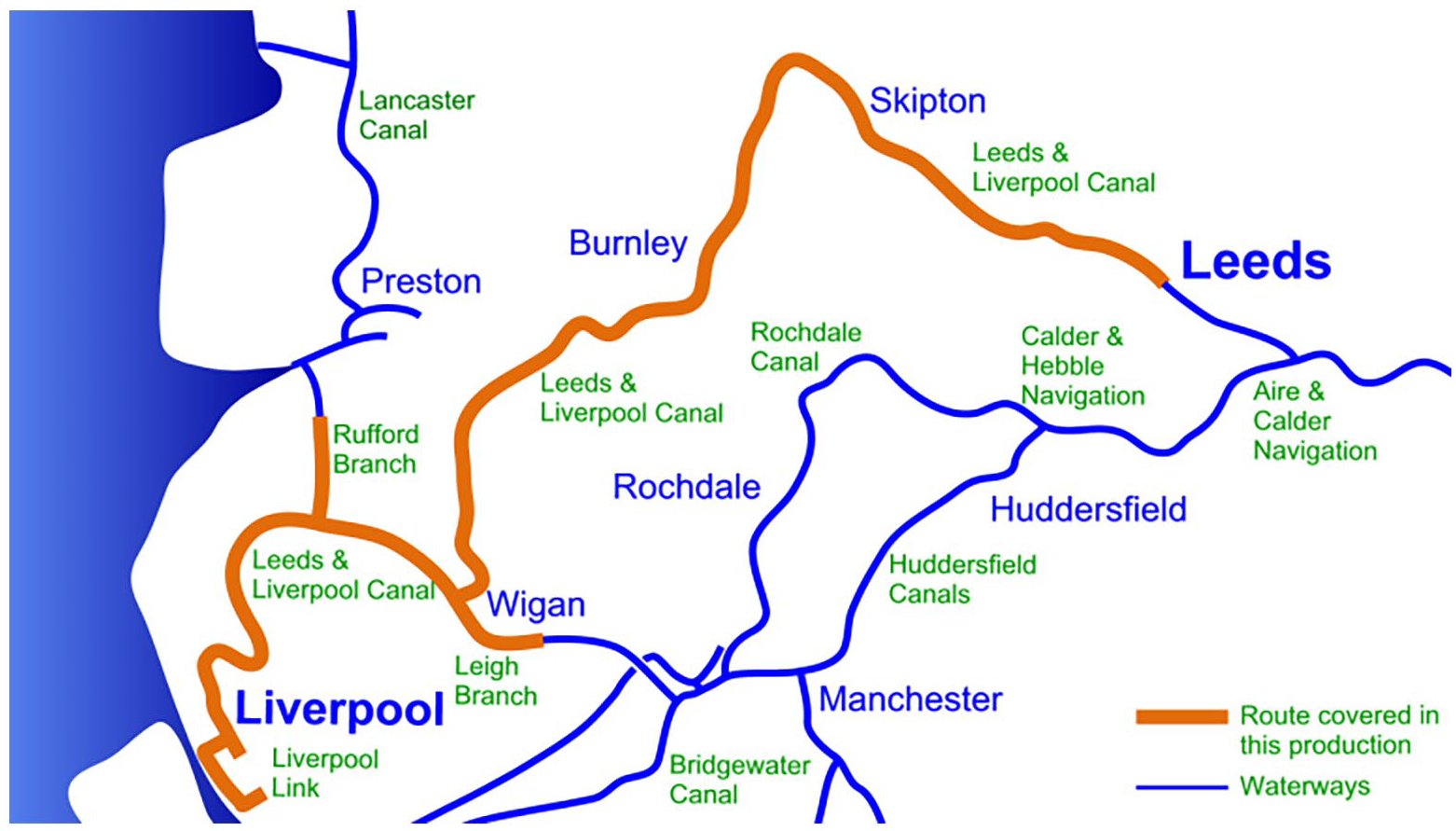
Map of Leeds Liverpool Canal.
The Regent’s Canal (RC) in London was overseen by John Nash, friend of the Prince Regent (later King George IV) and was completed around 1820. It was designed to link a downriver section of the River Thames with the Grand Junction Canal (opened in 1811) which connected west London to the industrial Midlands. The point of intersection was at Limehouse Basin in the east end docklands area, before travelling north and looping west through what we know today as a succession of inner-city districts where working class histories, communities and industrial landscapes jostle with cafes, bars and waterfront apartments: Mile End, Hackney, Hoxton, Islington and Camden Town. It skirts around Nash’s Regent’s Park (opened in the 1830s) before taking in the leafier areas of Maida Vale and St John’s Wood before ending in Paddington in the west (see Figure 2). It last saw commercial action in the 1960s but like the LCC has not been permanently drained or significantly physically altered since its inception (unlike, say, the (much wider) Canal St Martin in Paris, covered to enable 19th century Haussmanisation or indeed London’s Grand Surrey Canal – covered by roads and parkland – south of the Thames). It is around 8 miles long and, today, as part of the city’s larger waterway network, 25 is an increasingly visible part of London’s everyday fabric.
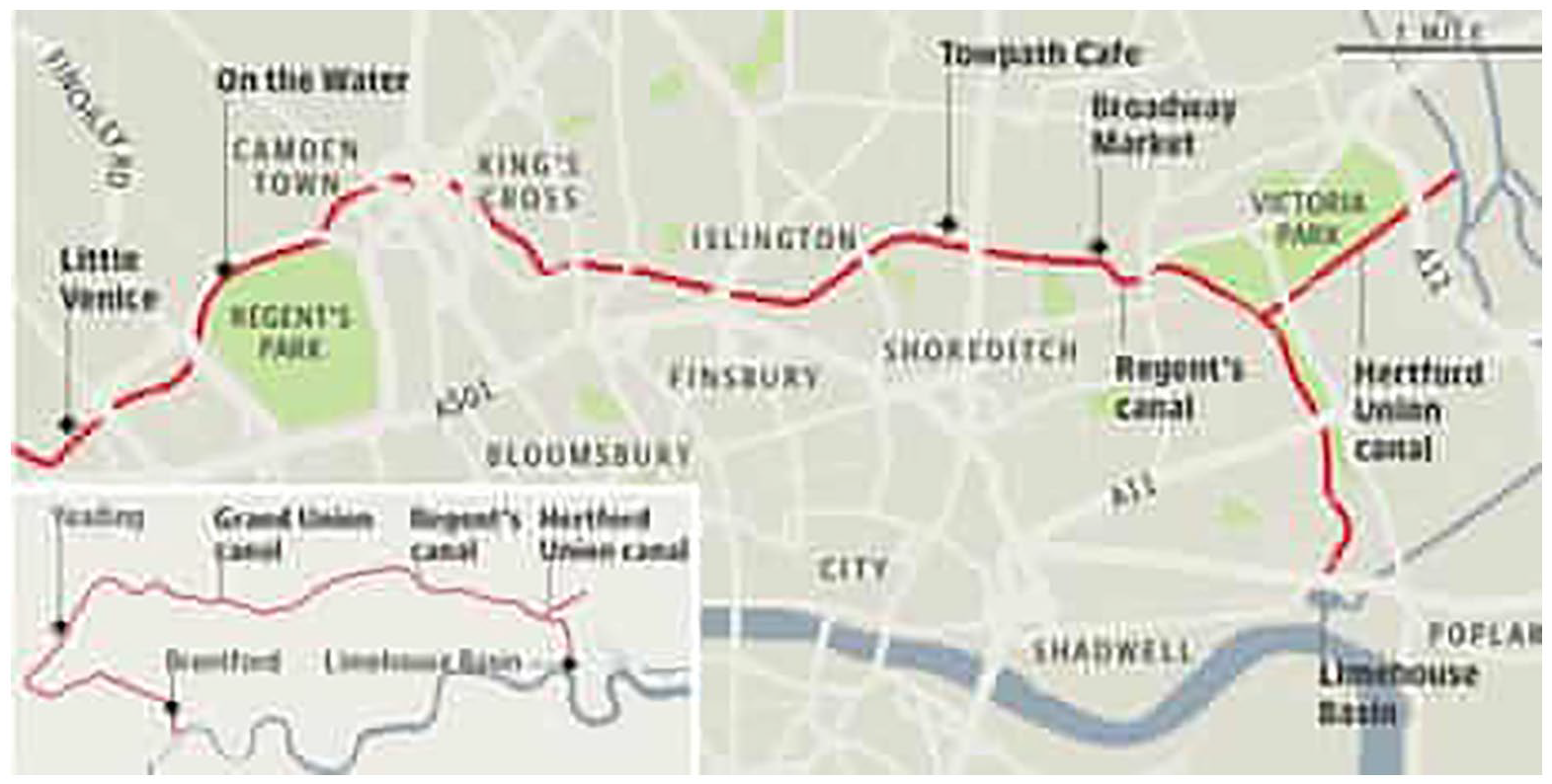
Map of Regent’s Canal.
We began explicitly investigating British urban canals in 2017. We had never lived on or cruised a canal boat but came to realise that we knew several boaters amongst family and friends. We both lived, worked and spent leisure time near the LCC and RC so walking or cycling along towpaths was a regular feature of our daily lives. Such regular encounters had elicited something akin to what Edensor describes as an ‘attunement’ with this unique environment rooted in ‘empathy with other times, people, events and non-human agents’. 26 The canal sections we knew were compelling contradictions; they were murky and rubbish-strewn relics but also ecologically and materially rich. They were mute and sunken liminalities one minute, polished and carnivalesque the next. They could elicit soothing or unsettling feelings depending on which bit of the canal you were in, when and near whom. Best of all though for us land-bound observers, they felt unknowable, stretching away endlessly into the peri-urban and beyond. Woven into our ambiguous responses was a recognition that canals had a mounting significance within British cities. Growing numbers of people were becoming ‘liveaboards’ amid a spreading crisis of housing affordability 27 whilst towpath commuting is said to have increased steadily. Piecemeal canal regeneration had been happening in cities since at least the 1970s, but more thorough going and multiple renaissances seemed to be gathering pace. These canals had drawn us, and millions more, in. The meshing of time (ruination), space (channels, paths, routes, verges), human hand (engineers, dredgers, boaters, conservationists) and nature (principally, water) had produced a curiouscape situated in awkward, uncertain relation with the urban dominant. We resolved to probe further at the unsettled afterlife of the English canal.
We spent 18 months undertaking ethnographic work and tracking online media, public and policy debates. During our regular journeys along the LCC and RC towpaths, we took photographs and made notes in field diaries regarding the rhythms, smells, sounds and atmospheres of the ‘canal-scape’: the water, the towpath and whatever immediate surroundings we found overlooking and enclosing the canal. We also conducted spontaneous conversations with boaters and Canal and River Trust (CRT) – the body responsible for managing inland waterways in England and Wales – volunteers. These conversations furnished us with fragments of experience regarding the contemporary politics and navigations of canal life. We walked the urban stretch of the LCC together and separately and each walked different stretches of the RC and LCC individually on multiple occasions. All our walks occurred in daytime hours avoiding what poet Ted Hughes called the canal’s ‘drowning black’. Canal boaters are a mobile and dispersed population but make use of digital spaces. 28 It made sense, then, to tap into these, such as public Facebook groups, to capture issues, conflicts and orientations amongst boating communities.
Revealing the canalscape
O the river in the street!
Fantastically you’ll meet
Behind high five-foot walls,
Never a sound does it make,
Its water pure yet opaque,
Peacefully there it crawls.
[from Streets II from Romances Sans Paroles by Paul Verlaine, 1874]
The ambivalent afterlife of the English industrial canal cannot be disentangled from its industrial heyday. As Verlaine and Rimbaud staggered between the lines of London’s frantic modernity, the crawling, silent Regent’s canal remained a commercial and enclosed affair. Canals were populated only by bargees (and sometimes their families) and the horses, donkeys or ponies used to pull barges along the tow (or towing they were known then) paths in lieu of a current. Fences, walls and signage would come to make clear these were resolutely not public spaces (see Figure 3).
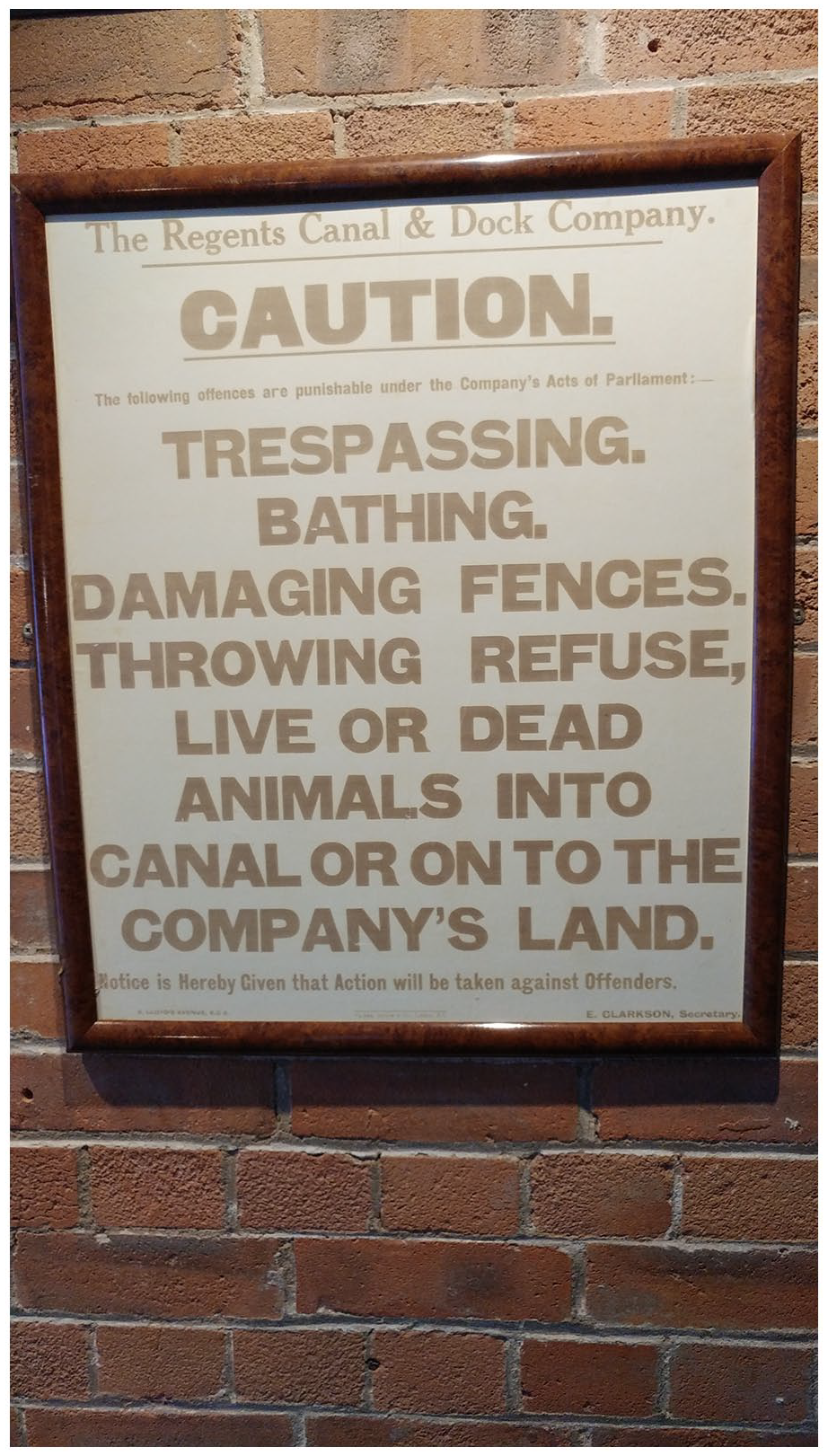
Caution sign from Regent’s Canal and Dock Company. Photograph taken in London Canal Museum by Andrew Wallace.
A walk along those same, now public, towpaths today is to be reminded of your trespass on these ghostly ‘taskscapes’. 29 Your ‘immanent immersion’ 30 brings encounters with low, dripping bridges, crumbling bricks, rope grooves, cracking lime mortar, rusting bollards, mossy horse ramps and faded mileposts (see Figure 4). Unlike an abandoned factory or mill, however, which might bear physical traces of habituated working lives, 31 these are not accumulations of social worlds per se, but sediments of slow industrial transit and wayfinding that constituted the rhythms of bargee life.
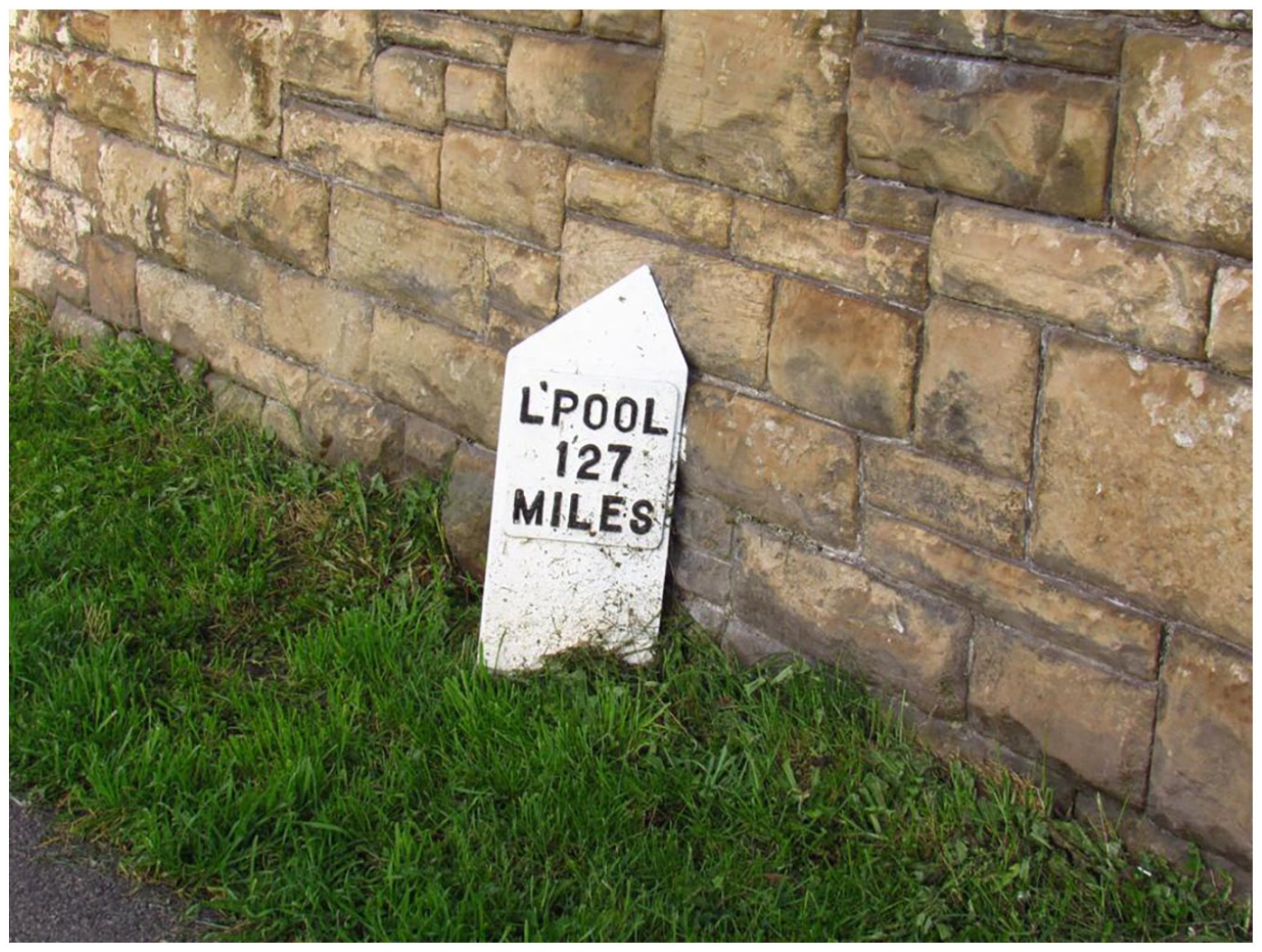
Leeds Liverpool Canal milepost. Photo by Katy Wright.
If contemporary urban canals are always in this slipstream, they are inflected with atmospheric differences, depending on context. In our case, the LCC in Leeds tends to be more languid (see Figure 5) whilst stretches of the RC can be fierce with boats, people and construction (see Figure 6). They offer different intensities of place-moments happening on the water, towpath and surrounding environment. That these moments have been able to accrete demonstrates that both canals have been widely recovered.
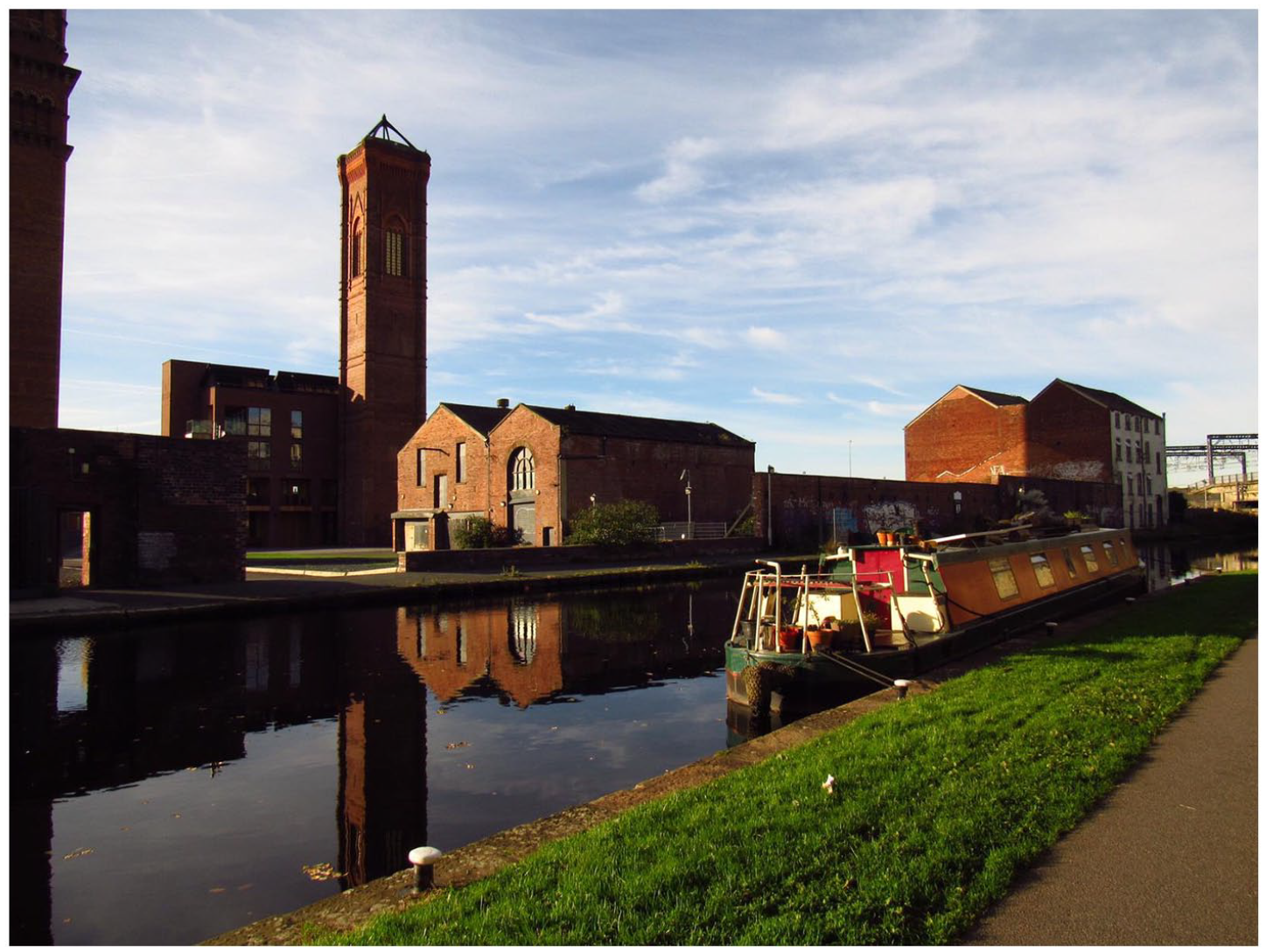
Languid LCC in central Leeds. Photo by Katy Wright.
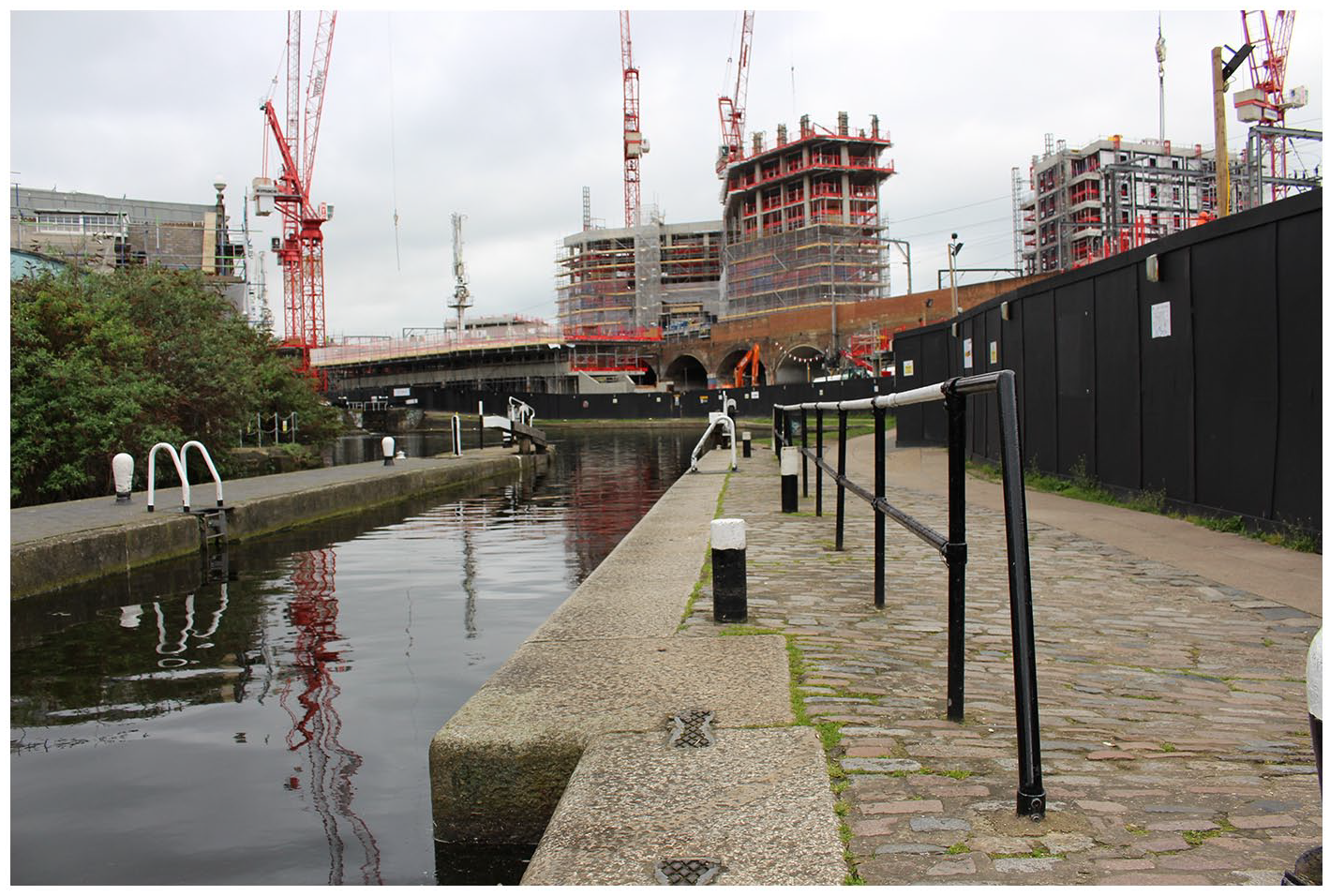
Construction work along the Regent’s Canal near Camden Town. Photo by Andrew Wallace.
By the early 1800s, water was being catalysed in a different way, this time to propel steam locomotives. By the 1860s, railway had become more efficient than canal boat at transporting freight and over the next century, canals fell into gradual disuse. Like other parts of Europe, the UK soon had a plethora of ‘waterway-scarred landscapes [leaving behind]. . . material reminders of days gone by’, part of a spreading post-industrial dereliction manifested in alien ‘moonscapes’ of abandoned brickworks, and vast swathes of poisoned, scarred and despoiled land left behind by extractive industries. Much canal water leaked out or dried up, making canals ‘a convenient place for rubbish disposal’ and a ‘muddy, stagnant’ presence in many towns and cities. Canals became unpopular, commonly dubbed as ‘stinking ditches’ – and became the focus of campaigns for closure and infilling. 32
Unlike other water systems, canals in the UK were never part of Fordist-Keynesian era grands projects ripe for 1980s neoliberal privatisation – quite the opposite. In fact, as a social and environmental ‘externality’ of capitalist accumulation, its management fell within the purview of the state at national and urban scales. 33 The British Government temporarily nationalised the UK’s canals during both world wars before permanently nationalizing them in 1947. At this point, however, they were still considered an inefficient freight transport system and parts of the network continued to be closed. The 1968 Transport Act proved decisive. It was used to introduce three categories of canal designation: ‘Commercial’ (the few that were left), ‘Cruiser’ (for leisure boating) and ‘Remainder’ (for elimination or disposal). This came after the 1963 ‘Great Freeze’ had brought industrial canal traffic to a solid stop and after persistent campaigning from the Inland Waterways Association (IWA), formed in 1946 to great effect by a small group of conservationists including L.T.C Rolt, author of the bestselling travel book Narrow Boat (1944) and occult fiction writer Robert Aickman. From the 1960s onwards, conservationists campaigned against closures and undertook successful restorations, producing cleaner, more pleasant environments in which leisure boating could become more widespread, as could full-time liveaboard living for those with a taste for ‘escape’ from ‘standardised thought’. 34 By the late 1970s, the previously private towpaths began to be opened up as ‘permissive paths’ for use by walkers and cyclists although public access was not formally legislated for until 2012. It was also then that the Government, which had directly managed the canals via British Waterways, transferred responsibility to the mutualised Canal and River Trust (CRT) as part of the UK’s post-Great Recession fiscal austerity drive.
The previously concealed industrial canal, then, had gradually undergone a ‘semi-translation’ of landscape 35 and entered the field of vision of the wider British public via unevenly distributed agendas, projects and representations. Alongside the volunteer-driven restoration and repair of some stretches, within cities canals often remained largely ‘indeterminate spaces’ 36 that could be woven into anxious portrayals of urban decay whether in film (e.g. Lynne Ramsay’s 1999 film ‘Ratcatcher’ set in 1970s Glasgow), critical travelogue (e.g. architect Iain Nairn’s scathing portrait of the LCC’s abandonment in ‘Nairn Across Britain’ in 1969) or drama serials (e.g. the murder of ‘Dirty’ Den Watts in the BBC’s London soap opera ‘Eastenders’ watched by 20 million viewers in 1989). In these accounts, canals seem to become emblems not just of edgy territory, but symbolic reminders that the power of capital continues elsewhere. 37
Then again, by the 1990s, this imagery would have to exist in tension with the regeneration of England’s central urban canal zones. Real estate developers – and urban managers keen to revalorise the city – had begun to commodify the vacant ‘brownfield’ land 38 that surrounded city centre basins and wharves, building new marinas, apartment buildings and consumption zones, in line with a wider strategic targeting of urban waterfronts and the residentialisation of industrial property. In Leeds, Granary Wharf (1990s) became (and remains) a ‘landmark’ mixed use development on the LCC, whilst Limehouse Marina, built as part of the same docklands regeneration as the Canary Wharf banking district in the 1980s and 90s, sits where the River Thames meets the RC. In Manchester, the Canal Street ‘gay village’, Castlefield locks and Deansgate Locks remain fixture nightspots (see Deas et al 1999), whilst Birmingham built an exhibition centre and sports stadium in 1991 near the redeveloped Gas Street Basin. 39 These projects would preface three decades of intermittent urban canal regeneration juxtaposing rusting materiality, opaque water and the malleable echoes of ‘heritage’ with the ‘ordering imperative’ 40 of smooth retail and consumption space.
These agendas have manifested differently along the LCC and RC, as befits their differing urban and regional economic geographies. Leeds has not quite, yet, become the ‘waterfront city’ that regeneration lobbyists have been pushing for and residential construction on or near the LCC has been stop/start, 41 although the £500m ‘South Bank, Leeds’ project has a remit to regenerate the historic central industrial district near the LCC. Walking from this area brings encounters with some elegantly choreographed locks, cranes and an historic canal office whilst things quieten quickly as you near Canal Mills (now an events venue) and move towards Kirkstall where the imposing old brewery building is a now student halls of residence (field notes, 2/7/19). The RC, on the other hand, has been steadily enclosed by public and private house-building since at least the 1970s. Recently, expensive apartment developments have dominated, especially in gentrifying east-central London (field notes, 22/5/19). 42 And canal basins have been heralded as the new ‘village greens’ of central London. 43 Pubs, cafes and restaurants are never far away and by the time you reach the King’s Cross area, you can glance across the brick and plate glass to see the offices of the Guardian newspaper overlooking the small but effective London Canal Museum housed on the site of a 19th century ice well. Push past here and you reach ‘Coal Drops Yard’ – a retail and consumption zone a few minutes from King’s Cross railway station and part of the new £2 billion ‘N1C’ property development. 44 Here the RC has become a supremely curated backcloth, authenticating a slice of the late capitalist urban ‘experience economy’. 45 Heritage ‘trail’ information is provided, original fixtures are refurbished and the ‘canal boat people’ – including ‘Dickensian-looking James’ – of St Pancras’ Cruising Club are celebrated in a window display as one of the ‘hidden tribes’ inhabiting the lively interstices of this new urban district (field notes, 22/5/19).
Canalscapes from below
Despite all this development, as one drifts along the canal towpath, in even the most built-up environment, there is a sense of being in a somewhat quiescent, even neutral space. A surrounding neighbourhood or nearby construction work might make itself apparent, but the canal itself feels detached, enabling passage by and through or dwelling beyond the city’s legible grid. This is another feature of the canal’s opening out. Unlike other industrial ruins, there is no real call for illegal trespass or subversive ‘urbex’ (urban exploration) tactics. Taking advantage of this and weaving through a busy towpath you sense how, after sufficient restoration and legislative allowance, a mass of activity from below gradually took hold in England’s waterways. Feeling your legs pounding the gravel, nodding at passers-by and putting away moment after moment, you ponder the canal as a site of ‘representational space’ or urban ‘spatial practice’ 46 borne of extended possibilities of rhythm, dwelling and encounter within the city. Canals have, to a degree, become ‘soft’ infrastructures 47 integrating the city and supporting urban life.
But we should not get carried away. Canal towpaths can be unilaterally closed should developers or engineers need to fence off access, conduct engineering work or if there is flooding, forcing you to default to tarmac as happened during the 2012 Olympics in east London. 48 Mobility is also hierarchised, of course, by constellations of bodily privilege, whilst a sense of detached ‘neutral’ space will perhaps unnerve as many as it entices. It might also be a delusion. In 2012, when the CRT took over the waterways, having the canal network digitally mapped was central, it was argued, to improving public use and understanding. A deal was struck with Google to map the towpaths, bringing them into everyday commuting and navigation decisions and in 2017, the Google ‘trekker’ – a ‘street view’ camera transported by backpack to film locations inaccessible by vehicle – was loaned to the CRT and its volunteers to construct 360° imagery of canals on Google maps. The CRT also developed an Open Data project using ArcGIS software to map the canal network and its related structures, amenities and attractions and launch an app Open Canal Map to aid navigation. The revelation of the canal was now digital and our navigations of it increasingly algorithmic and trackable. 49
For the growing number of commuting cyclists navigating the city via Google Maps (us included), they now had ‘fast’ routes directing them away from roads and onto narrow towpaths (1–2 m wide) helping to increase congestion at peak times. This led to a petition demanding Google change their algorithm and downgrade towpaths to a maximum 5 miles per hour classification. 50 It also contributed to tensions around contrasting rhythms of towpath mobility which have grown steadily in recent years as walkers, boaters, joggers, anglers, birders and others jostle with cyclists for space, 51 whilst an outbreak of bellringing, shouts, harrumphs, tutting and barking can make a mockery of the CRT’s vision of canals as calm, ‘super slow ways’ in busy cities. 52
All this, of course, is to align the plurality of the canal towpath with attempts to escape or circumvent the hassles and overloads of regulated or commercialised urban life in relatively ‘respectable’ ways. Canals might be mapped and easily foreclosed, but there remain long stretches peripheral to the street lit urbanity of bourgeois, heteronormative manners. 53 There are tunnels, steep banks and dense greenery. Dozens of tents belonging to homeless people are visible along the RC and LCC and a daytime walk brings us into contact with drinkers, smokers, graffiti artists, truant kids taking selfies and idlers of an indeterminate kind. One walk also saw us encounter three conspicuous looking police officers smoking and drinking coffees in a thicket of trees. Urban canals can reveal what Beaumont calls ‘the presence of individuals occluded in the chaotic circumstances of the day’. 54 Beyond our casual observations and into the night, parts of the urban canal-scape are reported to be important sites for cruising, dogging, sex work and drug-taking. 55 This ‘deviance’ must contend with regeneration schemes residentialising parts of the canal-scape, increasing scope for ‘public decency’ complaints, and a spreading urban surveillance infrastructure organised through growing numbers of CCTV cameras in crime ‘hotspots’ and policing campaigns like Marine Watch and London Canal Watch. 56 A passing glance at the news tells you that canals also remain sites where serious criminality and death can occur.
Out on the water, the social dynamics are similar borne of many of the same pull (liminality, freedom) and push (over-crowded and polluted cities) factors. 57 With itinerancy, the scope for practising alternative, ‘off-grid’ forms of work, home and dwelling is greater. 58 This can be about living cheaply to pursue a creative career, escaping difficult personal circumstances (an understatement in the case of IRA operatives said to be hiding on canal boats in the 1980s) 59 or adopting an ‘alternative’ lifestyle and identity. Smith 60 notes an almost ‘spiritual’ dimension to some boaters’ imagined relationship with nature and land whilst Bowles finds boaters’ nostalgic and anxious about the ‘enclosure’ of the canal, the ‘last bastion’ of common land in the UK. He finds that boaters enjoy the canal as a manual and analogue space – a ‘closed off little world’ – one that is being threatened by resurgent surveillance and development attention of state and capital. 61 For others, the enforced minimalism and simplicity of life in a small space is appealing 62 and there is a feeling that it represents a more sustainable and environmentally friendly way of life. 63 That said, liveaboard life can be uncertain and onerous, especially for those without permanent moorings (‘continuous cruiser’ licenses cost £500–£1000 per year and require that boat must move every 7–14 days to a new site and cruise at least 20 miles per year). Constant moving can undermine relationships with work, education or services, bad weather can limit mobility, whilst some moorings have few or no facilities to help with the daily domestic labour of emptying toilets, refuelling engines and stocking up on fuel for cooking and heating. 64 Startling increases over the last decade means this is a trade-off with which an increasing and record number of permanent liveaboard boaters must contend. 65 Demonstrating the charged importance of controlling rhythm and time on the water as well as towpath, Bowles 66 notes that continuous cruising imposes a rigid temporal logic that flies in the face of ‘boat time’ – a slow, ‘other’ and ‘discontinuous’ cruising tempo that some boaters enjoy as they look to subvert the accelerated, capitalist rhythms of settled life. With the enlargement and extension of these worlds, has come conflict within and between boating constituencies. Not only do more established boaters’ express frustration with the speeding and alleged incompetence (field notes 15/10/18) of those less inexperienced, sometimes in clearly gendered ways 67 but the increased prevalence of continuous cruisers has provoked sustained anxiety.
As the English urban canal-scape has been grown in visibility, its waterways and towpaths have been transformed. Within congested cities, citizens have shaped, not only projects of restoration, but practices of dwelling, mobility, work, home and much more besides, further hybridising and complicating canal meanings, functions and politics. State and capital are continually, ambiently present on and beside the water but have to work with, against or in spite of this realm of everyday life. Attending to this realm works as ‘another way of telling’ the city, for example envisaging the canal as a ‘linear village’ of complex belonging 68 rather than the intermittent enclosures of ‘place’ imagined and created by real estate developers. That the urban canal hosts such diversity today cannot be disentangled from its industrial before. However, without attending to the unique landscape bequeathed by this ‘before’ and how this shapes some of the encounters, projects and affordances we have mentioned, would be an oversight. It is to this aspect that we now turn.
Natural health service
Leafy-with-love banks and the green waters of the canal
Pouring redemption for me, that I do
The will of God, wallow in the habitual, the banal,
Grow with nature again as before I grew.
The bright stick trapped, the breeze adding a third
Party to the couple kissing on an old seat,
And a bird gathering materials for the nest for the Word
Eloquently new and abandoned to its delirious beat.
O unworn world enrapture me, encapture me in a web. . .
For this soul needs to be honoured with a new dress woven
From green and blue things and arguments that cannot be proven.
[‘Canal Bank Walk’ by Patrick Kavanagh, 1954]
The British Isles’ hydrospheric abundance and obliging topography provided an ample supply of water which was channelled into ordered space by the labour and genius of canal diggers and engineers. The result was a network that collapsed distances and metabolised resources and ecosystems from elsewhere. Patrick Kavanagh came to poeticise this ‘assemblage’ in the 1950s as he recuperated from ill health by the Dublin canals. Forget Beckettian ambivalence, here his narrator wills for complete subsumption in the natural, mundane but sublime canalscape.
Standing by a modern urban canal is to be folded into the enigmatic entanglement of nature and culture that so beguiled Kavanagh. These narrow and shallow ribbons stretch out in front and behind seemingly providing seamless routes to, from and through the city and its peri-urban and rural hinterlands. This entanglement has proven deeply alluring and highly adaptable, entwining conservationists, developers, entrepreneurs and the mass of people in various projects of protection, enjoyment, navigation and creation. On the water, the (relatively) orderly buoyancy that enriched the new industrialists has become feted in ‘mobile times’ 69 for its capacity for safe and slow passage through the city. There remains, obviously, an instrumental dimension to the relationship with canal water for liveaboards navigating the city, but the buoyancy and etching of canals into the built environment can also offer unique urban angles and atmospheres. Boaters can cruise slowly and surely, drifting past, through, towards and away from the city, its denizens and their fixed points of view: woodland, towpaths, benches, pub tables, boat cafes, residential balconies, working industrial estates or points of tourist cluster. A growing, floating industry of tours, restaurants and bars sell this distinctive feel, charging you for the liberty of modest watery drift without any of the ‘bodily work’ which dominated the life of the bargee. 70 For many, canal cruising still involves intense labour 71 whilst others have resources for exit and enclosure. The gated boating communities, marinas and exclusive wharves along the LCC, but especially the RC, give pause to consider how canal water (and the ‘boat time’ it affords) has become another site and register of urbanised class division.
Urban canal-scapes might not be urban ‘bluespaces’ quite yet, 72 but today, thanks in part to restoration efforts, but also the agency of the more-than-human, 73 stretches are rich with marine life, bird life, ducks, snakes, rodents and are surrounded by stone, trees, grassy verges, bushes and undergrowth, not to mention the mosses, lichens and rust thriving on exposed rock, dank tunnels, locks and bollards. The extent of this agency was revealed in 2014/15, when parts of the RC were drained for repairs revealing hundreds of fish including carp and pike surviving amongst a polluted, sunken montage of late modern debris including shipping trolleys, delivery bikes, mobile phones, digital cameras, not to mention an unexploded hand grenade. 74 It is, of course, this sense of interstitial wilderness within the city that has brought canals within the purview of developers looking to commodify post-industrial urban nature in ways that recall ‘linear parks’ such as Manhattan’s High Line. 75
There are obvious points to be made about the ‘greenwashing’ of real estate-led urban development. Back in 2003, the UK Government launched its ‘Wasted Space’ campaign naming canals as examples of ‘derelict’ ex-industrial urban land which could be regenerated, whilst today the regeneration of canals is more typically narrated in terms of sustainability and liveability. 76 This, however, dovetails with (and sits in tension with) a more subtle mobilisation of the English canalscape’s natural/historical landscape. In 2018, the CRT rebranded itself as a ‘wellbeing’ charity, adopted the slogan ‘Making Life Better by Water’ and began to embrace its role in reinterpreting and recontextualising canals as therapeutic and inclusive environments. This has expanded the need for volunteers who can help to continually bring the decaying canal back into ‘sensual order’ 77 by helping to pare back, even out, secure in place and restore flow. It also meant developing strategies to convey the ‘healing powers of the towpath’ (see https://canalrivertrust.org.uk/enjoy-the-waterways/walking). This happens in an aesthetic, vernacular register through projects like the ‘Arts of the Waterways’ programme connected with the enchantment of landscape in the case of the LCC (the Super Slow Ways programme https://superslowway.org.uk/) and by partnering with the staging of mega-events and ‘legacy’ missions such as the 2022 Commonwealth Games in Birmingham. It also happens in more tactile and embodied invitations to use canal for hiking, fishing and canoeing. These activities, the CRT suggests, can help us ‘enjoy life by water and turn a new tide’. To urban dwellers living in charged and unequal conditions, they make two specific pleas. First, to ‘try and make room for our canals in your day-to-day life and feel better’ including taking canal walks to and from work and, for those who get them, during lunch hours. Here, canals are narrated as physical and psychic infrastructures of wellbeing which can work with, embroider, and soothe the rhythms and aches of paid labouring life. At home too, the CRT reminds us, canals are on hand, especially for the urban poor. As chair Allan Leighton explained: ‘Eight million people live within 1 km of our canals. . . if you look at the path of our canals. . . they run very close to the communities who are most in need of the wellbeing they offer. We are in a unique position to improve people’s lives. We’re there, we’re on your doorstep already’. 78
The Covid-19 lockdowns have intensified the role of canal-scapes in many people’s lives but also opened up questions about how dependent salutogenic environments (and indeed phenomenological knowledge 79 ) are on direct touch and feel and, therefore, how this kind of landscape therapy might be communicated. For the CRT, one response was to coin the neologism ‘Natural Health Service’ in an attempt, presumably, to draw from the wellspring of public support for the National Health Service during the pandemic. Another way was to embrace the possibilities of what we might call digital salutogenesis through webpages labelled as ‘canals at home: our best bits’ replete with representations of canalscapes in the forms of images, films, poems, quizzes and Zoom backgrounds headed with the tagline ‘We’re making life better by water, online’. Navigating to another CRT page and we come across a recommendation to download an app called Urban Mind which provides access to ‘a personal wellbeing report free via your smart phone’. For those able to physically visit canals or the wider urban environment, the app tracks how your mental wellbeing is affected by our surroundings and feeds this data to environmental psychologists. The CRT supports the research, they say, because it will help ‘make the case to partners and funders of the importance of looking after and investing in Britain’s former industrial canals and rivers for the benefit of everyone’. The future of the canal-scape in the UK now partly lies, they imply, in its capacity to enlace and shape ‘human capacities, relations and experiences’. 80
Conclusion
Using the revelation of the English urban canal as a case study, our paper has traced how different legibilities and intensities of order get woven through the urban landscape generating ambivalent and uncertain subject-object relations. We have probed at how, in this case, the combination of time (canal as industrial ruin and urban ghost), space (canal as channel, route, path, verge) and social action (conservation practices, mobilities, deviances and so on) enabled a semi-translation of landscape 81 to emerge in English cities, meshed with claims and forces that have interplayed to generate new possibilities, restrictions and invitations. We presented this as both a chronological narrative and a shifting terrain of phenomenological engagement. We saw how industrial canalisation in the UK involved a harnessing of nature to aid capitalist modernisation. This restricted meaningful engagement to the engineers and bargees who lived, built and cruised the canals although, as Verlaine reminds us, enclosed canals were absently present ‘behind the wall’ in 19th century cities. Nonetheless, after it was abandoned, the canal network was unconcealed, revealed and restored, opening it up to explicitly to competing projects, claims and uses on, beside and near the ‘bad’ water. The historic scars and ecological frissons of the canal-scape became resources for citizens to use, claim, feel and consume in different ways, albeit subject to various inequalities and conditions. With the advent of the ‘green’ infrastructure, sustainability and wellbeing agendas noted briefly here, we saw how urban canals then became normatively inflected as spaces or landscapes we should use to reproduce our lives in responsible ways. This works to not only further enlarge ‘respectable’ usage of the canal-scape but brings its visibility and publicness into close relation with the management of our moods and mobilities. Canals, then, cease to remain worlds we may choose to encounter in the act of navigating and dwelling in the city but become, arguably, an affective and material demand on our urban citizenship under deeply unequal conditions: to keep it, you need to come, log in and feel it.
Our position here has been to adopt a somewhat ambivalent orientation which slips between concrete excavation and phenomenological attunement to sense, poeticise and politicise but not romanticise the hybridity and counter-spatiality of the canalscape. We remain circumspect about the transcendent power of ‘everyday’ urban spaces and wary of what might be obscured or overlooked in affectively ‘reparative’ scholarship ‘in search of a better story’. 82 We are aware that staying with such tensions has some risks, though, as thousands (like us) appear to surge to the urban canalscape to escape, move and dwell. A radical, urban commons agenda that could protect waterways and towpaths from sanitised heritage and deepened privatisation is one alternative, normative register; one that would certainly draw canals definitively away from much of the rest of the industrial ruinscape and the lineaments of abandonment, demolition, sanitisation or even ‘curated decay’ we find there. 83
Footnotes
Acknowledgements
We would like to thank participants at the conferences where we first presented this paper: the British Sociological Association and the Royal Geographical Society. We also thank the reviewers and editors for their helpful comments.
Funding
The author(s) received no financial support for the research, authorship, and/or publication of this article.
