




Abstract
This article extends our understanding of inland waterways by theorising the temporary absences of water in canals and rivers as possibilities for action, that is, affordances. The interplay of temporary absence and presence of water in the inland waterways provides a range of potentialities for various activities and practices. Affordance theory can help us to further theorise material absences and position them as important elements of performing, practicing and interpreting place. We show how temporary absence of water can create spatial, historical and communicative affordances, affording the movement of boats, revealing and recreating the past and raising environmental awareness. The paper is based on semi-ethnographic research on the rivers and canals in the United Kingdom and Italy, featuring document analysis, participant observation and semi-structured interviews with various waterway users.
Introduction
Water has been utilised, transformed and adapted by humans throughout history in a vast range of ways for different purposes be they physical, biological, social, economic or cultural. We work, live and spend time on and near water, enjoying its nearly universal appeal to human sensibilities 1 – yet water can also represent contamination, pollution, decay or danger. 2 The power of water lies in its socio-cultural as well as ‘elemental’ force and potential to cause damage in the form of its abundance, such as floods, as well as cause problems through its scarcity, as is the case with droughts. For these reasons, water has started attracting more attention in the social sciences recently, 3 even if there has been less focus on the inland water bodies compared to maritime and oceanic waters. 4 As we will show in this paper, water is powerful not only when present but also when absent. We will focus on the interplay of the material presence and absence of water within the inland waterways as spaces where presence includes absence and absence includes presence. 5
Geography, along with the other social sciences, is indeed ‘mostly concerned with what is present, observable, tangible and measurable’; this is particularly the case with the studies published within the larger ‘material turn’ or ‘new materialist’ approaches. 6 Nevertheless, recent decades have seen growing theorisation of the concept of absence as a mediating phenomenon between the material and immaterial. 7 Some of these works are inspired by Derrida’s 8 deconstructionist hauntology and spectrality. 9 Another strand of this research focussing on absences takes the phenomenological approach, dealing with various relational material absences, as well as the built environment. 10
As Meier et al. 11 note, absence ‘arises only, and without exception, in lived experience’. They point out that trying to draw a clear line between the materialist and phenomenological may not always be possible or desirable. In this paper, we take this as our starting point and suggest that affordance theory could help us to further think about material absences and position them – and their vast range of potentials – as important elements of constructing, performing, practicing and interpreting space and place. Indeed, affordances, possibilities of action, 12 are determined not only by the physical characteristics of the environment, but also depend on our individual perceptions of it. 13 Affordances can be concealed or visible, obsolete or current: a specific affordance is only evident for a particular individual based on their life experience, competences or socio-cultural background. 14 We argue that affordances do not only emerge in presences, but also absences, exemplifying this in our study of the temporary absence of water in rivers and canals. While there have been studies utilising affordance theory in order to apprehend watery materialities, for instance in terms of the household water consumption, 15 no dedicated attention has been paid to whether there are any affordances in water’s temporary absence, that is, in the interplays of the presence and absence of water.
We will ask: can some instances of water’s temporary absence in the canals and rivers of the UK and Italy be understood as affordances? The paper is structured as follows: first, we will give a theoretical overview of absences and affordances, especially in relation to water. After introducing our study methods and data collection (document analysis, participant observation and semi-structured interviews), we will present our results, showing how the interplays of presences and absences of water on the British and Italian inland waterways can afford movement of boats, reveal and recreate the past and raise environmental awareness. The paper concludes with the discussion on how understanding absence as an affordance – affording mobility, historicity and communication – can help us further our theoretical thinking about watery materialities in particular landscapes and environments.
The absences of material presences
Not only are there absences in every presence, but also presences in every absence. 16 This is not paradoxical, since ‘what is absent comes to be present not in and for itself, but only insofar as it is attended to as being absent’ – the awareness of absence is a necessary precondition for understanding the relationship between these two concepts. 17 This becomes especially clear in places such as cemeteries and museums, where, confronted with absence of the deceased people and the past lifeworlds, we often engage with their absence in embodied ways. As Meyer and Woodthorpe 18 argue, in sites like these, absence is agentive since they ‘do something to and something with the absent – transforming, freezing, materialising, evoking, delineating, enacting, performing, and remembering’ it.
Derrida’s 19 hauntological approach also applies criticism to the exclusive focus on that which is present and similarly insists on rejecting the binary approach to notions of presence and absence. Instead, we are encouraged to engage with the relational temporalities and spatialities of spectrality. 20 People derive their understanding of absence and presence largely from the space-time-related distinctions of here and there, and near and far. 21 However, as Wylie 22 notes, the hauntological approach ‘at one and the same time displaces, and is the condition of, received understandings of the constitution of space and time, presence and absence. The spectral is thus the very conjuration and unsettling of presence, place, the present, and the past’. In this sense, an absence of something is a form of perception and knowledge that also involves the embodied and sensory. Sometimes we can see, touch, hear, smell or taste the absence.
Absent water invites us to focus on ‘the concrete side of absence’,
23
on its materiality. With the help of the geographies of ruins and hauntings
24
it is useful to consider material absences simultaneously tangible and intangible: meaningful, affective, embodied and experiential, not things in themselves, but relational and ever-emergent conditions.
25
Edensor defines these key notions of material absence as follows: Material absence may be signified in numerous ways: a gap clearly identifies that which is not there; a replacement heralds the absence of an original, especially where it stands out from its older co-constituents; a residue or trace reveals the absence of that which caused it or to which it belonged; a thing may have altered over time to become a shadow of its former self; a repaired and renovated thing may contrast with its former appearance and constituency; [—] knowledge and belief about a durable thing and its style and purpose may evaporate; and the associations present only in memory about the meaning of a thing may be superseded, whether as part of embodied memory or reverie.
26
Edensor discusses how a number of buildings and infrastructure in Manchester, some demolished and disappeared, some modified and some in ruins, embody the absent presence of the area’s working class. The ever-changing temporal patchwork of past and present usages is how ‘the past haunts the presence by its absence [—] and especially possesses its mundane spaces’. 27 In order to fully engage with the absent materialities, however, it is important to clarify the key distinction between present absences and absent presences, namely that ‘“the presence of absence” refers to the absence itself, while the other expression, “the absence of presence”, refers to the missing thing’. 28
Absence can be a powerful signifier, as well as a tool for constructing space into something that is familiar or desirable. In a national park in British Columbia, for instance, ‘nature’ is constructed through the ‘constitutive absences’ 29 of people, built environment, modern culture and technologies by the managers and visitors of the park – but complicated by the presence of the First Nations. These ways of re-constructing nature have historical-geographic implications. The notion of absence therefore invites deeper analysis of environmental politics, cultural representations, spatialities and materialities. As Bille, Hastrup and Sørensen 30 argue, ‘what may be materially absent still influences people’s experience of the material world’. They also note that an absence can have the same effect and concreteness as a presence because ‘the absent can have just as much of an effect upon relations as recognisable forms of presence can have’. 31
It is therefore the absences of presence – the absent presences – upon which our paper focusses. Concentrating on the material and temporary absence of water in waterways, we study the ‘oscillation or a flickering between present-presence and absent-presence’. 32 Former industrial canals with their absent industries can be converted into leisure spaces or cultural heritage sites to tell stories of urban regeneration, whilst the presence of new users can contribute to removing certain practices or people from the waterways. 33 Furthermore, there are some absences on the waterways that are seen or felt only by those possessing particular information or local knowledge, such as former workers or people familiar with the local history. The subsequent water-landscape imaginaries are therefore not merely constituted by what is explicitly on display, but also of (temporary) absent presences that allow particular actions and practices. As Fowles argues, ‘absences push back and resist. They prompt us into action. And like present things, absences also have their distinctive affordances and material consequences that are not only prior to meaning but can, of their own accord, direct the process of signification itself’. 34 We will therefore now turn our attention to the notion of affordance.
Watery affordances
Affordance theory focusses on activities that can be enabled by a particular physical environment or its elements. According to Gibson, affordances are determined not only by the physical characteristics of the environment but depend heavily on perceptions of its inhabitants: ‘What we perceive when we look at objects are their affordances, not their qualities. [—] [W]hat the object affords us is what we normally pay attention to’, making an affordance ‘equally a fact of the environment and a fact of behaviour’. 35 In wider social sciences, ‘affordance’ has recently become a useful concept for overcoming the nature-culture dualism, and it is strongly linked to notions of space, place, embodiment and multi-sensory experiences. In elaborating on his actor-network-theory (ANT), Latour 36 also relied on the environmental psychology of Gibson, 37 discussing objects as agentive transformers and modifiers of both meaning and action. However, as put by Erofeeva, ‘actor-network theory is object-centered as it emphasizes the visible performativity of technologies (inscriptions) and ignores the action possibilities provided by them. Meanwhile, contemporary affordance theory helps to extend the agency of things to their potential performances’. 38
Our understanding of affordance in this paper is largely based on the work of Ingold and Edensor. 39 Ingold theorises affordances as a relational way to overcome the dualistic thinking that compels people to juxtapose concepts like culture/nature or human/environment, and focus on how people are attuned to the world that continually comes into being through their own activities, practices and corresponding competences, pointing out that ‘perceiving an affordance, and acting in its realization, are not distinct and sequential but one and the same: to act is to attend’. 40 Furthermore, Edensor 41 highlights the spatial dimensions, defining affordances as ‘spatial potentialities, constraining and enabling range of actions’.
It is therefore important to pay attention to the material properties of the environments that afford – either permit or prevent – particular embodied practices and performances. As Edensor shows, affordances of particular environments both constrain and enable a range of actions: The surfaces, textures, temperatures, atmospheres, smells, sounds, contours, gradients, and pathways of places encourage humans – given the limitations and advantages of their normative physical abilities – to follow particular courses of action, producing an everyday practical orientation dependent upon a multisensory apprehension of place and space.
42
Boating, for instance, means negotiating and sometimes managing water, but also being controlled by it; water has the power to influence the boater and their mobility as well as to modify the canal landscape, as it becomes the means through which agencies are exercised. 43 Water is an independent non-human materiality that both demands and attracts human attention. While people can open and close the lock gates and steer the boats, all these activities would be futile without water 44 : ‘water’s capacities, affordances and behaviours co-generatively shape human bodies and people’s social lives’. 45 Furthermore, ‘water is not all the same’, 46 for instance, the still, sometimes stagnant canal water differs considerably from the flowing, at times turbulent water in rivers, both of which have different affordances. Affordances also depend on particular perceptions and needs and are not merely physical properties of the environment: a waterway that affords a living environment to fish will afford catching that same fish to the human being. Affordances are therefore relational; they emerge dynamically in various interactions between humans, non-humans and materialities unfolding over time. They are also temporal since we can distinguish between ‘obsolete’ and ‘present’ affordances: the former are those that have been relevant in the past, but have been abandoned as currently irrelevant while the latter are in active use in the present. 47
This understanding of affordances opens the possibility that in some cases it is the absence of something, be it material or immaterial, that allows for an affordance to be realised. As we will show in this paper, the constant interplay of presences and absences can be instrumental to the development of certain affordances on the inland waters.
Study methods and research context
In the UK, the mostly privately owned canals were built for industrial purposes from the mid-18th century onwards and the ‘enclosed canals were absently present “behind the wall” in [—] cities’. 48 In northeastern Italy, where the focal point of the canal and river network is Venice and its lagoon, construction of the canals started in the Middle Ages the publicly owned waterways were similarly used for moving goods and people. In the UK, there was a fast decline of inland waterways transport with the arrival of railways in the 19th century; however, in Italy the decline started only in the beginning of the 20th century. 49
Today, the majority of the UK canals are owned by the Canal and River Trust (a charity, est. 2012 after the dissolution of state-owned British Waterways), while in Italy the major rivers and canals were managed by a public institution, Magistrato alle Acque (Magistrate for the Waters) until 2014, when it was dissolved and the control went to the Ministry of Infrastructure and Transport. In both countries, canals and rivers are now used for leisure (boating, rowing, fishing, swimming, walking, cycling, etc.) but also for irrigation and hydroelectricity. In the UK, there is also a community of ‘liveaboard’ boaters dwelling on the inland waterways 50 ; this is not the case in Italy, where the working boaters carrying cargo (barcari) left the rivers in the 1950s and a contemporary liveaboard community never emerged.
Our study adopts a semi-ethnographic method, drawing on a variety of secondary and primary sources analysing data collected in the UK and Italy. The data collection included three main stages: document analysis, participant observation and semi-structured interviews. The first stage consisted of collecting secondary data: archival documents, media stories as well as various policy, management and marketing materials relating to the British and Italian inland waterways. It also included online research on various local associations involved in river and canal conservation, navigation and management authorities, as well as boating, rowing, walking and cycling groups. This allowed us to develop the research questions for the next stage, collecting ethnographic data.
The second stage of fieldwork, deploying participant observation adopted mobile methods of data collection 51 and consisted of both fieldwalking as well as fieldboating on various stretches of rivers and canals, allowing us to experience the waterways both from the land as well as the water (UK: Ashton Canal, Rochdale Canal, Bridgewater Canal, River Irwell, Manchester Ship Canal; Italy: Rivers Brenta, Piave, Adige, Sile and Bacchiglione and the Battaglia and Bisato Canals). In addition to these separate trips, the researchers undertook two walks together: along the Rochdale Canal in Manchester and along River Sile in Treviso. The walks and boat trips allowed us to explore the everyday geographies of the inland waterways and experience the history and everyday life of the canals and rivers, learn the skills of steering the boats and working the locks, experience being a passenger on trip boats, as well as to observe the plethora of different and sometimes contradicting practices performed by people travelling, living, working and volunteering along the waterways. We used field diaries, photos and voice memos to capture our observations, conversations, thoughts, feelings and reflections. These first two phases of data collection (documentary research and participant observation) in turn informed the third stage, in which we conducted 20 in-depth semi-structured interviews (10 in each country) with people involved in various activities both on and near inland water such as boating, walking, fishing, cycling, rowing, kayaking and volunteering. The ethical requirements of our respective universities were followed during the data collection.
This different data was treated as text and analysed thematically using the NVivo data management software, identifying the recurring items and patterns within the data. Coding was initially undertaken by the two authors separately. After this, the authors compared and merged the initially identified codes and conducted the final level of data analysis together: identifying the relations and connections between the themes based on the identified codes via iterative and recursive reading and re-reading, coding and recoding of the data. 52 In this paper, we focus on one key theme that emerged from the coding process, the presence and absence of water, which we will discuss below, focussing especially on their interplay.
Analysis and discussion: the affordances of absent water
The absence of water presents us with several important affordances: the human manipulation of the absence (and presence) of water making mobility possible, revealing the past as well as the environmental situation. We will unpack these key affordances of the temporarily absent water in detail below.
Spatial affordances: mobility
Water is almost never present in its pure H2O form and is instead always a conglomeration of other entangled materialities, 53 subsequently negotiated and interpreted by the human actors. 54 The resulting watery landscapes combine both biological-physical as well as socio-cultural realities featuring moving water, people and various materialities in space 55 and are often physically heavily modified: artificial lakes, reservoirs and canals are constructed; locks, dams and flood defences are built. In these activities the presence and absence of water is regulated in terms of its flow rates, directions, quantities and can be understood in terms of mobility, socioculturally meaningful movement. With its lively, vibrant and changeable materiality, water is ‘a physical manifestation and a powerful metaphor of the conceptual proposition that is mobility: at once affording movement of the humans and objects, whilst being constantly on the move itself’. 56
The absence or presence of a certain amount of water in the lock (a structure which is used to raise and lower the boats in the canal onto higher or lower terrain as required) is the key affordance on the waterways in terms of boatmobility. Put simply, the lock has to be emptied or filled by the boaters before the boat can go through; there, water, human bodies, the stone of the lock chamber walls, the wood and iron of the lock gates all come together in order to make it possible for the boat to continue its journey (see Figure 1). Boaters on the UK narrow canals operate these locks themselves. An important rule in the etiquette of boating is determined by the absence or presence of water in the lock: the boat, which does not have to fill or empty the lock to go in, has the right to enter the lock first, which is important for successful boating practice. One boater, Phil (67), explains the situation when two boats are approaching the lock from different directions: You don’t steal the water from another boat – that’s the simple rule. The lock is set for them, if they’re at the top and the lock is full, then you let them go in. And when you approach a lock on thought to set it, if you’re coming down and the lock is empty, you walk to the bottom gates and have a look to see if there’s another boat coming up, before you start filling it.
As is evident from the quote above, the boaters talk about ‘empty’ and ‘filled’ locks in terms of the amount of water present. A lock, of course, cannot be ‘empty’ in absolute terms (even when emptied for maintenance works). Absence of water in the lock is therefore relational, it is a matter of degree. From the boater’s point of view, an ‘empty’ lock means that the potential for changing the boundaries of where the water can flow has been realised. Yet boating as an activity is characterised by the liquidness, the unpredictability of water, becoming especially evident when water is either absent or in short supply. If the lock is broken, the amount of water cannot be manipulated by the boater and the watery agency takes over, as the water flows freely.
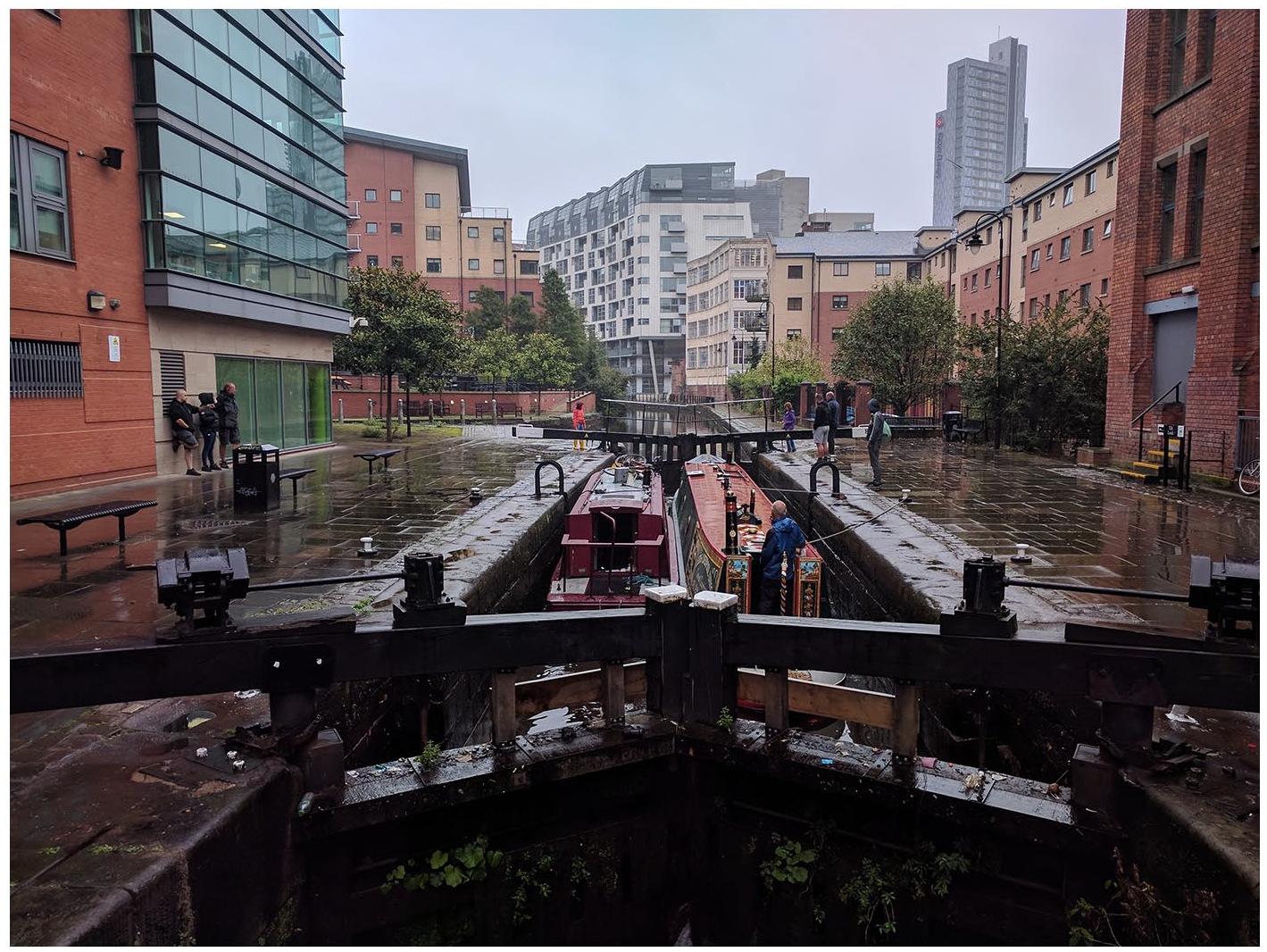
Two boats sharing a lock on the Rochdale Canal, Manchester city centre. Photo by Chris Chambers.
The physical work of opening and closing the gates and winding the paddles is a complicated embodied choreography, the sole purpose of which is to manipulate the interplay of the temporary absence and presence of water in the canal locks. This process requires the boater to collaborate with water, lock, the boat, as well as the necessary artefacts required in the form of specialist canal boating equipment. The end result from the boater’s perspective is an ‘empty’ or ‘full’ lock where the relative absence or presence of water in the lock is accomplished by the human-material cooperation of winding the paddles, monitoring the water levels and pushing the lock gates. Here, the mobile qualities of canal water in the lock, which are usually characterised by a relative stillness, are sharply contrasted to the turbulence occurring around the filling and emptying of the locks when the water rushes in or out of the lock. If the lock is broken, however, the absence and presence of the water cannot be regulated, which means that the boat has to stay immobile. Absence of water in the canal, such as an empty pound (a stretch between two locks) can therefore have many meanings and corresponding practical implications.
If the locks are abandoned and not maintained, the water will exercise its agency, flowing out of the canal. This, in turn, has direct consequences in terms of facilitating or disrupting the mobility of water and, consequently, boatmobility. Furthermore, the presence or absence of water is also determined by the presence or the absence of technological functionality and the political decisions of governing stakeholders that establish the particular affordances for mobility along the waterways. The absences or presences of water that afford (boat)mobility can therefore be interpreted in terms of the interaction and agency of myriad hybrid layers: material and elemental, technological, (local) knowledge-based, political, cultural and social.
Historical affordances: interacting with industrial heritage and local histories
In addition to allowing and directing boatmobility, water’s temporary absence and presence in the waterways is also vital for other purposes, which can be utilitarian and practical but also culturally meaningful. In the broadest sense, the waterways that were used for various industrial as well as transport purposes later became characterised by the absence of the very usages or industries that created or needed them. Consequently, some canals were filled in, some were abandoned and partially drained of water both in the UK and Italy, thus becoming ‘an illustration of the lingering “wreckage” inherent in (post) industrial modernity’. 57
Moving on to more specific, and localised absences, today, temporarily absent water in the canal affords the work necessary to care for the (heritage) infrastructure, as all the varied canal users, be they boaters, walkers, runners, cyclists, dog-walkers, anglers or commuters ‘are dependent upon the work of more than human infrastructural assemblages’.
58
In order to carry out this care work towards the infrastructure, the various navigation authorities have the power to impose stoppages, which means draining a whole section of a canal of water for planned maintenance works, or to close certain lock(s) at certain times. In addition to the utilitarian function – the maintenance works are needed to enable the operational working – the draining serves another important function: revealing the otherwise normally hidden material elements of industrial heritage, making it available for consumption. The absence of water therefore affords the experience of the tangible and intangible heritage and local history: When I’m working with the construction people, you’re actually getting into the heart of the canal. [—] And when you’ve got a stoppage and you drain the lock and take it apart, then you can actually see! And being a mechanical engineer, I’m interested in that sort of thing. How did they build them in 1780 like that? How can they still be working in 2016? That’s what really interests me I think (Richard, 67, a retired engineer and a volunteer for a UK navigation authority).
The Canal and River Trust (the biggest inland navigation authority in the UK) regularly holds open days during these works, to inform the public about its activities. The draining of the lock chambers, normally filled with water (albeit at different levels), becomes a visitor attraction, offering the backstage access of not only viewing the lock from the towpath but also walking inside the empty lock chamber. In making the regular maintenance works into an attraction, the Trust organised ‘the World’s first DJ set in a drained canal lock chamber [where] visitors [could] dance the night away to some much-loved Hacienda classics’ 59 in the Rochdale Canal in Manchester in 2017. Here, the absence of water afforded the continuous human modification and alteration of the water-landscape and the canal’s transformation into a visitor attraction and leisure space. The volunteers impersonated both historical and imagined characters from industrial and canal history, blurring ‘the boundaries between supposedly stable ontological categories (e.g. living/dead, being/non-being and presence/absence)’. 60 The location further afforded engagement with more recent history, as the empty lock hosting the dance party is nearby the now demolished (in)famous music venue, The Hacienda, which was instrumental in forming the city’s 1980s ‘Madchester’ music scene, and which, now physically absent, replaced with an apartment block, is still a spectral presence in the lives of many people living in the city. All this takes place in the context of recent urban change and gentrification, waterfront redevelopment and the emergence of new middle-class communities of the canal-side areas with their particular leisure and consumption practices.
The temporary absence of water can also reveal ‘obsolete affordances’ 61 – some heritage and history only becomes visible when the water disappears. In the summer of 2018, due to the effect of drought combined with the intensive use of the river’s water for agricultural purposes, the water levels in the River Adige, in Italy, were reduced significantly, revealing the remains of a number of burci, traditional Italian wooden riverboats, abandoned on the mud bottom of the waterway (see Figure 2). Today, there are no visible traces of the docks and the famous shipyard of the river village of Piacenza d’Adige, a former port on the extensive regional network of navigable waterways. The absence of water, however, revealed the past through ‘“knowing” people and places’ 62 – in order to identify the site of the river village, the observer had to be able to recognise the particular type of boat in this particular location. For the untrained eye, however, these remains would not have meant anything more than just some abandoned boat carcasses at the bottom of a dried-up river.
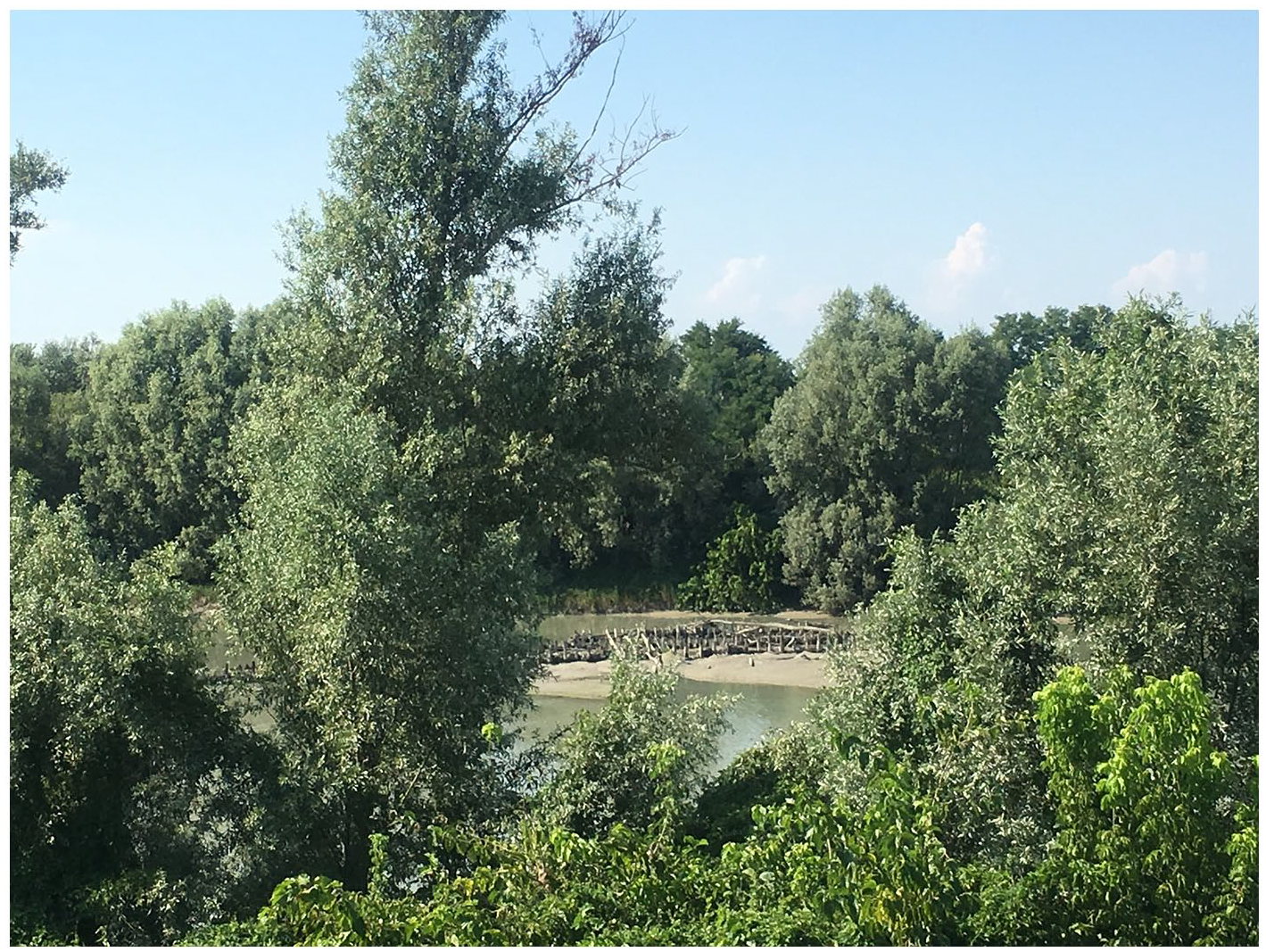
Remnants of traditional working boats in the bottom of River Adige, Italy. Photo by Francesco Visentin.
It is, therefore, the interchanging absence and presence of water that creates this particular affordance – an opportunity to observe the visible remnants of the history of this particular site. Its absences ask to be investigated, deconstructed and reconstructed, imagined and finally ‘understood through the trace, an absent-presence gesturing to other traces in infinite deferral’. 63 This particular historical affordance is realised only with the precondition of having knowledge about the local history, which allows ‘attending to the material history of the waterways, collapsing the boundary between past and present’. 64
The ongoing transformation of rivers and canals, both intentional and unintentional, produces residual traces and clues of the past. The (temporary) scarcity of water, for instance, can be intentional, induced by a dam or a planned engineering intervention, or unintentional, caused by the natural fluctuation in the hydrological cycle, or a combination of both (as in the case of River Adige). The absence of water reveals the presence of heritage and history in this continuous repositioning; the obsolete affordances of carrying cargo are replaced by present affordances of consuming history and heritage. The former spaces of work and everyday life become visible and present when the water disappears, and as such, the absence of water becomes full of new meanings, while affording various acts and practices. The absent water in the canal or river can reveal present or obsolete properties of the watery place and therefore contribute to both a Ruinenlust and to a certain nostalgic imagination of the space and place as utilised and filled by past narratives.
Communicative affordances: uncovering the watery layers
As humans, we are somewhat unfamiliar with under-water spaces; however, we need to pay attention not only to the landscape ‘surface’ but also to what is hidden. 65 When a section of the Rochdale Canal was drained for maintenance works in 2017 in central Manchester, the sudden (relative) absence of water did not just reveal the normally submerged parts of canal locks. As the opaque water was drained from the section, it also uncovered the large quantities of rubbish (from beer bottles to bicycles) that had been lying at the bottom of this urban waterway. This made the documented, 66 yet somewhat abstract awareness of the pollution in the waterways tangible and visible.
When we walk along, or boat on a river or canal, the opacity of the water as well as its sheer presence can mask what is underneath. A drained lock or a stretch of waterway (because of the drought, maintenance works, carelessness or vandalism) can therefore uncover and display pollution in the waterway. The presence of water can partially cover the litter while its (partial) absence can reveal the litter’s presence. To restate, the absence and presence are not to be understood in an all-encompassing, absolute way, but instead absence and presence of water emerge relationally and sometimes rhythmically. During hot and dry summers, the water level can be very low, allowing people to visually consume landscapes that are normally submerged. When water is present, the flow (another important aspect linked to the interplay of presence and absence of water) carries lightweight rubbish downstream, hiding these traces of human consumption in some places and revealing them in others. When there is little water, the riverbanks are exposed and reveal that what is normally hidden, which can include litter that has remained stranded on the shrubs or trees that grow on the riverbanks. Therefore, the relative absence of water can reveal landscapes – and smellscapes – of presence-absence.
On the River Sile, nearby the Venetian Lagoon, an association called ‘Open Canoe Open Mind’ works with young people to improve the environmental education of those living along the river by cleaning the waterway. Local nature guide and volunteer with the association, Cristian Bertolini, explains: Normally nobody sees what’s under the water. Only when there is little water in the river people are able to understand how much waste there is. The data collected over the past 2 years is clear, we recover 35 kg per month between Sant’Elena and Musestre. Over 80% of these are recyclable plastics, and over 70% come from household waste. But why do they end up in the water?
This temporary absence of water therefore reveals a significant environmental problem. The visual evidence of waste, however, can turn, as is the case of the volunteer organisations, into a good environmental (education) practice (see Figure 3). The volunteers do not only pick litter floating on water, they also use nets to fish rubbish out from beneath the water’s surface. The reason they can do this, however, is because of the partial absence of water, making the litter visible. The volunteers on River Sile also collect the rubbish and place it on the riverbank for everyone to see to demonstrate what Hetherington 67 reminds us: ‘that which has been turned into rubbish tends to have the ability to return’. People who walk along the river will be able to see both the volunteers working as well as the amount of collected rubbish, otherwise obfuscated and partially hidden by water. Disposing of this waste is therefore ‘as much a spatial as a temporal category’ and disposal becomes an act of ‘placing absences’. 68
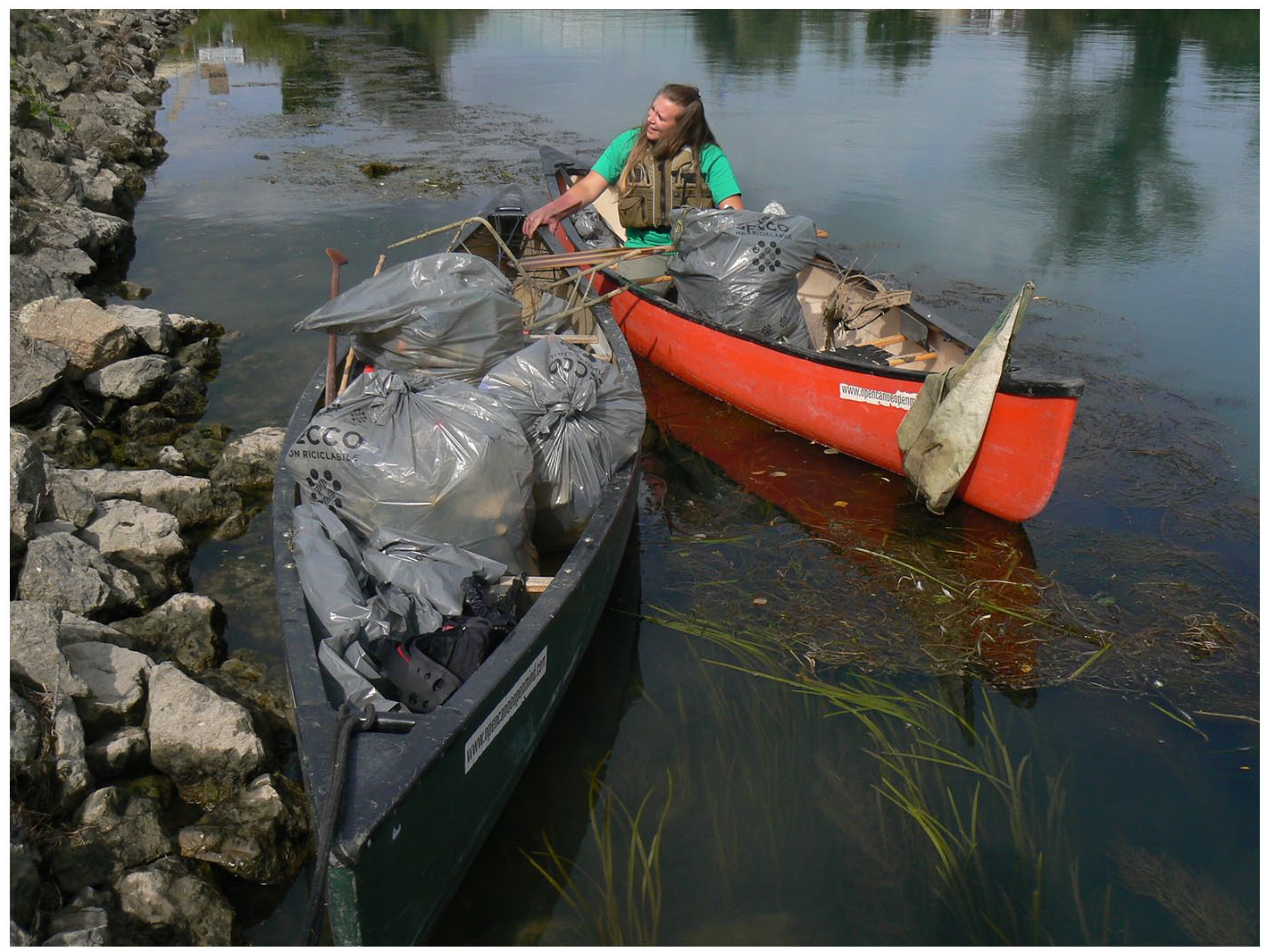
A volunteer with rubbish collected from the River Sile, Italy. Photo by Cristian Bertolini.
The situation is similar in the UK as the Canal and River Trust has identified plastic pollution as one of the key problems: ‘You’d be surprised to discover what’s under the surface of our canals and rivers. From shopping trolleys to traffic cones, there’s a lot of litter. Rubbish underwater can be dangerous for wildlife, as well as for anglers and people using boats and canoes’.
69
The Trust, Inland Waterways Association and other organisations organise volunteer working events that include litter picking both on the canal towpath as well as from the water. For example, one such volunteer, and also a boater, Barry (68), explains how rubbish in the canal can be hazardous for boaters, particularly when it gets stuck around the boat’s propeller, adding that: We’ve frequently had, in certain areas, still even now, when you get into a town, industrial environment, you’ll find there’s rubbish floating on the canal and you’ll get rope and stuff, plastic bags and bits of old cloth.
In the cases discussed above, environmental awareness is partially brought about by the temporary absence of water. It is only when the water temporarily disappears that the full extent of the environmental situation at that moment in time is revealed and communicated through the visual affordance provided by the absent water: as water disappears, rubbish ‘emerges and becomes an affective mobile materiality through a waste-related collective event and action’. 70 What is more, the littering discussed above (but also other polluting behaviours such as boaters burning coal or running diesel engines) further reiterate the hybridity of canals and rivers, being simultaneously ‘natural’ and ‘unnatural’ entities. 71 Temporarily absent water therefore affords a better communication about the state of the waterways and the subsequent opportunity for volunteers and others to take care of, and take responsibility for, their environment.
Conclusion: what does the temporary absence of water afford on the inland waterways?
Over time, inland waterways, regardless of whether they are engineered canals or natural rivers, have become increasingly ‘constructed’ with dams built and locks installed, affording an ever-greater control over the absence and presence of water. Taking a non-presentist perspective for investigating the human relationships with water, we suggest thinking about water otherwise: in terms of the interplays of absence and presence. Instead of focussing on what is present, we have asked how the temporary absence of water is experienced and interpreted as well as what these absences could afford us. In doing that, we have shown the power and agency of water as it becomes an affordance even when absent.
Water can simultaneously be present and absent, as its quantity or level is a subject of constant change and volatility. It is therefore through constant fluctuations that the temporary absence of water becomes an affordance and allows us to go beyond the present to focus on what, how and when water is not there. 72 It is important to reiterate that we have not studied the permanent absence of water, or the natural rhythmical interchanges such as ebb and tide, but instead focussed on its less studied temporary and liquid presences and absences. Indeed, water’s fluid qualities are essential for spatial affordances as they make the mobility of water (and mobility of various materialities in and on water) possible and the human actors have to constantly negotiate it. The boaters’ mobility depends on the amount of water in the waterway, a supply that comes from reservoirs, rivers and streams, as well as pumping stations retrieving water from underground and its subsequent manipulation through the usage of locks. The boaters depend on this water as well as on their own ability to negotiate its temporary presences and absences. Furthermore, it could be even argued that all contemporary boating practises are afforded by absence: absence of the industry for which the waterways were originally built and modified, absence of debris and rubbish in the water as well as the relative absence of water elsewhere in lakes or reservoirs used as water sources for the navigable waterways.
Material absence can also be essential for understanding time as a nonlinear fluctuation of different temporalities. The temporary, sometimes managed absence of water can create historical affordances, such as engaging with and imagining the local histories and heritage. It can also become a way for apprehending various materialities and their respective affordances in particular times and environments. 73 The properties and capacities of the natural and built environment are always already there; however, it depends on the awareness, perceptions and skills of a particular actor whether and how the various affordances will be understood, perceived or used. The temporary absence of water in canals and rivers can uncover what is not normally available to our sensory perception whether through sights, smells or other sensations. The presence of waste can subsequently be made embodied through environmental action 74 and can also communicate certain information, such as the environmental condition of the waterways. All these affordances – spatial, historical and communicative – are the result of the interplays of the temporary presences and absences of water. They also reveal a difference between intentional and unintentional absences, planned by various (technical) interventions or caused by natural fluctuations in the hydrological cycle of water.
Canals and rivers are a rich water-land-scape of various affordances that emerge both in presences and, as we have shown in this paper, also in absences: ‘the ways in which relatedness between people and place is forged, disrupted, and challenged [are partly owed] to absent presences’. 75 As we have demonstrated, the absence of water can afford various opportunities, actions and potentialities and absences as affordances should be understood processually in their spatio-temporal contexts. This study of interplays of the temporary presences and absences of water in the rivers and canals has therefore allowed us to unpack how they can afford spatial mobility, connecting and engaging with the (imagined) past as well as uncovering and communicating some otherwise hidden material layers and stories of the waterways.
These spatial, communicative and historical affordances should not be seen as separate or juxtaposed but rather as concurrent conditions that reveal the entangled dimensions of water as simultaneously present and absent. As we have discussed in this paper, absence and presence should not be considered in absolute terms but instead as relational; as such, they are continuously blurring the boundaries of natural and cultural, embodied and representational. Further studies on the absence of water and its respective affordances could help future research to better understand various environmental and societal issues, such as scarcity or over-abundance of water (in the form of draughts and floods) or lack of biodiversity as experienced by both humans and non-humans. It could also be productive to apply the theoretical notion of absence as an affordance to other topics such as for example placemaking, virtual realities or interpretations of heritage in order to better understand the meanings and imaginations as well as experiences and practices afforded by that what is not necessarily there.
Footnotes
Acknowledgements
We would like to thank Prof John Wylie and the editors of cultural geographies, the three anonymous reviewers, and Prof Tim Edensor, Dr Paul Gilchrist, Prof Davide Papotti and Dr Tarmo Pikner for feedback on the various versions of this paper.
Funding
The author(s) received no financial support for the research, authorship, and/or publication of this article.
