




Abstract
Balconies, windows and terraces have come to be identified as spaces with newfound meaning over the past year due to the Covid-19 pandemic and concomitant lockdowns. There was not only a marked increase in the use of these spaces, but more importantly a difference in the very nature of this use since March 2020. It is keeping this latter point in mind, that I make an attempt to understand the spatial mobilities afforded by the balcony in the area of ethnographic research. The street overlooking my balcony, situated amidst an urban village in the city of Delhi – one of my field sites, is composed of middle and lower-middle class residents, dairy farms and farmers, bovines and other nonhumans. In this note, through ethnographic observations, I reflect upon the balcony as constituting that liminal space between ‘field’ and ‘home’, as well as, as a spatial framing device which conditions and affects our observations and interactions. This is explored by examining two elements – the gendered nature of the space, and the notion of ‘distance and proximity’, through personal narratives of engaging-with the field, and subjects-objects of study in the city.
Balconies, windows and terraces have come to be identified as spaces with newfound meaning over the past year. With the majority of the global populace confined to their homes due to the Covid-19 pandemic and concomitant lockdowns, there was not only a marked increase in the use of these spaces, but more importantly a difference in the very nature of this use since March 2020. While such spaces have routinely been used for passive observations of, and participation in the happenings of the street, during the lockdown, they became for most of us, the locus through which our active interactions with the outside world took place. One might argue that during this time, these spaces became more than what they were originally constructed for, or envisaged as. In this short commentary, I reflect on the balcony as constituting that liminal space between ‘field’ and ‘home’, as well as, in becoming a spatial framing device which conditions and affects our observations and interactions. I closely examine two elements of balcony living – the gendered nature of the space, and the notion of ‘distance and proximity’, through personal narratives of engaging-with the field, and subjects-objects of study.
My ongoing research is an attempt to trace the natures, cultures and politics of milch cattle in urban India. My ‘fieldsite’ in the city of Delhi constitutes several locales – ‘urban villages’ – with a prevalence of small to medium scale dairy farming activity. 1 It was also partly by design that my ‘home’ for the duration of fieldwork (or ‘field station’) was an apartment located on the second floor of a building in one such urban village in North Delhi – K R Nagar. 2 The balcony of my home overlooked the main street of this neighbourhood, which during the day, is typically busy and chaotic, brimming with the movement and sounds of vehicles, vendors, mechanics, shops, children walking to the nearby school, etc. And since this is located amidst an urban village, animals such as cows, pigs, dogs, buffaloes and horses punctuate the streets (Figure 1).
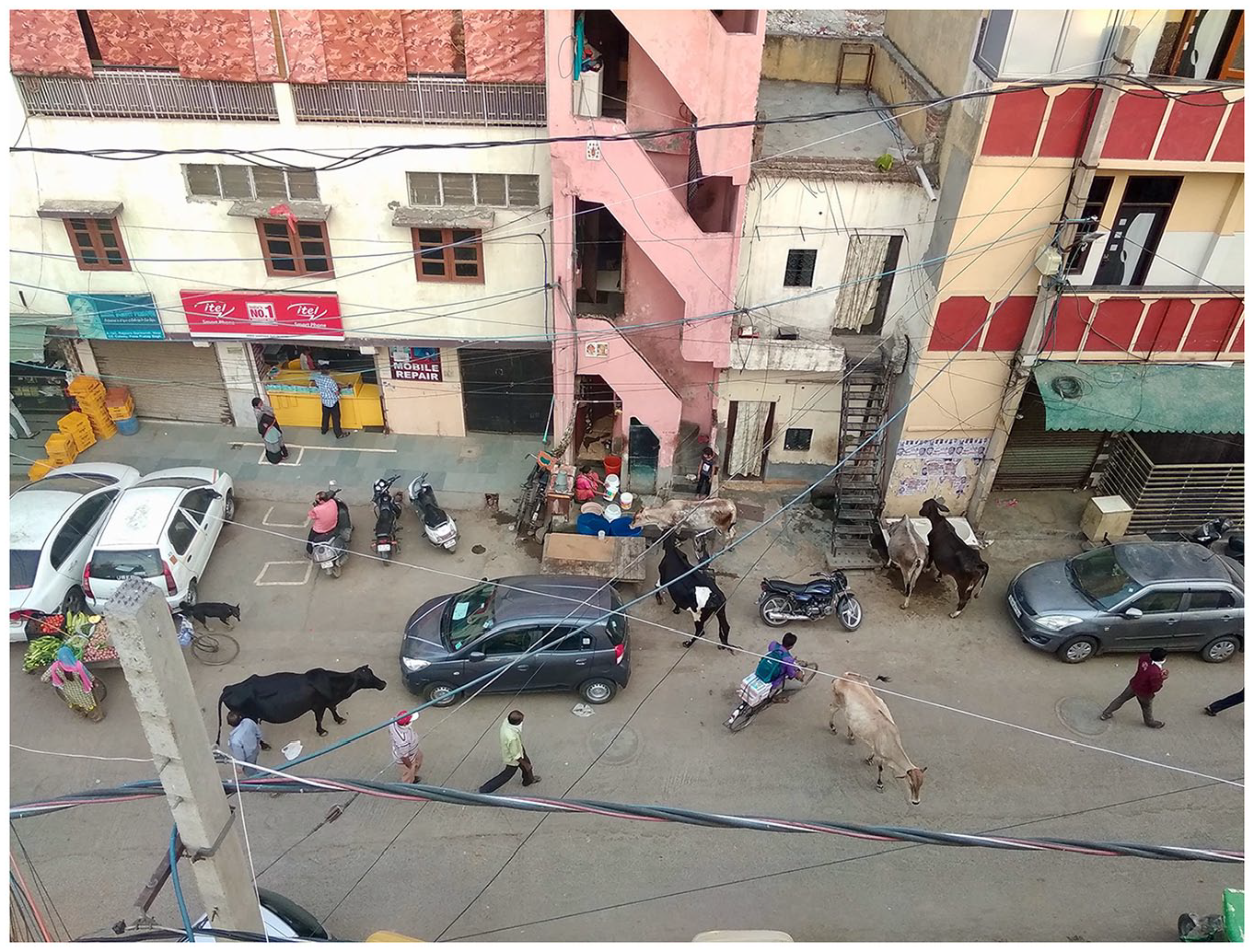
View of the street from the Balcony, K R Nagar.
Given the presence of dairy farmers, bovines and dairy shops, this locality would have been an obvious choice as a site to commence fieldwork. However, it was only after 6 months of conducting fieldwork at other sites across the city that I began my research here. In retrospect, I realise this had to do with inhibitions of the ‘home’ being too close to the ‘field’. This spatial separation argue Gupta and Ferguson, 3 is manifested through certain ‘contrasts’ such as location, in ethnographic writing, field entry and exit, amongst others. However, a lacuna in this conversation on spatial separation is a consideration of gender.
As is well known, in the Indian street/city-space there is a ubiquitous ‘male gaze’ on women, queer and trans bodies as well as on the bodies of men who do not conform to heteronormative standards. Encountering this gendered gaze in the field as a female researcher imposes ‘precautions’ such as donning ‘proper’ attire, exiting the field before sundown, or being accompanied by a (male) field assistant. Let me clarify that neither is the gendered gaze nor are these precautionary measures limited to conducting research in unfamiliar locations, with unfamiliar people or with particular communities. Rather, the everyday is inscribed by unwarranted gazes, so much so that measures taken to encounter them become deeply entrenched into the very ways that multiple bodies inhabit and experience city-spaces. Moreover, while conducting ‘bovine ethnographies’, 4 where I follow mobile cows as they navigate through the city, what I noticed was that while the cow has more or less blended into the urban landscape, as a female researcher, I stood out in those very same surroundings.
While I have described the gendered ordering of outdoor spaces above, I now explore this notion within spaces of the ‘home’ – particularly the balcony. According to Lefebvre, 5 the balcony is that spot located both inside and outside, providing one with a perspective of the world/street, from within the boundaries of the home. In much of urban middle-class India, it is the balcony that provides a sense of relief for women, who typically occupy indoor spaces, by offering a glimpse of the world outside and becoming a space for engaging with neighbours. Therefore, as much as it is a space of human interactions, there is also a gendered aspect to the space. One can delineate the modern urban manifestation of this ‘spatial order’, notes art historian Pollock, 6 in the paintings of 19th century women Impressionist artists like Berthe Morisot and Mary Cassatt, who depict women inhabiting indoor spaces of drawing-rooms, private gardens, bedrooms, balconies and verandas. Taking Morisot’s paintings ‘On the Balcony’ (1872) and ‘On the Terrace’ (1874) as a case in point, Pollock argues that the railings on the balcony and terrace are a symbol not merely of the landscape beyond, but rather represent a boundary between feminine and masculine spaces. In other words, the balcony becomes a liminal space – a gendered space, yet offering a view of the world outside. And in the context of my ethnographic research, the balcony acquired a different spatial role – that between the ‘field’ and ‘home’. It was from here that I was able to acquire a sense of the locality and rhythms of the street by making note of the multiple flows, energies, and movement of people, animals and goods, thereby not limiting my observations to only dairy farmers and their bovines. One might even say that the balcony became the site or space from which a pilot study was carried out for this particular field site.
Returning to the notion of spatial separation, one may note that objectivity is often considered essential to the production of ethnographic research. As we know, the history of such an objective gaze also enfolds various forms of domination. Keeping in mind this historical trajectory, I try to conceptualise the balcony not merely as a spatial location, but as enframing a gendered, middle-class gaze on the street. This ‘framing’ provides one with insights about the worldviews of residents, particularly concerning the presence of nonhuman animals and dairy farming in the locality. What was evident from the balcony was an apparent contradiction. For instance, it was common to see people feeding cows with leftovers or basi rotis and take her blessing – an activity stemming from religious values around the sacredness of the cow. Furthermore, these are the same individuals, who not only complain to the Municipal Corporation of Delhi (MCD) regarding the ‘nuisance’ of stray cattle, but also stand-by as the MCD seize, impound and auction bovine bodies (Figure 2). This is an act of erasing and in some sense even cleansing the street off the cows’ sensorial, bodily and material signs, into state-owned gaushalas (cow shelters) or by auctioning them to farmers residing outside the city. 7
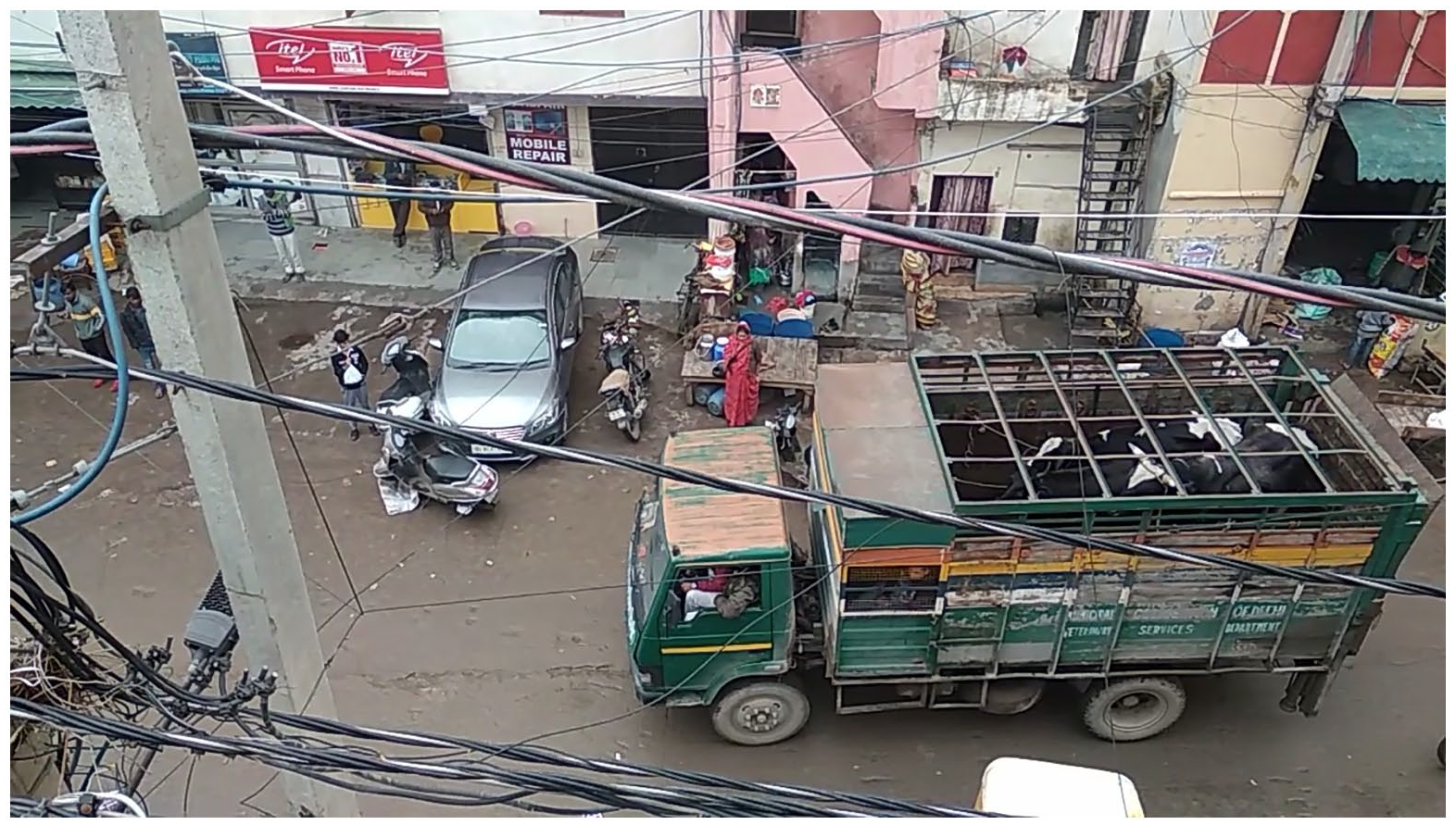
MCD truck with stray cattle to be impounded.
What this ‘ethnographic gaze’ from the balcony reveals is a structural anomaly that is produced due to the very nature of capital itself. It is the caveat of capital in a globalised world, which produces citizens who strive to be ‘global’ yet hold onto their faith and traditions, primarily arising from the fear of losing their cultural roots. This contradiction can be observed in the discourse on the consumption and export of beef at the macro-level, and amidst urban villages of the city at the micro-level. Therefore, while the cow is fed, revered and considered sacred, this symbolic value can be quickly replaced with notions of nuisance in matters of real estate and property values, and of an imagined aesthetics of a neighbourhood within a post-colonial capital city. Thus, while animals might otherwise form a significant part of the everyday lives and ecology of the neighbourhood, in such scenarios, the cow (and dairy farmer) no longer find themselves belonging to this landscape. What ensues in the process is not merely violence against certain bodies, but also of an active invisibilisation of bodies, advocated by local and state machineries, thereby contributing to the construction of ‘animal spaces’ in the city. 8
This note began with the notion of the balcony as a liminal space, introducing the idea of ‘proximity and distance’ – considered central to most debates on ethnographic research. In that sense, the balcony does have a spatial connotation of ‘seeing from above’, similar to a panoptic gaze. However, the argument arising from my ethnographic observations is to utilise certain spatial mobilities afforded by the balcony, whereby it becomes a mobile space experientially – static in terms of construction, but mobile in terms of enabling observations from above. de Certeau 9 argues that as much as one can decipher the ‘urban text’ from above, this text would be meaningless without the very beings who inscribe it, namely its walkers or ‘Wandersmiinner’ (wanderlust). In my ethnographic research, ‘walkers’ – both human and nonhuman animals, are the very beings who have been grasped by the city and thus ‘write’ and re-write city spaces through their mobile bodies. 10 The balcony, in this regard, enables the researcher to decode the inscriptions of the street, as well as re-inscribe the streets’ urban text through field experiences and observations. Therefore, despite the liminality afforded from this intermediate location, the balcony moves beyond this very debate, becoming not only a different spatial location, but by complicating the gendered ordering of spaces, to become a spatial framing device of modern knowledge production.
Footnotes
Acknowledgements
The idea for this essay began after reading Henri Lefebvre’s chapter ‘Seen from the Window’ during the lockdown in 2020, and I would like to thank Maan Barua for this suggestion. I also thank Anindya Sinha for his support and feedback. This article has taken shape from the feedback and conversations with Santhosh S. and Sneha Ragavan, and I am very thankful to them.
Funding
The author disclosed receipt of the following financial support for the research, authorship, and/or publication of this article: This research was enabled by the European Research Commission Horizon 2020 ‘Urban Ecologies: governing nonhuman life in global cities’ Starting Grant (uEcologies; Grant No. 759239).
