




Abstract
This paper develops cultural geographic understandings of more-than-human comfort and conviviality by analysing emails sent to trees living in the City of Melbourne, Australia. The emails arrive from near and far, sharing personal dilemmas, jokes, poetry, confessions, political concerns, and more. These messages provide a unique opportunity to consider how trees become foregrounded in people’s everyday lives. Working through the geographies of comfort expressed in these emails, the paper develops understanding about the politics of dis/comfort by examining how it is generative of conviviality. In doing so, the paper builds on a small body of work exploring more-than-human conviviality by bringing comfort into these discussions. The paper argues this sensibility provides insights into: how and why attachments between humans and other-than-humans are fostered and maintained; how trees shape and are shaped by urban places; and, how comfort, as an overlooked element of more-than-human conviviality, can be politically generative, assisting in the re-imagining of human and tree togetherness.
Introduction
Hello Tree,
I think your possum guard, and the possum guards of some of your fellow trees in Harcourt and Courtney St, is getting too tight, and your trunk seems to be suffering, am i right? I hope you get some help soon to loosen the guard, and that your fellow trees do too. (Alex) 1
In the City of Melbourne (CoM), Australia, trees are receiving emails. They arrive from near and far, sharing personal dilemmas, jokes, poetry, confessions, political concerns and more. The emails come to CoM’s offices through an online platform that hosts an interactive visualisation of the urban forest’s publicly managed trees (around 80,000) (Figure 1). 2 Such online maps are increasingly common for municipalities looking to share information with the public about a city’s urban forest. However, CoM’s visualisation took their platform’s interactivity further by assigning each tree an email. The aim was to allow Melbourne residents to tell City staff about maintenance issues regarding specific trees. It turns out, however, that such emails are rare. Instead, people send trees all kinds of messages (see the example above), providing a unique opportunity to consider how trees become foregrounded in people’s everyday lives. Excitement about the initiative’s results has led to media coverage world-wide, 3 spurring further emails. In this paper, we consider a subset of these emails that, like the opening email, trace the threads of comfort and conviviality.
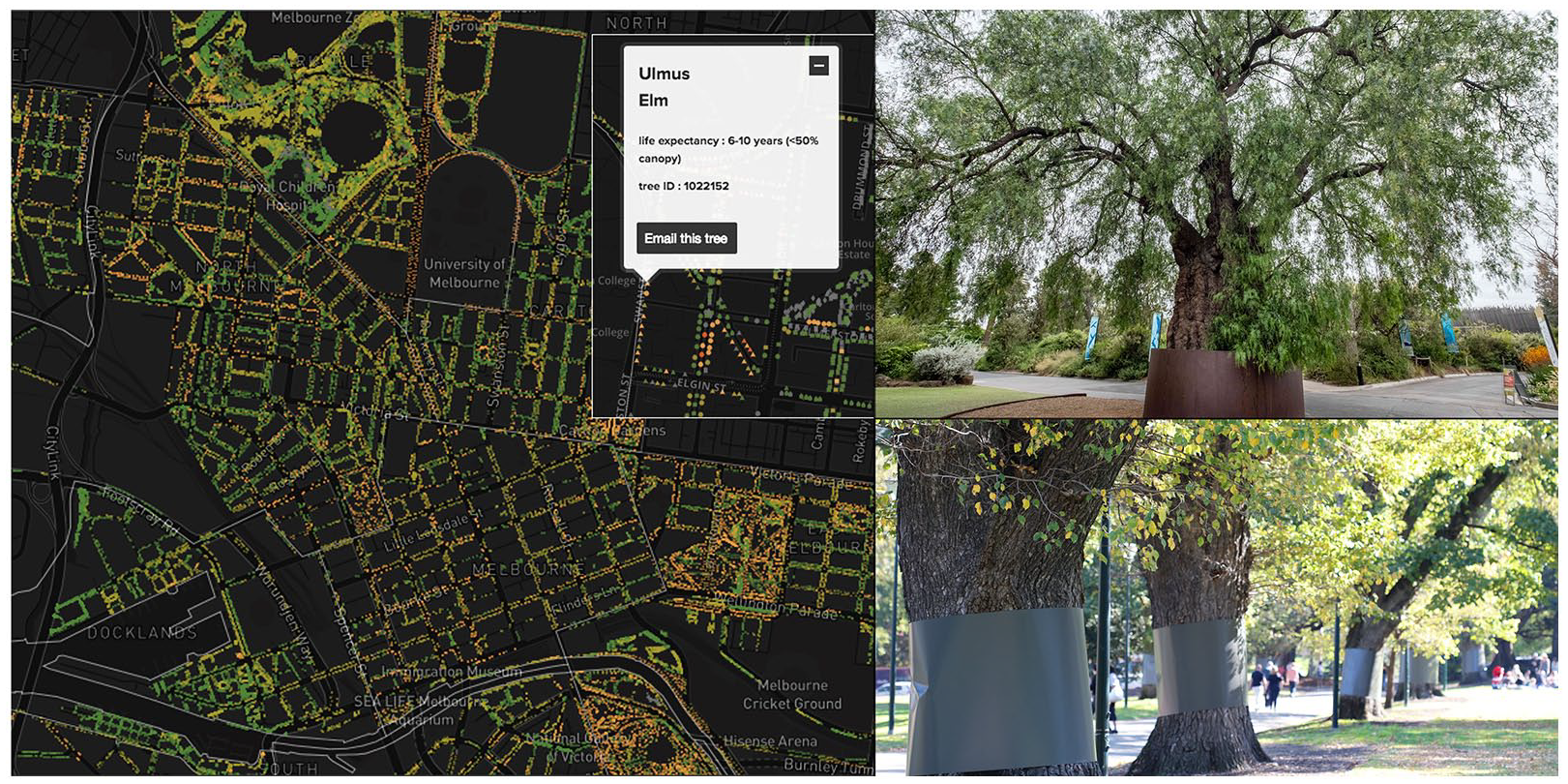
(left) Screenshot of the City of Melbourne’s online urban forest visualisation, with inset of information of a select tree, taken by Catherine Phillips (2018); (top right) a pepper tree (Schinus mole) in a Melbourne park, photo credit: Jaime Murcia, provided courtesy of the City of Melbourne; (bottom right) a series of mature elms marking the street-park boundary, each with a tight possum guard, photo credit: Sophie Takách (2019).
Tying conviviality explicitly to comfort, Price et al. assert that as an affective sensibility ‘comfort and feeling comfortable is ordinary but at its best it is porous, generative of conviviality, generosity and empowered embodied experiences’. 4 Further, they call for geographers to explore these connections through examining ‘how comfort is materialised, actioned and verbalised, and the times, space and place that discomfort becomes comfort’. 5 Taking inspiration from these geographers, our paper considers a more-than-human conviviality generated through different experiences of comfort/discomfort recounted in emails received by Melbourne trees. This approach redresses a tendency in urban scholarship to focus on conviviality as human-to-human encounters. Indeed, recent calls in human geography and planning argue a more-than-human understanding of sociality is required to cultivate urban greenspaces that will flourish into the future. This, Jones and Instone argue, involves generating more convivial ways of living with urban forests. 6 Such conviviality involves ‘accommodation of difference’ that is not restrained to the human. 7 Konijnedijk van den Bosch suggests that more-than-human conviviality might be achieved by approaching trees as vibrant agents that not only provide benefits for people but play crucial roles in creating cities. 8 These researchers point to a need to consider how people and trees become (un)comfortable with each other in urban places, and the implications of such feelings for negotiating shared living in cities.
Attending to the taking place of more-than-human conviviality through comfort, our paper makes three contributions to cultural geographic literature. First, it develops understanding about the politics of comfort by examining how it is generative of conviviality and ‘the potential for change, reflection and living together differently’. 9 In doing so, we build on a small body of work on more-than-human conviviality by bringing non-human comfort into these discussions. Our second contribution speaks to cultural geographic debates about attachments and detachments. We argue an important but overlooked aspect of more-than-human conviviality is how and why attachments are fostered and maintained, and our analysis contributes insights in this regard. Third, we further understanding about trees as city inhabitants, or ‘residents that shape and are shaped’ 10 by the urban in ways that are performative and emotional.
In the following, we consider scholarship on comfort and conviviality in relation to urban greening, followed by an introduction to the data and its context. We then turn to developing the paper’s contributions across three empirical sections, which consider instances when humans are comforted by trees, seek to get comfortable with communicating with a tree, and, lastly, comfort (of tree and human) is breached, leading to potentially transformative relations.
From comfort to conviviality
Within the emails we analysed, comfort appears as a process of attuning to or noticing the lives of trees. 11 This is a process that signals a growing openness to ‘earth others’ 12 built through the experience, or attempts, of working toward comfort as ‘relaxed, consoling, and reassuring’. 13 The empirical sections demonstrate conviviality does not only arise through proximity between human and tree, it can also be deepened at-a-distance through emailing as a space for experimenting with human and non-human relations. Recognising its processual qualities, Price et al. argue comfort can make and unmake worlds, situating it as political. 14 Indeed, McNally argues, ‘there is an important place for investigating where we find comfort in others’ 15 as it demonstrates where convivial togetherness can be generated. As a mode of attunement and ethico-politics, the comfort/discomfort felt as experience and concern for non-humans matters as it presents a pathway to conviviality through the building of communal relations.
Conviviality has been used in consideration of diverse human communities. In English, it tends to be ‘associated with sociable, friendly and festive traits’. 16 Reflecting this, some geographers argue that urban encounters have become increasingly unpredictable and alienating, and conviviality provides a means of redress. For instance, Amin approaches conviviality as a solidarity with space which produces civic ease, 17 while Koch and Latham conceptualise conviviality as a way of ‘nurturing the capacity of individuals to thrive in combination with others’. 18 However, Gilroy’s thinking on the Spanish convivir/convencia offers a more nuanced approach to practices of living and labouring together, one that recognises conviviality as ‘negotiation, friction and sometimes conflict’ rather than simply ‘happy togetherness’. 19 Across these registers, geographers have considered conviviality in different space-times of human interactions, leading Laurier and Philo to suggest it is an improvised experience emerging in the moment of the encounter. 20
Reflecting aims of (happy) conviviality, urban greening has emerged as policy initiative to ‘enhance the quality of social and community interactions’ 21 in urban public space. Thus, encounters and feelings of attachment are important considerations as they prompt opportunities and barriers for the development of green space. 22 Registering the opportunities, Coley et al. highlight how urban greening encourages outdoor space use, creating opportunities for social interaction. 23 Further, they note how solitary trees and denser groupings of trees encourage larger groups of human visitors, while decreasing perceptions of crowdedness, leading to reduced aggression and more positive interactions. Meanwhile, tree-lined areas are recognised as being important as providing pleasant places to linger, converse and build relationships with others. 24 Neal et al. also indicate that material characteristics of urban green spaces (e.g. trees, fields, flowers) create peaceful environments that draw visitors. Considering conviviality, they argue this is important in bringing together multicultural populations through both momentary encounters and routine engagements. 25 Such knowledge is important for informing urban greening; however, there is little consideration in this literature of the attachments forged between humans and non-humans, the frictions and negotiations involved, or the effects of such nuanced conviviality.
Scholars interested in more-than-human conviviality demonstrate concern with the material and non-material interconnections of entities, including how human and non-human worlds are brought together (or not) in ways that enable, constrain and eliminate life. 26 Exploring what conviviality means for more-than-human urban geographies, Hinchliffe and Whatmore suggest it points to how ‘realities are enacted, rather than pregiven’. 27 Elsewhere, Pearce et al. elaborate on resident-tree relations, foregrounding perceptions of trees as active participants in urban life and key ‘elements of the “ethical-political” space of cities’. 28 Looking closely at people’s lived experiences and the who-what-how-why of urban greening, Phillips and Atchison explore how sensibilities and belongings are shaped by and through the relations of arboreal and human inhabitants of cities. 29 Further, Jones and Instone contend it is through embodied, relational encounters with trees that humans might develop the skills and sensibilities required to share space with, care for and value urban forests. 30 For Rigby, such a project requires attending to how people ‘entangle with, and threaten, lives and livelihoods of other-kind’ 31 through conviviality and hospitality in the face of eco-social destruction. Enabling mutual flourishing may be the aim, but this process cannot be conflict- or violence-free; non-human and human discomfort will arise. 32
In taking a closer look at discomfort, we also add to a body of work that suggests conflict is necessary for living together well. 33 Conviviality can involve the management and negotiation of frictions. In the context of Australia’s urban greening, Cook et al. 34 identify how decision-making reinforces settler-colonial power relations, and how this must be contested to advance socio-ecological justice and develop understanding of the roles of plants in cities. Elsewhere, Kirkpatrick et al. 35 consider tree-focused debates among professionals and publics. Analysing a range of conflicts (e.g. emotional vs instrumental attachments), they highlight challenges for urban forest decision-making and variations in how those challenges might be addressed.
Tensions also exist regarding modes of engagement. While digitisations like CoM’s may be understood simply as the public sharing of information, the urban forest visual fosters particular understandings and encounters with urban trees. As Kitchin and Leszsynski suggest, a shift toward the digital is not straightforward; instead, such a move requires examination of the geographies produced by, through and of the digital. 36 In a recent review, Prebble et al. 37 examine how smart urban forest initiatives reinforce neoliberal governance and inequalities, while simultaneously opening possibilities for community feedback and the enhancement of urban nature connections. CoM’s email-a-tree initiative, thus, provides scope to develop understanding about how platforms and emails ‘facilitate or reshape civic engagement with forests and environmental change’, 38 shaping geographies 39 in the process.
The task of a more-than-human approach in this context is to account for the attachments, contestations and negotiations involved in how urban human-nonhuman relations take shape. The emails sent to Melbourne trees are important in this context as they sensitise us to how people think and feel about trees, demonstrating how trees (and non-humans more broadly) have import beyond the conventions of urban planning. As a mode of attuning to earth others, efforts to learn and foster comfort spotlight enabling relations that help build connections across difference. Such connections, not always pleasant or easy, are politically generative as they assist the re-imagining of human and tree togetherness.
Emailing Melbourne’s trees
Located on the south-east coast of Australia, Melbourne was settled by Europeans beginning in 1835, occupying the unceded lands of the Wurundjeri Woi Wurrung and the Bunurong Boon Wurrung people. Now an inner suburb of Greater Melbourne, CoM has a population of approximately 170,000 that during the workweek increases to about 1 million. Across approximately 37 km2, CoM manages park and street trees numbering almost 80,000, with high numbers of London Planes, Spotted Gums and English Elms (for examples see Figure 2). Droughts and heatwaves, along with ageing stock, threaten the urban forest. This has led CoM to expand, densify and diversify plantings. For instance, the first Urban Forest Strategy (2012–2032) set a goal of increasing canopy cover from 22% to 40% by 2040. 40 Through various strategies and programmes, including the email-a-tree initiative, CoM has become known for progressive urban greening and community engagement. 41
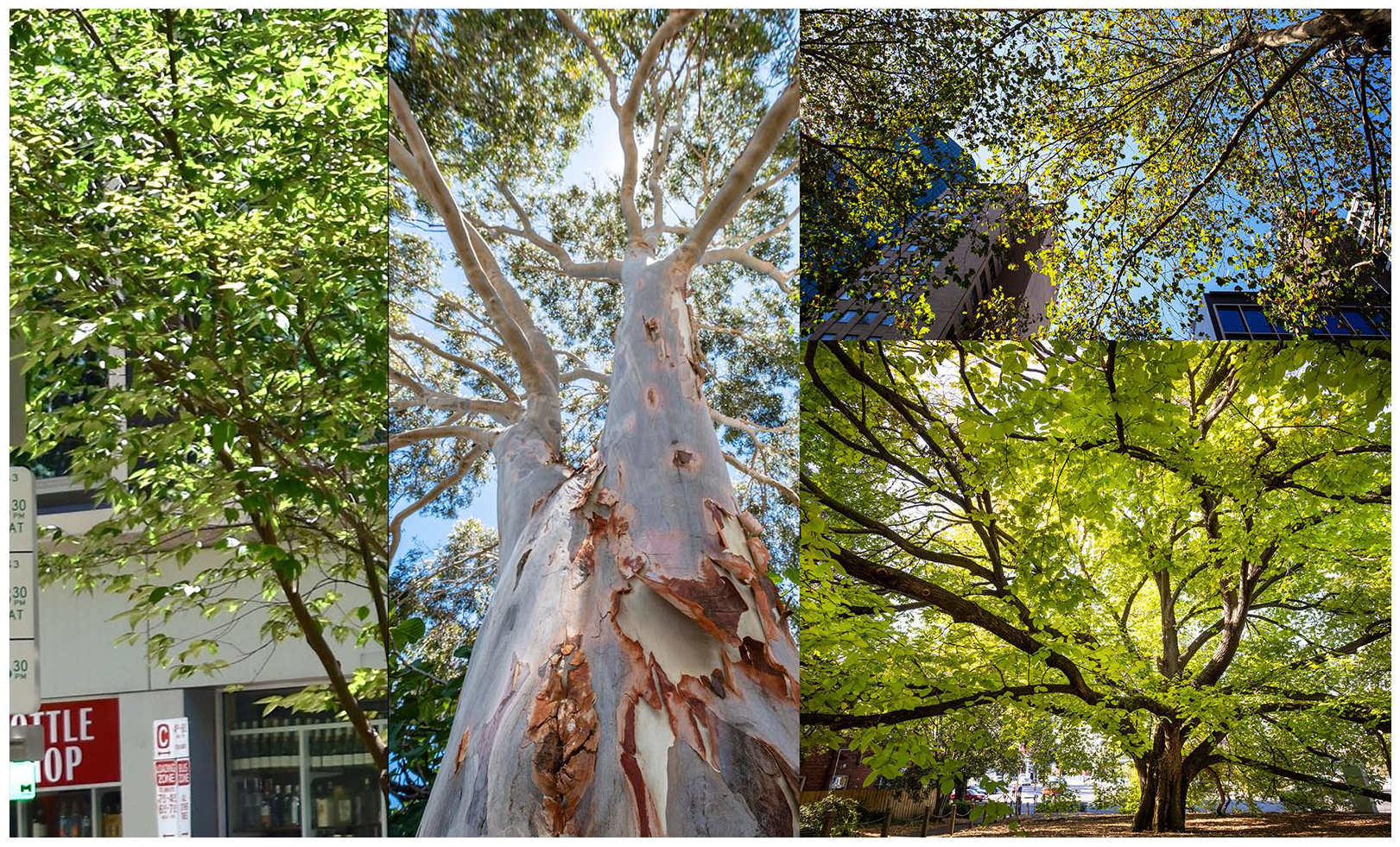
Examples of trees in Melbourne’s urban forest, including native and non-native as well as street and park trees. Photo credits: (left) Catherine Phillips (2019); (middle) Jaime Murcia, courtesy of the City of Melbourne; (right, top and bottom) Sophie Takách (2019).
To learn how people were thinking and feeling about trees as expressed in the emails to trees, the research team formed a collaboration with CoM. The overall research project involves qualitative, quantitative and spatial analysis, along with artistic and community engagement elements. The qualitative aspect, upon which this paper draws, involved a multi-person iterative coding process of de-identified emails resulting in thematic insights. The emails range in length from short greetings (‘hello tree, how’s your day been?’) to reflections of several paragraphs. Some trees receive more emails than others; the most emailed tree, for example, received 75 emails. Emails come from around the world, in different languages, from people of varied ages (as inferred from emails, e.g. having known a tree for generations or ‘I’m doing a school project[. . .]’) After a series of tests and calibrations, about half of the emails (n = 1,650 of 3,251) were manually coded, split between the beginning, middle and end of the study period (2012–2018). This initial coding provided focus for coding across the data along select themes. As exemplars: personification appears in an overwhelming majority of emails through modes of address (e.g. ‘Dear Lemona[. . .]’), naming versus numbering of trees, and pronoun use (e.g. you); despite the intended purpose of the initiative, few requests are lodged for practical tree management (e.g. tree pruning or replacement); and emotional attachments to trees were stark and wide-ranging; the data is full of feelings of joy, loneliness, curiosity, love, grief, et cetera. As a theme, comfort encompasses explicit and implicit mentions (e.g. ‘[. . .]You have offered me lots of comfort as I look at you from my office window[. . .]’, ‘[. . .]I would like to comfort you in your last year[. . .]’, or feeling able to share with a tree what could not be otherwise shared). Further, the theme of comfort relates not only to people’s comfort but concern for a tree’s comfort. This is evident in the opening email to the street tree (a Celtis australis) in which a practical management request is made (check the possum guard) but through concern for tree comfort. This article draws on our qualitative analysis to reflect on human and nonhuman comfort as part of processes enacting conviviality.
Arboreal comfort zones
Acknowledging that comfort is ordinary,
42
this section considers the mundane ways in which tree and human bodies, in proximity to each other, produce this quality of feeling. Emails to Melbourne’s trees highlighted prior embodied encounters and the import of this intimacy, connecting with Bissell’s reflection that comfort ‘emerges from a number of other sensibilities such as quietness, solitude, relaxation, slowness, and beauty’.
43
For example, emailers alluded to the calming affect of sitting with a tree: Dear Tree, I quite often visit you on a weekend (or after work if it’s a warm night) to sit under you and listen to music and read. It’s either you or one of your friends – so if it is a friend please pass on my email. It was hard to tell exactly on the map. Either way, you are very calming! Thanks for you being you, Tree. Cheers, (Cameron)
For Bissell, comfort is experienced through relations among proximate bodies and objects. Sedentary bodies can, therefore, participate in comfort. Bissell contends that by attending to affective capacities of immobile bodies, we can explore the different ways in which comfort is experienced. 44 This underscores the import of ‘Tree’ to Cameron’s comfort, which emerges via repeated encounters between tree and human bodies. This is a comfort that connects with a sense of calm and stillness. In work on therapeutic spaces, Conradson attends to stillness as an ‘internal state of calm in which a person becomes more aware of their immediate embodied experience of the world and less concerned with events occurring “out there”’. 45 Other emailers reiterate this notion with comments like ‘[. . .]There is so much on my mind, Yet the sight of you makes me feel so calm. [. . .]’ or ‘[. . .]You bring so much peace to my day.[. . .]’. Cameron emailed a Pin Oak that boasts an oval canopy of deep green leaves, resulting in filtered, cooling shade in summer. While the middle branches are horizontal, the lower branches drop down, cocooning the space around the trunk. These material characteristics create an ‘experiential texture’ that we suggest situates this tree as a ‘place of retreat’ where renewal and restoration can occur. 46 The comfort experienced by Cameron develops alongside a sense of improved wellbeing.
Other emailers are more explicit in describing how relations between tree and human bodies produce an experiential texture that supports comfort and wellbeing. For example: Dear Moreton Bay Fig, You are beautiful. Sometimes I sit or walk under you and feel happier. I love the way the light looks through your leaves and how your branches come down so low and wide it is almost as if you are trying to hug me. It is nice to have you so close, I should try to visit more often. You are my favourite tree because you are a native, standing proud in a cultivated English garden of colonising trees, imported to remind settlers of a home they may never return to. You remind me to be as strong and beautiful as you are. Thanks, (Pasha)
Pasha draws attention to how this tree’s aesthetic presence contributes toward feeling ‘happier’. The way light or wind played in leaves, the smell of blossoms, the cool of offered shade, the way a tree changed the feel of a place, among other aesthetic experiences were noted by emailers, usually in connection with desired states of being (e.g. peace, calm, inspiration). For Pasha, the tree’s body, in terms of its shape and interaction of leaves and sunlight, is important, but there is also a haptic sensibility of the enveloping effect of drooping branches aligned with the reassuring feeling of being hugged. Bissell notes that this comforting quality is actively designed in First-Class chairs for trains to reassure and facilitate relaxation. 47 However, Pasha’s reflections are not so literal, nor is the tree designed this way. Rather, in the company of Moreton Bay Fig, Pasha describes ‘a felt proximity separate and distinct from actual physical contact’, 48 a ‘felt dimensionality’. 49 This is what Wyschgrod calls a ‘metaphorical touching as a feeling of impingement upon and proximity to the world’. 50 Paterson’s analysis of such felt presence situates it as an interpersonal affect. Pasha’s experience extends such observations beyond the human, pointing to situations where felt tree presence brings comfort.
The comfort found in these ‘performative qualities’ sits alongside Pasha’s perception of this tree as ‘native’. Such classifications are problematic as they entrench a boundary between ‘native’ and ‘non-native’; in Australia this is significant as it relates to plant presence prior to European colonisation not plant capacities. 51 Further, such categorisations enable ‘familiar human desires and expectations to be misconstrued as essential belonging relationships between biota, places and eras’. 52 The bounds of such classifications also vary; indeed, these fig trees are endemic to Australia but not to the state of Victoria. Perhaps intensified by this tree’s location at an entrance to Fitzroy gardens, established by the Colonial Government in 1848, we suggest Pasha’s is a comfort that includes reliance on positioning ‘English’ trees as colonising. Such comfort from ‘natives’ was uncommon across the emails; more frequently comfort came from other tree qualities and associated symbolism.
Echoing Cloke and Jones,
53
large trees and their enduring presence often provide a point of reference in the emails. For example, a Spotted Gum in Royal Park (see Figure 3) gets the following email from An: Dear Spotted Gum, I want to tell you a story about me, which is actually a story about you. Maybe you know it already. Maybe you can tell it better than I can. I first laid eyes on you one hot summer evening on a stroll through Royal Park. I had arrived in Australia just a week earlier as a study abroad student and I was missing home like a part of me had vanished. But the day I saw you changed me. The field around you was glowing golden in the falling light and the lorikeets sang their hunger through the boughs of eucalyptus trees. It?s clich‚, I know, to say that you took my breath away, but you took my breath away. You were this strong, solitary monument and you made me want to burst into tears of happiness at the sight of you. Your smooth, pale skin smelled of parched earth and sunlight. Your arms were graceful, spreading from your trunk into a network of veins that extended into the sky. And the shape of you?a perfect half-dome above my head? made me feel protected in your shadow. Over the next year I spent hours beneath your branches, reading and writing and playing guitar, missing my home half a world away, wishing that Melbourne had been my home all along. You see, Spotted Gum, you were my tether. Whenever I started to drift off into loneliness or self-doubt, you were there to tug me back to myself. You were, like the city itself, welcoming and mysterious. There were days when you felt like my tree, and you greeted me as an old friend. Other days I would feel a cool, wary breeze filter through your branches and I would know that you were in one of your moods and to keep my distance until it passed. This is how the story of you weaves into the story of me. If you did not stand with such strength and purpose with nowhere to hide I might never have learned how to, either. I wanted you to know, Spotted Gum, that there is no such thing as ‘just a tree’ I wanted to thank you for humouring my tentative guitar strumming, for casting your sun-pricked shade upon my cheeks. Thank you for giving me a place to belong. Ever yours, (An)
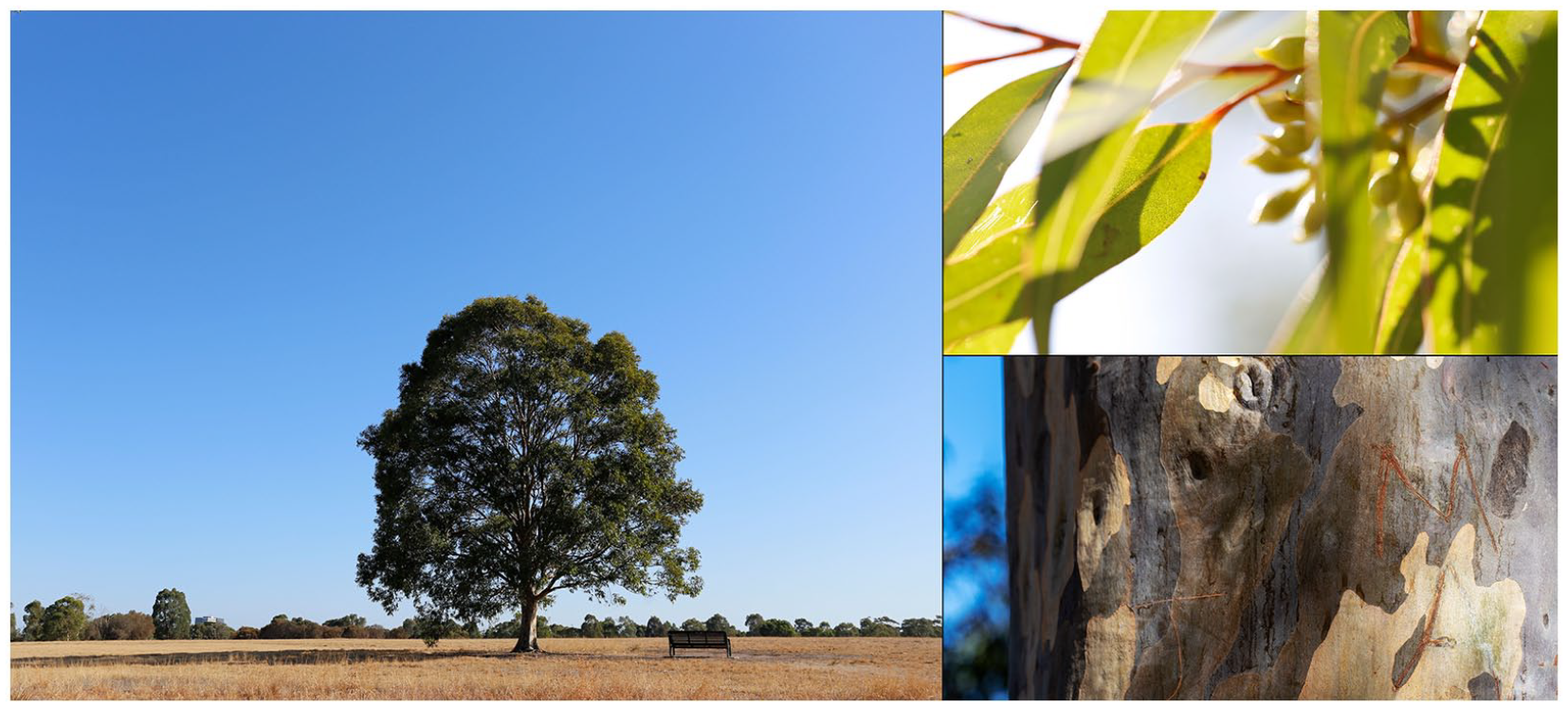
Spotted Gum (SG), located in Royal Park, emailed by An. Photo credit: Sophie Takách (2019).
An describes a process of becoming attached to Spotted Gum (SG) after a being separated – detached – from human connections. An draws comfort from a strength observed in this tree. Such symbolism, Rival suggests, draws attention to a moral quality that spotlights how a person might identify with a tree. 54 Indeed, given An’s recent isolation from community and support networks, it is notable that their observation is followed by acknowledgement of this tree’s solitary positioning, suggesting An draws comfort from seeing SG thrive within an enduring solitude. This is an endurance that An learns from, one that emerges between tree and human.
However, An’s encounter with SG cannot be reduced to visual or symbolic attributes. An describes how this tree’s company pulls them back from feelings of loneliness. In research on loneliness, Franklin tells us that to stave off this emotion, social bonds need to have ‘emotional qualities or intensities that make people feel they belong, they matter, and that they are cared for’. 55 An feels so welcome in SG’s place that they are drawn to return; SG provides a place of belonging, illustrating an attachment that keeps loneliness at bay.
We suggest An’s email teases apart how urban trees can become ‘comfort zones’ for some Melbournians, a point that resonates across the emails discussed in this section. Prazeres explains that through their ‘physical, embodied and affective space[s] of familiarity and comfort’, such comfort zones ‘provide a temporary respite from the stresses and uncertainties of living, working and/or studying in a foreign country’ 56 Importantly for Prazeres, comfort zones require reproduction by spending time ‘and (re)creating everyday routines in these places’. 57 An’s practice of reading and responding to SG’s ‘moods’ suggests a flexible routine that changes in accordance with atmospheric and sensory experiences of this tree place. This co-produced familiarity is suggestive of a process of becoming comfortable that aligns with Ahmed’s conceptualisation of comfort as ‘an encounter between more than one body, which is the promise of a “sinking” feeling. To be comfortable is to be so at ease with one’s environment that it is hard to distinguish where one’s body ends and the world begins’. 58 Ahmed describes a blurring of boundaries here that echoes within An’s powerful reflection that their story is one that relays how ‘the story of you weaves into the story of me’ which, in turn, suggests a growing ease. The sensitivity shown by An for tree being and comfort is a theme we build on and take forward in the next empirical sections.
Negotiating awkwardness
Distinguishing conviviality apart from friendly sociability, Nowicka and Vertovec highlight the concept as an ‘analytical tool to ask the ways, and under what conditions, people constructively create modes of togetherness’. 59 Bringing such understanding to an analysis of more-than-human conviviality, this section focuses on the various negotiations involved in how we relate to earth others. Specifically, we consider how ‘accommodation of difference in urban space’ 60 emerges through negotiations of address, negotiations that are an important part of becoming ‘at ease with difference’. 61 We make this claim in response to a vast majority of the emails sent to trees in Melbourne that insist on tree personification. Emailers displayed strong resistance to using assigned tree identification numbers accompanied by attempts to consider what an appropriate address might be. Greetings like ‘Dearest Green Leafed Friend[. . .]’, ‘Hi LSG [lemon-scented gum][. . .]’, ‘Dear Mr. Chestnut[. . .]’ or ‘Hello my special tree[. . .]’ run throughout the emails. Such messaging might be dismissed as having a bit of fun, but we read this differently. The emails go beyond engaging with trees in amusing ways and, whether intentional or not, such emails resist an understanding of trees simply as numbered objects in cities. This negotiation of address – a dual process of learning to feel comfortable with trees in a way that also accounts for the comfort of trees – is often characterised by an awkwardness that is part of the process of more-than-human conviviality.
This sensability extends more-than-human scholarship on awkwardness. Lorimer explains that ‘as an adjective, awkward describes the unfamiliar, the clumsy and the unskilled. It conveys embarrassment, inconvenience, and risk. To be awkward is to be ill at ease, uncomfortable or untoward’.
62
This awkwardness, he suggests, can be understood as part of a process of comparison of the ‘distinguishing properties’ of humans and non-humans. Regarding trees, these properties relate to bodily forms, kinds of mobilities, lifespans and rhythms, means of communication and so on,
63
which can spur curiosity, appreciation, even disgust, affecting the capacity for people to ‘tune into’ other living creatures.
64
To be clear, awkwardness does not always signal a negative experience, it can also be generative as ‘[d]isconcerting encounters across difference have the potential to prompt thought, practice and politics’.
65
As the emails below suggest, some emailers were uneasy about how to write to a tree but forged ahead: Dear 1040090, Is it okay if I call you George? 1040090 seems so impersonal. I was trying to contact your neighbor next to the path, but it looks like he was removed. I’m sorry about that. Do you miss him? I hope you get a new neighbor soon. Aloha from Honolulu! (Taylor) Dear Mr/Miss Sydney blue gum, Sorry for calling you a eucalyptus in the last email. What can I call you? I live in Brisbane, so I don’t yet know what you look like. Could you send me a picture? I would love that. Thank you so much for replying to the last email. From (Devin)
Taylor’s and Devin’s email demonstrate a clumsiness of address, yet they also indicate attempts to develop a vocabulary as a practice of conversing and getting comfortable with a tree. For Taylor, this stems from a perceived shortcoming in addressing a tree as a number. For Devin, this connects with a prior attempt at identification, which is felt to require an apology. And these emailers are not alone; others make comments such as ‘[. . .]Sorry I don’t know your real name, hmmmm, this is awkward. OK, for now I shall call you Tim. How’s it going Tim?[. . .]’ or ‘[. . .]What should I call you? Do you like Oak? Or would you prefer something else?[. . .]’ In this context, ‘awkwardness in encounters with non-mammalian life is temporally unstable. It relates in part to developing skills, habits and modes of relating’. 66 Within the awkwardness of address, these exemplars show an effort to develop a considerate relation with these Melbourne trees. For Taylor, this commitment is suggested through a proposed name for tree ‘1040090’, while for Devin the question ‘What can I call you?’ signals a process of trying to become familiar with this tree and its preferences. In this way, both emails suggest a concern for tree, and not just human, comfort.
In Taylor’s and Devin’s emails, among others, the use of language and experimentation with perceived tree identity suggests an effort to find passage to more comfortable relations with a particular tree. Certainly, these emails do not suggest that comfortable relations have been reached, but they are indicative of a practice through which an ease might be accomplished. These efforts are suggestive of an attempt to build a ‘dialogue’ with living beings beyond humans such that the conversation is respectful, inclusive, and leaves room ‘to be surprised, to be challenged, and to be changed’. 67
It is notable, that amid the awkwardness of address, we also find comic messages that play with language and a tree’s everyday living. For example: Hi dear Cyprus Plane tree, Do you mind if I address you by your full name? - Rather more poetic than a number eh? I have a question for you. . . If I may? Are you lonely for other leafy loves? Do you bend and twist longingly searching out your foliage friends? Would you like to have some other bough tickle yours? Or share a visit from a magpie with a friend? Lets get you a companion or two.. Close enough for you to sense support when the wind blows, To lock boughs with when the autumn wind strips your happy shape from you. And to increase your abundance of shade once summer arrives. How about it Melbourne City Council? (Char)
The awkwardness of address here is accompanied by humourous framing of tree feelings and movements based in anthropomorphism. While the value of anthropomorphism is debated, 68 Parkinson argues it is ‘a disruptive force, a capacity for imaginative appreciation of another perspective . . . and it can play a role in the development of empathetic relationships with other animals’. 69 Like some other emails to Melbourne trees, the use of this kind of comic anthropomorphism can, purposefully or not, serve to feel a way toward cross-species communication by (at least) disrupting norms of objectifying and instrumentalising non-humans. As Rosengren observes, laughter is ambivalent and can be used for malicious ends, but ‘good laughter’ – laughter that is shared among others – can help produce ‘a mode of knowledge that plays its part in the generation of conviviality’. 70
The combination of humour and anthropomorphism is a technique that aims to get to know the tree on human terms; however, the inclusion of curious questions in the emails in this section (among many others) suggests a different approach. Through asking about comfort experienced by trees, these emailers enact what Phillips 71 calls social curiosity. This is a curiosity that recognises and acts on a recognition of ignorance about another. Considered generative of conviviality, social curiosity can be a ‘[v]ehicle for meaningful encounters with others, initially for navigating social distances and differences in diverse societies, but ultimately for interrogating these fundamental terms’. 72 This argument builds on Wilson’s assertion that the work of finding out about and engaging with others can result in the ‘production of connection’. 73 Acting on their limited knowledge, some emailers, like the one quoted above, use a social curiosity that aims to get to know these trees on their own terms by asking questions directed at them – ‘[. . .]how are you feeling?[. . .]’, ‘[. . .]what’s the funniest thing you have ever seen?[. . .]’, ‘[. . .]How is it that you get enough water with such a small patch of land to work with?[. . .]’, ‘[. . .]Are you friends with other trees?[. . .]’, ‘[. . .]I figure you’ve seen some things in your time. Can you tell me a story please?[. . .]’. In this way, the email becomes a space of social curiosity that, in turn, can facilitate a process of attunement and the ‘forging of relationships’. 74
In sum, these emails illustrate practices of producing comfort through creatively enacting human-tree communication. Price et al. tell us such comfort-focused practice can be ‘world-making’, particularly when it involves humour for, as Emmerson suggests, to ‘laugh is to know the world a different way’. 75 Through an awkward curiosity that is empathetic, these emails display an enabling concern for getting comfortable with trees and for the comfort of trees as a process of attachment. Striving for both human and non-human comfort in this way enacts what Wise describes as ‘convivial labour’, or the ‘enacted, negotiated, practiced and cumulative labour that goes into provisionally successful situations of lived difference’ 76 Emails sharing concern, curiosity and humour with trees signal practices of more-than-human conviviality involving learning about and attending to the ways of trees.
Breaching comfort
This last empirical section further addresses a subset of emails that focus on how comfort ‘is relationally contingent on discomfort’.
77
As an experience considered central to social change, discomfort is generative of both connection and disconnection.
78
While much work on conviviality positions it as an affirmative experience, conviviality is not simply about accepting and accommodating difference, it also involves the active shaping of spaces for negotiating challenges.
79
To explore this further, this section considers one email that details a breach that creates discomfort for both tree and human, prompting further response: Hello Elm We met in the wee hours this morning. But though I gazed up at you and was working in front of you for about 6 hours I never introduced myself. My name is (Flynn) and I am the one who contributed to your top branch being broken. I am writing to apologize. I am sorry both for allowing the ladder to be brought down through your canopy snapping your extremity and for pretending that it was unimportant. In my work we priorities lives over property yet the life of plants doesn’t get a mention. You would have seen the flames from your upper branches and sensed the proximity and danger of the fire so I hope you can understand our frenzy to act and extinguish the blaze before it spread. You may not even mind sacrificing a branch for that cause, I don’t know. Perhaps however what you can not understand is that no one showed you any empathy, your life was potentially in danger too and you were injured and all we cared about was getting our job done and not damaging our expensive equipment in the process. Who is to say what is more important. Honestly, I value trees over buildings. A building is only a habitat for a person (or a business, which is simply redistributing wealth between a few people) but a tree creates habitat for the whole world. The world survived happily for a very long time without buildings but without trees? I wouldn’t want to think what that would be like. I guess I’m trying to say that you may not see it from the way humans act and treat you and your kind but you are valued. I’m sorry I caused you injury, that I didn’t protect you and that I don’t do more to protect all trees. I lie here totally sleep deprived yet unable to sleep and I don’t understand why I do what I do. I like to think that it is worthwhile, making the world a better place but perhaps my efforts are futile in that regard. You make the world a better place simply by existing. That is very admirable. I’m glad our paths crossed. Take care Love (Flynn)
In geography, and beyond, violence toward non-humans has been considered as inherent to conservation approaches. 80 However, the email from Flynn highlights how such violence also occurs accidentally, during other activities, and at different intensities. In this instance, an unintended act of violence occurs in the process of protecting human life and the non-organic materiality of the city from a building fire.
Flynn’s apologetic email indicates three aspects of an early morning tree encounter that bring discomfort. First, no introductions were performed despite a long, intimate sharing of space. Second, guilt at having caused physical harm – broken a branch – is confessed. And third, Flynn expresses discomfort with their initial response to this violence. With time and space away from the scene, shame builds in Flynn. This shame is indicative of ‘[d]iscomfort as a feeling-sense, moment of or process of rupture’, 81 through which this fire fighters’ values crystalise. For Probyn, ‘what makes shame remarkable is that it reveals with precision our values, hopes and aspirations, beyond the generalities of good manners and cultural norms’. 82 In short, shame ‘goes to the heart of who we think we are’. 83 For Flynn, this involves coming to terms with feeling for a non-human entity whose comfort is generally overlooked in everyday street life and acknowledging that Elm could – and should – be treated differently. Shame, for Flynn, acts ‘as a switch point for imagining [tree] consciousness’ and feeling, 84 driving them into sleeplessness and the redressive action of emailing an apology.
This email spotlights a positivity that underlines shame as it indicates a process of re-evaluating past actions to consider the ethics and practices involved in living with urban trees. Though less developed than Flynn’s, many apologies are found in the emails – for not knowing or misunderstanding something about a tree (akin to Devin’s message above) or how to care for them, or, most commonly, for not being able to visit a tree for various reasons. Such apologies reflect a humility that aligns with Plumwood’s comments on reciprocity between humans and earth others: We can learn to look for comfort and continuity, meaning and hope in the context of the earth community, and work in this key place to displace the hierarchical and exceptionality cultural framework that so often defeats our efforts to adapt to the planet. This involves re-imagining ourselves through the concrete practices of restraint and humility, not just vague airy-fairy concepts of unity.
85
Flynn’s email, among others, suggests such a re-imagining is in process, and that it involves a complex entwinning of varied discomforts: recognition of the transgression of the tree’s corporeality and its discomfort; a growing feeling signalling a transgression of appropriate relation with Elm; and the rejection of cultural norms of feeling associated with the nature/culture binary. 86 All this leaves Flynn feeling uncomfortable. And the associated re-evaluation points to a deepening awareness. Indeed, Flynn lays their discomfort bare to Elm through this email, suggesting an openness and vulnerability in offering apology (though not necessarily receiving forgiveness).
This email, along with all the others quoted thus far, highlights the power of the digital geography set in motion by CoM’s email-a-tree initiative. With caveats about their challenges and inequities, Prebble et al. assert that digital technologies like the visualisations and its emails afford the creation, support and enhancement of human-nature relationships ‘because platform data can help users connect with more-than-human affects establishing more direct yet complex understandings and relationships’. 87 The email-a-tree initiative provides opportunity to reflect on Gabrys’s 88 query about what digital technologies do for generating different kinds of practices, geographies and ontologies. Seeking to further an attachment with each emailed tree, these emailers utilise CoM’s platform to share their experiences and reflections, seeking to enhance and repair breaches in human and non-human comfort. In doing so, they exploit the opportunity to email trees to illustrate existing values and aspirations for more-than-human conviviality in the city.
Conclusion
In this paper, we have considered comfort as experiences through which some humans move toward convivial relations with urban trees. In conclusion, we address our three contributions and their implications. First, eschewing assumptions of always and already formed attachments, we highlighted the process of becoming attached via experiences of comfort. Attending to the processes and practices through which humans seek and find comfort with trees, we have extended understanding about how attachments not only exist but how they can form across human-nonhuman differences. In doing so, we note that what is at stake for the humans involved are deep feelings and valued experiences that expose such attachments. Reflecting insights into these attachments, and second, we reinforced research pointing to how trees act and are appreciated less as enumerated urban infrastructure elements and more as urban inhabitants, inhabitants that are not only shaped by the urban context but shaping of the places they live. Continued deployment of simplistic or dismissive notions of attachment between people and trees limits the possibilities for both.
Entwined with these two contributions, and third, we have shown how negotiating comfort can be generative of more-than-human conviviality, taking human-tree relations well beyond the dominant remit in urban greening of nature-based solutions. Our first empirical section demonstrated this involves embodied, emplaced experiences to facilitate a sense of co-presence and ease. We then considered how the awkward work of imagining the right language for a human-tree communication speaks to a desire for mutually comfortable multispecies relations. Our final empirical section looked at how the writing of discomfort demonstrates a re-imagining of both tree and human comfort that portrays a growing awareness of and respect for urban trees. Moving beyond communication about trees, these emails are addressed to trees. This sense-making reflects a more-than-human phenomenon involving attunement to and accommodation of the comforts and discomforts of tree and human lives. Notably, such sense-making is sometimes obvious but, at other times, it remains speculative, gestural, almost-thought possibility. For humans, the discomforts/comforts of trees, and other non-humans are, at least partially, unknowable. Keeping this in mind, an understanding of a more-than-human notion of conviviality could be useful in thinking about how to recognise urban places as not-only-human domains.
The pathways to comfort we outlined show how conviviality emerges through an openness to earth others. Yet, there is unease in the process. Emailers expose themselves in emails – through addressing a tree as a subject, through admitting to disrespect or limited understanding, by trying to grasp another way of being with trees. This suggests the emails are a practice of sharing and exploring comfort and conviviality, and that exposure, risk and vulnerability can intensify conviviality. The digital visualisation, and more specifically the space of the email, is instrumental here as it provides an opportunity to work through how to become comfortable with the process of learning about, communicating with, and supporting the comfort of trees. It also shows how the digital can foster conviviality at a distance by intensifying relations with trees even when they are far away. We suggest this case provides scope to consider more broadly the implications of digitalisation, particularly emailing, as a practice that can both inform and generate community engagement by enabling the building of connections and shaping urban relationships through expressions of comfort, care and conviviality. As a serendipitous emergent outcome of CoM’s initiative, further policy research might usefully consider the tensions of how such unforeseen opportunities, which also present risk for urban greening authorities, can be facilitated and sustainably supported.
Footnotes
Acknowledgements
Our deepest thanks to all the trees and emailers who shared moments of their lives with us for this research. Thank you to the City of Melbourne (especially David Callow, Kelly Hertzog, Freya Thomas and Ian Shears) for facilitating access to the data and ongoing discussions that informed our work. Thanks also to the National Trust of Australia, Jaime Murcia (via CoM), and Sophie Takách for permission to use their photos. Finally, we are grateful for the constructive comments of the anonymous reviewers, and especially for Dydia DeLyser’s generous editorial engagement.
Data availability statement
For legal and ethical reasons, the research dataset for this project is not openly available. The City of Melbourne holds the dataset and restrictions apply to its availability. The dataset was accessed under a legal research collaboration agreement between University of Melbourne, and University of Wollongong, and City of Melbourne. Selected data that support the findings of this study are available from the corresponding author upon reasonable request and with permission of the City of Melbourne.
Ethics approval
University ethics approval and a collaborative research agreement with the City of Melbourne governed research conduct. As a collaborating partner, the City has provided feedback on the draft of this article.
Funding
The author(s) disclosed receipt of the following financial support for the research, authorship, and/or publication of this article: The research was funded by internal grants from the University of Melbourne and University of Wollongong and, later, by an Australian Research Council grant (Phillips, Atchison & Head, DP210100884).
