




Abstract
The article discusses the findings of a small qualitative study of how experienced social workers in child protection roles navigated changes in their professional practice when they returned to work after the birth of their first child. Insider positionality grounded the study in the “messy realities” of transition to parenthood, and facilitated candid discussion of the unexpected impact of parenthood on professional practice. Participants reflected on destabilisation in their confidence, including doubts about the types of advice and guidance they were required to provide to service users. They were surprised that they could find no formal or informal milieu where they could safely process changes in their professional persona. Astounded that their employing agencies seemed to pay no heed to their needs as parents, they became acutely aware of the paradox of working for agencies that were predicated on support for children and families but fell short with their own employees. Drawing on our findings, we suggest ways in which the experience of transition to parenthood could inform child protection practice, develop congruence with aspirational rhetoric, and promote staff retention.
Child protection social work involves repeatedly responding to crises and emotional trauma while complying with prescribed, time-limited procedures that regulate how the work is done. The daily round of stressful responsibilities makes it hard to balance work and home demands (Chan et al., 2021). Hence, it is surprising that little attention has previously been paid to what helps social workers balance their child protection role and their role as a parent. In the light of findings of in-depth conversations with 10 social workers who became parents while working in child protection roles in a range of organisations, this article provides insight into how to support social workers to fulfil both roles and, potentially, draw on their experiences to reinforce practice in the field.
Managerialism has “pushed” social work (Ferguson et al., 2022) away from relational practice. In the child protection field this has resulted on a narrow focus on managing risk (Hyslop, 2022; Keddell et al., 2019) with the social worker’s role delineated as performance of a set of tasks. Practice focusses on risk assessment within prescribed timeframes, leaving little scope for “use of self,” (Webb, 2017), or the empathy, authentic communication, and judicious self-disclosure that helps build relationships that are conducive to transformative change (Ferguson et al., 2022). For authentic use of self, social workers need to reflect on their navigation of changing personal circumstances, noticing how they interpret experiences at work and modulating their responses to practice realities (Featherstone et al., 2014). While professional supervision can provide space for such reflection, practice in the child protection field is now commonly more mechanistic than relational and supervision typically focusses on monitoring task completion and managing risk rather than processing personal or professional challenges.
The study
The study was motivated by the personal experience of Jess, the first author of this article. Perplexed to find that she had no opportunity to process the impact of becoming a mother on her professional role when she returned to work in a New Zealand child protection agency after having her first baby, she searched the academic literature for help for what she experienced as a seismic shift in her professional stance. Finding nothing useful, she resolved to seek answers by embarking on postgraduate research. The other authors, her academic supervisors for this study, are social work academics with years of experience of working in child protection while raising children. Although Jess did not fit the study’s eligibility criteria as she had less than 3 years’ practice experience, she felt that she directly and currently shared the experience of the social workers she interviewed. This was a particular focus of our supervision meetings during the study. As Chammas (2020, p.538) explains, “Positionality in qualitative research refers to the fact that a researcher’s status and knowledge affect both substantive and practical aspects of the research process—from the nature of questions that are asked, through data collection, to analysis and writing, and to how findings are received.” The note below paraphrases Jess’s experience of positionality. Throughout the study, I experienced destabilising feelings of my dual mother/practitioner role. I literally knew what participants were talking about. My stance was definitely not researcher objectivity or neutrality, but nor was it that of someone who shares the same experience as participants. I was well aware that transition to parenthood is complex, and parents’ circumstances and experiences vary widely. The interviews were undertaken in a spirit of collegial curiosity, and my own experience helped me “walk alongside” participants as they described navigating parenthood while dealing with the unmodified demands of their professional role. Throughout the project, supervision was used to challenge and examine interpretations of data. While research questions were based in the lived experience of a practitioner—my own—my aim was not to explore personal quandaries, but rather to throw light on a very common experience that seems to have been consigned to the shadows at the edges of child protection practice. Intensive mothering, and the unease and guilt it occasionally induced, often featured in the interviews. As a mother I was well aware of the power and omnipresence of this paradigm.
The unease and guilt that Jess refers to above will be familiar to many working mothers. Biology and societal expectations have traditionally positioned women at centre stage in the drama of transition to parenthood. In exploring mothers’ subjective perceptions of work–family conflict, Collins noted that ‘women are assumed to be the primary caregivers and mothers often face pressures to perform “intensive mothering”…a model that suggests motherhood should be middle-class women’s primary, all-absorbing commitment’ (2020, p.850). Intensive mothering, a loose set of attitudes, expectations and requirements that involve being assiduously child-centred, has infiltrated Western notions of child-raising and now pervades social media in the form of curated depictions of the parenting experiences of celebrities and influencers. While these represent “performances of aspirational motherhood rather than community members who share in the gritty experiences of motherhood” (Abetz and Moore, 2018) some mothers judge themselves and their peers in the light of such performances (Minotte, 2023). Online resources have been found to be as influential as family and friends for mothers seeking parenting guidance (Moon et al., 2019). Against this background, mothers must decide whether to return to work for financial and career reasons or stay at home with their child. At every turn there is scope for guilt and blame. Involved fathering, conceptualised as engagement and active caregiving (Bataille and Hylan, 2023), has also gained traction. However, the contrast between “involved” and “intensive” is a clue that children’s well-being is still perceived as the concern of mothers, and mothers are the main focus of surveillance by child protection agencies.
Since the standards by which parenting is assessed are set in a context reflecting middleclass aspirations and online performances, these standards disregard cultural diversity in parenting practices, and do not recognise that resources required to meet these standards are often unavailable to parents struggling with hardship (Gibson, 2020). In general, it is not middleclass families who are the focus of child protection social work (Hyslop, 2022). Referrals to child protection agencies are frequently prompted by issues of poverty such as food insecurity, marginal income and inadequate housing. However, supporting families to overcome such problems is no longer a priority for organisations involved in supporting parents as managerialism has steered attention away from underlying systemic problems and inequalities (Hyslop, 2022; Keddell et al., 2019), obscuring the impact of socioeconomic structures, societal constructs, prevailing attitudes, and power relations on people’s everyday lives (Asakura, 2023).
Within this paradigm, determining a child’s safety eclipses social work’s espoused commitment to advocacy and social justice. Knowing that professional peers have been accused of being gullible, lax, or incompetent when children with whom they were working suffered serious abuse, child protection social workers dread being blamed and censured for missing something that might later be seen as having compromised a child’s safety (Turley et al., 2022). Their work prioritises risk assessment and assessment of parenting capacity, which in practice means judging mothers’ behaviour since mothers are regarded as responsible for children’s well-being and safety (Fong, 2020). Because mother blaming is entrenched across the landscape of health and social service provision (Dhunna et al., 2021) many mothers are wary of professional judgement about how they raise their children. It is well known that child protection social workers have statutory power to make decisions and take action that will be experienced as traumatic, including removing children from their families. Accordingly, mothers commonly conceal aspects of their lives that might increase a social worker’s perception of risk to children (Bostock and Koprowska, 2022). The result is a mutual lack of trust between social workers and mothers who need support, especially mothers who are socially disadvantaged (Keddell et al., 2019).
In New Zealand until early 2024 when funding for preventive services was curtailed, mothers deemed high risk were routinely referred to Family Start, a programme funded by contract with the statutory child protection agency, Oranga Tamariki (OT), and delivered by community agencies and Indigenous organisations throughout the country. While presented as a home-visiting service to support mothers with a child aged under five, Family Start also has a monitoring function focussed on the mother/child dyad. At every visit, workers are required to reassess risk, repeatedly bringing state power into living rooms. Mothers are aware of the consequences of being monitored (Fong, 2020). Although Family Start is voluntary, mothers referred to the programme know that workers have power to initiate punitive intervention unless they convincingly demonstrate the parenting standards that Family Start upholds. While mothers in general are not under such intense pressure to prove conformance with standards, they absorb prevailing notions about the nutrition, stimulation and attention that infants should receive. Social workers who become mothers are as exposed to these notions as anyone else. Similarly, male social workers will have been trained in child development, attachment, and the role of fathers (Gillies, 2009) and are likely to self-critique when they become parents.
Transition to parenthood
Transition to parenthood is a significant life event that is commonly experienced as much more stressful than anticipated beforehand. Practical challenges abound, especially with breastfeeding and disrupted sleep. Many new parents experience anxiety, emotional turbulence, loss of control, and unexpected changes in self-concept and confidence (Cousins, 2016; de Haan, 2016). Given the dearth of studies of social workers’ transition to parenthood, searching for relevant literature became a far-reaching endeavour encompassing grey literature about modern parenting as well as academic literature focused on comparable professions. Only one article was located that focused on the impact of transition to parenthood on social work practice, Cousins’ (2016) practice-based reflection on her own experiences and those of colleagues and supervisees. Cousins considered that “the conflict between being a good mother and a good professional may be experienced as unresolvable” because “fairly normal” doubts about being a good parent are amplified by years of training about what parents should and should not do (Cousins, 2016: 108). Redwood’s (2008) study of midwives’ and nurses’ transition to parenthood indicated that their “insider knowledge” did not prepare them for the visceral nature of the experience, and that many were taken aback and overwhelmed by its emotional and practical realities.
Methodology
The insider perspective of the researcher (Jess, the first author) was a clear strength in this project, bringing a powerful commitment and immediacy of insight to the research. However, such immediacy can also potentially distort the data gathering and analysis process (Berkovic et al., 2020). Accordingly, the researcher engaged in a constant process of self-questioning in relation to her own positionality, as a child protection social worker, a mother and a researcher. This reflection in and on action was facilitated by regular structured consultation with the research team; consideration of how insider knowledge and emotional investment can generate preconceptions and influence outcomes. The intent of this reflexivity was not so much to remove the insight which insider knowledge allows, but rather to ensure that this did not crowd out or distort participant narratives. The researcher has taken careful and continuous account of how her dual positioning, as researcher and carrier of lived experience, has both enabled and shaped this research project. The intent has been to understand, value and recognise the influence of this complex positioning while, at the same time, ensuring that this prior knowledge and personal commitment has not distorted the experiential voice of the research participants (Finefter-Rosenbluh, 2017).
Given the study’s focus on social workers’ lived experiences of transitioning to parenthood, an interpretive paradigm was considered fitting. Semi-structured, online, individual interviews provided a safe space to discuss participants’ experiences, and, it transpired, the disclosure of previously hidden, unsettling experiences and feelings. Ethical approval was applied for and received from the University of Auckland Human Participants Ethics Committee.
Recruitment
Participants.
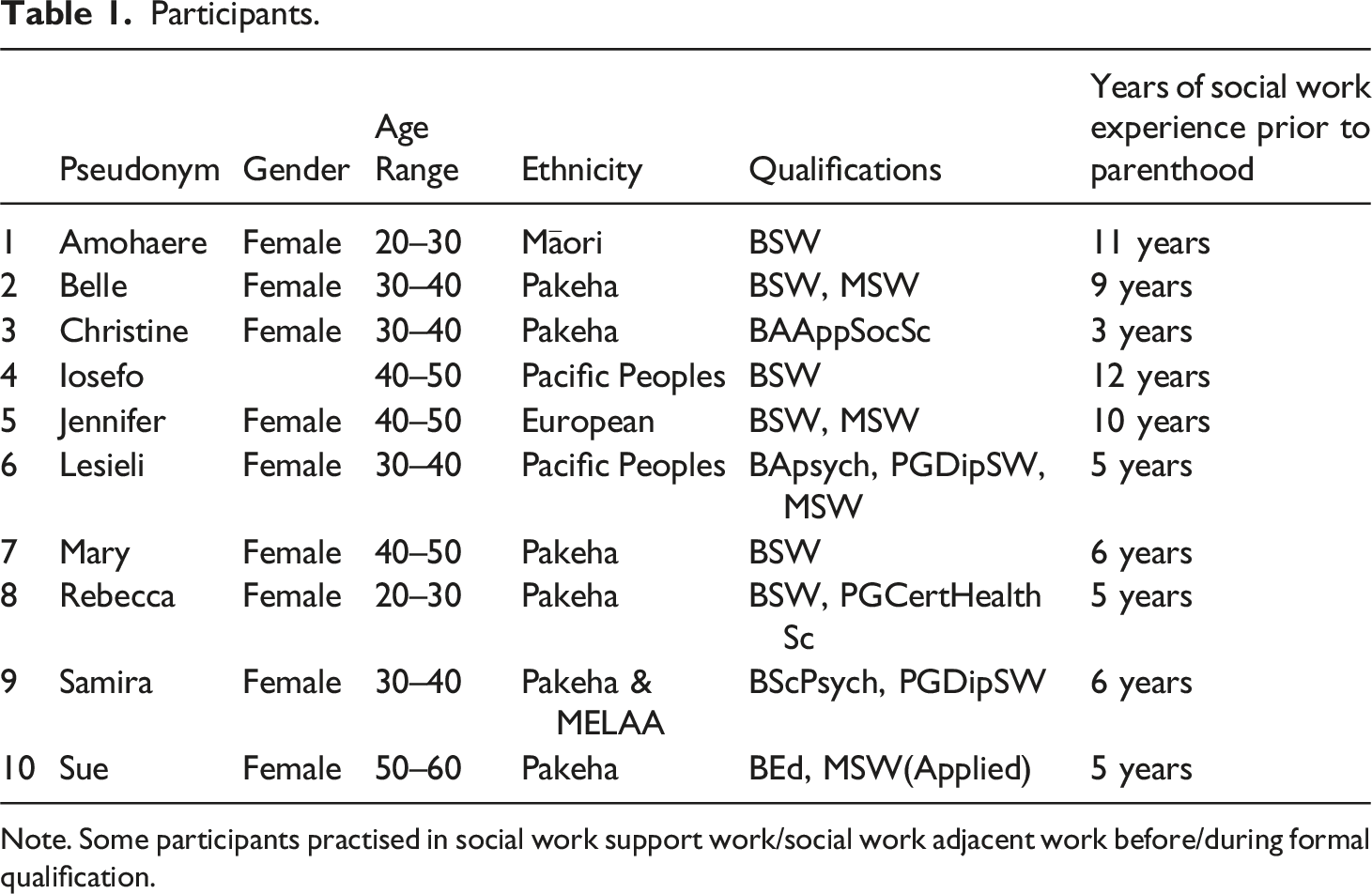
Note. Some participants practised in social work support work/social work adjacent work before/during formal qualification.
Data collection
While the study design was simple it was apt. Conversational, semi-structured online interviews facilitated far-flung participation whilst enabling participants to choose a time and place where they could feel comfortable and focus on the topic. Interviews demonstrated that participants had already reflected on integrating their role of parent with their role of child protection social worker, a process that they had not had much chance to articulate—there was little need for prompts from the prepared interview schedule. Participants recalled unsettling experiences of dissonance and incongruity when they returned to work, expressing feelings of bemusement, disappointment, incongruence, annoyance, and guilt. With quite a bit of humour, and some swearing, they recounted experiences of powerful emotional responses constraining them in performing professional duties that they no longer believed to be helpful.
Reflection and analysis
Although this was an academic project, the research team used reflective supervision throughout the interviewing and analysis phases to ensure a high degree of critical reflexivity in considering whether insider status or preconceived notions were distorting interpretation of what participants said. The collective experience of our research team functioned as a window on participants’ worlds, and an aid to reflexivity. Themes were mainly identified through inductive analysis, but simultaneously interpreted through a deductive lens reflecting a feminist, social constructionist stance (Gray et al., 2015), consciously acknowledging that research reflects the worldviews and understandings of researchers (Barusch et al., 2011). This approach acknowledges the improbability of being purely inductive (Braun and Clarke, 2019). Researchers will always bring some preexisting knowledge and experiences to the analysis of data, and this is unquestionably the case with this project.
Thematic analysis (Braun and Clarke, 2019) was used to analyse the data. Jess, the first author of this article, carefully listened to each interview, then transcribed the interviews verbatim and as orthographically as possible, noting hesitations, false starts, and long pauses. The dataset was then coded using NVivo 11 qualitative coding software and visual representations of developing themes. Some initial codes were descriptive (e.g., “the reality of parenting was very different to what I imagined”); others were more interpretive, (e.g., “loss of confidence in the agency’s parenting manual”).
The interviews confirmed what the scant literature on the topic indicated: that social workers, along with workers in comparable professions, are expected to take transition to parenthood in their stride. We were taken aback by the sense of dissonance that many participants expressed: destabilisation in their confidence in the parenting standards they were expected to uphold, and dismay at their employing agencies’ lack of support for their own parenting role. There are implications here for both practice and workforce retention. To bring the salience of this to light, and to ground recommendations for remedying this state of affairs in participants’ experiences and views, we decided to write this article, with the second author constructing the article and the other two reviewing and contributing.
Findings
Key Themes.
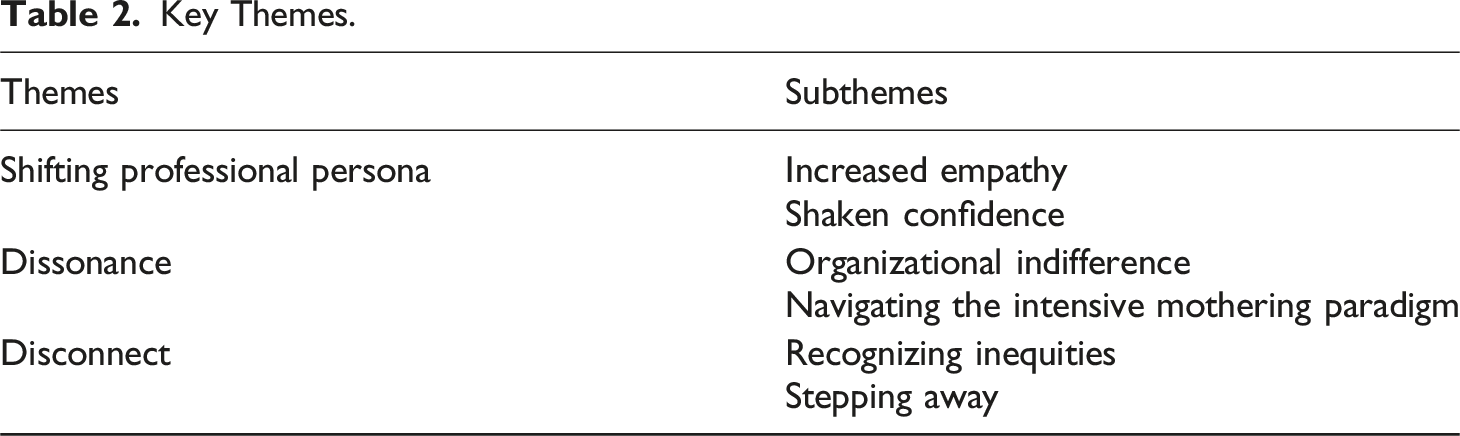
Shifting professional persona
Participants noted erosion of the expert part of their professional persona. Parenting strategies that they had advised mothers to use before having their own child were uneasily recalled and compared with their current, more down-to-earth perspective, the result of experiencing the “messy” realities of raising a child. Jennifer’s comment about this was wry: “I had to learn everything I didn’t know by becoming a parent.” Giving advice about parenting techniques now felt uncomfortable for many, especially if they had not used recommended techniques themselves. Providing solutions from the manual felt insincere to Christine, as when required to give advice on toilet training, a stage her child had not reached: I felt so awkward…I was reading out this article, all these things they should be doing and I'm like “Are they actually taking this in? I don’t know what I’m talking about!” Like, “Is any of this useful?” I just felt really weird, it didn’t feel sincere at all.
However, integrating parenting experience felt more authentic, as Sue explained: I think I [became] more compassionate, more empathetic, more useful in the sense of having more skills and strategies up my sleeve…If I observed something that I thought I might be able to sort of support, with suggestions, some alternatives, I felt I had more credibility because I had actually tried it myself.
Reflecting on her practice as a young social worker with no children, Rebecca now felt “a lot more comfortable giving advice…because I do have a kid, and I do get the basics of boundaries and consequences and all of that and I do understand development because I’m seeing it.” She was relieved that she no longer had to establish the validity of her advice and no longer dreaded the question “You don’t have kids? Well, how would you know?” Iosefo reflected on the difficulty of assessing parents “from the outside looking in,” using the phrase “You don’t know what you don’t know” to indicate his sense of how little he had known about parenting before becoming a parent. Amohaere’s comment, “everything I thought I knew, I didn’t,” put others’ experience in a nutshell.
Jennifer’s understanding of parenting assessment was transformed by her baby’s stay in a neonatal intensive care unit where she “definitely felt a sense of being like on stage or being observed or performing.” While as a professional she had been “judgmental of parents who didn’t follow up with health needs for their kids” she now understood the difficulty of following up because of having to “push for things to happen that should have just happened.” She felt her professional persona dematerialising. A shift in professional persona was also noted by Amohaere: I felt raw, sore like a bruise….When I had to look at those photos [a child’s injuries], and then the mum, when we talked to her, she was beside herself and I was getting the same way—I felt like my professional, my personal protective layer or skin was gone. I was better at child protection before becoming a parent.
Jennifer also used the word “raw” to explain removing herself from the child protection decision-making aspect of her work at an NGO: “What I found increasingly difficult was the grey area [inconclusive concerns about children’s safety]…I remember thinking I just can’t be in that space, I’m too raw.”
Lesieli explained post-parenthood empathy as a less judgemental lens on “good enough” parenting, “really understanding impacts of having little kids, you know, messy houses and chaos, and actually, what is good enough parenting, with the pressures that parents are under?” Pre-parenthood certainties gave way to ambivalence while participants processed new attitudes to their work.
Incongruence
While their employing agencies professed to be dedicated to the well-being of children and families, participants noted that organisational culture did not support their own needs as parents. Organisational norms assumed that they would carry on just as before without support to process what being a parent might mean for their professional identity, their practice, and their availability. Participants saw this as “incongruous.”
Enhanced understanding of parents’ challenges made participants want to engage in responsive, flexible practice. Lesieli illustrated this: I’d try and reassure, like, “I know what it's like, don't feel pressure to clean up, I can come another time.” But then, the [organisational] pressure. “You haven’t visited this mum yet? You've had seven days, we have timeframes, you haven’t done the safety and risk assessment.” And you're like, “Well, she's just had a baby” and they’re like, “Yeah but the hospital is on us, the midwife is gone, so…” You're really trying to meet [mothers] halfway, but then you've got that pressure, but then you also understand this is a new mum, let's give her a break.
Workplace etiquette seemed to require being careful not to imply that parenthood benefitted practice, even discouraging asking colleagues if they had children. Samira noted that social workers who were not parents were “staunch” in believing that parenting experience is irrelevant for practice. This was not Samira’s view. She was among several participants who found that sharing parenting experiences reinforced relational practice: “Often you can use a level of self-disclosure to build relationships, get some buy-in.” This strategy was not encouraged. Participants highlighted the gulf between employing agencies’ expectations and standards, and real-life experiences of raising children. They found that advice routinely provided by their agencies was impractical. Amohaere was ruefully irritated by being on the receiving end of such advice: At work I’m like “I’m so tired, [Daughter] wouldn’t sleep in her own bed” and they all basically social-worked me into what I should be doing, and I’m like “You guys have no idea! That doesn’t work!” The job we're doing…we've got so much knowledge about parenting, what’s deemed good and perfect. And you're trying to achieve that but it's not even possible! I know what should be done, I know how it should be done, there are words written in black and white—but that doesn’t mean it works. Somehow, I never thought about that before I had kids.
Amohaere’s comment “What’s good for the goose is good for the gander” referred to expectations that social workers use the parenting practices promoted and monitored by their agencies. She knew she was not doing so. In desperation, when she was “a teary mess” because her baby “just would not sleep,” she began co-sleeping with her baby, a practice she was professionally required to strongly discourage. Jennifer saw the irony in putting her child in daycare so she could work for an agency whose work was heavily influenced by attachment theory and by neurodevelopmental research interpreted as indicating that mothers should care for infants themselves. Similarly, Christine was prepared for awkward questions from mothers she visited: “I always felt like [mothers would ask], ‘Where’s your baby?’ ‘Oh. (laughter) Hmmm, let’s not worry about that one!’” Rebecca overcame guilt about her baby being in daycare. “Babies are boring! (laughter) And so I found a really good daycare…I kind of had some element of guilt but nothing that overrode me or made me not do it.” The word “guilt” pervaded accounts of parenting challenges; in Jennifer’s words, for example: If I lose my temper I start yelling at my kids. Particularly my oldest who is…very emotional and so I feel I’m on eggshells with him…When I lose my temper with him I feel really bad and think I should be more sympathetic to his emotional needs, the fact that he finds it difficult to just participate, in contrast to his brother who is very easy for me…Then I feel really guilty.
Mary adjusted her expectations, for herself as well as service users: My expectations are now fucking pick your battles! Like, at the moment, possibly five out of seven nights [Son] will have a wrap with cheese and grated carrots. And (groans) I feel terrible! But [if hearing that in the course of work] I'd be like, [that’s fine]. So, I sort of try and cut myself some slack.
Rebecca noted negative effects of notions of intensive mothering: I forget the terminology—that parenting stuff. [A colleague] said they get lots of mums in mental health who have so much pressure because of the expectation “I've got to be everything.” Well, I'm not going to be everything, I'm not going to do “best practice” in all scenarios, sometimes [Daughter] will have chocolate at 9 a.m. and I don't care! (laughter).
However, several participants felt that their time with their children was so restricted that it must be meaningful. They felt, as Belle said, that they had to “cram everything into the weekend.”
Disconnect
Having struggled to reconcile their parenting and child protection roles, participants “stepped back” from child protection work. Mary left statutory child protection when her fierce protectiveness of her own child and, by association, other children, made the work intolerable: “I knew I would sort of lose it at people.” This was something Mary never discussed with her supervisor. She was not the only participant who placed a cone of silence over their emotional, professional, and practical struggles. Supervision was evidently not conducive to articulating and processing this unexpected reconstituting of the professional self. Managers were either oblivious, or they expected social workers to just deal with it. None of the participants felt that organisational culture enabled them to process the significance and implications of the transition to parenthood, either personally or for professional practice.
A sense of social injustice caused “disconnect” when parenthood heightened awareness of inequity. Iosefo identified his “much more sort of honest appreciation of teen mums, solo dads—the systematic prejudices against them.” Jennifer compared her own child’s situation to those of children she saw through work. It’s a huge disconnect. You start thinking about the privilege that some kids grow up with versus others…I think that’s part of the pain, it’s hard to come home to your organic baby food whilst you’ve seen kids just eating what they can.
Occasionally, organisational responses to participants’ needs were nothing short of heartless, as Lesieli experienced in a particularly upsetting way: “I went [during lunchtime] for a gender ultrasound and there was no heartbeat… I remember calling and saying, “I’m not okay to come back” and our practice leader emailing, saying “You’d better get back here, the team need you.” Lesieli noted “the irony” that this organisation was tasked with “the care, the awhi [cherishing]” of families, and yet “it didn’t seem to mean anything when it was us.”
Participants did not feel looked after, or even seen. Realising that his agency expected him to continue to work “above and beyond,” thus curtailing his availability to his son, Iosefo moved to a less taxing job. “I thought, I’ll be present and available and energetic for my boy, or I’ll come home and just be stressed, very distant and whatever. It just didn’t make sense.” Having resigned from her role, Lesieli said, “I’m not looking at roles in child protection at all…To be honest I put it down to the organisational culture and the working conditions, really, just the way we’re treated.”
Discussion
In New Zealand and other western jurisdictions, child protection practice focusses on parents’, especially mothers’ responsibility for children’s welfare and development (Budds et al., 2017; Hyslop, 2022; Keddell et al., 2019). Children are conceptualised as vulnerable, and parents held accountable for children remaining harm-free. Risk-focussed child protection work prioritises safety assessment, but lack of time makes it hard for overworked social workers to get to know families and comprehend their circumstances well enough to do this in a fully informed way. Their practice becomes risk averse. Often the state steps in, either to bring parents’ behaviour more into line with the parenting standards that agencies uphold, or to remove children from families whose parenting is deemed inadequate. Little attention, or funding, is devoted to holistic, preventive social work to support families to meet self-defined needs and reorient themselves towards well-being. The “holding relationship” that underpins beneficial change (Ferguson et al., 2022) is not just hampered, but routinely derailed. Social work’s role in promoting social justice is deprioritised and neglected.
Our study found that transition to parenthood changes how social workers experience child protection practice. Parenthood conferred expanded participants' understanding of what real-life parenting involves. Yet they were expected to take up their role where they left off, and their experiences of the professional ramifications of becoming parents were sidelined. The notion of forming alliances with parents, as several participants intentionally did through self-disclosure, is not encouraged in a field that is set up to monitor parenting and assess risk.
Child protection social workers who become parents need to process crises of confidence, authentic use of self, self-disclosure as part of relational practice, intensified awareness of inequity, and heightened sensitivity. For participants in our study, this sometimes felt like over-identification with children or parents, which, as O’Sullivan and Cooper (2022) also found, could be deeply upsetting. Yet, when practice is set up to be more mechanistic than relational, professional supervision does not provide scope for dealing with such emotional turmoil through reflective practice. Participants described their sense of dissonance when child protection organisations dedicated to the well-being of children and families appeared to take little notice of what the responsibilities of looking after a child meant for them as social workers in practical and professional terms. They wished for a safe space, whether in professional supervision or less formally with peers, in which to process how parenthood both destabilised and enhanced their comprehension of practice in the field, and to deal with a troubling sense of emotional dissonance (Nielsen et al., 2023). No such space was available to them, as is typical in practice contexts that have resorted to prescribed procedures and deadlines (Cousins, 2016) with response to risk eclipsing response to need. Workplaces effectively silenced participants, offering no support for them to process the emotional and attitudinal changes they experienced when they returned to their child protection role, a time when they experienced heightened sensitivity to the impact of child maltreatment and heightened awareness of how social inequality increases parents’ stress, making maltreatment more likely. Just as they wanted to be able to take the time needed to hear about parents’ lives, they wanted someone in their workplace to listen to the impact and meaning of their parenting role in relation to their child protection work, They provided multiple examples of workplaces’ inability or unwillingness to vary employment conditions or respond to their needs as parents. This is a situation in dire need of attention.
Analysis brought interesting parallels to light. Our positionality as researchers encompassed insider status. The first author’s induction into this status was both recent and closely aligned to participants’ experiences, as she returned to a child protection role relatively soon after having a first baby. While the other authors’ experiences of raising small children while employed in child protection roles were less recent, we all found that participants’ experiences resonated with our own. We recognised participants’ new sense of alignment with parents they worked with, and their descriptions of returning to work after becoming a parent were infused with awareness of a shift in their professional positionality.
Participants were required to assess mothers’ parenting capacity according to standards embodied in guidelines and manualised instructions, while discovering through personal experience that neither these standards nor online representations of parenting reflect the realities of raising children. Parenthood increased participants’ empathy for the parents and children they worked with, but they had no opportunity to process this heightened empathy professionally with an empathic listener. In an analogous way, parents are hampered, by time constraints and by their own apprehension about possible consequences in the form of statutory intervention, in revealing their circumstances and emotions to social workers. Several participants, including the one father, found that they were more aware of the impact of inequality on child and family well-being, and some found the realities of maltreatment upsetting, especially when parents first returned to work after the birth of a first baby. While their heightened empathy was not experienced as vicarious trauma nor burnout, it was destabilising enough to warrant attention in professional supervision. This form of support was not forthcoming, as is unfortunately to be expected in agencies focussed on risk assessment and enacting the technical-rational approach currently dominating the field (Ferguson et al., 2022).
Participants took the action they needed to take. On first returning to work some proactively removed themselves temporarily from upsetting situations. Sooner or later all of them resigned, leaving the field at least temporarily and taking more flexible, less time-consuming jobs. Their reasons for resigning were not so much about burnout as about frustration and annoyance. They found their organisational culture to be uncaring and rigid and believed that families needed more nuanced support than their agency provided.
Implications
Our findings suggest that child protection agencies would do well to take notice of workers’ learning from transition to parenthood. Listening to them could be the basis for more grounded, relational practice. Participants in our study described a shift in their professional persona. They framed this shift as heightened propensity for empathy due to understanding the challenges of raising children. Their professional identities were no longer “overridden by a powerful occupational culture of the construction of ‘others’” (Scourfield and Coffey, 2002: 328). To both strengthen practice and promote staff retention, social workers’ experiential learning about parenting could be usefully shared with colleagues and integrated into child protection work to help build alliances with parents and reinforce relational practice. Currently, it is unlikely that this form of learning will gain traction as organisational culture sidelines parenthood as a potentially useful aspect of professional identity. Indeed, talking about one’s own experiences of raising children seems almost taboo. Yet the learning gained through parenting experience, and through the challenging process of making sense of this learning, could inform practice.
Given agencies’ rhetoric about partnering for well-being, participants experienced the mechanistic orientation and surveillance functions of their work as incongruous. Their stance on this echoed the findings of Scourfield and Coffey (2002: 328): “If social work practice is scrutinizing women even when anti-discrimination has a very high profile within their profession, social workers are in some ways doing what they know they should not do.” Parenthood sharpened participants’ perspective on how inequality impacts on parenting, but they found that any potential for addressing socioeconomic needs was subsumed by the prevailing focus on child development, parenting techniques, and monitoring risk.
Authenticity was further brought into question by a dismal disconnect between aspirational rhetoric about supporting parenthood and organisational support for social workers' own practical and emotional needs as parents, which were ignored. Workplaces do not normalise transition to parenthood, which is a significant life transition that can reorient a person’s perspective. Social workers who participated in our study minimised or concealed the enormity of the impact of transition to parenthood on their professional identity and persona. They needed time to engage in a process of adaptation and integration and to get used to the changes. This was especially needed by mothers returning to work relatively soon after the birth of a first baby. Since there was no opportunity to reflectively discuss how profoundly their parenting role affected their professional practice, they suffered in silence or removed themselves from aspects of the role that caused them distress. If child protection agencies fail to support staff in parenting roles, then claims to be dedicated to the well-being of children and families are functionally ineffectual and hypocritical.
It would behove child protection agencies to consider why experienced social workers resign after becoming parents, and to consider how a more relational, flexible approach might mitigate improve staff retention. A practical response is urgently required. Possibilities include ready availability of safe, reflective supervision and some kind of peer support or mentoring programme for social workers returning to work after becoming parents. More flexible working conditions are also needed.
The incongruity noted by many participants is the basis for the final and perhaps most challenging recommendation implicit in our findings: if the child protection field is to comprehend its role and literally know what it is doing, it must urgently engage in focussed discussion about the practice implications of positioning responsibility for children’s well-being as “both the private responsibility of individual mothers, and also a matter of public scrutiny and intervention, with mothering practices defined as ‘good’ and ‘bad’ in expert and policy discourse” (Lee, 2008: 468). This discussion should be led by social workers who understand social work as a professional endeavour encompassing social justice rather than as a monitoring exercise.
There is a long way to go if New Zealand’s state-controlled child protection field is to reach genuine commitment to supporting staff. Social workers struggle to manage the conflicting demands of child protection practice and parenthood (Burns et al., 2020). However, if agencies are unresponsive to social workers’ needs as parents, they will leave the field, taking their practice wisdom and experiential learning with them. Given that social work agencies struggle with staff retention this seems absurd. Hearing and learning from social workers who become parents could improve staff retention and make child protection practice more relevant and useful to the people it claims to serve.
Conclusion
The study discussed in this article explored largely uncharted terrain. Child protection agencies seem oblivious to the glaring paradox of presenting themselves as dedicated to supporting children and their parents while falling short with their own staff. Transition to parenthood is not a discrete personal matter that individual workers will manage, then return to routine work. Rather, heightened empathy causes them to question assumptions that underlie the purpose of the work and how it is done. Giving social workers space and time to reflectively process what they learn from transition to parenthood has the potential to enhance relational practice. As Iosefo said, child protection organisations need to learn to “walk the talk.” If they continue to ignore social workers’ difficulty in reconciling experiential learning from parenthood with the personal, emotional, and psychological toll exacted by doing the work, then they will continue to lose experienced, knowledgeable staff.
Footnotes
Declaration of conflicting interests
The authors declared no potential conflicts of interest with respect to the research, authorship, and/or publication of this article.
Funding
The authors received no financial support for the research, authorship, and/or publication of this article.
