



Abstract
Summary
Removing a newborn from his or her birth parents’ care is arguably a stark display of state power into the family. This study explores birth parents’ engagement with care proceedings in all (N = 177) newborn care orders in Norway between 2012 and 2016. The study asks which arguments parents use to assert their care rights, their focus, and whether arguments differ depending on the parents’ risks.
Findings
Applying the defence dichotomy and seeing arguments as accounts, the analysis revealed parents primarily both justifying and excusing risks, and in two-thirds of cases rationalizing their care rights. Parents primarily denied harm and pinpointed (failed) service provision efforts, as well as excused their situation by claiming sufficient change and placing blame on i.e. child welfare services. Rationalizations did not defend parenting as such, but claimed normalcy and deservingness, as well as echoing concerns raised. Arguments were primarily parent- and service-focused. Parents with substance use risks blamed significantly less than parents with personality risks, and parents with intellectual disability risks demanded significantly more leeway as ‘new parents’ than parents with personality risks.
Applications
The study reflects how a marginalized demographic similarly, comprehensively, and most often unsuccessfully, engages with the child welfare system. The arguments reveal both alignment and misalignment in understandings of acceptable state intervention and responsibilities. It points to the dire need for knowledge about parents’ actual understanding of child welfare services, as well as clear communication and feedback between parents, their legal counsel, and social workers in assessments and service provision.
Introduction
Defining when it is acceptable to intervene into the private life of families to safeguard a child is a long-standing debate and challenge (Freeman, 1997, 1983). State interventions involve inherent tensions between parents’ strong legal rights, on the one hand, child welfare services’ (CWS’) responsibility for child welfare on the other, as well as individual children's rights to welfare and their own family lives (Child Welfare Act [CWA], 1992; European Convention on Human Rights [ECHR], 2010). Criticism has come recently through several judgments from the European Court of Human Rights (ECtHR) against Norway and the Norwegian child welfare system, brought before the Court by Norwegian parents. These parents have exhausted their possibilities in the national legal system and have approached the ECtHR because they believe the state has violated their human rights to respect for family life. Little research exists on how parents in child welfare proceedings argue their case. Examining parents’ argumentation both with child welfare agencies and subsequent legal proceedings is vital both with regard to understanding parents’ interests and viewpoints, as well as providing knowledge about the basis for child welfare interventions. With access to all decisions about newborn care orders over five years (N = 177), this study is in a unique position to investigate birth parents’ substantive engagement with a serious child welfare intervention in Norway. Subjected to analysis are parents’ perspectives and arguments when CWS has applied for a care order of a newborn to the County Social Welfare Board (County Board). As CWS carries the burden of proof in the case, the analysis approaches parents’ argumentative responses to the accusation that they are not able to care for their newborn baby. Do they deny, comply or present new evidence or arguments in support of their case? Does their focus align with that of CWS? Furthermore, I examine if there are types of parental argumentation that are correlated with the type of parental health or disability risk in the case, such as a substance abuse problem or other types of problems causing concern.
An analysis of parents’ perspectives captures how parents understand and view CWS and engagement, their experiences with caseworkers, as well as how they view sufficient parenting. With this knowledge, it becomes possible to target, evaluate and improve CWS and service provision (Alpert, 2005; Bouma et al., 2020; Lundahl et al., 2020). It also provides necessary input as to what is already known about decision-making behaviour and justifications in assessing parents and their capacities in newborn care orders, both in Norway and internationally (Broadhurst et al., 2018; Juhasz, 2020; Krutzinna & Skivenes, 2020; Luhamaa et al., 2021). The analysis finally sheds light on what legitimate state intervention consists of for this group of citizens. The structure of the article is as follows; in the next section, context will be provided for particularities concerning assessments and decision-making in newborn care orders in Norway, as well as existing knowledge on parents’ participation in care proceedings. After this, ways to understand parents’ legal argumentation will be laid out. The data material and methodology will then be presented, followed by the findings, grouped by argumentation type. The findings will be discussed, and the article ends with some reflections on limitations, as well as concluding remarks.
Assessing and deciding newborn care orders
A triangle of risk
Research on child welfare decision-making emphasizes the significance of central aspects of a case, or case factors, for the decision outcome (Christiansen & Kojan, 2016; Gambrill & Shlonsky, 2000; Graham et al., 2015; Lauritzen et al., 2018; Vis & Fossum, 2015). Case factors are typically organized into three main domains as evident in the Common Assessment Framework, namely the parents’ capacities, the developing child, and finally the family and environmental context (Department of Health, 2000). This framework is widely accepted and works as a professional guide when child welfare assesses child safety, health, and well-being, as well as family contexts and needs. It has also been transferred to a Scandinavian context, as well as reworked to fit the newborn subset (Barlow et al., 2014; Socialstyrelsen, 2019). As newborn cases concern a potentially short-lived family and infant life, it is natural to assume that the cases primarily focus on the parents. Norwegian legal scholars Ofstad and Skar (2015) emphasize central parental concerns that are in effect in the newborn context: ‘Drug use in utero or other circumstances for parents that may impact parenting, such as intellectual disabilities or severe mental illness will (…) be of importance’ (p. 103). From previous international research on risk and reasoning in care orders of newborns, we know that the aforementioned risks, as well as personality disorders or problematics, are often central, overlapping, and cumulative, in the overall considerations of risk to sufficient parenting (Barlow et al., 2014; Broadhurst et al., 2018; Juhasz, 2020; Krutzinna & Skivenes, 2020; Luhamaa et al., 2021; Ward et al., 2012). The centrality of parents’ ability to make changes and utilize services and aid is also a central aspect of the care order context, especially for newborns (Juhasz, 2020; Lushey et al., 2018). These mentioned concerns, mental illness, substance abuse, intellectual disabilities, and personality disorders, come with varying capacities to change behaviour and utilize help. As such, exploring the arguments parents use to assert their care rights, along with what specific health or disability risks they face is of vital interest for this study.
Despite the focus on parents both in the newborn context in general, as well as in this study, the two other domains in the triangle are also necessary to map out. Concerning the child, a newborn baby is in general vulnerable and in need of immediate emotional and physical care. The existing knowledge base on the situation of newborns subjected to care orders informs that many of them experience maltreatment in utero both through substance misuse and domestic violence (Ward et al., 2012), some are born prematurely as a result of this, and in Norway, legal data informs that approximately 31% are born explicitly without a birth abnormality (Juhasz, submitted). Finally, the family and environmental context are also of importance. Factors known to affect the likelihood of harm to newborns include the (non-)presence of a family and social network, level of family isolation, and employment or educational situation (Putnam-Hornstein & Needell, 2011; Ward et al., 2012). As these three domains in sum are central to how child welfare workers assess risk in a case, the main aim of the analysis is to examine how parents argue across these domains, and whether parents’ focus on what is essential to consider aligns with how the CWS frames and County Board decides, the case.
A fourth domain – the duties of CWS and county board decision-making
All child welfare cases in Norway involving serious or involuntary intervention are presented to the County Board (Skivenes & Søvig, 2017). Through one legal member, one expert member (most often a psychologist) as well as a lay member, the County Board is intended to provide the necessary legal competence and knowledge about children's health, development, and needs, as well as represent legitimacy and knowledge from the public, as such securing due process in serious child welfare decisions (Falck & Havik, 2000; Hultman et al., 2020; Skivenes & Tonheim, 2017). In newborn care orders, the task of the County Board decision-makers is to decide whether a high probability of a situation or risk for the child, as stated in section 4–8, clause two, will occur if the child were to move home with its parents (CWA, 1992). The County Board assesses the fulfilment of three legal criteria, resting in the ordinary care order section 4–12 of the CWA. There needs to be (a) a situation where harm or neglect has occurred or was likely to occur, (b) in-home or help services have been unable or assessed as unable to facilitate satisfactory care, and (c) the care order is in the best interest of the child (Juhasz, 2020; cf. Skivenes & Søvig, 2017). Care order interventions typically include specifications about placement type and contact visits as well as the decision to place the child outside the family home (Skivenes & Søvig, 2017). Birth parents still retain parental rights. Nonetheless, due to the severity of the intervention and vulnerabilities of the parties, strong formal and legal rights come into play for parents in care proceedings (CWA, 1992; Civil Procedures Act, 2005; ECHR, 2010). Procedural rights are central in this regard and are established to varying degrees internationally and across child welfare systems (Burns et al., 2017; O’Mahony et al., 2016). The three legal criteria (risk assessment against threshold; assessment of in-home [less intrusive] services; child´s best interest) is likely to shape the parents’ arguments, focusing on the actual assessment of the risk, what help has been provided and what is best for the child. As such, arguments focusing on thresholds, procedures, and aid from CWS become an additional domain for the analysis, complementing the triangle.
Parents’ engagement with CWS and legal proceedings
National and international research on parents’ experiences of CWS involvement reveals that they are both positive and negative, as well as vary in which factors are vital to service satisfaction (Bouma et al., 2020). At the agency level, the characteristics of the child welfare workers, the quality of the relationship, the help offered and the parents’ feelings of insecurity and fear all affect the perceptions of contact with CWS (Lundahl et al., 2020; Studsrød et al., 2012). When a case moves over to the legal level, Norwegian parents do have a right to free legal aid. Drawing on Lindley et al. (2001) mapping of welfare rights advocacy, the lawyers provide and interpret legal information, advise based on the facts of the case, provide support, negotiate and advocate before the County Board. Advocacy for parents is presumed to be challenging, however, as the child welfare cases in Court usually involve more conflict, greater harm or risk, and parents who are harder to help than those that remain at the agency level (Masson, 2012). Both the nature of the proceedings and the relationship between parents and their legal counsel are essential to grasp parents’ engagement in court, and the context for written judgments and decisions. Research from American, British, Irish and Australian child welfare contexts illustrates that parents often disengage from the legal process, and the mentioned experiences of fear, confusion and being overwhelmed at the agency level also characterize engagement with the legal process (Cleveland & Quas, 2020; Lens, 2017; Masson, 2012; O’Mahony et al., 2016; Sankaran, 2010; Sankaran & Lander, 2007; Thomson et al., 2017).
As a general observation, however, research on the content of parents’ actual engagement and communication in legal proceedings remains understudied. A valuable exception from Finland explains that parents oppose (the continuation) of child placements due to changes in conditions or behaviours, an original wrongful decision, and biased and wrong expert statements (Poso et al., 2019). Assumingly, these and similar arguments will be visible in the Norwegian newborn material.
Analysing parents’ arguments
As the CWS carries the burden of proof in the case, meaning they are required to submit adequate evidence of suspected (future) risk, the structure of the care proceedings arguably puts parents in a defence position. The literature on criminal law distinguishes two main types of defences that a defendant can assume – justifications or excuses (Smith, 1989). ‘A justification claim … seeks to show that the act was not wrongful, an excuse … tries to show that the actor is not morally culpable for his wrongful conduct’ (Dressler, 2006; cf. Husak, 2005, p. 558). These legal defences are also identified as broader social defences, or accounts, aiming to bridge the gap between actions and expectations when these are being questioned (Scott & Lyman, 1968). As social defences, justifications similarly assume responsibility for the action in question but deny the illegality or immorality associated with it, underlining the necessity of the action (Scott & Lyman, 1968, p. 47). Excuses, on the other hand, are socially approved vocabularies for accepting the negativity of performance but mitigating or relieving responsibility for it (Scott & Lyman, 1968, pp. 47–50, see pp. 51–52 for substantive descriptions of each account). This approach has been applied to a sample of ordinary care order cases, exploring parents’ legal arguments as justifications and excuses in appeal cases before a Norwegian District Court (Juhasz, 2018).
It is important to emphasize that what distinguishes newborn care orders is that they can be increasingly uncertain in facts and circumstances, as they often lack a ‘track record against which parenting performance can be predicted’ (Campbell et al., 2003). Newborn care proceedings are therefore not merely a question of identifying guilt for past grievances, assigning responsibilities, and measuring a proper response. The analysis must therefore open up to alternative arguments. Apart from, or as a part of, the clear defence dichotomy, normalization has been identified as an argument for wrongful conduct (Juhasz, 2018; Vaca-Guzman & Arluke, 2015), where, in a child welfare context, parents explicitly aim to widen the scope of parental normality and adequacy. Furthermore, legislation requires considerations of whether non-intervention ‘will lead to a future situation or risk for the child’ (CWA, 1992). This normative and prognostic instruction highlights the cruciality of procedural justice in child welfare that the County Board proceedings must adhere to (Eriksen & Skivenes, 1998). In sum, the analytical point of departure is that parents’ engagement in newborn care proceedings will counter CWS argumentation with varying degrees and constellations of three types of arguments – justifications, excuses and rationalizations.
Methods
Data material and case characteristics
The study of parents’ arguments in care orders of newborns uses data material from a total pool of all (n = 177) care order decisions from the Norwegian County Board about newborns made between the years 2012–2016, rooted in sections 4–12 as well as sections 4–8, clause 2 of the CWS. The analysis rests on the final written judgments. In 45 of these cases, the parent(s) consented to the actual placement, and these cases are thus omitted from the analysis. Subjected to analysis were the remaining 132 cases where at least one parent opposed the care order decision and provided claims against it. In two cases, the father consented to the care order decision, but suggested foster placement with him, thus in reality not ‘withdrawing’ care for the child. These two cases were included in the sample, as argumentation centred around maintaining care rights. Five cases opposing, but not providing arguments against, the care order/placement was omitted. Access to the data was granted by the Norwegian Data Protection Authority as well as the Data Protection Officer at the University of Bergen, and several agencies were involved in granting access to and working with confidential material. The written decisions (n = 132) were between 5 and 25 pages in length. Chronologically they included procedural information about the parties and structure of the legal process, undisputed background information and facts, the claims presented by CWS about the care situation, the claims presented by the parents and finally the County Board assessment and final decision. Hundred and twenty-three of the cases resulted in a care order, placement in a foster home and between 0 and 24 annual contact visits. The parents’ claims were articulated by their lawyers and incorporated into the written judgment by the court after the hearing and final counsel meeting with the decision-makers. Regarding the constellation of parents involved, both parents had parental rights in 83 cases and sought joint care in 60 of these. The mother had parental rights alone in 49 cases and sought sole care in 64 cases, and in eight cases the father sought sole care of the infant(s). In no cases did the father have sole parental rights. The analysis focused on the claims of the parent(s) with parental authority, claiming de facto care for the child. In 57 cases, the claim represents the mother alone, in 53 cases one joint claim represents both parents, 15 cases include separate claims from both parents making one case having two parental claims, and seven of the claims represent the father alone. As such, 147 separate claims were identified within the 132 cases. They were structured by the three care order criteria mentioned above, and across the written decisions, ranged from approximately five sentences to four pages.
Analysis
Each case was read fully to become familiarized with it. The background section and final decision section informed coding for the County Board's assessment of risk factors, case outcome as well as parent constellations. To identify parents’ arguments, the section on parents’ claims across the 132 written judgments was analysed. The text was approached through a qualitative analysis based on reading and rereading the claims several times, followed by axial and theoretical coding (Coffey & Atkinson, 1996). The coding scheme departed from a defense argumentation framework but was open to the presence of arguments outside this dichotomy, allowing for flexibility in line with abductive analysis and theorization (Timmermans & Tavory, 2012).
Parents’ argument types were identified and captured through three meticulous coding rounds, focusing on (a) types of main argument, (b) subcategories of arguments, and (c) case factors in arguments (see Figure 1 below). Three argument types made up the main argument categories – justifications, excuses and rationalizations. Firstly, justifications consisted of four subcategories. These were denial of harm (arguments where parents claimed that no damage or wrongdoing has occurred, either harm to the child or oneself as a parent), whataboutism (condemning CWS or others for equally negative behaviour or contexts) and appeal to loyalties (serving some particular allegiance, to co-parents or wider family). Arguments focusing on CWS casework, and experiences of undue process were coded as such. Secondly, excuses were also made up of four subcategories. These were blaming (blaming a person or entity for outcomes or circumstances), defeasibility (typically lack of information, knowledge, will or capacity due to, e.g. a mental illness or being under the influence of substances, equating to exceptional circumstances where the law cannot be applied at all or must be softened) and biological drives (a bodily or biological explanation outside human control, such as references to own parents’ behaviour, or being a part of a substance abuse community). Some arguments were clearly formulated as excuses, but not oriented toward past or current risks or problems. As such, the last subcategory of excuses was claims of change, where parents explicitly focused on a new care situation. Lastly, the arguments outside the defence dichotomy, labelled rationalizations, consisted of four subcategories. Normalization was one subcategory and included arguments concerning new parenting uncertainties as being normal. Arguments where parents echoed the concerns of CWS (legitimate concerns subcategory) were coded, as well as normative elements of deservingness. This subcategory included arguments based on the wording of ‘deserving a chance’, and also where parents in such respect declared ‘love for the child’, as well as claiming to deserve a chance based on the motivation put into changing course due to the pregnancy. Arguments where the general lack of information or clarity in the case was argued for made up the case uncertainties subcategory. Finally, a small number of arguments labelled engagement/participation included parents wanting to shape the help they were to receive, and who had clear perceptions as to what help and services would be necessary, and an equally large group, labelled severity of intervention, argued that care orders, in general, are (too) invasive and consequential.
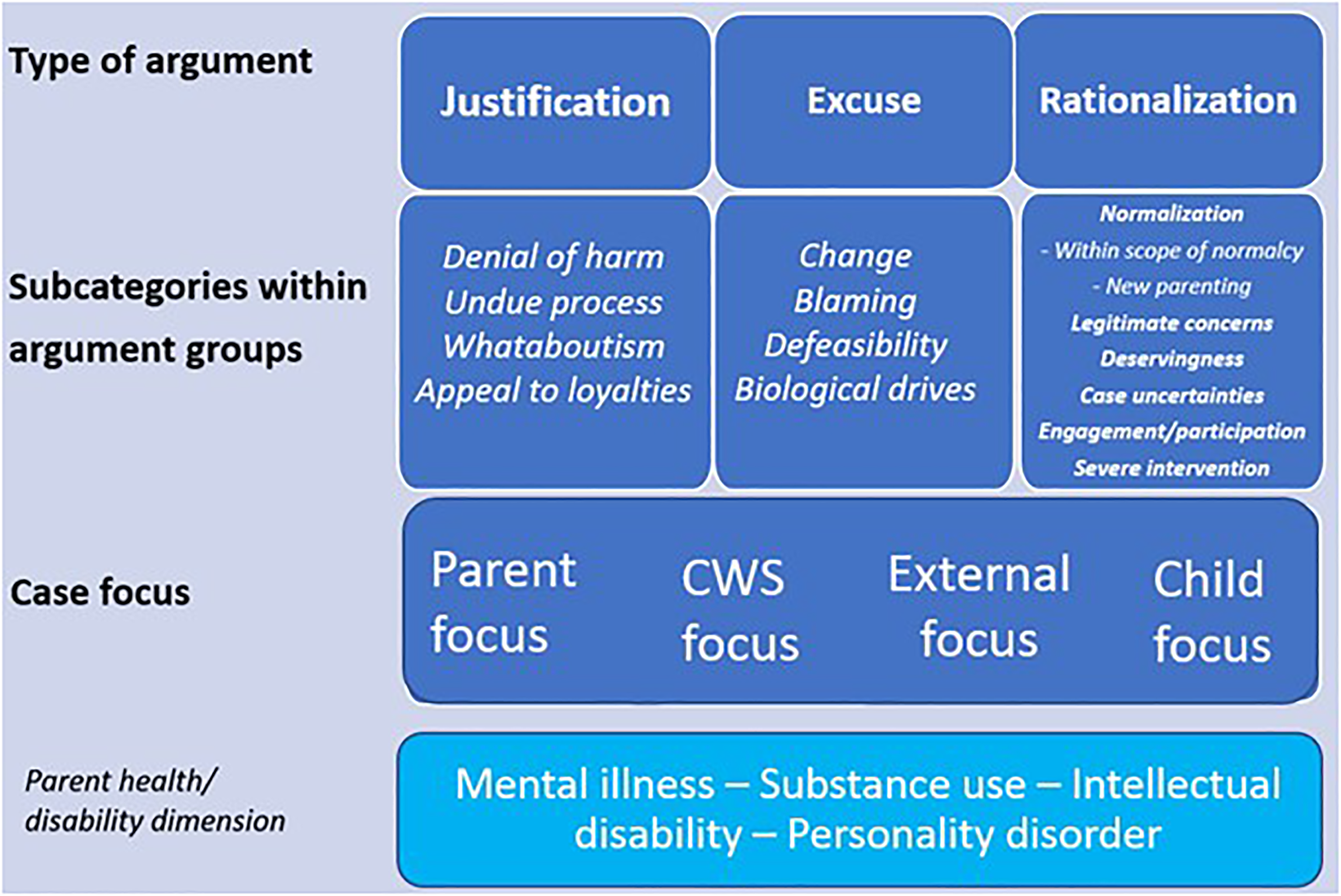
Overview of coding process and analytic approach.
The analysis finally aimed to capture the particular domains in which the arguments were anchored. The domains in focus were identified and coded, as either parent, child, environment or the fourth domain, that of CWS (see Online Supplementary Material for case factor coding scheme). It became evident throughout the coding that the rationalization arguments were unsuitable for this type of coding, either naturally being too vague or very explicit in their focus, and as such, only the justifications and excuses were subjected to case factor coding. Figure 1 below provides an overview of the coding process and analysis.
Following the coding rounds, the parents’ arguments were broken down by the different health or disability risks the parents faced, which had been coded previously as a part of a larger study. The premise for this categorization was that the County Board has emphasized said risk as a central concern in the final decision. Significant differences between the risk groups were investigated, using the Zigne Signifikans software. Differences between risk groups were assessed applying a one-tailed, single randomized sample test at both a 5% and 1% significance level. Nvivo v. 12 was used both for variable registration and all stages of the coding process.
A total of 121 cases had claims consisting of both justifications and excuses. Four cases (14-C27, 14-C42, 14-C5 and 16-C2) only included excuses and rationalizations, three cases (12-C15, 15-C31 and 15-C8) only provided justifications, and two cases (13-C2 and 13-C3) provided only excuses, while two cases (13-C34 and 15-C3) included justifications and rationalizations. Each case ranged from having 0–14 excuse arguments, 0–15 justification arguments and 0–9 rationalization arguments. These were mapped using NVivo's count of ‘references’ as a measure of individual arguments. Roughly, the average was 4.7 excuse arguments across the cases including excuses, 3.9 justification arguments across the cases with excuses, and 2.4 rationalization arguments in the cases where those arguments were present. As such, a case most likely appeared in several argument categories, and summation in the tables in the findings is by column. Categories representing less than 10% of cases are not included in the findings, and individual findings under 10% are not commented upon. The illustrative quotes in the findings are selected as typical representations of the respective categories and have been translated from Norwegian by the author. The claims are given names corresponding to their unique, non-identifiable case identifier, sorted by year of publication and case number (13-C1 being case number one from 2013). Each claim is referred to as a part of the case to which it belongs.
Findings
Out of the 132 cases in the analysis, 93.2% (123) were ruled as care orders, in favour of the municipality. Six cases included the revoking of parental rights as well as placement of the child, and three of these six were finalized as adoptions. Regarding the constellation of parents involved, both parents had parental rights in 62.9% (83) of cases and sought joint care in 45.5% (60) of these. The mother had parental rights alone in 49 cases and sought sole care in 64 cases, and in eight cases the father sought sole care of the infant(s). In no cases did the father have sole parental rights.
The findings reveal that the three main argument types – justifications (N = 127, 96.2%), excuses (N = 126, 95.4%) and rationalizations (N = 93, 70.4%), are very much and simultaneously present in parents’ response to the allegations put forward by CWS. The content of the argumentative strategies is outlined below, starting with justifications, followed by excuses, and finally rationalizations.
Parents’ justifications of care rights
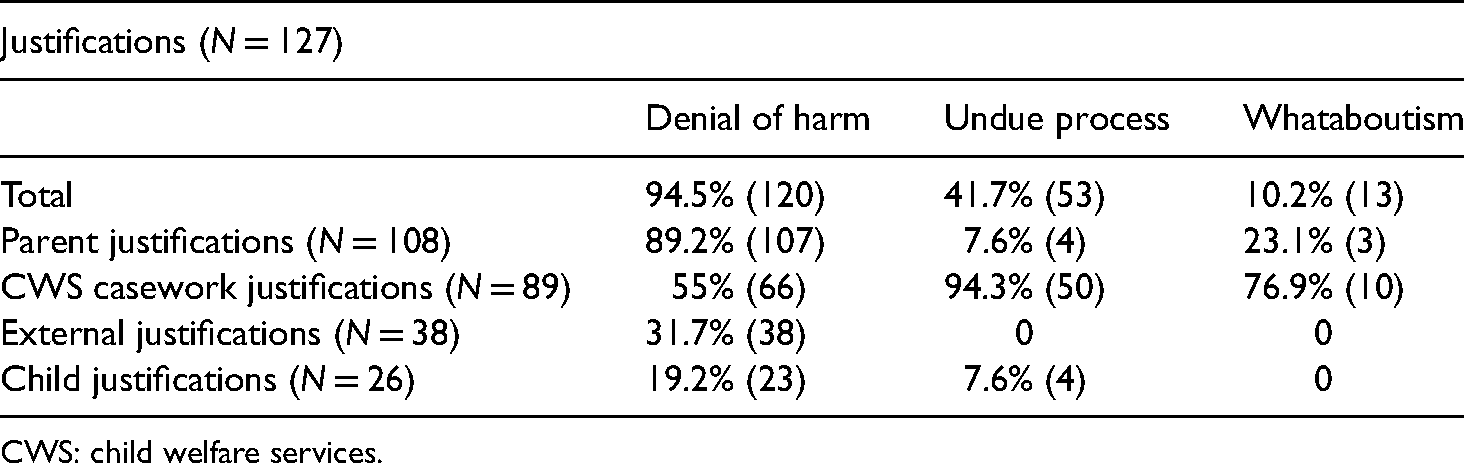
Starting with the claims where parents justified their care rights, the analysis revealed 127 cases where parents claimed that all or parts of their parenting capacities in question and past behaviour were justified and not wrongful. Three types of justifications were prevalent (Table 1). In 94.5% of the cases with justifications, denial of harm arguments were used, either as related to an action or behaviour, or the infant or previous children, claiming that no harm was done. The parents rejected concerns raised by CWS, and rather emphasized positive descriptions of themselves and their situation, as this quote illustrates: Mother is a well-functioning woman and has the possibility to be a good mother. She has no problems related to substance misuse or violence (16-C36). Approximately 42% of cases included arguments claiming undue process – that the CWS had not provided services or aid as mandated, as the following quote is an example of: Child Welfare Services in X have not done any investigation in relation to Mother, they have only had one meeting with her (13-C8). In 10% of cases, parents compared their parenting capacities and circumstances as equal or equally deviant to those of others through whataboutism arguments. This served as an attempt to justify their care rights through comparisons, such as the following statement illustrates: Foster placement is not always beneficial, and there will be risk of further uprooting (16-C31).
Justifications across case factors in parents’ claims.
CWS: child welfare services.
The analysis also explored the two most prevalent justifications and their distribution across the four case factor domains (parent, CWS, external environment or child). Starting with denial of harm arguments, it was evident that most denials of harm concerned the parents themselves (89.2%), seeing a situation, diagnosis, or certain risk as unproblematic. In 55% of cases, harm was denied with a focus on casework(ers) and evidence, claiming that CWS documentation or evidence did not align with proof of harm or inadequacy. Approximately 32% of cases denied harm towards extended family and environmental factors, arguing that these posed no threat or harm to the care situation, while approximately 20% of cases denied harm towards the child, as posed either during pregnancy, or at the hospital, or during contact visits. Looking at arguments about undue process, 94% of cases claimed undue process directed at CWS casework, meaning that the casework, service provision and assessments had not been assessed or provided fairly, thus equalling the situation with sufficiency. Finally, whataboutism arguments mostly focused on CWS (77%) – that the CWS was an equal or worse alternative, and 23% of cases using whataboutism arguments compared themselves to a generalized young parent or substance misuser.
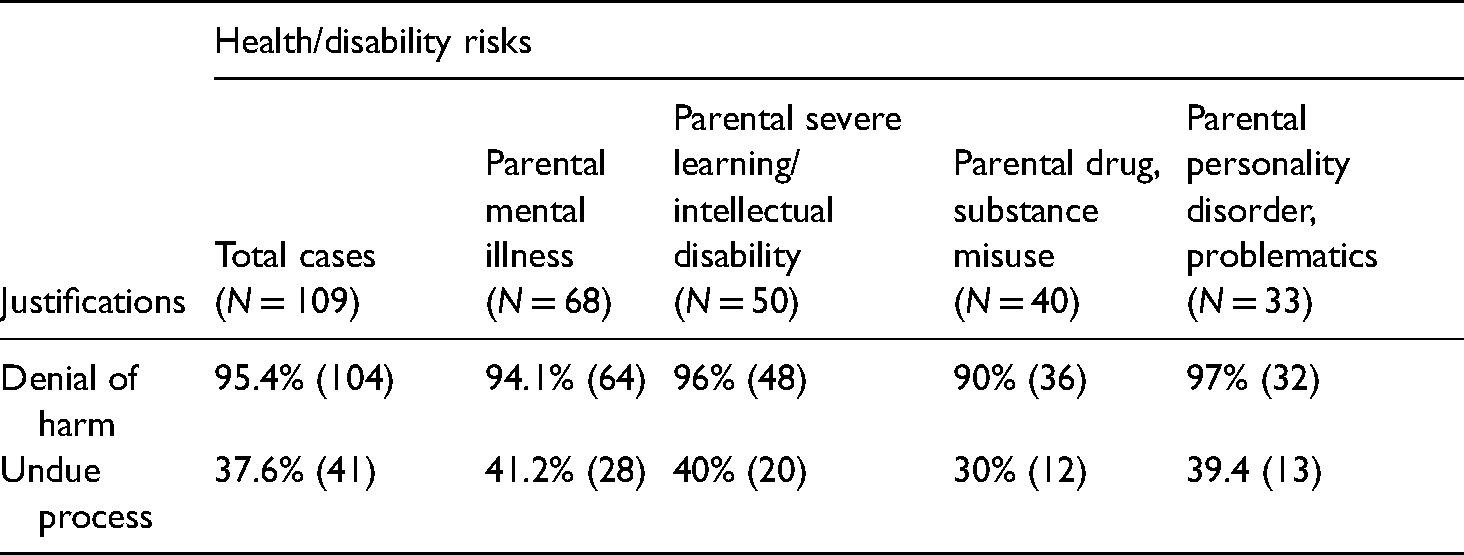
Table 2 illustrates the connection between justifications and the type of parental risk factor groups ultimately emphasized by the County Board. Overall, there were few differences across the risk groups. No significant differences were identified in what justifications parents invoked in their claims across the groups. However, less frequent use of denial of harm and due process arguments was evident by parents where substance abuse was an explicit risk factor.
Justifications across health/disability risks.
Parents’ excuses for care rights
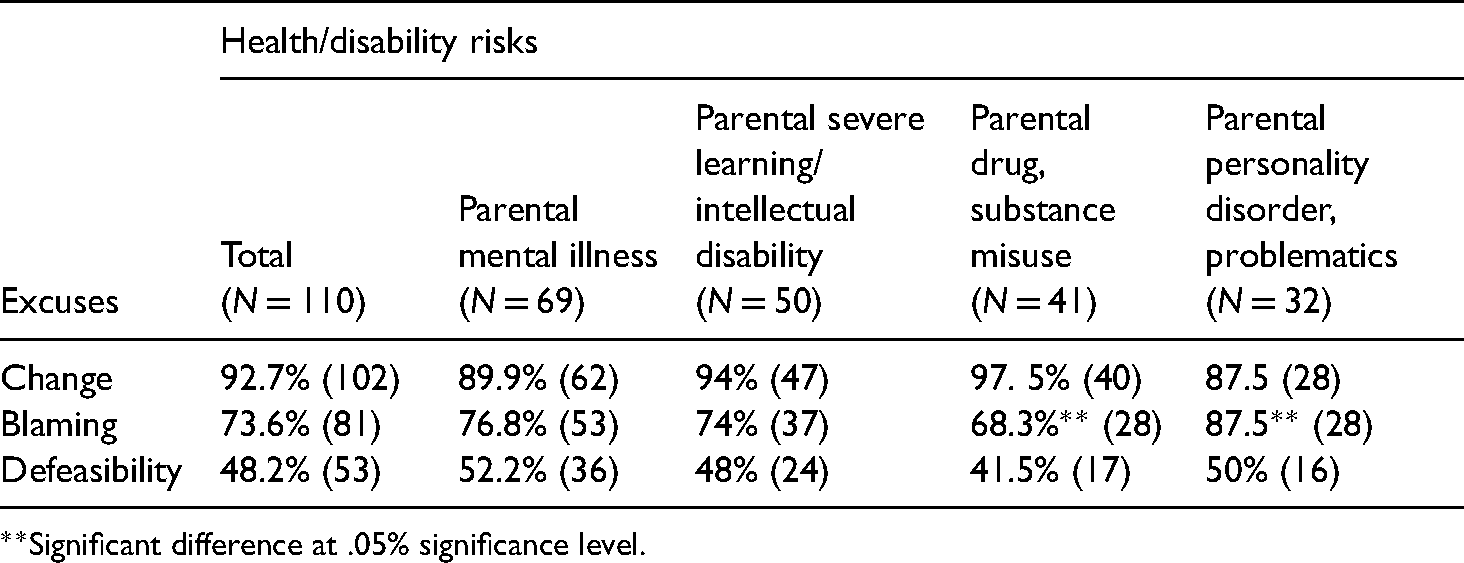
Hundred and twenty-six cases included arguments that either excused previous situations, conditions, and behaviour or focused on recent changes enabling security for the child (Table 3). Firstly, the analysis revealed that 89.7% (113) of cases included change arguments, in extension excusing past conditions and circumstances, illustrated by this quote: Mother is in better shape now, she is more energetic and motivated to receive help (13-C19). Secondly, 77% (97) of cases included blaming arguments, where parents located the source of their problems in other actors, as this statement exemplifies: It was the children's father who was the problem, but he represents no risk to mother or child today (16-C25). Third, in almost 50% (62) of cases, the parents claimed defeasibility that the parenting task or preparations for parenthood were unmanageable due to the lack of information or cognitive or physical capacity. Case 13-C31 illustrates this type of argument: The observations at the hospital were brief, and mother was sick.
Excuses across case factors in parents’ claims.
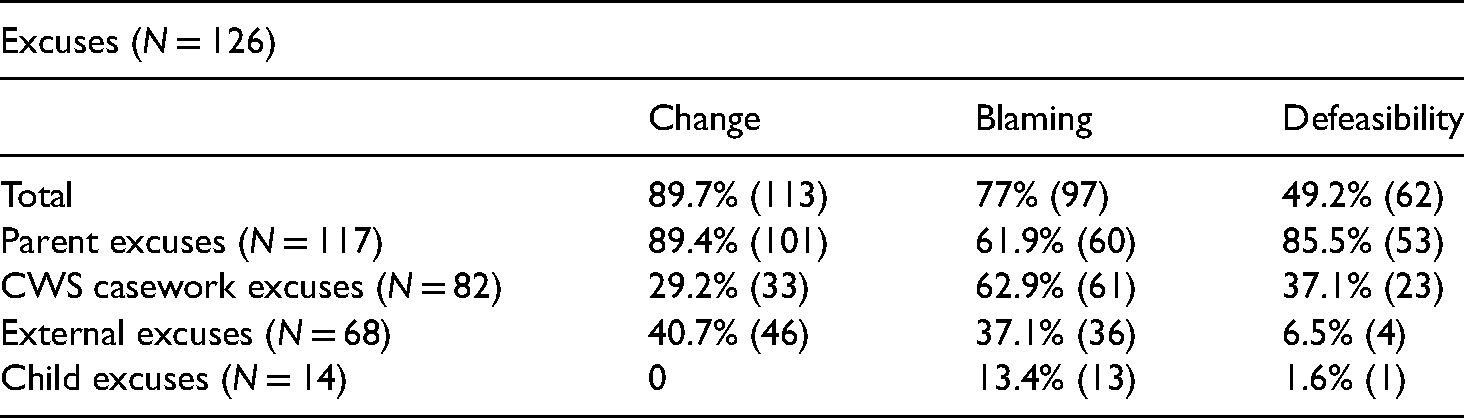
As with the justifications, the analysis explored the specific excuses and their distribution across the four case factor domains. Like the justifications, change arguments were in most cases related to the parents themselves (89.4%), and most commonly focused on improvements in health, addiction patterns, insights and compliance. Secondly, change was claimed with regard to the external environment in approximately 41% (46) of cases, while change was claimed towards the basis for documentation and casework by CWS in roughly 29% (33) of cases. Moving over to blaming, 63% (61) of cases included placing blame on CWS, acknowledging parental insufficiency but locating the reason for it with lacking or poor services and service provision. In approximately the same number of cases, 62% (60), parents blamed aspects of their functioning, such as a diagnosis, or about past experiences, or their own upbringing. Concerning the child, parents blamed the child's special needs as complicating the care task in 13.4% (13) of cases. Finally, parents also invoked arguments rooted in defeasibility. These were in 85.5% of cases about themselves that their dispositions made the care task or situation unmanageable, but this was also related to standards or situations set up by CWS in 37% (23) of the cases.
When exploring the excuses across the risk factor groups, we see the same pattern as with the justifications that parents’ defence types were not in large connected to the type of risk factors found important in the final decision. However, significant differences existed between the substance abuse group and the personality disorder group, where the latter to a significantly larger degree applied blaming arguments, as evident in Table 4.
Excuses across health/disability risks.
**Significant difference at .05% significance level.
Parents’ rationalizations of care rights
Rationalization arguments were identified in 93 cases, as displayed in Table 5, making out 70.5% of the whole sample. These took the form of four main types of claims: normalization, legitimate concerns, deservingness and uncertainty. Normalization arguments were most prevalent (approx. 61% of the rationalization cases) and came in two forms across 57 cases.
Overview of rationalization arguments.
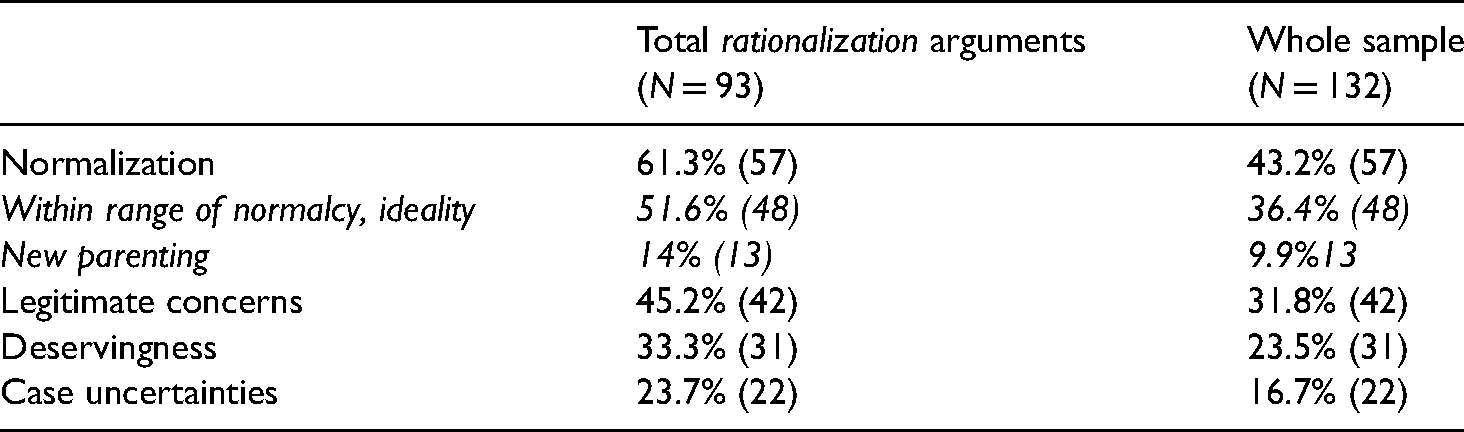
Rationalizations firstly acknowledged that the parenting capacities and situation in question could be probed, but still should be seen as normal or within a discourse of adequate parenting. These arguments were visible in 48 cases and were typically formulated such as this: Requirements of ideality should not be placed on the parents, and they should not be compared to the foster parents (16-C2). Secondly, in 13 cases, new parents explicitly asked to be granted leeway and claimed that their concerns and insufficiencies were normal, as evident in case 15-C4: That he [Father] has needed and accepted guidance during visitation with Daughter must not be assigned much weight. All first-time parents need guidance. In 42 cases (approx. 45%), parents admitted that concerns posed by CWS were legitimate, without any form of defence attached to it, as the following quote displays: The parents have not covered up the fact that they have challenges and need help in handling the parenting role (16-C37). In 31 cases (approximately 33%), parents claimed to deserve to parent, explicitly stating such, or stating love for the child as well as the baby being a turning point in their lives as legitimizing reasons for retaining care of the child. Case 14-C14 illustrates this type of argument: The parents now have a strong wish to be allowed to try, and to show that they are good enough. In this, acknowledgment of insufficiencies was often visible, but deservingness aimed to counter this. In 22 cases (approx. 24%), parents claimed that there was too much uncertainty in the case, as to allow for a care order, as this quote displays: One does not know how Mother would function with her daughter. There is no empirical evidence, only assumptions (16-C26).
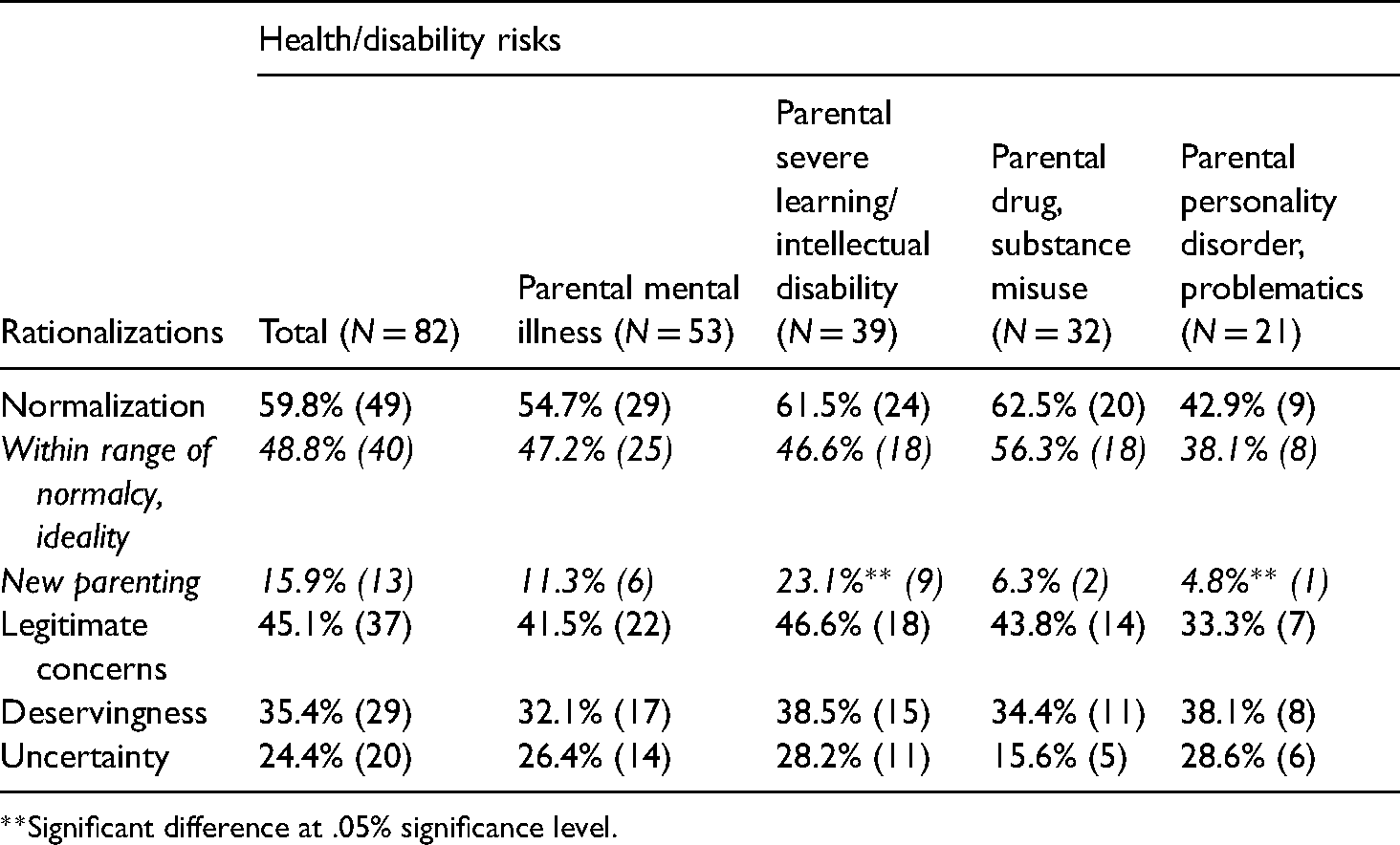
When breaking the rationalizations down by risk groups (Table 6), we see that parents who were assessed with substance misuse and intellectual risks to a larger extent applied normalization arguments when compared to the personality disorder risk group. When looking specifically at the two groups’ application of new parenting arguments, the intellectual risk group used this type of argument significantly more. Moving on, parents with personality disorder risks to a lesser degree echoed concerns raised by CWS, and parents with substance abuse risks to a lesser degree claimed case uncertainties. All four risk groups were roughly equal in claims of deservingness.
Rationalizations across health/disability risks.
**Significant difference at .05% significance level.
Lastly, nine cases were ruled in favour of the biological parents, reunifying them and their infant(s). The arguments by parents in these cases, who were ultimately successful in asserting their care rights (the nine non-removal cases), did not represent any clear patterns deviating from the general trends. They all included denial of harm arguments and were mostly parent-centred, and none included legitimate concerns arguments.
Discussion
This study explored birth parents’ responses to accusations of insufficient parenting at the outset of (a new) family life. Did they deny accusations, comply with risk assessments or bring completely new arguments to the proceedings? Through the analysis, it became clear that overall, parents’ claims for care rights were surprisingly multifaceted. Parents applied both justifications and excuses in over 90% of the cases and rationalized in over 70% when affirming their adequacy and worthiness as new parents. Parents both aligned with and opposed the CWS and County Board in their perceptions of risk and division of responsibility, as well as countered with broader arguments about normalizing and deservingness. The analysis revealed significant patterns and variations in how parents with differing health and disability risks asserted their care rights, while ultimately being subjected to the same outcome – placement of their infant in alternative care. How can this critical, yet most often insufficient legal engagement be understood?
Looking closer at each type of argument, almost all cases with justifications were focused on denying alleged harm or risk, and parents rather emphasizing positive traits and descriptions of their capacities and circumstances. They did indeed agree to a certain description of behaviour or situation but appeared to ‘deny the pejorative quality associated with it’ (Scott & Lyman, 1968, p. 47). Justifications focusing on undue processes were evident in 41% of cases. Parents focused on the lack of service provision and aid from CWS leading up to the care order, thus contesting procedures. Both these types of justifications can be linked to what Sykes (2011) calls institutional distancing, where parents involved in child welfare proceedings inherently object to parenting standards set by CWS, ‘questioning both the standards and enforcement procedures of the institution’ as a way to negotiate stigma (p. 455). These types of arguments can reveal differences in substantial and normative perceptions of family life and thresholds for intervention but may also be an alternative way to deal with feelings of shame towards the intervention and accusations. However, arguments about undue process can also be expressions related to findings from a British newborn context as well as the mentioned research on parents’ engagement in the Parents’ engagement with CWS and legal proceedings section above, where limited or poor communication between professionals and birth parents results in birth mothers’ lacking understanding of the child welfare and family justice processes in the pre-birth period (Broadhurst et al., 2017; Klee et al., 2002; Marsh, 2016; Marsh et al., 2019, cf. Mason et al., 2019). As this type of argument is present in almost half of the case sample, a need for further knowledge about parents’ actual perceptions, understandings and benefits of services, as well as the quality of communication and feedback between parents and CWS in the service provision phase and during pregnancy is evident.
However, parents also expressed alignment in perceptions of risk, as excuses similarly dominated parents’ claims for care rights. The three main excuses were change, blaming and defeasibility and were evident in approximately 93%, 74% and 48% of the cases, respectively. These types of arguments expressed parents’ acceptance of the negativity of situations or behaviour, as such acknowledging past insufficiencies. Norwegian policy stated decades ago, and keeps on being iterated, that newborn cases may prove to be extremely difficult if the parents have not cared for the child or a previous child, or time has passed since their previous care task, and it is alleged that sufficient changes have taken place (Barne- og familiedepartementet, 2000). As such, it was unsurprising that claims of change were central excuses, as they seem to be arguments of significant importance for the County Board. However, when the parents excused, they did not assume responsibility for their situation. This was especially evident in the approximately 77% of cases invoking blaming. Most blaming was oriented towards CWS, unsurprisingly. However, many parents also blamed elements related to themselves, such as their background, illness or other aspects affecting their functioning. Defeasibility arguments were evident across half of the excuses and somewhat overlap with blaming. Here, parents also acknowledged negativity, but contested manageability, due to for example the lack of information and willpower that comes with mental illness or substance abuse. Bridging this to change capacity, these parents can be viewed as reforming parents, ‘eager to improve (…) parenting by embracing services’ which caseworkers see as ‘best suited to work within the CPS system’ (Sykes, 2011, p. 453).
Care orders of newborns nonetheless draw upon broader sets of responses from parents, outside the defence dichotomy. Rationalizations were evident in 70% of the cases, comprised of normalization, legitimate concerns, deservingness and uncertainty as the subtypes, in descending order of prevalence. Normalization consisted of claims that the risk or situation in question should be seen as normal, as well as arguments claiming leeway and understanding for new parents. Almost one-third of the whole sample included parents echoing and confirming legitimate concerns from CWS, appearing to align in full with CWS’ definitions as well as assigning responsibilities. Rationalizations are especially interesting when comparing this study to a previous analysis of parents’ legal defences in general care orders appealed to the District Court (Juhasz, 2018). Based on the increased use of rationalization arguments, it is clear that parents’ arguments in care proceedings of newborns differ from those of older children. The magnitude of rationalizations in newborn cases also reminds us that care proceedings are not criminal proceedings, where the defence dichotomy is primarily situated. Beyond (lack of) parental and care histories, the infant's ongoing development, the birth parents’ future functioning, and developments as well as assessments of the future relationship between birth parents and their infant are all necessary and challenging, to consider.
The study also aimed to capture the location of, or domains within, the parents’ arguments. Parents seemed to at least in part mirror how CWS assesses risk. This can be illustrated by a valuable study by Tefre of child welfare workers’ risk assessment in a newborn intellectual disability context (Tefre, 2017). In this study, social workers primarily emphasize parental (cognitive, health and capacity) factors, followed by child and finally environmental factors when assessing risk in a suspected infant neglect case. This reasoning of risk aligns with parents’ arguments in a primary parental focus but differed in parents putting a lesser focus on the external environment, and least on the child, which is the opposite order of the social workers’ emphasis (Tefre, 2017). Off the bat, this seems natural as the child is still in his or her infancy, more information may be available about the external environment, and the CWS is mandated to assess the specific child's best interest. More concerning is that this correlates with research showing that children in these cases appear to be invisible, even though their best interests are the nexus for decision-making (Križ et al., accepted for publication). As research speaks clearly to the lack of child participation in child welfare (Falch-Eriksen et al., 2021), and evidence is emerging on infant brain development and early consciousness (Braarud, 2012; Filippa et al., 2017), the child-centeredness of newborn removals should not be downplayed.
The study finally aimed to identify whether the parents’ risks or problems impacted what types of arguments were invoked. Both differences and similarities were revealed. Parents with drug or substance misuse risks invoked significantly less blaming when compared to those with personality disorder risks. This gives the impression that parents facing such risks defend their care rights differently, perhaps assuming more responsibility or at least aligning more with the concerns raised by the County Board. Or perhaps they find such risks harder to defend? This aligns with research informing that substance misuse is understood to be both a significant and undisputed reason for child maltreatment and care orders, well as a factor decreasing the likelihood of a child returning to his or her birth family (Wittenstrom et al., 2015). A significant difference was also evident in the use of new parenting arguments. The intellectual disability risk group used this argument significantly more than the group with personality problems or disorders. This may be connected to the risks and potential prejudice associated with parents with intellectual disabilities in the child welfare system, and the critical timing of the newborn intervention (LaLiberte et al., 2017; McConnell & Llewellyn, 2000, 2002). However, the lack of other significant differences tells us that the risk groups in large appear to use the same arguments, despite their potential differences in actual compliance or capacity to change, for example. This can divert the attention to the role of the lawyer in care proceedings (Masson, 2012), in shaping arguments and applying strategies for parents.
In Norway, a shift from adversarialism to the incorporation of Alternative Dispute Resolution measures in legal care proceedings is ongoing. The mentioned experiences of disengagement and insecurity when involved with CWS, both at the agency and legal levels, as well as a heightened focus on child participation, can serve as backdrops for this change. This can affect how parents assert their care rights to a more direct and unfiltered dialogue with CWS and the County Board (Andersen, 2020; Viblemo et al., 2019). However, less formal decision-making environments have also been argued to disadvantage vulnerable children and parents by coercing the weaker party to comply with CWS (Porter et al., 2019). The alternative format could nonetheless contribute to altering parents’ perception of engagement and participation, with less adversity perhaps softening the overall experience of the process, and thus facilitating more acceptance of the outcome.
Limitations of the study
The study has limitations. Firstly, written legal judgments and decisions will never fully represent and capture the full ‘story’ of a case, from casework at the agency level, as well as the progression through the County Board pre-proceedings, hearing, and final deliberations between the decision-makers. However, the written decisions do include all necessary and relevant arguments for the justification, and as such represent the arguments legitimizing the intervention (Centre for Research on Discretion and Paternalism, n.d.). Secondly, the written claims are not direct, unfiltered claims from parents throughout the case. They are authored by the parents’ lawyers in some form of collaborative effort and incorporated into the final written decision by the County Board Chair, following the legal requirements for care proceedings (CWA, 1992; Civil Procedures Act, 2005). Knowing in detail the quality and proximity of cooperation between the parents and their appointed or selected lawyers is impossible within this research design. This is a critical issue, as it is impossible to discern whether the parents’ arguments reflect a ‘strategy’ proposed by the lawyer, and to what extent they are amended and changed to fit a legal discourse. However, the written County Board decisions are approached as representing the parents’ official statements and display the legal arguments provided in support of their care rights.
Thirdly, some reflections on the case selection for analysis are necessary. Out of the sample of 132 cases where parents oppose the placement, 19 cases ultimately did not fit within any of the four parental risk groups. As such, the between-risk-group analysis of arguments is based on 85.6% (113) of the cases. The 19 omitted cases emphasize other factors, both risk and protective, such as previous parenting, domestic violence, the parents’ marginal childhood, compliance, parental dynamics, the child's special needs, family/social network as well as socio-economic risks. This group could facilitate an interesting comparison or analysis in its own right. However, the cases have for this study been excluded, both due to limits in scope and size for the study, and variation in arguments between the health and disability risk groups being the primary research interest.
Concluding remarks
Parents’ accounts in child welfare emerge as critical in that they help explain how they make meaning and sense of their social world and can help identify culturally embedded normative explanations (Orbuch, 1997). When facing legal proceedings initiated by CWS, parents reflect on insufficient service provision and also argue for different views on what is sufficient parenting, risk, and harm. Parents’ accounts thus provide important perspectives for child welfare workers to build on and to be equipped with, when working with serious child welfare cases, assessing risk, and communicating with parents. That both justifications and excuses ‘are likely to be invoked when a person is accused of having done something that is bad, wrong, inept, unwelcome, or in some other of the numerous possible ways, untoward’ (Austin, 1961; cf. Scott & Lyman, 1968, p. 2), resonates with the findings of this study. Furthermore, it is stated that ‘excuses rarely provide the opportunity to completely escape responsibility and in fact, may at times backfire’ (Greenberg, 1996; cf. Tyler & Feldman, 2007, p. 47). This mirrors the lack of ‘success’ of parents’ argumentation before the County Board, as in 93% of cases it remains unconvinced.
Supplemental Material
sj-docx-1-jsw-10.1177_14680173221109691 - Supplemental material for Asserting the right to care – Birth parents’ arguments in newborn care orders
Supplemental material, sj-docx-1-jsw-10.1177_14680173221109691 for Asserting the right to care – Birth parents’ arguments in newborn care orders by Ida Benedicte Juhasz in Asian Cardiovascular and Thoracic Annals
Footnotes
Ethics

Funding
The author(s) received no financial support for the research, authorship and/or publication of this article.
Acknowledgements
I extend my deep gratitude to project supervisor professor Marit Skivenes for invaluable comments and supervision. The article has been presented and discussed at workshops and seminars at the University of Bergen.
References
Supplementary Material
Please find the following supplemental material available below.
For Open Access articles published under a Creative Commons License, all supplemental material carries the same license as the article it is associated with.
For non-Open Access articles published, all supplemental material carries a non-exclusive license, and permission requests for re-use of supplemental material or any part of supplemental material shall be sent directly to the copyright owner as specified in the copyright notice associated with the article.
