




Abstract
Social care assessments in England are envisaged as conversations, implying an informal and congenial encounter, in which both parties have equal roles. However, a fundamental task during an assessment is to gauge eligibility for resources. This article uses conversation analysis to consider audio recorded data of seven social care assessments in England. The article focuses on topic shifts, where the assessor introduces an ‘assessment relevant’ topic, and we examine how these shifts are managed. Sometimes assessors used what was said by the client or by the carer as a ‘pivot’, which could produce a feeling of friendly conversation, but simultaneously lead to an intrusion into the client’s personal knowledge domain. Assessors also had other strategies for framing a ‘next question’, such as noticing something in the environment, referring to previous notes or to previous conversations. The conversation might feel ‘friendly’, but these tactics could lead to the personal life domain of the client being inadvertently revealed and used as relevant for their assessment.
Introduction
Social care assessments in England are occasions on which a person needing social care (the client) is required to display their individual need to an assessor. As interactional practices, assessments can be problematic. They routinely and necessarily involve ‘troubles-telling’ (Jefferson, 2015), including difficulties with personal care or managing household tasks. They are social encounters in which other dynamics are also at play. For instance, the way English social care assessors approach their interactions may be informed by their ‘professional judgement’ (Symonds et al., 2018), and in an earlier article in this journal, Osterholm and Hyden (2018) showed how autobiographical stories in assessments of people with dementia were told for particular purposes, such as to support their application for social care.
One of the interactional tasks facing an assessor is how to move from one troubles-telling by the client to the next. As Button and Casey (1985) pointed out, the flow of topics from one to the next is a ‘systematic feature of topic organisation’, and the start of a new topic in mundane conversation is often designed in a mutual, interactional manner. As such, the start of a new topic may be hard to distinguish. However, as Jefferson (1984) notes, that is not always the case in conversations involving troubles-telling. Jefferson examines in detail some instances where other matters are introduced after a troubles-telling, which can in some instances constitute a disjunctive break in the conversation, effectively a ‘conversation restart’ (p. 193). She draws on Sacks’ reference to the device of a ‘stepwise move’ which can link the next topic with what has come previously, and she specifically highlights the opportunity for a troubles recipient to take up a ‘pivotal utterance’:
‘[an utterance] that, though recognisably on topic, has independent topical potential’ (Jefferson, 1984: 203).
Jefferson’s data was drawn from mundane conversation. By contrast, institutional encounters are characterised by the need to cover a range of questions, which are the bedrock of institutional talk in many different contexts (Hayano, 2013), such as in survey interviews (Houtkoop-Steenstra, 1997), and in quality-of-life (QOL) psychological interviews (Antaki et al., 2000). Questions not only set up a response slot which must be filled but they also harbour presuppositions, set action agendas and strongly shape a response into something that is ‘preferred’ by the question (Hayano, 2013). Houtkoop-Steenstra (1997) and Houtkoop-Steenstra and Antaki (1997) show how interviewers orient routinely to the ‘personal’ and re-frame questions which move the interviewee towards an agreement. Institutional markers such as using the word ‘excellent’ ‘brilliant’ to move topic (Antaki et al., 2000) can also threaten the conversational feel of an encounter.
Issues of personal knowledge, or ‘epistemics’, are pervasive in the design of questions (Heritage, 2012) and in a social care assessment, the talk is centred on the lifeworld of the client, so their privileged access to that knowledge tilts the relationship towards a knowledgeable client interacting with a naïve assessor (Bolger, 2014; Solberg, 2011).
In addition to these considerations, guidance for practitioners often states that social care assessments should be conducted as ‘conversations’ (Bolger, 2014; Kirin, 2016; SCIE (Social Care Institute for Excellence), 2017), which raises the interesting issue of what exactly might make an assessment encounter ‘conversational’, and what the interactional consequences might be. The introduction of small talk (Benwell and McCreaddie, 2016), and even jointly created laughter (Morriss, 2015), can be a signal of shared understanding between assessor and assessed. Nevertheless, during that free-flowing ‘chat’, a client may reveal aspects of their own life, very relevant to the assessment. This paper specifically explores the consequences of being conversational, at the moments when transition to the next assessment relevant topic is managed by the assessor.
Method
This paper is based on 6 h and 40 min of audio recordings of seven social care assessments in England, all with different assessors and different clients. They were collected by the second author as part of a larger mixed methods study on social care assessments in England, carried out for the national School for Social Care Research between 2014 and 2016, shortly after the Care Act was implemented in England. Approval and guidance were obtained for this study from the Social Care Research Ethics Committee (SCREC), a national body in England. There were ethical sensitivities to negotiate both for social care assessors, and also for clients who would be recorded. Symonds approached assessors who had taken part in a previous interview stage, and seven people agreed to take part, who then approached their clients for consent. Outline demographic details of assessors are given at the start of each excerpt. In all but two recordings (see Extracts 5, 6 and 8) at least one other family member was also present during the assessment. In varying ways, those individuals were performing the role of ‘family carer’ and that is how they are referred to in this paper. Six of the seven recordings were made by the assessor, who borrowed a recording device from the research team, and in one case Symonds was present to manage the recording. The data presented in this paper is taken from five different assessors, and is transcribed in the Jeffersonian tradition. In line with ethical processes at the University of Bristol, data is stored in a secure data server for 10 years, and all potentially identifying details and names are anonymised in this paper.
The analysis of data is in the tradition of conversation analysis (CA) (Sidnell and Stivers, 2014), which focuses on the fine detail of a naturally occurring interaction. The analysis is always based on the evidence of how each turn at talk is taken by the next speaker, and so strives to avoid assumptions or hunches about speakers’ intentions. In particular, this paper draws on institutional conversation analysis (Heritage and Clayman, 2010) which seeks to unpack what is happening in specific encounters, such as the social care assessments explored here. Typically, these are interactions in which one party has an institutional role, and the other is positioned as a lay person. Although some institutional encounters such as legal proceedings have a prescribed structure, even very formal interactions necessarily draw on the tools and patterns of ordinary, mundane talk. That has particular relevance here, where assessors are urged to be ‘conversational’, and as an analyst, one can draw on what is already known in CA about the rules and patterns of conversation, in order to explore their interactional consequences in the specific context of social care assessments.
Seeking to ensure that our research had practical value, we recruited co-researchers from a peer support group run by a Disabled People's organisation. They met monthly throughout the project, and listened to selected extracts from the data, discussing how they would react to those parts, and sharpening the focus of our analysis. With relevance to the current paper, they were interested in how the assessors took control of the flow of the talk as they had had similar experiences in their own assessments. They particularly felt that going through the questions on a form could get in the way of building a relationship, and for them the relationship was paramount. Some of their observations on this are contained in Values of Assessment (2017).
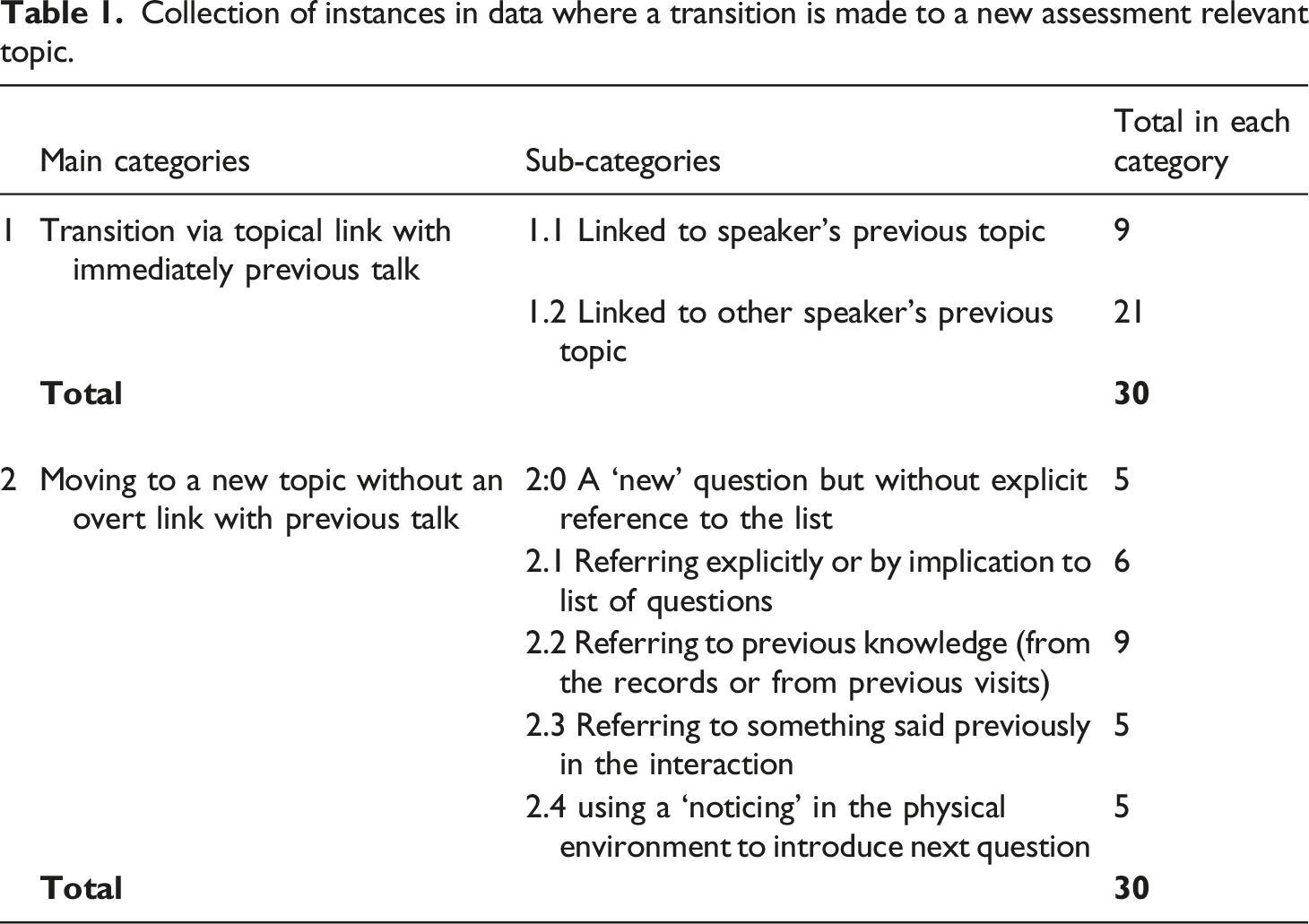
Collection of instances in data where a transition is made to a new assessment relevant topic.
Results
Transition via topical link with previous talk
Links with assessor’s own previous topic
Where an assessment relevant question has an overt linking device with the assessor’s own previous talk (Category 1.1 in Table), the conversation generally flows smoothly, and there is no clear ‘new topic’ introduced. First parts remain however with just one party, the assessor, and the ‘conversationality’ of the exchange could be considered quite skewed. Typically, in our data, the previous topic is closed down with a series of closing words such as ‘OK’ or ‘right’ and then the assessor moves on with an ‘and’ or a ‘so’. Extract 1 illustrates this pattern.
Extract 1 (Pam: Female social worker in adult social care team)
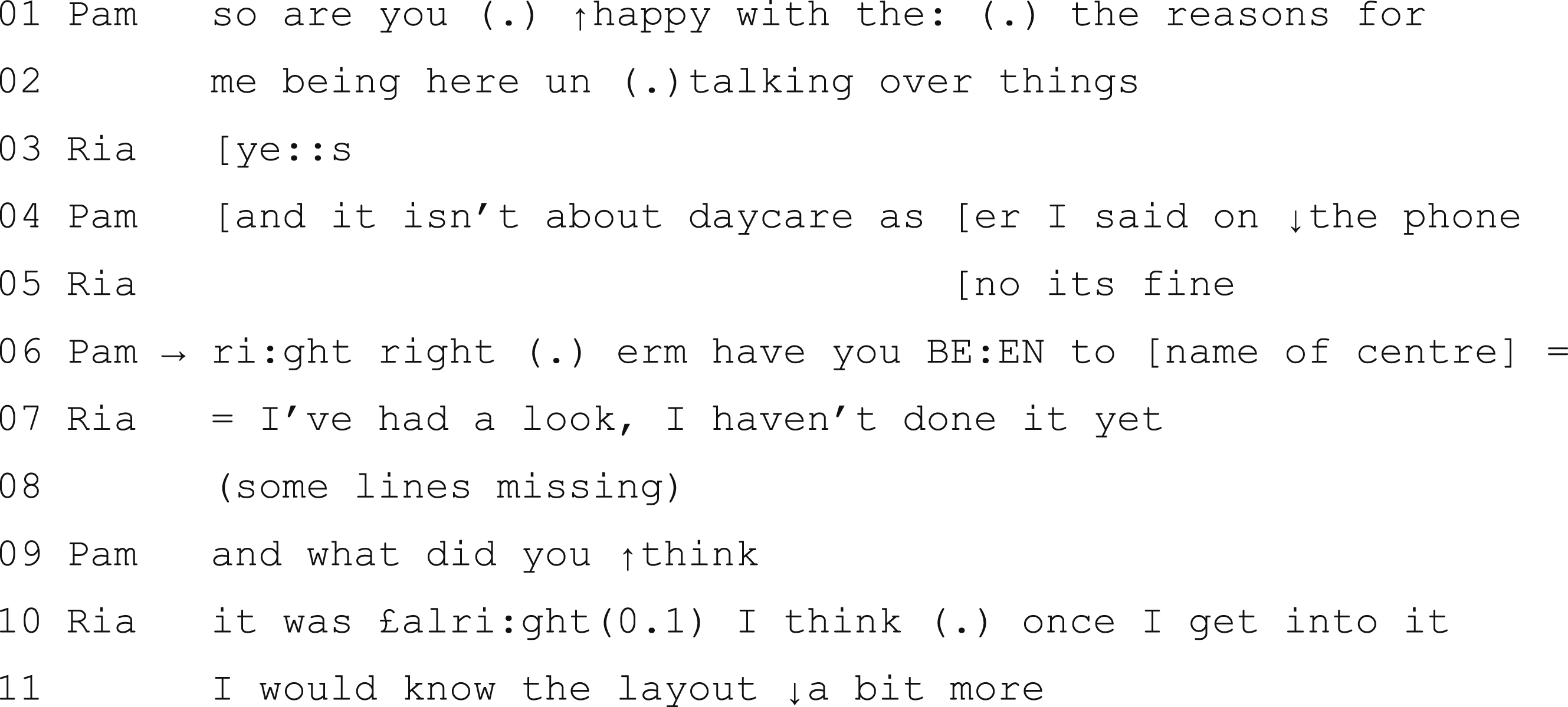
In Extract 1, the assessor’s first turn establishes agreement on her purpose for the meeting, which she frames as ‘talking over things’ in line 02. The question ‘Are you happy with’ is not only positively tilted, but in fact she scarcely waits for Ria the client to respond, which happens twice in overlap with Pam’s talk at lines 03 and 05. It is in the next turn that Pam then closes down that topic with ‘right right’ and after a slight hesitation she moves to a yes/no question about Ria’s actual experience of the centre. Line 06 seeks to establish whether or not Ria has visited the centre, with an implication that if she had BE:EN (note the emphasis) she will see that this is not about daycare, something which she has indicated is not the topic. Ria concurs in lines 10–11, where she laughingly concedes not only that it is ‘alright’, but that a greater contact with the centre would help her ‘get into it’ and become more familiar with it.
Links with other speaker’s topic
In Category 1.2, which was more common in our data, the assessor’s question not only appears to fit the client’s or carer’s concerns but also marks her active listening and accounting for those concerns. In Extract 2, Dan, the son of the client being assessed by Rik, has just answered a question about how his father manages to read the post, since it has been established that his visual impairment would preclude that. Dan has claimed that he does that for his father, but then interrupts himself to explain that he would only help his father in matters that are not ‘financial or legal’ since his brother John, who is not present, has the status of ‘power of attorney’ for his father.
Extract 2 (Rik: Male social worker in sensory impairment team)
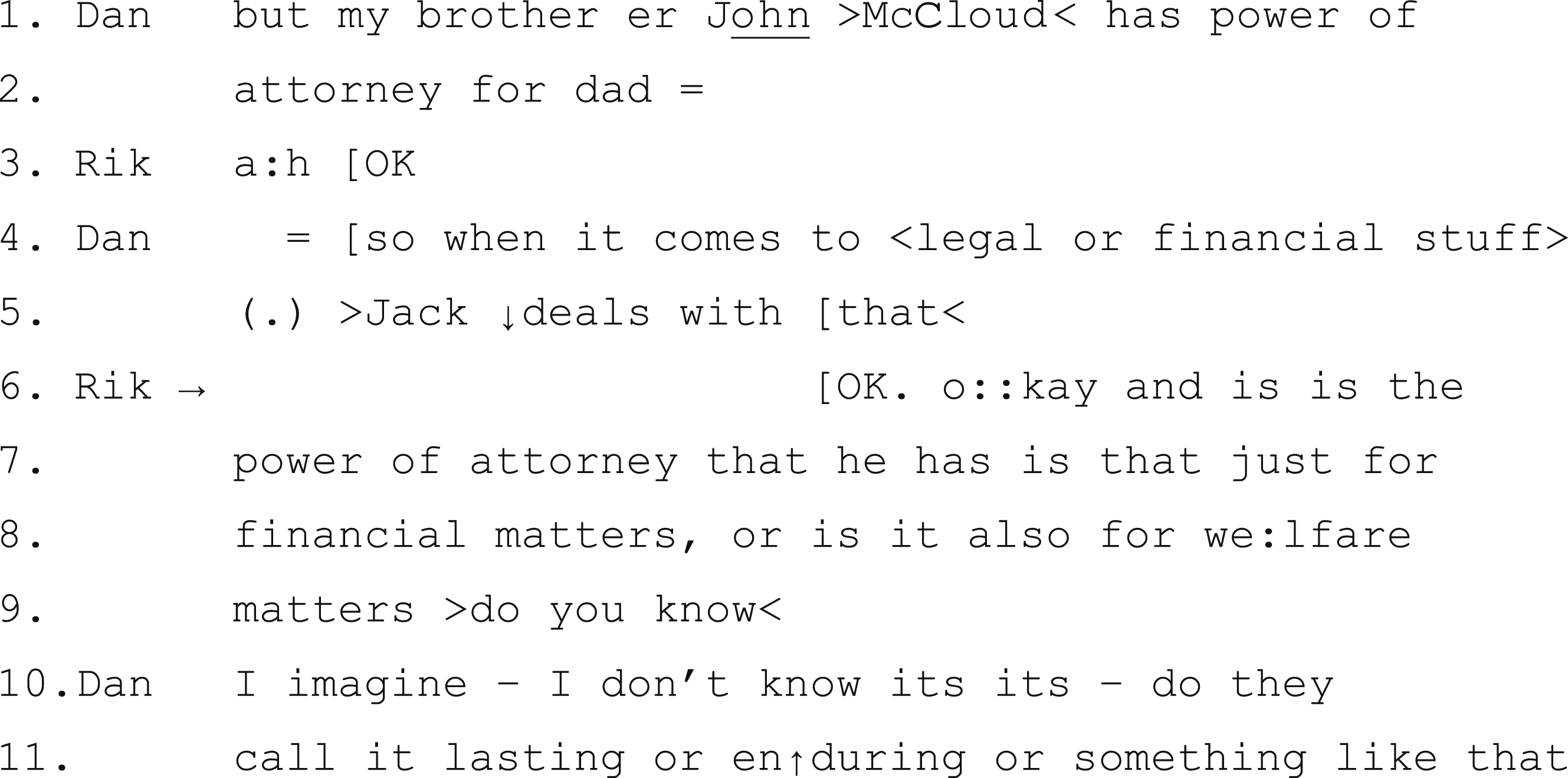
In line 3, Rik the assessor delivers a receipt token ‘OK’ (Beach, 1995: 126–128), acknowledging the information given by the carer, Dan, and then he repeats the ‘OK’ with a hearably longer ‘o::kay’ at line 6, marking the closure of that topic relating to the brother’s status, so that he can move the talk on. Since this flows so neatly, it is hard to say here that this is a topic ‘shift’, but maybe more accurately that the assessor chooses to build on the previous talk, in order to establish whether or not Dan has the power to speak for his father on welfare matters, something that is clearly relevant to the assessment.
The ensuing ‘and’ on line 6 signals that what comes next has a link with what Dan has just said, and Rik reinforces that link by repeating the exact wording of ‘power of attorney’. He effectively uses the information given by Dan to then frame his question, which offers two alternatives to specify the type of powers which John has taken on. The question thus builds on and displays the assessor’s knowledge of the various types of ‘power of attorney’, marking him out as more authoritative on these legal matters (Harding and Peel, 2019) and this leads to the hesitation in Dan’s non-conforming response at line 10, where he shifts into a response relating to ‘lasting’ or ‘enduring’.
Thus, even when the next question, as here, emerges directly from the recipient’s concerns, it can be framed in such a way as to signal the assessor’s interactional control (Ehrlich and Freed, 2010: 8; Eades, 2008 for similar practices in legal settings). In other examples in our data, repeats of vocabulary items were used as devices to pick up a matter raised by the carer or client, and turn it into a question: for instance, talk of ‘houses’ led to the question ‘How many other houses have you had?’
By topically linking a question to the previous client/carer talk, an assessor’s next question can move up the ‘epistemic gradient’ (Heritage, 2010). In other words, the assessor can build on the knowledge from the ongoing conversation to frame their questions more specifically. That effect is apparent in Extract 2, and that same assessor uses that strategy on seven occasions, often quite inconspicuously moving the topic on from a family carer’s story (an ‘ancillary matter’ in Jefferson’s 1984 terms) into something which is relevant to the assessment. Moreover, the topical shift provides a way for Rik to specifically select the client Bob for next turn, and he does that manoeuvre on several occasions, with varying degrees of take-up by the client. In Extract 3, for instance, Bob is selected successfully as next speaker by the assessor at line 8.
Extract 3 (Rik: Male social worker in sensory impairment team)
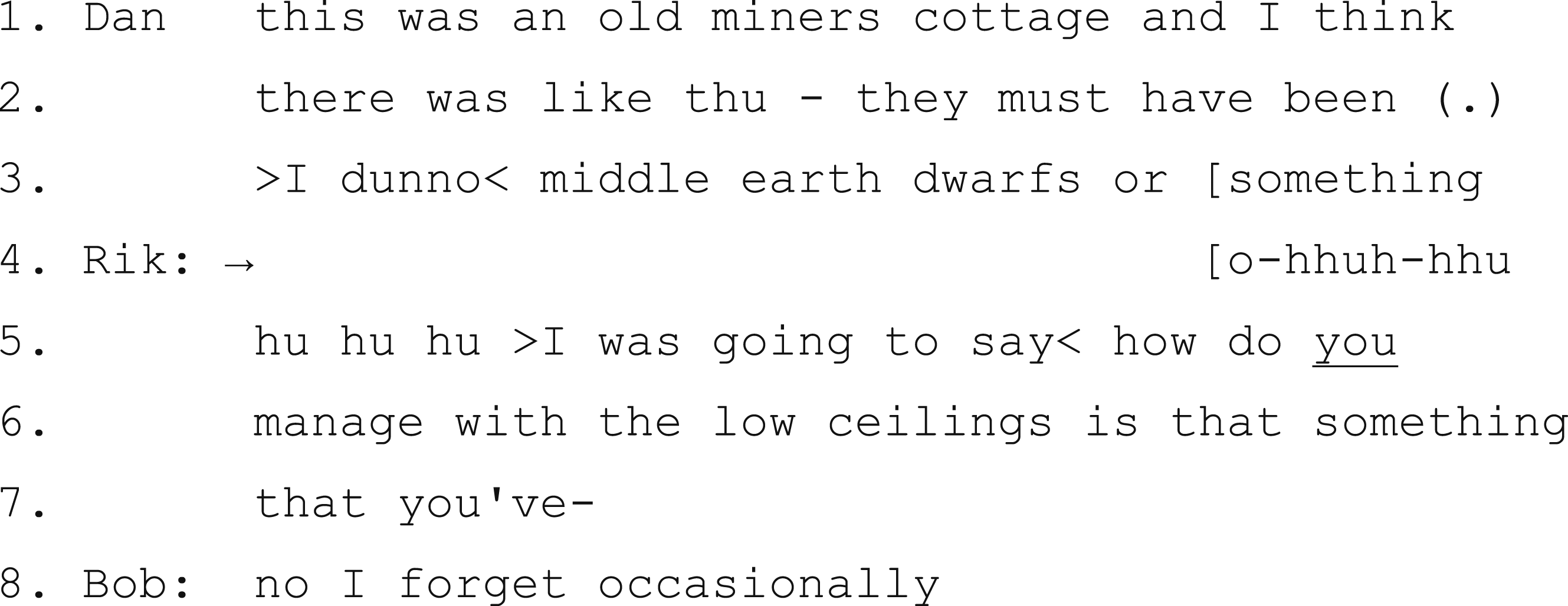
The assessor’s laughter starts in overlap with the end of Dan’s joking reference to ‘middle earth dwarfs’ as a characterisation of the low ceilings of the house where he lives, which not only gives Rik a slot to respond to the joke but also to quickly use that pivot (i.e. the implication of the joke) to get back to the client and discover how he manages the low ceilings given his visual impairment, an omni-relevant matter throughout the interaction. The preliminary remark ‘I was going to say’ at line 5 implies that he claims this question as one which did not even need to be raised by Dan, the carer. Topical shifts are complex, and often draw on more than one strategy; in this case, the take-up and smooth understanding of ‘middle earth dwarfs’ would not be possible without a visual noticing of the low ceilings.
Questions which shift the topic can also be framed without any preliminary (Schegloff, 2007), instead acting as clarification requests springing directly from the prior turn. To illustrate that pattern, we turn to another assessor. In Extract 4 it is again the family carer, Sandra, who introduces the topic, but it is then picked up by the assessor Rita, to formulate a more specific assessment relevant question.
Extract 4 (Rita: Female occupational therapist in adult social care team)
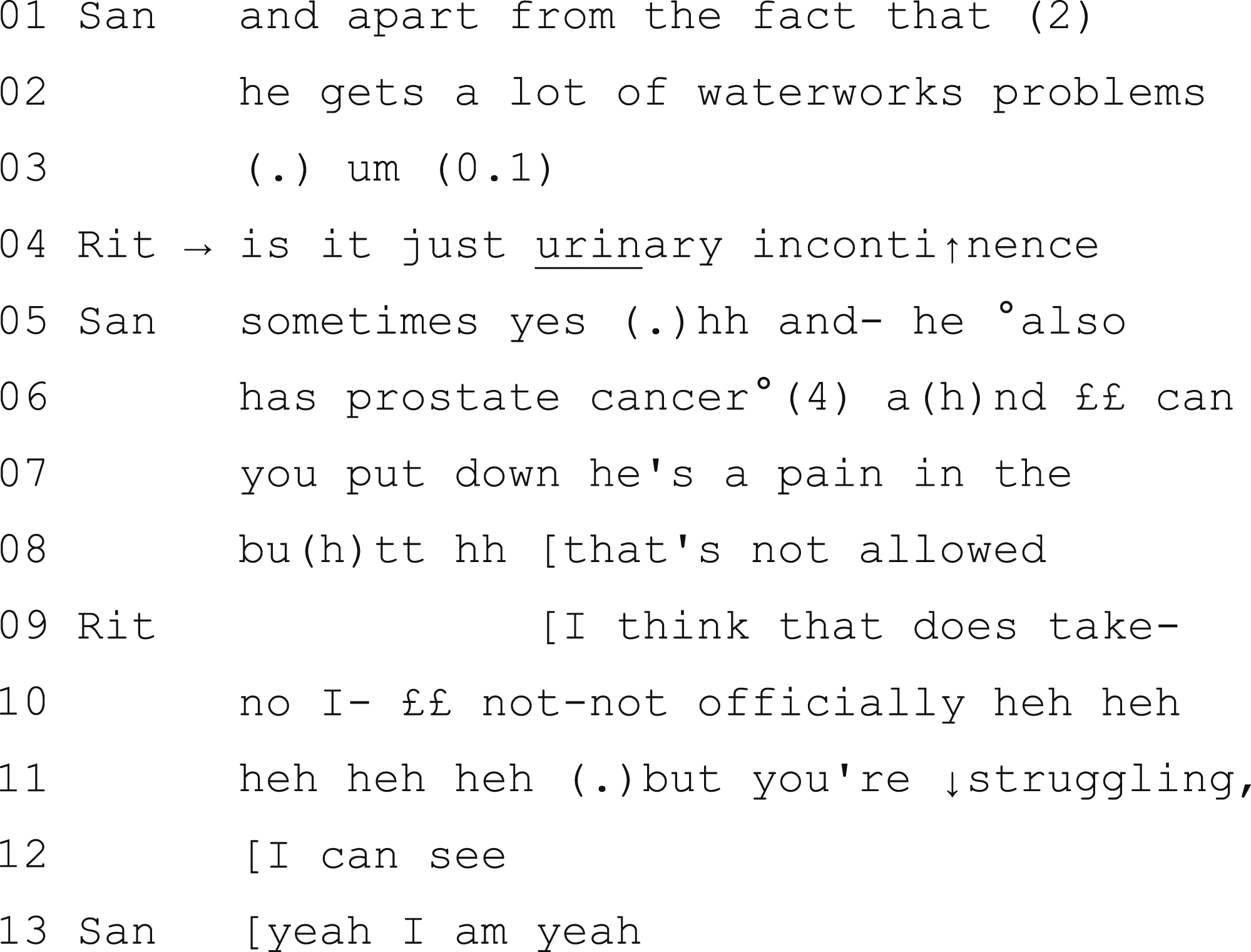
Following the family carer’s initiation of the topic in lines 1–2, the assessor Rita picks up on the matter of the ‘waterworks’ problems (a euphemistic and jokey way of alluding to urinary issues), and without any preliminary she asks a clarification question in line 4, asking Sandra to specify the nature of the problems; this neatly introduces the presupposition that it is possible for waterworks problems to consist of both urinary (and by implication, faecal) incontinence. A direct answer to that question would have accepted the presupposition as valid (Hayano, 2013: 401). However, in fact Sandra, the carer, gives a non-conforming response, which confirms in a rather ambiguous way (with ‘sometimes’) the urinary incontinence, and then moves the conversation on to the underlying issue of cancer. Noticeably though, the assessor’s question in line 4 had served to put a medical gloss on the colloquial, almost jokey, tone of Sandra’s choice of vocabulary (‘waterworks’), perhaps showing how this might be a seriously relevant matter for the assessment, and that might have been what occasions the subsequent mention of cancer, which occurs in slightly hushed tones. Following that, Sandra moves the interaction back into a joke, by associating the talk about incontinence with being a ‘pain in the butt’, and although Extract 4 is only 7 minutes into the assessment, the take-up of that joke signals the growing affiliation between family carer and assessor in this particular meeting, with each party moving from joke to serious emotional content and mirroring each other’s moves. Note that the client whose personal needs are being detailed here is in fact present in the room, although he takes no part in this section of the conversation, and may have been asleep.
There is a tension between the goal of obtaining relevant information from a family member, and keeping the client involved in the conversation. Twenty-one examples were collected where topic shifts into assessment relevant questions were managed via this strategy of picking up directly on an aspect of what had just been said. In all 21, the response broadly followed smoothly, with some more explanation of client need, and the supply of useful information for the assessment.
There were just a few counter-examples, where the assessor’s question appeared to lead off the assumptions embedded in the previous topic, but where the response was in some sense surprising, problematic or non-conforming. Extract 5 illustrates one of these six occasions, where Marion the client was being interviewed on her own. She has just been asked about any family carers and has mentioned her daughter, who has moved away recently for employment reasons.
Extract 5 (Sally: Female care coordinator in adult social care team)
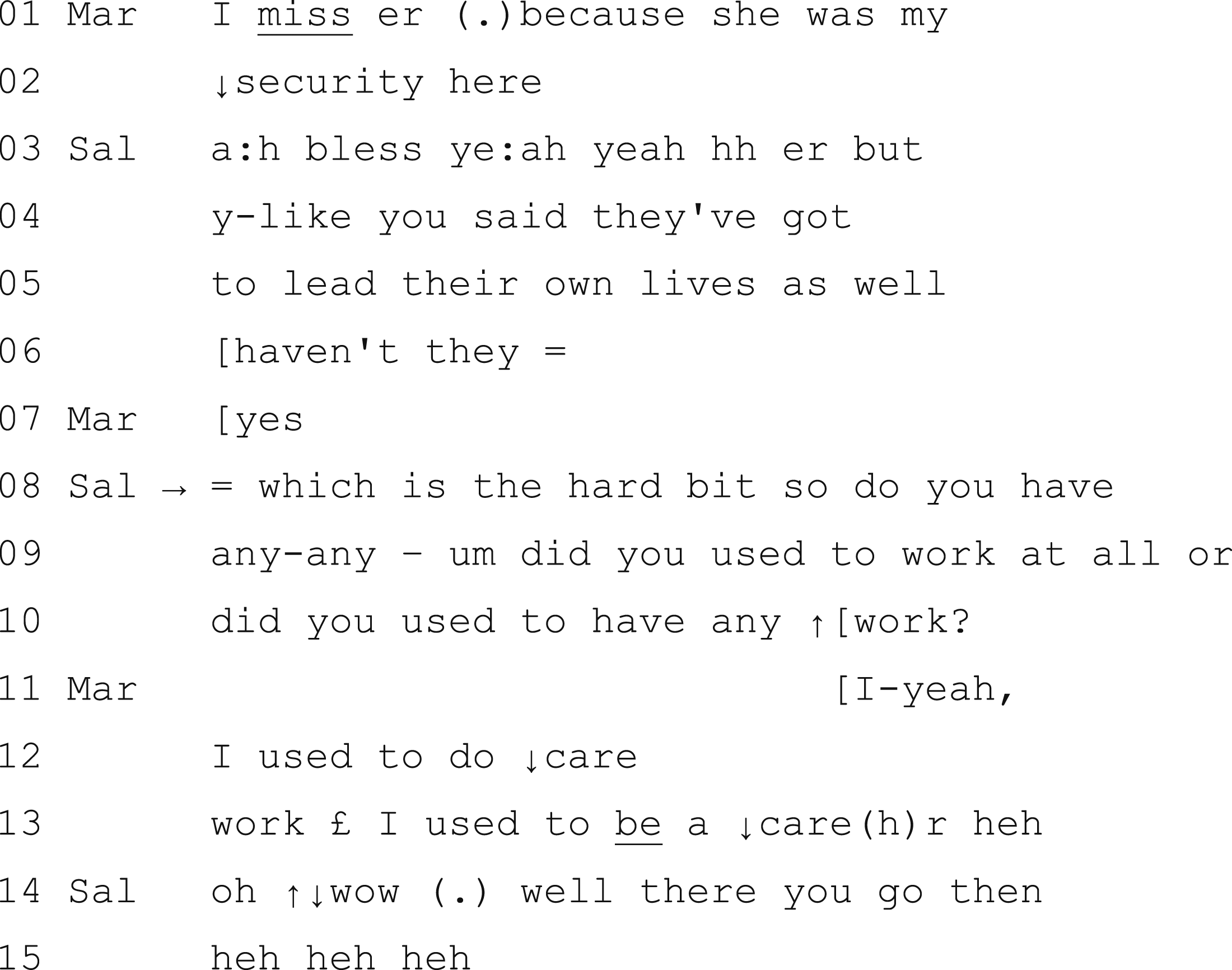
Sally the assessor does the same kind of ‘closing off’ in line 3 which has been noted by Jefferson (1984) in relation to mundane troubles-telling. Having displayed her empathy with the client, she picks up on a previous comment by Marion herself, who had mentioned her daughter’s reasons for moving away, namely the fact that she had a new job. Thus the new topic of ‘jobs’ or work emerges in lines 9–10 from the implied (and shared) knowledge of why the daughter has moved out, and enables Sally to move on to other aspects of interest or relevance to the assessment. However, her surprise at lines 14–15 is quite plain to hear, marked by a raised tone of voice, laughter and intonation patterns which could indicate discomfort. Note also that Marion has alerted Sally at lines 12–13 to the unlikely or surprising nature of what she is about to say, marking with downward intonation and a slight self-conscious laugh voice the fact that she too was a carer, a factor that could threaten the institutional boundaries of the assessor. Possibly for that reason, the former occupational status of the client, and her current wishes for work, are brushed aside in the talk after this extract.
Of the examples collected which fell into the category of dispreferred or unexpected response to a topically linked question, there were three instances where the talk had moved the assessment on into what could be a ‘delicate’ matter for the client. On one occasion, this was to do with a misunderstanding about who was who in a family situation where there was more than one carer, and on another occasion there was a frank statement of abuse which had led to the disability of the client. Thus, the conversational style that is favoured via the ‘topical link’ strategy does not always lead to the smooth, unremarkable conversation which assessors seemed to favour. Because these topically linked questions build on information which has been given by the family carer or client, the assessor is able to formulate a question built on that knowledge, thus increasing her epistemic gradient in respect of the client’s life circumstances. This strategy however leaves the client or carer with the trump card, since they may not have revealed the ‘whole story’, and the presupposition built into the assessor’s question can then be overturned. Institutional talk can be shot through with ordinary conversational tactics, and both parties can exploit some of these resources.
Moving to a new topic without an overt link with previous talk
We will now examine extracts where the transition to ‘next topic’ does not have any evident link with previous talk; we collected five instances where the new topic seemed to just be dropped into the talk without any preamble or justification. However, we are particularly interested in what strategies are available for assessors to manage those transitions, namely, by: (2.1) Referring explicitly to the list of questions. (N = 6) (2.2) Referring to previous knowledge (from the records, or from previous visits). (N = 9) (2.3) Referring to something said previously. (N = 5) (2.4) Noticing something in the here-and-now, and referring to it explicitly. (N = 5)
Going through the questions on the form
Going through the questions on the form is one strategy for getting through an assessment. In the following, Sally and Marion from Extract 5 are picked up about 13 min on. Sally is a relatively inexperienced assessor, and her reliance on reading out the form is continually a matter for apology or justification.
Extract 6 (Sally: Female care coordinator in adult social care team)
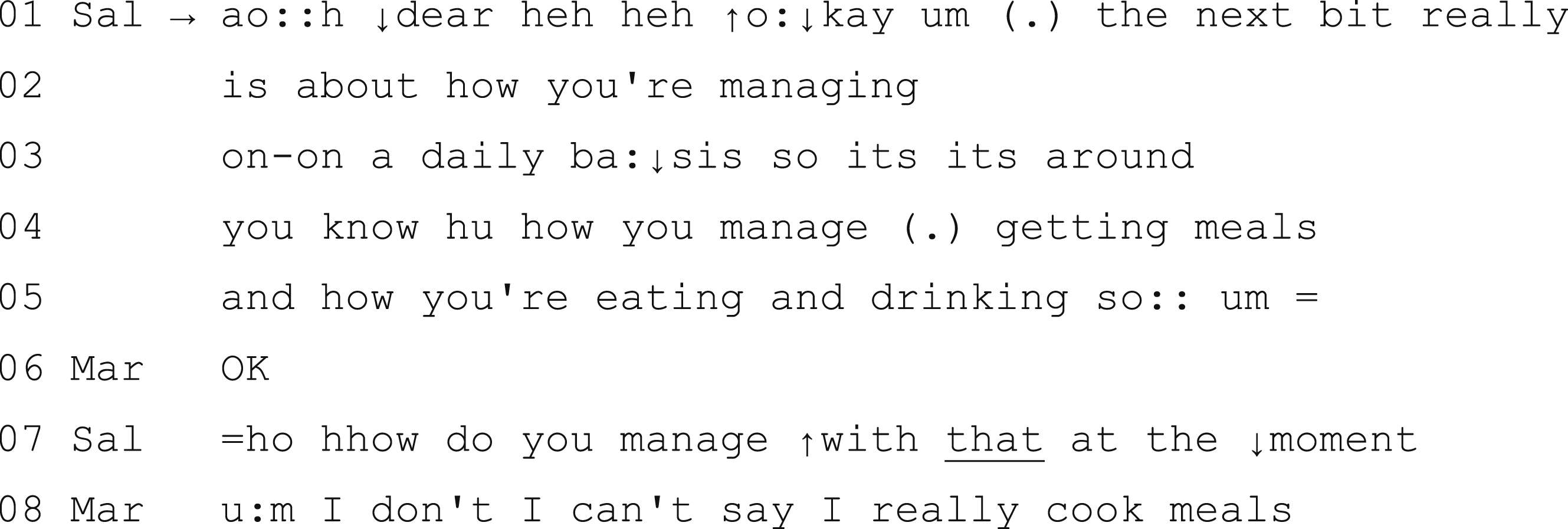
Having closed down some shared laughter, Sally refers to the paperwork in line 1, where she mentions ‘the next bit’. In a sense, she is topicalising the task of getting through the assessment. The response on this occasion (line 8) in fact challenges the assumption built into the question – that Marion cooks her own meals. As it subsequently transpires, she relies on a partner who is not present in the assessment, who does most of the cooking. As in five other examples where there was no obvious topical link at a ‘transition’ point, it can be seen how this strategy puts the assessor at risk of raising a matter that is not grounded in the previous conversation and may not be seen as relevant.
Referring to records or information known previously
A variant of this ‘going through the questions’ is to refer to a different kind of paperwork, namely the records relating specifically to the individual (nine instances). As in Heritage and Clayman (2010: 148–150), the question in those cases is often framed as a declarative, something which is read off from the written record.
Extract 7 (Rita: occupational therapist in adult social care team)
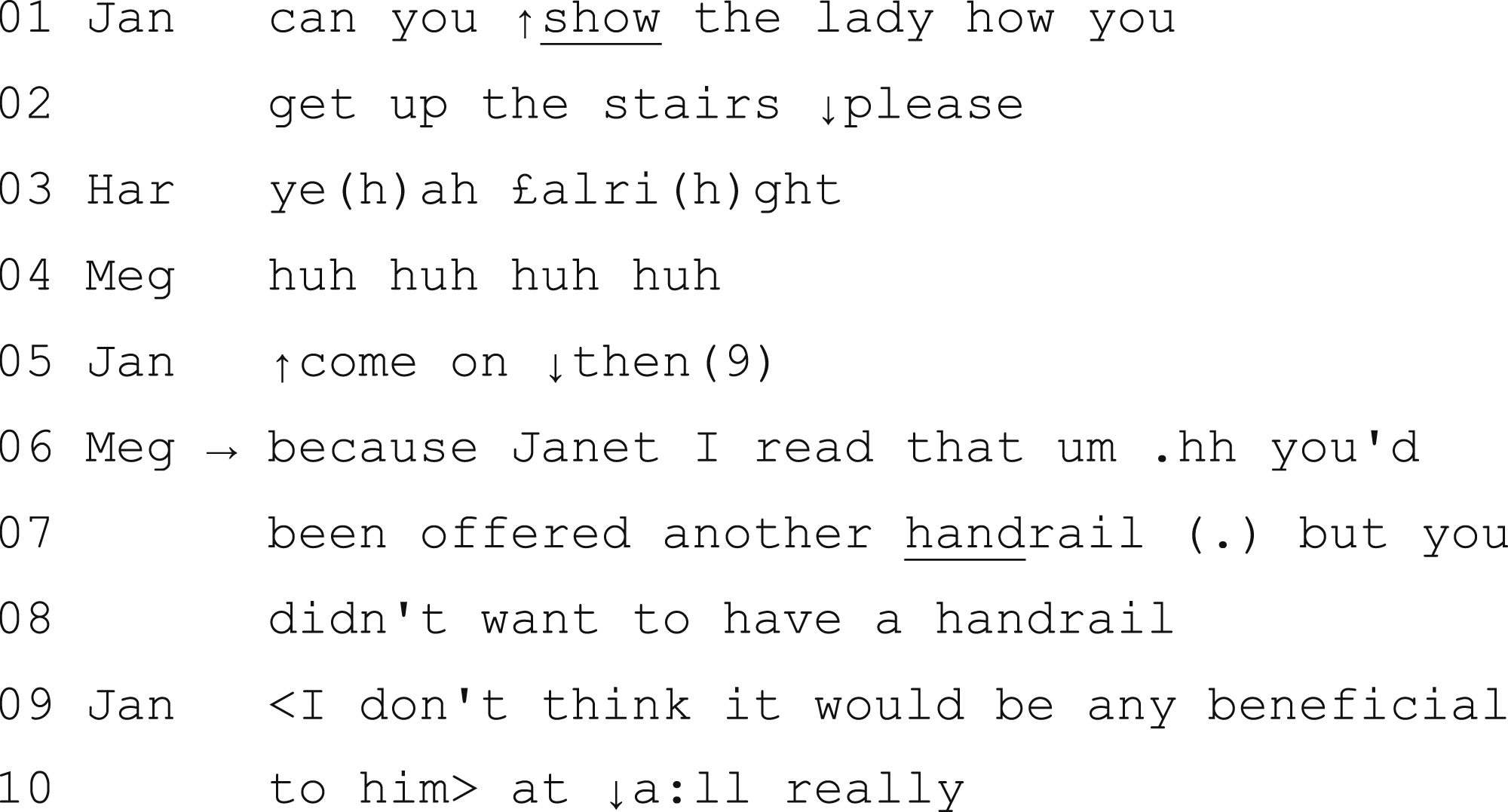
While a question in declarative mode (lines 6–9) can be heard as a yes/no question, setting up a slot for a confirmation, in this case the carer Jane responds by justifying her original decision. Maybe the read-out of something agreed previously is heard as a challenge, something which may not now be correct. In fact, here the matter in hand accompanies the physical enactment by Harry, the service user, of scaling the staircase without a handrail, and Jane is maybe sensitive to how his method for climbing the stairs will be judged by the assessor. There is constant sensitivity in how both the questions and responses in these encounters build on a growing epistemic closeness (getting to know the client) while simultaneously giving rise to detailed accounts which challenge the assessor’s or the client’s right to know. Nowhere is this clearer than in the following:
Extract 8 (Ruth: Female care coordinator in adult social care team)
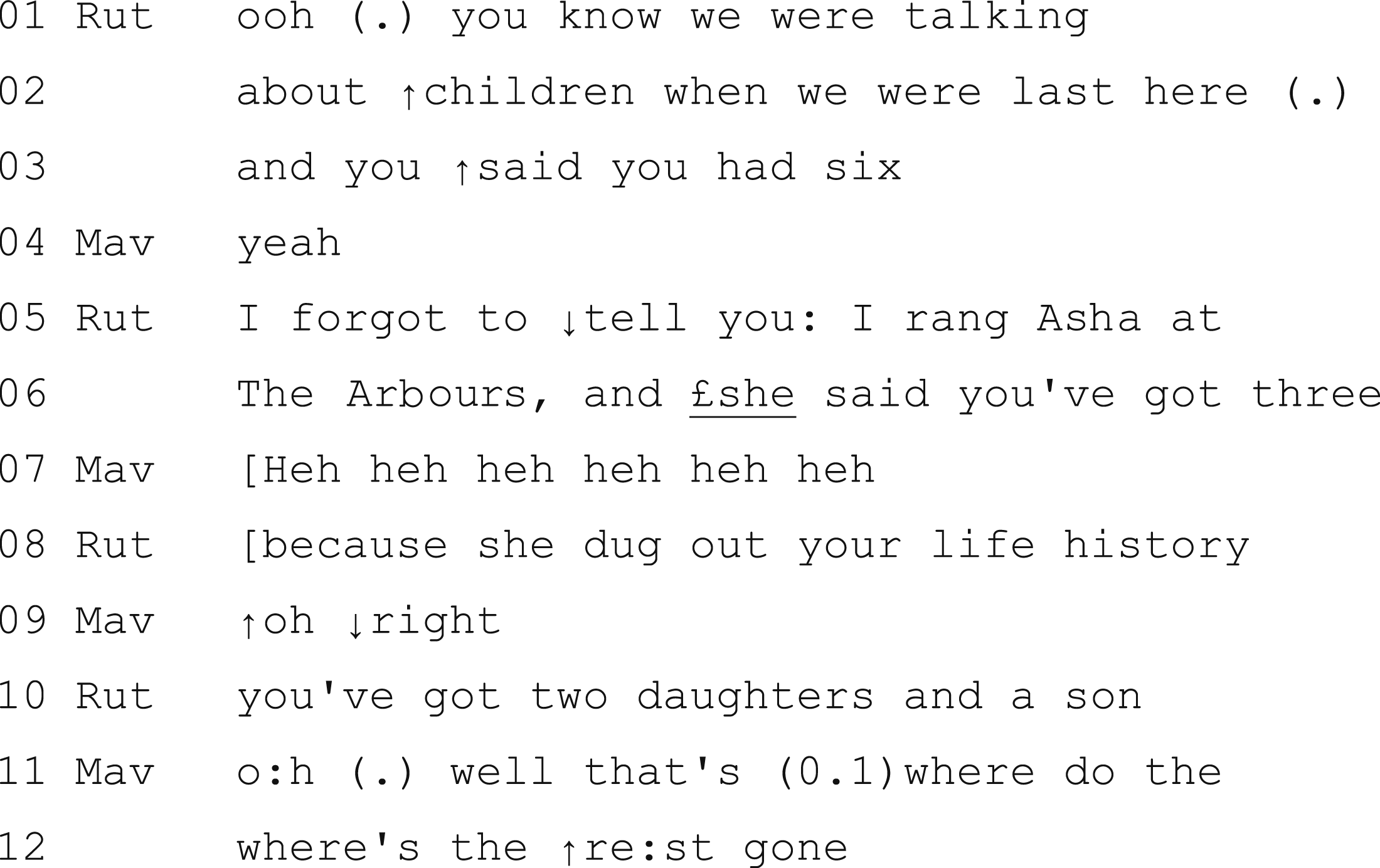
Ruth is one of two assessors visiting an older woman, Mavis, to find out more about her needs for support specifically in managing her money. As with nearly all the other assessments, the matter of ‘informal support’ (i.e. active assistance from family or friends) is introduced in these conversations, in order to gauge how far the funded social care element can be expected to be supplemented, or indeed, replaced or reduced because of the presence of family care. In Extract 8, however, the number of Mavis’ children is raised seemingly in order to challenge her previous version in which she claimed ‘six’ children. Not only might this have been in her records; Ruth specifically refers to a conversation she has had with Asha, a member of staff who purportedly knew Mavis, and in line 6, she offers Asha’s version of Mavis’ family as more factually accurate than Mavis’ own, on the grounds that ‘she dug out your life history’. While this topic shift is introduced broadly by referring to something Mavis had said on the previous visit, the additional strategy of reference to the record of her ‘life history’ is a strong news announcement (Button and Casey, 1985) which effectively trumps Mavis’ epistemic rights to have privileged access to her own life domain (Heritage, 2012), a huge potential challenge to Mavis’ rights both within this interaction and more generally in her life. As in Williams (2011: 38–43) and Williams et al. (2019), there are some groups of people who are routinely denied this epistemic right, and whose accounts are not believed. That challenge to Mavis’ own life knowledge thus carries with it a strong implication of incompetence, which again might be very relevant to the assessor’s task of finding out about the client’s needs. Peel (2015) notes that diagnostic talk about dementia regularly avoids explicit mention of the label ‘dementia’, and that patients often normalise their experiences of forgetfulness. In that light, it is interesting that Mavis’ response (line 9) ‘oh right’ is followed after some hesitation by what is almost a punchline (‘where’s the rest gone?’), certainly a joke-like uptake of Ruth’s version of her family.
Referring to something said during the current interaction
Referring to the ‘records’ for factual accuracy can thus be seen as a difficult move in transitioning to next topic, and is fraught with dangers of the question being heard as a challenge, or in fact the question being seen as challenging a client’s competence in the here-and-now. However, sensitivities in uptake of questions can also be apparent where a topic is introduced by the assessor by referring to something said at an earlier point in the conversation, maybe a few minutes earlier. Here is an example from our five instances in sub-category 2.3:
Extract 9 (Pam: social worker in an adult social care team)
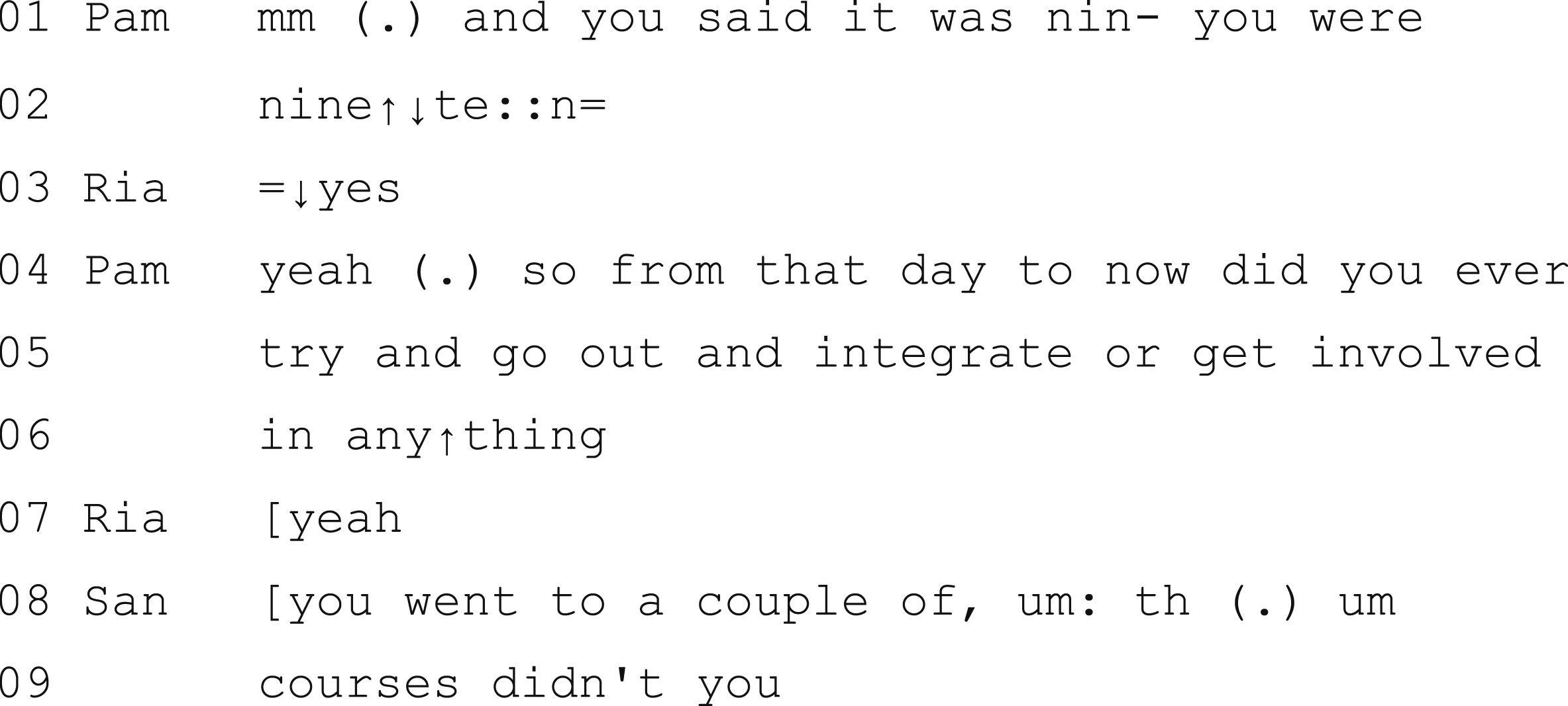
Some 100 lines prior to this, Ria’s mother Sandra had introduced the reason for Ria’s impairment, which started when she was 19 years old. The hesitancy in Pam’s turn at line 1 here reflects the sensitivity of referring to that, and the drawn-out ‘ninete::n’ is delivered in a low voice, which is then immediately taken up with a low ‘yes’ by Ria. Introducing such a painfully sensitive topic was only possible here by referring to something which had been acknowledged already in prior conversation. The no-tilted question posed by Pam in lines 4–6 carries the implication that her impairment will end all prospect of a meaningful life. Certain matters which are assessment relevant appear to thread through these conversations, perpetually available to be taken up or linked into the talk, and the need to provide a topical link may be balanced against the previously stated ‘relevance’ of that particular matter.
From the service user’s point of view, however, returning to a matter which had previously been closed off may signal some inadequacy in the way it had been dealt with previously, and Ria’s hesitant ‘yeah’ responses and her dispreferred ‘yeah’ in line 7 are some evidence of her discomfort. The detailed pursual of earlier matters in the talk provides for a tight logical coherence set by the assessor’s agenda.
Using a ‘noticing’ about the physical environment or the person being assessed to introduce next question
As with all the data in this paper, the strategies used to transition to next topic are complex, often layered and mixed. For instance, in Extract 3, there was both a topical link with matters introduced by the family carer (about the miner’s cottage), but at the same time, a reference to the observable low ceiling in the room where the conversation took place (‘I was going to say’). However, this method of referring to an observable matter is one strategy which can be turned to when all else fails in finding a way through to the next topic, and there were five clear instances of that in the data. Returning to Bob from Extracts 2 and 3, Rik the assessor was here moving on through the matters he needed to raise, having spent a long while on conversations led by the carer which were only possibly of tangential relevance to his assessment of Bob’s needs.
Extract 10 (Rik: Male social worker in sensory impairment team)
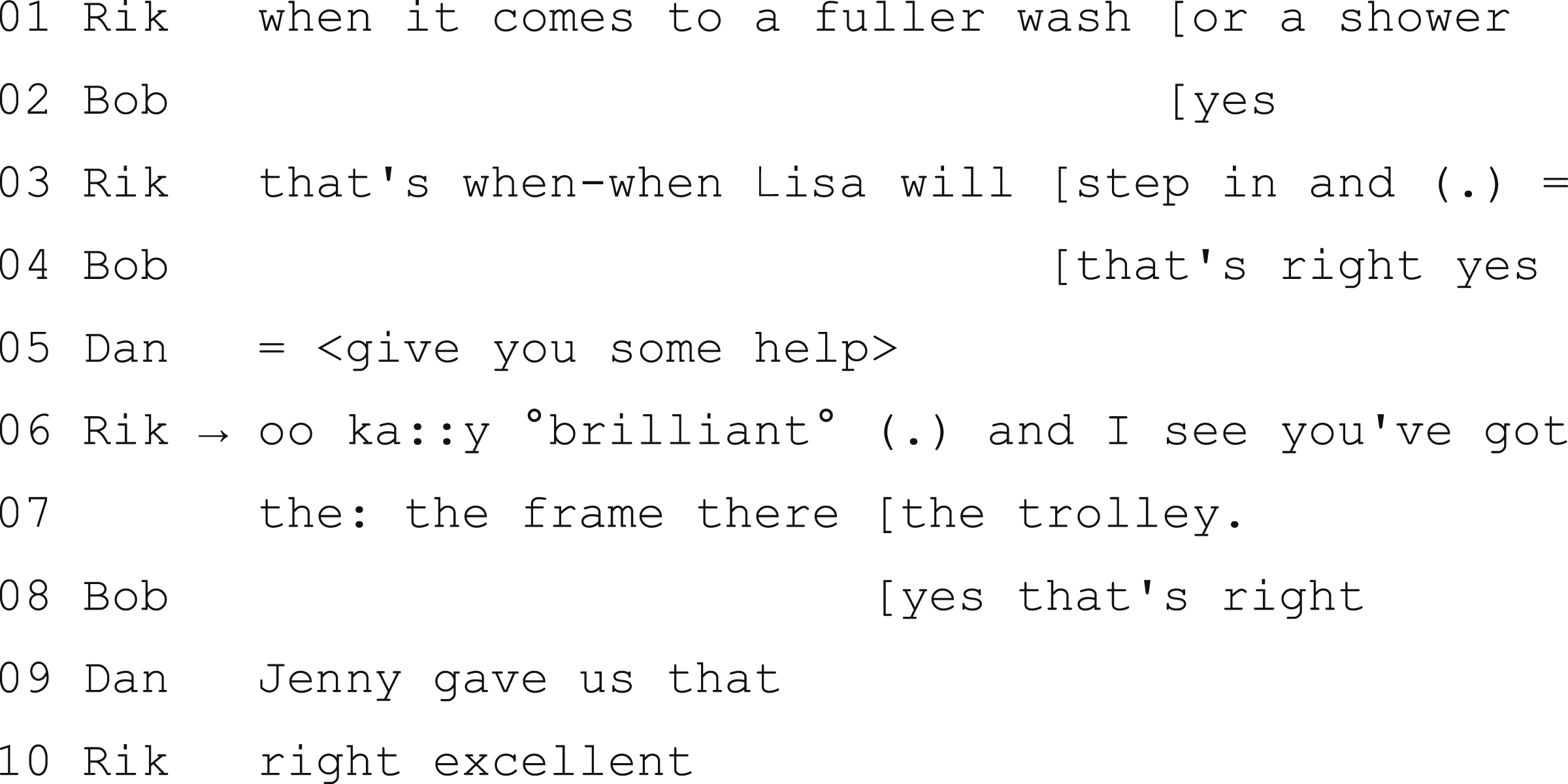
Much of the conversation about Bob’s needs has involved ‘others’, professionals whom Bob has seen or who have visited him recently. Thus at line 3, Rik mentions ‘Lisa’ who has already been established as a carer who comes in on an occasional basis to assist with personal care tasks such as showering. This is clearly relevant to the current assessment of Bob’s needs, and that relevance and procedural success is marked, as Antaki et al. (2000) point out, by the ‘OK. Brilliant’, that leaves a slot for Rik to carry straight on into the next question – which in this case he frames in lines 6-7 as a declarative statement about what has been noticed. ‘I see you’ve got the frame there, the trolley’. Thus, he is able to smoothly move from the discussion of personal care to a conversation about Bob’s mobility, via a straightforward strategy of simply mentioning what is in front of him. This seems to pass off well, as a type of ‘fill-the-blank’ question (Persson, 2017) with Bob agreeing, and his son then fits the matter to the previous agenda of ‘who has provided what support’, mentioning that Jenny gave them the walking frame.
Social care assessors generally engage with their clients in their home environment. Therefore, it is may be inevitable that the assessor would discuss, or probe what has been noticed in the environment. However, introducing a topic that relies on what one has noticed can create interactional problems, as in the following.
Extract 11 (Ruth: Female occupational therapist in adult social care team)
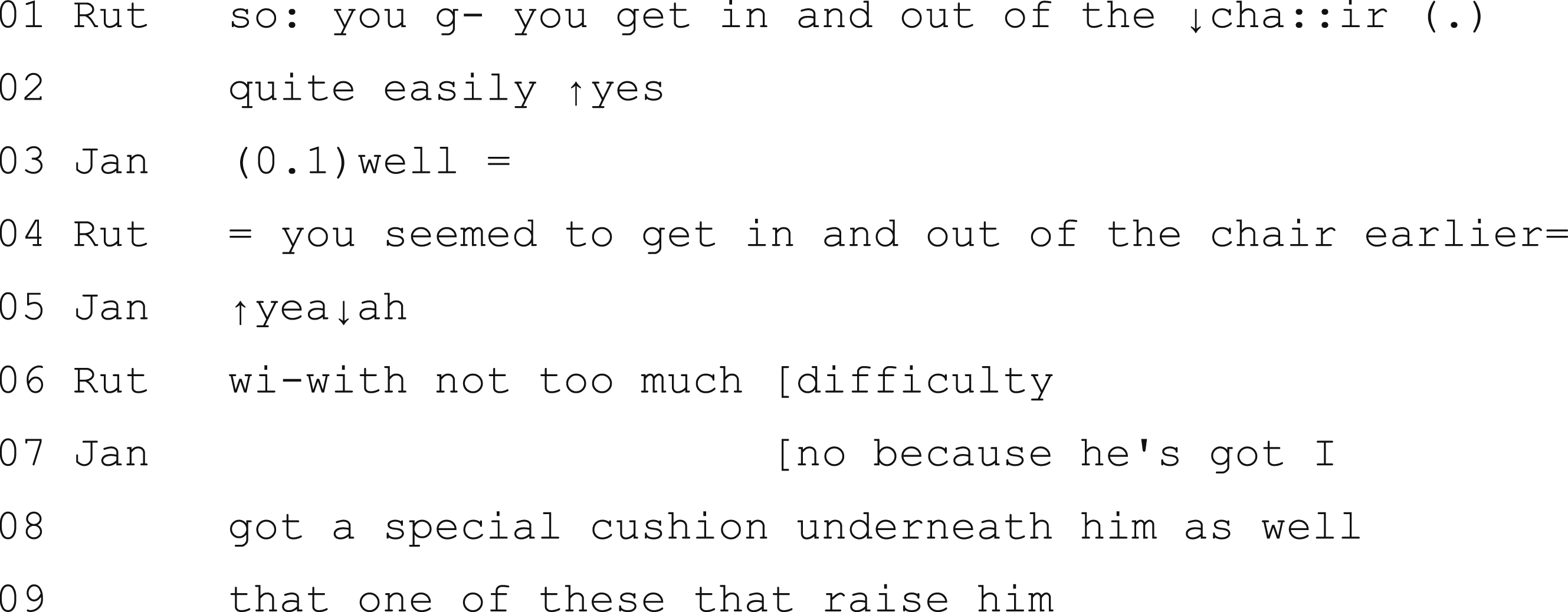
By noticing something, you may run the risk of challenging the veracity of what the person is saying. In this case, Ruth raises what she has ‘noticed earlier’ to back up her assertion in line 1 that Harry has no problem getting out of his chair. That might of course be something which Harry and Jane his wife wanted to discuss as a potential need, and Jane puts in her claim for next turn with a ‘well’ in line 3. This is much less than a full agreement with Ruth’s opening proposition, and in fact opens up a space for Jane to maybe qualify or discuss the way in which her husband might be standing up from his chair. It is in that environment of potentially conflicting views that Ruth then refers back to what she has observed, that Harry was able to get up ‘without too much difficulty’. Jane’s response to that is immediate, explaining that his ability to get up is dependent on the ‘special cushion’ that helps by raising him up. She is clearly orienting here to the potential relevance of her husband’s physical needs, and the risks of Ruth taking what she observes in the home at face value.
Linking to next topic via a physical noticing might be considered a ‘last resort’; however, it would seem from our data that it is particularly valuable to assessors who are stuck at the point of introducing a matter that is potentially delicate, such as personal care. In further examples, for instance, an assessor commented on a stair lift which she could see, in order to introduce questions about what was upstairs, including the bathroom. This then formed the basis for broaching a question about personal care later in the assessment, always a potentially sensitive matter.
Discussion
In the light of social care assessments in England being badged as ‘conversations’, this was a relevant moment to examine the ways in which such conversations are enacted. The task of the assessors in our data was essentially to draw on the ordinary resources of conversation, while accomplishing the institutional goals of the assessment, and the ‘permeable membrane’ between institutional and ordinary talk (Drew and Heritage, 1992) was on display throughout these assessments. In our data, a range of interactional styles were on display. At one extreme, it would be hard to distinguish the assessment from a mundane social conversation between people newly acquainted with each other (as with Rik in Extracts 2 and 3), while at the other extreme one of the assessments proceeded by moving from one question to another without much commentary at all. However, these styles were not mutually exclusive, and it was quite possible for an assessor to be drawn into a topically linked matter raised by the client, while going through the assessment questions.
One point to emerge from this analysis was the epistemic shift that can be accomplished by building a next topic on something raised by the client or carer. An assessment for social care is designed specifically for the assessor to get to know the client, and essentially, assessors were able to garner clues about the lifeworld of the client, by taking up points raised either by the client or by carers. This effectively allowed assessors to shift themselves up the knowledge gradient, becoming more knowledgeable (Heritage, 2012) about concerns which might be relevant to the client’s assessment. This frequently allowed them, as in Extracts 2–4, to move to a related topic, which could build on what they already knew. Both participants naturally become more knowledgeable about each other; however, the institutionality of ‘doing an assessment’ was omni-present in the fact that (a) only knowledge about the client (not the assessor) is articulated; (b) assessment relevant matters are frequently marked by the assessor writing them down.
Further, we explored in this paper situations where assessors were not able to build ‘next topic’ on the interactional environment in which they found themselves, and to see what strategies they could draw on. Referring to paperwork in front of them, as for Heritage’s (2010) medical assessors, was one fall-back position, and could be done without any recourse to what the client or carer was revealing about themselves. Arguably, that was a style of interaction which was the furthest from the ‘conversational’ style recommended by professional practice (SCIE, 2017). Olaison (2010: 514) for instance also comments that case files about older people in Sweden tended to ‘ignore the interactional nature of assessments’.
In the present data, assessors frequently shifted topics by drawing on more than one strategy, sometimes by noticing something in the material environment, and pivoting to the next topic by creating a link with what had just been said. In Symonds et al. (2018) interviews with social care assessors revealed their own awareness of the importance of observation, admitting that they would accept a cup of tea from the client, in order to ‘make an assessment, are they able to use the kitchen safely’ (p. 1923). Equally, past knowledge or records of a client’s case were often available to assessors, and they could bring in points which either confirmed or challenged accounts being given in the here-and-now of the conversation. These moments were amongst the most sensitive in our data, where clients were constructed as unreliable or incompetent to know their own affairs. In terms of the sequential outcome of each of these moves, it is evident from our data that clients were more likely to challenge, to refine or to counter something when the assessor had referred to the records, or even when they referred to something in front of their eyes.
Many of these points were picked up by the co-research group (Values of Assessment, 2017) and enacted in their training videos, where they speak from experience about the disempowered and stressful reactions they have to assessments. One visually impaired member of the group shows his audio microwave on camera, but then comments that ‘If you say you can cook yourself a meal, then they’re going to say you don’t need help’. The strategies which have been highlighted in this paper are not universally ‘bad’ or ‘good’ practice, but instead our study focused on the value of reflecting on the detail of how an assessment conversation was conducted. For instance, in the user-led workshops we conducted, assessors became aware of how an observation could lead to judgements of a person’s capabilities, which will threaten the open and trusting relationship which assessors pursued.
A paradoxical conclusion to all this is therefore that conversational ‘closeness’ can be a danger to a satisfactory assessment outcome from the point of view of the client, whose interests are to gain access via the assessment to support services or resources. When an assessor attains greater access to personal knowledge about the client, by allowing a client or carer to talk, their next turn is part of a tight logic which is very hard for the client to refute.
However, the rules of conversation can be used by either the assessor or assessed, and indeed, clients and carers can resist and reclaim agendas, by using the same moves as the assessor. It is quite possible for instance for a client or a carer to take over the assessment, and pursue their own goals. They could set the agenda, and pose the questions, keeping the assessor in response position. Assessments are never value-neutral, and it would be interesting to explore a wider sample in order to collect and compare strategies which are ‘conversational’ with those which are driven by the institutional requirements of the assessment form. It is quite possible that clients themselves can set agendas more easily when the need to carry out a conversation is not so salient.
Conclusion
Introducing the ‘next topic’ is a difficult, but powerful, conversational move. Where that can be done by a natural link with some matter introduced by another speaker, a smooth flow of talk may ensue. This paper has added to the literature on how these matters are managed in institutional settings, such as assessments for social care. Assessors moved to next topic both by linking to their own and the client’s previous turn, but also by a range of other strategies where no overt link was possible. We question whether the goal of ‘doing a conversation’ can give the assessor an epistemic advantage, which may create institutional inequalities for the client.
Footnotes
Acknowledgements
We are extremely grateful to the people who allowed their social care assessments to be recorded, both the assessors and the assessed. We would also like to thank the whole research team, including Caroline Miles and Mike Steel, and the late Dr Sue Porter. Finally, our best wishes go to the peer support group from the West of England Centre for Inclusive Living, who played a vital role throughout the research.
Declaration of conflicting interests
The author(s) declared no potential conflicts of interest with respect to the research, authorship, and/or publication of this article.
Funding
The author(s) disclosed receipt of the following financial support for the research, authorship, and/or publication of this article. This work was supported by the NIHR School for Social Care Research (P060). The views expressed in this article are those of the authors and not necessarily those of the NIHR SSCR, NHS, the National Institute for Health Research or the Department of Health.
