




Abstract
The Swedish Social Services Act stipulates an individual perspective that promotes self-determination. In practice, this means that relatives lack formal rights to intrude on a person with dementia’s right to self-determination in decisions about elder care services. However, the Social Services Act also states that family members who are caring for a close relative should be offered support. This legislation may lead to contradictions within social work practice with couples. The aim of the present article is to explore how social workers manage needs assessment meetings in which couples living with dementia express diverging stances and the partner with dementia resists an offer for elder care services. We benefit from conversation analytic theory and methodology. The findings suggest that social workers accomplish persuasion through these four conversational practices: ‘providing information about the offer’, ‘mitigating the offer’, ‘positive framing of the offer’ and ‘laying down conditions for the offer’. Also, local alliances with the partner of the person with dementia were demonstrated throughout. The analysis shows that PwDs provide resistance to the offered services, but there are no examples of a PwD influencing the outcome in terms of offered services. The results raise questions about the effectiveness of persuasion in needs assessment meetings. The findings also add to the critical debate on how social workers may be constrained by institutional logics and where relational competence is needed to balance and coordinate decision-making when assessing the needs of older couples living with dementia.
Introduction
The needs assessment process is central to the coordination and provision of services for older people (Lymbery and Postle, 2015) and ought to be a dynamic process in which both the older person and his/her relatives are involved (Nelson-Becker et al., 2020; Olaison and Donnelly, 2022). Across Europe, the resources for social services are scarce and new public management has found its way into the welfare systems. In this era, social workers are more dependent on older people’s relatives than previously in terms of informal provision of care and support (Ray et al., 2018), which in turn may put strains on the relatives (Tolhurst and Weicht, 2018). In needs assessment meetings with older couples, social workers need to balance the perspectives of the individual, the partner and the couple (Nilsson and Olaison, 2020). In these meetings, social workers use their communication skills and professional discretion (Evans, 2015) when respecting older persons and their self-determination, while also ensuring that they and their partners have overall well-being and a secure existence (see Österholm et al., 2015; Mattsson and Giertz, 2020). The aim of the present article is to explore how social workers manage needs assessment meetings in which couples living with dementia express diverging stances and the partner with dementia expresses resistance to a social worker’s offer regarding elder care services. Benefitting from a methodological and theoretical conversation analytic framework, the analysis explores the activity of persuasion for ‘getting the client on board’ by identifying different conversational practices of the interaction.
Informal care relationships are often familial and specifically spousal (Gibbons et al., 2014). Decision-making in relation to receiving care and support from elder care often creates challenges in the life of older couples (Cash et al., 2019; Österholm et al., 2015), and even more so when the couple live with a dementia diagnosis (McGovern, 2015; Österholm and Samuelsson, 2015; Tolhurst et al., 2019). As dementia affects both cognitive and linguistic abilities, the everyday life as well as future life of both partners in a relationship changes (Nilsson, 2022; Nilsson and Olaison, 2019). When living with dementia, partners may express diverging stances on factual matters (Landmark et al., 2021), but also on their shared and individual needs (Nilsson and Olaison, 2022). When partners express diverging stances on the provision of formal care and support, negotiations might be necessary in order to reach an agreement, and it may be challenging to prioritise the other person and find suitable solutions for both individuals and the couple (Tolhurst and Weicht, 2018). Here, social workers play an important role in encouraging couples to communicate and articulate both individual and shared needs as well as in making decisions about suitable support for both of them.
Social workers work under conflicting legislation, where the self-determination of clients can be jeopardised when the needs of relatives are also addressed, which may be the case when assessing older couples’ needs. Research has shown that, in needs assessment meetings, social workers in adult social work can adopt so-called ‘subtle persuasion’ to encourage the client to agree to something deemed beneficial to the individual (Nordström and Dunér, 2001; Suoninen and Jokinen, 2005). When performing subtle persuasion, social workers draw on different techniques, such as coaxing and letting time work, or making hints and guiding the older person towards a specific decision. Conversation analysts have argued that persuasion is an interactional accomplishment, something that becomes evident in an inductive analysis of conversations (Humă et al., 2019, 2020). The emerging use of conversation analysis (CA) in social work research has enabled a deeper understanding of the unfolding of actual encounters in social work practice regarding making assessments and providing support (Suoninen and Jokinen, 2005). Previous knowledge about how persuasion is adopted in social work practice draws mainly on analysis of interviews with social workers on the topic (Nordström and Dunér, 2001), one exception being a study by Suoninen and Jokinen (2005) who studied persuasion in actual encounters within social work practice. How persuasion with older couples living with dementia is accomplished has been studied to a lesser extent. This paper adds to a growing body of research on naturally occurring interaction in the context of needs assessments within elder care, focussing specifically on persuasion. In the following, conversation analytic research on persuasion in institutional interaction is presented.
Conversation analytic research on resistance and persuasion
Making proposals, giving advice or offering a service are central activities in institutional interaction, as is managing any potential resistance expressed by clients (Heritage and Sefi, 1992; Muntigl, 2013; Muntigl et al., 2020; Suoninen and Jokinen, 2005). The activity of persuasion and expressions of resistance are often closely intertwined within the conversation analytic research (Stivers and Timmermans, 2020). For instance, persuasion may be initiated after resistance to an offer, which is also the analytic focus of the present paper. We have structured this literature review section in two themes; first we address conversational analytic research on resistance and thereafter on the activity of persuasion in institutional interaction.
Research on resistance describes both active (or explicit), and passive (or implicit), resistance. Active resistance, or an explicit objection, has been conceptualised as the questioning of a project, such as an offer or advice. This type of resistance provides the interactant, for instance a professional practitioner, with material or clues to address and ‘work with’ in the ongoing interaction (Bloch and Antaki, 2022). If the content of the topic is within the epistemic domain of the person resisting, more interactional work is required by the practitioner. However, resistance can be more implicit through, for example, withholding of a response (silence) or minimal acknowledgement (‘mm’ or ‘yeah’) (Heritage and Sefi, 1992; Muntigl et al., 2020; Stivers, 2005). In cases of interaction involving cognitive or intellectual disability, resistance can also be understood as unreadiness, inability or unwillingness to participate in a specific activity, demonstrated through disengagement, vocalisations, averting the gaze or closing the eyes (Nicholson et al., 2021).
Stivers and Timmermans (2020) found three different bases of resistance used by parents in doctor-parent interactions. Preference-based resistance regards resistance based on ideology or simply ‘not wanting’ the doctor’s suggested recommendation or treatment. This resistance may challenge the professional’s deontic and epistemic authority. Fear-based resistance comprised the parents’ fear of the suggested recommendation. Finally, Experience-based resistance concerned where the parents put forward specific experiences that were grounded in their own knowledge as a basis for their resistance (Stivers and Timmermans, 2020), a resistance specifically rooted within their epistemic domain (see Bloch and Antaki, 2022). Persuasion is not always deployed when meeting resistance, and what kind of persuasion doctors deploy, and whether they modify their recommendation was, in this context, sensitive to the grounds for resistance they encounter. For instance, preference-based resistance was often connected to an initiation of persuasion by professionals.
Muntigl et al. (2020) studied therapists’ strategies for managing resistance by clients and found that they provided accounts for the proposals as well as elaborated on them by adding information. In a case study about couple therapy sessions, displays of resistance to and lack of compliance with an institutional agenda were recurrent (Muntigl, 2013). Here, the therapists met the resistance by addressing and topicalising it. The resistance expressed by one partner was also associated with the forming of a local alliance between the therapist and the other partner (Muntigl, 2013), which was also found by Pino et al. (2021) in palliative care encounters. In these cases, the practitioner is faced with the dilemma of ‘taking sides’ and thereby jeopardising relations and treatment (Muntigl, 2013; Pino et al., 2021).
We now move on to research on persuasion, described as the encouragement of someone else to agree, or affiliate, with a specific agenda (Humă et al., 2019, 2020; Suoninen and Jokinen, 2005; Stokoe et al., 2020). Humă et al. (2020) argue that adopting a persuasive conduct involves the mobilisation of ‘conversational resources that enable speakers to constrain interlocutors’ responses in order to pre-empt or deal with resistance to the courses of action they are engaged in’ (Humă et al., 2020: 360). For instance, Humă et al. (2020: 366) showed how, in sales calls, turns can be designed in a way that implies that acceptance of an offer is already in place. In this way, any potential resistance may concern the details rather than the main offer per se. Hence, through the design of an initial turn, a salesperson can secure a sale in subsequent turns without even asking the respondent explicitly. Similarly, Hepburn and Potter (2011a) showed how help line professionals adopt conversational strategies for managing the recipient and to improve his/her willingness to accept the advice given, such as repacking the advice in an idiomatic form, using tag questions or simply holding the conversational floor, something also found by Humă et al. (2019, 2020).
Moreover, in social work practice the institutional agenda being pursued can also be detected in social workers’ responses to clients’ talk. Contributions that align with the agenda are positively acknowledged through active listening or encouraging questions, and disaligning turns are met with passive listening (Suoninen and Jokinen, 2005). Looking at persuasion from the contributions by the resisting party, Stokoe et al. (2020) found that, in interactions involving different stances, speakers may stay silent for a significant time after an initial rejection before accepting the same initial proposal. In this way, speakers can save face while also changing their stance and expressing agreement to something they previously rejected. Stokoe et al. (2020) analysed these inter-turn silences and found them to be interactional resources for breaking the normal contingency of the turn design, where the turn after the silence can ‘stand alone’.
In summary, conversation analytic research has shown that persuasion sequences are delicate matters in which respondent’s recipience, and potential or actual resistance can be managed in the speaker’s design of utterances as well as in responses to clients’ talk. Persuasion sequences are interactional accomplishments in which the speaker adopts conversational resources to manage and constrain the recipient in her turn. For instance, designing an offer as if it had already been accepted as well as encouraging talk in the ‘right direction’ increases the chances of agreement. In the present study, we benefit from conversation analysis when analysing how social workers manage needs assessment meetings in which couples living with dementia express diverging stances and express resistance to a social worker’s offer concerning elder care services.
Methods and data
Design and participants
The data for the project consist of 18 audio- or video-recorded needs assessment meetings between social workers and partners/couples (in total 8.3 h of recordings, mean = 27.6 min/meeting), collected in four Swedish municipalities. The meetings were held either in the participants’ homes (three cases) or over the phone (15 cases) due to Covid-19. Taken together, the data involved eight participating social workers and 16 couples; two couples were recorded on two occasions. Of the 18 recordings, 10 involved couples living with dementia (or mild cognitive impairment/expressed symptoms of dementia according to the social workers). Informed consent was obtained verbally via the social workers when recording the meeting. In addition, the couples were sent information about the study as well as informed consent forms for them to sign and return by post to the researcher, marking whether the researcher was allowed to analyse their recorded meeting. In four cases, the couples declined participation in the research project after the assessment meeting; their recordings were deleted and not included in our data. In cases where the person with dementia did not participate in the recorded interaction, informed consent was obtained only from the partner who was recorded. The project was approved by the Swedish Ethical Review Authority (Reg. no. 2019-05216).
The setting
The Swedish welfare system has a strong ideal of equal rights to services for all members of society (Moberg, 2017), and social services are tax subsidised and offered to entitled citizens through a needs assessment process. The legal foundations of needs assessment practice are based on the Social Services Act [SSA] (2001: 453), which is a framework legislation without detailed regulations concerning the needs assessments process. Instead, the responsibility for organising and distributing elder care is largely determined at a municipal level, regulated by local politicians, and guided by local guidelines implemented by social workers (Brodin, 2018). Self-determination is a key concept in the Swedish social legislation (2001: 453), which is an area where Sweden differs from some other countries regarding autonomy for persons with dementia diagnoses (Giertz et al., 2019). When dealing with applications for elder care services, social workers need a clearly ‘stated application or expression of will that they can interpret as an application. It is not possible to approve help against someone’s clear will’ (Dunér, 2020: 91, our translation). In practice, this means that relatives or proxies lack formal rights to intrude on the right of the person with dementia to self-determination in decisions about care services (Mattsson and Giertz, 2020). Thus, assessment of the older person’s needs should be based on the individual’s own descriptions and wishes. At the same time, the Social Services Act, Chap. 5, Paragraph 10 (2001:453), stipulates that the social services must offer support to family members who are caring for a close relative. This means that social workers may face contradictory directives, specifically those who assess needs for persons with dementia, as their ability to express and maintain their self-determination and integrity may be challenged. Moreover, the partners of persons with dementia may be affected by the caring situation and therefore have substantial needs for relief that must be met by social services.
Analytical procedure
The analysis benefits from the methodological and theoretical framework of CA, which is a data-driven inductive analysis of the interactants’ own understanding of the conversation (Sidnell and Stivers, 2013). The first author transcribed the recorded conversations according to the Jeffersonian transcription system (Jefferson, 2004, see Appendix), including details such as prosody, pauses and overlaps. When relevant, non-verbal contributions, such as gazes and gestures, were also included in the analysis, thus adding more layers of ‘what is going on’ in the interaction (see Mondada, 2016).
The analysis is based on four conversations involving care managers and couples living with dementia, drawn from the dataset of 18 needs assessment meetings. The collection of extracts analysed in the present study involve a phenomenon of partners in couples expressing diverging stances on an offered elder care service, and where a person with dementia (PwD) expresses resistance to it and social workers engage in the activity of persuasion. However, not all extracts explicitly involve the actual discrepancy or diverging stances between the partners, as it might have been made relevant earlier on in the interaction regarding the specific service. In interaction involving PwDs, issues are addressed recurrently due to memory problems and there it is also difficult to give an exact number of extracts which comprise the collection, therefore we chose to provide the number of turns instead. One criterion for choosing the extracts was that a PwD displayed active or passive resistance to a service offered by a professional social worker, which the PwD’s partner expressed affiliation with. Another criterion was that the professional social worker, and sometimes a partner, employed one or several conversational practices for persuading the PwD to agree to the offered service. The action of offering within sequences align with the definition of offers by Clayman and Heritage (2014), in which the speaker presents him/herself as the benefactor of a service aimed at providing help for the client with dementia, who is thereby positioned as beneficiary.
The analytic process involved repeated sessions of both authors listening to and viewing the recordings, as well as reading the transcripts. Moreover, the data was presented and discussed in data sessions with other researchers within the field of conversation analysis, social work and dementia research. The extracts analysed in this paper were chosen based on the quality of the recordings as well as the clarity and length of extracts. The analytical focus was to identify the practices for persuasion that occurred across the extracts, as well as to pay attention to any practices occurring in single cases. The extracts were analysed with an emphasis on expressions of resistance by PwD and recipient management by social workers. The extracts were translated from Swedish to English, and personal information has been altered.
Analysis
The project of persuading a PwD to agree to a service entailed several conversational practices, presented here under the following headings with the frequency provided in communicative turns over all four conversations: ‘providing information about the offer’ (8 turns), ‘positive framing of the offer’ (22 turns), ‘mitigating the offer’ (9 turns) and ‘laying down conditions for the offer’ (1 turn). Not all practices were present in all the conversations, and sometimes two occurred in the same turn, such as providing more information and positively framing an offer. Similar practices have been found in persuasion sequences in other institutional interactions, with the purpose of ‘getting the client on board’ (Humă et al., 2019, 2020; Muntigl, 2013; Stokoe et al., 2020; Muntigl et al., 2020). Also, the analysis demonstrates how PwDs provide active and passive resistance to an offer (see Muntigl et al., 2020), but also attempt to negotiate the motivation for the offered service (see Stivers and Timmermans, 2020). In the interactions with couples living with dementia, the activity of persuasion to agree to an offer of a service appeared to also rely on the partner’s support for it. Throughout the analysis, we found that the social worker constructed local alliances (see Muntigl, 2013; Pino et al., 2021) with the partner of the client with dementia. These alliances were displayed through gaze, collaborative talk, by explicitly describing their agreements and by speaking on each other’s behalf. These constructions of local alliances will also be pointed out throughout the analysis. The English translation is provided in italics beneath the Swedish lines in grey.
Providing information about the offer
In this first example of describing the practices, the social worker introduces an offer that is met with resistance by the person with dementia. As seen in other studies on institutional interaction, resistance to an offer can be responded to by providing more information about it (Muntigl et al., 2020; Wasson, 2016), which is also the case here. Prior to the start of this extract, the social worker provided a pre-expansion (Humă et al., 2019) in which she asked the PwD about the day care centre they visited yesterday, to which the PwD responded positively. Thereafter she moved on to the main agenda of the meeting, namely recurring visits to the day care centre (see line 01).
Ex. 1: Home visit: SOC: Social worker, PwD: Person with dementia, PAR: Partner
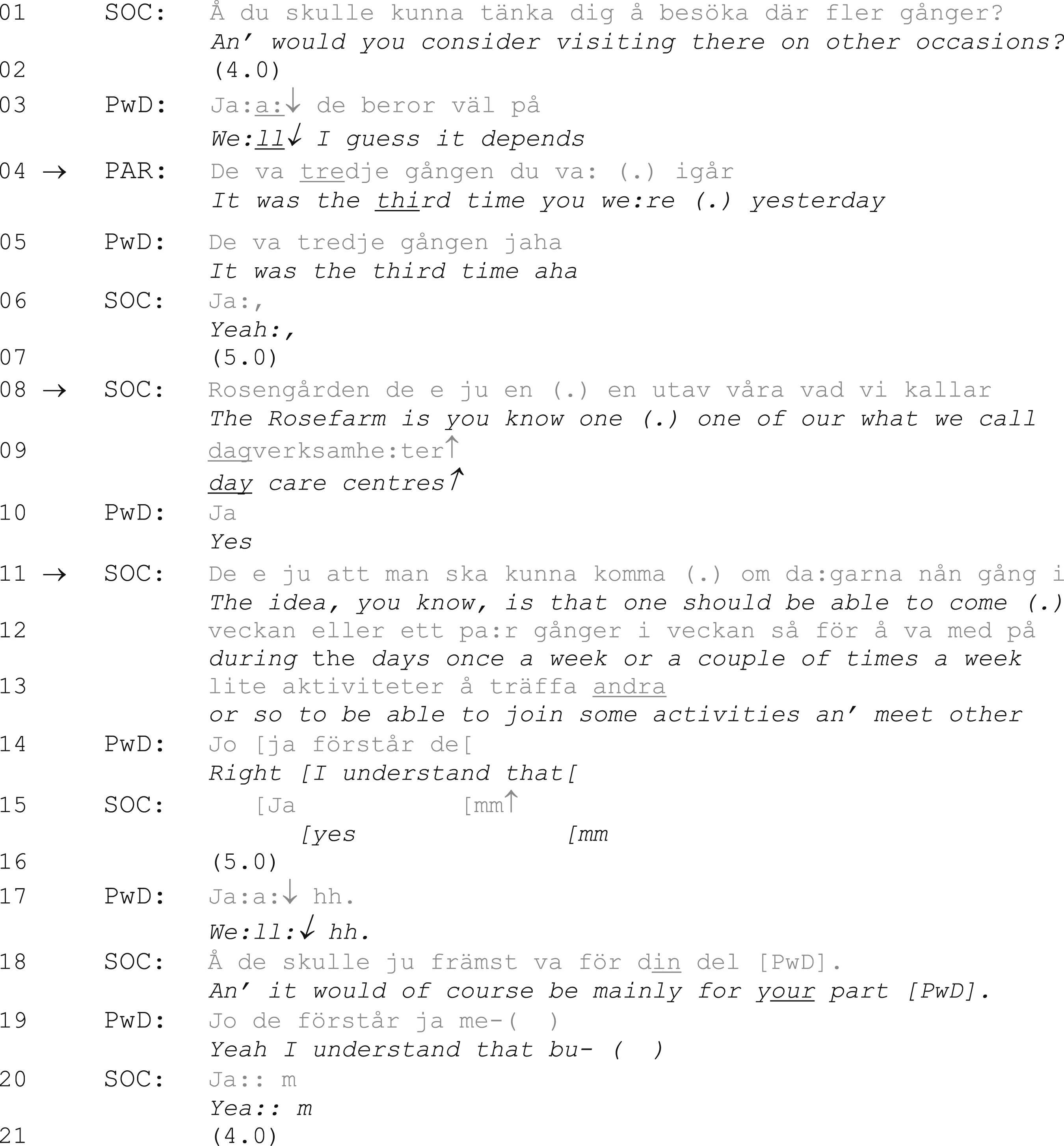
In her initial turn, the social worker uses an ‘and preface’ (Heritage and Sorjonen, 1994) when posing the question ‘and would you consider visiting there on other occasions?’ (line 1). This type of question design could indicate an orientation to an institutional agenda made out of a series of questions, rather than a more informal follow-up question, which normally does not start off with ‘and’ (see Heritage and Sorjonen, 1994) This turn design includes an opening for the client’s self-determination; however, it also implies a preference for a positive response. The elaboration of the topic of day care includes the description of coming there ‘once a week or a couple of times a week’ (lines 11–13) and is posed in a rather vague format that makes it easy to align with and hard to resist (Humă et al., 2019; Muntigl et al., 2020). Despite this turn design, the PwD expresses non-affiliation and instead remains silent for 4 seconds, which indicates resistance to the offer. His non-affiliation with or passive resistance to it is also expressed in his ‘we:ll↓ (Swedish: ja:
With an offer with a non-affiliative uptake on the table, the partner provides more information regarding the PwD’s visit to the day care centre; ‘it was the third time you were (.) yesterday’ (line 4). By doing so, the partner treats the PwD’s resistance to the offer as indicating a lack of knowledge about the topic. To follow up a non-affiliative stance, or resistance, by adding more details on the matter has been identified in other institutional interactions and serves the purpose of meeting an institutional agenda and goal (see Muntigl et al., 2020), thereby indicating a positive stance to the offer by the partner. However, the partner’s turn here may also serve the purpose of adapting the conversation to the PwD’s cognitive impairment and difficulty with keeping track in conversation. Evidence for this can be seen in the PwD’s response on line 5, where he repeats his partner’s formulation and adds a token of news by saying ‘aha’ (Wilkinson and Kitzinger, 2006).
Still, the PwD does not address the topic of more visits at the day care centre, instead there is an even longer silence of 5 seconds (line 7). Then, the social worker assumes speakership and adds to the partner’s information about the service by providing even more information on the day care centre (lines 8–9). The PwD responds with a clear ‘yes’, indicating alignment with the informational project (line 10). The social worker continues to add information about the day care centre, in mitigated formulations such as ‘a couple of times a week’, and ‘join some activities’ (lines 11–13). The social worker describes the day care centre and the plan for the PwD’s participation, by using the Swedish common ground marker ‘ju’ (Heinemann et al., 2011), translated as ‘you know’ (lines 8, 11 and 18). Perhaps invited through the epistemic marker, the PwD then claims his epistemic status of knowing (Heritage and Raymond, 2005): ‘right I understand that’ (line 14). However, he still does not take a stance in relation to the question from line 1, instead there is another 5 seconds of silence, followed by a ‘we:ll:’ with falling intonation and an exhalation.
The social worker advances the informational project by implying that there is already something of an agreement or plan for the PwD to go to the day care centre in the future: ‘an’ it would of course mainly be for your part [PwD]’ (line 18). This recipient management strategy of designing a turn as if there were an agreement was also identified in persuasion sequences by Humă et al. (2020). However, the PwD still does not respond to the offer and initiates an opposition: ‘yeah I understand that bu-’ (line 19), which gets cut off by the social worker’s encouraging ‘yea:: m’ (line 20) (see Suoninen and Jokinen, 2005), followed by another long silence before the social worker switches to another conversational practice (not included here).
Here, the practice of adding more information is a co-production by the partner and the social worker. It is as a response to non-affiliation to an offer and serves the purpose of treating stances by the PwD as epistemic shortcomings; hence it contributes to a positioning of the PwD as unknowing (Heritage and Raymond, 2005) rather than ‘unwanting’. In this way, the basis for the resistance is framed as an epistemic issue rather than as a preference based (see Stivers and Timmermans, 2020). This issue is addressed and verbalised by the PwD when he takes a stance as knowing (lines 14, 19). The adding of information could also serve the purpose of reorienting the PwD to the topic which may be a challenge in cognitive disability (Marcusson et al., 2011), and thereby enable the PwD to access the content of the offer in order to accept it (see Stevanovic, 2012). However, as the reorientation in this example is made after the assessment rather than prior to it, as well as after an expressed resistance, it is more likely to be characterised as being part of an attempt at persuasion to achieve agreement. In Stevanocic’s terminology (2012), there is some agreement with the communicative project, but lack of commitment to the offer by the PwD at this stage.
Positive framing of the offer
In institutional interaction that involves decision-making activities, the framing of an offer influences how it is received and responded to by others, and whether agreement can be achieved (Wasson, 2016). In the data for the present study, non-affiliation with, or resistance to the offered service, is on several occasions met with positively charged descriptions of the quality of the service, but also descriptions of how it relates to the well-being and interests of the client, or maximisation of the benefits (see Clayman and Heritage, 2014). The following excerpt is a discussion in which the social worker and the couple have talked about the PwD’s potential visits to a day care centre twice a week. The PwD resists the position of having needs that justify the service of day care, that is, being beneficiary (see Clayman and Heritage, 2014), and instead he suggests that it is actually his partner would benefit from the service. Here, the social worker and partner co-construct enhancement of the offer and foreground the benefits for the PwD rather than the needs of the partner.
Ex 2: Home visit: SOC: Social worker, PwD: Person with dementia, PAR: Partner
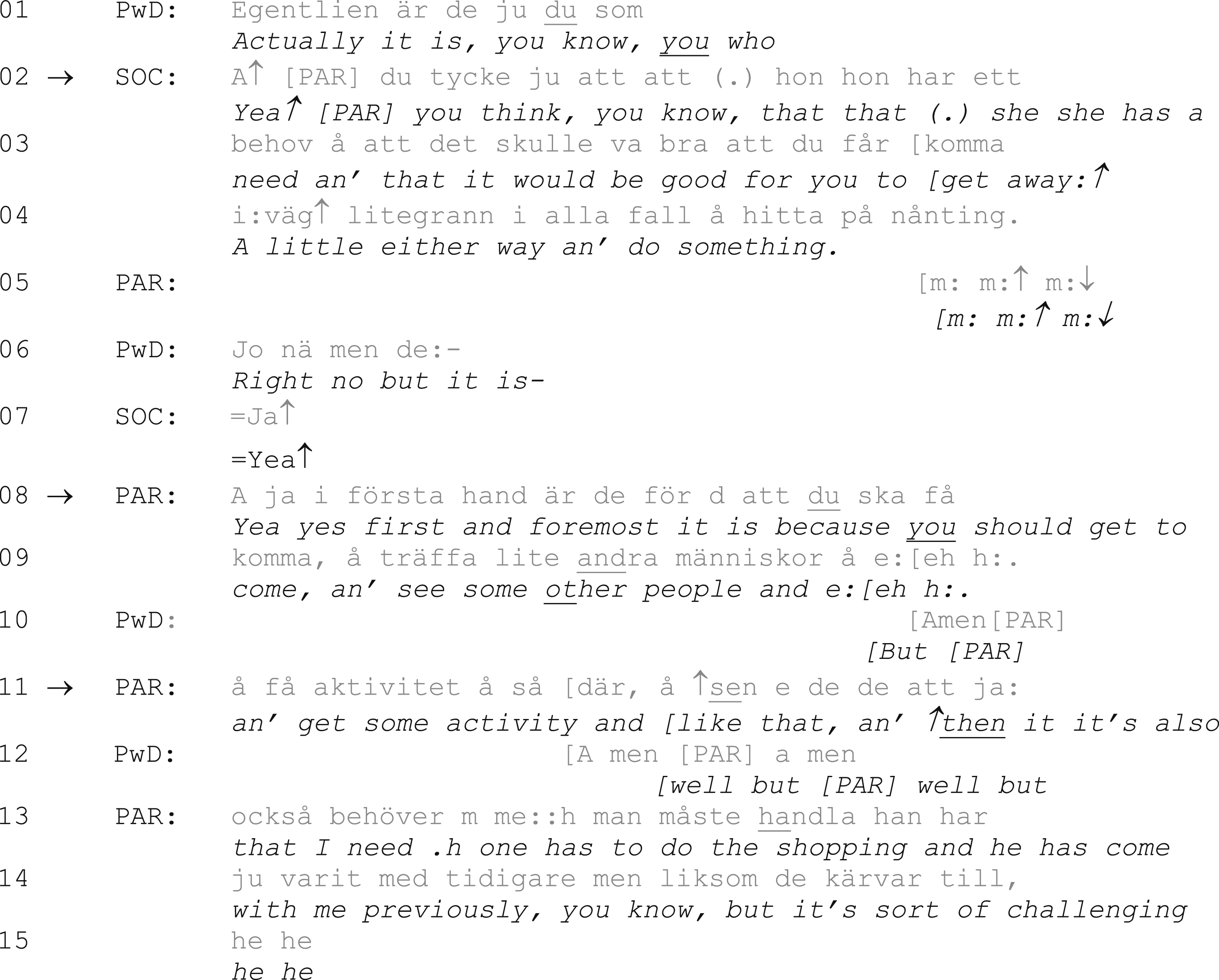
Here, the PwD takes an active position when placing the needs within the domain of his partner rather than himself. This action challenges the motivations for the offer of day care, as the needs and wishes of the PwD ought to guide the offering elder care services (Social Services Act, 2001: 453; National Board of Health and Welfare, 2020). The PwD specifically addresses his partner, emphasising ‘you’, in contrast to ‘me’, who needs something (see Bing, 1983). Here, the social worker takes speakership on the partner’s behalf, and uses the clues in the PwD’s turn regarding the needs of the partner (see Bloch and Antaki, 2022) (lines 2–4). Speaking on behalf of the partner, the social worker then reorients to the needs of the PwD by raising positive elements of the offer of visiting a day care centre, ‘good for you to get away’ (line 3). Here, the social worker expresses that both she and the partner are in favour of the day care centre, suggesting an allied front. When responding to the turn addressed to the partner, the social worker trespasses into the partner’s epistemic domain (Bristol and Rossano, 2020; Nilsson et al., 2018). Epistemic trespassing is common in intimate relationships in which the epistemic territories are less strict. In this sequence, it demonstrates a local temporary alliance between the social worker and the partner, as they have an agreement on a shared goal of framing the offer in a positive light and getting the PwD to agree to it.
Despite the practice of positive framing, the PwD expresses a non-affiliative well-prefaced objection ‘right no but’ (line 6), which is not further elaborated on as the turn gets cut off by the social worker’s positive response or continuer ‘yeah↑’ (line 7). At this point, the partner resists the position as ‘the one with needs’ suggested by the PwD and specifies that it is mainly the PwD who would benefit from seeing some other people and getting some activity (lines 8, 9 and 11). Her turn follows what was initiated by the social worker earlier, a positive framing of the activity of going to day care, where the emphasis lies on the benefits for the PwD. Although the PwD attempts to provide a diverging turn ‘but [PAR]’ (line 10), the partner manages this resistance by adding another positive element of the day care. After having presented the benefits of the offer to the PwD, the partner adds that she herself needs something, however accounting for her needs in the general framing ‘one has to do the shopping’ (line 13). The PwD repeatedly attempts to protest (lines 6, 10 and 12), however gets cut off mainly by the partner who continues to talk, not addressing the PwD’s attempts. Here, the partner manages the initiated resistance by holding the conversational floor (Humă et al., 2019, 2020).
In this extract, the PwD plays an active part in the interaction, incrementing new positions and grounds for the offer, namely the partner’ needs or wishes rather than his own. Here, the PwD offered clues for a fruitful way of getting the offer accepted (see Bloch and Antaki, 2022), where the PwD might have agreed to it out of moral obligations to care for his partner’s needs. However, the negotiated grounding of the offer receives resistance from the social worker and the partner who place the needs of the PwD first and the needs of the partner second. In their resistance to the grounds for the service expressed by the PwD, the social worker and the partner adopt the practice of enhancing positive elements of the offer in order to meet the needs of the PwD, which does not lead to the PwD accepting the offer. Both sides, the PwD on the one side and the social worker and the partner on the other, attempt to form common ground in defining the needs for the offer of elder care services. Here, it can be argued that the PwD’s project of placing the needs within the domain of the partner succeeded as both she and the social worker formulated her needs in the end, though placing them second after the PwD’s needs.
Mitigating the offer
Mitigations or downplays can be beneficial in interactions where bad news or dispreferred actions are at play (Fraser, 1980), or in offering sequences as a way of minimising the costs for agreeing (Clayman and Heritage, 2014). In the context of the present analysis, the mitigated contributions are self-serving, meaning they are used to accomplish an institutional agenda, in which the stakes or conditions are downplayed by the social worker (see Fraser, 1980; Florez-Ferrán, 2010). In the analysis of the practice of mitigating, the sequence starts with the PwD and the social worker discussing the PwD’s daily dental care, and the social worker’s offer that someone from elder care can come and help. Prior to the start of the example, the PwD had described how difficult it was for anyone to brush his teeth properly, based on experiences from his partner helping him at the time.
Ex 3: Home visit: SOC: Social worker, PwD: Person with dementia, PAR: Partner
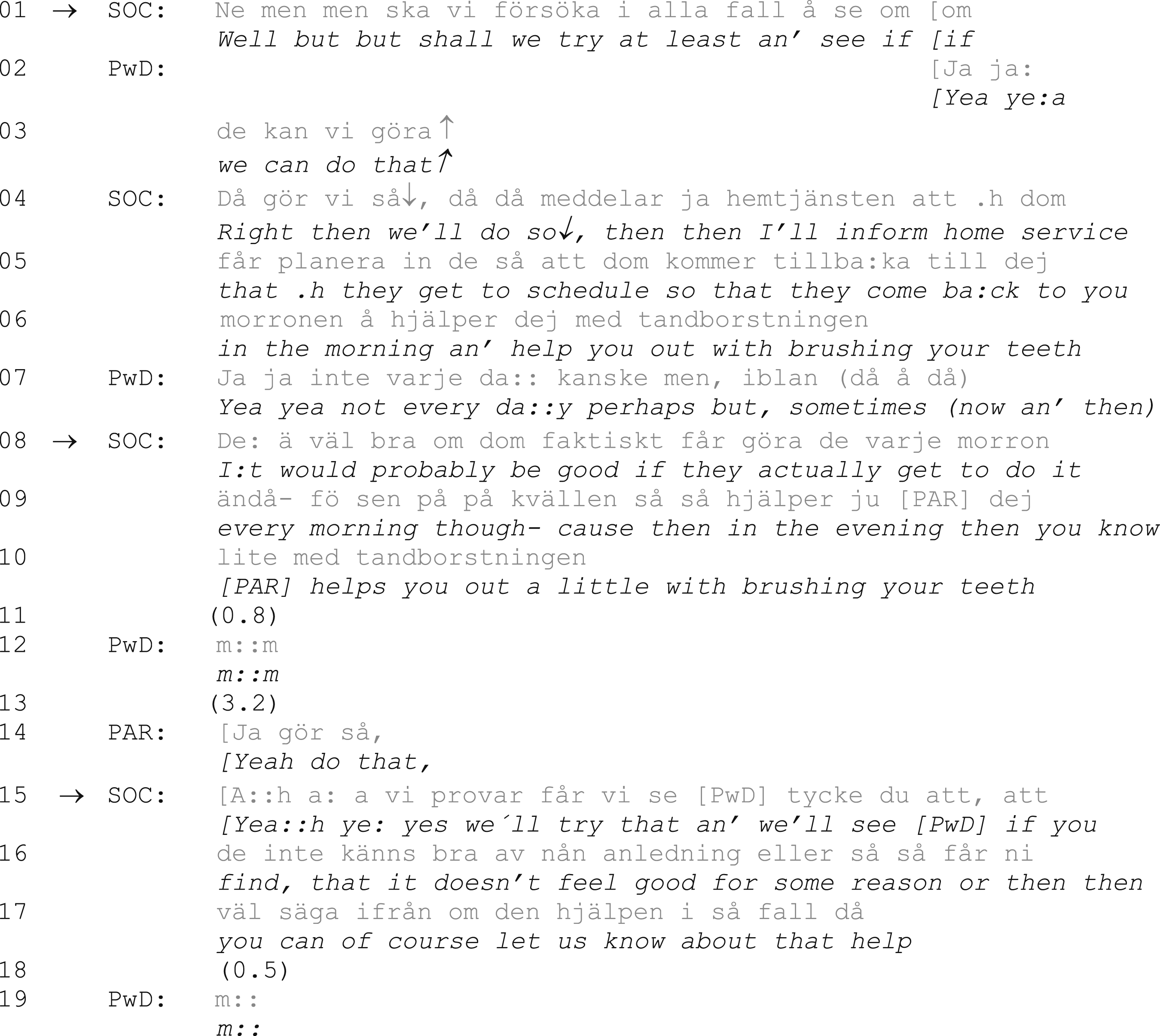
In line 1, the social worker formulates the offer of the PwD applying for help with brushing his teeth in the morning: ‘shall we try at least an’ see if’. This contribution is possibly an ‘institutional we’, that is, an action performed by the social worker in order to accomplish affiliation in line with the institutional agenda (Muntigl et al., 2020). This turn suggests low stakes for acceptance as it is offered as a ‘try’ which can be withdrawn, compared to a dedication (Humă et al., 2019). However, the phrase may also function as a way of defusing an offer for cognitively or communicatively challenged individuals (Samuelsson et al., 2014), and thereby reaching an agreement which is not based on self-determination for a PwD. The mitigated offer receives agreement on the part of the PwD, although slightly non-committal (lines 2–3), followed by the social worker’s extension of the conditions for the agreement (lines 4–6).
After hearing the details, the PwD largely agrees with the offer, but suggests adjustment regarding the frequency of the visits: ‘yeah yeah not every day perhaps but, sometimes (now and then)’ (line 7). The social worker opposes his suggestion with a mitigated counter statement: ‘it would probably be good if they actually get to do it every morning though, cause then in in the evening then then [PAR] is helping you out a little with brushing your teeth’. The epistemic hedge ‘probably’ (‘väl’ in Swedish) downplays the social worker’s epistemic and deontic status as the one who knows best and has the right to decide (see Heritage and Sefi, 1992). Moreover, she downplays the stakes and potentially threatening elements of the offer by stating that the help does not actually need to be twice a day, because his partner helps him ‘a little’ in the evening (Fraser, 1980). In addition, as part of the persuasion, the social worker uses the common ground marker ‘you know’ (‘ju’ in Swedish), which suggests an already shared view of the situation (Heinemann et al., 2011).
Despite the mitigations of the offer, it receives a delayed ‘m::m’ from the PwD (line 12), followed by a 3.2 second-long silence. This contribution could be interpreted as minimal agreement, but looking at the next turn where the partner provides an extended response, it may just as well be understood as passive or minimal resistance on the part of the PwD (Muntigl et al., 2020). Stokoe et al. (2020) suggested that, after prior resistance, the opponent can ‘change their mind’ and still maintain a positive face if the turn follows a long silence. In this example, it is the partner who fills the interactional slot after the silence and offers a positive stance to something that was initially opposed by the PwD: ‘yeah do that’ (line 14). One reason for this could be her shared stake in the matter as his partner and being part of the activity of helping him with his teeth. Her turn can also be understood as aligning with the social worker in the proposed agenda, as she accepts the partner’s response and declares her decision (‘we’ll try that’, line 15). However, the social worker involves the PwD as an addressee by using the singular pronoun ‘you’ as well as his first name ‘and we’ll see if you [PwD] find that, that it doesn’t feel good for some reason’ (line 15) and continues by explaining that he can decline the help if he wishes after having tried it out (lines 16–17). These final contributions by the social worker may be a way of accounting for the disregarding of the self-determination for the PwD. Mitigated formulations like ‘shall we give it a try’ have been identified as recurrent when pursuing an offer or agenda in institutional interaction (Muntigl et al., 2020), in this analysis the mitigations however received minimal affiliation from the PwD. On the contrary, the persuasion to accomplish agreement and balance the need of the partner with the self-determination of the PwD took several mitigating turns and interactional effort to accomplish.
Laying down conditions for the offer
In one needs assessment meeting, the activity of persuasion also involved the practice of laying down conditions for an offer, including a mild threat (see Hepburn and Potter, 2011b). Although it was rare in our collection, we argue that it is important to include here as it was preceded by all other practices for persuasion, and makes up the closing part of a meeting in which an agreement for an application for elder care service is decided on. As part of the social work agenda, self-determination ought to be guiding the process of applying for services (Dunér, 2020; Mattsson and Giertz, 2020), even when the client has a dementia diagnosis. As seen in Example 2, one way of meeting the needs and interest of the client during needs assessment meetings is to frame the service as being beneficial for the client with dementia, rather than for the partner or social worker. This poses a challenge for the interactants in Example 4, where it is expressed that both partners in the couple have needs that are somewhat different and that are managed by the social worker by laying down conditions for an offer using a conditional clause. Conditional clauses are commonly formulated as ‘if-then’ statements, implicitly paving the way for various subsequent actions, such as gaining commitment (see Beck Nielsen, 2018 on medical consultations). Here, a conditional clause is posed by the social worker towards the end of a meeting in which the PwD expresses resistance to attending a day care centre regularly, an offer made by the social worker. Hence, there is an offer on the table, but no commitment from the PwD to pursue any action (Stevanovic, 2012).
Ex 4: Home visit: SOC: Social worker, PwD: Person with dementia, PAR: Partner
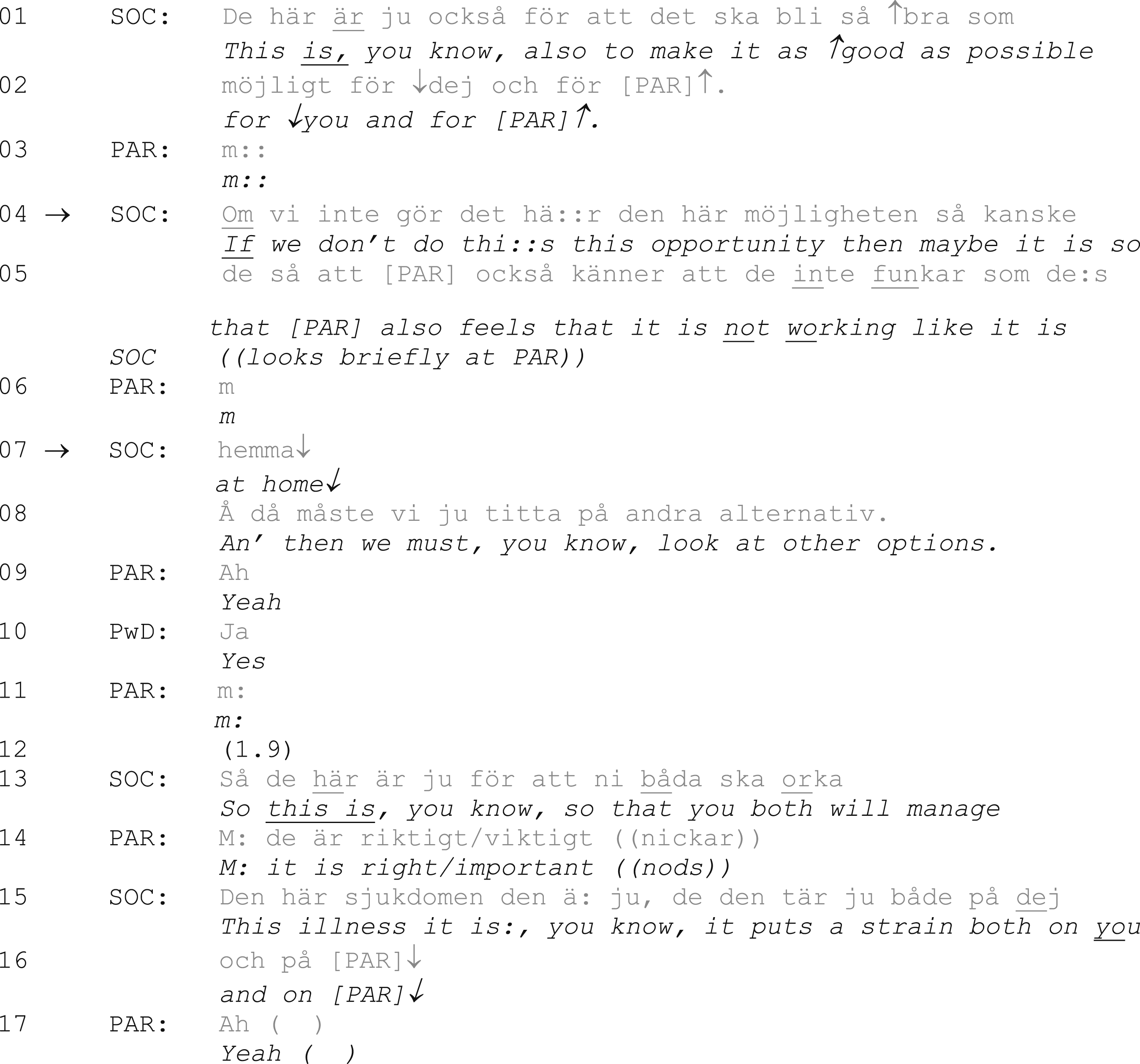
The social worker has just summarised an agreement on the services that the PwD is supposed to apply for, and the sequence starts with an account for this agreement. She uses the common ground marker ‘you know’ (‘ju’ in Swedish) when stating that this agreement is beneficial for both the PwD and his partner (line 1–2). Furthermore, the social worker formulates a conditional ‘if-then’ clause (Beck Nielsen, 2018), which involves a moral dimension to the matter as it suggests a struggle for the partner: ‘if we don’t do this this opportunity then maybe it is so that [PAR] also feels that it is not working like it is’. In her turn, the social worker invites, both verbally and via a gaze, the partner to be an ally (line 4–5) before closing with ‘at home’ (line 7). The consequences of not meeting the conditions of the offer, the ‘then’ part, are further explicated by the social worker: ‘and then we must, you know, look at other options’ (line 8). Here, the social worker initiates closure of their agreement with a condition that includes a mild threat if the PwD does not accept the offer (Hepburn and Potter, 2011b), namely indicating that she will take action and consider other social services if the PwD does not apply for the service. The contribution receives minimal affiliation, first from the partner and then from the PwD. After a silence, the social worker provides an account for making the agreement and returns to the moral dimension of the current situation putting a strain on the partner, but also on the PwD (line 13, 15–16). The contributions are met with agreement by the partner, both verbally and by nodding (line 14, 17), but no acknowledgement is given by the PwD.
When describing the couple’s situation, the social worker uses an idiomatic formulation ‘this illness, it is..’, which implies general, shared knowledge about the seriousness of the illness, something that Hepburn and Potter (2011a) also found to be common practice in institutional closures. However, they also argued that it does not always mean the end of a persuasion sequence (Hepburn and Potter, 2011a), which is partly true here as well when the PwD refrains from making a clear statement of agreement with the offer or of being convinced by the conditions or accounts.
The practice of laying down conditions touches on a core dilemma of social work, where the social worker must accomplish ‘motivating the client to make a change’, while also explaining why and what the consequences are if s/he does not comply. In Sweden as well as in English-speaking countries, there is a new informal term for this activity of motivating change with an embedded threat – ‘hotivera’ (Swe) and ‘threativate’ (Eng) – that can sometimes be more implicitly framed within the conversation (see Svensson, 2018). In interactions with children, Hepburn and Potter (2011b) found that explicit threats sometimes involved sanctions if not complying. However, in encounters with a client with dementia as in this case, the ‘threativation’ is properly embedded in an agenda of benefitting the client as the services ought to be person-centred and self-determined by the client. In this way, the social worker manages to include the needs and wishes of the partner and attempts to accomplish self-determination for the PwD; however, she receives only minimal agreement from the PwD on line 10.
Discussion
Needs assessment meetings entail challenges for social workers. They must balance maintaining the agency and self-determination of persons with dementia (Social Services Act, 2001: 453) with providing relevant support for both partners in the couple (Social Services Act, 2001: 453; National Board of Health and Welfare, 2020). This can create a contradiction and a dilemma for social workers in their practice (Cox and Pardasani, 2017), and can challenge the professional ‘social’ part of social work as some voices presenting couples’ situations and needs may be overridden (see Tolhurst and Weicht, 2018). By adopting a methodological and theoretical framework of conversation analysis, we access an inductive understanding of how social workers navigate in and manage this dilemma, that is, when partners in couples express diverging stances to an offer. In our data, this management entailed the activity of persuasion, aiming at ‘getting the client with dementia on board’ with an offer of elder care services, despite their resistance. To accomplish the persuasion, the social workers adopted the following conversational practices: ‘providing information about the offer’, ‘positive framing of the offer’, ‘mitigating the offer’ and ‘laying down conditions for the offer’. The persuasion sequences showed how social workers balance the empowering of agency of clients with dementia by providing information, and express empathy for the person’s opinions, and at the same time adjust the conversation through gradual dismantling of the person with dementia’s resistance to the offer of elder care services. When doing so, the social workers combine meeting the needs of the client with dementia with meeting the needs of the partner. By identifying the different practices of the persuasion activity, we demonstrate the fine-grained work that social workers perform when they encounter diverging stances in couples and contradictory directions from legislation and local guidelines for needs assessment practice, commonly found in different social work contexts. In our study, we have shown that social workers use persuasion to navigate through expressed resistance to services which they may consider to be helpful for the couple. Against this backdrop, ‘subtle persuasion’ to get a client ‘on board’ (Suoninen and Jokinen, 2005) appears to be justified in some cases, especially in relation to assessing both partners’ need for support in relation to the legislation.
Persuasion is a developing field of conversational analytic research on different institutional encounters (see Bloch and Antaki, 2022; Muntigl, 2013; Muntigl et al., 2020; Hepburn and Potter, 2011a; Humă et al., 2019, 2020; Heritage and Sefi, 1992; Suoninen and Jokinen, 2005; Stokoe et al., 2020). The present paper adds to this corpus of research by showing similar findings in relation to institutional formulations, as well as by specifically relating them to pursuing a particular institutional agenda within needs assessment processes of elder care services. Throughout the data, we found that social workers adopted a persuasive conduct (Humă et al., 2019, 2020). They provided positive feedback and continuers when aligning with the agenda (Suoninen and Jokinen, 2005), and provided mitigations and positive framing of offers when anticipating or experiencing resistance from the PwDs. Moreover, in these multiparty interactions involving also partners of PwDs, it was evident that local alliances with the partners were made (see Muntigl, 2013; Pino et al., 2021), both in the actual needs assessment meeting as well as prior to the meeting. In the total dataset, there are also interactions in which the PwD is excluded, and these interactions with partners recurrently include talk of ‘how to get him/her on board’ and apply for a specific service. In the data analysed here, we also have expressions like ‘me and [partner] talked earlier’, demonstrating that these meetings are often preceded by meetings in which the PwD is excluded. The analysis in this paper also shows similarities with previous research in that offers sometimes are embedded in talk, indicating that an agreement is already in place. This was recurrent in examples where the social worker in detail provides information about the terms and procedure of executing the service, which may in turn cause challenges for PwDs who sometimes have difficulties with abstract talk (Marcusson et al., 2011). PwDs therefore must manage the accomplishment of resisting to something which to them may appear to be already agreed on.
In the analysis, we have shown how social workers and sometimes partners adopt practices for persuasion. Despite the persuasion, the analysis present little evidence for PwDs changing their stances to the offered service. Based on this, the issue of the effectiveness of persuasion in these meetings may be raised. Also, throughout the analysis, PwDs constantly provide resistance to the offered services, but there are no examples of a PwD influencing the outcome in the sense ‘no application for the offered service is pursued’. However, their resistance leads to lengthy persuasion sequences of getting to a closure and can in turn have practical implications which potentially affect all participants in different ways. For the PwD, their resistance may lead to a sense of upholding agency and self-determination, but also potentially a lack of this when experiencing the outcome. Put frankly, persuasion may also exhaust a client with dementia who therefore, even if minimally, express something which can be inferred as an agreement in the end. For partners, lengthy sequences involving practices for persuasion which they themselves contribute to may challenge their sense of being a ‘good partner’ or being honest with their partner with dementia. However, they may gain some service, which will be of benefit for them. Lastly, for the social workers the activity of persuasion may be straining in the sense that they potentially overrule the regulations and guidelines for their work. The time they spend with each client and their partner in the needs assessment meeting may be longer than preferred and may result in more administrative work in terms of documenting the meeting and formulating motivations for their decision. However, from the perspective of the social workers, persuasion can contribute to the inclusion of the voices of all interactants, and a more nuanced discussion of different needs before pursuing the agenda they find beneficial for the clients (in this case both the PwD and the partner).
This study also adds to the field of research on persuasion involving atypical interaction within an institutional context in two ways. First, we have demonstrated how social workers balance a gentle approach towards resistance by using mitigated formulations in relation to an offer while also challenging the resistance and pursue the offer. These practices are characterising for an institutional agenda, but this type of interactional design may also relate specifically to dementia. Social workers within elder care must consider the symptoms of dementia in the conversation, where silences might sometimes be an expression of resistance, but could also indicate slower cognitive processing of or lack of understanding of the information (see Marcusson et al., 2011). Also, minimal agreement to an offer could very well be an intended clear agreement to an offer within interaction involving people with dementia, as their turns are often short, less frequent and co-interactants are often chosen as their spokesperson (see Nilsson et al., 2018; Österholm and Samuelsson, 2015). Second, we show how PwDs can express agency and competence (see Nilsson, 2022) when responding to persuasion practices, both with passive and active resistance by means of different interactional resources. The analysis demonstrates how a PwD in his resistance negotiates the grounds of the offer and thereby provides clues for a possible solution to reach agreement (see example 2). Here, the social worker could have made use of the clues, spoken openly about the partner’s stressful situation and facilitated the agreement with support from legislation to support the partner ’s needs rather than the PwD’s.
The conversation analytical debate on persuasion highlights that persuasion can be delicate in relation to how management of resistance is handled (Humă et al., 2019; ; Stevanovic, 2012; Stivers and Timmermans, 2020). Our findings are in line with this as the social workers mobilised conversational resources in the persuasion to present an offer in a positive frame, manage resistance and encourage both parties in the couple to agree despite initially diverging stances. Stokoe et al. (2020) found that resistance which was followed by silence, could provide an opportunity for a person to change their mind while saving face. In our study however, the PwD stayed silent after expressing resistance, but it was the partner who then took speakership and proposed a course of action for the social worker and accepted the offer on behalf of him (see example 3). However, the example provides no evidence that the PwD changed his stance to the offer, rather his minimal agreements are interpreted as continued resistance. Both the partner’s proposing of a course of action to apply for a service as well as the preceding silence could possibly be interpreted as attempts to make the PwD change stance regarding the service, or ‘give in’. For PwDs, it may be specifically challenging to pursue further resistance over several turns, both interactionally and cognitively (Nicholson et al., 2021), which may be the case in example 3 as the PwD stops resisting. However, the allowance for silence in interaction involving PwDs are often a used as a way of allowing time for the PwD to process information and turns by PwDs were recurrently preceded by silences throughout this dataset. Despite this, based on the interaction in example 3 in which the social worker accepts the response of the partner rather than giving more time to the PwD, it is less likely to be the case here.
The persuasion sequences also actualise moral aspects of vulnerability connected to social work practice involving people living with dementia, as it comes with cognitive and linguistic challenges. Common communicative symptoms concern orientation in conversation and keeping track of the topic (Marcusson et al., 2011), which in the present analysis may result in an alignment or affiliation on the part of a PwD, when in fact s/he has lost track of the topic. Part of engaging in persuasive conduct is to design utterances in ways that constrain the possible responses of a recipient, regarding either preference design, encouraging a certain direction, or implicit presuppositions about an agreement being reached (Humă et al., 2019, 2020; Suoninen and Jokinen, 2005; Stokoe et al., 2020). These turn designs mean more interactional labour for the recipient, here the PwD, in the form of producing an appropriate but also relevant response based on their stance. This makes resisting more difficult. Therefore, non-affiliation, and passive or outright resistance on the part of the PwD ought to be considered in light of the extra interactional labour it requires that everyone puts in, particularly persons with cognitive disabilities (see Nicholson et al., 2021). If social workers are to ensure self-determination among clients with dementia, it may be worth considering more neutral conduct and turn designs when discussing and offering elder care services. In our data, this approach was more current in the needs assessment meetings involving couples living non-cognitive related challenges.
It was evident in our study that when the social workers compromised with the principle of self-determination, it was to provide support for a caring partner. So, when social workers at times fail to sufficiently consider the self-determination of the PwD, they may have succeeded in the project of offering and providing needed indirect support and relief for the partner of the PwD, which in turn ought to affect the well-being of the PwD and the couple as a unit. Despite this, what is referred to here as ‘laying down the conditions’, and even ‘threativation’, stands in stark contrast to the Swedish principle of self-determination and not initiate an application for a service against someone’s own will (Mattsson and Geirtz, 2020). Perhaps the ‘threativation’ could have been avoidable had a more transparent approach been adopted, in which the conditions for the offer were presented prior to the persuasion sequence rather than towards the end of it. In this way, opportunities to take part in the decision and maintain one’s self-determination might increase. On the other hand, it might also appear threatening to have the conditions explicated without embeddedness in a longer discussion and investigation into the couples’ situation.
Managing needs assessments among couples living with dementia poses specific challenges. As partners in couples often share a biography, their stories and views tend to be intertwined, and they enter each other’s epistemic spaces by speaking on each other’s behalf (Landmark et al., 2021; Nilsson et al., 2018). How social workers manage to ensure self-determination for a client with dementia and decide when an application for a service is received during a needs assessment meeting could be related to the impact of the proposal on the couple’s lives. In some cases, the social worker and the partner form an alliance (see Muntigl, 2013) in which the voice of the partner is given precedence over that of the PwD (see Österholm and Samuelsson, 2015). In these cases, minimal agreement from the PwD may be sufficient for progressing with the application for a service. In cases of services that entail a disruption of their living situation, for instance, extended persuasion sequences are needed to ensure that acceptance of the offer is expressed. This issue requires further conversation analytic research on needs assessment practices, focussing on the content of an offer in relation to the sequential unfolding of the persuasion activity.
To sum up, the persuasion sequences analysed here potentially occur due to the contradictory regulations that are inherent in the Swedish Social Services Act (2001: 453). The act states that older persons with dementia have the right to self-determination and that relatives’ need for support should be considered. These two directives must be managed by the social workers in encounters with couples living with dementia. Specifically, it is relevant in those institutional practices where self-determination for clients is promoted, but at the same time clients are encouraged to walk the path the social worker considers most beneficial for them. Conversation analysis proved beneficial in generating knowledge about how this core challenge within needs assessment practice in elder care is managed – knowledge that might otherwise not have been visible. The results of the present study therefore constitute an important contribution to the understanding of social work practice with older couples living with dementia.
Footnotes
Acknowledgements
First and foremost, we would like to express our gratitude to the social workers and couples who participated in the research. We are also grateful for the thorough reading and insightful comments by the two anonymous reviewers as well as the editors of this special issue. We have also presented drafts of this paper and received useful comments by colleagues at the Department of Sociology at Uppsala University, as well as colleagues at the Centre for Dementia Studies (CEDER) at Linköping University - thank you!
Declaration of Conflicting Interests
The author(s) declared no potential conflicts of interest with respect to the research, authorship, and/or publication of this article.
Funding
The author(s) disclosed receipt of the following financial support for the research, authorship, and/or publication of this article: This work was supported by the Forskningsrådet om Hälsa, Arbetsliv och Välfärd [2019-01069].
