




Abstract
Responding to the Special Issue call by the Qualitative Social Work: Research and Practice Journal, this article reflects on the challenges faced by a Social Work doctoral student at the University of Edinburgh (Scotland) during the Covid-19 outbreak. Having already commenced their fieldwork through a series of Freirean-style dialogical interviews via Biographical Narrative Interpretive Method (B.I.N.M.), the nationwide-lockdown demanded a drastic deviation from the intended in-person face-to-face interviews with lone parent participants. Significant academic consideration had already been given to the researcher’s existing academic, professional, and social relationships to north and northwest Edinburgh - the geographical focus within the study - via a process of reflexivity prior to commencing the interviews, yet the shift from discussions in neutral venues (e.g. community centres and public cafes) to dialogues conducted exclusively via digital platforms brought about a radical shift in interpersonal dynamics as both researcher and participant were exposed to each other’s homes, families, and other aspects of domestic life. The change in circumstances bore major implications not only for participant recruitment, but also created an unexpected intimacy within the interviewer-interviewee relationships.
Introduction
Produced for the Special Issue of the Qualitative Social Work: Research and Practice Journal, this article, written by a doctoral student at the University of Edinburgh (Scotland), offers insight into contemporary fieldwork research experiences during the Covid-19 outbreak. Having already commenced the fieldwork stage of their Ph.D. Social Work investigation into the experiences of lone parent families residing in the north and northwestern regions of the Scottish capital during the decade of Conservative-led austerity (see e.g. Emejulu and Bassel, 2017; Patrick, 2017; Women’s Budget Group, 2018), the author had completed only one-third of the intended interviews when the first nation-wide lockdowns were implemented by the Scottish and U.K. governments (2020) in mid-March 2020. The subsequent closure of many community-based institutes through which recruitment had been intended to take place represented a significant challenge to completing the investigation and, indeed, prevented access to the intended interview spaces. This article, therefore, reflects on the shift in recruitment approach and interview process from in-person face-to-face dialogues to engaging in exclusively digital spaces, detailing the impact this had on the interactions and relationships established between the researcher and the research participants.
Researcher positionality and reflexivity
A second year doctoral student at the University of Edinburgh - though also an Associate Tutor (Community Development) at the University of Glasgow and an Associate Lecturer (Community Education) with the University of the West of Scotland - the author’s research is funded through the Macqueen Scholarship which facilitates investigations designed to benefit lone parent families in Scotland (University of Edinburgh, 2020). With a decade of community-based practice, seven years of those spent in north Edinburgh at organisations supporting social inclusion via anti-racist practice (see e.g. Campbell and Hay, 2018a; Campbell and Hay, 2018b; Campbell, 2019a), queer rights, adult education, and social activist movements (Campbell, 2019b, Forthcoming A), the author’s relationships to local residents required significant consideration to contextualise the research. The broader doctoral thesis, thus, contains a dedicated section addressing concerns around assumption, nostalgia, or proximity bias as a result of historical experience of the area and its local communities (Breen, 2007; Bonner and Tolhurst, 2002; DeLyser, 2001; D’Cruz et al., 2007), however the brevity of submissions for this Special Issue limits capacity to include such depth in biographical and autobiographical reflection. Consequently, the focus of the article specifically addresses the impact of Covid-19 on the Ph.D. Social Work investigation and the relationships between researcher and interviewees.
The intended research methodology
Ahead of commencing the their fieldwork, the author had established a dialogically-driven research method, influenced by the discursive co-learning spaces advocated by the late Brazilian educator Paulo Freire (see e.g. Freire, 1972; Ledwith, 2005) - one that fosters a space for participants to connect their lives to political and social phenomena, articulating it on their own terms rather than through imposed-questions. Centred on a desire to understand and value the experiences of the lone parent research participants, a conversational and thematic approach based primarily on the Biographical Interpretive Narrative Methods (B.I.N.M.) described by Ross and Moore (2016) was employed, whereby the researcher aims to ‘elicit and interpret narratives for qualitative analysis and evaluation; to excavate historically situated subjectivity; and to compare “the lived life” and the “told story” by focusing on discrepancies between self-understanding and behaviour’. This was further influenced by techniques within oral and narrative histories (see e.g. Portelli, 2001; Tonkin, 1992). During interviews, the author offered an initial discussion point of ‘Talk me, please, about your experience of becoming and being a lone parent …’, from which the participant could take the conversation down any avenue they wished. In-keeping with the B.I.N.M. guidance offered by Ross and Moore (2016), minimal interruptions occurred meaning that, albeit with occasional prompts and either orally or via physically embodied affirmation, the interviewee was able to describe their lived experience as they wished and in their own terms. Though three further themes were intended (concerning emergent social and support networks; reflections on the meanings of lone parenthood; and on the impact this position has had on their personal politics or activism), direct questions were only offered towards the end of the discussion if the topics had not already been broached organically or for clarity is a particular organisation or person was named by the participant.
Impact on participant recruitment
Although the recruitment phase of the author’s research was already underway before implementation of lockdown guidelines, the closure of many institutions (e.g. schools, nurseries, and youth clubs) and the strict regulation of entry into other spaces (such as medical centres, supermarkets, and local libraries) threatened to limit opportunities to identify would-be participants. Indeed, intended recruitment techniques such as ‘backpacking it home’, an approach advocated by Black Lives Matter (U.S.) activist DeRay McKesson (2019) - the movement itself co-created by, among others, Patrisse Khan-Cullors, Alicia Garza, and Opal Tometi - whereby sending a letter home through the schools may allow parents (lone parents for the purposes of this investigation) who might not engage with known local services to receive the invitation to participate could no longer happen.
Partially the result of several years worth of lived, professional, activist, and academic experiences in north Edinburgh, the researcher produced a three-part diagram to indicate his professional and potentially emotional distance from each participant, therein helping to address concerns of bias as a result of sustained proximity and pre-existing relationships. As illustrated through Figure 1, the researcher was placed at the centre of the smallest circle, with three stages of separation indicating (i) Known: those already known to some extent via one of the form aforementioned identities the author holds in relation to north Edinburgh; (ii) Referrals: those who were referred via professional, personal, or academic relationships but where the individual was not already directly known; and (iii) Unknowns: those with whom no direct relationship was held. Figure 2 demonstrates the results of how each interviewee was situated in regards to the Ph.D. student. Despite fears that access to would-be participants who were unknown to the research pre-investigation may become increasingly limited due to the reduction of opportunities to recruit folk via in-person attendance at community groups, the diagram demonstrates that the majority of, particular latter stage, interviewees were still identified from outwith the Known and Referral groups.
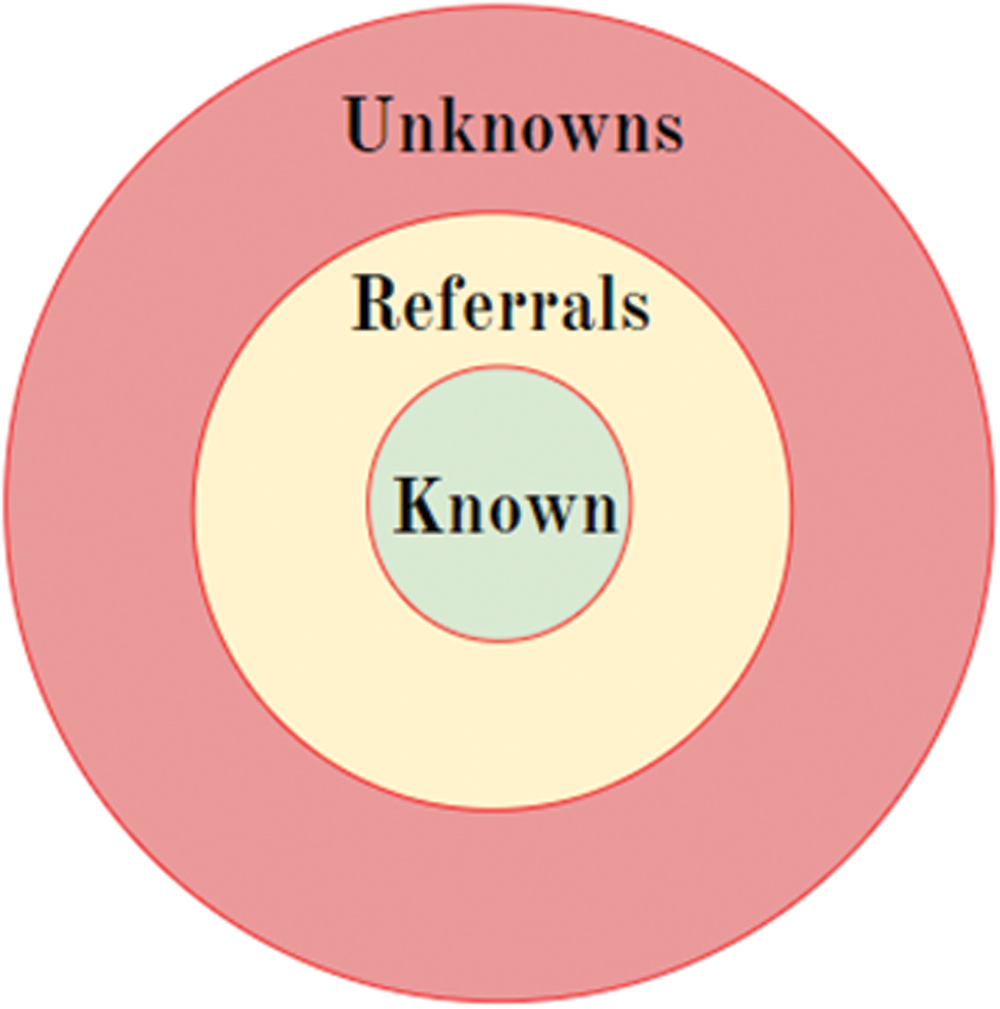
Colour-coded model demonstrating the proximity between the researched and each participant. (This figure is available in colour in online)
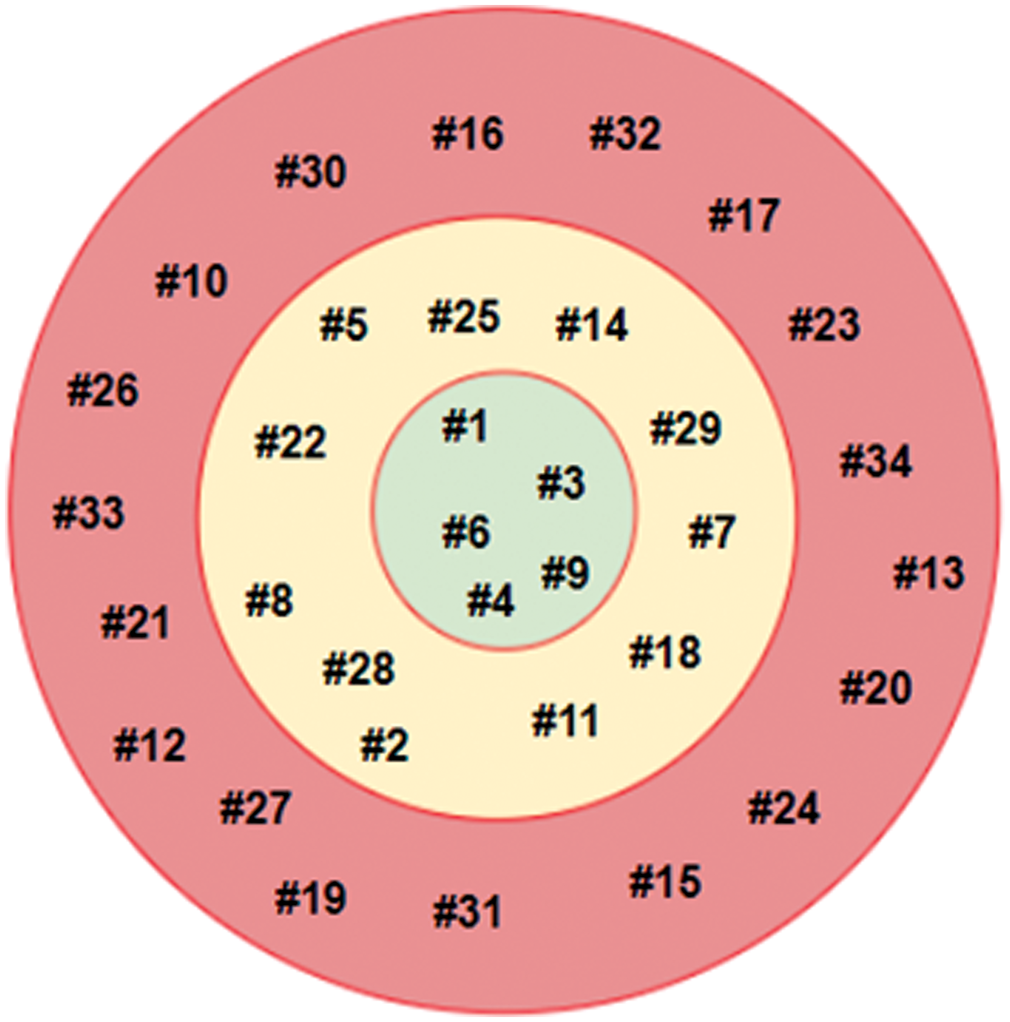
Participants charted by their proximity to the researcher. (This figure is available in colour in online)
The need to strictly adhere to healthcare and community safety guidelines during the Covid-19 pandemic meant approaches had to be made through social media channels where lone parents may be present. This largely meant recruitment occurred through advertising in relevant Facebook Groups - always posting only after permission had been gained from community leaders and administrators (often termed ‘gatekeepers’ by those in the academy). Identified groups included spaces designed for lone parents in Edinburgh, several Facebook Groups specifically created for residents in the north of the city, and two groups for queer parents. Additional approaches, met with mixed levels of success, were made to spaces catering for parents living with disabilities in Scotland and a variety of groups for those in Edinburgh with a migrant background where members may not have been involved in ‘mainstreamed’ parenting groups hosted on Facebook for a variety of personal, cultural, or institutional reasons.
A change in dynamics
Several months were spent formulating a comprehensive plan to ensure would-be participants felt comfortable in an interview space, and that the environment (including time, setting, and location) would be understanding of the circumstances lone parents may experience in relation to childcare, work, education, and other commitments. Though early interviews had taken place in community centres (participants #1 Nick and #2 Lawrence), public cafes (participant #9 Louise), and in the interviewee’s workplace after hours (participants #3 Lilly and #6 Griff), the interviews involving participants #10 - #34 took place online utilising either video or audio facilities on WhatsApp, Facebook Messenger, or phone calls with the discussion recorded (once consent had been gained) on a dictaphone. The intended approach of conducting the interviews in neutral venues was designed to avoid confusion or blurring the distinctions between neighbour, practitioner, and academic researcher, whilst also supporting local businesses by purchasing coffee for both the participant and the researcher when utilising these local facilities. Fortunately, the original ethical approval application had included opportunities for would-be participants to express a preference for over-the-one interviews where this was preferred over in-person discussions, and consequently no adaptations were required from an ethical perspective.
The shift to utilising video technology drastically altered the interview dynamic as both the researcher and the interviewee now found themselves presented, at least partially, with the other’s home, bringing with it (or perhaps risking) exposure to their family members, home decor, and often amusing interruptions from pets (mostly on the researcher’s end). So too, however, it brought additional research challenges, of which the physical distance was perhaps the most significant. When participant #4 Lachlan broke down momentarily at the commencement of his in-person interview due to the nature of his ‘pathway to lone parenthood’, it was possible for the researcher to bring him a tissue from the interviewee’s kitchen; however when participant ##25 Aiden needed to interrupt the interview to compose themself, it was still easy enough for the researcher to give them a moment alone by pausing the recording. Although it was possible for embodied sympathy to be conveyed through the digital mediums when video technology was the preferred medium, the physical distance seemed to extend into the emotional. This was emphasised by two instances in which participants requested audio-only interviews during which moments of silence and attempts to offer emotional space may just as easily have been misunderstood as merely waiting for the participant to resume talking, or worse concern that the phone call had been cut off. Though there is certainly further consideration to be given to the impact of bearing witness to each other’s appearance and the impact this has (e.g. perceived professional dress, tattoos, piercings, etc.) in-person or over video, the primary conclusions here must acknowledge the struggle to comfort participants at a distance (either visually or audibly).
As is often the case with such research projects, those that deserve the most thanks for their time and candour are the anonymised participants. Without their honesty and willingness to engage in what is, for many, an emotionally demanding topic (Dickson-Swift, 2008; Gray, 2008; Lee and Renzetti, 1990), this research paper, it’s insights, and indeed the larger investigation would not be possible. Whilst the opportunity to engage with the research participants is something the author will forever be grateful for, it remains a regret that the original intention of recruitment activity such as hand delivering several hundred recruitment flyers to flats in north Edinburgh could not take place due to the Scottish Government issued guidelines around maintaining physical distance from others so as to prevent spread of Covid-19. This is significant as the Addressing Poverty with Lived Experience Collective (2020, citing O.N.S., 2020) advised that “‘in 2018 there were still 5.3 million adults in the UK, of 10.0% of the adult UK population” who are non-internet users’. Consequently, with the exception of two participants (#24 Pria and #11 Mercy), those residing in north Edinburgh without digital literacy or access to the appropriate hardware (or without a friend or relative involved in one of these Facebook Groups) could not be reached for the purposes of this study (see e.g. Ravensbergen and VanderPlaat, 2010). It is hoped that a future investigation post-Ph.D. may be able to address this unfortunate impasse.
Conclusions
What has become obvious through these online dialogues is that witnessing each other's homes and unintentionally encountering members of their family, created an unintended intimacy between the researcher and the participants. These discussions no longer exclusively involved the narration offered by the interviewee, but several respondents likened the space offered by the B.I.N.M. and dialogically informed approach to a counselling session (participants #21 Edina, #26 Kim, and #32 Nicky) whilst others stated that they welcomed the opportunity to converse with another adult due to the social isolation they endured as a result of the earliest stages of the Covid-19 outbreak and the imposed lockdown. In addition, though a wealth of accommodations were intended to permit the research interviews to take place at any time of day which best suited participants (generally when their children were still at school or at after-school clubs), the pandemic resulted in an unexpected range of responses with the plan of controlling the researcher’s identities as an academic, activist, and local resident no longer under their control due to the home environment setting. Unexpectedly, in several instances, the lone parent participants encouraged their children to wave to the camera and occasionally - such as with participants #18 Carol and #21 Edina - who actually encouraged their child to tell the researcher about their experiences of having only one parent or indeed multiple families. One particularly joyous moment occurred when a young boy, at his mother’s prompting, nervously showed his painted red nails to the camera, only for the researcher to display his varnished black nails into the camera bringing a massive smile to the child’s face. With the early interviews (participants #1
Footnotes
Declaration of conflicting interests
The author(s) declared no potential conflicts of interest with respect to the research, authorship, and/or publication of this article.
Funding
The author(s) received no financial support for the research, authorship, and/or publication of this article.
