




Abstract
This paper analyses social workers’ moral agency in addressing child abuse and neglect. We argue that ethically sound social work requires the capacity to exercise strong, multidimensional moral agency. The contribution is based on a qualitative interpretative meta-synthesis of four studies representing different forms of child abuse and neglect in varied contexts. Drawing on our analysis, we identify three thematic categories of moral considerations in terms of social workers’ moral work in addressing child abuse and neglect: genders and generations, agencies and responsibilities, and families and communities. We then proceed to posit four dimensions of moral work in child and family social work – individual; cultural and communal; societal and political; and global – and argue that if they are to exercise strong moral agency, social workers must negotiate these intersecting contextual dimensions. Recognising the salience of these dimensions, how they increasingly intersect, and what this demands of social workers is necessary for the profession. Social workers must embrace individually sensitive, culturally translative, politically engaged and globally aware moral agency. This is crucial in elaborating context-sensitive practice that critically engages with moral complexities when working with individuals, families and communities.
Keywords
Introduction
This paper focuses on social workers’ moral agency in relation to child abuse and neglect. Social work is essentially moral work, an aspect of it requiring practitioners to articulate and exercise moral agency in work with children and families, where rights, responsibilities and duties are continuously evaluated (Broadhurst, 2012). For example, the best interest of the child is a crucial moral consideration, but it is a complex concept to apply in assessing individual situations (Berrick, 2017). We approach child abuse and neglect as a contextual phenomenon with definitions and responses being products of cultural, social and historical contexts, and one that impacts not only the people who experience it but also the family and the community to which they belong (DeLong Hamilton and Bundy-Fazioli, 2013).
The paper brings to light different moral considerations when addressing child abuse and neglect. The purpose is to explore what social workers do when they do moral work. We ask: (i) What are central themes of moral considerations associated with cases of child abuse and neglect and (ii) what are salient dimensions of the framework that informs moral work? These then allow us to conceptualise the forms of moral agency that social workers are called upon to exercise when responding to child abuse and neglect. Child abuse and neglect are widely researched areas, but we aim to present new insights that inform context-sensitive child and family social work.
Our focus – moral work – derives from the theorisations of Bauman (1993, 2000). Morality defines the value of action and determines what is good or bad and right or wrong. Individual morality is present in situations where social work interventions are needed, whereas social morality is constructed in social work practices and institutional environments (Bauman, 1993, 2000; Broadhurst, 2012). According to Bauman (2000), social workers’ agency as moral beings becomes visible when they take responsibility for the Other – victims and perpetrators in the case of child abuse and neglect. Although we use the term ‘moral’, our ideas draw upon Bank’s (2016) concept of ‘ethics work’ that places dilemmas and decisions in broader social, political and cultural contexts and sees responsibility in a wider and more relational sense. Drawing upon Hochschild’s (1983) concept of ‘emotion work’, Banks (2009) argues that ethics work involves emotion work, but has the added dimensions of moral considerations:
moral perception or attentiveness to the salient moral features of situations; recognition of the political context of practice and the practitioner’s own professional power (reflexivity) and the moral struggle to be a good practitioner/maintaining personal and professional integrity while carrying out the requirements of the agency role. (p. 62)
Challenges of moral work are connected to complex ethical values that Banks (2012a: 60) has categorised into three clusters:
Respect for the dignity and worth of all human beings: the obligation to respect each human being as an individual, treat all people as equally valuable and with respect and promote the human rights of individuals and groups to self-determination (particularly users of social worker services). Promotion of welfare or well-being: the obligation to bring about benefits for service users and for society more generally, balancing benefits against risks of harm. Promotion of social justice: the obligation to remove damaging inequalities between people and groups and promote the fair distribution of goods and services among people and groups.
Although these are clear as written, moral work is needed in realising them, because values may conflict and situations are shaped by competing ideas that force child and family social workers to make choices that are both contested and contentious (Berrick, 2017). As Bauman (1993) states, practices cannot rely on distinct divisions of good and evil. Accordingly, we view the exercise of moral agency as a dialogical process that proceeds in multidimensional encounters intertwined with power relations. Moral agency grasps the interplay of histories, cultures and languages, and stresses the existence of multiple possibilities and actions as contextual and situational factors that become visible in social relations. We emphasise how ideas taken as ‘truths’ lead to and justify how we address child abuse and neglect (Witkin, 2017).
Previous research has highlighted the multidimensionality of moral considerations within the interventions when responding to child abuse and neglect. The complexity calls for moral reasoning (Keddell, 2011), in which legal rights and ‘normality’ are challenged by individuals’ moral rights, children’s in particular (Forsberg and Pösö, 2008). Practice requires social workers to make moral decisions, in a process which entails deliberation, the decision itself and the consequent action (Keinemans and Kanne, 2013). Preceding this is a moral judgement, which can be defined as the evaluation of a situation. Raising concerns of child abuse can trigger moral panic, where social reactions may be charged with tensions stemming from ideological struggles over the signs of child abuse. These reactions may play a part in how social workers proceed with moral work (Cree et al., 2016). While the processes comprising moral work have been conceptualised, the moral considerations that figure in child abuse and neglect are so substantively complex that they remain intractable.
Additionally, previous research shows how moral work is challenged by different contextual factors, like the impacts of neoliberal politics and globalisation (Featherstone et al., 2018). Neoliberalism has led to economic austerity in public services, with resource constraints potentially leading to moral distress as social workers are forced to compromise their professional integrity (Weinberg, 2016). Additionally, the needs of service users are often determined in public discussions through moral conservatism. The ideology of the risk society and the consequent moral and strategic shift in governing the causes of social problems define who is eligible to be helped and who is not (Stanford, 2008).
Globalisation has created new inequalities and marginalised voices that emerge in current practices and require moral agency, that is, moral sensibility and responsibility on the part of social workers (Broadhurst, 2012). Different ways of living and new forms of social problems are increasingly interconnected and influence social work practices, for example via transnational movements of people (Johansson, 2011). The more multi-valued the society we live in, the more important it is that social workers are able to consciously reflect on the effects that moral judgements have on abused and neglected children, their families, the community and co-workers. The rise of neoliberalism, demographic and societal changes call for new knowledge(s) on child protection practices. By exploring the multidimensionality of moral agency in child and family social work, we respond to this call (Broadhurst, 2012; Keinemans and Kanne, 2013). In Figure 1, we have illustrated how we frame the fields of moral agency based on previous research.
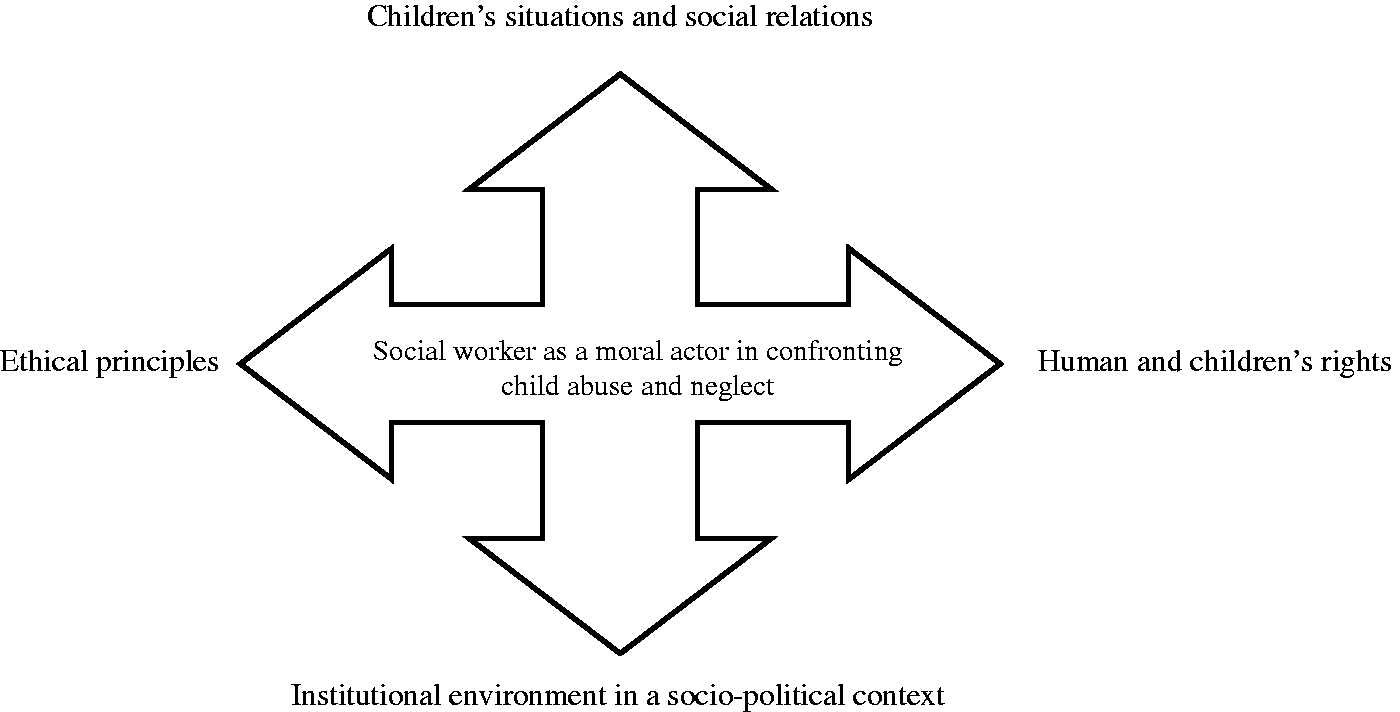
Fields of moral agency.
In the sections below, we first present a meta-synthesis of the four qualitative studies that underpin this paper. We then go on to identify three thematic categories of moral considerations in the cases of child abuse and neglect and four dimensions of moral work in child and family social work. Finally, we point out that strong, multidimensional moral agency among social workers could be realised best when the professional is individually sensitive, culturally translative, politically engaging and globally aware.
Method
Qualitative interpretative meta-synthesis
Our research applies the qualitative interpretative meta-synthesis model (QIMS) of Aguirre and Bolton (2013), developed for social work from nursing research (Zimmer, 2006). QIMS can be conceptualised as a means to synthesise a group of studies on a related topic into an enhanced understanding of the subject of study. In this process, the position of each individual study is changed from an individual pocket of knowledge of a phenomenon into part of a web of knowledge about the topic. (Aguirre and Bolton, 2013: 329)
Selection of studies
We used the combination of purposive and theoretical sampling as is usual for the QIMS (Aguirre and Bolton, 2013). The final sample is often small, for example, five studies out of 564 (Aguirre and Bolton, 2013) and nine out of 1227 (Nordberg et al., 2016). QIMS utilises researchers’ expertise widely, as in previous examples the authors have included their own work. Inspired by them, we decided to focus on our own works and included four studies reported as four original research articles and two reviewed monographs. The including criteria was that they focus on different forms of child abuse and neglect, include the description of moral tensions or considerations, and are conducted in various cultural, communal and societal contexts with different theoretical and methodological commitments. We find that the differences are complementary and they bring forth the multidimensionality of moral work (see Table 1).
The studies and tensions of moral considerations.
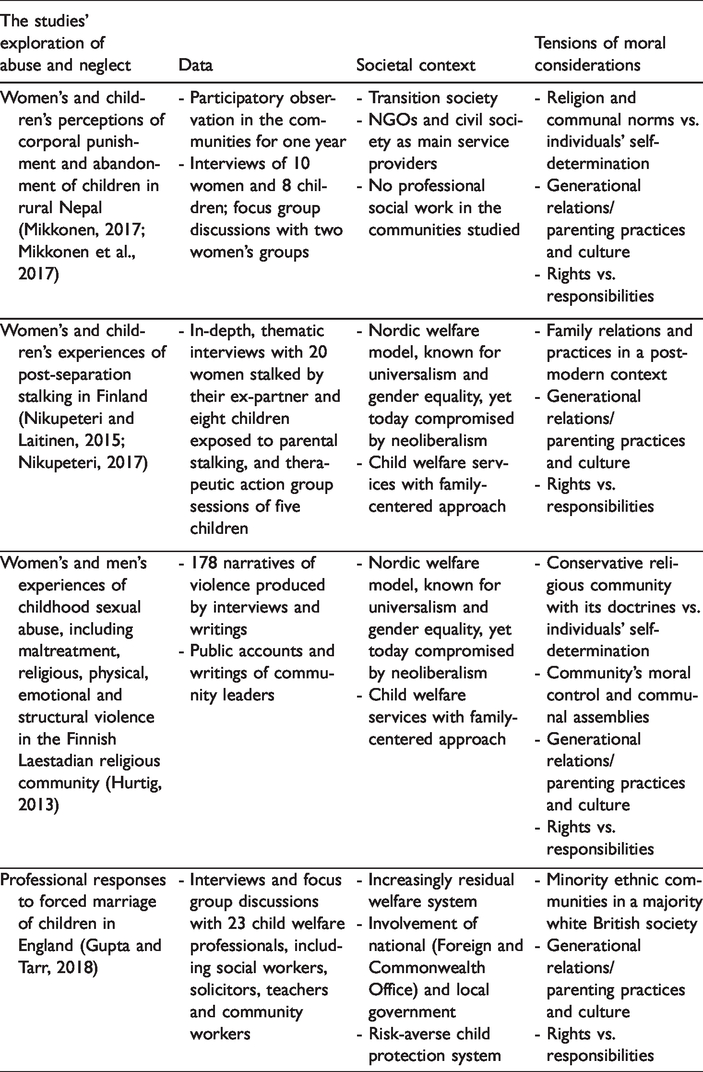
The studies include experiential and professional perspectives of child abuse and neglect in families or communities. The contexts differ in four respects: geographical location (England, Finland and Nepal); social setting (rural vs. urban); forum dealing with the cases (public sector versus the community); and cultural and societal context, that is, how childhood, parenthood and family are perceived. In spite of different contexts, the studies include parallel questions on patriarchy, conservatism, religion, communality and culture.
Analysis
We have sought to expand the analysis of the four original studies to gain new theoretical understandings of moral agency. In the analysis we have applied Layder’s (1998) adaptive theory, which considers the layered nature of social reality. We combined the use of pre-existing theory – theorisations on morality, moral activity and moral work in child and family social work – and of theory that we have generated from analysing the data. Adaptive theory offered us a possibility to focus on the ties between agency and structure in social life and the connections between micro- and macro-levels. We have illustrated the phases and contents of analysis in the Figure 2.
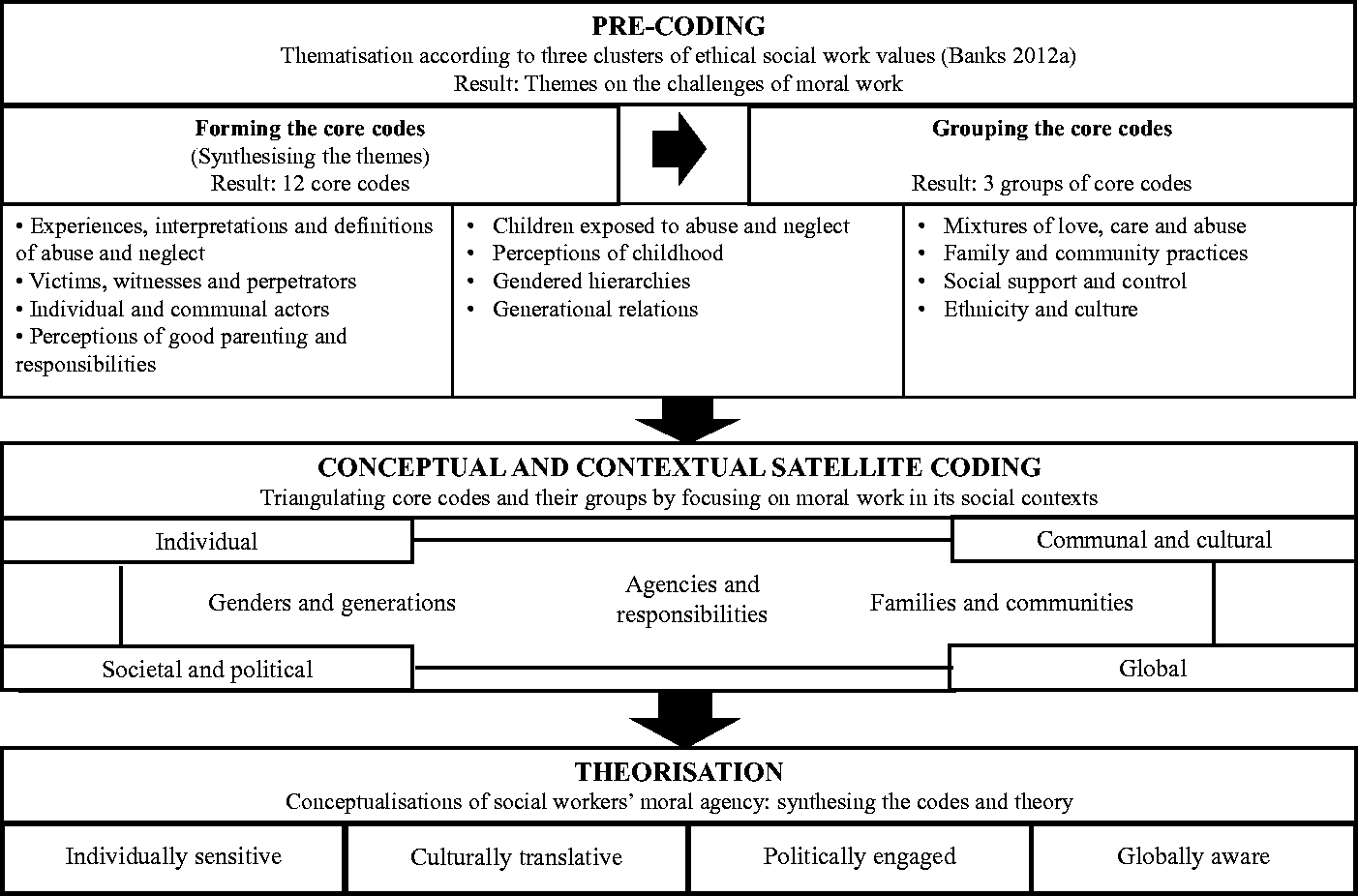
Analysis process.
In the first phase, pre-coding, we read the studies from the perspective of three clusters of complex ethical social work values (Banks, 2012b: 60). We marked sections describing the challenges of moral work, that is different experiences of abuse and reactions or parenting practices regarding it, and labelled them (Layder, 1998: 55). Next, we formed the core codes: we named the ‘main points’ that cover themes and patterns shaping our data (Layder, 1998: 56). For example, the core code ‘children exposed to abuse and neglect’ includes themes like age, gender, country of origin, religious and cultural background. Additionally, we grouped the core codes by synthesising their internal themes.
In the second phase, we analysed human activity in its social contexts more precisely. We triangulated the core codes to seek similarities and differences in how the codes were applied to moral considerations in the studies. The process yielded the conceptual and contextual satellite codes (Layder, 1998). In forming the conceptual satellite codes, we were asking, what are the concepts thematically defining the moral considerations in the data. In our joint discussion, we conceptualised them dually: genders and generations, agencies and responsibilities, families and communities. Additionally, we asked what are the social contexts of the moral considerations and named the individual, cultural and communal, societal and political, and global dimensions as contextual satellite codes. There are other dimensions as well, for example, organisational and interprofessional, which may play a more significant role in data collected in other contexts, such as the institutional.
In the third phase, we reflected on our findings and generated theorisation of social workers’ moral agency by building on written memos and existing theory (Layder, 1998). We asked what kind of moral agency of social workers is required regarding the moral considerations in various social contexts. In this theory building, we triangulated the synthesised codes and theory to produce a combined translation for synergistic understanding (Aguirre and Bolton, 2013), which developed conceptualisations of moral agency applicable to contextual moral work.
Limitations and strengths
The particular challenge of QIMS is how to bring the hermeneutic aspect to the process in order to develop broader understanding. It requires deep awareness of different approaches, data and interpretation in the original studies (Zimmer, 2006). In our research, we chose studies that we have conducted ourselves, which is both a limitation and a strength. We acknowledge that this choice limited the number and range of the data. However, as sampling and scarcity of the investigators’ voices have been general challenges of the QIMS (Nordberg et al., 2016), we address this challenge by our choice of studies. Nordberg et al. (2016) have described in depth how authors and their professional and personal experiences, along with training related to the focus of the study can be utilised as the primary instrument in the QIMS. The risk of misunderstanding the component studies was minimised as we were able to circumvent biases by posing questions and obtaining a detailed understanding of the separate inquiries interactively (Aguirre and Bolton, 2013). Another strength of our approach is that co-researching has been a central tool as we have exchanged views and critically reflected on each other’s research for several years, which deepened our awareness of the methodological commitments and prerequisites of knowledge.
Ethical considerations
There are a number of ethical concerns that bear on the interpretation of the original studies and thus the meta-synthesis. The main consideration is related to knowledge production. Even though the purpose of interpreting the studies is to deepen our understanding of moral work and moral agency, it entails a risk of simplifying the results of the original studies as well as losing the essence of the empirical data and authentic voices of participants. Additionally, embarking on a meta-synthesis includes a risk of losing phenomenon-specific features and moralities, which runs counter to the postmodern idea of personal and context-related moralities and the rejection of meta-narratives (Bauman, 1993). Moreover, interpretative meta-synthesis raises issues of power hierarchies, prompting one to ask whose knowledge is prioritised in analysing moral work (Mikkonen et al., 2017). We approached these questions through critical reflection in our research team, and triangulation of the data, methods and analysis strengthened the validity and reliability of the meta-synthesis (Aguirre and Bolton, 2013).
Thematic moral considerations in confronting and making sense of child abuse and neglect
We identified three dual conceptual moral considerations in confronting and making sense of child abuse and neglect. Genders and generations, agencies and responsibilities, and families and communities include multi-dimensional power relationships that are essential to be understood in moral work (Bauman, 1993, 2000).
Genders and generations
The first consideration is associated with genders and generations, which appeared as a pervasive category in the studies. These are not new themes in social work literature (Berrick, 2017; Broadhurst, 2012), but our study highlights the nuances that differing perceptions of childhood, parenthood and gender create when seeking to understand child abuse and neglect. Gender appeared as a complex and contextual issue regarding morality. For example, the study in the Laestadian community revealed the taboo nature of victimising boys, the prohibition against and fear of homosexuality preventing the community seeing and disclosing cases of abuse towards boys. Through these multi-dimensional impacts of genders and their intersections and relations with sexuality, taboos, gender roles and expectations, individual morality (Bauman, 1993, 2000) challenges social workers’ moral considerations.
The meaning of generations varied in the studies. For example, relations between children and mothers can create security for children who live with their father’s stalking, while the study in the Laestadian community illustrated how those relations can allow abuse to continue by silent acceptance. Intergenerational relations were also strong in Nepalese rural communities, where children’s responsibilities towards the family and community were emphasised. Generational relations are largely organised and ordered by adults (Alanen and Mayall, 2001), which is to be acknowledged while seeking to understand children’s experiences of abuse and neglect. The complexity of culture-related meanings of generations (Brydon, 2011) demands social workers to avoid cultural stereotyping and consequently, cultural otherisation of families and communities.
The moral considerations within genders and generations intersect. Tensions not only appear in communal and societal interpretations of abuse and neglect, but also prevail in the help-seeking processes (Forsberg and Pösö, 2008). The study on post-separation stalking revealed that a child’s rights and best interests can outweigh a parent’s need for security and help. Professionals viewed stalked women as alienating parents, unprotective mothers, overcautious women and/or implausible victims. Thus, professionals may defend the child’s best interest in their assessments when children’s situations are interpreted in relation to the mother and her abilities, but not the abusive father. The safety of the child can be an ultimate value, as in the case below, where the question was whether the child should be taken into care: In practice, they asked me: ‘Which one is more important, your child’s or your own mental health?’ And I knew that I had been driven into a corner with the authorities, too; I didn’t have any options. (Nikupeteri, 2017) The majority of the cases I’ve dealt with it’s been the mums and the aunties that have pushed for it [forced marriage]. We’ve had one case where the father was absolutely heartbroken and didn’t want it but his wife’s family were the more powerful family. (Gupta and Tarr, 2018) I’ve usually had calls from the victims themselves, sort of umm-ing and ah-ing about what they should do, ‘just need to talk to someone’, ‘I’m not too sure’, ‘don’t want to put my family to shame’. (Gupta and Tarr, 2018) I have been thinking about my mom’s religiousness. She talks about it all the time. She is saying that with faith you survive everything; God gives help in all situations; the gospel overpowers many faults. This makes me feel so conflicted. It is like a habit of goodness. You wear it and you don’t need to confront the truth. Religion is a way to protect oneself. (Hurtig, 2013)
Agencies and responsibilities
The question of agencies and responsibilities culminates in the experiences of abuse and neglect and how they are interpreted in the communities and professional practices. The victims, perpetrators and witnesses have own agencies that are intertwined with communal and family power relations and perceptions of victimisation. The studies show how individual and communal agencies may clash when the agency of an individual is limited in the name of the communal good – it is not only the social workers who make moral judgements (Keinemans and Kanne, 2013). For example, a religious community may not require people to internalise morality and bear responsibility; sometimes it is enough that the commitment of the members to the community is externally visible. Religiously orientated processes of apologising and forgiving can blur the agency and responsibility of victims, perpetrators and witnesses alike, as seen in the following excerpt from an interview of a victim of sexual abuse in the Laestadian community: My brother’s wife sent me a message the next day saying that the matter had been dealt with and settled in their family, the sins had been forgiven and that hopefully I’d get better. I thought that if I didn’t have those two children, I would slit my wrists. My brother got forgiveness. Fuck! [apologises for swearing] I’ve been torn apart – so deeply, that I might never survive this. (Hurtig, 2013)
Agencies may be restricted also by societal expectations and professional responses. Such a tension can be observed in the following excerpt exemplifying the hierarchy of professional and a stalked mother’s agency: If we think about the child protection, what has irritated me is that I have asked for many kinds of help. I have tried many channels, but one response I got was that here it is not the clients who make suggestions; these go top down. I had suggested what kind of help would work in our case. Ultimately, the only thing they had to offer us was that the children could be taken into care. This was supposedly the only way to protect the children. (Nikupeteri, 2017)
Families and communities
Each study indicated that care and love of families and communities can outweigh instances of child abuse and neglect within them (Helavirta, 2011). Significantly, the impact of child abuse and neglect is felt in broader social relations within the relatives, focal ethnic group, religious community, village and extended family; these relations may then prove supportive and/or harmful. The studies describe examples in which the members of the community stand up for the perpetrator and reinforce the understanding that violence in the name of a father’s care for his children or the doctrines of the religious community is justifiable. Yet, any analysis must look beyond the restrictive side of religion or culture. From the victim’s perspective, remaining in the community, despite its harsh beliefs, might provide greater protection than isolation from it and the consequent loss of one’s social network. For example, in Nepalese communities belonging was identified as one of the most important elements of well-being, and isolation as severe abuse.
In families, children and adults internalised cultural norms from the top down, from peers or through silent acceptance. These directions of communal control shaping individuals’ morality are illustrated in the following excerpts. The first is an example from the Laestadian community, the second from a Nepalese rural community: Father picked the norms that he preferred. Those were followed; the others did not really matter. We were not allowed to do ‘women’s work’ on Sundays. If father found someone knitting, he got furious and damned all of us children to hell. Then again, we were allowed to put on make-up and watch TV at the neighbour’s [Actions that were forbidden by communal norms]. (Hurtig, 2013) I think sometimes arranged marriage is good, sometimes bad. It all depends on the husband. If he’s good, then it’s good. Sometimes the girls use the freedom the wrong way. They might get pregnant when they are teenagers and after giving birth dispose of the baby. (Mikkonen, 2017)
A crucial question here is the role of social workers in creating moral narratives about people affected by child abuse and neglect (Witkin, 2017). For example, children who are stalked can experience the situation diversely, and the parties can see different realities. However, there is a risk that social workers present a one-sided picture of a child, parent, family or community (Stanford, 2008), which was highlighted in the forced marriage study, where some professionals questioned government guidance cautioning against mediation: When you force a young person to leave, problems remain. Don’t assume non-mediation – you have to weigh the risks. Some families can make changes – others could kill because of ‘shame’. (Gupta and Tarr, 2018)
When emphasising communal morals, there is a risk that child abuse and neglect is seen as a cultural and ethnic feature, a view which masks structural power relationships. For example, the focus on forced marriage as familial abuse ignores the structural inequalities such as poverty and disability. It also pathologises certain communities and renders invisible the needs of young people. Also, a focus on immediate protection at the expense of longer-term well-being resulted in lack of attention to the harm caused by psychological and social isolation when young women are removed from their families and communities. A lot of young women more than often go home; we’ve got nothing to support them; we’re leaving them in a vulnerable situation. (Gupta and Tarr, 2018)
The dimensions of moral work
Our analysis brought forth that the moral considerations appear within different dimensions. In confronting and making sense of complexity of the phenomenon, social workers’ moral considerations are intertwined in multiple ways to the contextual dimensions of their moral work, which appeared differently in each study. We posit four such dimensions: individual; cultural and communal; societal and political; and global.
On the individual level, the emphasis of moral work is on social workers’ sensitivity towards children’s and parents’ unique situation and the form of abuse or neglect. It is important to seek and listen subjective experiences in order to support children and their parents as agentic-subjects. As an approach, such sensitivity runs counter to the one-dimensional, professional-to-client orientation often typical of risk assessments and a rescue orientation with the parents and culture taking much of the blame (Urek, 2005). Developing relationships and promoting the individual child’s and family’s strengths, hopes and aspirations, as well as awareness of the harm caused by professional intervention, for example, the lack of post removal support for children at risk of forced marriage or the reality that sometimes there is no professional means to stop parental stalking are crucial. The individual dimension of moral work calls for social workers to question the straightforward ‘truths’ and interventions.
The cultural and communal dimension of moral work stresses that ideologies and norms underpin how morality is constructed in families and local settings. Our meta-synthesis shows that social workers need general and specific knowledge(s) on different cultures and religions to understand the relations within and between families and communities as well as to appreciate their specificity. This entails weighing the safety of the child and the importance of family relationships as a source of the child’s well-being in morally conflicted situations. However, morally aware practice requires social workers to prioritise the needs of the most vulnerable parties, which raises a need to recognise the complex conflicts that may be entered into the practice, as was reflected in the Laestadian study. The cultural and communal dimension of moral work calls for social workers’ questioning of power relations.
Moral work requires that social workers recognise and assess the effect of societal and political dimensions when working with child abuse and neglect. The studies focused on different forms of abuse and neglect, yet in every case, it was important how the phenomenon was defined as a social and/or juridical problem in the society. Our meta-synthesis substantiates earlier findings that moral work includes questioning the neoliberal ideal of the risk society by invoking the core principles of social work and the realities of children and their families (Stanford, 2010). Additionally, social workers need to take into account the experiential knowledge of children and parents in developing services that promote social justice. This requires applying practical–moral rather than technical–rational approaches in helping processes (Steckley and Smith, 2011). Societal and political dimensions of moral work call for social workers to challenge social injustice and advocate for the well-being of marginalised children and families.
Moreover, the metasynthesis highlights the global dimension in moral work (Bauman, 1993). This insight urges social workers to find a balance in supporting the equal worth of people and respecting unique contextual elements. The salience of the global dimension also compels social workers to ponder the question of ‘Western’ supremacy and imperialism and unbalanced global power relationships (Brydon, 2011) especially in working with families and communities from minority groups. Even though social justice and human rights are among the globally shared values in moral work, they need to be understood as context-specific (Banks, 2016; Bauman, 1993, 2000; Witkin, 2017) and multiple values are to be negotiated also at the global dimension of moral work.
Conclusion: conceptualising moral agency
The metasynthesis showed that when working with child abuse and neglect, social workers are positioned in the middle of conflicting issues. In theorisation of our findings we interpreted that these morally charged situations call for strong and multidimensional moral agency on the part of social workers (Broadhurst, 2012), that can be best realised when a social worker is individually sensitive, culturally translative, politically engaged and globally aware. The forms of moral agency are illustrated in Figure 3.
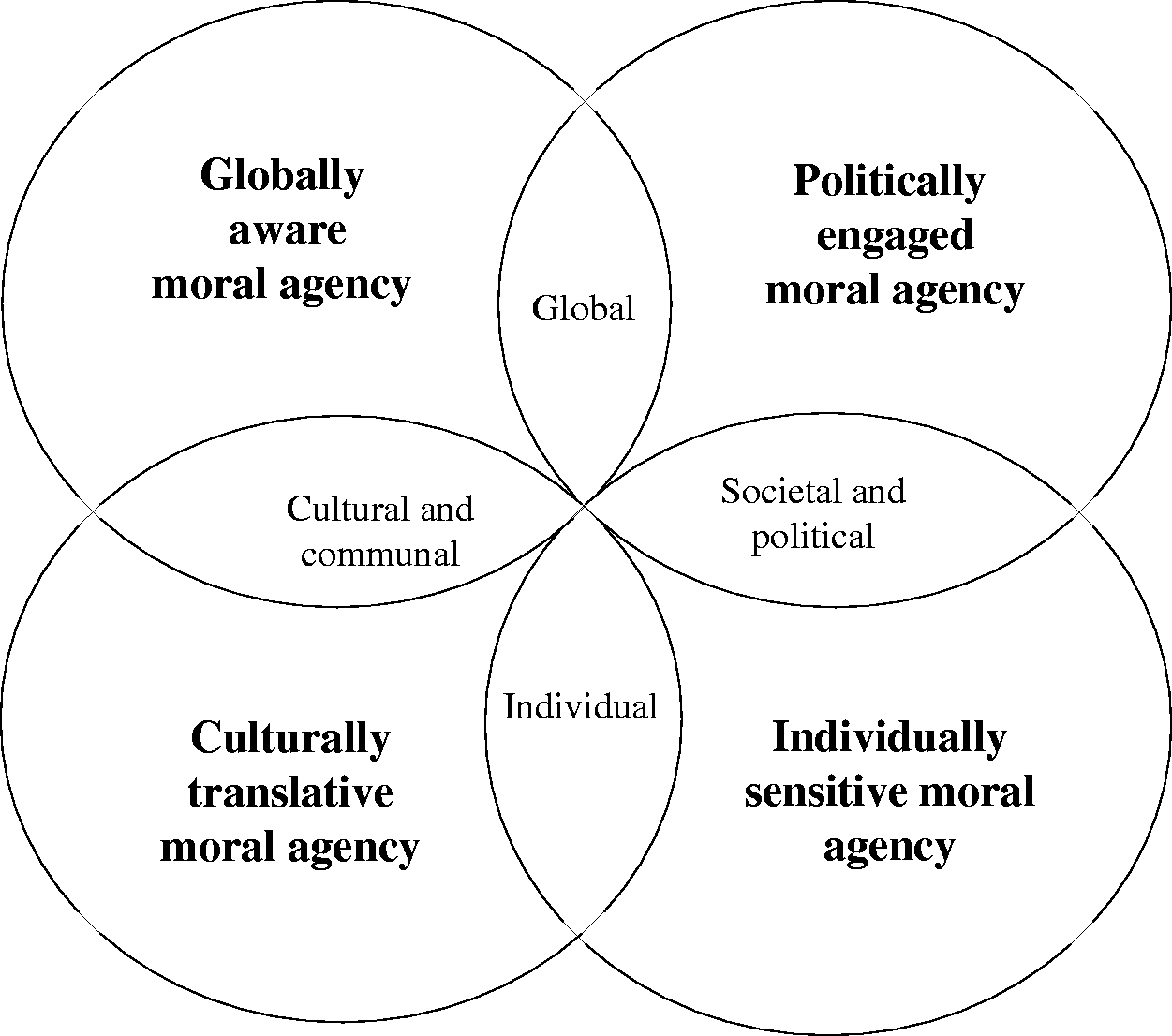
Forms of moral agency.
In exercising strong moral agency, social workers take a central position in negotiating issues and balancing the different dimensions of moral work. This in turn strengthens their moral stance and holistic approach to children, parents and communities. The exercise of moral agency is embedded in the values and mission of social work (Banks 2012a, 2012b; Fine and Teram, 2013). Due to multiple tensions in exercising this agency, social workers have to take into consideration the significance of cultural and contextual knowledges of how child abuse and neglect are constructed. In moral work, social workers need to negotiate between individual moralities, public morality and their personal and professional moral understandings, which may clash (Bauman, 1993, 2000; Broadhurst 2012; Stanford, 2010). This highlights the reciprocal nature of work with and between children, parents, social workers and other professionals involved in helping processes.
Furthermore, our challenging examples of child abuse and neglect highlighted that exercising strong moral agency requires social workers to reflect on their own subjectivity and the limits of their own understanding (Keddell, 2011). Accordingly, in taking a moral stance, they need to recognise the meaning of their own agency – bound as it is to personal and cultural values, institutions and politics (Banks, 2016). This includes reflecting on one’s moral reactions, which may be emotionally charged (Keinemans and Kanne, 2013). Where emotions are allowed to legitimise action, the moral complexity of a situation may be neutralised or denied. Social workers must thus recognise the ramifications of their own ‘shadow’ in moral agency. As Lindqvist (2002) points out, the most dangerous evil is one that blindly imagines itself to be good. The notion of ‘ethical trespass’ refers to the reality that many situations are those where no correct response is clear or indeed entirely right, and to the inevitability of harm not from our intentions but from our participation in social processes. Social workers usually have responsibilities to more than one service user at a time and are working with conflicting interests (Weinberg, 2016). Acknowledgement of ethical trespass, humility, willingness to be self-reflexive and listen to the experiences of marginalised others are crucial in terms of strong moral agency.
The main contribution of this research lies in the insights it provides into social workers’ moral agency at the intersection of different dimensions that may exist in any instance of child abuse and neglect. We argue that multidimensional moral agency yields insights which improve child- and parent-friendly practices. When a social worker considers morality as an array of multiple questions instead of an either–or proposition, it becomes possible to see the harmful dynamics at work in an individual’s life on not only the family and communal, but also the cultural and structural levels (Bauman, 1993). Where they embrace a multidimensional approach, social workers can offer space for moral reasoning, assessment and decision making, an approach that serves the best interest of the child in the complex processes of addressing abuse and neglect as contextual issues (Berrick, 2017; Forsberg and Pösö, 2008; Keddell, 2011) and in balancing between harmful and supportive family and communal relations. This all requires developing a fully reasoned moral stance in each situation.
In conclusion, we have argued that child and family social work needs to address moral work where different power relations between individual, communal and cultural, societal and political, and global dimensions intersect. A unique contribution social work can make in confronting and making sense of child abuse and neglect is the capacity for context-sensitive practice that critically engages with moral complexities and agencies when working with individuals, families and communities. This includes an ability to negotiate between multiple, not absolute, rights and wrongs and to develop morally aware practices in child and family social work.
Footnotes
Declaration of conflicting interests
The author(s) declared no potential conflicts of interest with respect to the research, authorship, and/or publication of this article.
Funding
The author(s) disclosed receipt of the following financial support for the research, authorship, and/or publication of this article: Academy of Finland (No. 308470) and the BASPCAN (British Association for the Study of the Prevention of Child Abuse and Neglect)..
