




Abstract
The Just City is a concept of justice that has gained traction in both planning theory and practice. Despite its popularity, the definition of alternative conceptions, the tradeoffs between them, and thinking them through systematically towards policy measures, has received less attention. The goal of this paper is to provide a framework that helps to inform academic and policy discussions about planning for urban justice. In doing so, it draws on political and economic philosophy. Four different ideal types of The Just City, based on four different philosophies, are being identified and compared: The Happy City (utilitarianist), The Equal City (egalitarian), The Supportive City (sufficientarian), and The Free City (liberal). The paper shows that each of these translates into different planning policies. Moreover, although each of them might appear sympathetic and desirable, at least at first glance, they do not all go well together or are even incompatible. Being precise and making choices about what urban (in)justice entails is necessary for effective and legitimate policy-making, especially in the long run.
Introduction
According to many, the downsides of the ‘triumph of the city’ (Glaeser, 2011) have become increasingly visible in the form of growing urban poverty, segregation, gentrification, housing affordability problems, and so on (e.g. Florida, 2017). As a consequence, calls for urban justice have become more audible. In the planning literature too, in recent years, we have seen a surge in publications about The Just City since Fainstein’s classic book of 2010 (see for instance Basta, 2016; Dadashpoor and Alvandipour, 2020; Davoudi and Bell, 2016; Janssen, 2024; Moroni, 2020, 2023; Moroni and De Franco, 2024; Weghorst et al., 2025).
The word ‘just’ in the idea of The Just City has such a positive connotation that it is hard to refute: clearly, nobody would ever advocate the contrary. But while there is much consensus about the desirability of the ‘concept’ of justice, there is much less convergence as to what the further ‘conception’ should entail (see Moroni, 2020, for that distinction, after Rawls, 1971) 1 . I observe that both in the literature and in policy debates ‘just’ is still far from a defined and operationalizable concept. There are various related issues in this regard.
The first is that, in such debates, the concept of urban justice is often not articulated into a specific conception: people tend to keep it as broad as possible, so as to hold on universal cross-boundary and context-unspecific meaning and avoid controversy (Sartori, 1970: 1034). It is problematic because it creates short-term and superficial consensus, whilst underlying conflicts remain obfuscated, and might ultimately surface in less productive ways in the long run.
The second, as already observed by Moroni (2020), is that, on the opposite side, urban justice is sometimes defined rather narrowly and exclusively, as if there are no alternative conceptions within the concept of justice. For instance: ‘The choice of justice […] reacts to the current emphasis on competitiveness and the dominance in policy making of neoliberal formulations that aim at reducing government intervention and enabling market processes’ (Fainstein, 2010: 8). However, as I will discuss later in this paper, not every conceptualisation of justice has neoliberalism as its target as Fainstein states. Alternatively, Young argues that justice is about ‘ (…) the institutionalized conditions that make it possible for all to learn and use satisfying skills in socially recognized settings, to participate in decision making, and to express their feelings, experience, and perspective on social life in a context where others can listen’ (Young, 1990: 91). This is a conception, not ‘the’ concept, since it is only one of the ways in which the concept can be specified (Moroni, 2020).
These two specific issues conduce to the third one, that is, the problem of inconsistency that arises when two or more competing conceptions are pursued at the same time. For instance, one cannot condemn gentrification and segregation on the one hand, and accept or even support the right to appropriation and free settlement on the other. Those are incompatible conceptions of justice (Buitelaar et al., 2017). Pursuing both at the same time for the same place is likely to lead to not achieving either of them, and hence may lead to an ‘unjust city’, viewed from both conceptions, not just one. By this, I do not mean to claim that any conception of justice is incompatible with any other conception, in all aspects. Moreover, I will show at the end of this article that some elements of multiple conceptions are complementary, if not the same. More than anything, it is an attempt to avoid going to the common ground too hastily, and to being precise and aware of differences, as too often different conceptions are lumped together erroneously.
The aim of this paper is to demonstrate that pursuing an ideal of The Just City requires making choices – at both the strategic city-wide level and the operational site-specific level – between alternative and sometimes competing conceptions, making those choices explicit, and showing how these result in rather different policies. At the risk of seeming conceited, by so doing the paper contributes to improve what I refer to as ‘justice literacy’ 2 , namely, the knowledge of and the ability to apply justice conceptions (i.e., the vocabulary) and the connections between them (i.e., the grammar) in a logical and robust way. To this end, I introduce four different conceptions of justice. Their overview does not offer an exhaustive account of all possible conceptions, it covers what I consider to be the most dominant ones in public discourse, and potentially the most conflicting ones. The overview should facilitate deliberation about urban policy-making concerned with justice in a way that is compatible with the limited reach and space of this article.
The outline of this paper is as follows. Section 2 introduces different conceptions of justice and their constituting elements (that is, the ‘materials of justice’). After that, I discuss four different conceptions and their policy implications: The Happy City, The Equal City, The Supportive City, and The Free City. In the section following that I deal with their (in)congruence. The final section draws conclusions for both planning theory and practice.
Vocabulary of justice: Deconstructing The Just City
In this paper, I identify four different conceptions of urban justice based on four different political philosophies: The Happy City (utilitarianism), The Equal City (egalitarianism), The Supportive City (sufficientarianism), and The Free City (liberalism). Before they can be unpacked and compared, three premises need to be made.
First, it is important to be aware that The Just City is actually a contradiction in terms: in itself, the city cannot be just or unjust. Justness only applies to the institutions – the formal and informal regulatory systems– within which the city develops (Moroni, 2020). Urban development is the outcome of interactions between actors within systems that may or may not be just, unless that the fairness of the system is enforced in these interactions. This does not mean that developments like the evolution of prices, demographic growth, and real estate investments cannot fulfill an important signaling function regarding injustice. In practice, they do: they lead to eyebrow-raising, concern, or even outrage. These are important emotions for starting discussions about the (in)justice of institutions.
Second, it is important to be explicit about what I mean by ‘city’ in The Just City. The ‘city’ and the ‘urban’ are multidimensional and multifaceted concepts. Here I mean by the city the ‘target territory’ (Moroni and De Franco, 2024) in which certain goods, duties, or rights must be allocated, that is, the territory to which the justice conception applies 3 . By focusing on the city as a target for justice, I do engage less with the city as a factor behind injustice, as has been the focus of many scholars within planning and geography (e.g. Harvey, 1972; Marcuse, 2009; Swyngedouw and Merrifield, 1996). This does not mean that I consider the city as just a neutral container to which a justice conception applies. In pursuing justice, the state has to bridge the gap between the existing injustices that the city (co)produces and an ideal conception of justice that the city can pursue and help to bring about.
I largely focus on the city as a provider of three basic services for three basic human activities: housing (i.e., residing), jobs (i.e., working), and transportation (i.e., traveling). That implies that I leave aside other related and important fields of justice research such as ‘environmental justice’ (Schlosberg, 2013) and ‘energy justice’ (e.g. Jenkins et al., 2016). By focusing on these things, I position myself within what in the ‘three-tenet framework‘ from the energy-justice literature (e.g. Jenkins et al., 2016) is called ‘distributional justice’, as distinct from ‘procedural justice’ (e.g. Tyler, 2006) and ‘recognition justice’ (e.g. Benhabib, 1992; Young, 1990).
Third, The Just City does not mean that the city as a governing entity is the only or most appropriate level of government through which the ideal of justice must be pursued. Rather, the idea of The Just City might be pursued at the level of the city, as well as other levels, such as that of the nation-state, the European, and that of the neighborhood. This article deals with the city as the ethical level of concern, that is, the level at which justice should be achieved, and not necessarily, or not only, the level (the executive level) at which that justice should be brought about (see Chiappero-Martinetti and Moroni, 2007, for the distinction between the ethical and the executive level).
Fourth, when reference is made to The Just City, it means to be about dealing with justice at the (urban) administrative level. However, many theories of justice are concerned with (pre-)constitutional justice decisions: in other words, with decisions that regard the state and its ability of regulating a basic structure of society (e.g. Rawls, 1971). Moroni (2023) qualifies this as ‘background justice’. However, daily decision-making at the city level deals with issues of ‘allocative justice’: essentially, the justice of ‘who gets what’. Although they are all inevitably linked to the basic structure of society, the four conceptions of justice that I discuss here are primarily of this latter kind, although they are inevitable linked to and embedded within the basic or background structure of society.
The four conceptions that will be discussed in the next four sections can be broken down into their basic components. This ‘de-composition’ is essential for rationalizing any argumentation around any conception of justice. Here I follow Dawkins (2021), who argues that a conception of justice can be decomposed into five ‘materials’. These materials are values, principles, grounds, scopes, and bases.
The value for example is a ‘property’ that someone wants to have or have access to, and that the city might be obligated to provide in some way, such as the provision of affordable housing and the provision of sufficient green space in close proximity. 4
Principles of justice are propositions about just allocation of these values. Think of John Rawls’ ‘difference principle’ (‘social and economic inequalities are to be arranged so that they are both to the greatest benefit of the least advantaged’) (Rawls, 1971), or of ‘equal distribution’ for which everyone should have the exact same value allocated to them.
The scope contains the subjects, or the territory, to which the principle applies. In the case of The Just City that is the inhabitants of the city, or simply ‘the city’. Obviously, one can extend the scope from the current inhabitants to future generations (i.e., ‘intergenerational justice’, the core of ‘sustainability’) and/or to non-human subjects (Wijsman and Berbés-Blázquez, 2022), which would link it to the field of ‘environmental justice’ (Schlosberg, 2013). In any event, the scope one defines applies to each conception, and therefore does not differentiate between them. For that reason, in the rest of the paper the scope gets less attention.
Finally, the grounds provide the reasons behind the proposed principle – whether instrumental or deontological – and the basis of justice the ultimate focal point of the theory. Following Dworkin (1977), these could be pragmatic goals – like pursuing collective welfare – or formal endeavors – like securing individual rights and duties to all.
The Happy City
Philosophy and materials of justice
The central value of justice, in what I call the Happy City, is utility. Arguably the best-know operationalization of that is ‘preference satisfaction’. This means that what people actually value themselves is the measure of what is right and wrong. A common way to measure what people’s preferences are, at least within neoclassical welfare economics, is their (marginal) willingness to pay for particular goods. The reasoning goes, that the more people are willing to pay for something, the more they value it. There is a fairly vast literature on the interface of economics and planning that follows this welfare economics rationale (e.g. Evans, 2004; Heikkila, 2000; Oxley, 2004).
If markets were to function perfectly – that is when information is complete, people act rationally, and there are numerous buyers and sellers – everything would have a price and all preferences would become apparent through those prices. In the case of equilibrium prices, there are no more gains to be made from trade, which is considered to be a (Pareto) optimal and efficient distribution. The ground for this line of reasoning is that the more people satisfy their preferences, the better it is for the collective; in a way, the individual is subordinate to the sum or the average.
However, as Pigou (1920) has shown long ago, markets tend to fail, especially in relation to the public goods and the externalities that constitute the building blocks of urban environments, and in relation with the market power accumulated by single suppliers (Klosterman, 1985). Economics has proven to be quite successful in producing so-called ‘hedonic-price analyses’ that allow for putting a price on such unpriced externalities and public goods (since Rosen, 1974). These are prices of attributes (i.e. externalities and public goods) that are derived from comparing prices of goods that are exposed and goods that are not or less exposed to particular externalities or public goods. Urban economics has conducted many hedonic-price analyses that put a price tag on both positive or negative externalities like noise nuisance, flood risks, green space, cultural heritage, and on public goods in general (e.g. Glaeser, 2011). Notwithstanding these methodological advances in economic research, market failures continue being a much used justification for public intervention and planning.
The basis of the Happy City, therefore, resonates with the utilitarian philosophical tradition that seeks ‘the greatest happiness of the greatest number that is the measure of right and wrong’ (Bentham, 1789), and consists of achieving maximum collective welfare. Such basis is not concerned with rights or duties, but with goals with regard to an end-state with for the (urban) collective, not with individuals or groups within the city. Its guiding principle is maximum collective utility.
Policy examples
The Happy City offers an important guidance for planning policy. Of all four archetypes, this conception has arguably the most advanced and elaborate method for policy evaluation: cost-benefit analysis (CBA) (e.g. Woltjer et al., 2015). Many large-scale infrastructure and urban-development projects are subjected to ex ante CBAs to determine whether they are not only financially feasible but also economically and socially desirable (e.g. Flyvbjerg et al., 2003).
Urban policies in The Happy City are policies that contribute to agglomeration economies, namely economies that deliver the highest economic efficiency (Glaeser, 2011). Within the planning literature, such policies are commonly (dis)qualified as ‘neo-liberal’. In a review article, Sager (2011) qualifies as many as fourteen different planning-related policies – like city marketing, urban development by attracting the ‘creative class’, economic development incentives, competitive bidding – that share the scope of increasing property values, welfare, and agglomeration effects.
This is not the first or only critique that the welfare economic approach has received. A traditional critique concerns the operationalization of its central value ‘preference satisfaction’ as someone’s ‘willingness to pay’ for something, that is, transaction prices. Alternative values such as subjective ‘happiness’ were proposed, leading to a switch from monetary indicators to surveys in which people are asked to score how satisfied they are with something (e.g. Layard, 2005; Veenhoven, 2010).
Although in this latter case the value central to the conception of justice is different, it is equally utilitarian in nature, in the sense that it strives for overall collective wellbeing in the same way that welfare economics does. More fundamental critiques take issue with the basis and the distributive principle of the conception. Utilitarianism in general and welfare economics in particular are often criticized for their negligence of the skewness of economic, and spatial distributions, and for their disregard of individual rights and freedoms (e.g. Campbell and Marshall, 2002).
The Equal City
Philosophy and materials of justice
As argued in the previous section, the disregard of inequalities is one of the main critiques of utilitarianism in general and welfare economics in particular. In contrast, egalitarianism does have the skewness of distributions as its focus. Most well-known is the relatively recent focus in economics on economic (in)equality, in terms of income or capital (e.g. Piketty, 2014; Stiglitz, 2012). Instead, in planning and geography the focus is on the spatial implications of (economic) inequality, in terms of the level of (economic) segregation (e.g. Harvey, 1972; Marcuse, 2009; Tammaru et al., 2016).
What is valued directly, in both economics and geography, are the equality of economic and spatial outcomes. Indirectly, the value that is pursued is the equality of opportunity, as the outcomes ultimately translate into opportunities, or lack thereof, both intra- and intergenerationally. The distributive principle is equality: ‘the more equal, the more just’ (Smith, 1994: 119). Although each conception in this paper has the whole city as its focus, The Equal city focuses particularly on the tail ends of the income distribution: the higher and the lower income deciles (Dorling, 2014). Ultimately, by focusing on a preferred end-state, views of material equality are goal-based rather than duty- or rights based. Alternatively, those who adhere to views about equal rights (that is, formal equality rather than material equality), are clearly rights-based (for instance, Dworkin, 1977).
As for the grounds, a distinction can be made between instrumental and intrinsic grounds. Some argue for targeting inequality and segregation because of their alleged negative social impacts. Negative effects of inequality include (social) health (e.g. Wilkinson and Pickett, 2009) and the economic effects (e.g. Atkinson, 2015). In the case of the case of segregation, it is the negative effect of the neighborhood on people’s individual performance (Tammaru et al., 2016). In other words, the impact of (in)equality or (de)segregation on other things, which makes them instrumental. There are others who do not look, or not only, at economic inequality and segregation instrumentally, in other words, who look at their impact on other social phenomena, but who argue that they are intrinsically – in themselves – unjust.
Both grounds are not without their controversies. The intrinsic argument has been disputed by philosophers who advocate sufficientarianism (e.g. Frankfurt, 1987), as will be discussed in the next section when The Supportive City is introduced. Empirical and meta studies have questioned the alleged negative impacts of inequality on economic growth (De Dominicis et al., 2008), on health (e.g. Leigh et al., 2009; Hu et al., 2015), and the negative neighborhood effects as a result of segregation (Ham et al., 2012).
Policy examples
Within economics a plethora of progressive taxes and subsidies are continuously and recurringly discussed as means to make income and capital distributions less skewed (Atkinson, 2015; Piketty, 2014; Stiglitz, 2012). Common policies in the spatial domain that aim for less segregation are policies aimed at social mixing or remixing to make sure that different groups are more evenly distributed across the city (Bolt et al., 2010). This specific targeting of neighborhoods and groups does not only lead to displacement, but may also lead to stigmatization and discrimination of both people and places (Uitermark et al., 2017).
The Supportive City
Philosophy and materials of justice
Various scholars have objected to the notion of distributive equality in economic and spatial terms (Frankfurt, 1987; Moroni, 1997). This concerns the pursued value, the distributive principle and the grounds behind this conception. In the words of Sen: ‘the fact that some people have a lower standard of living than others is certainly proof of inequality, but by itself it cannot be a proof of poverty unless we know something more about the standard of living that these people do in fact enjoy’ (Sen, 1983: 159).
Put hyperbolically for purposes of clarification: two people can be equal but poor, or very unequal but rich. Most would argue that the latter is to be preferred over the former. For that reason, in the Supportive City, the emphasis is not on relative poverty (inequality), but on absolute poverty. In other words, the Supportive City does not aim for an equal distribution, but for a distribution in which everyone has enough. This means that the Supportive City adheres to the ‘doctrine of sufficiency’. Frankfurt, one of the main protagonists, argues: ‘economic inequality is not as such of particular moral importance. With respect to the distribution of economic assets, what is important from the point of view of morality is not that everyone should have the same but that each should have enough. If everyone had enough, it would be of no moral consequence whether some had more than others’ (Frankfurt 1987: 21; italics in the original).
The obvious follow-up question then is, enough of what? In other words, what is the value that the sufficiency principle distributes? In this context, John Rawls (1971, 1993) talks about the importance of ‘social primary goods’. These are the basic goods that all people in the city should own or have access to. The Supportive City is rights-based, not goal-based like the previous two conceptions, because it focuses on the minimum for everyone and is not concerned with the pattern or distribution that emerges above that threshold.
The concept of primary goods can also be translated to the city and to space. These are ‘spatial primary goods’, as Moroni calls them (1997). He introduces four of them: adequate and affordable housing, accessibility to jobs (a maximum acceptable commuting distance between housing and a minimum number of jobs), proximity to a certain amount of greenery, and a safe living environment. But he adds that such a list can effortlessly be adapted and expanded, depending on the social and political consensus about what it is that every citizen should have access to.
Policy examples
Securing spatial primary goods are often explicit policy targets. Think of providing adequate and affordable housing, or alleviating ‘transport poverty’. In each case, the determination and measurement of the height of the sufficiency threshold is a key activity. For adequate housing, one can look at the ‘room stress factor’, which indicates whether people are housed appropriately (see, for example, Jonkman, 2019: 163–164). This measure divides the number of rooms available by the number of rooms required (and reduces the result by 1). A value below 0 means that a household does not live accurately.
For housing affordability, a commonly used measure is the so-called ‘housing ratio’. The housing ratio indicates what part of the income goes to housing costs. Usually 30 percent is the maximum that is considered an acceptable housing ratio. Calculating this measure is simple, but its interpretation is considerably more complicated. Because what does that 30 percent actually say about the affordability of a home for an individual household? Affordability depends much more on absolute income. The housing ratio says nothing about payment risks. A ‘budget approach’ does take those risks into account. Such an approach assumes that households run a payment risk when their disposable income minus housing costs is smaller than the budget that is considered necessary to run an independent household (e.g. Haffner and Heylen, 2011). With the appropriate microdata available, household payment risks can be calculated. Those who run a payment risk are then considered to be housed unaffordably.
In the field of transport, there has been substantial attention for the issue of ‘transport poverty’ (e.g. Lucas, 2012; Martens, 2015), with its various dimensions such as accessibility – how easily can people get to basic activities? – and affordability – against what price? Accessibility measures typically look at residential locations and the distance or time to get from those locations to schools, a hospital, or work locations (Lucas et al., 2016). In addition, a threshold must be determined to be able to assess which level of accessibility renders people ‘poor’ in terms of the activities they can get access to in a reasonable amount of time against a reasonable price.
Alternative and addition: Prioritarianism and limitarianism
Within political philosophy, both parts of Frankfurt’s statement have been commented on: ensuring that everyone has enough, and the perceived irrelevance of differences above the threshold of what is considered sufficient. Prioritarianism focuses on the first, limitarianism on the second.
Within a ‘doctrine of sufficiency’, the aim is to get everyone at or above a threshold value, whatever that is. But what to do when there are not enough resources for everyone to rise above that threshold? From the sufficiency perspective, it may be most efficient to allow those who are just below the threshold to rise above it. Within prioritarianism, however, attention is mainly paid to those who are further away from the threshold (for example Casal, 2007; Crisp, 2003). Crisp introduces the ‘compassion principle’, which means that means that below the threshold, priority must be given to those who are worst off: ‘Absolute priority is to be given to benefits to those below the threshold at which compassion enters. Below the threshold, benefiting people matters more the worse off those people are, the more of those people there are, and the greater the size of the benefit in question. Above the threshold, or in cases concerning only trivial benefits below the threshold, no priority is to be given’ (Crisp 2003: 758).
Limitarianism is a relatively recent philosophical movement that objects to the sufficiency principle that considers all differences above the sufficiency threshold to be irrelevant. Analogous to the threshold value at the bottom, protagonists of limitarianism propose a ceiling for the top. Robeyns (2017) defends limitarianism from an instrumental perspective – not from intrinsic immorality. Being rich is immoral because of the negative effects it has, she claims. First, it leads to political inequality: people who are rich are able to transform their financial power into political power. The second argument for limiting wealth that Robeyns mentions is that there are many needs (such as global poverty and combating climate change) that require more financial resources. Above that ceiling, people are too rich. Raworth’s famous doughnut-economy model can be seen as specific version of limitarianism. It assumes a ‘social foundation’ that provides the sufficiency threshold, whilst an ‘ecological ceiling’ constitutes a wealth limit (Raworth, 2017).
The Free City
Philosophy and materials of justice
The three conceptions discussed so far are very different. However they – especially The Happy City and The Equal City – are similar in at least one respect: they relate to a desired material order, in economic and spatial terms. In the Free City, it is not this that is central, but particular propensities of the institutional framework within which urban development unfolds, regardless of the spatial and economic order that results from it: ‘We can say the “good city”, the “desirable city”, cannot be defined in terms of certain features, but only in terms of the rightness of the framework of rules within which the city itself will emerge and function’ (Moroni, 2010: 147).
This institutional framework must meet certain values, such as guaranteeing fundamental freedoms and (equal) rights for all (i.e. the scope of The Free City). It is thus rights-based. The principle is assigning rights rather than distributing outcomes.
With this basis, principle, and these values, the Free City fits within the political philosophy of liberalism 5 , as developed by twentieth-century philosophers such as Hayek (1960, 1973, 1976) and Nozick (1974), and earlier during the seventeenth century’s Enlightenment by others such as John Locke and Adam Smith. John Locke (1690) already stated that the way in which a game is played can be unfair, not the result. For example, the result of a game of football can never be unfair, it is the result of a combination of skills and luck. However, specific actions of players in relation to other participants in the game can be unfair. Think of a serious offense and a goal unjustly disallowed or awarded by the referee.
The difference between liberalism and the other schools of thought actually arises from the question of what a social order, such as a city, is or should be. A classical distinction is that between a spontaneous order (cosmos) and a created, designed order (taxis) (Hayek, 1973). A spontaneous order is established through self-organization by free individuals, without a predetermined final image. According to Hayek (1973), complex social systems, such as cities, can only come to order spontaneously or organically.
From the perspective of the city as a spontaneous order, concepts such as distributive justice or social justice become less relevant (Hayek, 1976: 231–233). With these concepts, justice is usually viewed at the level of (urban) society as a whole. In a addition, a ‘designer’ is assumed that can be held responsible for order and distribution. In a free society, however, an order comes about spontaneously, without a ‘divider’, and one can only talk about justice at the level of individual behavior. Rules must contribute to the prevention of unjust actions by one person towards another.
But what do those rules for a just city look like? What test of criticism must these pass? According to Hayek, rules of justice must be subjected to what he calls a ‘negative test of universality’ (Hayek, 1976: 205). This means that the rules must focus on individual behavior and on the interaction between individuals, in a general sense and not on specific goals. In addition, rules must be ‘negative’, in the sense that they aim to eliminate unjust behavior instead of enforcing behavior deemed fair (Hayek, 1976: 201). This could include rules to prevent practices in which people cannot obtain a mortgage for a home because it is located in a marginalized neighborhood or postal code area, regardless of the borrowing capacity of the person applying for the mortgage (this is called ‘redlining’). This is based on discrimination and contrary to equal rights, and therefore unjust from a liberal point of view.
An example of a theory that focuses on such a form of ‘institutional’ justice is Robert Nozick’s ‘entitlement theory of justice’ (1974), consisting of two principles. The first is ‘justice in acquisition’, which refers to the legitimacy with which people acquire property such as money, real estate and land. The second principle is that of ‘justice in transfer’, which concerns the manner in which property passes from one person to another. Legitimate ways of transfer include exchange, gifts, purchase and inheritance, and non-legitimate ways include theft, discrimination, violence and fraud. According to Nozick (1974: 151), a distribution is just if it is achieved through legitimate actions. If an investor acquires and rents out a collection of properties through legitimate means (buy-to-let), and therefore has considerably more property than owner-occupiers, then eyebrows may be raised, but according to liberalism this is not a sign of injustice. In other words, if people acquire and trade land and real estate in a legitimate manner, then the resulting spatial and ownership pattern is just, regardless of what the wealth, material distribution and spatial pattern look like.
Policy examples
Almost all premodern cities, starting from the first Roman settlements, are spontaneous orders whereby a limited set of rules allowed spontaneous action to occur (Cozzolino, 2020). In modern days, one could say that attempts to refrain from intervening in individual rights are (non-)policy examples that fit this conception of The Just City, such as refraining from growth controls, inclusionary housing, and rent control. The same can be said about the introduction of rules that try to protect individual rights and freedoms.
An extreme case of spontaneous action that has received quite a bit of attention in the international literature, is the case of Almere Oosterwold, in the Netherlands (e.g. Cozzolino et al., 2017). It is an urban-extension area of the City of Almere where public land has been sold mainly to individual households. Those individuals are not only responsible for the design and construction of their own homes, but also for the preparation and development of the land, and for the provision of public goods such as roads, green space, and sewerage. This is governed by a limited and general set of rules by the city administration.
The Free City as a city of capabilities
Most classical liberals focus, as discussed above, on the safeguarding of freedom and on curbing government when it comes to interfering with that freedom. That is understanding is based on a ‘negative’ conception of freedom (Berlin, 1969). Positive freedom, on the other hand, ‘derives from the wish of the individual to be his own master. I wish my life and decisions to depend on myself, not on external forces of whatever kind’ (Berlin, 1969: 22–23). 6
Unlike classical liberalism, the capability approach does engage with this positive notion of liberty. According to Sen, commodity ownership or availability is not the right focus for expressing someone’s standard of living (Sen, 1983: 160). So-called ‘resource-based approaches’ (i.e., the first three conceptions I discussed) provide little answer to the fundamental question: ‘what are people actually able to do and to be?’ (Nussbaum, 2011: 20, 59). Sen argues that the capability approach is a ‘serious departure from concentration on the means of living to the actual opportunities’ (2009: 233 – italics in the original). 7
A capability needs to be sharply distinguished from a commodity and its characteristics, but also from its utility, or the mental reaction to a functioning. Sen (1983: 160) takes the example of a bike. A bike is a commodity, a good. A bike’s characteristic is that it can be set in motion and be made to transport someone. Then someone needs the capability to ride it – to get on it, to move the peddles, to be able to brake, to stay in the lane and not to fall off. Riding a bike from one place to another may give utility, happiness, satisfaction or pleasure. The bike, or any good, is in and of itself not a good proxy for the standard of living, says Sen, because, when you are disabled, for instance, a bike is of little use. Nor is utility, which concentrates on the mental reaction to the use of the bike. Not riding the bike because you are not willing to, and sitting at an outdoor café instead, may make you equally happy or even happier. Within the capability approach, the option to ride the bike, or to refrain from doing so, is what reflects the standard of living, according to Sen and others, and not the bike itself or the joy of riding it. Although a focus on capabilities does not make primary goods irrelevant – the presence is still a necessary condition (Robeyns, 2005: 99) – it is a significant departure from Rawls’s conception of the standard of living (i.e., social primary goods).
The capability approach has gathered a substantial following within planning and the urban studies; it has primarily occupied itself with the operationalisation of the concept of capabilities in the context of urban planning and housing (e.g. Basta, 2016; Janssen, 2024; Kimhur, 2020).
Discussion: Complementarity and conflict between conceptions
The materials of justice of different ‘cities’.
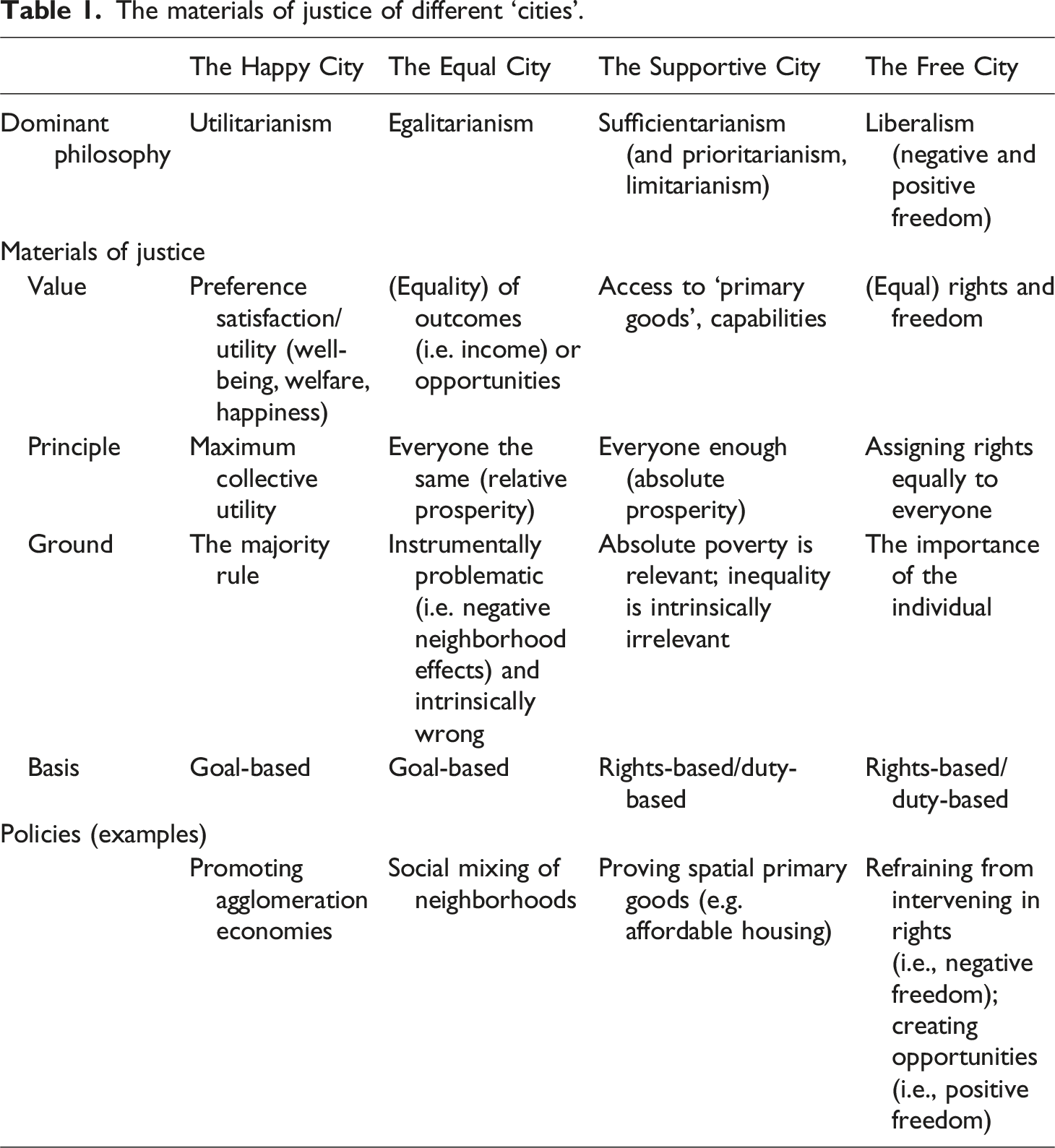
There might be a temptation to take all the different materials and recombine them in whatever way one sees fit. And indeed some mixing and recombination is thinkable and possible. However, not every combination is possible; there are conflicts and mutual exclusions. Here, I make a distinction between the internal and external (in)congruence of conceptions. Internal congruence is about the congruence between different materials of justice in the same conception, whilst external congruence deals with the congruence between the same material(s) of justice in different conceptions of The Just City.
Internal congruence
The materials of justice help us to understand the different components of a conception of urban justice. They are not ingredients that can be mixed in whatever way one desires, although there is some room for mixing. The rights-based approach of The Free City could easily be integrated with the idea of (spatial) primary goods of The Supportive City. Primary goods do not need to be material in nature, such as the spatial primary goods that were discussed, they can be institutional such as rights and freedoms. In fact, those are included in Rawls’s ‘social primary goods’ (Rawls, 1971, 1993). Also, striving for particular capabilities could easily fit The Supportive City. Within the capability approach, primary goods are considered a necessary condition (though not sufficient). Moreover, capabilities are essentially absolutist which fits the sufficiency principle of The Supportive City: ‘there is an intrinsically absolutist core in the concept of deprivation, which Sen’s and Nussbaum’s capability approach clearly identifies and defends at the ethical level’ (Chiappero-Martinetti and Moroni, 2007: 372).
However, most recombinations are at odds with each other, or even impossible, or nonsensical. For instance, individual rights and freedoms are values that are incompatible with the utilitarian principle of collective welfare. Similarly, the combination of preference satisfaction of The Happy City with the sufficiency threshold of The Supportive City is also hard to imagine.
External congruence
Although some conceptions can be combined, such as The Free City and The Supportive City, for similar reasons as explained above, conceptions can also be at odds with each other. It is particularly The Free City that is incompatible with The Happy City and the Equal City, the two goal-based conceptions (Table 1). That is for two reasons: (1) the notion of formal equality of The Free City is incompatible with the notion of material equality of The Equal City; and (2) the notion of liberty of The Free City upsets predetermined or designed ‘patterns’ such as the equal or efficient material distributions of The Happy City and The Equal City respectively (Buitelaar et al., 2017).
Equal rights inevitably – because of differences in human capital and labour (McCloskey, 2014) – lead to unequal material distributions, that is, of income and wealth. Redistributing income and wealth in order to reduce inequalities, logically implies the reduction or expropriation of rights of those whose money is recouped for redistribution to those who have less. The result is formal inequality (Nozick, 1974). The logic also applies to segregation: if a city is considered to be too segregated, it would require reducing or eliminating rights for some people to settle freely, move freely, and to trade homes freely, in order to correct that distributional pattern. That too would lead to formal inequality.
If you grant people a certain degree of liberty, patterns, such as material equality, or a Pareto efficient distribution, are not very likely to occur: liberty upsets designed patterns, as Nozick claims (1974: 160–164). For instance, if you grant people the freedom to settle where they want, to move homes and to trade homes (in the case of owner-occupancy), chances are slim that people from different socio-economic backgrounds, or any other background, will spread evenly across cities. People tend to cluster with people that are not too dissimilar to themselves: ‘birds of a feather flock together’ (e.g. Bailey, 2012).
Conclusion
The Just City is a concept that nearly everyone thinks society should aspire to. However, after claiming something like that, we have still all our work ahead of us. Because, what actually is a just city? There is not one but multiple potential conceptions that people could want to pursue. In this paper, I have tried to provide the vocabulary of the most dominant and competing conceptions of The Just City: The Happy City, The Equal City, The Supportive City, and The Free City.
Practice often shows that justice is incorporated into policy and action in intuitive and implicit ways (Weghorst et al., 2025). This article has put forward several archetypes that could guide decision-making about urban justice, and make the justification of policy more explicit and systematic. Providing a vocabulary has the potential to give a language for existing intuitive conceptions, or it may make people aware of the different choices that they face and any blind spots they may have.
However, justice is not a la carte. Justice literary is not only about the vocabulary, it is also the connection between the words – the ‘grammar’ – that counts. Not each and every element of a conception can be replaced by any one other element from another conception (i.e., they are internally incongruent). Likewise, although probably all four conceptions may appear sympathetic at first glance, it is important to make people aware that they do not sometimes go well together (i.e. externally incongruent). This requires being explicit, making choices, and potentially entering into conflict about values and all related ‘materials of justice’. Although it is tempting to rush to the common ground in order to avoid any collision, we must realize that politics is divisive by definition – so should be The Just City!
Footnotes
Declaration of conflicting interests
The author(s) declared no potential conflicts of interest with respect to the research, authorship, and/or publication of this article.
Funding
The author(s) received no financial support for the research, authorship, and/or publication of this article.
