




Abstract
Being in place is a political statement of rights, citizenship, and spatial justice. In this article, we argue the existential-political connection between place and disability justice is critical to progressing the inclusive communities and cities agenda and Sustainable Development Goal 11 – Make cities and human settlements inclusive, safe, resilient and sustainable. This is illustrated through our place-based participatory research with 97 people (9-92 years of age) of which over 50% identified as disabled people[1] from two Australian regions – Clarence and greater Hobart Tasmania and Gympie Region Queensland. The lived experiences shared illuminate that while place is essential in making communities inclusive, being-in-place is crucially contingent upon planned and built environments enabling diverse bodyminds to exercise their spatial agency, experience connectedness and dwelling in place. These lived elements are prerequisites to creating more inclusive communities and regions, while integral to the realisation of disability justice spatially and socially.
Introduction
Urban policy and planning have started re-embracing concepts of place linking wellbeing, equity and inclusion – hastened through our collective experience of the global pandemic (Jon, 2020). Yet, what has remained largely silent in this post-covid futures dialogue is the needs and perspective of disabled people in the context of place-making and planning our cities and communities for equity and inclusion (Pineda, 2020; Stafford et al., 2022). In reality, the voices and inclusion of disabled people in urban research remain largely absent (Terashima and Clark 2021). This absence remains especially acute for disabled children and young people (Stafford et al., 2020; Staples and Essex, 2016), neurodivergent people (Saloman and Cho, 2022), and people with intellectual disabilities (Carnemolla et al., 2021; Wiesel et al., 2023). Furthermore, despite the acknowledged link between place and cultivating belonging and inclusion (Cushing, 2015) and flourishing inclusive cities scholarship linked to the United Nations Sustainable Development Goals (SDGs) (Morrison et al., 2020), there remains little exploration of the intersection between place, disability justice and inclusive communities and cities as lived by disabled people. From global policy to localised placed-based planning practices, it is vital that research and practice badged with “inclusive communities and cities” is connected to the lived experiences and needs (socially, structurally, and spatially) of all disabled people.
We present the right to be and belonging in place as central to progressing truly inclusive communities and cities. Our approach brings attention to the important intersection of place, planning inclusive communities and disability justice at the everyday lived level, thereby expanding how research and practice conceive inclusive communities and cities. Disability Justice (DJ) conceptualised by Sins Invalid (2019) is a critical lens that has much to offer inclusive communities’ literature. A disability justice lens not only makes disability visible; but disrupts “normative” beliefs and images of what constitutes a “normal” and “able” bodymind (that is invariably upright, white, young, male, ‘athletic’ physique), while reinforcing and validating all bodyminds as unique and essential. The use of bodyminds also contests notions of the body and mind as separate entities; instead reinforcing the complex interconnectedness between our mind and physical systems (Price, 2014). DJ also importantly recognises that not all bodyminds experiences are the same, as intersectional power-dynamics exist that can uphold exclusion and oppression of some bodyminds, particularly bodyminds with intersectional identities like indigenous disabled people (Clare, 2017). By adopting a DJ lens, our research helps expand the inclusive cities and communities’ discourse at the junction of place and embodiment.
We argue being in place is as much an embodied lived experience as it is a political statement of rights, citizenship and justice spatially. The insights shared in this article are established from participatory community research involving the diverse lived experiences of 97 participants, 50% of whom identified as having a disability, neurodivergent, and/or people with chronic illness or mental health needs. The participants were aged 9-92 years of age from two locations – Clarence City in Tasmania and Gympie Region in Queensland, Australia. These locations were selected for their opportunity to understand planning and inclusive communities at the local level and give voice to people with disabilities living in inner regional communities (towns and small cities) who are often underrepresented in research despite a higher proportion of people with disability living in these areas (ABS, 2022).
Before we present these emergent insights, we review literature shaping the current understanding of disability in relation to inclusive communities and cities research, before outlining conceptual linkages of Place, Disability Justice and Embodiment for Inclusive Communities. We then present the research design followed by our research insights – the right-to-place – illuminating the often unseen but integral lived elements in making communities inclusive for all bodyminds.
Disability in relation to inclusive communities and cities and place research
Inclusive cities and communities research has grown over the last decade, leading to varied, dynamic, and multidimensional meanings and understandings (Stafford et al., 2024). Inclusion discourse in urban studies has matured to consider age, disability, gender and race among factors that compound social and environmental injustice perpetrated by the design of built environments (Pineda, 2020). There is much variability in how inclusive cities literature approaches disability. This is in part due to a range of disciplinary perspectives being applied – such as geography, social work, urban planning, architecture, design and occupational therapy (Watchorn et al., 2021). There are also different concepts informing contemporary discussions, such as inclusion, exclusion, ableism, disablement, and accessibility (Wiesel and Van Holstein, 2020). Different perspectives and concepts contribute different lenses, while illustrating the conceptual, political, and empirical gaps around place-based discussions of disability and urban planning (Bezmez, 2013).
Another challenge that has emerged within the literature is the narrowly defined ideas of inclusion applied in context of the lives of people with disabilities. Several inclusive communities studies focus on inclusion as social inclusion. However, Cushing’s (2015 p. 84) study with people with developmental/intellectual disabilities has cautioned against narrowly adopting views of social inclusion, as this can ignore or downplay the importance of public spaces, places and lived experiences that are just as important in understanding inclusive communities and cities. This was also reflected by Wiesel et al. (2023) in their Melbourne, Australia-based study involving people with intellectual disabilities that illustrated how social and spatial aspects of cities influence choice and control in accessing everyday services.
Planning, design and governance are central in influencing different ways of being in place (Pineda, 2020). However, Tucker et al. (2022) and Carnemolla et al. (2021) noted that design and planning outcomes rarely live up to aspirations grounded in principles of access and inclusion despite extensive advocacy and legislative or policy reform. This tension was reflected in studies by Baldwin and Stafford (2019) and Stafford et al. (2020) who involved the voices of people with diverse ages and disabilities across Australian regional cities. However, their work also showed how strategic planning is intricately linked to the provision of social, transport and open space infrastructure in promoting spatial and mobility justice, fostering sense of place and full participation for disabled children through to disabled older people.
Another important tension emerging from the disability discourse surrounds who is deemed worthy of inclusion and who is doing the inclusion. Scholarship has often presented “inclusive city and community” as a homogenous idea, yet critical disability scholarship has shown it to have many layers of meaning (Bezmez, 2013) with different cultural interpretations and realities (Meekosha, 2011). Thus, inclusion discourse is called to reckon with who is constructed as “out of place” (Kitchin, 1998) and the ways in which planning perpetuates oppression of disabled people and /or undermines an individual’s sense of belonging or being in place (Stafford et al., 2022). Here, the lived and embodied experience of diverse disabled people is key to understanding gaps, and to disrupt, refine and progress theoretical concepts and discourses pertaining to disability justice, place and inclusive communities and cities.
Linking place, disability justice and embodiment for inclusive communities
Place matters – as everyday lived experiences of people and communities remind us. Just as all life happens in place (Casey, 2009); place is the locus in which one’s sense of place or placelessness is cultivated and lived. Extensive research has revealed how one’s sense of place or placelessness is facilitated through our continual embodied and temporal interactions with our built and natural worlds (Seamon, 1980). Our sense of place or being out-of-place is also felt through our embodiment/disembodiment with the materiality of spaces, people and infrastructure (Imrie, 2003) and in exercising our spatial agency – our unique way of being in and moving about the world (Allen, 2004; Stafford et al., 2020). It is through our everyday rhythms we affirm deep connections/disconnections and immersion/exclusion in our world (Seamon and Mugerauer, 1985). The intersection of place and disability justice thus reveals how the ability to exercise spatial agency and to cultivate one’s sense of place is critical in progressing the inclusive cities and communities agenda if we are to work towards achieving equity and rights for all disabled people. In this section, we present conceptual linkages, firstly by making the critical connection between Disability & Spatial Justice to progress the right to place, followed by an overview of existential place concepts of embodiment, spatial agency and dwelling and their link to disability justice and inclusion and equity spatially.
Disability justice and spatial justice
The social model of disability was revolutionary in the late 20th century for its demonstration of how disablement is socially created and intensified (see Oliver, 2009). However, the emergence of Critical Disability Studies (CDS) advanced a more complex narrative and understanding of disability – reflecting the diversity of how disability is constructed and experienced (Meekosha and Shuttleworth, 2009); and probing stronger tensions between medical and social dualism that exist in disability scholarship. Power, justice and rights are important lenses within Critical Disability Studies and Disability Justice thinking (Sins Invalid, 2019), aiding critical understanding of inclusion and exclusion in communities and cities. Hegemonic power has widely been a mechanism for creating and maintaining oppression and stigmatisation of disabled people, prompting over six decades of steadfast advocacy for disability rights (Charlton, 2006). While disability rights play a role in challenging hegemony, remnant power imbalances mean a need to untangle rights from a broader understanding of disability justice (Meekosha and Shuttleworth, 2009).
Foregrounding place and disability justice in inclusive cities scholarship recognises that disability “injustices and oppressions are not experienced evenly; deep intersections are at play, as reflected by activist Indigenous disabled people, disabled people of colour, disabled people in the global south, queer disabled people, and disabled women and girls” (Stafford et al., 2022: 103). Additionally, DJ shows that oppression and injustice experienced by disabled people are not produced solely by state institutions, but are enacted and maintained through entrenched ableist attitudes, processes, and the spatiality of everyday environments and services (Sins Invalid, 2019).
DJ shares a deep connection with spatial justice. To achieve disability justice in communities and cities one can argue is to experience spatial justice (SJ). Spatial Justice described by Soja (2009: 2) is the “fair and equitable distribution in space of socially valued resources and the opportunities to use them”. Foregrounding the spatial in justice frameworks not only helps improve our knowledge but can help identify more responsive and transformative practices and actions to help eliminate exclusion encountered in everyday environments (Iveson, 2011; Soja, 2009). As Bailey et al. (2012) argue, the SJ lens enables us to make connections between the threats of exclusion, which also allows for a more critical, scale-able and planned response – something currently missing in the broader inclusive cities and communities discourse regarding disabled people. When considered with DJ, SJ helps to identify how social, cultural and structural processes, practices and systems are mediated spatially to aid or hinder inclusion and either foster or foreclose the diverse ways bodyminds inhabit, sense, experience and live space (Stafford, 2022). Combining DJ and SJ provides a critical framing to help progress the rights to communities for all disabled people while illuminating the complex and insidious spatial production of disabled people’s oppression and exclusion at the lived, everyday level that remains largely misunderstood in urban planning; and its relationship to place and justice that is largely under-valued. Such an approach also provides the vehicle for disabled people to disrupt, reframe, redefine and expand theorising in inclusive communities and cities as lived, while also progressing urban policy agendas.
Disability justice and its embodied relationship to place
Being a disabled person-in-the-world exposes the complex ways we come to, or are prevented from, experiencing a deep sense of belonging as our embodied self in place. As DJ highlights, exclusion/inclusion are enacted and maintained in everyday life (Sins Invalid, 2019), it shows the importance of inclusive communities research focusing on the lived, emplaced and felt aspects of inclusion to illuminate the systemic processes, structures and hegemonic power that mediate embodiment and belonging. In this section, we introduce concepts of embodiment, spatial agency, and dwelling and layer these on to DJ-SJ to gain deeper insight.
Embodiment and spatial agency
Linking DJ-SJ with embodiment and spatial agency helps gain a deeper lived, critical and dynamic insight into how spatial and social power dynamics reverberate in bodyminds and place. An embodied understanding of how exclusion and inclusion are felt and lived in cities and communities has been studied by disability geographers with a peak in the 1990s with key leaders such as Brendan Gleeson, Rob Imrie, Rob Kitchin, and Vera Chouinard. A further wave of disability and urban scholarship is applying a more critical disability lens with geographical phenomenology to illuminate the deep connection between embodiment, sense of place/placelessness, and disability – spatial (in)justices (Cella, 2017). Spatial agency – a deeply embodied and actualising concept – has also been used to reveal the ways in which our body-minds navigate space in their unique embodied way to engage in and experience everyday life spaces and activities (Allen, 2004; Stafford et al., 2020).
The everyday entanglements of bodyminds, movement and place are where the effects of exclusionary systems, ableist mindsets and processes located in planning and design are enacted and re-lived (Cushing, 2015; Lajoie, 2022). As Seguna (2014: 46) argues embodiment must be understood in the context of societal customs and “social, cultural, political and legal practices that confine, restrict and determine the lived experience”. To not consider spatial, structural, institutional, and attitudinal context Seguna (2014: 46) argues “neglects the consideration and determination of the embodied reality of disabled identities, compels the marginalisation or exclusion of perception and practical activity”.
The embodied reality of disability identities invokes phenomenological and ecological approaches linking the bodymind with the experiential richness (or otherwise) of place and how place promotes interdependence as issues of justice (Cella, 2017; Sins Invalid, 2019). Questions of justice link both to socio-spatial systems and mindsets, and the inexorable entwining of diverse bodyminds, ecology and place (Cella, 2017; Garland-Thomson, 2011; Jampel, 2018). Planning and inclusive cities and communities literature in this context has much to learn from what we describe as a turn towards embodiment at the intersection of DJ scholarship and place (Cella 2017; Jampel 2018; Lajoie, 2022).
Dwelling as the existential dimension of belonging and inclusion
Being in the world as oneself completely is an expression of a deep sense of at-homeness of place best understood through the phenomenological concept of dwelling (Seamon, 1979). Seamon (1979: 93) illustrates the idea of dwelling “involves less tangible qualities and processes” such as “…feeling at home and part of that place”, that are qualitative and elusive for their taken-for-grantedness in human existence. Dwelling invokes the experience of being “at home”, which may happen in solitude, in bustling public spaces, at movement or stillness; and the want and ability to care for and shape place (Casey, 2009).
Dwelling develops one’s sense of place through repeat interactions that engender familiarity, including the freedom to “wander” through place (Casey, 2009). Similarly, access to places that all bodyminds can experience as “comfortable” and “interesting” is important in cultivating belonging that engenders a deep sense of at-homeness in community (Cushing, 2015). However, research also shows how planning and design can prevent opportunities to participate in everyday activities generating a sense of not belonging (Cushing, 2015; Morrison et al., 2020). Here, placelessness coined by Relph (2008), remains relevant in understanding experiences of denial of place or loss of place (Casey, 2009). For disabled people, placelessness becomes bound up with ableism as systems, environments and mindsets foreclose the embodied connectedness and experiential aspects of everyday interaction that cultivate place meaning and belonging (Chouinard, 1997).
The concept of at-homeness, remains largely underexplored for its significance in questioning and progressing DJ and inclusive cities and communities. Drawing on Seamon’s (1979, 2018) work on the link between dwelling and justice reveals how access to vibrant places can be seen as a human right. In a DJ context, vibrant, universally designed places become a prerequisite to a deeper sense of belonging and human wellbeing (Seamon, 2018b; Silver, 2022) – and the erasure or absence of such places becomes a vector of injustice. Revitalising moribund exclusionary environments requires a shift in thinking, along with change in the processes of planning and design and the mindsets that bring them about. Too often they are oriented to promoting lifeless homogenised environments at the expense of rich and alive ones, undermining the vibrancy of place that allows for a richer sense of dwelling (Relph, 2008). We now turn to our empirical research that uncovers the right to place as a new direction for inclusive cities research and practice from the voices of disabled people and communities.
Research design
Research context and methodology
The place-based community qualitative research presented in this article draws from a larger two-stage research project – Planning Inclusive Communities. Stage 1, the focus of this article, establishes how inclusive communities are understood, experienced, and given meaning to by affected citizens and communities in everyday life. The research team for stage 1 consisted of the lead researcher who identified as a disabled person, an expert-by-experience advisor who identified as a person with disabilities, a visual content creator and a research assistant without disabilities. The overall research project and stage 1 received full committee ethics approval that upholds the national statement of ethical conduct of human research in Australia (QUT Ethics Approval Number: 1900000898).
The interpretative lifeworld approach used in this research brings into focus the diverse lived experiences of people with disabilities using inclusive participatory methods to describe and illustrate how exclusion and inclusion are perpetrated and lived at the level of everyday experience (Imrie and Thomas, 2008). Engaging at the level of lived experience is important in bringing forward concrete demands and in developing responsive, inclusive environments (Enright, 2019). As Titchkosky and Michalko (2012: 275) note “The lived reality of the disabled offers a far more complex picture”. It is essential we understand people’s own sense-making of what makes communities inclusive that is situated at the “everyday” level of people’s lives (Charmaz, 2014). This approach reflects the need for “evidence based on experiential knowledge” to reveal the meanings and interpretations of experiences that illustrate the needs of disabled people (Staples and Essex, 2016; Saloman and Cho, 2022).
Research method
This research utilised qualitative parallel-mixed methods design for its capacity to build knowledge in a way that aligns with the interpretive lifeworld approach that uses multiple and different methods to generate better understanding (Denzin, 2012). Informed by inclusive research principles and guided by expert by experience advisor and local advisory groups, the four methods used were designed to provide participants with choice in how to participate while also helping to address potential power differentials between participant groups. The research methods were also adapted to work with COVID-19 lockdowns and changing government guidelines enforced at various times between the commencement of the fieldwork in March 2020 to December 2021 to ensure the safety of participants, researchers and research ethical obligations.
Each of the methods were framed by the same four research questions: (1) What makes an inclusive community to you? (2) What helps make communities inclusive for people with disabilities? (3) What does not help make communities inclusive for people with disabilities? (4) What is needed to make communities better for all?
Method descriptions
The four research methods used in this study are described below.
An online anonymous short questionnaire with open-ended questions using Qualtrics was made available for 3 months during the first national COVID-19 lockdown in 2020 (March to June) to aid participation, as face-to-face community chats and one-on-one interviews/chats were cancelled during this time. The online questionnaire was also available in word and print version to aid digital accessibility barriers such as access to internet, along with easy read storyboard version of the survey. A total of 13 were completed.
1:1 Chats (semi-structured interviews) up to 1 hour in length were conducted via face-to-face, online, or phone depending on COVID-19 restrictions and people’s preferences. A total of 13 chats were completed and audio recorded using Zoom or MS Teams. Participants had the option to complete an easy read storyboard to share ideas using pictures and text before interviews to maximise cognitive accessibility. Two participants completed the storyboard before their chats.
Eleven two-hour community chats were conducted face-to-face with strict COVID-19 protocols in place. The community chats were underpinned by World Café protocol (The World Care Foundation, 2015) and materials such as photo card sets (e.g. Big Ideas, Reflexion card from St Luke’s Innovative Resources), coloured pens and pencils, sticky notes, shapes, butchers’ paper on the tables were provided to help people explore each question, communicate and share experiences. People were also given the questions ahead of the community chat to allow people time to prepare in advance. Eight of the larger chats also had a visual recorder present who drew pictures and words live of the themes and ideas shared (see Figure 1), and one of the community chats were for young people only. Total of 71 participants were involved and registered for chats using online Qualtrics participant consent form, word version form, or easy English form. White paper with words and drawings in different colours of key ideas shared from one of the community chats about what makes communities inclusive. 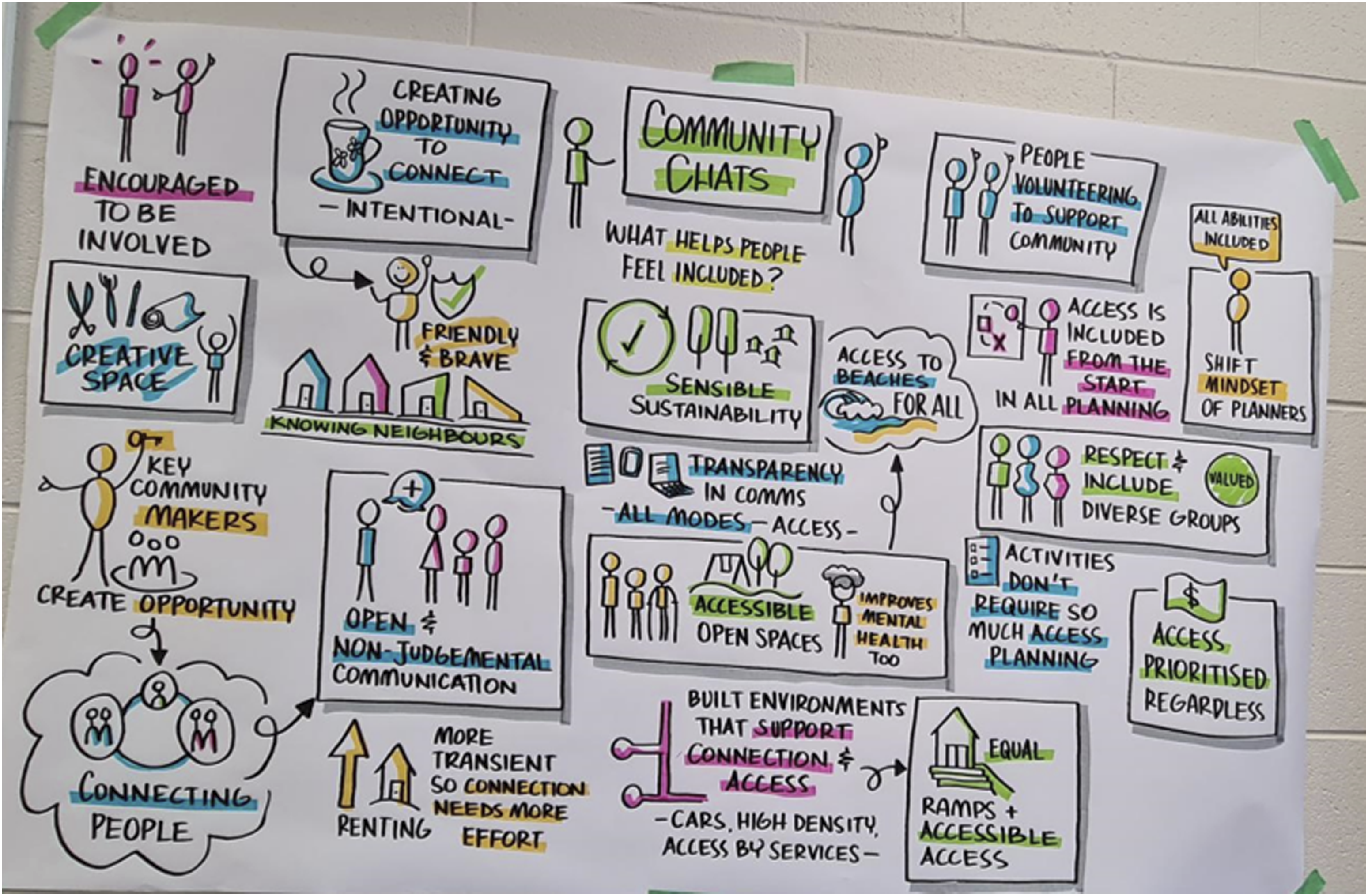
The format for the community chats
The two-hour community chats were structured around two rounds of questions with a break in-between. Round 1: What makes communities inclusive for you? (participants were promoted to think about what helps, or what does not help). Round 2: What you would change or add to make community more inclusive for people of all ages, all disabilities? For each round, participants were given time to individually reflect and think about what they wanted to share in response to the question. Participants were told to draw from their experiences covering stories, memories, spaces, infrastructure or places. After 10–15 min, the lead researcher invited people back together to share thoughts/experiences and to reveal ideas and consistent themes. This is known as a group harvest. Responses for each question were captured through audio recording, notes by researchers, and in eight of the chats, a visual recorder live drew the concepts and idea shared by participants (see Figure 1). The visual recorder signed a confidentiality agreement as part of the research process. At the end of the chat, the lead researcher summarised the key themes emerging from the Community Chat, as well as highlighted visual recordings and reporting timeframes.
Research location and participants
Research location
Two locations, Clarence City Council Tasmania and Gympie Regional Council Queensland, were purposefully selected as locations for this research, for their opportunity to understand planning inclusive communities at the local level and give voice to people with disabilities living in inner regional communities – that is small cities and towns outside of major capital cities (ABS Remoteness Area structure). At the time of commencing the research in 2020, according to ABS inner regional areas had the higher proportion of population with people with disabilities (16%) compared to major urban areas (11%) (ABS, 2015); yet these areas are often overlooked in disability and planning research. Furthermore, while Clarence and Gympie were active local governments in disability inclusion and strategic planning in creating more inclusion in their regions, like many regional areas they often face the challenge of reduced levels of social infrastructure and services compared with major cities (Baldwin and Stafford, 2018).
Specific characteristics
The City of Clarence with a population of 56,945 (Australian Bureau of Statistics, 2021) is in lutruwita/Tasmania – an island state south of the mainland Australia – which is the ancestral land, seas and waterways of Palawa/Pakana people. Clarence is in the greater Hobart region (population of 251,047 (Australian Bureau of Statistics, 2021) and is one of the largest regional areas in Tasmania. Tasmania has the highest rate of disability proportional to population than any Australian state – 30.5% compared to national average of 21% (ABS SDAC, 2022). Gympie Regional Council, Queensland, is northwest of the state capital of Brisbane with a population of 53,750 (Australian Bureau of Statistics, 2021), bordering Noosa Shire (56,873 population (Australian Bureau of Statistics, 2021) and Sunshine Coast region (346,648 population (Australian Bureau of Statistics, 2021), all on the ancestral lands and seas of Gubbi Gubbi people.
Participants
Stage 1a involved 97 people, aged from 9 years up to 92 years of age. The participants included a diversity of ages, backgrounds, roles and professions. From the onset this research was design from inclusive creative methods that provided various opportunities for any person 9 years and up to tell their story. The research also importantly embedded supportive decision-making processes to enable the participation of people with cognitive disabilities and severe mental ill-health. Only exclusions criteria applied in this research were: (1) children under 9 years and (2) anyone living outside of these regions. Ethics approval conditions prevented disaggregated data by regions and disability type due to identifiability issues within communities. However, larger breakdowns included: 57% of participants identified as a person with a disability (inc. physical, intellectual/cognitive, sensory), neurodivergent, mental ill-health or/and chronic illness; 6% of participants were parents of a person with a disability/chronic illness; and 37% were non-disabled people community members that included local government workers.
Participants were recruited through the dissemination of information through advisory groups, local government networks and non-profit organisations’ social media sites, as well as local radio and print media. Informed consent was facilitated through participating information and resources such as easy-read materials and videos for each research activity method, along with an easy-read full website. Participants could complete consent forms online, by email or over the phone.
Analysis
Interpretive grounded theory analysis using Charmaz’s framework with triangulation was applied to develop a holistic understanding of the meaning and experience of inclusive communities (Charmaz, 2014). In this study, this meant undertaking multiple steps of analysis of the de-identified transcripts (1:1 and group chats) and open-ended questions from the questionnaire. This began with individual coding analysis of each data type first, moving to the merging step of the different data type findings, through to interpretive steps and theoretical saturation. The visual data was directly considered with the narrative transcripts as participant provided their explanations of why they chose the picture/words. This inductive analytical process was assisted using qualitative software NVIVO 12. The emergent meaning and themes about what makes communities inclusive arrived out of this rigorous staged coding process, including two coders aiding qualitative inter-rater reliability and trustworthiness of the qualitative analysis.
Limitations
COVID-19 provided specific issues to field research in the case locations in Queensland and Tasmania due to border closures between states in Australia, which significantly impacted the length of time in fieldwork and variation in participants involved in methods. It also meant wider diversity within disability community could not be guaranteed, which was further impacted by not being able to collect and report on such data due to ethics approval restrictions. The qualitative nature of this study along with being place-based and context-sensitive means it is not generalisable. However, the study findings are applicable at the conceptual, policy and practice level, when considered in context.
Findings
What makes or hinders communities from being inclusive is complex, and influenced by social, economic and built environment structures and systems (Stafford et al., 2024), but inclusion also happens in place and in movement – at the level of everyday experience. Participants' lived experiences and visions illuminated that to experience an inclusive community, one must have a deep sense of belonging-in-place facilitated through Enacting and Expressing Spatial Agency; Authentic Connections and Connectedness; and Dwelling in Place as Oneself. These factors are intrinsic to a sense of inclusion in community, showing the importance of how lived elements of place are considered in how we plan and design.
Exercising and expressing spatial agency
Spatial agency is a deeply embodied and actualising concept, concerned with the way our body-minds interact and navigate everyday spaces in their unique embodied way to undertake the mundane activities and encounter and make connections between people, place and nature. Participants detailed the freedom felt in being able to exercise one’s spatial agency to and in everyday life spaces, which was also understood as a precursor to developing a sense of belonging in everyday life, something that has been argued in the broader disability and geography literature. Exercising agency in everyday life is a prerequisite to undertaking repetitive social practices that engender an individual’s sense of place and belonging. As participant shared: A community where everyone feels safe, respected and feels that they can be themselves. A community that does everything it can to give everyone full access to services and resources, where everyone can participate. (Disabled person questionnaire respondent)
Participation in public life, beyond the worlds of home and work, was described in terms of having the opportunity to invest oneself in public life on one’s terms.
Spatial Agency is thus associated with everyday places, everyday activities, and being able to enjoy them with a sense of embodied ease that involves a feeling of safety, and not having to “fight” or endure stress to do so. These concerns extended to carers and parents of disabled people, including a couple who stated that: “Being an inclusive community means to us that we can take our son who uses a wheelchair to all activities easily, safely and stress-free” (Parent questionnaire respondent). The opportunity and capacity to undertake everyday routines, activities and moments, that are vital to developing a sense of place (Casey, 2009), is immensely contingent upon social and environmental factors that manifest in spaces (Stafford et al., 2020). What makes community inclusive is being able to access the same facilities and same areas…facilities, day-to-day things…that everyone else can in a community, and we shouldn’t have to fight to do it. (Disabled person – Chat 9)
We also heard how having the freedom to explore using one’s spatial agency was integral to performing everyday tasks that are key to building connectedness to place. This was expressed in the ability to travel through space to a desired destination, and the ability to explore space by wandering and interacting. Casey (2009) described wandering as integral to dwelling, bringing forward the experiential aspects of place and the want to engage a human sense of curiosity. For participants, immobilising aspects of exclusionary built environments (such as poor or unsafe footpaths, no curb cuts, and lack of connectivity in suburbs and cities) resulted in very limited routes, foreclosing opportunities to explore and connect deeper with place (Figure 2). When I’m in the community and people are saying, well physically I can’t go there because they can’t accommodate my needs or physically when I walk down this street, I can’t go there, I can’t enjoy my life because of external things to myself, from a physical environment point of view. That makes me really sad and I want people – I think, well what can I – I’m always thinking, what can we do, what can I do? (Local government worker – 1:1 interview (2)) White paper with the hand written words “Being allowed to occupy space” . A Disabled Participant note from community chat 1.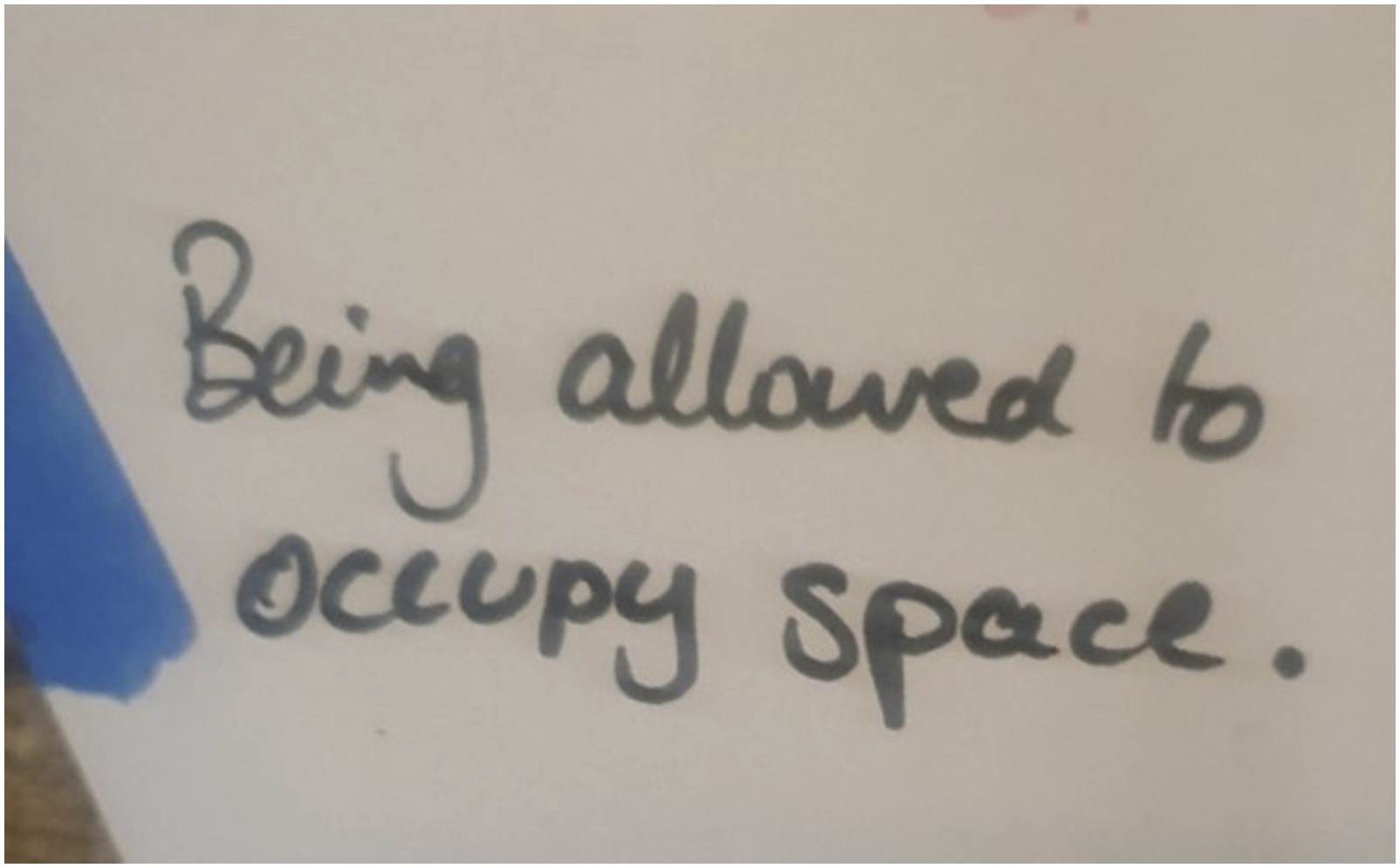
Public transport was also heard to be an essential part of exercising spatial agency beyond one’s immediate street/suburb. However, in contrast, we heard how suburbs designed for car-dependent transport, with no or infrequent public transport, and poorly designed transport infrastructure such as bus stops, foreclosed essential acts like food shopping, going to work, socialising, etc. Public transport was also linked with connection and interdependence promoted in and through place. This essence was reflected when confronted with the absence of suitable services and infrastructure that would otherwise enable encounters that engender a sense of community. These are illustrated in the excerpt below: So I think when people think of transport, it's important to see – I'm sure we all do, but it's not just about the A to B and getting to a job or a sport. It could be as simple, as basic as feeding your family or yourself. (Parent of a person with a disability – Chat 1) Transport is a big issue for me for inclusive communities, coming from a community where the transport's gotten a little bit better, but it's not fantastic…that can make it really hard for our kids to be included in a lot of things. Walking, good walkways, seating and people looking out for one another (are important). (Parent - Chat 1)
Agency and belonging are most visibly entwined in questions of mobility – that is how bodies can navigate space in ways that enable participation in everyday activities. Critical for participants was the ability to move through space safely and on their own terms, unencumbered, as part of their dwelling. Mobility justice literature has explored the importance of safe, viable and alternative forms of transport as a priority, and the need for transport to consider body-mind diversity (Enright, 2019; Waitt and Harada, 2022), as well as the need for walkable and wheelable streets to promote inclusion by allowing people with disabilities to live their daily lives (Baldwin and Stafford, 2018).
In heavily car-dependent contexts, such as where this research was undertaken, the lack of alternative transport options and walkable or wheelable paths created both perceptions and lived realities of exclusion. In some situations, car dependency and poorly designed infrastructure pose a danger to people’s bodies, such as collapsing wheelchair ramps at bus stops or paths on steep topography that were not suitable for wheelchairs. These findings reinforce the link between ableism and coerced immobility (Stafford et al., 2020) and forced car dependence, which has been shown to worsen impairment and foster spatial injustice (Aldred and Woodcock, 2008). Part of this injustice is how limited or absent active and public transport infrastructure foreclose the possibility of fostering everyday connections and experiences of place that are integral to the richness of human dwelling and the cultivation of belonging.
Authentic connections and connectedness as place creation and strengthening
The everyday experiences discussed in participants’ interviews and community chats revealed the importance of having authentic connections and connectedness in the community as a form of place creation and strengthening. These connections were often situated in public spaces and natural environments in/around communities and cities. This insight links to understanding the role of place, particularly those in the public realm, as a locus of attachment, meaning, and belonging (Devine-Wright et al., 2019).
In the research, spaces between buildings, interfaces between buildings and street fronts, and public open spaces that provided accessible (sensory, physical, emotional, cognitive) connections with people and nature were revealed as particularly important foci in evoking a sense of belonging and as a marker of an inclusive community.
Sense of place as vibrant and fun
A significant essence of place belonging is the vibrancy conveyed in spaces and infrastructure (Silver, 2022). Such vibrancy was heard to engender a sense of fun and friendliness, bringing people together, and being creative, while ensuring seamless connectivity and participation. Participants explained how they felt vibrant places support the flourishing of people by evoking joy but importantly breaking down silos – helping to bring people together. Furthermore, communities and cities with public spaces that enable creativity to be expressed in many mediums were key to making cities and communities inclusive. Areas where I feel like people can just come and be and you see people from diverse communities and different cultures. Parks, most of them are all accessible for people, you can come and play, sitting on the grass and you see all the families, sharing food and it's a happy – amongst nature in the sunshine, it's a happy place. Playgrounds. A big one for me is the beach. Yeah, wanting that to be accessible for everyone because I know sometimes not everyone can experience the beach in the same way as everyone else. (Disabled person – Community Chat 5)
What is common to places that engender a deeper sense of inclusion is the experiential richness they carry and the ways they afford spatial agency in social and spatial practices that promote connection through a sense of fun, ecological diversity or distinctiveness.
Our interview participants stated that “plain”, “dull” and “grey” public realms didn’t evoke inclusion. These insights suggest that the inclusion discourse may currently neglect the quality of place as it is integral to creating and strengthening a sense of belonging and wellbeing. As discussion illuminated, too often the “fun” was taken out of public space in urban environments, removing celebration of diversity and elements of play and enjoyment. As one participant stated: I sometimes feel that Australia is a little bit rigid, and I understand that because (Occupational Health and Safety) and all of those things, but it would be good to just break out in dance or something [laughs]. Bring everyone together [laughs], have some fun. (Community Chat 5 – Local government worker participant)
Our participants’ insights lead us to ask the question – who would want to be included in a lifeless environment? And what would inclusion be without a sense of fun that all can enjoy? Fun, too, happens within and through place, as these participants explain: Fun, it's social, no barriers, outdoor spaces, creativeness, nature, bushwalks, yeah, just everyone being able to do whatever they want to. (Chat 1 – Local government worker participant)
Sense aliveness helps belong in place
“Aliveness” was also described by participants as central to a sense of belonging in place. This was expressed in terms of the public spaces themselves as well as the presence and connections with natural environments. A key part of why someone wants to live in a community is to have nice places to be and that will also be alive, so there will be an abundance of wildlife and insects and different plants and flowers, and it'll be nice. That comes back to being fun and happy and friendly and welcoming environment. (Chat 5 – Local government worker participant)
These experiences were not just about sociality, but also sensory richness and ecological diversity at hand, as participants articulated “you can smell the flowers” (Older person – Chat 3). Participants associated a deeper connectedness with landscape and nature as pivotal to wellbeing and grounding. Furthermore, immersion was not merely visual, but tactile, through scent that carries memory, and deeply experiential. One participant found the sensory experience of floating on the water or looking out to sea particularly important: I find the sea is my space; where I want to be. Floating on the water; love it….Like, you’re coming home and a beacon as to where you’re going to go; where you belong. (Disabled person – Chat 3)
As participants in a community chat put it, immersion in nature provided a “heightened sensory experience…so you know where you are,” (disabled person) pointing to an enmeshment within the web of ecology as important in cultivating one’s sense of place and belonging.
While the importance of nature in urban environments has been linked to wellbeing across an array of literature (Bush et al., 2020; Plumwood, 2002), the way interaction with nature fosters a sense of ecological inclusion, of being part of an ecological world, a more-than-human “coming home” has remained unexplored in inclusive cities literature. The wellbeing implications may be particularly relevant for people with sensory processing needs or mental health needs, for whom more tranquil natural environments may prove particularly therapeutic (Lakhani et al., 2018).
The research insights affirm that belonging and connectedness are ontological grounding elements of place that are lived through habitual and serendipitous body-space-time processes and interactions as Seamon described in his Place Ballet typology. However, we also understand through these lived meanings, how access to and the freedom to participate in vibrant and alive places is not only essential to inclusion but can be considered a matter of spatial justice and rights (Seamon, 2013; Soja, 2009; Bailey et al., 2012). The importance of connectedness created through interactions, having fun, immersion with nature and public realms, signals the need for “inclusion” to go beyond regulations, to thinking about how we plan and design public spaces that foster everyday joy, wellbeing and vibrancy – crucial to belonging.
Being oneself in place – Feeling of at homeness
Enacting spatial agency and having authentic connectedness with lifeworld create and strengthen one’s sense of place and facilitates inclusion. However, a deeper sense of belonging was heard to be engendered when you are free to be yourself in place. This sense of belonging reflects what Relph referred to as existential insideness in 1976 – “the deepest kind of place experience, where one feels they belong and has a sense of at-homeness” (Seamon and Sowers, 2008: 51–55). It’s one where we celebrate diversity and the things that make us different. One that provides opportunities for everyone to participate. One where we challenge stereotypes, and where nothing and everything is normal. Then I’ve sort of centred around the Universal Declaration of Human Rights, using the freedom, respect, equality, dignity as just sort of some dot points. (Disabled person – Chat 9)
While the right to place is linked to spatial justice and right to cities (Soja, 2009) it is the focus on everyday embodiment, and the interconnectedness of all body-minds, place and ecology that makes it distinctive.
The feeling of at-homeness was signalled when the designed environment reflected the diverse ways of experiencing and being in space. That is how we feel, sense, think and move about in everyday spaces, which is reflected in spatial layout, streetscapes, wayfinding, the use of materials and colours, nature and landscapes, and so on. Planning and designing for our body-mind diversity, strengthens a sense of place and belonging. Such learnings can also help to inform spatial planning and design practices that help evoke the human experience of felt insideness in planning inclusive sustainable cities and communities. …. Not feeling like [sighs] I can't go there, I won't be included, it's not going to be for me, I won't be received well here. But to me, this is a picture of hope that somebody can go wherever it is and in an ideal world that that wouldn't be a factor. Thinking I can just go wherever I want and be included and feel part of life and everything. (Disabled person 1:1 Chat 4)
Participants, however, reflected on the prevalence of existential outsideness, and how prejudice and stigma around disability and difference remain a significant problem in communities and cities. Examples of prejudice and stigma were expressed socially (attitudes and beliefs about what’s “normal” and average). This was also reflected spatially – in how streets, public spaces, and transport excluded and denied access to diverse bodyminds due to planning for “normal”. This hostility and othering towards “non-normative” bodyminds was expressed in materiality and felt in one’s embodied interactions. you know, show me normal? I’d love to have like, some sort of, you know, higher profile campaign around that. We’ve got posters on the back of the toilet doors around depression and check in with a mate, and all that sort of thing. If there were a campaign that sort of said, show me normal, I’d be wanting to be a part of that campaign. ..I’m not supposedly normal. Because I don’t think anyone is. (Disabled person – Chat 4)
For inclusive communities and cities to manifest, it requires a paradigm shift in how we value our differences with a change in mindset that recognises and celebrates body-mind diversity as this becomes the reference point of planning and design practice. Getting to this point, however, will require the disruption of the entrenched bias of “normal” body-mind entrenched in the built environment (Imrie, 2003), along with questioning stereotypes of what constitutes “disability” (Sins Invalid, 2019)
Discussion and conclusion
This research has demonstrated the importance of place to disability justice and inclusive communities and cities discourse, drawing upon the insights and lived knowledge of 97 interviewees aged nine and over from two Australian regions. The theoretical contribution of this paper illuminates the critical connectedness between embodied, ecological and critical thought, proposing the “right to belonging in place” as an agenda for conceiving new ways of approaching planning for disability justice and expanding the policy discourse on inclusive communities and cities. In doing so, our research also reinforces the long-held understanding in phenomenology of the entwined wellbeing of people and place (Seamon, 2018b). Secondly, our research builds on Seamon’s work on “place justice” (Seamon, 2013; 2018b) by demonstrating the importance of access to a network of vibrant places that engender a sense of belonging and connectedness in the everyday lives of disabled people. Integrating this agenda with disability justice more firmly links the ecological, embodied and emplaced nature of existence.
Importantly, our research reveals and reinforces that the right to belong in place is dependent on the opportunity to occupy, participate and be immersed in a network of vibrant, experientially rich places. These may be highly social places, full of human encounters and expressions of diversity, or they may be more tranquil places characterised by slower rhythms and the sensory experience of being immersed as part of nature. Furthermore, to belong in place, requires all bodyminds a sense of ease in moving between and navigate places conducive to participation in everyday life. Here, agency is understood as located in the entwining of bodyminds and built world, as well as mediated by socio-political practices of planning and design. Enacting agency is critical to opening space to perform social practices and everyday interactions that cultivate place attachment and belonging as our interview participants disclosed. However, because the built world is hostile to diverse bodyminds, enacting one’s spatial agency is often hindered, and exclusion to participate prevails – evoking coerced immobility, alienation and placelessness.
Within urban and regional planning, the right to place is concerned with a need to “reconfigure places that facilitate lifeworlds in which people feel a part rather than apart”, allowing for “qualities of place that contribute to…individuals’ well-being as they simply live their daily lives”, including people and more-than-human life (Seamon, 2013: 163–164). The right to place recognises the entwining between individual, collective and ecological wellbeing that place engenders – rather than an individualistic rights-based approach, it is concerned with both the individual and the politics or expression of interdependence that sense of place conjures (Seamon, 2013). Our research insights combined with phenomenology place scholarship, also vividly illustrate the importance of planning practice that opens the way for all bodyminds to experience dwelling as oneself. Such experience is an expression of place and disability justice because the denial of the right to belong in place as disabled persons is an existential-political issue of justice and rights.
Finally, a right to belong in place is associated with the holistic interdependence of being “at one”, and immersed in the world. While the sensory richness of immersion in the natural world is vital for human wellbeing (Lakhani et al., 2018), it is the feeling of being part of life rather than being separate from that which promotes a deepened sense of belonging. Equally important, our research illustrates the importance of vibrant, fun and sensory-rich places to engender sense of inclusion, aliveness and togetherness. However, to date vibrant joyful places engendering inclusive communities has not been well recognised in either the disability or inclusive communities’ discourse. It is high time for change. We argue, inclusive cities and communities discourse must engage better with idea of socio-ecological connectedness that allows each of us to explore and shape our being-in-the-world through symbiotic interactions that require thriving, ecologically-rich, vibrant places (Bush et al., 2020; Seamon, 2013, 2018a, 2018b).
While this research does not specifically focus on settler colonialism, the right to belong in place from a disability justice lens must recognise and prioritise the restoration of existential links to place and, in the land known as Australia, for First Peoples with disabilities (Cooms et al., 2022). The literature demonstrates that gathering places and sites that allow for restoration and practice of connection with Country are particularly vital for wellbeing in First Nations contexts, particularly amid the ravages of settler-colonialism (Kingsley et al., 2018). Consideration of the impacts of colonisation further emphasises the importance of place as the precursor to connection, and Country as an actor in its own right with agency (Foster et al., 2020). We see the importance of further research focusing on how colonialism acts as a barrier to disability justice, furthers intersectional oppression and undermines the ability for disabled people to be part of thriving places.
In summary, our research advances the conceptions of inclusive communities and cities by illuminating how inclusion is always a lived and emplaced phenomenon as well as a socio-political phenomenon. Inclusion depends on quality of place, including access to vibrant joyful and nature-dense places, as well as the way systems and structures consider and reflect diverse bodyminds, and promotes spatial agency. Recognising the nexus of place and disability justice in inclusive communities discourse is critically important in progressing planning futures discourse as disabled people are likely to be more heavily affected by environmental degradation and the climate emergency (Jampel, 2018) at the level of everyday experience. At a practice level, the research foregrounds the importance of engaging with lived experience as a means of understanding diverse ways of dwelling, spatial agency and connecting with place. The research also suggests that policy, planning and governance need to attend to the ways these disciplines consistently open or foreclose the possibility of deepening a sense of at-homeness that reflects our diverse bodyminds.
The right to place for disabled people is a critical component of disability justice and must be an essential focus for inclusive cities and communities research and practice. This requires greater visibility of disabled people voices in urban planning and policy, more scholarship contesting ableist assumption within broader inclusive cities and communities’ discourse, and the need to re-engage with the importance of place in the everyday lives of disabled people.
Footnotes
Acknowledgements
We wish to thank Rosie Pretorius, Pippa Rogers, and Isaac Tye for their work on the project and thank every participant who made this research possible, as well as many people and organisations for supporting this project over a difficult time in Australia with bushfires and global pandemic. Special thanks to Julie Andersson, Clarence City Council, Disability Voices Tasmania, Mission Australian PITC, THS-Health Promotion, Young Leaders of Tasmania, Gympie Regional Council, Queensland Disability Network, and all members of Gympie and Clarence local advisory groups in 2020.
Author contribution
Lisa: Conceptualisation, Data curation, Methodology, Analysis, Writing; Matt – Analyse, Writing;
Declaration of conflicting interests
The author(s) declared no potential conflicts of interest with respect to the research, authorship, and/or publication of this article.
Funding
The author(s) disclosed receipt of the following financial support for the research, authorship, and/or publication of this article: This project is funded by the Australian Research Council under DE190101512 - Dr Lisa Stafford ARC Discovery Early Career Researcher Award (DECRA).
