




Abstract
Approaches from agonistic planning theory view conflict as immanent to pluralistic democracies and criticize communicative planning theories for disregarding such conflict and relying too much on consensus and cooperation. This criticism has led to a partial division between agonistic and communicative planning theories. The article presents the basic principles of agonistic planning theory and develops a criticism of its biasedly positive view of conflict as a productive force, as well as the significant gap between its theory and practice. In order to expand the scope of planning and to bridge this gap between theory and practice, the article distinguishes between three ideal types of dealing with conflict: (a) avoidance of conflict that is understood as disruptive, (b) conflict as an occasion for participation and consensus building, and (c) acceptance of conflict. These passive, reactive, and proactive manners of dealing with conflict are assigned to the comprehensive-rationalistic, communicative, and agonistic planning theories. Because these ideal types occur in practice in various mixed forms, the theoretical framework may help to understand and analyze the politics of planning. Finally, the article presents some planning challenges and dilemmas with regard to the ongoing transition towards pluralist democracies.
Introduction
Many countries in Europe are currently characterized by increasing social heterogeneity and inequality. This reinforces political divisions and democratic cleavages. A decline of the middle class resulting from the increasing social polarization of poor and rich, a growing “super diversity” of the population due to immigration, and a decline of former people’s parties are much-discussed signs of this shift towards pluralist democracies (Paxton, 2020). The current rise of right-wing populism in many European countries can also be interpreted as an expression of increasing pluralism. Although right-wing populism itself is anti-pluralistic (Sager, 2019), its consolidation has led to increasing controversy about political alternatives, and the participation of voters once again increasing. Following a supposed phase of “post-democracy”, the active civic engagement of citizens in public protest, citizens’ initiatives, and referendums is also increasing in many countries. In the transition to pluralist societies, conflict within and from planning is increasing, too. In Germany, for instance, this includes: conflict surrounding the implementation of large-scale projects resulting from reduced acceptance and increasing citizen protest, for example, the Stuttgart 21 project (Gualini, 2015); conflict that arises from urban growth and housing shortages in large cities, exacerbated by direct forms of democracy, for example, the Tempelhofer Feld referendum in Berlin (Hillbrandt, 2016); conflict that arises in the implementation of the post-fossil era energy transition, for example, through numerous citizens’ initiatives against wind turbines and power lines (Weber, 2018); and conflict over immigration policies in the transition to a pluralistic immigration society (Foroutan, 2019). Agonistic approaches in planning theory are currently very popular because they respond to the increasing conflict within society. Such conflict has not been adequately addressed by the approaches of communicative planning and governance research, which have instead strongly focused on consensus and cooperation. Some planning researchers have already declared agonism to be a new paradigm for planning theory (Gualini, 2015; Pløger, 2004, 2018). The approaches of agonistic planning mostly refer to Chantal Mouffe’s political theory of agonistic pluralism. According to this theory, conflict is inherent in pluralist societies and the acceptance and legitimacy of conflict characterizes pluralist democracies (Mouffe, 2013). In some contributions, agonistic planning theory is portrayed as the highest level of planning theory, replacing communicative planning (Bäcklund and Mäntysalo, 2010). Agonistic approaches in planning theory distance themselves from communicative planning-theory approaches and criticize them for their negation of conflict, over-reliance on consensus, and depoliticization of planning theory (Gualini, 2015). The opposing focuses of consensus and conflict have led to a division between communicative and agonistic planning theories.
The following article outlines the main principles of agonistic planning theory before presenting several points of criticism relating to its theoretical premises and the gap between theory and practice. The article then distinguishes between three ideal types of dealing with conflict through planning and assigns these to different planning-theoretical models: (a) avoidance of conflict (comprehensive-rationalist planning), (b) consensual resolution of conflict (communicative planning), and (c) acceptance of conflict (agonistic planning). A comparison of these models follows, analyzing the specific relationship between planning and conflict, the respective understanding of conflict, the goals in dealing with conflict, and the role attributed to planners. Since conflict is in many cases an expression of democratic deficits and power inequalities, the different understandings of democracy and power that underlie the theoretical planning models are highlighted. Finally, the article identifies some planning challenges and dilemmas that result from the ongoing transformation into pluralistic societies.
The article seeks to reflect the international state of research on agonistic planning theories, but in describing planning practices and in its empirical examples relates predominantly to the author’s experience with the German planning system. In a comparative European perspective, the German planning system has been described as a decentralized and multilevel system, in which the federal, the Länder, the regional and the municipal level are closely related. Due to the federal constitution of the country, the Länder and the municipalities have a strong position (Blotevogel, Danielzyk and Münter, 2014). A municipal planning autonomy as part of a local self-government is constitutionally guaranteed. But in practice municipalities are depending on financial resources of the state and for this reason develop planning approaches. In addition to the formal land-use planning system, informal planning instruments (e.g. visioning processes, urban and regional development concepts, strategic plans, scenarios) are increasingly gaining significance on all levels. Informal planning is based on an extension of civic participation and is often used to find compromises during formal plan preparation procedures. Because informal planning requires win–win situations among the actors in order to be successful, the possibilities for solving conflicts are limited (Blotevogel et al., 2014: 87). In contrast to majoritarian democracies, as in the UK, the German planning system is based on a coalitional political culture, where decisions are taken on the basis of consensus (Hendriks et al., 2010; Lijphart, 1999). The often broadly used concept of “planning” is limited here to public administration agencies functioning at the spatial level of cities and regions. In this narrower understanding, urban and regional planning forms part of the political-administrative system. Planning is dependent on policy because politicians set the scope of action for administration through their democratically legitimized leadership and decision-making powers. In considering this unequal relationship, I prefer the term “politics of planning” and see planning as a political process in all its phases.
Agonistic pluralism as a political theory
Many agonistic contributions to planning theory refer to the political approach of agonistic pluralism described by Belgian political scientist Chantal Mouffe. A central assumption of her work Agonistics: Thinking the World Politically (Mouffe 2013) is stated thus: “Conflicts in liberal democratic societies cannot and should not be eradicated, since the specificity of pluralist democracy is precisely the recognition and legitimation of conflict” (Mouffe, 2013: 7). Mouffe distinguishes the antagonistic from the agonistic political sphere. In contrast to antagonism, which is based on unsolvable opposition between hostile parties, agonism is based on competition between opponents based on commonly accepted rules within the framework of pluralist democracies. “To put it in another way, what is important is that conflict does not take the form of an ‘antagonism’ (struggle between enemies), but the form of an ‘agonism’ (struggle between adversaries)” (Mouffe, 2013: 7). She goes on to criticize political practice: “Too much emphasis on consensus, together with aversion towards confrontations, leads to apathy and to a disaffection with political participation” (Mouffe, 2013: 7). Mouffe’s work thus lies in the social-science tradition of Georg Simmel, Lewis Coser, and Ralf Dahrendorf, according to which the resolution of social conflict is productive on condition that there is a common basic consensus (consensus omnium) between the conflicting parties, comprising the legitimacy of opposition and the rules of conflict resolution (Coser, 1956; Dahrendorf, 1961). By institutionalizing rules, antagonistic struggles can be transformed into agonistic ones. In a liberal world view, this includes, for example, corporatism between employers and unions or legal disputation.
The struggle between opponents to which Mouffe refers is constitutive for all political-science models of pluralism (Dahl, 1961). Politics in pluralist democracies lives from controversial debate and passionate contentions, including conflict. The role of parties and lobbies is to represent the particular interests of organized groups. The competition between government and opposition, and election campaigns for political power, are core elements of classic democracies. A main critique of Mouffes theory of agonistic pluralism is, that it lacks an adequate account of democratic institutionalisation. Because of this “institutional gap” (Paxton, 2020: 80) it remains unclear which democratic institutions are able to realize agonistic principles. Although Mouffe’s theoretical approach refers mainly to the national and international level of politics, she does not address the great variety in degree of conflict cultures found in the various national forms of democracy in Europe (Lijphart, 1999). In this regard, consensus democracies (e.g. Switzerland, the Netherlands, Germany), in which conflict is regulated through negotiation, compromise, and proportion can be distinguished from competitive democracies (e.g. United Kingdom, Ireland), which are characterized by the majority principle and fierce competition between political parties. In consensus democracies, decisions are taken on the basis of compromises, in competitive democracies, decisions are taken on the majoritarian principle (Hendricks et al., 2010).
The transfer to agonistic planning theories
Many authors have applied this approach from political science to the field of planning, aiming to develop an agonistic planning theory (Gualini, 2015; Pløger, 2004, 2018; Roskamm, 2015). The main strengths of agonistic planning theory are that they address the role of public planning in dealing with the growing conflict in society and cities (Gualini, 2015); they repoliticize planning after a supposed phase of “post-politics” and (once again) see planning as a political practice inevitably underpinned by different and often conflicting interests (Gribat et al., 2017); they overcome the alleged lack of alternatives in the supposed “post-democracy” and (once again) enable debate about alternative solutions in planning (Roskamm, 2015); and they (once again) strengthen the role of democratic participation by citizens in planning processes (Bäcklund and Mäntysalo, 2010).
Conceptual weaknesses of agonistic planning theory
Agonistic approaches to planning theory also have clear theoretical and conceptual weaknesses, however. Deficits include the following points:
- Agonistic planning theories do not determine the conditions under which antagonistic conflict can be transformed into agonistic conflict. Some authors assume that antagonism is essentially indomitable and counter that attempts to tame antagonism inevitably fail (Roskamm, 2015: 397). This position assumes that all conflict is antagonistic, in the sense of rule or class conflict, and cannot be agonistically regulated. At the same time, this radical criticism moves away from the premises of pluralistic democracy.
- Agonistic planning theories do not reflect on whether, and under what conditions, the theory of agonistic pluralism can be transferred from policy to planning (Pløger, 2018: 269). Pluralistic policy is based on conflict; by contrast, planning as part of public administration is based on a need for consensus. “Public planning is politically legitimized as a way to avoid endless disagreements” (Pløger, 2018: 269). The German planning scientist Dietrich Fürst speaks of a “dilemma between the need for consensus in planning and the growing conflict intensity of fragmented societies” (Fürst, 2018: 1717). This spatial-planning dilemma results from the defined tasks of weighing different departmental demands, coordinating public and private actors, and balancing divergent interests (Fürst, 2018). Planning systems in other European countries such as the Netherlands are essentially consensus oriented and seek to balance local interests. “Planning is an instrument of consensus, which is the only way to move forward in the complex web of conflicting interests that characterizes local planning practice” (Özdemir and Tansan-Kok, 2019: 746).
- A central and normative premise of agonistic planning theories is that conflict is a productive force. “The system must make strife a productive force” (Pløger, 2004: 87). However, agonistic planning-theory approaches provide no statements about the conditions under which conflict can be such a productive force. According to social-science conflict theories (Coser, 1956; Dahrendorf, 1961), the institutionalized rules recognized by actors are of crucial importance to a productive outcome of conflict. Theoretical statements concerning the influence of institutionalized rules of planning procedure on the course of conflict are therefore necessary, but do not yet exist.
The gap between agonistic planning theory and practice
Agonistic planning theory is often also criticized for the large apparent discrepancy between its practice and its theoretical approaches, which suggest no specific means for its application (McAuliffe and Rogers, 2018). According to some authors, there is a “widening gap between theory and practice” (Bäcklund and Mantysalo, 2010: 348). Agonistic pluralism is a theoretical ideal, but “there is no proven ‘design’ for realizing it” (Gualini, 2015: 21). From the perspective of practice-oriented planning research, the following criticisms can be identified:
- In models of agonistic planning theory, it remains unclear what concrete role planning is assigned in dealing with conflict. Is it about resolving such conflict or, on the contrary, about escalating confrontation? Should conflict be “negotiated”, “moderated”, “mediated”, or “arbitrated”? The planning literature relies on very ambiguous concepts for this. A book on planning and conflict speaks of “conflict management” and “resolution strategies” (Gualini and Bianchi, 2015: 42) and thus implicitly refers to strategic-planning approaches that depend on numerous preconditions that seldom exist in planning practice. The productive outcome of conflict is thus the focus, but at the same time the blind spot, of agonistic planning theories.
- Agonistic approaches do not consider that previous planning expectations regarding the role of conflict mediation (Forester, 1987) have mostly been unfulfilled in practice. In the course of the sustainability debates of the 1990s, too, regional planning in Germany was assigned the role of mediating conflict between ecological, social, and economic concerns (Diller, 1996). An important reason for the failure of this role assignment is probably that planners, as part of public administration, are dependent on policy requirements and therefore do not have the neutral role required for professional mediation.
- Agonistic approaches assume that conflict should be turned into a productive force, but say very little about the possibilities of how planning can contribute to a productive solution of conflict. To date, there are only vague statements that appear of little help for planning practices. Pløger, for example, describes that roles “to stress openness, temporality (temporary solutions), respect for difference, and the need to live with inconsistencies and contingency, are needed. This requires among other things open-ended processes, a politically autonomous but responsible institutional design, a plurality of discourses at play, and a form of ongoing, never-ending, critical, and mutually inspiring dialogues between politicians, planning authorities, and citizens.” (Pløger, 2004: 87). Even such newer role attributions as “wandering planner”, “editorial organizer of dialogues”, and “non-excluding ‘strategic navigation’“ (Pløger, 2018: 273) are not really convincing to practitioners.
- In political practice, conflict is not in most cases considered productive, but rather a disruption that threatens social peace and poses the risk of violent struggle (Othengrafen et al., 2015). In most cases, therefore, politicians normally try to avoid conflict. Criticism of agonistic pluralism starts exactly with politics’ *”aversion towards confrontation” (Mouffe, 2013: 7). In planning practice, too, much conflict is described as non-productive, rather than debilitating, since citizen protest often emerges very late after projects have been approved and construction begins. In many cases, protest is not articulated at an earlier phase of political participation processes before political decisions have been taken (Hunig, 2015: 346).
Ways of dealing with conflict in planning
These criticisms show that agonistic planning theory takes a highly biased positive view of conflict without considering existing reservations and ambivalence in the political practice of planning. In the following, I would like to broaden the spectrum of action for planning in dealing with conflict and to bridge the gap between theory and practice. I therefore differentiate between three planning-theoretical models, representing ideal types that in practice can occur in various, mixed forms (see Othengrafen et al., 2015). These models follow an evolutionary approach in planning theory, which is based on dialectic “turns” and paradigm shifts. Those turns of models have been described from comprehensive-rationalist to incrementalist and from communicative to agonistic planning (Bäcklund and Mäntysalo, 2010; Wiechmann 2019). The comparison of these models takes into account the specific relationship of planning to conflict, their respective understandings of conflict, their goals in dealing with conflict, and the roles attributed to planners. Since conflict is often an expression of democratic deficits and power imbalances, different understandings of democracy and power underlying the theoretical planning models are highlighted (see Figure 1).
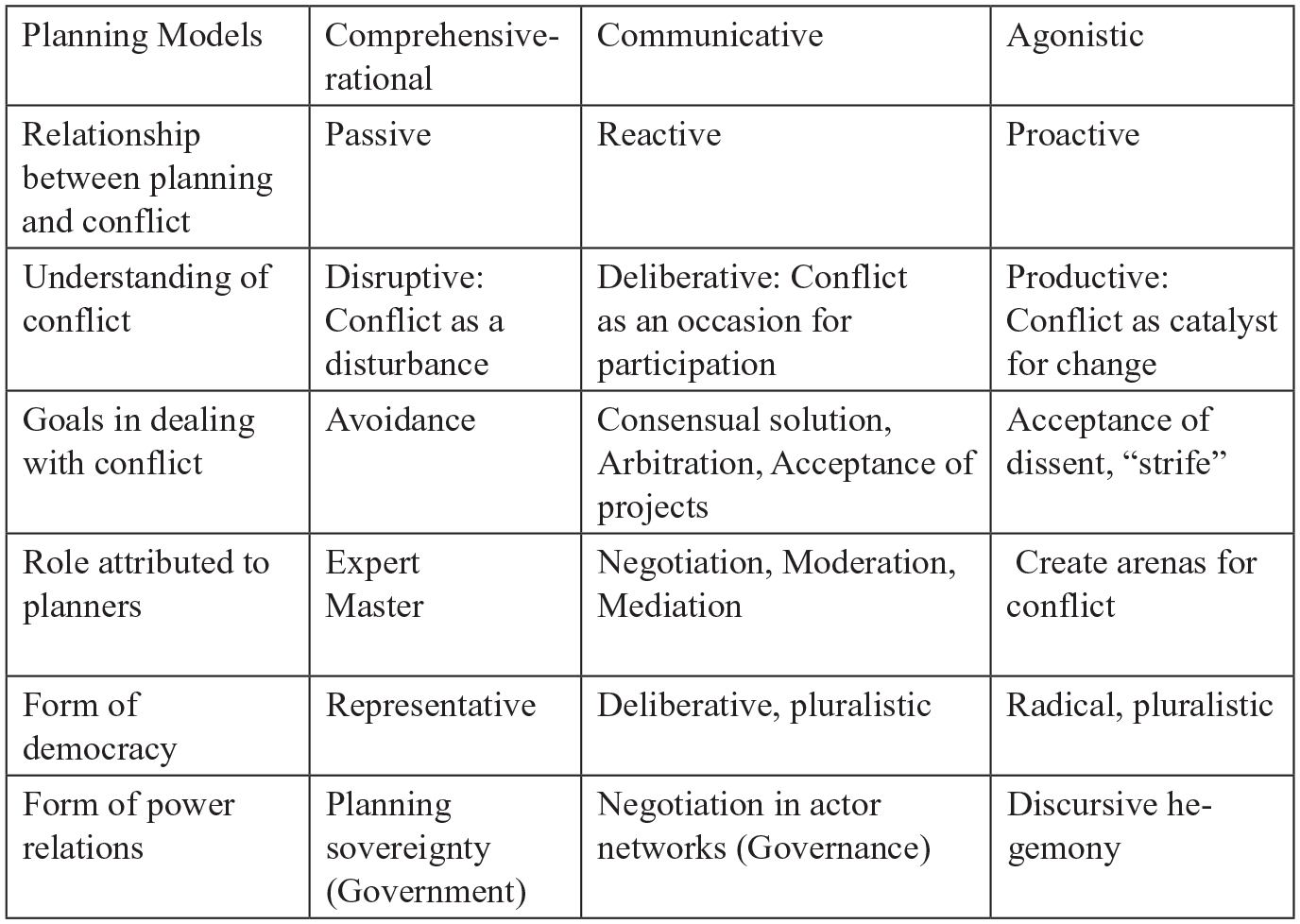
Planning models in dealing with conflict.
Comprehensive-rationalistic planning: Avoiding conflict
The comprehensive-rationalist planning model emerged in the post-war period out of a scientific and technocratic notion of society. The role of a higher-level master and independent expert was assigned to planning, who collected the most comprehensive information available, developed forecasts, defined long-term goals, coordinated resort departments, and derived “large-scale plans” or “master plans” (Altshuler, 1965). This model viewed planning as a technocratic engineering science (Friedmann, 1996). The model was based on pronounced triumphalism within planning and on an unencumbered understanding of power of the governmental political-administrative system. Democratic participation in public planning by citizens was hardly developed in this model, since planning asserted a still largely uncontroversial claim to define the public interest uncontested. Correspondingly, conflict has not been a feature of this model and was understood in the form of unexpected disruptions to planning processes that was to be as far as possible avoided or suppressed. The relationship of comprehensive-rationalist planning to conflict is a passive one. Power is understood as the control of public government over private actors (“power over”).
Communicative planning: Consensual resolution of conflict
The communicative planning model is strongly related to Jürgen Habermas’ social-science theory of communicative action. Habermas conceived a notion of deliberative democracy based on the ideal of domination-free discourses, seeking to reach consensus through rational argument. A basic model for settling discourses is participatory planning. In this model, planning is often assigned the role of a moderator of discussions organizing public debate, participation processes, and forms of collective cooperation (Forester, 1989; Healey, 1992; Selle, 2013). The relationship between communicative planning and conflict is reactive. The outbreak of protest and manifestations of conflict are seen as an opportunity to organize discussions and participation processes. The main goals are to resolve conflict by finding a consensus between actors. In many cases a consensus has the implicit goal of increasing acceptance of a plan or a decision. In dealing with conflict, planners are explicitly assigned the role of a negotiator and mediator. In an article on how planning at the local level should deal with conflict, John Forester has spoken of “mediated negotiation” (Forester, 1987) and thus ascribes two conflicting roles to planners: on the one hand to mediate between investors and citizens, on the other hand as a partisan actor supporting weaker and disempowered groups in negotiation processes. In this approach Forester combines the models of communicative planning (Healey, 1992) and “advocacy planning” (Davidoff, 1965).
Communicative planning theory understands democracy as deliberative and pluralistic, hence the power relations between the actors are primarily understood as a pluralistic negotiation of interests. According to this understanding, the public interest is also a result of negotiation and can no longer be defined by planning from above (Morini, 2018). In their understanding of power, there are close relationships between communicative planning theories and governance approaches from political science (Healey, 1992; Mäntysalo and Bäcklund, 2018). Both emphasize the importance of collective forms of cooperation between public and private actors and stress the participation of civil society and business in decision-making processes. In order to increase the ability of public policy and administration to act, power is defined less as social control over others (“power over”) and more as the ability of actors to collectively act (“power to”).
Agonistic planning: Acceptance of conflict
In contrast to the passive and reactive approaches described above, agonistic planning theories have a proactive relationship to conflict. Conflict is understood not only as immanent to pluralistic democracies, but also as productive (Pløger, 2004: 87). A possible productive force of conflict lies in its transformative function as a catalyst of social and institutional change, as Ralf Dahrendorf has described (Dahrendorf, 1961). The goals of the agonistic planning model are to accept dissent between actors, to make them visible, and to cultivate “strife” (Pløger, 2004). Since conflict resolution and consensus-building are core processes in politics, conflict and consensus are not mutually exclusive—even if this is suggested by the sometimes sharp distinctions made between communicative and agonistic planning theories. This is also recognized by Mouffe: “While consensus is no doubt necessary, it must be accompanied by dissent. (. . .) This consensus will therefore always be a conflicting consensus” (Mouffe, 2013: 8). However, the particular role attributed to planners remains rather unclear in the agonistic model. There is little concrete information on what “conflict management” (Gualini and Bianchi, 2015: 42) means in practice, or whether planning has the ability to deal with conflict productively. However, an essential role for planning can be derived from the theoretical premises: that is, to offer public arenas for disputes. Extended participation processes thus become a core component of agonistic planning theories (Bäcklund and Mantysalo, 2010). The participation of actors in planning processes is an essential step for the transformation from antagonistic to agonistic conflict. According to Mouffe’s theory, by taking this step actors leave the sphere of the political and enter the sphere of politics. The political refers to the dimension of antagonistic relations in society, while politics refers to practices, discourses and institutions (Mouffe 2013: 2/3). Within the formal and informal participation processes, civil-society initiatives are included in an arena of agonistic negotiation, the outcome of which is inevitably shaped by the power relationships between actors (Kühn, 2017). The dilemmas resulting from this are discussed at the end of the article. As we have seen, there are major overlaps in participation between communicative and agonistic approaches. Accordingly, some attempts are being made in planning theory to overcome the division between communicative and agonistic approaches and to form a synthesis (Bond, 2011). In an approach to participation in radical democracies, attempts are thus being made to combine the theories of Habermas and Mouffe (Beaumont and Loopmans, 2008).
In its understanding of democracy, the agonistic planning model shows many similarities to the older model of incremental planning (Lindblom, 1959; Rittel and Webber, 1973). Both models relate to pluralist democracies, in which different interest groups compete against each other. The public interest therefore results out of negotiation processes. Accordingly, the role of planning in incremental planning theory is greatly reduced, no longer a matter of accumulating extensive knowledge and formulating long-term goals, but of making short-term improvements in political practice. The model focuses on pragmatism and progress in small steps. The role of creating temporary solutions by degrees is attributed to planning in particular. In their understanding of power, however, agonistic and communicative planning theories differ significantly. According to agonistic theory, power is the achievement of discursive hegemony with the aim of political supremacy over opponents. The dominant regime will always be temporary and contested. Discursive hegemony refers not only to language, but to action in practice. Such hegemony goes hand in hand with the marginalization of lesser interests in the power struggle. In this regard, agonistic planning underlies a left-liberal notion of “power over” within democratic rules.
Challenges for planning in pluralistic democracies
During the development of pluralistic societies, the social, economic, and political lines of conflict in democracies increase. Planning is confronted with more frequent protest and conflict, while at the same time planning itself becomes an occasion for both. This results in a number of challenges, which the last part of this article will describe.
- While demonstrations and protests on streets and in public squares often act antagonistically—in practice, usually directed against a specific project or decision—a relocation of protest from the street to the town hall leads to a taming of conflict. The decision to attend in participation processes is also a step taken to tame conflict. Due to the spread of digital democracy, public arenas for agonistic conflict resolution are increasingly found in new digital media and social networks, alongside traditional governmental spaces such as the town hall. Digital media make it much easier for individual opinions to be articulated, but at the same time make the formation of a collective opinion and common political will much more difficult.
- In order to establish a lively “culture of debate” in cities and regions, agonistic planning approaches should focus more on the discussion of alternative solutions, including the so-called “zero solution”, that is, waiving a plan or project if the disadvantages outweigh the advantages after all matters are considered. Planners can support lively dispute in pluralistic democracies by being tasked by politicians to develop alternative planning options, to propose solutions, and to put them up for public discussion. One of the strengths of agonistic theories of planning lies in its overcoming the supposed lack of alternatives in so-called “post-democracy”, and in its presentation and discussion of alternatives.
- The requirement for open-ended procedures and discussion of alternatives contradicts the fact that informal pre-decisions are made in practice. In many planning cases decision-makers already made informal arrangements, such as between project developers and politicians. Participation procedures for citizens often serve as a false alibi, since many planning processes are no longer open to their results, preliminary decisions having already been made (Selle, 2013: 368 f.). In these cases, constraints are constructed and participation processes are mainly carried out to legitimize the goals of the project. Whether and how these preliminary decisions can be avoided is an open question that depends on the power relations between the actors involved (Kühn, 2017). In addition to elections (votes) and public protest (voices), citizens have the opportunity to use the media to mount political pressure, make scandal from violations of the institutional rules of democracy, and achieve a discursive counter-hegemony. In the local and regional fields of power, the media become important actors who can actively influence politics through their reporting and framing of events, particularly in conflict situations.
- Participation methods in planning represent a key element in bridging agonistic and communicative approaches, but there are fundamental dilemmas for planning due to the contradictory requirements for participation (Van Wymeersch et al., 2019). On the one hand, the participation of competing interest groups is a prerequisite for settling a dispute and resolving conflict. On the other hand, higher-educated, socially better-off, and powerfully organized groups dominate participation in planning practice. In pluralistic societies with large social inequalities, this dominance marginalizes disadvantaged groups that do not participate, are poorly organized, or do not make themselves heard (Gudrich and Fett, 1974: 53). The critical objection to pluralism, that it strengthens powerful groups while marginalizing the disadvantaged, concurs with empirical findings on participation research in super pluralistic cities, such as Antwerp (Beaumont and Loopmans, 2008). Critical participation studies speak of “marginalization through formal participation” (Mc Auliffe and Rogers, 2018: 9). The existing power imbalances between social groups have therefore not been balanced by agonistic approaches and participation processes.
- Civic engagement, protest, and citizens’ initiatives have so far mostly been perceived in political and planning research as beneficial to pluralistic democracy. This even includes the protests of affected citizens to protect particular interests, the so-called NIMBYs. With the rise of right-wing populism in many countries in Europe and public protest against refugees and open immigration policies, this assumption of democratic civil society is brought into question (Sager, 2019). As a result of right-wing populism, conflict between migration-open, cosmopolitan groups and marginalized, xenophobic groups occurs in many places (Foroutan, 2019). A further dilemma for planning is that, even given the greatest possible openness in participation processes, interest groups that not only pursue particular interests, but also anti-democratic and anti-pluralistic, can prevail. This may imply a need to return from agonistic to antagonistic conflict.
- At the end of all planning, participation, and negotiation processes, there is inevitably a need for political decisions to be made. “‘We cannot escape the moment of decision’ and this will make ‘a space of inclusion / exclusion’” (Mouffe, cited in Pløger, 2018: 268). Decisions in representative democracies are usually made by representatives of the people given legitimacy by public elections. Due to the introduction of direct forms of democracy in Germany—petitions for referendums and citizens’ decisions at the local level, referendums and popular petitions at the state level—decisions at the local and state levels are increasingly being made directly by the citizens. While these direct forms of democracy tend to polarize decision-making and provoke new conflict between majorities and minorities, modes of decision-making available to democratic representatives are more diverse. These range from negotiating a compromise to (minimal) consensus and hierarchical determination.
- If a political decision is not accepted and provokes new conflict, this is in many cases not the end of a planning process. After decision-making is adjudication a further and often last step of planning policies. Hence a main actor for the resolution of planning conflict are courts. Courts are in plural democracies an independent power, which have the task to judge or evaluate decisions or conduct in relation to laws and norms (Bryson and Crosby, 1993). Regarding the role of courts there are big differences between European planning systems. In some countries, as the UK, planning inspectorates have been institutionalized by the Town and Country Planning Act, while in others countries courts are acting independently from planning and politics. There is little research in planning theory on the capacity of courts for a resolution of conflict in planning.
Conclusion
Main strengths and benefits of agonistic planning theories are, that they address the role of planning in dealing with increasing conflict in pluralist democracies; they re-politicize planning theory; they overcome the alleged lack of alternatives in the supposed “post-democracy”, and once again they enable debate about alternative solutions in and by planning. Agonistic planning theories see conflict as a productive force and take a highly biased positive view of conflict without considering existing ambivalences in the political practice of planning. The productive outcome of conflict is thus the focus, but at the same time the blind spot of agonistic planning theories. I have argued, that main weaknesses of agonistic approaches are, that they have not learned from the failure of conflict moderation and mediation approaches in the past, they do not discuss tools or procedures for dealing with conflict, and for these reasons they are not able to show ways for realizing agonistic planning in practice. In accepting and normalizing conflict as a part of plural democracies, the role of planners would be to establish a “culture of debate”, to offer public arenas for open-ended disputes, to discuss alternative solutions and to use the increasing protests of citizens and social movements to change the fields of power. Organizing participation processes is a main step to transform antagonistic in agonistic conflict. To tame conflict, planners need institutionalized and accepted rules or procedures to consider and balance contradictive interests and to legitimize decisions. In all these conditions planners are depending on politics because they can not escape their inferior role as a part of public administration.
In conclusion, it can be said that much conflict that occurs is not regulated by actors in planning, but in politics and the courts. In pluralist democracies, not only are majority rule and compromise established procedures in political practice to resolve conflicts, so too are legal decisions. The forms of conflict resolution are then carried out in the courts, and planning is no longer involved. This demonstrates that the role of public planning for conflict regulation is limited. Especially in the early phase of preparing plans and before political decision-making, there is scope for planning to deal with conflict. In an increasingly pluralist society, the future tasks of planning lie primarily in the development of alternative solutions that are discussed early, controversially, and openly by different groups. The value of agonistic theories of planning lies in disputing the alleged lack of alternatives in post-democracy and in showing that alternatives are indeed available.
Footnotes
Acknowledgements
I’d like to thank my colleagues Matthias Bernt and Gala Nettelbladt for helpful comments and also the three anonymous reviewers.
Funding
The author received no financial support for the research, authorship, and/or publication of this article.
