



Abstract
Collecting high-quality qualitative data is time consuming and expensive. The World Café method can save time and money while still collecting qualitative data of high quality. This method is particularly useful when the collective knowledge of a large group is needed to solve a problem or to acquire insights. Despite growing interest in the World Café method, how it should be conducted has not been clearly described. To address this, we have developed a Three-Phase Blueprint that describes how to host a rigorous World Café based on a literature review and our own experience. By following the structured approach of the Three-Phase Blueprint, researchers can exploit the advantages of the World Café method.
Introduction
The World Café method was first invented by Juanita Brown and David Isaacs in 1995, with the purpose to provide a practical framework for hosting meaningful conversations in organizations and communities. Participants from different backgrounds are brought together to develop and exchange ideas on a specific topic (Brown & Isaacs, 2005, p. 53). In a café-like atmosphere, participants are divided into different tables. They discuss the question provided at their table, exchange opinions, and record their thoughts on table paper clothes provided for this purpose. One host per table guides the discussion. Once the first round of discussion is complete, participants randomly switch seats each round, which creates wisdom of the crowd effect. By the wisdom of the crowd participants get encouraged to create lively discussions and exchange ideas (Brown & Isaacs, 2005, p. 4). The World Café method is a smart and versatile way to collect rich qualitative data. It is a collaborative method because it can answer questions from different perspectives using the wisdom of the crowd (Brown & Isaacs, 2005, p. 4). The World Café method is particularly useful when lots of people come together to discuss a certain topic (Schiele et al., 2022, p. 283) at eye level (Aldred, 2009, p. 67). It can also be used for explorative research projects (Schiele et al., 2022, p. 281), especially to develop new frameworks and theories or to challenge existing ones from different perspectives (Schiele et al., 2022, p. 294; Prewitt, 2011, pp. 190-191). Researchers can save time and money using the World Café method while still collecting rich qualitative data (Schiele et al., 2022, p. 281; Gibbs et al., 2020, p. 2029). It is efficient because it not only maps the collection of qualitative data but also encompasses the entire research design. Therefore, the World Café method is used in academic research for two reasons. First, to explore and understand a problem, where the wisdom of the crowd is particularly valuable in the presence of multiple perspectives. Second, to develop solutions to a problem, as is common in design science. However, where there is sufficient guidance for applying the World Café method on practical level, there is no clear guidance on how to conduct the World Café method on a scientific level. We have designed a first approach to finding how the table host influences the quality of the data and how to prevent the host from disrupting data collection. In particular, the role of table hosts in the World Café method is crucial for collecting robust data and this matter is not addressed in the current literature (Klatt et al., 2025).
This paper aims to address this knowledge gap by answering the research question “How should a researcher run a World Café?” We further developed the Three-Phase Blueprint (Klatt et al., 2025, p. 2076) and explained how it can be used in a scientific World Café method based on a literature review of 82 relevant papers. These papers were found using a structured database analysis and an iterative analysis. We distinguished between methodological papers on the World Café method and papers that applied the World Café method to analyze methodological establishment and to determine the strengths and weaknesses of using the method. Appendix A3 summarizes what we consider to be the most important methodological and practical papers on the World Café method. In addition to the literature review, we also used our practical experience with the World Café method on different topics and in different settings to develop the Three-Phase Blueprint. In this paper, we present this structured approach to determining what to do and how to host a research World Café method in science to collect robust data. With the development of the Three-Phase Blueprint, we also aim to make it clear to researchers what needs to be improved when using the World Café so that high-quality academic data can be collected. An overview of all necessary actions and their effects can be found in Figure 6(a)–6(c). The main contribution of this paper is therefore methodological. The Three-Phase Blueprint should be considered a guide to conducting the World Café method and should help both experienced and non-experienced researchers to plan, execute, and evaluate the World Café method. It also gives researchers the freedom to adjust the method depending on the research project. By following our Three-Phase Blueprint, the advantages of World Café method can be fully exploited.
This paper is divided into six parts. The first part outlines the characteristics and current knowledge of the World Café method. Parts two to four describe the three phases of the World Café method: the planning phase, the execution phase, and the evaluation phase (see Figure 1). Part five explores different quality criteria of the World Café method, and part six presents the discussion and conclusion. Three Phases of the World Café method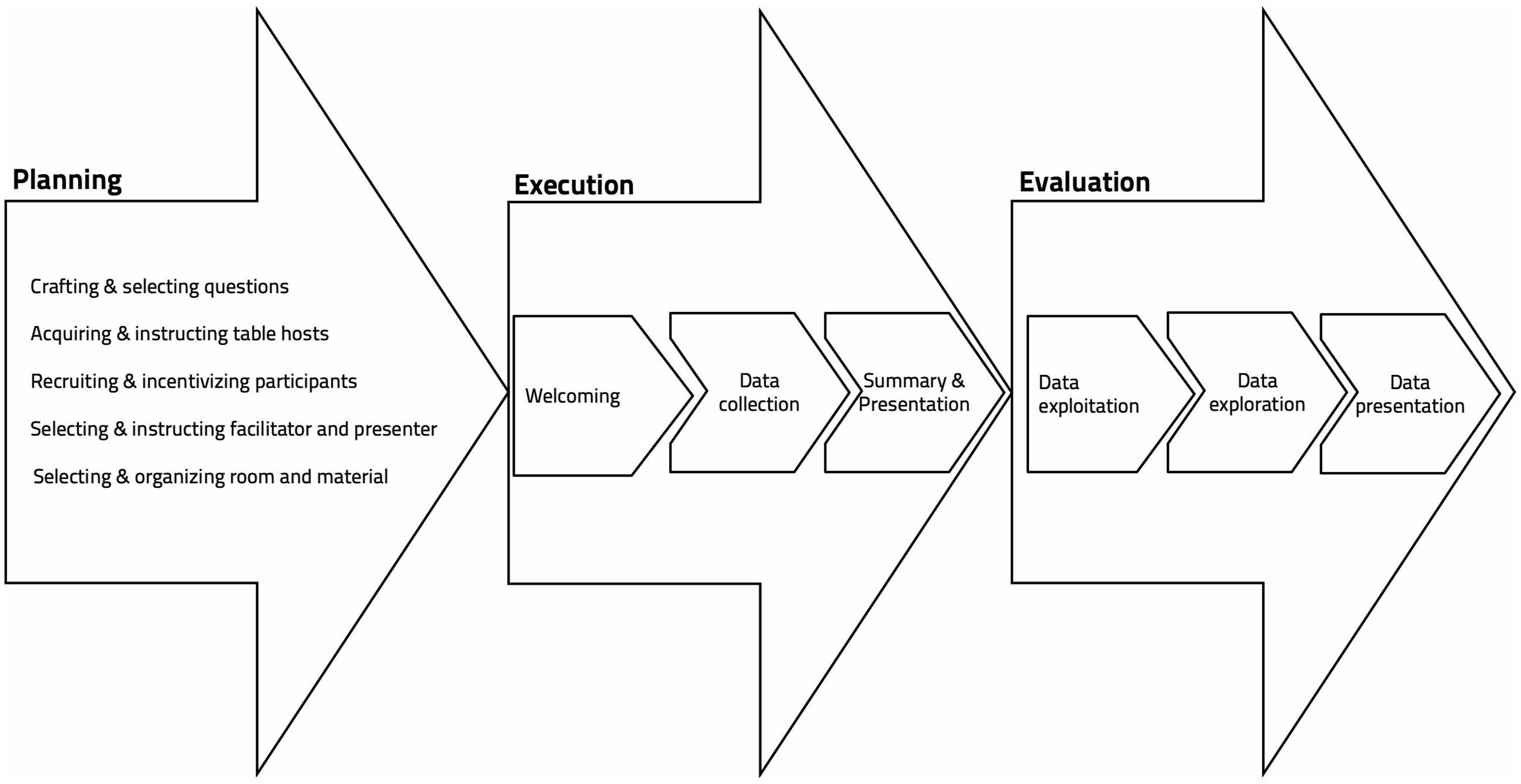
Introducing the Three-Phase Blueprint of the World Café Method
The idea of acquiring qualitative data via the World Café method was first introduced by Juanita Brown and David Isaacs in 1995. Since then, this method has increased in popularity (Löhr et al., 2020, p. 1), and is used both in practice and in research (Löhr et al., 2020, p. 2; Schiele et al., 2022, p. 284). It is an explorative research method (Schiele et al., 2022, p. 294) and is especially useful as a participatory assessment tool (Löhr et al., 2020, p. 1). In research, the World Café method has mainly been used in the fields of health care (Broom et al., 2013; Fouché & Light, 2010), education (Fullarton & Palermo, 2008; Partridge, nd), community development (Aldred, 2009; Brown & Isaacs, 2005; Fouché & Light, 2010), business (Chang & Chen, 2015; Jorgenson & Steier, 2013) and strategy planning (Chang & Chen, 2015). The World Café method is particularly effective when group wisdom is needed to explore a topic (Brown & Isaacs, 2005, p. 4), and is generally used as part of change management or learning experience (Schieffer et al., 2004, p. 2). With this method, a large amount of data can be collected more quickly than with traditional qualitative data collection methods such as focus group interviews or the Delphi method (Schiele et al., 2022, pp. 291-292). A comparison of the World Café method and other methods for collecting qualitative data can be found in Schiele et al. (2022, p. 288) work. We do not consider the World Café method as an interview method such as expert interviews or focus group interviews. With the help of the World Café method multiple perspectives are brought together. In the World Café method different perspectives are not just tolerated but nurtured. Unlike traditional interview methods, there is no question-and-answer situation between the interviewees and interviewers. Rather the World Café is a method in which participants play a dynamic role in exchanging ideas from a wide variety of perspectives. The ideas generated relate exclusively to a specific question presented by the hosts for each table and round. Accordingly, the World Café method also reduces the academic-practitioner gap by bringing practical experts and scientists together at one table (Schiele et al., 2022, p. 281).
The World Café method aims to create new ideas by combining what a group of people knows or thinks about a topic (Brown & Isaacs, 2005, p. 4). To do this, an artificial café atmosphere is created in which the participants can engage in lively and trusting discussions (Brown & Isaacs, 2005, p. 40), just like in a normal café. The familiar café atmosphere nurtures social exchange and encourages participants to share their ideas without inhibition (Löhr et al., 2020, p. 2; Aldred, 2009, p. 5). The method can be used for a wide range of group sizes, ranging from 12 to 1,000 people (Lagrosen, 2019, p. 1521; Hüttinger et al., 2014, p. 701; Churchman & King, 2009, p. 510; Necochea & Cline, 2008, p. 248; Brown et al., 1999, p. 1). Participants are divided into smaller groups of five to six, and each group sits at a café table and discusses the question prepared for that table. Group wisdom and exchange of ideas is enhanced by changing the table after each round of discussion (Brown & Isaacs, 2005, pp. 14 - 15). In general, there are three rounds of discussion, each lasting around 30 minutes (Schiele et al., 2022, p. 285). Each table is led by a table host (host) who is responsible for taking notes and writing summaries. The host stays at the same table and does not change after each round with the other participants. Participants can write their ideas on paper tablecloths or blank beer mats and the results of each discussion round are documented in this way (Brown & Isaacs, 2005, p. 166).
Brown and Isaacs (2005, p. 40) developed the following seven design principles for the World Café method: (1) set the context, (2) create a hospitable space, (3) explore questions that matter, (4) encourage everyone’s contribution, (5) connect diverse perspectives, (6) listen for patterns, insights, and deeper questions, and (7) harvest and share collective discoveries. These seven principles show how the World Café method should be run in general, but are not specific enough to plan, execute, and evaluate the World Café method so that high-quality data can be collected (Klatt et al., 2025, p. 2074). The Three-Phase Blueprint helps researchers to collect high-quality data with the World Café method in three phases: planning, execution, and evaluation. In the planning phase, the main preparatory elements are discussed such as table hosts, participants, facilitator, presenter, room and materials. The execution phase comprises three subprocesses: welcoming, data collection, and summary and presentation. The evaluation phase also has three subprocesses: data exploitation, data exploration, and data presentation (Klatt et al., 2025, pp. 2076-2077) (Figure 1). In the following, we introduce the Three-Phase Blueprint, highlighting which steps are relevant and showing how to check quality and fulfill each phase with academic rigor.
Planning Phase
Planning is the key to success in the World Café method, and includes formulating the right questions, briefing the key players, and designing the room. The planning phase is the first phase of the World Café method, during which the World Café is organized. It demands the highest input effort to avoid problems with data collection or the collection of falsified data. During the planning phase, attention must be paid to (1) crafting and selecting the question(s), (2) acquiring and instructing the host(s), (3) recruiting and incentivizing the participants, (4) selecting and instructing the facilitator(s) and presenter, and (5) making sure the room and necessary materials are prepared. In the following, we discuss these five crucial elements of the planning phase.
Crafting and Selecting Questions
The World Café method cannot take place without (research) questions. These questions have to be open, since the World Café method aims to bring people together in an open atmosphere to create new ideas and exchange knowledge and perspectives (Necochea & Cline, 2008, p. 245). Success of the World Café method depends on these questions, so they need to be chosen carefully (Löhr et al., 2020, p. 10; Prewitt, 2011, p. 196). Two things are considered when preparing the questions: (1) the type of questions and (2) the number of questions.
Two types of open question can be used for the World Café method – analytical or design-oriented questions. Analytical questions aim to understand a certain situation better, for example regarding people’s preferences or knowledge. These questions look for a reason (why?) or try to understand something (what? or when?). Example questions are “What are the internal problems and challenges you face in sustaining a high level of performance?” (Latham, 2008, p. 10) or “What is needed to educate others about integrative nursing practice?” (Hess et al., 2006, p. 133). In our literature search, we found that the behavioral sciences favor analytical questions when conducting the World Café method. Design-oriented questions generate ideas to improve conditions, and start with “how can…?” or “how might we...?” Example questions are “How can our community employ more people with disabilities?” (Carter et al., 2012, p. 12) or “How can I encourage leadership that is different to my own and challenges me?” (Gibbs et al., 2020, p. 2035). Unlike traditional interview methods, the World Café method does not involve a question-and-answer situation as interviewers and interviewees are accustomed to. In each round, there is one question per table for the participants to discuss. This makes it all more important that the table question is formulated precisely and comprehensively. Ensuring that the question is understandable for the participants, contributing to the research question by not being formulated too broad or narrow so that a lively discussion arises.
The number of questions depends on how the World Café is run. Three ways of running the World Café have been reported in the literature. The first was to discuss the same question at each table. In this scenario, the participants change tables but discuss the same question with different people in each round. The second was to discuss the same question at each table, but to change the question for each round. In this scenario, one round is needed for each question (e.g., (Horng et al., 2017)). The third was to place different questions at each table but to stick to the same questions in all rounds. In this scenario, the maximum number of questions needed is the number of tables and exchange of ideas is increased by changing discussion partners each round (e.g., Hüttinger et al., 2014).
Acquiring and Instructing Table Hosts
Schiele et al. (2022, p. 285) reported that the host’s behavior significantly influences the success of the World Café method and the quality of the collected data. Therefore, selecting and instructing a host properly is very important. In the following, we present structured recommendations for selecting and instructing a host. With regard to the hosts, researchers must organize (1) the tasks and behavior of table hosts, (2) the selection of table hosts, and (3) the instruction and training of table hosts (Klatt et al., 2025, p. 2077). These points have been discussed in detail (Klatt et al., 2025, p. 2077), but we have enriched these three steps, particularly with regard to instructing and preparing the table hosts for their job. Graphics illustrating the process of the World Café process can be provided to hosts to support their preparation (Klatt et al., 2025, p. 2077) as shown in Figure 2. The three steps of the execution phase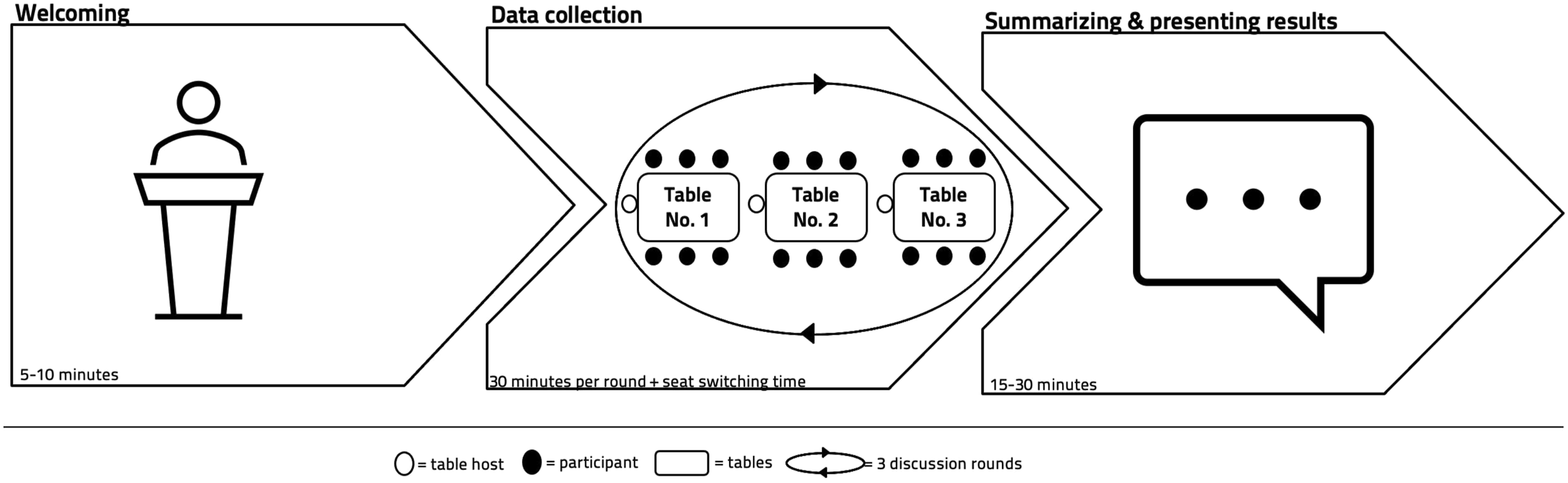
Figure 2 shows an example of a World Café method on the topic of office design, illustrating how long each step should take and what it should include. A different question was discussed at each table and the question remained the same at each table. There were three rounds and participants switched tables for each round.
The host should write a summary of the main opinions and behavioral observations observed during the World Café (Klatt et al., 2025, p. 2079). A prototype for this summary can be found in Appendix A2. This summary is important because it allows the research team to read the discussion afterwards. In contrast to Schiele et al. (2022, p. 286) and Wood (2012, p. 220), we do not recommend recording the discussions, so this written summary ensures no information gathered during the discussions is lost. We do not recommend using recording devices because we believe they inhibit the wisdom of the crowd and contradict the very idea of the World Café method.
We present a guide for researchers on the instruction of table hosts in Figure 3. Timeline of host instruction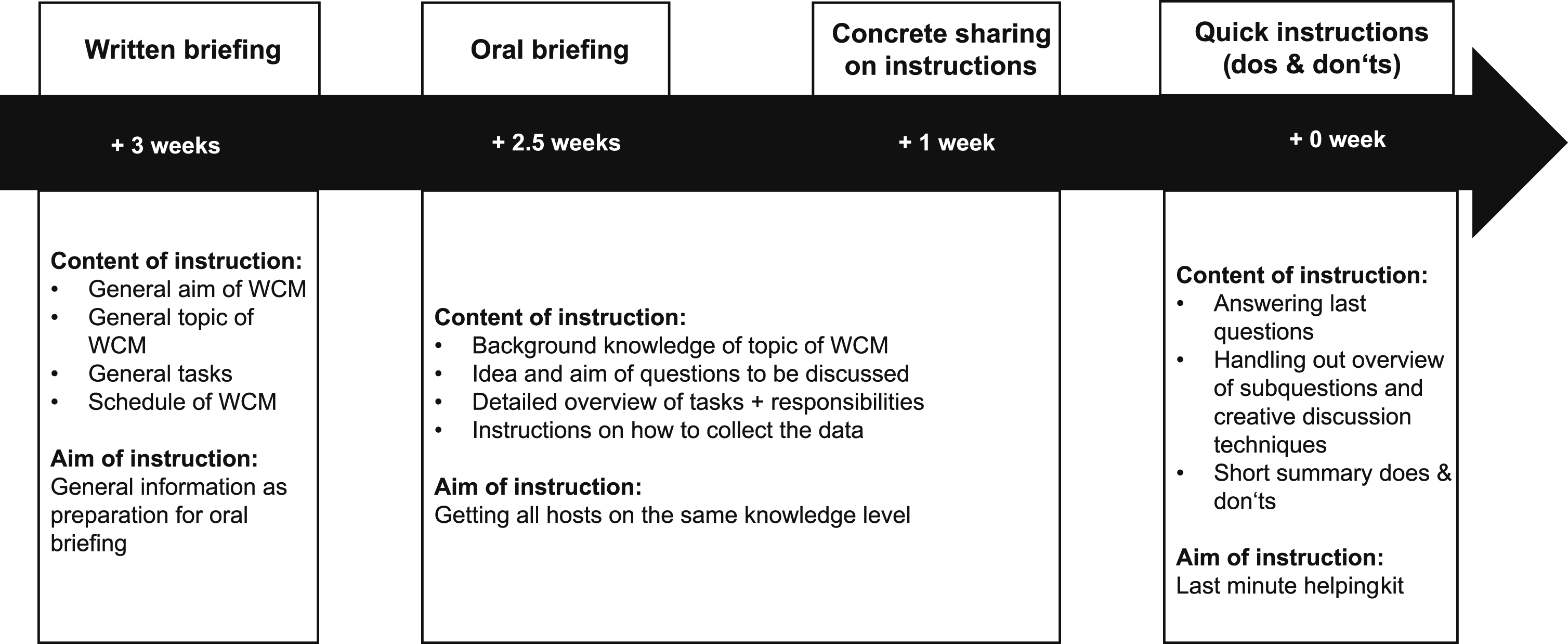
Recruiting and Incentivizing Participants
World Cafés can be hosted with any number of participants. The success of the method depends on the number of participants at each table rather than on the total number of participants. Ideally, there should be five to six participants at each table. More or fewer participants than this at each table may inhibit the free exchange of ideas or may prevent everyone from being included in the conversation, thereby suppressing the wisdom of the crowd.
We have identified two types of participants suitable for the World Café method: Type I and Type II (van Zeeland, 2023). Type I participant is directly affected by the topic of the World Café, and the outcome of the method will affect them or their work. These participants can be, for example, employees or members of an organization, residents or users of a program. Type II participant share their knowledge and experience to create something new but are not directly affected by the outcome. These participants include experts, such as medical professionals. Depending on the aim and topic of the World Café method, type one and type two participants can be combined in one World Café.
There are four approaches to the World Café method depending on the setting and participation (Figure 4). The setting of the World Café method can either be an individual event or embedded in an event such as a conference. In both cases, participation can be either voluntary or mandatory, with advantages and disadvantages to both. Voluntary participation means that participants are intrinsically motivated to contribute to the World Café, whereas mandatory participation informs the organizers in advance how many participants will take part, allowing them to plan for and invite participants accordingly. A guest list gives the facilitator an overview of the participants during the execution phase. The four approaches to conducting a World Café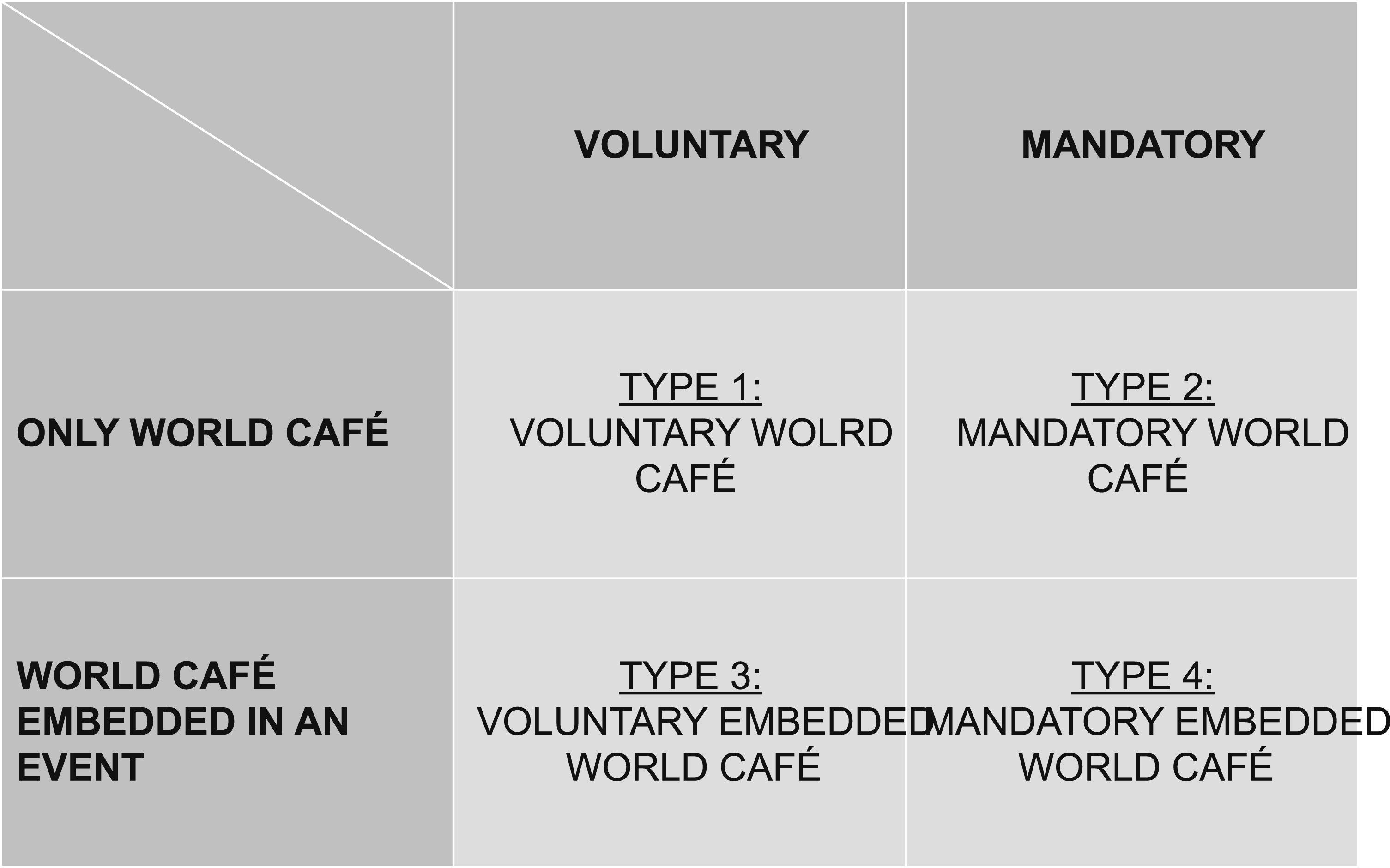
In all approaches, the participants should be informed about the aim, general topic, and schedule of the World Café before it starts. The seven core principles of a World Café method should be explained to the participants, so they understand the importance and relevance of participating. Participants should be aware that their opinions can be heard and are of interest. The artificial café setting should help participants to feel comfortable talking and exchanging insights without the inhibitions of an experimental setting. Participants do not need to know about the World Café method to be able to participate and add value to the discussions.
Selecting and Instructing a Facilitator and Presenter
The facilitator hosts the World Café and is responsible for keeping the process smooth (Lorenzetti et al., 2016, p. 202; Prewitt, 2011, pp. 191-192). They welcome the participants to the World Café (MacFarlane et al., 2017, p. 281; Ritch & Brennan, 2010, p. 406) and bring hospitability to the café-like experience. The facilitator’s role is very process driven (Schieffer et al., 2004, p. 4) – they keep an eye on the time during the discussion rounds, and help the participants to change tables when the discussion time is up. They also manage the seating arrangements depending on whether participants are assigned to particular tables or are free to choose, and they make sure that five to six participants are always seated at the tables. The World Café method is very dynamic, so the facilitator should not take on the role of table host after the participants have been welcomed. Usually, only one facilitator is needed for a World Café, but they may need assistance if more than 30 participants are taking part or if the discussion tables are spread over several rooms. The facilitator should ideally be a member of the research team and should be familiar with the World Café method.
The presenter gives a speech to introduce the topic of the World Café method and why research is important for this topic. This introductory speech should spark curiosity and motivation to take part in the World Café, but should not influence the participants’ opinions. It should give a neutral overview of the topic and questions that will be discussed. The presenter needs to have in-depth knowledge of the topic so should ideally be a member of the research project or an expert in the field. The presenter can also take on the role of facilitator, but not the role of table host because they have substantial knowledge on the topic and may therefore introduce bias.
Selecting and Organizing the Room and Materials
The room and the materials used are key to the success of the World Café method. The room should represent an artificial café (Brown et al., 1999, p. 2) with a hospitable atmosphere (Brown & Isaacs, 2005, p. 40), containing small tables for five to six participants plus at least one host (Horng et al., 2017, p. 1266). Each table has a paper tablecloth on which the participants can record their ideas and thoughts during the discussion rounds (Brown et al., 1999, pp. 1-2). Alternatively, participants can use sticky notes or moderation cards to note down ideas (Fallon & Connaughton, 2016, pp. 6-7; Fouché & Light, 2010, p. 9; Pumpe & Vallée, 2017, p. 856; Brown & Isaacs, 2005, p. 166). In contrast to suggestions by Schiele et al. (2022, p. 286), we do not recommend using flip charts as these disrupt the café-like atmosphere. Anything that helps to create a café-like atmosphere and keep the participants comfortable is recommended, such as providing drinks and snacks (Brown & Isaacs, 2005, pp. 73-76).
The question to be discussed should be on tables. In addition, the schedule and the World Café method ethos should be available as small flyers or posters, or as a presentation projected on a wall. This information helps the participants to orientate themselves and gives them a structure. A clock at each table is also helpful so participants know how much discussion time is left.
Participants need to be able to change tables quickly after each round, so the tables should not be too far apart. Unlike in a real café, good acoustics are needed for the World Café so that the participants can understand each other and the exchange of ideas is not disturbed. If possible, the tables should be far enough apart so that conversations on the neighboring tables cannot be overheard (Schiele et al., 2022, p. 285). The checklist in Appendix A4 summarizes the set-up of the artificial café. Figure 5 provides a summary of all roles with their tasks and responsibilities. Overview of the different roles and their tasks and responsibilities of the World Café method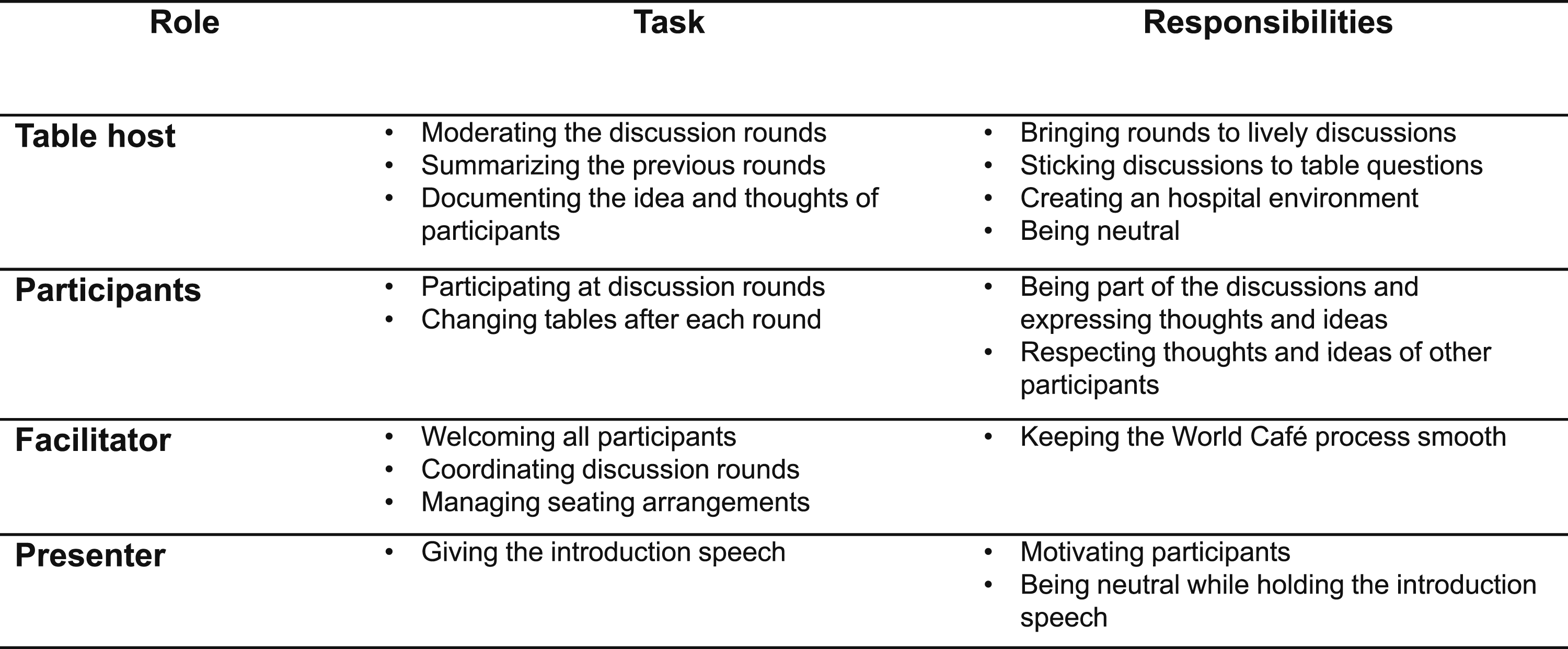
Execution Phase
The execution phase can be divided into three main steps: (1) welcoming, (2) collecting data, and (3) summarizing and presenting results.
Welcoming
The participants gather in the artificial café before the discussion rounds start. If seats are assigned, participants should be shown to their places quickly and if they are free to choose their seat, they should be told this when they enter the artificial café. Ticking participant names off a guest list as they arrive can help the facilitator determine when all the guests have arrived and the official welcome can start. Sufficient check-in time must be included in the schedule, and this will vary depending on the number of participants. For a World Café with 30–40 participants, we recommend a check-in time of 15–20 minutes.
Once everyone has arrived, the facilitator welcomes the participants and explains the process and schedule of the World Café method. They then hand over to the presenter, who briefly introduces the topic of the World Café together with the questions to be discussed. After this short introduction speech (of no more than 15 minutes), any follow-up questions that are relevant to the research topic can be answered, but comments on the presentation are discouraged to avoid influencing the participant’s opinions. Once any questions have been answered, the discussion rounds can begin.
Data Collection
During the World Café, the participants discuss the questions they are given. To facilitate wisdom of the crowd, each question should be discussed in at least two rounds. A World Café method normally consists of three rounds, with one round taking 20–30 minutes. We recommend taking 30 minutes for the first two rounds and then shortening the third round to 20 minutes. The first round should be at least 30 minutes so that the participants can familiarize themselves with the topic and the World Café itself. This lays the foundations. In the second round, the participants are familiar with the situation and the topic and can build on the discussion from the first round. This usually takes 30 minutes. By the third round, participants often struggle to find new insights and spend the time reflecting on and evaluating what has already been discussed. This usually takes no longer than 20 minutes.
Tables must be changed without chaos to avoid any confusion or delays that might disrupt the café-like atmosphere. Changing tables can either be free or planned. If participants are free to choose which table they move to next, the facilitator should help and should make sure that the groups contain different participants in each round to enhance the exchange of ideas and to make sure the wisdom of the crowd is not lost. The facilitator must also make sure that each table has the same number of the participants in each round. Free seating is not recommended in groups of 40 or more participants. If free seating is chosen for groups this large, then the facilitator should have at least one person to help them coordinate the participants. If the same question is being discussed at several tables in a large group, the facilitator must make sure that the participants do not discuss the same question several times. If the changing of tables is planned, then participants should be given a plan of where they will sit in each round when they arrive at the World Café. Planned seating is particularly convenient with large groups because it ensures easy table changes without chaos. In this scenario, tables must be clearly marked so that the participants can find their new place quickly. If the seats are assigned, the facilitator may only have to show the participants to their table. Care must be taken, however, that the assignment does not inhibit the wisdom of the group or introduce bias.
Information on when to take breaks during the World Café method have not been published. We do not recommend breaks during a World Café method because this gives participants the opportunity to exchange ideas among themselves without documentation. A World Café usually lasts about 2 hours, which includes the start and the conducting phase. In our opinion, this amount of time can be managed without a break, especially if drinks and snacks are available. However, we do recommend giving the participants 5 minutes to switch tables after each round.
Summarizing and Presenting Results
Once all the discussion rounds have been completed, participants are given a 30-min break during which the hosts summarize the results of the discussions held at their table together with their experiences and observations. This is done in written form, and we have developed a blank form to help with this (Appendix A1). These short-written summaries allow the hosts’ observations to be considered in the evaluation of the World Café method. They also record any discussion content that might not have been written down by the participants. The hosts can also use these short summaries to present the key results to the participants. Once the summaries are written, the hosts present the results so that all participants have an overview of the discussion outcomes. This gives the participants the feeling that they have collected concrete results during the World Café.
The time allowed for the presentation of the results should be adapted to the scenario. This may also depend on the way the questions were distributed during the World Café. If all tables discussed the same questions at the same time, a more detailed presentation of the results would be useful. This allows participants to hear the ideas discussed beyond their own group. However, we believe that a more concise presentation of the results is necessary if the questions at the tables were the same throughout and the participants changed tables per round.
Whether an open discussion can and should take place after the presentation of the results has not yet been discussed in the literature. We recommend allowing comments from participants who forgot to share thoughts or ideas during their discussion rounds and now want to add them because this contributes to the wisdom of the group. The facilitator guides the comments and records complementary ideas for the evaluation of the World Café method. Provocative opinions or discussions should not be allowed after the results are presented as this is not a suitable conclusion for the World Café.
Evaluation Phase
During the evaluation phase, data exploration, exploitation, and presentation should be considered. Once the World Café method is complete, two data sources can be explored: the ideas and thoughts written down by the participants and the summaries written by the hosts. All data must be evaluated and processed. To exploit and analyze the data, it needs to be structured, clustered, and coded. Qualitative content analysis as described by Mayring (2014) can be used here. Behavioral observations and other conspicuous features noted in the hosts’ summaries can be assigned to individual categories. To ensure the content has been analyzed correctly, the results must be presented to the hosts so they can check for forgotten or incorrectly displayed content. The results should be processed from different perspectives. For example, they could be presented from different lenses. The thinking hats of De Bono (2017) can be an orientation or type of presentation. The results from different knowledge views or perceptions can be presented as an inquiry of different needs and criteria or as a process-driven discussion.
World Café Method and Academic Rigor – Fulfilling Quality Standards
Only a few papers have assessed the quality of data collected by the World Café method. Chang (2016, p. 319) reported that validity of the World Café method is demonstrated by its practical use, while Du Plessis et al. (2013, p. 768) noted that the World Café fulfills Guba’s model of trustworthiness. However, both Chang (2016) and Du Plessis et al. (2013) do not explain this further. Hüttinger et al. (2014, p. 701) reported a more specific view that the iterative processes of the World Café increase construct validity and reduce potential bias. Löhr et al. (2020, p.10) also stated that the World Café reduces selection and interviewer bias. Only Schiele et al. (2022) looked more comprehensively at the quality of the data collected in a World Café. They listed examples that fulfilled construct validity, internal validity, external validity, and reliability. Nevertheless, no concrete overview has been made of which parts of the World Café influence quality criteria in qualitative research. The Three-Phase Blueprint presented here for the academic World Café method not only helps the collection of rich qualitative data but also increases academic rigor, and improves the quality of qualitative research.
Unlike quantitative research, the quality criteria in qualitative research are wide-ranging and not standardized, and there are different perspectives on which quality criteria are suitable. To demonstrate that the Three-Phase Blueprint helps to fulfill academic rigor of the World Café method, we have applied the quality criteria developed by Guba and Lincoln (1982) to the context of the World Café method. The criteria developed by Guba and Lincoln (1982), and further developed by Jarrahi and Newlands (2024), among others, are considered. Further considerations, such as those put forward by Tracy (2010), are also important for achieving academic rigor in qualitative research. Guba and Lincoln (1982, p. 376) emphasized the importance of finding quality criteria for qualitative research that correspond with those for quantitative research. They recommended transforming validity to credibility, reliability to dependability, and consistency, confirmability and generalizability to transferability and theoretical generalization.
The Three-Phase Blueprint and how it furthers the quality criteria of qualitative research developed by Guba and Lincoln (1982) is shown in Figure 6(a)–6(c). Each of the three Figures is dedicated to one phase of the Three-Phase Blueprint. The Figures show not only which steps of the Three-Phase Blueprint affect Guba and Lincoln’s quality criteria summarized by Jarrahi and Newlands (2024), but also which specific actions improve data quality. All steps in the Three-Phase Blueprint contribute to the rigor of qualitative data. For example, data rigor is increased in the World Café method through the iterative discussion rounds. However, it is the planning phase that lays the foundation for achieving high-quality data. The detailed Three-Phase Blueprint steps in the planning phase will enable researchers to collect data that fulfills the quality criteria of qualitative research. Credibility is achieved by choosing the participants that fit best to the research aim, i.e., by choosing experts with the relevant knowledge rather than issuing an open invitation. Dependability and consistency of the data is increased by improving how the World Café is prepared and conducted. This includes formulating stringent questions, selecting participants who can contribute, and organizing iterative World Café rounds in a structured way. Iterative data collection using the World Café method ensures the confirmability of the data collected. To increase confirmability, the questions must be formulated clearly, and the hosts must be properly trained. During the implementation, the hosts must fulfill their role, not influence the participants, and ensure that the data is recorded. Confirmability is also increased by the presentation of the results at the end. The transferability and theoretical generalization of the data is supported by the welcome presentation, during which the participants are made aware of the research framework, and by the data analysis carried out at the end. (a) Effect of the actions of the Planning Phase on quality criteria of qualitative research (Effect of the actions of the Planning Phase (a), Execution Phase (b) and the Evaluation Phase (c) on the quality criteria of Guba and Lincoln (1982) as summarized by Jarrahi and Newlands (2024)). (b) Effect of the actions of the Execution Phase on quality criteria of qualitative research. (c) Effect of the actions of the Evaluation Phase on quality criteria of qualitative research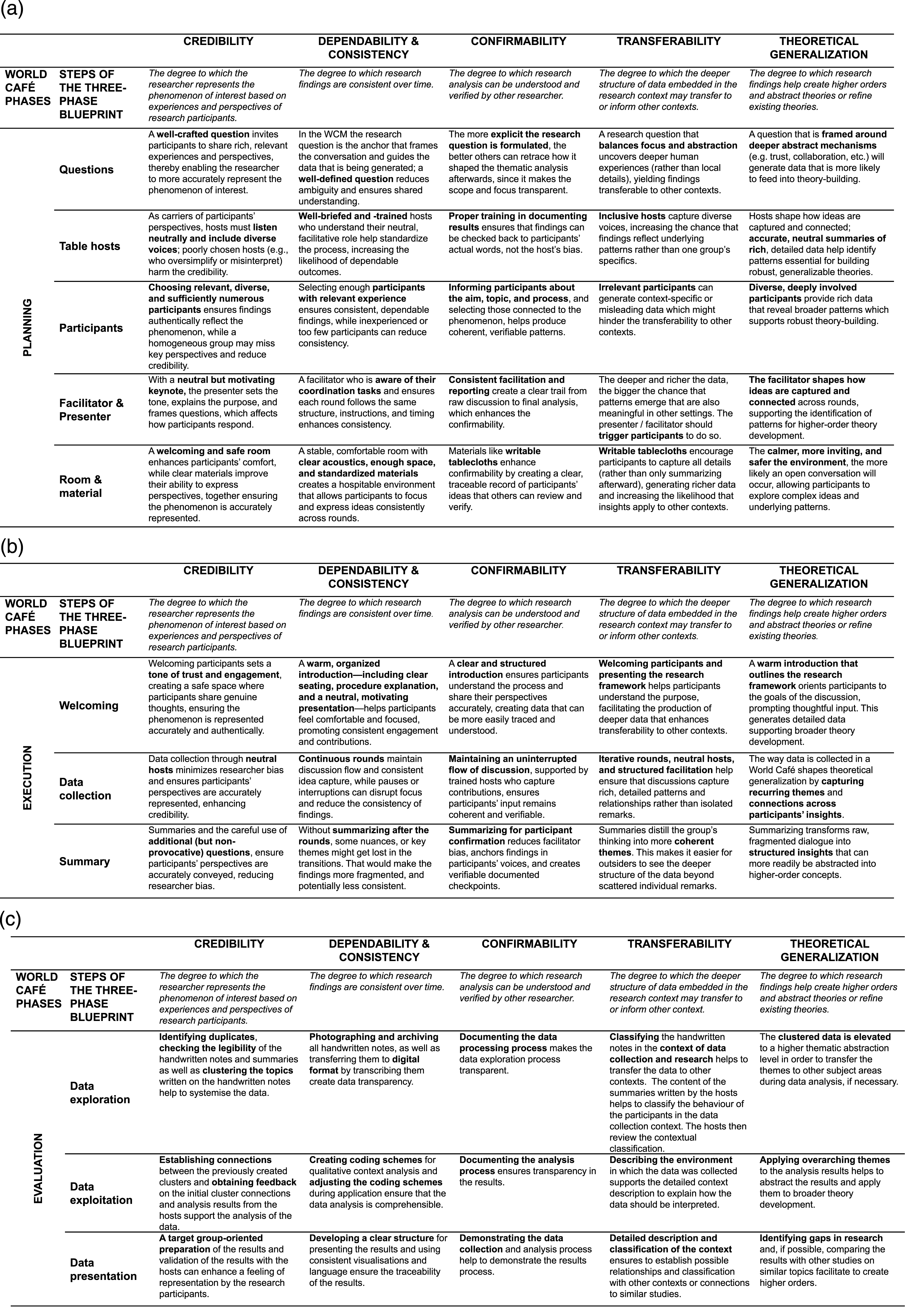
Discussion and Conclusion
In this paper we present a Three-Phase Blueprint that makes it easier for researchers to apply the World Café method in a structured and rigorous way. The aim is to give guidance on how to use the World Café method to collect qualitative data with academic rigor. Based on our own practical experience, we developed the Three-Phase Blueprint, which divides the World Café method into three phases: (1) planning, (2) execution, and (3) evaluation. With our structured Three-Phase Blueprint, the World Café method is easier to use and more rigorous. In times of constant change, the wisdom of the group becomes more and more important in academic research, and this is supported by our Three-Phase Blueprint. Furthermore, assigning the individual steps of the Three-Phase Blueprint to Guba and Lincoln’s quality criteria for qualitative research helps researchers to collect qualitative data from the World Café method in a short time and with little effort as highlighted in Figure 6(a)–6(c). In addition, the idiosyncratic nature of the World Café method allows to facilitate at least four additional dimensions of data quality: (1) speed and fast availability of results, (2) interpretation and stablishing of results, (3) elaboration of data by digestion and refinition through iterations and (4) prioritization based on group consensus. Thus, relevance of research and rigorousness of data can be easily combined. Therefore, the World Café method can assure rigorous data collection and should be applied with more certainty.
Whether additional audio or video recordings should be used in the World Café must be carefully considered. On the one hand, recordings provide more raw data and insights about the behaviour of the participants (Garcez et al., 2011), but on the other hand, this conflicts with the nature of the World Café method. It is precisely thy dynamic character, creating the wisdom of the crowd that makes the World Café method successful. This dynamic atmosphere created during the World Café encourages participants to engage in discussions. Thus, a large amount of data is produced. Well trained hosts ensure that this data is well documented and supplemented by the hosts’ summaries. Even without recordings, a large amount of data is available for evaluation at the end of the World Café session.
One limitation of this paper is that it is only a theoretical and methodological analysis of the World Café method, and future studies need to provide an empirical analysis of how much the Three-Phase Blueprint improves data collection. Future studies should also develop the steps of the Three-Phase Blueprint, particularly the selection and formulation of the questions that matter. Future studies could also develop a more concrete quality check.
In summary, this paper contributes to our theoretical understanding of the World Café method and of qualitative research in general. Our findings will help researchers to use the World Café method to collect large amounts of qualitative data based on the wisdom of the crwod.
Supplemental Material
Supplemental Material - How to Run a World Café: A Comprehensive Guide Using a Three-Phase Blueprint
Supplemental Material for How to Run a World Café: A Comprehensive Guide Using a Three-Phase Blueprint by Annika Klatt, Eveline van Zeeland, Jörg Henseler in International Journal of Market Research.
Footnotes
Acknowledgment
During the preparation of this work, the authors used DeepL to improve the readability and language of the manuscript. After using this tool, the authors reviewed and edited the content as needed and take full responsibility for the content of the publication.

Funding
The authors disclosed receipt of the following financial support for the research, authorship, and/or publication of this article: This work was supported by national funds through FCT (Fundação para a Ciência e a Tecnologia), under the project - UID/04152/2025 - Centro de Investigação em Gestão de Informação (MagIC)/NOVA IMS - https://doi.org/10.54499/UID/04152/2025 (2025-01-01/2028-12-31) and UID/PRR/04152/2025 https://doi.org/10.54499/UID/PRR/04152/2025 (2025-01-01/2026-06-30).
Declaration of Conflicting Interests
The authors declared no potential conflicts of interest with respect to the research, authorship, and/or publication of this article.
Supplemental Material
Supplemental material for this article is available online.