



Abstract
Using political branding as an analytical lens can help explain the emotional connections and evaluative perceptions citizens have regarding political parties and their leaders. Measuring what makes a successful brand is best usually conducted with the benefit of hindsight, we can explain why a brand was a success or a failure based on public opinion data and attribute this to events. However, our research seeks to test the extent that analysis of strategic communication can offer opportunities to predict outcomes. We explore the communication of two prime ministerial brands who, due to their similarities and differences, offer an opportunity to assess the extent that the dimensions of a successful brand are universal. We employ Needham’s framework, developed to demonstrate why the brand of UK prime minister Tony Blair (1997–2008) proved so popular. We find that the dimensions of a successful brand are present in the strategic communication of both premiers. However, we find that the nature of some brands may make them appropriate for campaigning, but not for governance in challenging times. We argue that political brands need to be consistent, but once in government must be adaptable for the changing conditions and develop an appropriate style to accommodate the challenges facing a prime minister in the 21st century.
Introduction
Viewing parties and their leaders as branding is not a new perspective (French & Smith, 2010) but offers additional insights into the relationships between citizens and those who seek their electoral support. In an age where party or ideological loyalties are weakened, it is argued voter choices have similarities to consumer decision making (Solomon et al., 2012). Particularly the functional and emotional benefits one party or leader offers compared to alternatives. Hence, there is an intangible, perceptual quality to voters’ assessments of the performance of a potential political leader, especially at elections when the latter direct compete for public support (Marland et al., 2017). During elections and periods of governance, citizens are presented with “differentiated perceptual images” which speak to their needs and desires within specific contexts (Popkin, 2020). However, understanding what makes a leader brand successful, in the context of brand development, campaigning and governance is complex and highly contextual. In order to explore whether a generic model for successful leader branding can be utilised, this paper explores how brands are strategically communicated by two prime ministers with contrasting styles and in different contexts who came to power at similar times and faced similar challenges. The aims of the paper are three-fold. Firstly, to assess the applicability of Needham’s (2005) dimensions of a successful brand beyond its original context. Needham developed the model using a grounded theory approach for analysing UK prime minister Tony Blair 1997–2007, offering a clear set of features which are potentially universal and represent how an individual leader builds a brand that connects emotionally with citizens (Needham, 2006). Using this as a framework, we assess the strategic rhetoric of UK prime minister Boris Johnson 2019–2022 and Greek prime minister Kyriakos Mitsotakis 2019 onwards. The selected speeches reflect their brand positioning prior to becoming leader, within a campaigning context and then as premier. Secondly, focusing on the latter, we assess the applicability of the dimensions within government and how they help us understand how a successful brand can be maintained in the face of unexpected crises. Thirdly, we evaluate how Needham’s dimensions can be utilised to predicting the success or failure of a political brand in real-time as opposed to with the benefit of hindsight. The paper firstly sets out the core arguments relating to political branding before introducing the research context, the methodology and presenting the findings of an analysis of the strategic branding of the two premiers.
Political branding: Strategy, symbolism and emotional resonance
Branding research shows politicians and parties attempt to strategically control the impression they make on audiences (Landtsheer et al., 2008). Political brands are constructed from multiple elements within the parties’ strategic narrative as it connects with specific contexts (Banet-Weiser, 2012). Maintaining a brand means ensuring positive associations are ‘front of mind’, suppressing the cognitive importance of negative associations circulated across media, by opponents, and retained in the memories of citizens (Van Steenburg & Guzmán, 2019). Hence branding is a symbiotic process of co-creation between the political brand, citizens (Arvidsson, 2005) and key stakeholders (supporters, activists, media commentators, etc.) (Pich et al., 2020). Strategically, branding involves “assembling and maintaining a mix of values, both tangible and intangible, which are relevant to consumers, and which meaningfully and appropriately distinguish one supplier’s brand from that of another” (Murphy, 1988, p. 4). In political terms the brand is a combination of the party and its leader and prominent figures. Branded political communication is a complex composite of longstanding values, current vision and the personality of the individual leader (Ströbel & Germelmann, 2020). Hence “political brands need to ensure their identities are believable, grounded on style and substance, live up to expectations, coherent across all touchpoints and prepared to amend their offering in relation to an ever-changing dynamic political environment” (Pich & Armannsdottir, 2021).
Party leader brands have become integral to electoral success and the maintenance of support while in power (Ahmed et al., 2017). How the leader makes citizens feel can often override logic (Mensah, 2017, p. 199). Hence, the interactive and relational process of branding aligning with the emotional demands of the marketplace and the political and socio-economic context of the time is crucial (Billard, 2018). Parties making grand elections promises risk losing public support if promises are broken. They can also be more open to attacks by opponents. Thus, to combat negative brand associations, party leaders attempt to communicate an emotionally resonant brand (Grimmer & Grube, 2019) to cut through the fragmented and cluttered communication environment by emphasising character attributes over specific deliverables (Pich & Armannsdottir, 2021). Headlines, social media posts, memes and any incidental communication by or about a party evoke emotional responses (Lilleker, 2014). Citizens hold a schema of associations regarding any well-known individual or organisation which is triggered by name cues: ‘a network of linkages between all the cognitive and emotional elements’ evoked by the name of an organisation (Gutman & Miaoulis, 2003, p. 106); positive linkages lead citizens to feel positive, secure, proud etc. A leader viewed positively will encourage citizens to feel the party they lead will perform well in government, embodying their values while delivering sound management (Saint Clair & Forehand, 2020). Leaders can be the determinant of success due to their prominence and ability to command media attention (Ahmed et al., 2017) and because an individual is more relatable than the heterogenous group that constitute a party (Rojas-Méndez et al., 2013).
Assessing branding strategies
Various frameworks have been developed for understanding how citizens might read political brands, largely focusing on perceived brand attributes. Aaker’s model (1997: 347) incorporating perceptions of the leader being warm, friendly and agreeable, competent, effective and efficient has been widely used (Davies et al., 2018; Jain et al., 2018). Alternative schematics have included demonstrating sincerity, excitement, competence, sophistication, and ruggedness (Caprara et al., 2001). Studies have also attempted to capture the judgments voters make when assessing the qualities of candidates and leaders (Mattes & Milazzo, 2014) focusing on perceived authenticity, as well as communicating the right values for the context (Serazio, 2017), possessing an aura of authority and demonstrating the ability to deliver on their promises and agenda (Speed et al., 2015). While developed for the specific context of analysing former UK premier Tony Blair, 1997–2007, Needham’s (2005) six dimensions of successful political brands (simplicity; uniqueness; reassurance; aspiration; values; and credibility) offer a rigorous framework for assessing branding strategies (the denotation of the brand) and voter perceptions (the connotations drawn from communication) based on the analysis of strategic branding rhetoric. The dimensions are elaborated on prior to operationalising these within our methodology. • Simplicity focuses on accessibility and salience, expressing ideas, values and a clear, relevant mission statement that resonates with public opinion in short memorable statements. • Uniqueness focuses on the values and attributes that make the brand stand out in comparison to competitors based on direct comparison. • Reassurance focuses on how rhetoric reduces or neutralises citizens’ fears or doubts in supporting the implementation of a strategy. • Aspiration focuses on the expression of a vision for the future of the nation. • Values focus on the ethos and convictions of the leader and how they inform their vision, policies and responses to events. • Credibility focuses on communicating the ability to deliver on the vision and promises providing both sound management and conviction-led politics.
Needham’s dimensions offer a framework for analysing the branded rhetoric and performance to understand what perceptions citizens may possess after engaging with strategic communication from the brand. Beyond the original studies (Needham, 2005, 2006) the framework has been utilised to analyse Greek political party brands (Koliastasis, 2020) and the dimensions map well to citizen’s evaluations of political brands (Pich & Armannsdottir, 2018). We employ the schematic to identify how claims made by political leaders align to the dimension and how leaders establish and maintain their brands through rhetorical alignment with these dimensions. We test its applicability comparatively exploring its use as a real-time tool for brand evaluation.
Comparing Greece and UK
The United Kingdom (UK) and Greece are suitable for comparative analysis of the application of political branding strategies. Both are majoritarian party-centric democracies (Lijphart, 1999), traditionally led by single-party governments and both suffered political turmoil and instability due to relations with the European Union, (the 2010–11 political crisis surrounding the Greek economic bailout and fallout from the UK’s 2016 Brexit referendum). The two premiers, the UK’s Boris Johnson and Greece’s Kyriakos Mitsotakis, both elected subsequent to the periods of instability, also share similarities. Both led conservative, center-right parties and became premier in July 2019. Johnson was elected UK Conservative leader making him premier but then won a national election in December 2019. Mitsotakis was elected leader of the New Democracy (ND) party in January 2016 and became premier after winning the national elections (Koliastasis, 2022). Third, they led single-party governments which faced similar challenges including building a non-partisan consensus around the national response to the Covid-19 pandemic (Figgou & Andreouli, 2023).
However, importantly for comparison, the premiers had contrasting styles and ideological stances: Johnson is seen as a right-wing populist who championed UK’s exit from the European Union; Mitsotakis is a technocratic centrist who championed Greece remaining in the Eurozone and EU (Koliastasis, 2022). Both leaders also had a contrasting hinterland. Johnson became a media celebrity, appearing on BBC satirical news programme Have I Got News For You, while developing a nationalist and Eurosceptic persona through his journalism. As an MP he was characterised as a uniquely authentic eccentric able to survive numerous scandals (Purnell, 2011), his media and public profile underpinned his election as Mayor of London, which coinciding with hosting the 2012 Olympics Johnson enhanced his status as a political celebrity (Gimson, 2012). Mitsotakis studied at Harvard University and worked in finance prior to entering politics as a ND parliamentarian in 2004. As son of Kyriakos Mitsotakis, party leader (1984–1993) and premier (1990–1993) he is part of a political dynasty representing the moderate liberal ND faction. His first governmental role was Minister of Administrative Reform in the pro-bailout ND-PASOK coalition (2013–2015) charged with promoting the modernization of public administration (Koliastasis, 2015). The contrast between the media courting populist and technocrat economist could not be starker. The differing styles translate to their rhetoric and branding and enable testing the validity and predictive capacity of the strategic branding measures independent of the political actor within similar though not identical systems.
Research questions and methodology
The article has three interrelated goals: (1) To what extent did the communication strategy of Johnson and Mitsotakis reflect the dimensions of Needham’s brand schematic. (2) Assessing how the branding evolved over the three stages of their premiership. (3) Whether Needham’s schematic offers clear potential for analysis of communication strategy to predict the success of political leader brands.
Overview of texts selected for analysis.
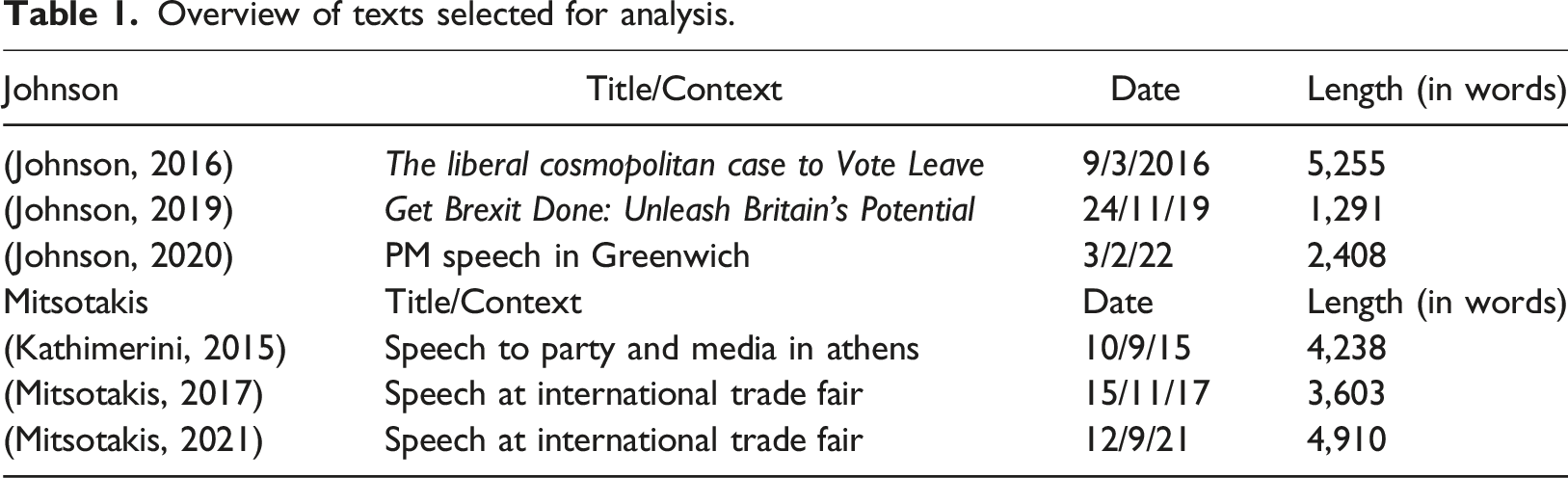
The number of texts is small, hence strategic selection is crucial. The texts selected were all speeches which drew considerable media attention and were designed for multiple audiences. They also had to be available in full text format on an official party or governmental website. Johnson’s 2016 speech was a position statement on voting to leave the EU but also his vision for post-Brexit Britain which made him a figurehead for Eurosceptics in the UK Conservative party and ultimately securing his elevation to party leader. Alongside a variety of other appearances, this speech, his manifesto launch speech based on the introduction published in the document (Johnson, 2019) and his Greenwich speech (Johnson, 2020) to celebrate the UK leaving the EU were designed for live public consumption but also to be synthesised by journalists to reach a wider national audience. This is similarly the case for Mitsotakis’ speeches. His pitch to be leader (Kathimerini, 2015) was widely reported on by media and the two speeches to the International Trade Fair (Mitsotakis, 2017, 2021) were clearly designed to reassure both his immediate and the domestic audience of Greece’s stability with Mitsotakis as premier. Given that all speeches can be viewed online and are reported on by international media, their construction should consider how they develop touchpoints to multiple audiences and so the most important selection criteria was the career context.
The analysis that was employed a corpus-based approach focusing on a selective and predetermined small sample as appropriate for qualitative hand-coding and deep analysis of each text (Baker, 2023). Speeches are a form of affective storytelling (Papacharissi, 2015) and can employ symbolism and metaphor in order to have emotional resonance conveying the logic and ethos of the argument as well as the character of the speaker. Hence studies of carefully chosen strategic speeches, subjected to in-depth discourse analysis, are proven able to develop an understanding of the denotation and potential connotations of political communication (Bull, 2002). Small but strategic corpuses have proven useful for a number of studies designed to understand communicational strategies across corporate and political contexts (Irfan & Khaja, 2019). The coding followed principles of discourse analysis, looking for symbolic meanings, metaphor and meta-narratives within the rhetoric which provided specific information about the leader and might provide important information to citizens seeking to learn about the leader brands.
The analysis followed the qualitative rhetorical analysis approach of Charteris-Black (2018) which utilises semiotic analysis of discourse. The full texts were downloaded from reputable official websites and subjected to a close reading in the original language. The first stage was to code words and phrases in the text which mapped onto Needham’s six dimensions: simplicity, uniqueness, reassurance, aspiration, values and credibility. Built into this stage were discussions between coders to ensure the coding of the texts was consistent, objective and reliable. The authors completed the initial coding of their national leader, with key sections from Mitsotakis translated to allow for cross-checking and testing of intercoder reliability and consistency through a process of double coding and analysis of sections. The second stage was to identify branding information which fell outside of the dimensions to assess whether the schematic is as inclusive as necessary for comparative analysis. We next set out the key findings in relation to Needham’s dimensions across the three career stages of each leader prior to offering a holistic analysis of the branding rhetoric and usefulness of Needham’s schematic as an analytical tool. When making assessments about the overall success of the brands we draw on reputable opinion data and secondary research which was utilised to assess the public standing of each leader at key points during their career.
Assessing the Johnson and Mitsotakis brands
Simplicity
Simplicity involves using slogans and soundbites to convey resonant messages to citizens. Johnson’s political brand employed simplicity at every stage, unlike Mitsotakis who adopted simple slogans only when elected as leader. Campaigning in favour of Brexit, Johnson synthesised public concerns about sovereignty, globalisation and unrestricted EU migration in the slogan ‘Take back control’ (Johnson, 2016). Using the phrase thirteen times in relation to laws, borders and money. The speech introduced the UK’s financial contribution to the EU as an issue, although based on misleading figures, he offered the simple choice between “taking back control of our money – or giving a further £100bn to Brussels before the next election” a sum sufficient “to pay for a new British hospital every week”. Johnson’s simple, perhaps simplistic, choice was between a free, strong Britain versus an inability to control the national economy, destiny or borders. Johnson’s election slogan, also frequently repeated, had similar simplicity: “Let’s get Brexit done, and take this country forward” (Johnson, 2019). The choice he presented was voting for him or further ‘dither and delay’ echoing public opinion he declared: “We want to move on”.
There are echoes of this style in Mitsotakis’ campaign slogan “Greeks deserve better” (Mitsotakis, 2017) and in the vision he communicated for Greece in 2017. Despite addressing an international audience, Mitsotakis stressed Greeks ‘do not deserve to live in misery and constant impoverishment paying for the lies and illusions of trainee magicians (…) We are here to create a healthy and safe Greece, that is not afraid of the future” (Mitsotakis, 2017). The ‘trainee magicians’ comment alluded to Mitsotakis’ comparative messaging which portrayed Tsipras and SYRIZA negatively. As premier Mitsotakis labelled his relationship to the people his “Agreement of Truth” (Koliastasis, 2022, p. 103). Such statements referenced his campaign which contrasted the trustworthiness of ND under his leadership with the inconsistency of SYRIZA. Mitsotakis also focused on highlighting delivery using the slogan “we said it, we did it”. Johnson, in contrast, continued to employ a simplistic rhetorical style, making vague, highly optimistic claims that the challenges could be solved through the unfettered trade life outside the EU: “We have the opportunity, we have the newly recaptured powers, we know where we want to go, and that is out into the world” (Johnson, 2020). Johnson’s branded simplicity was his ebullient optimism, Mitsotakis his measured approach and evidence of delivery.
Uniqueness
All brands, commercial or political, require a unique selling point and party leaders often prove pivotal in revitalising party brands through their unique character and performance (Smith & French, 2011). The Johnson brand has long been seen as combining unapologetic positivity and a maverick style with a political vision (Lilleker & Stoeckle, 2021; Purnell, 2011). Brexit allowed him to reinforce these elements with a populist style, he campaigned for election as the champion of popular democracy, Brexit was the will of the people, and they wanted it done. Once elected with a majority Johnson employed nationalistic jingoism to highlight his vision of Britian post-Brexit: “humanity needs some government somewhere that is willing at least to make the case powerfully for freedom of exchange, some country ready to take off its Clark Kent spectacles and (..) emerge with its cloak flowing as the supercharged champion of the right of the populations of the earth to buy and sell freely among each other” (Johnson, 2020).
The inference being that while Britain was superman, it was Johnson’s unique political style and drive which bestowed on the nation its superpowers.
While Johnson built on an existing brand persona, Mitsotakis had to develop his own. In campaigning to be leader he emphasized how his candidacy offered ND renewal which would position the party to defeat SYRIZA and return to power (Kathimerini, 2015). He also asked his supporters to adopt “with Kyriakos”. This personalization focusing on just his first name differentiated him from competitors, from his famous political father, while also embracing the anti-establishment populist sentiment prevailing in Greece due to public frustration with the economic crisis. As leader of an election campaign he emphasized the uniqueness of the ND party brand. Mitsotakis adopted a confrontational strategy toward SYRIZA, criticizing premier Tsipras for his anti-bailout platform and subsequent U-turn and attacking Tsipras for ignoring political realities and creating economic instability. The ND, he told the international trade fair, would implement tax cuts and policy measures aimed at attracting private investment to stimulate economic growth (Koliastasis, 2022, p. 102). Even as premier, Mitsotakis focused on his economic management and political platform as his selling point, highlighting policies to restore public safety, limit undocumented migrant flows and show how his record differed from that of the SYRIZA administration (Koliastasis, 2022). Emphasizing uniqueness through his achievements, Mitsotakis argued Greece was “stronger today than it has been for many years. It is economically, geopolitically, and militarily stronger. Its image abroad has changed and its status has been upgraded” (Mitsotakis, 2021). Hence, while both leaders developed a unique brand, Johnson’s brand was performative and rhetorical while Mitsotakis grounded his uniqueness in emphasizing delivery on his program.
Reassurance
Electing a new leader involves a degree of risk, hence citizens seek reassurance during campaigns as well as after an election, especially if they did not support the new government and seek reassurance of its inclusivity. Johnson’s reassurance messages rested on his optimist perspective that Brexit would empower Britain. While it may have reassured voters that “the 5th biggest economy in the world” could overcome the challenges, often his messages were stark choices “the possibility of hope… or accepting that we have no choice but to knuckle under” (Johnson, 2016). His election campaign similarly targeted only Brexit supporters reassuring them he would, “respect the democratic will of the people” and claiming: “we have a great new deal that is ready to go” (Johnson, 2019). The latter may have been intended to reassure doubters, but it ignored the obvious complexities of trading arrangements and any negotiated future relationship (Grey, 2021). But throughout, Johnson downplayed the challenges in negotiating trade deals, the only measure of reassurance he offered critics was: “We will not engage in some cut-throat race to the bottom” (Johnson, 2020) but his case for this was his government could develop trading arrangements which were better than “EU restrictions… on flexible working, protecting the environment and animal welfare”.
Mitsotakis’ reassuring messages reflected the different stages of his career more clearly. In campaigning for leader he reassured party selectors that he would ensure unity within ND: “This is what people expect from us” (Kathimerini, 2015); once leader he campaigned on a reassuring message by stressing the need for change (Mitsotakis, 2017). As premier this latter theme continued. Mitsotakis reassured citizens his government “is tackling new challenges immediately, making bold decisions and setting ambitious goals without losing the thread that connects all of its steps: achieving high growth rates for all and promoting the widespread modernization of the country” (Mitsotakis, 2021). These goals remained his focus, emphasizing the “we said it, we did it” slogan despite the challenges of the pandemic. Hence, there is again a contrast between using personal confidence to be a reassuring brand versus emphasizing steady management and delivery on promises.
Aspiration
Both leaders emphasised aspirational messages, though with contrasting targets. Mitsotakis in standing for the ND leadership, articulated a political vision that reflected the aspirations of ND members and sympathizers, stating he was fighting ‘to make ND a great party of government again, a central reference point for political developments in the country” (Kathimerini, 2015). His focus pivoted for the election campaign where he spoke to the whole nation, extolling a vision of “a Greece where those who succeed are rewarded and the weak are supported’ (Mitsotakis, 2017). Speaking as premier this inclusive image of Greece continued, claiming the nation: “knows what it wants to achieve in a challenging world (..) This is precisely why we are optimistic” (Mitsotakis, 2021). It is argued Greeks bought into this vision as polls show he enjoyed popularity ratings over 60% for almost 12 consecutive months (Metron, 2021).
Johnson’s brand was largely inclusive from the start, but it ignored the serious divisions within his party or the nation over Brexit. When promoting Brexit he claimed “We can see the sunlit meadows beyond. I believe we would be mad not to take this once in a lifetime chance to walk through that door”. The “sunlit meadows” were ones of prosperity: “We will trade as much as ever before, if not more”. Similarly in launching the election manifesto he claimed: “From freeports to free trade deals, from abolishing the cruel live shipment of animals to cutting VAT on tampons… where we choose, we will be able to do things differently and better”. Arguably his vision was more grounded in aspiration than reality. His speech as premier claimed the EU would accept Britain’s demands and Johnson would lead the way in freeing nations from tariffs which caused inequalities. This renewed freedom would enable his levelling up program but also see Britain globally spreading its values: “open, outward-looking, generous, welcoming, engaged with the world championing global free trade now when global free trade needs a global champion”. Johnson’s aspirational brand was cloaked in jingoistic symbolism of a Britian which harks to golden ages of the past reimagined for the future.
Values
The jingoism is reflected in the national values Johnson placed at the heart of his brand. He defined post-Brexit Britain as “open global free-trading [and] prosperous”, and Brexit “the great project of European liberalism” returning power to the British people via their parliament. He also talked of his personal patriotic mission: “The independence of this country is being seriously compromised. It is this fundamental democratic problem (..) that brings me into this fight” (Johnson, 2016). Such broad values contrasted with Mitsotakis’ pitch to be leader which centered on the political values of ND, referring to credibility, excellence, restructuring the state, and economic growth (Kathimerini, 2015). Mitsotakis emphasized more aspirational values during the election campaign, talking of freedom, democracy, meritocracy, excellence and solidarity. Equally as premier Mitsotakis emphasized the need for rationality, social solidarity, and individual responsibility both to restructure the nation but also to prevent the spread of Covid-19 (Mitsotakis, 2021). Hence, Mitsotakis grounded his value statements in the reality of the situations he faced.
Johnson maintained more abstract and nationalist aspirational values at the heart of his rhetoric. For example, during the election campaign he claimed: “We want to get Brexit done so that we can get on with our work of making Britain the greatest place in the world to live, to go to school, to start a family, to own a home, to start a business…” (Johnson, 2019). His opponents, he claimed, lacked political imagination and faith in the strength of Britain. His claim during the referendum campaign that voting Leave was patriotically “fighting for freedom” (Johnson, 2016) reflected his commitment to emphasising his and Britain’s nationalist and libertarian character even in the face of a pandemic: “there is a risk that new diseases such as coronavirus will trigger a panic and a desire for market segregation that go beyond what is medically rational” (Johnson, 2020). It was these abstract values as a mission which underpinned Johnson’s stance, while Mitsotakis was more measured in his rhetoric and applied value-driven solutions to very specific problems.
Credibility
The contrasts noted above thus has ramifications for the communication of credibility. Johnson’s uniqueness and credibility rested on hyperbolic and exaggerated claims delivered with complete confidence. Johnson’s brand character, and his claim that he was able to take the country to those ‘sunlit meadows’, earned him a personal vote. At the 2019 election Johnson was also able to attract votes from communities that traditionally did not support the Conservatives due to him championing Brexit but also for his claims to support the aspirations of a range of societal groups through his levelling up agenda. But while he promised aspiration, freedom and openness to all, his claims became increasingly incredible among the majority of Britons (O’Donoghue, 2021).
Mitsotakis maintained his credibility by carefully managing his claims. On seeking the party leadership he emphasized his record for delivering on his promises as an MP and Minister (Kathimerini, 2015). He was also careful not to impose his personal aspirations on Greek citizens, he told the internation trade fair that: “political power is not an end in itself but a means to improve people’s lives” (Mitsotakis, 2017). Such rhetoric emphasized his commitment to public service. Once elected Mitsotakis maintained his credibility by communicating how he met his core pledges. At the 2021 trade fair he highlighted cutting taxation, claiming his government “returns to the middle class what SYRIZA took from it” (Mitsotakis, 2021). Hence when Mitsotakis claimed “a year after the Government’s announcements at the 2020 Budget and two years since I spoke here [in the International Trade Fair] for the first time as Premier, I can tell in five words: ‘We said it, we did it’” (Mitsotakis, 2021) this resonated with Greek citizens. He was able to maintain his brand’s credibility by highlighting delivery on key pledges, thus contributed to his stable position in opinion polls.
Discussion
Johnson’s and Mitsotakis’ rhetoric reflected the dimensions of Needham’s brand schematic for successful brands to differing extents and with different styles. Firstly, both brands offered a degree of simplicity, although the emphasis on slogans differed across the stages of Mitsotakis’ career compared to that of Johnson, however the contexts for the speeches prior to becoming leader were markedly different. The remaining five dimensions are found to explain how they strategically positioned themselves, thus demonstrating the differences between the two leader brands. The Mitsotakis brand emphasised credibility and values primarily, followed by aspiration and reassurance, there was less focus on uniqueness beyond the comparative campaign messages which contrasted ND from SYRIZA. Johnson’s brand, in contrast focused on aspiration, values and his own uniqueness, this was also used as the case for his credibility and reassuring doubters. Johnson’s overt optimism thus contrasted the statesmanlike realism of Mitsotakis (Figgou & Andreouli, 2023). While they were both elected in times of instability, they adopted highly contrasting approaches. Mitsotakis’ campaign presented him as a competent manager and his promises focused on practical ways to resolve societal issues resulting from the economic crisis, presenting a vision echoing Greek’s concerns and aspirations (Gutman & Miaoulis, 2003). Johnson’s appeals were to myths of national identity and an aspirational if unrealistic perception of Britian, a more populist strategy (Susila et al., 2020). Therefore, the Needham schematic proved a useful analytical tool for assessing the dimensions of the brands as well as which dimensions were given the greatest emphasis. When considering the schema of citizens, and the linkages cognitively stored relating to their respective leaders, it is likely the dimensions priorities map onto their perceptions of their leader (Gutman & Miaoulis, 2003; Lilleker, 2014).
The differing priorities for communication, reflected in the weight given to each dimension, allows us to assess how the styles and personalities of the individuals are reflected in their approach to developing a personal brand. Largely, the differences found are consistent with the general perceptions of the two leaders: Mitsotakis as a technocrat and Johnson as a populist. However, the analysis of the speeches reveals how they created personal brand touchpoints (Rayner, 2014) which resonated with their respective voters. Expectedly Johnson’s appeal was largely grounded in the symbolism and hyperbole consistent with highly emotional campaigning styles (Mensah, 2017), and we find this emphasised in the aspirational dimension of his branding, combining patriotic symbolism with national values. As a technocrat Mitsotakis focused on his record and evidence of delivery, but still invoked aspirational values but across his speeches these were grounded in deliverable pledges rather than abstract values.
The Mitsotakis brand also proved to be more adaptable for different contexts and there is evidence across the speeches that his brand evolved significantly 2015–2021 compared to that of Johnson. Mitsotakis had a consistent set of values that informed his vision, but he adapted his messaging to reassure detractors within the party, to gain voter support and to build consensual support for his premiership. The success of the Mitsotakis brand was entirely tied to his ability to deliver on his promises, the core of which is delivering competent management. Johnson meanwhile relied on overt self-confidence and the idea of Britian as superpower able to doggedly overcome challenges outside of the EU to win support. Johnson’s brand proved emotionally resonant among large sections of British society (Kaneva & Klemmer, 2016) but appeared more suited to campaigning than governance. His Greenwich Palace speech in 2020 was ultimately a continuance of this aspirational message which made claims that had only a tenuous link to reality. The failure to pivot from a campaigning style, albeit staying absolutely true to the brand Johnson had established for himself, contributed to his downfall in the faces of the various challenges his government would face during managing the Covid-19 pandemic (Lilleker & Stoeckle, 2021).
Needham’s (2005) schematic proved useful for uncovering the way that the two leader brands were established and the dimensions they emphasised. While it was developed to assess why the Blair brand was successful we argue that it can also be applied for the assessment of leaders in real time, based on their rhetoric, and understand at a minimum how they seek to win support from citizens at differing stages of a political career and when facing differing socio-economic and political contexts. Combining rhetorical analysis of speeches with data on public opinions can aid understand how political speeches attempt to build pathos with the mood of their audience (Irfan & Khaja, 2019). We also found that the dimensions proved sufficiently inclusive and broad to cover the branding strategies of both leaders as well as understanding how their strategies and approaches differed. By exploring the adherence to Needham’s dimensions it is possible to gain insights not only into the strategy of the leaders, the denotation involved in crafting rhetoric, but also into how a brand may be understood by citizens. If citizens find leaders’ slogans simple and resonant, the claims to be aspirational while credible and reassuring, to offer uniqueness and to reflect their values they will likely support that brand. However, we emphasise that context also matters. It is likely the technocratic approach of Mitsotakis was exactly what Greek voters sought following years of political turmoil and instability. He was positioned to offer managerial competence while building relationships with international partners in ways Tsipras and SYRIZA could not. The choice at the UK 2019 general election was a leftist with an ambiguous position on Brexit and the ebullient and bombastic Johnson who claimed to have an easy solution to the turmoil that had enveloped politics since the referendum result was announced. Johnson’s branding was sufficiently robust to convert the aspirational message of Brexit into a parliamentary majority, but would it have proven so with a different opponent? Our research allows us to posit that Needham’s branding schematic could be employed successfully to compare different leaders within different contexts, and competing party leaders at elections, to understand how branding and context interrelate and potential shape political outcomes.
Conclusion
Needham’s schematic helped understand how two political leaders rhetorically built personal brands, how the branding adhered to the dimensions of a successful brand, and how the brands differed in emphasis of those dimensions. The findings highlighted how the brand dimensions reflected the personalities and characters of the two leaders and the extent the brands were adaptable across different contexts. The research extends understanding of brands by looking across a wider context than a single leader and one election contest (Needham, 2005). Political leader brands emerge that are right for a specific moment in history, often driven by the character of the individual, but these can be inappropriate when the context changes. Our analysis helps explain how political brands are adapted, or not, to differing contexts and suggest that this offers insights into why brands might be able to retain high public approaval and why some brands might fail to retain support.
The differences between the two leaders help us assess the validity of Needham’s brand attributes but a wider sample of speeches from a range of more diverse leaders is required to extend this research further. Given the increased centrality of the leader within party-centric systems, how leaders build and maintain their brands is an area fertile for research. Our research shows we can learn how brands are strategically communicated, why they might have appeal and why a leader brand may become exposed if the leader does not possess the right attributes for a given context. Our research may also suggest some brands are excellent for campaigns but cannot be sustained under the spotlight of government during a crisis. Such questions require further testing as we consider how to understand political brands in contemporary societies.
Practical implications
Branding is a complex aspect of political marketing. A personal leader brand must reflect the character of the individual politician while also being appropriate as a leadership style for a particular context. Therefore, building a brand must take into consideration what citizens already think about the individual, what they like about them and what further dimensions must be added to the brand to make them appear suitable for leadership. Research on the qualities and character of a leader, particularly what citizens like or do not like, provides important baseline data. Branding must also be able to manage transitions between both career stages and different phases of leadership as well as dealing with challenges and crises. At different stages a potential leader may need to focus on communicating with their own party or a narrow group of citizens prior to transitioning to speaking to the entire nation. Across these stages the brand must be consistent while also appealing to potentially distinct audiences. Hence, a brand must show it will stay true to its core ethos but also be able to adapt to different audiences and contexts, both of which may be metaphors for performance in office. A political brand manager must therefore consider what dimensions need to be emphasized at different stages for the brand to be seen as reflecting the most appropriate qualities: to be reassuring in a time of crisis, but aspiration when campaigning for election for example. It is also important to consider what qualities are required, and are sought by citizens, for different contexts. A leader may have to deal with face natural disasters, political and economic crises, and at each point deliver a message that conveys the right qualities to the citizens. Hence, at different periods the differing dimensions of the leader brand need to be emphasized. The values need to be consistent and there must always be an air of credibility. But some moments require aspirational leadership and others require reassurance. Considering what dimensions need to be emphasized while retaining credibility, a degree of uniqueness and simplicity can ensure that a leader can win and maintain a supportive consensus despite dealing with the unpredictable forces that buffet a national leader.
Footnotes
Declaration of conflicting interests
The author(s) declared no potential conflicts of interest with respect to the research, authorship, and/or publication of this article.
Funding
The author(s) received no financial support for the research, authorship, and/or publication of this article.
