



Abstract
New brand launches are notoriously risky, with high failure rates. Yet, most research focuses on the out-of-store factors inherent to their success/failure, overlooking strategies that can be employed in-store. The present research addresses this oversight by examining the influence of two in-store factors, distraction and shelf position, and their impact on a new brand’s visibility on the shelf. We draw on a unique data set featuring a real-life new brand entrant into the Australian market. Using an experimental design in a shopper laboratory, and mobile eye-tracking, we find that the new brand stands a greater chance of being noticed and visually attended to on the shelf when shoppers are distracted. This is attributed to shoppers dwelling longer in front of the fixture, being more open to new-to-the-consumer brands, and by negatively affecting the top-down processing of existing brands on the shelf. We also find that optimising shelf position, which is a common in-store marketing tactic for existing brands, may not produce the same return on investment for a new brand. The findings offer valuable theoretical and practical implications for improving the success rates of new brand launches, including selection of distribution channels, allocation of marketing resources, and the interplay between in-store and out-of-sore factors driving shopper behaviour.
Introduction
New brands are essential for business growth and serve multiple purposes, such as helping companies to appeal to variety seeking consumers and opening up new revenue streams (Kapferer, 2012; Trinh et al., 2016). However, they are notoriously risky endeavours. Victory et al. (2021) conducted an extensive study of over 80,000 stock keeping units introduced into the USA and found that 25% of new launches are no longer offered one year after launch, increasing to 40% after a second year. To date, most research has focused on how to improve the success rates of new brands through out-of-store factors, such as advertising that builds awareness and brand memory structures for the new brand (Ehrenberg et al., 1997; Kendall, 2017). In contrast, the battlegrounds that new brands face in-store have been largely ignored. This is surprising and in sharp contrast with the importance of the in-store environment where, for example, 67%–75% of purchase decisions are believed to take place (Gofman et al., 2010; Inman et al., 2009) and the majority of a consumer’s new purchases (Bogomolova et al., 2019). As discussed by Wästlund et al. (2018), new brands are ‘practically invisible’ in-store (p. 55), which suggests the in-store environment may have untapped potential for optimising new brand launches.
The present research addresses this opportunity by investigating two potentially useful aspects of the in-store environment, distraction and vertical shelf-position, and their impact on visual attention of new brands. Visual attention is of key interest to marketers, given that brands that are visually attended to receive enhanced processing, which in turn influences decision-making (Pieters & Wedel, 2004). Research shows that consumers are becoming increasingly distracted in-store, particularly due to the use of mobile phones (Deloitte, 2017; Grewal et al., 2018; Sciandra & Inman, 2016). Distraction is known to influence top-down (e.g., memory and goal-related) factors related to in-store behaviour by negatively impacting a shopper’s ability to manage shopping tasks (Grewal et al., 2018; Sciandra et al., 2019; Sciandra & Inman, 2016). The present research proposes that, contrary to its effects for existing brands, distraction may counterintuitively aid a new brand’s visibility on the shelf. That is, studies have shown that when shoppers are distracted, they divert from their conventional shopping loop, dwell longer in the store and in front of shelves, and spend more time examining products and prices (Grewal et al., 2018). Moreover, distraction leads to more unplanned purchases (Inman et al., 2009; Sciandra & Inman, 2016; Thomas & Garland, 1993). Hence, these conditions could be particularly useful in assisting new brands to be visually attended to and found on the shelf, and present a potentially underutilised strategy for increasing visual attention of new brands in-store.
Understanding the optimal vertical shelf position also offers untapped potential for improving in-store visibility of new brands. While there are several bottom-up (e.g., environmental) in-store marketing strategies that a new brand can employ to increase visual attention (e.g., the number of facings, end-of-aisle gondolas and horizontal shelf placement), vertical shelf position has been shown to be one of the most important (Chandon et al., 2009; Valenzuela et al., 2013). However, existing research on the optimal vertical shelf position for new brands is both insufficient and contradictory. Some scholars suggest that new brands may value from a better shelf position but have not agreed on what this might be or whether it will be different to existing brands (Chandon et al., 2009; Valenzuela et al., 2013); others suggest there may be no benefit of improving the shelf position for new brands at all (Chandon et al., 2006). Given that brands pay considerable premiums for attaining certain shelf positions (Dreze et al., 1994), we address whether this investment is ‘worth it’ for new brands and, if so, which shelf they should aim for.
To investigate these factors, the present research draws on a unique data set using a real-life new brand entrant prior to its launch into the Australian market in Q4 2019. The study uses mobile eye-tracking in a shopper laboratory to compare visual attention and purchases for an entirely new brand (e.g. not a brand extension) across two different shelf positions (top and middle), different levels of memory-based equity (zero, representing when the new brand is first launched and some, once the brand has acquired prior exposure), and distraction (measured by giving shoppers a cognitive load, as per the psychology literature – see Gilbert et al. (1995). The advantage of using a shopper laboratory and mobile eye-tracking is that it affords the benefits of a controlled experiment but in a more realistic shopping environment than previous desktop eye-tracking studies (Bogomolova et al., 2019, 2020; Chandon et al., 2009).
The paper makes a three-fold contribution to theory and managerial practice. First, we extend the current lens used to investigate new brand launches by highlighting the importance of the in-store environment. Second, we show that distraction provides a welcome advantage for new brands and can aid them in being found on the shelf. In particular, we show that not only does distraction lead to more unplanned purchases, but new-to-the-consumer purchases; that is, consumers become more exploratory. This has implications for distribution strategies, e.g., it emphasises there may be value in launching new brands into distracted environments, such as convenience stores first. Third, we show that shelf position is less important for new brands until they have acquired some memory-based brand equity. This finding is particularly valuable and contributes to calls to better understand the dynamics between in-store and out-of-store factors (e.g., Huddleston et al., 2018); it also helps brand managers to allocate their marketing budgets more efficiently.
Background
Theories of visual attention
Visual attention refers to the process of selecting and allocating enhanced processing to particular aspects in a visual field (Wedel and Pieters, 2006, 2017). Visual attention is an evolutionary mechanism, given that the amount of visual stimuli present in the environment at any one time far exceeds what the brain can process. Therefore, the brain relies on mechanisms to select relevant information and simultaneously suppress less relevant information (Wedel & Pieters, 2008). Visual attention is a psychological construct of interest in much eye-movement research in marketing, in that when a particular location or object (e.g., brand) is visually attended to, processing of it is enhanced, which has the potential to influence decision-making (Pieters & Wedel, 2004).
According to theories of visual attention (see Wedel & Pieters, 2008), what consumers visually attend to on any given occasion is driven by both top-down (e.g., memory-based) and bottom-up (e.g., visual-based) mechanisms (Chandon et al., 2009; Lynch et al., 1991; Wedel and Pieters, 2006, 2017). Top-down mechanisms are driven by goals, memory, expectations, and states and traits of the individual (Wedel & Pieters, 2008). In the context of in-store shopper behaviour, top-down factors have also been referred to a brand’s memory-based ‘equity’, e.g., the knowledge consumers have for different brands, including their visual identity, acquired from prior marketing and brand experiences (Chandon et al., 2006). In contrast, bottom-up factors are driven by the saliency and contrast (e.g., conspicuity) of stimuli in the visual field (Wedel & Pieters, 2008). In relation to in-store shopper behaviour, bottom-up factors are the perceptual features of locations, objects and brands, such as shelf position, the number of facings a brand has on the shelf, and package design. Importantly, the interplay between top-down and bottom-up factors is important (Chandon et al., 2009; Huddleston et al., 2018; Wedel & Pieters, 2008). The red Coca Cola can has a greater potential to be attended to for consumers who are aware that Coca Cola comes in a red can and the packaging stands out on the shelf. This is because consumers store memory modules for object recognition, which help to prioritise aspects of the visual field relative to their goals, which is reflected in eye-movements.
New brands (defined in this research as entirely new brands in the market, rather than brand extensions) present a unique interplay between top-down and bottom-up factors. For example, whilst some new brands do out-of-store advertising prior to launch, many others cannot afford to, or choose not to (see the example of Tony’s Chocolony - (Jefferson, 2022)). Even if new brands do advertise, it’s unlikely to have reached all consumers, and most consumers likely arrive at the shelf with no memory-based brand equity for a new brand. As such, it seems reasonable to posit that bottom-up factors may be more important to new brands than top-down factors. Previous research has so far focused on increasing memory-based brand equity for new brands (Tanusondjaja et al., 2016), rather than any potential opportunities that may exist in the in-store environment. To address this, the present research investigates two aspects of the in-store environment, distraction and shelf position, and their role in guiding visual attention to new brands. Specifically, we pose the research question: How important is the in-store environment for new brands?
Distraction
Distraction is defined as ‘the act of diverting or directing attention from one object to another or apportioning attentional resources in multiple directions’ (Sciandra & Inman, 2016, p. 7). There are several ways that shoppers can become distracted in store, such as from music (Hynes & Manson, 2016), perceptions of crowding (Aydinli et al., 2021), and shopping with others (Borges et al., 2010). Recently, a distraction that has gained attention from both academics and practitioners is mobile phone use (Grewal et al., 2018; Sciandra et al., 2019). According to a report by Deloitte (2017), 93% shoppers admit to using their mobile phones in store. Interestingly, rather than being seen as outside their control, retailers recognise the opportunities of promoting distraction in store, such as offering wi-fi, proximity marketing (e.g., push notifications based on location), and providing charging devices on trolleys (Grewal et al., 2018; Sciandra et al., 2019).
Several theories help to explain the effect of distraction on shopper behaviour (see Grewal et al., 2018 for a comprehensive overview). Limited cognitive capacity theories posit that since working memory has a limited capacity, when it is asked to perform several tasks simultaneously (as is the case when a consumer is distracted), the tasks cannot be executed successfully (Grewal et al., 2018; Repovš & Baddeley, 2006; Unsworth & Robison, 2016). Multiple resource theories of information processing similarly contend that there are multiple pools of processing resources that individuals can tap into when making decisions. However, as the number or complexity of tasks increases, task interference occurs which negatively impacts the ability to perform tasks successfully (Wickens, 2008). Lastly, bottleneck theories (Fagot & Pashler, 1992), posit that when people try to process multiple pieces of information concurrently, information processing slows down because of a restricted bottleneck of available information (Gopher & Navon, 1980). In summary, distraction is believed to negatively impact a shopper’s ability to manage shopping tasks (Sciandra et al., 2019), and prevents shoppers from considering their goals (Drolet et al., 2009; Drolet & Luce, 2004; Rottenstreich et al., 2007).
Research investigating the impact of distraction on shopper behaviour has typically examined shopping experiences ‘overall’; that is, the number of store and category purchases (Grewal et al., 2018; Sciandra et al., 2019), types of decision-making, e.g. hedonic versus utilitarian (Aydinli et al., 2021; Drolet et al., 2009; Rottenstreich et al., 2007); how consumers compare products, e.g. attribute-to-attribute versus brand features (Pieters & Warlop, 1999), and overall enjoyment (Borges et al., 2010). In contrast, there is scarce research investigating the impact of distraction for specific types of brands, including new brands. This is a limitation of existing research and, for new brands especially, presents an untapped opportunity. For example, Grewal et al. (2018) found that being distracted causes consumers to divert from their conventional shopping loop, dwell longer in front of shelves, and spend more time examining products and prices. In addition, other research has shown that distraction influences a shopper’s ability to manage shopping tasks, leading to more unplanned purchases (Inman et al., 2009; Sciandra & Inman, 2016; Thomas & Garland, 1993). Combined, these outcomes offer two favourable conditions for driving visual attention to new brands. First, if distracted consumers spend longer at the shelf and examine more products (Grewal et al., 2018), then distraction may aid new brands in being noticed simply by creating increased opportunity. Second, distraction may not disadvantage new brands in the same way as existing brands. That is, Sciandra and Inman (2016) showed that in addition to increasing unplanned purchases, distraction also leads to forgetting planned purchases. As such, given that new brands will not be a planned purchase, they may benefit from being one of the alternative brands that could be purchased instead. This also aligns with visual attention theories in that if distraction restricts shoppers from managing their goals, then it may negatively influence top-down processes that aid existing brands, such as a shopper’s ability to prioritise known stimuli (e.g., brand packaging) and reduce the suppression of less well known stimuli (e.g., new brands). Given the challenges new brands face to be found instore (Wästlund et al., 2018), the present research investigates this formally with the following hypotheses:
Shelf position
Previous research has shown that not all shelf positions are equal, and that a position advantage exists whereby brands on a more favourable shelf position attract greater visual attention, more favourable evaluations, and a have higher likelihood of purchase (Dreze et al., 1994; Chandon et al., 2009; Valenzuela and Raghubir, 2009; Chen et al., 2021). The literature examining which shelves are ‘optimal’ typically illustrates that vertical, rather than horizontal, position is the most important (Chandon et al., 2009; Valenzuela et al., 2013). That is, moving a brand from a less to a more optimal vertical position has a greater effect on visual attention, evaluation, and sales, than moving a brand to a more optimal horizontal position (Chandon et al., 2009). Importantly, this effect allows retailers to command a price premium for certain shelf positions (Dreze et al., 1994).
To date, both the practitioner and academic research lacks a clear consensus on the optimal vertical shelf position. ‘Accepted wisdoms’ of manufacturers and retailers suggest that “eye level is buy level” (Hewett, 2017; Lihua, 2016; Santaella, 2020); that is, products positioned at eye-level are likely to receive more attention and have a greater chance of being chosen. However, as argued by Dreze et al. (1994) and more recently Chen et al. (2021), what retailers and manufacturers mean by ‘eye-level’ is highly ambiguous. Dreze et al. (1994) asked experts to specificize eye-level and found that it referred to ‘any one of several shelves above the knees but below six and a half feet’ (pg. 20). Chen et al. (2021) reported that the optimal shelf height that practitioners recommend occurs across a wide range, from 36–60 inches (Sorensen, 2009) to 47–59 inches (Lihua, 2016). More recently, practitioners have confusingly suggested that eye-level should not be considered the level of the eye, but 15–30° lower, where the natural gaze lies (Nielson, 2020); others suggest that the “sweet spot” is actually from the waist to the shoulder (Usborne, 2012).
The academic literature also lacks a concrete recommendation for optimal shelf positioning. Dreze et al. (1994) conducted a quasi-experimental approach with modelling and found that a central shelf position is optimal for sales. Specifically, moving a brand from the worst (bottom shelf) to the best (middle shelf) position across a number of categories improved brand purchases by 39% (Dreze et al., 1994). Chen et al. (2021) conducted a field-based study using eye-tracking glasses and found that central shelves were also superior. Specifically, the optimal central shelf generated 14%–15% more attention compared with top and bottom shelves, and 7%–8% more attention compared with the shelves directly above and below it. In contrast to both Dreze et al. (1994) and Chen et al. (2021), Chandon et al. (2009) conducted a desktop eye-tracking study and found that the top shelves performed the best. Unlike Chen et al. (2021), Chandon et al. (2009) investigated higher-order stages of the decision-making process in addition to visual attention (e.g., brand consideration and choice). They found that whilst the middle shelves attracted visual attention, this did not follow through to consideration and choice. In contrast, the top two shelves attracted visual attention, which also had a significant effect on consideration and evaluation (Chandon et al., 2009). This finding was attributed to a mediation effect, whereby an improved vertical position (e.g., moving a brand upwards from the bottom shelf) positively effects visual attention, but the effect of attention on brand consideration can either be strengthened (if a brand is on the top two shelves) or weakened (if the brand is on the middle shelves) (Chandon et al., 2009).
The methods employed in these existing studies offer some explanation for the lack of consistency in the findings. Dreze et al. (1994) used sales data and, although it is widely assumed that attention and sales are connected, visual attention was not explicitly measured. Chen et al. (2021) conducted a highly robust field-based eye-tracking study but due to the complexities of the real-world nature of the study, did not look at different types of brands nor control for well-known covariates that drive visual attention, such as consumer’s prior brand usage/familiarity and saliency of packaging. Although Chandon et al. (2009) acknowledged this by investigating additional metrics to visual attention (e.g., brand consideration and choice), they had shoppers sitting at a desktop computer with a built in eye-tracker, hence the study lacked ecological validity.
To add further complication to understanding the ideal shelf position, research from the social cognition literature indicates that consumers hold shelf-space beliefs and schemas which influence their behaviour towards different products and brands (Meier & Robinson, 2004; Schubert, 2005). Valenzuela et al. (2013) found that consumers hold beliefs about how retailers organise shelf displays, such that they believe popular products are placed on middle shelves, expensive products on top shelves, promoted products are on the extremes of a display, and cheaper products are on the bottom. Importantly, Valenzuela and Raghubir (2015) found that consumers deliberately use their schemas as cues for quality and status of brands. More specifically, beliefs that products are placed in descending order of price from top to bottom results in inferences that items in the centre are more popular as they represent a trade-off between price and quality (see also Valenzuela & Raghubir, 2009). This finding corroborates the postulation put forward by Chandon et al. (2009) and helps to further explain why middle shelves attract visual attention (because they feature the most popular brands) but why brands on the top shelves are considered for choice (because they are of higher quality). It also affirms the confusion over whether the top or the middle shelves are most important.
To the best of the author’s knowledge, neither the best nor the expected shelf position for new brands has been investigated thoroughly. Chandon et al. (2009) investigated fictious brands (akin to new brands that consumers have never heard of) and found that in-store marketing can increase visual attention. However, the authors manipulated several in-store marketing activities (shelf position being just one) and due to limited data, were not able to determine which activities showed the effect. Valenzuela et al. (2013) investigated consumer’s schemas for new brands, although they reported incomplete results. The authors found that 21% of consumers expected new brands to be on the second shelf from the top and 19% of consumers thought that new brands would be on the middle shelf (percentages did not add up to 100%). Combined, this research points to shelf positioning being important for new brands but, like for existing brands, it is unknown whether the top or middle shelves are most important. Other research has questioned whether shelf position is important at all for new brands. Drawing on theories of visual attention, Chandon et al. (2006) devised a decision-path model to investigate the relative importance of memory-based and visual-based factors on brand consideration. To do so, they introduced the term visual lift to refer to the incremental consideration probability gained from noticing a brand at the point of purchase, and visual responsiveness as the impact of incremental changes in visual salience on brand consideration. The authors found that visual responsiveness is maximal for brands with moderate levels of memory-based equity. That is, brands that consumers have heard of and have stored at least some knowledge about in memory, are more likely to benefit from increasing visual salience. The authors went as far as to say that raising visual salience does not create any visual lift for brands with zero (i.e., new brands) or 100% memory-based equity. Whilst this research suggests that shelf position may not be important for new brands, it is important to note that Chandon et al.’s (2006) model included several in-store factors including vertical and horizontal shelf position, and the number of facings a brand has on shelf. The authors were able to say that, collectively, there was no impact of raising in-store visual salience for new brands, but they could not disentangle the effect across the factors. As such, their research also leaves open the possibility that one or more of the variables positively influences brand consideration, but the effect was balanced out by other variables having a contrasting effect. Indeed, Chandon et al. (2006) recognised that further research would be needed to manipulate shelf location and the number of facings to better understand this (p. 25).
Given the contradictory and insufficient nature of the research to date, the present research highlights shelf position as another unknown but potentially valuable in-store factor that could improve a new brand’s visibility on the shelf. As such, we test the following research question and hypothesis:
Method
Design and stimuli
The data used in the present research pertains to an actual new brand launch in Australia in Q4, 2019, two weeks following data collection. The new brand that was tested was a nut, seed and fruit bar competing in the snack bar/ball category. Although the brand is owned by a major FMCG manufacturer, it was introduced to the market under a completely new brand, hence shoppers would have had no prior memory-based equity.
The study took place in the FMCG manufacturer’ shopper laboratory; a room comprising of a high-definition screen [6.12 m × 2.29 m] and artificial segmentation used to create a shopper aisle alongside the screen. The planograms shown on the screen were the actual planograms used by the retailer for the launch of the product (see Figure 1 for an example). That is, the placement of brands on the shelf and the fact that snack bars/balls were placed next to confectionary products was ecologically and externally valid. We also set the height of the display to match the store’s confectionary aisle. The planogram did not feature prices, thus controlling for other known influences of decision-making beyond the saliency of a brand’s packaging on the shelf. Using a shopper laboratory (rather than participants sitting at a desktop computer - as is typical with other eye-tracking studies (Espigares-Jurado et al., 2020; Lacoste-Badie et al., 2020) - offered three further advantages to the research. First, it allowed for the direct manipulation of the shelf design (described below). Second, it presented a more realistic shopping environment where participants could walk up and down a shopping aisle, stand in front of a shelf, and move their gaze to browse products as they normally would whilst shopping. This satisfies calls for eye-tracking research to be conducted in more realistic retail environments (Huddleston et al., 2018). Third, it helped to avoid central biases of desktop eye-tracking studies, where the first fixations are often in the centre of a scene and participants use the centre of the screen to orient their attention (Chandon et al., 2009). Overall, the design offered a balance between controlled experimental conditions and a realistic shopping environment. Example planogram used in the study.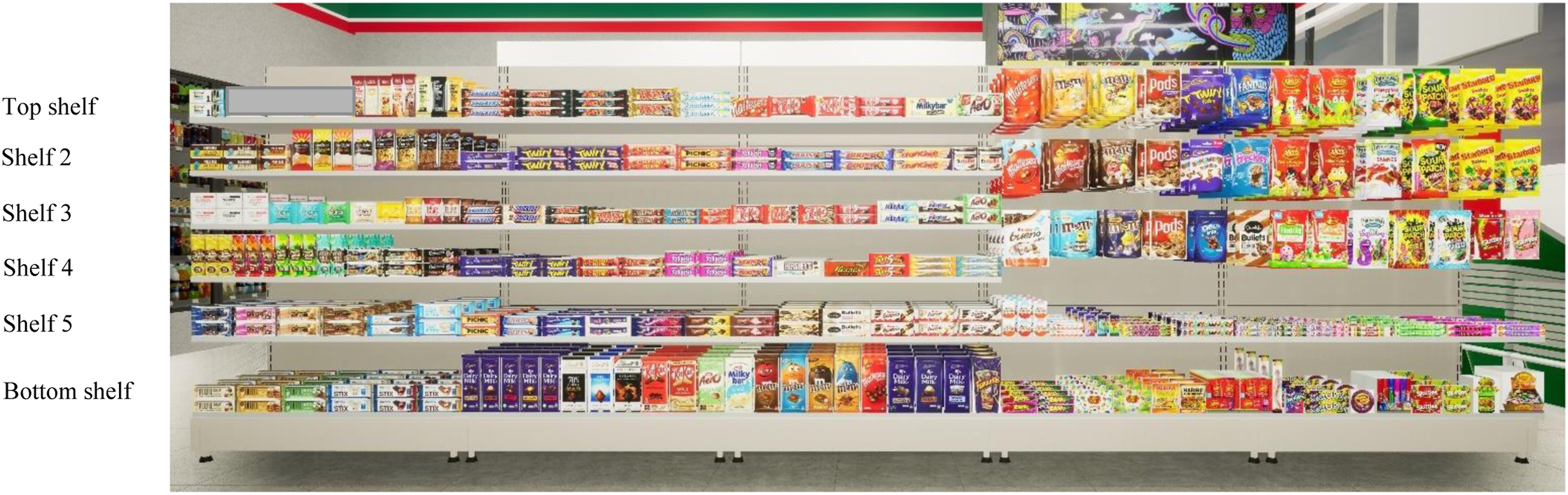
To test the research questions, we employed a 2 (shelf position: top shelf vs. middle shelf level) × 2 (advertising exposure vs. no exposure) × 2 (distraction vs. no distraction) between-subjects research design, as described below.
Distraction
We induced distraction by giving participants a cognitive load (Gilbert et al., 1995; Rottenstreich et al., 2007; Shiv & Fedorikhin, 1999). The cognitive load involved asking participants to memorise an 8-digit number before their shopping task and to recall it after their shopping task (Gilbert et al., 1995).
Shelf position
The shelf position manipulation involved alternating the new brand between a top shelf position and a middle shelf position (shelf 4 – see Figure 2), which are the two shelf heights that previous research suggests as potentially optimal (Chandon et al., 2009; Chen et al., 2021). To ensure that the visual layout of the shelf remained as similar as possible across conditions, all other brands stayed in the same position with the exception of the new brand and the category leader (e.g., the brand with the highest market share in the category). The category leader switched directly with the new brand, such that when the new brand was on the top shelf, the category leader was on the middle (fourth) shelf and vice versa. The reason for this switch was purely practical: the packages of the two bars are of a very similar size and thus facilitated a direct swap without having to move any of the other brands and alter the shelf layout. This reduced any additional, potential confounding variables. Shelf manipulation example.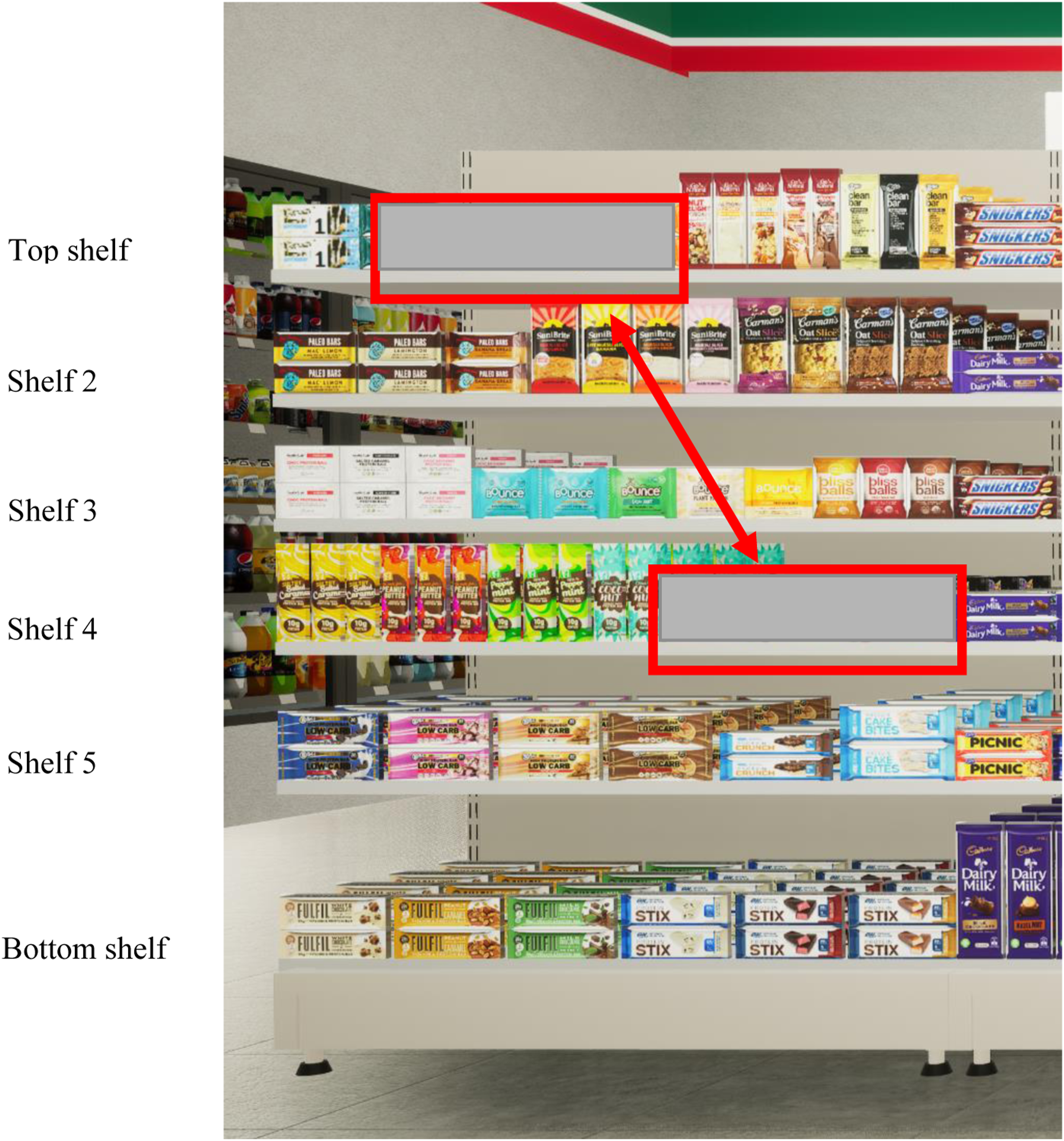
Advertising exposure
Our third manipulation involved exposing participants to advertising for the new brand (plus three other brands unrelated to the category that would be found in typical convenience stores and supermarkets in Australia – crisps, ice-cream and water) before shopping. The purpose of this manipulation was to create some memory-based brand equity. Participants were given as much time as they wanted to look at the advertisements. The no advertising condition did not see any advertisements.
Sample
We recruited 93 participants using an external recruitment agency, Focus People, based in central Melbourne. Participants were screened on the following criteria: a representative mix of sexes (males and females) and ages (between 18–60 years), and previous purchase or consumption from the snack bar/ball category in the past 3 months, screened using the question: “Have you purchased and/or consumed any snack bars/balls in the last 3 months?”. We also screened for eye conditions which would hinder the quality of the eye-tracking, using the question: “Do you wear glasses with more than one power (i.e., bifocals. Trifocials or progressives) and/or have you ever had eye surgery (corneal, cataract, implants) and/or do you have an eye movement/alignment abnormality (i.e., a lazy eye, strabismus or nystagmus)?”; the answer needing to be no to any of the criteria. Participants were paid an incentive of $60, in line with recommendations from the recruitment agency as being typical of market research studies.
After eliminating participants with technical and/or gaze quality issues (described below) the final sample size was N = 80 (N = 10 per experimental cell), which is recommended (Bojko, 2013) and consistent with previous eye-tracking studies (Chandon et al., 2009). When we had data for a greater number of participants than 10 per cell, we selected participants with the highest gaze quality to obtain an equal sample size for each cell. The final sample included: 51% males, 39% 18–24 years, 38% 25–34 years, 20% 35–44 years, 4% 45–60 years. 49% of participants were employed full time, 25% part time, 18% were in education; 4% were unemployed and 4% other (e.g., home duties) or preferred not to say. 42% of participants had an average household income between $100,000 – $149,999 pa (41% lower, 36% greater).
Protocol
Participants were invited into the shopper laboratory and set up wearing Tobii Pro Glasses 2 wearable eye-tracking glasses. To calibrate the glasses to each individual, participants were asked to look at a black dot on a white card, placed at eye level approximately 1.5 metres away. As per manufacturer instructions, participants with a gaze quality below 50% were manually reviewed and removed from the analysis.
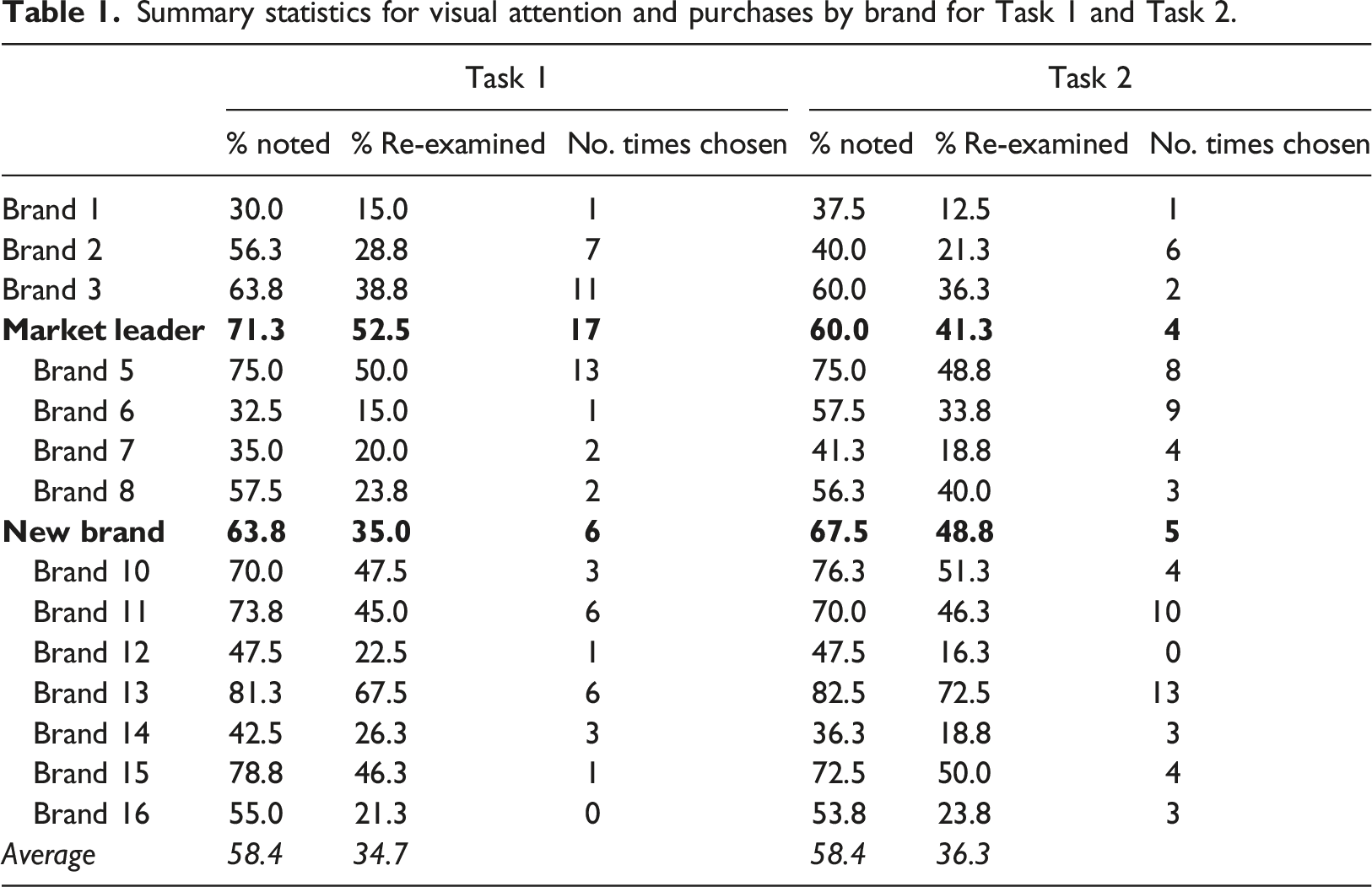
Summary statistics for visual attention and purchases by brand for Task 1 and Task 2.
Following the shopping task, the eye-tracking glasses were removed and participants completed a survey about their current and past consumption and purchases of snack bars/balls; awareness of brands of snack bars/balls; and brand image of snack bars/balls brands (i.e., perceptions held for different brands). We also collected responses relating to dietary and health requirements (e.g., celiac disease) and dietary and health preferences (e.g. eating gluten free but not for medical reasons).
Measures
Prior to computing the eye-tracking measures, we created Areas of Interest (AOIs) for every brand and shelf position. Because it is difficult to confidently attribute eye-fixations that land within AOIs that are directly next to each other, they were created with a small gap in between. We examined three main measures of visual attention: Total Fixation Duration (TFD), Fixation Count (FC) and Time to First Fixation (TFF). TFD refers to the total amount of time a participant spends looking at a given area of interest; FC refers to number of times that a participant’s eyes are relatively still on an area of interest, inferring that a participant is taking in information about what is being looked at; and TFF measures the amount of time from the participant first looking at the planogram to noticing a given area of interest. From these measures, it is possible to generate two further measures: noting (whether the brand was fixed on at least once) and re-examination (whether the brand was fixed on at least twice), which are commonly used in scholarly and commercial eye-tracking tests – see Chandon et al. (2009). Additionally, we measured the duration of each task (as the time from the first fixation on the planogram to when participants pointed to the brand they wanted to choose) and which brand was purchased (based on the brand that the participant pointed to at the end of each task).
Analysis
The research questions were tested with a factorial ANOVA to evaluate the impact of shelf position, priming and distraction. The benefit of this analysis technique is that tests for both main and interaction effects across these variables. Factorial ANOVA is widely used in experimental marketing research (Baker et al., 2002; Hingston & Noseworthy, 2018; Wagner et al., 2009).
Discussion of results
Descriptive statistics
The new brand performed above average for the category in terms of noting (64% and 68% in Task 1 and Task 2 respectively) (Table 1). Although it performed lower than average for re-examination in Task 1 (35%), it performed higher than average in Task 2 (49%). Arguably, the higher re-examination rate in Task 2 reflects the task set: the new brand was yet to be launched in the Australian market and so was more suited as a brand that participants had never bought before. Interestingly, the new brand was chosen a similar number of times across both tasks (6 vs. 5 times).
Visual attention metrics and purchases per shelf level.
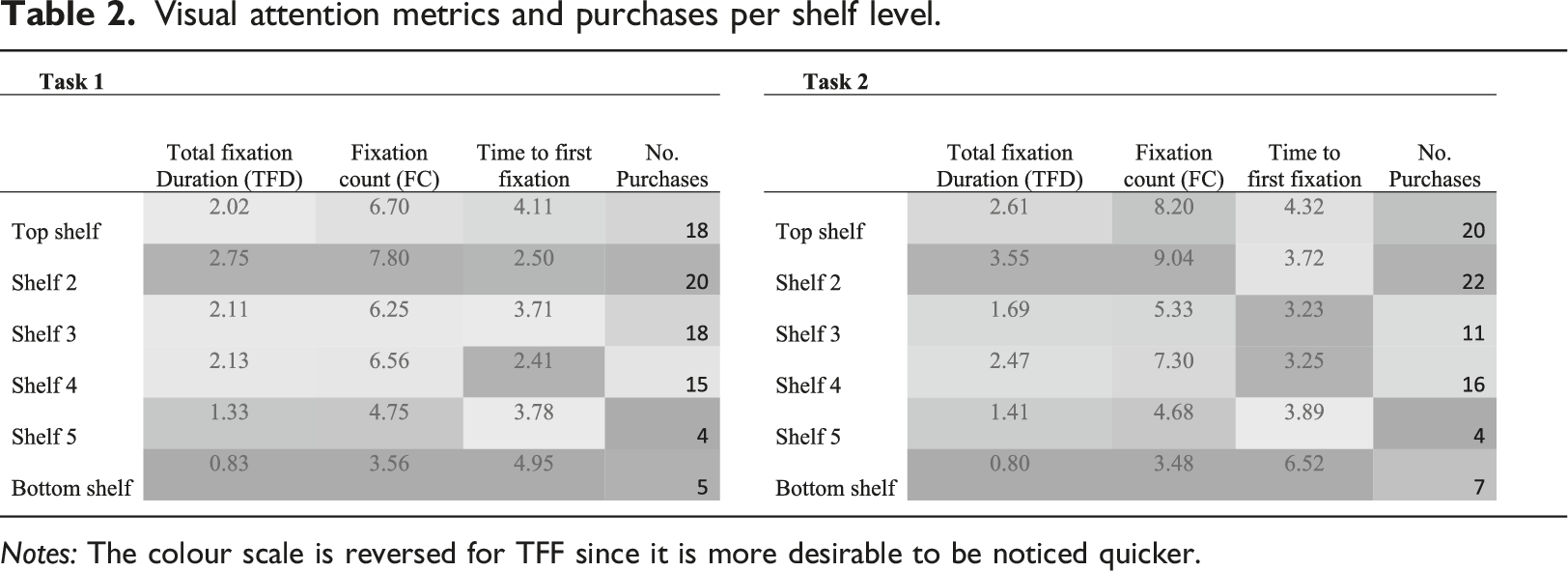
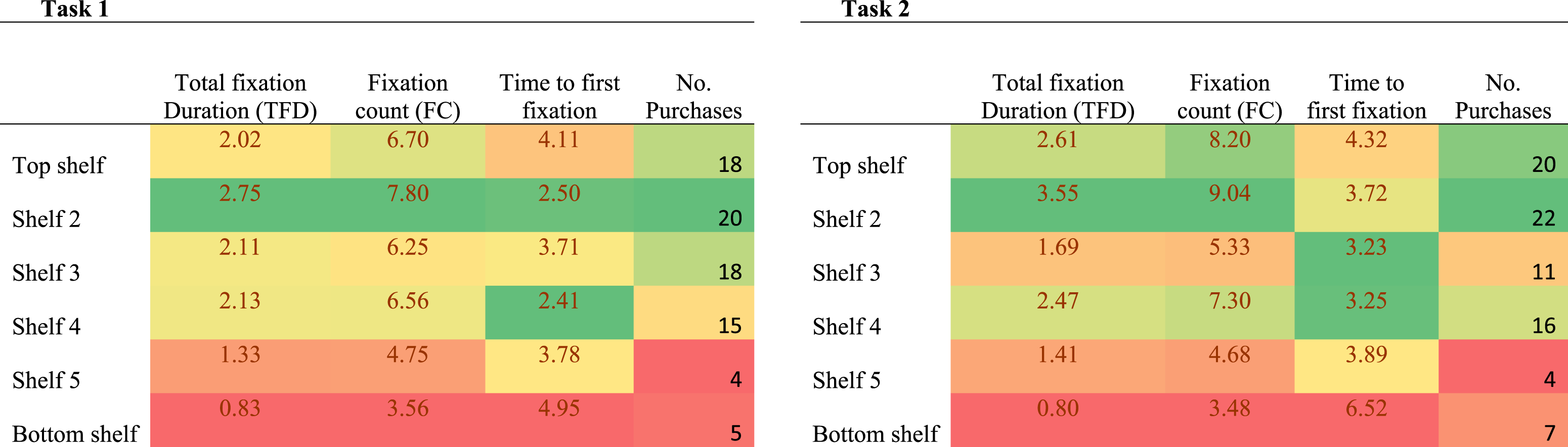
Notes: The colour scale is reversed for TFF since it is more desirable to be noticed quicker.
The distraction worked as per existing research by increasing dwell time in front of the fixture (task duration increased from 9.4 seconds with no cognitive load to 15.1 seconds for tasks with a cognitive load; not significant). Interestingly, the number of brands that shoppers noticed was comparable with/without a cognitive load (an average of 10.4 vs. 10.1 brands). However, re-examination was higher with the cognitive load. That is, an average of 7 brands were re-examined in the cognitive load tasks versus 4.5 brands in the non-cognitive load tasks. This extends the work of Grewal et al. (2018) by showing that not only do distracted consumers spend longer examining products on the shelf, they examine the same number of brands but make more inter-brand comparisons across them.
New brand
Factorial ANOVA results NEW BRAND (overview).
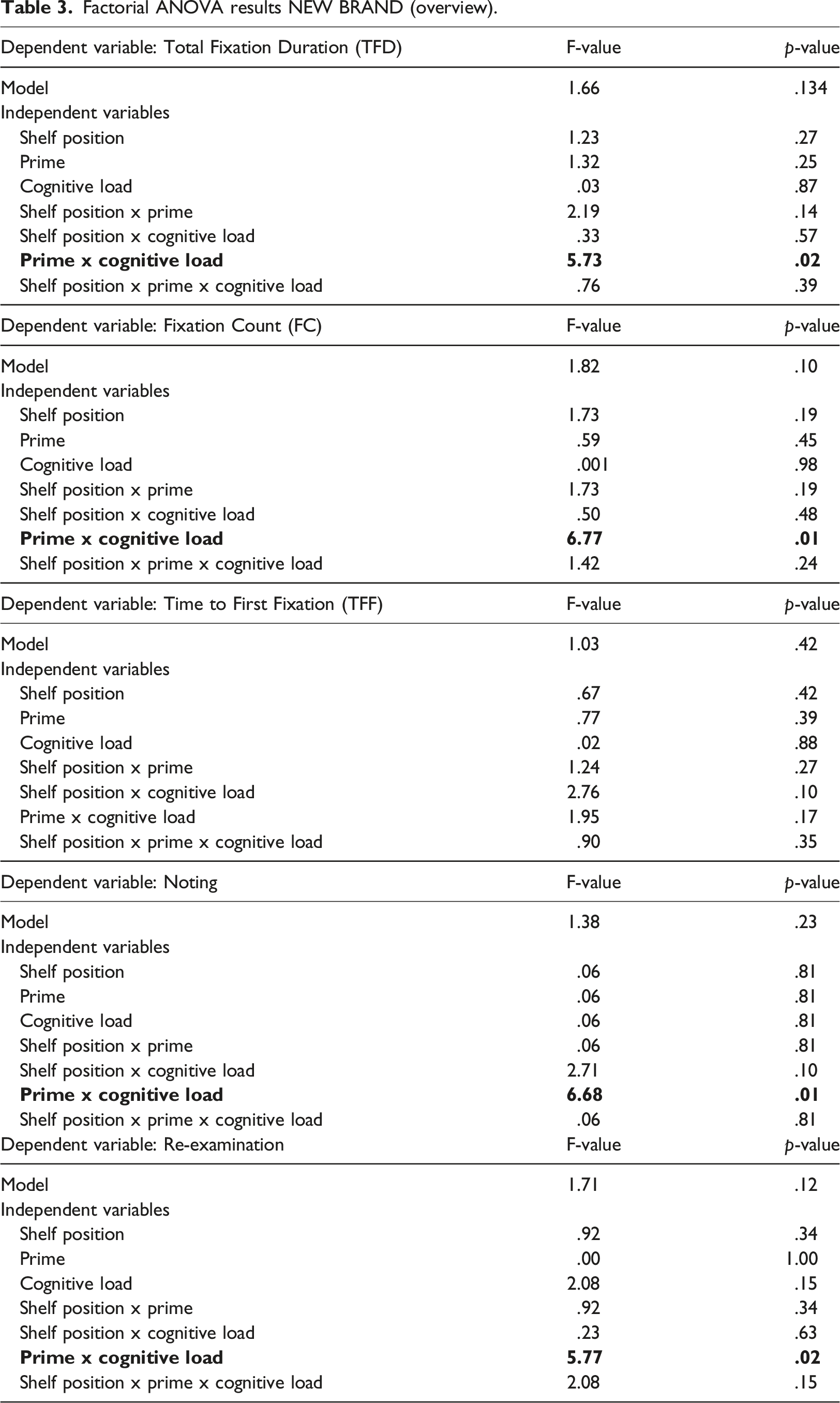
As shown in Table 3, there was no significant main effects for shelf position (F (1,72) = 1.73, p > .05), advertising exposure (F (1,72) = .59, p > .05) or cognitive load (F (1,72) = .001, p > .05). That is, placing the new brand on either the top or middle shelf did not significantly increase visual attention (answering RQ1); nor did distracting them (rejecting HP1). We also found no significant interaction effects between shelf position and advertising exposure (F (1,72) = 1.73, p > .05), thus rejecting HP3, which posited that shelf position would have a greater effect on visual attention once a new brand has some memory-based brand equity. Nonetheless, there was a statistically significant interaction effect between advertising exposure and cognitive load (F (1,72) = 6.77, p < .05), leading to acceptance of HP2. Specifically, fixation count on the new brand was higher when participants were distracted but were not exposed to prior advertising; when participants were exposed to prior advertising, the new brand attracted greater visual attention when participants were not distracted (Figure 3). The partial Eta Squared was .086, which would be considered medium (Cohen, 1988 p.22). These findings are consistent for total fixation duration, fixation count, noting and re-examination. There were no significant main or interaction effects for time to first fixation. Interaction effects of Cognitive Load and Prime (Task 1 NEW BRAND).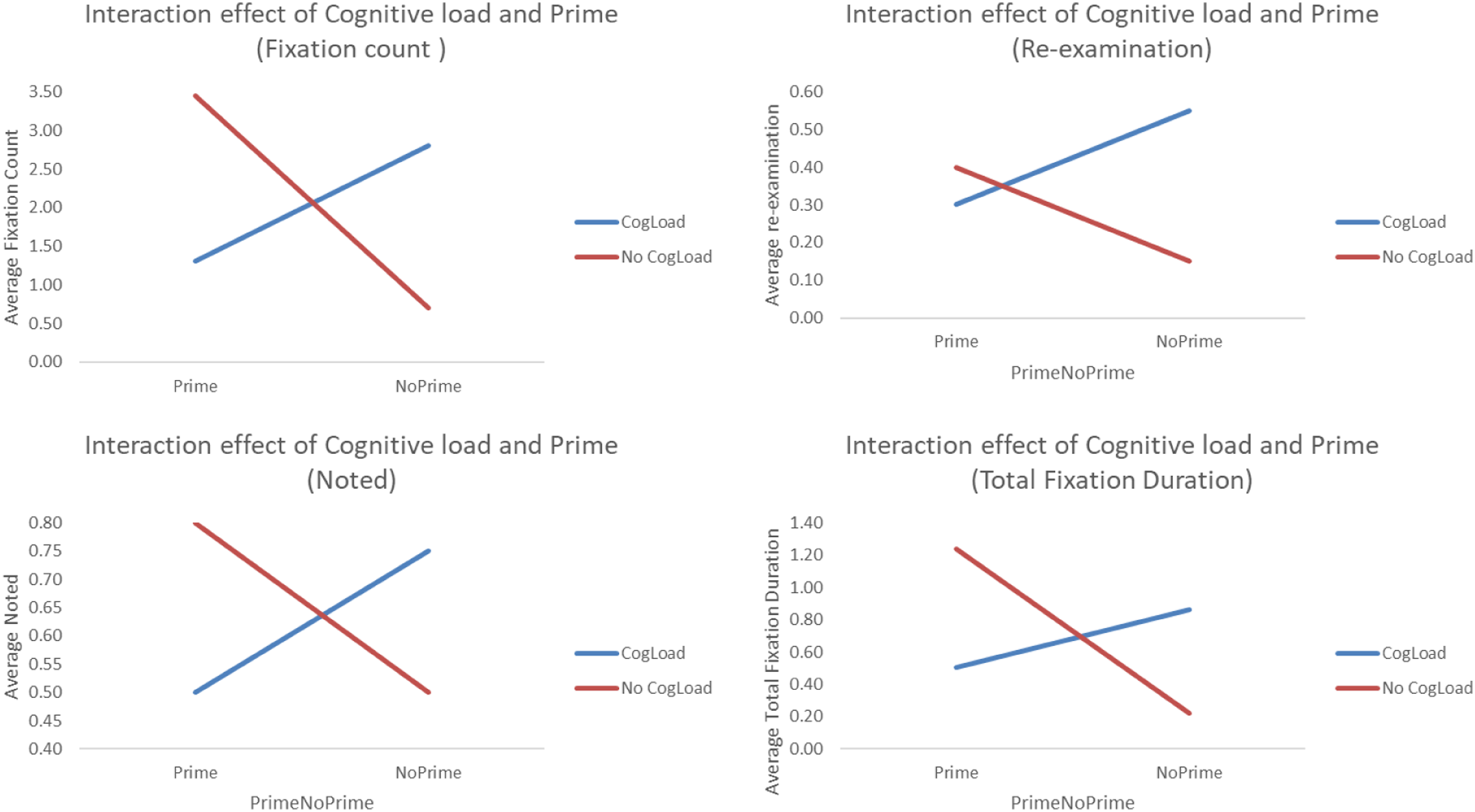
Market leader
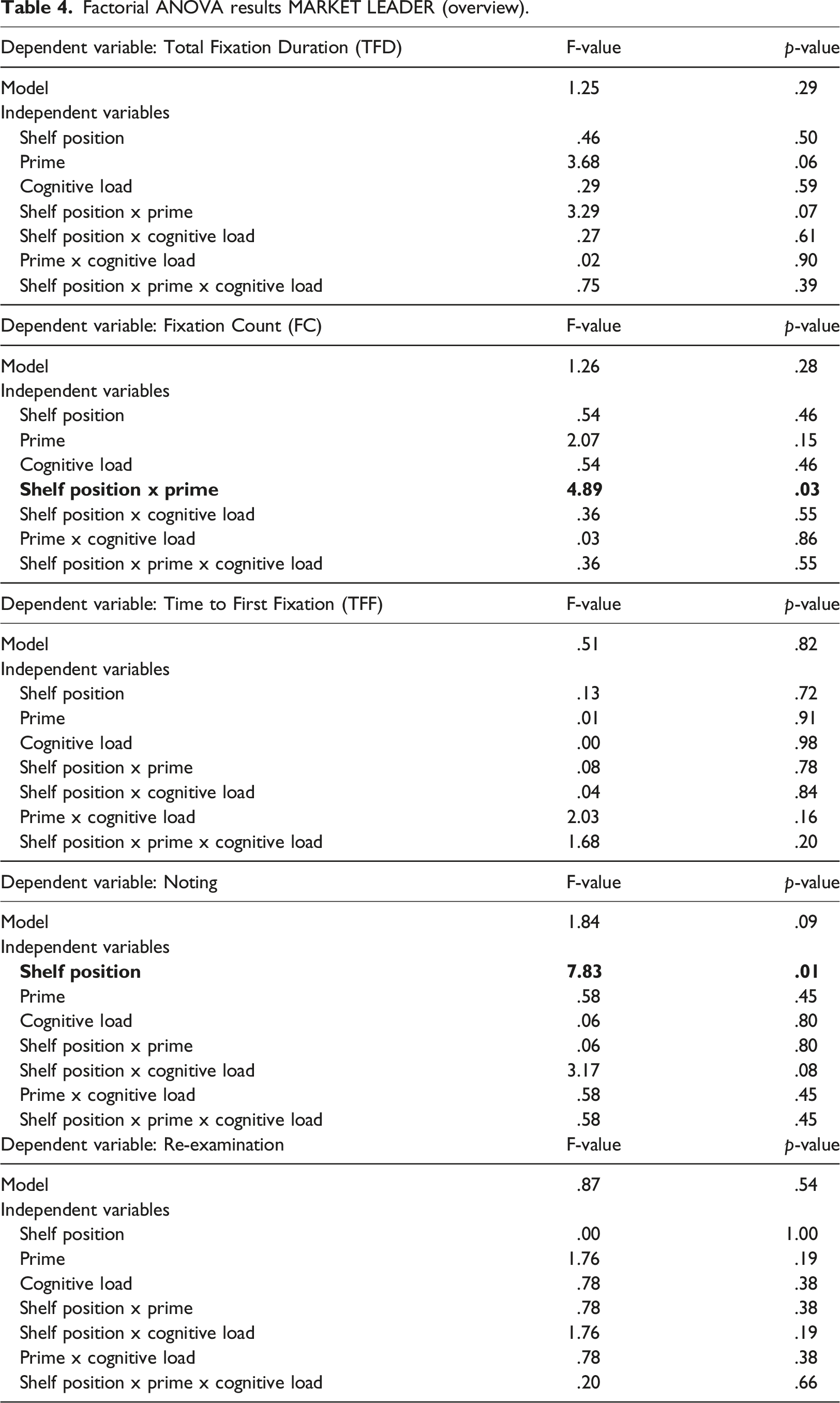
Factorial ANOVA results MARKET LEADER (overview).
Discussion
The present research investigated the importance of two factors on the visibility of new brands in-store: distraction and shelf position. We investigated in-store factors because new brands face substantial challenges to be noticed in-store (Wästlund et al., 2018), yet the in-store environment has received comparatively little research attention compared to out-of-store factors. To the best of the author’s knowledge, the present research is one of the first studies specifically investigating the value of in-store factors for driving visual attention of new brands. In doing so, the present research offers three overarching contributions; (i) it extends previous research into new brand launches that has so far focused on the out-of-store factors influencing their success (Ehrenberg et al., 1997; Kendall, 2017); (ii) it highlights the value of distraction for new brands, which advances existing research by showing the impact of distraction on shopping for specific types of brands; and (iii) it progresses research on the relative importance of memory- and visual- based factors in-store. These contributions are explained in more detail, as follows:
First and foremost, we found that shoppers who are distracted are more likely to notice new brands on the shelf. There are two plausible and complementary explanations for this. First, consistent with Grewal et al. (2018), one explanation from our results is that distracted shoppers spend longer in front of the fixture and therefore have a greater opportunity to notice the new brand. Extending the work of Grewal et al. (2018) however, we found that instead of increased dwell time resulting in more brands being noticed on the shelf, rather a similar number of products are noticed, but the new brand has a greater chance of being one of them. This finding corroborates and extends other research showing that distraction leads to more unplanned purchases (Sciandra & Inman, 2016). In more detail, rather than unplanned purchases being brands in a shopper’s usual repertoire that they just didn’t plan to buy on that occasion, they can be entirely new-to-the-consumer brands. As such, not only does distraction cause shoppers to deviate from their planned purchases for a given trip, it also makes them more exploratory to try new products. A second explanation for why distraction helps new brands to be noticed on the shelf comes from visual attention theories. Specifically, it could be that distraction prevents shoppers from considering their goals (Drolet et al., 2009; Sciandra et al., 2019), which hinders their ability to draw on top-down drivers of visual attention for existing brands (e.g., object recognition and goals) and avoids suppression of unfamiliar stimuli, such as new brands. In line with this explanation, distraction may not advantage new brands per se, but rather benefit them indirectly by disadvantaging existing brands and putting new brands on more level playing field.
These findings and explanations are particularly valuable for brand managers and retailers. As discussed by Wästlund et al. (2018), new brands are ‘practically invisible’ on the shelf (pg. 55), so much so that those authors advised managers of new brands to mimic the packaging of existing brands so they stand a greater chance of being noticed in-store. This recommendation is widely enacted by practitioners; for example, Lindt has taken several brands to court over copycat packaging (Partridge, 2022) and Aldi is regularly in court for trademark infringement (Farrell, 2023). The present research shows that distraction may help to override the advantage that existing brands have on the shelf, at least to some extent. This offers new brands options to compete with existing brands, without having to rely on risky copycat strategies. Interestingly, distraction is not only something that retailers can manage - for example, by increasing background noise and music (Cockrill et al., 2008; Hynes & Manson, 2016); promoting mobile phone use (Grewal et al., 2018; Sciandra et al., 2019); and increasing perceptions of crowding in stores (Aydinli et al., 2021). Instead, distraction is something that managers of new brands should be aware of and can guide distribution decisions. For example, previous research has shown that shoppers allocate less cognitive effort when shopping in convenience stores versus supermarkets, and they also make less purposeful trips (Nilsson et al., 2015). As a result, there may be certain store-types (like convenience stores) where shoppers are more naturally distracted that may be particularly advantageous to launch new brands in. This presents a valuable avenue for further research and a novel way of approaching the competitive in-store environment that new brands find themselves in. Convenience stores may also be especially valuable for certain types of products – such as snack bars investigated in the present research - which appeal to a growing preference for ready-to-eat, nutritious and convenient snack options, and to which convenience stores have seen the strongest growth in distribution (Fortune-Business-Insights, 2022).
The second contribution of the present research arises from empirically examining whether, and if so what, the optimal shelf position is for new brands. We found that competing for an optimal shelf position is less important for new brands until they have acquired some memory-based brand equity; then, once they have, the top shelf offers greater returns. This finding contributes to the literature in several ways. To the best of the author’s knowledge, it offers a first empirical investigation into the effect of shelf position on visual attention for new brands; research to date has focused on existing brands. That we found no impact of shelf position for new brands supports visual attention theories (Wedel and Pieters, 2006, 2017) and early modelling work (Chandon et al., 2006), which valued from being empirically tested. Specifically, we support the idea that a trade-off exists between memory-based and visual based factors, whereby the amount of visual lift (e.g., increase in consideration) that a brand can achieve by increasing visual salience (e.g., moving from a less optimal to more optimal shelf position) is greater for brands with some established memory-based equity. As such, for brands with no prior memory-based equity such as new brands, optimising the shelf position has no effect on visual lift.
This is an important finding that deserves more research attention. One possible explanation is that shoppers always employ top-down processes (e.g., draw on a brand’s memory-based equity) whereas bottom-up drivers (e.g., shelf position) are ‘good to have’. In this case, increasing the visual conspicuity of new brands has a minimal effect on whether a new brand is noticed on the shelf because shopper’s eye-movements always go first and foremost to brands with some memory-based brand equity. An alternative postulation is that a threshold level of visual lift is needed for new brands to ‘make-up for’ the lack of memory-based equity. If this is the case, then any shift in a new brand’s visual salience will need to be much larger than that needed for an existing brand, and potentially much larger than what we achieved by moving the brand from the middle to the top shelf (because both of these were “good” shelf positions). Yet, had we moved the new brand from the bottom to the top shelf, we may have seen an effect. This explanation could also explain why we saw an increase in visual attention for the market leader by moving from the middle to the top shelf, because the threshold increase in visual lift to cross didn’t need to be as big. Given that this finding is not easily explained in our data nor in theories of visual attention, we welcome further experimental research to examine what this threshold might be. It may also be valuable to examine whether other visual marketing strategies, e.g., package design or brand blocks, could serve to achieve this gap more easily than vertical shelf position.
For managers of new brands, these findings are valuable because attaining optimal shelf space in retail stores is highly competitive (Dreze et al., 1994) and until now, it has been largely unknown whether the cost would be ‘worth it’ for new brands. The present research demonstrates that fighting for optimal shelf position may be less important for managers of new brands until their brand has acquired some memory-based equity. Given that global marketing and trade budgets continue to decline (Blum & Omale, 2021; Vizard, 2020), this should be a welcome finding for managers who can more confidently divert marketing spend to other areas until the brand is more established in consumer memory. In particular, it confirms the importance of investing in out-of-store brand building for new brands to establish some memory-based equity before shoppers reach the shelf (Tanusondjaja et al., 2016).
Limitations and avenues for future research
A strength of this study is that it used realistic stimuli (e.g., a real-life new brand and retail planogram), and found a balance between eye-tracking studies that are conducted in-store (which are ecologically valid but where it is difficult to manipulate variables for experimental research) with the rigor of controlled desktop eye-tracking studies (where variables can be easily controlled and manipulated but the setting lacks ecological validity). While this approach offers obvious benefits, it similarly presented some limitations. In particular, although shoppers were instructed to shop as normal during the tasks, the context was still a laboratory and hence they knew they were part of a study. These aspects are likely to have influenced, at least in some way, visual attention and shopping patterns (Bogomolova et al., 2019). Moreover, we employed a small sample size. As discussed by Chen et al. (2021), the annotation of mobile eye-tracking data is labour intensive, time consuming and expensive, which naturally limits the amount of data that can be collected. Indeed, small sample sizes are representative of eye-tracking research in marketing in general (Lewandowski & Kammerer, 2021). Whilst this limits the statistical power of the results presented in this paper, it is valuable to note that the study is still robustly designed and offers a valuable contribution to the literature by raising awareness of a counterintuitive finding and novel opportunity for in-store research that could aid new brand launches. In this way, the present research provides a foundation for future research, and we welcome follow-up research using larger sample sizes.
Another consequence of mimicking real-life conditions is that it is difficult to control for all variables known to influence visual attention and decision-making, most prominently, the memory-based and visual-based equity of all brands on the shelf. On the one hand, the real-life nature of the study reflects its ecological validity in that different shoppers naturally come to the shelf with different memories, goals and object recognition. Nonetheless, the saliency of different packs (e.g., different sizes, colours, shapes etc) and prior knowledge of the brands (e.g. from past usage experience) is likely to influence visual gaze patterns. For this reason, future research should aim to measure and control the memory-based and visual-based equity of brands used in the study, including looking into how to do this from a methodological standpoint, given the complexities. It would also be valuable for future research to examine additional product categories to increase the generalisability of the results, e.g., beyond snack bar/balls, and to examine further experimental groups and factors, for example, different shelf levels, other in-store marketing strategies (e.g. number of facings) and the effect of moving other brands on the shelf. In particular, a limitation of the present research is that whilst our results indicate that striving for an optimal shelf position (e.g., the top shelf vs. middle shelf) may not be necessary for managers of new brands until they have acquired some memory-based equity, we cannot ascertain whether having a bottom shelf could be detrimental. Moreover, we cannot say whether a stronger advertising exposure – or at what threshold level of memory-based brand equity – shelf position becomes important. The research would value from being replicated with a larger sample, in other product categories and with additional manipulations, to investigate these ideas.
Moreover, the present research used cognitive load as a way to induce distraction. Whilst this is a popular approach in the marketing literature (e.g., (Gilbert et al., 1995; Rottenstreich et al., 2007; Shiv & Fedorikhin, 1999), we acknowledge that there are contrasting viewpoints on the relationship between cognitive load and distraction (Sörqvist et al., 2016), with some scholars arguing that cognitive load may decrease susceptibility for distraction because of an increase in foal task-engagement and concentration (Sörqvist & Marsh, 2015). For this reason, we encourage authors of future studies to consider these to inform the manipulation of distraction.
Lastly, in addition to distraction, there are also other variables that could be of value for new brands, such as the course of the day and week. Burke (2009) found that shoppers are more task-orientated earlier in the day on weekdays, and become increasing interested in browsing in the evening and weekends. It would be worthwhile to examine whether sales of new brands follow a similar pattern and are purchased more when shoppers are in a less-task orientated mood. If this proved the case, then an additional in-store strategy to encourage trial of new brands could be to target shoppers at specific times of the day/week.
Footnotes
Author contributions
RF: conceptualisation, methodology, formal analysis, investigation, resources, writing (original draft), project administration, funding acquisition. SH: conceptualisation, investigation, resources, writing (review), project administration, funding acquisition. SP: conceptualisation, methodology, writing (original draft), writing (review and editing), funding acquisition.
Declaration of conflicting interests
The author(s) declared the following potential conflicts of interest with respect to the research, authorship, and/or publication of this article: This work was co-funded by Mars Australia. The research was conducted in the Mars shopper laboratory and a Mars employee (co-author) facilitated the project administration and data collection. Mars did not have any involvement in the study design, analysis and interpretation of the data presented in this manuscript. All authors attempted to uphold standards of objectivity throughout.
Funding
The author(s) received no financial support for the research, authorship, and/or publication of this article.
