




Abstract
Levels of debt and poor mental health are at an all-time high among UK families, while the gap between rich and poor has also widened. Exposure and susceptibility to advertising, belief that purchased products will lead to happiness (materialism), and poor mental well-being have been shown to be linked in previous research, but the role of children’s socio-economic status has seldom been taken into account. A greater understanding of the effects of this dynamic among those without the ready money to purchase highly advertised and desired products is important, particularly given the connections with children’s low self-esteem. This study aimed to (1) quantify differences in TV advertising exposure, materialism, and self-esteem between deprived and affluent children, (2) measure differences in susceptibility to the effect of TV advertising exposure on materialism between deprived and affluent children, and (3) measure differences in susceptibility to the effect of materialism on self-esteem between deprived and affluent children. It was found that children from deprived backgrounds were more materialistic than children from affluent homes, and that this was the result of both higher exposure to advertising and higher belief in the credibility of advertising. At the same time, we found that children from affluent backgrounds were more susceptible to advertising’s reinforcing effect on materialism, whereas children from deprived background were more susceptible to materialism’s detrimental effect on self-esteem. Two different dynamics appear to be at play in the two groups. This adds a new dimension to our understanding of the role of advertising in a society with high levels of inequality.
Introduction
As Kasser and Linn (2016) and Richins (2017) have noted, the vast majority of materialism research has been conducted within economically developed capitalist Western societies. This research is no different. However, while previous research has built on the premise that the wealthy living conditions in these countries allow individuals to consume copious amounts of products and services in pursuit of happiness and success, this research builds on the observation that this may be true for some, but not all people within affluent societies. More specifically, it focusses on the context of the United Kingdom. Income inequality in the United Kingdom is the largest in Western Europe (Organisation for Economic Co-operation and Development, 2020), and in the financial year ending 2020, the income of the richest 20% of people was more than six times higher than the poorest 20%, while the richest 10% received 50% more income than the poorest 40% (Office of National Statistics, 2020). Many families struggle to get by, and the number of people receiving 3-day emergency food packages from Trussell Trust (2020) food banks has increased by 74% over the past 5 year to 1,900,000 in 2020: 700,000 of these went to children. Debt levels are now at more than £15,000 per household (Brignall, 2019). Hence, income inequality, poor living conditions, and other associated aspects of deprivation affect not only workers but also their families and children. It is on children that we focus in this article.
Materialism has been defined as “the importance a consumer attaches to worldly possessions” (Belk, 1984, p. 291) and “the importance a person places on possessions and their acquisition as a necessary or desirable form of conduct to reach desired end states, including happiness” (Richins & Dawson, 1992, p. 307). A person’s level of materialism has thus come to be seen as the extent to which wealth and possessions are viewed as (1) central to their life, (2) an important source of happiness, and (3) a prominent means of judging their own success and that of others. These three elements form the basis of the most widely used measures of materialism, that is, the adult Material Values Scale (Richins & Dawson, 1992; Richins, 2004) and the Youth Materialism Scale (YMS; Goldberg et al., 2003). Research (mainly using these scales) has consistently confirmed a relationship between materialism and self-esteem with higher levels of materialism strongly associated with lower self-esteem (Ahuvia & Wong, 2002; Cohen & Cohen, 1996; Kasser & Kanner, 2003; N. D. Wright & Larsen, 1993). This relationship is usually understood as bi-directional with feelings of low self-worth or low life satisfaction fuelling the desire for heavily advertised, symbolically important (often branded) possessions in one direction and acquired goods failing to lead to anticipated happiness in the other. Indeed longitudinal youth research shows a cyclical pattern whereby unhappy young people place a high value on acquiring the “right” brands as a coping mechanism only to become even more unhappy and dissatisfied months later when the goods fail to deliver what was promised in the adverts (M. L. Wright et al., 2011).
Previous research (Csikszentmihalyi, 2003; Fournier & Richins, 1991; Kasser & Kanner, 2003) consistently shows that adults living in social and economic deprivation tend to be more materialistic than their affluent counterparts. The theory underpinning this was largely developed by Inglehart (1979, 1990) whose deprivation hypothesis asserts that longings are enhanced when there is little or no possibility of meeting their objectives. In other words, the more unobtainable something is, the more desirable it appears (Cohen & Cohen, 1996). As noted above and discussed in much more detail below, other research (e.g., Opree et al., 2014) has shown that TV advertising fuels these longings. It is the dynamic between advertising, materialism, self-esteem, and deprivation that we examine in this article.
Aim and objectives
The overall aim of this article is to investigate whether children from deprived backgrounds are more susceptible to the negative effects of advertising and materialism than those from affluent backgrounds. Qualitative research would certainly suggest so as interviews with parents and children have indicated that both deprived children and their parents assign more value than their affluent counterparts to obtaining products that are presented as “right” in order for them to fit in and gain peer acceptance—yet often experience that this trick does not work as they cannot keep up with the trends (Mason et al., 2011; Bailey, 2011; Nairn & Ipsos MORI, 2011). Our research adds a quantitative dimension by modeling the “advertising-materialism-well-being” dynamic using data collected from 252 children attending school in a deprived area, and 305 children attending school in an affluent area in the same part of the United Kingdom.
The objective of this article is thus threefold: (1) to quantify differences in TV advertising exposure, materialism, and self-esteem between deprived and affluent children, (2) to measure differences in susceptibility to the effect of TV advertising exposure on materialism between deprived and affluent children, and (3) to measure differences in susceptibility to the effect of materialism on self-esteem between deprived and affluent children. This adds a new dimension to our understanding of the role of advertising in a society with high levels of inequality.
Conceptual framework and hypotheses
Deprivation and affluence
To identify children from comparatively deprived and affluent areas, we used the UK Government Index of Multiple Deprivation (IMD) produced and regularly updated by the Ministry of Housing, Communities and Local Government (2019). IMD is the official measure of relative deprivation in each constituent country of the United Kingdom (i.e., England, Scotland, Wales, and Northern Ireland). In each country, it follows an established methodological framework and comprises a weighted combination of seven distinct domains of deprivation: income; employment; health deprivation and disability; education, skills training; crime; barriers to housing and services; and living environment. The index is a ranking rather than an absolute measure and is calculated at the Lower-layer Super Output Area (LSOA) level. There are currently around 32,000 LSOAs in England, each one representing around 1,500 households. It is thus a relatively fine-grained measurement tool. Two primary schools and one secondary school were located in areas ranking in top 15% and two primary schools and one secondary school in areas ranking in bottom 15% of UK LSOAs. The other measure that could have been used to select schools at the time of the survey was the percentage of children eligible for free school meals (FSMs). These two measures tend to be highly correlated (e.g., Crawford & Greaves, 2013), but we felt that the broader measure of deprivation was potentially more appropriate for a study considering how material goods may compensate for a range of things lacking in a child’s life.
A number of studies have shown that levels of TV viewing are related to socio-economic status (SES), with children from more deprived areas tending to watch more TV than those in affluent areas (Anand & Krosnick, 2005; Woodard & Gridina, 2000). TV is an inexpensive form of entertainment compared with sporting, musical, or other social and recreational activities that are less easily afforded by families that are more financially stretched or have fewer amenities in their area (Hoff-Ginsberg & Tardif, 1995). Other studies (e.g., Vittrup, 2009; Warren, 2005) found that families in more deprived areas had fewer rules about the amount of time children could watch TV as well as the type of programs they could watch. Vittrup (2009) argues that this may be because lower SES families have less time and energy to enforce rules due to long working hours or because they are less concerned about the influence of TV. In her study, 92% of affluent parents believed their children were influenced by TV, whereas only 48% of deprived parents believed the same. In our study, we are interested to see if these previous findings are replicated:
In addition to experiencing low self-esteem driven by the failed promise of materialism, children from deprived backgrounds may also, in turn, be driven to materialism to compensate for feelings of low self-worth. Two theories may account for the compensatory consumption mechanism in those from less affluent backgrounds: the deprivation hypothesis and the attainment hypothesis. The deprivation hypothesis (as outlined briefly earlier) rests on the assumption that “relative deprivation can . . . lead to higher than average priority for certain goals” (Cohen & Cohen, 1996, p. 7). Thus, where there is little possibility of meeting them satisfactorily, physical and psychological needs can become more salient. In other words, the more unobtainable something is, the more desirable it appears. The attainment hypothesis (Cohen & Cohen, 1996) however assumes that life values and achieved goals “reflect a history of purposive activity toward some held values” (p.7). In this model, the level of materialism varies in relation to the importance of possessions and money within a personal value system (which is likely to be propagated directly within family structures and social communities, e.g., Richins & Chaplin, 2015). Marks (1997), for example, noted that materialist values are influenced by parental socialization and are transmitted directly from parent to child. Thus, parents from deprived backgrounds who have developed high priorities for material goods may pass these priorities on to their children. The aforementioned insights lead to the following hypotheses:
Linking advertising and materialism
Fifteen years ago, a large-scale literature review (Buijzen & Valkenburg, 2003a) highlighted a consistently positive correlation between exposure to TV advertising and youth materialism concluding that “analysis clearly suggests that exposure to advertising stimulates materialistic values in children” (p. 451). Work since then has reinforced this finding (e.g., Dunkeld et al., 2019; Goldberg et al., 2003; Schor, 2004), and at the same time, longitudinal and experimental studies, past and present, have supported the hypothesis that advertising exposure leads to materialism rather than the alternative proposition that materialistic children seek out adverts to inform their compulsion to purchase.
The directionality between advertising exposure and materialism has been supported at both a macro- and micro-level. For example, at the macro-level, a longitudinal study of 300,000 17/18-year-old Americans across three generations (1976–2007) showed that advertising spend (as a proportion of GDP) has both contemporaneous and lagged positive associations with materialism (Twenge & Kasser, 2013). At the micro-level, four studies have also established a causal or quasi-causal connection between advertising exposure and child materialism. Goldberg and Gorn (1978) found that 4- and 5-year-olds exposed to a toy commercial would subsequently rather play with this toy than their friends, Greenberg and Brand (1993) showed that 15- and 16-year-olds who were exposed to the classroom commercial TV station “Channel One” were more materialistic than those who were not, and Moschis and Moore (1982) established that heavy TV viewing by 12- to 18-year-olds predicted high materialism 1 year later. The most recent longitudinal study by Opree et al. (2014) with Dutch 8- to 11-year-olds found that greater exposure to advertising dense TV programs was associated 1 year later with increased product desire for the advertised brands which in turn was associated with increased materialism more generally.
Much of the research into the relationship between advertising exposure and materialism is inspired by cultivation theory. More than 50 years of cultivation research have produced substantial empirical evidence that TV viewing has a modest but reliable influence on people’s overall perceptions, judgments, and values (see Morgan & Shanahan, 2010 for a review). According to cultivation theory, those who watch more TV are more likely than those who watch less to perceive the real world as reflecting messages implicitly or explicitly expounded on TV. Affluence is over-portrayed on TV (O’Guinn & Shrum, 1997), with heavy viewers having misguided perceptions of the numbers of people who are rich (Potter, 1991) or own luxury status products and brands (Shrum, 2001).
A much smaller body of research has considered TV’s cultivation of the personal value of materialism and findings for adults remain somewhat inconsistent (Shrum et al., 2011). Sirgy and colleagues’ (1998, 2012) cross-national studies found evidence for TV’s cultivation of materialism in some countries and age groups but not others. O’Guinn and Shrum (1997) however found no relationship in either a student or an adult sample, whereas Shrum et al. (2005) found a strong association between TV viewing and materialism. It seems that, not surprisingly, this relationship is conditional on other factors, and a handful of studies have now investigated this possibility. Importantly for this study, Richins (1987) found a significant relationship between TV viewing and personal materialism for a representative US adult sample but only for individuals who believed the people featured in TV commercials were representative of those in the real world in terms of attractiveness, happiness, and wealth.
The direct role of TV advertising as a cultivation agent has been addressed over the past 30 years with advertising, like TV in general, shown to hold up a “distorted mirror” (Pollay, 1986, p. 18) to social reality and to increasingly over-represent affluent lifestyles. For example, a content analysis of US advertising from 1900 to 1980 (Belk & Pollay, 1985) found that appeals to luxury and pleasure had increased during the period, whereas practical and functional appeals decreased. Two refinements of cultivation theory are of relevance to our article: the competing concepts of resonance and mainstreaming (Gerbner et al., 1980; Shrum & Bishak, 2001). While the underpinning tenet of cultivation theory is that the values of heavier TV/advertising viewers come to be in tune with those of programming/adverts, it has also been observed that people’s life experiences moderate these effects (Shrum & Bishak, 2001).
Following the reasoning of resonance, children from affluent homes may be more susceptible to advertising’s effect on materialism because advertising’s content resonates with their day-to-day reality in which their family household is able to buy more expensive possessions and they are more likely to perceive advertising as realistic and believable. However, based on the reasoning of mainstreaming, children from deprived homes may be more susceptible to advertising because they might overestimate the proportion of other children and families who own the brands presented positively in advertising, causing them to think heavy consumption is the norm and something one should strive for—thus also perceiving advertising as realistic and believable but for different reasons. Because of these competing explanations, there is no way of hypothesizing whether the perceived reality/believability of advertising is likely to be higher among children from affluent homes (supporting resonance) or children from deprived homes (supporting mainstreaming). However, given that both advertising exposure and materialism are deemed higher among children from deprived background, the latter seems more likely. Hence, from the theory presented above, the following hypotheses were derived:
Linking materialism and self-esteem
There is little question that materialism and well-being are closely linked (e.g., Ahuvia & Wong, 2002; Buijzen & Valkenburg, 2003a, 2003b; Chaplin et al., 2014; Chaplin & John, 2007; Goldberg et al., 2003). The negative relationship between materialism and well-being has been seen to stand across a wide range of child well-being measures such as qualitative parental assessment of child happiness (Goldberg et al., 2003), life satisfaction (e.g., Ahuvia & Wong, 2002), life dissatisfaction (e.g., Buijzen & Valkenburg, 2003a, 2003b), and self-esteem (e.g., Chaplin & John, 2007, 2010; Goldberg et al., 2003; Schor, 2004) The particular aspects of well-being that have most often been tested in this body of research are self-esteem and life satisfaction. In this study, we focus on self-esteem in particular because previous research has indicated that many children from deprived background have self-esteem issues due their inability to keep up with their affluent counterparts.
A study by Mason, Green, and the young people’s group Amplify (2011) for the UK Children’s Commissioner found that when young people were asked why they felt under pressure to buy expensive brands, common replies included, “Because everyone else seems to have them and none of us wants to look poor,” and “Anything to prove you’ve got money” (p. 12). This concern is in evidence among not only children but also their parents. A qualitative government study among parents in the United Kingdom (Bailey, 2011) highlighted pressure felt by parents to buy specific consumer goods and brands to stop their children being bullied or left out. As one parent put it, “My eldest’s school shoes and coat were bought out of us worrying that he may be bullied if it wasn’t the right look” (p. 56). The “right look” it turns out is an “expensive” look. Research for UNICEF UK (Nairn & Ipsos MORI, 2011) found a similar discourse among UK parents. As one low-income mother reported in relation to the coat bought for her toddler, “I got it because it didn’t look cheapy . . . it looked expensive” (p. 63).
In relation to well-being, several hypotheses have been put forward to account for the negative effects of materialism. In relation to children, the theory that has gained most traction is the displacement hypothesis (e.g., Kasser & Ryan, 1993; Nairn & Ipsos MORI, 2011) which posits that obsession with material possessions acts to displace the human relationships with family and friends that children need for healthy social development. Of relevance is also the escalation hypothesis or hedonic adaptation hypothesis which suggests that centring one’s life on the acquisition of consumer goods in the 21st century is destined to disappoint as no sooner is the latest fashion in shoes or the most advanced version of phone acquired than trends and technologies have moved on, necessitating the purchase of the next newest thing (Lyubomisky, 2011). When applied to self-esteem, these theories can be used to explain why materialistic children may experience low self-esteem because materialism may lead them to believe that their current state is not good enough, and may lead to weakening of strong social ties which reinforce positive feelings of self-worth.
Children from deprived homes may be more likely to be exposed to materialistic messages via the media and via their social environment, and this may result in a “double” whammy of being driven toward compensatory consumption by cultivation effects from heavy TV viewing on one hand, and by socio-economic feelings of inadequacy on the other hand. Either way, we expect that children from deprived homes are more likely to experience the negative consequences of materialism on self-esteem than their affluent counterparts.
Method and measurements
For this study, data were collected among 557 children between the ages of 9 and 13 years (Mage = 11.18, SDage = 1.27, 51.6% girls) as part of a National Consumer Council (NCC) study in the United Kingdom—“Watching, Wanting and Wellbeing” (Nairn et al., 2007). Following on from its Shopping Generation study (Mayo, 2005), this research sought to understand the links between time spent engaging with TV and the internet; desire for consumer goods and a range of well-being measures. It built on the work of Juliet Schor (2004) in the United States. A paper-and-pencil survey was administered on-site at six different schools in the United Kingdom: four primary and two secondary. Half the schools were located in a deprived area (N = 252), the other half in an affluent area (N = 305). As noted above, the areas were classified as deprived or affluent based on the UK government IMD. In the primary schools, every child in Years 5 and 6 (age 9–11) present on the day of the survey (with parental permission) took part; in the secondary schools, we had the participation of every child with parental permission present in Years 7 and 8 (age 11–13). The survey was taken by a more or less equal number of boys (48%) and girls (52%) and a more or less equal number of junior (47%) and senior school (53%) children. The full survey consisted of 140 questions and took approximately 20 min to complete. Before administration, parents gave informed consent and the children gave informed assent, following the guidelines of the Market Research Society and University Ethics Codes. Given the potentially sensitive topic of self-esteem, mood-boosting activities were conducted with the children post-survey.
Advertising exposure
Following standard practice, advertising exposure was measured using children’s self-reporting of how much TV they watched coupled with their preponderance to watch commercial TV (i.e., where there is advertising; Opree, 2014). To aid more accurate recall, children’s weekly TV use was measured with a total of 17 items. The first five items related to TV use on Monday to Friday. Children were asked whether they watch TV “in the morning before school,” “when you come home from school,” “during the evening meal,” “after the evening meal,” and “just before you go to sleep.” They could pick an answer from one of the four categories, being (1) never, (2) some days, (3) most days, and (4) every day. Research shows that children and adolescents find it difficult to choose from five categories but very much easier to choose from four (e.g., Borgers et al., 2004). We therefore used four ordinal categories in all our measurements. Items 6–11 related to TV use on Saturday. Children were asked whether they watch TV “on Saturday mornings,” “during lunch,” “in the afternoon,” “during the evening meal,” “after the evening meal,” and “just before you go to sleep.” Items 12–17 related to TV use on Sunday and were identical to those asked about Saturday. The four answer categories for Saturday and Sunday were identical to each other, and to those for TV use on Monday to Friday. To construct an index score for children’s weekly TV use, mean scores were calculated for children’s TV use on Monday to Friday, Saturday, and Sunday separately. These scores were then combined into a single score by multiplying children’s mean score on Monday to Friday by 5, adding the mean scores for Saturday and Sunday, and dividing the total by 7 (observed range 1.10–4.00, skewness = 0.29, kurtosis = −0.73, M = 2.45, SD = 0.68).
Belief in advertising
The extent to which children believe TV adverts was measured with two items (Derbaix & Pecheux, 2003; see credibility dimension). These items were “I believe what they show in TV adverts” and “I think that TV adverts tell the truth.” The response options for these items were (1) NO, (2) no, (3) yes, and (4) YES. Pre-tests showed that for children “NO” indicates a stronger belief than “no.” The correlation between children’s scores on the two items was .56 with p = .000. Because of this strong correlation, the two items formed one single scale (observed range 1.00–4.00, skewness = 0.42, kurtosis = −0.18, M = 2.07, SD = 0.71).
Materialism
Children’s materialism was measured with the 10-item YMS (Goldberg et al., 2003). The items in this scale were “I’d rather spend time buying things than doing almost anything else,” “I would be happier if I had more money to buy more things for myself,” “I have fun just thinking of all the things I own,” “I really enjoy going shopping,” “I like to buy things my friend have,” “when you grow up, the more money you have, the happier you are,” “I’d rather not share my snacks with others if it means I’ll have less for myself,” “I would love to be able to buy things that cost lots of money,” “I really like the kids that have very special games and clothes,” and “the only kind of job I want when I grow up is one that gets me a lot of money.” The four answer categories accompanying these items were (1) strongly disagree, (2) disagree, (3) agree, and (4) strongly agree. Although the items loaded on two separate factors (Eigenvalues 3.16 and 1.26), they did form one reliable scale (α = .74, observed range 1.00–4.00, skewness = 0.28, kurtosis = 0.24, M = 2.39, SD = 0.51).
Self-esteem
Children’s self-esteem was measured with the five positive items of Rosenberg’s (1965) well-established self-esteem scale. Children were asked to respond to the following items: “on the whole, I am satisfied with myself,” “I feel that I have a number of good qualities,” “I am able to do things as well as most other people,” “I feel that I’m a person of value, at least as valuable as others,” and “I feel good about myself.” Children could choose from four answer categories: (1) strongly disagree, (2) disagree, (3) agree, and (4) strongly agree. All items loaded on a single factor (Eigenvalue 2.63) and formed one reliable scale (α = .78, observed range 1.00–4.00, skewness = 0.47, kurtosis = 0.90, M = 2.02, SD = 0.52).
Data analysis
Structural equation modeling (SEM) was conducted in MPlus 7.4 using the Maximum Likelihood estimation with Robust standard errors (MLR) estimation method and the full information maximum likelihood (FIML) approach for handling missing values. The MLR resulted in parameter estimates with robust standard errors and an adjusted chi-square and is suitable for analyses with ordinal indicators like ours. We tested three different models. The first model, which we will present in this section, is a measurement model. Through this measurement model, we can demonstrate the discriminant validity of our measurements—more specifically that items load onto their designated factor and none of the other factors (Farrell, 2010). Because advertising exposure was measured as an index, it was included as a manifest variable in the measurement model. However, belief in advertising, materialism, and self-esteem were included as latent variables with, respectively 2, 10, and 5 indicators each. Following standard practice with measurement models, all exogenous variables (i.e., the manifest variable for advertising exposure and the latent variables for belief in advertising, materialism, and self-esteem) were allowed to correlate (Kline, 2015). The fit of the measurement model as well as the other two models was evaluated based on the models’ comparative fit index (CFI) and root mean square error of approximation (RMSEA): CFI values above .90 and RMSEA values below .08, ideally with a non-significant value for p close (i.e., >.05; Kline, 2015). The measurement model had a good fit to the data: χ2 (df = 130, N = 557) = 268.19, p = .000, CFI = .91, RMSEA = .04, p close = .918. All indicators had a significant and positive factor loading on their designated factor and—as indicated by the model’s modification indices—there were no cross-loading items, meaning the current operationalizations could be used moving forward (Farrell, 2010). Discriminant validity was further supported by the fact that the correlations between all four exogenous variables were lower than .80 (i.e., falling in the range of −.11 to .39). In the “Results” section, we present the results of our causal model and the multigroup model which were based on these operationalizations. The causal model was used to test H1–H5, the multigroup model to test H6 and H7.
Results
Causal model
The second model that was analyzed was the causal model presented in Figure 1. To get to this model, the correlations between the manifest variable for advertising exposure and the latent variables for belief in advertising, materialism, and self-esteem were replaced by the hypothesized paths for H1–H5, as well as paths from advertising exposure to materialism and from materialism to self-esteem needed to test H6 and H7 later; furthermore, the demographic variables such as sex, age, and SES were included as correlated observed exogenous variables, and paths from sex, age, and SES to all core concepts (i.e., advertising exposure, belief in advertising, materialism, and self-esteem) were added. Unlike the measurement model, the causal model initially did not fit the data: χ2 (df = 175, N = 557) = 552.37, p = .000, CFI = .81, RMSEA = .06, p close = .000. However, based on the modification indices, four theoretically plausible modifications were made in sequence. Two sets of indicators for materialism were allowed to correlate (i.e., item 1 <> item 4 and item 2 <> item 8), and paths from the demographic variable sex to item 1 and item 4 were added. This adjusted model had an acceptable fit to the data: χ2 (df = 171, N = 557) = 345.50, p = .000, CFI = .91, RMSEA = .04, p close = .966, meaning its results can be interpreted to draw conclusions regarding H1–H5.
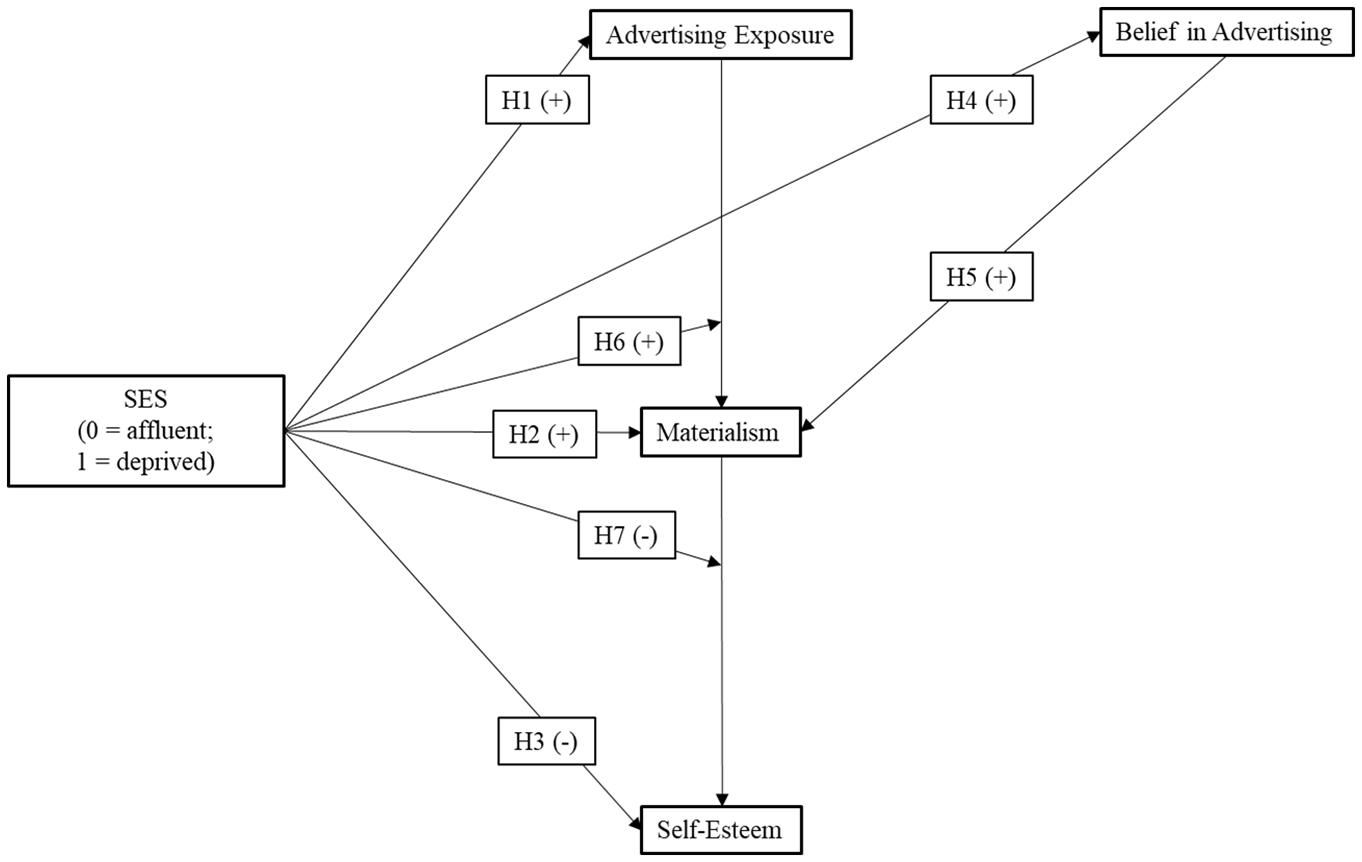
Theoretical model.
The observed standardized path coefficients from the causal model are presented in Table 1. With regard to the SES-differences in children’s advertising exposure, materialism, and self-esteem, it was found that—compared with children from an affluent background—children from a deprived background scored higher on advertising exposure (β = .45, p = .000), materialism (β = .27, p = .000), and belief in advertising (β = .24, p = .000), thus confirming H1, H2, and H4. However, no SES-difference in self-esteem was found (β = −.01, p = .848), disproving H3. Belief in advertising was significantly related to materialism (β = .11, p = .033, one-sided) and, hence, H5 can be accepted.
Path coefficients from SEM analyses (N = 557).
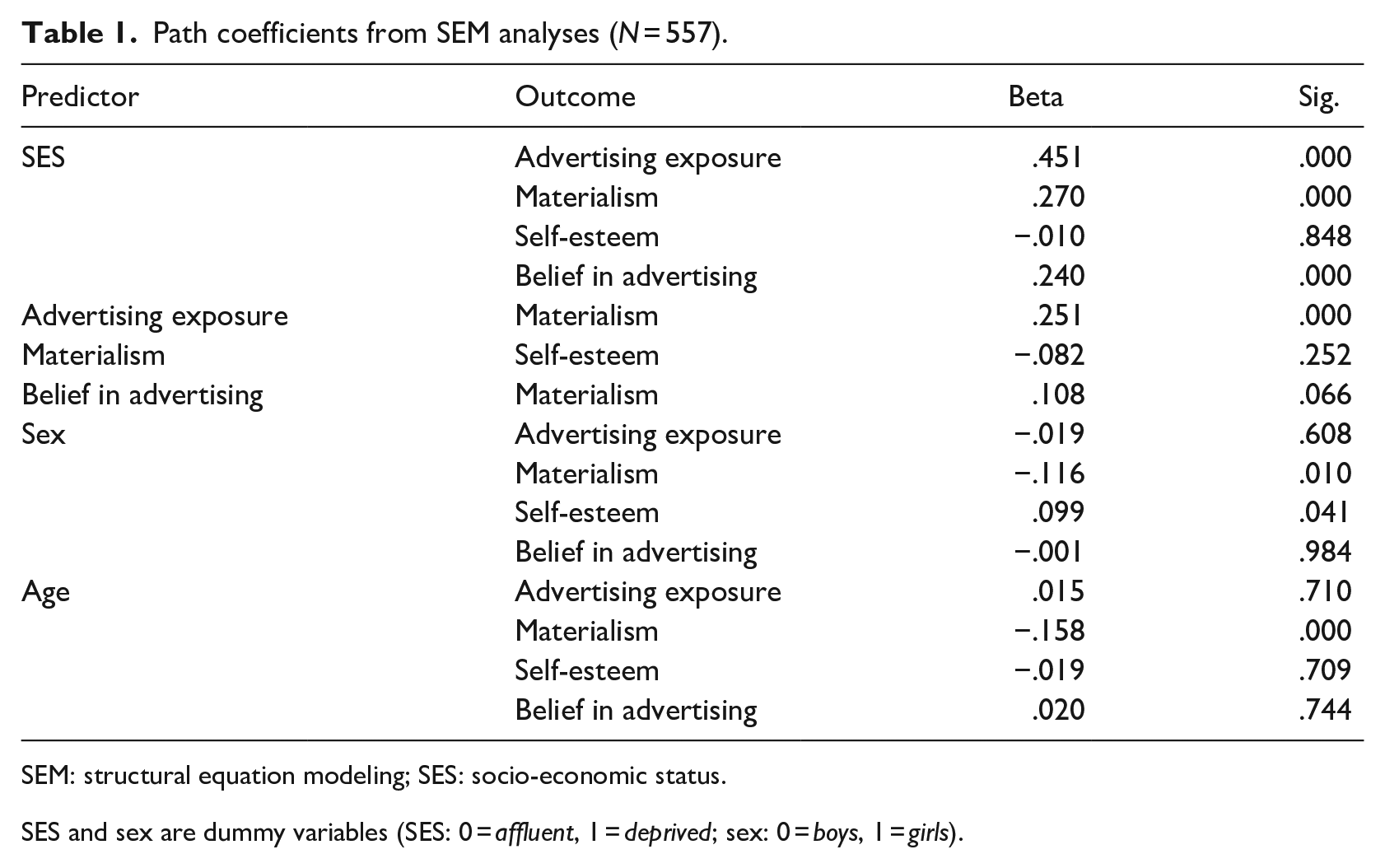
SEM: structural equation modeling; SES: socio-economic status.
SES and sex are dummy variables (SES: 0 = affluent, 1 = deprived; sex: 0 = boys, 1 = girls).
Multigroup model
The adjusted causal model was used as the basis for the multigroup model. However, the SES variable was removed as a manifest indicator and used as a grouping variable instead to enable us to verify whether the observed paths differed in size between children from affluent and children from deprived backgrounds. H6 focused on the difference in effect of advertising exposure on materialism, and H7 on the difference in effect of materialism on self-esteem. Looking at the group overall (see Table 1), the effect of advertising exposure on materialism was positive and significant (β = .25, p = .000) and the effect of materialism on self-esteem was negative and non-significant (β = −.08, p = .252).
Initially, the multigroup model did not result in a satisfactory CFI value: χ2 (df = 342, N = 305 and N = 252) = 569.33, p = .000, CFI = .87, RMSEA = .05, p close = .597. Based on the modification indices, two paths from the demographic variable age to item 4 and item 10 were added in sequence to obtain an acceptable model fit: χ2 (df = 338, N = 305 and N = 252) = 510.08, p = .000, CFI = .90, RMSEA = .04, p close = .946. The observed standardized path coefficients are presented in Table 2. With regard to the SES-differences in the effect of advertising on materialism, it was found that advertising exposure affected materialism for children from an affluent background (β = .26, p = .000) and children from a deprived background (β = .19 p = .012) differently. However, unlike the expectations, the effect was stronger for children with an affluent background, meaning H6 must be rejected. With regard to SES-differences in the effect of materialism on self-esteem, it was found that materialism did not affect the self-esteem for children from an affluent background (β = .07, p = .365), but did affect the self-esteem for children from a deprived background (β = −.30, p = .003). Hence, H7 is accepted.
Path coefficients from SEM multigroup analyses (N = 557).
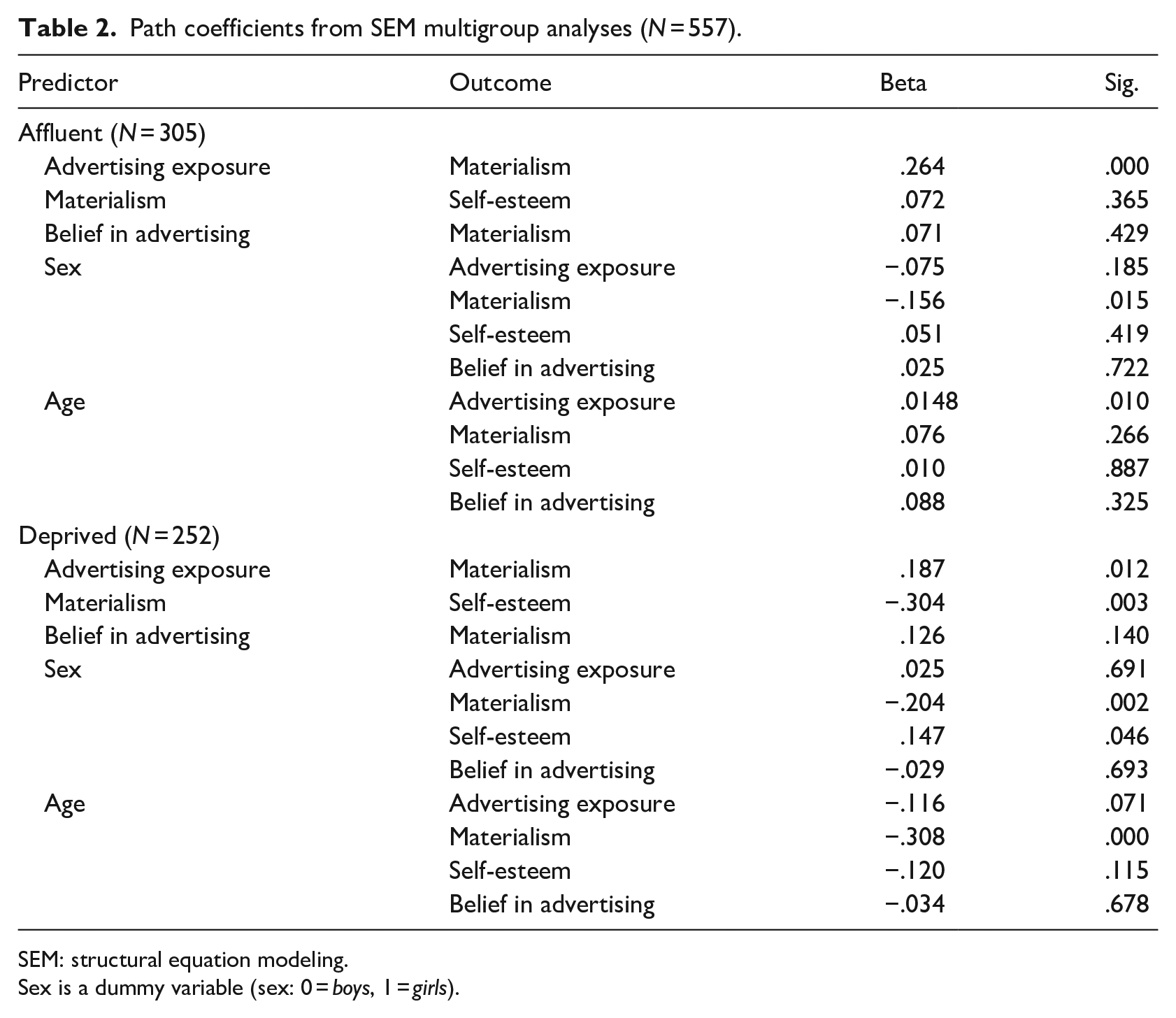
SEM: structural equation modeling.
Sex is a dummy variable (sex: 0 = boys, 1 = girls).
Conclusion and discussion
The first aim of this study was to establish whether advertising exposure (H1) and materialism (H2) were higher, and self-esteem (H3) was lower among children from deprived homes than children from affluent homes. The first two hypotheses were affirmed. As expected, children from deprived homes watched considerably more TV, and particularly commercial TV, than their affluent counterparts. A further comparison of the most avid TV watchers in the survey (i.e., those who ticked the “every day” option) showed that children from deprived homes were nearly four times more likely to watch TV in the morning before school; four times more likely to watch TV in bed before going to sleep; six times more likely to watch TV during the evening meal on weekdays; and nine times more likely to have the TV on during Sunday lunchtime. These rather dramatic differences in exposure to TV and advertising may partly be explained by the fact that while 97% of the deprived children had a TV in their bedrooms, only 48% of their affluent counterparts did so. These figures suggest two very different patterns of involvement with media, which may perhaps be accounted for by the fact that TV is a very inexpensive form of entertainment compared with some of the extra-curricular sports, musical, and other activities available to more affluent families.
We also found, consistent with other scholars (e.g., Chaplin et al., 2014; Schor, 2004), that children from deprived homes were considerably more materialistic than children from affluent homes. Indeed, whereas 28% of affluent children agreed that “the only kind of job I want when I grow up is one that gets me a lot of money,” the figure for deprived children was more than three times as great (69%). Likewise, 23% of affluent children agreed that, “I would rather spend time buying things than almost anything else,” compared with 47% of deprived children, and only 23% of affluent children believed that “the more money you have when you grow up the happier you are,” compared with 51% of deprived children. This adds some striking new evidence to support both the deprivation hypothesis that the more unobtainable something is the more desirable it becomes and the compensatory consumption hypothesis that those who are lacking important things in their lives such as money, decent living conditions, or life opportunities seek to compensate through acquiring desirable possessions.
Rather to our surprise, no differences in self-esteem were found between the two groups of children. We had expected, in line with previous studies, that deprived children would display lower self-esteem. A number of possible explanations for our findings occur. Affluent children may find themselves under other pressures, for example, performing well at school or in extra-curricular activities (see Luthar & Becker, 2002) which reduces their self-esteem to the same extent as that of deprived children who feel disenfranchised by their place in society. Indeed, this was one of the findings from a qualitative study by Nairn & Ipsos MORI (2011). This study also found that close communities where, for example, extended family spend a lot of time with children can act as a protection to children’s self-esteem and it may be that the particular communities in which we conducted the surveys offered this sort of protection. Exploring the more nuanced antecedents of self-esteem in children’s everyday lives would certainly be a fruitful avenue for future research.
With self-esteem roughly similar in both of our groups of children, we now turn to the question of whether materialism is more strongly related to self-esteem for deprived or affluent children (H7). Looking at the group as a whole (see Table 1), materialism is not related to self-esteem. However, zooming into the two different groups suggests that a negative effect is present for the children from a deprived background and not for the children from an affluent background. There is a link between self-esteem and materialism only for deprived children. This strongly supports the compensatory consumption hypothesis that when there is a lack in one’s life, then highly advertised, desirable goods may seem to offer an answer. This is problematic for society and children’s mental health as longitudinal research has shown quite clearly that feelings of inadequacy due to low income, poor living conditions, and few educational opportunities cannot be compensated for by material goods but that, in fact, this attempt leads to even more negative well-being (M. L. Wright et al., 2011).
Beyond this, our research has made an interesting finding on the relationship between advertising and materialism. Believing advertising is positively related to materialism (H5), confirming the influence of advertising on children’s propensity to want the latest possessions. At the same time, children from deprived backgrounds are more likely to believe adverts (H4). However, somewhat curiously, our hypothesis that children from deprived homes are then more susceptible to the effect of advertising on materialism (H6) was not proven. In fact, children from affluent backgrounds seemed more vulnerable to the effect of advertising on materialism. This may show support for the theory of resonance. While although affluent children may not necessarily believe the claim made in adverts, the advertised goods themselves resonate with their surroundings and lifestyles.
Strengths, limitations, and suggestions for future research
The data for this study were collected as part of an NCC study (Nairn et al., 2007) in the United Kingdom. A major strength of our article is that it is the first peer-reviewed journal article to investigate the dynamic between deprivation, materialism, and advertising in children—and hence a starting point for future investigations. A second strength is the use of IMD as a method of identifying schools and thus children from different socio-economic backgrounds. The data were, however, collected in 2007 when television use was rather more restricted to regular programming. Now, of course, it is also possible to watch on-demand content via a smart TV and/or to watch TV content on a computer, laptop, or mobile device. Nonetheless, as many as 97% of 5- to 15-year-olds still watch television on a TV set and do so for an average of 13 hr and 36 min per week (Ofcom, 2016), giving us cause to believe that our findings are still relevant and worth reporting today. As 2015 was the first year in which children’s online television viewing (15 hr) surpassed traditional viewing (Ofcom, 2016), future research may choose to investigate whether there are SES-differences in children’s exposure and susceptibility to general and commercial TV content across devices (i.e., desktop, laptop, tablet, smartphone, and gaming devices) and not just for television viewing.
Due to the study’s cross-sectional nature, we could only investigate the associations between children’s advertising exposure, materialism, and self-esteem means within and not across time points. If future studies employ a longitudinal design, they can establish causality and/or SES-differences in causality between children’s advertising exposure, materialism, and self-esteem. Although findings regarding children’s advertising exposure and materialism are unequivocal in finding that the first predicts the latter, such a uniformity in findings is lacking for studies on the causal link between children’s materialism and self-esteem. While we hypothesized that materialism would affect self-esteem, Chaplin and John (2010) have also tested the theory that low self-esteem leads to materialism. Longitudinal research could provide further insight into the questions of whether self-esteem predicts materialism in the long term, and whether its causal effect is similar for children from deprived and children from affluent homes. In addition, following previous research showing unhappy kids who are more vulnerable to advertising’s effect on materialism (Opree et al., 2012), future studies could investigate whether self-esteem moderates the causal effect of children’s advertising exposure on materialism. If so, self-esteem interventions can be used to not only boost children’s life satisfaction but also help reduce advertising’s adverse effects.
Overall, although the findings are complex, this study adds a new dimension to our understanding of role of advertising in a society with high levels of inequality.
Footnotes
Acknowledgements
We thank Prof. Dr Paul Bottomley for his feedback on previous versions of this article.
Declaration of conflicting interests
The author(s) declared no potential conflicts of interest with respect to the research, authorship, and/or publication of this article.
Funding
The author(s) disclosed receipt of the following financial support for the research, authorship, and/or publication of this article: This research was supported by the National Consumer Council (London, UK).
