




Abstract
Organisations such as multinational enterprises (MNEs) coexist and constantly compete and cooperate in complex networks of value creation that cross geographical and cultural borders. To address the corresponding management implications, traditional theoretical concepts have often focused on national cultures, thus simplifying cultural complexity and the realities of cross-cultural cooperation. This is reflected in a prevailing problem-focused view of culture and solutions such as adaptation, adjustment, and the development of intercultural skills at an individual level. Against this backdrop, this article explores the conceptual implications of a transcultural approach to management that focuses on developing commonalities rather than on managing cultural differences. Such an approach is in line with the “relational turn” in the social sciences, which proposes a conceptual shift away from a focus on entities (e.g., nations, individuals, leaders, groups or organisations) towards a focus on continuously unfolding relations. Accordingly, transculturality emphasises the relational nature of culture itself and pursues the continuity of cooperation as its main goal. Specifically, this article develops a total of four models of transcultural management: it introduces the relational event as the unit of analysis, describes an experience-based and commonality-focused transcultural learning model, develops an approach to identify and foster cooperation corridors, and finally presents the Transcultural Management System to productively relate the global and local level of MNEs.
Keywords
Introduction and rationale for a transcultural approach
What does it mean for organisations like multinational enterprises (MNEs) to successfully deal with cultural complexity, particularly in times of global tensions and transformations? How to effectively and sustainably connect a global strategy with diverse local realities? Questions like these have received manifold answers over the last decades based on different paradigms and the diverse, interdisciplinary and multifaceted nature of international business studies and cross-cultural management research (Bennett, 2013). This ongoing debate has produced a rich body of knowledge from different disciplines (economics, organisational theory, social psychology, communication studies, anthropology, and many others) as well as practitioners helping to understand cultural differences and their effects on various aspects of cross-cultural management (e.g., Adler, 1980, 2008; Bird and Mendenhall, 2016; Distefano and Maznevski, 2000; Javidan et al., 2006; Meyer, 2014; Schein, 2010; Schneider and Barsoux, 2003; Smith et al., 2008; Ting-Toomey, 1999) and intercultural communication in general (e.g., Bennett, 2013; Hall, 1959, 1976, 1997; Spencer-Oatey, 2008, 2011). The comparative approaches with their emphasis on differences between national cultures (Hofstede, 1980; House et al., 2004; Schwartz, 1992; Trompenaars and Hampden-Turner, 1997) were important trailblazers and agenda setters in our field, but they reduced real complexity in favour of rather simple categories and terms. This was important to raise awareness of the relevance of culture in a business context, yet it increasingly fails to do justice to the realities of business, especially as they have developed since the 2000s, in the sense of the ‘rise of the global’ (Bird and Mendenhall, 2016). The cooperative relationships in globally operating companies have developed strongly into dynamic and multi-layered networks, which are characterised by the diversity of the actors, their interdependence, ambiguity and continuous change (Lane et al., 2004) and thus by cultural complexity. Notably, cultural complexity stems from the coupling and interaction of multiple cultures (national, professional, organisational, etc.) with their different decision-making logics, decision-making contexts, and language games (Wieland, 2023). The times of “culture A meets culture B” are over, and just adding “culture C and culture D” or introducing new subcategories like professional or industry cultures seems not appropriate to describe the increase of complexity - a fresh view and thus, a different reference point and unit of analysis is required. Adding to this, modern organisations must recognize that cultural complexity has often been reduced in the past to core problems such as potential conflicts, frictions, and misunderstandings, leading to a predominant problem-focused view on culture, as well as solutions such as adaptation, adjustment and development of intercultural skills on the individual level (Søderberg and Holden, 2002; Tung and Stahl, 2018). Rethinking these conceptual approaches, especially their shortcomings, is the starting point of this article. It advocates for a relational view on management that considers cultural complexity as a regular phenomenon that both results from and simultaneously nurtures the highly interconnected realities to which many parts and processes of our societies are constantly and increasingly exposed. Overall, it will be argued that dealing with cultural complexity for management requires a relational view with a focus on the development of successful shared value creation (Porter and Kramer, 2011) through the relationalisation of resources and interests (Wieland, 2020) in a process of transcultural stakeholder management (Freeman, 1984). Unfortunately, in international business, including cross-cultural management, less attention has been paid to the ontological and epistemological roots of concepts and its implications (Bennett, 2023), which strengthens the need for the proposed elaborations on a relational approach for transcultural management.
Relational ontologies, even though there are many different variations within this field, share the fundamental recognition that the nature of reality is inherently relational (Emirbayer, 1997; Gergen, 2009). This entails that the existence and properties of individual or collective entities result from and are constituted by their relations with other entities and the environment. Therefore, this approach does not consider entities engaging in relations as a secondary act, but highlights the importance of understanding the constituting relational processes of entities (Steenkamp and Fourie, 2023). This includes the recognition that entities inevitably change in their engagement in relational events (Emirbayer, 1997; Gergen, 2009; Rovelli, 2021). The unit of analysis thus is no longer the entity, but the relational event as a context- and time-specific transaction. This stands in contrast to more traditional, often Western ontologies that consider entities as having independent, self-contained existence and inherent qualities.
As for the rationale of our argumentation, it departs from the observation that the reality of international corporates is shaped by the multiple and fuzzy cultural affiliations of their stakeholders (Bolten, 2020; Sackmann, 2023) as well as their polyvalent contexts, decision logics, communicative patterns, resources and interests (Baumann Montecinos, 2022; Wieland, 2020). This is what cultural complexity means in real life and what management of MNEs needs to address. In such contexts, it is relations that can make this complexity tangible, experienceable, accessible, and shapeable for people and organisations (Snowden and Boone, 2007). These relations manifest themselves and can be described as being both the precondition and the result of commonalities of the involved actors. Therefore, the focus on the processes of identifying and developing commonalities lies at the core of a transcultural management concept as it will be presented in this article. By consistently pursuing a relational perspective, we aim to address the limitations of essentialism, comparative studies, and binary concepts inherent in many intercultural approaches, whose derived practical implications often seem to not sufficiently capture the real-life cultural complexity of international organisations (Henze, 2020; Sackmann, 2023). At the same time, this overcomes mainly Western-centric assumptions of entity- and universality-focused theories in international business that have dominated the field for too long (Tung, 2023). The intended contribution is to offer a concept of transcultural management based on a relational approach that provides us with tools and strategies targeting ongoing processes of creating shared meaning and action as a driver and result of cooperation in culturally complex situations.
The concept of transcultural management presented here is based on a relational view of cultural complexity. Therefore, relations and the way in which they can be established and maintained by developing commonalities play a crucial role. In this regard, the notion of “beyond” emphasizes that management must go beyond the mere recognition, tolerance or management of cultural differences, and actively develop new commonalities to ensure the continuity of cooperation. Commonalities refer to the observation that different actors (e.g., individuals or organisations) can have and can develop something in common (e.g., shared understanding, meanings and/or actions) and yet remain different. Thus, commonalities refer to the state or process of sharing something (e.g., common interests, challenges or ways of thinking, feeling and/or acting), while similarities refer to the state or fact of being similar. Striving for similarities may end in homogenization, while striving for commonalities involves connecting and building relations, while maintaining diversity (Baumann Montecinos and Grünfelder, 2022).
Overall, this article can be considered as a response to the calls for more pragmatic inclusivity perspectives of cooperative value creation by Luo (2024), for the development of concepts that move beyond dominant logics in international business based on dichotomies (e.g. convergence vs divergence; standardisation vs localisation) by Caprar et al. (2022), for more relational perspectives in international business by Szkudlarek et al. (2020), for more focus on the continuity of shared value creation in a diverse network of stakeholders by Distefano and Maznevski (2000), for a more dynamic and positive view of culture by Tung and Stahl (2018) and thus to increase and maintain the relevance of contemporary cross-cultural management studies (Mahadevan and Primecz, 2024). This article is a first step to venture a relational view on the management of cultural complexity, with the aim of facilitating new discussions for theory building and practice.
Why transculturality and its focus on commonalities help navigate real-life cultural complexities
Concepts of transculturality (Glover and Friedman, 2015; Ortiz, 1947/1995; Welsch, 1999; Wieland and Baumann Montecinos, 2018) highlight the interconnections, flows, interdependencies and permeations of cultures. This includes a dynamic understanding of culture that address a need in our field, as “little progress has been made in theory and research on culture in IB since the introduction of Hofstede’s (1980) dimensional approach” (Tung and Stahl, 2018: 1167). At the same time, particularly by building on a relational understanding of culture itself, a transcultural approach may help readjust “our inner compass: away from the concentration on the polarity of the own and the foreign to an attentiveness for what might be common and connective wherever we encounter things foreign” (Welsch, 1999). The realities and tensions that MNEs are increasingly facing in regards to cultural complexity support a shift towards focusing on common grounds as a highly relevant endeavour, which Appiah (2006) also encourages us to pursue in his work on cosmopolitanism.
The conceptual offer of the prefix “trans”, particularly with its connotation of the “beyond”, was analysed in an international and interdisciplinary Delphi study conducted from 2020 to 2022, aiming to clarify the general implications of a focus on commonalities in contexts of cultural complexity (Baumann Montecinos and Grünfelder, 2022). Even though the question of what could be meant by the prefix “trans” – especially in contrast to “inter” – was an aspect that was discussed in the Delphi study, it is actually less about the terminology itself but rather about the connotations associated with the prefix “trans” that guide the argumentation of this article. Keeping this in mind, the following outline aims to clarify the understanding of “trans” on which we base our transcultural management approach, highlighting four aspects: First, the prefix “trans” defies and neglects static concepts of culture and thus moves beyond essentializing and “either/or” approaches. Second, it implies a movement and process not in-between, but through and beyond groups, communities, countries, regions, etc., including different time horizons, thereby taking the fuzziness and relational nature of cultures into consideration. At the same time, the possibility of the emergence and relevance of patterns and structures is not neglected. Third, the prefix “trans” offers to move beyond the recognition, tolerance and acceptance of cultural differences toward developing new commonalities across cultures, thus focusing on constructing new realities. This discussion on moving beyond the mere recognition of cultural differences is inspired by concepts like mutual adaptation (Bennett, 2013, 2020), cultural synergy (Adler, 1980), reconciliation of cultural dilemmas (Trompenaars and Hampden-Turner, 2012) and third-culture building (Bhabha, 1994; Casmir, 1993, 1999; etc.). Fourth, the prefix “trans” even hints towards the “beyond beyond”: The newly developed commonalities ensure and determine the ongoing cooperation that in turn is the starting point for the continuity of shared value creation over time. Enabling the continuation of cooperation thus becomes the main goal of transcultural management. In this spirit, transculturality can be understood as “accepting differences as a starting point, and openness to a process to develop new commonalities. Transculturally competent people show an openness to a mutual and recursive learning process (as an event in a continuum) and understand that there is no exclusive cultural truth with a preference for long-term cooperation” (Baumann Montecinos and Grünfelder, 2022: Appendix). Accordingly, transcultural competence can be defined as “referring to a general competence of individuals or organisations to intentionally develop new commonalities in contexts of cultural complexity. It refers to the ability and willingness to engage in context-specific processes of constructing new shared meaning and action beyond existing practices by shared experience and mutual learning as a means and result of being in relation. The new commonalities are based on a sense of belonging to a heterogeneous community of experience rather than on overcoming one’s own identity in a process of homogenization. New forms of cooperation and the expansion of existing cooperation corridors may be the goals and results of applying transcultural competence” (Grünfelder and Baumann Montecinos, 2023: 25–26).
Interestingly, as for the paper at hand, it can be noted that many aspects of this definition are represented in the discussion on intercultural competences, competences for a global mindset and cross-cultural competence (Johnson et al., 2006; Levy et al., 2007; Osland et al., 2006). It needs to be recognized that the distinction between intercultural competence and transcultural competence is not oppositional, but the difference is a gradual one (Antor, 2020), whereby the nuance of the “trans” offers additional considerations aiming to take the discussion further. Nevertheless, by focusing on developing commonalities, this also carries a distinction to many prevalent definitions of intercultural competence that have mainly approached cultural complexity through the prism of handling cultural differences effectively and appropriately at an individual level. There appears to be a consensus on the general concept of intercultural competence as an individual’s ability to think, interact and act effectively across different cultures (Leung et al., 2014). However, dissimilarities exist when it comes to the particular features, models and measures of intercultural competence. Literature, in fact, shows that there exist more than 30 intercultural competence models, with over 300 related constructs (Deardorff, 2006; Johnson et al., 2006; Leung et al., 2014). In addition, Johnson et al. (2006) empashized the environmental and contextual impediments to the effective application of the requisite skills, knowledge and attributes that have been identified as necessary for cross-cultural competence, resulting in a gap between ‘knowing’ and ‘doing’.
Against this backdrop, the proposed definition of transcultural competence wants to emphasise that it is a relational process that resides between and even beyond people in a context and evolves as people engage with each other and develop commonalities, which in turn continues their cooperation. Taking such an understanding of transcultural competence into account, the next step is to analyse its conceptual implications for management theory and practice. In order to pursue this goal, this article develops a total of four models of transcultural management: it introduces the relation as a unit of analysis, elaborates on a Transcultural Learning Model to interrelate cultural differences in experience-based and commonality-focused processes, develops an approach to identify and foster cooperation corridors, and finally presents the Transcultural Management System as a management tool.
Transcultural management as a relational concept
In order to specify our contribution and pave the grounds for the subsequent conceptual steps, transcultural management will be presented as an approach that identifies specific relational events as its unit of analysis.
Selected conceptual debates on a relational perspective
Szkudlarek et al. (2020) criticise the field of international business studies for its overreliance on entity level conceptualizations (e.g., individuals or organisations as the unit of analysis) and identify several corresponding shifts to advance the field’s theorising. Taking a relational perspective can address multiple of those shifts (e.g., from a static to a processual perspective, from decontextualized to context-rich accounts, etc.), bearing in mind that relations among different entities are constantly changing and emerging processes that are co-created and always context-dependent.
Such a shift to more relational perspectives in international business is in line with what can be called a relational turn in the social sciences (West et al., 2020). As for a bigger picture, it can be observed that a relational understanding is gaining increasing attention in various disciplines (e.g., in sociology, psychology, cultural studies, linguistics, leadership, economics, sustainability studies), presumably because it is considered to better capture the complexity of human interactions as well as human-nature connectedness (Hertz et al., 2020; Walsh et al., 2020). This trend was already related to cultural studies by Bartholomew and Adler, when they argued for “a conceptual shift: from a hierarchical perspective of cultural influence, compromise, and adaptation, to one of collaborative cross-cultural learning” (1996: 27) as well as by Dinges and Lieberman (1989) who called for a revision of existing models of intercultural competence that favour person-centred variables. They contend that context, the type of situation, and the other participants involved have a larger impact on intercultural communication competence than do individuals themselves. Furthermore, Chen (2017), in his recent review, makes an important case for a relational perspective, arguing that the debate needs to move towards interpretative and critical paradigms as well as culturally diverse views on intercultural communication to overcome the Western, individual-focused approach that has dominated the field to date. Accordingly, the Delphi study on transcultural competence has advocated that “post-modern world encounters require a paradigm shift towards a more relational approach, where the focus shifts from the object of culture to its subject, towards the quality of our relationship to Otherness”, observing that “there is a tendency to over-emphasize the importance of cultural differences, which makes people ignore or be ‘blind’ to commonalities” (Baumann Montecinos and Grünfelder, 2022: 43).
At the same time, Bennett importantly reminds us that a relational view is actually nothing new to our field and that the relational roots of intercultural communication are sometimes overlooked, especially in business schools and commercial intercultural training (Bennett, 2023). All the more remarkable is the observation by Szkudlarek et al. (2013: 478–480) that “culture is never the ‘only’ explanation for what’s gone wrong in a particular situation, and often it’s not even the ‘biggest’ explanation”, and that what we should aim for is “understanding how and when culture matters and not overemphasizing cultural explanations”. Consequently, shifting towards relations as a means to put cultural explanations in context has multiple relevant implications on management in particular, which will be explored further in the course of this article.
In order to derive the potential of the relational approach for our field using the example of its application in other management areas, reference is made here to the field of sustainability management. The potential of a relational view for sustainability science is for example addressed by Hertz et al. (2020) suggesting that a ‘paradigm shift’ from substantialist to relational assumptions in coupled systems thinking can help overcome dichotomies and dualisms between humans and nature, better conceptualize complexity, and develop new management, governance and policy approaches for sustainability (West et al., 2020). These observations can lead us to the realisation that, in a similar way, it is time now to unleash the potential of a relational perspective for cross-cultural management and international business.
Management implications: relational events as the unit of analysis
So what should be the unit of analysis for transcultural management? Based on a relational view, the unit of analysis would not be a concept of “cultural difference” or “culture” that “equates very strongly with the boundaries of nation-states” (Søderberg and Holden, 2002: 108), but specific transactions as dynamic and unfolding relational events. This is in line with Burton’s early suggestion to not use systems or actors as the basic unit for analysing the global society or global economy, but instead “transactions and links that exist” (1972: 35). Accordingly, Wieland argues that “approaching the global economy no longer simply means ‘adding up’ the various national economies, but instead consists in identifying, grasping and shaping collaborative and transactional relations” (2020: 2), and Beugelsdijk and Mudambi point out that international business is “reaching the limits of what can be achieved under the constraining assumption that fixes the location unit of analysis at the level of the nation-state” (2013: 421–422). Similarly, Brannen and Salk (2000) use organisational events as the unit of analysis and show that contextual influences together with individuals’ culturally determined sensemaking in regards to specific organisational events are highly useful determinants of negotiated outcomes.
Against this background, relational events can be defined as the nodes of relational processes, in which the relational events themselves will invariably change all actors and elements involved (Rovelli, 2021), as Abbott described already in 1996: “What comes out are new actors, new entities, new relations among old parts” (1996: 863). It thus becomes evident that the field of cross-cultural management in particular could benefit from switching from “culture” or “cultural differences” as its unit of analysis to “relational events”.
The recognition that each relational event is context- and time-specific and therefore unique has multiple implications for theory and practice, which lay the foundations for the concept of transcultural management presented here. In the end, this addresses the challenge for international organisations to find ways how to relate all the different actors and their polyvalent settings to do the best possible next step together. This means that the different actors usually cannot optimize or maximize the output of a certain situation alone, but create shared adaptive governance structures and processes to continue their cooperation - which specifically means taking one of the possible best next steps together. In this way, it is a pragmatic approach that seeks to focus on the continuity of cooperation and thus aims to reflect the reality of many international organisations. Figure 1 aims to summarize such an understanding of relational events as the unit of analysis, Table 1 explains the respective terms. Relational events (own illustration). Explanation of the key concepts of “relational events”.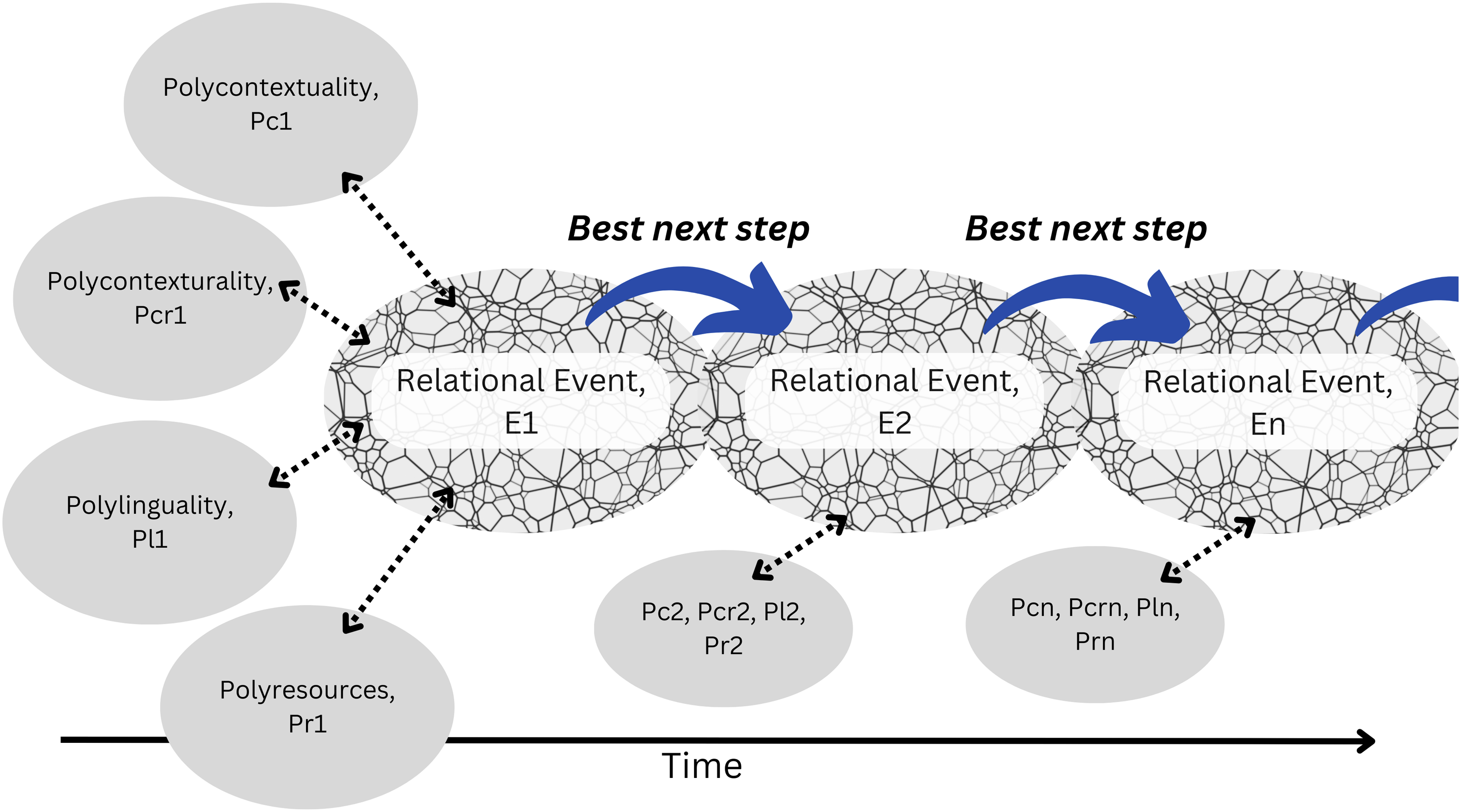
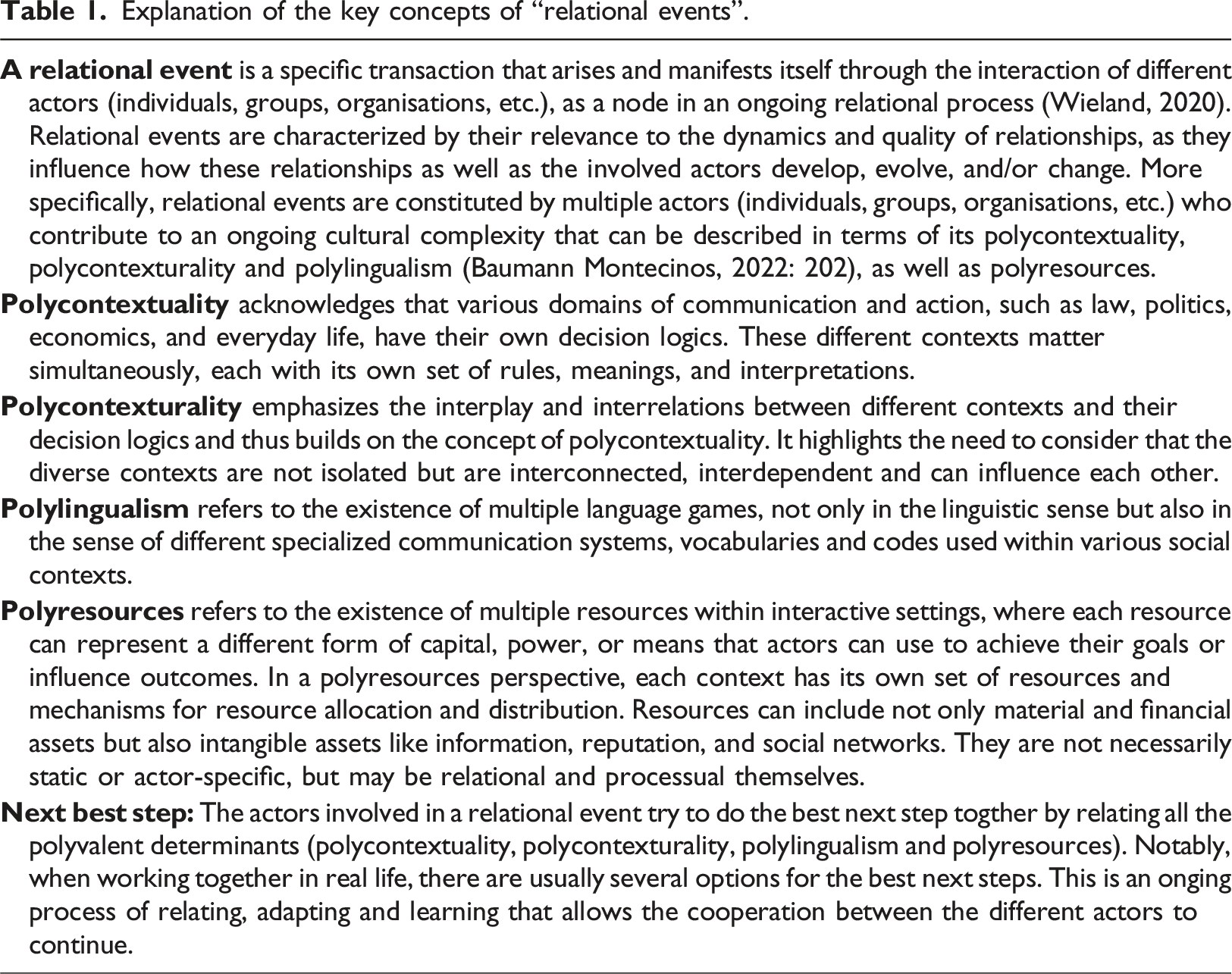
The concepts of polycontextuality, polycontexturality and polylingualism can be traceed back to Luhmann’s systems theory (1987, 1997), which focuses on the complex and dynamic nature of modern societies and to the role of communication in shaping and maintaining social systems. Taking a relational event as the unit of analysis entails manifold practical implications for organisations. For example, the unit of analysis would not be the supplier or customer from India or Spain, as in this case the focus would only be on the national difference and thus on the “other”, but rather on the concrete and existing relations that exist with the supplier or customer as they manifest in context- and time-specific shared actions. In practice, this means that management must always start by analysing specific relational events (e.g., a compliance or product quality issue with a supplier in country X). Therefore, a careful step-by-step analysis can be applied, which includes identifying the relevant stakeholders with regard to the relational event, analysing the respective resources, interests and values of the stakeholders and finally possible intrapersonal, inter-organisational and intercultural value conflicts (Wieland and Baumann Montecinos, 2024). By applying a careful analysis that begins with the relational event, a simplification and generalisation of culture is avoided, and the real complexity is thus done justice to. At the same time, this does not mean that organisations and its management do not need to prepare for relational events. Knowledge of business etiquette or the customs of certain cultures is very helpful, as long as it does not lead to stereotyping and the focus is not limited to assumptions or generalizations about the other. Managment should rather carefully identify the relevant relational events they are involved in, as well as recognize that polycontuality, polycontexturality, polyligualism and polyresources constitute and shape the specific setting. This also means accepting that the different parts of a relational event can never be fully reduced and understood separately, but need to be analysed as they are embedded in and mutually influenced by their interrelations. Coming back to the example, taking the next best step together for an MNE could mean to try new communication formats with their suppliers and customers from India or Spain, based on an analysis of the contexts, decision logics, language games and resources of the involved actors and corresponding pragmatic considerations of what could be appropriate for this specific constellation. Importantly, identifying relational events includes shifting the focus to the corresponding mutual learning processes. The crucial role of shared experiences to develop shared meaning in contexts of cultural complexity will be discussed in the next part of this article.
Transcultural management as an enabler of learning processes
If the unit of analysis is always a specific relational event in which the best next step is to be derived, this directs the focus on corresponding learning mechanisms that are considered a core element of our concept of transcultural management.
Selected conceptual debates on the role of commonalities, shared experiences and sensemaking
To understand transcultural management as an enabler of learning processes that foster the individual and collective willingness and ability to cooperate in culturally complex situations directs our focus on three interrelated aspects: first, the role of commonalities, especially as they relate to differences, second, the relevance of shared experiences and third, the process of indiviudal and collective sensemaking. In order to pursue this direction, the following conceptual insights on characteristics of commonalities might pave the way:
First, commonalities are not the same as similarities: Commonalities refer to what is shared, while similarities refer to the state or fact of being similar. As the findings of the Delphi study on transcultural competence indicate, “striving for similarities may end in homogenization, while striving for commonalities involves connecting and building relations” (Baumann Montecinos and Grünfelder, 2022: 48). In this regard, Binder and Holla state that commonalities allow holding cultural complexity by connecting cultural differences without overcoming or merging them (Binder and Holla, 2023). Notably, Appiah (2006) emphasizes the role of commonalities and argues that dialogue and conversations do not have to lead to consensus, especially not about values, but should help people get used to one another. The distinction between commonalities and similarities is also crucial to Jullien, who argues that “[u]nder globalization’s imposed regime of uniformity we are tempted to reduce the common to the similar: that is, to engage in assimilation. We must instead promote the common that is not the similar. Only this manner of common is productive” (2021: 6). Second, because commonalities are shared, they are inherently relational. To strengthen this – admittedly very obvious – classification of commonalities ties in with the focus on relations and relational events as introduced before. Third, commonalities need to be seen in their relation to differences. A relational understanding of cultural complexity views cultural commonalities and differences not as opposites, but as mutually enabling and enriching, complementary resources for cooperation (Baumann Montecinos and Grünfelder, 2022). Similarly, Lee and Quinn argue that leadership in global work is about developing a dynamic balancing approach that embraces the commonality-difference duality in the spirit of “seeking commonality while preserving difference” (Lee and Quinn, 2023), whereas Jullien states that focusing solely on differences in a static and positivist sense could be dangerous and thus concludes that “it is difference, hand in hand with identity, that isolates and ‘essentializes’ cultures. It is difference that drives us into the impasse of universalism or of relativism” (2021: 58). Fourth, commonalities are not an end per se, but could rather be considered a vehicle forming connections among members from different cultures and thus as a means of coordinating meaning across cultures (Baumann Montecinos and Grünfelder, 2022: 47). Against this backdrop, commonalities become the starting point and reference point of cooperation. As an important note on the role of commonalities to determine and enable cooperation, commonalities are not per se about harmonious relations, but may create tensions for learning, creativity and innovation. Fifth, commonalities reduce relational costs. According to Wieland (2023, 2020), relational costs “are the costs that a given organisation has to pay in order to continually fulfil the purpose of its existence, namely interacting with stakeholders and their resources. More specifically, they are the costs incurred by generating and maintaining the willingness and ability to cooperate” (Wieland, 2020: 149). It is precisely when it comes to the willingness and ability to cooperate over time that existing and newly developed commonalities may play an important role. To give an example, emerging patterns of communication and shared understandings of the division of work may emerge in a diverse team out of shared practice and thus reduce relational costs over time.
Summarizing, the role of commonalities as an enabler of the continuity of cooperation lies at the core of a transcultural management approach that intends to move beyond recognizing, tolerating and managing cultural differences. Nevertheless, to criticise an overemphasise and predominantly pessimistic view of cultural diversity and to focus on developing commonalities does not entail that cultural differences are excluded or overlooked. If we consider cultural differences as resources for cooperation, it is the commonalities that allow these resources to be related. In this spirit, the role of commonalities can be also added to the categories of Otherness and Saming introduced by Mahadevan and Primecz (2024) that offer a new concept for cross-cultural management away from the aim of defining culture and cultural differences.
As noted above, by taking relational events as the unit of analysis, shared experiences between different actors become a central focus for transcultural management and the development of commonalities. As for this emphasis on shared experience when it comes to developing commonalities, manifold linkages to ongoing debates in several academic disciplines can be highlighted, in particular to the process of sensemaking.
First, in psychology and other social sciences, the contact hypothesis (Allport, 1954) suggests that intergroup contact under appropriate conditions can effectively reduce prejudice between majority and minority group members. The relevance of experience is also highlighted in experiential learning theory which is rooted in the works of Dewey, Lewin, and Piaget and defines learning as “the process whereby knowledge is created through the transformation of experience” (Kolb, 1984: 41). Binder and Holla (2023) summarize that experiential learning processes involve a concrete experience that provides the basis for reflective observation which, in turn, enables learners to assimilate their experience and observations into abstract concepts which can then be drawn upon for active experimentation which, again in turn, leads to a new experience. Thus, shared experiences can be attributed to become the starting point for sensemaking. Weick (1995) coined the term “sensemaking” as practically meaning making sense of the world around us. Sensemaking can be defined as the “process of creating situational awareness and understanding in situations of high complexity or uncertainty in order to make decisions” and “a motivated, continuous effort to understand connections (which can be among people, places, and events) in order to anticipate their trajectories and act effectively” (Klein et al., 2006: 70). In this regard, cultural sensemaking is the processes by which individuals and collectives make sense of and explain culturally different behaviors without relying solely on stereotypical, bipolar cultural dimensions (Osland and Bird, 2000). Sensemaking can be individual or collective, prospective or retrospective, and in the case of transcultural management refers to the process of developing commonalities, shared meanings and shared practices based on shared experiences. Overall, the importance of enableling shared experiences and making individual and collective meaning out of them seems crucial in dealing with cultural complexity and thus becomes a central aspect of transcultural management. Only by allowing, cultivating and fostering experiences with ongoing reflections and sensemaking, new commonalities can emerge. All of the mentioned coordinates may then lead to transcultural learning as described in the following model.
Building on these observations, we will argue later that for transcultural management, “doing something together” can be seen as a framework condition that holds manifold strategic implications, and that being able to foster, create and use opportunities for shared practice is considered an important individual and organisational competence to deal with cultural complexity.
In a nutshell, a relational view on the role of shared experiences, sensemaking and commonalities in connecting cultural differences forms the basis for a transcultural approach to management.
Management implications: transcultural learning model
Building on the relational view and its focus on the context-specific, experienced-based development of commonalities directs the attention on the locus of the corresponding learning opportunities: The question of where shared experience actually takes place in an organisation thus becomes highly relevant for transcultural management. Accordingly, identifying and setting up the practical relational spaces where these experiential learning processes take place becomes a management task that must be integrated, strengthened and planned in a strategic manner.
Against this backdrop, Figure 2 summarizes the transcultural learning process that seeks to establish and continuously develop cooperative relationships in complex and polyvalent networks. Transcultural learning model (own illustration, based on Baumann Montecinos, 2022).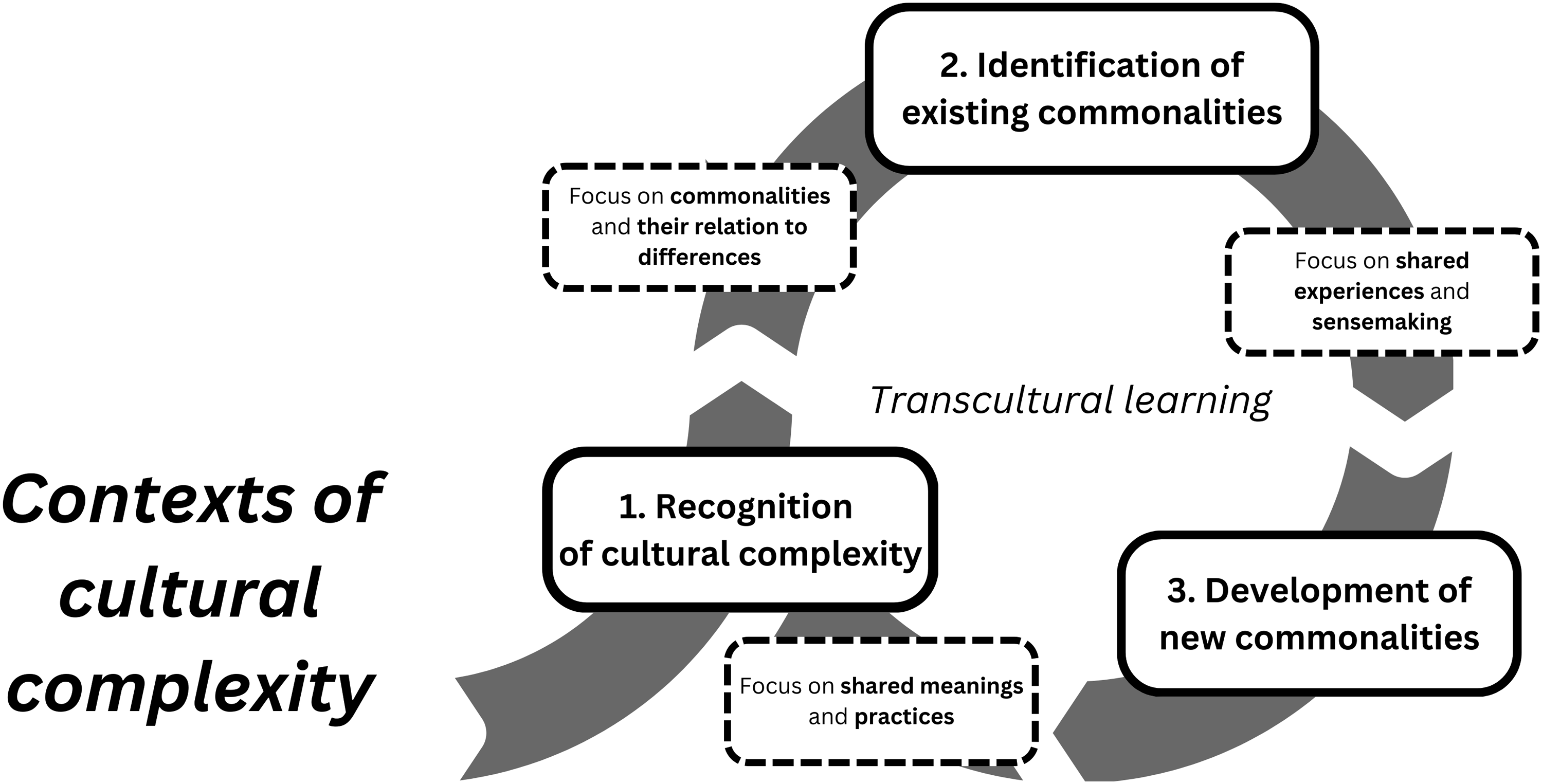
This transcultural learning process has similarities to the MBI approach developed by Distefano and Maznevski (2000) that consists of the three elements mapping (understand the differences) bridging (communicate, take differences into account), and integrating (bring together and leverage the differences), but takes into account the important role of commonalities and shared experiences as highlighted above. Again, in a similar spirit, Distefano and Maznevski conclude in their final step that “teams need shared ground around two things for good bridging: defining the situation itself, and interacting with each other” (2000: 53), an insight that the transcultural learning models aims to take further by connecting differences and commonalities.
Explanation of the “Transcultural Learning Model”.
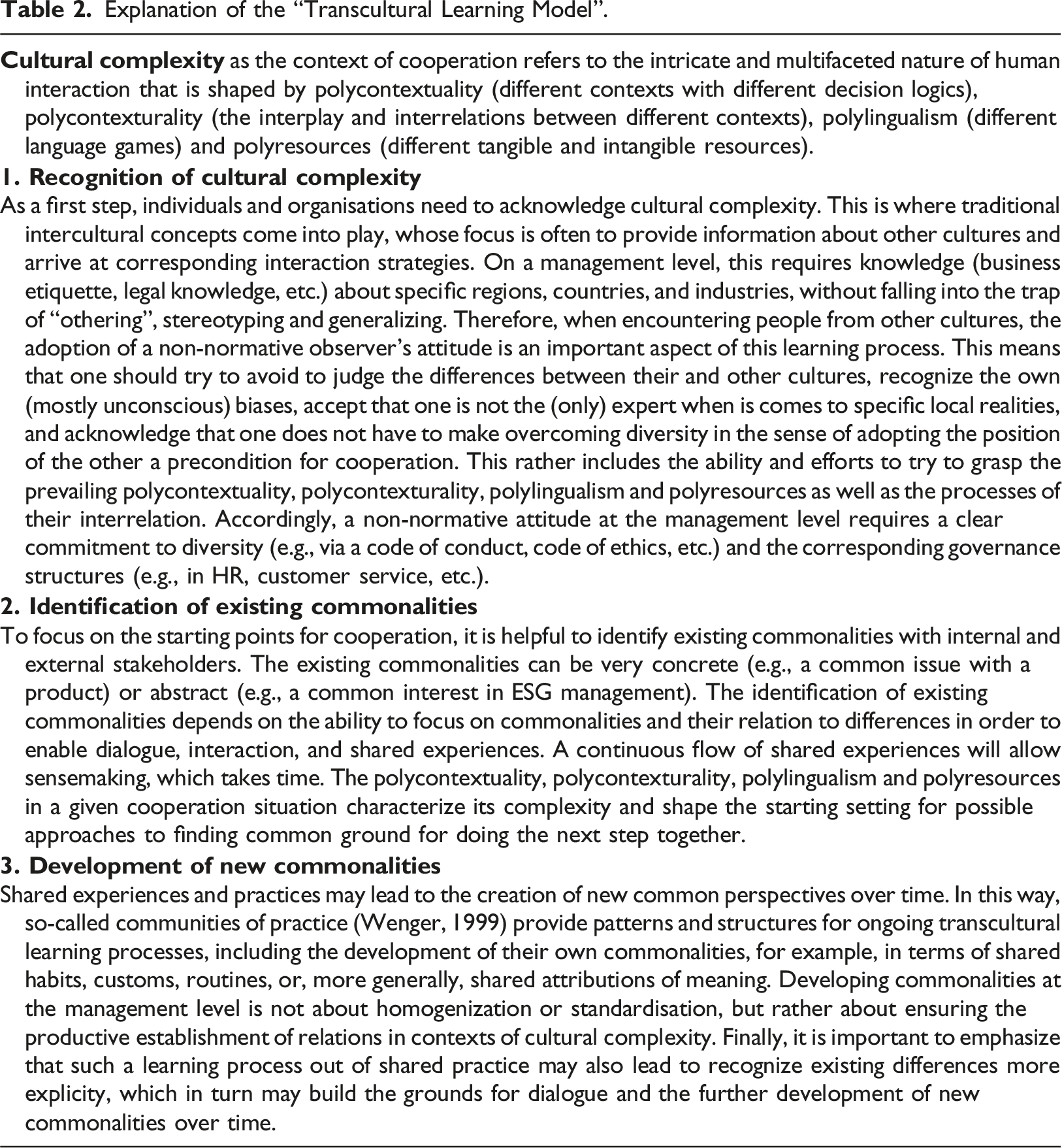
The transcultural learning model has been applied to case studies and to concepts of higher education (Grünfelder, 2024; Grünfelder et al., 2024a, 2024b) and can be used by management to map, guide and analyse their learning process and development of commonalities. The transcultural learning model can, for example, serve as a conceptual template for management initiatives, knowledge management activities and the development of L&D programmes.
Transcultural management as ensuring the continuity of cooperation
After introducing the relational event as the unit of analysis and elaborating on the transcultural learning process, the following part sheds light on implications of the “beyond” as a unique feature of transcultural management.
Selected conceptual debates on “trans” as meaning “beyond”
As already stated, the nuance of the “beyond” highlights that the main goal of transcultural management is to enable and ensure the continuation of cooperation and value creation. Against this backdrop, our proposed understanding of the term “transcultural” resonates with existing concepts like mutual adaptation (Bennett, 2013, 2020), cultural synergy (Adler, 1980), reconciliation of cultural dilemmas (Trompenaars and Hampden-Turner, 2012) and third-culture building (Bhabha, 1994; Casmir, 1993, 1999; etc.). For instance, intercultural synergies are described to arise from the combination and interaction of individuals from different cultures, which are of higher quality than the sum of the individual actions (Adler, 1980, 2008; Barmeyer and Franklin, 2016; Moran and Harris, 1983). According to Adler, “[c]ulturally synergistic organisations create new forms of management and organisation that transcend the distinct culture of their members. This approach recognizes both the similarities and differences among the cultures that compose a global organisation and suggests that we neither ignore nor minimize cultural diversity, but rather view it as a resource in designing and developing organisational systems” (2008: 109). Finally, Barmeyer and Franklin (2016: 204) point out that “the notion of intercultural synergy has remained little explored both on the theoretical and conceptional level and on the practical and empirical level.”
The concept of “mutual adaptation” has been coined by the work of Bennett (2013), strengthening that mutual adaptation generates third cultures, which can be defined as a kind of communicative intersectional space. According to Bennett, “a third culture is virtual in that it comes into existence only in that particular interaction and it ceases to exist when the interaction ends. A virtual third culture is not necessarily a simple hybrid of the two originating cultures since a kind of meta-coordination of meaning is occurring” (2013: 97).
In addition, works on adapting individual behavior across cultures are helfpul (e.g., Molinsky, 2013), but when a certain context is shaped by many different cultures, the question of who or what to adapt to can be raised. Therefore, it seems more appropriate on a management level to ask how we can relate different actors to each other and ensure the continuity of cooperation to develop shared meanings and actions across cultures, geographies and disciplines.
Overall, intercultural synergy and mutual adaptation have inspired our concepts, but they do not explicitly address the connotation of the “beyond” that points to the importance of an ongoing, continuous process of developing shared meanings and actions beyond the previously existing realities. The importance of continuity was also mentioned by Trompenaars and Woolliams (2002). They conclude that “organisations must reconcile change with continuity in order to preserve an evolving identity” (2000: 362).
As for our approach to transcultural management, the end result is not a resolution of cultural differences in a higher synergy or mutual adaptation, but the continuous relationalisation of cultural complexity and the development of commonalities. In a world characterised by the ongoing competition and cooperation between nations and MNEs (Luo, 2024) and high levels of complexity and uncertainty, the main challenge is not to create conflict-free societies or a harmonious world order, but to ensure, maintain and further develop cooperation corridors.
In a nutshell, the nuance of the beyond reminds us that transcultural management is about ensuring the continuity of cooperation by developing new commonalities. Accordingly, the aim is to connect various actors and to engage them in ongoing processes of transcultural learning by mapping and extending the cooperation corridor, as the following model aims to introduce.
Management implications: mapping the cooperation corridor
Taking the so far discussions about the transcultural approach into account, transcultural management aims to develop commonalities that ensure the continuity of cooperation. Therefore, relational spaces are required that enable different actors to gain experience and do something together. Relational spaces are made up by multiple relational events and the involved actors and processes. They are stabilized only provisionally, must be continually remade, and as they are remade, they change. Accordingly, relational spaces are “places in nonterritorial terms” (Amin, 2002: 391) and can be seen not as hierarchies (global, national, local), but as “nodes in relational settings”. Transcultural management of MNEs must carefully establish and design relational spaces that allow shared experiences, mutual learning and the development of commonalities. Finally, the continuity of transcultural learning in relational spaces allows a cooperation corridor to emerge. A cooperation corridor can become larger, smaller or even terminated over time.
Figure 3, “Mapping the cooperation corridor”, aims to summarize this understanding and derive the corresponding implications for transcultural management, Table 3 explains underlying concepts. Again, the blue arrows symbolize the search for the best next steps. Over time, this accumulates to a process that reaches beyond beyond by the ongoing relationalisation of different actors as they develop new commonalities. In this process of learning from and with each other in relational spaces, the actors mutually transform each other. Importantly, this process is not mainly about adapting to each other, but about creating new forms of cooperation together. Mapping the cooperation corridor (own illustration). Explanation of key concepts of “mapping the cooperation corridor”.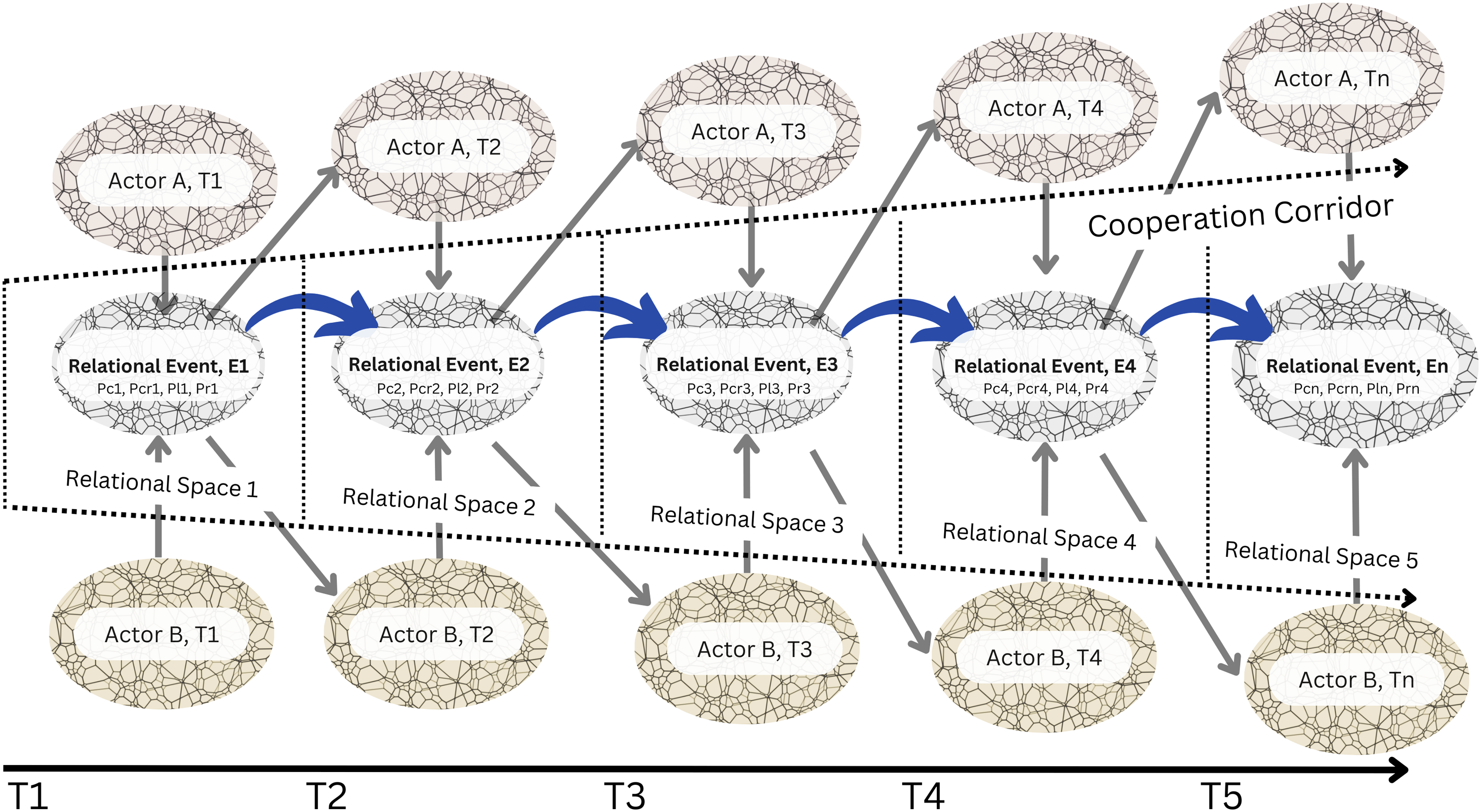
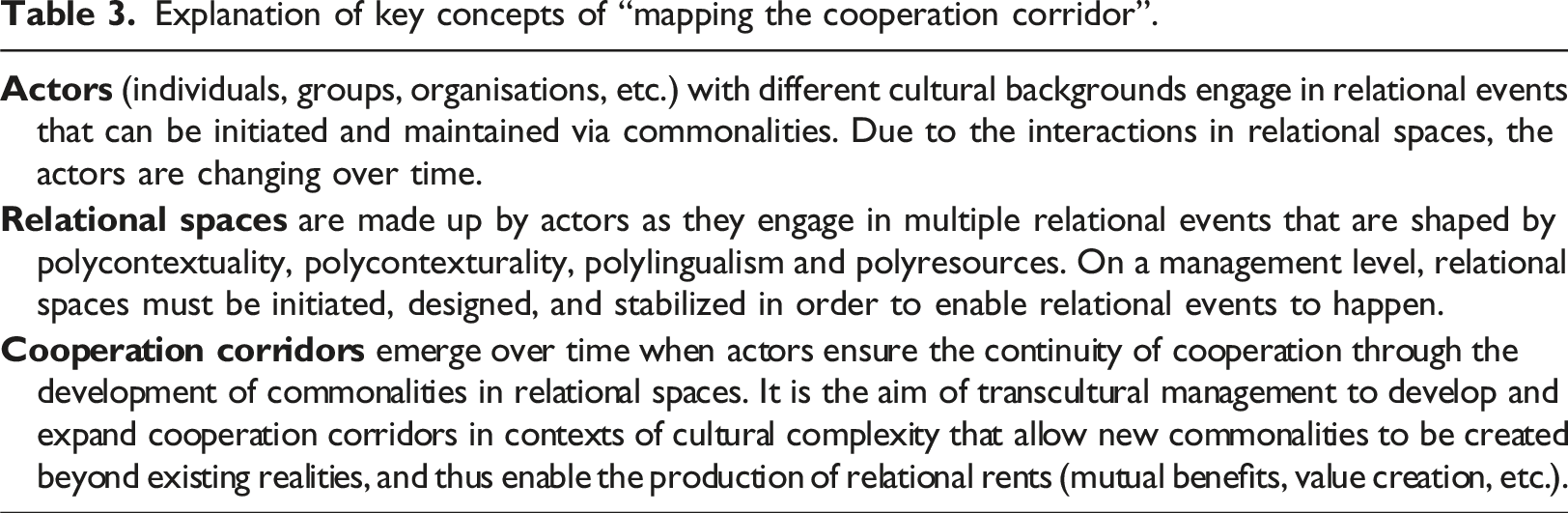
Considering the practical implications, globally operating companies must establish, design and stabilise relational spaces to ensure the development of commonalities and thus, in turn, ensure the continuity of the relational spaces. This starts with carefully identifying, inviting and even empowering stakeholders who can develop solutions for a specific challenge together.
First and foremost, the relational spaces should allow meaningful and shared experiences, so that new shared meaning and action can emerge. Importantly, the outcomes of this process are not predefined, but continually unfold in a context-specific manner. This process thereby not only impacts all the involved actors, but also builds the grounds for further shared experiences - this is what the cooperation corridor indicates as a manifestation of the “beyond beyond”. Ideally, relational spaces are inclusive and allow actors to meet at eye level. Encouraging active listening and mindful speaking, and allowing time for translating and explaining, increases effectiveness to develop new shared meanings. Openness of the relational spaces might allow actors to enter, and to leave in case of uncomfort.
This creation and stabilisation of relational spaces for shared experiences and learning is a central task of transcultural management. Relational spaces should be characterised by mutual respect and trust, cultural awareness and sensitivity, open and inclusive communication, adaptability and flexibility, shared vision and goals, and pragmatism and feasibility. Against this backdrop, rituals can play a decisive role in developing patterns and structures for networks shaped by cultural complexity. Schein (2010) emphasises the importance of rituals for embedding and passing on culture in organisations and their potential for storing shared meaning and action. Overall, transcultural management should always try to answer the questions: (1) What relational spaces exist and how are they designed to enable shared and meaningful experiences with internal and external stakeholders? (2) And what new relational spaces should be created?
One specific example here could be a multicultural team that comes together as part of a particular work assignment and therefore - possibly even involuntarily - embarks on a cooperative process. As the participants work together on the project, they develop patterns of interaction and communication that unfold in a person- and context-specific way. Such new commonalities become particularly apparent when new members join at a later stage who are initially unfamiliar with these patterns and then change them further by participating in the process. Management of such a team would then require to focus on governance structures that ensure the possibility to create new shared meaning out of shared experience, which means that a community of practice (Wenger, 1999) is allowed to evolve and develop over time.
In addition to such company-internal cooperation settings, it is also the requirements of cooperation with external stakeholders that can benefit from a transcultural management approach geared towards the continuation of the cooperation corridor. Examples here include intersectoral settings between the private sector, civil society and political actors, for example in pursuing the Sustainable Development Goals.
Transcultural management as organisational competence to relate the global and the local
In the final step, transcultural competence and transcultural learning as defined earlier are considered to have implications for the management of a local, regional and global level. The transcultural management system introduced here considers MNEs in their role to develop governance structures that foster the development and continuity of commonalities and address the perpetual tension between global integration and local responsiveness of MNEs, or to use another dichotomy, between standardisation and localisation. In a world shaped by cultural complexity, herein lie the true challenges of the transcultural management of MNEs.
Selected conceptual debates on standardisation versus localisation
Research in international business and cross-cultural management has centred mainly around how cultural differences challenge and thus negatively impact the performance of organisations, and then tending to mainly focus on strategies of adaptation, adjustments and development of intercultural skills (Søderberg and Holden, 2002). This predominantly pessimistic and simplifying view of cultural differences in research and practice has been perceived and criticised by different scholars (Barmeyer and Franklin, 2016; Stahl et al., 2016, 2017; Stahl and Tung, 2015). Against this backdrop, we agree that the task of cross-cultural management is “not to provide definite answers on what characterizes culture and on how cultures differ, but rather to take up the human responsibility of increasing people’s resilience against processes of Othering and categories of Otherness in a ‘world of crisis,’ by instilling trust, by acknowledging (but not acquiescing to) people’s, organisations’ and societies’ cultural identity anxieties and fears, and by offering an ‘entry point’ for moving beyond” (Mahadevan and Primecz, 2024: 6).
Furthermore, Caprar et al. (2022) critically analysed the dominant logic in the international business literature according to which multinational corporations should adapt business practices to ‘‘fit’’ host cultures. Their findings indicate, however, that countercultural approaches can also be useful, “[s]howing evidence for both benefits and acceptance of countercultural practices (i.e., practices that are seemingly incongruent with local cultural norms or values), and disadvantages and rejection of local practices”. Against this backdrop, they explore that the potentially positive effects of countercultural business practices call for a more balanced and sophisticated view on the role of culture and cultural diversity in international business, thus refocusing strategic attention on the productive potential of learning from and with each other in a context of cultural complexity (Caprar et al., 2022). In this way, they address a question broadly discussed in the field on different levels: on a macro level, this is analysed as a tension between convergence and divergence of business practices across nations (e.g., Tregaskis and Brewster, 2006), whereas on a meso level, it refers to a balance between standardisation and local differentiation of practices within multinational networks (e.g., Pudelko and Harzing, 2007) or as a dual imperative of global integration and local responsiveness of business strategies (e.g., Bartlett and Ghoshal, 1998). According to Pudelko and Harzing (2007), the core problem for MNEs is to define for themselves a strategy between standardisation and localisation, and they conclude that “there is less need to localise than frequently believed” (2007: 553). They argue that it is often standardisation towards global best practices that is more relevant than either standardisation towards headquarter (HQ) practices or localisation and that, accordingly, “best practices could in principle derive from any country model (including the parent country) or be a combination of various models. In addition, for different areas of management, different country models might be the point of reference for defining best practices” (Pudelko and Harzing, 2008: 401).
This call for developing global best practices is in line with a transcultural management approach aiming at developing new commonalities and forms of cooperation. To address the global and local levels in their relational coexistence and interdependence and not as dichotomy seems to be key (Caprar et al., 2022). The transcultural management system which is developed below builds on these observations and transfers the relational approach presented in this article into a strategic tool.
Management implications: transcultural management system
In this final part, a transcultural management system is introduced that builds on the elaborations done previously in this article on a relational view on learning and cooperation in contexts of cultural complexity. Three aspects seem to be particularly relevant to preface the introduction of this concept, applying the previously elaborated aspects of the relational view on cultural complexity to questions of strategic management.
First of all, our transcultural management system departs from the recognition that cultural diversity forms the business reality of international organisations and should be seen as a resource that can be cultivated and connected. It is thereby grounded on a relational understanding of cultures that emphasizes their existence in relational webs of interconnections, flows and permeations as well as the ongoing processes of exchange and the role of commonalities (Antor, 2020; Benessaieh, 2010; Geertz, 1973; Welsch, 1999). Second, the relational focus also emphasizes that the strategic goal of transcultural management is the ongoing development of commonalities to continue cooperation and thus relationalisation, and not only the recognition and tolerance of cultural differences. In this regard, it is the attempt to not get stuck in the trap of cultural relativism or universalism (Bennett, 2013) and to connect cultural complexity in a productive manner. By shifting the focus on developing commonalities out of shared experiences, a transcultural management system wants to offer MNEs a new reference point on a strategic level by shifting the business model towards shared value creation in a diverse network of stakeholders. Third, our transcultural management system highlights the need for international organisations to connect and relate the global and local levels in an ongoing transcultural learning process. The global level thereby refers to an abstract and thin descriptions of values, ideas or goals, whereas the local level refers to concrete and thick descriptions. As Walzer states, thick descriptions are “richly referential, culturally resonant, locked into a locally established symbolic system or network of meanings” (1994: XI). Thin descriptions or “minimalism”, as he calls it, on the other hand, “consists in principles and rules that are reiterated in different times and places, and that are seen to be similar even though they are expressed in different idioms and reflect different histories and different versions of the world” (Walzer, 1994: 17). The abstract level, which is usually the global level of MNEs, might offer starting points, for example with a code of ethics, to engage in first steps towards cooperation or, in the words of Appiah, to begin a “moral conversation” (2006: 46, 57) which may then pave the way for concrete interaction on a local, concrete level. A successful transcultural management system therefore tries to connect the global and local levels in an ongoing loop of transcultural learning. Figure 4 is an attempt to design such a transcultural management system. Transcultural Management System (own illustration, based on Wieland and Baumann Montecinos 2018).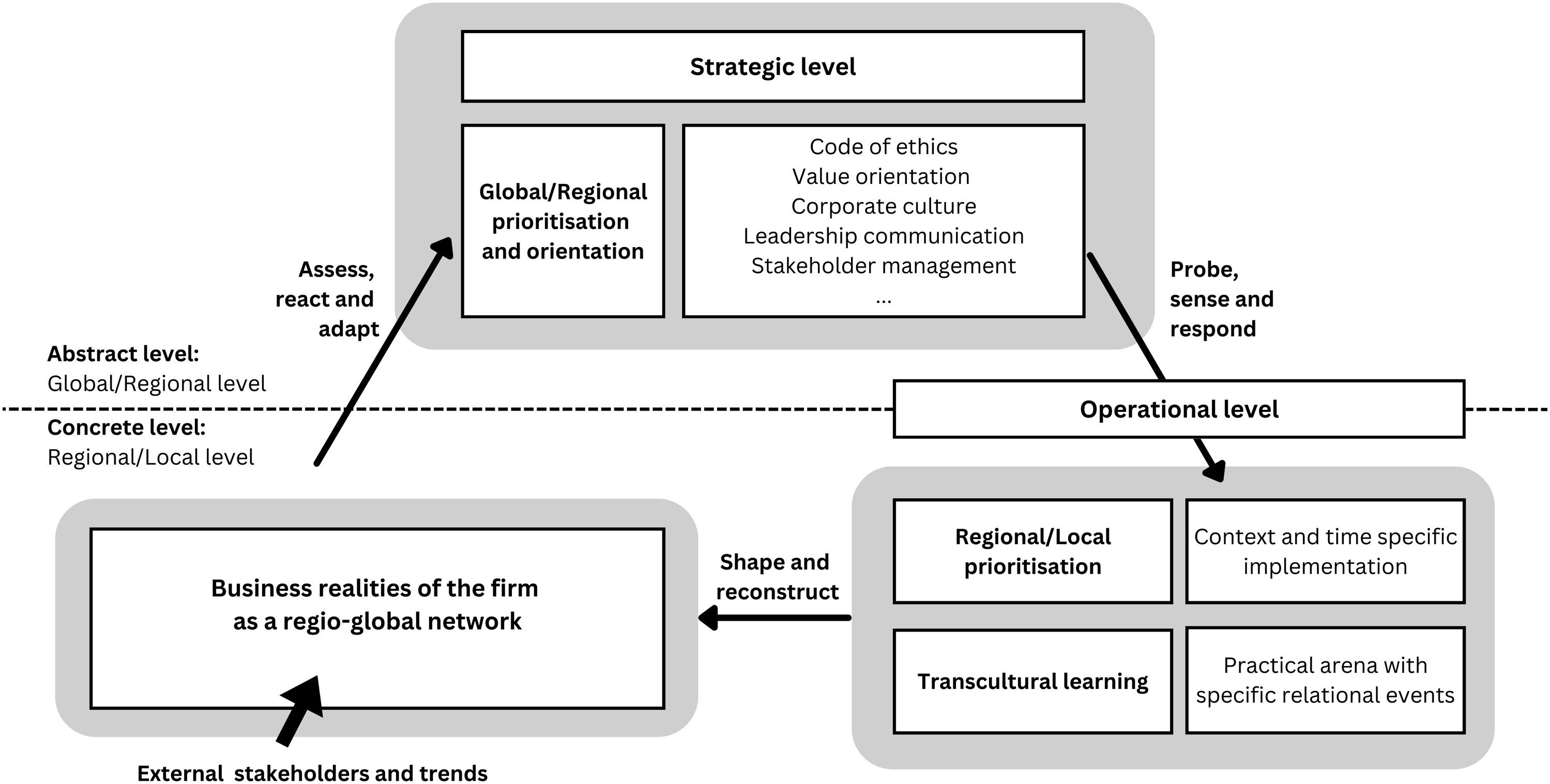
Explanation of the key concepts of the “Transcultural Management System”.
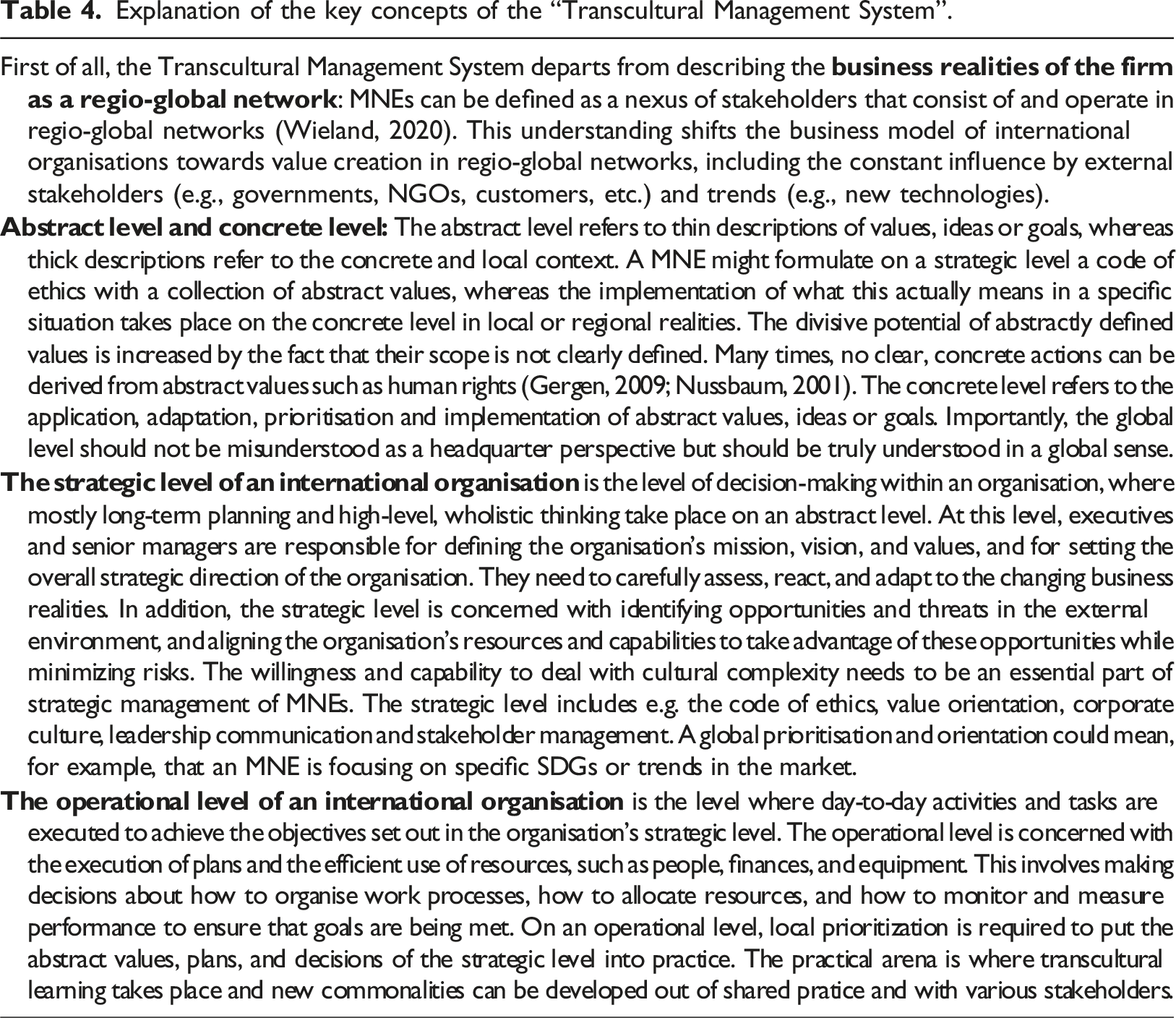
At this point, the importance of regionalization needs to be addressed, too. Regional solutions may represent a compromise between the local and the global, offering some of the benefits of both without incurring some of the associated costs (Asmussen, 2012). In addition, regional strategies can be “incorporated as a third strategy in which the firm develops firm-specific advantages that are neither completely non-location bound in a global sense, nor completely location-bound in a national sense, but ‘region-bound’” (Verbeke and Asmussen, 2016: 1070). The regional level can therefore be seen as both an abstract and a concrete level that represents an important middle ground and potentially plays an important role in dealing with cultural complexity and also in the implementation of the circular economy (Benito and Fehlner, 2022).
Finally, the practical arena consists of relational spaces in which different actors enter into a learning process. These can be dialogue platforms (e.g., multi-stakeholder dialogues, town hall meetings, etc.) and other mechanisms to develop communities of practice and thus allowing for shared experiences that will make the abstract concrete. Out of this process, more concrete understandings and actions can emerge. Examples of the application of the transcultural management system can be found in an earlier work by Wieland and Baumann Montecinos (2018) on diversity management and CSR management.
Conclusion
Against the backdrop of global interconnectedness combined with current globalization and deglobalization trends, globally operating enterprises are increasingly called for a reset in their strategic agendas (Cui et al., 2023), and disparities in attitudes towards the future world order in different cultural regions (Garton Ash et al., 2023) will present them with major challenges in the upcoming years.
Accordingly, management approaches and their corresponding business models and governance structures are required that move beyond a predominantly negative view on cultural complexity as coined by binary and comparative understandings of culture. Strategic management of globally operating companies should rather focus on the development and continuity of commonalities across cultures as a driver and result of cooperation.
The proposed transcultural management approach aims to address the complex realities of international business and offers a relational paradigm for further discussion. This also implies the search and development of revised international business models that are designed around a relational understanding of value creation networks and cooperation. As the nature and strategic alignment of globally operating companies is changing, the models introduced here might address the observed realities: by using relational events as the unit of analysis, by fostering transcultural learning to interrelate cultural differences in commonality-focused processes, by identifying and expanding cooperation corridors, and by implementing transcultural management systems that rethink the relation between the global and the local levels, the management implications of a relational view on cultural complexity have been sketched out. Overall, if the offers of a relational turn in the field of international business and cross-cultural management are considered a promising direction for further conceptual and practical debates, this article has reached its goals.
Footnotes
Acknowledgments
We would like to thank Milton Bennett, Jürgen Henze, Yih-Teen Lee, Sonja Sackmann and Josef Wieland for their valuable feedback and encouragement to submit this article, as well as to the Editor-in-Chief and three anonymous reviewers of the IJCCM for their important remarks and suggestions that helped us to improve our manuscript. Furthermore, we would like to thank the experts of our Delphi study that paved the way for this article. These are, in alphabetical order: Sabine Aydt, Milton J. Bennett, Nadine Binder, Jürgen Bolten, Olga Coetzee, Michelle Cummings-Koether, Eric Davoine, Darla K. Deardorff, Susanne Dranaz, Peter Franklin, Harris L. Friedman, Catherine Isabel Froehling, Gerald Glover, Valerie V. V. Gruber, Nikola Hale, Paul Hanges, Katharina von Helmolt, Jürgen Henze, Stephan Hild, Gert Jan Hofstede, Jana Holla, Christiena Kirchhoff, Eithne Knappitsch, Hannah Lambeck, Yih-Teen Lee, Richard Lowe, Angelica V. Marte, Ulrike Mayrhofer, Rafael Mollenhauer, Kirsten Nazarkiewicz, Laurence Romani, Sonja A. Sackmann, Stefan Schmid, Olebogeng Selebi, Christian Seufert, Jan Soffner, Yolande Steenkamp, Gary Thomas, Fons Trompenaars, Uwe Ulrich, Iris Wangermann, Josef Wieland, Helmut Willke, Yeliz Yildirim-Krannig, Ulrich Zeutschel. In addition, our thanks go to two further experts whose names are not disclosed and who were part of the study, as well as to three experts who participated in the first two Delphi rounds. We are delighted and grateful to see where this joint Delphi learning journey has taken us.
Declaration of conflicting interests
The author(s) declared no potential conflicts of interest with respect to the research, authorship, and/or publication of this article.
Funding
The author(s) received no financial support for the research, authorship, and/or publication of this article.
