




Abstract
New forms of organizing (NFOs) such as crowds and communities are increasingly relevant as novel collaboration partners for organizations. Although the motivations and goals that prompt organizations to collaborate (the why) have not changed over time, the way they collaborate (the how) seems to have changed significantly. Surprisingly, research to theorize these new forms of collaboration is still sparse. This conceptual paper investigates the extent to which a widely established theoretical framework—the relational view—can capture this new and mostly undertheorized setting of firm–NFO collaborations. More precisely, we ask whether and how the relational view also applies to this new context of interaction between firms and NFOs. Adopting the relational view’s four determinants as a framework, we systematically analyse and disentangle firms’ collaborations with NFOs. We ground this investigation in two analytical dimensions, the degree of NFO self-organizing and the degree of firm-relatedness. They enable us to exemplify the variety of new forms of collaboration and, most important, to delineate clear differences between firm–NFO collaboration and traditional interorganizational collaboration. We stress the boundaries of the relational view, suggest expanding its scope to capture the variety of firm–NFO collaborations, and propose ways of doing so.
Keywords
There is wide agreement in the literature that organizations need to collaborate to grow and thrive (Berends & Sydow, 2019; Deken, Berends, Gemser, & Lauche, 2018; Oliveira & Lumineau, 2019; Parmigiani & Rivera-Santos, 2011). Such interorganizational collaboration can be understood as cooperative arrangements between two or more organizations to share and access resources and ultimately to improve performance (Oliveira & Lumineau, 2019; Parmigiani & Rivera-Santos, 2011). To stay innovative and competitive, firms increasingly face the need to strive for new strategic openness and to operate outside their well-known boundaries (Appleyard & Chesbrough, 2017; Berends & Sydow, 2019; Chesbrough, Lettl, & Ritter, 2018; Sims & Woodard, 2020). One way of translating this need into action is to incorporate “new forms of organizing” (NFOs), such as crowds or communities, into their relationship portfolio (Amit & Han, 2017; Boudreau & Lakhani, 2013; Dobusch & Kapeller, 2018; Fisher, 2019; Sims & Woodard, 2020; West & Bogers, 2017; Zobel & Hagedoorn, 2020).
These firm–NFO relationships can be regarded as new forms of collaboration. They become increasingly relevant as avenues to various kinds of relational benefits, including useful knowledge, enhanced innovation, performance improvements, and efficient resource allocation (Berends & Sydow, 2019; Boudreau & Lakhani, 2013; Dobusch & Kapeller, 2018; Harhoff & Lakhani, 2016; Seidel, Langner, & Sims, 2017). This relevance continuously challenges the power of traditional approaches, theoretical lenses, and underlying assumptions to explain these new and complex developments (Alexy, Frederiksen, Hutter, 2017; Amit & Han, 2017; Majchrzak, Jarvenpaa, & Bagherzadeh, 2014; Puranam, Alexy, & Reitzig, 2014). As Felin, Lakhani, & Tushman (2017, pp. 119–120) state, While we are descriptively learning much about these crowd-type phenomena and more open forms of organization . . . [it] seems that our theories continue to lag practice, where various organizing and organizational “technologies” and designs are outpacing the ability of our theories to capture and explain them.
These rather new phenomena divide scholars on the question of whether new theory is needed or established theories can explain these new forms. Alexy and colleagues (2017, p. 403) call us “to develop and test both new and established theories.” Following this advice, we argue that before developing new theory, a closer look at established theory is necessary and appropriate (Puranam et al., 2014). Indeed, collaborations with NFOs have not yet been sufficiently theoretically explored and explained, and there is great need for “additional and deeper integration with theories and theoretical questions that are well-established in management research” (West & Bogers, 2017, p. 46).
We respond by revisiting the relational view (RV) (Dyer & Singh, 1998; Dyer, Singh, & Hesterly, 2018) as the analytical frame for this study. Unlike a sole perspective on resources (Barney, 1991), firms’ capabilities (Teece, Pisano, & Shuen, 1997), or the market and industry structure (Porter, 1980), the basic unit of analysis of the RV is the collaboration. At first sight, collaborations with NFOs may not fall under the explanatory power of this theoretical lens, for NFOs and their properties have not been considered in the RV framework (Dyer & Singh, 1998; Dyer et al., 2018). However, we state that it is still the collaboration that remains the core for firms working together with NFOs. The RV suggests four determinants as the primary sources for the generation of relational benefits—(1) complementary resources and capabilities, (2) relation-specific investments, (3) effective governance, and (4) knowledge-sharing routines (Dyer & Singh, 1998; Dyer et al., 2018). With these four determinants in mind, we explore whether and how the RV and its basic assumptions apply to the firm–NFO context by investigating the underlying structures and processes of these innovative types of collaborations (Barney, 2018).
We ground our investigation in two conceptually derived dimensions mapping the field of firm–NFO collaborations: the degree of NFO self-organizing that encompasses the particular NFO’s level of organizing captured by, for example, formal organizational structures and processes such as decision-making procedures and the degree of firm-relatedness capturing the specificity of an NFO vis-a-vis a partner firm. These two dimensions allow us to challenge important assumptions of the RV in the context of firm–NFO collaborations and help us answer the research question of whether and how the RV allows to capture these new forms of collaboration. We illustrate our theoretical arguments by using multiple examples. Closely considering the boundaries of the RV, we propose ways of expanding its scope to encompass the variety of new forms of collaboration.
Our paper makes three theoretical contributions. First, we add to the literature on NFOs and new forms of collaboration by introducing self-organizing and firm-relatedness as analytical dimensions that stretch important assumptions of the RV. They enable us to capture the variety of NFOs and to theorize the resulting variety of new forms of collaboration. The two analytical dimensions also guide our analysis of the differences between firm–NFO collaboration and traditional interfirm relationships in light of the RV. We theoretically ground these under-researched relationships and thereby respond to various calls for new insights into new forms of collaboration (Alexy et al., 2017; Felin et al., 2017; Majchrzak et al., 2014; West & Bogers, 2017). Second, we contribute to the literature on interorganizational relationships in general and on new forms of collaboration in particular by systematically delineating the specific structures, processes, and mechanisms through which firms generate relational benefits when collaborating with NFOs. Third, we expand RV literature by challenging the RV’s basic assumptions, determinants, and boundaries in this new firm–NFO context and by critically examining the RV’s key assumptions regarding the specificities of firm–NFO collaborations. This approach enables us to explore the boundary conditions of the RV carefully, propose ways to adjust some of its extant assumptions, and progressively expand its scope, making it accessible to a broader audience (Barney, 2018; Foss & Hallberg, 2017).
We begin our analysis by briefly introducing the literature on NFOs and on new forms of collaboration. We then explain basic assumptions of the RV as our analytical framework and elaborate whether and how the RV allows to capture these new forms of collaboration. With the help of two conceptually derived dimensions, we disentangle mechanisms, structures, and processes that suggest how firms generate or do not generate relational benefits through collaborations with different types of NFOs and how these structures and processes differ from traditional interfirm relationships. We conclude by outlining implications for future research.
New Forms of Collaboration
When it comes to the incorporation and sharing of potentially complementary resources, collaboration between NFOs and firms has become increasingly relevant in organizations’ relationship portfolios (Amit & Han, 2017; Puranam et al., 2014; Seidel et al., 2017). Online communities, for example, have become “a key stakeholder group to form a source of competitive advantage that comes from the firm’s ability to generate information, influence, and solidarity benefits from engagement in the online community” (Fisher, 2019, p. 281). Such rather user-oriented forms of collaboration have become particularly prominent in the design and implementation of innovation processes (Harhoff & Lakhani, 2016). Collaboration with “a large number of players across multiple phases of the innovation process” is what Chesbrough (2017, p. 37) calls Open Innovation 2.0. Regardless of the label and the actual degree of openness, scholars dedicated to studying such constellations forecast that the future will be characterized by even more collaborations with diverse partners (Chesbrough, 2017).
By nature, this rather new research field spans two adjacent, yet unconnected, research fields. Whereas the debate on traditional interorganizational collaborations takes place predominantly (and fundamentally) in organization and strategy literature (Oliveira & Lumineau, 2019; Parmigiani & Rivera-Santos, 2011), most of the literature on NFOs—the potential upcoming collaboration partners for traditional organizations—is rooted in innovation literature (Boudreau & Lakhani, 2013; Felin et al., 2017).
At this junction of organization and innovation research, we endeavor to improve the understanding of how firms generate relational benefits through collaborations with NFOs. The unit of analysis is the dyad between a focal firm and NFOs, explicitly the collaboration between these somehow different collaboration partners. For such collaborations to take place and for external knowledge to flow, open and permeable boundaries of firms (Powell, Koput, & Smith-Doerr, 1996; von Hippel, 1998) are arguably a salient precondition (Dobusch & Schoeneborn, 2015; Zobel & Hagedoorn, 2020). Indeed, the practice of accessing and using knowledge from outside the firm is not new. Newly established firm–NFO collaborations therefore do not necessarily imply that the motivations behind these collaborations are also new or should be treated as completely new (for early discussions on (innovation) networks or open innovation, see Ahuja, 2000; Chesbrough, 2003; and Gulati, 1998; for recent discussions on strategic openness or free innovation, see Alexy, West, Klapper, & Reitzig, 2018; and von Hippel, 2017.) Organizations that engage in collaborations with NFOs strive for goals that are similar or even identical to those adopted by firms that pursue traditional forms of collaboration, such as engaging in knowledge transfer (van Wijk, Jansen, & Lyles, 2008), building relational capital (Elfenbein & Zenger, 2014), and accessing complementary resources (Deken et al., 2018). In short, new forms of collaboration do not necessarily indicate new organizational goals, neither do new goals necessarily call for new forms of collaboration.
The motivations and goals, the why organizations collaborate, thus seem to have changed little over time. What seems to have changed significantly is the way, the how organizations collaborate. We assert that much of the novelty regarding new forms of collaboration stems from the significant differences between NFOs and traditional organizations. These differences have already been described in the existing literature (e.g., Parmigiani & Rivera-Santos, 2011; Puranam et al., 2014). We highlight four of them that we deem particularly important for our research endeavor: (1) the role of boundaries, (2) the degree of openness, (3) the importance of IT, and (4) the nature of social activities.
(1) Most important in comparison to traditional forms is that NFOs are not necessarily characterized by established boundaries and structures (Dahlander & Frederiksen, 2012; Dobusch & Schoeneborn, 2015; Schreyögg & Sydow, 2010). They therefore lack a feature argued to be fundamental to any organization (Dobusch & Schoeneborn, 2015; Puranam et al., 2014; Weick, 1969). On account of this fuzziness, and in contrast to most other organizations, “little prevents individuals from being members of multiple communities” (Dahlander & Frederiksen, 2012, p. 989), for being a “member” of an NFO is typically less an issue of real membership than of “contributorship.” Dobusch and Schoeneborn (2015, p. 1006) summarize that “the fluidity of these forms of organizing challenge classic assumptions of what an organization is.” (2) NFOs differ from traditional organizations also because they “are purported to be more open and participatory than traditional organizational forms” (Powell, 2017, p. 289). The contrast lies in “their fluid nature and the extent to which they depend on the voluntary participation and intrinsic motivation of members to persist (Faraj et al., 2011)” (Fisher, 2019, p. 279). (3) NFOs are typically driven by technological advancements in information technology (IT) (Amit & Han, 2017; Puranam et al., 2014) and mostly provide an online-based platform for sharing and exchanging knowledge or interests (Amit & Han, 2017; Fisher, 2019). (4) Although certain social structures of NFOs resemble those of traditional organizations, the socially relevant activities of most NFOs are virtual and driven by online interaction (Dahlander & Frederiksen, 2012; Fisher, 2019). This online interaction and the fact that it is more the contribution than the presence that defines the membership in an NFO lead some scholars to differentiate between core members (users that have a pivotal position inside a community) and cosmopolitans (boundary-spanning users with peripheral positions across multiple communities) (Dahlander & Frederiksen, 2012) for community-type NFOs.
Besides the literature dealing with such unifying basic NFO features—the commonalities between the various forms of NFOs (Powell, 2017; Seidel et al., 2017; Sims & Woodard, 2020; West & Sims, 2018)—another stream of research addresses the idiosyncratic characteristics and subtle differences between special forms of NFOs, such as different kinds of crowds (Felin et al., 2017; Kolbjørnsrud, 2017; Nickerson et al., 2017) and communities (Dahlander & Frederiksen, 2012; Faraj, von Krogh, Monteiro, & Lakhani, 2016; Kane & Ransbotham, 2016). Despite these distinctions, however, “there is often considerable overlap between these forms—and often the boundaries are fuzzy” (West & Sims, 2018, p. 61), and “crowd and community attributes can coexist” (Sims & Woodard, 2020, p. 122). We agree with both of the latter statements and hold that these NFO forms are similar enough to be subsumed under a term that encompasses crowds and different kinds of entities, such as online communities, innovation communities, user communities, crowdsourcing activities, and community sourcing (Boudreau & Lakhani, 2013; Dahlander & Frederiksen, 2012; Felin et al., 2017; Harhoff & Lakhani, 2016; Seidel et al., 2017). At the same time, we explicitly concede the variety of these relatively new emerging phenomena that “the organization, innovation, and strategy literatures have struggled to theoretically integrate . . . coherently into their body of work” (Felin et al., 2017, p. 120).
The Relational View as a Potential Perspective on New Forms of Collaboration
The RV is a potential perspective to capture firm–NFO relations understood as new forms of collaboration. The RV’s relevance for explaining the generation of benefits resulting from collaborations has been proven in a broad range of studies. Scholars have applied the theory to risk management, supply-chain integration, and innovation performance (Wiengarten, Humphreys, Gimenez, & McIvor, 2016); corporate innovation through corporate venture capital (Weber, Bauke, & Raibulet, 2016); strategic purchasing, supply management, and organizational performance (Chen, Paulraj, & Lado, 2004); and social value creation in the not-for-profit sector (Weber, Weidner, Kroeger, & Wallace, 2017). Selected ideas and concepts from the RV have also already made their way into the literature on open innovation (Monteiro, Mol, & Birkinshaw, 2017) and corporate entrepreneurship (Simsek & Heavey, 2016).
Extending this line of research, this study applies an RV lens to capture new forms of collaboration. Whether the focus in RV studies is on the traditional dyadic perspective (Dyer & Singh, 1998; Dyer et al., 2018) or on new forms of collaboration, the RV approaches the relationship rather than each partner individually. To analyse these firm–NFO relationships, the RV offers four important determinants that help explain how organizations leverage relational benefits through collaborative activities (Dyer & Singh, 1998; Dyer et al., 2018). Those determinants are (1) complementary resources and capabilities, based on Barney’s (1991) resource-based view and highlighted as a precondition for entering into collaborations (Dyer, et al., 2018; Weber et al., 2016); (2) relation-specific investments, based on transaction-cost theory (Williamson, 1979, 1985); (3) knowledge-sharing routines; and (4) effective governance, which is “assumed to influence transaction costs and the willingness to combine or exchange complementary resources and capabilities” (Weber et al., 2017, p. 932).
When these determinants are applied to the firm–NFO context, it is necessary to take account of important differences between new forms of collaboration and traditional interfirm relationships. To investigate whether and how the RV’s basic assumptions and determinants also hold for firm–NFO collaborations, we therefore first introduce two independent, conceptually derived, analytical dimensions that we believe to be particularly relevant to our research endeavor: (a) the degree of self-organizing that encompasses the level of organizing of the respective NFO, and (b) the degree of firm-relatedness capturing the specificity of an NFO vis-a-vis a partner firm (see Figure 1). They explicitly challenge basic RV assumptions grounded in established ideas of the theory of the firm (Coase, 1937; March & Simon, 1958). We argue that NFOs can differ in both dimensions (higher or lower degrees of self-organizing and firm-relatedness). The two analytical dimensions guide us in three ways—in mapping out the variety of new forms of collaboration, in sounding out the explanatory power of the RV in the context of firm–NFO collaboration, and in analysing the differences between firm–NFO collaboration and traditional interfirm relationships in light of the RV.

Conceptual dimensions mapping the field of firm–NFO collaborations.
Degree of self-organizing
Our first analytical dimension challenges the assumption of the RV that, in the understanding of Dyer and Singh (1998), the collaborating parties of the dyad are organizations of more or less of the same kind (March & Simon, 1958)—two firms forming an “interfirm linkage” (Dyer & Singh, 1998, p. 661). This dyadic interfirm assumption implies that both parties are constituted by similar or comparable ways of organizing, encompassing similar or comparable organizational structures and processes such as decision-making processes driven by hierarchical fiat (Coase, 1937; Felin et al., 2017). In our context of firm–NFO collaborations, this interfirm assumption of the RV is challenged because NFOs differ in various essential organizational characteristics from the firms that are their counterparts. Whereas the key characteristics of traditional organizations, such as their constitution as organizations, their formal structures, their clear boundaries, and their set of organizational goals, suggest a high degree of organizing (Tsoukas, Patriotta, Sutcliffe, & Maitlis, 2020; Weick, 1969), this implication does not hold in the same manner for NFOs. Although we acknowledge that the field of NFOs encompasses a variety of NFOs with different degrees of reciprocal interaction inside the respective NFO (Sims & Woodard, 2020) and, hence, different degrees of self-organizing (Afuah, 2018; Afuah & Tucci, 2012; Dahlander & Frederiksen, 2012; Dobusch & Schoeneborn, 2015; Majchrzak, Malhotra, & Zaggl, 2021; Sims & Woodard, 2020), the general difference between NFOs and traditional firms in terms of degree of self-organizing remains significant.
Degree of firm-relatedness
Our second analytical dimension challenges the assumption of the RV that the two parties to a collaboration are able to develop “a relational capability” (Dyer & Singh, 1998, p. 673) and that they are able to do so only with a limited number of partners at the same time. More precisely, the RV suggests that relationships are rewarding only if they offer a level of value creation higher than that of typical arm’s-length market relationships that are rather easy to imitate and not rare (Dyer & Singh, 1998; Dyer et al., 2018). Collaborations are thus idiosyncratic, and relational benefits are generated “only as they move the relationship away from the attributes of market relationships” (Dyer & Singh, 1998, p. 662). These idiosyncratic relations imply that potential partners are scarce and that firms “cannot access the capabilities of a potential partner because [they have already] coevolved with another firm” (Dyer & Singh, 1998, p. 674). Firms therefore carefully seek to “find a partner with the requisite complementary strategic resources or relational capability” (Dyer & Singh, 1998, p. 674). That is, they want to find the partner that fits best.
In the case of firm–NFO collaborations, successful firms have been reported to build and develop longstanding relationships with their respective communities (Antorini, Muñiz, & Askildsen, 2012; Chesbrough, 2011; Hienerth, Lettl, Keinz, 2014). In these examples of nicely fitting firm–NFO collaborations, the NFOs exist, for instance, as a direct result of the focal firm (Antorini et al., 2012). In other words, an NFO is highly tailored to or solely oriented to that single firm (high degree of firm-relatedness). A high degree of an NFO’s firm-relatedness can also come about because the NFO emerged as a reaction to a specific problem statement in, say, a crowdsourcing contest (Afuah & Tucci, 2012). However, there are sufficient examples of NFOs existing independently around a certain theme, problem, or topic regardless of a specific firm’s existence (e.g., Sims & Woodard, 2020) and collaborating with multiple firms at the same time. This fact clearly challenges Dyer and Singh’s (1998) scarcity argument that the two parties to a relational benefit-generating collaboration are able to develop a relational capability only with a limited number of partners. Despite the multiple partnerships that these NFOs maintain with firms simultaneously and despite this obviously relatively low degree of NFO firm-relatedness with a single partner firm, successful collaborations with NFOs are also typically reported to go beyond traditional market relationships (Boudreau & Lakhani, 2013; Chesbrough, 2011). These findings are supported by innovation scholars who state that open innovation, of which crowds or communities are popular examples (Bogers et al., 2017; Sims & Woodard, 2020), generally go beyond arm’s-length market relationships (Chesbrough, Vanhaverbeke, & West, 2006; Vanhaverbeke, 2006). Thus, although we acknowledge that the field of firm–NFO collaborations encompasses a variety of NFOs with different degrees of firm-relatedness (Afuah & Tucci, 2012; Antorini et al., 2012; Sims & Woodard, 2020), the general difference between firm–NFO relationships and traditional interfirm relationships in terms of NFOs’ degree of firm-relatedness remains significant.
We now use these two analytical dimensions in combination. The resulting matrix (Figure 1) helps us map out the variety of firm–NFO collaborations and to investigate the RV’s explanatory power in the firm–NFO context. In addition, it guides our further analysis of the specificities of firm–NFO collaborations as compared to traditional interfirm relationships. In the remainder of the paper, we discuss the relevance of the two analytical dimensions for the respective firm–NFO constellations and illustrate them with examples.
Disentangling the Generation of Relational Benefits in Firm–NFO Collaborations
We begin our navigation through the RV in the context of firm–NFO collaborations by demonstrating how the RV’s core idea, the generation of relational benefits (Dyer & Singh, 1998), still holds for firm–NFO relations. Thereafter, we introduce the four determinants of the generation of relational benefits (Dyer & Singh, 1998) in an identical structure, beginning with a brief description of the determinant in its original interorganizational setting before translating the determinant into the novel firm–NFO context. We then explicitly connect the two analytical dimensions with the determinant and discuss how their respective manifestations in the varying firm–NFO collaborations influence the explanatory power of the determinant. Lastly, we conclude our considerations for each of the determinants in the firm–NFO context.
Figure 2 presents an overview of our analytical approach based on the original RV model.
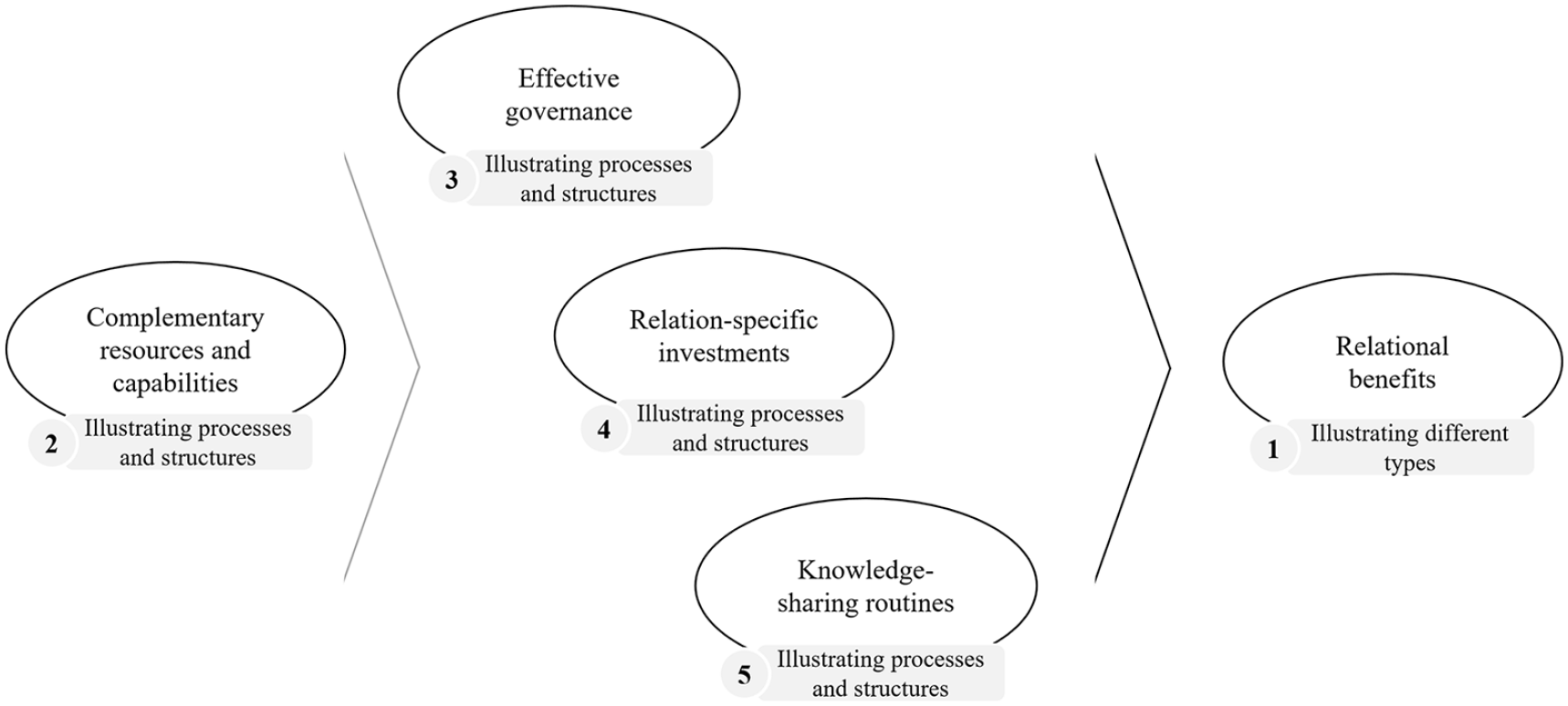
Analytical procedure in this paper.
Relational benefits
Relational benefits are different types of benefits and value created from collaborations in which each of the partners profits from new and valuable combinations of resources (e.g., new knowledge or ideas). Relational benefits are jointly generated by the collaboration partners (Dyer & Singh, 1998), including firm–NFO collaborations (Dahlander & Frederiksen, 2012). Although benefits are a primary goal of any collaboration, relational benefits do not necessarily unfold and therefore cannot be taken for granted (Dyer et al., 2018). Whereas relational benefits are clearly understood to be jointly generated by the collaboration partners, we argue that each partner’s types of value resulting from collaborations in firm–NFO settings will in some cases differ significantly from those resulting from traditional interorganizational relationships.
Firms benefit from NFOs in various ways, such as gaining access to valuable innovative contributions (Dahlander & Frederiksen, 2012; Harhoff & Lakhani, 2016); achieving operative goals, including cost reduction or increased revenue and growth (Fisher, 2019); reducing tensions in strategy-making (Dobusch & Kapeller, 2018); and strengthening brand consideration (Kim, Choi, Qualls, & Han, 2008). NFOs thereby offer fruitful breeding grounds of know-how and information for firms to leverage relational benefits and turn them into competitive advantages. In addition, the roles of contributors and customers are often blurred for members, so firms eventually benefit from both increased marketing and demand for the firm’s products (Miller, Fabian, & Lin, 2009).
For the NFO, values and benefits stemming from firm–NFO collaborations such as reputation or self-rewards within the crowd or community are undisputed (Dahlander & Frederiksen, 2012; von Hippel, 2017). In addition, the nature of the value for the NFO (e.g., individuals in an online community or contributors in crowdsourcing contests) may be much more diverse, ranging, for example, from fun, learning, altruistic motives, and financial incentives (Boudreau & Jeppesen, 2015; von Hippel, 2017; von Hippel & von Krogh, 2003), to access and idiosyncratic knowledge, and to signaling and reputation (Boudreau & Jeppesen, 2015).
Beyond these specific types of benefits, Fisher (2019, p. 281) describes a feedback-loop that raises the value of relational rewards for both parties. More precisely, by engaging in the online community, firms not only constitute a source of competitive advantage but “also generate distinctive benefits for the online community, which can create a self-reinforcing cycle of benefits between a firm and an online community.”
In summary, the concept of joint rewards or relational benefits still holds because value is created by both parties for both parties (Dahlander & Frederiksen, 2012).
Determinants of relational benefits in new forms of collaboration: Complementary resources and capabilities
(1) Determinant in brief
This determinant is grounded primarily in the resource-based view (Barney, 1991). Milgrom and Roberts (1995) and Hess and Rothaermel (2011) argue that resources are complementary “when the marginal return to one resource increases in the presence of the other” (Dyer et al., 2018, p. 4). Complementary resources therefore yield greater value together than if they are claimed individually by the respective parties. Such resources are pivotal for taking advantage of the collaboration (Dyer & Singh, 1998; Weber et al., 2017). Complementary resources and capabilities can be tangible, intangible, or both (Dyer et al., 2018). To leverage them for relational benefits, the collaborating partners need to be capable of identifying and subsequently accessing and incorporating each other’s valuable complementary resources (Deken et al., 2018; Dyer & Singh, 1998; Grant & Baden-Fuller, 2004). This “access to complementary resources provides an initial rationale for forming alliances, but benefits from complementarity can attenuate over time” (Dyer et al., 2018, p. 3140).
(2) Determinant in the firm–NFO context
The aforementioned process was originally conceptualized for traditional interorganizational collaborations, so adapting it to firm–NFO collaborations means that the focal firm needs to be able to leverage resources or capabilities that lie at the very core of a crowd or an online community. As in traditional interorganizational collaborations, the important mechanism in this firm–NFO context is the sourcing and incorporating of complementary external knowledge (Monteiro et al., 2017) into the knowledge pool of the firm, which can then benefit from increased innovation capabilities (Dahlander & Frederiksen, 2012; Harhoff & Lakhani, 2016) and an improved base for problem-solving (March, 1991). Catalysts of this mechanism are the growing outward orientation of firms and the rapid development of IT and broadband internet availability (Amit & Han, 2017; Berends & Sydow, 2019), which have provided firms with opportunities to access and engage with NFOs previously not accessible to them (Fisher, 2019).
The software firm that accesses crowds to test codes is not the only example of generating relational benefits from collaborations with NFOs. A second one is Coca Cola’s External Technology Acquisition (ETA) team calling for submissions on the HeroX platform to find substitutes for sugar and innovative ingredients to sweeten food and beverages. The company used the “sweet story challenge,” by which people were asked to submit ideas on how to sweeten beverages. Lego, too, is a well-known example of how a firm learns and generates great benefit from an active, engaged, and longstanding relationship with its own user community as a complementary asset—tracing back to the mid-1990s (Antorini et al., 2012).
In summary, firms initially enter into collaborative activities with NFOs because they perceive their resources and capabilities to be complementary (Afuah, 2018). The actual amount and nature of complementarities achieved, however, is most likely to develop gradually (Deken et al., 2018). Closer examination makes it apparent that the collaboration with NFOs offers an entirely new pool of intangible potential complementary resources and capabilities for the firm, such as efficient access as well as acquisition of high-quality knowledge of the particular NFO partner, innovative ideas and contributions, quickly accessible customer feedback to firms’ products, and broad new ways of problem-solving. This quick and highly efficient access to the complementary resources and capabilities is especially interesting for firms with limited financial resources (say, for research and development), typically a substantial barrier to sourcing external knowledge (Monteiro et al., 2017). We argue that the traditional importance of tangible complementarities in interfirm relationships (Dyer et al., 2018) is rather irrelevant in firm–NFO collaborations. NFOs find complementarities, too, because firms open what had been their hermetically sealed research and development or production departments in a way that makes corporate knowledge and capabilities accessible to external individual community members. Users inside the Lego community, for example, can realize their own ideas and input with the help of the Lego engineers and production capabilities (Antorini et al., 2012). For software coding, GitHub users receive the opportunity to gain access to early-stage products from software companies (e.g., Microsoft) and the latest developer frameworks (e.g., Alphabet’s Google Android) (Sims & Woodard, 2020). These dynamics are in line with the early observation by von Hippel and von Krogh (2003) that open-source software developments are often characterized by a mixture of private and collective models of innovation. Obviously, the aforementioned interesting complementarities can be leveraged only by combining corporate and community inputs.
(3) Degree of NFO self-organizing
Given the variety in the degree of self-organizing among NFOs, we can assume that different levels or degrees of complementarities are leveraged in the various firm–NFO constellations. For instance, previous research (Majchrzak et al., 2021; Sims & Woodard, 2020) has shown that comparatively high levels of reciprocal interaction inside an NFO, and thus higher degrees of self-organizing, enable the members or contributors in the NFO to collaborate on developing initial ideas into novel and useful knowledge that leads to novel and more useful solutions and increased problem-solving. From the perspective of a focal firm, this increased problem-solving ability of the NFO eventually means higher complementarities. This higher degree of self-organizing and interaction can furthermore be the key to gradual development of and increase in complementarities in firm–NFO relationships. This argument is also consistent with the RV (Dyer et al., 2018) and with Deken et al.’s (2018) findings in the traditional interfirm context.
(4) Degree of firm-relatedness
It is likely that NFOs which have formed independently of a firm—around a specific field of interest, topic, or theme, for instance—will at least initially have only a loose connection with the focal firm’s specific interest and, accordingly, will be characterized by a lower degree of firm-relatedness, if any. Whereas an advantage of a low degree of firm-relatedness and, hence, a low degree of specific firm-knowledge may lie in potential unexpected complementarities that eventually emerge or are discovered by the firm over time, such low degree of firm-relatedness may complicate or even hamper the focal firm’s identification of and access to the expected complementarities. Furthermore, these potential complementarities are uncertain and may turn out to be too broad in scope to be exploitable by the focal firm. For example, contributions that GitHub members make to different software projects offer the potential for transfer from project to project (Sims & Woodard, 2020) and thereby from firm to firm. Whether these knowledge gains, however, translate into useful complementarities for subsequent firm–NFO relationships will depend on the respective firm.
By contrast, if an NFO is explicitly launched by or for a company, that is, if it possesses a comparatively higher degree of firm-relatedness, then the contributed resources and capabilities are likely to be more specific to and focused on the focal firm. In such cases of an NFO’s higher firm-relatedness (as with a firm’s crowdsourcing contest), sought complementary resources and capabilities can be formulated by the focal firm prior to the collaboration, with NFO members subsequently self-selecting in response to them (Afuah, 2018; Afuah & Tucci, 2012). It stands to reason that the complementarities achieved by the focal firm are firm-specific and problem-related yet also potentially narrow in scope. For instance, the Lego community formed around Lego, making it highly firm-related (Antorini et al., 2012). The NFO existed independently before the focal firm Lego entered the collaboration with a clear idea of which complementarities to expect. In the case of Coca-Cola, the focal firm started a crowdsourcing contest for their “sweet story challenge,” which targeted a specific crowd with expertise in chemistry and called for a certain area of expertise or knowledge from the individual members or contributors in order to provide the envisioned complementarities (Afuah, 2018). The emerging crowd thus formed around this contest. In both cases the firm-related and specific nature of the NFO’s complementary resources enabled the focal firm to identify and access these complementarities more quickly than would have been the case for NFOs with low firm-relatedness. This narrow and specific nature of complementarities, however, bears the risk of being exploited quickly and thus lasting only temporarily (Dyer et al., 2018). In addition, we can assume that complementary resources in firms’ collaborations with NFOs characterized by a high degree of firm-relatedness fit better with the focal firm than with less specific NFOs (low degree of firm-relatedness).
(5) To conclude
Firm–NFO collaborations offer both new complementarities and new sources that traditional organizational collaborations do not. The greater the firm’s competency to identify, access, and incorporate the somewhat different pool of complementary resources and capabilities offered by NFOs, the greater the potential for relational benefits. NFOs with a comparatively high degree of self-organizing are likely to harbor greater potential for complementary resources and capabilities over time. For firm-relatedness, we expect complementarities to follow a nonlinear function. Whereas NFOs with a low degree of firm-relatedness are likely to offer comparatively little potential for useful complementary resources and capabilities, NFOs with a moderate to high degree of firm-relatedness are likely to harbor a greater potential. In cases in which the degree of NFO firm-relatedness is or has become exceptionally high, the potential for exploitable complementary resources and capabilities is likely to be moderate or to decrease because of increasing similarities between NFO and focal firm.
Determinants of relational benefits in new forms of collaboration: Effective governance
(1) Determinant in brief
Effective governance is grounded in transaction-cost theory (Williamson, 1979, 1985). Dyer and Singh (1998) have argued, and previous research has shown, that effective governance mechanisms reduce transaction costs of the collaboration and thereby improve the access (Grant & Baden-Fuller, 2004) as well as the exchange of complementary resources and capabilities (Mawdsley & Somaya, 2018; Weber et al., 2016). Effective governance can generate relational benefits “by either (1) lowering transaction costs or (2) providing incentives for value-creation initiatives” (Dyer & Singh, 1998, p. 670). Dyer and Singh (1998) differentiate between formal (e.g., contracts) and informal (e.g., trust-based) governance mechanisms as well as between self-enforced and third-party-enforced governance mechanisms. In traditional collaborations firms can apply both formal and informal governance mechanisms and can use self-enforced and third-party enforcements (e.g., court settlements) to govern their interests (Dyer & Singh, 1998).
(2) Determinant in the firm–NFO context
With regard to the governance dimension and from an RV perspective, there is an important difference between firm–NFO collaborations and traditional interfirm relationships: in interfirm relationships, both parties are traditionally characterized by formalized and hierarchical governance. For firm–NFO collaborations this attribute holds only for the focal firm. NFOs per se are characterized by nonhierarchical forms of governance and decision-making (Fjeldstad, Snow, Miles, & Lettl, 2012; Kolbjørnsrud, 2017; Puranam et al., 2014).
To establish effective governance in the firm–NFO relationship, firms need to take the internal governance of their partnering NFOs into account. In most NFOs, at least in those with a fair degree of self-organizing, general governance mechanisms have manifested. They include basic principles such as voluntary participation (Dahlander & Frederiksen, 2012), membership restrictions and different types of community rules (Kolbjørnsrud, 2017). Demil and Lecocq (2006) label such specific forms of governance as “bazaar governance.” To communicate and interact successfully when building relations with NFOs, members of the focal firm need to understand and deal with these specific bazaar forms of governance. For example, when Microsoft started to engage with the software development community GitHub in 2008 (eventually buying the platform in 2018), the action raised questions inside GitHub about whether Microsoft would align itself with the community’s already established forms of governance (Silver, 2018). This concern eventually led to a lengthy entry and discussion that the then-future CEO of GitHub (Nat Friedman) deliberately initiated to address the issue in the online forum Reddit.
Another important difference between firm–NFO and traditional interfirm collaborations regarding the governance dimension is that, in collaborations with NFOs, the collaboration partners (e.g., the individual contributors in crowdsourcing contests) are often also individual customers or users of the respective firms’ products (Dahlander & Wallin, 2006). This fact may lead to conflicts of roles or interests (e.g., based on individual customer needs). Unlike the traditional interfirm (B2B) logic of Dyer and Singh (1998), such as a buyer–supplier relationship, this additional, or simultaneous, layer of a specific business-to-client constellation leads, in the firm–NFO relationship we describe, to the firm’s need for a more nuanced focus on the relationships with the individual contributor. Given that formal governance mechanisms prove either impossible or inappropriate in such firm–NFO relationships, this special attention to individual contributors is amplified.
A further important difference between firm–NFO and interfirm relationships is the risk of knowledge drain. In traditional interfirm collaborations, unintended knowledge drain is a major issue for both collaborating parties (Mesquita, Anand, & Brush, 2008; Zobel & Hagedoorn, 2020). In a firm–NFO context it is predominantly, if not solely, the focal firm that needs effective governance mechanisms to prevent unintended knowledge drain. For instance, Zobel and Hagedoorn (2020) highlight that firms must be open to seeking external resources if they are to create value from their openness and must simultaneously take into account that the potential to create value from that external openness may be limited by transaction costs, knowledge integration challenges, and behavioral biases. It thus becomes apparent that effective governance—more precisely, the “right” balance between openness and closure vis-a-vis the collaboration partner—is key to the focal firm’s successful collaboration (Nickerson, Wuebker, & Zenger, 2017).
(3) Degree of NFO self-organizing
Looking closely at the variety of NFOs regarding their degree of self-organizing, we can assume that different forms of firm–NFO governance are effective. We argue that collaborations with NFOs characterized by a low degree of self-organizing, which tend to be crowdsourcing-types of activity, could entail a firm-centric rather hierarchical form of governance prespecified by the focal firm. In these settings the focal firm is likely to set clear rules and boundaries for the collaboration. The individual NFO members have little influence on the exact governance mechanisms but can agree to them via self-selection (Afuah, 2018; Afuah & Tucci, 2012). In collaborations with NFOs characterized by a relatively high degree of self-organizing (rather community-type settings), the already existing governance mode of the respective NFO is, by contrast, likely to have a fairly large influence on the firm–NFO governance. This means that the focal firm is somewhat bound to accept a multitude of governance modes of the NFO in order to leverage the potential complementary resources and capabilities.
Reaching out to the NFO as a whole and to certain potentially influential individual members inside it therefore becomes vital to the focal firm’s effort to build and sustain a working relationship with that NFO (Piezunka & Dahlander, 2019). This process of tie formation between the focal organization and the respective NFO is essential if the firm is to develop and establish trust and, hence, effective means of governance. In the case of firm–NFO collaborations, however, there is strong reason to believe that this tie-formation process proves more difficult for the focal firm than in traditional interfirm relationships, in which the tie-formation process can be developed by dedicated individuals. This process is likely to be particularly challenging when the focal firm engages with NFOs that have a low degree of self-organizing and no dedicated representatives or boundary spanners on the NFO side. Thus, the NFO’s internal governance regarding who is perceived as representative of the NFO (to be a liaison for the focal firm) is a relevant factor for the success of the tie-formation process. In NFOs with a low degree of self-organizing, each NFO member might prefer to develop their own relationship with the focal firm, so the tie-formation process will be particularly costly and inefficient.
(4) Degree of firm-relatedness
When considering firm-relatedness and effective governance, we need to differentiate between formal and informal governance mechanisms. Throughout our discussion, it has become evident that formal mechanism and mechanism enforced by a third party are likely to be uncommon and even unwelcome in most NFOs, if not all of them. This unpopularity exists because such features clearly contradict the voluntary character of crowds and communities. Formal governance or third-party enforcement as mechanisms to lower transaction costs and initiate value creation are therefore highly unlikely and sometimes even impossible to apply effectively in any firm–NFO collaboration. Their relevance seems slight in this debate. An informative example is Sony. Unlike Lego, which embraced input from its community (Antorini et al., 2012), Sony reacted in quite the opposite manner to a similar community developing around its AIBO robot. The company filed lawsuits against hackers and developers for violation of the United States’ Digital Millennium Copyright Act of 1998 and thereby missed or even destroyed a potentially fruitful relationship by applying traditional interfirm governance mechanisms to an NFO context.
Given that the focal firm has very limited, if any, legal means or levers to govern the firm–NFO relationship via formal governance mechanisms, we concentrate our evaluation on informal governance mechanisms. We side with Dyer and Singh (1998), arguing that informal governance mechanisms such as trust are likely to be predominant for generating relational benefits in the interaction with NFOs. More precisely, one way for the firm to establish a lasting firm–NFO relationship and instill trust vis-a-vis the related NFO is to build veritable ties with and stay responsive to the contributors (Piezunka & Dahlander, 2019). “An explicit rejection [of a submitted idea] with an explanation signals to newcomers that the organization is interested not only in their ideas, but also in developing relationships with them” (Piezunka & Dahlander, 2019, p. 507). The authors empirically demonstrate that individuals are much more likely to submit additional and more qualitative contributions if the firm sends them an appreciative or even developmental explanation of why their ideas have been rejected (Piezunka & Dahlander, 2019). Embracing these motivated individuals and their submissions is thus key to maintaining the pipeline of new innovative contributions and eventually increasing the relational benefit, for “the quality of contributors’ ideas tends to improve as they continue to submit” (Piezunka & Dahlander, 2019, p. 504).
Considering the degree of firm-relatedness, these ties will be easier and more promising for the focal firm to establish and maintain if the respective NFO is characterized by a high degree of firm-relatedness, for repeated interactions with the same and well-known counterparts are likely. Only then will these procedures reduce transaction costs for both the firm and the NFO over time (Williamson, 1979, 1985) and, in turn, enhance effective governance. By contrast, higher transaction costs can be expected if the NFO counterpart is characterized by a low degree of firm-relatedness. In such cases, trust-based informal kinds of governance will be more difficult to establish because NFO members are likely to be less committed to the firm and to move around or jump between multiple firms. As a consequence, establishing mutual governance structures and processes might be hampered, and neither the focal firms nor the NFOs can easily build on mutual learning typically grounded in frequent and repeated interaction. Nonetheless, firms collaborating with low-firm related NFOs are likely to weigh their transaction-cost-intensive tie formation carefully and to standardize procedures somewhat. In such specific settings, further development and strengthening of the individualized ties may enhance effective governance and increase potential for relational benefits.
(5) To conclude
Effective governance in firm–NFO constellations relies predominantly on informal governance mechanisms and only slightly, if at all, on formal ones. When compared to traditional interfirm collaborations, firm–NFO constellations greatly diverge from formal governance mechanisms and resemble informal governance mechanisms. The greater an organization’s ability to foster and develop effective informal governance mechanisms for the internal and external management of NFOs as collaboration partners, the greater the potential for relational benefits. The lower the NFO’s degree of self-organizing, the greater the complexity of the tie-formation processes for the focal firm and the more likely it is that the firm–NFO governance structures and processes will be influenced, even dominated, by the focal firm. Regarding firm-relatedness, highly firm-related NFOs offer greater potential for relational benefits for they allow the establishment of expedient informal governance mechanisms where formal governance mechanisms are not applicable.
Determinants of relational benefits in new forms of collaboration: Relation-specific investments
(1) Determinant in brief
Relation-specific investments are primarily about asset specificity arising from a transaction-cost perspective (Williamson, 1979, 1985). Asset specificity includes physical asset specificity, site specificity, and human-asset specificity. Relational benefits can be generated if the partners make investments that are specific to the collaboration (Dyer & Singh, 1998).
(2) Determinant in the firm–NFO context
Transferred to the context of firm–NFO collaboration, investments in site specificity (such as production sites) as a source for creating relational benefits are most likely not applicable. In addition, one of the aforementioned dominant characteristics of NFOs, the fact that they operate mostly online (i.e., virtually), supersedes the formerly relevant site specificities (Williamson, 1979). Traditional site specificity of investments no longer plays a dominant role in firm–NFO relationships, and the nature of physical assets has shifted toward kinds of “digital assets.” There is therefore reason to believe that this determinant is “too rooted in a context that no longer corresponds to present day reality” (Puranam et al., 2014, p. 162). However, relation-specific investments are still appropriate, albeit somewhat different, in firm–NFO settings.
In firm–NFO relationships, relational benefits will be achieved through, for instance, the initial intelligent setup of digital platforms, investments in existing platforms, or even the acquisition of existing platforms. For example, communities around Lego emerged as early as the 1990s (Antorini et al., 2012), but the strategic value for the company only gradually developed when Lego started to invest in different kinds of platforms (e.g., Lego Ideas), leading to an increased engagement of users and innovators (Antorini et al., 2012). Lego’s relation to the community is even transferred to a powerful instrument (the 10k club) for judging the quality of contributions submitted to Lego Ideas. This example bears out both Piezunka and Dahlander (2019) and particularly Dyer and Singh (1998): the highest potential to achieve relational benefits lies—as in interfirm partnerships—in relationships that exceed arm’s-length logics. Building on the example of Microsoft and GitHub, we certainly also observe relation-specific investments, for Microsoft has invested heavily in this collaboration. The company has engaged and assigned employees (human-asset specificity) to work with the community over a relatively long period and has invested 7.5 billion US dollars to acquire GitHub (physical-asset specificity) so that the community can operate even more closely to the firm than it already had (Microsoft, 2018; Sims & Woodard, 2020). “The purchase is also interesting because GitHub defies a clear-cut description as either a ‘crowd’ or a ‘community’, combining characteristics of both” (Sims & Woodard, 2020, p. 105). On GitHub’s side the community members built specific knowledge regarding Microsoft’s software structure by also investing time and knowledge in topics relevant only to this collaboration, making “sponsor-specific investments” (Sims & Woodard, 2020, p. 108). In Dyer and Singh’s (1998, p. 662) words, these are “transaction-specific capital investments . . . that tailor processes to particular exchange partners.” For firm–NFO collaborations the nature of relation-specific investments has thus somewhat changed, for the most important assets are no longer characterized by brick-and-mortar investments in, for instance, shared production sites.
In addition to the decreasing relevance of site-asset specificity and the gradual shift from physical assets to digital investments, human-asset specificity remains especially important, as when firms pursue knowledge creation and learning (Simsek & Heavey, 2016). Traditionally, strong interpersonal ties between the collaborating organizations are considered to eventually develop into an asset of their own: social capital (Dyer & Singh, 1998). However, unlike traditional organizations, NFOs no longer have dedicated (alliance) managers but rather different and changing roles of members such as cosmopolitans and core members. As outlined above, firms are consequently no longer able to form comparably strong interpersonal ties with these new counterparts. One response is to develop new forms of human-asset specificity to match these different and sometimes changing roles of individual NFO members.
For example, firms explicitly assign employees to spend time working with and within these crowds and communities. Dahlander and Wallin (2006, p. 1243) call certain community members “firm sponsored individuals” and show that employees of the firm spend serious amounts of company time working in online communities “to gain access to developments and, to an extent, influence the direction of the community.” If firms want to use NFOs as complementary assets in their collaboration portfolios, they must participate actively in that crowd or community, interact with its members, and learn from them. This active participation is one, if not the, key mechanism of a firm to create and sustain human-asset specificity and ensure a gateway to and into the particular NFO and its desired complementary resources and capabilities (e.g., expert discussions, technologies, or codes). Moreover, this active participation offers further potential to attribute action, steer relevant discussions, or enable collective problem-solving strategically for the firm’s purpose (Dahlander & Wallin, 2006), and eventually increase the relational benefit.
(3) Degree of NFO self-organizing
In collaborations with NFOs that are characterized by a relatively high degree of self-organizing, the focal firm will likely be able to make investments specific to the collaboration (e.g., human assets via firm-sponsored individuals). Such investments in the firm–NFO collaboration can build on and even strengthen self-organizing inside the NFO (Majchrzak et al., 2021). In firm–NFO collaborations involving NFOs characterized by comparatively little, if any, degree of self-organizing, we assume that firms’ investments in, say, a certain crowdsourcing contest or platform are initially rather unspecific, for the NFO will be created only after the investment. These initial relation-unspecific investments, which are important mainly to attract this emerging NFO, may eventually develop into further investments more specific to the relationship once a certain degree of self-organizing has evolved.
(4) Degree of firm-relatedness
Our arguments above also reveal how the NFO’s degree of firm-relatedness influences the focal firm’s propensity and ways to participate in the NFO actively. In the GitHub example Microsoft’s purchase of the platform can thus be understood as way of trying to increase the NFO’s firm-relatedness. In firm–NFO collaborations with NFOs characterized by a low degree of firm-relatedness, it will be difficult for the focal firm to establish and maintain human-asset specificities via active participation, for it “competes” with other firms for comparable relational mechanisms. Furthermore, in such collaborations with low firm-related NFOs, it seems particularly complicated for the focal firm to attribute action or reputation to the counterpart, especially when the degree of NFO self-organizing is also low.
(5) To conclude
The greater the ability of firms to invest effectively in relation-specific platforms and human resources in order to access and eventually influence the NFO’s internal structure while dealing with exchangeable ties, the greater the potential for relational benefits. The higher the degree of the NFO’s firm-relatedness, the easier it will be for the focal firm to develop human-asset specificity that subsequently ensures a gateway to the NFO’s complementarities. The higher the NFO’s degree of self-organizing, the easier it will be for the focal firm to make investments specific to the NFO relationship.
Determinants of relational benefits in new forms of collaboration: Knowledge-sharing routines
(1) Determinant in brief
Knowledge-sharing routines are predominantly based on the assumption that the frequent and routinized exchange of knowledge between the collaboration partners is a critical factor in mutual learning processes and the subsequent generation of relational benefits (Dyer & Singh, 1998; Weber et al., 2016). Dyer and Singh (1998) highlight the value of suggestions from customers and suppliers, that is, from beyond the boundaries of the focal firm. Drawing on von Hippel (1988) and Powell and colleagues (1996), the authors explain that “more than two thirds of the innovations . . . could be traced back to a customer’s initial suggestions or ideas” (Dyer & Singh, 1998, p. 664). Numerous empirical studies, too, have demonstrated the value of external knowledge for organizations (Ahuja, 2000; Escribano, Fosfuri, & Tribó, 2009; Majchrzak, Griffith, Reetz, & Alexy, 2018).
(2) Determinant in the firm–NFO context
Given that innovation often originates outside the organization and stems from action across boundaries, Afuah (2018) provides two explanations of how crowds possess the potential to solve problems more effectively than other organizational forms. First, from a resource perspective, this kind of NFO allows specific individuals with the needed knowledge to “identify themselves [like] ‘needles’ in the haystacks” (Afuah, 2018, p. 15). Second, collaborations with NFOs allow for a broader set of incentive mechanisms than originally mentioned in the RV (Dyer & Singh, 1998) or other forms of interfirm relationships (see also Chesbrough, 2017; Felin et al., 2017). This set includes a variety of self-rewarding mechanisms—the fact that individuals “benefit from such things as the fun and learning of developing their innovations, or the good feelings that come from altruism” (von Hippel, 2017, p. 2). In addition to the set of incentive mechanisms, Boudreau and Lakhani (2013) point out that the loose structure of NFOs allows for more multifaceted ways of interacting than is the case with structures of traditional organizations. For firms engaged in collaborations with NFOs, these dissimilar kinds of interaction lead to a difference in knowledge-sharing routines. Distributed knowledge within the NFOs and different roles of their respective members, such as cosmopolitans and core members, can change established ways in which firms interact. As noted above, scholars have therefore returned to the concept of strategic openness to explain the growing outward orientation of organizations in recent years (Alexy et al., 2018; Appleyard & Chesbrough, 2017; Kane & Ransbotham, 2016). Strategic openness in combination with new individual roles in firm–NFO relationships lead to the circumstance that the focal firm must develop and establish new or adapted forms of knowledge-sharing routines. These routines are linked to the focal firm’s ability to generate the necessary degree of absorptive capacity (Cohen & Levinthal, 1990; Monteiro et al., 2017). Although Williamson’s (1985) concept of partner specificity plays an elemental role in Dyer and Singh’s (1998) traditional forms of collaboration, firm–NFO relationships call for a new or adjusted understanding of this partner specificity and of the knowledge-sharing routines that accompany it. Lego, for example, learned that community members often worked full time on other jobs and used their private time to work on collaborative activities with Lego (Antorini et al., 2012). Rather than expecting community members to adopt Lego’s internal knowledge-sharing routines (e.g., exchange during business hours, short reaction times), the company and community members together established flexible and individually designed ways of interaction that fit the needs of the individual community members. In addition to these specific routines for different NFO members, firms may tailor ways of interacting with NFOs in general. In one case, personal exchange with one NFO (e.g., Lego inviting community members to the company campus in Denmark) will be highly relevant. In another case, with a different NFO, regular virtual meetings will be the routine of choice. In brief, the ability to establish new routines and to deal with changing NFO partners, changing community members, or both within certain NFOs is crucial. These new, yet dynamically changing, organizational routines in partnerships with a given NFO need continuous re-evaluation and adjustment.
(3) Degree of NFO self-organizing
In collaborations with NFOs characterized by a relatively high degree of self-organizing, the establishment of effective knowledge-sharing routines will be easier for the focal firm because the concomitant processes and structures can be coordinated jointly with dedicated NFO representatives. Hence, a certain degree of NFO self-organizing seems to be key if the focal firm is to establish effective knowledge-sharing routines. Moreover, NFO members’ reciprocal interaction (Sims & Woodard, 2020) will likely support the aforementioned various incentive mechanisms present in NFOs. In collaboration with NFOs that are characterized by a low degree of self-organizing, we assume that the focal firm will tend to engage in individualized interactions because knowledge-sharing is likely to be distributed among many individuals. In such firm–NFO collaborations (e.g., for crowdsourcing contests), firms can actively enhance the quality of knowledge- and idea-sharing by building on continuous interaction with the individual members of the NFO (Piezunka & Dahlander, 2019).
(4) Degree of firm-relatedness
We reason that an NFO’s degree of firm-relatedness clearly influences the establishment of knowledge-sharing routines. For NFOs that have a low degree of firm-relatedness and thus potentially interact with multiple firms, the different knowledge-sharing routines from the various firm–NFO constellations could mutually conflict and lead to diminished relational benefits for the focal firm. In firm–NFO collaboration with NFOs characterized by a high degree of firm-relatedness, the resulting partner specificity still requires routines and mechanisms specific to the NFO (see the Lego example) and must be respected by the focal firm in order to attract and maintain the NFO and ultimately achieve relational benefits. For these high firm-related NFOs, we expect partner-specific absorptive capacity (Lane & Lubatkin, 1998) to eventually develop both on the firm and NFO side and to further improve knowledge-sharing routines.
(5) To conclude
Firms engaged in firm–NFO collaborations need to manage a broader variety of partnerships with different and changing members than is the case in traditional interfirm collaborations. Purposeful investments in digital platforms and dedicated employees are needed in order to establish effective knowledge-sharing routines. The greater the firm’s ability to establish and dynamically manage the relationships with different NFOs, different NFO members, and digital platforms, and the higher the firm’s absorptive capacity to capture the value of the incoming knowledge flows that result, the greater the potential for relational benefits. The lower the degree of NFO self-organizing, the greater the need for the focal firm to establish costly individualized knowledge-sharing structures and processes. The higher the degree of NFO firm-relatedness, the easier it will be to develop knowledge-sharing routines mutually, especially when they are combined with a high degree of NFO self-organizing. Figure 3 affords an overview of RV-based insights in the context of the analytical dimensions elaborated above.

RV-based insights in the field of firm–NFO collaborations.
In summary, the RV’s original arguments are least challenged by firm–NFO constellations in which the corresponding NFO is characterized by a comparatively high degree of self-organizing and a high degree of firm-relatedness (e.g., Lego), for the respective NFO partner still aligns somewhat with traditional organizational features. Accordingly, the firm–NFO relationship and, hence, the potential for relational benefits is consistent with RV predictions to a large extent.
By contrast, firm–NFO constellations with NFOs characterized by a low degree of self-organizing and a low degree of firm-relatedness (e.g., HeroX) challenge the RV the most and will be captured the least by mechanisms proceeding from the original RV. This assumption holds because many characteristics of such constellations resemble usual arm’s-length market relationships. From a long-term perspective, such arm’s-length relationships offer the potential for interdependent complementarity resources and capabilities in the sense of Dyer and colleagues (2018) only if unspecific investments (e.g., the initial set-up of a digital platform by the focal firm) eventually transform into more relation-specific forms. Referring to Gulati and Singh (1998), Dyer et al. (2018) argue that different types of complementary resource interdependence (pooled, sequential, and reciprocal) require different degrees of coordination and investment in order to generate synergies. For precisely these firm–NFO constellations, we expect that relation-specific investments might turn into a key determinant and precondition for recognizing and accessing NFO complementarities. We state that trying to stimulate interaction inside the NFO is likely to lead to a certain degree of NFO self-organizing (Majchrzak et al., 2021) and, thus, increases the potential for the focal firm to reap relational benefits. Firm-relatedness is expected to influence the potential for relational benefits in different ways: High firm-relatedness will potentially offer complementary resources and capabilities that are more specific to the firm and accessible rather quickly. Furthermore, knowledge-sharing routines, effective governance, and relation-specific investments will be easier to establish in settings with high firm-relatedness of the NFO, whereas these three determinants will be more complex to fulfill in collaborations with NFOs characterized by low degrees of firm-relatedness. In addition, these rather complex procedures in firm–NFO collaborations with low-related NFOs are likely to require higher transaction costs for trust as an informal governance mechanism, and trustful ties are hardly applicable as a facilitator for knowledge-sharing routines. Consequently, the cost-benefit ratio of the focal firm needs attention to keep the costs from exceeding the potential relational benefits.
Discussion and Conclusion
In this paper we embarked on a systematic analysis and conceptual disentanglement of firms’ collaborations with NFOs and on an investigation of the RV’s explanatory power in this specific firm–NFO context. We conclude by identifying how this paper contributes to different streams of literature and by proposing directions for future research.
Analytical dimensions to theorize the variety within firm–NFO constellations
First, we add to the literature on NFOs and new forms of collaboration by introducing into the discussion two analytical, conceptually derived dimensions that stretch important assumptions of the RV: the degree of self-organizing and the degree of firm-relatedness. They allow us to capture the variety of NFOs and theorize the resulting variety of new forms of collaboration, adding to the debate on the differences and overlaps between NFO types (Sims & Woodard, 2020; West & Sims, 2018). In addition, the two analytical dimensions help guide our analysis of the differences between firm–NFO collaborations and traditional interfirm relationships in light of the RV and thereby facilitate exploration of the RV’s explanatory power in the context of firm–NFO collaboration. By having the debate on firm–NFO collaboration include those two analytical dimensions in the context of the RV, we also help strengthen the theoretical underpinning of this new and under-researched relationship. We thereby respond to various calls for fresh insights on new forms of collaboration (e.g., Alexy et al., 2017; Felin et al., 2017; Majchrzak et al., 2014; West & Bogers, 2017).
Distinctiveness of structures, processes, and mechanisms of firm–NFO collaborations
Second, we contribute to the literature on interorganizational relationships in general and on new forms of collaboration in particular by systematically delineating the specific structures, processes, and mechanisms that enable firms to generate relational benefits when collaborating with NFOs. Literature on interorganizational relations typically covers relationships between two organizational entities. However, there has been little systematic investigation of the relationship between an organization and any kind of NFO. We show this avenue of inquiry to be promising by delineating how these firm–NFO collaborations differ from traditional interfirm relationships. Doing so helps improve the understanding of how the differentness of NFO characteristics—their fluid nature, voluntariness, and social structure driven by online interaction—shapes the structures and processes in new forms of collaboration. With our nuanced analysis of firm–NFO collaborations, we further enrich the wider debate on the breadth of various interorganizational settings (Berends & Sydow, 2019; Parmigiani & Rivera-Santos, 2011). Because NFOs offer fruitful opportunities for organizations to leverage complementary resources and capabilities in order to generate relational benefits, our research on firm–NFO collaborations also supplements the discussion on potential costs related to accessing and integrating those resources and capabilities. In addition, our study complements the debate on potential outcomes of interorganizational relationships in general, given the new variety of relational benefits generated in firm–NFO collaborations (Amit & Han, 2017; Dahlander & Frederiksen, 2012; Deken et al., 2018; Fisher, 2019; Majchrzak et al., 2021; Powell, 2017; Sims & Woodard, 2020). Furthermore, we complement recent discussions on firms’ strategic openness (Alexy et al., 2018; Appleyard & Chesbrough, 2017; Kane & Ransbotham, 2016) by showing how the governance mechanisms of firm–NFO collaborations are shaped by incentive mechanisms and relationships that, as a function of the NFO partner’s specificities, are broader and more dynamic than those of traditional interfirm relationships. Lastly, we close a theoretical gap in innovation literature by bringing an established organizational perspective, the RV, to bear on this context of new and mostly undertheorized NFO research and on the debate about new forms of collaboration (Alexy et al., 2017; West & Bogers, 2017). By emphasizing this established theoretical perspective in the discussion about the sameness or otherness of firm–NFO collaborations in comparison to their traditional counterparts, we reveal the former kinds of interaction as important sources of external innovation.
Expanding the scope of the relational view
Third, we expand the literature on organization theory in general and on the RV in particular. Earlier in this paper we stated the challenges confronting traditional approaches, theoretical lenses, and underlying assumptions when offering explanations for new and complex organizational phenomena (Alexy et al., 2017; Amit & Han, 2017; Majchrzak et al., 2014, Puranam et al., 2014). The present study adds a concrete example to this stream of literature regarding the predominant question of whether new theory is needed or whether established theories are sufficiently able to explain these new phenomena (Alexy et al., 2017; Puranam et al., 2014). By challenging the RV’s corpus in this new firm–NFO context and by critically examining its key assumptions in light of the specificities of firm–NFO collaborations, we complement the debate on the explanatory power of established theories (Foss & Hallberg, 2017; Puranam et al., 2014). In addition, we add to the literature on the RV as a specific theoretical lens (e.g., Mesquita et al., 2008; Monteiro et al., 2017; Weber et al., 2016) by carefully exploring its basic assumptions and boundary conditions—its context-specificity—and by proposing possibilities to adjust some of these assumptions. With our sound arguments for an “assumptional deepening” (Foss & Hallberg, 2017, p. 411) of several determinants, we progressively expand the scope of the RV, making it applicable to a new context and accessible to a broader audience (Barney, 2018; Foss & Hallberg, 2017). Our suggested expansions of the RV’s scope pave the way to having it include firm–NFO collaborations.
Avenues for organization and strategy research
This paper offers multiple avenues for future research. First, empirical investigation will allow valuable insights into the extent to which our suggestions for broadening the scope of the RV are supportable in practice. We call on empiricists to test the illustrated mechanisms and processes of the RV in the context of firm–NFO collaboration, especially focusing on the two conceptually derived analytical dimensions we suggest. By the same token, empirical papers that apply the RV in different contexts have shown the existence of mediating effects and interaction effects between the different elements of the RV (e.g., Monteiro et al., 2017; Weber et al., 2016, 2017). Promising research might lie in an empirical exploration of those mediating effects in firm–NFO collaboration. In addition, empirical studies that compare traditional and new forms of collaboration could be particularly rewarding. For instance, exploring the entire collaboration portfolio of focal firms would help researchers identify the circumstances under which firms build relationships with NFOs, if firms replace traditional forms of collaboration with new ones or would help specify the cases in which firms try to combine traditional and new forms. Second, we have mainly taken the focal firm’s perspective, so the NFO’s structures and processes of generating relational benefits offer further avenues for research. We have already incorporated arguments and evidence relevant for such investigation (Dahlander & Frederiksen, 2012; Harhoff & Lakhani, 2016; von Hippel, 2017), but a closer analysis of the NFOs’ structures and processes in collaborations with firms could help forge an even more acute understanding. For instance, it would seem fruitful to conduct a detailed analysis of concrete mechanisms and specificities at the level of the individual NFO member by comparing core members with cosmopolitans. Third, throughout our analysis we acknowledged the advantages of strategic openness. We suggest an interesting avenue for further studies to investigate the “dark side” of firms’ openness in the context of firm–NFO collaborations. For example, a relevant aspect could be whether and how the dark side of collaboration differs between traditional interorganizational relationships (e.g., conflicts, opportunism, and unethical practices; see Oliveira & Lumineau, 2019) and firm–NFO relationships (see the firm–NFO conflict from our Sony example). Fourth, although we have focused on the degree of self-organizing and the degree of firm-relatedness as two important analytical dimensions for investigating new forms of collaborations from an RV perspective, there may also be other relevant criteria that help support the analysis of firm–NFO collaborations. Elaboration of additional analytical criteria beyond our suggested ones from the RV context would therefore be a potential path for research. Future studies could also concentrate on a different theoretical underpinning that will offer debates on different characteristics to capture the field of firm–NFO collaborations. Examples such as the unique Hyperloop setting (Majchrzak et al., 2018) show that the focal organization and the NFO de facto sometimes overlap, resulting in a completely new organizational form. Further research could also address the boundary conditions under which such “mergers” occur. Fifth, future studies could set out to improve exploration of the role of digital platforms (e.g., Innocentive or HeroX) as facilitators between organizations and their NFO partners. For instance, how can these platforms lower the barriers to relation-specific investments for firms? How can these platforms help in dealing with a large and changing group of partners (effective governance)? We note, too, that most of the work on crowdsourcing and user innovation centers on specific areas (e.g., software development and consumer goods). Further studies could look at the role of NFOs in industries that have been dominated by traditional interorganizational relationships (e.g., the automotive industry as extensively studied by Dyer & Singh, 1998). Given both this industry’s value shift from selling cars to selling services and the opportunities for ever greater digitization to drive advancements in IT (Amit & Han, 2017; Puranam et al., 2014), NFOs are likely to play an increasingly important role in traditional industrial sectors. Sixth, as indicated by prior work (Majchrzak et al., 2021; Sims & Woodard, 2020) future research is needed to understand how focal firms can influence and eventually “transform” different types of NFOs. Scholars are invited to build on the analytical dimensions introduced in this paper as a basis for further studies in this area.
Conclusion
Collaborations between firms and NFOs afford great potential for relational benefits but are characterized by structures and processes somewhat different than those of traditional interfirm collaborations. Such firm–NFO collaborations have not yet been theoretically and conceptually explored, despite high practical relevance and scholarly interest. The RV offers an initial way to close that gap and act on this emerging phenomenon. We suggest expanding the scope of the RV to make it incorporate the new forms of collaborations. This paper helps solve the challenges associated with the increasing relevance of NFOs as collaboration partners. May our work encourage other scholars to advance or elaborate on the ideas presented here.
Footnotes
Acknowledgements
We would like to thank David Seidl for his helpful editorial guidance, as well as the comments and suggestions from two anonymous reviewers.
Declaration of conflicting interests
The author(s) declared no potential conflicts of interest with respect to the research, authorship, and/or publication of this article.
Funding
The author(s) received no financial support for the research, authorship, and/or publication of this article.