




Abstract
This qualitative study investigates the leadership implications of COVID-induced work-from-home in the German context. We find that sentiment has become part of post-pandemic leadership expectations and identify the ‘coaching leader’, on lower leadership levels, and in relation to one’s peers, as a new style. The increased relevance of empathy, sentiment and development is in contrast to the leadership expectations which project GLOBE has established for Germany. Furthermore, we see that leadership in times of crisis becomes more malleable, providing individuals with the possibility of moving beyond existing norms, such as culture-specific value orientations, standards and leadership styles. The contribution of our study lies firstly in identifying the ‘coaching leader’ as a new style. Secondly, we show that leaders’ creative performances might be more relevant to New Work than the culture-specific styles which comparative cross-cultural management is based upon. Consequently, cross-cultural management research on leadership, as well as leadership development in practice, needs to become more individualized and contextualized. We also find that interviewees continue to make sense of leadership using the established culturally-contingent templates identified by project GLOBE, even though their actual leadership practices have changed. This gap between subjective leadership perception and objective leadership practice needs to be taken into account by cross-cultural management theory and practice. In summary, we propose that cross-cultural management research on leadership should (1) integrate qualitative, in-depth, and quantitative, comparative approaches for mutual enrichment, (2) differentiate leadership contexts into stability and change (crisis), and (3) consider both subjective and objective leadership realities.
Introduction
Social distancing measures during the COVID-19 pandemic threw the majority of German white-collar workers into extensive work-from-home conditions. In the long run, this experience led to a much wider acceptance and prevalence of work-from-home in Germany (Kaiser et al., 2022; Maurer et al., 2022). When the context and boundary conditions of work are radically altered, as it was the case during the COVID-19 pandemic in Germany, this brings about novel challenges but also opportunity for change and transformation – for example in the area of leadership (Mahadevan and Steinmann, 2023; Spyridonidis et al., 2022; Wittmer and Hopkins, 2022).
Our qualitative study investigates the leadership implications of COVID-induced work-from-home in the German context. In line with the qualitative nature of our study, we understand leadership as socially constructed. This means that leadership emerges between individuals: a person may only successfully lead, if others accept this claim. Socially constructed leadership is thus often a collective and distributed process, describing situations in which several employees share the leadership role, thus influencing collective and individual actions and outcomes. We studied both the perspective of those who formally lead (‘leaders’) and those who co-construct this leadership (‘followers’).
We ask whether the established ‘outstanding leadership expectations’ proposed by project GLOBE (House et al., 2004) are still relevant in the German post-COVID work environment. We find that German leadership expectations now include sentiment, this being a clear difference to the pre-COVID industrial environment, also from the perspective of our interviewees. We deduce a lower assertiveness and a higher humane orientation from our empirical material and conclude that post-COVID leadership in Germany needs to be more team- and humane-oriented and less assertive and autonomous. On a more general level, we see how leadership in times of crisis creates a vacuum which people need to fill, and this places additional leadership responsibilities and expectations on the lower levels of management. It is at this point that individuals try out new approaches and thus create new leadership styles.
The contribution of our study lies firstly in showing to what extent GLOBE leadership styles do not fit the German post-COVID work environment in this specific context, and how leadership expectations have changed since COVID. Thereby, and secondly, we exemplify that comparative cross-cultural management models are mainly relevant to cultural contexts characterized by stability, but not applicable to cultural contexts undergoing change and transformation. Thirdly, we show how people’s sensemaking of leadership experiences and practices is more in line with established culturally-contingent leadership styles than their actual practices. This suggests that subjective and objective realities need to be differentiated when studying leadership within and across cultures.
In order to make this contribution, we proceed as follows: First, we outline the theoretical background of our argument, namely the GLOBE study data on outstanding leadership requirements in Germany. We then describe the context of our study and our methodology. Next, we present and discuss our findings and draw implications from there on. After reflecting upon the limitations of our study, we summarize and conclude.
Context of our study: the COVID-19 pandemic and work-from-home in Germany
The first official COVID-19 case in Germany was documented on January 27, 2020 (BfG, 2022). By the 20th March 2020, the first social distancing measures had taken effect, and citizens were asked to minimize any social contacts and activities outside of their homes (BfG, 2022). By April 2020, most companies in Germany had started sending at least their white-collar workers to work from home (BAS, 2021; BfG, 2022). Working from home was part of the general measures for ensuring social distancing, such as closing schools, daycare centers, restaurants, stores (except those selling goods for daily needs) and public institutions, and restricting daily activities such as indoor and outdoor sports and cultural activities (RKI, 2021a). These measures were only loosened once health risks were determined to be acceptable (RKI, 2021b). Employees were thus not only thrown into work-from-home but also had to work from home under conditions of social isolation and heightened anxiety. In January 2021, these conventions were formalized by means of the SARS-CoV-2 Occupational Health and Safety Regulation (BAS, 2021). This regulation was the trigger event for our study which we initiated shortly thereafter (see methodology section).
For the purpose of this paper, the COVID-19 pandemic is characterized by two relevant qualities. Firstly, it constitutes a ‘serious crisis’, that is “a serious threat to the basic structures or the fundamental values and norms of a system, which under time pressure and highly uncertain circumstances necessitates making vital decisions” (Rosenthal et al., 1989: 10). This definition contains three key components: threat, uncertainty, and urgency (Boin and T’Hart, 2007), all of which apply to the COVID-19 induced novel leadership conditions.
Secondly, due to social distancing requirements in order to contain the pandemic, COVID-19 also introduced or further accelarated a shift towards remote work, in particular towards work-from-home. This shift was even more pronounced in countries such as Germany which, pre-pandemic, had lagged behind other OECD countries concerning digitalization (BMWi, 2021; OECD, 2020) and in which institutions and employers had supported and granted flexible work arrangements such as work from home only reluctantly and on a single-case basis (Schattenberg, 2021; Statista, 2020, 2021). By making work-from-home mandatory, whenever possible (BAS, 2021), the COVID-19 pandemic turned established conventions upside-down. The ‘workplace’ as a separate locality with fixed equipment decreased in relevance, at least for knowledge-based, white-collar work, and work-from-home, in particular, became much more widely demanded and employed (Ipsos Group, 2022; Statista, 2022).
Against this background, we ask the question whether and, if so, to what extent culturally-contingent expectations on outstanding leadership are still relevant and refer back to project GLOBE (see next section) for doing so.
The GLOBE cultural value orientations and leadership styles
The so-called GLOBE (Global Leadership and Organizational Behaviour Effectiveness) study is the most recent large-scale comparative cross-cultural management and global leadership study (Chhokar et al., 2007; House et al., 2004, 2013). The initial data was collected in the 1990s by 170 scholars from various cultures through more than 17,000 interviews with middle managers from 62 countries in three industries (House et al., 2004). Since then, subsequent research phases have followed (see https://www.globeproject.com/). GLOBE considers societal cultures, not countries. Germany, for example, was split into West and East because of their separate history. In our paper, we use the Germany-West data, as our research was conducted in the Southwestern state of Baden-Württemberg.
The first GLOBE study (House et al., 2004) derived nine cultural value orientations, thus adding to previous studies, mainly the Hofstede cultural dimensions (Hofstede, 1980, 1991, 2001; Hofstede and Bond, 1988). The GLOBE cultural value orientations are described on two levels, namely Cultural value orientations according to project GLOBE. Source: own table, derived from GLOBE (2023a; GLOBE, 2021, 2022).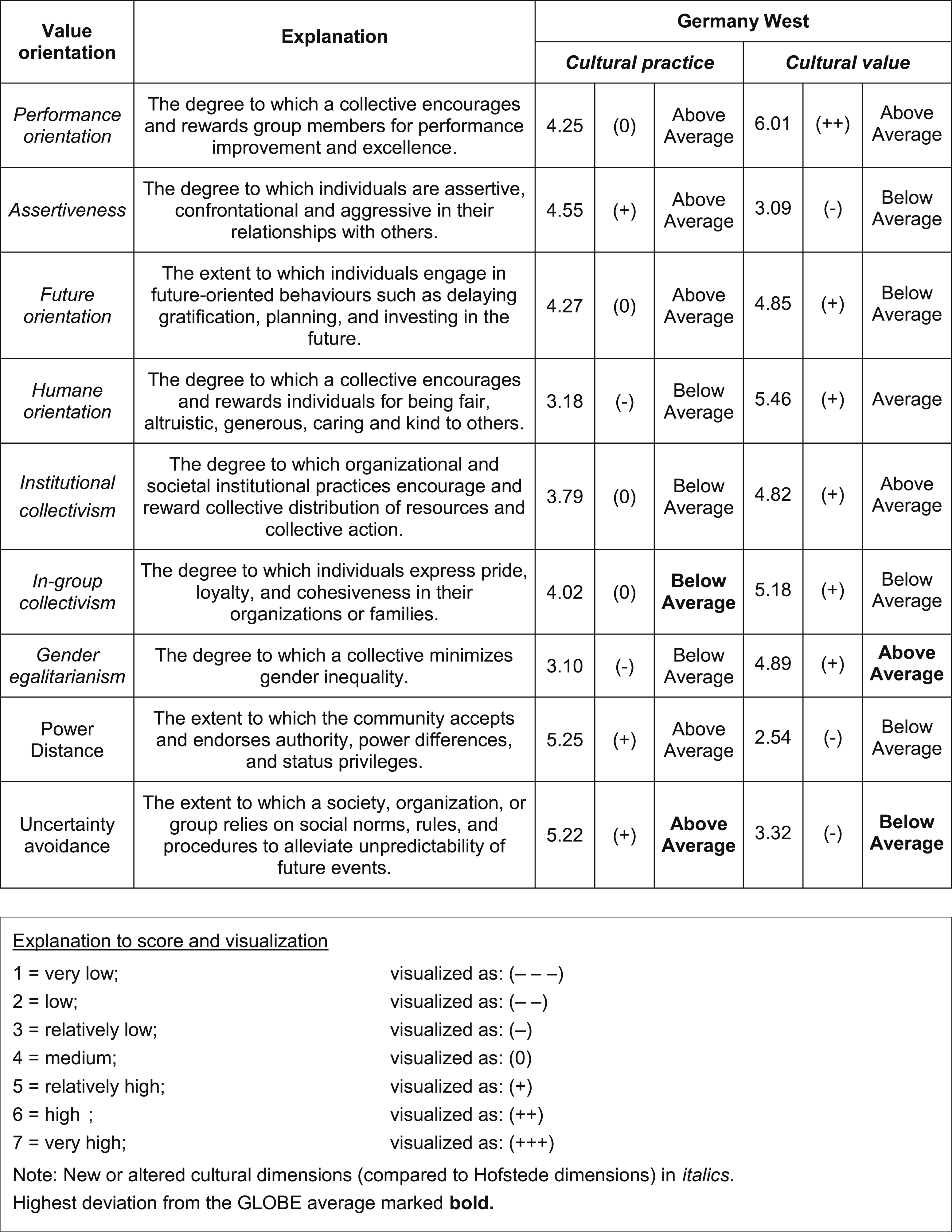
According to project GLOBE data, in-group collectivism is the dimension in which GLOBE societal cultures differ the most (Javidan et al., 2004: 31–32), and assertiveness is the one with the least spread (ibid.: 32). High power distance and “being somewhat male-orientated” is what most GLOBE cultures have in common (ibid.: 30–31).
For the purpose of our study, project GLOBE is more helpful than the Hofstede study, due to the following reasons: First, in addition to specific country scores, GLOBE also presents the scores for the whole of the GLOBE societal cultures, both score range and average score. This means that one can also see which cultural dimension – value or practice – scores higher or lower across all cultures (see Figure 1; range (---) to (+++)).
The second reason has to do with three amendments made to the Hofstede cultural dimensions (see Figure 1, in italics). GLOBE (1) differentiated collectivism into in-group and institutional collectivism, (2) split up masculinity and femininity into gender egalitarianism and the expected degree of managerial assertiveness, and (3) introduced humane orientation (see Figure 1). Germany-West scores moderately on institutional collectivism (value) and below average on in-group collectivism (value and practice), high on assertiveness (practice, but not value) and high on the value, but low on the practice dimension of gender egalitarianism. For the novel cultural value orientation of humane orientation, Germany (West) ranks the lowest of all GLOBE societal cultures studied.
The second GLOBE publication explicitly addresses leadership (Chhokar et al., 2007) and thus allows for insights regarding if and to what degree expected and preferred leadership styles are culturally contingent (Figure 2). GLOBE leadership styles. Source: own table, based on data from GLOBE, 2022, GLOBE, 2023a, GLOBE, 2023b, GLOBE, 2023c.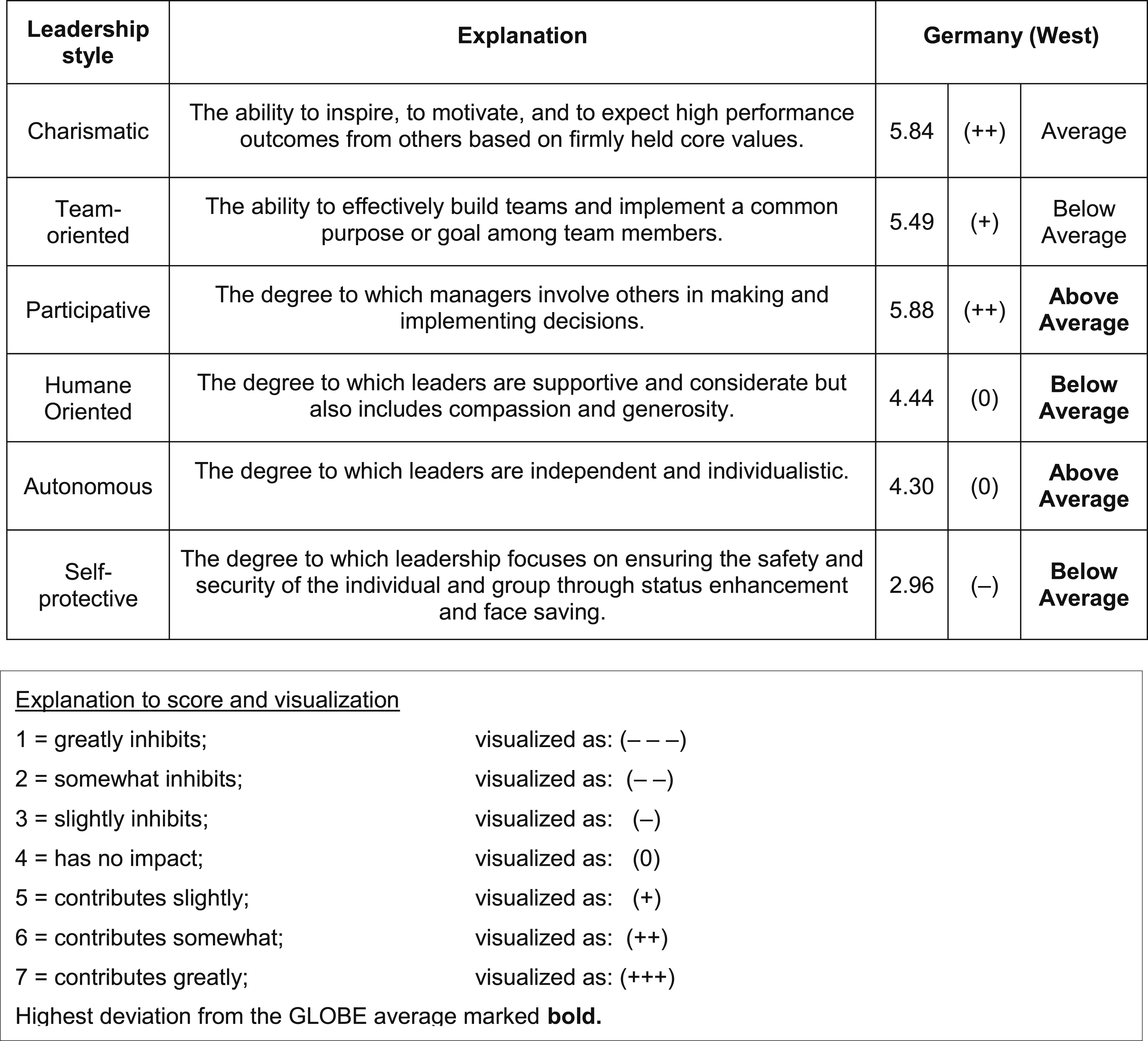
The second GLOBE study (Chhokar et al., 2007) focussed on the interrelations between cultural value orientations and leadership and clustered the data into six culturally-endorsed leadership styles (see Figure 2). Charismatic leadership was found to contribute the most to outstanding leadership across all GLOBE societal cultures (with a GLOBE average of ‘contributes slightly to somewhat’), followed by team-oriented leadership (the style with the lowest spread across all GLOBE societal cultures) and participative leadership (which in some cultures only contributes very slightly). Humane-oriented leadership is highly debated: in some societal cultures it is thought of as impacting outstanding leadership slightly, in the highest-ranking cultures it is found to contribute slightly to somewhat. Autonomous leadership is ranked the lowest in some societal cultures (inhibits outstanding leadership somewhat) and contributes slightly in others. Self-protective leadership ranges from inhibits to contributes slightly.
Methodology
Based on a grounded theory approach (Glaser and Strauss, 1967), we interviewed white-collar workers in the regional industrial sector in three phases: 2021 (Phase 1, during the COVID-19 pandemic), 2022 (Phase 2, mid- and post-pandemic) and 2024 (Phase 3, post-transformational). Phrase 1 and 2 identified and traced changes in leadership practices and expectations, Phase 3 was the main phase of our study, with the focus of finding out which of these changes lingered on after the pandemic-induced work-from-home arrangements, which had initially triggered these changes, had subsided. Pre-COVID, work-from-home as workplace arrangement was not widely practiced and even frowned upon in Germany, with organizations and employees lacking digital equipment and know-how. In Phase 1, social shut-downs suddenly made work-from-home mandatory for most white-collar workers, with most organizations and employees being unprepared for this shift (BMWi, 2021; OECD, 2020). In Phase 2, the COVID-19 induced work-from-home experience changed the interplay between work and home domain resources for white collar workers in Germany (Mahadevan et al., 2024b). During and since Phase 3, partial remote work has become normalized at the German workplace: a fundamental transformation of the leadership context.
As it is common in qualitative research, we started from a holistic interest (Flick, 2017), namely to understand how people made sense and experienced the sudden extensive work-from-home conditions into which they were thrown by the social distancing measures during the COVID-19 pandemic. We as researchers shared this experience, and this led us to the formulation of the first guiding questions. Such researcher co-construction of the empirical field is a common feature of qualitative, explorative study of novel phenomena for which no previous models of theories exist (Mahadevan et al., 2024a; Mahadevan and Moore, 2023).
Our purpose was to develop novel theories from the social reality studied, an approach commonly referred to as grounded theory (Glaser and Strauss, 1967). Grounded theory distils patterns from complex social reality and thus densifies complex reality into patterns. We thus did not approach our interviewees with the clear idea of studying ‘leadership’. Rather, leadership emerged as relevant from the interviews of Phase 1, also in light of studies on culturally-specific leadership, in particular project GLOBE. Pre-pandemic, the German leadership style has been described as performance-oriented, assertive and scoring low on emotional qualities such as compassion and humane orientation (see Brodbeck and Frese, 2007; Brodbeck et al., 2002). The German leadership style is thus globally particular in the sense that it is impersonal and focussed on people’s function on the job, with leaders’ separating the private sphere of life from their professional selves in order to appear competent. A specific focus which emerged from the empirical material during COVID-induced extensive work-from-home (Phase 1) was the insight that this leadership style was no longer feasible under the combined conditions of serious crisis and extensive work-from-home.
As workers were sent to work-from-home suddenly and unexpectedly, leadership manifested and was experienced mainly on the levels of teams, as individuals ceased to be fully connected to the organization at large. Also, team-leaders and -members had to find their own ways of coping with crisis. Most interviewees thus experienced leadership on lower levels, either in large or medium-sized industrial organizations. What is shared across individuals and organizations is the need for leadership in times of crisis under comparable external boundary conditions (COVID-19 pandemic effects). This unifying effect of shared influencing factors, such as the crisis conditions of urgency, threat and uncertainty, enabled us to study leadership expectations across individuals, teams and organizations.
We followed team-leaders’ and team-members (followers’) sensemaking by applying constructivist grounded theory (Charmaz, 2006). This is a specific type of grounded theory that focusses on people’s lived experiences and their ways of interpreting (‘making sense’) of the social world by means of narrative, in this case: what it takes to be a ‘good’ leader during and after the COVID-pandemic. We traced leadership sensemaking through Phase 1. Phase 2 brought about the additional question to what extent the change in leadership expectations and patterns had come to stay. This led us to initiate Phase 3 (post-transformational) which allowed us to answer this question conclusively. This way, we reached the point when additional interviews did not deliver additional sensemaking patterns into leadership change, this being a point when one may end the study (Glaser and Strauss, 1967). We thus concluded with Phase 3.
All authors are associated with a German university, with close ties to the surrounding industrial sector. Therefore, it was not difficult to find potential interview partners who met our requirements. These requirements were: being employed in the German industrial sector and having experienced a shift to COVID-induced work-from-home. The first author was the one who conceptualized and led the study and who wrote this paper, the second (and partially the third) author conducted and analysed interviews during Phase 1 and were the ones to identify leadership as a relevant focus. Authors four to eight (in alphabetical order, equal contribution) conducted interviews during Phase 3 and analysed interviews of all three phases. Author nine analysed interviews of all phases and contributed to the writing of this paper. Authors 11 to 14 (in alphabetical order, equal contribution) conducted and analysed interviews during Phase 1 or 2, respectively.
Details to data collection
Phase 1 (February to September 2021) consisted of 38 interviews, Phase 2 (March and April 2022) of 20 interviews and Phase 3 (February and March 2024) consisted of 26 interviews. Interviews (except one which was conducted in English because this was the interviewee’s first language, and the interviewer was fluent in it) took place in the German language. Phase 1 and 2 interviews were mainly conducted with virtual meeting tools; Phase 3 interviews mainly in person. Duration varied between 60 and 90 min.
Each researcher conducted one trial interview in advance to check upon the relevance of the guiding questions and to amend them, if need be. Interviewees were sent a consent form including all relevant information about the study, as well as data protection information. Consent was given verbally and recorded at the beginning of each interview. None of the interviewees were compensated. All interviewees were employed in white collar-work, most of them full-time, except RB03 (30 h per week), JS02 (90%) and MM03 (80%), which is still close to a full-time occupation. The proportion of women amongst the interviewees was representative of the respective industries (Boksch, 2019). All age groups, individuals with and without care-work obligations, and single individuals and individuals in a relationship were included.
Data analysis
Interviews were recorded and saved as audio-files and transcribed verbatim. Interviewers also took notes and extended them directly after the interview. Phase 1 interviews were transcribed manually, Phase 2 and 3 interviews were transcribed using an auto-transcription software (f4x) which was then edited by means of a manual tool (f4).
Coding was done manually, by two authors per interview, one of them being the interviewer, so that inside and outside perspectives could enrich each other (Flick, 2017). Phase 2 researchers were provided access to the material of Phase 1, and Phase 3 researchers were provided access to the material of Phases 1 and 2 and analysed previous interviews, in addition to already existing inner-phase analysis. This way, temporal coherence was ensured. The first author was the one to analyse all interviews, to wrap-up each phase, to initiate the next phase and ensure the transition between phases, and to train the researchers of each phase.
The interview analysis involved several steps: First, interviewers documented all memorable content in the interview protocol. Next, two researchers (one of them being the interviewer) compiled a first thematic analysis of the transcript. The goal was to identify themes in the interview, such as ‘leadership’, ‘sentiment’, ‘work-from-home conditions’. Third, Phase 3 researchers summarized the content of the most relevant interviews independently and sorted them according to relevance. Forth, quotes from all Phase 1 interviews and from the most relevant interviews of Phase 2 and 3 were then transferred to an integrated excel file. The purpose of this file was to established connections across quotes (and, thus: research phases and interviews) beyond the categories already identified. Analytical columns included: interview code, time stamp, quotation, theme, categories (1-4), the first person to categorize the quote, the second person to categorize the quote, and further comments.
Findings
Phase 1: lower-level managers in the role of leaders
Phase 1 interviews were conducted between February and September 2021, at the height of the pandemic. As the most notable finding, the interviewees, who worked from home under shutdown conditions, did not perceive and experience leadership from higher levels anymore. For instance, as LB04 says: “You do not really see the company that you work for anymore, it is all reduced to those people you are working together with.” (LB04: 01:34:00). Consequently, the task of leading was now executed by lower levels of management, such as team-leaders (e.g. AS06; AS07).
Naturally, team-leaders struggled with these new responsibilities. As LB01 reflects: “Especially in such times, there are many employees who need a little, well, not care, but a little empathy [emphasis in the original]” (LB01: 1.16.51). Throughout, empathy emerged as the most relevant criteria as to whether followers experienced their immediate superiors to have taken up the ‘leadership’ role successfully (e.g. AS02; AS03; LB01; LB05). Interviewees also stated that such empathy had been lacking before. FG07, for instance, says: “[prior to the pandemic,] I have always had the feeling: business first, and human beings second, and this is sad (…)” (FG07: 0.53.30). Relevant leadership practices that, to followers, indicated empathy and care were, for instance, inviting team-members to virtual coffee-breaks and get-togethers (e.g., LB01; LB02; LB09). As AS07 says: “We moved coffee-machine chit-chat to the virtual realm, that was pretty much fun, we did it for a while, to include this aspect [of social exchange] virtually as well.” (AS07: 00:13:21). Some teams found creative solutions, such as delivering Christmas dinner to each team-member at home, celebrating together virtually and taking a virtual tour to the stables of an Alpaca farm, with an employee of the farm showing them around wearing a headset with a camera. Throughout, lower-level leaders became the most relevant confidants for their followers. As AS01 reflects: “Concerning what the [leadership] role means in relation to employees now: Well, I am their boss and coach, and sometimes also their (short laugh) pastor, you know?” (AS 01: 00:03:31). This shows that leadership, as executed on lower levels, has extended in scope (to involve human needs) and relevance. With his laugh, the team-leader indicates that he does not (yet) feel fully comfortable in having such extended human access to his team-members and that he is not convinced of being able to live up to arising high 'humane-related' expectations.
How to care and empathize without controlling others was another key theme that emerged from the interviews. Followers talked about how they were not, or did not wish to be, controlled by their leaders, and leaders talked about how they did not like to control their members (e.g., AS10; FG06). Most followers, strongly felt that a ‘good leader’ should enhance, cultivate and develop the abilities of their followers, as well as their own (e.g., FG06; LB02). Followers stated that they felt supported by a leader who was open to their problems at and beyond work (e.g. AS03), and who actively coached them, both in relation to tasks and personal matters (AS06).
Yet, the degree of control versus autonomy which was ideal for individual followers in order to achieve such a coaching and developmental relationship seemed to have differed across individuals, tasks and contexts. For instance, some leaders also said that, despite own attempts of letting followers work at their own discretion, they felt that employees wanted to have rules of when and how to work, in order to not to “get lost at home” (LB03: 00:31:24). Thus, the need to care and the need to coach and develop clearly intersected and were highly contextualized.
A key dilemma was leaders’ shared insight that some followers wanted as much autonomy as possible and that others wished for their managers to make job-related decisions and allocate tasks. Thus, leaders tried out the strategy to let followers work at their own discretion, and this often became the means through which leaders could install a high sense of commitment (e.g., AS05; AS06; AS09; LB02). However, in some cases, leaders were also disappointed with the outcome and returned to practices of stronger supervision and control (e.g., AS01; AS02; AS07; AS09; LB01; LB06). They did so based on the understanding that a follower was overwhelmed by increased self-leadership demands and thus tried to ensure that developmental and relational needs were met via increased control instead (e.g. AS02; AS09; FG01). Nonetheless, both approaches were just two sides of the same coin, namely complementary ways of ensuring a caring and empathic way of getting the job done, depending on how much self-leadership an individual could be assumed to handle well.
The new leadership challenge was thus to recognize when and how to choose and implement which approach, and to find the right balance between discretion and control.
Phase 2: followers’ need to be taken care of
Phase 2 interviews took place between February and March 2022. Since Phase 1, shutdown conditions and work-from-home requirements in Germany had alternated between being tightened and loosened several times, depending on local and national infection rates and vaccination rates: Pandemic induced work-from-home was thus ebbing away but not yet fully over. In Phase 2, too, we found indications of sentiment, empathy and recognition now having become key expectations which followers had towards their leaders. Generally, a ‘good leader’ came to be understood as a person who “asks their employees what they would feel comfortable with in such a situation [COVID-induced extensive work-from-home, the authors], and not generally assumes that it will be okay for everyone anyway if they just carry on as they used to before.” (FB06: 00:47:28).
Thus, a good leader was also a person who considered their followers individually and cared about their needs.
Interviewees also reflected on how their perception of being controlled by their leaders had changed. For example, FB06 states that “the atmosphere in the office was always like, well, you felt a little like ‘big brother was watching you’” (FB06: 00:00:36). At the same time, it was also understood that leaders had to keep overall tasks and goals in mind, and to consider interdependencies and make decisions accordingly, even though some individuals might not like it. All interviewees experienced an increased need for coordination with one’s followers and peers, and achieving it was experienced as highly stressful and resource-demanding, and as requiring an increased amount of active cognitive work (e.g. SM04; SM05; RD06). For example, interviewee TS05 talks about how the whole team was negatively affected by another team-member independently making the decision when to work from home and when to come to the office during a time of low infection rates in which work-from-home was not mandatory. He says: “And he did not do the task [which required on-site presence, the authors] because he said: ‘I want to work from home [on that day of the week]’. And as long as there are people who manage work-from-home like that, that is just bullshit because others had to do his job, and that is not okay.” (TS05: 00:09:38).
TS05 continues: “Well, it is the boss who has to pay attention: ‘What is it that the employee is doing and when is it important for them to show presence or interact with colleagues. Because, otherwise, what will happen is that tasks will not be executed.” (TS05: 00:10:56).
Besides having to coordinate tasks and people under flexible work-from-home conditions, which makes people run on different schedules, leaders had to be accessible when required. FB06, for example, looks back onto his manager whom he considers to be a ‘bad leader’ because he was micro-managing without being accessible in return: “Well, in principle, I was just running to him all the time to show the things which I had done just then [because he did not trust me enough]. And when I was lucky, he had time just then, and otherwise, I just sat there for half an hour and played Solitaire.”
Those who lacked ‘feedback’ clearly felt constrained by it and described how their workplace culture was characterized by a lack of positive feedback in general (e.g. SM01, SM03). The German idiom ‘no complain is praise enough’ epitomizes such a workplace culture which is assumed to be typical in a German corporate environment (Brodbeck and Frese, 2007). However, due to the reduced visibility of work and commitment when working from home, and the increased need for recognition due to a general, pandemic-induced lack of meaningful social interactions, such a workplace culture no longer sufficed for meeting followers’ demands (e.g. RD03, RD06). Furthermore, a workplace culture in which it is common to only communicate when there is an issue to be solved or a clear task to be carried out, did no longer provide individuals with sufficient development opportunities (e.g. SM03). Conversely, a workplace culture in which the available information technologies and communication channels were also used to socialize, to meet without issues to be solved, and to generally ask about others’ well-being and doings, were perceived as a very positive work environment (e.g. SM08, SM10, RD03, RD06).
Interviewees also described the relevance of harmonious relations between colleagues, something which had not been relevant before, as they said (e.g. SM01, SM03). Leadership thus became a more informal guiding and coaching role, also in relation to professional knowledge and skills. The following quote by FB04, a team-leader, summarizes these responsibilities of what may be called a ‘coaching leader’: “Well, I was the contact person for those who had questions, and we then solved this in the team. From a certain point onwards, I then was not the sole contact person anymore. Such things and the like, you can solve amongst peers, for example problems that occur again and again. In particular when it concerns [applications] which I personally do not use much in my own work, it can now also happen that they [the team-members] ask each other.” (FB04: 00:34:53)
Interviewees also spoke about increased emotional demands caused by prolonged uncertainty and social isolation (e.g. SM05; SM10; RD02; RD10). Furthermore, interviewees mentioned that they now also sought developmental opportunities from their peers and colleagues (e.g. SM04), and those with pre-COVID work-experience stated that this reliance on the team had not existed before. This suggests that leadership in the sense of moving the team forward and developing team-members was in the processes of becoming a more distributed and collective effort than it used to be, as is recommended for high-performance virtual team collaboration (Mahadevan, 2024c). For example, interviewees reflected that it was now easier to ask for help and to admit to not knowing something, e.g. how to use a certain digital tool, because “everyone is lacking some knowledge on something, so you do no longer feel ashamed and can drop the façade” (RD04: 00:41:01). Generally, this suggests that leaders and followers became more emotionally accessible and vulnerable to each other.
Phase 3: a change in leadership style, and its limits
In order to figure out which leadership patterns and expectations continued to manifest post-pandemic, Phase 3 interviews were conducted in February and March 2024. During that time, shutdown regulations were no longer in place, and many employees had returned to the office. Still, work-from-home was more prevalent in Germany than it used to be before the pandemic, yet, also remained highly debated (see section context of our study). With regard to our research interest, namely to figure out which changes in leadership practices and expectations lingered on beyond pandemic-induced work-from-home arrangements, Phase 3 is thus the main phase of our study.
When initiating the interviews under these conditions, we soon realized that most interviewees still had the ‘old industrial picture’ of leadership in their minds, namely leadership as a hierarchical, formal and authoritative higher-level individual role. For example, when being asked whether they would be willing to be interviewed regarding ‘leadership’, many interviewees did not perceive themselves as being in a ‘leading’ role. Yet, when we explained that we also understand those who guide and coach to be ‘leaders’, interviewees quickly recognized themselves as ‘leaders’. Thus, interviewees’ actual practices differed from their understanding of what constitutes ‘leadership’: They did not (thus far) make sense of empathy or them being compassionate and ‘caring’ about individuals as ‘leadership’, yet, in their practices, this element, in particular as related to providing guidance and support to others, was very visible.
During the interviews, all leaders mentioned a higher complexity of the leadership challenge, and also an individualization of followers’ needs, with the ensuing need to diversify and adapt their own leadership practices. Project-leader MM01, for instance, reflects how it has become more difficult to find the right moment for providing feedback and advice to followers remotely. He says: “If I see a person every day, I will wait for the right moment, of course. And being reminded daily [simply by seeing the other, the authors] makes the task much easier, of course.” (MM01: 00:40:54).
Leaders furthermore struggle with aligning tasks and people beyond their immediate teams and across functions. MM02 (00:16:46), for instance, says: “It is very difficult to identify the right people to talk to remotely”, a process, which also costs more time (MM01). Adding another challenge, MM03 reflects how providing the required attention to everyone in the team “is much more exhausting virtually” (MM03: 00:22:39).
Whilst leaders described their practices using different words, all agreed that a somewhat empathic style (however phrased) was the best way to lead. RB01, for instance, says: “Nowadays, I would always lean to [an empathic style], also, of course, because it works better. You simply must have an empathic part as a leader nowadays, because this gives you the means of enabling people to do things which they might not be inclined to do at first, of course.” (RB01: 00:28:58).
Leaders described how remote workers were also more removed from understanding why their job should be done and why it was relevant. In order to instil a sense of context, leaders had to choose a less assertive approach. MM01 describes this as follows: “It is not enough to tell people how to do things and who should do it, and until when [as it was done previously, the authors], because they realize and are aware of even less. [Rather, you have to tell them]: Please help me with your work to service this customer or to achieve the following, and it would be nice if you could do it as early as possible because….” (MM01: 00:22:16).
Establishing a sense of connectedness and belonging in the team, these being features that were felt to fade away when working remotely, became an additional leadership task. This task went beyond merely making the decision when to work on-site and when to work from home. For example, MM03 reflects that it is “not the solution to order people to the offices (…) but [on has to] to consciously say: ‘Why are we as a team at the office, where and how will we sit together, and what will be our surroundings like? Simple things that enable us to feel our growing-together again.” (MM03: 00:19:12).
Individualized followers’ needs and finding balance between discretion (via extending trust) and control continued to pose a tremendous coaching and development challenge. In comparison to Phase 2, leaders now seemed more able to pattern this challenge which MM01 summarizes as follows: “There are those who don’t have the knowledge, and they say: ‘I want detailed instructions of what I have to do, otherwise I won’t even start working.’ And there are others to whom you say: ‘See, I have an idea, give me some feedback on it’ [and this is enough for them to start working]. Depending on the type of person, people look forward to such a thing or are scared of it.” (MM01: 00:24:54).
Most leaders described that extensive work-from-home arrangements worked the best within teams that had been collaborating for a long period of time (MM03). The reasoning was that those teams had already experience a sense of togetherness and belonging which they did not want to lose. As MM03 says: “The longer you don’t see each other physically, the more energy you have to invest into relations, if you want to leverage their collaborative potential for the team.” (MM03: 00:19:12).
Because they were aware of the collaborative potential of social relations at work, long-term teams more often chose to invest this additional energy while members were working from home.
How to establish a culture of trust under extensive work-from-home conditions was another key theme. To most leaders, such as RB03, trust was the best way to “motivate followers to deliver” (RB03: 00:30:48). Others simply realized that there was no other way under extensive work-from-home conditions. MM01, for instance, says: “I have a basic trust in people, that all of them are motivated to do their job.” The underlying rationale was that control is impossible anyway: “I cannot chase ten people [who work from home], for ten tasks, and ask them how it looks like every day.” (MM01: 00:27:44). Nonetheless, there were also negative side-effects of a trustful leadership. RB02 reflects: “There have always been employees who first read the newspaper in the office until the boss was there, speaking figuratively. For those, it is now easier to hide at home. And those who already tried to do the best job possible before as well, can still do this when working-from-home. There is just a little more spread now [between the two types].” (RB02: 00:41:03).
RB02 reckons that leading a fully remote team “is less critical than I had previously imagined. But the conflict is still there, and there is more spread”. (RB02: 00:14:56). JS03, too, beliefs that “trust is the key to leading people nowadays” (JS03: 00:23:06). However, he contradicts RB02’s assessment by saying: “Well, I don’t think that you need more trust when people work-from-home compared to on-site work, because those who do not want to do their job on-site, simply won’t.” (JS03: 00:23:23).
To JS03, the solution was to change his communicative style. He says: “I believe that you have to communicate with your people in a much more aware manner, regarding how and when you communicate, and to also communicate proactively. The difference when working-from-home is that you need to consciously seek the conversation. And then you need to listen between the lines: ‘Is there something?’, and this means that you also have to talk about some things [which are not directly work-related].” (JS03: 00:25:14).
The need for lower communicative and interactive assertiveness in a leader, which is also evident in the aforementioned quotes, was another theme. As RB05 puts it: “Well, let me say, you have to convince them with arguments and to explain your motivation, but what won’t work is: ‘I am the boss. That’s how we do it.’” (RB05: 00:15:18). At the same time, followers still reckon that a certain type of individual is advantaged due to their assertiveness. MM01, for instance, reflects that “the company is not approaching the high-performers and asking them: ‘Do you want to have more challenging tasks?’, but rather the expectation is: ‘If you want something, you need to raise your hand [and ask for it].” (MM01: 00:40:54). To MM01, this is a crucial inequality associated with extensive work-from-home: “because you do not see the quieter ones [virtually] that much.” (MM01: 00:38:03). MM05 therefore made the choice “to approach employees whenever I sense something, and on the other hand [they trust me] and approach me whenever there is a problem.” (MM05: 00:27:59).
Leaders find that low assertiveness, whilst more relevant to leading virtually and remotely, is not widely practiced in their companies. MM04, for instance, says: “it is much easier to give each other shit over the phone than when sitting opposite of each other” (MM04: 00:32:23), “but at the same time it is so much more difficult to motivate another person via phone compared to seeing each other in person” (MM04: 00:31:47). Thus, remote leaders have to pay even more attention to low assertiveness and high enough humane-orientation when communicating with the team. As RB01 reckons: “For me, it has proven right to always remain friendly and polite” (RB01: 00:11:30). At the same time, RB01 sees much behaviour to the contrary: “There are enough people – and this is reflected in the organization – whose tone is just so stressful. However, in the long run, this only leads to the frustration of all involved.” (RB01: 00:12:44). Thus, what RB01 critiques is a highly assertive communicative style in general, and she furthermore has the feeling that the way in which work is organized reflects this style. To her, it is therefore essential to make sure to extract the knowledge and opinions of less assertive team-members when working remotely: “There are always colleagues who, by their nature, almost never say anything at all in a [virtual] meeting, and you then need to get this out somehow. This means that you really have to address them directly.” (RB01: 00:14:35) (…) “This is about fairness, which is much more difficult now [under work-from-home conditions, the authors] and more generally about treating people in such ways in which human beings want to be treated.” (RB01: 00:26:14).
Whereas some women leaders, such as MM03, MM05, RB01 and RB03, more often mentioned the need for less assertiveness and higher vulnerability, male leaders tended to stress the relevance of providing direction. Two quotes, by RB03, a 59-year old women leader, and by MM04, a 47-year old male leader, exemplify this difference. RB03 describes her leadership practice as follows: “To be open, to communicate, also about me personally, and to maybe also show my weaknesses. This way, becoming a role model, to deal with [followers’ insecurities] this way somehow” (RB03: 00:12:55).
Conversely, MM04 says: “You can only rock this thing together. Alone you will not achieve anything, you depend on the others. You are the one who is standing at the bow and is making pace. (…) You need to tell your boys: ‘This is where we need to go’” (MM04: 0037:34).
Thus, whereas RB03 practices humane oriented and a fully participative leadership, MM04 practices lean more towards an autonomous, charismatic and assertive leadership. The latter style is more in-line with GLOBE study scores for Germany-West (see Figure 2). Furthermore, it is noteworthy that MM04 uses gender-specific metaphors in describing his leadership, namely those of a ‘captain’, and speaks of ‘boys’. It therefore remains to be seen to what extent there will be gender-specific differences in how leaders will meet the challenges of a post-pandemic remote work environment in Germany, as there are also male leaders who have considerably reduced their assertiveness (e.g. MM01, see previous quotes).
The coaching leader, albeit implemented in different ways, is a style that is shared across genders. JS03, a male, 47-year old leader, says: “I believe that you need to consciously implement these leadership elements, and you need to become aware that you need to lead differently when people are working from home. That communication has to take place differently, and also togetherness.” (JS03: 00:29:10).
Taking up the role of coach in such ways requires learning and growth. For example, JS04, a male 30-year old leader, says: “The best-possible self-awareness is important. And then to look and ask: ‘Well, where can I become even better? That is the first part. And the second part is: You develop your routines with time, you become more confident, and this happens automatically.” (JS04: 00:39:45).
Leaders also reckon that, whilst being essential for their own lower- and middle-levels of management, showing sentiment has not yet reached the top-ranks of management. RB01 exemplifies this assessment by saying: “Well, the moment in which you are acting on managing director or board levels, [empathic leadership and showing sentiment] becomes more difficult because you make yourself vulnerable. And from there on, it becomes complicated. For middle management, [empathy and sentiment] are indispensable. But when it comes to top-management, I do not want to get involved [with answering whether leadership has become sentimental, the authors].” (RB01: 00:28:28).
As this quote suggests, the change in leadership behaviour and expectations towards empathy, sentiment and coaching, which our study identifies, is something that happened on lower levels, when lower-level managers and followers found themselves in a ‘leadership vacuum’, without the overall organization providing them with directions or blueprints of ‘how to lead’ under COVID-induced extensive work-from-home conditions. Post-pandemic, this change has evolved into new leadership practices which have not yet reached organizational structures and top-management levels.
Discussion
In this section, we discuss the leadership-related insights in relation to cross-cultural management studies. As became evident during Phase 1, leadership responsibilities and expectations moved to lower levels of management, and members started to seek guidance from lower-level leaders who could not rely back on established templates on ‘how to lead’.
Our study clearly shows how (lower-level) leaders and followers facing the crisis conditions of uncertainty, urgency and threat needed to strategize, that is: create strategy through their practices (Reichert and Mahadevan, 2021). Essentially, this means that those who suddenly found themselves in the novel role of ‘leaders’ did not have a blueprint upon which to base their actions. Rather, they needed to combine existing leadership styles and ‘learn by doing’ and to try out those actions that seemed to have an effect in the situation. This suggests that culturally-contingent leadership styles and expectations, such as the ones proposed by project GLOBE, might be valuable in times of stability but less reliable in times of crisis. As the cross-cultural management environment is increasingly characterized by brittle, anxious, non-linear und incomprehensible conditions (BANI model, see (Mahadevan, 2024d)), strategizing and leadership as practice is likely to become more relevant in the future. Furthermore, project GLOBE (and comparative leadership theory in general) only establishes leadership styles and expectations for middle and higher management, and we find this to be a theoretical and conceptual limitation during times of crisis, when individuals and teams need to create leadership while lacking reliable interpretive and structural frameworks for doing so. We therefore propose that comparative cross-cultural management studies think about leadership less as an existing style or expectation but rather as a practice in the making, in particular when boundary conditions are novel and shifting, and to also consider the role of lower levels of management in this.
Due to pandemic-induced crisis conditions, filling the leadership vacuum on lower levels also needed to involve sentiment. Empathy, ‘caring for the individual’ and ‘developing each other’ thus emerged as key leadership expectations, and acting as a ‘coach’ fulfilled this need. This new leadership style of coaching oneself and others, also on peer-levels, does not fit the leadership patterns and expectations which project GLOBE has established for Germany (Figure 2). The driver behind this could be the paradoxical score of assertiveness in Germany (West), as this dimension is high in practice but low in value (Figure 1). It suggests that people might practice assertiveness more than they wish to do, and being freed from the constraints of institutionalized leadership and organizational boundaries, might have enabled them to engage in alternative practices.
Taking up the leadership challenge under uncertain circumstances must have been even more difficult in a context, such as the German one, in which there is a high tendency to avoid uncertainty in practice (Figure 1). However, as our study shows, individuals slowly viewed their new autonomy as positive, which aligns with the low GLOBE study scores for the value dimension of assertiveness. Thus, crisis conditions enabled individuals to establish a new practice free of previous constraints. The comparably high German score on institutional collectivism, thus: the expectation that it is structures and procedures that built groups from the outside, not individuals striving for building and identifying with groups from the inside (in-group collectivism, see Figure 1), must be assumed to have been a hindering factor in this change process.
In Phase 1 and 2, interviewees did not frame most of their trust-building practices, such as holding meetings, as ‘team-building activities’ but rather as requirements rooted in the need for efficiency, effectiveness or reliability. The humane orientation score (value) for Germany (West) is below average (Figure 1), and, consequently, even those practices that were clearly humane oriented, were not interpreted as such by both leaders and followers. By Phase 3, however, trustful leadership had become a style that was consciously employed. Sometimes, this style was rooted in the motivation to instil high-performance behaviour in followers, and this aligns with the high scores for performance orientation (Figure 1).
The process of taking up the leadership challenge on lower levels furthermore created a fruitful ground for what we call ‘peer-leadership’. For instance, we found that colleagues, too, stepped into the relational and developmental role of ‘coach’. This way, peers co-coaching each other directed, developed, and motivated themselves and others to collectively achieve team goals. The trend towards peer-leadership, as identified in our study, is thus highly relevant: Previously, the German style has been characterized by low levels of both in-group and institutional collectivism, and was not fully developed in terms of its participative elements. Assigning, taking up and sharing the role of ‘coach’ in relation to one’s peers may achieve this change. However, because interviewees make sense of this change by means of ‘old’ leadership templates, this change only becomes visible via in-depth, qualitative methods. In GLOBE vernacular, there is thus a gap between leadership values and practices in our empirical material. Furthermore, as interviewees reflect, the coaching leader who shows empathy and sentiment is at risk of becoming vulnerable on top-management levels, and this is why the overall organization does not reflect existing grass-root change.
There is also the risk that more assertive individuals might be advantaged by leadership under extensive work-from-home conditions, as the perception prevails that followers need to step up and raise their voice if they wish to be seen and recognized. The prevalence of this practice is a critical finding. Felix et al. (2023), for instance, have shown that remote workers who are highly capable of performing might have to spend so much time on impression management and on showing that they perform to their leaders, that they lack the time to actually perform. Thus, a coaching and caring post-pandemic leadership in Germany should also include strategies for involving those who are less assertive. It should furthermore establish a culture of trust wherein it is no longer necessary to promote one’s own performance assertively. The question of how to develop and involve those followers who are less capable or confident regarding their self-leadership and their independent execution of tasks is still unsolved. Thus, it remains to be seen whether more participative or more autonomous approaches to leadership will prevail in the future. Institutionalized programs to make individuals take up the self-leadership challenge, thus reducing lower-level leaders’ over-exhaustion, could be a fruitful way of solving the dilemma between participation and autonomy. However, this requires that lower-level leaders (who are followers to higher-level management) experience that higher-level leaders, too, orientate themselves towards an empathic and coaching leadership, and our findings show that this is presently not the case.
Implications for cross-cultural management
Our study asked the question whether GLOBE study leadership styles and expectations of what contributes to ‘outstanding leadership’ (Figure 2) still apply to post-COVID work-from-home in Germany (West). Figure 2 described the degree to which the six GLOBE leadership styles are supposed to contribute to ‘outstanding leadership’ for Germany (West). The paradox here is that Germany (West) ranges considerably above the GLOBE average for both participative and autonomous leadership, yet, only participative leadership is found to contribute somewhat to outstanding leadership. Humane-oriented leadership – defined as the degree to which leaders are supportive, considerate, compassionate and generous – is assumed to have no impact on outstanding leadership. This correlates with the low value and average practice of humane orientation. Self-protective leadership – defined as the degree to which leadership focuses on ensuring the safety and security of the individual and group through status enhancement and face saving – is thought of as slightly inhibiting outstanding leadership. Therefore, Germany (West) is firmly positioned at one side of the global leadership ambivalence surrounding both leadership styles, and for the question of how managers led employees through an extensive crisis such as the COVID-pandemic, both dimensions are highly relevant. Our study finds that the extent of participative and humane-oriented leadership has increased in relevance in the German post-pandemic work-environment.
We found a clear shift in leadership expectations towards leadership as involving more sentiment, more coaching and more development, both individually and collectively (on peer-levels). Therefore, we conclude that crisis conditions create a leadership vacuum in which leaders and followers ‘strategize’, thus creating leadership blueprints in the making. We suggest that the models for culturally-contingent leadership proposed by comparative cross-cultural management studies are mainly relevant in times of stability, but not applicable to times of change and crisis. This is in line with the existing literature that critiques comparative cross-cultural management for perpetuating a ‘timeless’ view on culture and for exaggerating internal cultural homogeneity (e.g. McSweeney, 2009), and that have called for a more contemporary approach to cross-cultural management (Mahadevan, 2023).
Leadership has furthermore increased in relevance on lower levels and within smaller organizational units. Individuals who previously simply executed tasks and managed subordinates within a given framework, such as team-leaders, suddenly found themselves in the role of ‘leaders’, and their team-members, too, expected them to act in this role. These findings are highly relevant, as the context which we studied – the German industrial sector – has previously been characterized by high levels of assertiveness, and low levels of humane orientation, gender egalitarianism and in-group collectivism. When reflecting upon their pre-pandemic conditions of work, interviewees describe such an environment which is indicative of the cultural value orientations proposed by project GLOBE (Brodbeck and Frese, 2007; Brodbeck et al., 2002; House et al., 2004) and which is coupled with a hierarchical structure of work. Visibly taking over care-work obligations and to emotionally ‘care’ about colleagues and team-members had thus previously been difficult. However, with the COVID-pandemic, this changed, and interviewees perceive this a liberating in the sense that it is now easier to be ‘human’ at work and to also collaborate in such a manner with each other. Consequently, we find the new leadership expectation and pattern of acting as a coach in relation to one’s subordinates and, moreover, also when interacting with one’s peers. Coaching in that sense involves both performance-related and humane-oriented aspects.
Throughout, we see a clear change in leadership expectations and practices, triggered by pandemic-induced changes to the context of work. In particular, both in-group collectivism and humane orientation seemed to have increased in relevance. Nonetheless, individuals still make sense of their experiences in ‘old’ ways which are in line with the cultural dimension scores proposed for Germany (West) by project GLOBE (see Figure 1). This suggest that one should use the quantitative scores provided by comparative cross-cultural management not as objective facts describing reality, but as interpretive schemes by means of which individuals make sense of their experiences. For instance, even though leaders in our study empathize with and care about their followers (high humane orientation), they and their followers still interpret these practices as the need to structure time and interactions, thus: as a measure directed towards performance (high performance orientation), to be achieved by creating integrative structures (high institutional collectivism). This suggests that both functionalist and interpretive cross-cultural management studies can enrich each other for shedding light onto novel cross-cultural contexts, as proposed by Mahadevan (2024a).
Gender egalitarianism is certainly a point to be further researched upon in the future. In the GLOBE study data, a societal culture’s orientation towards higher assertiveness is often coupled with lower gender egalitarianism. This suggests that a more assertive professional style either advantages men over women or hinders men to assume roles and tasks which are thought of as being in contradiction with assertiveness, such as care work, flexible work arrangements or part-time occupation (Mahadevan, 2023). For the future of virtual work and work-from-home in Germany, this is a relevant interrelation: If leaders and higher levels of management continue to downplay the side of leadership which is commonly associated with the female gender role (high humane orientation, low assertiveness), this might continue to perpetuate existing gender inequalities in Germany (see Figure 1), despite the clearly identified need for more ‘sentimental’ leaders who act as coach, this being a role that fits the socially learned role of women in Germany. The current phase of project GLOBE is in the process of investigating whether women lead differently than men across cultures, and it will certainly be relevant to re-examine this study’s findings in light of the outcome of the current GLOBE phase, once its findings have been published.
Germany West scores high on assertiveness in practice, but low on value. Assertiveness can therefore be assumed to be a way in which roles and functions are enacted on the job (in practice), yet, it is not a value orientation in itself. During the pandemic, the limits of this orientation became visible: When home and work are blurred, people seem to work less assertively, in particular when not confined to the routines and practices of the corporation anymore, as it was the case during the COVID-19 pandemic. This might open an avenue towards gender-inclusive change: If German leaders can change their self-perception, then they will free themselves of the practice rituals of ‘assertiveness’ which they do not value. However, if altruistic and caring behaviours are not encouraged (low humane orientation on value levels, see Figure 1) – how will future German leaders address people’s needs for empathy and sentiment post-crisis? As our study shows, this vacuum has been filled with the new leader self-identity as a ‘caring coach’ who empathizes with and develops their followers and peers. However, even though this self-identity manifested in practice, interviewees continued to make sense of their experiences in the established culturally-contingent ways. For instance, interviewees in all phases were not aware that their ‘caring for each other’, ‘empathizing with and relating to other’s needs’ and ‘providing guidance and support’ (beyond task-related matters) constitutes ‘leadership’, even though their practices clearly involved such highly humane-oriented elements. Thus, the key challenge for the future seems to lie in finding a sustainable balance between ‘old’ and ‘new’ leadership expectations, and in training individuals to recognize themselves and others as leaders when exhibiting such behaviour. A starting point might be leaders’ and followers’ shared need for increased autonomy and their high-performance orientation, from which motivations towards sentiment, empathy and development often stemmed. On meta-level, this points to a new leadership challenge for cross-cultural management studies, namely to integrate quantitative and qualitative approaches for better insights into how individuals in micro-contextual interactions make sense of the macro-level leadership templates available to them, and how this then shapes their experiences and further actions.
Based on our findings, cross-cultural management studies should also pay higher attention to whether a cultural context is stable or not. For cultural contexts undergoing change and transformation, in-depth and qualitative studies are the methodology of choice, in particular, when context and boundary conditions change fundamentally, as was the case during the COVID-19 pandemic. Secondly, our study showed a clear difference between people’s leadership practices and how they made sense of them. Whereas practices were more indicative of change, interpretations largely followed the established culturally-contingent templates proposed by project GLOBE. Consequently, cross-cultural management studies need to differentiate between objective and subjective leadership realities. This points to a key area in which interpretive, qualitative work can enrich comparative, quantitative cross-cultural management studies, and vice versa. One would therefore need to engage in more multi-paradigmatic and multi-methodological studies on cross-cultural management contexts, as, for instance, Mahadevan (2024b), and Bausch and Mahadevan (2024) have done for the phenomena of intercultural training and international knowledge transfer, respectively.
In summary, we propose that future cross-cultural management research on leadership should (1) integrate qualitative, in-depth, and quantitative, comparative approaches for mutual enrichment, (2) differentiate leadership contexts into stability and change (crisis), and (3) consider both subjective, oftentimes shifting, and objective, oftentimes stable, leadership components. For contributing to leadership practice, cross-cultural management theory should help leaders and followers recognize their behaviour as ‘leadership’, even though the established culturally-contingent leadership templates by means of which they have collectively learned to structure their experiences, might suggest otherwise.
Summary and conclusion
Based on a grounded theory approach (Glaser and Strauss, 1967), we interviewed white-collar workers in the German industrial sector in three phases: 2021 (Phase 1, during the COVID-19 pandemic), 2022 (Phase 2, mid- and post-pandemic) and 2024 (Phase 3, post-transformational). Pre-COVID, work-from-home had been a workplace arrangement not widely practiced and even frowned upon in Germany, with organizations and employees lacking digital equipment and know-how. In Phase 1, social shut-downs suddenly made work-from-home mandatory for most white-collar workers, with most organizations and employees being unprepared for this shift. In Phase 2, individuals had to find new ways of integrating the work and the home domain under work-from-home conditions. In Phase 3, partial remote work has become normalized at the German workplace: a fundamental transformation of the leadership context.
In Phase 1, we identify a lack of visionary leadership on higher levels, which results in an increased relevance of leadership on team-levels. We also find a much higher need for meaningful social interaction and sentiment at work. Becoming a ‘coach’ for one’s followers and colleagues emerged as a new leadership requirement. In contrast to the established German leadership styles, for instance, as identified by project GLOBE (Chhokar et al., 2007), ‘good’ leadership thus started to involve empathy and compassion, and a caring commitment towards followers and peers, in order to develop their abilities and acknowledge their human needs.
Mid-pandemic (Phase 2), sentiment was no longer thought of as indicative of ‘bad leadership’ (as it has been the case pre-pandemic) but rather becomes a relevant resource for team-leaders, fulfilling novel needs from the side of team-members and preventing isolation and emotional exhaustion. In extreme contexts and under novel crisis conditions, leadership thus clearly becomes more malleable, providing individuals with the opportunity to find their own styles beyond existing templates and culture-specific norms.
In Phase 3, a transformational shift towards sentiment as part of leadership expectations and practices could be identified. Lower levels of management increasingly acted as coach, and followers without formal leadership responsibility took up the task of guiding and developing their peers. Consequently, participative and relational leadership became more relevant, and humane orientation increased. Still, interviewees continued to use ‘old’ culturally-contingent leadership templates to interpret their experiences, focussing, for instance, on performance and time-planning and clear communication to reduce uncertainty. These differences in leadership realities and how these realities were made sense of by those involved show the need to integrate quantitative and qualitative approaches when studying leadership in today's complex cross-cultural management contexts.
Cultural contexts undergoing extensive change are therefore also an individual and collective learning opportunity. In relation to the ongoing individualization and flexibilization of work (New Work, see Foelsing and Schmitz, 2021), this suggests that leaders’ creative performances, as well as informal, self and peer support, might be more relevant to today’s and tomorrow’s cross-cultural management than the culture-specific leadership styles which comparative and global leadership theory is based upon. Thus, cross-cultural management research on leadership, as well as practical leadership development, needs to become more individualized and contextualized than is presently the case, and move beyond national cultural orientations on a macro-level. Furthermore, cross-cultural management studies on leadership needs to differentiate contexts into stability and change (crisis). The paradox is that, whilst culturally-contingent leadership templates might no longer guide behaviour in novel contexts, they might still continue to frame people’s sensemaking regarding leadership in culture-specific ways. For identifying both the realities and the implicit assumptions of leadership one needs to differentiate between objective and subjective leadership realities. In summary, what is required is a mixed methods approach to leadership that acknowledges both objective and subjective leadership qualities, and that differentiates leadership contexts into stability and/or crisis. As our study has exemplified, such an approach allows cross-cultural managers and researchers to move beyond assessments of what leadership is, and to conceptualize what leadership could be, within and across cultures, in a post-pandemic environment, and under New Work conditions. As a next step, studies might consider gender implications on leadership, also in relation to the ‘coaching leader’ or ‘coaching peer’ which emerged as a new style from our study.
Footnotes
Declaration of conflicting interests
The author(s) declared no potential conflicts of interest with respect to the research, authorship, and/or publication of this article.
Funding
The author(s) received no financial support for the research, authorship, and/or publication of this article.
