




Abstract
The work-from-home practices initiated during the COVID-19 pandemic have caused a paradigmatic shift in how we work. Work from home (WFH) led to an intermingling of the domestic and professional spaces, and the WFH phenomenon has asymmetrically impacted women’s work. In such a scenario, women professionals experience a greater work–life conflict, and the significance of family support comes to the fore. Studying this phenomenon in the Indian context is interesting because the primary responsibility for Indian women lies in the domestic arena. Female Indian professionals are expected to seamlessly fulfil their domestic duties no matter how demanding their job is. The multiplicity of challenges that affect women professionals’ productivity at work only gets compounded when women are expected to work from the domestic sphere where the demand of domestic duties constantly confronts them. Several global scholars have indicated that the burden of domestic duties was greater for women during the COVID-19 pandemic, and the burden of child-care, elderly care and cooking activities increased as outsourcing such activities was not an easily available option during the lockdowns which led to reduced work productivity amongst women. However, this study revealed that Indian female professionals reported better work productivity than female professionals working from their workspace. Indian women are used to fulfilling domestic and professional duties even prior to the pandemic, and Indians perceive greater satisfaction in interpersonal relational experiences rather than individualistic career goals. The study also revealed that family support did not increase when women were working from home, but the increase in family support increased women’s work productivity. Findings also indicate that female professionals with children showed significantly lower work productivity than female professionals (married and unmarried) without children.
The COVID-19 pandemic has ravaged the healthcare systems and economies across the globe. COVID-19 changed the way businesses operate. World Health Organization (WHO, 2020) reported that social interaction should be minimal to curb the spread of COVID-19. WFH has been under debate for a very long time, and COVID-19 has acted as a trigger for implementing WFH (Financial Express, 2021).
Past accounts have suggested that providing flexible work conditions like WFH would increase women’s work productivity as they could pay attention to both home and work (Kossek et al., 2006). Mass quarantine imposed in response to the COVID-19 pandemic, unlike the traditional WFH setup, induced psychological stress (Kowal et al., 2020) and increased the burden of household chores and care work for women (Alon et al., 2020; Cui et al., 2021). A few scholars have studied the impact of WFH on women’s work productivity during COVID-19 (Feng & Savani, 2020). Studies across different cultures have found that women’s work productivity decreased while WFH during the COVID-19 pandemic (Lee & Tipoe, 2020; Parlak et al., 2021; Ralph et al., 2020; Utoft, 2020). However, these studies were primarily conducted in western countries.
Interestingly, we found no study conducted in India examining the effects of WFH on women’s productivity. India presents unique challenges as expectations on women to perform household chores are immense (Bhatnagar & Rajadhyaksha, 2001), and usually, most family members stay together in a single home (Yada, 2019). The burden of familial care may contribute to a lack of work productivity during COVID-19 in a WFH scenario. However, unlike the west, Indian women have also been performing multiple duties before the pandemic. A typical Indian woman, no matter how demanding her job, is always expected to manage both work and household duties seamlessly (Syed & Tarik, 2017). WFH saves travel time, increases flexibility, and has the potential of letting women spend time with their families; therefore, female professionals may experience more fulfilment and be more productive than before. The extensive yet conflicting research on WFH and work productivity calls for examining this relationship, especially in the Indian context.
If family burden reduces work productivity, family support in household chores may be essential in enhancing work productivity. Family support also increases affection, warmth, and emotional support during a crisis (Walsh, 1996). However, we did not find any literature examining the role of family support in exploring women’s work productivity in the COVID-19 scenario.
Therefore, this study aims to test the following hypotheses.
The present study analysed data collected from 266 Indian working women to answer the research questions.
The study is organized as follows. In the next section, the theoretical background based on a rigorous literature review is presented. The subsequent section focuses on developing the hypotheses, followed by a section on methodology and a section that lists the results of the investigation. The next section discusses the results of the study. The theoretical and managerial implications of the study are explored in the next two sections. The last section lists the limitations of the research and urges future scholars to take this study forward.
THEORETICAL BACKGROUND
Factors Affecting Women Professionals’ Productivity at Work
In a traditional sense, work productivity is a worker’s ability to deliver services or produce expected goods in a stipulated timeframe (Giampietro et al., 1993). Work productivity is often considered from an economic perspective and is studied concerning employee wellness and health (Escorpizo, 2008).
While female work participation is shown to increase worldwide, in India, female labour workforce participation has seen a steady decline of 33.3% in the past decade. India has performed worse than its contemporaries, Indonesia, Brazil, and Mexico, in the female labour participation rate. Most women workers are engaged in highly insecure jobs with less pay and low production value that are generally confined to the informal sector (OECD Report, 2019). These findings are coherent with the World Bank and the International Labour Organization (ILO Report, 2018). The effect of female work participation is essential not just for egalitarian underpinnings but also because it contributes significantly to the economic growth and prosperity of the country. Klasen and Lamanna (2009) reveal that gender disparity in employment and education can hamper economic progress, especially in developing countries of South Asia. In times of an economic slowdown, such as the one we find ourselves in, it becomes imperative to examine factors deterring worker productivity, especially for a vulnerable worker group like women.
In the review of literature on factors contributing to women professionals’ productivity loss, two overarching themes emerged: (a) gender bias at the workplace and (b) work–life conflict.
Gender bias due to gender stereotypes leads to biased judgment and discriminatory treatment of women in workspaces hampering their career advancement and work performance (Heilman, 2012). Gender stereotypes can have descriptive (how men and women are) and prescriptive (how men and women should be) properties (Eagly & Karau, 2002). Descriptive properties have a negative impact on a woman’s performance at work and their career by perpetuating the idea of a ‘lack of fit’. This means there is a dissonance in the attributes innate to women and the attributes required for the job (Heilman, 2001). Prescriptive properties promote expectations from men’s and women’s behaviour, resulting in the devaluation of women who do not abide by the gender norms (Heilman & Parks-Stamm, 2007). Moreover, there are inequities in promotion (Lyness & Heilman, 2006), selection (Schmader et al., 2007), and recruitment (Gaucher et al., 2011) of women professionals.
Work–life conflict can be explained by the work–family/life border theory, which describes that work and family are two distinct spheres separated by a boundary (Clark, 2000). Emslie and Hunt (2009) argue that the work and the family border are more porous for women professionals than for men (e.g., women might worry about their sick child while at work or worry about a work deadline when one is with the family). Men can get away with being mildly participative in their children’s lives, and women are expected to be participative and the primary caregivers for their children (Hatten et al., 2002). Emslie and Hunt (2009) further argue that women professionals are more conflicted between their home and work demands. This suggests that female employees should be an integral part of discussions between intersections of work and life because they have distinct work–life realities compared to men. Moreover, higher work–life conflicts decrease wellness, reduce job satisfaction and commitment, and increase medical expenditure and absenteeism from work (Parks & Steelman, 2008).
This study extends the literature on work–life conflict by examining the relationship between WFH, the family support they receive while doing WFH, and the consequent work productivity during the COVID-19 lockdown. The pandemic scenario raised novel issues for organizations and their members. As a result, the work and domestic spheres were conflated, given the global acceptance of WFH due to social distancing norms.
Challenges of Working Women—Indian Context
In India, according to the payroll data from the employee provident fund organization, women’s participation in the formal workforce has been reduced to 19.9% in 2020–2021 from 22.76% in 2019–2020 predominantly due to the lack of employment opportunities, patriarchal mindset, and no family support (Nanda, 2020). Moreover, Indian working women are more vulnerable to gendered attitudes at work and home. When Indian women professionals try to straddle the roles of caregiver and provider in modern society, they are heavily burdened with centuries of social conditioning reinforcing regressive societal attitudes towards Indian women (Gowda & Rao, 2018). Societal attitudes are based on feminine subjugation espoused by the Manu Smriti (an ancient Indian religious text dictating the functioning of Indian society) (Chakravarti, 2018; Chaudhuri, 2016) and the perception of the role of Indian women as self-sacrificing mothers and devout wives (Desai & Krishnaraj, 2004). It is believed that work is still the man’s primary responsibility, and family is the primary responsibility of women (Sahu & Rath, 2003).
Scholars in the Indian context have found that women professionals face discrimination in their jobs. They are paid lower wages than men (Menon & Sharma, 2020), they are not provided equal opportunities to enhance their skills (Deshpande et al., 2018), and they are perceived as less capable than men at performing their jobs (Memon & Jena, 2017). Women professionals feel disempowered at work, even in the upper and middle classes, because of the patriarchal mindset (Rawat, 2014). From the organizational perspective, Indian women professionals experience barriers in their career growth and are generally appointed to low-cadre positions in leadership roles (Mohammadkhani & Gholamzadeh, 2016). This is conceptualized as the glass ceiling effect, which suggests that there are apparent barriers to the upward mobility of women professionals in organizations (Kiaye & Singh, 2013). Moreover, women professionals do not experience a conducive atmosphere at the workplace because men perceive women professionals to be indecisive, weak, risk-averse, and unwilling to relocate and make sacrifices required of top managerial roles (Jain & Mukherji, 2010). Thereby, women’s glass ceiling beliefs tend to reduce subjective career success (Smith et al., 2012) regarding job satisfaction and general wellbeing, worsening women professionals’ productivity at work (Wesarat et al., 2014). Gender inequality concerning subtle sexism at workspaces is inflicted on women employees even in modern-day organizations leading to dissatisfaction and demotivation at work (Memon & Jena, 2017).
In addition to challenges at the workplace that women face in India, women also face societal pressures leading them to underperform in the job environment. For instance, Srinivasan et al. (2013) found that Indian women professionals choose their family responsibilities over their careers. They feel guilty about being ambitious despite getting a decent income and holding respectable positions. They suggested even when the family is seemingly supportive, they ask women professionals not to ‘work this hard’ in their professional roles. To overcompensate for working professionally, women professionals tend to perform ‘second shift duty’ corresponding to care work at home. These scholars further reason that since India has a weak childcare support system and non-flexible working policies, women professionals are often chastized for prioritizing their careers over their family responsibilities, forcing working women professionals to make a tradeoff.
Similarly, Bhatnagar and Rajadhyaksha (2001) refuted the adult development theory in the Indian context and supported the gender socialization theory. Adult development theory suggests that men are involved with their jobs at the beginning of their careers. They let go of masculine baggage and adopt feminine sensibilities as they reach retirement age. Women professionals cannot focus on their careers early on due to childbearing and rearing responsibilities; they seem more involved and committed to their jobs once the children grow up. However, in the Indian context, they found that reward value and commitment to work were more significant for men regardless of their age, and for women, it was not. The probable reason for not supporting adult development theory is that Indian culture has built women’s salient role in family life. Hence, women’s attitude towards work remains diminished even in later life.
Knowing that discriminatory practices are present against women professionals that affect their work productivity, COVID-19 presents new challenges to women as new policies, such as WFH, mixed family, and work–life. In the next section, we discuss the literature on COVID-19 and its impact on women’s work productivity.
COVID-19 and Work Productivity
The COVID-19 pandemic has brought widespread income loss, job loss, and unemployment. It is not just a public health crisis but an economic and socio-cultural one. The impact of the crisis has been disproportionate in terms of its adverse effects on marginalized communities (Cortes & Forsythe, 2020). Trends worldwide have shown the gendered impact of COVID-19 (Mooi-Reci & Risman, 2021). Previous studies have been gender-blind in analysing past pandemics like Zika and Ebola. Perez (2019, p. 140), in her book ‘invisible women’, stressed that in over 15,000 peer-reviewed titles, there were 29 million manuscripts published around the time of these epidemics. Still, less than 1% focused on the gendered impact.
Viglione (2020) listed articles that found that academic women’s work productivity in publishing articles has decreased during the COVID-19 period. The reasons for the decrease in productivity are as follows: (a) Women have more household responsibilities than their male counterparts, such as handling children, maintaining a home, and taking care of the ill and elderly; (b) most women are young academicians; hence, they are risk-averse to trying new research ideas; and (c) more teaching responsibilities are given to women than their male counterparts who are given admin duty, decreasing significantly during corona.
Feng and Savani (2020) state there are no significant differences between men’s and women’s work productivity before COVID-19. However, during/after COVID-19, women have become less productive in work from the home environment than men. According to the gender gap theory, the scholars’ reason is that women have been homemakers for hundreds of years, and men play bread earners. The gendering of men and women creates more household responsibilities for women. In the COVID-19 period, where the boundary between work and home is diminished due to policies like WFH, women face additional pressures of maintaining household activities. Similarly, a few recent news articles also present different challenges for women in maintaining the home during COVID-19. The excerpts from the reports are shown below:
During the pandemic, women, especially mothers, spent more time on tasks such as childcare and household chores. To the extent that women spent more time on chores than men, they reported lower happiness.(Hindustan Times, 2021) Nearly 82% of women surveyed say their lives have been adversely affected by the pandemic, citing negative impacts in mental and physical wellbeing and work/life balance. A survey, which polled nearly 400 working women, unveils the pandemic’s impact on work/life balance and wellbeing and highlights how the pandemic could threaten some of the progress made in recent years in achieving gender equality in the workplace. (Sarkar, 2020)
Staniscuaski et al. (2021) conducted their research in Brazil and found that women’s work productivity decreased during COVID-19 lockdowns because of the unequal distribution of household activities between men and women. They argued that most performances are evaluated from the male perspective as most men hold the highest positions in the organizations. Additionally, they found that black women have even lower work productivity due to racism biases in Brazil. Similarly, a recent study showcases that women with children had to reduce their working hours four to five times more than men (Collins et al., 2021). In academia, the same scenario repeated as women could not put in enough research hours (Myers et al., 2020).
As described in the previous section, the Indian context presents even more challenges to women professionals in the COVID-19 scenario. Given a system where the gender role socialization is so deeply entrenched in the Indian psyche, the responsibility of work and care (which is considered a woman’s primary responsibility) during COVID-19 may make it more difficult for women professionals to fulfil their immediate and long-term career goals. Work–life balance is also difficult to maintain in a lockdown-like situation. The spillover of work into life and vice versa makes it all the more difficult when women professionals are doing WFH in the presence of their family members whose needs they must address. Additionally, the childcare and elderly support system, which otherwise might be available to upper-middle-class working women in India, was not present during the lockdown. The unavailability of additional support might aggravate women’s trade off and regress the progress women empowerment movements have made in the past.
HYPOTHESIS DEVELOPMENT
WFH and Work Productivity
The COVID-19 pandemic has fused the boundaries of work and home due to the cyclical lockdowns and WFH policies adopted by organizations. Previously, researchers have suggested that WFH benefits increased individual productivity and reduced travel commute time and sick leave (Bloom et al., 2015). The COVID-19 pandemic has made WFH a necessity due to the nature of the infection. Researchers have theorized that when employees choose their preferred location (e.g., when they are doing WFH), they experience greater utility residential satisfaction and will put in greater productivity-enhancing efforts (Choudhury et al., 2021). In addition, WFH helps employees personalize their workspace, choice of clothes, and music (Gajendran & Harrison, 2007).
However, some researchers disagree. An experiment revealed (Battiston et al., 2017) that when workers have face-to-face communication, they tend to be more productive.
In the current context of our study, it is crucial to understand the work productivity of working women professionals while doing WFH amidst a pandemic. Generally, women experienced more distress during the pandemic than men (Jahanshahi et al., 2020; Megatsari et al., 2020). Additionally, women have to bear the brunt of a few or all the following activities: childcare, homeschooling, elderly care, cooking activities and other household chores. This is likely to affect their productivity at professional work. Previous efforts have focused on investigating work productivity and employee wellbeing in terms of remote work (Gajendran & Harrison, 2007; Wiesenfeld et al., 1999). However, it is unclear if previous research on remote work still holds ground in a global pandemic for Indian female professionals, where schools are shut for over a year. Working professionals are working from a predominantly non-professional space. Multiple roles in work and family can be a source of satisfaction for working women (Crosby, 1987). Given the substantial involvement of Indian women professionals in the domestic sphere, we believe that they will be able to better fulfil their dual responsibilities of work and family while performing WFH. Therefore, we hypothesize
The Direct Effect of WFH on Family Support and Family Support on Work Productivity
We build our case based on the assumption that WFH may result in more family support, increasing productivity for women professionals. Literature shows that when family members experience female working partners for a long employment duration, they are likely to contribute more to domestic duties (Gershuny et al., 2005). For instance, Cunningham (2008) claims that when women are paid employees, they garner significant family support, making the household more gender-equitable. Similarly, when women professionals contribute significantly to household income, the workload at home is distributed more fairly because they receive higher support from their families (Brines, 1994). Additionally, support from family members benefits work performance and productivity (Greenhaus & Powell, 2006). Based on these studies, we postulate that since many women professionals were doing WFH during the pandemic, women’s families would become more sensitive towards their paid work and contribute towards household chores to alleviate some pressure for the female family members. Family support, in turn, will lead to higher work productivity in women (i.e., we test for a direct effect of WFH on family support and family support on women’s work productivity).
The Moderating Role of Family Support
Buddhapriya (2009), in her research study, argues that Indian women professionals face arduous challenges in balancing work and life and believe that family commitments are a deterrent to their career progress. She further indicated that due to the pressure of Indian societal norms, women professionals often put family responsibilities ahead of career progress. Moreover, women professionals are often inflicted by the ‘superwoman’ syndrome (Newell, 1993). They are expected to manage work and family meticulously, and the inability to do so pushes them into a ‘guilt complex’.
Additionally, the inability to outsource domestic duties and childcare constitutes major impediments to Indian women professionals’ work efficiency (Bharat, 2001). As a consequence of the COVID-19 outbreak, the lockdowns have forced many women professionals to WFH with little or no access to domestic help or dedicated workspaces at home, exacerbating the woes of professional women. Furthermore, working women are likely to experience stress, burnout and depression due to a lack of family support and organizational support (Sriharan et al., 2020).
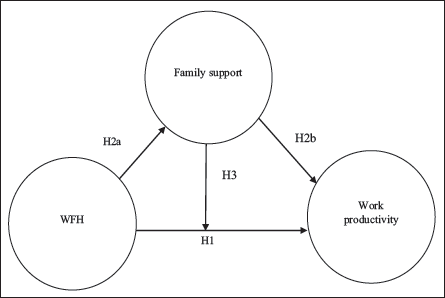
Balancing the disparate worlds of work and life while doing WFH becomes all the more important for women professionals to receive family/spousal support in a low gender-egalitarian Indian society (Rosenbaum & Cohen, 1999). Family support also plays a pivotal role in enabling women professionals’ work performance and career success (Neneh, 2018). Moreover, instrumental support (i.e., family’s contribution in managing household chores) can save time for female employees, encouraging them to tend to critical work-related tasks (Wayne et al., 2006). Further, the crossover theory explains the transfer of negative emotions from home to work and vice versa (Hammer et al., 1997). However, researchers predict positive crossover also occurs (Bakker & Demerouti, 2009), which indicates that when employees receive social support from their families, they perceive satisfaction at work (Friedman & Greenhaus, 2000). Therefore, when women professionals receive social support from their spouses, parents, relatives and children, it positively affects women’s careers (Voydanoff, 2001). Few researchers have investigated the aspects of family support enabling women’s work in the Indian context (Bosch et al., 2018; Kossek & Lautsch, 2018; Verma et al., 2018). However, there is a pressing demand to examine the women professionals’ productivity, especially in a highly vulnerable scenario of the lockdown in the Indian context, while most employees are participating in a WFH setup. To fill this lacuna, in this study, we aim to investigate if family support has a role in determining the effect on women professionals’ work productivity during the COVID-19 pandemic (Figure 1). Therefore, we hypothesize
Theoretical Framework.
METHODOLOGY
Participants and Procedure
We followed a convenience-snowball sampling technique to gather responses using Google forms. The survey questionnaire was emailed to authors’ personal and professional female acquaintances on 8 April 2020, during the first phase of the national-level lockdown announced by the Indian Government on 25 March 2020. This stay-at-home order for about 1.3 billion people was one of the largest lockdowns in history. At this point, people were starting to adapt to disruption in their regular work and life. We conducted an initial round of surveys among 24 participants to check on the overall quality of the instrument. We then improved the final questionnaire based on the inputs received from the survey respondents. After the survey was finalized, the online questionnaire was distributed amongst our immediate network through social media (e.g., WhatsApp). They were encouraged to further pass it on to others in their network. The study participants were briefed about the broad objectives of the study through email and other social media platforms, after which consenting individuals filled out the form.
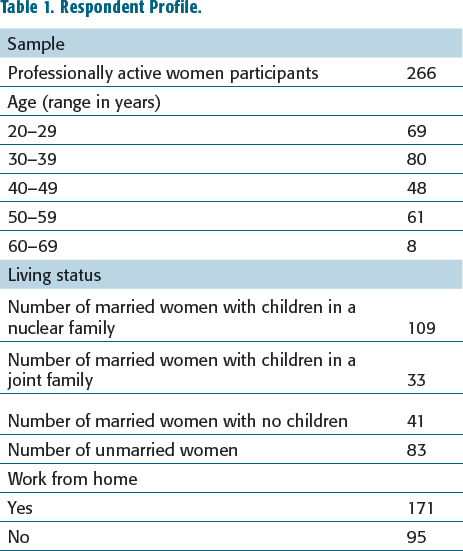
Women professionals who had an internet connection, access to social media, understood and read English, resided in India, and were above 18 years of age were included in the study. We received 325 responses from female participants. Out of those, 266 female respondents were professionally active. The inclusion criteria for the study were working women professionals of Indian ethnicity with postgraduate and above qualifications who lived in India during the lockdown induced by the pandemic. Data were collected about their socio-demographic factors, perceived productivity at work (WFH/ non-WFH), and instrumental support from their families (Table 1).
Respondent Profile.
Survey Instrument
The survey questionnaire was designed after the lockdown was announced. Given the vulnerability of the situation in March 2020, a simplistic survey instrument was constructed to ensure a decent response rate. To understand the impact of WFH during the lockdown on women professionals’ work, we examine three factors.
Work productivity:
Family support:
CURRENT RESEARCH
In this research, we test three hypotheses examining the influence of WFH on women professionals’ work productivity (H1), the direct effect of WFH on family support (H2a), and the direct effect of family support on work productivity (H2b), and the interaction of WFH and family support on women professionals’ work productivity (H3). By testing Hypothesis 1, we asked women professionals whether they were working from home or the workspace. We examined if women professionals doing WFH reported significantly higher work productivity than women working from the workspace (results presented in Hypothesis 1). For testing Hypothesis 2a, we examined whether women professionals doing WFH received more family support. For testing Hypothesis 2b, we examined whether women professionals who received more family support reported better work productivity (Table 2). Further, the testing of Hypothesis 3, we determine if there is an impact of the interaction between WFH and family support on female work productivity.
Hypothesis Testing (H2a and H2b).

RESULTS
Preliminary Analysis
We performed a normality test by checking the skewness and kurtosis of each item individually. The results indicate the following: instrumental family support (Kurtosis: −1.09, skewness: −0.2) and work productivity of female working professionals (Kurtosis: −1.03, skewness: −0.5). These values are in the acceptable range for assuming normalcy of data (George & Mallery, 2010). Since we have taken single-item indicators in the questionnaire, the use of PLS-SEM to analyse the data is most appropriate for this study (Petrescu, 2013).
Hypothesis 1
Independent sample T-test: We conducted an independent sample T-test to examine the work productivity of women professionals who were doing WFH and working from their workspaces during the COVID-19 pandemic. The female participants who worked from home demonstrated significantly better work productivity (N = 171, M = 3.8, SD = 1.09) when compared to the female participants who worked from their workspaces (N = 95, M = 3.1, SD = 1.65); t (264) = 4.11, p = 0.00. This result supports our hypothesis that women professionals doing WFH reported higher productivity than women professionals working from their workplace. Levene’s test for equality of variances is significant, so we have chosen the values for equal variance assumed.
Hypothesis 2
Direct effect: To investigate the direct relationship among constructs such as WFH and family support (2a) and family support and female work productivity (2b), t-values and beta-coefficients have been calculated using SmartPLS 3.0 at a 95% confidence interval level. These values are exhibited in Table 2. The study finds a significant direct relationship between family support and work productivity (H2b) but not for WFH and family support (H2a). The Cronbach alpha values for each of the constructs were tested and found to be greater than 0.7, ensuring reliability.
Hypothesis 3
Table 3. Hypothesis Testing (H3).

Additional Analysis: We performed an independent sample T-test to tease out differences in work productivity and family support based on the living status of the female professionals. First, we compared the work productivity of female professionals based on their marital status. The work productivity (unmarried: N = 60, M = 3.52, SD = 1.38; married: N = 111, M = 3.19, SD = 1.22) and family support (unmarried: N = 60, M = 3.93, SD = 1.08; married: N = 111, M = 3.79, SD = 1.09) were higher for unmarried female professionals than the professionals who were married, but there was no significant difference. Second, we compared the work productivity of female professionals based on their parenthood status. The work productivity (not parents: N = 90, M = 3.41, SD = 1.39; parents: N = 81, M = 3.19, SD = 1.15) and family support (not parents: N = 81, M = 3.92, SD = 1.09; parents: N = 111, M = 3.75, SD = 1.09) were higher for female professionals who did not have children. There was a significant difference between work productivity (t (169) = 1.01; p value = .007) of female professionals who had children and those who did not have children.
DISCUSSION
Studies investigating women professionals’ work productivity revealed that the lockdowns during the COVID-19 pandemic disproportionately impacted their work while working from home (Alon et al., 2020; Feng & Savani, 2020; Guy & Arthur, 2020; Wenham et al., 2020). Contrary to this, our findings (Hypothesis 1) in the Indian context indicate that women professionals working from home during the lockdown reported higher work productivity than women professionals working from their workspaces. Perhaps, Indian women professionals experienced flexibility while doing WFH, because of which they reported higher work productivity. Moreover, based on the relational-cultural theory, growth and development occur through intersubjective relational experiences and not individualistically (Banks, 2011). These values stand in contrast to western values, so in the Indian context, women professionals might be experiencing higher work productivity while doing WFH even if they are overworked because they intrinsically appreciate relatedness and interconnectedness that percolates to their professional work. They may also have better managed their time between professional and household duties due to no commute. Further, our findings (Hypothesis 2a) indicate that WFH did not garner instrumental family support for women professionals. Since women professionals were doing WFH, they had to diligently perform household chores, care work, home schooling, and professional work. The families did not see the need to support working women with household duties since doing WFH is not seen as demanding work. The finding aligns with the study (Gross, 2020) that highlights grotesque gender inequality in household work during the pandemic. In fact, sharing of household burdens has not improved despite more women pursuing professional careers over the past decade (Lachance-Grzela & Bouchard, 2010). Moreover, failure to work and manage the household effectively is often seen as a personal failure and not a social issue (Toffoletti & Starr, 2016).
Additionally, WFH increases the load of unpaid work at home for women professionals (compared to men) because of social pressures on women to dedicate more time to household chores and child-rearing activities (Noonan & Glass, 2012). On the one hand, women professionals believed WFH did not consequent in them receiving family support. On the other hand, our findings (Hypothesis 2b) reveal that they reported higher work productivity when women professionals received family support. Prior research studies suggest that gender inequalities in work and family are connected (Gerson, 2009; Perry-Jenkins & Gerstel, 2020; Raley et al., 2012), and the outbreak of the COVID-19 pandemic has deepened these inequalities. However, some researchers (Carlson et al., 2020; Shockley et al., 2020) have suggested that gender egalitarianism has persisted in some households that enabled sharing of household responsibilities during the pandemic.
Furthermore, our findings reveal that female professionals with children showed significantly lower work productivity than female professionals without children (married and unmarried). This finding suggests that even when professional women perceived their partner’s contribution to household chores, childcare predominantly remained a female responsibility. As a result, female professionals with children could not be as productive at WFH as their female counterparts with no childcare responsibilities. Moreover, this study looked at instrumental family support for household chores wherein childcare was unaccounted for.
THEORETICAL IMPLICATIONS
This study contributes to the large body of work and efforts made by various researchers to understand the gendered impact of COVID-19 on women professionals’ work in multiple contexts across the globe. Our study in the Indian context puts forth a distinctive perspective given the unique socio-cultural standing of India that differentiates it from the western culture. For instance, we found that WFH in the Indian context enhances women professionals’ work productivity. This finding is distinct from the studies conducted in western nations (Feng & Savani, 2020). This study showcases and supports literature indicating that differences in culture produce varying results, so culturally specific theories should be adopted. This study also contributes to the literature in the work–family discourse, which is central to the wellbeing of women professionals in this novel situation of a global pandemic. Finally, worker productivity often locates the locus of control within the worker (Chen & Silverthorne, 2008). In contrast, this study shifts the focus of women professionals’ work productivity from a personal or familial issue to a social one by arguing that the role of family support is not sufficient to enable women to perform work efficiently. A holistic approach to tackling the overall patriarchal mindset needs to be considered.
MANAGERIAL IMPLICATIONS
Our study has various practical implications for managers. First, women employees have reported better work productivity while doing WFH, which suggests that flexible and family-friendly work policies might help them derive more satisfaction from work and engender their work productivity. Managers should ensure flexibility of geographical location and time for their female employees. Second, since remote work has become the new normal of our times, managers must focus on creating a work environment that is not just gender-neutral but gender-sensitive. Since our findings indicate that women professionals doing WFH do not garner family support, the onus lies on organizations to ensure their female employees’ social support. Third, the COVID-19 pandemic has resurfaced the importance of work–family discourse, ‘one size fits all’ HR policies might appear tokenistic and have little to no impact on the wellbeing of their employees. Managers need to understand these implications in the Indian context and formulate policies accordingly.
CONCLUSION, LIMITATIONS, AND FUTURE RESEARCH
The COVID-19 pandemic has created a unique working environment, with WFH becoming the new normal. Scholars indicate that WFH practices have varying influences on the work productivity of men and women. As a result, a couple of scholars conducted a study to test the impact of WFH on women professionals’ work productivity using the lens of gender role theory (Bem, 1993) during the COVID-19 lockdown and found that WFH decreases women professionals’ work productivity because their proximity and accessibility at home gives rise to higher domestic demands which significantly reduces their professional productivity (Feng & Savani, 2020). However, many of these studies were conducted in western nations. This study attempts to examine the impact of WFH on professional women professionals’ work productivity in the Indian context. Furthermore, the impact of family support on work productivity and the interaction of WFH and family support on work productivity are also examined.
The findings present novel takeaways. First, unlike the west, WFH in the Indian context improves professional women’s work productivity because they might have experienced greater flexibility in managing their domestic and professional duties. Second, we tried to examine whether WFH increases family support and can explain the increase in women professionals’ work productivity. The findings indicate no support for the hypothesis. This relationship has not been tested before and hence contributes to the literature. It would be interesting to examine this relationship in the western context by performing cross-cultural studies. Third, this study indicates that family support increased professional women’s work productivity during the COVID-19 lockdown. We found no literature examining this relationship in the Indian context, and hence, this is a novel finding. Fourth, WFH and family support do not interact to increase work productivity. This finding suggests that individually, WFH and family support contribute to work productivity, but together they do not. This finding makes practitioners sense that while both aspects are essential, thinking WFH means more family support would be wrong. Additionally, work productivity in female professionals with no children was significantly higher than female professionals with children because of the gendered nature of childcare responsibilities.
Several limitations are present in the research. First, this study generalizes professional women. Although we have teased out some findings based on women professionals’ marital status and parenthood status, we did not consider single women with children and women who were the sole working members of the family and their varied professions. These women professionals might have faced exacerbated difficulties during the pandemic. Hence, future researchers may study specific samples of working women and make a comparison. Second, the data are collected through a survey method. The survey can create social desirability, non-response, and common method biases. Although steps were taken to minimize these biases, these biases still may exist. Future researchers may adopt a mixed-method approach to confirm the findings through several data collection and analysis methods. Third, since many people are confined indoors, they might succumb to mental health issues. Future researchers can examine how mental health affects work productivity in women and its reasons. Fourth, comparing male and female work productivity in heterosexual dual-income couples in the Indian context would be interesting to shed some light on WFH and family support. Lastly, we also believe that family support, especially in the Indian context, will significantly impact the work productivity of married women professionals who stay in joint families compared to women in a nuclear family context. The analysis of such data can provide exciting revelations. We urge future researchers to look into this.
Footnotes
DECLARATION OF CONFLICTING INTERESTS
The authors declared no potential conflicts of interest with respect to the research, authorship and/or publication of this article.
FUNDING
The authors received no financial support for the research, authorship and/or publication of this article.
e-mail:
e-mail:
e-mail: