




Abstract
Considering the potential impacts of context-specific value systems in individuals’ perceptions of phenomena, this study seeks to investigate whether and how cultural differences could influence the effectiveness of leadership styles in establishing trust and positive employee outcomes (PEOs) as well as the relationships between such outcomes based on the GLOBE project. The sample consisted of 1647 valid responses from 128 independent hotels’ employees in four countries from two GLOBE clusters (Anglo and South Asia). Multilevel structural equation modelling has been used for the analysis. Significant but different relationships were found between Servant Leadership and Transformational Leadership with Trust, and PEOs in the two clusters, which could be potentially attributed to societal and contextual factors as a deeper layer mechanism. Our findings have significant implications for both academics and hotel managers in terms of the critical role of alignment between context-specific contingencies and the selected leadership style in establishing trust and PEOs.
Keywords
Introduction
This study compares the effect of two leadership styles on trust and on the relationships between trust and other organisational variables, such as Organisational Citizenship Behaviour (OCB) which are known to affect organisational outcomes, such as effectiveness and profitability. The data were collected in two regions of the world which have contrasting national culture characteristics to discover how national culture affects these relationships. They are of particular current interest since these relationships will, inevitably, become more significant in the face of presently unfolding technological developments (Alibakhshi et al., 2024).
Additionally, taking on a comparative perspective in studying national culture and its potential impacts on developing trust and positive employee outcomes is necessary to extend our current understanding of how the universal and effective leadership practices are (House et al., 2004). So far, the concept of national culture and its relation to wide a variety of organisational aspects including organisational culture, and performance (e.g. Fisher et al., 2010; Nazarian et al., 2017), Organisational Citizenship Behaviour (OCB) (e.g. Nazarian et al., 2020; Paine and Organ, 2000) and Organisational Effectiveness (e.g. Nazarian et al., 2019; Sucher and Cheung, 2015) have been investigated in the hospitality literature. However, there are still gaps in our understanding of how cultural differences may influence leadership effectiveness in building Trust in Leaders along with the positive employee outcomes which are dependent on it.
In the 1990s the theory of Full Range Leadership came into vogue which, in its simplest form, divided possible leadership styles between Transformational and Transactional (Bass and Avolio, 1990). Here the Transactional style harked back to the bureaucratic approach of the second Industrial Revolution where it was assumed employees were motivated by material rewards whereas the Transformational style assumed that employees could be more effectively motivated by being part of an inspiring collective endeavour revealed to them by Transformational Leaders. This approach to leadership coincided with the Third Industrial Revolution where there was a need for well-educated employees who can work with a minimum of supervision giving rise to a movement away from emphasis on bureaucratic management according to Taylorist principles towards encouraging employee involvement in decision making and problem-solving processes, while acknowledging the importance of Hertzberg’s Hygiene Factors (Herzberg and Mausner, 1959).
Transformational Leadership is still popular among scholars despite problems with the notion that it is the actions of individual leaders that make a difference (Gronn, 1995); however, more recently other leadership styles have also found favour among leadership researchers such as Authentic Leadership (George, 2003), Servant Leadership (Greenleaf, 1977) and Ethical Leadership (Nazarian et al., 2022). As we move into the era of the Fourth Industrial Revolution with the increasing use of AI and autonomous devices, scholars will be increasingly digging deeply into the originating principles of leadership styles to examine what it is leaders are trying to achieve. This study assumes that making employees as effective as possible is the most important task of a leader and, therefore, the leadership style that puts most emphasis on the employees, Servant Leadership, seems to be particularly relevant to the new age. Leadership style affects Trust, which in turn affects Job Satisfaction, Commitment and Organisational Citizenship Behaviour (OCB), and these ultimately affect profitability. Therefore, one of the possible outcomes of this study is to suggest some characteristics of national cultures which make them fit to cope with the new age.
An excellent context in which to conduct this examination is the hospitality industry since its principles of customer service are resistant to technological improvement and, therefore, we can assume that this industry will have been similarly unaffected by technology in all parts of the world. This point is encapsulated in the Doorman Fallacy (Sutherland, 2019) which is a generalization from an observation that when a hotel installs automatic doors, they dispense with the doorman who formerly opened the main doors of the hotel for guests. The occupancy of the hotels fell, and this was found to be due to the doorman doing much more than opening the doors. He was also giving the hotel a friendly, human face.
This study aims to discover how cultural and context-specific variations can influence the effectiveness of leadership styles in establishing Trust in Leaders, followed by Job Satisfaction, Organisational Commitment and Organisational Citizenship Behaviour as well as how such outcomes relate to each other in two different cultural clusters. In doing so, we build on previous cross-cultural studies in the hospitality industry which investigate the perception of employees from different cultures and its impact on other factors such as OCB (Nazarian et al., 2021) or intention to leave (Nazarian et al., 2022). To address this gap in our knowledge, we apply the GLOBE index (Dorfman et al., 2012) as a foundation for the selection of the countries under study. Based on this index, the countries in the Southern Asia cluster - Iran and India - exhibit different values from those of the Anglo Cluster - United States and UK (House et al., 2004).
Data were collected from independent hotels in the four countries categorized in two distinct cultural clusters (South Asian and Anglo), which places the present research among the very few projects at this scale. Moreover, our research sheds light on how national culture may influence employees’ perceptions of leaders’ trustworthiness, the role of trust in achieving positive employee outcomes and the interrelationships between positive employee outcomes in different cultural settings.
Theory and hypotheses development
GLOBE study: Concept and application
The GLOBE study is a multi-phase, multi-sample project which presents a cultural variance across, and congruence within, cultures about the definition and characteristics of effective leaders (Stephan and Pathak, 2016). GLOBE shows how the same behaviours of the leader might be perceived differently in different contexts (Schyns and Schilling, 2011).
The Anglo societies exhibit rather high scores in Performance Orientation, which encourages individualistic behaviours and competitiveness. Meanwhile, Institutional Collectivism scores in the medium range, favouring group cohesion and the collective distribution of resources. Humane Orientation is also rated in the middle range, whereas Power Distance, or the degree members acknowledge the necessity for power differentials, is relatively low. Of particular interest is the Anglo’s score on Charismatic Leadership as the highest among all clusters, reflecting the desire for a realistic vision, and high-performance expectations. The cluster also scores highly in Participative Leadership approaches, where members are encouraged to contribute to decision making and implementation. As such, we expect this cluster to prefer leadership practices that provide inspiration and vision as well as teamwork, delegation and inclusiveness of all members in decision making.
On the other hand, the South Asian cluster is characterized by high levels of In-group Collectivism, Power Distance and Humane Orientation. This means members take pride in family and organisations, accept status privileges and encourage caring behaviours towards others. Performance Orientation, and Institutional Collectivism stand in the middle range whereas Assertiveness is lower than other clusters, including the Anglo. An interesting point about the South Asian cluster is its strong tendency not to depart from its existing cultural practices. In other words, the cluster struggles to achieve lower Power Distance as well as higher Performance, Future Orientation and Institutional Collectivism. The cluster also favours visionary leaders willing to make personal sacrifices. Although participative approaches are viewed positively, the cluster scores highest in Humane Orientated styles.
Servant Leadership and Transformational Leadership: Does national culture matter?
Servant Leadership (SL), as a form of people-centred leadership, continues to gain prominence in organisational studies thanks to its proven positive impacts on employee engagement, cooperation, creativity and service quality (Neubert et al., 2016). According to Eva et al. (2019), Servant Leadership is “an (1) other-oriented approach to leadership (2) manifested through one-to-one prioritizing of follower individual needs and interests, (3) and outward reorientating of their concern for self towards concern for others within the organisation and the larger community” (p. 114).
In 2023 with the release of ChatGPT 4.0, and other chatbots, the 4th Industrial Revolution, characterized by Artificial Intelligence took off. Scholars agree that the organisations that are fittest to survive in this environment are agile ones (Marnewick and Marnewick, 2020). A leadership style that has been shown to support agility is Servant Leadership (Abdolrasoul Hosseini et al., 2014). It follows that Servant Leadership will be of enduring interest to scholars and practitioners as they get to grips with how to make organisations fit for this new world order.
Similarly, Transformational Leadership (TFL) encourages members to engage more in in-role and extra-role activities (Ng, 2017), using charisma, inspiration and motivation in a top-down manner (Yang et al., 2021). TFL is a leadership style that “influences followers to transcend their self-interest for the larger good of their team and organisation” (Deinert et al., 2015, p76).
Debates concerning the most effective leadership style for a specific context have been ongoing for decades, with arguments about the power of national culture in shaping effective leadership (Rabl et al., 2014). However, the findings of previous studies have been inconsistent, which justifies further investigation into the topic. For example, Rockstuhl et al. (2012) found that members of collectivist versus individualistic cultures react differently to similar member-leader exchanges. In contrast, Li et al. (2012) show that leader-member exchanges appear to be stronger in countries lower in Performance Orientation or Gender Egalitarianism and higher on Power Distance. They further point out that independent of the national culture, Ethical, Transactional and Servant Leaderships are all appropriate to induce employee engagement.
H_0: The Leadership-Trust relationship is stronger in the Asian cluster than in the Anglo cluster.
Trust in the leader
Trust in the leader is defined as “perceptions of being able to communicate openly [with the leader] … on job-related problems without fear of negative repercussions” (Fulk et al., 1985: p. 302). While current literature has demonstrated the positive impact of followers’ Trust in Leaders on generating desirable employee/ organisational outcomes (e.g. Burke et al., 2007; Dirks and Ferrin, 2002), our knowledge about the extent to which leadership practices can generate trust is still in its infancy (Soderberg and Romney, 2022). Prior studies refer to the leadership style as a key antecedent of Trust in Leader (e.g. Kara et al., 2013; Kelloway et al., 2012; Podsakoff et al., 1990). Because of their minimized pride, altruistic behaviours and concern for the interests of all stakeholders, Servant Leaders are perceived as reliable role models by followers (Schwepker and Dimitriou, 2021). Servant Leaders commonly establish a one-to-one basis for communication with followers to best understand their unique needs, goals and aspirations. They also inspire employees' trust (Chiniara and Bentein, 2016).
However, the effect of Servant Leadership and Transformational Leadership are different in building Trust in Leaders. Van Dierendonck (2011) argues that Servant and Transformational Leadership share common attributes such as supportive behaviour, individualised attention to followers’ needs and inspiration. But the difference lies in an element of charisma in Transformational Leaders and their different focus of attention, that is individual and organisational objectives for servant and transformational approaches, respectively. While both Servant and Transformational Leadership positively impact employees’ trust, the latter has also a dark side that can be as strong as its bright side, but often ignored by scholars (Li and Yuan, 2017; Tourish, 2013). The charismatic element of Transformational Leadership, although inspirational for followers, may at times turn into self-centeredness, excessive self-admiration, thirst for power, and less openness to criticism, which represent authoritarian preferences (De Villiers, 2014; Li and Yuan, 2017), and thus are less effective for building Trust in Leaders among employees. From a different perspective, Servant Leadership strives for the fulfilment of employees’ individual needs, with organisational goals seen as only secondary (Eva et al., 2019). In contrast, with Transformational Leadership, individual needs are answered to facilitate the realization of organisational objectives as the main focus.
Although Transformational Leadership is often viewed as a means to raise motivation and morale in both the leader and followers, Transformational Leaders may fall into pseudo-transformational practices. On the other hand, Servant Leaders’ primary focus is their followers in contrast to Transformational Leaders, who endeavour to inspire followers to better realise organisational goals (Hoch et al., 2018).
Thus, it is hypothesized that:
H_1: Servant Leadership has a more positive impact on Trust than Transformational Leadership.
Positive employee outcomes and leadership style
Leadership has often been cited as a major driver of positive employee outcomes (Huertas-Valdivia et al., 2019; She et al., 2020), which leads to better performance of organisations and service excellence (e.g. Kang and Busser, 2018; Kara et al., 2013; Li et al., 2012). Positive employee outcomes cover a wide range of employee attitudes and behaviours. However, the focus of this study is on Job Satisfaction, Organisational Commitment, and Organisational Citizenship Behaviour (OCB). Job Satisfaction is defined as a pleasurable or positive emotional state resulting from one’s job or job experiences (Appiah, 2019). Organisational Commitment refers to the degree an employee identifies with and believes himself/herself to be a member of the organisation. Finally, Organisational Citizenship Behaviour (OCB) includes employees’ extra-role activity that is not formally recognised by the reward system, yet it is done for the benefit of the others in the organisation or the organisation itself and promotes overall performance (Yoon et al., 2015).
Thanks to its developmental nature, Servant Leadership (SL) has a substantial role in generating positive employee outcomes (Eva et al., 2019). Certain attributes of SL such as empowering, giving direction, authenticity and high levels of interpersonal acceptance could induce Job Satisfaction in the followers (Van Dierendonck, 2011). Because Servant Leaders serve the interests of followers first, they provide followers with the opportunity to realize their potential, choose their own ways of doing things, and even receive support in professional and personal problems, all of which contribute to positive work experiences for the followers (Ozyilmaz and Cicek, 2015). Similarly, Mayer et al. (2008) posit that SL can both directly and indirectly (through a mediating mechanism of justice perception) improve employees’ Job Satisfaction. In addition, acting as caretakers by the leaders encourages employees to take a more active role in the organisation (Ozturk et al., 2021), and results in higher levels of commitment among the employees (Jang and Kandampully, 2018). Finally, the high-quality leader-follower exchanges characterized by mutual trust, genuine interest and empowerment received from the Servant Leader are likely to motivate employees to reciprocate beyond their in-role tasks (Van Dyne et al., 2008; Zou et al., 2015).
Thus, it is hypothesized that:
H_2: Servant Leadership has a positive impact on Positive Employee Outcomes.
H_2.1: Servant Leadership has a positive impact on Job Satisfaction.
H_2.2: Servant Leadership has a positive impact on Organisational Commitment.
H_2.3: Servant Leadership has a positive impact on OCB.
In a similar vein, Transformational Leadership has been associated with feelings of trust and positive employee outcomes. TFL influences Job Satisfaction and commitment through inspiring employees to have a more positive experience resulting from the leader’s attention to their interests and giving meaning to their jobs (Guay and Choi, 2015; Ng, 2017). Furthermore, by giving individualized mentoring, fostering collective goals and creating a sense of belonging with shared values and beliefs in the followers, Transformational Leaders can inspire followers to be more committed (Avolio et al., 2004; Van Dierendonck et al., 2014) and perform above what the formal organisation expects from them (Guay and Choi, 2015), thus exhibiting augmented levels of OCB.
Therefore, it is hypothesized that:
H_3: Transformational Leadership has a positive impact on Positive Employee Outcomes.
H_3.1: Transformational Leadership has a positive impact on Job Satisfaction.
H_3.2: Transformational Leadership has a positive impact on Organisational Commitment.
H_3.3: Transformational Leadership has a positive impact on OCB.
Trust, Job Satisfaction and Organisational Commitment
Trust is an antecedent to several desired work outcomes (e.g. Burke et al., 2007; Guzzo et al., 2021). It is directly associated with overall Job Satisfaction, which results in heightened levels of Organisational Commitment among frontline hotel employees (Magnini et al., 2011). Developing organisational Trust means employees feel safe to depend on the organisational practices, including how the organisation treats them in challenging situations, conducting mentorships to provide them with better opportunities to grow and fulfilling its promises (Chathoth et al., 2011). Under such circumstances, employees are more inclined to experience Job Satisfaction and Commitment (Yao et al., 2019).
Thus, it is hypothesized that:
H_4: Trust has a positive impact on Job Satisfaction and Organisational Commitment.
H_4.1: Trust has a positive impact on Job Satisfaction.
H_4.2: Trust has a positive impact on Organisational Commitment.
Positive employee outcomes and their relationship
Positive employee outcomes are interrelated. Job Satisfaction is believed to positively impact Organisational Commitment and OCB. Higher satisfaction results in increased level of employee engagement, which includes commitment, and personal dedication to one’s job (Lee et al., 2011). Furthermore, unsatisfied employees tend to leave their jobs because Job Satisfaction is an important predictor of employee commitment, loyalty to the organisation and intention to stay (Koo et al., 2020; Lu et al., 2015).
Similarly, Podsakoff (2000), found four different antecedents of OCB: employee characteristics (including Job Satisfaction and Organisational Commitment), and leadership styles along with task and organisational characteristics. Because satisfaction creates a stronger sense of willingness to cooperate and contribute to the employees, it positively influences OCB, where satisfied employees feel committed to reciprocate the benefits provided by the managers or the organisation (Koo et al., 2020; Yang et al., 2021). Also, Organisational Commitment positively correlates with OCB because the more an employee is committed to his or her organisation, the higher the propensity for engaging in extra-role behaviours to achieve organisational goals (Koo et al., 2020).
Thus, it is hypothesized that:
H_5: Job Satisfaction has a positive impact on OCB.
H_6: Job Satisfaction has a positive impact on Organisational Commitment.
H_7: Organisational Commitment has a positive impact on OCB.
Mediating role of trust in the relationship between leadership style and positive employee outcomes
Trust in leaders is often associated with positive outcomes and motivations in the employees (Tourigny et al., 2019; Wood et al., 2021). Yet, despite rising interest in the correlations between Trust and leadership styles, results have been inconsistent (Schaubroeck et al., 2011), which calls for more investigation (Soderberg and Romney, 2022). This is even more critical in the quest for exploring the mediating mechanisms, whereby Trust in the leader affects the leadership-employee outcomes (e.g. Chan and Mak, 2014; Kashyap and Ragnekar, 2016). Trust is a two-facet construct, composed of cognitive and affective Trust (Dirks and Ferrin, 2002). The cognitive dimension of Trust focuses on performance-relevant concepts such as competence, reliability and dependability to solve job-related problems. Thus, it can mediate the relationship between leader and employee satisfaction and commitment (Hon and Lu, 2010). On the other hand, the affective side refers to the emotional ties between the parties based on sincere care, affiliation, reciprocity and empathy (Schaubroeck et al., 2011), all of which justify why affective Trust can act as a mediating factor in the relationship between leadership style and OCB (Hon and Lu, 2010). Braun et al. (2013) consider a mediating role for Trust in Leader-follower relationships because building Trust-based relationships positively impacts followers’ perceptions of teammates, supervisors and the organisation in general. In fact, establishing high levels of Trust is a common bridge that develops balanced social exchanges, resulting in favourable attitudes and outcomes such as employee commitment, Job Satisfaction and Organisational Citizenship Behaviours (Ling et al., 2016).
Thus, it is hypothesized that:
H_8: Trust mediates the relationship between Servant Leadership and Positive Employee Outcomes.
H_8.1: Trust mediates the relationship between Servant Leadership and Job Satisfaction.
H_8.2: Trust mediates the relationship between Servant Leadership and Organisational Commitment.
H_8.3: Trust mediates the relationship between Servant Leadership and OCB.
And:
H_9: Trust mediates the relationship between Transformational Leadership and Positive Employee Outcomes.
H_9.1: Trust mediates the relationship between Transformational Leadership and Job Satisfaction.
H_9.2: Trust mediates the relationship between Transformational Leadership and Organisational Commitment.
H_9.3: Trust mediates the relationship between Transformational Leadership and OCB.
Methodology
Context
Independent hotels constitute around 46% of the industry worldwide (IHG Annual Report, 2018, 2021), with an increase of up to 90% in specific countries (Nazarian et al., 2021). This posits independent hotels as a major component of the industry and an important economic driver of nations (Nazarian et al., 2019, 2021). Yet, independent hotels suffer from less recognition among customers, lower pre-established demand, insufficient management skills (Ribaudo et al., 2020) and strict resource limitations (Madera et al., 2017; Nazarian et al., 2019). As a remedy to these disadvantages, hotels are in dire need of leadership styles that allow for more effective interaction of managers with employees to influence their attitudes and perceptions and subsequently how they treat visitors (Buil et al., 2019; Testa, 2009).
Sample and procedure
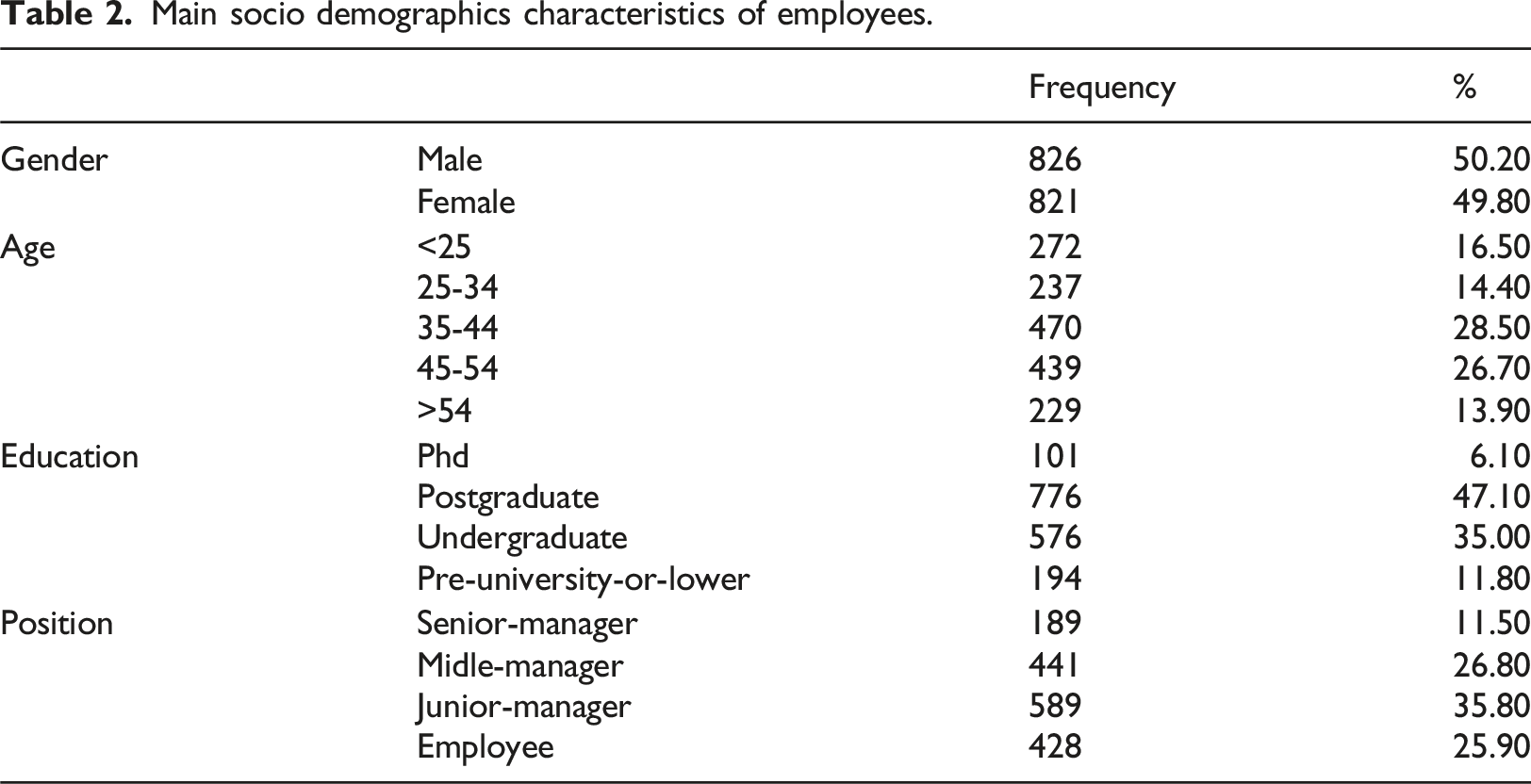
Data was collected from 128 independent hotels in different sizes, based on the number of employees, in order to test the proposed hypotheses. Hotels were located in major cities in four different countries: United Kingdom, United States, India and Iran. The cities were selected considering their tourist activity. Thus, in the UK, most of the survey responses come from hotels located in London and Edinburgh. In the case of the USA, the hotels are in New York, San Francisco and Los Angeles. In India, the hotels are located in Delhi, Mumbi and Agra, while in Iran most are located in Tehran, Shiraz and Isfahan. The selection of hotels was made through a non-probability convenience sampling according to the accessibility of the hotel managers who collaborated in the data collection. More specifically, the questionnaire was developed in both hard-copy and online link. Most of them were received in online format and a very small part of them were completed in hard-copy format. A total of 1647 valid responses were received by hotel employees.
Distribution of number of hotels and an employees per country.

Main socio demographics characteristics of employees.
Measures
The instrument included a total of 51 items used in the previous literature to measure each of the six relevant variables used in this study: Servant and Transformational Leadership, Trust, Job Satisfaction, Organisational Commitment, and OCB. Servant and Transformational Leadership, as well as Trust in the Leader, refer to issues that have to do with the direct managers of the employee who responds in each case. Instead, Job Satisfaction, Organisational Commitment, and OCB are variables that refer to employee-related issues. The measurement of all these variables was carried out using a seven-point Likert-type scale that goes from extremely strongly disagree to extremely strongly agree. All the questionnaires were in the same language, English, since this is the universal language used in the tourism sector.
Servant Leadership was measured using the reduced seven-item scale proposed by Liden et al. (2014). Transformational Leadership was measured using the short version of the MLQ 5X, using 20 items that measure its five dimensions; each of these latent factors was measured with four items (Nazarian et al., 2017). Trust in the Leader was measured by four items adopted from Schoorman et al. (2006) that has been used in other similar works (Dai et al., 2013). Job Satisfaction was measured by four items extracted from Macdonald and Maclntyre (1997) and Nazarian et al. (2019). Three items by Chiang and Jang (2008) and three others taken from Dai et al. (2013) were used to measure Organisational Commitment. Finally, the OCB measure includes 10 items adapted from Wang and Wong (2011) that are related to the contribution that employees make to the organisation of their own free will, that is, without considering the organisation’s formal rules, rewards or punishments that can be derived from such behaviours. The OCB measure includes two items to measure each of the dimensions proposed by Podsakoff et al. (1990): conscientiousness, sportsmanship, civic virtue, courtesy and altruism.
Analytical strategy
Two, out these six variables described, refer to the leadership style in the organisation (Servant and Transformational) and another measured Trust in the leader. The rest are variables that measure employee related variables (Job Satisfaction, Organisational Commitment, and OCB). This allows us to distinguish two levels depending on the nature of these variables. On the one hand, there are the variables of the most disaggregated or atomic level, that is, employees. At the atomic level, the origin of variability is due to the differences in the responses that employees provide regarding their satisfaction with work, commitment to the organisation and the OCB, as well as the context in which the work takes place.
The presence of contextual variables that affect the employees of the same organisation observations cannot be considered as independent. It is important to accommodate these circumstances and for this reason, in this study, a multilevel methodology is used distinguishing two levels: the atomic level (or level 1), which refers to employees and where variables such as Job Satisfaction, Organisational Commitment and OCB are circumscribed; and the upper level (or level 2) where we can find the variables related to the leader of the organisation (Transformational / Servant Leadership, and Trust in Leader).
Finally, since each variable is measured by more than two items, it is essential to evaluate their psychometric properties using the multilevel confirmatory factor analysis. Once the scales have been validated, that is, once its convergent and discriminant validity has been verified, as well as its reliability, the hypotheses will be tested using multilevel path analysis. As Silva et al. (2020) explain, multilevel structural equation modelling is a statistical technique whose purpose is the simultaneous estimation of several equations to test the relationship between a set of variables. Unlike classical structural equation models, multilevel equation models accommodate variables that are at different levels when the data is naturally nested (children in schools, regions in the EU, voters and districts, etc). Multilevel structural equation models can also be seen as models where a set of random coefficients exist, which is why they are sometimes also known as mixed models.
Results
Measures validity
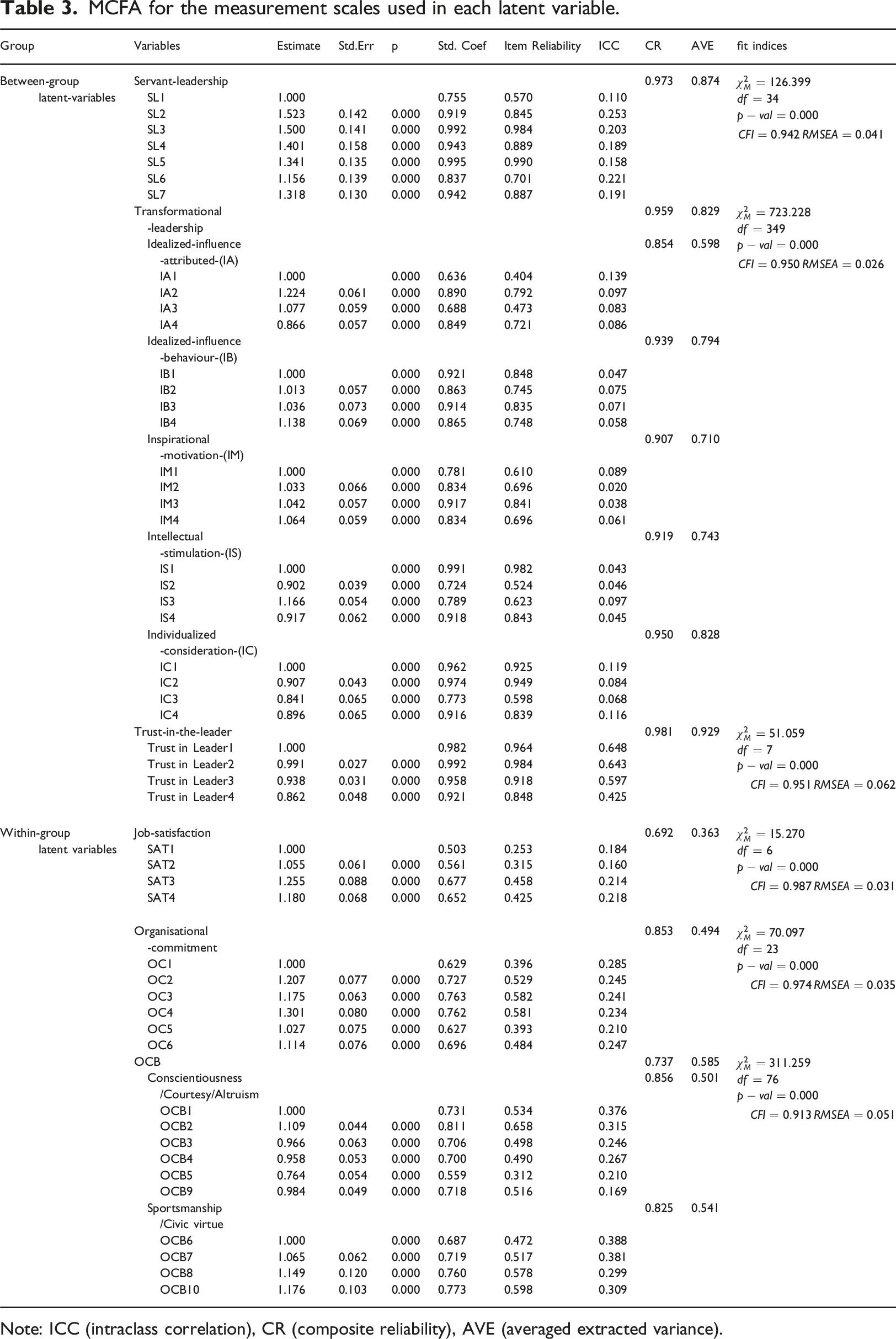
MCFA for the measurement scales used in each latent variable.
Note: ICC (intraclass correlation), CR (composite reliability), AVE (averaged extracted variance).
Secondly, the mean intra-class correlation (ICC) fluctuates between 0.07 (Transformational Leadership) and 0.578 (Trust in Leader), what justifies the use of multilevel modelling (Dyer et al., 2005). In addition, all MCFAs show adjustment indicators above the standards recommended by the literature since the CFI is above 0.90 and the RMSEA is in all cases below 0.05. The fact that the statistic (?_M^2) of the model is significant is partly explained by the large sample size analyzed.
Thirdly, for the three latent variables of the higher level (Servant/Transformational Leadership, and Trust in Leader), high between-group factor loadings are obtained, which is consistent with the proposition that the theoretical level of these three constructs are part of the higher level (level 2) (Dyer et al., 2005).
Fourthly, for the three constructs at the atomic level (Job Satisfaction, Organisational Commitment, and OCB), the factor loads at the atomic level are high; therefore, these latent variables will be analyzed at the atomic level (employees of each hotel).
Finally, the composite reliability of all latent variables (including atomic level and higher level) is greater than 0.70 (with the exception of Job Satisfaction, which is very close to a value of 0.692), which means that all latent variables are reliable. On the other hand, AVE is above the recommended value of 0.50, except for Organisational Commitment, which is very close to this limit (0.494) and Job Satisfaction (0.363). In the latter case, the elimination of any of the items does not substantially improve the AVE; therefore, all have been maintained to avoid harming the content validity in this way (Hair et al., 2010). The individual reliability of each of the items used in the questionnaire exceeds the value of 0.5 or is close to this value (Hair et al., 2010) (see Table 3). From the previous results, it can be concluded that the scales have convergent validity.
Item parcelling and aggregation the between-group latent variables
Given the complexity of the factorial structure shown in Table 1, we choose to simplify each latent variable by averaging the items that have been used to measure it (Hair et al., 2010). Literature recommends using both agreement and reliability measures to determine the degree of similarity between the aggregate variable and that of the atomic level (Bliese, 2002). In order to demonstrate agreement, it is necessary that the similarity of the responses of the members of a group (hotel employees) is greater than that which would have been obtained randomly. The most common way of doing this is using the indicator r_wg, which requires values above 0.70. Because there is an agreement index for each group (hotels in our case), we chose to summarize all this information using the median. While reliability is usually measured using the indicator ?ICC?_2, which also requires values above 0.70.
The results show that in all cases r_wg is above the limit recommended by the literature (0.854, 0.878 and 0.769 for servant, transformational and Trust in the leader, respectively), while ?ICC?_2 is also higher than the recommended value (0.87 for Servant Leadership and 0.968 for Trust in the leader), except in the case of Transformational Leadership, which is very close (0.68). Based on the above, the variables servant / Transformational Leadership and Trust in the leader are added at the top level (hotels).
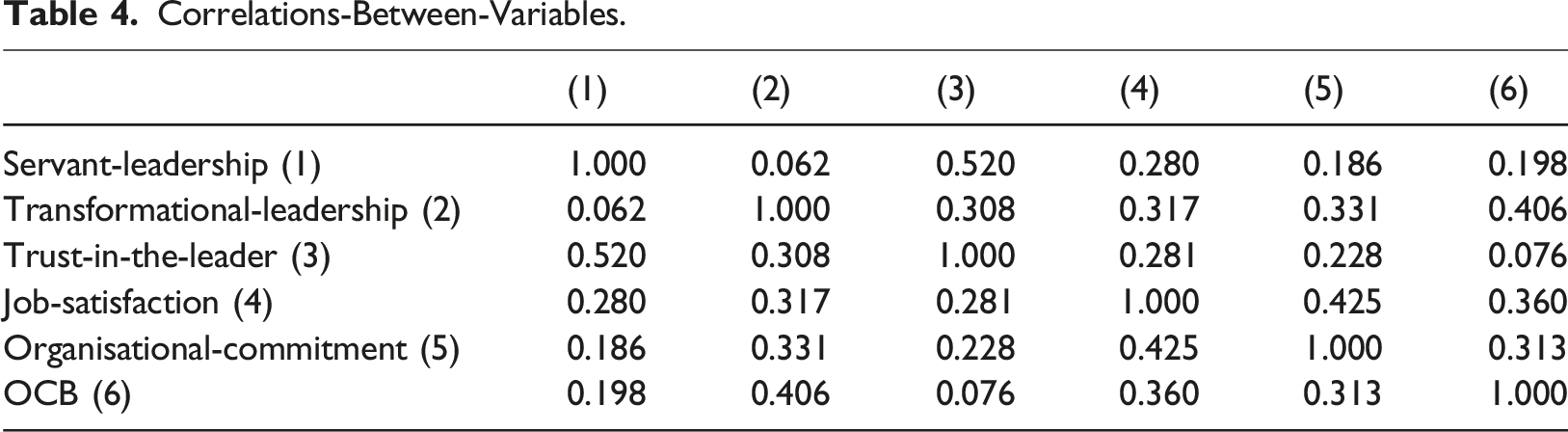
Correlations-Between-Variables.
Hypotheses testing
A multilevel path analysis with a random intercept is carried out to test the hypotheses proposed in this investigation (see Figure 1 and Table 5) and maximum likelihood is used as an estimation procedure. The model fit was adequate since the global fit indicators are within the values recommended by the literature, with the exception of the ?_M ^ 2 statistic, which was significant due to its dependence on the sample size (?_M ^ 2 = 6691 ; df = 2; p = .035; CFI = 0.991; RMSEA = 0.038). Standardized coefficients of proposed relationships. Unstandardized-And-Standardized-Coefficients-Of-Proposed-Relationships.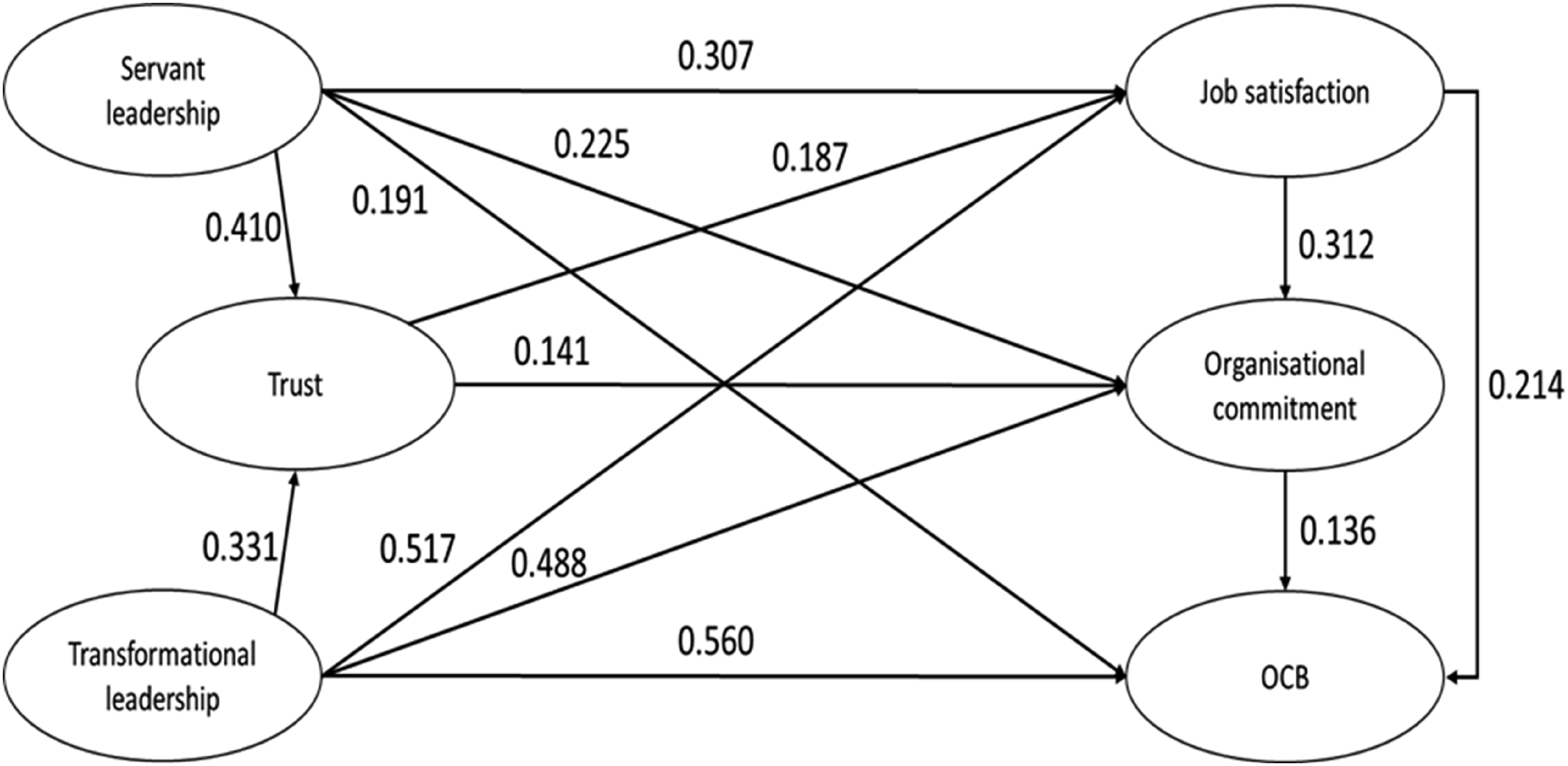
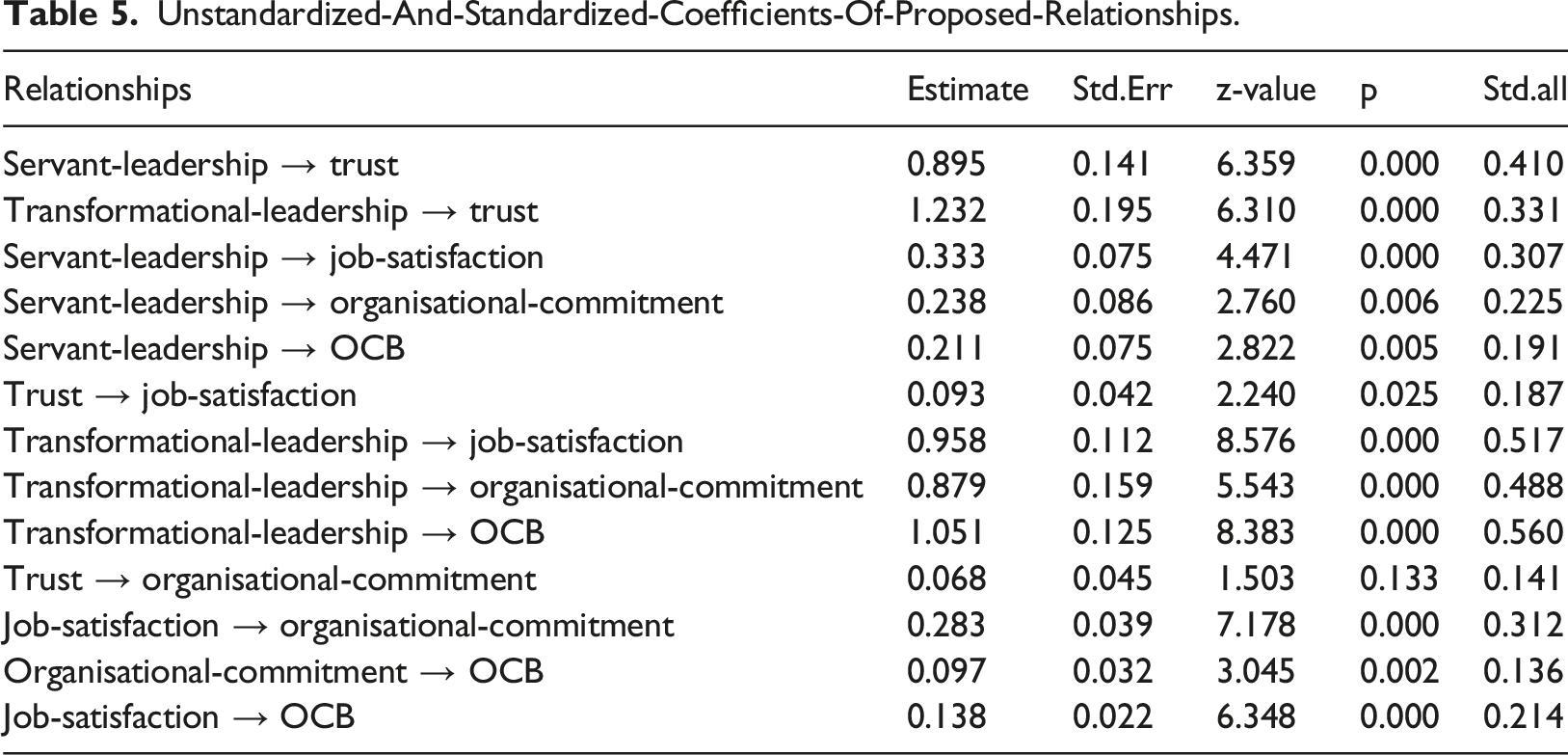
The hypothesis H1 states that Servant Leadership has a more positive impact on Trust than Transformational Leadership. Testing this hypothesis requires the comparison of two models where the relationship between Servant Leadership and Trust will be restricted in one of them. The results reveal that the difference between these two models is not significant (?_dif ^ 2 = 1582; df = 1; p = .209), therefore it can be concluded that both models have a similar fit and that the difference between these two relationships is not significant. Therefore, H1 does not receive empirical support.
The results show that, as expected, Servant Leadership positively influences Job Satisfaction (? = 0.333; p = .000), Organisational Commitment (? = 0.238; p = .000) and OCB (? = 0.211; p = .000). Therefore, H2 receives empirical support.
Regarding the hypothesis H3 the results show that the influence of Transformational Leadership is positive and significant on Job Satisfaction (? = 0.958; p = .000), Organisational Commitment (? = 0.879; p = .000) and OCB (? = 1.051; p = .000), therefore H3 also receives empirical support.
On the other hand, the influence of Trust is positive and significant on Job Satisfaction (? = 0.093; p = .025) but not on Organisational Commitment (? = 0.068; p = .133), consequently H4.1 receives empirical support but H4.2 does not receive empirical support.
Regarding the mediating role of Trust in the influence of Servant Leadership on Job Satisfaction, Organisational Commitment and OCB (H5), the results show that the indirect effect of Servant Leadership on Job Satisfaction is positive and significant (? = 0.084; p = .036), therefore H5.1 gets empirical support. Secondly, the indirect effect of Servant Leadership on Organisational Commitment (considering only indirect paths through Trust) is positive but only significant for ? = 0.10 (? = 0.085; p = .060), therefore H5.2 receives partially empirical support. Lastly, the indirect effect of Servant Leadership on OCB (taking only the indirect paths through Trust) is positive and significant (? = 0.043; p = .021), consequently H5.3 receives empirical support.
To test H6, a similar procedure was followed, but this time considering the mediating role of Trust in the relationship between Transformational Leadership, on the one hand, and Job Satisfaction, Organisational Commitment and OCB. The results show that the indirect effect of Transformational Leadership on Job Satisfaction is positive and significant (? = 0.115; 0.025), therefore H6.1 receives empirical support. Meanwhile, the indirect effect of Transformational Leadership on Organisational Commitment is positive although significant for ? = 0.10 (? = 0.117; p = .061), for that reason H6.2 receives partial empirical support. Finally, the indirect effect of Transformational Leadership on OCB is positive and significant ? = 0.112; p = .002). Consequently, H6.3 receives empirical support
Regarding the expected relationships within-groups, Table 5 shows that, as expected, the influence of Job Satisfaction on OCB is positive and significant (? = 0.138; p = .000), as well as that it positively and significantly influences Organisational Commitment (? = 0.283; p = .000) and that, finally, Organisational Commitment influences OCB positively and significantly (? = 0.097; p = .002). Consequently, H7, H8, and H9 receive empirical support from the data.
Southern Asia Cluster vs Anglo Cluster comparison (H0)
To investigate the question proposed in the introduction (H0) in more depth, the model proposed in Figure 1 has been estimated differentiating between these two blocks. The results obtained show that the adjustment in both cases is acceptable. Thus, for the block formed by the Anglo Cluster, the estimated model shows a value for the statistic ? ^ 2 not significant (?_M ^ 2 = 6118; df = 2; p = .050), as well as a value of the CFI and RMSEA within the range of acceptable values (CFI = 0.986; RMSEA = 0.050). In the case of the block formed by India and Iran (Southern Asia cluster), although the ? ^ 2statistic is significant (?_M ^ 2 = 9771; df = 2; p = .008), the values of the CFI and RMSEA are within the values recommended by the literature (CFI = 0.981; RMSEA = 0.069).
Comparison between anglo & southern asia clusters.
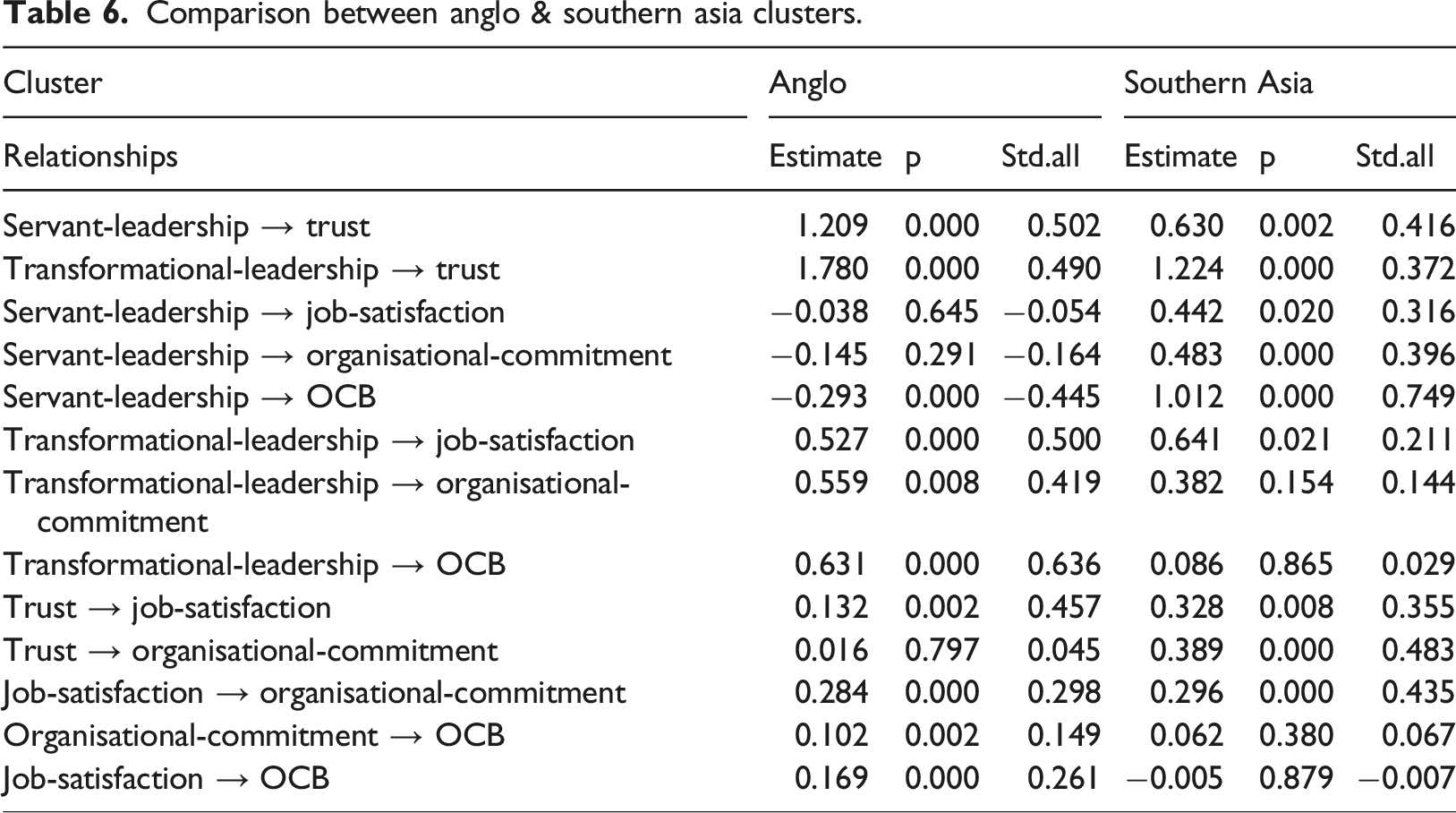
Figure 2 shows the standardized coefficients for both groups, as well as the significance of the relationships using a dashed arrow for the case of non-significant relationships. Comparison between anglo & southern asia clusters (Standardized coefficients).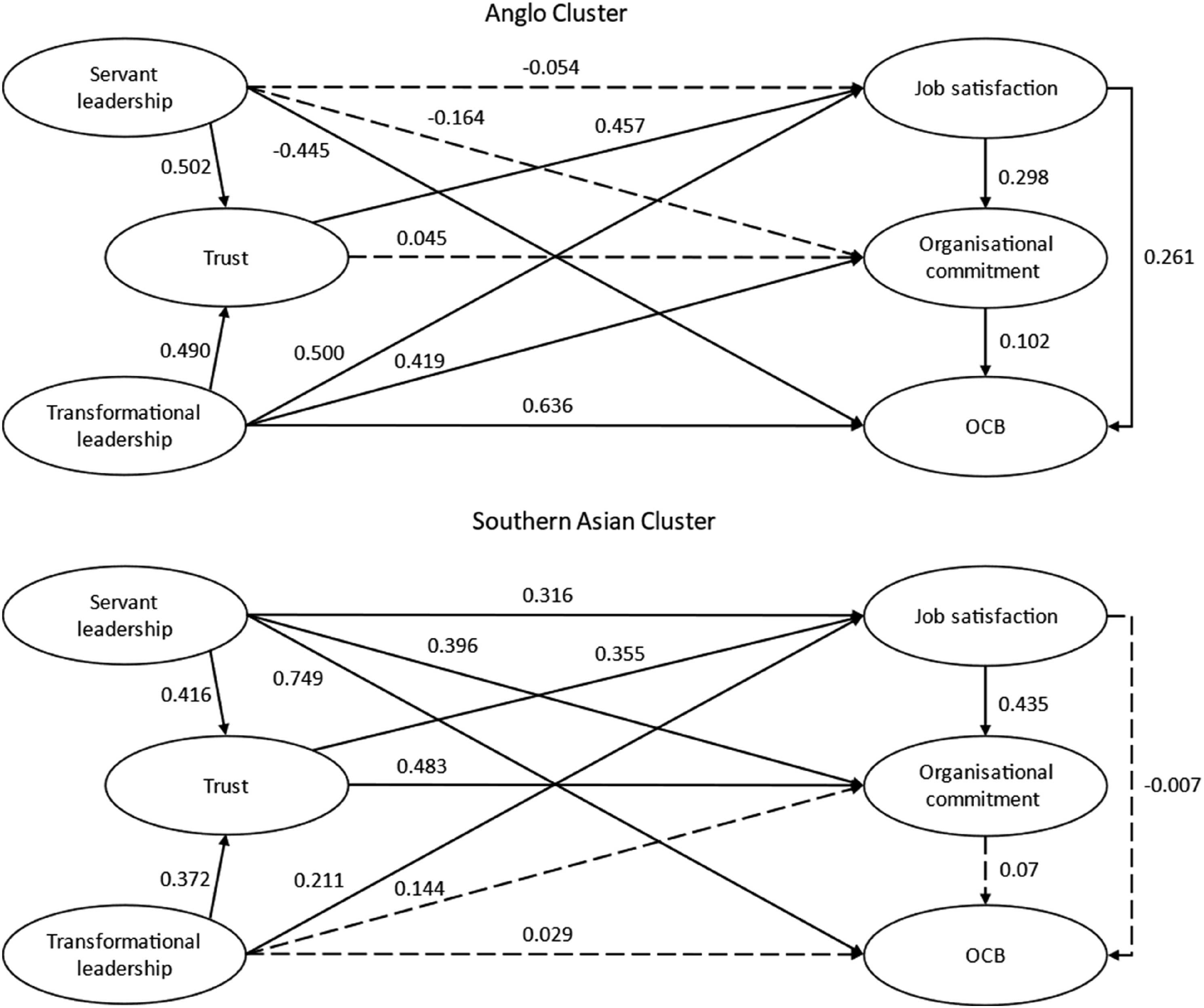
Discussion and conclusion
There were three aims to this study. The main aim was to examine the impact of Servant and Transformational Leadership on certain work-related outcomes in the independent hotels of four different countries, Iran and India (Southern Asian cluster), the United States and UK (Anglo cluster). As the results of the relationships between the variables tested in one country might be different from the results of other countries, the second aim of this study was to highlight the differences and similarities found in the patterns of the relationships between the variables by using GLOBE’s cultural dimensions. These aims were to be pursued in the context of the pressing need for organisations to adapt to a new world order brought about by technological developments in the field of Artificial Intelligence. This need for adaptation gave us the third aim, which was to help organisational leaders in different parts of the world to bring about the organisational conditions that are now required.
Servant Leadership was found to have a more significant impact on Trust than Transformational Leadership in both the Anglo and Southern Asia clusters. One possible explanation is that the score of Humane Orientation dimension is relatively high in the Asian cluster and above average in the Anglo cluster (House et al., 2004), which is in tune with the different aspects of Servant Leadership, such as egalitarianism and moral integrity. This means that Servant Leaders, who have a preference for the absence of a hierarchical relationship between themselves and their followers, provide their staff with a high-quality relationship that satisfies their needs and engenders a feeling of trust among them (Chan and Mak, 2014; Mittal and Dorfman, 2012).
In addition, the mediating role of trust in the relationships between leadership styles and employee outcomes was confirmed in the two settings. In fact, our research shows that Trust acts as a bridging mechanism that directly influences followers’ perceptions of leaders in positive ways (Schaubroeck et al., 2011; Braun et al., 2013; Podsakoff et al., 2000). Other similar findings in the two clusters included the positive influence of Servant Leadership on OCB, and Transformational Leadership on Job Satisfaction (Braun et al., 2013; Piccolo et al., 2018). Also, employees exhibit stronger intentions to stay with the organisation and are more willing to invest themselves in the tasks assigned to them once their needs are met in their workplace (Koo et al., 2020).
Despite the existence of shared patterns of behaviour towards Servant and Transformational Leadership, the results revealed interesting differences. In fact, some of the relationships previously found to be meaningfully significant, turned out to be ineffective in the clusters under study. While Servant Leadership has a positive effect on Job Satisfaction and Organisational Commitment in Southern Asia, such a relationship was not detected in Anglo countries. In addition, no significant relationship was detected between Transformational Leadership on one hand and Organisational Commitment and OCB on the other hand in Southern Asia. Furthermore, the positive impact of Trust on Organisational Commitment could not be confirmed in the Anglo group. Finally, Job Satisfaction and Organisational Commitment were found to positively impact OCB only in Anglo countries.
Such variations could be in part due to the different attributes of the two clusters. According to House et al. (2004), the Southern-Asia cluster is commonly known to have a high Humane Orientation. Thus, behaviours such as fairness, generosity and caring for others are encouraged and rewarded. The societal values in this cluster show an increasing desire to reduce power distance although it currently scores above average in this dimension. In addition, the high rate of In-Group Collectivism indicates that members tend to develop family-oriented and personal rather than organisational relationships with their leaders. Such attitudes along with the high score of uncertainty avoidance in this cluster favour paternalistic modes of leadership in which the leader stands-by and protects followers in the face of unknowns. The relationship between the leader and followers in this context takes priority over organisational processes and leads to a considerable degree of Trust in the leader, rather than in the organisation (Nazarian et al., 2020). These characteristics and the natural tendency of Servant Leaders to serve subordinates firstly means that they are more likely to experience satisfaction, Trust and commitment in the Servant Leaders, making this style effective in the Southern Asia cluster.
On the other hand, the countries located in Anglo cluster respect and recognize performance orientation, Humane Orientation and future orientation. Meanwhile, the lower In-Group Collectivism score in the Anglo countries means they are less cohesive within families and organisations, signalling the institutional nature of the relationship between the leader and the subordinates. Thus, effective leadership in these countries is composed of giving inspiration, high performance expectation, responsibility delegation, and participation of all parties in decision-making processes. Such attributes match the profile of Transformational Leaders, creating feelings of satisfaction and commitment in employees. Also, organisational members tend to develop a sense of Trust in the leader and are encouraged to reciprocate the (psychological, and organisational) benefits received in the form of citizenship behaviours to improve the overall performance of the organisation.
Theoretical implications
Leadership styles are an inseparable component of the organisational setting and can shape followers’ work experience and work-related outcomes (Chiniara and Bentein, 2016). This study compares the outcomes of Servant and Transformational Leadership and the emphasis is on the role of situational/contextual factors in their effectiveness, although both styles promise to stimulate positive feelings and behaviours in employees. Therefore, it is crucial to identify the most effective leadership approach in accordance with the followers’ psychological needs as well as the contextual and cultural contingencies.
Much of the current insight into leadership originates from studies conducted in the Western world, which casts doubts on the applicability of the findings from other settings. Regardless of the type of leadership style, national culture is a determinant of the success of various leadership practices. The results show that the effectiveness of leadership practices is a function of the value system of the country where such practices are being implemented.
Practical implications
These findings show that Servant Leadership has a positive effect on Trust and OCB in both the Anglo and Southern Asian contexts. Though the other variables tested here have a different pattern of relationships, this result suggests that Servant Leadership could be a universal style for bringing about the organisational agility required for organisational survival.
These findings provide insight into how businesses could leverage positive employee outcomes through implementing a leadership style well-suited to their particular societal and contextual circumstances. This becomes even more prominent in hotels, as highly centralized organisations to ensure efficiency. However, these businesses have to exhibit a certain degree of customization to meet the increasingly changing and complex demands of the market. Such a shift requires active engagement of employees in Organisational Citizenship Behaviours, stemming from their interest in the organisation and positive attitudes towards their job (Alibakhshi et al., 2024; Yen and Teng, 2013).
Employee perceptions and behaviours are a major determinant of customer experience, which in turn stimulates more loyalty on the customer’s side and higher profitability for the business (Stamolampros et al., 2019: p. 132). Thus, many hotels are in urgent need of considering alternative leadership practices to create a more supportive and motivating atmosphere, where employees Trust their supervisors/organisations and so are more likely to develop constructive work-related perceptions and practices.
Our findings should encourage managers to investigate the cultural characteristics associated with the wider society where their businesses are located to address the competencies and practices required for effective leadership in each context. In contexts where Servant Leadership is more effective, leaders must exert more effort in acting as role models to prioritize the needs of the subordinates and minimize their inclination to self-interest through monitoring and self-discipline. Also, Transformational Leaders must be aware of the risks resulting from pseudo-Transformational or unethical practices that may result from the abuse of employees.
On the one hand, independent hotels have limited access to monetary resources, on the other hand, these businesses are significantly dependent on their staffs’ effectiveness and commitment to fulfil their customers’ needs. Our study suggests that intangible assets such as an appropriate and functional leadership style within the organization can significantly influence employees’ satisfaction and commitment, resulting in OCB and increasing the organisation’s effectiveness. Moreover, employees in the tourism and hospitality industry often have a face-to-face relationship with customers when accomplishing their routine tasks. To provide better services and to increase organizational profitability, our research proposes that managers’ behaviours and attitudes, in the form of leadership style, produce intrinsic motivations for their staff and enhance their psychological state to experience higher levels of Job Satisfaction that has a major impact on conducting their job activities. At a much higher level of generalization, since both clusters responded positively to Servant Leadership, it also suggests that employees in both regional clusters are well placed to benefit from the latest technological developments.
Research Limitations and Future Lines of Research
This research focused on the outcomes of servant and Transformational Leadership, which serves to deepen the existing insights of scholars and practitioners into the significance of shifting towards alternatives to hierarchical and transactional approaches to those that foster agility which will be increasingly necessary as the fourth Industrial Revolution gets under way.
Therefore, future research could be directed towards exploring the prerequisites to develop these leadership practices, taking into account the cross-cultural complexities. Moreover, it will be necessary to examine other mediating variables in the relationship between leadership and work-related constructs. It is worth noting that research into the benefits of more modern leadership behaviours has grown in recent years.
However, this does not necessarily mean such leadership styles are free of downsides, especially considering the prevalence of cultural diversity in the workforce. As such, it is recommended that future studies seek to examine the potential negative outcomes of Transformational and Servant Leadership styles as well as the circumstances under which such practices fail to produce constructive outcomes.
Finally, this paper also contributes to future studies investigating how leadership styles and the role of culture can help to promote inclusivity and diversity in organisations. As our data was limited to four countries from two cultural clusters, we suggest that future studies collect data from independent hotels of other countries located in different cultural clusters to provide new insights and discover further insights into ethe organizational constructs of independent hotels. Moreover, future studies could complement quantitative data with qualitative inputs to enhance our understanding.
Footnotes
Declaration of conflicting interests
The author(s) declared no potential conflicts of interest with respect to the research, authorship, and/or publication of this article.
Funding
The author(s) received no financial support for the research, authorship, and/or publication of this article.
