




Abstract
Cross-cultural encounters with diverse individuals, such as gays and lesbians, has resulted in these persons often encountering a sense of otherness. Within the workplace context, there exists a preferable cultural identity of heteronormativity, where heterosexual individuals dominate and represent the ‘we,’ while those who are ‘different,’ including gays and lesbians, represent the ‘cultural other.’ The study that informs this article investigated how Black African gay and lesbian people, as the ‘cultural other,’ experience otherness through workplace gossip, and why gossipers engage in such behavior. Using a qualitative research approach comprising semi-structured face-to-face interviews with 18 Black African gay and lesbian persons, in various South African organizations, thematic analysis was the basis for data analysis. Findings suggest that Black African lesbian women at lower organizational levels experience greater marginalization in the form of gossip compared to Black African gay men. Furthermore, the perception among gay and lesbian participants is that gossip related to the sexual orientation of the other is more rooted in the Black African than the White, Coloured and Indian South African communities. It was also found that intersecting identities (socio-economic class; educational qualifications; geographic location) result in marginalized, lower educated employees from Black African townships gossiping to a greater extent about gay and lesbian people, than those with higher qualifications and socioeconomic profiles residing in suburbs. Organizational cultures where people were rooted in religious beliefs produced more intense office gossip than workplace cultures where managers and peers embraced diversity. We recommend that in embracing cross-cultural management practices, training of employees regarding cross-cultural adjustment and understanding the other, will bring positive outcomes in the workplace environment.
Keywords
Introduction
With increasing numbers of individuals from different demographic backgrounds entering the workplace at various occupational levels, it has become imperative for managers and employees to embrace a multicultural workforce to remain competitive (Carrim, 2019). Brannen (2020) points out that the extent to which employees identify with their respective cultural and/or social groups is critical to research and practice in cross-cultural management (CCM) studies. However, cultural identity at an individual level has not been widely researched in CCM. The studies that were conducted on cultural identity in CCM have focused on nationality, language and organizational culture (Maude, 2017). CCM scholars are therefore calling for more research that focuses on cultural identity from an individual perspective, rather than a macro-national or organizational perspective (Caprar et al., 2015; Stahl et al., 2016).
CCM researchers are increasingly investigating individuals who identify with multiple cultures, referred to as n-cultural identity-individuals (Pekerti et al., 2015). The focus of this line of research is on the extent to which multiple cultures are segregated or integrated into an individual’s self-concept (Vora et al., 2019). For example, being gay or lesbian is one of the identities that some Black Africans have integrated into their self-identities, even though it is not regarded as part of their ethnic identity (Francis, 2021). While considered ‘un-African’ (Academy of Science of South Africa (ASSAf), 2015), this type of alternate sexual identity is embraced by many Black Africans on the African continent (Francis, 2021). The result is that this group of individuals experience otherness, as they are marginalized within their communities and in some instances in the workplace as well, which has implications of how managers should deal with diverse employees in their work environments (Lӧtter, 2015). Additionally, employee turnover, lack of trust, and cultural misunderstandings are likely to occur as a result of the limited understanding of individuals’ diverse cultural identities (Berry and Ward, 2016), also on grounds of sexual orientation, gender identity and –expression (SOGIE). 1
Individuals differ not only in terms of their culture, as considered by mainstream CCM studies, but vary in terms of other identities as well, such as race, gender, ethnicity, or a combination thereof (Mahadevan et al., 2020). Thus, culture and diversity markers give rise to power effects which influence intercultural interactions. CCM scholars are therefore calling for a broader approach to understanding diverse individuals in their specific contexts (Mahadevan et al., 2020). For example, Maznevski (2020) points out that current social and technological environments are shaping contexts in which cultural intersectionalities are becoming salient and that scholars need to look inward within countries at diverse intersectionalities. Cross-cultural scholars are increasingly calling for research to take into consideration such ‘home’ contexts as otherness may be experienced differently in different contexts (Mahadevan et al., 2020; Maznevski, 2020). There is a void in empirical research on the topic of gossip and specific minority groups. We use gossip as a medium to understand the experiences of sexual minorities (more specifically, gays and lesbians) in South African organizations. Gossip may be one means through which cultural intersectionalities may become salient (Carrim, 2016; Vega and Valles, 2015). We consider established notions of race, class, gender, sexual orientation and other markers of difference that come together in gay and lesbian employees’ experiences of office gossip (Mahadevan et al., 2020). Importantly, related research has mostly focused on the experiences of cisgender heterosexual employees (Lee and Barnes, 2021). Could one predict that lesbian and gay workers might react in a counterintuitive manner than heterosexual workers, given more widespread prior experiences of ‘othering,’ in general?
We use Tylor’s (1871: 1) definition of culture as “that complex whole” which includes all elements of the social as well as material aspects. We also subscribe to Mahadevan et al.’s (2020: 2) view of culture as socialization, which includes all learned and social ways of how one is expected to do or perceive things. Office gossip is understood as informal communications among colleagues about the affairs of others that, indeed, may be considered inappropriate, given the focus on sensitive personal and/or private matters (Tan et al., 2021). People who work in group contexts and want to maintain the group’s norms usually target those who are deemed uncooperative or in violation of the group norms (Carrim 2016; Mujtaba and Senathip, 2020). Within a patriarchal, heteronormative and heterosexist world, and workplace, in general, it becomes apparent that lesbian and gay colleagues may, indeed, be deemed non-conforming. In this article identities such as race, sexual orientation, gender and ethnicity stemming from intersections of culture, power and diversity will be considered. We identify where and how categorizations of differences for gays and lesbians have emerged and may be viewed as problematic and manifest in negative office gossip.
We conducted this study in South Africa as research on sexual and gender minorities in most other parts of the African continent is rendered difficult, and nearly impossible because of lesbian, gay, bisexual, transgender, queer (LGBTQ)+ criminalization (Pillay et al., 2022). The national contexts of for example countries such as Zimbabwe, Cameroon and Nigeria have suppressed queer culture and scholarship (Epprecht, 2021). The progressive post-1994 constitution of South Africa however forbids discrimination on gender, race or sexual orientation, informing related workplace protections, and same-sex marriages have been legalized since 2006. South Africa has therefore been a useful terrain for the promotion and expression of LGBTQ+ activism and research (Nel et al., 2019). The focus of our research was on Black African 2 gay and lesbian employees, specifically, as such a focus allows for a greater application of an intersectional lens, as we indicate.
With the particular objective of understanding if office gossip serves to enable and/or sustain homophobic behavior in the workplace, and the characteristics of gossipers, the current study explores the following questions: • How do Black African gay and lesbian people experience gossip in their homes, families, communities and at work? • What are the intersecting characteristics of employees who gossip about Black African gay and lesbian people in the workplace? • How do Black African gay and lesbian people deal with being targets of office gossip?
Focusing on South Africa as case study, we conducted a review of literature relating to cultural identity, intersectionality, office gossip, as well as SOGIE within the South African context, before reporting the findings obtained in this study.
Literature review
The South African context
Mahadevan et al. (2020) suggest an intersectional approach to culture and diversity categories and their power effects in assessing perceptions and realities of ‘difference.’ In this respect, South Africa’s history of institutionalized discrimination under apartheid and colonialism, characterized by a regime of politics of difference, of categorization, discrimination and prejudice (Judge, 2021; Nel and Mitchell, 2019), is relevant in understanding office gossip targeting Black Africans in this locality. Here, nation, race, gender, ethnicity and sexual orientation, as traditional identity markers and vital pillars of power, serve as all-powerful anchoring points for both the establishment and the perpetuation of difference (Judge, 2021; Nel and Mitchell, 2019). In addition to overt prejudice, entrenched social, political and cultural processes in which all are involved, but remain mostly oblivious to, contribute to sustain oppression. Relationships between diverse communities are, in turn, shaped by hostilities, harassment and violence (Perry, 2015), so doing also mutually reinforcing both symbolic and overt violence which may extend to understandings of negative gossip and its effect. Symbolic violence creates the circumstances within a society such as South Africa with its particular history that allows the victimization of certain vulnerable groups, on the basis of, for instance, their gender, race, social origin, sexuality or other grounds; it becomes socially acceptable. Inversely, overt violence reinforces symbolic violence through the messages that are sent to victims of hate, as well as to their larger communities, communicating their undesirability. In this manner, the violence and/or micro aggression - the daily ongoing hate incidents or acts of taunting, constant bullying, conflict between people known to each other, or negative gossip, is normalized as a consequence of what is considered to be their indecent, inappropriate or socially unacceptable identity and/or behaviors (Pieterse et al., 2018).
In contemporary South Africa, difference corresponds with race and class location, and gender inequalities persist in that the othering of LGBTQ+ identities and expressions helps maintain the dominant status of heterosexuality, through the devaluing of those who do not conform; achieved in a similar manner that whiteness continues to assert its superiority over blackness, as inferior; and how the privileges associated with hegemonic masculinities remain reliant on the subordination of women, trans and gender non-conforming people (Judge, 2021). South Africa is also a religious society and religious attachment across all demographic categories, finds expression in conservative moral beliefs about individual sexual activity and gender roles with implications for equality, safety, and social inclusion of LGBTQ+ people (Pillay, 2022; Sutherland et al., 2016). Research conducted by the “Love Not Hate campaign” (OUT LGBT Well-being [OUT], 2016), provides evidence of actual harms perpetrated against people in South Africa who did not conform to sexuality and gender norms. According to the OUT report, close to half of the LGBT participants across the country had experienced discrimination in the previous 24 months, mostly in the education sector (56%) and ‘general life’ (44%). In the latter category, verbal insults were the main form of abuse, and hate crimes were more common in three specific South African provinces. Of the sample, 41% knew of someone who had been murdered due to being, or suspected of being, LGBT (OUT, 2016).
Historically, LGBTQ+ research in South Africa disproportionately sampled White, middle-class, urban men and women, and in so-doing, ignored nuanced cultural diversity (Pillay, 2022). For instance, South Africa’s “race–gender–sexuality–class mix shapes the prospects for queer harm (signifying injury and exclusion), on the one hand, and queer harmony (signifying well-being and inclusion), on the other hand” (Judge, 2021: 124), with violence impacting Black African persons and lesbians, in particular. As in much of sub-Saharan Africa, same-sex sexuality is held to be ‘foreign,’ and is portrayed as a product of colonialism and th traditional Black African communities in South Africa where cultural beliefs also suggest those of a same-sex sexual orientation are cursed or bewitched (ASSAf, 2015). A great deal of evidence points to sexual minorities in South Africa being stigmatized in Black African townships, 3 in particular, leading to deep-seated and widespread prejudice, discrimination and homo-, bi- and transphobic harassment and violence. This includes increased rates of verbal and other forms of harassment, teasing, bullying at school or in the workplace, threats of violence and actual violence (ASSAf, 2015; Nel and Mitchell, 2019). Blackness in South African townships encompass a sense of marginality as inhabitants experience deepening socio-economic impoverishment. In response to their impoverished state, Coloured and Black African township residents have constructed an alternative moral world with a different set of values and social relations in an effort to regain and redefine a positive sense of identity (Salo et al., 2010: 302). Women in their role as child bearers are keys to this moral economy and attest to men’s ability to father children. These family relations provide a strong sense of personhood against social impediments brought about by socio-economic impoverishment and racism (Yarbrough, 2020). Thus, mandatory heterosexuality became the means through which women in their roles as mothers, and men in their roles as fathers became the moral police of personhood and the defenders of their communities as a means to redefine and recuperate a positive sense of identity within Coloured and Black African communities (Lӧtter 2015; Salo et al., 2010: 303).
In a first national exploratory survey of the psychosocial experiences of South Africans of Indian descent, as a historically excluded sub-group in related empirical work, diversity was found, even among this minority group within a minority group, “because perceptions and lived experiences in South Africa are rarely normative or homogeneous, given the historical and contemporary socioeconomic forces that contour even the most intimate aspects of the lives of queer people” (Pillay, 2022: 11), thus indicating the need for an intersectional understanding of LGBT+ identities, specifically, and cultural identity, generally.
Cultural identity, intersectionality and office gossip
Cultural identity as defined by Schwartz et al. (2006: 6) is “a sense of solidarity with the ideals of a given cultural group and to the attitudes, beliefs, and behaviors manifested toward one’s own (and other) cultural groups as a result of this solidarity.” Brannen (2020) points out that within CCM, defining cultural identity is important for several reasons. The first reason being that the term should be clearly defined as errors of commission can occur where one can associate a relationship between cultural identity and specific competencies that an individual may or may not possess based on, for instance, nationality or ethnicity. Errors of omission can also occur where one overlooks the numerous and overlapping aspects of cultural identity that impacts an individual’s behavior in organizations. Also, cultural identification or lack of identification has a wide reach and extends to groups of people one works with, the organization, and functional group within an organization which can affect an employee’s performance (Brannen, 2020). Within the gossip literature, the concept cultural identity has not been researched. There is therefore a need to study this phenomenon from the perspective of gossip focusing on a broader understanding of the concept.
Which areas of cultural influence are significant will depend on the employee’s work context and particular issues that arise on a daily basis in the workplace. The individual dimension of cultural identity therefore refers to an individual’s self-concept in comparison to the person’s cultural groups (Brannen, 2020). It also refers to an individual identifying with certain cultural groups and being accepted by them (Phillips and Sackmann, 2015). These cultural groups are not necessarily dependent on geographic location but due to interactions which have developed over time, individuals’ lifestyle choices and experiences also form part of this classification (Lane and Maznevski, 2019). CCM scholars point out that cultural identity should be researched from a broad perspective (Mahadevan et al., 2020). A criticism against CCM literature is that it has not taken note of the multi-layered elements of cultural identity which are influenced by socio-cultural and contextual environments (Brannen, 2020). Thus, complex cultural combinations at the individual level which connect to identity have not been incorporated into the extant literature on culture (Adler and Osland, 2016). Brannen (2020) suggests several ways in which this shortcoming can be addressed by following a broad approach. Firstly, it should be recognized that for many employees nationality and ethnic identity may not be the most salient in their overall sense of identity or in a specific situation in the workplace. Most research in CCM focuses on macro-national and organizational levels of analyses, leading to narrow perspectives (Mahadevan et al., 2020; Primecz et al., 2016). A broader approach would enable one to look at within-group variance, as well as interactions between employees taking into account that cultural identity is an ongoing, negotiated process.
Second, Brannen (2020) argues that we need to look at how identities such as race, gender and so on simultaneously interact with cultural identity. Thus, conceptualizing cultural identity in a multifaceted way would result in considering intersectionality (Crenshaw, 1992) as part of the research design. Crenshaw (1992) argues for the use of the term intersectionality to assist us in understanding the different levels of marginalization and not painting everyone who belongs to a particular group as experiencing the same level of subjugation. Similarly, in this paper, Black African sexual minority identities are regarded as being shaped in relation to the interlocking structural domination of, among others, race, class, gender, and spatial marginality. In order to more accurately represent the complex nature of identities, and the obscured networks of desire in the lives of Black African men and women, the social construction of blackness has to incorporate sexual and gender diversity and sexual minorities.
Since culture, diversity and power are inseparable, we need to understand how they intersect within specific organizations in specific country contexts (Mahadevan et al., 2020). If organizations are to be inclusive, there is a need to understand the extent to which sexual minorities experience both positive and negative office gossip, especially in multicultural societies such as South Africa where minorities form an important part of organizations. South Africa strives for workplace equality, diversity and inclusion, also on the grounds of SOGIE (Nel et al., 2019). Within an intersectional framework (Bowleg, 2013), Black African lesbian and gay employees, may, indeed, be subjected to multiple layers of exclusion, discrimination and/or oppression (Koch et al., 2020). The focus should be on how each individual is viewed by his/her relevant cultural others and how this influences how the individual experiences a particular cultural identity (Mahadevan et al., 2020). Additionally, we need to consider the power distance between the employee and the individual’s relevant others in the workplace and how this evolves over time (Primecz et al., 2016).
Thirdly, Brannen (2020) points out that having a broader conceptualizing of cultural identity would result in decreasing stereotyping, generalizations and oversimplifications. For CCM researchers, looking at cultural identity from a broad perspective related to distinct societal, organizational, historical and relational contexts can result in new ways of understanding this construct (Mahadevan et al., 2020). We will therefore focus on how sexual minorities negotiate their cultural identities within their homes, communities and the workplace, taking into account the South African socio-political context. An individual’s social status also determines whether the person will be a target of positive or negative gossip at work; relevant here are the number of friends the person has in the network and the person’s popularity within the group (Tan et al., 2021). By implication, in the current study, the power that heterosexual individuals wield within the workplace that mostly remains patriarchal, heteronormative and heterosexist, and whether they use gossip to tarnish the reputation of sexual minorities, will be explored. A further element that will be explored is whether gays and lesbians are aware of being excluded from social and workplace activities, as well as promotional opportunities.
Methodology
Biographical information of participants.
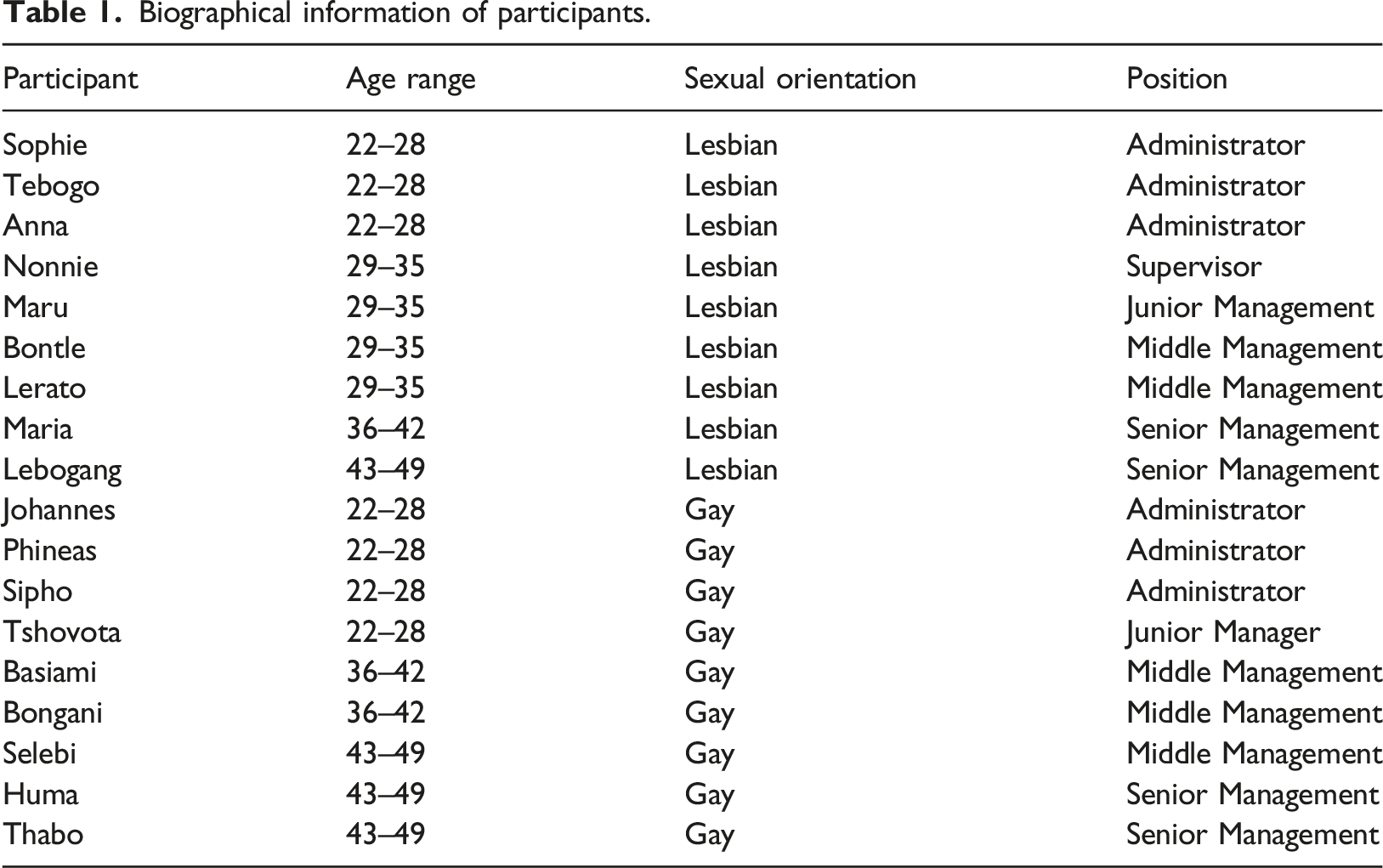
All participants were given pseudonyms to ensure confidentiality. Semi-structured interviews were used, as this method is powerful in capturing in-depth information, in this case relating to office gossip, from participants (Leedy and Ormrod, 2005). Each semi-structured interview lasted 60 to 90 min, and follow-up interviews, of approximately 60 min, were conducted to clarify and probe deeper into aspects not fully uncovered in the first round of interviews (Chepp and Gray, 2014). These interviews were held at participants’ respective workplaces and homes after the objective of the study had been explained to them, and informed consent established. Notably, some participants preferred conducting interviews at home as they worked in environments where privacy was limited.
Thematic analysis example.

We obtained ethical clearance to conduct the study from our institution and followed the ethical guidelines as prescribed by the institution when approaching participants, ensuring that information supplied by them remained confidential and that they were not forced to take part in the study. Participants were also told that they could withdraw from the study at any stage during the data collection process.
Findings
Analysis of the data resulted in three major themes, firstly, The brunt of historic gossip; secondly, Workplace experiences; and, thirdly, Coping with gossip. The theme, The brunt of historic gossip, has four sub-themes: Historical context, geographical space and gossip; Heterosexuality normalized; Coming out; and Suppressing sexual identities. The second major theme, Workplace experiences, has two related sub-themes that are further broken down into sub-sub themes, firstly, grouped under Organizational culture, as Corporate culture; Differential treatment of gays and lesbians; and Religion; and, secondly, Gossip from different demographic groups, broken down into Gossip from older employees; Gossip by diverse racial groups; Gossip from supervisors; and Gossip by suburban versus township dwellers. The third major theme, Coping with gossip, has three sub-themes: Identity suppression; Resilience and agency; and Avoiding social gatherings. These themes are respectively outlined below.
The brunt of historic gossip
Under this, the first of three major themes, as indicated, there are four sub-themes: Historical context, geographical space and gossip; Heterosexuality normalized; Coming out; and Suppressing sexual identities.
Historical context, geographical space and gossip
Race-based segregated settlements, initiated during the apartheid era, persist today, especially in Black African townships (Carrim, 2019). All the participants in the current study were raised and schooled in Black African townships. They grew up in close-knit family and community circles where neighbors and community members were aware of their movements, even when family members, fortunate to be employed, given widespread unemployment, were not around to keep a check on them. If they digressed in their behavior in any way, gossipers would quickly spread the stories and their parent(s) would be told about it. Tshovota, reminisces: Living in a Black African township is not easy as you have many spies and gossipers. We were always aware of our family members and the community checking on us and talking about us behind our backs. If we were to get up to mischief, you can bet my parents would have found out very quickly through the grapevine.
Heterosexuality normalized
The participants were raised in middle class homes and in this regard thus not representative of a vast majority of Black South Africans who, instead, measure a lower socioeconomic status (SES) (Marais et al., 2021). Some participants were raised in Christian homes but practised many of the traditions as prescribed by their African worldviews and beliefs. A majority of the participants subscribed to African religions and associated practices. Heterosexuality was normalized within their homes, communities, churches, and the schools that they attended. Participants indicated that homosexual behavior was not tolerated at all in their families and communities. Their family and community regarded homosexuality as part of “the White man’s” identity and not part of the Black African person’s cultural identity. Black Africans practicing an alternate sexual identity were perceived as the ‘Other’ and seen as pariahs in their communities. Lerato, follows the Christian faith which her family integrates with African beliefs: Most of my family believe in ancestors and we follow our rituals when we bury someone. In my family we follow Christianity as we go to Church and read from the Bible or when we baptise a child. But in other ways we still follow many African traditional norms. In my family and community, our school and Church, they do not support homosexual behavior. They say it’s against the African tradition and gays and lesbians are ostracised.
Coming out
Participants indicated that they felt that the family reputation was at stake if they had revealed their sexual identities and their parents would have to bear the brunt of malicious gossip and in extreme cases being ostracised and their child being raped and killed. They did not want their parents to be alienated from the community and to be gossiped about at social and communal gatherings which are an important element in their lives. Johannes, expressed his reluctance to disclose his sexual orientation as follows: My parents would never have forgiven me if I had ‘come out’ while I was in school. Our family and friends would have gossiped about them and they would have said mean things about them. They would have even gossiped in front of my parents about them and that would have hurt them deeply. I may even have been raped or killed. So I kept quiet.
Female participants expressed a greater fear than their male counterparts about losing their lives. In the majority of cases participants did not develop friendship ties with gays and lesbians in their townships. Maria expressed her fear of coming out in the following way: When I was in high school I used to hear the gossip against one of my classmates who was gay. They used to call him such bad names and they would say bad things behind his back. I was even afraid of talking to him in case I become stigmatized as well. Lesbians would get raped and they would even kill them. Men had it a bit better.
Suppressing sexual identities
The participants indicated that they suppressed an alternate cultural identity by not taking part in cultural events arranged by LGBTQ+ communities in the cities. They also feared telling their friends about their alternate sexual identities as they felt that this would start rumours and gossip stories about them and they would eventually be ostracised from these circles. While some of them had the urge to develop relationships with like-minded youth in their schools, they desisted from pursuing such. Huma expressed his concerns: I didn’t dare tell my friends about my gay instincts. They would have started gossiping about me and would have thrown me out of the group. I was also afraid of taking part in the gay parade in case someone recognized me and would report back home and start rumours about me.
Workplace experiences
Under this, the second of three major themes, there are two sub-themes: firstly, Organisational culture, and, secondly, Gossip from different demographic groups. The first sub-theme is again broken down into three sub-sub themes: Corporate culture; Differential treatment of gays and lesbians; and Religion. Under the second sub-theme, Gossip from different demographic groups, findings are further grouped under Gossip from older employees; Gossip by diverse racial groups; Gossip from supervisors; and Gossip by suburban versus township dwellers.
Organisational culture
Corporate culture
As is to be expected in a heteronormative society, participants indicated that most of the employees in the organizations they worked for were heterosexual, and thus favoured in their respective organizations’ cultures. There however were differences in acceptance of sexual minorities across organizations. Participants who worked for organizations that were more inclusive, still found it difficult to express their sexual identities, although organizational cultures were more receptive to diverse employees. The reason they still suppressed their sexual identities within receptive workplaces was that there was always the fear that persons from their communities may be employed in the organization or they may encounter employees in the workplace that had close links with people from their townships. Thabo explained: It’s hard to be true to your alternate sexual identity even in a liberal workplace culture like ours. I’m especially afraid – what if someone from my neighborhood gets a job here or someone who works here has family or friends in our township. How will I then be able to visit my family back home? My family will become the butt of everyone’s gossip.
Differential treatment of gays and lesbians
Participants indicated that they similarly all worked in corporate environments that were patriarchal and favoured men. Compared to gay men, lesbian women were aware of the intensity of negative gossip about them. These women thought more carefully about coming out in the organization as the gossip about them was more severe and unbearable compared to the gossip about their male counterparts. Maru expounded on the process of coming out in the workplace and becoming the target of gossip: As a lesbian you need to be prepared to come out. I found in my previous organization that we as lesbians faced a lot more gossip and the gossip was much harsher compared to gays.
Selebi echoed Maru’s sentiments: Gays experience negative gossip against them but I feel that office gossip against lesbians is worse compared to what we as males go through.
Sophie related that some women in her environment gossiped about her and subtly discouraged other women from forming collegial relationships with her: They don’t understand that I can have female friends in the office. If I’m friends with somebody or close to somebody then there would be gossip that there’s something going on. Sometimes other women would warn female newcomers that you do know that this person is a lesbian, so maybe you want to keep your distance from her before she hits on you.
Some of Bontle’s colleagues who gossiped about her in a negative way refused to work with her because she was lesbian: They would say that they are not going to be taught by a stabane.
5
There was a time when I had a meeting with people on the factory floor and I could feel that something was said about me – they told me outright that they did not want to work with me.
Religion
Some participants indicated that they found it difficult to express their cultural identities as sexual minorities in organizations where certain religious beliefs and attitudes dominated. Tshovota indicated that as his fellow employees were very religious he would never reveal his sexual orientation. He felt that he could become a target of negative gossip: We have a lot of conservative Methodists in our work environment and I would never even think of opening up to them. I know I would definitely be gossiped about.
Gossip from different demographic groups
Gossip from older employees
Most the participants in the study indicated that they found that older males and females in the workplace tended to be less receptive to diversity. They always found older females gossiping and trying to instigate managers against those that ‘did not fit’ into the workplace culture. Participants who worked for organizations where there was a greater presence of older females found it difficult to express their sexual identities and kept their interactions to a minimum, especially with these colleagues. Participant however indicated that older males in their work environment gossiped to a lesser extent. Participants indicated that many older women would probe about their marital status and children. Participants would create stories about their family lives in order to hide their true sexual identities. Bontle fabricated a story related to her relationship with a man: There is this older woman at work always nagging to see the man in my life. I decided to ask one of my gay friends to accompany me to one of our social parties at work. He played his part so well that she was convinced that we were a couple. I don’t like doing such things but I’m forced to because she is one of the biggest gossipers in our workplace.
Gossip by diverse racial groups
All the participants reported that White, Indian and Coloured people were more accepting of their sexual orientation than fellow Black African people. Basiami related: My boss is a cool guy. He is a White man; he knows his boundaries and we have a work relationship. I’ve never heard him gossip about me.
Some of the participants indicated that Black African colleagues call them by derogatory names and deliberately teased them. Thabo mentioned that he has heard Black African colleagues giving him derogatory names and maliciously gossiping about him: I was one day sitting in a cubicle at work (it was not my usual work station) and I heard these two Black African colleagues gossiping about me. They had a derogatory nickname for me and they were saying such evil things about me which were not true. Their words really hurt me very deeply. One of my Black African colleague at work always teases and taunts me and says that he wants me to date him and then the other Black African colleagues and he would laugh at me.
Gossip from supervisors
Some participants experienced negative gossip from their Black African supervisors as well. Anna explained: During workplace events my supervisor would quote phrases to colleagues as I would pass the group about how people who are homosexuals are polluting the world and they would all sneak glances at me.
Gossip by suburban versus township dwellers
All the participants expressed the opinion that colleagues from suburbs gossiped less about gay and lesbian people than those from Black African townships.
6
According to them, almost all hate crimes against gay and lesbian people took place in these townships. Maru shared her experience: There was this guy from the Black African township xxx and he had heard gossip about me being a lesbian. He one day came up to me and said that he wants me to leave my job because I am a bad influence on the women working there.
Selebi referred to his belief that gay and lesbian people who lived in suburbs occupied a higher SES, were less traditional and were more educated than those who lived in Black African townships and engaged in far fewer hate crimes and less discrimination: People living in suburbs are more educated, higher social class, more tolerant, open minded and less traditional than those earning less and [from a] lower social class from townships. It depends on where you have grown up in South Africa. You are safer in cities than [in] small towns. In most suburbs you don’t even know your neighbors.
Tebogo added the following in regard to the norm of exclusivity imposed by culture: At home in the townships people are more traditional and religious than in suburbs and tend to gossip more in the workplace than people from suburbia. They also tend to be more concentrated at lower organizational levels.
Coping with gossip
The third major theme, Coping with gossip, has three sub-themes Identity suppression; Resilience and agency; and Avoiding social gatherings.
Identity suppression
Some of the participants stated that they adhered to societal standards in their predominantly heterosexual workplaces so as not to become targets of gossip. They camouflaged their real sexual identities and constantly managed perceptions of their sexual identities to conform to acceptable standards of ‘public decency’ so that colleagues would not spread rumours about them. Johannes related his experience: It’s hard to blend in with males. You are not being totally yourself, because you don’t want them to know the other part about yourself. So you come across as a different person because you are hanging out with people who are expecting you to be in a certain way. There are straight guys and you need to be on their level of conversation and speak about the same things, like gossiping about girls. Now you can’t join in their conversation about girls and be totally free.
Resilience and agency
Participants at middle management, lower management and administrative levels in the organizational hierarchy were less resilient than those in senior management and expressed their desire to leave their current employment as they were unable to handle the negative gossip directed at them. Sophie told of the anxiety that negative gossip had caused her: I just want to leave, I’m tired of the gossip. I want to work for a company where everyone knows, oh, this is Sophie, and people feel comfortable around me and I feel comfortable around them. That’s the kind of company I’m looking to work for.
Male and female participants in senior management were more resilient, agentic and open about their sexual identity at work. They did not really care what people said about their sexuality. As time went by and they progressed in their workplace they acquired the confidence of feeling unconcerned. Huma explained: I work at company XXX, which is where I started straight from varsity. As a Black gay person I think over the years I became very confident in who I am – nothing that anyone says or does really gets to me anymore.
Lebogang shared the advice that she had received from a supervisor (also a lesbian woman) regarding discrimination: There was this lesbian supervisor and we had a chat one day and she told me that she was a lesbian and her colleagues talked rubbish about her but she has a crocodile skin and ignores them.
Avoiding social gatherings
Many participants avoided attending social workplace gatherings, especially when they had to invite their partners. Nonnie expressed her unwillingness to bring a partner to social events at work: Whenever I attend a social event at work, I ask my sister or brother to accompany me. When they are not available I abstain from going. I feel awkward as my colleagues always come with their spouses.
Discussion
The study focused on Black African gay and lesbian people’s experiences of office gossip from their cultural identity perspectives. The findings revealed that gays and lesbians who were born and raised in Black African townships were aware of wide-ranging, life long, negative gossip around alternative sexual orientations and thus generally suppressed their alternate identities. These findings resonate with those of Reygan and Lynette (2014) who point out that the experiences of Black African sexual minorities is different in their communities where traditional values are strongly upheld, compared to city dwellers.
An interesting finding is that even in organizations where diversity is embraced and office gossip is minimized, Black African lesbians and gays who were participants in our study, tended to continue suppressing their alternate sexual identities. On a personal level, these participants feared having to encounter persons from their own townships and their families having to face the consequences of such negative gossip and being ostracised in a heteronormative and patriarchal township environment. Both gay men and lesbians experienced the same amount of gossip although it might be less intense in the case of males than females. The aforementioned findings correspond with previous research indicating prospects for queer harm - injury and exclusion, impacting Black African persons and lesbians, in particular (Judge, 2021; Nel and Mitchell, 2019). Research by Marais et al. (2022) similarly indicate a higher vulnerability of emotional consequences if a victim of hate is exposed to economic consequences, if the offender is known to the victim, and if the victim identifies as Black African.
Black African gay and lesbian employees in lower positions experienced more anxiety and distress due to gossip related to their sexual identities as they were in a weaker position in the organizational hierarchy and they were afraid of the negative repercussions from family and friends. Notably, employees developed confidence in their own sexual identity at work with the passage of time if they progressed in their careers and continued to work in a particular environment. The reason could be that they no longer needed to negotiate their sexual identities and that they developed resilience, agency and confidence as their expertise and skills in their fields of employment increased. Their level of power also increased as they progressed in their careers, allowing them to express their alternate cultural identities to a greater extent. This finding may enhance the call for affirmative, systemic, interpersonal, and contextual stances in South African LGBTQ+ scholarly work to make better sense of resilience science suggesting multiple socio-ecological systems interact with individuals in adversity (Wilks et al., 2022).
This study found that colleagues used gossip as a tool to display homophobia and hate toward ‘the other’ in the workplace. This finding corresponds to the statements of Carrim (2016) that gossip is used to show dislike of and prejudice against minority and stigmatized colleagues. Interestingly, participants perceived older employees and in some cases supervisors being less receptive to diverse employees and gossiped more about sexual minorities in the workplace. Also, the participants perceived that employees who held conservative religious views gossiped more about gays and lesbians. An interesting finding was the perception of lesbian and gay participants, themselves Black African, that employees who lived in suburbs, were more educated, from a higher SES and occupied higher occupational levels, gossiped less than Black Africans who lived in townships and were less educated. These findings accords with attitudinal research in South Africa that suggest despite some prudish beliefs remaining stubbornly resistant to change, there is an increasingly progressive sentiment about LGBTQ+ people and their diverse cultural identities (Sutherland et al., 2016).
Research indicates that the further the target is socially from the gossiper, the less damaging the information becomes to the target of gossip (Chang and Kuo, 2021). However, the current study contradicted this finding, in that gossip negatively impacted victims of gossip as they were primarily targeted by employees from their own race group than by employees from other race groups. CCM research indicates that persons from one’s own group tend to have a positive bias toward similar others (Lakshman, 2013). However, in the current study sexual orientation identity is seen as the ‘Other’ and dominates racial identity.
These findings therefore reveal that gays and lesbians are constantly negotiating their cultural and sexual identities within the workplace. Lesbians have to negotiate their sexual identities to a greater extent compared to males and will decide in which workplace contexts it is safe to reveal their sexual identities. Also, employees from lower level positions in the workplace experience more gossip then those in higher level posts. Unlike past research the current study reveals that lesbians in management also become targets of gossip with those from middle management levels and downwards finding such behavior intolerable (Al-Hindawi and Abukrooz, 2013).
While this research has generated significant findings, it also has limitations. For example, the study is based on the experiences of Black African gay and lesbian workers only. Future research could focus on the experiences of office gossip of lesbian and gay persons from other race groups as an inclusive and intersectional approach that critically and meaningfully includes historically excluded sub-groups, such as South Africans of Indian descent, will advance our understanding of LGBTQ+ people’s experiences (Pillay, 2022). To inform policy, research, and interventions, future research on office gossip should also focus on others who are included in the LGBTQ+ collective, such as transgender and bisexual people, precisely because these groups are clustered together in one abbreviation due to similarities in experiences of marginalization, exclusion, discrimination and victimization in a hetero-cis-normative and heterosexist society (PsySSA, 2017).
Conclusion
This study’s findings present a sobering view of the experiences of Black African gay and lesbian people in the workplace. Although the qualitative study had no intention to enable the generalization of its findings, the findings support the reported experiences of other gay and lesbian workers in South Africa (International Labour Organization, 2016) and indicate that homophobic prejudice against gay and lesbian people is common and has a negative effect on people who deviate from the heterosexual norm. A surprising outcome of this study is that there were no reports of positive gossip and similarly no positive reflections from gays and lesbians related to their experiences. Even where organizations embrace diversity, gays and lesbians are unable to express their alternate cultural and sexual identities.
Gossip about gay and lesbian people does not occur in a vacuum, nor can it be brushed away as harmless. It can contribute to a climate of toxicity for some gay and lesbian people, leading to workplace unhappiness and psychological distress. The findings suggest that even a progressive legislative and policy environment cannot protect sexual minorities from harm in the workplace. Findings further indicate that the attitudes of South Africans towards gay and lesbian people differ: in some cases attitudes are benign or neutral and in other cases attitudes lead to harmful actions in the form of negative gossip, side-lining and open displays of hostility resulting in a suppression of sexual identity even where workplaces embrace diversity. If this research and gossip studies, generally, were to contribute maximally to CCM studies, “there is the need to acknowledge how the various positionalities, marginalities, inequalities, and intersectionalities of LGBTIQA+ persons can be theorised and understood in relation to resilience theory and concepts so the complex systems and strategies of resilience required by differently stratified/marked queer people in South Africa are not rendered reductively or in theoretical generalities” (Wilks et al., 2022: 2). Wilks et al. (2022) purport that knowledge of the psychological and social factors of resilience among lesbians and gay men, in general, remains sparse, and strategies to build resilience need to be prioritised; available resources for dealing with life challenges may be unlike those in the broader population, mainly if there are challenges with access to support from significant others due to rejection or fear of institutionalized discrimination. Resilience-building interventions may also require alterations to accommodate stigma-related challenges, while resilience can be advanced through training.
The literature is replete with descriptions about the challenges faced by Black African LGBTQ+ persons, but their resilience capacity is given little attention (Marais et al., 2022; Wilks et al., 2022). Resilience strategies include withdrawing from heterosexist social environments, concealing a sexually diverse identity, cultivating a marginalized identity, finding community, dismissing prejudice, or directly confronting it, approaching others for support or professional assistance, developing political consciousness, and striving for confidence and self-acceptance. It is strongly recommended that supportive laws and policies are strengthened and applied both by organizations and individuals, although it may come at considerable workplace and personal risk. Perhaps more importantly, business organizations should adopt measures to protect their LGBTQ+ employees, provide training programs on LGBTQ+ issues and rights, and agree on minimum standards of care and respect as proposed in the South African Workplace Equality Index (SAWEI) by the The South African LGBT+ Management Forum (2018). Moreover, the trade union movement should be encouraged to stand up for their LGBTQ+ members. In addition, consideration could be given to a Nedlac 7 -driven policy framework for employers in regards to accommodating workers from diverse identities. Leadership is necessary: workplace leaders need to step up in addressing LGBTQ+ issues and giving more support to LGBTQ+ leaders and groups in workplaces.
Finally, recognizing the systemic and relational resilience dimensions and integrating alternate sexual identities with other identities to resist stressors that divide communities, may contribute to broader and more effective interventions and public policies for LGBTQ+ populations. Also called for is a focus on the strength-based, rather than risk-based, in understandings of improving the lives of all.
Footnotes
Declaration of conflicting interests
The authors declared no potential conflicts of interest with respect to the research, authorship, and/ or publication of this article.
Funding
The author(s) disclosed receipt of the following financial support for the research, authorship, and/or publication of this article: This work was supported by the National Research Fund, South Africa.
