




Abstract
Our research explores how the historically institutionalized and authoritarian discriminatory South African context continues to affect the experiences of LGBT mid-level managers in the workplace. South Africa provides a rich environment to explore “axes of oppression” (heteronormativity/homophobia, race/racism, gender/sexism), and how these manifest and impact on participants’ work experience. Bringing together intersectionality as an analytical strategy with identity work allows us to examine the interaction between identities and the institutionalized processes by which they are shaped. Our findings show a multifaceted fluidity of oppression where individuals can move between continuums of advantage and disadvantage. We demonstrate the importance of historically embedded modes of oppression within the theory of intersectionality and how this manifests in institutional and organizational practices. As a result, organizations, institutions, and individuals play a role in reproducing inequality through intricate systems of oppression at micro, meso, and macro levels. This affects how individuals draw on their intersecting identities to respond to and decipher encounters with others.
Keywords
Introduction
Our research explores how the previously institutionalized and authoritarian discriminatory South African apartheid context has affected, and continues to affect, the experiences of LGBT mid-level managers in the workplace, through the perspective of intersectionality and identity work. Given that the basis of intersectionality is the simultaneity and overlapping nature of interlocking classifications of oppression (Carbado et al., 2013), the extreme institutionalized context of South Africa, which targeted different dimensions of identity, provides a rich environment to explore “axes of oppression.” (heteronormativity/homophobia, race/racism, gender/sexism).
Consensual same-sex relations are explicitly illegal in at least one-third of the world’s countries, but even in countries where it is not illegal, LGBT individuals may not be protected against workplace discrimination, may have no legal recognition of their relationships or parental rights, and may not be protected against hate crimes (Luiz and Spicer, 2021). In the workplace, studies show that discrimination against LGBT employees is still conspicuous (Capell et al., 2018; Köllen, 2016; McPhail et al., 2016; Ozturk and Tatli, 2016) and it displays in varied guises, including wage discrimination, harsher evaluations, and less opportunity for career advancement (Bryson, 2017; Hammarstedt et al., 2015; Shepherd and Patzelt, 2015). This matters because besides the importance from both a social and legal perspective of ensuring inclusive work environments, research finds that where LGBT employees feel heard and protected that there are gains from an organizational perspective (Colgan et al., 2007; McFadden, 2015).
Much of this literature on LGBT discrimination focuses on the single dimension of sexuality but we know that discrimination is often compounded by multiple forms of inequality and disadvantage creating obstacles that are not always fully understood (Crenshaw, 1992). Meyer (2012: 850–851) cautions that “approaches that take only one system of oppression into account sometimes provide homogenized and distorted views of marginalized groups.” He argues that intersectional theory has remained marginal to sexualities scholarship and that as a result studies often neglect how gender and race and sexuality are simultaneously implicated in experiences of oppression.
The South African situation is informative given its fraught history of apartheid, which not only discriminated, and did so in an institutionalized manner, based on race, but also in terms of gender and sexuality, among other criteria, and thus provides a rich setting for studying the intersectionality of oppression. This is complicated by the institutional dualism faced by LGBT individuals in South Africa at both a national and organizational level. The dualism manifests as the schism between the protections afforded by the post-apartheid constitution and the compliance it requires from companies, which provides relatively safe environments, surrounded by a sea of hostility where violence and bigotry targeting the LGBT community continues apace. LGBT managers must traverse parallel spaces (dualities) of moving between protected and unprotected settings—the de jure protections of the constitution versus the de facto situation on the ground.
We make three key contributions. Firstly, by integrating identity work with intersectionality, we examine how respondents use variegated identity to make meaning of power and status conditions, given contextually and historically embedded modes of oppression (Atewologun et al., 2016). Despite ontological tensions between identity work and intersectionality, we argue that such an approach provides theoretical value in understanding identity formation within compound intersecting identity positions. We offer insight into the dynamic relationship between overlapping axes of oppression and identity work, highlighting the centrality of historical context both analytically and theoretically in its operation. This is particularly important in sexualities scholarship that may underplay the multiplicity of dimensions of inequality (Meyer, 2012). Secondly, we demonstrate how historically embedded modes of oppression manifest in institutional and organizational practices. The South African case with its legacy of apartheid, colonialism, and patriarchy, allows us to explore how this complex intersectional inheritance connects to organizational logics and how individuals make sense of this through identity work. There has been a dearth of scholarship in this field examining the South African setting, taking into account the historical backdrop of homophobic institutionally sanctioned practice (Van Zyl, 2015). Given that vast parts of the world still operate in such environments, our contribution is instructive (Hamann et al., 2020). Lastly, we contribute toward understanding the organizing of in/equality more broadly by analyzing how organizations, institutions, and individuals reproduce inequality through intricate, interwoven practices of oppression (see Adams and Luiz, 2022).
The paper is structured as follows. The literature review focuses on intersectionality and identity work and explores how social structures and historical processes affect such intersectional analyses. This is followed by the research methodology. Our findings are structured around the manifestation of, and fluidity of, axes of oppression. This is followed by the discussion and conclusion that elaborate on our contributions and the implications of this work both theoretically and in terms of practice.
Literature review
Intersectionality of oppression
Intersectionality refers to the overlapping nature of social classifications such as race, class, gender, and sexuality, which result in interlocking matrixes of discrimination (Cho et al., 2013; Einarsdóttir et al., 2016). As an analytical tool it is a way of analyzing and understanding the structure of power in a given society and that this is not shaped by a solitary axis of social partition but by many intertwined axes (Collins and Bilge, 2016).
The feminist origins of intersectionality, originally coined by Crenshaw, initially focused on the marginalization of black women (Collins, 1986; Holvino, 2008; Hooks, 1995). It sought to examine the “overlapping margins of race and gender discourse” and the empty spaces in between and at capturing the “simultaneity of race and gender as social processes” (Crenshaw, 1992: 403; discussed in Nash, 2008: 2). It has spawned a multitude of studies examining different dimensions of inequality and power dynamics experienced by individuals and groups within their social membership (Rodriguez et al., 2016), including research on sexuality (Riach et al., 2014; Taylor et al., 2010). The work on intersectionality has been critiqued on multiple fronts and a full discussion of this lies beyond the scope of this research (see Walby et al., 2012) but these critiques generally take issue with the categorical or binary recognition of identities within some of this work. For example, Brown (2019) highlights how identities are implicated in organizational processes and the micro-politics of identity formation and illustrates the often illusory nature of such constructions.
Intersectional studies are not uniform in their methodological approaches to the study of multiple and complex social relations and McCall (2005) discusses three such approaches. The first she refers to as anti-categorical complexity that deconstructs analytical categories and argues that set categories are simplifying social fictions that produce inequalities. The second approach is intra-categorical complexity that acknowledges the durable relationships of social categories whilst maintaining a critical stance toward them. The last approach is that of inter-categorical complexity that acknowledges this complexity and “begins with the observation that there are relationships of inequality among already constituted social groups, as imperfect and ever-changing as they are, and takes those relationships as a center of analysis . . . to explicate those relationships” focusing on the “modalities of social relations and subject formations” (McCall, 2005: 1785, 1771). The dividing line between these three approaches are often blurred along a continuum and our ontological approach lies between the latter two categories.
An advantage of a more inter-categorical approach is that it allows us to analyse intersectionality in various contextual settings (Creed et al., 2010; McBride et al., 2015; Mooney, 2016; Paisley and Tayar, 2016). Given our research question, and the imperative of putting intersectionality into practice (Rodriguez et al., 2016), we acknowledge the multiplicity and fluidity of subjects and structures and focus on revealing the complexity of lived experiences. The South African case, which under apartheid strictly codified categories and subcategories (e.g. not only by race but by ethnicity and language within defined racial groupings), lends itself to this approach. It allows us to explore how the socio-political and historical context continues to affect the LGBT struggle for belonging and identity in the workplace.
Intersectionality and identity work
Identity work is the dynamic and mindful process in which individuals make sense of who they are in a multidimensional manner through everyday events (Ashforth et al., 2008). Identity work should be understood both in terms of inward/internal self-contemplation and outward/external engagement with social identities. As such it “involves the mutually constitutive processes whereby people strive to shape a relatively coherent and distinctive notion of personal self-identity and struggle to come to terms with and, within limits, to influence the various social identities which pertain to them in the various milieux in which they live their lives” (Watson, 2008: 129). Whilst it provides some agency as regards identity work, it acknowledges the position of structure in understanding experiences. It sees actors negotiating complex webs of power in different settings and in relation to others in which they concurrently find themselves on both sides of the power continuum (Simpson and Carroll, 2008). It therefore involves navigating intersections with other concurrent identities and making meaning of interactions with people and practices and the wider historical, institutional, and political influences that shape these relations (Alvesson et al., 2008).
In this process of making sense of identity and its social construction, contestations of normative boundaries arise around what Yuval-Davis (2011) argues to be the “politics of belonging” consisting of three interrelated facets. Firstly, social locations are ascriptive positions that situate people within categories with pre-existing ideological boundaries (such as class, race, gender, sexualities) that carry weight in the power networks in operation in society and these manifest as intersectionalities of inequalities. The second facet of belonging relates to identities that are not fixed but continuously in process of “being and becoming” and being shaped by dialectical interactions with others and where the yearning for belonging denotes emotional attachments. In the workplace, which operates on constructions of normative “us” versus “inclusion” for “others,” LGBT employees may not connect with workplace ideals linked to identity and threats to belonging might result in strategic identity management as they decide how, where and to whom to disclose their hidden identities such as sexual orientation (Van Zyl, 2015). The final facet of belonging highlights how ethical and political values pervades the way in which identities are judged by different communities to define where the boundaries are drawn about what is acceptable. These boundaries of belonging are determined by hegemonic groups until challenged by relegated groups via struggles for belonging.
In the case of South Africa where the constitutional provision of LGBT rights “provides a powerful foundation for belonging,” most LGBT citizens are “still struggling for belonging in their communities” (Van Zyl, 2015: 140). Our analysis of intersectionality highlights how the South African historical context has been central to how social divisions have been constructed and thus affected LGBT employees’ specific positioning. In some historical contexts constructions of identity can be forced on people and the “relationships between locations and identifications can become empirically more closely intertwined” (Yuval-Davis, 2006: 203). Such analysis also needs to account for temporal dimensions as LGBT employees may engage in identity work during the course of a day as they stand inside or outside imaginary boundaries of belonging and having to decide whether they are “us” or “them” and how much of themselves to disclose (Yuval-Davis, 2006).
Whilst we acknowledge the tensions between identity work, and an inordinately agent centric focus, which may underestimate the importance of structures and socio-economic context, and intersectionality, with its systemic approach to the simultaneous conceptualization of multiple axes of oppression, we advance for the value of an intersectional identity work approach (Atewologun et al., 2016). The shared tenets of intersectionality and identity work based upon multiple and mutually constitutive identities and the dynamic processes underlying both allow us to examine how employees negotiate self-identity at these intersections and how this is affected by sociocultural structures of power and privilege (Corlett and Mavin, 2014). We would argue that there is value in theorizing from extreme contexts, and that South Africa provides an important environment to reveal intersectional dynamics through the analysis of macro-level historical, socio-economic, and institutional factors, meso-level organizational practices, and micro-level individual agency, and how these contribute toward organizing in/equality more broadly.
Research methodology
The research adopted social constructivism augmented by pragmatism as its interpretive framework to gain in-depth understanding of how the participants negotiated intersections of oppression between their race, gender, sexuality, and management position. Creswell and Poth (2018) explain that the ontology underlying social constructivism and pragmatism can be aligned with both valuing authentic assessment. Social constructivism seeks to understand the world participants live in, and how they construct meaning, mindful of context, whilst pragmatism focuses on the practical applications of research and a concern with “what works.”
Researcher reflexivity is particularly important in ensuring the trustworthiness and credibility of research around identity and sexuality. The nature of intersectionality is such that our own understanding would not intersect all facets of our participants. As researchers we can never fully understand the experiences and oppressions of participants and so we built into our methodology attempts to minimize potential threats to the trustworthiness as we outline in section 3.3.
Contextual setting
Like Carrim and Nkomo (2016: 263) the study started from the premise that social identity is complex with multiple axes that “intersect in historically specific contexts.” This, in turn, required “recognition of the simultaneous interaction between systems of domination (e.g. racism, patriarchy, apartheid, colonialism) and institutionalized processes (e.g. racialization, gendering, and culturalization).” The South African socio-political-historical context is essential to the analysis of the lived experiences of LGBT mid-level managers in both inclusive and exclusionary organizational environments and their journey to senior management.
South Africa is unique on the continent in that it enshrines constitutional protection against LGBT discrimination and is the only country in Africa that recognizes gay marriage (Luiz and Spicer, 2021), although this is a relatively recent phenomenon and is the outcome of the post 1994 constitutional reforms. Before that, the apartheid government controlled every facet of societal life (Luiz and Roets, 2000). Apartheid was rooted in Afrikaner nationalism with foundations in Christian Calvinism but with a distorted ideological attachment to the maintenance of Christian and racial purity. Sexual deviance was seen as a degenerative disease that would weaken the Afrikaner race (Pushparagavan, 2014). The then government passed the Immorality Act of 1957 that curbed the relationships between people and prohibited sex between people of different ethnicities and restricted unnatural/immoral sexual acts which was a euphemism for homosexuality (Pushparagavan, 2014). As late as the 1980s, homosexuals in the military were still subject to electric shock therapy and imprisonment and beatings. As the tide turned against apartheid in the 1970s and 80s, LGBT rights groups began to incorporate the LGBT struggle into the broader anti-apartheid movement and the government retaliated by implementing harsher punishments for sexual crimes (Pushparagavan, 2014). The impact of HIV/AIDS reinforced the apartheid government’s view that this was God’s punishment and further marginalized the LGBT community.
With the transition to democracy in 1994, the de jure environment rapidly improved. In 1996, South Africa became the first country to provide constitutional protection against discrimination based on sexual orientation (Gevisser, 2016). Yet the de jure environment does not reflect conditions on the ground for large parts of the population—homophobic violence is rampant, discrimination continues, and many continue having to hide in the shadows. The prevalence of “corrective rapes” of lesbians continues as a scourge on society. Likewise, HIV/AIDS is still a threat for gay men and the social stigma makes it harder for them to receive treatment (Pushparagavan, 2014).
At the corporate level, many organizations have antidiscrimination policies but there is also evidence of continued exclusion and discrimination in the corporate and social environment (Davis and Luiz, 2015; Gevisser, 2016). From an LGBT leadership perspective, when compared to Western countries, the heterosexual male leadership archetype is considered more prominent in South Africa and African countries where strong patriarchal norms and values prevail in social and organizational contexts (Gevisser, 2016). The oppressive, authoritarian nature of white leadership in South Africa during apartheid which was rooted in the archetypical “heterosexual masculinity” style of leadership still pervades South African corporates (Gevisser, 2016).
At a wider level, South Africa remains a deeply racialized and unequal society with the world’s highest Gini coefficient of 0.66—the richest 10% of the population earns 60% of national income and owns 95% of all wealth; and more than half of all South Africans live below the poverty line (these schisms are largely racially defined). Adams and Luiz (2022) unpack what they refer to as the incomplete institutional change, which continues to reproduce inequality, with structural contradictions between the ambitions of the 1996 liberal constitution and the historical legacy that persists in defining the present reality.
South Africa therefore provides an interesting context of the intersectionality of oppression in terms of race, gender, and sexuality given its history. A dualism exists between the de jure and de facto experience of LGBT individuals in the country and this is affected by race, gender, class, economic sector, etc. Van Zyl (2014: 138–139) explains that “the constitutional guarantees of equality on the basis of sex, gender, and sexual orientation exist in counterpoint to hegemonic cultures of heteropatriarchy” and this is further “shaped by discourses of difference and power.” She demonstrates how intersecting identities such as “being black and gay serve to challenge normative constructions about African identity” and how these need to be strategically negotiated (p. 148).
By exploring the lived experiences of LGBT employees in South African based companies, the study investigates how they negotiate identity in the workplace, given the extreme way in which the country historically enforced hierarchies of separated estates of identity. Using an intersectional lens allows for the examination of how intersecting identities are leveraged, given the fluidity and concurrence of privilege, dominance, and subordination in the South African workplace.
Data collection
A semi-structured interview guide was prepared based on the research question and the literature review and was utilized for all interviews conducted, although interviews were allowed to flow as we wanted to hear the stories of participants. Questions addressed four main topics: their individual identification in and out of the workplace and the alignment of these identities; if relevant, their strategies and support for managing their identities in the workplace; the perception of the leadership archetype in the organization; and their experiences of any unequal treatment in the workplace and how this affected their identity alignment.
The study’s population consisted of LGBT mid-level managers in South African based companies. Disclosure of their sexual orientation or gender identity in the organization was not a factor of selection but was analyzed in the context of the study, specifically with consideration to their identity management strategies. To achieve consistency, all participants needed to have achieved a level of seniority (middle-level management leading a team of employees) in their organizations. The focus on mid-level management was due to research demonstrating the particular complexities and dilemmas that managers at this level face with pressures from above and below due to the “agency scope of the middle manager in the context of the organizational structure” (Kempster and Gregory, 2017: 497). Furthermore, “[M]iddle managers have been shown to be vulnerable, ambiguous and insecure, seeking to protect their role, protect their identity, emerging as a block to change, with a concurrent desire to maintain and advance their careers” (Kempster and Gregory, 2017: 497).
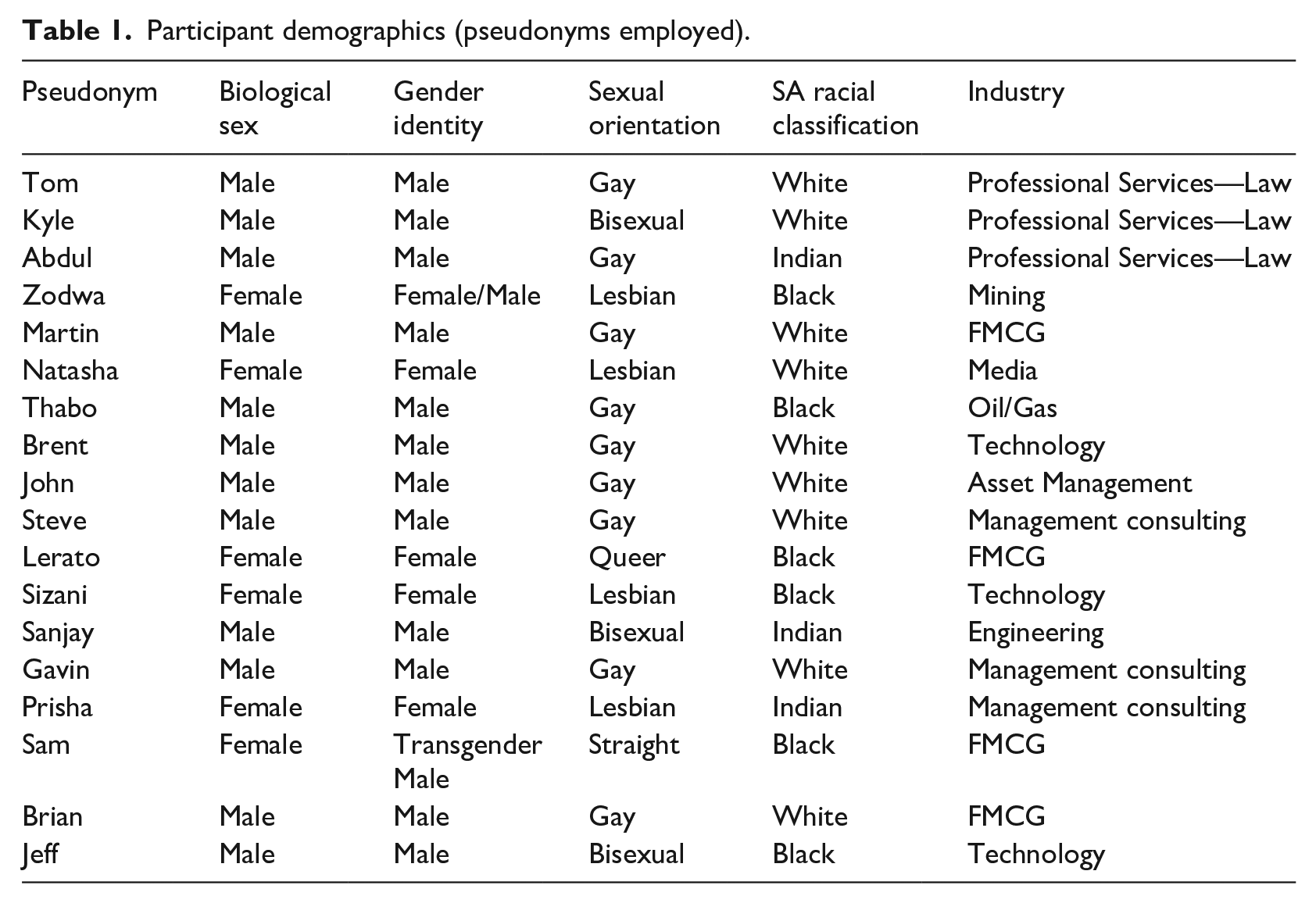
This study utilized a dual approach to sampling. Purposive sampling was used to approach candidates based on participation at professional workplace LGBT bodies, and this led to a snowballing technique whereby they recommended additional contacts. One of the authors was already a member of these bodies and this facilitated access to participants. Eighteen interviews were conducted across 14 different organizations—see Table 1. From a gender identity perspective, four participants identified as female and 13 identified as male, including a female-to-male transgendered person. One participant disclosed that they privately identified as male, but publicly as female. Nine identified as gay, four as lesbian, three as bisexual, one as queer, and the transgendered person identified as straight. In terms of South Africa’s racial classification, three participants were classified as Indian, six as black, and nine as white. Data was gathered through personal interviews; but in three cases the participants were not able to meet the researchers and thus were conducted via Skype. Interviews lasted between 1 and 3 hours each and were conducted between May and November 2017. Interviews were recorded, with permission, and these were then transcribed.
Participant demographics (pseudonyms employed).
Analytical process
Using manual open coding, the transcript data was deconstructed, scrutinized, and compared. Thereafter, categories were identified and further analyzed. General and recurring themes in the transcripts were analyzed and compared between all respondents. The final step in the process was to code the information based on the themes and categories revealed in the interview data following Gioia et al.’s (2013) recursive approach. Figure 1 presents an overview of how we moved from first order codes to aggregate theoretical analysis. Participants’ accounts of managing their identities in the workplace revealed identity work of having to adapt to “your audience” and a schism between the de jure and de facto institutional and organizational dictates. Responses revealed complex, intersectional, historically embedded modes of oppression based on race, gender, and sexuality, amongst other dimensions.
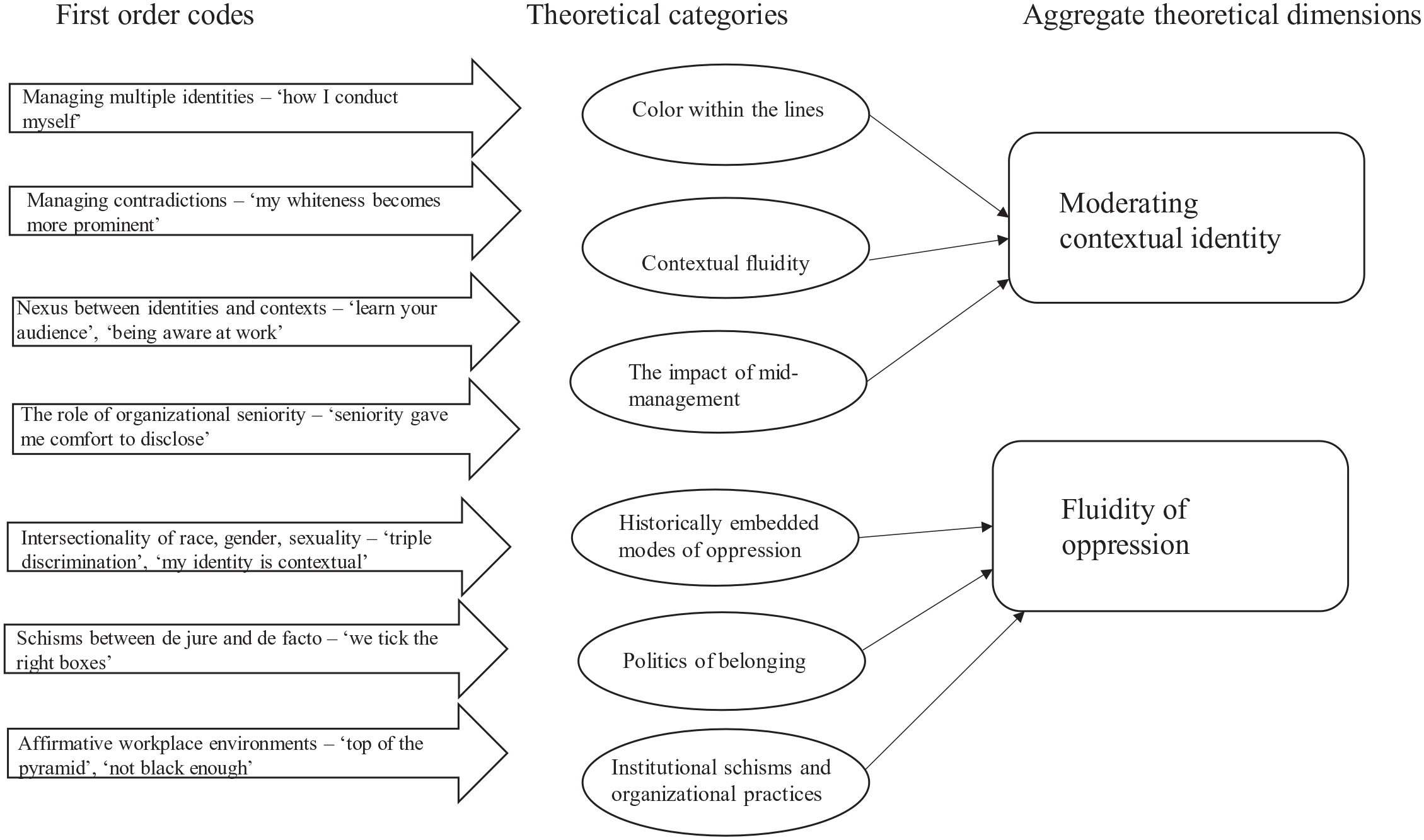
Overview of data structure.
We sought to safeguard validity and reliability by ensuring that we were faithful to the participants’ description of their lived experiences which enhanced the credibility and authenticity of the research. It is their voices that we seek to capture through our descriptive quotations. Not only was this a concern during the data collection but also in terms of the interpretation and analysis and we constantly asked for clarification delving into the meanings of participants. Besides checking the transcripts for accuracy, we sought to learn from our participants in terms of our interpretation by receiving feedback from them on earlier drafts of our findings. The threat of researcher bias is something we dealt with through open and honest communication and self-awareness about potential biases and being as transparent as possible in this respect. The advantage of having multiple researchers meant that we were also able to challenge each other as regards our responses and our intersectional identity positions. Furthermore, to maximize dependability we developed clear protocols for the data collection and documented all our procedures.
Findings
Institutional schisms, organizational practices, and identity work
Participants highlighted the duality between the South African legislative environments, which formally provided protection of non-discrimination and for “inclusive citizenship” (Van Zyl, 2015), while still witnessing extreme homo-prejudice often associated with violence. The adoption of the progressive 1996 South African constitution resulted in South Africa becoming the first country in the world to list sexual orientation as an equality provision in its Bill of Rights. This provision then cascaded downwards and forced organizations to ensure their compliance in their diversity policies. But the constitution with its de jure provisions are far removed from the realities on the ground. The inclusion of the same sex rights clause in the post-apartheid constitution was hard-fought by activists who had played important roles in the anti-apartheid movement. This macro national level disconnect manifests at the organizational level too, where firms possess codified inclusive policies and yet where the implementation leaves a lot to be desired with sexuality largely absent.
The theme of a schism between the diversity policies, implementation, and the organizational culture came through very strongly. Lerato described the situation in their organization as follows: “On paper we tick all the right boxes, and on paper we really do have some of the best diversity and inclusion policies, but that does not always fully translate to the kind of cultures that you should see alive on a day-to-day basis and that’s where I would say there is a disconnect. [. . .] Even though the organization sees the business and cultural benefit of being inclusive, unfortunately those [inclusive] policies are not always executed in a very inclusive fashion.” Lerato’s comment was repeated by most other participants who opined that their companies were doing what was necessary to comply with legal requirements but were not committed to embracing diversity to its fullest. They felt that sexuality was often ignored in the implementation of diversity policies and that these were driven by compliance with affirmative action targets set by the state which did not recognize sexuality as an area for redress.
This disconnect manifested in many different ways—from the use of homophobic language at work, to the exoticization of the LGBT experience where managers would explicitly reference their “acceptance” of LGBT employees by singling them out in meetings both internally and with clients. This behavior reinforced the boundaries of the politics of belonging as it explicitly manifested the separation of the population into “us” and “them.” For example, the managing director of Natasha would introduce her as “Oh, I brought my lesbian along” singling her out as the “other” and yet wanting to demonstrate this as a progressive act. Sanjay explained his experience in this regard as follows: “You think you work in Sandton 1 and it’s pretty liberal and you’re ok but it’s when, you know, you’re in the meeting rooms or in private little coffee discussions where these homophobic jokes happen, and you realize that even though you are working in the liberal heart of Africa, Sandton, only buys you so much social acceptance, but it’s not true acceptance.” The participants highlighted the limitations of acceptance and still not belonging, and the role that specific social locations and narratives of identity played in this, to use Yuval-Davis (2011).
The politics of belonging reinforces the notion of the interrelation between the subjective (the individual identity) and the structural (the broader rules of the game of the institutional environment) in the formulation and management of identity (work) in the workplace. The dissonance between the formal tick boxes of diversity compliance and yet the signaling of exclusion resulted in our participants having to engage in identity work and negotiate and moderate the expression of identity in the face of contextual realities. Participants frequently raised examples of where they were told how their organization did not discriminate and welcomed diversity but that they needed to be more of a “team player” which implied being a little “less in your face” with their sexual identity. There was a sense of it being fine to be LGBT as long as one conformed and played the role as required (“be gay but not too gay”) highlighting the necessity of taking on socially constructed identities mindful of the context. Lerato, a black lesbian, was explicitly told to try and color a little more within the lines: “I have been told that I color too much outside the lines and I need to bring myself a little more and color within the lines, within the boxes which I have been given to color.” She explained that she was told that she was not a good team player and that team players conform and embrace certain cultural and organizational imprints—“to belong one must conform.” Abdul likewise revealed how he had been told to “tone down my gay self”. He ended up transferring some of the blame onto himself in not adhering to organizational values and stereotypes associated with heteronormativity as a leadership type: “I have always been quite overtly gay, probably a bit too much.” He reflected that being too gay was going to impact his career progression within the organization. Our participants felt that these repeated calls to be more of a team player was coded but that it meant adopting a more heteronormative persona that conformed to organizational expectations to make other team members feel less uncomfortable. This was then framed as important for facilitating the effectiveness of team projects and work output.
Nearly all participants adopted active moderating identity strategies which meant toning down parts of their identity and being aware of having to negotiate multiple influencing contexts within the same organization and within the same day. This resulted in following a signaling strategy by “testing the waters” within new teams, and with superiors, and new contexts within their organizations in expectation of non-acceptance and discrimination. This could include referring to something topical in the press that had a sexuality angle to it to see how people responded or something more general to pick up on how liberal the worldview of the audience was before revealing a little more and continuing in this vein until they felt comfortable enough to reveal their sexuality. Sam explained how he adapted his identity to different audiences within the organization and that he had developed an instinct for how different people would react.
They specifically singled out religiosity as a factor which signaled that they were likely to be more conservative and not react well to sexuality: “You need to learn your audience, you need to learn your people.” Lerato explained how important it was to remain alert to how people might react to her and therefore how she expressed herself and that she was constantly checking herself in terms of how much she revealed: “I am who I am and I don’t know how to be anybody else, but in the work environment I am very much toned down, I’m a lot more aware.” Martin likewise stated that: “When I move into new groups I am deliberately more reserved in sharing my personal side of things, I won’t hide, I won’t lie, but I won’t talk about my weekend . . . because unfortunately they always jump to ‘What’s her name?’” Abdul confessed to adopting multiple personas mindful of his audience. He was especially cautious with men, especially older men, who he felt were more likely to be conservative and more hostile to his sexuality: “There are definitely multiple personas I engage with depending on different directors or members of my team. A [male] partner who is in his late sixties, I will adopt a certain decorum with, be more polite; whereas when I deal with my direct boss [female] and chat to her, I’m like It’s between us girls.” Our participants adopted a guarded approach where their expression of identity was affected by their reading of the audience and how they were likely to react. Past experience had shown them which audiences were more likely to be less judgmental.
Whilst the centrality of historical context has been central to intersectional studies, what our research demonstrates is how this impacts organizational practice and the experience of individuals. In the South African case, we have an extreme manifestation of this because of how apartheid codified and imposed identity clusters, and whilst the transition to a liberal democracy was meant to erase this legacy, it permeates the present. Participants felt that this forced them to negotiate identity 2 as they navigated the duality of the environment and moved between macro and micro contexts where formal legislative protections were disconnected from daily experiences. Employees had to negotiate these ambiguous contexts by moderating their identity expression mindful of mutable contexts.
Intersectional identity work
Respondents were clear that different elements of oppression associated with race, gender, and sexuality (and other dimensions discussed below) exhibited contextually across time and space within the workplace. The experience of these axes intersected differently for each participant and were not immutable as these often manifested contextually. Furthermore, post-apartheid legislation aimed at redress resulted in hierarchies of affirmative action with race (designated groups) having the highest priority followed by gender. 3 The atomistic nature of the post-apartheid affirmative action policies which identifies particular individual dimensions (principally race) and creates a hierarchy of identities for redress might partly account for why participants emphasized the inter-categorical dimensions of the intersectionality they faced in different organizational contexts and how these were informed by interpersonal encounters.
Participants seemed to identify a hierarchy of identity dimensions in the workplace as they navigated leadership stereotypes in order to progress (Courtney, 2014). The historically structured nature of intersectionality affected how identities were constructed and leveraged. For example, Gavin stated that “identities are often contextual; my sexual orientation may become more prominent in in a group of cisgender males, my whiteness becomes more prominent in a group of majority black Africans.” He acknowledged the intersectionality but argued that in varying contexts, different elements of his identity became more pronounced in relation to others and to the context.
Race was ever present with all participants although it manifested differently depending on the intersectionality with other dimensions. At an organizational level, white or Indian gay males argued that not being black resulted in their axes of oppression being overlooked. Their non-black status meant that they were perceived as being previously advantaged within the South African system even though their sexuality resulted in discrimination but that “race trumps sexuality.” Brent (white gay male) argued that organizations in South Africa recognized only limited dimensions of identity, particularly race and gender, but treated other dimensions as novel or exotic categories and that they did not recognize the complexity and fundamentals of identity in the South African workplace and the full nature of discrimination: “If you only look at people from a gender and race perspective and you don’t get into the non-visible aspects of who they are, who they already are, because when you talk about inclusion and diversity and all of those things, it’s almost like were talking about these novel things, like something new, but it’s something that is already here; diversity is here, we are it.” Black participants emphasized how race intersected with other dimensions and particularly gender in the case of woman, and masculinity and sexuality in the case of men. Lesbian participants (regardless of color) highlighted gender as a “critical link among interlocking systems of oppression” (Collins, 1986: S20). The patriarchal nature of South African society still dominated the narrative as did the dominant male leadership type.
With regard to masculinity, South Africa’s history celebrated a white, male, heterosexual leadership type and the present defaulted to this organizational model (while gradually replacing white with black leadership) even while adopting affirmative action policies to correct for gender and racial inequality. All respondents sensed the need to express strength and masculinity irrespective of other dimensions of their identity. Thabo (black male) commented that he felt the most pressure to be strong and masculine and that being gay was tolerated but “not effeminacy.” Several male participants initially identified as bisexual to overcome potential biases associated with “emasculation.” It became apparent that gay men who “performed femininity” felt that this was particularly an obstacle to promotion and that they either had to suppress this side of their identity and take on more masculine personas or potentially face being removed from client-facing roles. Sam stated: “So you’re not going to be discriminated against in an active way, but there may be some subtleties in the values of the organization that may be heteronormative or conservative that could actually be a disadvantage. [Examples include] the view of leadership, the view of strength. It’s the same thing women face, being female in the corporate environment is seen as weakness and if you were a feminine homosexual man, that would be seen as weakness as well versus the traditional view of strength which is masculine and ‘normal.’” Thabo saw his sexuality and masculinity as affecting his career identity and prospects: “Absolutely! I first get judged on how I look and act as a feminine gay man and then based on performance and intellectual capacity.” In fact, he had been told explicitly by his direct manager that his career prospects would be limited: “You do realize that you’ll never make it beyond a certain grade within this organization because you’re an openly self-identifying gay man who is on the feminine side. You are in a role that is customer-facing but you will have very limited access to customers because of that.”
Participants also felt that being too open as regards sexuality could harm promotion into senior management positions where there were certain leadership expectations. Thabo explained it as follows: “But here at the top, we’re still a boy’s club. We’ll take who we want, who looks like us, behaves like us [and] thinks like us.” There was a sense expressed that senior managers needed to reflect certain generic qualities and these needed to manifest in terms of identity expression. This confirms Brown’s (2019: 14) statement that to maintain a professional identity, marginalized individuals “must learn actively, to navigate normative requirements and emit ‘proper messages’”.
A prominent enabler of an aligned identity strategy was the level of seniority in the organization—the longer the tenure and more senior their position, the more comfortable they were to follow an integrating strategy. Sanjay explained it as follows: “When I was not out at work, I lived a hyper-masculine life. As I gained more skills and had less fear of losing my job based on my sexual identity, I became more comfortable to disclose. I had to become quite senior to be able to do it. And similarly, you can kind of see younger professionals who identify as LGBT who can’t do that just yet, or who have and the character assassination around their coming out is quite difficult to witness.” Participants generally reported that they started their professional careers following an avoiding strategy, by making a point of not talking about their sexual identity. Gaining seniority in the organization and moving into middle management positions opened more opportunity to follow an aligned identity although participants felt that disclosing could hurt their chances of moving into senior management positions. This reflects both an accrual of capital with those who were more senior having more capital to be more “themselves” at work, but also the ability to leverage more personal resources in interpersonal encounters through the gaining of seniority.
Participants felt that although legislation prevented explicit discrimination, that their ability to manifest their LGBT identity was curtailed by the identity of those more senior to them. This affected how participants experienced the world and their socially constructed identity. Brian highlighted religious conservativism among managers and how this impacted on his experience and identity: “I think that [my LGBT identity] has played a factor, I don’t think it’s the only wall and it’s not like it’s direct discrimination because I am a homosexual, but all the people ahead of me are conservative, Evangelical and Christian and my fate is in their hands and their view of what I am and my experience of the world taints that, very much so.” This ties in with the literature on social relational approaches to discrimination (Ridgeway and Correll, 2004) about how marginalized employees (LGBT in this case) have their freedom to express their identity partly shaped by their senior managers’ identities. The salient hegemonic cultural aspects that might apply in different contexts (both spatial and temporal) could be gender, race, heteronormativity or any other pertinent dimensions related to that context. From the perspective of the LGBT mid-level managers, they inferred that if they did not moderate their identity expression there would be negative consequences to their ability to lead and therefore to their career progression.
Our intersectional identity work perspective revealed how interpersonal encounters, which manifested across power continuums, surfaced varied identity negotiations (Atewologun et al., 2016). Such intersectional identity work is an enduring process that occurs at the intersection of the individual and the social context. As a result, moderating contextual identity (work), is structured within historically embedded modes of oppression. This sees different identity facets surfacing in distinct contexts and interpersonal encounters, but framed by the historical sinew of apartheid attaching to organizational practices and individual rationalization.
The organization of inequality and the fluidity of oppression
Intersectionality resulted in multifaceted tensions around identity and power and privilege. A fluidity of oppression was palpable in the South African environment where individuals could find different parts of their identities being expressed as the oppressor or the oppressed in the same day, but in different contexts. Different permutations of race, gender, sexuality and masculinity could see an individual move between continuums of oppression, and these were often context and time specific.
Thabo, a gay black male, explained how different dimensions of his identity were affected by the context and the social relational dimensions of who he was interacting with at work. He felt most at ease around his female colleagues and most guarded around heterosexual black males where he often felt most judged not just for being gay but for being “a feminine gay man” (his words). Not only did he run into stereotypes that being gay is “un-African” but also into patriarchal leadership typecasts embodied in masculinity.
The white gay male experience was expressed differently. White males were considered the archetype of advantage in South African history and are still classified as such in terms of employment equity legislation. A white male is thus seen as the pinnacle of advantage. Because “race and gender trumps sexuality,” a gay white male is thus considered historically advantaged, even though they would have faced discrimination for being gay under apartheid and continue to do so in post-apartheid South Africa. They therefore simultaneously exhibit elements of being both advantaged (their whiteness) and disadvantaged (their gayness). Depending on contexts within the workplace they could exhibit either of these elements, namely advantage or disadvantage, and could move from a state of being the white oppressor to being a gay oppressed within the same day. This resulted in them often feeling particularly alienated as they would be reminded of their status as oppressor while simultaneously experiencing discrimination based on their sexuality. They also felt that while there was active redress in the workplace based on race and gender that this underplayed their oppression both historically and in the present. The explicit South African focus on race and gender in terms of affirmative action resulted in them not being considered for promotion and they argued that being a gay, white, male meant triple discrimination. Sanjay, an Indian male, also commented that he felt discriminated against as a male and that he was not “black enough.”
At an organizational level, firms were grappling with South Africa’s historically embedded modes of oppression but manifesting distinct contradictory logics. Whilst firms were engaging in legislative compliance structured around undoing legacies of inequality, its tick-box operationalization was leading to difficult individual intersectional identity work, often perpetuating experiences of inequality, and not belonging. The legislative requirements create an atomistic hierarchy of identity facets for affirmative action leading to intricate interpersonal encounters along complex power continuums based upon race, gender, seniority, and sexuality, amongst other dimensions. The latter often becoming lost within the organizational practice.
Discussion
LGBT mid-level managers in South African organizations find themselves in a Daedalian environment; one characterized by tensions, contradictions, and dualities. We demonstrate that as an analytical tool, intersectionality allows for the development of insights into identity work processes through the exploration of how identities are navigated and the dynamic interaction with different dimensions of power and privilege (Corlett and Mavin, 2014). The findings make three key contributions in advancing our understanding of intersectionality and identity work in these multifaceted settings.
Firstly, whilst we recognize tensions between identity work and intersectionality research, we suggest theoretical contiguity between the two. Identity work ensues at the juncture of the individual and the exterior environment, implying that although we have certain agency, our identities are also negotiated interpersonally and restricted by social settings (Caza et al., 2018). Our analysis shows how intersecting identities are experienced and leveraged in encounters with others and how these impact upon the dynamics of oppression and asymmetric power during the course of a workday. Such an “intersectional identity work” perspective accommodates multiple identity dimensions whilst allowing for the intricacies of identity work within “the context of socio-structural power relations that trigger ongoing self-evaluation and resolution of identity gaps” (Atewologun et al., 2016: 227). Our research illustrates the interaction of dimensions of identity work and how these are molded by numerous levels of influence at both micro and macro levels.
The South African environment which was shaped by institutionalized oppression and authoritarianism has impacted, and continues to, the intersectional identity work among LGBT mid-level managers. Participants grappled with this intersectionality of oppression in a country where identities were made particularly salient by its history, perhaps making individuals’ responses to their environment more pronounced and consciously considered. By examining how individuals make sense of the simultaneity of their advantage and disadvantage and how these intersect, we show how they construct gender, race, organizational seniority, and sexuality concurrently and independently to negotiate their positions relative to other identities. The advantage of such an approach is that it allows insights into how individuals engage with identity dimensions as they “interpret encounters, negotiating self and others” views . . . conscious of their/others’ complex intersectional identities’ (Atewologun et al., 2016: 239). The post-apartheid state, in its attempts to undo the legacy of apartheid, adopted some of the same identity classifications to promote an affirmative labor market policy to address some of the sources of inequality, but the consequence of this is that identities are still shaped by the power of the state. Whilst this is understandable it does lead to complex rationalizations at the individual and group level.
Along the lines proposed by Spedale (2019: 38) our “deconstruction analysis shows how the unique positioning of the research subject(s) emerges at the intersection of complex discourses” casting employees as both victims and perpetrators of “inequality across a kaleidoscope of interacting categories of oppression.” Recognizing this allows for a better theoretical understanding of the temporal and spatial connections with intersectionality and how similarity and dissimilarity and oppression manifests. In our research we saw how participants’ sense of belonging during the course of a day was shaped by different aspects of identity and social locations and how they negotiated moving between belonging (“us”) and exclusion (“them”).
Boogaard and Roggeband (2010) refer to this as the paradox of intersectionality—how white women resisting gender discrimination could concurrently function as a means of power in relation to black women and men. In the case of South Africa, where hierarchies of power were institutionalized and continued to be institutionalized, now in an affirmative manner, this creates particularly complex permutations. How individuals navigate and make sense of this not only within themselves but in relation to others showed high levels of temporal and spatial mutability. The study highlights the notion of restraining contextual identity where LGBT employees must negotiate their identity and temper its expression in the face of contextual realities. We also saw how their own seniority within the organization affected their ability to navigate these spaces—a social relational approach to identity became apparent as mid-level managers felt that their freedom to express their LGBT identity was affected by the cultural beliefs of those more senior to them.
We contribute toward sexualities scholarship, highlighting the importance of paying attention to intersectionality along multiple categories of social difference. Focusing exclusively on sexuality and heteronormativity, which underpins a lot of this scholarship (Ragins et al., 2007), results in the experiences of many groups of LGBT people not being fully understood (see Meyer, 2012).
This connects with our second contribution, which is to demonstrate how historically embedded modes of oppression manifest in institutional and organizational practices. We reveal the temporal and spatial nature of identity work through the dynamic interface between identity and the institutionalized processes and historical legacies by which they are formed and reformed over time. By following McCall’s (2005) call for more studies to adopt an inter-categorical complexity approach to intersectionality this allowed us to examine the “modalities of social relations and subject formations.” The interface between practices of differentiation and structures of hegemony evinces the processes through which demonstrations of difference are socially ordered. In the case of South Africa, the coexistence of institutionalized apartheid, patriarchy, and colonialism requires recognition in terms of how these intersect to socially generate distinct identifications (Carrim and Nkomo, 2016).
The dualistic environment (liberal constitution and formalized diversity policies within organizations often disconnected from homophobic practices) provides mixed signals to LGBT employees, which result in complex strategies to manage and moderate their identity expression in the workplace mindful of contextual realities. This often resulted in them “testing the waters” and adopting a signaling identity management strategy before exhibiting (Clair et al., 2005), or avoiding revealing, or identifying as bisexual. The disconnect between the organizational and policy environment and the contextual reality result in the need to moderate identity around context. There was a sense of a “glass closet” 4 and of participants having to navigate in and out of the closet and between various states of transparency and opaqueness of the closet walls as they adapted to context and engaged in identity work.
Our third and final contribution is to establish the importance of historical legacy within contemporary institutional and organizational practices and the structure of in/equality more broadly. We indicate how the historical sinew of apartheid combines, connects, and coalesces with organizational logics, discourses, and expectations. 5 Recognizing that “change and social justice are at the core of intersectionality as a political project” (Ruiz Castro and Holvino, 2016: 342) and are embedded in culture, is important to bring contextual influences to the fore. The transition to democracy in 1994 is argued to be an incomplete institutional transition giving rise to contradictory institutional and organizational logics. This manifests as a dualism between the liberal post-apartheid constitution enshrining protections for the LGBT community and forcing organizational compliance, and yet such safe environments in practice being small enclaves surrounded by continued violence and bigotry targeting this community. Likewise, racial inequality persists despite legislative efforts to undo this legacy. As a result, organizations, institutions, and individuals continue to play a role in reproducing inequality through complex interlocking systems of oppression at micro, meso, and macro institutional levels (see Adams and Luiz, 2022). This, in turn, affects how individuals draw on their identity facets to respond to and decipher encounters with others.
Conclusion
The study explores the experiences of LGBT mid-level managers in the South African workplace with reference to how the legacy authoritarian discriminatory context affects the intersectionality of oppression. It demonstrates “axes of oppression” (heteronormativity/homophobia, race/racism, gender/sexism) and how these manifests in the work experience of the LGBT participants as they respond to both macro and micro levels of influence associated with the institutional and organizational environment.
In terms of implications, this work carries importance for how organizations go about creating more inclusive, diversity-friendly settings where employees can express their full identities. Recognizing intersectionality and the contextual axes of oppression in the workplace shows how far organizations still need to go to be more fully inclusive and welcoming of diversity (Rumens, 2018). The research demonstrates that the often static approaches used to recognize identity and address discrimination through diversity programs may not reflect the fluidity and intersectional nature of identity and oppression. Priola et al. (2018: 733) highlight the “fragility and contradictory character of the notion of inclusion” that often recreate hierarchies and binaries that may result in “inclusive” organizations continuing to exclude (Rumens and Broomfield, 2014). If such diversity policies, resulting in forms of “benevolent discrimination” (Romani et al., 2019), are to be avoided then the starting point needs to be reflected in the utilization of an intersectional lens that embraces identity as being dynamically intertwined with socio-political-cultural-historical settings that reflect the lived experiences of employees (Carrillo Arciniega, 2021; Creed and Cooper, 2008; Zanoni et al., 2010). Our work also contributes to critiques of the dualism implicit in binary categorizations of disadvantage and the victim—perpetrator paradigm. The challenge for policy is for a greater sensitivity toward the complexity of inequality (Spedale, 2019). In the South African case, this requires a recognition of all the dimensions of oppression from the past and how it frames the present and concrete commitments to address all the dimensions, including sexuality.
The study has limitations. Firstly, our approach opens the possibility of critiques of the identity categories themselves (see Holvino, 2010). Allowing for a more grounded approach for deconstruction and social construction opens alternative ways of conceptualizing intersectional scholarship.
Secondly, the research focused on participants in white-collar jobs which are traditionally more LGBT friendly, and research with more of a blue-collar concentration will add further layers to this understanding (Balay, 2014). Furthermore, because of the invisibility of LGBT employees, sampling is biased toward individuals that are more open about their sexuality and gender identity.
Lastly, future research can adopt a longitudinal approach which explores the lived experiences at diverse milestones in the participants’ careers which may expose changing identity work and oppression dynamics at different parts of their careers and how issues of intersectionality manifest and are managed over time.
Footnotes
Acknowledgements
We gratefully acknowledge the helpful suggestions and comments made by the associate editor Kathleen Riach and that of the anonymous reviewers.
Declaration of conflicting interests
The author(s) declared no potential conflicts of interest with respect to the research, authorship, and/or publication of this article.
Funding
The author(s) received no financial support for the research, authorship, and/or publication of this article.
Ethical compliance
The research was conducted in compliance with full ethical standards and was approved by the Ethics Committee of the University of Cape Town. It was performed in accordance with the ethical standards as laid down in the 1964 Declaration of Helsinki and its later amendments or comparable ethical standards. We provide further details on this in the paper itself but below we list some of the key elements of this compliance.
(a) Confidentiality: Neither the name of the organization nor the individual employee participant was recorded against interview transcripts, and a password-protected spreadsheet was maintained in order to match the employee to the interview recording and transcript.
(b) Informed consent and voluntary participation: Every respondent participated in this study on a voluntary basis. Participants were informed that they had the option to decline to answer any questions that made them feel uncomfortable or had the potential to compromise their privacy.
(c) Data management: Interview recordings and transcripts were stored on a secure device and backed up on a cloud-based drive with full security and encryption and password protection and were only available to the researchers.
