



Abstract
Cross-cultural management (CCM) studies is the discipline that investigates the interrelations between culture, management and organization, and ensuing implications. Like all disciplines, it is built upon certain presumed ‘disciplinary truths’, such as paradigmatic delineations, and assumptions of how culture should be studied differently within different paradigms. Such presumed truths easily become ‘trends’, potentially even disciplinary closures. In this article, I show how the concept of genealogy (Foucault), can help challenge prevalent ideas of how the disciplinary knowledge of CCM studies is ordered, in particular the idea that positivism and interpretivism are opposing CCM paradigms which study culture in distinct ways. It then becomes apparent how positivism and interpretivism, as selectively understood and delineated by CCM studies, are characterized by a shared focus on stable and immaterial selected aspects of culture and, consequently, suffer from the same limitations. Genealogy thus ‘un-fixes’ disciplinary knowledge and, via widening the scope of the analysis, enables CCM scholars to make choices beyond presently taken-for-granted disciplinary delineations.
Keywords
Introduction
Paradigms have received increasing attention in Cross-Cultural Management (CCM) studies (overview in Romani et al., 2018a; Mahadevan, 2023), and it has become common practice to ground one’s research approach paradigmatically. Yet, locating one’s study in terms of paradigms might also function as ‘closure’ (Foucault, 1977): a knowledge that has become generally accepted by a community, with the effect that is it no longer questioned and thus attains the status of a ‘disciplinary truth’. When this happens, further disciplinary knowledge development is restricted, as Knorr-Cetina (1999) shows in her study of science. Also, after closure, a community stops asking further questions to a certain subject matter, as, for instance, Mahadevan (2023) shows in her ethnography of the intercultural training business: Training content is bad, because (or so academia presumes) trainers are not sufficiently qualified – other potential explanations, such as the gendered nature of the business, are not further considered as relevant, once ‘truth' has been closed. For overcoming closure, Foucault (1977) suggests the method of genealogy.
This article uses genealogy as a conceptual lens to show how present paradigmatic ‘truths’ in CCM studies are limited and how scholars might come to a higher disciplinary, post-paradigmatic awareness. I exemplify my argument with discussing Geert Hofstede’s (1980) comparative cross-cultural management study and Clifford Geertz’ (1973) interpretive work in relation to the paradigmatic history of CCM studies.
First, I outline the background and relevance of this article, as well as its scope and aims, and clarify what is meant by genealogy as a method. I then exemplify the principles of genealogy with regard to the question of why and how positivist and interpretive CCM studies emerged as different, thus challenging presently held assumptions and paradigmatic delineations regarding them. Via a side-wards investigation of disciplinary history, as it is presently told, it becomes apparent which actors, places and events at which points-in-time connect positivist and interpretive CCM studies, and how and when both crossed lines. Findings are discussed in light of wider implications. Finally, I summarize and conclude.
Background and relevance
Paradigms in cross-cultural management studies, and their underlying assumptions
Three Major CCM Paradigms.
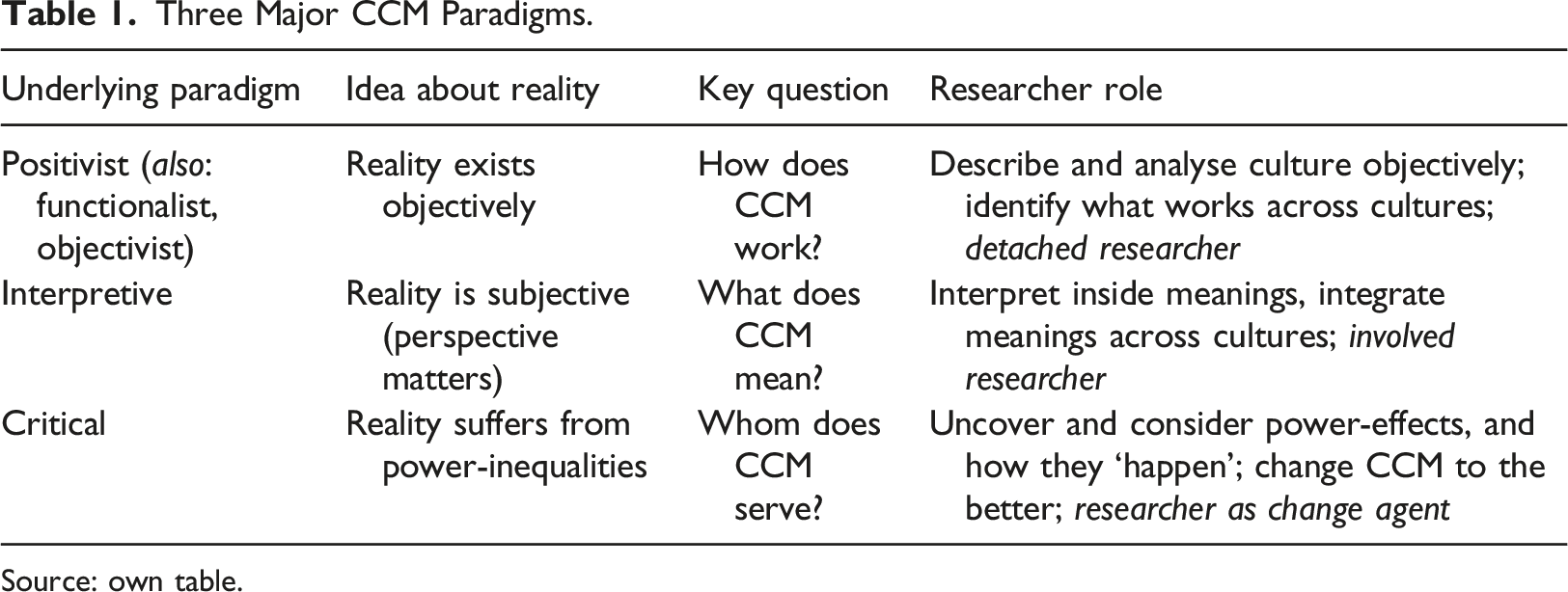
Source: own table.
Scope and aims of this article
This article argues that the ways in which CCM scholars have come to view the existing CCM paradigms as ‘different’ is the outcome of a process of selective historical adoption. It is neither an objectively ‘best’ way of ordering disciplinary knowledge, nor is it the only knowledge that could have been selected. For making this point, this article applies a genealogical lens to how CCM scholars have come to understand the paradigmatic delineations of their discipline. This genealogical deliberation takes place in light of those CCM texts which outline or delineate paradigms in CCM studies (Adler, 1983; Bird and Mendenhall, 2016; Boyacigiller et al., 2003; Cardel Gertsen and Zølner, 2020; Hofstede, 2001; House and Javidan, 2004; Jack and Westwood, 2009; Mahadevan, 2020b; Mead and Andrews, 2009; Minkov, 2011, 2013; Peterson and Barreto, 2015; Peterson and Søndergaard, 2011; Phillips and Sackmann, 2015; Schneider et al., 2014; Sackmann, 2015; Smith et al., 2008; Yeganeh and Su, 2006).
Genealogy and its application to positivist and interpretive cross-cultural management studies
Genealogy is derived from Nietzsche (1996) and has been developed by Foucault throughout his writings (1970, 1977, 1979, 1980, 1984, 1995 [1972]; overview in 2003). It is a technique for tracing how certain disciplinary developments have come to constitute a perceived present ‘normality’ (Mahadevan, 2020b, 2023; Prasad, 2009). Its purpose is to ‘challenge’ this normality (a process referred to a problematization, see Alvesson and Sandberg, 2011) and, thus, to enable researchers to re-order knowledge in more sophisticated and less myopic ways, thereby advancing and extending the disciplinary body of knowledge.
Despite using a commonly known term (genealogy), Foucault (1977) uses this term very differently than for instance, the Encyclopaedia Britannica (“the study of family origins and history”, 2023) or Merriam-Webster Dictionary (“an account of the descent of a person, family, or group from an ancestor or from older forms”, 2023) propose. Foucault’s method of genealogy is not about ‘digging up’ factual lineage and pedigree. Rather, what Foucault proposes is a way of becoming aware of how the present has been shaped by a certain historical process of selective adoption, and then to ‘work’ from this awareness.
This requires identifying four closure mechanisms in what seems historically ‘true’, namely Principles and elements of genealogy. Source: own figure.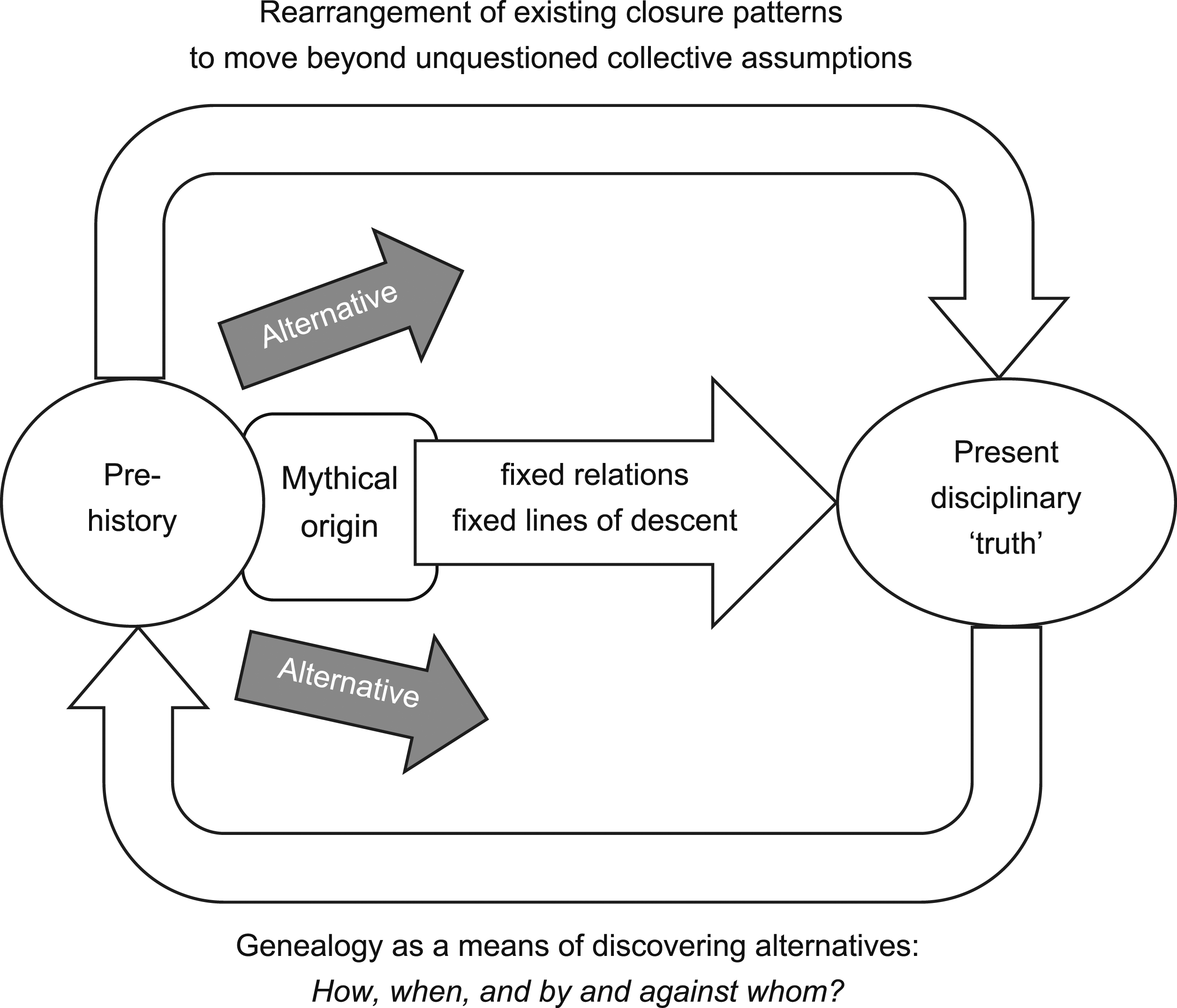
Disciplinary history as a process of distilling single ‘truths’
Every discipline (such as CCM studies) involves the idea of its being based upon, representing and producing a certain knowledge (Mukerji, 2007). An example is the idea that positivism and interpretivism are distinct CCM paradigms (Barmeyer et al., 2019; Romani et al., 2018a), and – within the interpretive CCM community – that the interpretive approach to culture is suited for overcoming inherent limitations of how culture is conceptualized within the positivist paradigm (Chevrier, 2009; D’Iribarne, 2009; McSweeney, 2009).
Foucauldian genealogy is a way of becoming aware of how the present has been shaped by a certain historical process of selective adoption, and then to ‘work’ from this awareness. The starting point is the insight that, at a certain point, a certain method or approach with a certain degree of novelty was proposed to a community, such as CCM studies. When this happens, disciplines are prone to consider past events solely in how they contribute to how disciplinary knowledge is presently codified (Jørgensen, 2002), in this case: how positivism and interpretivism emerged as different. In the development of any discipline, it is inevitable that some arguments take precedence over others. In the process, ‘alternative histories’ are forgotten, because they do not fit to the present knowledge which has already emerged as ‘true’ and is thus not contested anymore (Foucault 1995[1972]).
Genealogy is thus not a general critique towards processes of selective adoption as such. Rather, it wishes to identify those processes of selective adoption that function as closures for present and future disciplinary knowledge and might thus have limiting effects upon a discipline’s potential body of knowledge (see Foucault, 1984). If disciplinary history is a process of selective adoption with the goal of streamlining disciplinary knowledge – as genealogy proposes – then those past events which do not directly contribute to the creation of present disciplinary ‘truths’ (such as: positivism and interpretivism are opposing CCM paradigms) are likely to have faded from disciplinary memory.
These patterns apply to the work of Hofstede (1980) and Geertz (1973): these were sufficiently ‘different’ from previous approaches to studying culture to widen the knowledge base of what later became CCM studies. At the same time, both also built upon previous works, e.g. Hofstede (1980) on Triandis et al. (1972), Kluckhohn (1951) and Kroeber and Parsons (1958) – transdisciplinary references which Hofstede himself (2001:9-10) acknowledges as having contributed to his definition of ‘culture as the collective programming of the mind that distinguishes the members of one group or category of people from another’ [italics in the original]. However, when further studies started to locate themselves in the tradition of Hofstede or Geertz, respectively, they increasingly stopped referencing those studies leading up to these presumed origin (Hofstede or Geertz). Foucault (1977, 1984) identifies this as the first step by which disciplinary history becomes closure.
A closure is, simply put, a mechanism that prevents the consideration of alternatives, for example, alternative theories or research questions, in this case: alternative ways in which paradigmatic knowledge might be delineated in CCM studies. The purpose of genealogy is to ‘break up’ history and ‘un-fix’ the present. It is not to establish an alternative, ‘true’ history in the sense of lineage but about the process of paying attention to how closure mechanisms order present knowledge, and of engaging in a search for alternative ‘logics’, even though these seem to run contrary to what is believed to be ‘true’ by oneself and by one’s peers, in a certain present. Ultimately, genealogy is thus not a ‘historical’ method but rather a way of problematizing the present by proposing another ‘lens’ (Kearins and Hooper, 2002), that is: to analyse the assumptions that underlie a certain present in order to highlight that what seems ‘normal’ and ‘natural’ today is selective (Jørgensen, 2002), and that the discipline could have selected otherwise.
For example, in CCM studies, it is assumed that interpretive anthropology came into being only with Geertz’ (1973) ‘seminal’ work The Interpretation of Cultures: Selected Essays, and ‘thick description’, as the method required for applying this perspective, is assumed to have first been outlined in Geertz’ (1972) ‘famous’ Notes on Balinese cockfight. Likewise, comparative CCM studies is assumed to have been ‘invented’ by Hofstede (House and Javidan, 2004; House et al., 2004; Mead and Andrews, 2009; Minkov, 2011, 2013; Peterson and Barreto, 2015; Schneider et al., 2014; Smith et al., 2008; Yeganeh and Su, 2006) without considering works prior the presumed ‘origin’ of a certain paradigmatic orientation.
According to Foucault (1977, 1984), this then signifies the construction of the mythical origin, that is: an origin without pre-history via an act so grand that it is almost mythical, as the first type of closure. Later studies then locate themselves only in relation to this
As soon as the mythical origin and its lines of descent have obtained the status of ‘true knowledge’ in the present, any other study rooting itself in the disciplinary body of knowledge then needs to establish its relevance in relation to them (
Finally, even those CCM texts which investigate the history of the conceptualization of culture within the positivist paradigm prior to Hofstede (1980) or Geertz (1973) then need to consider previous studies not in their uniqueness but in how they ‘lead to’ or ‘build towards’ Hofstede’s study (as, for instance, evidenced in Hofstede, 2001; House and Javidan, 2004; House et al., 2004; Mead and Andrews, 2009; Minkov, 2011, 2013; Peterson and Barreto, 2015; Schneider et al., 2014; Smith et al., 2008; Yeganeh and Su, 2006) or Geertz’ (1973) approach to culture. For example, cultural anthropologists such as Margaret Mead are then only considered in relative terms by CCM studies, namely in how they were forerunners of either Hofstede’s or Geertz’ work (Mahadevan, 2020b). This then signifies closure via ‘
Disciplinary knowledge as a product of its time and place, and the actors who promoted or resisted it
To break of up closures, genealogy demands that one contextualizes disciplinary knowledge in time and space. For instance, concepts such as Hofstede’s (1980) cultural dimensions are not timeless and universal, but the product of a time (1967 to 1972) and place (IBM). This implies that their meaning, e.g. of masculinity versus femininity (Hofstede, 1980), needs to be viewed in light of this context. Factually, the dimension encompasses two aspects (Hofstede, 2001: 312): first, a masculine business style implies the dominance of values that are considered ‘masculine’ such as assertiveness and competitiveness. In contrast, a ‘feminine’ business style implies the dominance of values that are considered ‘feminine’ such as care, cooperation and modesty. Secondly, power-positions in societies characterized by high masculinity are assumed to be male-dominated, and power-positions in societies scoring high on femininity are assumed to be more gender-equal.
However, from the standpoint of the present or at least a closer past, men are not born competitive and assertive, and women are not born cooperative and modest (Acker, 2006). Rather, they have socially learned to be in a certain way, thereby internalizing culturally-informed gender roles (ibid.). As Emrich et al. (2004) thus argue (within the QSCR tradition), the Hofstede (1980) dimension mixes up biological and socially learned gender, as well as gender egalitarianism, with the degree of assertiveness required when in a position of social or organizational power (see House and Javidan 2004: 13-14). Furthermore, Hofstede’s (1980) data originates from a single company, namely IBM, and one might wonder how many women worked at IBM in the 1960s and 1970s (and in which position). Labelling socially-learned ways of doing things as ‘masculine’ and ‘feminine’, and equalling ‘masculinity’ with male dominance under such conditions, therefore might perpetuate gender stereotyping (Emrich et al., 2004). Time and place thus matter for contextualizing disciplinary knowledge, and Hofstede himself (2000) has revised his approach to masculinity and femininity in later publications.
Rather than taking disciplinary knowledge for granted, genealogy asks how and when some ideas have taken precedence over others. For instance: When did it happen that the present paradigmatic delineations of CCM were formed, and how did they enter the disciplinary knowledge base of what became CCM? If this point in time and its actors are identified, then the formerly hidden alternatives of a certain selective adoption are discovered: One can see when and how disciplinary knowledge has departed from its alternatives: pre-history becomes history, and, thus being given a choice where previously there was none, present CCM scholars can reconsider their selective choices in light of these alternatives and choose otherwise.
Investigating cross-cultural management history side-wards: what connects positivism and interpretivism
For asking how commonly accepted disciplinary knowledge could not be true, genealogy requires investigating history
If one proceeds from these connections, one can then see that North American anthropology as a discipline emerged at the end of the 19th century. This discipline, in relation to other anthropological schools, was particular in two aspects (Eriksen and Nielsen, 2013): First, the closest object of study for North American anthropologists were Native American communities, whose social systems were no longer intact, and whose cultures (compared to the complex cultures elsewhere studied by European and British anthropologists) seemed much diminished in richness – with the risk of inferior academic discoveries (Eriksen and Nielsen, 2013). In particular, the societal structures and other, more explicit cultural traits, had long since vanished. Thus, social systems, a major focus of what later became British ‘social’ anthropology, was not a fruitful avenue for academic discoveries (Kuper, 1999). Operating from a ‘sense of urgency’ to uncover Native American culture before it became extinct, North American anthropologists then focused on artefacts and immaterial cultural traits, such as values (Eriksen and Nielsen, 2013: 23-24).
Genealogy thus helps scholars to consider the interests underlying a certain historical choice: In order to have a fruitful object of study of its own, North American anthropology, also being the ‘youngest’, smallest (in terms of trained anthropologists) and the academically least established of the then-existing anthropological traditions (German, French, British, see Eriksen and Nielsen, 2013), had to find something worthwhile studying, and the focus on immaterial and presumably ‘timeless’ aspects of culture, such as values, as well as collecting artefacts, then provided a promising and, thus, ‘logical’, way out (Mahadevan, 2020b).
The specific state of Native American cultures at this time also implied the need to focus on the stability of culture and to favour it over change (because, otherwise, the ‘cultural remnants’ still left to be studied would diminish in relevance), and to argue for the distinctness of cultural values (Eriksen and Nielsen, 2013; Kuper, 1999; Mahadevan, 2020b). The same conditions also facilitated cultural comparison, because it was only selected aspects, and not ‘the whole of culture’, that was still available for scientific analysis (Schnegg, 2014). As a methodological consequence, this condition considerably reduced the complexity of the data to be handled and invited comparison. The implications of comparison were more promising for the immaterial (value) aspect of culture, not for its material one (artefacts), which then further strengthened choices leaning towards a value focus (e.g. Kroeber and Kluckhohn, 1952).
Secondly, and in contrast to European anthropologists, North American anthropologists studied cultures nearby, and, in the process, easily moved from Native American communities to studying workers and urban communities (Kuper, 1999). This made anthropology come close to North American sociologists, and the danger emerged that both disciplines might cannibalize each other (Mahadevan, 2020b). Sociologist Talcott Parsons and anthropologist Alfred Kroeber thus initiated an ‘academic truce’ between sociology and anthropology, whereupon anthropology agreed to retain its ‘value’ focus, and not to enter sociological questions such as organization, role, hierarchy, industrialization and so on (Eriksen and Nielsen, 2013: 81-2). Consequently, Kroeber and Parsons’ (1958) definition of culture (what was ‘agreed upon’ in the inter-disciplinary truce) draws a line between ‘culture’ (as a value or meaning system) and ‘social systems’, which is not as present in other anthropological traditions, such as French sociology and anthropology (Mahadevan, 2020b). At the same time, interdisciplinary studies between anthropology and social psychology, focussing on values, were promoted, also by Parsons himself (Johnson and Johnson, 1986), resulting in the first small-scale comparative studies on value orientations by anthropologist Clyde Kluckhohn and social psychologist Fred Strodtbeck (1961), which became one of the codified origins of Comparative CCM in the tradition of Hofstede (2001). This suggests that the ‘value’ focus of North American anthropology was as much constrained by the interests of others as it was freely chosen by those involved.
Other North American anthropologists, such as Clifford Geertz (1973), who had studied under both Parsons and Kluckhohn, turned to structural linguistics (semiotics, see De Saussure, 1977) to extend the scope of ‘culture’ again, namely as ‘text’ to be read and interpreted by the cultural researcher. Again, this can be interpreted as an act of positioning against the acts of positioning made by others. When doing so, Geertz borrowed from the specific ‘French’ academic tradition, wherein anthropology and sociology had remained closely intertwined, and wherein interdisciplinary scholars, such as Marcel Mauss (1925), had combined both disciplines, e.g. for studying the culturally universal social purposes of gifts. However, Geertz (1973) did not choose more ‘tangible’ cultural traits, such as habitus (fine social distinctions inscribed socially into individuals’ ‘ways of being’, nowadays ascribed to Pierre Bourdieu, 1984, but actually originating from earlier scholars such as Norbert Elias, 1939, and Marcel Mauss, 1934, in a continental European tradition), as an alternative interdisciplinary sociological/anthropological concept, but remained focussed on the ‘meaning’, rather on the ‘doing’ aspect of culture.
Genealogy as a method thus highlights how, out of the stated conditions, a specific North American interpretive cultural anthropology emerged, with a focus on symbolic meaning as the core element of culture, and it is this particular type of anthropology which has informed management and organization studies, including CCM studies (Mahadevan, 2020a; Moore and Mahadevan, 2020). Within this specific interpretive orientation, meaning systems within one culture are considered to be comparably stable and convergent (see Romani et al., 2011a), with the ensuing need to negotiate meaning across cultures (ibid., Cardel Gertsen and Zølner, 2020). The underlying idea of interpretive CCM, in its present form, is thus that collective meaning is relatively homogeneous and stable in time, in particular when compared to its alternatives, such as postmodernism (Mahadevan, 2017; Mahadevan and Moore, 2023).
Both major paradigmatic orientations of present CCM are thus underpinned by the idea that it is immaterial cultural traits which determine behaviour and create cross-cultural differences, namely value orientations (positivist CCM) or symbolic meaning (interpretive CCM). What they furthermore have in common is the idea that there are generalizable patterns of culture to be inferred from specific and particular phenomena, events and actions. For instance, Geertz postulated that meaning creates culture in all cultures, and he exemplifies this idea with a treaty on religion as a general system prevalent in all cultures (1965, 1966), which is similar to how Mauss (1925) had conceptualized gift-giving as a general social function across cultures. This then makes cultures comparable which, consequently, implies the need to consider their underlying characteristics (value/meaning) as sufficiently stable and distinct.
Crossing lines: challenging the distinctness of interpretive cross-cultural management
Paradigmatic delineations, with the purpose of distilling ‘single truths’ and definite origins, operate with broad distinctions. For instance, Geert Hofstede is commonly referred to as a social psychologist, as his studies locate culture within individuals (‘culture as the collective programming of the mind’, Hofstede, 2001: 9). Conversely, Clifford Geertz is thought of as an ‘anthropologist’, as he locates meaning (i.e.: culture), as a socially constructed phenomenon between people. In the established logic of interpretive CCM, his metaphor of ‘culture as text’, to be interpreted by the researcher, is an essential part of how the core of the interpretive approach to culture is presently constructed (Cardel Gertsen and Zølner, 2020), in particular as an act of positioning against the presumed limitations of the positivist search for universal and objective cultural laws. Both beliefs constitute a closure associated with the origins of a certain paradigmatic orientation, and, whenever researchers build their argument for or against a certain paradigm in relation to these origins, they built additional closures by means of fixed relations.
Genealogy questions such universal disciplinary delineations by taking a closer look at the specifics of history. This way, it rearranges present disciplinary knowledge patterns so that researchers may move beyond closure-effects emerging from fixed origins and relations. It then becomes apparent that Hofstede roots his approach in a North American anthropological definition of culture (Kluckhohn, 1951) in his own writings (Hofstede, 2001: 9). Geertz, the presumed ‘anthropologist’, graduated from the Department of Social Relations (DSR) of Harvard University under Talcott Parsons, one of the leading North American sociologists at that time (see Cossu, 2019). The idea of ‘culture as text’ which he promoted shows close ties to French discourse analysis in the tradition of Michel Foucault (overview in Foucault, 2003) and the structural linguistics/semiotics of Ferdinand De Saussure (1977); it is as ‘linguistic’ as it is ‘cultural’ (see Cardel Gertsen and Zølner, 2020). Still, the link to related disciplines who are also linguistically informed, such as intercultural communication (ICC), is seldom made, and ICC studies remain fixed to the mythical origin of Edward T. Hall at the US-American Foreign Service Institute in post-World War II, this being a major disciplinary closure point of this discipline (see Leeds-Hurwitz, 1990, 2010; Mahadevan, 2020b).
Obviously, ‘labels’ and ‘names’ might not do justice to the full content of a certain academic work, yet, still, genealogy, as a technique wishing to challenge unquestioned ‘single truths’, enables scholars to resist disciplinary closure. The genealogical questions to be asked are thus: when and how did the two paradigms cross disciplinary lines (and who crossed them, and out of which purposes), and what are the implications of these questions for how the interpretative approach to culture in CCM presently legitimizes itself against the positivist approach?
The genealogical lines of descent for both positivist and interpretive CCM, and its respective actors, cross in the Department of Social Relations (DSR), actually: Department of Social Relations for Interdisciplinary Social Science Studies, at Harvard University, in the 1950s and 1960s. The DSR was founded in 1946 as an interdisciplinary research collaboration amongst the three major social science departments, namely anthropology, sociology and psychology, with Talcott Parsons as its long-term chair (Cossu, 2019). Major projects conducted at the DSR were, for instance, a multidisciplinary analysis of Soviet culture (Bauer et al., 1956), comparative studies of value-orientations by Florence Kluckhohn and Fred Strodtbeck (Kluckhohn and Strodtbeck, 1961), and by Evon and Ethel Vogt (Vogt and Vogt, 1966), and a comparative study on the development of personality in six cultures (Whiting and Whiting, 1975). Comparative CCM refers to Clyde Kluckhohn in its definition of culture, the study by Florence Kluckhohn and Fred Strodtbeck is frequently referenced as one of the predecessors of Hofstede’s (1980) study (e.g. House et al., 2004), and both Clifford Geertz and Fred Strodtbeck are amongst the graduates of the DSR. Other prominent contemporary graduates are, for instance: Jerome Bruner, (a cultural psychologist who conducted studies on the interlinkages between culture and personality (Bruner, 2008); Roy D’Andrade, a founding figure of cognitive anthropology with its close ties to cross-cultural psychology and later discussions on cultural complexity (e.g. Chick, 1997), and Harold Garfinkel, a founding figure of ethnomethodology, an approach promoting the idea that it is cultural interactions (visible culture) that are constitutive of immaterial or tacit cultural aspects (such as values) (Garfinkel, 1984 [1967]).
Bruner’s work stands in the tradition of Ruth Benedict (1934) and Mead (1928) who brought forward the ‘culture as personality school’ (Kashima, 2016), which developed out of North American anthropology, and to which both culture-related psychology (e.g. Shiraev and Levy, 2010), as informing QSCR (Hofstede, 1980, 2001; House et al., 2004; also see Minkov, 2011, 2013; Smith et al., 2008), and interpretive CCM refer (Cardel Gertsen and Zølner, 2020). Likewise, cognitive anthropology (overview in D’Andrade, 1995) is close to the approach to culture promoted by cross-cultural psychologist Triandis (1972) and, ultimately, QSCR in the tradition of Hofstede (1980): Cognitive anthropology, too, wishes to measure a collective construct (culture) on individual level, which is a point of much methodological discussion in contemporary CCM (Caprar et al., 2015; Maznevski et al., 2002; McSweeney, 2002; Smith et al., 2008). Conversely, Garfinkel promotes an approach directly opposite to the idea of immaterial traits (values/meaning) as constitutive of culture and as promoted by both Hofstede and Geertz (see previous section); this line of descent from North American anthropology thus represents an alternative historical knowledge-base which was chosen by neither positivist nor interpretive CCM (Mahadevan, 2020b). These examples highlight not only the interdisciplinarity of the work at the DSR beyond established paradigmatic delineations, but also establish alternative origins and lines of descent across presumed disciplinary divides.
For the purpose of this article, it is thus relevant to note that Geertz’ work did not start with The Interpretation of Cultures, but emerged from the specific context of the DSR, and in close interaction with the previously stated theories and studies. Even though officially ‘structural functionalist’ in orientation, the goal of the DSR in the 1950s and 1960s was to establish a unified language and theory of the social sciences, (Parsons and Shils, 1951, see discussion in Isaac, 2010) whilst at the same time “nationalizing” it (Klausner and Lidz, 1986). As Cossu (2019: 4) writes in the first historical analysis of how Geertz developed his early theories with the support of this interdisciplinary network of scholars, the DSR “produced compelling multi-disciplinary collaborations and cohorts of gifted graduate students”. Structural-functionalism in such a multidisciplinary environment coveted by state agencies and spurred by national interests “was less an orthodoxy than it was a ‘free floating paradigm’, constantly updated” (Cossu, 2019: 3). Aronova (2017) finds that interdisciplinarity during that time was promoted as an ideal of Cold War scholarship not only to achieve practical results, but also to exemplify good citizenship. Cohen-Cole (2014: 67-68) states that scholarly virtues such as creativity, practicality, open-mindedness and tolerance, as well as scientific excellence, were associated with interdisciplinarity. This time has therefore been referred to as “a golden age of inter-, cross-, and multi-disciplinary work” at the DSR (Cossu, 2019: 3).
‘Values’, as a major research focus of the DSR between the early 1950s and late 1960s (Johnson and Johnson, 1986), were considered to be relevant not only for academic insights, but for building a ‘better’ US-American society and for promoting ideals of national culture under Cold War conditions (Klausner and Lidz, 1986). It is thus not surprising that (national) culture and ‘national character’ (Inkeles, 1996), as exemplified by ‘values’, became of interest, as the identification of universal cultural patterns was expected to also serve national interests (Engerman 2010).
The Interpretation of Cultures is often understood as the ‘turning point’ in Geertz’ oeuvre, by means of which he broke away from the structural-functionalism of Talcott Parsons (Alexander and Smith, 2011). When Geertz’ work is cited in CCM studies (and beyond) by scholars locating themselves within the interpretive paradigm, it is usually The Interpretation of Cultures (1973) which is referenced (Cardel Gertsen and Zølner, 2020), sometimes also by those wishing to improve upon a Geertzian approach to culture (e.g. Primecz et al., 2009). In this anthology, Geertz promotes a more interpretive, hermeneutic (Gadamer, 1960) approach to culture, in particular via his methodological chapter on “thick description”, and via his “crash course to interpretive anthropology” (Cossu, 2019: 2) entitled “Deep Play: Notes on Balinese Cockfight” (originally published in 1972).
However, as Cossu (2019) argues in the first historical analysis of how Geertz developed his early theories with the support of this interdisciplinary network of scholars, Geertz remained closely linked to the interdisciplinary work at the DSR, both before and after The Interpretation of Cultures was published. For instance, Geertz’ seldom referenced ‘cultural systems’ treaties, e.g. on Ideology as a Cultural System (1964), Religion as a Cultural System (1965, 1966), and – published
Discussion
Paradigm sensitivity, within and across paradigms, is commonly understood as a way towards more relevant research (Grosskopf and Barmeyer, 2021; Mahadevan, 2013; Patel, 2017). Thus, it is relevant to reflect what CCM paradigms have in common, and to also challenge why and how they might be distinct. What all paradigms in CCM studies share the need to conceptualize culture somehow, yet, each paradigmatic orientation operates within certain concepts of culture, each has ideas of where this concept of culture comes from, and each has developed its own ideas of what constitutes culture and how it should be studied (as put forward by Bird and Fang, 2009; Boyacigiller et al., 2003; Caprar et al., 2015; Chevrier, 2009; D’Iribarne, 2009; Fang, 2012; Lowe, 2002; Lowe et al., 2007; McSweeney, 2002, 2009; Phillips and Sackmann, 2015). Consequently, positivist and interpretive CCM studies have come to be understood as different and associated with distinct mythical origins and there is even the idea that interpretive CCM is the ‘better’ approach in the sense that it will overcome the inherent limitations of the comparative, value-based approach.
Within present paradigmatic delineations, positivist researchers in the tradition of Hofstede (1980) compare selected aspects (in particular: value orientations) of large units of culture, such as nations and societies, by means of quantitative methods in order to identify objective relative differences across these large units of culture. Conversely, researchers in the interpretive tradition of Geertz (1973) investigate of how intersubjective meaning (meaning that emerges between individuals) is produced in interaction (‘in the field’), by means of in-depth qualitative and often textual methods, and, when doing so, also reflect about researcher role and how researcher-field relations influenced research outcome. Consequently, because origins, lines of descent and relations are fixed, and because pre-history is obscured by the ‘mythical origin’, it then becomes ‘true’ that positivist and interpretive CCM studies are ‘different’. Instead of focussing on the differences across both approaches, genealogy reveals how both paradigms are interconnected in their evolution and thus limited in similar ways.
Firstly, interpretive and positivist CCM are united by the same process of selective adoption at a specific time and in a specific place, namely under the condition of North American anthropology being in need of an object of study. Both paradigms chose selected immaterial aspects of culture (value/meaning) over the whole of culture, and both assume that the whole of culture can be inferred from these selected immaterial aspects. Both did so out of the need for academic legitimacy, in comparison to other academic schools and against another major emergent discipline, namely North American sociology. Both are in search of generalizable patterns (value dimensions/meaning systems), and both assume that these cultural patterns tend towards homogeneity, stability and convergence. Based on the outcome of the genealogical investigation, it is thus ‘merely’ the specific immaterial aspects chosen (values vs meaning) that differ, not the fundamental ideas about culture upon which they rest. Even though interpretive CCM is mainly associated with qualitative methods (Cardel Gertsen and Zølner, 2020) and positivist CCM with quantitative methods (Sackmann, 2020), this is not a necessity, as, for instance, Geertz’ (1965, 1966, 1975a, 1975b) long-term ‘cultural systems approach’ to religion, art, and common sense exemplifies, and as Fisher’s (2009) quantitative approach to measuring culture as meaning system shows.
Furthermore, the idea of interpretivism and positivism involving distinct theoretical worldviews and methodologies (e.g. Primecz et al., 2009) is something that does not fit the historical context from which both paradigms emerge, namely the Harvard Department of Social Relations between the early 1950s and late 1960s. Here, interdisciplinarity enabled scholars to use multiple theoretical and methodological angles for shared practical and idealistic purposes, fired by national interests that were presumed to be at stake, which again strengthened the focus on a presumably ‘immaterial’ national culture in close interconnection with more psychologically-oriented studies of cognition, character and personality.
Contrary to established disciplinary truth, genealogy brings to light how Geertz (1973) developed interpretive symbolic anthropology as interwoven with the roots of positivist CCM. Thus, it is questionable whether interpretive CCM is truly the ‘better’ approach to uncovering national cultural complexity beyond the limitations of positivist CCM, as several scholars maintain (Chevrier, 2009; D’Iribarne, 2009; McSweeney, 2002, 2009). This then suggests that, merely via pursuing an interpretive approach to culture or via employing qualitative instead of quantitative methods, CCM scholars will not move beyond the limitations of how culture is conceptualized in CCM studies, and this might then explain what the discipline ‘fails’ to see and to acknowledge. Genealogy thus helps reflect upon what a present discipline is ‘stuck in’, as, in the case of CCM studies: in the idea of immaterial culture from which patterns of (national) difference need to be deduced. Interpretivism is thus not the ‘better’ version of CCM studies: it is simply another facet of the same limitation, as Figure 2 visualizes. Summary – what connects positivist and interpretive CCM studies. Source: own figure.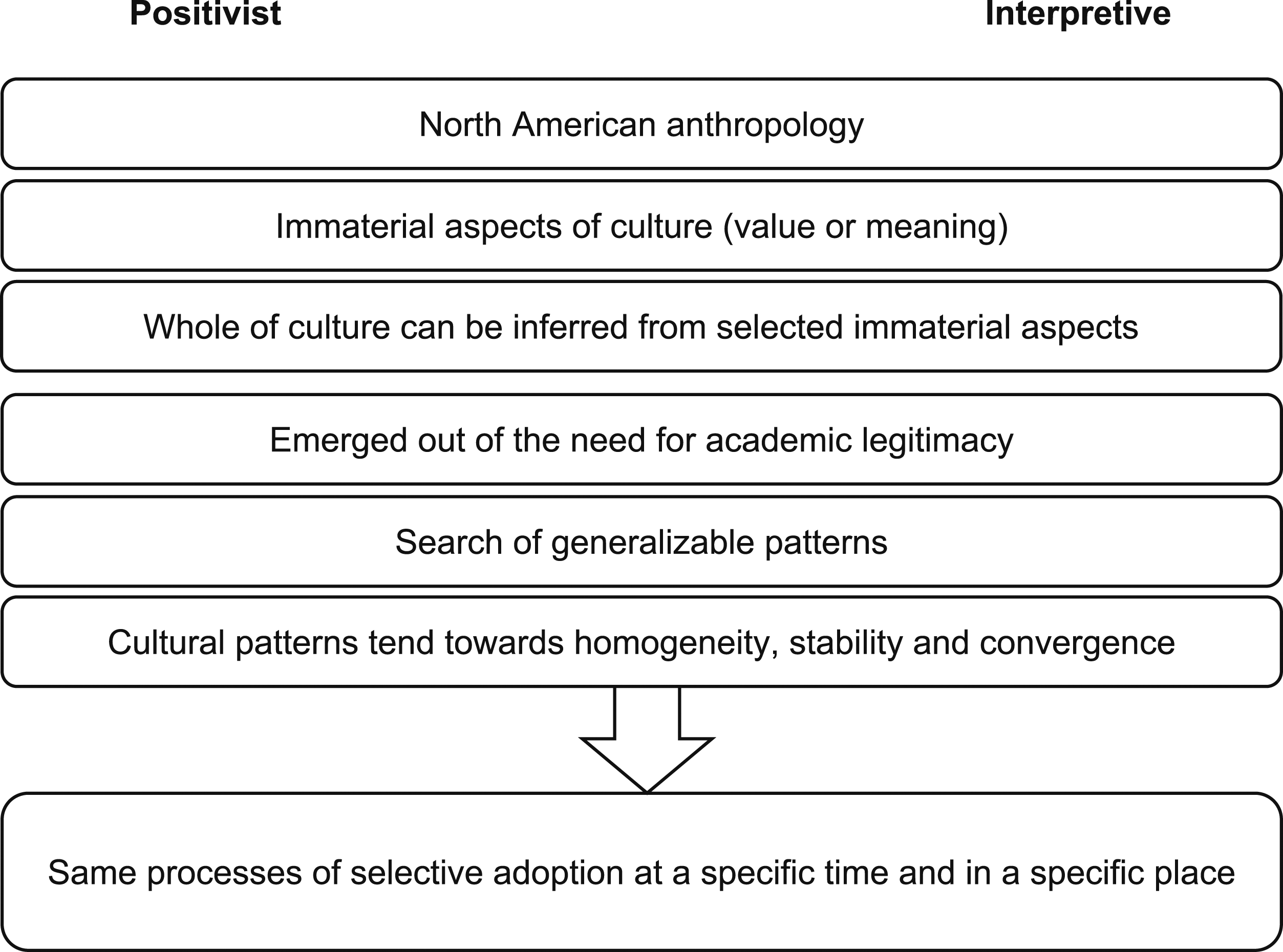
Implications
As genealogy helps CCM scholars ‘see’, the limitations identified in the concept of culture and how it is studied might have less to do with the paradigm to which they are ascribed, but rather with the historical choices made across the positivist and interpretive paradigm, upon which CCM as a discipline has not (yet) reflected upon. If present CCM scholars hold both in mind – how paradigms are distinct, but also which elements of the past are presently missing and how these could enrich the present – they might contribute to the disciplinary body of knowledge in more complex and sophisticated ways. Out of this realization might then emerge new methodological options across interpretive and positivist orientations, such as Qualitative Comparative Analysis (QCA, Ragin, 1987), which is been increasingly applied to International Business studies (Fainshmidt et al., 2020).
CCM scholars may then consider how positivist CCM is also ‘interpretive’, and how interpretive CCM is also ‘positivist’, and what is lacking across both. For example, in the anthropological tradition outside of the North American cultural anthropology from which CCM studies draw, in particular in British social anthropology, there is also the tradition of ‘structural functionalism’ (see Mahadevan and Moore, 2023; Mahadevan and Moore, 2023) that integrates interpretive and positivist approaches to culture. Also, there is a specific ‘French’ school of interpretive CCM which leans much more towards sociology, in the shape of French structural functionalism, than interpretive CCM in the tradition of Geertz does (e.g. D’Iribarne, 2009). Scholars might then keep in sight those knowledges which are presently not selected as relevant across all choices made. For instance, the postmodern approach to culture (Mahadevan and Moore, 2023), never seems to fully fit present paradigmatic differentiations in CCM studies: it is too textually deconstructive to be large-scale critical (Romani et al., 2018b), and too sceptical of homogenous and stable meanings to be interpretive (Mahadevan, 2020a). Therefore, postmodernism (also referred to as radical humanism by Burrell and Morgan), whilst highly relevant to CCM studies (Ailon, 2008), is likely to be considered the less, the more the delineations of positivist, interpretive and critical CCM take hold.
As time goes by, CCM requirements change, and previously discarded disciplinary concepts might become relevant anew. For instance, out of all anthropological options, Hofstede (1980) chose values, and interpretive CCM chose meaning, not artefacts, the alternative focus point of North American cultural anthropology at that time. This selective adoption took place at a specific point in time, when artefacts and material culture meant physical artefacts. However, nowadays, technology as impacting upon CCM has become largely virtual and non-physical (Mahadevan, 2023), and, in contrast to physical objects, ‘artefacts’ of such kind might be easily studied in multinational and multi-local settings (Mahadevan, 2020b), and one might consider artificial intelligence as a CCM actor. This then implies that the value/meaning focus of CCM studies should not be taken for granted, just because it has been pre-selected by certain actors, pursuing certain and resisting other interests, at a specific place and at a specific point in time. Nor should the choice of CCM worldviews and methodologies be limited by existing ideas of what differentiates a certain paradigm, because, as genealogy shows, these paradigms developed as part of a multi-methods toolkit, aiming at interdisciplinary scholarship.
Ultimately, genealogy, as a means of working against closure, enables CCM researchers to pursue presently ‘mis-fitting’ options. However, again, the task is not only to construct this new body of knowledge, and its delineations, but to also de-construct and challenge its content and boundaries whilst pursuing it. This article thus suggests genealogy as a suitable method for collectively building and re-building disciplinary knowledge-in-the-making. As a side-effect, this then also leads to a higher resilience against disciplinary ‘trends’ and ‘fashions’, such as a taken-for-granted, unquestioned – and thus limiting – focus on paradigms in the sense of a ‘status quo’. For example, one may also ask the genealogical question of which actors, context and events put forward a focus on paradigms and challenge the relevance of this approach: another deconstruction leading to new knowledge constructions. In that sense, genealogy is a way of being ‘pragmatically reflexive’ (see Alvesson and Sköldberg, 2000) about what one (and a discipline) does and does not know: Reflexivity is employed as a means to an end, and the end, in this case, are more differentiated and sophisticated and, thus, more relevant, disciplinary knowledges.
Summary and conclusion
Genealogy enables CCM scholars to reconsider their mental maps of how CCM knowledge is ordered. It challenges the disciplinary knowledge that is presently accepted as true by bringing to light how four interrelated types of closures (mythical origins, fixed lines of descent, pre-history leading to mythical origin and fixed relations) impact upon the present, in this case: the idea that positivist and interpretive CCM are opposing paradigms which are differentiated by a distinct approach to how culture should be conceptualized and studied. The two premises of genealogy are (1) the insight that disciplines use history to distill ‘single truths’ and (2) the need to un-break history in order to un-fix the present. To reach this goal, genealogy investigates history side-wards and crosses those demarcation lines which have become accepted as ‘true’. In the case of this article, it then becomes apparent how positivist and interpretive CCM can be traced back to the same origins, actors, points-in-time and place, and how both are connected by a focus on culture as selected stable, immaterial traits. Such historical reconstructions enable present CCM scholars to establish new connections, to consider what is missing, and to re-order and re-imagine present disciplinary knowledges in novel and more sophisticated ways. The outcome of this approach is not a new, better and finite history but a constant disciplinary process of un-breaking history, with the purpose of un-fixing a certain disciplinary present. Ultimately, this is a collective endeavour and an ongoing project, and further studies need to be conducted in this light to advance CCM studies’ disciplinary body of knowledge.
Footnotes
Declaration of conflicting interests
The author(s) declared no potential conflicts of interest with respect to the research, authorship, and/or publication of this article.
Funding
The author(s) received no financial support for the research, authorship, and/or publication of this article.
