



Abstract
How are public organizations subjected to institutional work that reduces barriers to marketization within public decision-making while undermining procedural safeguards and democratic accountability? Drawing on a critical hermeneutic analysis, we examine the procurement of a multibillion hospital project in Sweden, where a public–private partnership gained legitimacy despite established safeguards for procedural fairness and public accountability that weighed against it. We show how liminality, as a state of being neither fully inside nor outside organizations, enables interventions in bureaucratic procedures without equivalent formal accountability. We conceptualize this as liminal market-shaping, expressed through management consultants’ efforts to destabilize decision paths, moral foundations, and sanctioning mechanisms in public procurement. The study contributes to marketing theory by extending market-shaping research to public organizations, introducing liminal market-shaping as a form of disruptive institutional work, and conceptualizing public de-responsibilization to explain how marketization erodes rather than activates agency in markets and beyond, within democratic governance.
Keywords
Introduction
In June 2008, the Region Council Assembly in Stockholm, Sweden, voted to procure one of the country’s largest public infrastructure projects, the New Karolinska Solna University Hospital (NKS), through a public–private partnership (PPP). Only a few years earlier, the same assembly had rejected a PPP for NKS, citing limited Swedish experience with PPP contracting and higher financing costs than conventional public procurement. In a short period, a model framed as inappropriate and risky became politically and administratively legitimate.
This reversal cannot be explained by electoral change alone. The right-wing regional leadership elected in 2006 supported market-oriented reforms, but implementing a “world-class hospital” (Johannesson and Qvist, 2020) required more than political preference. The PPP decision reconfigured how public healthcare infrastructure could be financed, governed, and justified. It also raised a basic question: how can institutional safeguards designed to protect transparency, procedural fairness, and democratic accountability be destabilized from within?
Marketing theory increasingly emphasizes that markets are shaped through purposive action rather than emerging solely from structural change (Baker and Nenonen, 2025; Benmecheddal et al., 2023; Humphreys and Carpenter, 2018). Research has therefore examined how actors perform institutional work to create, maintain, expand, and disrupt market institutions (Baker et al., 2019; Burr, 2014; Coskuner-Balli et al., 2021). Yet much of this literature focuses on commercialized or culturally distinctive settings (Diaz Ruiz and Makkar, 2021; Maciel and Fischer, 2020). As Pedeliento et al. (2023: 188) note, the field exhibits a degree of “exoticism.” This emphasis risks underplaying the institutional complexity of markets as they cut across sectors, governance domains, and competing institutional logics (Reay and Hinings, 2009). Public organizations remain comparatively understudied in market-shaping research, despite their central role in organizing markets (Ahrne et al., 2015). While recent work has examined how public actors shape markets (Kaartemo et al., 2020; Wiebe and Mitchell, 2023), less attention has been paid to the reverse dynamic: how public organizations themselves are subjected to institutional work that advances marketization.
This omission matters because public administration is not a neutral arena into which market solutions simply diffuse. Rather, it constitutes an institutional arrangement historically designed to uphold collective responsibility, procedural safeguards, and democratic legitimacy, principles that often stand in tension with market-based discourses emphasizing competition, efficiency, and entrepreneurial governance. In this sense, bureaucratic administration can be understood as an institutional counterweight to marketization rather than a natural conduit for it. The growing presence of management consultants (MCs) in public administration therefore intensifies this concern (Kirkpatrick et al., 2023; Wargent et al., 2020; Ylönen and Kuusela, 2018). MCs increasingly operate deep inside public decision-making processes while remaining formally external to bureaucratic hierarchies. As Czarniawska and Mazza (2003) argue, consultants’ liminal position grants them influence without equivalent formal accountability. Because markets consist of configurations of actors and discourses engaged in market practices (Storbacka and Nenonen, 2011), shifts in who participates, and with what justificatory frames, can reconfigure market dynamics. Consultants’ liminal positioning therefore raises both theoretical and normative questions about how marketization becomes enacted in public governance and more broadly across society.
The aim of this study is to examine how MCs engage in disruptive institutional work within public organizations to shape and advance marketization in the welfare sector. We analyze the NKS project between 2006, when Region Stockholm opposed a PPP, and June 2008, when the assembly decided in favor of it. PPPs mobilize private capital to finance, build, and operate public infrastructure and thus represent a prominent vehicle of marketization in welfare contexts. While this initiative did not seek to reshape the entire healthcare market directly, micro- or meso-level attempts to reconfigure local social orders often carry expectations of generating broader, macro-level market transformations over time (Biggemann et al., 2013; Storbacka and Nenonen, 2011).
Interviewees.

The article proceeds as follows. We first review literature on market-shaping, marketization, and institutional work, with particular attention to public organizations and the role of consultants. We then outline the case and methods before presenting our findings. The article concludes with a discussion of theoretical contributions and implications for democratic governance and public policy.
Theoretical framework
This section presents the theoretical framework for the study, including a review of key literature on market change, market-shaping, and marketization in marketing theory. This is followed by a concise discussion of institutional work and the transformative power of liminality and MCs in markets.
Market change, market-shaping, and marketization
Markets are not merely arenas of exchange, but institutional orders sustained by power relations, normative commitments, and shared understandings (e.g., Araujo, 2007). Contemporary marketing scholarship has therefore shifted from viewing markets as outcomes of structural forces to examining how actors actively engage in efforts to drive institutional change in markets (Benmecheddal et al., 2023; Humphreys and Carpenter, 2018; Nenonen et al., 2019). Market change, in this view, is not simply adaptation, but the reconfiguration of institutional arrangements that govern how actors coordinate, justify, and legitimize market-based thinking.
Such engagement ranges from defensive efforts that stabilize existing market dynamics (Beninger and Francis, 2021; Yngfalk, 2019), to offensive strategies that actively destabilize them (Baker et al., 2019; Harrison and Kjellberg, 2016). Scholars have further emphasized the collaborative character of market-shaping, demonstrating how collective action and strategic alliances enable actors to reconfigure market dynamics. Beyond overt efforts to create new markets (Kjellberg and Olson, 2017; Martin and Schouten, 2014), which may result in market bifurcation (Diaz Ruiz and Makkar, 2021), for instance through countercultural resistance (Hietanen and Rokka, 2015), markets can also be shaped by actors in subtler ways (Fyrberg Yngfalk and Yngfalk, 2020). Prior research further suggests that market-shaping entails the extension of markets through the diffusion of commercial discourses into new domains (Burr, 2014).
Accordingly, market-shaping also entails marketization: the diffusion of market-based rationalities into domains traditionally organized by alternative logics (Appau and Yang, 2024; Firat, 2020; Tadajewski, 2020). Marketization involves institutionalizing competition, pricing, and entrepreneurial norms (Brunk et al., 2018), often accompanied by responsibilization processes that shift duties of calculation and choice onto individuals (Bajde and Rojas-Gaviria, 2021). While marketization thus may function as a precondition for market-shaping (Chaudhuri and Belk, 2020), it also highlights the role of public actors in enabling, stabilizing, or restructuring markets through regulation, infrastructure, and policy (Diaz Ruiz et al., 2020; Fuentes and Fuentes, 2022).
Market-shaping and public organizations
While market-shaping and marketization inherently involve the formal organization of markets (Ahrne et al., 2015), public organizations remain comparatively underrepresented in marketing theory. Prior research has acknowledged public actors’ role in shaping markets (Kaartemo et al., 2020), yet public administration itself is seldom examined as a site of institutional transformation.
Public organizations are embedded in institutional logics that differ markedly from private-sector market rationalities. Whereas private firms typically emphasize efficiency, performance, competition, and responsiveness to external demands, public administration in Western welfare contexts has historically been anchored in Weberian bureaucratic principles that prioritize equity, professionalism, public interest, procedural safeguards, hierarchical accountability, and impartiality (Meyer et al., 2014; Pollitt and Bouckaert, 2011). Although subsequently reconfigured through waves of managerial reform (Djelic, 2006), these bureaucratic foundations continue to shape institutional expectations and influence how markets are organized, justified, and governed.
In existing market-shaping research, public organizations are predominantly conceptualized as regulators of markets that operate through formal rules, pricing controls, procurement practices, and policy instruments to shape market structures and legitimacy (Bohnsack et al., 2016; Li et al., 2018). Other studies have, however, examined how public actors mobilize normative and cultural-cognitive resources, for instance through branding and symbolic positioning, to shape markets (Kaartemo et al., 2020; Wæraas et al., 2015). As Wæraas et al. (2015) note, public organizations are characterized by multiple, often competing identities that resist condensation into a single coherent brand. Rather than striving for consistency, they draw on diverse institutional roles and value commitments to generate meaning and legitimacy among different constituencies. Although the present study does not examine branding practices per se, these insights illustrate how public actors mobilize symbolic capital to shape institutionalized perceptions. Marketing, in this sense, entails institutional work that reconfigures cultural-cognitive understandings and attracts normative resources in markets.
While this literature primarily portrays public organizations as agents of market-shaping, considerably less attention has been paid to how public organizations themselves—and the institutional arrangements they enact—are subjected to institutional work that reorients bureaucratic logics toward marketization.
Institutional work, management consultants, and liminal power
Institutional work refers to purposive efforts to create, maintain, or disrupt institutions (Lawrence and Suddaby, 2006). While prior research has examined how public actors deploy regulative, normative, and cultural-cognitive mechanisms, such as financial backing, campaigning, educating, and lobbying, to steer markets toward societal objectives (Kaartemo et al., 2020), institutional fields also contain actors whose interests are not aligned with prevailing arrangements and who therefore seek to destabilize them. Lawrence and Suddaby (2006) thus distinguish disruptive institutional work from institution-building and maintenance. Disruption entails disconnecting rewards and sanctions from established practices, disassociating practices from their moral foundations, and undermining core assumptions and beliefs. Through such interventions, actors can manipulate the symbolic and social boundaries that sustain institutional stability.
Management consultants (MCs) are particularly well positioned to enact such disruption within public administration. Their growing presence in public administration can itself be understood as a manifestation of institutional pluralism, yet this condition has received surprisingly limited attention in prior studies (Cerruti et al., 2019: 918). Research shows, however, that MCs increase commercialization, negotiate institutional boundaries, and mobilize elite authority to reshape market trajectories (Back et al., 2014; Gond and Brès, 2020). While Back et al. (2014) demonstrate how MCs fill institutional voids in emerging markets, Gond and Brès (2020) show how they traverse market sites and reconfigure commodification boundaries in the CSR consultancy field. These studies suggest that MCs possess a distinctive capacity to connect disparate institutional domains and enable institutional shifts. In relation to this, Czarniawska and Mazza (2003), drawing on Victor Turner’s (1982) anthropology of ritual, conceptualize consultants as occupying a liminal position, neither fully inside nor outside established institutions. In their terms, MCs inhabit a liminal phase that may, on the one hand, render them vulnerable, but on the other hand emancipate them from institutional obligations. From this threshold position, MCs can thus influence decision-making processes without bearing the same formal accountability as public officials. We conceptualize this liminal position not merely as a location “in-between,” but as a transgressive capability. In practice, liminality enables actors to traverse and disrupt institutional elements; regulative rules, normative expectations, and cultural-cognitive templates, without being fully disciplined by any one of them. This is precisely what makes liminality consequential for market-shaping in institutionalized settings.
Building on these insights, MCs’ interventions in public administration can be understood as expressions of liminal power: the capacity to mobilize and recombine regulative, normative, and cultural-cognitive elements to enact disruptive institutional work that reduces barriers to marketization. While prior research demonstrates how public actors shape markets, considerably less is known about how marketization itself is diffused within public organizations and about the forms of institutional work that make such diffusion possible. Whereas prior work often treats market-shaping capabilities as resources for coordination, orchestration, or mobilization, liminality matters here because it enables transgression: the ability to subvert institutional boundaries and make contested arrangements appear administratively feasible.
Case and method
The case and context
This article draws on a larger, longitudinal, multidisciplinary study of the NKS project conducted between 2017 and 2019. The larger study examines the organization of the NKS project from 2001, when it was initiated by regional politicians, to 2016, when the first patients arrived. NKS qualifies as a public-private megaproject (Van Marrewijk et al., 2008): a complex, multibillion infrastructure initiative delivered through a public–private partnership (PPP) and unfolding over an extended period. Megaprojects often invite “extraordinary” governance arrangements to manage complexity, particularly where public administrations have limited experience with comparable undertakings (Flyvbjerg, 2014). In Sweden, PPP contracting was largely unfamiliar, and NKS became Sweden’s first hospital PPP of this scale, governed via a 30-year agreement (2010–2040). The project is therefore well suited as a case for examining how marketization unfolds in public administration.
A critical antecedent to marketization in Swedish healthcare is the longstanding role of the political right in advancing competition-oriented reforms. Since the late 1980s, right-leaning parties have promoted policies that concentrate the state on “core” functions, separate purchaser and provider roles, and expand outsourcing, procurement, competition, and private ownership in public services (see e.g., Andersson et al., 2017; Blomqvist, 2004). These reforms have normalized competition as a coordination mechanism within public administration and contributed to the privatization of healthcare provision (Anell, 2005). Although healthcare remains a national responsibility, Sweden’s 21 regions exercise substantial autonomy in hospital construction, organizational design, and service delivery. In the NKS case, the right-wing leadership in Region Stockholm elected in 2006 acted as a gatekeeper by opening access points for MCs and enabling market-oriented reforms. This political alignment is important for understanding the case and resonates with broader concerns about consultocracy (Ylönen and Kuusela, 2018), where partisan governance can create conditions for technocratic actors to reshape public institutions.
Furthermore, with its original estimated total cost of 52 billion SEK (approximately 5.4 billion USD), covering construction, maintenance, operations, and ancillary services (e.g., cleaning and laundry) throughout the contract period (2010–2040) (RS, 2012), NKS is one of the world’s largest healthcare PPPs. In the contractual arrangement, Region Stockholm partnered with Swedish Hospital Partners (SHP), owned 50% by Sweden’s largest construction company Skanska and 50% by the UK-based infrastructure investor Innisfree Ltd. SHP is responsible for design, construction, operation, maintenance, and financing through 2040, while Region Stockholm pays an annual fee to use the hospital for public healthcare delivery.
Given Sweden’s limited experience with PPPs, Region Stockholm relied heavily on MCs during the period leading up to the June 2008 decision to procure NKS as a PPP, and throughout the procurement process until the final contract was signed in 2010. This article focuses on the earlier phase (2006–2008) and examines how MCs became involved in the decision-making process and enacted institutional work that legitimized the PPP model while disrupting the arrangements that had underpinned the assembly’s earlier rejection.
Data generation
The larger longitudinal study includes 83 qualitative in-depth, semi-structured interviews (Kvale and Brinkmann, 2008). The analysis in this article primarily draws on 31 interviews conducted between November 2017 and December 2019 that focused specifically on the PPP decision. Respondents included consultants, civil servants, and regional politicians directly involved in the NKS project during the period studied (see Table 1).
Interviews were conducted face-to-face, with one follow-up by telephone. To contextualize and triangulate the interviews, we collected and reviewed approximately 500 documents from Region Stockholm’s official NKS project archive. These materials included policy documents, minutes, audits, consultancy reports, and other project documentation relevant to the study. To preserve anonymity, we withhold interviewees’ names and disclose consultants’ organizational affiliations only when their involvement is already a matter of public record through media coverage or officially published reports. Although multiple consultancies were involved at different stages, two firms were particularly central to the PPP decision: PricewaterhouseCoopers (PwC) and Ernst & Young (EY). Their involvement in the NKS project is publicly documented, and the reports they produced are publicly available. In the analysis, we refer to PwC and EY when drawing on these publicly accessible reports. Interview participants (see Table 1), however, are anonymized and attributed generically (e.g., “management consultant, consultancy 1”) to ensure confidentiality and reduce the risk of deductive identification.
Because interviews were conducted several years after the relevant events, we took several steps to mitigate risks associated with retrospective accounts. First, NKS is an unusually salient and heavily scrutinized case, repeatedly revisited through audits, evaluations, political debates, and media coverage, which reduced risks of memory decay. Second, triangulation with contemporaneous archival materials enabled us to verify factual claims and identify inconsistencies. Third, ongoing discussions and follow-ups among the research team helped calibrate interpretations and refine emerging insights. Fourth, we interviewed actors in different institutional positions and used process-focused, semi-structured protocols anchored in concrete decisions and episodes. Together, these measures reduced risks of recall bias, selective memory, and post hoc rationalization and strengthened the reliability of the empirical basis for the analysis.
Data analysis
We followed hermeneutic principles, moving iteratively between parts and whole and allowing both pre-understandings and theoretical resources to be applied and challenged (Alvesson and Sköldberg, 2017). Rather than treating interviews as material to be mechanically coded, we approached them as meaningful texts, attending to both explicit content and the symbolic and metaphorical expressions through which actors articulated their positions. Variation and contradiction across accounts were treated as analytically productive signals of tensions surrounding the PPP decision. More concretely, we used abductive interpretive reasoning (Dubois and Gadde, 2002) and followed the phases of thematization outlined by Braun and Clarke (2006) in an iterative manner. The analysis unfolded in four stages. First, we immersed ourselves in transcripts and documents, noting recurring formulations, striking expressions, and figurative language. Second, we generated initial codes abductively, attending to both descriptive content and symbolic framings in relation to our framework. Third, we clustered codes into interpretive categories reflecting recurring symbolic repertoires and practices of institutional work. Fourth, we refined and named three themes: (i) disconnecting institutional paths for decision-making through new status hierarchies; (ii) disassociating moral foundations through epistemic elitism; and (iii) undermining assumptions, beliefs, and sanctions through lobbying and confidentiality agreements.
Overview of thematization process.
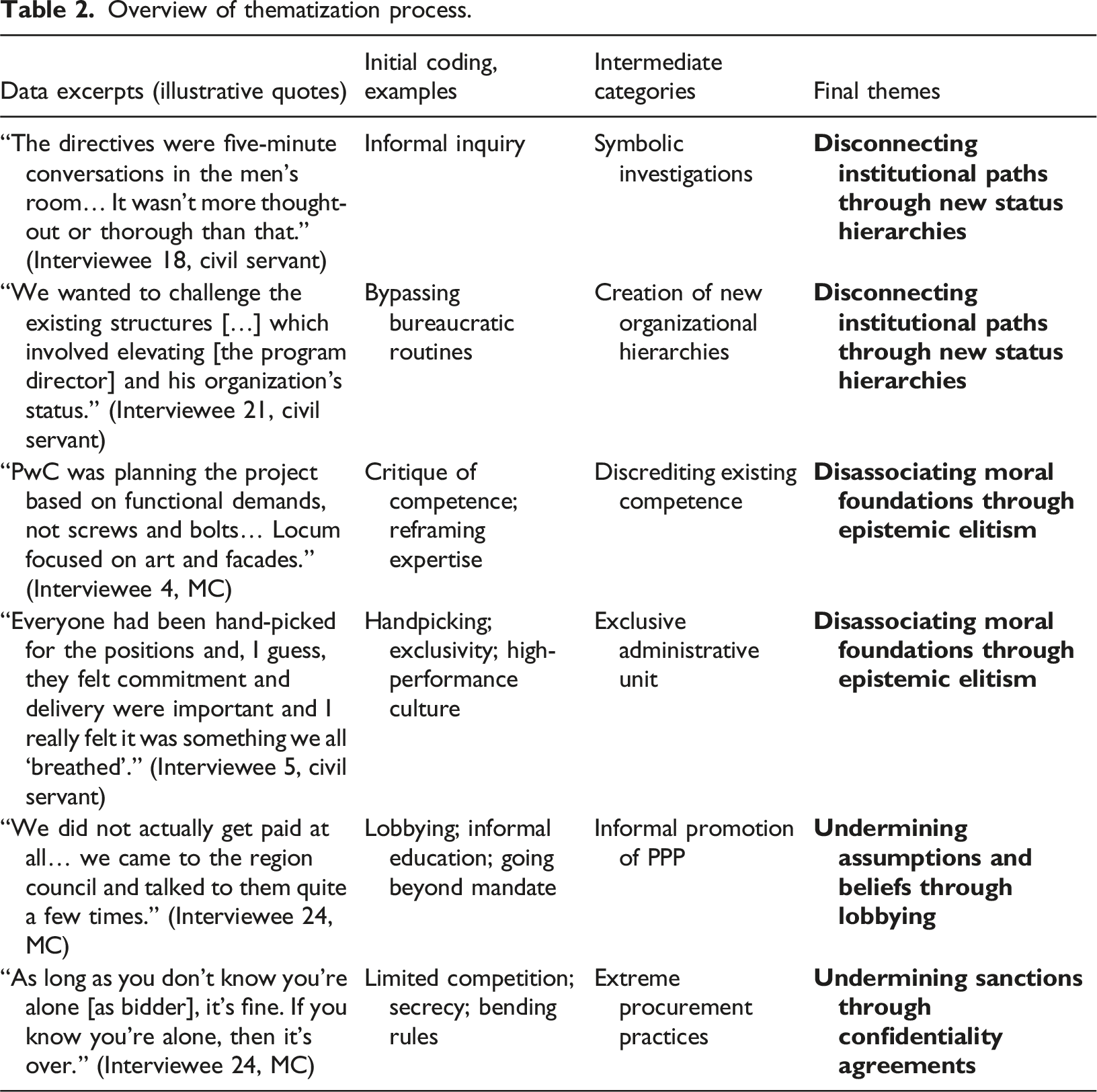
While Table 2 does not capture the full richness of the material, it illustrates the interpretive steps linking our hermeneutic engagement with the data to the patterns of institutional disruption analyzed in the findings.
Findings: MCs and institutional disruption in the procurement of NKS
So far, we have argued that MCs engaged in substantial institutional work in the NKS project to advance the public–private partnership (PPP) by destabilizing existing administrative barriers. Our analysis identifies three interrelated forms of disruptive institutional work (see Figure 1). First, MCs disconnected established decision-making paths by producing symbolic investigations and reinforcing new status hierarchies. Second, an epistemic elitism surrounding the consultants disassociated the moral foundations of established administrative practices. Third, through lobbying and support for confidentiality agreements, MCs undermined prevailing assumptions, beliefs, and sanctions in the decision-making process. Together, these themes show how consultants not only facilitated the adoption of the PPP model but also reconfigured the institutional conditions of public procurement more broadly. Forms and implications of disruptive work.
Disconnecting institutional paths for decision-making
Within the first theme—disconnecting institutional paths for decision-making—we identify two interrelated subthemes: (i) the production of symbolic investigations that reframed available procurement options, and (ii) the construction of new status hierarchies that elevated particular forms of expertise and steered the process toward a PPP solution.
In 2007, selecting an appropriate procurement and financing model became a priority to advance the NKS project. At the time, the official position rested on two earlier internal investigations, namely the SNUS report (RS, 2002) and the 3S report (RS, 2004), both of which concluded that a PPP was unsuitable. The main objections concerned the “risks associated with being a Swedish pioneer” in PPP contracting (RS, 2002: 7), and the higher borrowing costs associated with private consortia compared to public financing. Following the election of a right-wing majority in 2006, the regional assembly requested a renewed assessment of the PPP alternative. Although political actors could not formally override prior administrative evaluations, the NKS program office, under a newly appointed program director, decided to revisit the issue. In spring 2007, the office engaged PricewaterhouseCoopers (PwC), because of its recognized international PPP expertise (Interviewee 2, civil servant, Region Stockholm). This involvement is publicly documented through PwC’s reports (PwC, 2007a, 2007b).
PwC initiated a formal review of the PPP option for NKS, starting in June and working through early fall 2007 to “compare alternative solutions” (PwC, 2007b). As part of this process, PwC conducted a “market survey,” contacting approximately ten construction firms (PwC, 2007a: 58). In letters to potential bidders, the NKS PPP was framed as a significant business opportunity, inviting private partners to expand their presence in the Swedish welfare sector. [NKS] has the potential to be one of the first of a series of PPP projects in Sweden. [...] The new government has clearly indicated its interest in trying new forms for procurement, risk sharing and financing of public investment, in particular for large public infrastructure investment projects [in which] [T]he government is considering the use of PPPs as an option to improve economic efficiency (PwC, 2007a: 47)
Illustrated by this quote, the MCs articulated the PPP as an opportunity to expand private-sector engagement in Swedish public healthcare, including potential involvement in “the construction, operation and running of the adjacent patient and families hospital” (ibid.). Their final report concluded that the PPP represented the most suitable solution for NKS (PwC, 2007b: 63).
Advancing this position required strengthening the status of the NKS program office within regional politics and aligning the project with the new government’s broader market-oriented agenda. In May 2008, the program office was granted formal status as a separate administrative unit with its own financial division (hereafter, the NKS Administration). Around the same time, a newly appointed county director supported separating the project from Locum, the region’s central property administration, to clarify responsibilities and increase flexibility. According to one senior official within the NKS Administration, relocating decision-making authority closer to political leadership was seen as necessary to circumvent conventional bureaucratic constraints: “the weakness or problem for the NKS administration [before May 2008] was precisely that it was under the county council’s administration” (Interviewee 2). The County Council Board’s proposal to establish the NKS Administration, like the subsequent PPP decision, did not follow a conventional investigative and referral procedure but was instead based on a more informal inquiry process tied to the consultancy report. As one involved county council investigator explained: Well, it ended up being a short memorandum of about 8–10 pages, and I believe [the program director] primarily intended it for his own use in the ongoing discussions. […] [The investigative directives] were very broadly defined, something like: ‘outline the organizational alternatives for managing the work of planning and preparing for NKS moving forward.’ […] Should it be run as a limited company? A separate municipal administration? Or continue as it had been? […] I mean, the directives were five-minute conversations in the men’s room… It wasn’t more thought-out or thorough than that… (Interviewee 18, civil servant, internal investigator, Region Stockholm).
Although the investigative work was loosely defined and largely symbolic, it later formed the basis for the formal considerations used to justify and legitimize what several respondents described as a more “executive organization” (Interviewees 2; 5) for the PPP, one characterized by greater operational autonomy from Locum. Others referred to it as an “implementation organization” (Interviewee 18). As one senior official in the County Council Director’s office explained: You must understand, we wanted to challenge the existing structures [...] which involved elevating [the name of the head manager of the NKS program office] and his organization's status. And you do so when you make him head of his own administration (Interviewee 21, civil servant, Region Stockholm).
To lead the financial unit and thereby continue the PPP work, a senior economist with several years of experience in both the county council and the private financial sector was handpicked. One of the heads of the NKS Administration explains: Well, it was quite straightforward. The politicians told us: ‘it’s supposed to be PPP.’ One must remember, I was a civil servant. In an organization governed by politicians, it is the politicians who decide. I call that democracy. […] So we assumed we were going to try this thing called PPP. We recruited a very competent person […] with a background from [major business school] and McKinsey. […] Together we did a new procurement for assistance, and the task went to [consultancy firm]. (Interviewee 2, civil servant, the NKS Administration.)
The quote suggests that the senior civil servant experienced tacit pressure from the new political majority to reconsider the PPP option. The subsequent establishment of a separate administrative body to manage the NKS project functioned as a status-enhancing reorganization, granting the project organization greater authority and flexibility to depart from established bureaucratic procedures.
Disassociating moral foundations through epistemic elitism
The second theme shows how institutional disruption was advanced through what we term epistemic elitism, enacted via the MCs’ involvement in the NKS administration. Here, decision-making was progressively detached from the moral foundations of established bureaucratic practices and reframed as a matter of superior expertise, rationality, and performance. Two interrelated processes characterize this shift: (i) discrediting Locum’s competence and established routines, and (ii) cultivating an internal culture of exclusivity that marginalized critique. In line with Lawrence and Suddaby’s (2006: 237) account of institutional disruption through disassociation, actors worked to strip established procurement practices of their moral legitimacy. Rather than openly contesting existing procedures, they subtly recast them as outdated, naïve, or technically inadequate for a project of NKS’s scale. This reframing was evident in how Locum’s competence was described by the MCs: [Locum] was planning the project based on solutions, that is to say, what screws, bolts and types of concrete were needed, rather than what the functional demands of the hospital were […] It’s evident one should rather begin with the functional demands, not what materials the building should have or how the facade should look […] but what work we are going to conduct and what our demands are for that (Interviewee 4, MC).
As illustrated by this quote, the MCs portrayed Locum’s prior work as overly focused on technical and esthetic details rather than functional performance. This framing implicitly questioned Locum’s competence, a view echoed by several civil servants within the NKS administration (e.g., interviewees 11; 15; 22). Respondents described a growing distinction between “us” and “them,” where the newly formed administration was perceived as exceptional within the broader public bureaucracy (Interviewees 5; 8). Many officials emphasized that they had been handpicked for demanding tasks, fostering a professional identity grounded in exclusivity, urgency, and high performance. As one civil servant explained: It was big and expensive business - important, and kind of cool. Everyone was on their toes; people worked very intensively because they felt it mattered. [...] Commitment and delivery were what we all ‘breathed’. (Interviewee 5, civil servant, the NKS Administration.)
Similarly, another civil servant noted: This type of project attracts certain people who enjoy it. So, many of us ended up there because we were deeply engaged in it. (Interviewee 23, civil servant, the NKS Administration.)
Barriers to criticism gradually emerged within the administration, as many officials regarded their involvement as a rare career-defining opportunity. This fostered strong internal loyalty and clear hierarchical boundaries, including restricted access to information about the PPP procurement. Decisions concerning the emergent PPP became increasingly difficult to question, both externally and internally. Several respondents described a leadership style that reinforced this culture, particularly under the administrative director, who embodied the authority and status of the new administration. As one civil servant recalled the interactions with the director, in which critical reflection related to the PPP was rarely acknowledged: From my technical perspective, we presented various alternatives [to the PPP]. We wanted analysis and to highlight consequences, but he said something like, ‘I’m a neurosurgeon by training, I don’t have time for this. We operate with completely different decision-making processes. I have two seconds, and either the patient dies, or they don’t. So don’t come to me with analyses.’ (Interviewee 20, civil servant, head engineer, the NKS Administration.)
Another official described it in a similar manner: It was something we talked about a lot among ourselves. There were people who raised concerns and pointed out risks, saying, ‘This doesn’t feel right, how do we address this?’ But in many cases, we didn’t get much response. The whole decision-making process around it now seems a bit strange to me. (Interviewee 23, civil servant, the NKS Administration.)
These accounts illustrate how epistemic elitism operated within the administration. Analytical alternatives were not openly debated but subtly reframed as inappropriate within a decision culture that privileged speed, authority, and experiential judgment over procedural scrutiny. Epistemic authority thus displaced bureaucratic deliberation. This dynamic also shaped how resistance was interpreted. As one consultant explained: In [the administrative director’s] absence, extremely strong opinions were expressed against the PPP […] ‘PPPs were the worst shit you can imagine,’ in those terms - without any clear arguments to support it. (Interviewee 4, MC)
Critique was thereby cast as emotional and irrational rather than as legitimate institutional concern. Together, these dynamics cultivated a high-performance culture in which dissent appeared misaligned with urgency and expertise. Institutionalized procurement practices were not directly abolished but gradually detached from their moral authority. Having recast deliberation and caution as obstacles to performance, the conditions were established for a further step: undermining the assumptions, beliefs, and sanctioning mechanisms that had previously constrained the adoption of the PPP model.
Undermining assumptions, beliefs and sanctions
The third theme shows how MCs also targeted the underlying assumptions and sanctioning mechanisms that had previously constrained the adoption of a PPP. This unfolded through two interrelated processes: (i) lobbying and informal education of politicians and civil servants in PPPs, and (ii) the strategic use of confidentiality arrangements that weakened conventional procurement safeguards, including expectations of competitive bidding.
Building on the earlier moral and organizational repositioning, disruption now moved to the level of responsibility. A central message advanced by PPP proponents was that the complexity associated with planning and constructing the hospital could be reduced, or even transferred, through the PPP model. Rather than mobilizing internal administrative competence for economic calculations and technical oversight, MCs encouraged a shift toward defining functional “needs” and delegating risk to the private partner. As one consultant put it, “we worked with a completely different mindset [than theirs]” (Interviewee 4, MC).
This reframing altered core assumptions about the obligations of the public entity. Responsibility for technical, financial, and operational risk was recast as something better managed through the market. While this appeared to simplify decision-making, it simultaneously increased dependence on external expertise. Several respondents described this as a marked departure from prior project practices, in which public administrators retained direct responsibility for technical and financial control. You turn so many things completely around, including responsibilities. Suddenly we were expected to let go […] Responsibility was with the project company, which would have opportunities for innovation. We soon got into this line of thinking - the entrepreneur as the innovator, coming up with new solutions, also in healthcare. (Interviewee 20, civil servant, the NKS Administration.)
As this account illustrates, civil servants experienced a deprivation of responsibility, which unsettled established assumptions about public oversight and control in major infrastructure projects. This process of de-responsibilization gained formal endorsement in October 2007, when PwC delivered its final report recommending the PPP model (PwC, 2007a, 2007b). Drawing on its own market survey, PwC argued that a PPP would likely generate cost efficiencies through enhanced bidder competition (PwC, 2007b: 63). Earlier county council investigations had warned against the risks of becoming a Swedish pioneer in PPP procurement (RS, 2002; RS, 2004), yet the model was now presented as the superior alternative.
Following PwC’s formal recommendation, the NKS administration commissioned a “second opinion” (Interviewee 2); this was delivered by EY (EY, 2008). According to one consultant, however, the objective extended beyond evaluating procurement technique. The PPP was framed as part of a broader transformation of Swedish healthcare governance, a means of reshaping market dynamics rather than merely selecting a contract model. As the consultant explained: It was about modern working methods in healthcare - working in a different way. […] For that, new hospital ‘bodies’ were needed. A plan for the future was created, driven by the regional healthcare administration together with consultants who drafted the first vision. It wasn’t about NKS; it was about how Region Stockholm should work with the future of healthcare - including primary care - and how to put the patient at the center. (Interviewee 17, MC)
During the spring of 2008, before the June decision to procure the hospital according to the PPP model, EY presented their own report in which they strongly advocated a PPP for NKS. EY believes that a private consortium […] has better opportunities to themselves, or via its subcontractors, to bear both responsibility and risks associated with operational and financial commitments [...] than [Region Stockholm] (EY, 2008, p. 5).
Drawing on these additional consultancy insights, the NKS administration stated in an official memorandum to the Regional Council Assembly in April 2008 that a PPP could not be considered inappropriate for the project, leaving the formal decision to the political majority. Yet institutional resistance had not disappeared. As one civil servant recalled: In 2008, we definitely advised against the PPP [...] but then the decision was made and, I don't know [...] there was a belief from the political side that, 'yes but now we have avoided problems', so to say, this will now be resolved. It will be like renting a hospital and we in the regional council bear no risks here and so on. (Interviewee 8, civil servant, the NKS Administration.)
To further strengthen the legitimacy of the PPP ahead of the decision, the consultants moved beyond the formal assignment and engaged in informal efforts to educate politicians and civil servants about PPPs. Although this was not part of their official mandate, the MCs met with political representatives on several occasions, often pro bono. As one MC recalled: So, we were there and talked to the Region Council Assembly […] I don't remember exactly how it came up. [...] We did not actually get paid at all. […] I had to come in for like half an hour [...] participating [in their] usual meetings and talk to them. Quite a few times… (Interviewee 24, MC)
Through these informal engagements, consultants targeted the assumptions of decision-makers and actively lobbied for the PPP solution. Their reports emphasized strong international interest in participating in the procurement (EY, 2008; PwC, 2007a, 2007b), a message that was subsequently echoed in the administration’s public communication following the June 2008 decision. Yet the promise of competition soon encountered practical constraints. After the formal decision to proceed with a PPP, a prequalification process in late 2008 resulted in only one bidder: Skanska. Despite the complete absence of competition in relation to the requirements of the Swedish Public Procurement Act, as only one bidder submitted a compliant bid rather than the expected five, the MCs advised the administration to proceed at this stage. Drawing on the Swedish Public Access to Information and Secrecy Act, confidentiality agreements were introduced, limiting transparency and restricting oversight of the procurement process. By curtailing access to documentation and scrutiny, these measures effectively insulated the decision from external review and weakened the possibility of formal sanctions. As one consultant explained: Because [name of legal matters consulting firm] was also with us in these discussions, we combined our different streams of expertise. And then it was all about, ‘as long as you don’t know you’re alone, what happens?’ And the answer was clear, ‘No worries,’ just as long as you don’t know you’re alone. If you know you’re alone, then it’s over. (Interviewee 24, MC)
This rationale effectively suspended the institutionalized expectation of competitive bidding. While competition had been central to legitimizing the PPP, secrecy now enabled the process to continue despite its absence. In this way, sanctioning mechanisms designed to safeguard public procurement were not directly removed but rendered inoperative through restricted transparency and constrained scrutiny.
Taken together, the consultants’ institutional work operated across formal and informal domains. Through the staging of competition, the reframing of responsibility, and the strategic mobilization of legal instruments to manage transparency, they destabilized taken-for-granted assumptions about fairness, accountability, and due process in public procurement. Rather than openly contesting regulatory frameworks, they worked within and around them, reshaping how rules were interpreted, enacted, and enforced. In doing so, the consultants did not merely advocate a procurement model. They contributed to a gradual reorientation of the institutional foundations of regional healthcare governance, where competition could be symbolically invoked without being materially present, and where mechanisms of oversight remained formally intact yet practically disconnected from sanction. This illustrates how institutional disruption may unfold not through overt rule-breaking, but through the strategic reconfiguration of the beliefs, expectations, and enforcement practices that give those rules their force.
Discussion and conclusions
This article examined how institutional disruption unfolds in and around management consultants (MCs) embedded in public organizations, focusing on how public healthcare marketization was mediated through the regional decision-making process that led to the public–private partnership (PPP) of the New Karolinska Solna University Hospital (NKS) in Stockholm, Sweden. Extending marketing theory on market-shaping, institutional work, and marketization, we show how MCs’ liminal positioning in markets as neither fully inside nor outside public administration (Czarniawska and Mazza, 2003) enables a form of liminal power: an epistemic, subtle capacity to intervene in institutional arrangements; rules, normative expectations, and cultural-cognitive templates, without carrying corresponding formal accountability. In our case, this capacity materialized as liminal market-shaping, that is, the enactment of disruptive institutional work that reoriented public procurement toward market-based governance through public–private entanglements.
Drawing on Lawrence and Suddaby’s (2006) original discussion of disruptive institutional work, we identified three interrelated mechanisms through which marketization was advanced in the procurement of NKS (see Figure 1): (i) disconnecting established decision-making paths; (ii) disassociating moral foundations through epistemic elitism; and (iii) undermining assumptions, beliefs, and sanctions through lobbying and confidentiality arrangements. Importantly, these mechanisms were mutually reinforcing rather than sequential; they overlapped and were mobilized at different points to destabilize institutional expectations and enable the PPP to gain legitimacy.
Institutional disruption enacted upon public organizations
First, the study extends market-shaping theory by showing how institutional work is enacted upon public sector organizations for market-shaping purposes, rather than only being practiced by them (Kaartemo et al., 2020), or unfolding primarily in emergent or established consumer markets (e.g., Diaz Ruiz and Makkar, 2021). In doing so, we complicate the conventional portrayal of public organizations as market-shapers (Kaartemo et al., 2020; Wiebe and Mitchell, 2023) engaged in the organization of markets (Ahrne et al., 2015). Our analysis shows how public administration can become both a site (i.e., subject) and a target (i.e., object) of disruptive interventions that reduce institutional barriers to marketization from within. Procedural rationality anchored in transparency, equality, and collective deliberation (Meyer et al., 2014) was displaced by a managerial logic privileging performance, competition, and innovation, thereby depoliticizing the implications of procurement choices and reconfiguring accountability. Conceptually, this highlights marketization as a pathway through which market-shaping advances via reconfigurations of the administrative logics that underpin the formal organization of markets (Ahrne et al., 2015), strategically unsettling institutional stability.
Liminal market-shaping as institutional transgression
Second, we theorize liminal market-shaping as a mode of market-shaping in public governance enabled by liminal power. Building on Czarniawska and Mazza (2003), we show how MCs’ liminal state creates a threshold position where institutional logics can be temporarily suspended and epistemic authority can substitute for formal mandate. As a transgressive capability, liminality works by allowing actors to treat institutional obligations as negotiable inputs, reframing what counts as “appropriate” procedure, “credible” knowledge, and “responsible” allocation of risk, rather than as fixed limits on action. From this position, MCs acted not only as shapers of discourse, but as informal institutional engineers who embedded neoliberal rationalities across administrative systems while eluding formal accountability. Importantly, this is not simply a matter of “external expertise” entering the organization. Liminality is powerful because it combines embedded access with external status, enabling consultants to traverse accountability relations that would otherwise constrain bureaucratic action. While prior market-shaping research has emphasized collaborations among diverse actors (Benmecheddal et al., 2023) and identified firms (Kindström et al., 2018), consumers (Dolbec and Fischer, 2015), and NGOs (Fyrberg Yngfalk and Yngfalk, 2020) as agents of institutional change, it has more often highlighted overt conflict (Denegri-Knott, 2004; Giesler, 2008) or constraining regulation (Weijo et al., 2018) as key drivers. By contrast, our findings foreground a subtler, technocratic form of power: market-shaping through institutional transgression, where consultants reconfigure what is treated as legitimate, feasible, and accountable action inside public governance, and often without overt conflict and without formal rule change. This also complements consultocracy research, which has documented consultants’ growing presence in public governance (Wargent et al., 2020) but less often specifies the concrete mechanisms through which such influence becomes institutionally effective in marketization processes.
Public de-responsibilization and the erosion of agency
Third, the study introduces public de-responsibilization as a conceptual counterpoint to consumer responsibilization. Whereas responsibilization is commonly theorized as extending market logics by assigning duties of calculation, choice, and self-management to consumers and citizens (Bajde and Rojas-Gaviria, 2021; Giesler and Veresiu, 2014), our analysis shows how marketization can also advance by eroding formal responsibility and, thus, agency within public administrations. In this case, public actors were not merely “relieved” of responsibility under neoliberal discourse; they were deprived of it as institutions designed to formally sustain public agency and accountability were destabilized. This complements a market-shaping perspective by showing how institutional change can unfold within the regulative and normative architecture of public organizations (Baker and Nenonen, 2020), not only through the creation of new roles and competencies but also through the dismantling of existing institutional capacities. As responsibility diffused across public–private arrangements, accountability became increasingly opaque, weakening democratic safeguards.
Managerial implications
The study offers implications for civil servants and policymakers engaged in public sector governance and market-based reforms. It highlights how MCs’ contributions often extend beyond technical advice by reshaping the institutional logics that organize public decision-making. First, public organizations should treat consultant engagement as institutionally consequential rather than neutral: consultants may promote market-oriented logics that privilege efficiency, competition, and privatization, potentially displacing public sector values such as transparency, equity, and procedural fairness (Raudla et al., 2023; Ylönen and Kuusela, 2018). Second, administrations should protect internal competence and institutional continuity. Persistent reliance on external expertise can create dependency and reinforce public de-responsibilization; reinvestment in internal evaluative capacity and professional development is therefore crucial. Third, governance frameworks for consultant involvement should be strengthened to ensure transparency in contracting, clearly defined advisory scopes, and accountability procedures that prevent informal influence outside public scrutiny. Finally, institutional resilience depends on critical literacy toward expertise: cultivating deliberative cultures that surface the normative assumptions embedded in “efficiency” and “best practice” narratives can counter depoliticizing tendencies and protect democratic accountability in hybrid governance arrangements, especially in central welfare sectors such as healthcare.
Conclusion
This study makes three contributions to research on market-shaping and institutional change. First, it shows how institutional disruption can be enacted upon public organizations through interventions by externally positioned yet internally embedded professionals, destabilizing bureaucratic infrastructures underpinning public accountability. Second, it theorizes how MCs’ liminal state in public organizations enables liminal power, which in turn materializes as liminal market-shaping, that is, the capacity to mobilize epistemic authority to reshape decision-making and embed market logics within public governance. Third, it introduces public de-responsibilization to conceptualize how marketization may proceed through the erosion of public agency and the subtraction of state capacity. Together, these insights foreground the public sector as a crucial yet underexplored arena of market-shaping, where institutional change entails not only creating markets but also weakening the institutional safeguards that condition democratic legitimacy.
Future research could deepen these insights in several ways. Comparative cross-national studies may clarify how consultants’ influence is mediated by political cultures, welfare regimes, and administrative traditions. Ethnographic research could capture how consultants translate political goals into technical artefacts and enact liminal market-shaping in everyday interactions. Further work could also explore the affective and symbolic dimensions of expertise—how status, aspiration, and professional identity sustain epistemic authority in public decision-making—and examine how consultants and political principals jointly construct reform agendas and negotiate responsibility in hybrid governance structures. Finally, research on resistance and counter-expertise could illuminate when and how public institutions can reconstitute governing capacities and reassert democratic accountability under marketization.
In closing, the relationship between MCs and political principals illustrates how marketization can become institutionalized within frameworks formally designed to safeguard democratic accountability, yet in ways that gradually reconfigure how accountability is defined, exercised, and enforced. Long-term PPPs such as NKS thus demonstrate how reliance on private expertise can gradually reconfigure responsible governance: political deliberation is translated into managerial procedure, and public accountability is reframed as contractual compliance. When epistemic authority substitutes for democratic scrutiny, the institutional safeguards of public administration risk becoming procedural shells rather than substantive constraints. Preserving democratic legitimacy therefore requires rendering consultants’ liminal power visible, accountable, and contestable within the architectures of public governance.
Footnotes
Acknowledgments
The authors thank the editor and anonymous reviewers for their constructive feedback and careful engagement throughout the review process.

Ethical considerations
This study did not involve human participants and therefore did not require ethical approval or informed consent.
Consent to participate
The authors have nothing to report.
Funding
The authors received no financial support for the research, authorship, and/or publication of this article.
Declaration of conflicting interests
The authors declared no potential conflicts of interest with respect to the research, authorship, and/or publication of this article.
Data Availability Statement
The data are not publicly available due to privacy and ethical restrictions.