



Abstract
Recent years have seen growing interest in market-shaping – the intentional efforts of firms, consumers, governments, and nonprofits to transform, disrupt, or maintain market systems. However, the ‘dark side’ of market shaping – its strategic use to entrench power and shift burdens onto others – remains underexplored. This paper examines the historical case of U.S. beverage container production (1950–1990) using institutional work as a theoretical lens. Analyzing actions taken by container and beverage manufacturers, industry associations, activists, media, and government, we find industry actors collaboratively sustained dominance by simultaneously making and breaking institutions, with little regard for broader environmental and societal consequences. These shaping efforts were systemic, evolving, and increasingly channeled through specialized, strategically focused industry associations. In contrast, opposing actors lacked comparable coordination and influence. We contribute to market-shaping literature and extend critical macromarketing debates by foregrounding asymmetrical shaping and the urgent need to evaluate such strategies through normative frameworks that consider ecological and social limits.
Keywords
Introduction
Firms today are not just participants in markets but increasingly act as architects of market arrangements that shape societal outcomes. This growing awareness has prompted researchers and practitioners to investigate how firms, and the collectives they belong to, deliberately engage in market-shaping strategies to influence their operating environments (Helfat, 2021; Nenonen, Storbacka, & Windahl, 2019). Market-shaping is defined as the intentional efforts of firms, consumers, governments, and diverse collectives to transform, disrupt, or maintain markets (Hawa et al., 2020; Nenonen, Storbacka, & Windahl, 2019). Past research has illuminated various aspects of market-shaping strategies, including how they can be pursued individually (Gavetti et al., 2017) or collectively (Baker & Nenonen, 2020; Struben et al., 2020), can result in significant changes to existing markets (Helfat, 2021) or creation of new ones (Lee et al., 2018), and can be one-off or on-going (Humphreys & Carpenter, 2018).
Although past research has increased understanding of the market-shaping phenomenon, extant literature almost exclusively explores positive outcomes of market-shaping, and generally in purely business-related terms like increased sales, revenue, profitability (Kuncoro & Suriani, 2018; Stathakopoulos et al., 2022; Tang et al., 2021), and firm competitiveness (Flaig et al., 2021). Indeed, the outcomes of market-shaping strategies are usually portrayed as a win-win-win for multiple actors through increased market size and greater density of resources. However, this leaves the ‘dark side’ of market-shaping underexplored. With just a few exceptions (e.g., Cova et al., 2021; Diaz Ruiz, 2023; Mele & Russo Spena, 2020; Yngfalk, 2019), the negative or unintended consequences of market-shaping remain largely ignored (Cova et al., 2021; Khan et al., 2007) even though real-life examples abound across diverse domains. Consider, for example, the US opioid crisis where almost 645,000 people died of overdoses between 1999 and 2021 (CDC, 2023) due to the unrelenting shaping activities of opioid manufacturers. Other examples that have delivered questionable outcomes include market-shaping by US casino operators (Humphreys, 2010a), marijuana suppliers (Kjellberg & Olson, 2017), online sports betting agencies (Gregory, 2025), and oil producers (Okullo & Reynès, 2016).
In response, the purpose of this paper is twofold: To investigate how commercial firms (1) undertake market-shaping despite negative consequences for other actors and the wider system, and (2) counteract efforts to undo these negative consequences. The vehicle for this exploration is the novel, rich, historical case of the market for throwaway beverage containers in the US from 1950 to 1990. This market system implicitly includes three key interdependent industries—beverage production, container manufacturing (especially plastics), and waste management (including recycling). The case illustrates how beverage and container manufacturers collaborated through their industry associations to avoid responsibility for waste creation and shift responsibility onto municipalities and individual citizens.
We draw on the concept of institutional work—those deliberate actions taken by individuals, collectives, or organizations to change or maintain institutions (Lawrence & Suddaby, 2006) — to analyze the shaping efforts of actors in favor of environmental responsibility (e.g., the activists) and those seeking to preserve harmful market arrangements (e.g., the plastics industry association). Lawrence and Suddaby (2006) identified three broad categories of institutional work: creating, maintaining, and disrupting institutions, with subsequent work elaborating specific forms such as normative, discursive, political, boundary, and associative work (Lawrence et al., 2013; Zietsma & Lawrence, 2010). While our analysis acknowledges these categories, we adopt a more flexible, recursive, and sometimes morally ambivalent reading of institutional work that foregrounds how multiple forms can co-occur or evolve over time. We pay particular attention to collective forms of institutional work (e.g., via trade associations) that serve not only to enable market change, but to entrench unsustainable or unjust arrangements. To assess the broader consequences of such shaping, we invoke Doughnut Economics (Raworth, 2018) as a normative lens. This enables us to evaluate whether shaping strategies uphold or undermine ecological ceilings and social foundations.
We make four main theoretical contributions. First, while prior studies have explored opportunistic behavior in market-shaping (Yngfalk, 2019), we introduce the concept of collective opportunism to describe how entire industries, often under the auspices of industry associations, collaborate to repel opposition and reinforce market dominance. We extend existing studies on collective market-shaping (e.g., Baker & Nenonen, 2020; Maciel & Fischer, 2020) by exposing the darker side of coordinated collective action, in which associations serve not only as enablers of collaboration but also as mechanisms for shifting accountability and shielding firms from scrutiny. This analysis contributes to macromarketing debates by revealing how institutionalized collective action can entrench systemic inequalities, enable regulatory capture, and shift ecological and social burdens onto public actors (Benton & Stasch, 2024; Cherrier & Türe, 2023; Layton, 2011).
Second, this case reveals how shaping strategies developed emergently over time, not from a fixed future vision for the market, but through a process of ongoing adaptation in response to activist and regulatory challenges. These reactive but coherent visions enabled industry actors to pursue offensive and defensive strategies simultaneously. Rather than viewing market-shaping as the execution of a predefined future vision (cf. Flaig & Ottosson, 2022; Nenonen, Storbacka, & Frethey-Bentham, 2019), we show how evolving visions, especially in the hands of well-resourced collectives, can be just as potent in entrenching profitable but problematic market arrangements.
Third, we expand the current debate on inclusion and exclusion in markets (Cova et al., 2021; Geiger & Gross, 2018) by showing how forced inclusion (e.g., compelling municipalities and citizens to assume responsibility for waste) can also produce harmful market outcomes. This insight contributes to growing conversations on the limits of marketization (Sandel, 2012; Satz, 2010), particularly when market logics are extended into domains such as environmental governance, where public institutions and civic actors are ill-equipped to bear the burden.
Fourth, our findings contribute to research on market infrastructures (Araujo & Mason, 2021; Kjellberg et al., 2019; Ozcan & Santos, 2015) by challenging assumptions that commercial firms are willing providers of such infrastructure. Instead, we show how firms can offload infrastructure-building costs onto public actors through strategic institutional work, especially by mobilizing industry associations to present these shifts as necessary or efficient. This expands the scope of recent research on responsibilization, which has largely focused on consumers (Cherrier & Türe, 2023), by showing how public actors, too, are made responsible for sustaining markets designed to serve private interests. At its core, this paper examines how institutional work oriented toward maintenance rather than transformation—particularly when enacted collectively—can entrench harmful systemic patterns and redistribute burdens across actors. This focus on the interplay between maintenance and disruption provides the conceptual backbone for our analysis and frames the ensuing discussion of how market-shaping strategies can function as instruments of systemic power.
Theoretical Background
Market-Shaping
In recent years, scholars have advanced new understandings of what constitutes a ‘market’ (Layton, 2007, 2011; Mele et al., 2015), increasingly conceptualizing markets as socially constructed, complex systems (Giesler & Fischer, 2017; Peters et al., 2020) ‘performed’ through the practices of diverse actors (Kjellberg & Helgesson, 2007). Hence, markets are defined as “complex adaptive socio-technical-material systems, consisting of institutions, actors, practices, and discourses that organize particular economized exchanges” (Nenonen, Storbacka, & Frethey-Bentham, 2019, p. 252). This systemic view of markets, which recognizes markets are plastic and, hence, subject to agentic change efforts (Nenonen et al., 2014), has helped drive scholarly interest in market-shaping.
This systemic perspective also enables conceptualizing the different layers or dimensions that constitute a market system, and the elements that reside within those dimensions (Nenonen, Storbacka, & Frethey-Bentham, 2019). As depicted in Figure 1, at the core of any market sits ‘exchange’—what is exchanged, where, for how much, and the underlying pricing logic. The ‘network’ dimension refers to the number and types of providers, suppliers, customer groups, industry associations, partners, and alliances—and their interactions. ‘Representations’ encompass how actors describe, define, research, report on, celebrate, and debate a market. Finally, ‘rules and norms’ include both formalized rules (e.g., regulations, technical standards) and informal institutions (e.g., conventions, assumptions, expectations) that guide market functioning. These different layers are not hierarchical but are interdependent, as changes in one layer will frequently influence outcomes in others. For example, an innovation to what is exchanged (like a move from the sale of ownership rights to a digital platform-based subscription) will naturally impact industry and consumer norms and expectations, drive changes in how the market is reported, defined, or discussed, and potentially deliver new network structures, groupings, or regulations.
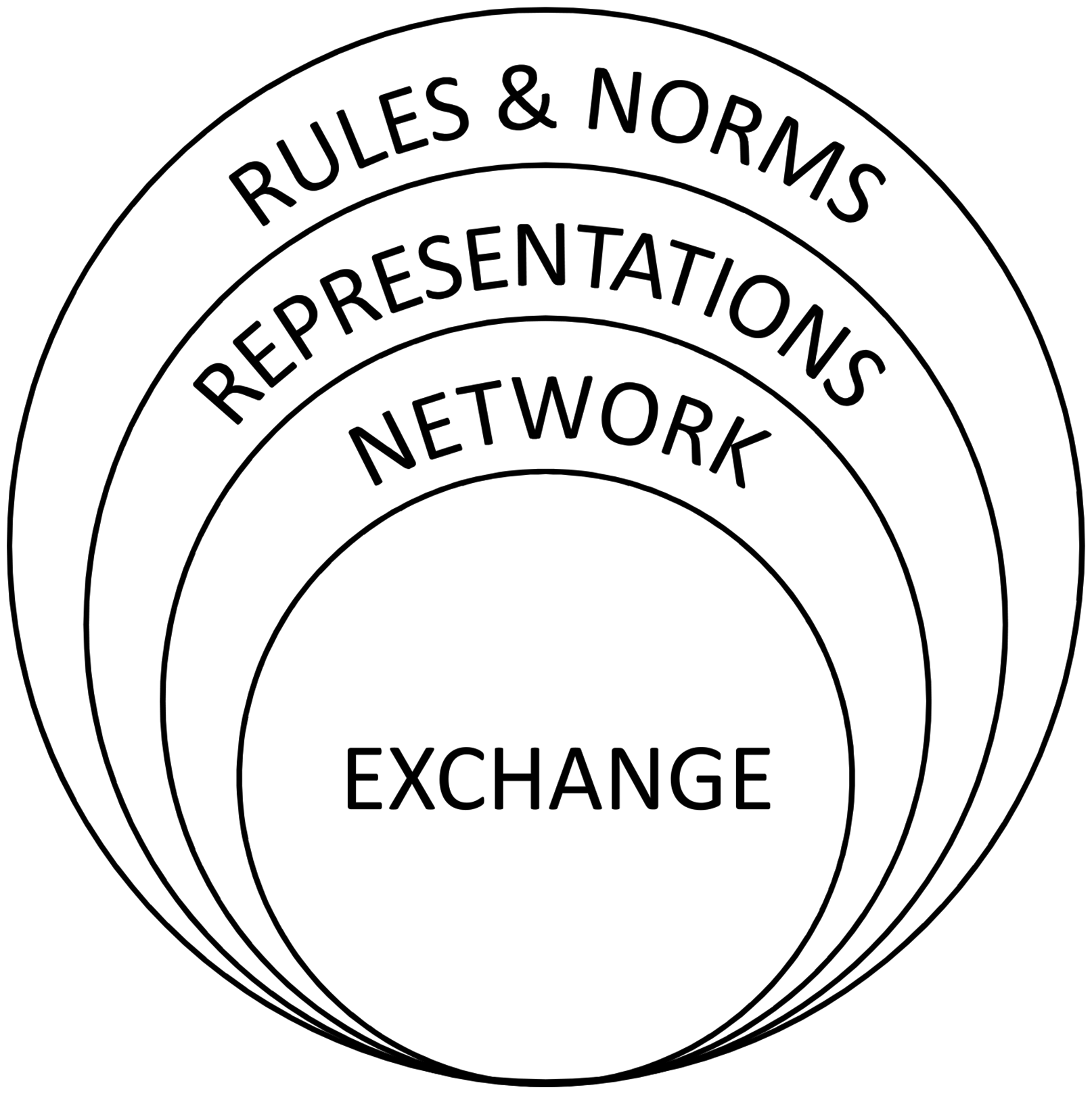
Layers of a Market System (Adapted from Nenonen, Storbacka, and Frethey-Bentham, 2019).
Scholars have investigated how market actors deliberately drive change in a variety of empirical contexts including steel (Kindström et al., 2018), wine (Baker & Nenonen, 2020; Humphreys & Carpenter, 2018), service stations (Azimont & Araujo, 2007), commercial software (Ulkuniemi et al., 2015), and circus (Baker et al., 2019). Most market-shaping research has focused on shaping efforts by commercial firms, but there is also growing understanding of market-shaping conducted by consumers (cf., Dolbec & Fischer, 2015; Martin & Schouten, 2014), governmental actors (Kaartemo et al., 2020; Mountford & Geiger, 2020; Nguyen & Özçaglar-Toulouse, 2021), and non-profit organizations (Kullak et al., 2022). Additionally, ‘shaping strategies’ are now gaining attention in the scholarly management literature (e.g., Helfat, 2021; Patvardhan & Ramachandran, 2020).
Reflecting the multiplicity of empirical research contexts, scholarly investigations into market-shaping draw on various theoretical perspectives such as institutional theories, resource-based theories, practice theories, innovation research, and service-dominant logic (Nenonen & Storbacka, 2021). In the present research, we adopt the institutional perspective as it is powerful in illuminating how markets—and hence market-shaping—relate to broader society (Mountford & Geiger, 2021). In the context of markets and market-shaping, scholars have applied institutional theories to explore the evolution of market definitions and boundaries (Baker et al., 2019; Faulconbridge & Muzio, 2021; Rosa et al., 1999), legitimization of markets (Humphreys, 2010a, 2010b; Regany et al., 2021), and the influence of competing institutional logics (Ertimur & Coskuner-Balli, 2015).
Among institutional approaches, ‘institutional work’ is commonly used to describe how actors can surmount the ‘paradox of embedded agency’ and shape constraining institutions (Battilana & D′Aunno, 2009; Garud et al., 2007), with or without prior institutional affiliations (Alvarez et al., 2015). Institutional work is defined as “the purposive action of individuals and organizations aimed at creating, maintaining and disrupting institutions” (Lawrence & Suddaby, 2006, p. 215). Scholarship on institutional work is a broad church and the term itself has been described as “an umbrella concept and a rallying point” (Hwang & Colyvas, 2011, p. 62). It is therefore unsurprising that no definitive list exists of the forms such work takes in market-shaping contexts (Kaartemo et al., 2020).
Nevertheless, studies by Koskela-Huotari et al. (2016), Baker et al. (2019), and Baker and Nenonen (2020) are examples of market-shaping studies investigating institutional work to break, make and/or maintain institutions related to markets. Some authors have proposed a special case of institutional work, ‘market work’, to denote purposive making, transforming, and maintaining of markets (Baker & Nenonen, 2020; Nenonen, Storbacka, & Frethey-Bentham, 2019). Such market work can be conducted either by individual actors or collectives (Baker & Nenonen, 2020; Beninger & Francis, 2021). Institutional work has also been used to investigate the creation of new markets for responsible investing (Gond & Boxenbaum, 2013), B-Corps (Stubbs, 2017), and improved inclusivity (Mair et al., 2012). However, despite advances in understanding market-shaping, no studies explicitly contrast market-shaping strategies enacted by opposing actor groups—where one set of actors works to establish or reinforce market elements while another seeks to dismantle or disrupt them. Further, little attention has been paid in the market-shaping literature to cases where such efforts knowingly produce negative outcomes.
Negative Outcomes from Market-Shaping
Despite the considerable growth of market-shaping research in recent years (Sprong et al., 2021), scholars have only recently begun to interrogate its negative consequences. These consequences can result from both intentional and unintentional actions; hence, intentionality does not determine the nature of market-shaping outcomes (Cova et al., 2021; Khan et al., 2007). For example, as the soccer ball industry sought to de-institutionalize child labor and institutionalize Western factory-based production in Pakistan, the initiative gave rise to various unintended, negative consequences such as abuse of women, their withdrawal from the workforce, and the subsequent loss of income and family disruption (Khan et al., 2007). In contrast, negative outcomes might manifest from deliberate irresponsibility, as documented by Yngfalk (2019) when examining the legitimization of food waste in Swedish grocery retail.
When shaping markets, existing studies have examined negative outcomes related to exclusion, opportunism, power and information asymmetry, or conflict. Cova et al. (2021) examine exclusion related to market-shaping—both exclusionary outcomes and actors’ responses to being excluded from the market. Similarly, Geiger and Gross (2018, p. 6) demonstrate that inclusion and exclusion are linked to how value is assigned to market actors, objects, ideas and arrangements, and that the excluded elements “at all times threaten to ‘strike back’ against the market's frames.”
Opportunism has been studied by Yngfalk (2019), who uncovered interlinked forms of institutional work that enables the subversion of corporate sustainability and continued food waste generation: framing environmental responsibility as a risk and cost, and prioritizing consumer choice. In their investigation of market practices in the automotive market, Mele and Russo Spena (2020) highlight asymmetries related to both information and power as important contributing factors to the ‘Dieselgate’ scandal. Finally, conflicts during market-shaping processes can occur between actors or markets. Mele et al. (2018) suggest that dyadic conflict—most typically taking place between the market-shaping actor and its competitors, current non-customers or current non-suppliers—is perhaps less significant than systemic conflict, arising between the market being shaped and adjacent markets. However, despite these recent advances, research into the detrimental effects of market-shaping is still nascent.
To address this gap, we draw on ‘Doughnut Economics’ (Raworth, 2018) as a normative framework for evaluating the systemic consequences of market-shaping. The doughnut model envisions a ‘safe and just space for humanity,’ bounded on two sides: 1) a social foundation, which sets minimum thresholds for human well-being (e.g., access to food, water, housing, education, equity, and political voice); and 2) an ecological ceiling, which identifies planetary boundaries that must not be breached to maintain Earth system stability (e.g., climate change, ocean acidification, chemical pollution, and biodiversity loss). Economic and market activity are sustainable only when operating within this doughnut-shaped space—avoiding both shortfalls on the social floor and overshoots beyond ecological ceilings. Hence, market-shaping activity can be considered ‘dark’ not merely due to its tactics (e.g., manipulation, exclusion, or asymmetry), but because it entrenches or amplifies systemic patterns that push society beyond these planetary and social boundaries. Doughnut Economics (Raworth, 2018) offers one useful normative lens for evaluating such outcomes, highlighting how economic and market activity becomes unsustainable when it breaches either the ecological ceiling or the social foundation. While our argument does not ultimately depend on this particular framework, it nevertheless helps illustrate the broader normative stakes of market-shaping strategies that embed overshoot and shortfall into market systems.
While the Doughnut Economics (Raworth, 2018) concept is primarily forward-looking, we apply this lens retrospectively to examine how historical market-shaping in the U.S. beverage container industry institutionalized long-run overshoot via the generation of environmental harms, the redirection of waste responsibility to the public, and the construction of misleading narratives around recycling and responsibility. Indeed, Doughnut Economics is increasingly employed as a cross-disciplinary framework to assess sustainability impacts across sectors and scales (Shao, 2025), further validating its relevance to evaluating the ‘dark side’ of market shaping. In so doing, we move beyond general critiques of harm to offer a conceptually grounded and normatively robust basis for identifying when market-shaping outcomes should be understood as detrimental.
Research Approach
This study adopts a qualitative case study approach (Yin, 2011) to explore the history of the US beverage container market through the latter half of the twentieth century. This is a suitable method when exploratory work is required (Yin, 2011), especially when exploring “the dynamics of a certain historic period of a particular social unit” (Stoecker, 1991, pp. 97–98). Given the complex, systemic nature of market-shaping, a longitudinal, historically embedded case study enables a richer understanding of how markets evolve over time (Merriam, 1988; Nguyen & Özçaglar-Toulouse, 2021).
The beverage container market was chosen for two reasons. First, it provides a clear illustration of market-shaping processes across multiple layers of the market system. At the exchange layer, the nature and pricing of products shifted from reusable bottles to disposable cans and plastic bottles, and from deposit schemes to recycling schemes. Changes in norms included how consumers engaged with products (from reusing to returning, disposing, and recycling) and evolving expectations around individual responsibility. Networks shifted with the rise of plastics manufacturers, the centralization of production, changes in the number and type of industry associations, and the increasing role of municipalities in managing and funding recycling schemes. Finally, representations evolved in media coverage, public relations campaigns that blamed consumers for waste, and changing public narratives around pollution.
Second, the case offers an unusually rich longitudinal archive, enabling rigorous analysis, triangulation, and interpretive validity (Siggelkow, 2007; Yin, 2011). More politically charged markets (e.g., guns, tobacco) that might also demonstrate harmful market-shaping were excluded to minimize the risk of partisan interpretation.
Data Collection
Data were selected and analyzed as secondary historical sources, drawing on more than 6,000 pages of printed material, in addition to webpages and audiovisual content. These sources were gathered from five categories: (1) government records and legislation (e.g., US EPA, state deposit legislation), (2) media coverage and documentaries, (3) industry publications and trade association reports, (4) academic and historical books, and (5) scholarly articles (mostly used for contextual understanding). A comprehensive bibliography of all secondary data sources is provided in the Supplementary Web Appendix.
Source identification proceeded in three stages. First, we reviewed foundational historical texts on waste management, plastics, and packaging (e.g., Ackerman, 1997a, 1997b; Andrady, 2015; Rogers, 2005a, 2005b). Second, we conducted targeted searches of regulatory databases, industry archives, and media repositories (e.g., Wayback Machine, NewsBank, and trade association websites). Third, we employed snowballing—following citations, cross-references, and leads from initial documents—to uncover additional relevant sources (Greenhalgh & Peacock, 2005).
Documents were selected for their relevance to institutional work (Lawrence & Suddaby, 2006), including framing of responsibility, contestation over market roles, and efforts to shape policy or public perception. While academic articles mainly provided contextual background, a small number offered empirical insights supporting event reconstruction and identification of institutional work (e.g., Godush, 2001; Rogers, 2007; Rome, 2013). Triangulation was central to our interpretive strategy: only events supported by at least two distinct source types (e.g., a regulatory document and a media article) were retained. This reduced potential bias and strengthened the credibility of the historical narrative.
Data Analysis
Data were analyzed using document analysis (Bowen, 2009)—a systematic process for evaluating both printed and electronic textual material. Although frequently used to triangulate other data, document analysis is also especially effective for conducting historical or cross-cultural research (Bowen, 2009), including of market-shaping (e.g., Burr, 2014; Humphreys, 2010a, 2010b; Pinchera & Rinallo, 2021). For example, Nguyen and Özçaglar-Toulouse (2021) use document analysis to examine nation branding by the Korean government as a form of market-shaping, while Baker et al. (2019) explore market changes in circus through the twentieth century.
In our study, we started with respected fulsome histories of different dimensions of the case, including waste management (e.g., Ackerman, 1997b; Rogers, 2005a; Zimring, 2005), the US environmental movement (e.g., Andrady, 2015; Dunaway, 2015), and political and policy perspectives of waste and consumerism (e.g., Cohen, 2003; Konrad, 2023). Snowballing was adopted by supplementing these sources with media articles and video documentaries, industry articles and reports, and academic journal articles (Greenhalgh & Peacock, 2005). In assembling such a broad set of sources, we attempted to overcome the main criticisms of document analysis—biased selectivity and insufficient detail (Bowen, 2009; Yin, 2011).
Analysis then involved sorting data into time periods, thereby creating an ‘event history database’ of critical activities by date (Garud & Rappa, 1994). This ‘temporal bracketing’ structured the data into discrete, yet interlinked blocks of events and activities (Langley et al., 2013). Only those events and activities that could be triangulated across multiple data sources were included, as triangulation provides “a confluence of evidence that breeds credibility” (Eisner, 1991, p. 110). The interlinking of data across the periods means the demarcation between them is not entirely clean in the presentation of the Findings. Nevertheless, the case is divided into three general periods, each “separated by identifiable discontinuities in the temporal flow” (Langley et al., 2013, p. 7). In line with Hollander et al. (2005), we use periodization not as an arbitrary segmentation of decades, but to reflect event- and context-driven shifts in actor coalitions, discursive frames, and institutional dynamics. Phase 1 (1950–1969) culminates in a widely publicized waste crisis; Phase 2 (the 1970s) features the most intense period of environmentalist and regulatory contestation, including the first Earth Day in 1970; and Phase 3 (the 1980s) marks a neoliberal pivot in U.S. governance, with industry actors successfully shaping recycling as the dominant market-based response. The case concludes in the early 1990s, by which time market practices, mechanisms, structures, and assumptions had become routinized for decades to come.
Rather than coding data into predefined categories, we employed process-tracing from a case-centric (rather than theory-testing) perspective (Beach & Pedersen, 2013) to reconstruct the mechanisms and sequences of change in the beverage container market. Process-tracing seeks to link causal mechanisms and outcomes, enabling researchers to “peer into the box of causality to locate the intermediate factors lying between some structural cause and its purported effect” (Gerring, 2006, p. 45). Process-tracing is particularly useful for longitudinal case studies where the goal is to understand how and why certain outcomes occurred rather than simply identifying patterns in the data. In accordance with best practice, any potential bias in evidentiary sources was compensated for through the diversity of sources and triangulation (Bennett & Checkel, 2015).
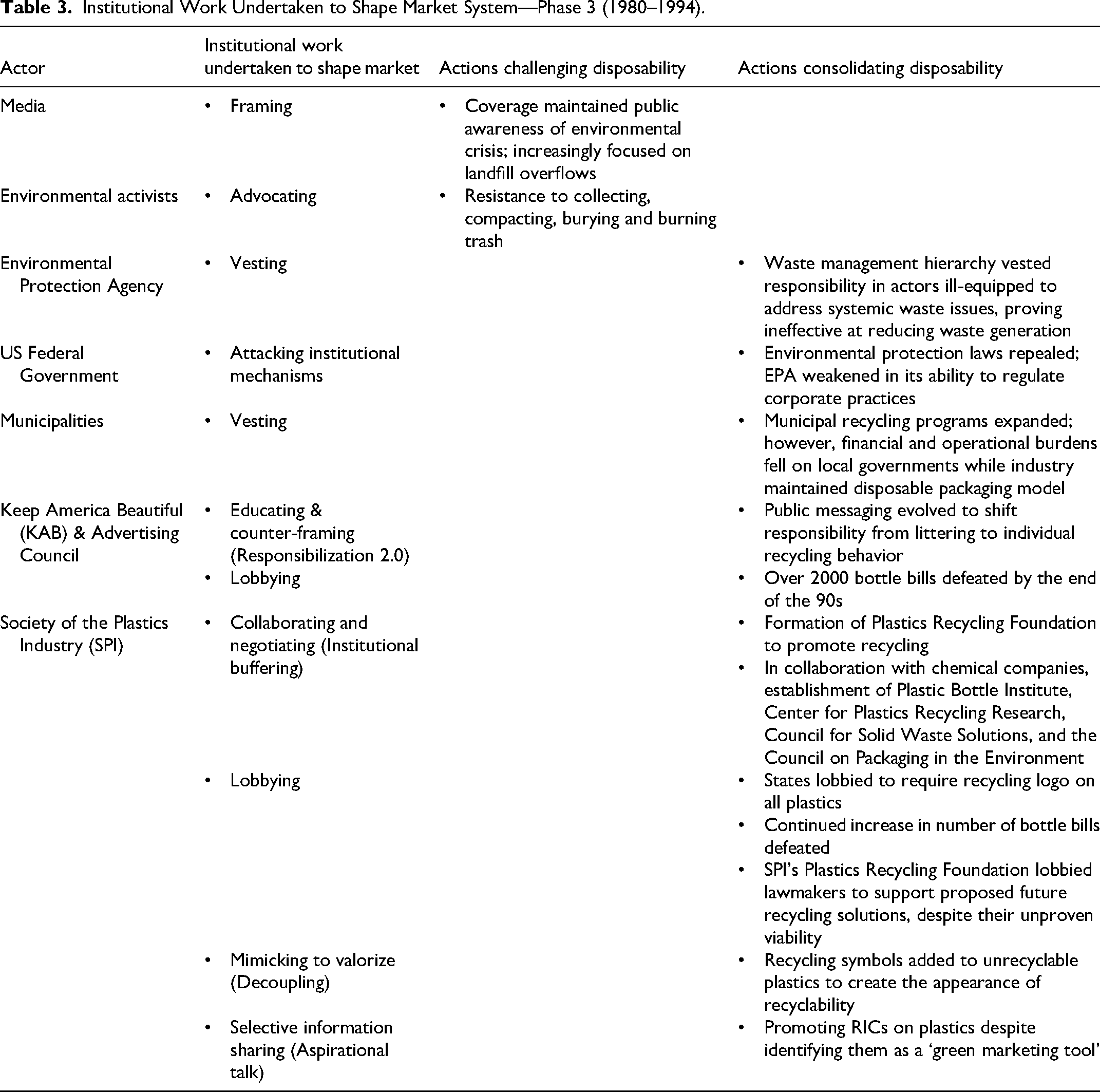
Our analysis of institutional work was sensitized by Lawrence and Suddaby's (2006) typology, which we treated as a heuristic rather than a fixed template. Initial identification of creating, maintaining, and disrupting work evolved inductively as our engagement with the data deepened. New forms—such as responsibilization framing, aspirational talk, and collective opportunism—emerged from the material and extend beyond existing classifications. This approach aligns with prior research that uses institutional work as a sensitizing concept to capture evolving repertoires of market-shaping practices (e.g., Baker et al., 2019; Kullak et al., 2022), as reflected in Tables 1 to 3.
Institutional Work Undertaken to Shape Market System—Phase 1 (1950–1969).
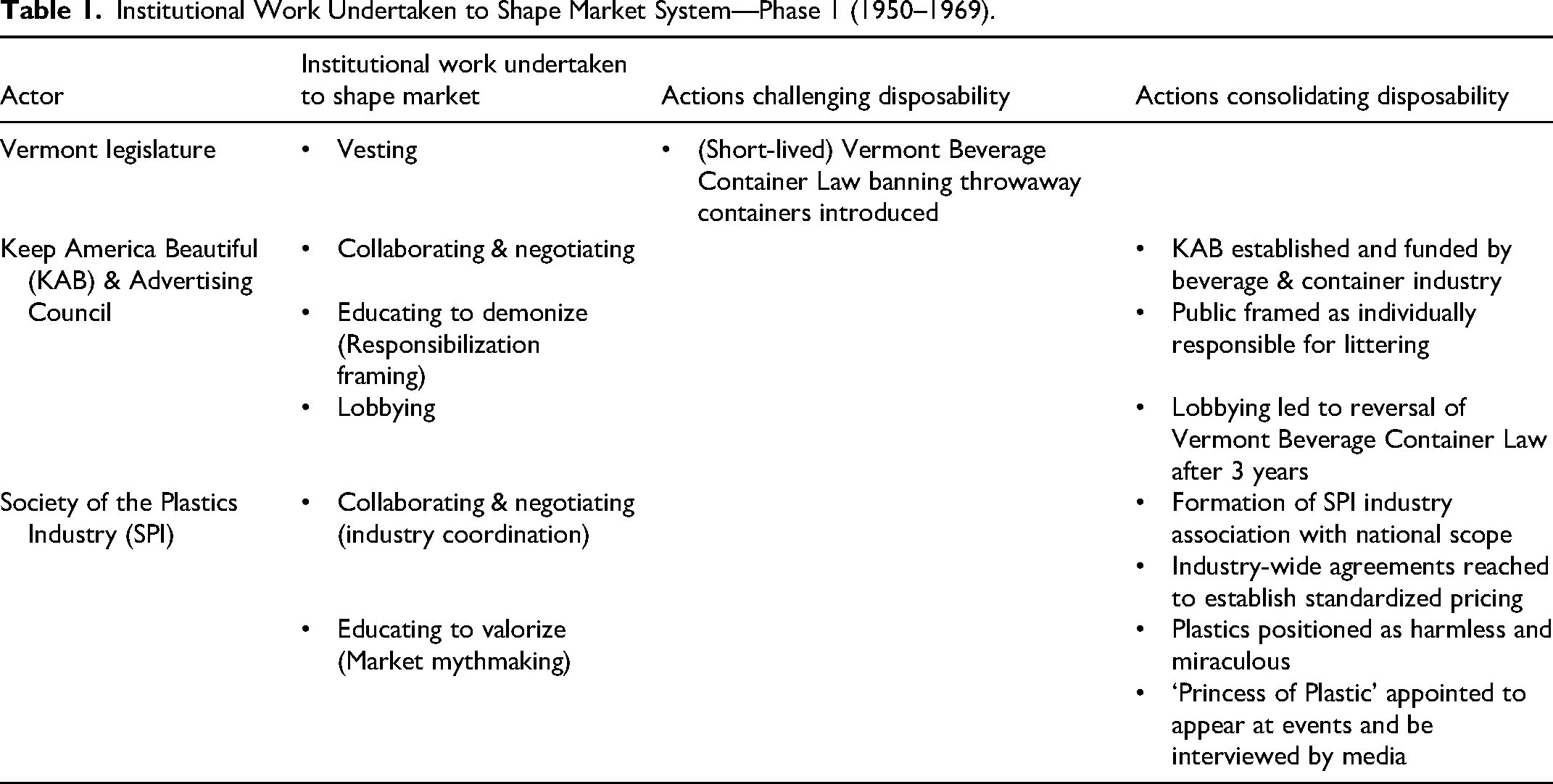
Institutional Work Undertaken to Shape Market System—Phase 2 (1970s).
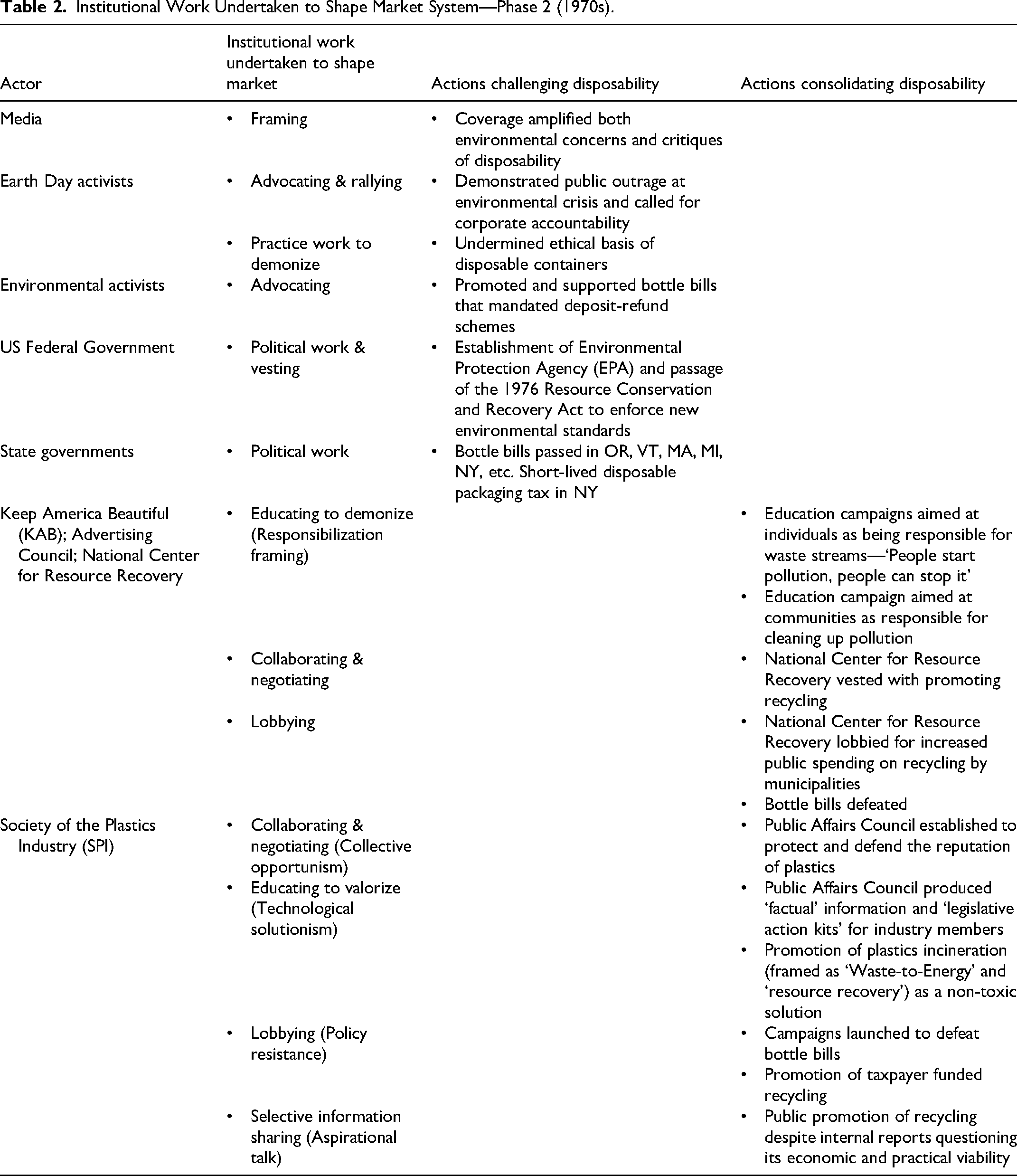
Institutional Work Undertaken to Shape Market System—Phase 3 (1980–1994).
Case Background
In the decades following World War II, U.S. consumerism surged, fueled by government mortgage schemes, rising household incomes, and rapid technological innovation. Synthetic materials developed during the war — especially plastics — captured the public imagination and quickly became woven into everyday life. Economic growth was substantial, and packaging around food and beverages proliferated (Ackerman, 1997b; Rogers, 2005a).
Today, the United States remains both the world's largest consumer and its most wasteful nation, generating more waste per capita than any other country (Block et al., 2024; Semuels, 2019). Plastic packaging, particularly single-use beverage containers, has become the dominant form of material waste. The U.S. alone accounts for around 40% of global plastic demand (National Academies of Sciences, Engineering, and Medicine, 2021). Yet most plastic waste ends up in landfills or the environment, with only 9% of all plastics ever produced having been recycled (OECD, 2022). Because plastics do not biodegrade, they accumulate across ecosystems and cause near-permanent contamination (Geyer et al., 2017; The Economist, 2018; Wilkins, 2018). The scale of this crisis is staggering: by 2050, the weight of plastics in the ocean is projected to exceed that of all fish (Beaumont et al., 2019; Ellen MacArthur Foundation, 2016).
The dominant institutional response to this mounting waste problem has been recycling. While environmentally preferable to landfill or incineration (Borrelle et al., 2020), recycling has often functioned as a false panacea—a symbolic solution that obscures deeper systemic drivers such as overproduction and consumer excess (Micklethwaite, 2021). Recycling rates in the U.S. have remained stubbornly low: just 5% of plastics were recycled in 2000 (Rogers, 2005a), rising only to 8.8% by 2012 (Landreth & Rebers, 2020). Meanwhile, virgin plastic production continues to grow far faster than recycled content. Between 2019 and 2021, new plastic production outpaced recycled feedstock by a factor of fifteen (Charles & Kimman, 2023). Hundreds of municipalities have reduced or eliminated recycling programs altogether in recent years due to budgetary pressures.
Responsibility for managing plastic waste has been placed largely on individuals and local governments (Rhodes et al., 2014). Even the language of “post-consumer waste” implies that consumers are the source of the problem (Barnett et al., 2023), diverting attention from structural drivers such as packaging design, producer incentives, and supply chain practices. As a result, behavioral interventions dominate both scholarship and policy (e.g., Austin et al., 1993; Barr et al., 2011; Burn & Oskamp, 1986; Kim et al., 2005; Osbaldiston & Schott, 2012), while far less attention has been paid to how the market system itself was actively shaped over time (Barr et al., 2011; Micklethwaite, 2021).
This case traces the institutional and strategic work through which industry actors—often in concert with regulators and civic organizations—constructed the prevailing system of single-use plastic packaging and recycling. It reveals how responsibility for waste was systematically shifted away from producers and onto the public.
A fuller, extended version of the case study, with additional empirical detail and source citations, is provided in the Supplementary Web Appendix. Figure 2 outlines the key developments across the three phases explored below.
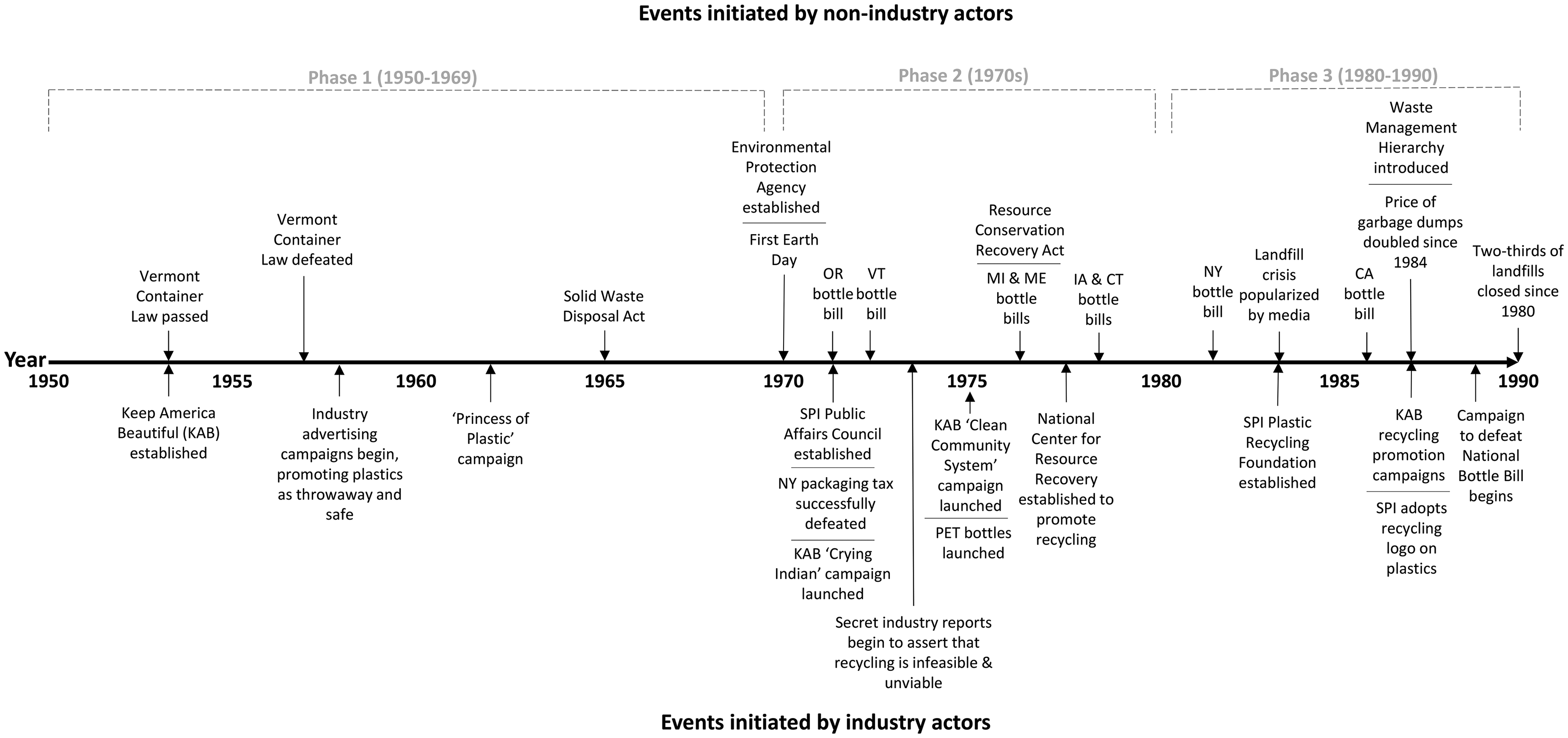
Overview of Case Timeline.
Beverage Container Manufacturing in the US from 1950 to 1990
Phase 1 (1950–1969): Rise of the Throwaway Paradigm
The first phase of throwaway beverage container production was marked by a layered configuration of institutional work. Rather than a tightly orchestrated strategy, industry efforts emerged through a combination of opportunistic adaptation, early public–private collaboration, and proto-institutional experimentation. While some initiatives were deliberately strategic (e.g., lobbying and consumer education), others reflected unintended outcomes or later co-optation of civic initiatives. Nevertheless, these efforts contributed to institutionalizing a throwaway paradigm by stabilizing proto-institutions (Zietsma & Lawrence, 2010) and embedding moral framings of waste and responsibility.
In the early 1950s, the beverage industry was still organized around reusable containers and localized refill systems. However, technological advances such as aluminum cans with pull-tab tops (introduced in 1958 and 1962, respectively) coincided with consumer demand for convenience and mobility, especially among returning servicemen accustomed to single-use containers during World War II (Ackerman, 1997b; Dunaway, 2015). These innovations enabled centralized production and expanded distribution, but also led to increased packaging waste and declining use of refillable bottles.
Institutional responses initially emerged at the state level. In 1953, Vermont passed a Beverage Container Law banning disposable bottles—a law motivated less by environmental concerns than by dairy industry pressure following livestock deaths from discarded glass (Bottle Bill Toolkit, n.d.). Although short-lived, the legislation revealed the growing salience of container waste, even in the absence of an environmental movement capable of framing the issue systemically.
Recognizing a potential threat to emerging business models, packaging and beverage firms mobilized early, most notably through the creation of Keep America Beautiful (KAB), a nonprofit that would become a key institutional actor. While KAB initially attracted support from conservation groups such as the National Audubon Society and Sierra Club (Bottle Bill Toolkit, n.d.), it increasingly engaged in “educating to demonize” (Lawrence & Suddaby, 2006)—deploying public messaging that reframed waste as the fault of individual consumers rather than producers. With backing from the Advertising Council, KAB's anti-litter campaigns embedded the idea of the “litterbug” into public discourse, positioning cleanup as a civic duty while obscuring systemic contributors to waste (Plumer, 2006; Rogers, 2005a; Wilkins, 2018). These efforts marked a subtle but powerful form of framing work (Reinecke & Ansari, 2015), which redirected regulatory attention away from corporate accountability.
The plastics industry followed a parallel path. While the Society of the Plastics Industry (SPI) was initially focused on pricing and standardization, it began undertaking public-facing institutional work in response to consumer skepticism about plastic packaging. SPI launched education campaigns to “valorize” plastics, promoting them as modern and hygienic materials (Modern Plastics, 1957; Rogers, 2005b). Yet these campaigns also reveal a process of institutional trial-and-error: consumers often reused early plastic containers, prompting industry advocates to explicitly teach disposability as a norm (Meikle, 1997).
As criticism of packaging waste grew through the 1960s, SPI shifted from reactive education to more direct political engagement. It opened a lobbying office in Washington D.C., marking the start of a more formal role in shaping the regulatory environment. This move toward ‘lobbying’ and ‘agenda-setting’ (Lawrence et al., 2009) signaled a strategic deepening of institutional work, laying groundwork for more organized industry resistance in subsequent phases.
By the end of the 1960s, the throwaway paradigm had been normalized through a mix of material innovation, cultural reframing, and pre-emptive organizational mobilization (Zilber, 2007). Key proto-institutions—such as litter discourse and emerging consumer expectations of convenience—began to stabilize a new system of disposability (Lawrence et al., 2002; Zietsma & Lawrence, 2010). Although many developments appeared incremental, they collectively transformed both industry practices and public perceptions. Importantly, cracks were already forming: tensions between KAB's public-facing civic message and its industry funding base foreshadowed deeper conflicts that would surface in later decades.
Phase 2 (The 1970s): Post-Earth Day Environmental Contestation
The 1970s marked a turning point in the evolution of beverage container waste, with escalating public concern and growing regulatory intervention triggering intensified institutional work. Industry actors—especially beverage, packaging, and plastics firms—moved beyond ad hoc responses, engaging in coordinated, strategic efforts to defend their market position. Through discursive reframing, lobbying, and the promotion of selective environmental narratives, they sought to neutralize emerging threats while projecting alignment with societal values (Maguire & Hardy, 2009). This period exemplifies how actors engage in normative, discursive, and political work (Lawrence & Suddaby, 2006) to preserve institutional arrangements under pressure.
The decade began with an explosion of environmental awareness. Media images of litter and pollution, the publication of iconic photographs like NASA's Earthrise (Thulin, 2019), and the unprecedented scale of Earth Day in 1970 galvanized public opinion (Dunaway, 2015; Hsu, 2020; Rome, 2010; 2013). Protesters targeted the beverage and packaging industries as emblematic of ecological irresponsibility, fueling calls for government intervention. In response, President Nixon established the Environmental Protection Agency (EPA) in 1970, ushering in a new era of environmental regulation (Hirsch & Bermiss, 2009).
As regulatory scrutiny intensified, industry actors undertook defensive institutional work. The plastics and packaging sectors lobbied aggressively against legislative initiatives such as deposit-return schemes (“bottle bills”) and packaging taxes (Blumberg & Gottlieb, 1989; Bottle Bill Toolkit, n.d.). These efforts were coordinated through industry associations like the Society of the Plastics Industry (SPI), which created centralized public affairs units, disseminated oppositional playbooks, and developed counternarratives via trade journals (Heckman, 1972). The EPA's Resource Conservation and Recovery Act (1976) inadvertently exacerbated landfill closures and pushed cities toward incineration, a practice the plastics sector reframed as “waste-to-energy” to secure normative legitimacy (Allen et al., 2024).
To displace blame and deflect regulatory threats, firms ramped up discursive work. KAB, now closely aligned with corporate sponsors, released high-profile public service campaigns that reframed pollution as the result of individual irresponsibility rather than systemic production practices (Rogers, 2005a; Wilkins, 2018). The launch of KAB's “Clean Community System” in 1975 exemplified how industry promoted community clean-ups to pre-empt policy reform (Blumberg & Gottlieb, 1989). Although KAB maintained an official stance of neutrality on bottle bills, it increasingly functioned as a vehicle for symbolic compliance (Christensen et al., 2020), appearing environmentally engaged while shielding industry interests.
Bottle bills nonetheless gained traction in several states, including Oregon (1971), Maine and Michigan (1976), and Connecticut and Iowa (1978), generating a crisis of legitimacy for the industry (Melosi, 2000; Michigan History Magazine, 2004). This catalyzed boundary work (Zietsma & Lawrence, 2010), as firms discredited environmental advocates as politically radical and pressured public agencies to withdraw support. Following inflammatory remarks from industry leaders, the EPA and major civic organizations resigned from KAB's board, signaling a rupture in cross-sectoral alliances (Bottle Bill Toolkit, n.d.).
Simultaneously, industry actors promoted technologically mediated market work (Nenonen, Storbacka, & Frethey-Bentham, 2019; Nenonen, Storbacka, & Windahl, 2019). The mid-1970s saw the commercial introduction of lightweight PET plastic bottles, replacing reusable glass with high-volume disposable packaging (Rogers, 2005b). Although touted as innovation, internal documents revealed the technical and economic infeasibility of large-scale plastic recycling (Nollet, 1972; Sullivan & Gonzalez, 2020). Still, firms publicly endorsed recycling as a viable solution, performing mythologizing work to reframe recycling as a panacea while deflecting scrutiny from their unsustainable production practices (Manning & Deskins, 2020; PBS, 2020).
The formation of the National Center for Resource Recovery (NCRR) in 1975 consolidated industry influence. Co-funded by SPI and beverage companies, the NCRR worked to institutionalize recycling infrastructure while opposing source reduction and reuse mandates. Hundreds of drop-off centers were established through NCRR-affiliated campaigns, further entrenching recycling as the industry's preferred solution (Manning & Deskins, 2020).
Across this period, multiple institutional mechanisms were activated. Activists engaged in disruptive practice work through direct action and protest, while regulators undertook vesting work via landmark legislation (Zietsma & Lawrence, 2010). The media played a critical role in framing the issue (McCombs & Reynolds, 2008; Riaz et al., 2011), while industry actors combined discursive, normative, and political strategies to resist structural reform and reshape the cognitive schema of responsibility (Hargrave & Van de Ven, 2009). By the end of the decade, the industry's throwaway model was more deeply entrenched than ever, even as regulatory threats persisted. What changed, however, was the sophistication of industry responses: rather than confronting regulation directly, firms now positioned themselves as partners in environmental stewardship, using moral appeals and technological promises to shape both policy and public expectations.
Phase 3 (1980–1994): The Landfill Crisis and the Recycling Turn
Building on the discursive and political groundwork laid in the 1970s, the 1980s and early 1990s saw industry actors respond to mounting environmental concerns not through resistance, but by strategically redirecting the sustainability agenda. Rather than embracing systemic reform, industry actors institutionalized a market-oriented response centered on recycling, privatization, and individual responsibility. This phase marks a shift from discursive and defensive work to more coordinated forms of institutional work aimed at legitimizing disposable packaging within an emergent neoliberal policy environment.
A key catalyst for this repositioning was the so-called ‘landfill crisis,’ widely circulated in U.S. media (Ackerman, 1997b). In response, the EPA introduced the Waste Management Hierarchy in 1988, prioritizing waste minimization, followed by recycling and finally disposal (Gertsakis & Lewis, 2003; Schall, 1992). Although well-intentioned, the hierarchy misaligned responsibility, placing expectations on waste managers who had no control over upstream production decisions. This institutional design failure opened the door for industry-led narratives that emphasized downstream consumer responsibility and voluntary recycling over upstream regulation or producer accountability.
To reinforce this framing, petrochemical and packaging firms intensified associative work (Zietsma & Lawrence, 2010), founding or expanding organizations such as the Plastics Recycling Foundation, the Plastic Bottle Institute, the Center for Plastics Recycling Research, and the Council for Solid Waste Solutions (Allen et al., 2024). These bodies produced technical reports, funded academic research, and engaged in lobbying, all aimed at normalizing mechanical recycling as the default solution—even though the feasibility and efficacy of recycling were consistently challenged (Ackerman, 1997b; Taylor, 2013c).
In parallel, symbolic and normative work was advanced through coordinated campaigns by KAB and the Advertising Council. From 1988 to 1992, messaging increasingly emphasized that recycling was not only possible, but also a civic duty (Dunaway, 2015). This discursive shift resonated with the broader political economy, particularly during the Reagan administration, which pursued deregulation and contracted waste services to private firms (Spross, 2019; Zimring, 2005). Waste management became a lucrative industry dominated by a handful of vertically integrated corporations, further entrenching market-based solutions and weakening public-sector oversight (Corkery, 2019).
Another key tactic was mimicry (Lawrence & Suddaby, 2006). The Society of the Plastics Industry (SPI) appropriated the now-iconic ‘chasing arrows’ recycling logo—originally developed for paper and cardboard products—and embedded it on plastic items alongside numerical resin identification codes (RICs) (Center for Energy Efficiency, 2020; Rogers, 2005b; Sanchez, 2020). While these codes suggested recyclability, most plastics were not economically or technically recyclable, leading to widespread consumer confusion (Breggin et al., 2019; Jones & Powell, 1999; Semuels, 2019). Even SPI's internal documents acknowledged the ambiguity and marketing utility of RICs (NRC & SPI, 1993). The institutional effect was what Christensen et al. (2020) call ‘aspirational talk’: forward-looking commitments that maintain legitimacy despite limited operational follow-through.
These strategies also exemplify what institutional theorists describe as decoupling — the strategic separation of symbolic commitments from substantive practices to preserve legitimacy under scrutiny (Hirsch & Bermiss, 2009). Decoupling was evident in the industry's use of aspirational talk, the deployment of recycling symbols on largely non-recyclable plastics, and the promotion of recycling as a comprehensive solution despite internal recognition of its limited feasibility. Through such practices, firms were able to project environmental responsibility and deflect regulatory pressure while materially maintaining unsustainable production models. In this way, decoupling functioned as a crucial mechanism underpinning broader patterns of collective opportunism and asymmetrical market-shaping.
Through lobbying and public campaigns, recycling became mainstream. By the early 1990s, over 40% of Americans had access to curbside recycling programs (Ackerman, 1997b). Yet the expansion of such programs yielded unintended consequences. First, building on the earlier introduction of PET plastics, reusable bottles were fully displaced by single-use packaging. Second, deposit-refund systems—proven to drive high return rates—were marginalized in favor of less effective, but industry-preferred, collection programs (Adams & Even, 2020; Godush, 2001). Despite their questionable cost-effectiveness, these programs were promoted as evidence of industry responsibility.
Meanwhile, corporate actors pursued defensive political work to avoid federal legislation. Between 1989 and 1994, they spent millions lobbying against a national bottle bill, arguing that centralized collection systems were inefficient (Fisher & Liesemer, 1998; Wilkins, 2018). In some states, industry groups even promoted ‘bans on bans’—preemptive laws preventing municipalities from outlawing single-use plastics (Manning & Deskins, 2020). These moves reflect what Levy and Scully (2007) describe as control-oriented institutional work: maintaining dominance through structural and legal maneuvering rather than public debate.
By the mid-1990s, the cumulative effect of these strategies was a highly institutionalized, market-centric waste regime. Through a combination of associative work, mimicry, lobbying, and discursive reframing, industry actors successfully positioned recycling as a legitimate and sufficient environmental solution (Taddonio, 2020). This allowed them to retain control over the terms of sustainability discourse, while offloading costs and responsibilities onto municipalities and consumers. In so doing, industry actors not only entrenched their preferred model of environmental governance but also exemplified how institutional work can reconfigure responsibility across market actors, consumers, and the state. The era marks a consolidation of market logic within environmental governance, displacing alternative models rooted in regulation, reuse, or extended producer responsibility.
Discussion
This paper set out to examine how institutional work functioned as a tool for market-shapers to advance their own interests while facing opposition from regulators, activists, and media actors. Our historical analysis of the U.S. beverage container market (1950–1990) shows that market-shaping extends far beyond lobbying or marketing influence. It entails systematic, long-term efforts to embed dependencies, shape governance structures, and redefine sustainability itself—often while maintaining an appearance of public-spiritedness. As noted earlier, while the Findings section presents three empirically grounded phases of market development, here we discuss these phases using a more conceptual frame that emphasizes the industry's shaping strategies over time: Foundational Market-Shaping (Phase 1: Rise of the Throwaway Paradigm), Strategic Expansion and Reinforcement (Phase 2: Post-Earth Day Environmental Contestation), and Shaping Market Dependencies (Phase 3: The Landfill Crisis and the Recycling Turn). These phases trace the evolution of a collective effort by the beverage and container industries to entrench disposability as the dominant packaging model.
While each phase corresponds to broader developments in the beverage container market, industry actors exhibited strategic agility by continuously adapting their shaping strategies in response to public, regulatory, and activist pressures. This included shifting discursive tactics, reorganizing coalitions, promoting industry-preferred sustainability solutions, and embedding responsibility for waste management within municipal structures.
Particularly in Phase 1, industry actors presented themselves as modernizers and public stewards, aligning throwaway packaging with progress and personal freedom. This framing resonated with mid-century cultural narratives and helped deflect early critiques. Rather than overly deterministic or unidirectional, this first phase also shows how the industry capitalized on existing cultural values and infrastructure gaps, suggesting a more nuanced, adaptive, and opportunistic form of institutional work than critics may assume. These dynamics are visualized in Figure 3, which summarizes the unfolding of industry-led market-shaping strategies across the three historical phases identified in the Findings. The figure illustrates how actors combined rule-setting, discursive framing, and organizational coordination in an evolving pattern that embedded industry priorities while shifting responsibilities elsewhere. Rather than presenting a linear sequence, Figure 3 reflects the layered, recursive, and often morally coded strategies that underpinned the construction of market dependencies.
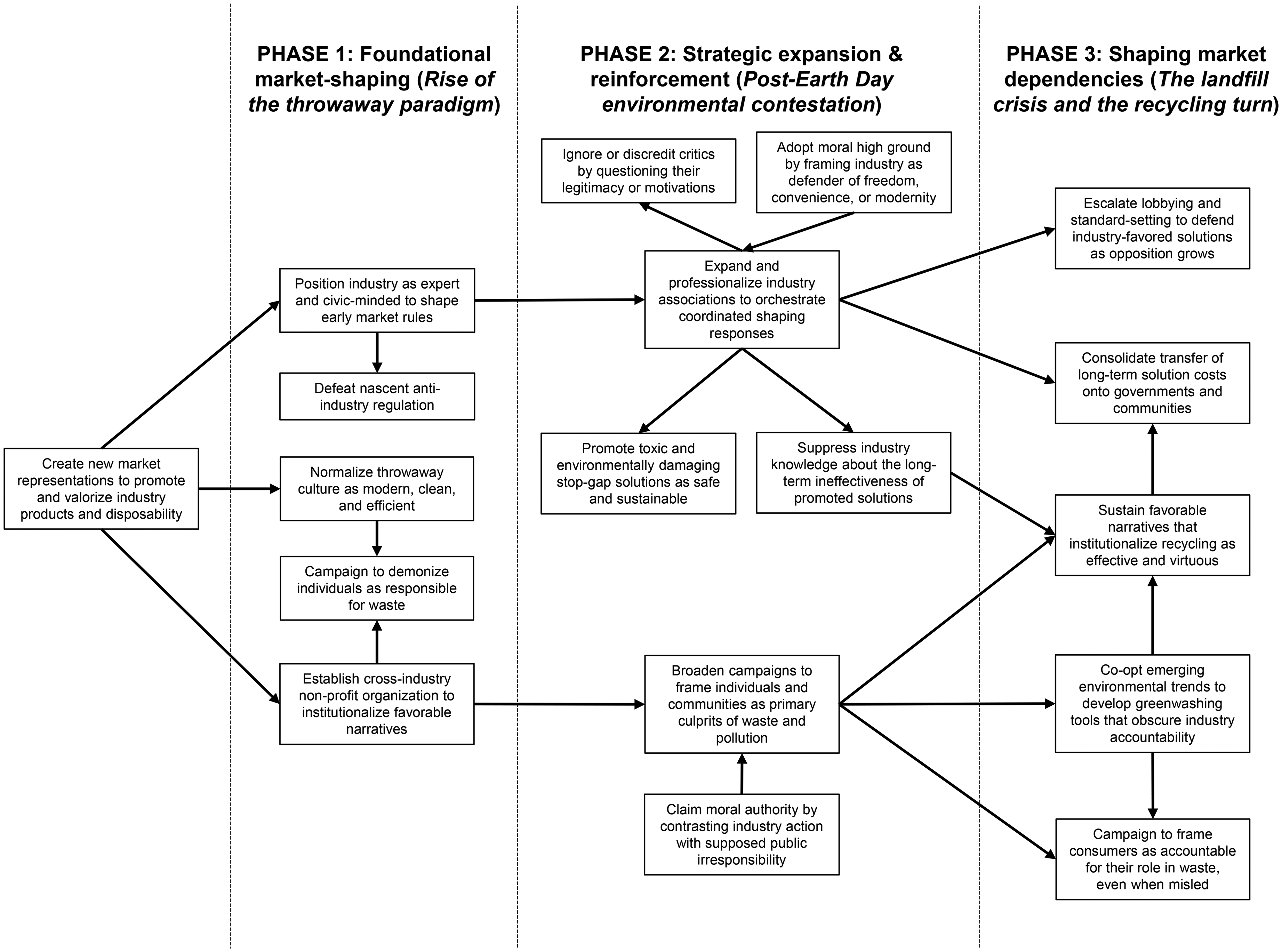
Three Phases of Market-Shaping Strategies by Industry Actors.
A core feature of industry success was the coordinated, strategic adaptability of trade associations. Acting as institutional buffers (Scott, 2008), these associations pooled resources, sustained lobbying, and shielded individual firms from scrutiny, enabling what we term collective opportunism: the coordinated pursuit of industry-wide advantage at societal and ecological expense. This collective capacity allowed firms to reshape governance structures, externalize costs, and maintain dominance under the guise of neutrality.
In addition to downstream burden-shifting, the industry's preference for virgin plastic was underpinned by upstream economic and policy incentives. Recycling was not only framed as the responsibility of municipalities and citizens; it was also structurally disadvantaged. Unpriced environmental externalities from resource extraction, combined with substantial subsidies to oil and petrochemical companies, made virgin plastic significantly cheaper and more attractive than recycled alternatives. These policy arrangements actively distorted the market, disincentivizing circularity while locking in linear production models (Layton, 2011; UNEP, 2025).
Industry shaping efforts were largely uncontested at a structural level. Despite moments of resistance from activists and regulators, industry actors maintained the upper hand due to resource asymmetries, long-term vision, and their ability to define the sustainability agenda. The opposition was often fragmented, episodic, and focused on specific legislative proposals such as bottle bills. Even when activists and regulators succeeded in specific jurisdictions, industry actors leveraged broader coalitional power and policy influence to constrain broader diffusion. This dynamic echoes what Welford (1997) describes as the “hijacking of environmentalism,” whereby powerful incumbents strategically co-opt environmental discourses to preserve their dominance while deflecting demands for more transformative change. The resulting asymmetry of institutional work, between a coordinated and resourced industry collective on one hand, and a dispersed, reactive set of challengers on the other, proved decisive in shaping the trajectory of the market. Figure 4 highlights this asymmetrical institutional work.
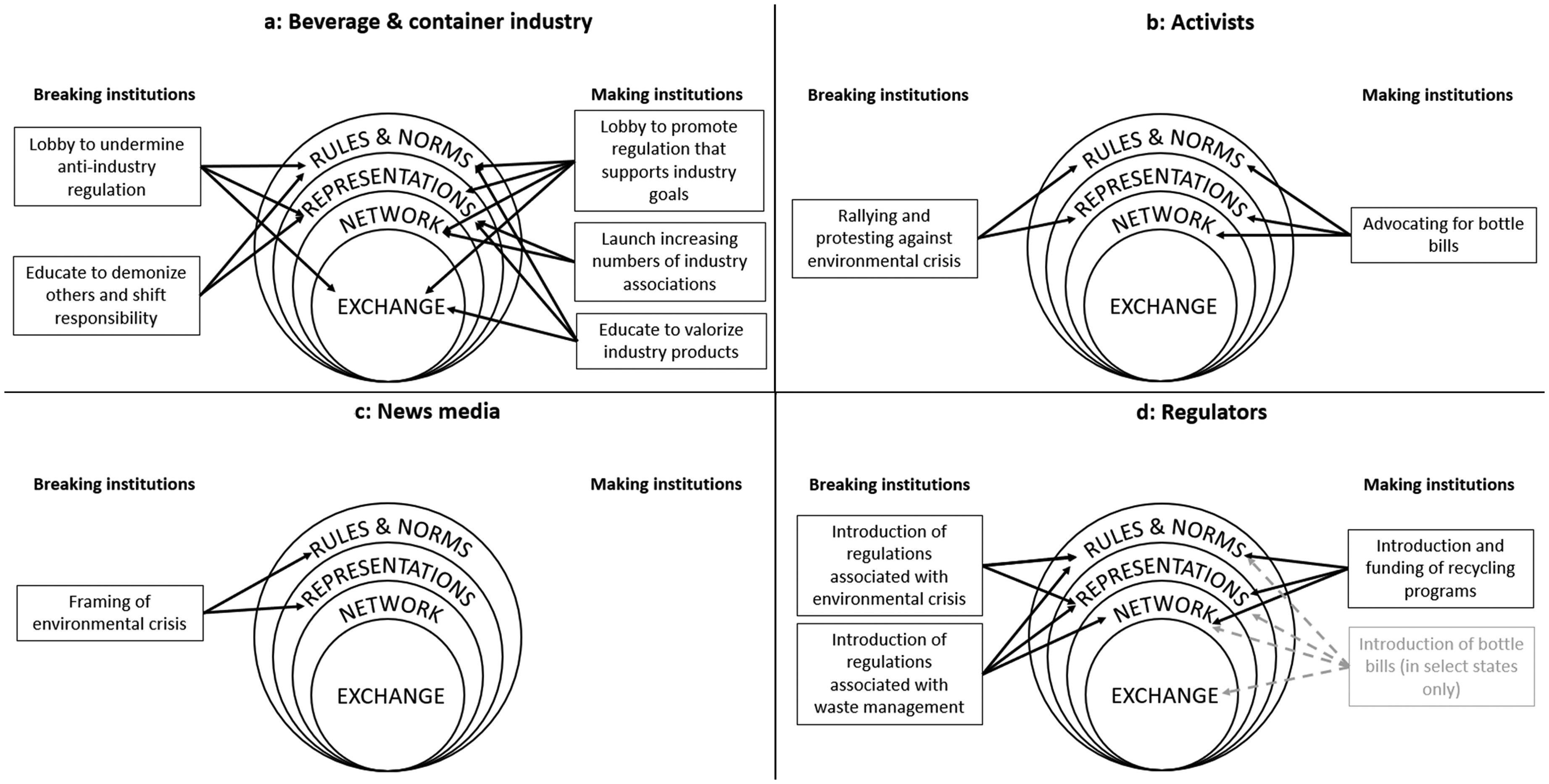
Impact on Market Layers of Actor Groups’ Institutional Work.
This asymmetry was also moralized. Industry actors consistently framed their preferred market configurations as the most sustainable and responsible options, portraying regulatory alternatives as burdensome or regressive (Reay & Hinings, 2009). The term ‘litterbug’ effectively moralized individual behavior, while public investments in recycling were presented as common-sense environmental solutions, even as they displaced more circular packaging systems. This strategic positioning culminated in what Cherrier and Türe (2023) describe as the responsibilization of public actors: the progressive transfer of accountability and cost for managing sustainability issues from private firms to municipalities and government bodies. Here, the public sector was not just co-opted but structurally bound into a model that benefited private industry, creating enduring dependencies and limited scope for systemic alternatives.
These patterns can be further illuminated through the normative lens of Doughnut Economics (Raworth, 2018), which conceptualizes a ‘safe and just space’ bounded by an ecological ceiling and a social foundation. We use this lens not as a definitive evaluative framework but as one illustrative tool for articulating when market-shaping outcomes breach ecological or social thresholds. Even without this specific metaphor, our analysis highlights how collective opportunism can entrench systemic overshoot (e.g., material throughput, waste generation) and social shortfall (e.g., shifting costs to under-resourced municipalities). In the U.S. beverage container market, industry strategies repeatedly transgressed both boundaries: breaching the ecological ceiling by prioritizing disposability and locking in linear waste flows, and undermining the social floor by shifting costs onto under-resourced municipalities. These shifts were framed as modern and efficient, yet they eroded both planetary boundaries and democratic responsibilities, constructing a market that was simultaneously ecologically precarious and socially regressive.
Importantly, this normative lens helps us move beyond a binary view of market outcomes as either innovative or exploitative. While the market-shaping strategies studied here were undeniably strategic and technically effective, their long-term effects reveal how institutional power can entrench harmful models of production and consumption under the guise of public interest. The case invites broader reflection on the moral dimensions of market-shaping and the institutional infrastructures that enable or constrain socially just outcomes.
Theoretical Contributions
Despite the wide-ranging implications of market-shaping outcomes on wider society, the negative outcomes of shaping efforts have been largely ignored. While a handful of studies have taken a ‘dark side’ approach (Cova et al., 2021; Diaz Ruiz, 2023; Mele & Russo Spena, 2020), this study investigates the actions of an industry, working collectively and collaboratively, to deliberately shape a market in its favor, at the expense of broader society and ecological wellbeing. Drawing on the normative lens of Doughnut Economics (Raworth, 2018), we assess how industry-led shaping efforts may breach both the ecological ceiling and the social foundation of just economic systems. Against this backdrop, our study makes four main theoretical contributions to the literature on market-shaping.
First, we introduce ‘collective opportunism’ as a potential mechanism for negative market-shaping outcomes. While prior work has noted opportunism in market-shaping contexts (Mele et al., 2018; Yngfalk, 2019), it typically centers on individual commercial actors. In contrast, our study indicates that collective opportunism—collusion by several sectors or industries that produces negative outcomes—may be just as fruitful a unit of analysis in the context of market-shaping strategies. We highlight how opportunism can be coordinated across sectors and institutionalized via trade associations, yielding collective action that privileges industry interests at broader societal and ecological expense.
Further, over time, this collective opportunism was amplified by the increasing specialization of industry associations. Initially broad-based and multi-issue, many evolved into highly targeted, technically expert entities capable of executing finely tuned shaping strategies—from legislative lobbying to public relations—with greater precision and less public scrutiny. This specialization concentrated expertise and resources, enabling associations to act as both strategic hubs and institutional buffers, reinforcing their asymmetrical advantage over less coordinated opponents.
This notion of collective opportunism extends existing research on collaborative market-shaping (Baker & Nenonen, 2020; Lee et al., 2018; Maciel & Fischer, 2020; Struben et al., 2020) by exposing how such coordination may be strategically effective but normatively problematic. Drawing on Doughnut Economics, we view these shaping efforts as harmful not just because of their outcomes, but because they embed governance structures that contribute to overshooting planetary boundaries and eroding the social foundation. Importantly, our findings position industry associations as central enablers of such processes, as entities that have been largely overlooked in market-shaping literature (Storbacka & Nenonen, 2021), which often treats them as passive representatives of market legitimacy (see Rinallo & Golfetto, 2006 for an exception). Associations, we argue, can be both powerful shapers and targets of market-shaping themselves (Weber et al., 2008).
Our findings also highlight the role of decoupling as a mechanism through which collective opportunism operates. Industry actors strategically separated symbolic commitments—such as public endorsements of recycling or the use of sustainability-oriented symbols—from substantive change in production practices, thereby maintaining legitimacy while materially preserving unsustainable market arrangements (Hirsch & Bermiss, 2009). Recognizing decoupling as part of the repertoire of institutional work deepens understanding of how collective opportunism is enacted and sustained over time.
Importantly, our theorization of collective opportunism contributes to macromarketing debates on systemic inequality, institutional capture, and the distributional consequences of market design (Benton & Stasch, 2024; Cherrier et al., 2012; Layton, 2007, 2011; Mittelstaedt et al., 2014). By highlighting how powerful actors restructure market dependencies to shift burdens and responsibilities, we respond to recent calls for critical macromarketing perspectives that foreground moral consequences and asymmetries in market systems (Giesler & Veresiu, 2014; Shultz & Holbrook 1999). Together, collective opportunism, institutional buffering, and decoupling reveal how coordinated actors can entrench harmful market arrangements under the guise of progress.
Second, our case reveals that shaping processes unfolding over long timeframes often rely not on a predefined visionary blueprint, but on a continuously evolving and reactive vision of the market. While prior research emphasizes the importance of bold, future-oriented visions to engage support for market-shaping (Flaig & Ottosson, 2022; Nenonen, Storbacka, & Frethey-Bentham, 2019), our study shows that no singular vision guided the early stages of industry action. Instead, the vision emerged through opposition, adapting in response to external critiques while remaining focused on collective strategic aims. This more fluid, adaptive orientation allowed for simultaneous deployment of offensive and defensive tactics (cf. Flaig et al., 2021), sustaining legitimacy across shifting cultural and regulatory environments. Such emergent visions may be particularly functional for collectives, like trade associations, that must continuously negotiate shared interests and manage reputational risk. In this light, industry associations can be seen not merely as conduits of strategy but as entrepreneurial visionaries in their own right—as agents capable of framing markets over time without anchoring their actions in a singular guiding future.
Third, our findings offer a more nuanced perspective on the normative desirability of market-shaping outcomes, contributing to two interrelated conversations: the inclusion–exclusion debate (Cova et al., 2021; Geiger & Gross, 2018) and the broader critique of marketization (Sandel, 2012; Satz, 2010). While inclusion is often framed as ethically desirable and exclusion as a dark side outcome, others caution against the uncritical expansion of economized markets, urging market-shapers to recognize normative heterogeneity and structural incompatibilities (Coskuner-Balli et al., 2021; Debenedetti et al., 2021; Dorobantu et al., 2017). Our study suggests that both lenses are necessary to assess shaping outcomes. For example, compelling municipalities to serve as lead actors in a technically infeasible and economically unviable recycling market illustrates how inclusion can be burdensome rather than empowering, especially when driven by collective private interests without adequate commercial alignment. In such cases, inclusion becomes a form of delegated risk rather than empowerment. These findings point to the importance of shaping adjacent markets (e.g., for reusable bottles or alternative packaging) to create viable pathways for more sustainable systems. This extends recent work on system-to-system dynamics in market-shaping (e.g., Mele et al., 2018) and aligns with the logic of Doughnut Economics (Raworth, 2018), which calls for systemic coherence between ecological limits and social foundations.
Relatedly, our fourth contribution concerns assumptions about who builds and maintains market infrastructures (Araujo & Mason, 2021; Kjellberg et al., 2019; Lee et al., 2018; Ozcan & Santos, 2015). While market infrastructures are typically conceptualized as “materially heterogeneous arrangements that ‘silently’ support and structure the consummation of market exchanges” (Kjellberg et al., 2019, p. 209), most prior work assumes that commercial firms are willing contributors when they are built (and assumes that infrastructures are built when needed). Much of this literature focuses on the barriers to infrastructure development, such as firm-level disagreements or collective action problems (Lee et al., 2018; Ozcan & Santos, 2015). In contrast, our study shows that even coordinated firms may choose not to invest, instead strategically shifting the responsibility for infrastructure provision onto public actors. This outsourcing allows industry actors to retain market control while offloading sustainability burdens—a form of infrastructural shaping that has gone largely unexamined. Such dynamics reveal that market infrastructures are not neutral backdrops to exchange but contested terrains that can themselves be strategically shaped—enabling powerful actors to displace accountability, reconfigure responsibilities, and entrench their preferred market arrangements without materially altering their own practices.
While prior work has explored the responsibilization of consumers (Cherrier & Türe, 2023), our study extends this logic to the responsibilization of public actors, revealing how municipalities and governments can be enlisted, under the guise of partnership or efficiency, into supporting infrastructures that primarily serve industry goals. This dynamic not only distorts the allocation of accountability but also embeds long-term dependencies that limit the emergence of more equitable or sustainable alternatives. Such patterns are consistent with broader forms of responsibilization and moral deflection in market systems, where institutional actors construct discourses that shift accountability for systemic harms away from firms and toward individual or public actors (Barnett et al., 2011; Giesler & Veresiu, 2014).
Practical Implications
Market-shaping delivers systemic impacts well beyond those that might be expected from classical competitive strategies. With such power comes increased responsibility. The market-shaping concept proposed in this study implies guidelines for developing and assessing shaping strategies. There are four key considerations for practitioners.
First, it would appear market-shaping strategies that, through time, both 1) make and break institutions, and 2) impact all layers of a market system, are highly effective in the long term. This reality generates various implications. For policymakers, shaping markets solely through regulation is insufficient. Instead, shaping efforts must target all layers of the market system—rules, norms, networks, exchange, and representations. While others have argued for governments and other public actors to take a visionary role in shaping markets (Mazzucato, 2017; Mountford & Geiger, 2024), our findings indicate that shaping strategies must be systemic, not just regulatory. Policymakers must also anticipate counter-shaping efforts (like burden-shifting) by entrenched industry actors, who often work to neutralize regulatory efforts. Ensuring alternative structures exist, such as supporting circular economy initiatives rather than solely relying on industry-led recycling programs, may help sustain shaping efforts in the long run. For example, many present-day European waste and recycling markets involve complex relationships between regulators, retailers, product and packaging manufacturers, waste management and recycling companies, deliver high collection rates and desirable environmental outcomes by embedding incentives for multiple stakeholders.
Second, activists may need to adopt a more strategic, market-shaping approach rather than focusing solely on opposition. While activism has historically played an essential role in drawing attention to social and environmental harms, our findings suggest that fragmented or reactionary approaches often struggle to achieve lasting institutional change. Analogous dynamics appear in other domains of social change. For example, the African-American Marxist, Cedric Johnson argues the Black Lives Matter movement, while representative of mass anger and frustration at social outcomes for disadvantaged populations and racist policing, has not delivered substantive or lasting reforms (Johnson, 2023). Perhaps a market-shaping approach, focused on not just what is wrong, but also what specific systemic changes will deliver desired outcomes, might assist in tackling such issues. Instead, activists may benefit from leveraging consumer influence, forming alliances with policymakers, and identifying systemic leverage points that drive enduring market shifts. Activists can act as ‘market co-shapers’ rather than merely oppositional forces, collaborating with aligned stakeholders to shift demand and drive alternative market solutions. This perspective may be relevant for contemporary movements advocating sustainability transitions, where economic incentives and structural market change must be considered alongside public pressure.
Third, businesses engaging in market-shaping should evaluate not just the profitability of their strategies but also their ethical implications in relation to planetary boundaries and social foundations. This includes: what is being exchanged and how; the structure and quality of networks; agreements and interactions between partners; the authenticity of market representations and embedded participants; compliance with formal rules; and the broader influence of market activity on societal norms, expectations and assumptions. Specifically, stakeholder input into the development of market visions is of utmost priority. Hence, sitting at the core of shaping an ethical market system should be ‘negotiation work’—joint problem-solving within and between stakeholder groups (Helfen & Sydow, 2013). Unlike stakeholder consultation (Sulkowski et al., 2018), which assumes one party takes stakeholder needs or aspirations into account before unilaterally mapping the path forward, negotiation work assumes all parties contribute equally to institutional outcomes. In sum, negotiation work reduces the chances of unintended consequences and enables collective goals, objectives and approaches to be formulated (Vigneau et al., 2015). Further, beyond ethical considerations, businesses that proactively shape markets in socially responsible ways can also gain strategic advantages. Firms that preemptively align their strategies with social and environmental concerns may be able to enhance legitimacy, gain first-mover advantage, and preempt regulatory crackdowns. Rather than waiting for government intervention, businesses can benefit from taking an active role in pro-social markets.
Fourth, industry associations must be held accountable for their market-shaping activities. While some associations foster sustainable transitions, others function as defensive institutions that protect incumbents and slow regulatory change. Ensuring transparency in the objectives and activities of these associations is critical, as they often serve as the primary mechanism through which firms exert collective influence over market structures. Firms should actively monitor the objectives and activities of the associations they belong to, and even withdraw from or reform them, to ensure ongoing alignment with ethical business and sustainability goals.
In sum, market-shaping is not just a tool for industry actors; it is a powerful force that policymakers, activists, and ethical businesses must engage with strategically. Effective market-shaping requires systemic action across all layers of the market, anticipation of counter-shaping efforts, and alignment with long-term ecological and social goals.
Future Research and Limitations
As this is a historical case study drawing on secondary data, generalizability is limited. With widening social and cultural fissures today, relying on a non-partisan news media to express cohesive societal expectations is challenging. Hence, a more contemporary empirical context would be worthy of investigation. Additionally, while the sustainability lens has been fruitful in investigating corporate exploits, market-shaping offers a complementary perspective to explore the strategic activities of the twenty-first century's major shapers, e.g., fast-fashion, social media, and global digital platform businesses. A market-shaping perspective could provide additional insights, especially regarding barriers to sustainability transitions. Future research might also investigate how evolving visions interact with normative frameworks like Doughnut Economics, especially as collective actors recalibrate those visions to appear aligned with ecological and social goals. Power dynamics and asymmetrical institutional work in market-shaping similarly warrant deeper examination.
Further, more research on industry and trade associations is needed. These actors are often incorrectly dismissed as ‘boring’ or assumed to be passive extensions of their members’ interests. This study demonstrates these associations can exercise independent agency. The arm's length relationship between managers of member firms and associations needs closer scrutiny. Do all associations implicitly offer managers opportunities to avoid responsibility? Do digital technologies provide similar forms of plausible deniability for executives, officials, or politicians seeking distance from ethically questionable activities?
Standard regulatory responses that aim to ‘fix market failures’ are inadequate. A market-shaping perspective enables deeper focus on how public actors might proactively shape markets toward pro-social outcomes. While some economists (e.g., Mazzucato, 2017) have promoted calls for shaping by ‘entrepreneurial states,’ others question the state's role in shaping markets top-down (Schou, 2024). The managerially-oriented market-shaping perspective adopted in this study could be a fruitful middle ground, recognizing that markets evolve through both top-down (governmental and institutional) and bottom-up (entrepreneurial) shaping.
Supplemental Material
sj-docx-1-jmk-10.1177_02761467251388876 - Supplemental material for Shaping Markets, Shifting Burdens: Collective Opportunism and Asymmetrical Market-Shaping
Supplemental material, sj-docx-1-jmk-10.1177_02761467251388876 for Shaping Markets, Shifting Burdens: Collective Opportunism and Asymmetrical Market-Shaping by Jonathan J. Baker and Suvi Nenonen in Journal of Macromarketing
Footnotes
Acknowledgments
We are deeply grateful to the Associate Editor and reviewers for their constructive and generous feedback, which has substantially strengthened this manuscript. In particular, we appreciate the thoughtful guidance that helped us streamline and sharpen our argument while retaining the historical and conceptual depth that characterizes what one reviewer aptly described as “a relatively beautiful monster.” We thank the editorial team for their careful consideration and support throughout the review process.
Associate Editor
Terrence Witkowski

Author Contributions
Funding
This research did not receive any specific grant from funding agencies in the public, commercial, or not-for-profit sectors.
Declaration of Conflicting Interests
The authors declare no potential conflicts of interest with respect to the research, authorship, and/or publication of this article
Supplemental Material
Supplemental material for this article is available online.
Author biographies
References
Supplementary Material
Please find the following supplemental material available below.
For Open Access articles published under a Creative Commons License, all supplemental material carries the same license as the article it is associated with.
For non-Open Access articles published, all supplemental material carries a non-exclusive license, and permission requests for re-use of supplemental material or any part of supplemental material shall be sent directly to the copyright owner as specified in the copyright notice associated with the article.
