



Abstract
This article explores the affective atmospheres of thresholds, which have been overlooked as consumption spaces. We argue that the emphasis on liminality within our field eclipses the related concept of thresholds. In particular, we contend that threshold points of inflection exist not just in the liminal phase but also in preliminal and postliminal phases, extending far beyond the context of any rite of passage. In turning our attention to thresholds, we consider and particularly contribute to understanding their atmospheric qualities and affects. Threshold atmospheres are conceptualised as affective atmospheres generated at or by inflection points – those critical sites and/or moments of significant change or transformation. Four affective qualities of threshold atmospheres are identified and described: modulation, suspension, hauntology, and transformation. Threshold atmospheres modulate affect by shaping our emotional states, priming us for upcoming experiences, and mediating between various realms. They create a suspension or a momentary pause of affect and feelings, amplifying the awareness of the boundary being crossed or the moment of crossing. Threshold atmospheres can be imbued by a spectral hauntological quality, providing glimpses into or a heightened sense of other realms, alternative forms of knowing and being, and a feeling of what might have been and what might yet be. Furthermore, atmospheres of thresholds frequently connect with moments of transformation and transgression. Based on our conceptualisation of threshold atmospheres as a new unit of analysis, several potential future lines of inquiry for marketing and consumer researchers have been proposed.
Keywords
Introduction
Every space or situation has an atmosphere that shapes its perceptual, sensory, and emotive impression (Bressani and Sprecher, 2019). Atmospheres are defined as feelings, moods, or stimmung that transcend an individual body, encompassing ‘the overall situation in which bodies are entrenched’ (Riedel, 2019: p. 85). The ‘silent language’ of atmospheres (Kotler, 1974: 48) has been studied in diverse commercial contexts (e.g. Biehl-Missal and Saren, 2012; Bissell, 2010; Danatzis et al., 2025; Spence et al., 2014) and private settings (Pennartz, 1986, 1999). Of particular interest to scholars is the affective aspect of atmospheres (Anderson, 2009; Brown et al., 2019; Joy et al., 2023; Kolehmainen and Mäkinen, 2021; Preece et al., 2022), which refers to their capacity to influence emotional states and bodily sensations through intersensorial intensities that circulate between bodies (Palstroem, 2023). This article explores the affective atmospheres of the previously uncharted, potentially powerful, but largely overlooked consumption spaces of thresholds.
Every journey we take, whether physical (a tourist excursion or everyday commute) or metaphorical (shamanism and fantasies), entails crossing certain thresholds (Belk, 1997). A threshold can be understood as both a space and a metaphor, an important category structuring our thoughts and feelings (Mukherji, 2013). Thresholds are inflection points where the direction, character, or composition of something fundamentally shifts, marking a boundary break or opening between different states or conditions. Similar to points of inflection, thresholds provoke enquiries regarding ‘what constitutes interiority and exteriority’, combining entangled, folded and conflicting forces in intricate manners (Brown et al., 2019: p. 12). Thresholds are also distinct from the more extensively studied concept of liminality. As we explore below, there are conceptual nuances and distinctions between liminality and thresholds that remain incompletely theorised.
Unlike liminality, which is described as an intermediate phase in a rite of passage (Van Gennep, 1960), the threshold represents a specific moment of crossing (Kirst, 2023). Van Gennep’s original description of liminality stated that special acts would signify the ‘social transition to and from a liminal period’, and the crossing of thresholds would indicate the ‘spatial transition to and from a liminal space’ (Banfield, 2022: 613). This distinction positions the threshold as a specific site of transition between liminal and non-liminal spaces but does not extend far enough in considering thresholds as generative zones that actively shape the crossings they mediate. We argue that threshold points of inflection are present not only during the liminal phase but also in the preliminal and postliminal phases, extending well beyond the context of any specific rite of passage. Important to our conceptualisation of threshold atmospheres is the difference between the act of crossing a threshold, which is a brief and ephemeral experience, and liminality, which represents a deeper, more significant phase that unfolds over time.
Previous consumer research has focused on various liminal stages (Cody and Lawlor, 2011; Kapoor et al., 2020; Noble and Walker, 1997; Schouten, 1991), with lesser attention to pre- and postliminal phases (for exceptions, see Chaney and Goulding, 2024). Researchers have also explored enduring or recurrent forms of liminality (Appau et al., 2020; Kerrane et al., 2021; Mimoun and Bardi, 2022). Studies have also noted the importance of (physical) thresholds at entry points to festivals (Chaney and Goulding, 2024), club entrances (Danatzis et al., 2025), and garages as alternative domestic entranceways (Hirschman et al., 2012). However, we argue that the emphasis on liminality within our field eclipses the related concept of threshold. The threshold opens up the concept of liminality while foregrounding the significance of transition. Though the concept of thresholds as autonomous domains are worthy of independent analysis, they remain inadequately understood. In turning our attention to thresholds, we are specifically concerned with their atmospheric qualities and affects. Broadly, we conceptualise threshold atmospheres as affective atmospheres generated at or by inflection points – be they physical, cerebral, supernatural, or creative. Our aim in this paper is to answer the research question: What are the affective qualities of threshold atmospheres? In answering this question, we identify four qualities of threshold atmospheres: modulation, suspension, hauntology, and transformation.
Our paper contributes to marketing theory by introducing the concept of threshold atmospheres as a new unit of analysis. Much like ‘surfacing’ and ‘sticking’ provide us with ‘analytical tools’ to help us understand our journeys in and out of affective atmospheres (Preece et al., 2022: 374), our focus on threshold atmospheres as a new unit of analysis enables the exploration of emerging relational networks and unexpected phenomena, leading to innovative inquiries and research directions. The affective atmospheres of thresholds are dynamic fields of emotional and physical impact that can be activated, manipulated, and experienced in various consumption contexts. More than that, crossing thresholds hints at open-ended understandings of time that centre on the present moment while also involving multitudinous pasts and anticipated futures. Furthermore, the affective qualities of thresholds provide vitality and identity to the threshold itself and to the forces that cross it or emanate from it. This is similar to how the atmospheric forces surround and permeate the ‘mound’ – a raised pile of earth in the landscape – contributing vitality, life, and identity to both the mound and the myriad human and non-human entities that surround it (Ingold, 2013). Thus, while thresholds influence and shape the temporal, they also impact and reverberate within the geographical or physical landscape. It is the potential unexpectedness of new objects, new people, and new activities at thresholds (and their interplay) that holds such promise. For these are the seeds for serendipity (Merton and Barber, 2004). However, the unforeseen can also be imbued with foreboding as with Dante’s Divine Comedy (1320/2014) inscription: ‘Abandon hope, all ye who enter here’.
The remainder of the paper is organised as follows. First, we provide a brief section distinguishing thresholds from the broader concept of liminality. Next, we provide an overview of previous research conducted about atmospheres. We then discuss four affective qualities of threshold atmospheres. In the final section, we illustrate potential future research directions based on our conceptualisation of threshold atmospheres and discuss the study’s practical implications.
Liminality versus thresholds
The terms ‘threshold’ and ‘liminality’ are frequently employed (sometimes as synonyms) across different disciplines to refer to moments or spaces of change or being stuck in a prior moment or space, and to discuss processes of transition, crossing, and transformation; however, the two concepts have distinct meanings and applications (see Figure 1). Van Gennep describes liminality as the intermediate phase of transition in the rite of passage which consists of three stages: separation, in which a person disconnects from their social role or status; transition, in which the person makes various modifications to fit into their new role; and reincorporation, in which the person incorporates themselves into the new status or role (Van Gennep, 1960). As such, the social space of liminality is ‘betwixt and between the social positions assigned and arranged by law, custom, convention, and ceremonial’ (Turner, 1969: 95). Thresholds versus liminality.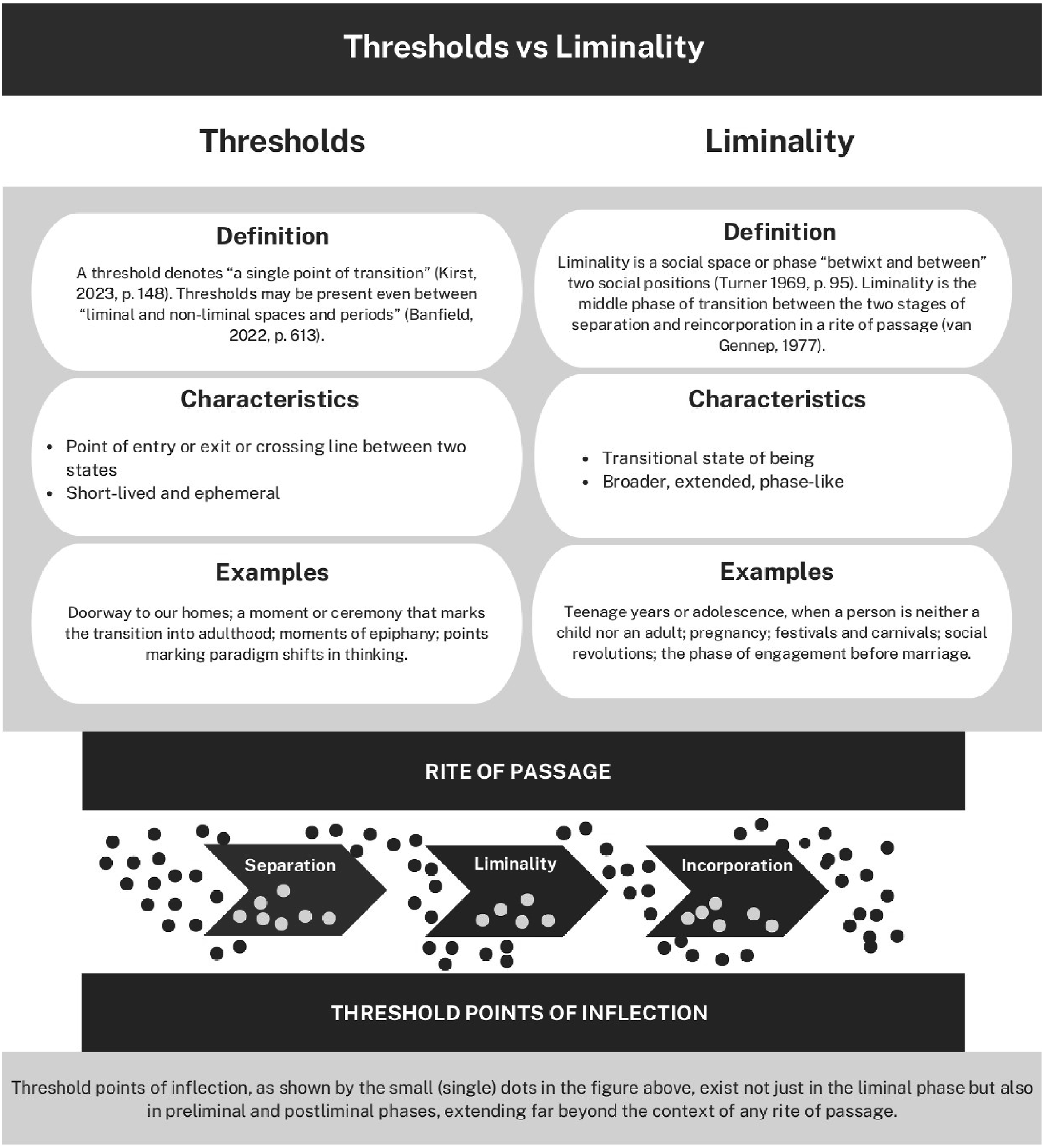
Previous consumer research has focused on various liminal stages, including the transition from childhood to adolescence (Cody and Lawlor, 2011), the change from high school to college (Noble and Walker, 1997), states of sexual identity negotiation (Kapoor et al., 2020), and the role transitions associated with undergoing plastic surgery (Schouten, 1991). Joining these discussions are studies that emphasise and explore enduring or recurrent liminality. For instance, Appau et al. (2020) employ the concept of ‘permanent liminality’ in relation to Pentecostal conversions where converts exist continuously in a state of separation and incorporation, navigating between a dangerous and a safe world. Kerrane et al. (2021) demonstrate that life changes such as new motherhood can create ‘liminal hotspots’. Additionally, in the context of a fluid marketplace, Mimoun and Bardi (2022) conceptualise ‘consumer chronic liminality’, characterised by recurring transitions, ongoing self-transformations, and experiences of precarity. Recent scholarly attention has also been given to preliminal stages in heavy rock music festivals, highlighting the festival-goers’ preliminal stage involving preparation and anticipation (Chaney and Goulding, 2024). And Ghoshal and Belk (2025) find that when young Indian women move from village to local university to a call centre job in the big city of Mumbai, they do not leave liminality for postliminal stasis but rather enter a state of continued uncertainty and change.
In contrast to the liminal phase, the threshold denotes ‘a single point of transition’ or, more precisely, a single point of crossing – this can include a psychological experience, the movement from one location or time to an alternative one, or a shift from one state of mind to another (Kirst, 2023: 148; see Figure 1). Notably, thresholds – whether dramatic (e.g. the entrance to a cathedral) or mundane (e.g. a domestic doorway) – materialise the boundary between different domains of experience, each with its own set of rules, identities, and possibilities. There are different types of thresholds. Physical crossing points, such as the doors to our homes that signify the point where the private and public spaces divide (Kapoor et al., 2026) and the entry gates of festivals and clubs (Chaney and Goulding, 2024; Danatzis et al., 2025), as well as the storefronts of brick-and-mortar retail settings (Joy et al., 2023), represent the most obvious type of thresholds. Digital thresholds can be seen in the act of entering temporary online communities (Kozinets, 2001). Olfactory and gustatory thresholds also exist as singular gateways to understanding but also in vibrant interactions that create and shape these environments in intersensorial alchemy (Howes, 2014). Symbolic thresholds might manifest in states such as the transgressive indulgence of our desires (Belk et al., 2003), points in social relations beyond which trust may not be possible (Frederiksen, 2012), the imagined point where, for instance, immigrants may feel like they transition from being their ‘true selves’ to being labelled as ‘Other’ (Garvey, 2005; Patel, 2022), or as watershed moments that prompt victims in abusive relationships to decide whether to end those relationships (Murray et al., 2015). Other thresholds may include those between matter and mind, waking and dreaming, worldly and ghostly, self and material world, inside and outside, before and after, access and exclusion, connection and separation, inner and outer worlds, behind and ahead, past and future, and body and mind.
Thresholds mark the point of crossing or hold the promise of crossing between all sorts of stages and places, even between ‘liminal and non-liminal spaces and periods’ (Banfield, 2022: 613). While liminality is characterised by transition through a phase, thresholds are marked by the act of crossing a boundary point. Like Janus, the two-faced Roman god of doors, passages and crossings, thresholds look backwards and forwards, indicating futures and pasts (real, imagined, or potential), and underlining the ways in which temporality itself is a less-than-solid construct. However, we argue that threshold points of inflection exist not just in the liminal phase but also in preliminal and postliminal phases, extending far beyond the context of any rite of passage (see Figure 1). Liminality is originally conceived as a temporal concept with stages; by contrast, thresholds are states or places which are more spatial conceptually. Indeed, some thresholds exist without consideration or relation to liminality at all.
Physical doorways in mundane settings like convenience stores or public transit systems function as spatial thresholds without invoking liminal transformations; digital interfaces that require login credentials create technological thresholds between public and private digital spaces, again without a liminal dimension; sensory thresholds exist where one sensory experience gives way to another (as in moving from a noisy street into a quiet building); and cognitive thresholds occur when new information causes a shift in perception or understanding without the ritualistic or transformative aspects associated with liminality. Moreover, the act of crossing a threshold is an ephemeral and fleeting experience that swiftly passes, although it can be artificially extended by considered architectural design. In contrast, the state of transitioning liminality unfolds like a broader, more profound phase-like experience (see Figure 1).
The nature and significance of atmospheres
Atmospheres are distributed across spaces and times, exist independently of the bodies from which they originate, and are formed from the combination of affect-generating entities and spaces through which those affective energies flow (Anderson, 2009; Hill et al., 2014). Affects are non-cognitive and, unlike emotions, exist within and between bodies, involving interactions between them (Buser, 2014). The term ‘affect’ lacks a precise definition and can refer to a multitude of ideas including physiological impulses, embodied practices, relational capacities of ‘becoming’, and neo-Darwinian allusions to physiological facial changes (Thrift, 2007). Both atmospheres and affects share the common floor of ambiguity – so much so that Anderson (2009: 80) uses the term ‘affective atmospheres’ and asserts that to understand atmospheres, we must appreciate the ambiguities and indeterminateness of affects. Vannini (2015: 8–9) uses the terms affects and atmospheres interchangeably at times, defining affects as ‘a push and pull, an intensity of feeling, a sensation, a passion, an atmosphere, an urge, a mood, a drive–all of the above and none of the above in particular’. Atmospheres are, therefore, elusive in that they are beyond determination (Olesen, 2010) and representation (Pink et al., 2015) and are perhaps ontologically vague and unlocalisable (Bille, 2015; Böhme, 1993). Personal attunement, material culture, and sensual mediation processes are important aspects of and responses to atmospheres (Bille, 2015).
In the ‘force field’ of atmospheres in which we exist, our senses, labours, and imaginaries attune to new ways of ‘living in or through things’ (Stewart, 2011: 452). These ‘things’ should be understood in how they radiate and extend from themselves rather than their distinctions from other ‘things’ (Böhme, 2017). Furthermore, Böhme (2017) refers to the thing’s extension as ‘the ecstasy of the thing’ (19). For example, things like lamps, candles, and colours are ‘ecstatic’ insofar as they surpass their tangible limits and embed themselves in the material world by forming an assemblage with other things around them that includes materials, humans, and sensory environmental elements such as air and light (Bille, 2015; Olesen, 2010; Pink and Mackley, 2016). That is, existing between objects and subjects, atmospheres occur from the arrangement and entanglement of bodies and forces (Brown et al., 2019). Besides, they are co-produced through ‘collective, intracorporeal, and trans-subjective’ affective labour and might involve various co-creators (Kolehmainen and Mäkinen, 2021: 449). Additionally, human subjectivity and everyday life intrusions shape, amplify, and occasionally unsettle atmospheres (Tadajewski, 2025).
Atmospheres have agentic capacity, which is ‘differentially distributed across a wider range of ontological types’ (Bennett, 2010: 9). For example, Bissell (2010: 81) highlights how the affective atmospheres of hospitals can amplify the experience of physical pain while not overlooking the ‘affective power of the condition of uncertainty itself’, in turn, generating anxiety-induced constraints. In a similar way to how sounds can elicit distinct subjectivities, socially organise us, and induce varying responses over time (Patterson and Larsen, 2019), the atmospheres and affective dimensions of the inflection points of thresholds also possess their own agentic force.
Below, we provide an overview of key research on atmospheres, followed by our conceptualisation of threshold atmospheres and their affective qualities.
Research on atmospheres
As Böhme (2017) suggests, both the emotional and the spatial constitute the tuned space of an atmosphere. Building on Böhme’s (1993) earlier argument that atmospheres are not ‘free-floating’ but are instead related to persons and things, researchers have begun to look at atmospheres with material rooting and textures (e.g. Bille et al., 2015; Kuruoğlu and Woodward, 2021; Olesen, 2010). That is, atmospheres have important physical features, but they also have historic, temporal, and associative features such as being the site or occasion of ghosts, battles, celebrations, and celebrities. Spaces that have garnered significant attention from scholars of atmospheres include clubs (Danatzis et al., 2025), stores and retail settings (Eroglu et al., 2003; Joy et al., 2023; Spence et al., 2014), public spaces such as stadiums (Bradford and Sherry, 2015; Edensor, 2015a; Hill et al., 2022; Steadman et al., 2021), domestic spaces such as homes (Olesen, 2010; Pennartz, 1986; Pink and Mackley, 2016), dark tourist sites (Goulding and Pressey, 2023), and neighbourhoods (Bille, 2015). Studies on retail atmospheres have investigated how embodied interactions with socio-material elements at stores generate affective atmospheres (Joy et al., 2023) and how optimal levels of consumer stimulation that lead to more positive consumer behaviour are only achieved when store atmospheres are considered (Spence et al., 2014).
The impact of store atmospherics on consumer behaviour has been explored not only in physical stores but also in online stores (e.g. Eroglu et al., 2003). Changes to atmosphere are found to benefit service providers, consumers, and customers in several ways. Some of these include enhancing perceptions of service encounters (Bitner, 1990), affecting consumers’ purchase behaviour (Madzharov et al., 2015) including their tipping behaviour (Lee et al., 2018), and fostering harmony between customers’ bodies and the environment (Grant, 2020; Yakhlef, 2015). Nevertheless, aesthetic manipulation may also be a component of the production of consumption contexts with the intention of enhancing shoppers’ desires to consume or gamblers’ desire to gamble while concealing aspects of commercialisation or exploitation (Biehl-Missal and Saren, 2012).
The atmosphere within stadia is shaped by the experiences of the people both inside and outside the venue, and these experiences can extend from years prior to the start of the game to a period following the final whistle (Steadman et al., 2021). Experiences of atmospheres in such group contexts are frequently generated via interactive ritual chains or processes that synchronise the behaviours and emotions of group participants, culminating in what may be termed ‘social atmospheres’ (Bradford and Sherry, 2015; Hill et al., 2022). A recent ethnographic study of music clubs by Danatzis et al. (2025) revealed different mechanisms through which firms manage customer diversity to create desirable social atmospheres. However, here too the aspect of commercialisation may exist much like that mentioned above in the context of more straightforwardly business settings (Edensor, 2015b). In such situations, atmospheres may also be incapacitating, disabling, and disorienting: ‘they can disturb and disorient bodies and dramatically limit or close down possibilities for action and social connection’ (Krueger, 2021: 117).
Scholars have also focused on atmospheres in domestic spaces when exploring the concept of intimacy and the ‘all-encompassing heat’ found in Japanese household atmospheres, demonstrating that the sense of homeyness that influences people’s actions is not confined to individual bodies, specific objects, or physical structures (Daniels, 2015: 54). Furthermore, the functions of light (Bille, 2015), radio (Tacchi, 1998), and ethnic objects (Olesen, 2010) in producing atmospheres in domestic settings have been studied. However, Pennartz (1999) asserts that sociopsychological elements are more decisive than spatial elements in determining residents’ experiences of atmosphere within their homes. Whatever the case may be, it is certain that both spatial and sociopsychological factors shape atmospheres to an extent that is contingent upon factors such as the intensity of one’s memory, somatic experience, the effectiveness of the spatial design, and more.
Notably, atmospheres play an essential role in everyday microsociology (De la Fuente and Walsh, 2020). The atmosphere of a particular neighbourhood (influenced, for example, through its lighting) can instil a feeling of interconnectedness and communal belonging amongst inhabitants, even in the absence of personal familiarity between them (Bille, 2015). In ethnically diverse public settings, certain spatio-material arrangements can facilitate cosmopolitan openness (Kuruoğlu and Woodward, 2021). But the significance of atmospheres manifests even in solitary practices involving ‘the non-relational, lived acts of media tourism that hinge [fictional] stories to unrelated places’ (Lovell, 2023: 2), or night-time practices involving lighting and locking at home (Pink and Mackley, 2016). But what these diverse studies suggest is that atmospheres are a recurring, evolving and ubiquitous feature of everyday spaces that continuously shape social experiences and collective sensibilities across multiple scales of human interaction.
As noted above, atmospheres (including spatio-material arrangements, in various settings) and their implications for marketing and consumer behaviour have garnered significant scholarly attention. However, although understanding atmospheres in diverse threshold contexts is instructive, these intersecting concepts have not been subject to sustained analysis. We will now discuss certain qualities of threshold atmospheres before highlighting some contexts and frameworks for exploring them.
Thresholds and their affective atmospheres
Broadly, we conceptualise threshold atmospheres as affective atmospheres generated at or by inflection points – those critical sites and/or moments of significant change or transformation, whether they be material, architectural, analytical, spiritual, or imaginative. As transitional and intermediate points of entrances and exits, the threshold is imbued with its own affective atmospheres and energies. For the philosophically inclined, the constructed or artificial nature of many of our threshold concepts is regularly revealed, be it in the gender fluidity of posthumanism, the contemporary understanding of spectrum conditions of neurodiversity rather than rigid diagnoses of difference, or the complex evolution of categories of experience and personal space throughout the pandemic and in its aftermath. With the collapse of taken-for-granted distinctions and categories of thought, other new thresholds may emerge. Furthermore, contemporary consumers experience multitudinous thresholds simultaneously as these consumers’ very existence is underpinned by instability and mobility. For example, in a world marked by flexible or precarious lives (see Mimoun and Bardi, 2022; Sharifonnasabi et al., 2024), globally mobile consumers may cross multiple thresholds as they inhabit temporary lodgings or live between numerous dwellings or ‘homes’. What this suggests is that thresholds may be arbitrary or, at other times, carefully produced to manage emerging contexts or novel insights, as new thresholds materialise, and their implicit challenges and opportunities are managed by contemporary consumers and marketers.
As a cultural construct, the threshold demonstrates a dynamic organisation of space and time as the atmospheres of the inside and the outside are not qualitatively equivalent, resulting in a variation in the density of their atmospheres and the horizons they evoke (Masi, 2024). In that sense, the very act of crossing, or of closing a door, is significant. It spotlights boundaries and the atmospheric and structural distinctions between zones, demarcating spheres and shaping the angle with which we enter and exit realities. Drawing our attention to this angled aspect of atmospheres, Ahmed (2010: 37) notes: ‘…we may walk into the room and “feel the atmosphere,” but what we may feel depends on the angle of our arrival. Or we might say that the atmosphere is already angled; it is always felt from a specific point’. In that way, the affective atmospheres of threshold points delimit and shape our transitions in profound ways, and they are, as such, worthy of careful consideration.
Below, we discuss four affective qualities of threshold atmospheres: modulation, suspension, hauntology, and transformation.
Modulation
Thresholds, in their various forms, serve as the foundation of our experiences, shaping and moderating our thoughts and feelings (Mukherji, 2013). They act as ‘fine lines’ or ‘islands of meaning’ that enable those undertaking crossings to navigate and differentiate between various categories and experiences, making them more manageable (Zerubavel, 1991). In particular, the atmospheres of thresholds modulate affect by shaping our emotional states, priming us for upcoming experiences, mediating between various realms, regulating affect, and facilitating navigation between categories of experience. Threshold atmospheres serve to down- or up-modulate affects in various ways, from hammering on the front door of a domestic entrance to release frustration to hiding behind a door to seek cover, to crossing imaginary thresholds in life, for example from rags to riches or from loneliness to love.
Similar to how an emotional qualification disrupts narrative flow to capture a specific state (Massumi, 1995), threshold atmospheres modulate the affective intensity of experiences occurring between internal and external environments. In this way, the atmospheres of transitional points, such as entrances or lobbies, act as affective primers that shape people’s feelings when transitioning between areas and set the tone for their overall experience within an ancillary space. In liminality, modulation occurs gradually across an extended phase, while threshold modulation is concentrated and intensified at the precise point of an opportunity for crossing. Studies on urban environments indicate that barriers like fences play a role in modulating behaviour insofar as they are ‘purposeful stillings of movement which work toward the production of particular (calmer) atmospheres and the stilling of (unwanted) bodies’ (Buser, 2017:138). The cult US TV series, The Wire, makes a central distinction between ‘stoop kids’ and ‘corner kids’ in its setting of a Baltimore ghetto where the former remain safe on their domestic thresholds while the latter become street children more easily lured into dangerous public and criminal spaces. The atmosphere at thresholds can also impact social interactions. Brisbin (2014: 93), for example, observes that the threshold of a veranda or porch serves as ‘a device for social interaction, both within the private confines of the house and in mediating interactions with the public life of the street’. In that sense, atmospheres at entranceways modulate and effectively frame the relationships between different realms.
Whether entering or exiting a (pre, post, actual, or non-) liminal space, the threshold atmosphere modulates and primes the in-transit person for their next phase. For example, a warmly lit doorway can evoke a sense of comfort and invitation, while a sterile exit might create feelings of urgency or numb detachment. A majestic entrance adorned with symbolic décor may elicit reverence or awe, enhancing the feeling of solemnity during entry or exit. Modulation of affect occurs not only in physical threshold spaces but also in digital realms. For example, research on digital thresholds (entry points) of hotel websites indicates that e-atmospheric cues, such as visual design, can modulate feelings, which in turn affects booking intentions (Essawy, 2019). By classifying and distinguishing between different environments and perceptions – drawing clear lines and recognising and curating thresholds – we can organise places, experiences, and states of being.
Suspension
When examining the affective aspect of suspension in threshold atmospheres, we imply a temporary pause – an interruption in the flow of emotions and experiences and the setting aside of pre-existing emotional states. In periods of crossing and transitioning, there may be a feeling of suspension, of being neither here nor there but in a state of abeyance. Even still, such a feeling can be managed or manipulated; for example, on a web page, that feeling of suspension can be ameliorated by the use of a background of a certain blue, which make viewers feel more relaxed so that time will pass more quickly (Gorn et al., 2004). However, liminal suspension is more likely to create a prolonged state of being ‘betwixt and between’, whereas threshold suspension creates a momentary pause that heightens awareness of the boundary being crossed or the moment of crossing. Such feelings can be productively extended or compressed by those designing or curating threshold atmospheres. In fiction, such sites of suspension can create emotional suspense as characters anticipate or experience tense uncertainty.
Certainly, creative writing within numerous genres is often a rich resource for mining the suspenseful atmospheres of threshold points. For example, Stewart (2011) explains how in a novel called The Gardens of Last Days, the bouncers that straddle the entranceway to a strip club watch for ‘pockets’ to unfurl, thereby unleasing ‘a pause, a temporal suspension animated by the sense that something is coming into existence’ (446). In such an instance, threshold atmospheres are affecting, forcefields of ephemeral suspension and edgy anticipations. Such ephemeral atmospheres shape social and lived experience in numerous ways and their effects are not confined to fictional characters. By contrast, in Cruel Optimism, an extended sociological interrogation of affective atmospheres embedded and dominant in contemporary North America, Berlant (2011: 5) describes a pervasive feeling of precarious liminality as a ‘state of animated and animating suspension that forces itself on consciousness, that produces a sense of the emergence of something in the present that may become an event’. In such an extended liminal context, society itself seems suspended but, frequently, the individual cannot breach the suspension as there is no visible threshold or accessible exit or means to escape that stimmung.
Threshold atmospheres can sometimes create a suspension of affect and feelings by fostering an environment where people are compelled or convinced to temporarily set aside their pre-existing emotional states or their personal identity projects while transitioning between roles or spaces. Entry points in places like government buildings, hospitals, banks, or places of worship often have an air of formality or solemnity. This atmosphere can lead individuals to set aside their emotions – such as frustration or light-heartedness – that they were experiencing before entering, allowing them to adapt in that moment of suspension to the new environment and to behave in expected and socially acceptable ways. Related to this are areas with visible security checks, cameras, or controlled access points which necessitate caution and attention. In such moments, visitors must foreground their official identities and permission documents, while sublimating and suspending aspects such as gender and sexual preferences, their personal histories, or future plans. Ultimately, the atmospheres at these entry and departure points prompt people to suspend or defer actions to allow for more seamless transitions, either by creating a serious ambiance, promoting neutrality, or indicating that specific feelings may be inappropriate in that context.
The atmospheric qualities of thresholds direct our movement and attention, as well as provide an intermission where we spend suspended time in suspended space (Stevens, 2004). In that sense, thresholds are particularly conducive to somatic intensities or forces. Cvetkovich (2012) argues that such felt experiences and affective atmospheres can contribute directly to personal change and social transformations. Neither intrinsically positive nor negative, the concept of the threshold distinguishes it from other types of structures, be they material or immaterial; it is literally a point of in-betweenness, providing vistas or the felt experience of numerous elsewheres. While liminal spaces can also suspend, thresholds create an increased tension between determinacy and indeterminacy of atmospheres (and affects). This affective intensity is emphasised by Preece et al. (2022: 360), who express qualms about whether ‘our arrival into a given atmosphere is immediate and automatic, [whether] we open a door and are instantly through the threshold’; this poses a question about the significance of the interval of suspension. This suspension can also be disconcerting, resulting from marketplace interactions that disrupt or distress customers without their approval or awareness (Cronin and James, 2024).
Processes of modulation and suspension are integral to threshold atmospheres, and these forces make them amenable and prone to ontological alchemy. As such, a threshold atmosphere can generate an uncanny space – one that is open to hauntological forces, revealing other temporal, spatial and ontological vistas. We now turn to the hauntological aspect of threshold atmospheres.
Hauntology
Hauntology, which supersedes its ‘near-homonym ontology’, shifts the focus on another from a ‘being and presence’ to a phantom, which is ‘neither present nor absent, neither dead nor alive’ (Davis, 2005: 373). This alternate form of knowing is all the more pronounced in threshold spaces that unsettle the certainty and boundaries of distinct realms. Threshold atmospheres tend to straddle margins or borderlands – of thought, of states of mind, of feeling, of place. As breaks or opening points in boundaries, threshold atmospheres can be imbued by a spectral quality, providing glimpses into, or a heightened sense of, other spheres and alternative forms of knowing and being. Such affective atmospheres have an impact beyond their borders, exerting unseen forces and pressures imbued with a feeling of what might have been and what might yet be (Ní Bheacháín, 2012).
In her classic study of social haunting, Gordon (2008: 63) identifies ghosts as ‘primarily a symptom of what is missing’, so that their presence compels others to confront absences; we argue that threshold atmospheres possess such ghostly aspects, alerting us to other realms and realities. When referring to hauntological presences in threshold atmospheres, we are referring to not only the shadowy reminiscences and echoes of the past that are still present among us as ‘intimations, hints, suggestions, and portents’ (Gordon, 2008: x) and our past imprints and encounters, which, for example, leave a mark upon the skin surface (Ahmed, 2004) but also the idea of the future (or lost futures) as haunting presences that impinge on our present (Fisher, 2012).
But in crossing a threshold, there is also the potential to experience disorientation and disturbance as boundaries shapeshift, disintegrate or blend into other spaces, unsettling a sense of reified reality or temporal coherence. The very ephemerality of threshold crossings makes them particularly susceptible to hauntological dimensions in two distinct ways. First, during the actual moment of crossing, thresholds can invoke hauntological resonances as multiple temporalities and realities temporarily converge. In this suspended instant, past, present, and potential futures may become simultaneously perceptible, creating a unique affective experience where absences become present. Second, because the crossing itself is fleeting, it creates a concentrated affective impression that can resonate beyond the moment. While liminal spaces unfold as extended processes with their own temporal rhythms, threshold atmospheres compress experience into intense momentary imprints that can haunt one’s subsequent experience – whether through sensory memories, emotional residue, or cognitive shifts that occurred at the specific point of crossing.
In his unfinished The Arcades Project, Benjamin (1999: 409) describes the covered corridors of the Parisian arcades (essentially proto-shopping malls) as fundamentally ‘a ghost walk, on which doors give way and walls yield’. Within these spaces with manifold (and perhaps) unnoticed points and portals, waxy mannequins and marketplace ephemera indicate the tensions of facades that simultaneously distinguish and destabilise the gap between interior and exterior, reality and illusion, and ‘the hideous, cunning mediation between costume and viscera’ (Benjamin, 1999: 409). These seamless mise en abîme configurations or layered interfaces prefigure the kaleidoscopic perspective in contemporary media and film culture that leverages split-screens to create multiple dimensions to provide illusory and complicating multimedia impressions (Hagener, 2006). Such a forcefield creates an affective atmosphere that is uncanny in its very instability, familiarity, and mutability. A contemporary shopping mall or busy urban streetscape can create similar atmospheres. In that sense, threshold atmospheres pulsate with promise (or menace) because they allow glimpses of what is fleeting, episodic and evanescent.
In his discussion of how atmospheres function as a medium – including yet surpassing the physical bodies involved – Riedel (2019) suggests that atmospheres can ‘render potential futures or repressed memories’ and make ‘otherwise absent or ulterior persons or relationships perceptible’ (p. 85; see also May and Lewis, 2022). Anderson (2009) also asserts that atmospheres have a continuous and dynamic nature, characterised by their formation, deformation, emergence, and disappearance. Hirschman et al. (2012) suggest that garages are often a form of alternative threshold, providing a secondary access point to the domestic space, and existing as liminal spaces that are haunted by the sounds and images of former family events and activities, as well as the time spent in them and the objects and memorabilia stored there: ‘… garages are inhabited by ghosts of the family’s past’ (375). Similarly, spaces of digital archives are haunted by the affectivity and vitality of that which remains repressed and foreclosed (Blackman, 2019). These memory echoes reverberate, creating atmospheric and temporal disjunctions in the present. In this way, physical and virtual spaces are always haunted by affective atmospheres – both in uncanny or unsettling ways, and in forms that (dis)comfort and make familiar, and this haunting is intensified in the atmospheres of threshold spaces. Ghostly presences appear in ephemeral guises, through scent, sound, somatic memories, and through what Benjamin terms the ‘aura’ that emanates from objects and bodies (Benjamin, 2008). They are part of an animism in which our surroundings are alive for us and act as living forces in our lives, similar to kami spirits in Shinto. The presence of familiar yet unfamiliar elements ties a ‘knot’ of uncanniness (Beyes, 2019: p. 183) in threshold atmospheres.
The hauntological dimension of threshold atmospheres is intensified by their temporal complexity. Unlike ordinary atmospheric spaces, thresholds compress past, present and future into concentrated points of crossing, highlighting the determinacy-indeterminacy dilemma of threshold spaces. May and Lewis (2022: 94) note that atmospheres constantly evolve, and they also highlight how ‘the decades’ worth of memories of the space’ contribute to our perception of a place’s atmosphere. At thresholds specifically, these memory echoes reverberate, creating atmospheric and temporal disjunctions in the present. In this sense, spaces can be infused or shaped by their hauntology (Derrida, 1994) and we argue that threshold spaces are distinctly impacted by such hauntological influences, serving as privileged sites where the spectral qualities of atmospheres become most palpable and affecting. The doorway of an ancestral home, the entrance to a historical site, or even the login screen of a once-familiar digital platform each becomes a concentrated inflection point where temporalities collapse and the affective atmosphere of these thresholds are saturated with hauntological potential. Much mysticism remains.
Transformation
Crossing a threshold is synonymous with transformation: for example, a wedding is a threshold life event involving rituals to symbolise metamorphosis. Bourdieu (1977: 130) views a threshold as ‘a sort of sacred boundary between two spaces, where the antagonistic principles confront one another and the world is reversed’. Liminal transformation unfolds through an extended process of becoming, while threshold transformation occurs in the brief passage between states: so that an engagement might be the liminal state of preparation or anticipation of matrimony, while the wedding ceremony is the brief ritualistic threshold between these two distinct states of being married and unmarried.
The notion of thresholds in the form of ‘threshold concepts’ (e.g. argument, theorising, framework, knowledge creation, analysis and interpretation, and research paradigm) has also been recognised in higher education research, where a threshold concept is defined as ‘one that, once grasped, leads to a qualitatively different view of the subject matter and/or learning experience and of oneself as a learner’ (Kiley and Wisker, 2009: 432). As such, threshold concepts, which are preceded by an unsettling and counter-intuitive liminal state, are distinct from core concepts in that they introduce the researcher to a new expanse of transformed understanding rather than simply adding layers to existing knowledge foundations (Barradell, 2013; Cousin, 2006). By using the term ‘threshold’ in this context, pedagogical theorists are illuminating both the power of this foundational educational content and the descriptive power of the threshold as a metaphor for transformative potential. A paradigm shift would be a stronger characterisation, but we focus here on more preliminary transformations.
The generative and transformative capacity of thresholds is also a subject of analysis in cultural criticism. In The Weird and the Eerie, a treatise that repeatedly returns to portals and crevices, and their narratological functions, Mark Fisher (2017) critiques H.G. Wells’ (1911) story ‘The Door in the Wall’ and Joan Linday’s (1967) novel, Picnic at Hanging Rock as a way of investigating the threshold structures and ambivalences of creative and political imaginings. In literature, art, religion, and science, thresholds frequently connect with moments of transformation and transgression. For example, climate scientists articulate their warnings regarding catastrophic global warming in terms of threshold points being breached, signalling temporal and environmental limits looming ominously. Religious and humanist ceremonies structure and manage threshold moments in life scripts. In literary genres such as Fantasy and Speculative (Science) Fiction, portals serve as transitional points between worlds and alternative states of being as with Ursula K. Le Guin’s The Beginning Place (later republished as Threshold). Across societies, religions, and cultural forms, the concept of the threshold has agentic power and is itself imbued with transformative potential. Crossing the physical thresholds of religious sites such as temples, mosques, and churches, not to mention dimensional and temporal portals, may encourage individuals to relinquish unpleasant thoughts and feelings and embrace a more compassionate emotional state. This crossover may involve transformation via rituals.
Walter Benjamin connects thresholds with ‘rites of passage’, with the folkloric resonance of elemental ceremonies marking birth, puberty, marriage and death; Benjamin notes that contemporary society has ‘become very poor in threshold experiences’, and that what remains are more elusive threshold moments such as falling asleep, the ‘ebb and flow of conversation and the sexual permutations of love – experience that surges over thresholds like the changing figures of the dream’ (Benjamin, 1999: 894). For Benjamin, these thresholds have more to do with conceptual, emotional and psychological categories than with either life transitions or actual physical space (Masi, 2024). But it could be argued that architectural thresholds have long been repurposed as the site of profound human transformation such as the tradition for a bride to be carried over the threshold of her new home.
Discussion
Marketing theory has widely adopted the concept of liminality (Appau et al., 2020; Cody and Lawlor, 2011; Kapoor et al., 2020; Mimoun and Bardi, 2022; Noble and Walker, 1997), but less attention has been given to the inflection points of thresholds within and beyond liminal and non-liminal spaces. The promising concept of the threshold is not just physical and sensory but also perceived and metaphorical, and it can be applied to different areas of life, such as personal growth, social interactions, or even cultural transitions. We contend that threshold points of inflection are present not just in the liminal phase but also in preliminal and postliminal phases, extending much beyond the scope of any rite of passage (see Figure 1). Thresholds can generate or reveal new crossing points; indeed, the very concept of the threshold is embedded in numerous disciplines including pedagogy, architecture, political science, cultural studies, and gender studies. We conceptualise threshold atmospheres as affective atmospheres generated at and by inflection points, characterised by modulation, suspension, hauntology, and transformation.
Threshold atmospheres modulate by shaping emotional states, priming individuals for upcoming experiences, mediating between various realms, regulating affects, and facilitating navigation between categories of experience. Threshold atmospheres suspend insofar as they interrupt the flow of emotions and experiences, defer pre-existing states, and serve as an invitation to participate or cross through. Certainty is unsettled and boundaries between distinct realms dissolved, possessing a hauntological quality and offering glimpses into, or a heightened awareness of, other spheres and alternative ways of knowing and being. Ultimately, threshold atmospheres have the potential to transform understanding of the social self, possibly leading to the development of a new identity.
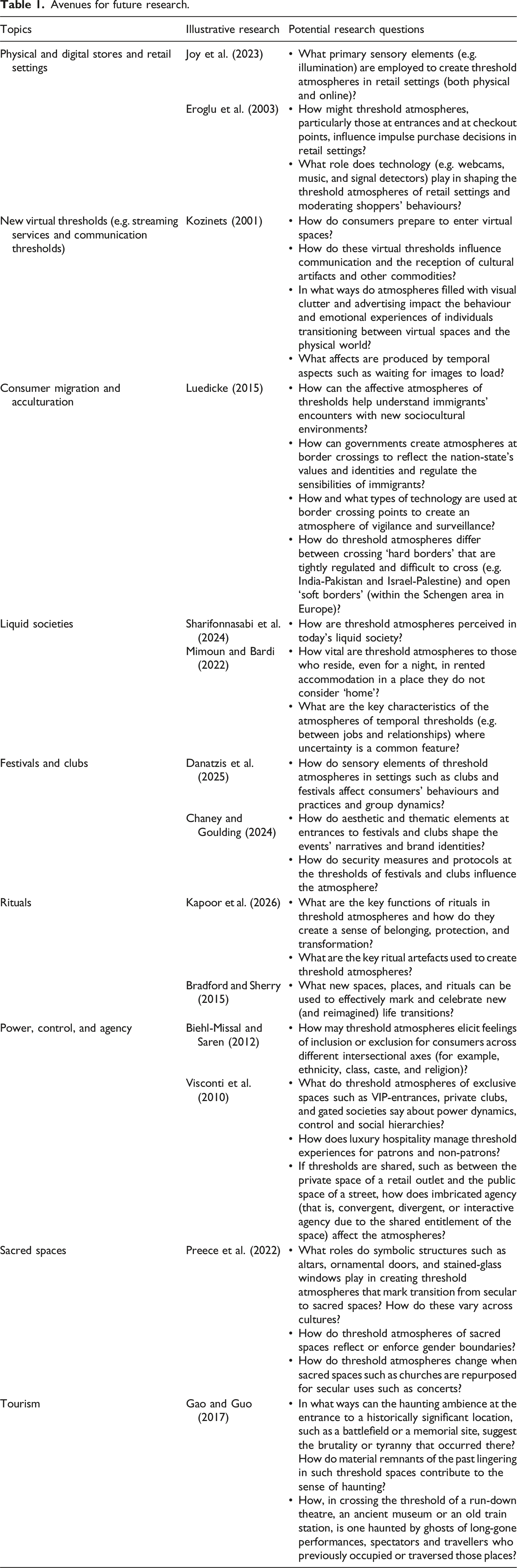
While one might argue that modulation, suspension, and transformation are broadly present throughout liminality, they manifest in profoundly different ways in the context of thresholds. In the latter, the very essence of the threshold is held within the break of a boundary line, wherein lies the possibility (and promise) of transition, transit or transformation. Qualities such as modulation and suspension are intensified as affective load and portent increases. It is this ephemerality and affective intensity which shapes threshold atmospheres and makes them susceptible to haunting presences. To our knowledge, hauntology has not been studied in the context of liminality, and it productively complicates and deepens conceptual understandings of threshold atmospheres, highlighting their multimodal dimensions. Furthermore, it is this multifaceted intensity which contributes to the specific transformative potential of threshold atmospheres. Significant too is how threshold atmospheres can leak into ancillary spaces, impacting, beckoning or repulsing through their affective load; as such their influence can extend beyond the crossing point and into surrounding spaces. Therefore, the conceptualisation we offer provides a fresh perspective for analysing different marketing and consumption phenomena. Below, we outline some future research avenues of our framework before discussing its practical implications.
Avenues for future research
Avenues for future research.
Practical implications
Our conceptualisation of threshold atmospheres has significant practical implications across various fields, including retail and consumer behaviour, architecture and urban planning, event and experience design, digital interface design, healthcare environments, workplace design, tourism and hospitality, and security and border control to name but a few. Insights into threshold atmospheres will enable retailers to create and curate more effective store entrances and improve transitions between different areas of a store. Such affective atmospheres, in turn, can influence customer emotions, behaviours, and experiences, potentially impacting purchasing decisions and enhancing the overall shopping experience. Similarly, architects and urban planners could apply the affective qualities of threshold atmospheres to design more meaningful transitions between public and private spaces or between various functional areas in buildings and cities. Event planners and experience designers, likewise, might use these concepts to craft impactful entrances and exits for events, festivals, or themed attractions, thereby heightening anticipation and setting the mood and behavioural norms for participants.
In digital contexts, understanding threshold atmospheres can inform the design of more effective user interfaces, particularly for transitions between different sections of websites or apps, ultimately improving user engagement and navigation. Hospitals and healthcare facilities can utilise the concept and features of threshold atmospheres to create calming and reassuring transitions for patients as they enter treatment areas or move between departments. Office designers can apply insights from threshold atmospheres to enhance transitions between different work areas or signal shifts between work modes, such as collaborative versus focused workspaces. Similarly, hotels, resorts, and tourist attractions can create more impactful arrival and departure experiences by focussing on threshold atmospheres. Insights into threshold atmospheres could also be used to design effective and humane security checkpoints or border crossings. These practical applications illustrate how a deeper understanding of threshold atmospheres can influence design, behaviour, and experiences across various domains of human activity.
Concluding thoughts
To conclude, the inherent brevity or ephemerality of thresholds (contrasted with the potential persistence of liminality) makes their atmospheric qualities particularly potent. Because they cannot be dwelled in, thresholds create concentrated nodes of affective potential in the moment of crossing that shape both the spaces they connect and the experiences of those who traverse them. Furthermore, the very presence of a threshold impacts everything in its broader orbit, generating areas of interest and influence beyond its perimeter. This makes it a zone of critical importance in both theoretical and practical terms. In addition, in our consideration of threshold atmospheres, what becomes clear is that threshold crossings provide leakage points between zones when it comes to affective atmospheres.
Thresholds are significant domains and to overlook their agentic capacity is to miss important opportunities to shape them and to commune with those that pass through them. Designers, architects, gardeners, and visual merchandisers work to cultivate specific atmospheres and to seal spaces from contaminating or unwanted emanations from human and non-human bodies. Even still, atmospheres resonate and circulate in ways that are not entirely manageable or containable. Thresholds are essential to the flow of energy, but they also generate and possess their own affective qualities which can disseminate and diffuse energy, shaping the spaces which adjoin them in geographical or temporal terms and influencing the trajectory and feelings of those that traverse them as they enter or exit other spaces.
Footnotes

Funding
The authors received no financial support for the research, authorship, and/or publication of this article.
Declaration of conflicting interests
The authors declared no potential conflicts of interest with respect to the research, authorship, and/or publication of this article.