




Abstract
In an effort to combine tourism with pro-social giving and personal development, more and more people choose to go abroad on volunteer tourism trips. We explore the potential transformational influence such trips have on travelers, aiming to map the transformation process stages and examine their boundary conditions. In doing so, we follow a mixed methods approach using a qualitative study comprising ethnographically informed in-depth interviews and a quantitative one, by means of a structured questionnaire. Findings indicate that the transformation process volunteer tourists undergo involves three stages related to liminality. We conceptualize the degree of liminality as immersiveness and show how the transformation process is significantly influenced by the degree of authenticity and the immersiveness of volunteer tourists’ experiences, as well as their own perceptions on how societally meaningful their actions were during their trips. Based on our conclusions, we present important implications for academics, managers, and tour operators.
Introduction
Over the last few decades, there has been a proliferation of academic interest and public debate on forms of “alternative” tourism, such as ecotourism, responsible tourism, and sustainable tourism (Smith and Font 2014). Among these, volunteer tourism, the fastest growing form of alternative tourism (Germann Molz 2016), has been praised as a positive combination of service to host communities, simultaneously offering cultural, educational, and/ or scientific benefits to participants (Sin 2009; McGehee 2014). In an effort to attract customers, many of the organizations who send volunteer tourists worldwide promise an opportunity for individuals to step out of their comfort zones, discover themselves, learn, and grow as individuals. Such claims of a transformational experience reflect the motives of volunteer tourists themselves, whose personal well-being motives rank as highly as intrinsic motives to make a difference; however, these transformational experiences are only partially supported in the current literature. Recent studies have challenged the impact of volunteer tourism trips on travelers and have expressed the view that the potential changes on volunteer tourists could be rather superficial (McGloin and Georgeou 2016; Couch and Georgeou 2017).
In parallel, a separate but relevant stream of research has attempted to clarify how individuals create and maintain their identities through symbolic consumption practices (Dimanche and Samdahl 1994; Ekinci, Sirakaya-Turk, and Preciado 2013). Research on consumer identity explores how consumers deploy resources to build a personal or collective narrative of their identities (Arnould and Thompson 2005), by continually changing their status and transforming themselves (Ulver and Ostberg 2014). However, consumer researchers “tend to emphasize identity work itself, leaving unquestioned the processes and the nature of transformations that consumers experience in the construction of such narratives” (Castilhos and Fonseca 2016, p. 6). This gap is even more prominent in tourism research, where previous literature has suggested that transformation may take place, but is less focused on the elements or the process of transformation (Brown 2009; Coghlan and Weiler 2018). Specifically, with respect to volunteer tourism, calls have been made for further research on “the inconsistency in the transformative process, for example the antecedents and factors associated with the volunteer tourism provider or the experience itself in fostering or inhibiting personal transformation” (Coghlan and Weiler 2018, p. 580).
To address this gap in the literature, we explore volunteer tourists’ transformation processes using the theoretical lens of liminality and conceptualizing their trips as a “rite of passage” (Gennep 1960). In so doing, we seek to gain a deeper understanding of how transformation is experienced by volunteer tourists and why it actually materializes. Understanding the process rather than simply documenting its presence is a necessary step to facilitate the design of volunteer tourism experiences that foster meaningful transformation. Uncovering the characteristics of transformation and examining enablers and barriers that lead to perceived transformation is useful for other individuals too, who might be interested to change via alternative initiatives such as traveling alone or volunteering locally. More importantly, we seek to understand why transformation occurs for some, but not all, volunteer tourists (Zavitz and Butz 2011) and examine the conditions under which said transformations take place. We also acknowledge the mostly normative arguments (e.g., Coghlan and Gooch 2011) and secondary data (e.g., Germann Molz 2016) of previous research. We make a theoretical contribution by attempting to answer calls for more research focus on how tourist experiences impact individuals’ well-being and quality of life “beyond the actual consumption experience” (Knobloch, Robertson, and Aitken 2017, p. 659). We also answer calls for mixed method approaches to examine volunteer tourism (Wearing and McGehee 2013) and employ a combination of qualitative and quantitative studies. We problematize the concurrence or divergence of experiences and practices of various volunteer tourists in order to (a) document and explore volunteer tourists’ perceived transformation and analyze the underlying process and (b) develop and empirically test a holistic conceptual framework that integrates the conditions under which significant transformations happen.
We begin by presenting the theoretical underpinnings of our qualitative study, followed by outlining our methodology and the main results. Subsequently, we present the literature that led us to develop the conceptual framework of our second study, as well as its methodology, analysis, and results. Finally, in the last section we analyze the conclusions of both studies and discuss their theoretical and practical implications.
Literature Review
Volunteer Tourism
Volunteer tourism became a prominent subject in tourism literature during the last 20 years, when academic interest on alternative forms of tourism proliferated (Wearing and McGehee 2013). Volunteer tourists are “holiday-makers who volunteer to fund and work on social or conservation projects around the world” (Wearing 2004, p. 217). Their motives for engaging in volunteer tourism trips include desire to contribute to societal causes, interact with other people and cultures, learn and self-develop, improve their skills and career prospects, and get a sense of personal fulfilment (Weaver 2015). Volunteer tourism has been praised as a phenomenon that contributes positively to individuals’ personal development and cultural awareness, as well as to host communities’ well-being (McGehee 2014). Nevertheless, volunteer tourism has also been heavily criticized for being American or European and white centric (Henry 2018), as well as a form of neo-colonialism that does not really offer value to the host communities and has only a superficial impact on travelers (Conran 2011). Moreover, it has been argued that volunteer tourism enables people’s view of poverty and economic inequality as an aesthetic experience (Mostafanezhad 2013) to be commodified, undermining efforts for a wider political and societal change or even leading to oppression and emancipation (McGehee 2012).
Volunteer tourism is a complex tourism phenomenon, full of contradictions (McGehee 2012). On one hand, volunteer tourists have strong altruistic motives (Mustonen 2008) but on the other hand, an important motivation to embark on these trips is CV building and enhancing career prospect (McGloin and Georgeou 2016). They are interested in experiencing authentic trips (Kontogeorgopoulos 2017) but at the same time they participate in mass commodification of tourism (Wearing 2001). They are also in a constant tension between desire to escape everyday life and desire for some level of order and routine (Kontogeorgopoulos 2017). They can be seen at the same time as volunteers, pilgrims (Mustonen 2008), existential tourists (E. Cohen 1979) or recreational ones, travelers, or workers. Further, volunteer tourism organizations can either act as facilitators of positive social change and sustainable tourism or as catalysts of neo-colonialism and dependency of local communities on the volunteer-sending nations (McGehee 2012). Adopting a postmodern view allows volunteer tourists to combine different experiences and motivations in the same trip and reject old definitions and worldviews. They are postmodern travelers who, as Maoz and Bekerman (2010) aptly put it, “try and taste a wide range of experiences, who can switch from one mode of travel to another, and . . . cannot be termed in a rigid, objective term any more” (437).
Transformation in Volunteer Tourism
Although interest in volunteer tourism has proliferated, one relatively understudied area concerns the impact of volunteer tourism on the individual and there is evidently “much room for additional exploration” (Wearing and McGehee 2013, p. 126). Previous literature has shown that a volunteer tourism trip can have positive effects on the individual, such as post-trip interest in social movements (McGehee and Santos 2005), enhanced leadership skills and cross-cultural understanding (Palacios 2010), increased trust and decreased depression and anxiety (Alexander 2012; Wearing and Grabowski 2011), greater social responsibility (Barbieri, Santos, and Katsube 2012), pro-environmental behavior (Schneller and Coburn 2018), conscious-raising (Spencer 2008), and development of self (Sin 2009).
A stream of scholars has focused on the impact on volunteer tourists beyond these effects, examining their holistic transformations. Among the first researchers to explore this were Zahra and Mcintosh (2007), who conceptualize volunteer tourism as a cathartic experience with life-changing results, such as improved well-being and finding purpose in life and “ultimately, happiness.” Aiming to explore how such changes occur, Coghlan and Gooch (2011) apply a transformative learning framework to volunteer tourism borrowing the concept from adult education. Transformative learning involves “experiencing a deep, structural shift in the basic premises of thought, feelings, and actions” (O’Sullivan, Morrell, and O’Connor 2002, p. 11) and, according to Mezirow (1997), starts with a disorienting dilemma that leads to self-examination, exploring options and building competences, and ends with reintegrating into society with a new perspective. Coghlan and Gooch’s (2011) theoretical proposition draws parallels to these steps, with the volunteer tourist’s personal journey through challenging experiences and emotions, to self-actualization.
Transformative learning is not the only framework that researchers have used to explore volunteer tourists’ transformations. In fact, Prince (2017) argues that implementing transformational learning theories to volunteer tourism may be “problematic,” as it “pictures the host-community as a mere prop to be used as part of a learning experience” (p. 1621). Conceptualizing interactions between volunteer tourists and hosts as learning opportunities assumes active search for new frames of reference from the participant (Coghlan and Gooch 2011) but commonly interactions remain superficial, similar to what Boorstin (1992) describes as “pseudo-events” and later MacCannell (1976) critiques as “staged authenticity.” If sincere encounters are not central to the transformation, “the host-community becomes a mere pawn to enrich volunteers, not a meaningful agent nor a benefactor” (Prince 2017, p. 1630). The sentiment that transformation requires sincere collaboration is echoed in Mulder et al.’s (2015) study. They conclude that the co-created element of the volunteer tourism experience leads to change. Interaction with a diverse group of peers can challenge volunteer tourists’ original beliefs, lead to transformative insights (Johnson-Bailey and Alfred 2006; Mulder et al. 2015) and create opportunities for reflection, potentially a key element in transformational change (Coghlan and Weiler 2018). Finally, the idea of volunteer tourists transforming themselves by progressing to a new state of knowledge seems incompatible with postmodern theories where there is no distinction made between low and high culture (Lash and Urry 1994). The concept of self-actualization, on the other hand, is related to the postmodernity of volunteer tourism, as “it is linked with individualism and taking care of one’s quality of life, which is not necessarily linked with material welfare” (Mustonen 2008, p. 172).
Rites of Passage
Although a few recent papers (e.g., Prince 2017; Germann Molz 2016; Coghlan and Weiler 2018) have already explored the transformation process of volunteer tourists, we concluded that previously used frameworks were not appropriate in our context. Mezirow’s transformative learning framework, while commonly cited, is too detailed and has been characterized as “cumbersome” (Knollenberg et al. 2014, p. 928) while Prince (2017, p. 1621) argues that when it comes to volunteer tourism “learning cannot be packaged as a commodity.” Focusing on the interaction (Prince 2017) or cocreation of value between participants (Mulder et al. 2015), while important, does not cover the full extent of voluntourists’ transformation processes, as they ignore cases where participants may have minimal interaction with hosts or service providers and still transform because of the difficult, emotional experience.
We opted to use a “rites of passage” framework to explore volunteer tourists’ transformations, a concept mainly employed in anthropology to describe how ceremonies enable the individual to make a transition from one position, identity, or social situation to another (Gennep 1960). Van Gennep divided the ceremonial patterns that accompany the passage from one state to another into three successive phases: (1) rites of separation, where the individual separates from her or his current identity or social status; (2) transition rites, where the person acquires a new identity and enters an ambiguous phase of transition; and (3) rites of incorporation, where the individual’s reintegration into society with a new status takes place. Van Gennep (1960) and later Turner (1967) described the transition state as “liminal,” and liminality has come to refer to “a limbo between a past state and a coming one, a period of ambiguity, of non-status, and of unanchored identity” (Schouten 1991, p. 421). During the ambiguous period of liminality—or liminoid as Turner (1967) calls the same state for secular rituals and leisure activities—different social patterns emerge and social relations become less structural and hierarchical (Graburn 1983). Liminality is ambiguous, painful, and disruptive (Beech 2011; Turner 1982), but simultaneously facilitates productivity, innovation, and a sense of freedom (Bamber, Allen-Collinson, and McCormack 2017). There is a growing body of work focusing on perpetual liminality where individuals such as temporary workers, consultants, and employees with competing loyalties are in a permanent state of liminality (Bamber, Allen-Collinson, and McCormack 2017). However, our focus here is transitional liminality, describing the reconstruction process of a person’s current self to an aspirational identity (Thornborrow and Brown 2009).
Rites of passage have been used to explore a multitude of diverse contexts, from skydiving (Celsi, Rose, and Leigh 1993) to use of makeup (Gentina, Palan, and Fosse-Gomez 2012). Rites of passage have likened to tourism experiences such as dance music scenes (Jaimangal-Jones, Pritchard, and Morgan 2010), backpacking (S. A. Cohen 2011), and exploring battlefields (Dunkley, Morgan, and Westwood 2011) but have rarely been applied to volunteer tourism. This is surprising, given that liminality relates to volunteering because work and nonwork spheres are blurred (Toraldo, Islam, and Mangia 2019) and volunteers are “in constant state of transition between the everyday and the liminal” (Wallace 2006, p. 220). Liminality also relates to tourism, as concepts central to tourism such as “space, community, temporality and mobility can be seen as embedded within rites of passage” (Tsoni et al. 2016, p. 36). Tourism can be understood as a form of “secular ritual” where leisure and travel disrupt everyday life (Graburn 2004) and strict social norms and conventions are relaxed during the relative anonymity and freedom of travel (Urry 1990).
In contrast with mass tourism though, where individuals want to “come back refreshed as better versions of their same old selves” (Graburn 2004, p. 33), volunteer tourists are searching for an extraordinary experience emphasizing on aspects of personal growth and self-actualization. They are closer to MacCannell and MacCannell’s (1993) conceptualization of postmodern travelers as neo-nomads, imaginative travelers choosing the unknown as a destination interested to create extraordinary experiences and embrace encounters with the mysterious other. MacCannell’s earlier (1976) work had envisioned tourists as mainly middle-class travelers alienated by the modern capitalistic society and therefore searching for wholeness and authenticity, which is in turn provided to them by “staged” interactions with the natives. The volunteer travel can lead to self-actualization through exposure to risks and difficulties and encounters with exotic others and societies ruled by unrecognizable social structures (Dalwai and Donegan 2012). The difficulties experienced may include the emotional stress of missing home, assuming the role of a professional expert in spite of lacking qualifications, or even a simple gastroenteritis from consuming local cuisine. Volunteer tourists then emerge victorious from the unknown and exotic and return home heroes (Tomazos and Butler 2010). Critics will argue, though, that they are heroes only to their own self-perceived identity and almost definitely not to the local community, which realizes insignificant and sometimes even negative effects from volunteer tourism (Guttentag 2009).
Method, Analysis, and Results
Mixed Methods Approach
Following a single research strategy (quantitative or qualitative) cannot sufficiently provide an answer to our main research questions and provide a comprehensive understanding of a complicated phenomenon such as the process and conditions of volunteer tourists’ perceived transformation, and we therefore opted for a mixed method design composed of a quantitative and qualitative study (Creswell and Clark 2017). A mixed method approach “combines quantitative and qualitative research techniques, methods, approaches, concepts, or language into a single study [italics added]” (Johnson and Onwuegbuzie 2004, p. 17). Our two studies are mixed both conceptually and on a methodological level as (1) we have a single set of research questions where both qualitative and quantitative strands of the research address both the process and “outcome” of volunteer tourists’ transformation; (2) the unit of analysis remains transformation, the same in both studies; and (3) the sample frame and analytic strategies are similar in the two studies (Yin 2006).
To more efficiently mix our qualitative and quantitative parts, similar to previous research on volunteer tourism (Suhud 2013), volunteering trips (Chesbrough 2011), and tourism in general (e.g., Pansiri 2006), a pragmatist paradigm was adopted. Pragmatist views recognize knowledge as conditional and situational (Talisse and Aikin 2008) and postulate that “holding to single worldview risks stifling progress by blocking inquiry” (Korte and Mercurio 2017, p. 72). Pragmatism is a practical research philosophy oriented less toward finding universal truth but facilitating human problem solving (Powell 2001). Pragmatism has been hailed as the foundation of mixed methods (Pansiri 2006) and has successfully enabled the understanding of complicated phenomena in tourism research (e.g., Bregoli 2013). The main benefit of following a pragmatistic philosophy is that it allows researchers to “maintain both subjectivity in their own reflections on research and objectivity in data collection and analysis” (Shannon-Baker 2016, p. 325). The two methodologies serve two distinct but complementary purposes in our research design: The first, qualitative part, generates a conceptualization on transformation’s process, enablers, and barriers as it is grounded in the viewpoints of the participants (Bryman 2006). The quantitative strand refines this understanding by exploring the boundary conditions (Creswell et al. 2006) under which transformation can happen.
The Process of Transformation
Methodology
The first part of our study used a qualitative research approach, adopting a social constructivist ontology (Crotty 1998) operationalized by an auto-ethnographically informed research complemented with post-trip qualitative interviews. Data comprised direct observation fieldnotes, participation in a volunteer tourism trip, formal and informal interviewing, and analysis of documents and photos, creating what Spradley (2016) calls “an ethnographic record.” The ethnographic research was undertaken by the third author. An experienced volunteer tourist herself, with lengthy trips to Peru, Argentina, and Tanzania, she kept detailed notes and a field journal to record personal feelings and thoughts, as well as encounters and discussions with fellow volunteer tourists. Her participation in volunteer tourism programs left her curious about the produced narratives of the organizations, and the outcomes of these trips—a curiosity that intensified when exposed to the diverse literature on volunteer tourism. Her own subjectivity as a researcher positionality as white, Western, young female participant was deconstructed and reflected upon in discussions with the other members of the research team, which came from diverse backgrounds in terms of culture, age, sex, and education. For the rest of this article, this author is referred to as the participant observer and her diary entries form part of the data set.
The ethnographic element of the study is important as an effective tool for understanding identity formation and facilitating access to participants’ contemplations of their journey to transformation, the narrative of the self, or what McAdams refers to as “personal myth” (McAdams 1993). Ethnography has emerged as an appropriate approach to study volunteer tourists (Freidus 2017) as it “presents an accurate reflection of participants’ perspectives and behaviors, and . . . uses the concept of culture as a lens through which to interpret results” (LeCompte and Schensul 1999, p. 9). We endeavored to refrain from imposing our own worldview and opinions, allowing for the flexibility and subjectivity of participants, suitable for the postmodern way of thinking (Maoz and Bekerman 2010).
In addition to her own observations and fieldnotes, the observer also helped inform the research questions and the constructs for the interview guide, playing the important role of mediator and cultural broker. She also interviewed eight of her co-travelers post-trip, gaining unique access to an in-depth narrative of how volunteer tourists interpreted their lived experiences. Being interviewed by a fellow volunteer tourist developed “the kind of empathetic understanding of research participants that immersive ethnographic fieldwork can provide” (Scott, Cayla, and Cova 2017, p. 27). However, during interviews she distanced herself from the role of participant and cotravelers and assumed a role closer to the researcher (Caretta 2015). In addition, 16 post-trip qualitative interviews with different volunteer tourists were conducted by other members of the research team, in an attempt to access the multiple perspectives of this deeply personal experience and minimize any potential bias that might result from researcher involvement. We attempted to interview individuals from different trips, diverse backgrounds, and different demographics. Our sample includes men and women aged 19-65 years from Europe, United States, and Latin America, with trips to Africa, Latin and Central America, and Asia ranging from 10 days to six months. However, the sample was skewed toward white young and female, mirroring the population of other studies in voluntourism (Kirillova 2012; Coghlan and Weiler 2018; Mustonen 2008). In all cases, the individuals had organized their trips through volunteer tourism organizations, which offered support in the destination, arranged transportation from and to airports, organized social events, and placed travelers with trusted host families or hostels.
Thematic saturation was reached after the 12th participant; nevertheless, the additional planned interviews were conducted. All interviews were digitally recorded and transcribed.
Data analysis
Applying the rites of passage paradigm to volunteer tourists’ narratives revealed three stages of self-transformation: (1) the pre-liminal phase, characterized by the disruption of everyday life and acceptance of the new experience and environment; (2) the liminal phase, marked by the “persistence of disrupted normalcy and vacillation between the former and future identities” (Beudaert, Özçağlar-Toulouse and Türe 2016, p. 60); and (3) the post-liminal phase, where the individual has accomplished self-transformation and embraces her or his new self on reintegration back to her or his previous life.
Pre-liminal phase
The new experience that separates volunteer tourists from their previous status manifests rather quickly, with the realization of everything left behind, or the shock of the new experience becoming a “triggering event” for the liminal process (Beech 2011): On the first day, I was so overwhelmed I cried. Neither the students nor the co-teacher spoke any English and I could not understand what to do or why I was there. . . . To this, add a sleepless night due to jetlag and having had chicken ramen for breakfast . . . it was too much. At that moment, I knew in order to make this work I needed to adjust right away. (Corey)
The feelings of turmoil and powerlessness often came up in the interviews and have been reported in the pre-liminal phase of personal transformation in other contexts (e.g., Gibbons, Ross, and Bevans 2014). Moreover, the process of deconstruction is also facilitated by the discovery-oriented nature of the experience, an activity that McCracken (2008) describes as “de-stereotyping of self”: Back home, I was always the one caring about [the environment] and talking to my friends about other cultures or the importance of giving etc. Suddenly I was among a group of people who for the most part had done [volunteer tourism] before, often volunteered in their everyday lives, worked for NGOs, etc. I felt I was the least caring and giving person in the group. (Sarah)
Turner (1982) describes the separation phase as entailing a “detachment of the ritual subjects . . . from their previous social statuses” (Turner 1982, p. 24). The most intense way in which this occurred was by the volunteer tourists seeing the hardship and challenges faced by people in a different culture with their own eyes. Zahra and Mcintosh (2007, p. 176) elaborate: “When volunteers were confronted with suffering, poverty, cultures embedded with deep values devoid of materialism and consumerism . . . each volunteer was transformed.”
It puts things in perspective, doesn’t it? Here I am, making friends with people who have literally nothing, building a well to bring them water. . . . So, my anxieties and worries for school, or work, or boys they all seemed irrelevant at that point in time. (Andie)
During the pre-liminal phase, individuals’ self-concept shatters, and liminality has the potential to set in (Schouten 1991).
Liminal phase
During the liminal phase the individual, or the “liminar,” is in an ambiguous situation and passes through a state with few attributes of their ‘before’ and ‘after’ states (Gennep 1960). Having separated from their previous status, volunteer tourists make a step into the liminoid (Graburn 1989) ready to be transformed. Turner (1967) extended this conceptualization, considering the individual in a liminal state to be “interstructural” or “betwixt and between” the identities they occupy in the pre- and post-liminal phases. He later defines liminality as possessing certain characteristics, many of which fit well with the process of transformation as narrated by our informants (Turner 1967).
First, the liminar is in a state of transition, by definition devoid of self-conception. As Noble and Walker suggest, liminality “significantly disrupt[s] one’s internal sense of self or place within a social system” (1997, p. 31).
Volunteer tourism is not cheap so I knew I was surrounded by people of better social standing; in the beginning, I was ashamed to say I got a loan to go there, and felt out of place. But I realized none of this mattered for as long as we were in Nepal. By the end of the trip, I was the one leading the group, during work and nights out. (Joanna)
Secondly, Turner identifies the existence of “communitas,” where ambiguity and paradox characterize the social situation of liminal persons (Turner 1967, p. 97). Communitas is more than just a sense of community—it is a recognition among individuals temporarily stripped from their social status that they are all the same (Turner 1969). Sharing an extraordinary experience and relating to others is also one of the most emphasized aspects of transformative learning (Mezirow 1997), tourism (Amsden, Stedman, and Kruger 2010), and also volunteer tourism (Coghlan and Gooch 2011). Ebru Ulusoy (2016) characterizes groups of volunteer tourists as an “organic community” (288) to include concepts of inclusivity and emotional support, trust, and intimacy, while Emre Ulusoy (2016) observes that the formation of subcultures helps “rectify the social isolation, depersonalization, and emotional detachment” (Emre Ulusoy 2016, p. 251).
I knew we were not similar; different lifestyles, backgrounds, different characters, cultures. But having gone somewhere so extraordinary together . . . for that two weeks [in Cambodia], they were the ones I would turn to when I had a problem at work, or when I missed home, or when I got sick. They were the closest I had to family. (Niki)
Fostering “communitas” is further enabled by uniform clothing, which has symbolic value toward a state where there are “no distinctions of wealth,” “disregard of personal appearance,” and “absence of rank” (Turner 1969, p. 366). In contexts such as nightclubs (Goulding and Shankar 2011) or movies (Choi, Ko, and Mcgehee 2014) clothing demarcates moving from the world of work to the world of play and helps reveal and visualize transformations. In their auto-ethnographic study of volunteer tourists, Tomazos and Butler (2010, p. 369) report: What was underlining this feeling was the uniformity in our appearance wearing the T-shirts. They brought a change of atmosphere. It seemed like all of the volunteers gained a new sense of identity and we were all swept away by a wave of newly found enthusiasm, responsibility, and energy.
Finally, an important part of the process of transformation during the liminality phase is volunteer tourists’ reflections of their experiences. In other words, liminality is “a phase in which the liminar reflects about their society and their cosmos in order to return to society in a new identity with new responsibilities and powers” (Beech 2011, p. 287). Research on volunteer tourism (Zahra and Mcintosh 2007; Sin 2009) has already documented reflection as an important element for transforming.
I had never realized before you asked, but I would never have had the guts to change careers had it not been about that trip. If I end up becoming a good nurse and help a few people, it would be because of that trip. (Sarah)
Schneller and Coburn (2018) note that specific career change decisions were a common outcome of volunteer tourism. Sarah’s comment suggests that transformation may never have registered in an individual’s consciousness, but when they are given the tools to reflect on their experience, the learning value of projects is enhanced (Hammersley 2014). Perhaps this is why others, too, have suggested that volunteer tourism programs offer opportunities for reflection (Leigh 2006), or that volunteer tourists keep journals (Raymond and Hall 2008). After the transformation has taken place and the volunteer tourist has had a chance to reflect on it, they are ready to enter the post-liminal phase.
Post-liminal phase
The final step in the transformation process is that of reaggregation, where the individual attempts to reenter society with their new identity. Those volunteer tourists who move beyond liminality toward their newfound identities “redefine the boundaries of normalcy by attributing new meanings and significance” (Beudaert, Özçağlar-Toulouse, and Türe 2016, p. 61) to their activities.
Coming home was difficult because nothing around me reflected that change. I have been trying not to fall completely back into the usual habits. . . . I’ve been doing yoga which always seemed cheesy, but now I resonate with the ideas of being present and focusing on effort more than achievement. Gratitude. Patience. The sense of enough. Trying to keep things in perspective. Focusing on the now. These are all things that I learned on my trip. (Journal entry, p. 29)
Van Gennep (1960) conceptualized this phase as the consummation of the passage and mentions that, upon reentering society, individuals employ specific rules of conduct and celebratory rituals.
I now give to the homeless whenever I can, and I also support a child through ActionAid’s adoption scheme. And when I do get a full-time job, I plan to donate more consistently. When you’ve seen the poverty in the global south, you feel guilty returning to your everyday life as if this was just another trip. (Mark)
The process of reintegration is not always straightforward. One informant in our study explained how she experienced a ‘reverse culture shock’ when she noticed how “nothing had changed in the time I had been gone, people were going about their normal lives, where I felt like so much had changed for me” (Dorothea) similar to a participant at Mustonen’s (2008) study who was afraid to go home after six months in India. This phenomenon resembles what Wearing and Grabowski (2011) term “deculturation”, where the returning volunteer tourist is stuck between two cultures. For others, returning home reinforces the transformation experience.
When I came back home everyone kept asking me whether I had readjusted. My feeling was that I was not supposed to be re-adjusted, I am a new person now. (Journal entry p. 40) In Nepal, most of us were in the same situation; lost and lonely and disorientated [. . .] only when at home comparing myself with my sister and old friends did I realize I had changed—I was now more confident, vocal and proactive. (Achilleas)
Discussion
Although our findings give us insights on how transformation happens, they also hint that not all volunteer tourists transform and those who do, experience it differently. This could be explained if some individuals do not enter the liminality phase or if they left it without experiencing a long-lasting transformation. Most importantly, in many occasions the borders between the three phases are blurry, and a distinct liminal space is not always developed. As previous researchers note, digital technologies (e.g., social media, videocall services) allow travelers to communicate with their pre-trip environment and maintain a connection with their peers and families while traveling (Munar and Gyimóthy 2013), hindering therefore separation and reaggregation to a point where liminality cannot be achieved (Conti and Cassel 2019). As Voase (2018) highlights, due to smartphone usage “the experience of ‘removal’ cannot be liminal, because the precondition of separation has not taken place, nor can it be ‘escape,’ because the subject remains diurnally captive to the form and force of the familiar” (p. 392). Acknowledging that not all individuals enter the liminality phase, we carried out a quantitative study aiming to further understand the prerequisites of transformation
Examining the Conditions of Transformation
Research scope
The first part of this study documented that transformation may occur during a volunteer tourism trip and explored the three stages under which it materializes. An important conclusion from the qualitative interviews was that not all people transform. Aiming to explore the boundary conditions of this transformation and increase our understanding of this complex phenomenon, we implemented a second data collection phase, this time, using a questionnaire. To this end, we developed a conceptual framework describing the conditions under which transformations happen and undertook a quantitative survey to test the framework’s validity.
Hypotheses development: When does transformation really happen?
Research on volunteer tourism does not sufficiently explain why transformation occurs in some volunteer tourists and not in others or why some studies find evidence of transformation, yet others do not. Some volunteer tourists in South Africa transformed when their assumptions and beliefs were challenged by what they were seeing, while others rejected opinions that were different from theirs (Sin 2009). Similarly, Zavitz and Butz (2011) propose five transformative failures based on the short-term nature of volunteer tourism trips and the misalignment between volunteer tourists’ identities as volunteers and as tourists. Recently, Coghlan and Weiler (2018, p. 580) concluded that not all volunteer tourists “either can or do experience personal transformation” and they call for further research into the antecedents and conditions of the effect of volunteer tourism and transformation. Adopting the viewpoint that the link between a volunteer tourism experience and transformation is not universal, but context and process specific, we explore potential boundary conditions that may affect this relationship. In doing so, we develop a conceptual framework based on an extensive literature review and the findings of study 1, integrating the influence of authenticity, immersiveness, and perceived societal meaningfulness on volunteer tourists’ transformation (Figure 1).
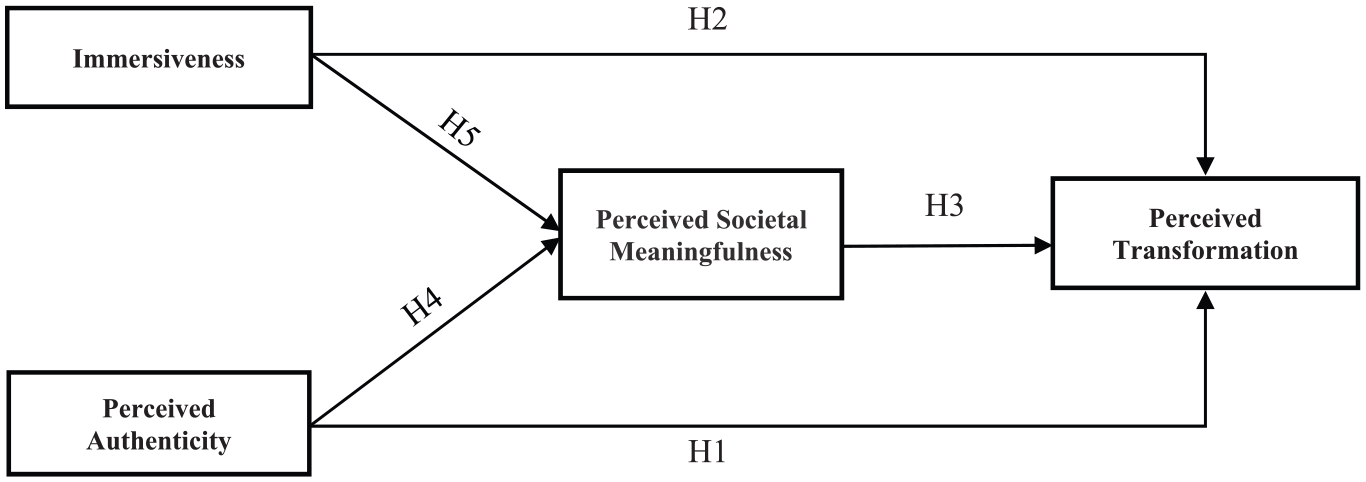
Conceptual framework—study 2.
Authenticity
The word authentic is, at its core, associated with “genuineness,” “reality,” and “truth” (Mkono 2013). Because of its considerable importance for tourists, hospitality organizations, and tourism destinations, authenticity has been intensively discussed in tourism literature. According to Wang (1999), there are three approaches in conceptualizing authenticity of tourism experiences: objectivist, constructivist, and postmodern. The first approach considers authenticity as the degree to which objects, people, and experiences are genuine, accurate, and truthful (E. Cohen 1988). As MacCannell (2001) notes though, this approach is becoming obsolete, as touristic objects and destinations become more and more standardized and homogenous. According to the second approach, the way tourism objects are viewed by travelers depends on their expectations, beliefs, and feelings. Hence, their authenticity is conceptually equal to the symbolic authenticity each tourist projects onto them (Bruner 1994). The postmodernist approach deconstructs the concepts of truth and originality and suggests the notion of existential authenticity (Brown 2013). Wang (1999) defines existential authenticity as the collection of individual and intersubjective feelings “activated by the liminal process of tourist activities” (351). Authenticity, therefore, should be associated not only with the genuineness of a traveler’s experience but also with its degree of liminality. As highlighted by Wang (1999, p. 361), authenticity in tourism “is experienced only within a liminal zone, where one keeps a distance from societal constraints (prescriptions, obligations, work ethic, etc.) and inverts, suspends, or alters routine order and norms.”
Although authenticity is a significant pursuit for individuals in all types of tourism (E. Cohen 1988; Yi et al. 2017), its importance is even more prominent in volunteer tourism (Palacios 2010). According to the literature, most volunteer tourists consider themselves to be “travelers” rather than “tourists” (Paulauskaite et al. 2017). Although they tend to have a variety of expectations and motives (Andereck et al. 2012) a primary motivation is their quest for authenticity (Ooi and Laing 2010). Contrary to conventional tourists, volunteer tourists seek to form stronger relationships with the host community, engage more meaningfully with the local culture and lifestyle, and even contribute to the local community’s well-being (Sin 2009), thus pursuing higher levels of authenticity. As the participant observer highlights: I reflect on days that felt “authentic” and days where I felt like I belonged. They were as interested in us as we were in them, with their draped fabrics and mounds of beads; some of them had probably never seen a white person before. The most difficult part was finding who I am in these countries. (Journal entry, p. 6)
Similarly to what our participant observer notes, Kontogeor-gopoulos (2017) argues that for most volunteer tourists, achieving existential authenticity is synonymous with the process of finding and improving themselves. It is a liminal process of challenging their sense of self (Noble and Walker 1997) and disengaging from known social constraints (Wang 1999). It is also related to the process of engaging with one’s surroundings and fellow human beings (Yi et al. 2017). As postmodern scholars note, an authentic existence unravels as a “co-happening” within a community (Heidegger, Macquarrie, and Robinson 1962). Hence, perceiving activity-related authenticity in their experiences, or in other words achieving existential authenticity (Wang 1999), enables volunteer tourists to better understand their identity before the trip (in the pre-liminal phase); challenge established emotions and beliefs (during the liminal stage); and work toward a new identity after the trip (at the post-liminal stage). Moreover, it helps them authenticate and validate their newly transformed identity, as the latter is manifested in their attitudes, beliefs, and behavior (Noy 2004). This is also supported by the findings of study 1. For example, one interviewee, Adam, highlights, “I think I’m a lot more ambitious in terms of wanting to make the most out of the opportunities I get in life. I also realize you can’t always wait for opportunities to come to you, you must look for them yourself.”
Based on the above discussion, we postulate that:
Hypothesis 1: Perceived authenticity of volunteer tourists’ experiences positively influences their perceived transformation.
Immersiveness
Findings from study 1 reveal that entering the liminal phase is an important prerequisite of the transformation process. Not all volunteer tourists enter this phase, and not to the same degree (Zavitz and Butz 2011). As evidenced from our interviews with volunteer tourists, and also reflecting back to the literature on identity change, important prerequisites need to exist: escaping from previously held beliefs and self-concepts; entering a state of ambiguity and paradox; interacting with fellow travelers; and having the time to reflect on the experience. In an effort to measure the degree to which volunteer tourists enter the limonoid, we use the conceptually similar notion of immersiveness.
Compared to other forms of traveling, volunteer tourists engage intensively with the tasks they have to carry out, even when the conditions are physically and psychologically uncomfortable (Tomazos and Butler 2010, p. 377). In this study, we argue that in order for significant changes in individuals’ beliefs, attitudes, and behaviors to occur, they must challenge the way they view reality by meaningfully interacting with others, dealing with shock and guilt, and engaging in immersive activities (Mezirow 1991). During their trips, volunteer tourists may deal with difficult situations and often develop strong emotions of shock, fear, frustration, and mental strain (Coghlan and Gooch 2011). Through their engagement with these emotions and situations, and their effort to overcome them, they become more self-aware and self-reflective, which leads to their development and the actualization of a new identity (Coghlan and Weiler 2018). This is because they go through a liminal process, which suggests they start “reflecting about their society and their cosmos in order to return to society in a new identity with new responsibilities and powers” (Beech 2011, p. 287).
The amount of physical, mental, and psychological effort they put into this process, in other words, the immersiveness of their experience (Coghlan 2015; Mulder et al. 2015), determines the intensity of the liminal process and, in turn, the degree of their actual transformation as human beings. As Joanna in study one explains: “I think the biggest change is that I have more confidence in myself due to having to put myself out of my comfort zone every day.”
In the present study, we conceptualize the notion of immersiveness as the degree to which volunteer tourists perceive they need to put in significant effort, or are induced to substantial pain and suffering during their trip. It is reasonable to assume that immersion in a volunteer tourism experience facilitates transformation in two ways, especially during the liminal phase: first, by pushing the volunteer tourists beyond their comfort levels; and second, by enabling them to consider how they view themselves and the world around them (Mulder et al. 2015). As in other forms of experiential tourism (Noy 2004), the more immersive their experience is, the more changed they will feel when it is over, that is, in the post-liminal phase. This is not only because increased effort tends to facilitate a change in their attitudes and beliefs, but also because it validates and authenticates this change in their minds. This is also supported by the findings of study 1. For example, Andie noted, “I think in my experience it depends a lot on what you put into it. Kind of what you put in is what you get out of it.” The observations of the participant observer were similar: They were people in my group that didn’t put in any effort. They didn’t even live in the house. And when they did, they were only going to the “white people cafes.” Most of the times they avoided doing difficult tasks. I don’t think these people were influenced by the trip at all. (Journal entry, p. 31)
The above discussion leads us to posit the following research hypothesis:
Hypothesis 2: The immersiveness of volunteer tourists’ experiences positively influences the degree of their perceived transformation.
Perceived societal meaningfulness
A sense of meaning or meaningfulness relates to the feeling of belonging and contributing to the common good, and has been found to be a key source of happiness and well-being (Seligman 2012). Previous research has distinguished between personal meaningfulness and societal meaningfulness, with the latter referring to individuals’ commitment to contributing to society (Larsson and Enander 1997). The desire to meaningfully help others and contribute to societal well-being is a prominent motive for volunteer tourism (McGehee and Santos 2005; Grimm and Needham 2012) and an experience based on meaning that is (or feels) authentic is more likely to lead to transformation (Pine and Gilmore 2011). As noted by McGloin and Georgeou (2016), volunteer tourists feel they can “make a difference” only when they see the effects of their “benevolent” acts. In contrast, when they do not see an immediate societal impact of their actions, they sometimes become disappointed and disengaged (Vodopivec and Jaffe 2011). This is what differentiates them from other tourists and makes their transformations deeper and more truthful. On this basis, we define societal meaningfulness as the perceived impact of volunteer tourists’ actions on society and we posit the following hypothesis:
Hypothesis 3: Perceived societal meaningfulness positively influences the degree of volunteer tourists’ perceived transformation.
Authentic volunteer tourism trips are believed to be more sustainable and have a more positive contribution to the local community (Zahra and Mcintosh 2007). Furthermore, they provide more opportunities for travelers to engage in meaningful activities and assist in tackling important social issues, such as poverty (Sin 2009). Furthermore, perceived authenticity enhances the “myth of the hero’s adventure” (Coghlan and Weiler 2018) and allows volunteer tourists to realize new aspects of their true potential contribution to societal well-being. Hence, the more authentic travelers perceive their experience to be, the more likely that they will feel they are true volunteers and perceive their “adventure” as societally meaningful.
In addition to perceived authenticity, immersiveness of volunteer tourists’ experience may also enhance their perceptions of the meaningfulness of their actions. Travelers who engage with more and harder tasks with more immediate and visible results for the community consider they are doing something meaningful (Vodopivec and Jaffe 2011). Moreover, Mulder et al. (2015) found that increased effort by the volunteer tourists to overcome communication and cultural barriers results in a stronger and more meaningful bond between the volunteer tourists and the locals. As one of their participants notes, “The barriers between us acted as a wall that we each had to work extra hard to climb over. Causing not only more work but also a deeper connection in the end because each person I connected with, I had put so much effort into it felt more genuine” (Mulder 2015, p. 873). In that way, they develop a better understanding of local needs and problems and potentially identify as meaningful contributors to the host community.
Based on the above discussion, we formulate the following two research hypotheses:
Hypothesis 4: Volunteer tourists’ perceived authenticity positively influences the perceived societal meaningfulness of their trips.
Hypothesis 5: The immersiveness of volunteer tourists’ experience positively influences the perceived societal meaningfulness of their trips.
Methodology
To test the validity of our conceptual framework, we conducted a primary quantitative study using a structured questionnaire. Our sample comprised individuals who had recently participated in a volunteer tourism trip. In order to broaden our sampling frame, we contacted two major British volunteer tourism organizations, who gave us access to individuals who had recently been on one of their trips. The questionnaire involved volunteer tourists who had recently completed their trip. The combined list consisted of 380 volunteer tourists, who were contacted via e-mail with a request to participate in our study. Of the 380 individuals, 134 completed the questionnaire. Three questionnaires were incomplete and thus discarded. Aiming to test for nonresponse bias, a reminder was sent a few months later to those who had not responded to the initial invitation. At this round, 16 additional questionnaires were collected. The final sample comprised 147 volunteer tourists—an overall response rate of 38.68%. No significant differences were found between the two rounds of data collection in terms of participants’ demographic characteristics and responses to the survey’s questions, indicating therefore that nonresponse bias was low. Of the 147 participants, 64.6% were female, with an average age of 22. All of them were native English speakers. For 58.5%, this was their first ever volunteer tourism trip; the rest had participated in similar trips previously.
For all constructs in our conceptual framework, we developed seven-point Likert-type multi-item scales or adapted previously validated ones. The labels in all items were anchored by “strongly disagree” to “strongly agree.” To capture authenticity, we adapted the three-item scale by Ramkissoon and Uysal (2011); and to measure immersiveness, we developed a five-item scale based on Alexander’s (2012) study on volunteer tourism. We used an adaptation of the four-item scale developed by van der Voet, Steijn, and Kuipers (2017) to measure societal meaningfulness and a four-item scale developed by Stuckey, Taylor, and Cranton (2013) was employed to capture transformation. The complete wording of all scales’ items is depicted in Table 2.
Data analysis
The unidimensionality and discriminant and convergent validity of all scales were tested using confirmatory factor analysis (CFA). As depicted in Tables 1, 2, and 3, all scales were found unidimensional and valid as the standardized factor loadings were above 0.6 for all items and all scales’ average variance extracted (AVE) was larger than 0.5, and greater than the highest squared correlation among all scales (Byrne 2006; Fornell and Larcker 1981). The scales were also internally consistent, as all Cronbach’s alpha coefficients and composite reliability coefficients (CRs) were above 0.7 (Nunnally 1994; Fornell and Larcker 1981). As all measures were found to be unidimensional, reliable, and valid, the data were aggregated into a single measurement for each scale, by calculating the average of each scale’s items. Given that all data come from a single source, there was a strong possibility of bias due to common method variance (Podsakoff et al. 2003). For that reason, we tested our data for common method bias, by calculating all partial correlations with a conceptually irrelevant measurement, generosity, as a control variable. No partial correlations were significantly different from the correlations without the control variable, allowing us to assume that common method variance is not high.
Descriptive Statistics, Validity and Reliability.
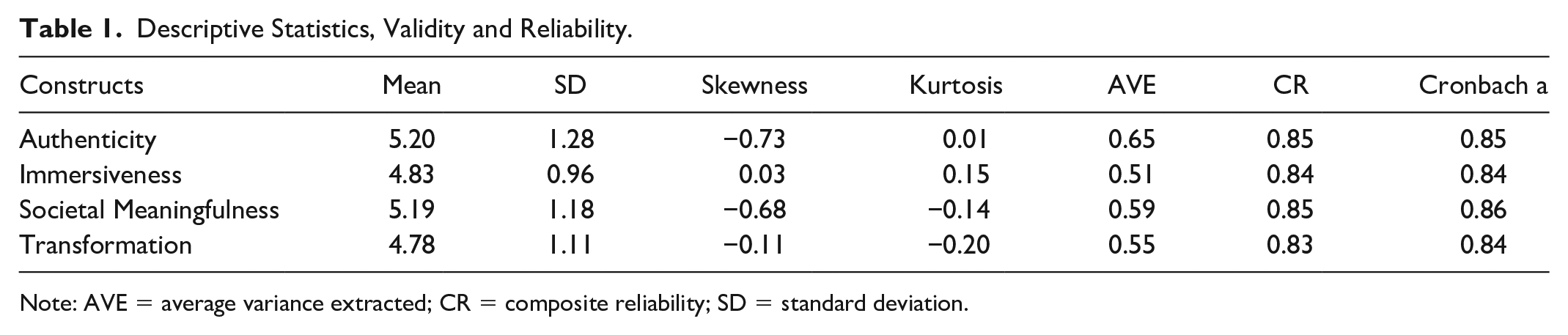
Note: AVE = average variance extracted; CR = composite reliability; SD = standard deviation.
Items’ Descriptive Statistics and Factor Loadings.
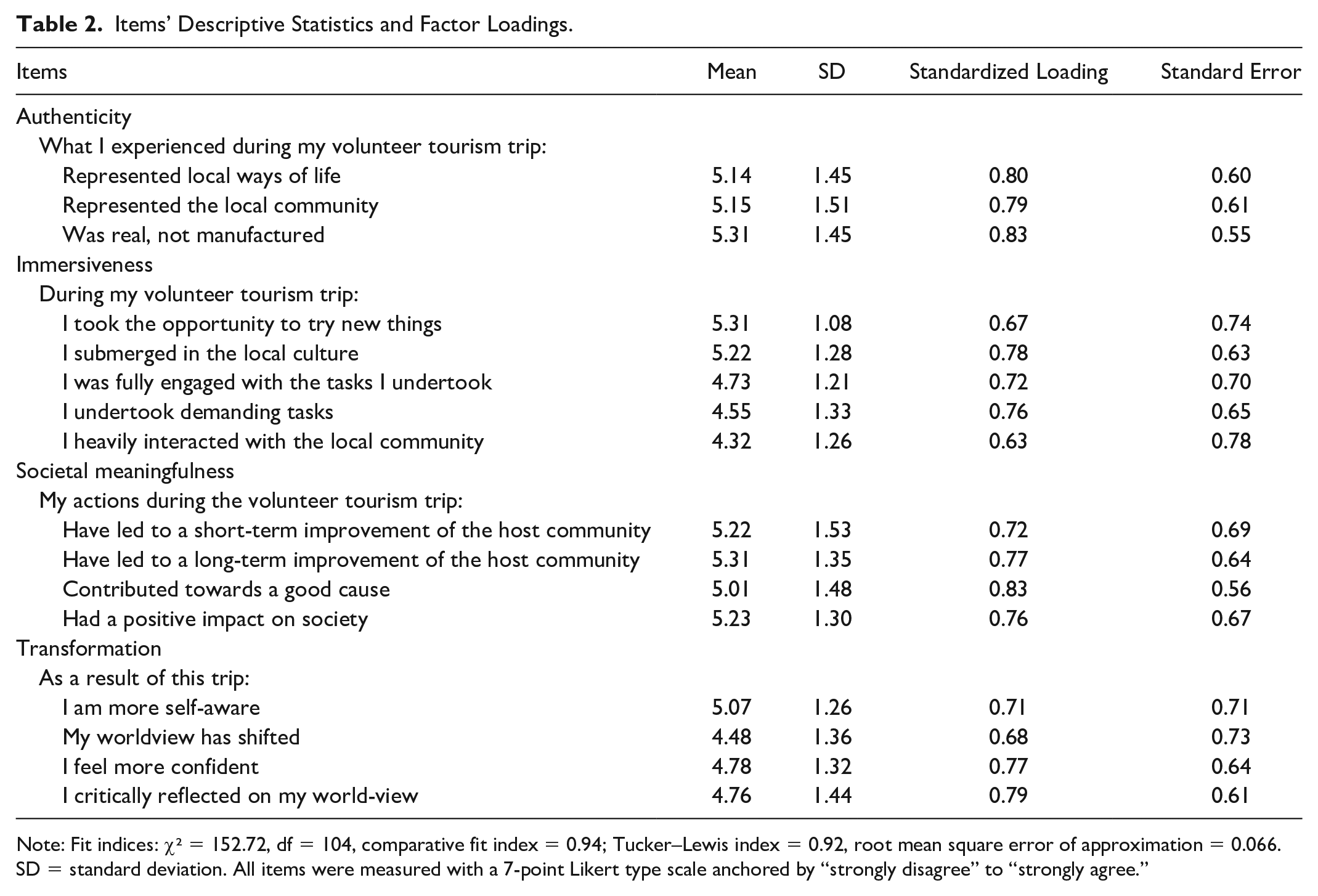
Note: Fit indices: χ² = 152.72, df = 104, comparative fit index = 0.94; Tucker–Lewis index = 0.92, root mean square error of approximation = 0.066. SD = standard deviation. All items were measured with a 7-point Likert type scale anchored by “strongly disagree” to “strongly agree.”
Correlations (below Diagonal), AVE (Diagonal), and Squared Correlations (above Diagonal).
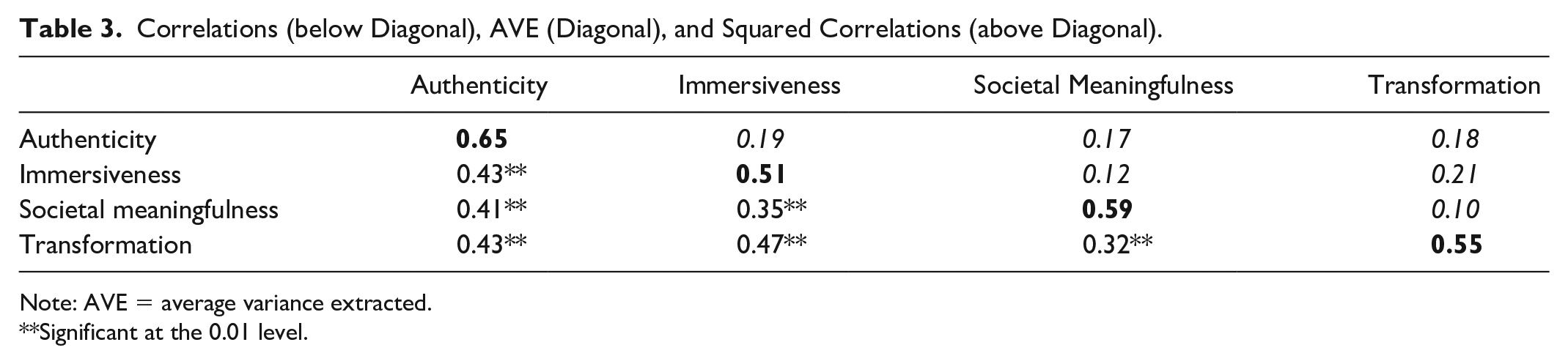
Note: AVE = average variance extracted.
Significant at the 0.01 level.
In order to test the validity of the study’s conceptual framework, we employed structural equation modelling (SEM) using EQS 6.2. The hypothesized model was the same as the study’s conceptual framework, since all variables seem to be significant correlated with each other (Table 3). The results of the analysis (Table 4) indicate that the hypothesized model has an adequate fit with the data (χ² = 184.29, df = 99, comparative fit index = 0.92, Tucker–Lewis index = 0.91, root mean square error of approximation = 0.077). Moreover, most paths in the regression models were found to be significant. Specifically, the transformation of the volunteer tourists’ experience was significantly influenced by the authenticity (t=3.037, p<0.01) and the immersiveness (t=4.019, p<0.001) of their experience (R2=0.326) thereby confirming hypotheses H1 and H2. Volunteer tourists’ perceptions of societal meaningfulness were found to be significantly influenced by authenticity (t=3.935, p<0.001) and immersiveness (t=2.729, p<0.01) (R2=0.215). Hence, hypotheses H4 and H5 are also confirmed. However, the impact of societal meaningfulness on transformation was not found to be significant. Therefore, hypothesis H3 cannot be accepted.
Fit Indices and Regression Weights for the Path Model.
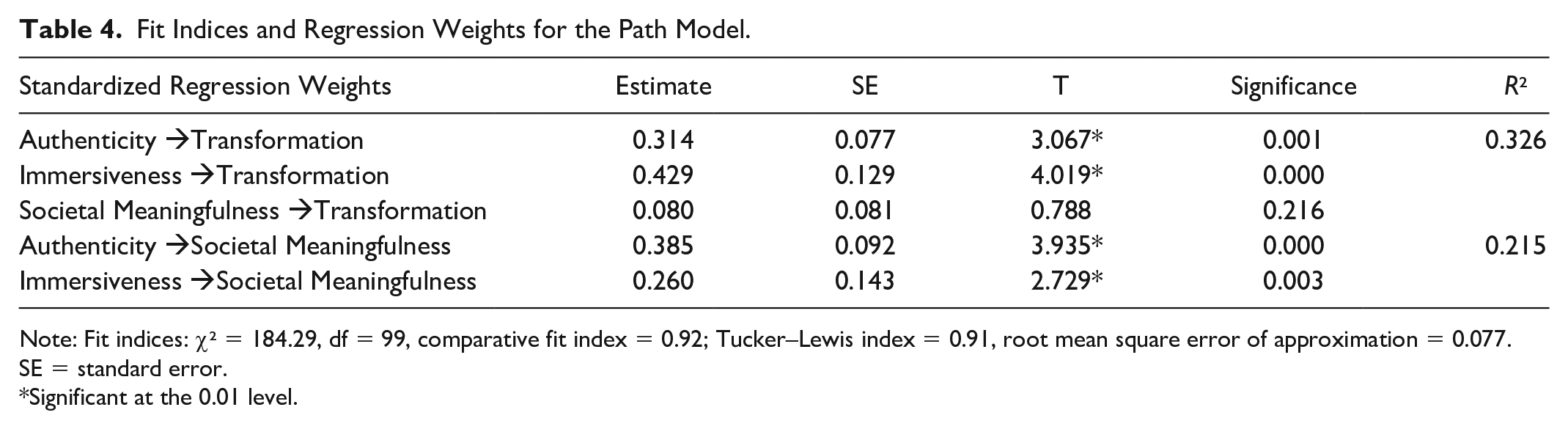
Note: Fit indices: χ² = 184.29, df = 99, comparative fit index = 0.92; Tucker–Lewis index = 0.91, root mean square error of approximation = 0.077. SE = standard error.
Significant at the 0.01 level.
The results of our quantitative study pinpoint two major factors influencing the transformative influence volunteer tourism has on individuals (transformation). Specifically, confirming hypotheses 1 and 2, transformation was found to be directly impacted by the authenticity and the immersiveness of the volunteer tourists’ experiences. These results are in line with previous studies’ findings (Kontogeorgopoulos 2017; Coghlan and Weiler 2018) and previously expressed normative arguments (Mulder et al. 2015), confirming the importance of the experiences volunteer tourists have on their trips. Our findings also indicate that the aforementioned variables have a positive impact on the perceived societal meaningfulness of the volunteer tourists’ trips, confirming hypotheses 4 and 5. As expected, the more immersive and authentic their trips were perceived to be, the more important the contributions of their actions were perceived by them. The relationship between societal meaningfulness and transformation, although significant when measured independently (e.g., via Pearson’s correlation coefficient), was not found to be significant when incorporated in the study’s hypothesized model. This means that, although there is evidence of volunteer tourists being more transformed when they perceive their actions to be meaningful, the direct influence of authenticity and immersiveness is more substantial than the indirect one.
Discussion
Conclusions
The present study’s contribution to the literature on volunteer tourism is twofold. Firstly, using arguments derived from previous research and the findings of our mixed methods study, we conceptualize volunteer tourism trips as rites of passage, a ceremonial experience that facilitates identity change and, potentially, transformation. We are therefore able to explore, define, and document the process behind volunteer tourists’ transformation. Second, we empirically examine the conditions under which transformation materialize, demonstrating the underlying mechanisms of volunteer tourists’ identity change. In doing so, we move forward from previous research that has treated volunteer tourists as a cohesive, universal body of individuals, and suggest a conceptual framework that enables exploration of the prerequisites and boundary conditions of their transformations.
The findings of the qualitative part of our study reveal that the process of volunteer tourists’ transformations is an internal, existential process involving three stages: the pre-liminal phase, the liminal phase and the post-liminal phase. This three-stage process of self-transformation is conceptually analogous to the archetypal process of a hero’s adventure, as explained by Campbell (1988). According to this archetype, every hero myth starts with a call to adventure (pre-liminal phase); presents challenges along the way, from which, with assistance from various helpers, the hero emerges victorious (liminal phase); and, transformed by the experience, the hero returns to the previous world bearing their trophies (post-liminal phase). Based on this, Hudson and Inkson (2006) use the hero’s adventure archetype to explain the learning and transformation process of international volunteers. As they note (2006, p. 317), “volunteering overseas creates major disjunctions in career and in life, and these disjunctions appeared to be transformational for many volunteers.” These disconnections can be attributed to individuals’ perceptions of having a transformative adventure, a “hero’s journey,” that helps them challenge themselves and the world around them.
However, as demonstrated by our findings, the well-documented and much celebrated transformative experience does not materialize for everyone. It requires the conscious realization and manifestation of a new identity (Beudaert, Özçağlar-Toulouse and Türe 2016), through a process that involves a powerful experience and increased involvement and interaction with the local community. To further explore when volunteer tourists’ experiences are meaningful enough to lead to significant transformation, we conducted a confirmatory, quantitative study. Our findings indicate that the aforementioned journey through the three stages of liminality leads to meaningful transformation under two circumstances. First, transformation occurred when volunteer tourists’ experience is perceived as authentic, in other words, not a preset, “packaged,” conventional tourism experience. The concept of authenticity frequently came up in our interviews, as participants were looking to have the most authentic experience possible. In study 2, we demonstrate that authenticity does indeed positively influence volunteer tourists’ transformations. The second condition for significant transformation therefore is a high degree of immersiveness, that is, exerting the required effort or potentially accepting pain in the process. Our survey’s findings confirmed both the theoretical arguments from previous studies (Coghlan and Weiler 2018) and the views that emerged from our interviews concerning the strong relationship between immersiveness and transformation.
Our conclusions on the effects of immersiveness and authenticity on perceived meaningfulness can be elucidated by the “martyrdom effect”: Olivola and Shafir (2013) demonstrate how people may behave in a way that contradicts classical economic and psychological theories. Individuals are more likely to develop pro-social behaviors when their actions require increased effort and pain because they will perceive their suffering as a process of contributing to a cause they believe in (Thompson and Bunderson 2003), but only if they perceive this pain and effort to be meaningful (Olivola and Shafir 2013). With this in mind, it is easy to see how the required pain and effort of volunteer tourism experiences facilitate transformation in two ways. First, such trips push the volunteer tourists beyond their comfort levels, enabling them to reflect on how they view themselves and the world around them (Mulder et al. 2015), especially during the liminal phase. Second, Olivola and Shafir (2013, p. 102) show that painful and/or effortful practices “make the experience and act of contributing seem more meaningful for people, thereby increasing their willingness to contribute.” Therefore, perceived meaningfulness may not only be a prerequisite to exert effort and endure pain but also a potential result of them.
Managerial and Academic Implications
The findings of our study cast light on the transformative role of a unique type of tourism experience and identify the conditions under which meaningful transformation occurs. We argue that our conclusions have useful implications for academics, organizations that organize volunteer tourism trip and host communities, as well as volunteer tourists themselves. First, the present study highlights the importance of transformation in volunteer tourism trips. Although not all volunteer tourism trips need to be transformative, self-actualization and self-development are highly cited as motivating factors for volunteer tourists (Weaver 2015) and should not be overlooked, either by future research or trip organizers.
Furthermore, our study offers a blueprint on how transformation can be achieved and the factors that enable it. Specifically, we suggest that if travelers wish to make their trips meaningful, they should be ready to enter a liminal phase, by leaving behind their current narrative of the self. They should also immerse themselves in their trip, putting in the required effort and engaging intensively with fellow volunteer tourists and the local community, aiming to create in that way a tourism-related social capital (McGehee et al. 2010). Organizations can invest in facilitating this process by offering opportunities for more meaningful work to voluntourists and by showcasing the change in local communities resulting from their work. Moreover, they need to establish a safe environment where volunteer tourists can lose their previous identity and enter a liminal state ready to be transformed. Facilitating the development of an organic community with uniform clothing or group activities and offering opportunities for reflection by, for example, journal writing or post-trip discussions can enhance volunteer tourists’ immersiveness and perceived authenticity. There is a delicate balance to be achieved, as there is such a thing as too much liminality where alienation and frustration of volunteer tourists can lead to negative effects (Kontogeorgopoulos 2017). Having more realistic and honest communication about the traveling experience is also important, as setting expectations too high for a “life-altering event” may lead to the opposite results. Finally, trip organizers can actively contribute to the social impact of their trips, thereby establishing voluntourism as a truly sustainable form of alternative tourism (Ong et al. 2014).
The present study also contributes to theories of volunteer tourism and transformative consumer research. Our findings offer a blueprint on making volunteer tourism trips more influential and transformative, contributing to the discussion on how consumers undergo identity change both in the context of tourism and that of general sustainable consumption. We offer van Gennep’s (1960) “rites of passage” as a new theoretical lens to volunteer tourism research that helps document and explain the process of transformation. In an attempt to quantify the degree to which volunteer tourists enter the liminal phase of the rites of passage, we introduce the conceptually similar notion of immersiveness. Future researchers interested in volunteer tourism may find our initial conceptualization of this interesting concept useful, and further build on it. This article has also highlighted the central role authenticity plays, not only in influencing volunteer tourists’ motivations and perceived benefits as highlighted by previous literature (Kontogeorgopoulos 2017), but also in affecting their perceived transformation. Our data also suggest that individuals with more immersive and authentic experiences will perceive trips as more meaningful and with a more important societal impact. The relationship between meaningfulness and transformation, however, was not found significant. A potential explanation for this could be that according to volunteer tourism critics, perception of societal contribution may not necessarily lead to genuine transformation but instead to self-righteousness and neo-colonial attitudes (Palacios 2010). Following Conran (2011), this article takes these critiques seriously but attempts to move beyond the neocolonial perspective. We explore volunteer tourism as a platform for transformative consumer experiences, yet we caution that when volunteer tourism is not authentic and does not result in tangible improvement of host communities’ well-being, it runs the risk of contributing to stereotypes and cross-cultural misunderstandings (Sin 2009).
Limitations and Future Literature
Our study is not without limitations, which offer though opportunities for future research. First, regardless of the approach taken in studying the phenomenon of volunteer tourism, it is crucial that its Western-centric character should be acknowledged and taken into consideration (Mustonen 2008). In both our studies, the majority of participants were young, middle-class, white women who live in the United Kingdom, and hence their perceptions should be viewed through the prism of their sociodemographic profile. In addition, future research could explore travelers’ transformation in different time frames (such as taking into consideration the lasting effects of such trips). Couch and Georgeou (2017), for example, found that after five years students who had participated in an immersive trip to India did not find the trip as transformative as they initially thought. Furthermore, the present study focuses unilaterally on the individual transformation of travelers. Future research should simultaneously explore the transformational impact of volunteer tourism trips on travelers, local communities and the environment, acknowledging that such trips can only be sustainable if all parties work harmonically together toward achieving positive transformational outcomes. Methodologically, as ethnographic studies rely heavily on data collected by the participant observer, results may be based exclusively on the researcher’s own interpretations (Vidich 1955). While reasonable steps were taken to reduce objectivity bias, for example, by using a team of researchers in the second data collection and by discussing observations and findings with other researchers (Palacios 2010), the findings need to be qualified, taking into account potential methodological limitations. Our quantitative study is also not without limitations, not least the use of a convenient and relatively small sample which had only recently completed their trip. Finally, given that this is one of the first studies in volunteer tourism to use a structured questionnaire to measure the constructs of our conceptual framework, the operationalization of its main variables should be tested in different contexts in order for the validity and reliability of the scales we used to be examined further.
Footnotes
Declaration of Conflicting Interests
The author(s) declared no potential conflicts of interest with respect to the research, authorship, and/or publication of this article.
Funding
The author(s) received no financial support for the research, authorship, and/or publication of this article.
