



Abstract
Marketing and consumer research has drawn attention to life transitions as critical sites of consumption but has insufficiently explored bereavement, a universal life transition that can involve (un)wanted inheritance, initiating a potential cycle of retention, reimagining or disposal. Life transitions represent potentially transformative moments of consumption when individual consumption can be more positively redirected towards sustainable choices. Using semi-structured interviews and qualitative data, this study critically investigates the cycle of inheritance consumption, informed by Evans’ understanding of consumption with an emphasis on both acquisition and disposal. The study uncovers three liminal stages: separation and detachment; instability, ambiguity and prolonged liminality; and stability and completeness. First, we expand the scope of empirical consumer research by conceptualising inheritance as liminal. Second, we illuminate the inheritance consumption cycle, showing liminal inheritance stages are critical transition moments that trigger complex positive and negative emotional responses, with implications for whether goods remain suspended or pass into further utility. Finally, we extend liminality theory by conceptualising bereavement as a liminal life transition, and call for researchers to study inheritance beyond acquisition, since how inherited goods are retained or divested in liminal moments can have implications for sustainability and may provide opportunities to steer more responsible and fulfilling consumption with an emphasis on limits rather than excess.
Introduction
Life transitions are varied but offer potential transformative moments for consumption (Yap and Kapitan, 2017). Increasingly relevant to marketing and consumer behaviour scholars, these have been recognised as moments when individuals’ consumption can be more positively redirected towards sustainable choices (Burningham and Venn, 2020). Some transitions such as retirement may increase consumption of items such as vacations or reduce consumption such as home downsizing (Ross et al., 2021). At times these transitions change consumption permanently, illustrated by Noble and Walker’s (1997) study of moving from high school to college. They found students in transition hold dear symbolic possessions from their past, while prioritising consumption that helps facilitate their transition to independence. Recent work has suggested the potential for life transitions to support sustainability (Burningham and Venn, 2020; Verplanken and Roy, 2015; Darnton et al., 2011), for example, the birth of a child may trigger an interest in organic food or ethically manufactured toys, and the impact of negative and positive life transitions on solace seeking through consumption (Thyroff et al., 2018). While consumption behaviour related to certain life transitions such as motherhood have been extensively explored by marketing academics (Tonner, 2016; The VOICE Group, 2010; Carrigan and Szmigin, 2006, 2004), other transitions are less well documented (Darveau and Cheikh-Ammar, 2021).
Bereavement is a challenging life transition well documented in the psychology and sociology literature (e.g. Paddock et al., 2019; Marshall, 2018). Marketing and consumer research has explored this universally resonant transition within contexts such as the bereaved consumers and restorative gifting (Drenten et al., 2017), funeral spirituality and rituals (Hackley and Hackley, 2015), bereavement service encounters (Turley and O’Donohoe, 2017), death and voluntary simplicity (Cengiz and Rook, 2015), but greater understanding of bereavement consumption is needed. Bereavement often triggers inheritance, the passing on of property or goods, especially for younger generations, with complex and (positive and negative) emotional consumption challenges (Bauer and Bonanno, 2001). Consumption triggered from inheritance is multifaceted, encompassing both acquisition and disposal, as goods and their new owner navigate the transitional process (Van Gennep, 1960). This process can bring joy in items reminding the inheritor of family history as well as pain from the size of the task at hand (Patterson, 2022). The movement during this ritual of transition has been likened to moving from one state to another, and in the ‘doorway’ between these states rituals of transition take place. Noble and Walker (1997: 32) noted that life events will trigger transitions, defined by them as a ‘change in a significant life role marked by a transitional or liminal period’, that produces ‘significant psychological consequences’, and where consumption behaviour may facilitate the transition. With this study, we expand the scope of empirical consumer research into life transitions by conceptualising inheritance as liminal. The paper also contributes to marketing scholarship by illuminating the inheritance consumption cycle, demonstrating liminal inheritance states are critical moments of transition, triggering emotions that may impact on the suspension or throughput of goods. Finally, liminality theory is extended, since by conceptualising bereavement as a liminal life transition, we show how the retention or divestment of inherited items can have implications for the increase or reduction of consumption.
The interaction between consumption, bereavement and inheritance has received little scholarly attention (Guillard, 2017); our study addresses this omission. Integrating Evans’ (2019) definition of consumption, with Van Gennep’s (1960) framework of liminal transition periods (explained later in this paper), we explore the nature of the liminal experience of bereavement and its effect on consumers. By doing so, we empirically extend the analysis of consumption, as Evans (2019) suggests, beyond acquisition to also explore disposal, focussing attention upon the rituals of inheritance transition and the potential for sustainable outcomes. We seek to understand how liminal periods of bereavement inheritance, which may involve extensive time and difficult decisions, represent dimensions of consumption incorporating acquisition and divestment, and how consumers transition through this liminal state.
First, we consider the literature on inheritance. Next, we define consumption and discuss transitory situations and transformative events within the context of liminality, and the liminality of possessions. We then outline methodological considerations, followed by an analysis that explores participants’ evolving consumption linked to bereavement and inheritance, and how they are affected by ongoing shifts in acquisition and disposal. We present how a liminal perspective linked to bereavement as a life transition may be significant, including in terms of understanding consumption limits and excess, individual wellbeing and potential implications for sustainability. Finally, a conclusion and suggestions for future research are offered.
Literature review
Transference and inheritance
Intergenerational transference includes the inheritance of both tangible possessions and intangible elements such as behaviours and values (Scabini and Marta, 2006). Here, we focus on tangible inherited possessions which may differ across cultures and societies (Pfeffer and Killewald, 2018), but can include jewellery, furniture and clothing. The personal significance of inherited possessions goes far beyond monetary value (Kessous et al., 2017), as families are also engaged emotionally with their memories. They might be costly or mundane (Finch and Mason, 2013) and have practical or sentimental (nostalgic) value (Holmes, 2019). Such possessions maintain ties to the previous owners (Weiner, 1992; Price et al., 2000), and bestow a sense of social identity and rank on the heir (Curasi et al., 2004) highlighting guardianship and object attachment (Price et al., 2000). Some possessions may be treasured but removed from their utilitarian value (through display) due to shared sacred meanings (Curasi et al., 2004). This demonstrates the ritualistic aspects of consuming familial possessions (Belk et al., 1989) where guardians follow in the footsteps of ancestors by caring for heirlooms (Bradford, 2009).
Some research suggests a changing significance for inherited possessions (Collins and Janning, 2010). Arguably, individuals cherish familial possessions, yet their inheritance may be overwhelming or create sentimental clutter (Jones and Ackerman, 2016). Clutter is defined by Roster et al. (2016: 32) as ‘an overabundance of material possessions that collectively create disorderly and chaotic home environments’. A subjective concept, debilitating clutter is created when the volume of possessions becomes excessive, potentially interfering with people’s ability to conduct normal life activities. Woodward (2021) has recently noted clutter often raises moral dilemmas among families, and represents a potent force that affects people, creating complexity and contradictions. How one saves and keeps possessions can range from completely normal to excessive and dysfunctional possessional attachment (Roster et al., 2016). Inheritance introduces items to an individual’s home that were acquired by others but become the responsibility of the receiver. Conflicts between family members frequently surface in association with inheritance, arousing a myriad of paradoxical feelings such as love, gratitude, anger, blame and pride (Sousa et al., 2010). Retaining possessions, particularly those with problematic histories such as ivory or indigenous peoples’ artefacts may lead to ambivalence and guilt (Kellor, 2019). In response, heirs may create something new from the heirloom by repurposing or may let them go (Türe and Ger, 2016), both of which can be done with thoughtfulness, as heirs attempt to do justice to the possessions and their legacy.
The changing meaning of inheritance
The changing meaning of inheritance and its impact on intergenerational transference is complex. British society features decades of excessive consumption, evidenced as it transitioned from austerity to a culture of consumption (Venn et al., 2017). Such consumerism is problematized in its contemporary association with negative judgements regarding the privileging of possessions over spiritual values, and hints of moral failing (Scott et al., 2014). Sociologists such as Evans (2019) highlight how consumerism is often positioned as a culture of excess rather than sufficiency. Notably, researching the consequences of inheriting possessions from generations who have transitioned (often) from austerity into abundance is less prevalent. The passage of possessions may be especially problematic due to the contemporary lifestyle of generations that favour less ownership (Lamberton and Goldsmith, 2020) with consumer researchers observing trends of minimalism, loosening emotional ties with possessions (Bardhi et al., 2012) and higher levels of mobility (Alter, 2017). Consumers often seek temporary, disposable or shared possessions and display changing aesthetics that involve less belongings, epitomised in the tiny house movement (Mangold and Zschau, 2019). This symbolises a growing trend that eschews volume transference of material property between generations (Alter, 2017). Certain generations may shun the collections of china or crystal (Verde, 2017), and gravitate towards living spaces that can accommodate only the most meaningful possessions, contrasting with previous generations.
Dealing with these possessions takes time, sometimes intertwined with emotional burden (Jones and Ackerman, 2016). This process may result in repurposing, discarding and letting go, fulfilling minimalist tendencies (Türe and Ger, 2016) as a catharsis from over-consumption perhaps due to a personal experience (Wilson and Bellezza, 2022). Alternatively, hoarding may take place as the bereaved struggle to do justice to the memory and legacy of their lost relatives (Winterich et al., 2017). Bereavement and inheritance, as well as its anticipation, are emotionally imbued moments and tensions appear as individuals reconcile various demands and value systems (Tronto, 2013). The failure to discard large volumes of inherited possessions that appear to have limited value or utility is associated with anxiety sensitivity (Medley et al., 2013). Hoarding and holding on can be linked to extreme emotional attachment and anxiety pathology (Mathes et al., 2020), resulting in debilitating clutter as inherited possessions and the heir remain in limbo until decisions concerning how to transition forward are made (or not).
Defining consumption
For some time, marketers have drawn our theoretical understanding of consumer behaviour from a range of disciplines, including a synthesis of anthropological, psychological and cultural studies approaches to ‘insights into consumption’ (Askegaard and Linnet, 2011: 381), underpinning work by, for example, consumer culture scholars (Arnould and Thompson, 2018; Belk, et al., 2013; Cova, et al., 2013) and sustainable consumption researchers (Davies et al., 2020; Carrigan et al., 2020). Within consumption scholarship the dominant focus has been on the early part of the consumption process, what sociologist Alan Warde (2005: 137) defines as where individuals engage in ‘appropriation and appreciation…. of goods, services, performances, information, or ambience, whether purchased or not, over which the agent has some degree of discretion’. Inheritance represents goods that, while not purchased by the inheritor (although may well have been sometime in the past), are theirs to retain or discard. In his consideration of how consumer scholarship offers distinctive resources to tackle ecological crises and uncertain futures, Evans (2019) critiques current approaches to sustainable consumption, and the ascendancy of theories of practice in sustainable consumption research focused on resource intensity studies, such as household cleaning. He suggests a re-emphasis on the sociology of consumption, to enhance research on cultural, social, relationship, aesthetics and desire in consumption and a detailed engagement with the process and content of consumption. He notes (Evans, 2019: 506) the bias of consumption scholarship ‘towards the “front end” of consumption’ citing Warde’s (2005) three moments of consumption – acquisition, appropriation and appreciation. He explains these three A’s: acquisition is how people access what they consume; appropriation refers to what they do with goods once acquired, while appreciation links to how we derive pleasure and satisfaction from consuming. Recently consumer research into sustainability has started to focus more attention on how we discard various types of products from clothes to smartphones (Sarigöllü, et al., 2021; Ting et al., 2019; Norum, 2017), highlighting the need for greater responsibility and circularity in our behaviour and slowing the throughput of goods and resources (Davies et al., 2020). Our study contributes to this evolving literature by exploring acquisition and divestment of goods in the context of bereavement and inheritance, and the possibility for sustainable outcomes stemming from this life transition.
Reflecting on the ecological challenges we face, Evans (2019: 8) proposes an extension of Warde’s ‘A’s, ‘concrete’ moments of consumption, suggesting a counterpart further three Ds, to extend the definition of consumption to include devaluation, the cessation of a good’s pleasure or satisfaction; divestment, the counterpart of appropriation dealing with how we lose attachment to goods acquired; and disposal, how goods are disposed of, sometimes not as waste, but reappropriated into further consumption cycles such as second hand or upcycling markets (Roux and Guiot, 2020). This offers a novel approach to think about consumption limits rather than consumption theorised as a culture of excess. Evans (2019) argues that his revised definition of consumption legitimately encompasses any activity that involves moments of resource use, and he notes how goods bought by one individual impact on others, something central to the inheritance process where receivers deal with products they did not purchase. Evans (2019) highlights how his approach is a ‘useful starting point for the development of an approach that takes seriously the “consumption” in sustainable consumption’ (p 507). However, Evans (2019) provides only a limited framework and definition of consumption and future research must examine this within an empirical setting understanding the process and content of consumption, as well as determining how well it represents wider inheritance behaviour as well as sustainable aspects. Loaded with possibilities for dismay or joy, inheritance consumption carries the potential for sustainable behaviours depending upon how consumers respond to, deal with and may dispose of their inheritance. These transitions impact on future generations' learning of how we acquire and divest, signifying an important yet not fully understood area in consumption scholarship which we aim to explore further.
We use the inheritance context as a vehicle to empirically examine Warde’s ‘A’s and Evans’ ‘D’s concept of consumption, exploring whether receivers of inherited items decide to retain or relinquish goods, and the transition process they pass through within the consumption experience and to expand on the limited framework put forward as a starting point by Evans (2019). For some, indecision may stifle this process, while other consumers may decide to discard possessions that link them to undesirable moments or retain possessions that represent cherished memories (Cruz-Cárdenas and Arévalo-Chávez, 2018). The inheritance consumption process involves a transitory situation, a liminal experience where individuals make (or do not make) consumption decisions and choices to enable their (or the items’) transition (Darveau and Cheikh-Ammar, 2021). This liminality can trigger feelings of vulnerability, stress and ambivalence (Elms and Tinson, 2012; Tonner, 2016) especially where inherited possessions remain neither used nor discarded and receivers spend time contemplating or avoiding contemplating the destination of inheritances. How people respond towards inheritance and this liminal state, including anticipated inheritance/liminality (a recognition of impending bereavement), and the responsibility of consuming cherished possessions is significant. Whether these are held intact (used or unused); remodelled; discarded or transferred with (or without) sentiment offers insights into understanding family and individual consumption patterns and identity (Price et al., 2000; Winterich et al., 2017), and potential moments of behaviour change (Yap and Kapitan, 2017) that may include sustainability (Burningham and Venn, 2020).
Liminality: Life transitions and possessions
Liminality, from the Latin word limen for boundary or threshold, was first used by Van Gennep (1960) to explain the transition from adolescence to adulthood centred upon rites of passage which includes a ‘before’ and an ‘after’, that are separated by thresholds to be crossed. Van Gennep identified a sequence consisting of three periods: a separation or pre-liminal period, a transition or liminal period, and an incorporation, aggregation or post-liminal period. The separation or pre-liminal period is marked by detachment from a previously existing role (as a non-inheritor prior to [anticipated] bereavement) and marked by a triggering event (in this case bereavement, learning of inheritance or anticipated inheritance) (Noble and Walker, 1997). In the case of inheritance, this pre-liminal stage may also be related to anticipated inheritance and expected future bereavement. The individual finds themselves in the pre-liminal state as they experience anticipation of either imminent or more distant inheritance. The individual will know they need to travel beyond known ground to a new reality (Darveau and Cheikh-Ammar, 2021) and may take part in rituals such as burial and/or cremation services (sometimes religious), will reading and preparations for the actual physical process of receiving an inherited object either soon or in an anticipated future. The transition or liminal period is characterised by instability and ambiguity (Noble and Walker, 1997). Failure to transition through the liminal state to a post-liminal state leads to prolonged liminality (Schouten, 1991) which may have dire emotional, sometimes distressing consequences (Noble and Walker, 1997). The post-liminal period is characterised by stability, an improved sense of psychological wellbeing and a sense of completeness, that it is a task fulfilled (Schouten, 1991; Noble and Walker, 1997). Consumers are likely to experience different psychological states through the liminal transition (Noble and Walker, 1997). It is ‘being in the middle of or being in-between roles, situations or spaces that constitutes liminality’ (Darveau and Cheikh-Ammar, 2021, p. 874).
Consumer researchers have drawn upon liminality to examine significant life events and transitory transformative situations (Darveau and Cheikh-Ammar, 2021); as such, we advance that liminality theory offers insight to the complexities of life transitions experienced in bereavement. Life transitions are characterised with periods of disequilibrium (Mason and Pavia, 2006), although this disequilibrium ranges in timeframes. Hirschman et al. (2012) note the limitations of earlier work (Turner, 1969) that failed to recognise transitions may result in failure, postponement or revision by individuals. During the intermediate period, possessions have an indeterminate, liminal status when ‘they may or may not be used. They may or may not be useful’ (Hirschman et al., 2012: 372). The ranging temporality of liminality is reflected in consumer research on life transitions of the teenage years – a threshold when individuals are no longer children, nor yet adults (Cody and Lawor, 2011). Possessions such as beloved toys are often retained but untouched until the teenager transitions from child to adult and divests or curates those items as cherished memorabilia. For Kerrane et al. (2021: 1178), the ‘relationship between liminality during life transitions and the emergence of ongoing liminality remains under-theorised’ within consumer research. The body of work on liminality within consumer research also demonstrates that liminal experiences are not uniformly positive (see Tumbat and Belk, 2011), and that stalled life transitions can lead to endured difficulty and anxiety (Appau et al., 2021).
Possessions may undergo liminal transformations by being ‘moved’ from one use to another (Hirschman et al., 2012), where object-related transitions are typically associated with disposition behaviours (Guillard, 2017). Roster (2001) asserts that possessions may experience ‘continued storage without use or clear intent of future use, [or] neglect, concealment, and hierarchical downgrades’ (p. 427). Possessions may linger in suspension as decisions are being made (or not) about the received item (Cody and Lawlor, 2011), remaining in a limbo-like state (Hirschman et al., 2012), which could also be related to Appau et al.’s (2021) ideas around permanent liminality. As life events involve times of behavioural change encompassing unique consumption behaviours and meanings (Carrigan, et al., 2004), we argue that inheritance from bereavement represents a significant moment of potential change and continuity (Türe and Ger, 2016). The impact of bereavement and how receivers react towards inheritance and enact consumption during these transitional moments is significant and under-investigated within consumer research (Frahm et al., 2022; Alter, 2017). Research has yet to fully understand why or how inherited possessions are held intact (used or unused); remodelled; discarded or passed on with sensitivity, although some work such as Lovatt (2015) has explored divestment and disposal of possessions from the homes of older family members.
Integrating Warde (2005) and Evans’ (2019) three A’s and three D’s definition of consumption, in the following study we empirically investigate consumers liminal experiences of inheritance consumption. We use the lens of liminality to study the transitional period of actual and anticipated inheritance for consumers, exploring the ritual of transitioning those possessions and the potential for consumption excess or limits during those periods.
Methodology
An interpretive qualitative approach was considered appropriate given the exploratory nature of the research (Creswell and Creswell, 2017). Rather than make empirical generalisations, the aim was to make theoretical inferences (Williams, 2000). The data collection was concerned with both mid-transition and transitioning behaviours associated with inheritance, so participants were asked to reflect on both actual and anticipated inheritance of familial possessions.
Participant information.
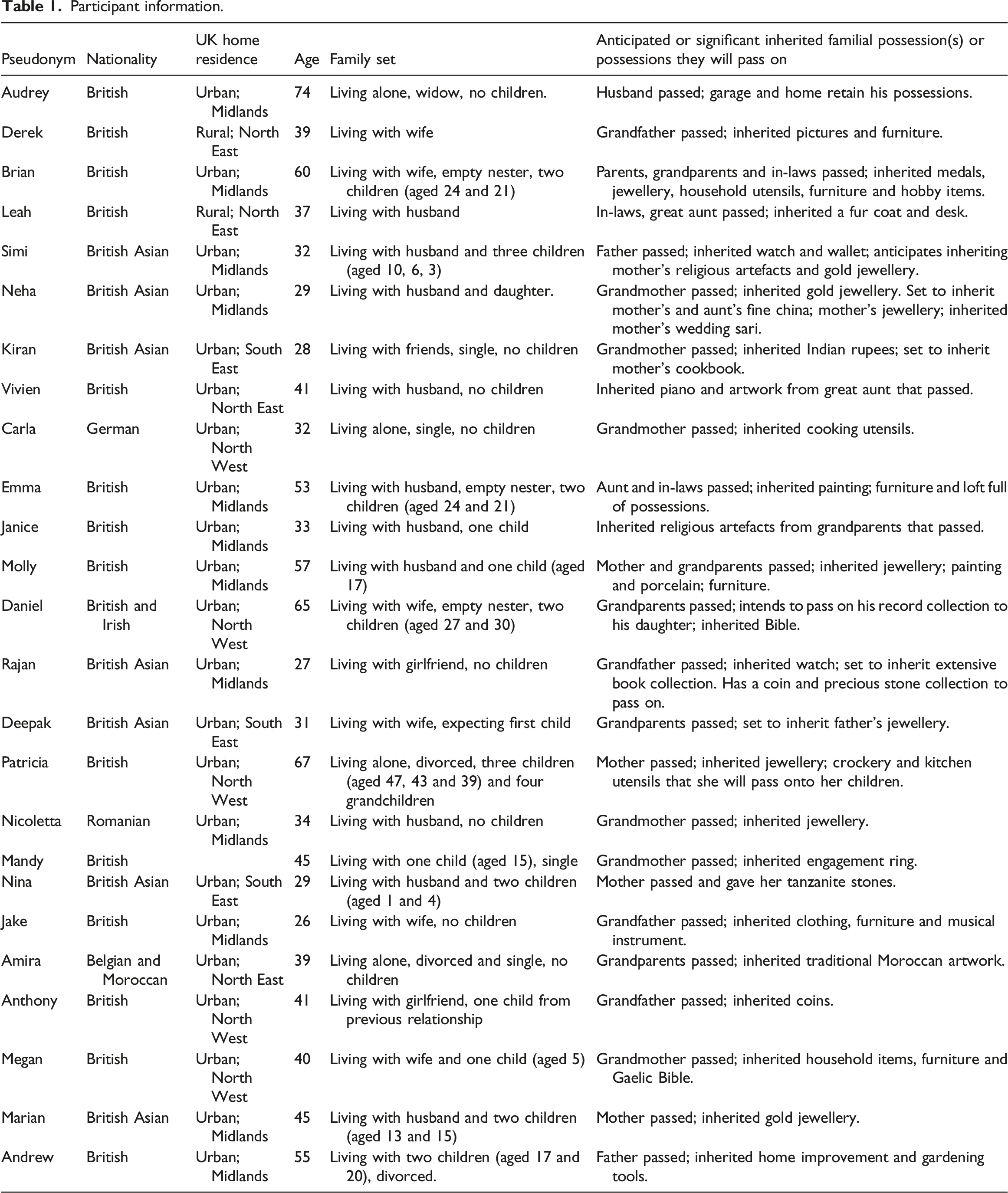
At the start of the interview, participants were informed of the nature and scope of the research and given an information sheet. Informed consent and permission to record were secured, and participants told they could withdraw at any stage. Full ethical approval was established via the university approval process. Each participant received a £10 ‘Love to Shop’ online voucher for their participation.
Together, the authors developed a discussion guide around questions about the participants’ backgrounds, how they came to inherit and/or anticipated inheritance, the nature of the possessions and how they dealt with them, as well as more general thoughts about ownership and disposal. The semi-structured nature of the interviews meant that participants were encouraged to develop a personal narrative (Andrews, 2013). The variety of participant experiences led to narrative themes discussing inherited possessions, family rituals, relationships, habits and traditions, aspects of consumption and disposal, delving into a deeper understanding of family consumption behaviours as we sought to look beyond individual identities and seek to understand collective family identity (Epp and Price, 2008). Participants were encouraged to discuss various inherited possessions including those that were mundane.
The interviews took place between 2018 and 2019, and typically lasted between 45 and 90 min, situated in either participants’ homes, workplaces or other mutually agreed locations; around half were online via Skype or by phone. There were no discernible differences between the data collected in person and that obtained online. Approximately twenty-pages of researcher notes supplemented the interviews and added to the dataset. We continued interviewing participants until theoretical saturation was reached, in other words, no new themes emerged in the data (Clark, 2008).
Interviews were audio-recorded and transcribed verbatim by a professional transcriber. There were three stages of thematic analysis. First, once transcribed, we read each other’s interview transcripts as part of the open coding process. This stage involved identifying overarching themes (King and Horrocks, 2010) relating to intergenerational behaviour in the context of consumption practices. Next, as the analysis progressed more detailed codes emerged and were organised around the liminal experiences that included a ‘before’, ‘during’ and ‘after’. Within this stage, we also sought to analyse the liminality of the inherited possessions and anticipation of inheritance.
Finally, we employed a writing strategy that focused mainly upon key narrative themes derived from the findings, consistent with previous studies (Wheeler, 2012). During this data analysis stage, we sought to highlight the most relevant and exceptional elements (Bazeley, 2013) focussing particularly on narratives of inheritance, their transitions and flows and their contributions to liminality theory (Moraes et al., 2021). We sought to achieve interpretive quality by considering the study’s theoretical frame and contributions, comparing and discussing understandings, respecting participants’ storytelling and providing evidence of the emerging interpretations (Moraes et al., 2015).
Findings and discussion: Inheritance as a liminal experience
The data collection resulted in a diverse range of circumstances and challenges related to the inheritance of possessions. The findings are presented within the three liminal transition stages: i) a pre-liminal state of separation and detachment, ii) a liminal state of instability, ambiguity and prolonged liminality and iii) a post-liminal state of stability and completeness.
Pre-liminal state: Separation and detachment
Families often discuss the future inheritance of goods, assigning outcomes to different possessions, which can be a source of conflict and/or comfort to the generations participating (Ekerdt et al., 2012). Vivien’s old-fashioned family heirloom was something she was reluctant to inherit: There are sometimes family heirlooms that you don’t want…there is this horrible, weird bell thing that seems to run in our family… my mum keeps going, ‘you are going to get it’ …and it’s just horrible. I would probably put it in the hallway. It’s one of those things that tastes really change, don’t they?
While small, unwanted possessions can be located unobtrusively in homes without causing disruption, some inheritance causes greater consternation. Janice anticipated the burden of what she perceives as her ‘baby boomer’ father’s clutter: It’s really difficult, I’m quite anxious about it, my dad is pretty much a hoarder, he has 70,000 records. He does often make this joke ‘well you are going to have to deal with it’. Because there is only me, the amount of stuff is just phenomenal, it’s going to be a lot of work to go through all the records, work out what the value is. Dad he always jokes I’m going to need several skips. I read the recent article was it in New York Times1 about the generation that didn’t want things. I don’t want to end up with a house like my dad’s.
Janice knows that she will need to let go of his collections when he passes, dismantling what was cherished but will become devalued. Janice’s identity is someone who has ‘always known about sustainability and the importance of not damaging the planet’, bolstered by her approach to curating her own home with fewer enduring, quality possessions, wanting ‘less things…again partly to do with the sustainability I would rather have less and better things that are going to last’. Within this pre-liminal stage, Janice felt ambivalent about the looming obligation, the cumulative effect of several generations’ inheritance and her father’s extreme acquisition habit. She was already anticipating that it would be unrealistic to dispose of this surfeit of possessions sustainably – skips end up in landfill - and that she had no interest in retaining them, evidence of her loosening emotional ties with her parent’s possessions (Bardhi et al., 2012).
Emma also agonised about being ‘overwhelmed with stuff’. She had already inherited from her in-laws and faced an impending ‘burden’ coming from her parents: I look at all the stuff my mum and dad had a house full of stuff. I worry about it, and I worry about what happens when they have to sell their house. I don’t want any of it, they’ve got lovely stuff, but I don’t want any of it. It’s a massive responsibility and I don’t want it.
Janice and Emma mirror several other participants whereby consumption patterns of past generations are perceived negatively as pathologised clutter (Woodward, 2021), and at odds with contemporary and future aspirations of limiting possessions. This pre-liminal stage proved a catalyst for several participants to discuss avoiding passing on stressful scenarios to the next generation, and their intention to sift and discard redundant inheritances: We’re organised, we pack stuff away in the loft. I don’t pass on clutter to Jenny and Louise [her daughters]. I don’t want them to come in here one day, and think where on earth do we start, especially if we have all their grandad’s stuff here too, I want it nice and neat for them. I don’t want them to be burdened (Emma).
These excerpts show how liminal experiences can profoundly affect future consumption behaviour (Darveau and Cheikh-Ammar, 2021). Emma’s extended pre-liminal state causes her anxiety, something she wants to avoid for her children. She reflects upon the reducing consumption needs of different generations, recognising her children will not be ‘hoarders’ like their grandparents. The volume of inheritance lingering in her home now seems burdensome, prompting her to detach from the past and the possessions, and declutter for their and her own sake. Research suggests experience with non-minimalist behaviours in childhood can predict later minimalist choices (Wilson and Bellezza, 2022): I think our age group were a very different generation to what our parents are; their house is full of stuff but I’m thinking all the stuff we have got. Jenny and Louise won’t want any of it. We’ve got to make it easier for them, what we’re going to go through with our parents, I just don’t want them to be burdened with our stuff.
By decluttering, Emma’s intention appears to be to avoid future stress for her daughters, limit the throughput of possessions to next generations, and hopefully resolve the lengthy limbo of the inherited goods in storage. Whether Emma will declutter sustainably in terms of how she moves those goods on is unclear. Keeping goods in circulation extends their utility, and recycling and reusing has potential to avoid ‘fast’ consumption trends if consumers choose vintage rather than new (Roux and Guiot, 2020), market exchanges that unwanted inheritance can encourage.
These examples, also demonstrate Thomassen’s (2009) idea of conceptualising liminalities as ranging on a temporal continuum from the short term to permanent, for some people will never resolve how to move on unwanted inheritance. A key feature here is that these inheritors have never acquired, appropriated or appreciated these items, have not built or chosen bonds with them and therefore are forced to jump straight to disposal, often not devaluing or divesting as these have never become integrated into their belongings.
Liminal state: Instability, ambiguity and prolonged liminality
Participants in the liminal stage spoke about the inherited possessions that lay untouched in the house as they contemplated how to deal with them, resulting in a paralysis of inheritance. The inherited possessions are not entirely ignored, but instead catalyse a darker side of inheritance that leads to a range of reactions such as anxiety, guilt and a sense of responsibility. The analysis revealed that certain possessions remained suspended in liminality for many years, if not decades, while other inherited possessions were in a relatively short-term liminal state. The reasons behind the paralysis varied but demonstrate transition disequilibrium.
An example of prolonged liminality is Leah’s inherited fur coat, problematic due to its social history. This fur coat sits in suspension in her wardrobe due to the wearing of animal pelts being misaligned with Leah’s and contemporary society’s values: Certainly, in the past decade, it became horrendous to have fur. I wouldn’t want to throw it away, I wouldn’t necessarily want to give it away, but then whether anyone in this generation would go ‘phew you killed however many rabbits for that coat’, I just don’t know what to do with it.
Some inherited possessions carry a significant duty to past generations, despite no longer possessing a practical purpose, or sometimes generating revulsion. While moving this item on to extend its utility might represent sustainability, not all items have value in perpetuity, and the potential circular currency must be balanced with the desirability of the item for next-generation owners.
Stories of interfamily conflict (Sousa et al., 2010) lie beneath many feelings of guilt, anxiety and hoarding behaviours (Winterich et al., 2017), which Leah navigates as she deals with the contemporary discomfort of familial possessions (Kellor, 2019), not wishing to discard the item casually, but uncertain how to move forward. Brian’s solution is to store inherited possessions in his loft; a liminal space, while he decides how to curate and retain their historic narrative. Although he had no use for them himself, Brian feels a personal responsibility for their safe passage: My mum’s brother he was killed in Dunkirk, I’ve got his medals and my grandfather’s medals from World War one and photographs, I thought it was important to try and maintain some continuity…keep them together. They are in the loft, but perhaps when the time comes, descendants will be more interested. It’s got to be documented properly otherwise nobody will know its significance, at the moment they are just in a box with other stuff.
Brian is using this spatial liminality to retain the family history within possessions that represent a time capsule for the deceased, but until other family members are interested in them the wartime artefacts remain in suspension. Both Leah’s inherited fur coat and Brian’s grandfather’s medals are in a prolonged liminal state; however, Brian anticipates an end to liminality as he expects other family members to become interested. Leah’s fur coat is in persistent liminality, similar to Szakolczai’s (2000) conceptualisation of permanent liminality, which on the surface seems paradoxical as liminality is a transitional phase. However, in the case of the fur coat, this transitional phase is frozen in time until Leah decides the fate of the coat, held despite having little hope that it will become socially appreciated again.
To move the inherited possessions out of suspension, a common thread that emerged from the participants was the desire for people outside of the family to enjoy or use their inherited possession, particularly if that continuity could not be found within the family. However, the sustainable benefits of passing on good quality items can be undermined by emotions, as Leah demonstrates when discussing an unused heirloom. She might like to pass on the desk for someone to use and cherish, but hasn’t quite reached that stage: We’ve a got a desk in the bedroom that we don’t use, it was given to us by Martin’s [her husband’s] parents. It’s a lovely desk, but it’s just sort of taking up space, you almost want someone else to have use out of it, I just wouldn’t want to smash it up. I would want someone to have it, but I think Martin wants to keep it.
A practical item such as this could re-enter the market, and benefit others, but is unlikely to while the generational ties are strong. Despite it causing inconvenience, the family attachment holds the desk and Leah in prolonged liminality.
When showing an interest in astronomy, Brian unintentionally encouraged his father-in-law to give him his telescope. Brian knows he doesn’t use it but feels unable to sell it, despite its obvious utility for someone else. He feels emotionally contracted to retain the telescope, but as time has passed, he believes the moral solution is to move this possession out of limbo, and to transition through his liminal state by giving it to someone to use: It’s wrong of me to flog it because it was given to me in good faith with an intent that I should be using it, I felt beheld to it, like beheld to the contract but I’ve become less of that now and think well I would like to sell it or pass it on, knowing someone else can use, it’s a shame it doesn’t have utility with me.
Brian demonstrates a relaxing of the inheritance obligation he felt to his father-in-law’s possession (Bardhi et al., 2012), but like Leah hasn’t quite got to the stage of completely letting go, even though both recognise others could enjoy the items, and their utility would be revived rather than neglected.
For others, the storage of inherited goods represents a dysfunctional consumption problem, replete with family discord and guilt. Like Janice and Emma, Jake’s grandfather’s legacy is an overabundance of possessions that Jake and his mother resist letting go, causing interfamily tension: I know my mum’s still got loads of stuff she doesn’t want to get rid of. It was very stressful going through his house, it caused a lot of arguments. I don’t want to kind of get rid of everything because it’s my grandads, then at the same time, I have to be practical. Our garage used to be the pool room, now it’s just full of stuff. I have a lot of responsibility in the family, I think I would end up having to sort things out.
Similar to the study of garages as liminal sites by Hirschman et al. (2012), Jake’s mother’s garage is also a liminal site (Darveau & Chielh-Ammar, 2021), where the possessions are neither used nor passed on. Jake knew these goods could be recirculated into secondary markets, but instead, as Darveau and Cheikh-Ammar (2021) describe, the garage remains a ‘transitional space for material possessions, one whose positioning in between interior and exterior spaces reaffirms its liminality’ (pp. 880). This notion of liminality to create potential chaos and danger is also reflected by Douglas (1966). Jake acknowledges that retaining the items indefinitely is impractical and neglectful, and that it disrupts the family’s life. He is slowly accepting that despite the mixed emotions and tensions involved, he should move the possessions out of the liminal, and allow his family also to move on from this shared liminal state. Jake’s example also demonstrates that liminal experience can be a group phenomenon (Noble and Walker, 1997) where groups share a common collective experience of liminality (Darveau and Cheikh-Ammar, 2021), sometimes punctuated by discord. Moving past this liminal stage may require generational disruption, as Jake anticipates.
In this stage inheritors do appropriate (whether to display, treasure or place in a liminal space) and in some cases appreciate their inheritance. However, this appreciation may not be with the physical item itself, rather pleasure and satisfaction may be gained through the sentimental and connective aspects of the inheritance. Because the appreciation has been built, inheritors need to devalue and divest before they can dispose, which can be an extended process.
Post-liminal state: Stability and completeness
People and their possessions were situated in the post-liminal stage when articulating the purpose of the anticipated or inherited possession. This stage demonstrated both continuity and discontinuity in the utilitarian value of the possession. For instance, inherited possessions hold more resonance and are consumed more willingly when there is continuity in the aesthetics of past and contemporary generations. The popularity of vintage goods and the celebration of past decades in fashion and home décor is evident in possession retention by our participants that they considered to be tasteful and chic (Abdelrahman et al., 2020) bolstering sustainability as they do so by avoiding new purchases. Jake demonstrates continuity in a shared intergenerational sense of style and music, as he discusses both the charm and utility of a coat inherited from his grandfather: After he passed away, we found this coat in his wardrobe and now it’s mine, I love it. I wear the coat all the time… he was really into his jazz music, and it’s like that style, and that’s why I like it as well, cos it's sort of like, maybe like mutual interest.
A further outcome of the liminal experience is Jake integrates his inherited furniture into everyday life. Jake appreciates the quality and longevity of the furniture as well as the connection with his grandfather and their shared enjoyment of the furniture: We…got given my grandad’s sofas and armchair, we can use them and I kind of quite like them and the fact that they were my grandads…if I was to go out and buy a sofa from Ikea, I wouldn’t have spent that much money on it and it probably wouldn’t maybe last that long.
By not buying new, and reusing his grandad’s sofa, Jake demonstrates the potential for reduced throughput and sustainability derived from inheritance. Additionally, Jake has not only acquired (through inheritance) but has appropriated and appreciated the items.
Although Emma struggled with the volume of her in-law’s inheritance, she too is drawn to retaining and remodelling one of the stylish pieces, citing its vintage credentials and functionality. This presents an opportunity for refurbishment and sustainable consumption: Ben [her husband] is from a family of hoarders but there is a chair in the back room that would be nice if it was reupholstered…it would look quite retro. I’m thinking I would like to recover it, I’ve never done that before, but I would like to have a go, to try and jazz it up. I suppose it is functional, it can be used, it can be sat on rather than sit in the corner.
Both Emma and Jake exhibit a sustainable curating of the possessions they have inherited. Continuity of the utilitarian value is reflected in repurposing outdated sentimental possessions to appropriate their functional purpose in contemporary lives, generating appreciation (Evans 2019; Warde, 2014). In liminal and post-liminal periods individuals highly value possessions linked to past relationships (Noble and Walker, 1997). The creative transformation of inherited possessions, removes the initial anguishing uncertainty for the heir, transitioning them from their limbo-like state. Brian remodelled an unused amethyst tiepin into a ring for his wife, and Molly described how she overcame the disconnect between her taste and her mother’s by remodelling inherited jewellery. Recycling and remodelling jewellery is recognised as a more sustainable outcome, avoiding further scarce resource depletion (Moraes et al., 2015), even if triggered by aesthetics as in this instance. Molly reflected upon the initial ambivalence (where she and the items sat in a liminal suspension causing negative emotions at the neglect), citing how troubling it was to recognise the emotional significance the jewellery held for her parents and herself. Yet, it did not chime with her own identity. Below she discusses how by appropriating the items she overcame the paralysis and moved them to an appreciative post-liminal space: The jewellery was old fashioned, it really upset me that I kept it in a jewellery box for about a year, every time I opened it, I would start crying. I felt really sad that it was just lying there…I was never going to wear it and then I felt guilty. I went to a jeweller and I said to them I want to remodel these. I want to keep as much of it as I can, together we designed a ring. I wear it every day. It connects all the generations, it’s really special and even though it’s different it absolutely feels like my mum’s jewellery.
Such ambivalence, ‘the simultaneous or sequential experience of multiple emotional states as a result of the interaction between internal factors and external objects’ (Otnes et al., 1997: 82), is also noted in other liminal experiences such as motherhood (Tonner, 2016). An outcome of the liminality experienced in inheritance is sustainable upcycling, again a creative process, which emerges in many of the participant’s narratives. For Molly, upcycling bridges the divide between generational discontinuity and continuity, resolving concerns about the neglect, while retaining her own consumption tastes, and moving her to a post-liminal state. Molly also encourages her own daughter to continue to reimagine the inheritance when the jewellery is passed to her. This pragmatism around wastefulness extends to other possessions that Molly anticipates once passed on may devalue and require disposition to retain utility and avoid liminal suspension, something she openly discusses with Fran: I’m not at all sentimental for Fran doing the same. We are quite open when we talk about things she would want. I’ve quite a lot of Mulberry bags, I would pass on and I know she’s not that bothered …they are not her taste…if she decided to sell them, I would be absolutely fine with that. I want them to be useful, that’s more important to me than the idea that she feels she has to keep them because they were mine, that would be upsetting or sad.
Recirculating goods in the market that will be acquired and used again is a more sustainable outcome for inheritance than items languishing in liminality, but one that is not always accomplished. When appropriating their inheritance, participants seemed comfortable remodelling and recirculating some items, but not others. Neha redesigned her mother’s wedding sari, rather than buying new, but discussed the protection and continuity of inherited possessions that she would not change. In this instance, Neha derives appreciation by curating her family’s jewellery: The big thing in our culture is 24-carat Indian gold. When you are the bride, your parents give you a gold necklace and earrings. It’s not my taste, I don’t wear jewellery, but I want to keep it in its original form. I think that’s part of its beauty to know that’s how my mum was given it by her parents, as it was my grandmother’s, and it was given to her…It will always be in our family and my daughter will one day have this jewellery. If it was melted down and made into something modern, I think it would lose its sentimental value…
Holding on to the jewellery reflects hope of intergenerational passage (Curasi et al., 2004), where Neha can enact a caring and continuity role, passing it to her daughter, just as her mother and grandmother did. The utility of such inheritance centres upon a positive hoarding behaviour reflected in a cultural acquisition for future generations and perpetuating the ritualistic aspects of intergenerational transference. Each generation acquires, suspends (gaining utility from the heirloom) and then passes on the family treasures, as the items move in and out of liminal transition.
Another outcome of the liminality is discontinuity, and different forms of letting go, as the inherited possession is no longer valued or needed, and in some instances divested to purchase a more meaningful possession or experience for the individual. As Evans (2019) notes, the process of discarding can be infused with love and care. Emma reflected on a picture she inherited from her auntie, but now devalued by troubling memories: I think if I look at the picture now perhaps, I think she [her auntie] didn’t have a very nice life; her husband went off with somebody, so she had to sell the house, all her things. So perhaps it’s just looking back and thinking of a bit of bitterness to it all now 'cos he spoiled it all, if I can sell it, fantastic and get something, do something. Go back to Italy where I went with Auntie and think God, we had such a good laugh here.
For Emma, the planned disposal of the picture dissipates the bitterness attached to that period for her Aunt and the sadness it poses for her ownership. Disposition allows her to recreate a happier time, representing greater utility and a more comfortable post-liminal solution than retention.
For many of these individuals while they did not choose to acquire these items, they do appropriate and appreciate them, through remodelling, adaptation and display and therefore do not have to devalue, divest or dispose of them. For those who do choose to dispose of items (Emma selling her aunts picture or future Fran disposing of Mulberry handbags) the devalue and divestment is straightforward as they have not appreciated the items in the first place, due to negative connections or differences in taste.
Conclusion
Bereavement (and anticipated bereavement), and the ensuing inheritance creates consumption; wanted or unwanted and these items become the responsibility of the inheritor. As the new owners navigate this transitional moment, the liminal period presents opportunities to acquire and divest, with the potential for sustainable and unsustainable outcomes, and possible recirculation of goods to alternative markets. Integrating Evans’ (2019) sustainable reorientation of consumption with liminal theory helps to frame and extend our understanding of this universal but unique life transition. Empirical findings take the analysis of inheritance consumption beyond acquisition, to study what becomes of those goods, and the problematic consumption circumstances that bereavement (or anticipated bereavement) can create. As individuals move or remain in liminal periods of bereavement inheritance, we found that how some consumers transition through this liminal state has implications for sustainability, for in those often emotionally laden periods of reflection and decision-making lies the potential for interventions and disruptions to elicit more sustainable consumption choices.
We discovered that consumers’ positive responses to inherited goods (appropriating and appreciating them) have the potential to slow throughput and decrease waste, such as Jake’s coat and sofa, or extend product life cycles using upcycling and avoid new consumption such as Molly’s jewellery, or Emma’s chair. But when inheritance is problematic, less sustainable choices can be made that are wasteful but resolve individual stress, such as Janice’s skip solution to her father’s hoarding. People will also suspend the utility and enjoyment of inherited goods that could re-enter the market such as Leah’s desk or Brian’s medals and telescope when conflicted or unable to decide how to move forward out of the liminal paralysis (making devaluating, divestment and disposal more difficult). From these findings, we have learned how inheritance consumption has impacts on future generations and implications for wider society regarding how we consume or divest after bereavement.
First, we have expanded the scope of empirical consumer research by conceptualising inheritance as liminal, a stage at which people arrive and pass through in different ways and at different speeds. Second, we have illuminated the inheritance consumption cycle, showing liminal inheritance stages are critical transition moments that trigger complex positive and negative emotional responses, with implications for whether goods remain suspended or pass into further utility. Finally, we extend liminality theory by conceptualising bereavement (anticipated or actual) as a liminal life transition, and call for researchers to study inheritance beyond acquisition, since how inherited goods are retained (appropriated or appreciated) or divested (devalued and disposed of) in liminal moments can have implications for sustainability and may provide opportunities to steer more responsible and fulfilling consumption with an emphasis on limits rather than excess.
A central issue is that those who are responsible for divestment may not be those responsible for the acquisition of possessions, meaning that these two parties may feel and act differently in their consumption of these items and an important factor is whether inheritors appropriate and appreciate these items. We have learned that certain familial possessions remain suspended, often neglected, in liminality for many years, if not decades, while other inherited possessions were in a relatively brief liminal state. These offer some of the most intriguing aspects of the study, and the findings show the reasons for suspension in liminality are varied and complex, sometimes intersecting. For example, Neha’s refuses to melt down inherited jewellery for sentimental reasons, so it stays suspended in the safe unworn. The inherited goods in Jake, Emma and Brian’s attics and garages are tinged with sentimentality, but also the sheer volume of goods is a barrier to transition and underpins their suspended liminality. Leah’s fur coat is something neither she, nor she believes anyone else, would want but its previously cherished value causes her to hold it indefinitely in a liminal state without a resolution. Vivien is willing to hold onto an unobtrusive item because it takes up little space, even if she doesn’t want, like or use it. The length of liminality is affected by whether the inheritors appropriate or appreciate the possession (either because it fits with their taste or provides happy memories or is sentimental or because of guilt) making them less likely to dispose of it quickly (even if they want to) because once appropriated and appreciated the process of devaluation and divestment must take place prior to disposal.
This highlights a contribution in developing, through empirical interrogation, Evans’ (2019) moments of consumption definitions and stages. Evans emphases the moments (3As and 3Ds) and suggests (although not explicitly) that these are a linear process. However, as we highlight here, this is not necessarily a linear process. By inheriting an item, you may have not gone through acquisition, appropriation and appreciation and may go directly to disposal. Additionally, in the process of devaluation and divestment, you may find a new role for the item (perhaps through remodelling) and this may mean you move ‘backwards’ to appropriate and appreciate the item. Essentially in the inheritance process acquisition is forced, appropriation and appreciation may never happen and devaluation and divestment may be a painful process. Essentially, we suggest that Evans’s framework should be viewed, not as linear, but as a spiral or intertwined network where consumers can step between moments in a non-linear fashion.
Moving each person out of conflicted liminal suspension will require different approaches, and some may never resolve these dilemmas. For some the prospect of sorting, sifting and passing on excess inheritance is overwhelming and creates the paralysis. Support from outside or within the family to undertake this task might help them move forward to deal with and limit that excess as would reassurance that treasured but redundant items could find purpose elsewhere (Abdelrahman et al., 2020). The prosocial benefits of donation are well documented (Urbonavicius et al., 2019), and alternative markets and upcycling are increasingly popular (Roux and Guiot, 2020; Türe and Ger, 2016). These offer possible solutions to inheritance consumption dilemmas that could provide positive economic, sustainability and wellbeing outcomes for the donator and recipient, something waste prevention policy can support, as would connecting individuals with outlets such as tool or toy libraries (Ozanne and Ozanne, 2011), or local donation centres who can help manage the transition.
The analysis probed the cherishing and the devaluing of what is exchanged during these life transitions and exposed the complexities specifically at the heart of the devaluing, disposal and divestment consumption cycle, which for some never happens. Some participants construct a generational identity that combines innovation and conservation and use the inheritance to build wellbeing for themselves and future generations as they navigate consumption by retaining, reimagining or disposing of the possessions. For others, it is more difficult to let go, as they struggle to transition the inheritance into a more harmonious space.
Future research
Given the influence that culture can play on bereavement (and anticipated bereavement), and attitudes to consumption and inheritance, we would recommend extending the study beyond the UK to other countries, and to a more culturally and economically diverse population, to determine if experiences are mirrored elsewhere. This would allow us to examine populations that have experienced migration, poverty, a dearth of property or economic struggles (Holmes 2019). Research that investigated more deeply anticipated inheritance could explore how problematic inheritance might be avoided, including how bereavement taboos might influence those interventions.
With growing trends towards minimalism, decluttering, sharing and renting (Koenig-Lewis et al., 2020), coping with large, multi-item inheritances may become less prevalent. In some cases, the trauma of dealing with inheritance led some participants towards a more dematerialised minimal lifestyle, recalibrating their attitudes to consumption and their own future legacy of transference. Others such as Janice, Bill and Leah discussed how their own inheritance challenges inspired them to make less purchases of better quality. It would be worth examining this phenomenon more broadly, and to explore how consumers may be encouraged towards lifestyles that focus less on excess and more on limiting consumption (Davies et al., 2020).
Footnotes
Acknowledgements
The authors thank the Academy of Marketing Early Careers Research Fund and the Marketing Trust for supporting this research.
Declaration of conflicting interests
The author(s) declared no potential conflicts of interest with respect to the research, authorship, and/or publication of this article.
Funding
The author(s) disclosed receipt of the following financial support for the research, authorship, and/or publication of this article: This work was financially supported by the Academy of Marketing.
