




Abstract
This paper explores processes of economisation in the context of publicly funded visual art exhibitions, a setting that has not traditionally been characterised as a market. It examines modes of exchange in the art world and how artists’ work can be transformed into objects of market exchange through the use of a regulatory device. It conceptualises the economisation processes of exhibition work as consisting of objectification, classification, and valuation. Building on previous work on economic exchange, including gift exchange and market exchange, it analyses a transition from a specific form of gift exchange – swings and roundabouts – to a form of market exchange – quid pro quo. The paper shows how new exchange practices in the Swedish art market evolved with the introduction of the so-called MU agreement and how it contributed to transforming parts of artists’ exhibition work into objects of market exchange. Despite these new practices, however, the status of the exhibition work as an object of swings and roundabouts exchange was maintained. Exhibition work instead forms a hybrid exchange object, consisting of both swings and roundabouts and quid pro quo exchanges.
Keywords
Introduction
How can a market exchange be created for something that has not traditionally been exchanged as a market object? This paper addresses the changing practices of compensating visual artists for their work activities in the context of publicly funded art exhibitions, and the shift in focus from the artwork to the work as the object of exchange. As well as being an important issue for artists, this topic has wider implications for the study of processes of economisation, particularly for contexts typically exposed to forms of gift exchanges.
The economisation of art worlds has long attracted the interest of marketing and social science scholars due to its association with a variety of complexities, including issues such as valuation (Karpik, 2010), distribution (Pardo-Guerra, 2011), production (Becker, 1982), and exchange (Appadurai 1986). Research has explored, for example, how art objects – while resisting commodification – recurrently enter and exit the commodity sphere (Appadurai, 1986; Kopytoff, 1986), how mechanisms other than supply and demand influence the pricing of artworks (Velthuis, 2005), how artworks are commercially distributed by being displayed in a non-commercial frame (Joy, 1998), and how the production of art involves a wide range of actors (Becker, 1982/2008).
Although markets for artworks are complex enough, the economisation of artists’ work introduces additional complications. First, artists’ work has traditionally been evaluated, valued, and remunerated based on the outcome of that work, that is, artworks. However, not all artworks are easily or even intended to be exchangeable, as artworks may be site-specific, temporary, or process- and project-based rather than product-based (Gerber and Childress, 2017; Sansi, 2020). Moreover, it is difficult to evaluate work effort before seeing the outcome, and there is a lack of heuristics for evaluating similar work. Second, it is difficult to separate the work – the object of exchange – from the artist – the seller – as artists and their work are necessarily linked. While it has been suggested that what distinguishes a commodity from a gift is that the connection to the seller/giver has been erased (Thomas, 1991, in Çalişkan and Callon, 2009), this is not entirely the case for artists and their work.
The commodification of art has been described as a major movement in modern art history, and its nearly inherent business-versus-art conflict has often been debated (Wood, 1996/2003). While it is well known that art worlds are economic as well as aesthetic, social, political, and cultural, the specific ways in which artists’ work is made exchangeable as a market object remain largely unexplored. Instead of settling for the grand narrative associated with commodification, which suggests a conflict between art practices and business practices and risks black-boxing the actual market exchanges for artists’ work, we turn to research perspectives that explicitly advocate a detailed study of the practices that shape these exchanges. Similar to what Finch and Geiger (2011:906) have said about market objects, we argue that behind every art exhibition, ‘there is much and often highly interesting market work, and that many facets of this work remain to be explored’. In order to understand how art worlds – settings long characterised by unpaid work (Artist Information Company, 2023; Jones, 2015; Konstnärsnämnden, 2008, 2016) – become economic, it is essential to examine the actions, objects, and people involved in economising processes (Ertman and Williams, 2005; Çalişkan and Callon, 2009). A key issue in the study of market exchanges (Çalişkan and Callon, 2010) is the analysis of the actions required to transform an object so significantly entangled to the seller – the artist – into a stable object that can be exchanged. This paper therefore seeks to unpack the concrete efforts to exchange this work and how this business–art conflict is managed in practice.
Why is it important to study exchange in markets for visual artists’ work? 1 Following Braun et al.’s (2021) call to study (new) forms of exchange and the mutability of economic things, this paper draws attention to exchange in an art world context characterised by forms of gift exchanges. Indeed, artists’ work with exhibitions constitutes a ‘labour market’ that is not (yet) highly economised and where actors ‘grapple with different registers of value as well as with multiple tools and objects of valuation’ (Helgesson and Kjellberg, 2013:366). Although exhibition work may constitute an extreme case of economisation, the paper provides insights useful for other settings in which non-paid work is carried out, such as in academia.
Despite the complexities involved in the economisation of artworks and artists’ work, recent efforts have been made to transform artists’ work into objects of labour market exchange. This paper focuses on one particular effort: the introduction of the MU agreement (MU) in the Swedish art scene in 2009. The purpose of this agreement is to regulate the economic remuneration of artists engaged in exhibition work. As a device introduced to structure a previously non-existent market for artists’ exhibition work, this case enables us to examine how artists’ work, traditionally considered resistant to commodification and rather exchanged through forms of gift exchange, can be transformed into an object of market exchange. Thus, by studying the implementation of MU in the Swedish job market for artists, this paper aims to contribute to the understanding of processes of economisation and how the shaping of objects of exchange unfolds in practice.
The paper is structured as follows. Next, we present our theoretical framework and key analytical concepts. This is followed by a section outlining the case description and how the fieldwork and analysis were conducted. We then present the findings and build our theoretical argument. Finally, we discuss and conclude our findings in terms of their wider practical and theoretical implications.
Theoretical framework
In order to examine the practical workings that constitute the art world as economic, we draw on previous work on processes of economisation, defined as ‘the processes through which behaviours, organizations, institutions and, more generally, objects, are constituted as economic’ (Çalişkan and Callon, 2010:2). In the research literature on the production and consumption of art, these processes are traditionally understood as the commodification of art (Appadurai, 1986; Wood, 1996). In this paper, we refer to both terms, drawing on the notion of economisation to explore how objects become economic, while also relating to previous literature where the concept of commodification is more common in exploring how art objects become saleable.
The commodification of art is usually based on the conflicting idea of commercialising something that should not be commercial (Appadurai, 1986). Artworks are seen as goods whose essence is non-commodifiable (Velthuis, 2005) and should be protected from commodity spheres (Kopytoff, 1986). Hence, the literature on the economisation of art revolves around the idea that art worlds are not like everyday commodity markets (Bourdieu, 1993; Joy and Sherry, 2003; Kopytoff, 1986). As the artist and the artwork are inextricably linked (Preece and Kerrigan, 2015; Schroeder 2005), the representation of the artist as a commodified product is equally questioned, as the artwork – the exchange object – cannot be detached from the artist – the seller. This practical dilemma of commodification in the art world, suggesting a constant link between seller and exchange object, relates to the distinction between gifts and commodities proposed by Thomas (1991, in Çalişkan and Callon, 2009:387), that ‘a gift circulates while preserving the presence of the giver embedded within it, while a commodity erases that connection’.
A key concern in the commodification of art literature is the exchange. According to Kopytoff (1986), the only time an object undoubtedly has commodity status is at the moment of actual exchange. In commercial markets, the common market exchange is a quid pro quo exchange (Bagozzi, 1975). However, in the context of publicly funded art exhibitions, a common form of exchange is what could be referred to as a form of gift exchange, which does not imply a pure, unreturned gift, but an expectation of a future gift in return, or exchange based on reciprocity (Polanyi, 1944/2001). Artists ‘give’ their work to the exhibition organiser, as they do not receive a monetary fee in return. Instead, they expect symbolic, non-monetary compensation, such as exposure, increased status, and appeal in the art world, which, for example, could be manifested in a higher ranking in the Artfacts’ (2023) artist ranking. By improving their reputation and exhibition CV, however, artists can hope for other potential economic rewards, such as future sales of artworks, public commissions, and grants.
In this context, the ‘gift exchange’ of exhibition work can be understood as the concept of ‘swings and roundabouts’. That is, what artists lose on the ‘swings’ (time and resources spent working for free), they hope to gain on the ‘roundabouts’ (e.g. future sales of artworks and income from state grants). This form of gift exchange entails that the counterpart of the swings and roundabouts exchange is unknown and not the same as the receiver of the exhibition work. It is a precarious form of exchange as the ‘roundabout’ income is uncertain and only potential.
The exchange relations involved in public art exhibitions also relate to what has been defined as generalised exchange (Bagozzi, 1975), which involves at least three actors in the exchange relations: A gives to B, who gives to C, who gives back to A. For example, the tax-paying public (A) gives tax money to the central municipality (B), which gives money to the public art gallery (C), which in turn provides an art exhibition experience to the tax-paying public (A). As can be seen, one actor is missing from this equation: the artist (D), who gives (work) to the public art gallery (C) – and hence, an art experience to the tax-paying public (A) – but does not receive any economic remuneration in return from C (see Figure 1). In order for artists to be able to ‘give’ work to the public art gallery without a quid pro quo exchange, and only the insecure roundabout exchange in return, artists need to finance their work from other economic sources, often generated from day jobs, savings, and grants. Exchange relations.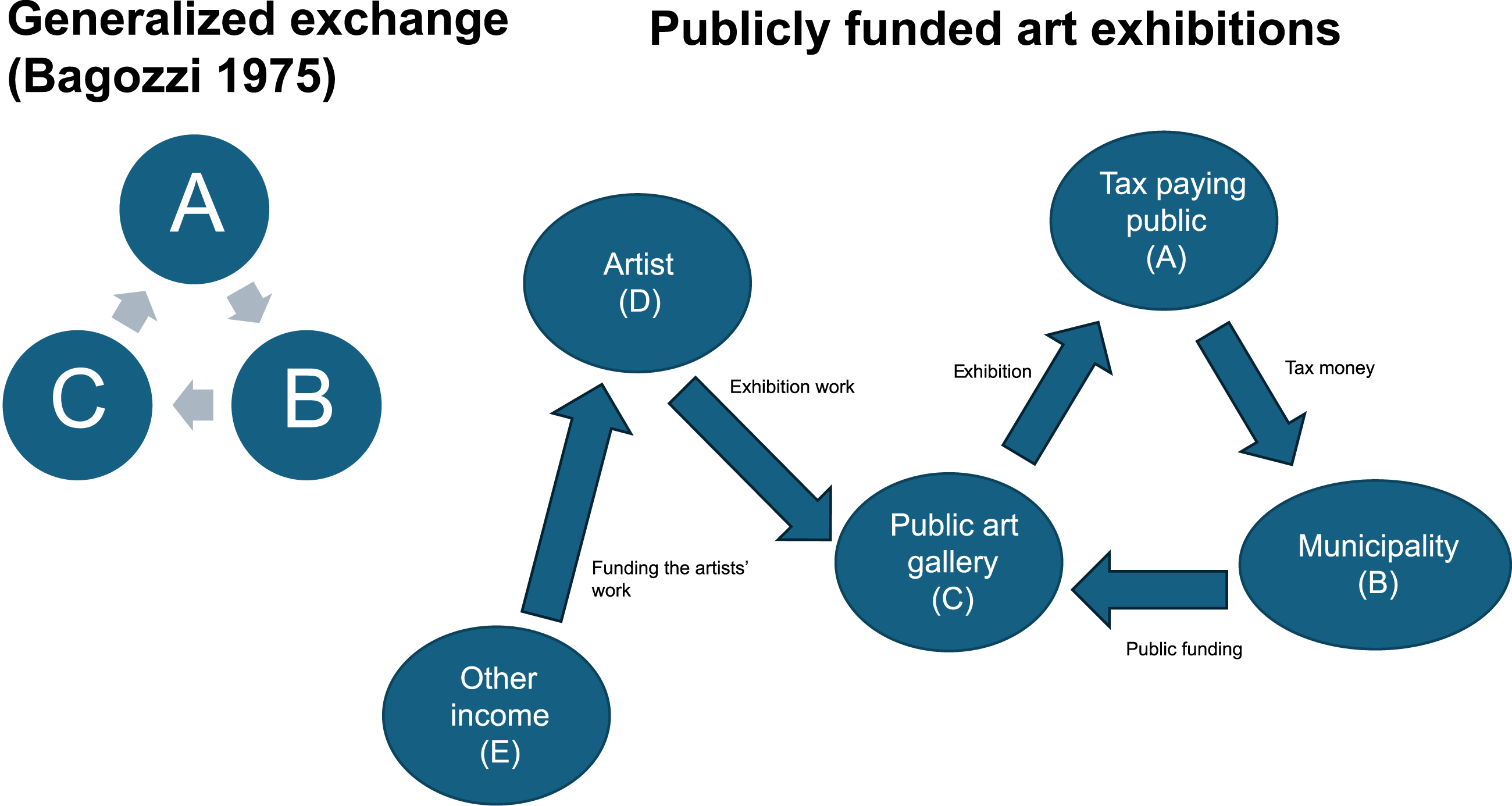
Returning to the debates in the arts commodification literature, it is claimed that artworks that are transferred to new owners as ‘gifts’ and not exchanged for money resist the transformation into commodities (Velthuis, 2005, following Wood, 1996/2003). Therefore, ‘giving away’ one’s work would allow the artist’s work to resist commodification. With the expectation of an improved CV and reputation in the art world for each successful exhibition, the artists’ work could also be understood as part of ‘assetisation’ (Braun et al., 2021), enhancing the artist’s human capital (Pistor 2019) or brand equity (Preece and Kerrigan, 2015). Societies commonly combine mixed modes of exchange, including gift exchange, redistribution, market exchange, and sharing (Braun et al., 2021; Brill, 2021; Çalişkan and Callon, 2009; Polanyi, 1944/2001; Scaraboto, 2015). In the context of art exhibitions, however, mixed exchanges have a special significance. While some work within these networks, for example, the work performed by curators, technicians, and transporters, follows a market arrangement, where services are directly exchanged according to quid pro quo (Bagozzi, 1975), the work performed by artists, often do not.
Recent research on mixed modes of exchange has explored the configuration of hybrid economies in collaborative consumer networks (Scaraboto, 2015) and hybrid exchange objects in morally driven markets (Brill, 2021). These studies discuss how moral, ethical, and social values play an important role in these exchanges. This paper extends the research on hybrid exchanges by examining the fragmented role of work as an exchange object in art worlds, commonly occurring in swings and roundabouts exchanges, but later also subject to quid pro quo exchanges. It focuses on practices enabled through a particular device (MU) that aims to shape artists’ work from its current gift status towards a more clearly defined market status, and what the new fragmented exchange object implies for old and new exchange agents.
Specifically, we examine hybridity of two exchange forms: quid pro quo and swings and roundabouts. Quid pro quo entails an agreed exchange between specified agents, but does not necessarily imply a traditional market exchange that follows the logics of profit maximisation (Scaraboto 2015), which makes it useful in a non-traditional job market setting. Swings and roundabouts refer to situations in which one agent voluntarily gives something to another in anticipation of reciprocal income in the future, although this gift-giving is not dyadic (c.f. (Weinberger and Wallendorf, 2012), meaning that the counterpart is not the same as the receiver of the first ‘gift’, and may not be pre-determined. The swings and roundabouts exchange related to exhibition work differs conceptually from other forms of non-dyadic gift-giving discussed in Weinberger and Wallendorf (2012), as the counter-exchange that artists hope to receive is clearly monetary, but involves a highly insecure and only potential two-step process. This means that the first counter-exchange is symbolic and constitutes the improved CV (assessed collectively by members of the art world (c.f. Karpik, 2010; Thornton, 2008), which potentially may lead to the second counter-exchange – understood as the roundabouts – which is monetary (e.g. the granting of a state scholarship or sales) and is the long-term goal of the artists’ gift-giving.
Thus, while Scaraboto (2015) highlights the consumer’s role in shaping hybrid economies, and Brill (2021) focuses on how commodity exchanges re-position partly as gift exchanges, this study further adds to this body of work by focusing on the configuration of the exchange object, as called for by Scaraboto (2015), by highlighting the practices aiming to make previous gift-objects into market objects. By examining the actions that shape these mixed objects, and tracing the reframing of the objects of exchange from swings and roundabouts to include elements of quid pro quo, we analyse the concrete economic objects that ‘circulate from hand to hand’ (Çalişkan and Callon, 2009:384).
On the basis of an analysis described in the next section, and in order to explain the transformation of artists’ work into objects of market exchange, the paper uses the concepts of objectification, classification, and valuation (cf. Borgblad, 2019). Objectification refers to the practices of materialising things and activities into objects that can be owned and transferred between owners (Callon et al., 2002). It involves the practices of establishing what counts in a quid pro quo space, and what is excluded from that space (Finch and Geiger, 2011). Classification involves defining and relating categories to each other and placing objects in these categories. These practices position and differentiate objects in relation to other objects to be assessed in the market (Finch and Geiger, 2010; Rosa et al., 1999). The categories also set expectations of similarity and comparability within the category (Khaire and Whadwani, 2010). Valuation is about making the object valuable and consists of valorisation (producing values) and evaluation (negotiating and calculating prices) (cf. Vatin, 2013). In order to conduct valuations in markets, it is crucial to have knowledge about the object being exchanged (Beckert and Aspers, 2011). However, unlike markets for standardised and mass-produced objects, art markets are characterised by a high degree of uncertainty and uniqueness about the objects being exchanged (Appaduari, 1986; Joy and Sherry, 2003; Karpik, 2010; Menger, 1999; Velthuis, 2005). These valuation practices consider multiple aspects, as art valuations are created in both market and non-market settings (Joy and Sherry, 2003; Karpik, 2010; Kopytoff, 1986; Preece and Bida, 2017), including educational settings such as art schools and public institutions.
By analysing the use of MU in artists’ work with exhibitions, the paper joins discussions on the configuration of exchanges and the shaping of exchange objects in particular (e.g. Appadurai, 1986; Araujo, 2007; Braun et al., 2021; Brill, 2021; Callon, 1998; Callon and Muniesa, 2005; Finch and Geiger 2010; Harrison and Kjellberg, 2016; Kjellberg and Helgesson, 2007; Scaraboto 2015), as well as research on artists’ work (e.g. Borgblad, 2019; Gerber and Childress, 2017; Lindström, 2016; Parker, 2013; Sansi, 2020). In doing so, it addresses the broader aim of market studies research to develop knowledge about economisation and marketisation (Çalişkan and Callon, 2009, 2010) by empirically examining practices in non-mainstream markets, such as markets of concern – beyond everyday commodity, retail, and financial markets – where actors debate which values to prioritise (Geiger et al., 2014), and markets that demonstrate resistance to commodification (Ertman and Williams, 2005).
Method and materials
The paper is based on a study of the so-called MU agreement (MU), which we examine as an attempt to shape artists’ work as an economic exchange object. MU is a particularly appropriate case for exploring the process by which artists’ work with exhibitions becomes an object of exchange. In general, there are two main categories of art exhibitions. First, there are exhibitions where the purpose is to sell artworks, such as in commercial galleries and art fairs. Second, there are exhibitions where the purpose is to display artworks, such as in publicly funded art galleries and museums. This paper addresses this second category of exhibitions. In Sweden, according to recent data (Myndigheten för kulturanalys, 2023), over 1,400 visual arts exhibitions were organised in 2022. Most of these organisers, such as art museums and galleries, receive public funding. Since the artworks in these exhibitions are not for sale, the potential object of market exchange here is not the artwork, but the artists’ work.
Signed in 2009 by the Swedish Ministry of Culture and three artists’ associations, 2 MU aims to secure financial compensation for artists when they exhibit in publicly funded art institutions (Swedish Arts Council, 2024). MU are the initials of the Swedish words for ‘participation’ and ‘exhibition’. It is a framework agreement sometimes referred to as MU agreements in the plural to emphasise that it can refer to both the framework agreement (which sets out the general conditions and terms of collaboration between artists and organisers) and to the individual exhibition agreements (which describe in more detail the specific terms relating to a particular collaboration). The framework agreement was concluded between the Swedish State as one party and the artists’ associations as the other. The individual exhibition agreements, however, are concluded individually by each artist and organiser who decides to collaborate on an exhibition project. Swedish government agencies and institutions (including some of the major art museums) are obliged to use MU, but its principles on remuneration are also intended to have a normalising effect and to guide all exhibition organisers in Sweden, such as regional, municipal, private, and non-profit organisers, for example, artist-driven galleries.
Data was collected through a combination of interviews, observations, and documents. The fieldwork took place over two periods: 2014–2015 and 2022–2023. This means that interviews were conducted both in an initial period closer to the implementation of the agreement and in a later period when one can expect to see more long-term effects of its implementation. A total of 60 interviews (60 individual interviewees) were conducted with various stakeholders including artists, exhibition organisers, representatives of artists’ associations, officials of national government agencies, and professors and staff in arts education. Of these, 23 interviews were conducted in 2014–2015 and 37 in 2022–2023. The average length of the interviews was 1 hour each. The interview guide differed slightly between the different stakeholder groups. For instance, questions to the artists’ associations were largely about how the construction as well as revisions of MU came about. Questions to artists focused on how they work with exhibitions, how they are funded, and how/if they have used MU. Questions to organisers focused on how they work with exhibitions and how they work with artists’ fees in general and MU in particular.
The observations were conducted during lectures and workshops on MU organised by the artists’ associations for educational purposes. Three lectures and one workshop were observed in 2014–2015 and one lecture (online) in 2022. The target audience for these lectures varied, sometimes being artists (and art students), sometimes exhibition organisers and public sector principals. One observation was also conducted at the exhibition of The Artist (see next section) in 2015. In addition to specific exhibition contracts based on MU (24 documents), documents include industry and government reports on the visual arts sector and follow-up reports on MU (5 documents), MU campaign and workshop materials (10 documents), and news and press material (12 documents).
All interviews were transcribed verbatim shortly after they took place. The analytical process of all empirical material – interviews, observation notes, and documents – evolved iteratively (Czarniawska, 2014). The main analytical work was conducted on three levels of analysis (Styhre, 2013). The first level was detailed to identify all the actions that constituted potentially significant practices. These practices were coded into 17 themes, such as ‘pricing’, ‘studio work’, ‘MU revisions’, and ‘norms’. At the second level of analysis, insignificant issues were filtered out, and the remaining themes were assembled into larger themes with similar characteristics. At the third level, the analysis evolved into the three main themes describing the construction of an exchangeable object: objectification, classification, and valuation. The second and third levels of the coding process were influenced by previous concepts aimed at explaining processes of market exchange (Callon and Muniesa, 2005; Finch and Geiger, 2011; Kjellberg and Helgesson, 2007). The findings are presented along the practices of objectification, classification, and valuation, and form the framework for discussing how the artists’ work is constructed as a hybrid exchange object constituting both quid pro quo and swings and roundabouts exchanges.
Shaping artists’ work as an exchange object
In the following sections, we outline how MU plays a role in the practices that contribute to shaping artists’ work as an economic object: objectifying, classifying, and valuating practices. To illustrate this transformation, we will particularly describe the practices taking place before – and during – the solo exhibition of The Artist, 3 displayed at a publicly funded, municipal art gallery in Sweden in 2015.
Objectification
Objectifying practices refer to practices of materialising objects into products that can be owned and transferred between owners. Objectification thus means conceptually that the entity to be exchanged, in this case the artists’ work, must become ‘ownable’ and ‘transferable’. However, since the work cannot be physically detached from the artist, objectification refers to the time and place at which an artist’s work enters (and exits) the commodity phase (Appadurai 1986). This entails the hours artists spend on their work temporarily assigned to specific tasks agreed upon with the organiser. Thus, unlike the objectification of artworks through materialised qualities that allow for ownership and transfer of ownership, objectification here is based on the artist’s working hours in relation to a specific exhibition and the previous production of artworks.
The objectifying practices of artists’ work with an exhibition imply clarifying the different elements needed for the exchange. This consists of deciding: (1) that the artist’s work should be remunerated, (2) what the object of exchange is (the forms of the artist’s work to be temporarily transferred to the buyer), and (3) who the agents of the exchange are (the selling artist and the buying organiser). Objectification thus begins with the decision to pay the artist for their exhibition. The first paragraph of the framework agreement states that it aims to determine: … forms of negotiation (mode of exchange), content of agreements (the exchange object) and the signing of agreements between the exhibition organiser and the exhibiting originator (agents of exchange) in connection with the displaying of works owned by the originator. (Swedish Arts Council, 2021b, authors’ comments in brackets)
The individual exhibition agreements state whether the work is to be remunerated only according to the U-fee (exhibition), which implies a copyright fee for the artist. The object of exchange here is the organiser’s right to display the artworks for a certain number of weeks, for which the artist is remunerated. The agreement should also state whether the organiser remunerates the artist according to the M-fee (participation), which means that the organiser will pay for the hours the artist spends on work specifically related to the exhibition. This work could include the production of new artworks, hanging the exhibition, project meetings with the curator, participation in public seminars, etc.
While the U-fee functions as a kind of copyright agreement, the remuneration related to the M-fee can be seen as a kind of wage labour. This means that the work remunerated according to the U-fee is sometimes considered retrospectively, after the work producing the artworks has already been done. The work remunerated according to the M-fee is considered before it is carried out, as it concerns new work activities commissioned by the organiser and directly related to the exhibition. Another significant difference between the M- and the U-fee is the degree of obligation. If a municipality states in its cultural policy that its exhibition organisers should follow MU, only the U-fee is mandatory and cannot be avoided by the organiser. The M-fee, however, is negotiable, which means that remunerations for working hours vary between different art galleries and museums.
To explore the objectification of artists’ work in more detail, we will take a closer look at The Artist exhibition in 2015. The artworks exhibited included video works, photographs, installations, and performances. The form of work involved in performance artworks is sometimes difficult to objectify in terms of MU. An exhibition consisting only of a one-off performance can be remunerated as an exhibition of a minimum duration, that is, 1 week, according to the U-fee. In The Artist’s exhibition, however, the artist conducted a performance that ran for a month. The performance consisted of The Artist being in the gallery on Wednesdays to Fridays between 1 pm and 3 pm for 4 weeks. During this time, the performance grew and became an installation measuring 6*10 m, as it consisted of the artist writing a repetitive text on one of the gallery walls until the text covered the entire wall.
The decision to run the performance for a month was taken after a ‘pilot test’ of the performance, calculating how many hours it would take. On a day when the art gallery was closed to the public, The Artist simulated the performance by writing 2 m of text on the wall. The Artist wrote the text in the specific size and at the specific pace that the Artist wanted to write when conducting the performance in public. While the Artist wrote these 2 m of text, one of the art gallery technicians timed how many minutes the writing took. This number was multiplied by the total area of the performance wall. Through this procedure, the work activity was objectifiable. The Artist thought that the calculation and the exact timing made the remuneration in relation to the work effort concrete and easy to motivate, also because it implied a physical work effort on site: When I did the wall, the text wall, I kind of wanted to play with the issue of ‘day jobs’. And artists’ work. Because I was able to set aside X number of hours in a month. While producing a new artwork. I think it was the only artwork that was … that was kind of easy to motivate. This work takes this many hours. (Interview, 2015)
Other artistic activities, including the production of work for exhibitions, are not as easily remunerated. The Artist claimed: In my experience, if you were to count the hours of preparation for a particular work, you would never be able to get paid for it. It is usually only the material that can be motivated, then you can justify, for example, someone who works with producing a physical work, a painting. I think it’s easier to point to that: I need 7 meters of canvas, it costs this much, here’s the receipt. In my case it’s more fluid, I’m working with volatile materials, and you might be working with rather long preparations over time. And then there is the real, concrete work of recording or editing, but it is so terribly little time. It might be 10% of the total work. So maybe you can get paid for the 10%, but not for the 90%. No chance. (Interview, 2015)
This quote suggests that artists may have a certain perception, based on a percentage, of what kind of work can be economically remunerated and what work remains unpaid. However, as other interviews with artists indicate, the activity of counting hours, and determining what percentage corresponds to, for example, artistic work or administrative work for a specific project, is also uncommon. Hence, establishing precisely which work activities should be included is challenging and reflects the nature of artists’ work, often characterised by long processes, fragmented tasks, and irregular working hours.
To summarise, this section has shown that objectifying exhibition work as an exchange object through MU implies setting the general terms for the exchange. The physical contract is thus an objectifying device as it materialises the conditions for the exchange of the artists’ work on the one hand and the organiser’s remuneration on the other. Establishing these terms also implies establishing what work will be excluded from the market exchange. For example, the actors may agree not to include all the participatory work activities related to the specific exhibition, such as installing the exhibition, meetings, and producing new works. This means that some exhibition work, such as the performance hours in the case of The Artist, is objectified as a quid pro quo object, thus becoming a question of market exchange. Meanwhile, some work is excluded from the market exchange (Finch and Geiger, 2011), such as large parts of the preparation hours of artworks, as in the case of The Artist. The work is still exchanged, but only as a ‘swings and roundabouts’ exchange, as the artist may hope for other, potential future income from this exhibition work.
Classification
Classification refers to practices of defining and relating categories to each other, and of placing objects in categories. Some of the general classifications of artists’ work using MU are already established through objectifying practices: there are work tasks to be exchanged, and there are actors on both sides of the exchange: artists and organisers. The actors have established what counts in this market space (Finch and Geiger, 2011) and indirectly what is exchanged only as swings and roundabouts. However, these initial considerations introduce questions that require more elaborate considerations of classification, such as, who counts as an artist, who counts as an exhibition organiser, what counts as an exhibition, what counts as work, and what are the different kinds of work?
To be considered as an artist whose work is to be remunerated, there is a professional categorisation of the artist and the exhibition situation that must be met for the agreement to apply. The artist cannot be under 18 years old, and the exhibition cannot be organised in an educational context. Apart from that, the organiser classifies who is an artist based on subjective judgement. In the MU framework, there is no requirement to be a trained artist or to have a specific CV.
The interviews indicate that related to the question of who qualifies as an artist is the question of what qualifies as an artwork. Although the agreement makes no distinction between artworks and ‘non-artworks’, in practice organisers have made such distinctions. There have been doubts as to whether exhibited objects could be classified as artworks and thus whether MU would apply. One example given in an interview with a museum manager was an exhibition that included photographs. According to the museum manager, it was not clear whether these photographs should be classified as artworks or simply as part of the ‘scenography’ of the exhibition, and whether the photographer should be classified as an artist or as a ‘supplier’.
Moreover, although MU should not take into consideration what category of artwork is exhibited, performance artworks have often been open to interpretation in terms of the object of exchange and the form of remuneration. Compared to, for example, paintings, sculptures, videos, and installations, performance artworks are time-specific. They exist during the performance and cease to exist when the performance ends. Sometimes, but not always, the performance ‘leaves behind’ artefacts in the exhibition space, which can be displayed as an extension of the performance artwork after it has taken place. So how should an individual performance – consisting only of a material presence for, let’s say, 5 minutes – be exchanged using MU?
According to representatives of artists’ associations that advise and support artists on MU, this kind of question has been asked by performance artists trying to understand if and how MU applies to their work. The follow-up report by the Swedish Arts Council (2021a) also indicates that exhibition organisers find it difficult to interpret and calculate the M-fee for certain artworks, such as performances. The fact that artists are usually present during a performance (or, sometimes make use of other people’s presence, see, e.g., Parker 2013) – and thus the work effort is very upfront – sometimes makes it difficult to decide whether it should be remunerated according to the U-part (‘only’ displayed artworks in an exhibition), or according to the M-part (active participation in an exhibition), or both. In The Artist’s case, the performance was remunerated based on the M-part, partly because it was a new artwork, produced for the exhibition in question.
As shown in the objectification section, not all work activities are ‘quid pro quo’ exchangeable, and there are borderline cases that may be different for each exhibition in terms of how to categorise work activities. According to the organiser of The Artist’s exhibition, the work activities in relation to the exhibition were categorised as at least two kinds of work: artistic work, which mainly involved the production of artworks, and more technical and administrative work, which included, for example, project meetings and hanging the exhibition. However, in a 2023 interview with an exhibition director at another Swedish art museum, it was stated that they did not distinguish between creative and other types of work when defining the work activities included in artists’ participation, regardless of whether the work entailed thinking, creating, administering, or writing invoices.
Organisers are also classified in MU. Based on factors regarding the character of exhibition organisers (their main activity), ownership structures, and annual visitor statistics, they could be classified into four categories (Swedish Arts Council, 2021b). The remuneration to the artists based on the U-fee depends on under which category the exhibiting organiser falls. The Artist’s exhibition was held in a municipal art gallery, which is classified in category 3, as it is a smaller art gallery with 10,000–50,000 visitors per year.
These categories were established in 2014, when MU was revised for the first time since 2009, partly in response to criticism from organisers. Embassies were previously in category 1 because they were organisers with government principals and had a high total number of annual visitors. However, they were moved to category 4 because the number of visitors who came specifically to see the art exhibitions was much lower than the total number of visitors who came to the embassy for administrative reasons. Other revisions to the agreement in 2014 involved changes in the terminology. ‘Art exhibition’ was changed to ‘exhibition’ and ‘artist’ to ‘originator’ to make it clear that the agreement covered not only traditional visual artists but also, for example, photographers and illustrators.
In 2023, MU was revised again, partly due to the Swedish Arts Council’s follow-up report (2021a), which indicated that some exhibition organisers found the agreement difficult to interpret and implement. 4 A representative of the committee working with the revisions argued that the new MU agreement should be more user-friendly and not require its users (i.e. curators and artists) to have a law degree. As a result, one revision in 2023 was that the work related to M-remuneration was more clearly defined, already on the first page. In the new agreement, examples of this work are given, including the artists’ working hours involved in the production of the exhibition as well as of new artworks, catalogue work, hanging/displays, participation in meetings, opening and programme activities, as well as post-production work. Also, the four organiser categories were changed to be based primarily on visitor statistics.
The, perhaps, most significant change in the revised MU is that it adds a sentence at the beginning that emphasises the normative role of the agreement: ‘The Agreement is also intended to establish good industry practices regarding conditions and remuneration to originators for the exhibition of their work as well as for organisers other than the state’ (Swedish Arts Council, 2024). Indeed, the follow-up report from 2021 (Swedish Arts Council, 2021a) shows that knowledge about MU has increased, confirmed also by many of the interviewees who claim that there is now a different discourse around payments to artists compared to how the rhetoric used to be. This discursive shift in the art world is also highlighted in Gerber and Childress (2017).
In summary, this section has shown that classifying exhibition work as an exchange object involves considerations based on explicit criteria, such as the category to which the organiser belongs. It also involves criteria that require more interpretations, such as what counts as an artwork, how an artwork should be classified according to the M- or U-part, and what counts as ‘participation work’; decisions largely influencing the form of remuneration. These many considerations of classification thus lead to questions of valuation: how is the artist’s work valuated?
Valuation
Valuations refer to the practices of making the object valuable and consist of valorisation (producing values) and evaluation (negotiating and calculating prices) (cf. Vatin, 2013). While the previous sections described the practices of defining the exhibition work as an object of market exchange, that is, establishing what counts in a market space (Finch and Geiger, 2011), this section outlines the practices of deciding on the economic value of the work to be exchanged.
Regarding the U-fee, which remunerates the right to display the artworks for a certain period, the production work behind the artworks is paid for indirectly, but retroactively. An artist reflected on the difference between the indirect work that is remunerated according to U, and the direct work that is remunerated according to M: There’s a big difference if you exhibit paintings that you have already done, that already exist. Perhaps you’re invited to show the same exhibition that you showed in one part of the country in another part of the country. Then there is not the same amount of work as if you were to do, for example, site-specific works, produced in relation to a certain milieu or theme, etcetera. That’s all together something else and hence it needs to be remunerated much more. Because it involves a lot more work in regards to the exhibition. (Interview, 2014)
The U-fee is not based on intrinsic or extrinsic valuations related to work effort, hours, production costs, number of artworks, artist brand, etc., but on the categorisation of the organiser, the duration of the exhibition, and whether it is a solo, small group, or large group exhibition. The different fee levels in the tariffs follow certain principles in relation to standard copyright-oriented factors based on the reach of the artist’s exhibition. For example, the more people exhibiting together, the less each artist receives. And the higher the number of visitors, the more the organisation pays.
The standardisation of the U-fee means that this remuneration is predictable, and for artists exhibiting with state-owned organisers, the fee is expected, as these organisers are obliged to remunerate in accordance with the U-fee. However, the tariffs only specify the minimum level of the fee. There is nothing in MU that – in principle – prevents the organiser from paying a higher U-fee. However, in practice, these U-tariffs have become the maximum level of remuneration. In a 2014 interview, a representative of an artists’ association claimed that as soon as a minimum fee was decided, it was automatically implemented as a maximum fee. Likely, this minimum-is-maximum level is partly related to a kind of supply and demand aspect in the art world. As the supply of exhibiting artists exceeds the demand from exhibition organisers, there is little incentive to attract artists with higher fees.
The M-fee is not as standardised as the U-fee but is a matter of negotiation between the organiser and the artist. Although no explicit rates are mentioned in the framework agreement, it refers to industry guidelines regarding what is a fair hourly rate for the artists’ work. 5 However, the price of the work related to the M-fee is rarely based on this hourly rate. The financial scope to pay artists for their exhibition is usually fixed in a pre-determined exhibition budget, often set years in advance. The exhibition budget thus conditions what work can be paid for or how much it can cost. If an artist wants or is asked to make a new artwork that is expensive to produce (considering materials, working hours, suppliers, etc.), most of the budget may be spent on that artwork. In addition, some artists work with artistic practices that are improvised and difficult to plan in advance. This makes it difficult to estimate the costs of these exhibitions, which relates to the discussion on the objectifying practices and the difficulties of even defining what the exchange object consists of.
In the exhibition with The Artist, the remuneration was based on both M- and U-fees. Following the agreement’s tariff, the U-fee was calculated based on the category of the art gallery, the fact that it was a solo exhibition, and the duration of the exhibition. The M-fee was partly calculated according to the guidelines of the framework agreement. As stated above, technical non-artistic work or qualified creative work is differentiated by some organisers where technical work may have a lower hourly rate than creative work. Artists may then be offered an average rate that includes both types of work. The organiser of the exhibition with The Artist thought that the production of the artwork was more valuable than The Artist’s participation in activities such as hanging and installing the exhibition, which affected the calculation of the hourly rate. The organiser explained that they calculated the hourly rate partly based on when they tested and estimated the number of hours it would take to complete the performance. The gallery also considered the recommendations of the industry guidelines but found them to be too high for what they could afford. In the end, The Artist’s work was remunerated according to both the fact that it was artistic work, not just technical or administrative, as well as it was conditioned by the exhibition budget.
To summarise, this section has outlined how valuating exhibition work as an exchange object through MU implies setting prices in relation to fixed tariffs, negotiations based on industry guidelines, as well as the purchasing power of the organiser – that is, the budget. The fact that organisers are financially limited by public funds affects the calculation of the fee to artists. The pre-determined budgets partly determine what kind of work can be paid for, and thus what kind of work can be considered an object of market exchange. This also means that although artists are paid for their work activities, such as producing new artworks, writing catalogue texts, hours spent installing the exhibition, and attending project meetings, it may be at a lower rate than is considered fair according to industry guidelines, which can lead to the feeling that the work is being exchanged as ‘swings and roundabouts’. However, the valuation of what non-paid work will be exchanged as swings and roundabouts is very much an activity assigned to the artist. Ultimately, it is the artists themselves who decide how much work they should put in and how to finance this work, but as there is an external (from the organiser) as well as internal (from the artist) expectation of delivering high quality, their situation is precarious as the intrinsic valuations (improved CV) related to the ‘roundabouts’ (e.g. potential sales or commissions) are at stake. This point relates to previous work on hybrid exchanges addressing the continuous tension between different modes of exchange, as noted by Scaraboto (2015).
Discussion
This paper has explored a process of economisation in Swedish job markets for visual artists through the case of MU, which has contributed to constructing a hybrid object of market exchange. Since economisation involves a broad understanding of how a product becomes economic (Çalişkan and Callon, 2009), without necessarily making it marketable, we believe it is a more suitable term than commodification for the phenomenon we have studied. The object in question becomes partly economically calculable as a gift and partly economically tradeable as a market product, forming the hybrid object of both swings and roundabouts and quid pro quo exchanges.
This paper has discussed how the specific form of gift in the artists’ labour market being swings and roundabouts is directed towards the unknown future (within the art world) and not towards the buyer of the quid pro quo object. By examining practices related to art exhibitions and the use of MU as a framing device, the paper has shown how artists’ work partially transforms into objects of market exchange through three main practices: objectification, classification, and valuation. For each of these, we have described how they enabled the transformation of exhibition work from being primarily objects of swings and roundabouts exchange to also being objects of quid pro quo exchange. The object is both standardised to meet the general requirements of the agreement, and singularised, as each work situation is objectified, classified, and valuated as a unique object (Karpik, 2010). These practices are closely interlinked. Objectification of artists’ work forms an overarching phase of the process, wherein the basic elements of the exchange are established. These elements, deciding that work will be performed and remunerated, and that there are exchange actors, include the more specific practices of classification (identifying the specific actors and delineating the form of work to be exchanged) and valuation (how the work is valuated, thereby influencing the calculation of the M- and U-fees).
Moreover, the analysis shows how the implementation of MU and the construction of the new exchange object have altered other sub-practices of exchange (Kjellberg and Helgesson, 2007) within the artists’ labour market, such as the configuration of exchange actors. With the artists’ work becoming the object of exchange, the exhibition organiser now acts as a buyer of the work rather than solely serving as a marketing platform for artists’ potential future sales and income. Consequently, the exhibition space is transformed into a labour market where the work itself is exchangeable. Although the agency of the artist remains that of a seller, it now pertains to a new object of exchange: the work. This shift in agency implies a different, more market-oriented set of professional skills, as the work and remuneration exchanged according to the M-fee are negotiated.
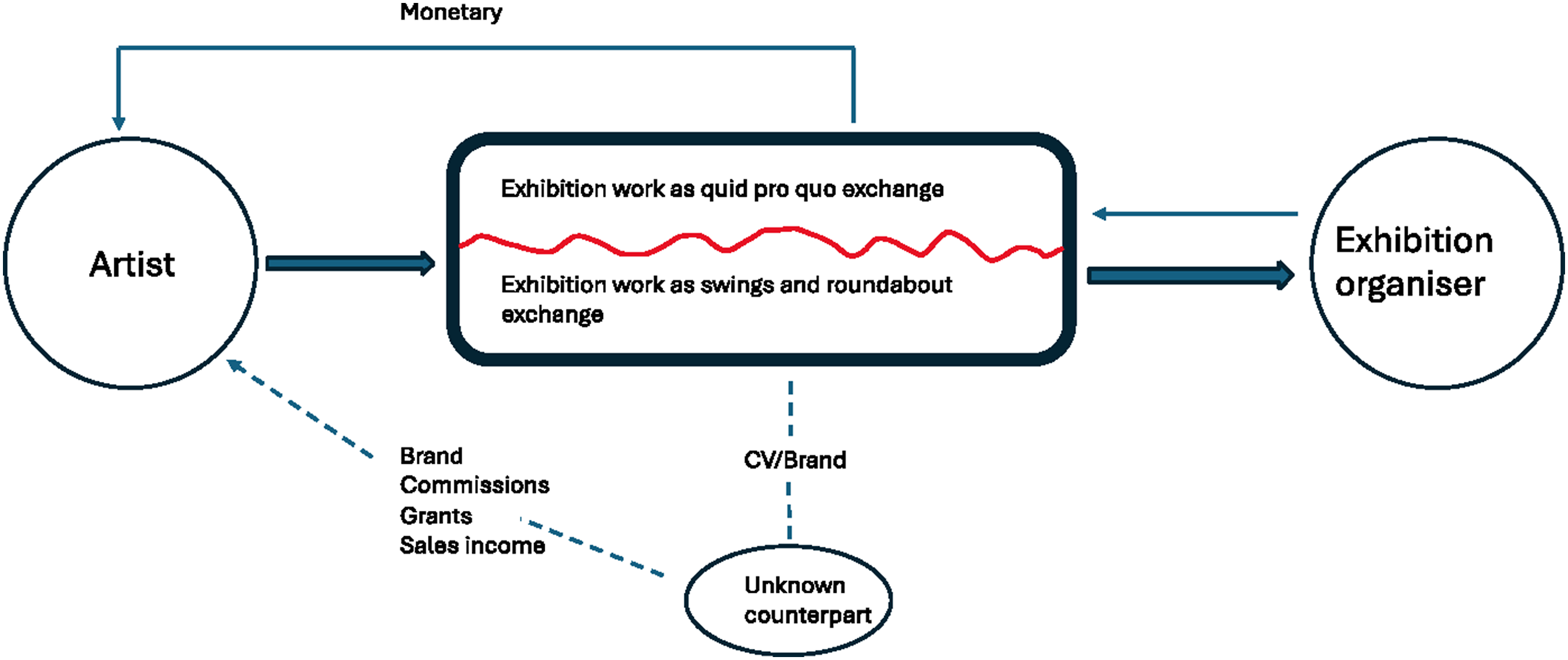
However, although part of the exhibition work becomes a market object, the unpaid part of the work retains its status as an object of swings and roundabouts. Moreover, because the artist is so embedded in the work, it is difficult to erase the link between the object and the seller, and so future valuations of their work are taken into account. The intrinsic valuations of the artists as they engage in professional activities related to the exhibition – building relationships with the organiser, extending their network in the art world, and adding an exhibition experience to their CVs, which are crucial for the allocation of grants – are all considered in the roundabout exchange. Thus, part of the exhibition work is temporarily counted as a market object by the buying and selling actors through objectifying, classifying, and valuating practices, but the work that counts outside of this quid pro quo exchange is simultaneously considered and remains a swings and roundabouts exchange for which the artist may hope for a future monetary exchange. This analytical point adds to earlier discussions (e.g. Brill, 2021; Scaraboto, 2015; Weinberger and Wallendorf, 2012) of the characteristics and exchange qualities of the gift by showing that the voluntary gift is not only a matter of ethics and conscience and pursuing social relations but may be a necessary and calculated part of the exchange, as the artist’s free work is expected to be monetarily returned in the future. Moreover, without the swings and roundabouts as part of the total exchange object (the exhibition work), the work framed as quid pro quo exchange would likely not be able to constitute a sufficiently satisfactory result (the exhibition). Hence, it is partly a stable market exchange object (Çalişkan and Callon, 2010) that is constructed but requires the aspect of swings and roundabouts.
Figures 2 and 3 illustrate how exhibition work was previously exchanged as swings and roundabouts (Figure 2) but now also exchanged as a quid pro quo object (Figure 3). Figure 3 shows this hybrid exchange object, where part of this exhibition work is framed as a market exchange object, with the exhibition organiser as the buyer of the quid pro quo exchange. The other part of the exhibition work remains as swings and roundabouts, with potential, but so far unclear, counter-exchanges, which may be, for example, state working grants, public commissions, and income from sales of artworks. Hence, while the artist remains the seller/giver of both the swings and roundabouts and quid pro quo exchange, these two forms of exchange have different counterparts. Moreover, the symbolic counter-exchange that is needed for the monetary roundabouts exchanges is the artist’s enhanced reputation within the art world after their exhibition, here understood as improved CV/brand. This relates to previous discussions on how artists’ work could also be understood as part of ‘assetisation’ (Braun et al., 2021), of the artists’ human capital (Pistor, 2019), or the artists’ brand (Preece and Kerrigan, 2015). For each exhibition, these hybrid exchange objects are individually constructed, as MU is interpreted and implemented differently from case to case. Exhibition work as a swings and roundabouts exchange object. Exhibition work as a hybrid exchange object.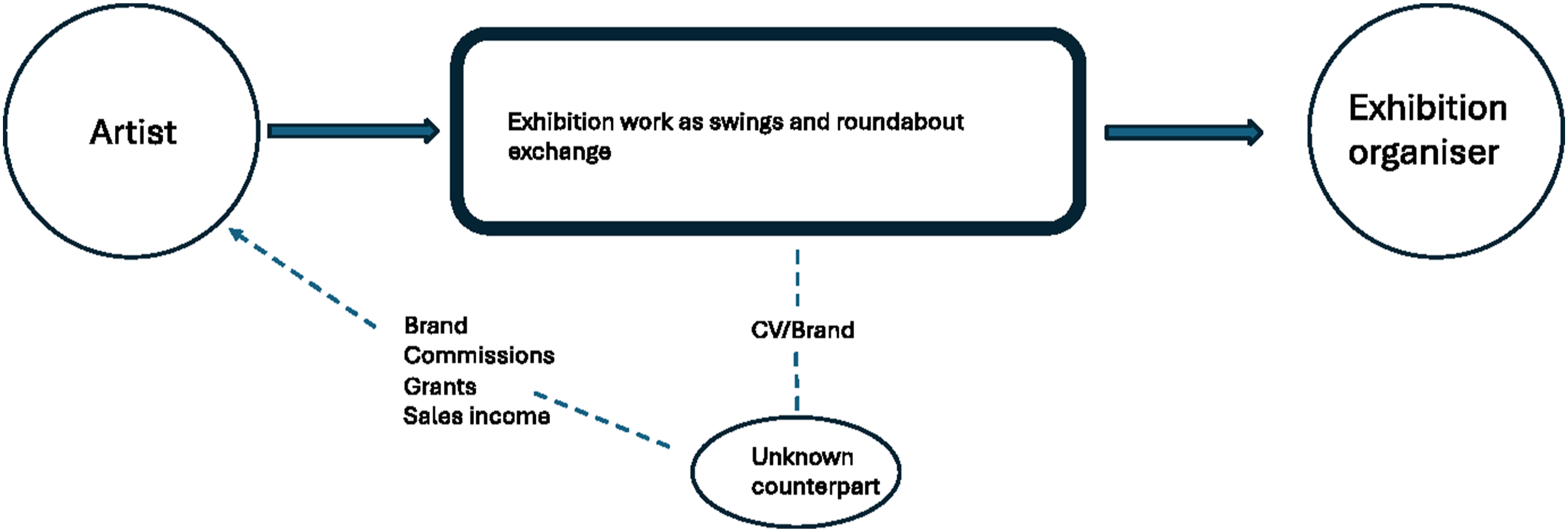
The paper has demonstrated how MU functions as a framing device, clarifying the roles of the seller and buyer, and establishing that an exchange is to take place. Indirectly, MU also highlights what work falls outside the quid pro quo exchange, instead being ‘traded’ as swings and roundabouts. The revisions to the agreement also reveal how it aims to shift exhibition work towards quid pro quo exchanges rather than swings and roundabouts. The changes in the revised 2024 agreement (which was not in effect at the time of the fieldwork for this study) aim to enhance clarity and ‘user-friendliness’ in order to increase its implementation. For example, in the list of definitions on the first page, the term ‘participation fee’ is now defined with concrete examples illustrating the nature of participation work. In contrast, the previous agreement was perceived as a more complicated juridical product, difficult to navigate.
From a job market more akin to swings and roundabouts exchange, where the artist mainly incurs costs from the exhibition work, potentially reimbursed through future income, MU has the potential to establish more quid pro quo exchanges in the markets for exhibition work. So far, MU has not so much contributed to revolutionising wages for artists, as much of the work is still carried out without economic compensation. However, MU may help to clearly distinguish for both the selling artist and the buying organiser what constitutes ‘free work’ and what is paid for, thus identifying what the artist is ‘sponsoring’ in terms of work effort for the exhibition.
Furthermore, findings from interviews and follow-up reports indicate that the discourse about artists’ compensation has changed since MU was introduced in 2009, as also discussed in Gerber and Childress (2017). Previously (and some still), exhibition organisers typically manifested responses such as: ‘The artists will get exposure and enhanced CVs in return for this exhibition’, mirroring the symbolic counter-exchange. More recently, however, another common narrative has emerged, establishing attitudes such as ‘We want to pay the artists, but we are limited by our budget’ (e.g. Bildkonst Sverige, 2024). This new attitude further implies a shift in the dynamics of negotiation, from a relationship primarily between the artist and the organiser to one that more clearly involves the organiser and their respective funders. The desire to use MU to operate professionally as exhibition organisers and to appear legitimate in the art world has meant that the costs implied by MU are used in requests for increased budgets.
Moreover, it is worth noting that the implementation of MU and the framing of exchange objects, and what should count as paid exhibition work and not, also creates overflows (Callon, 1998) in the job market for exhibition work. Overflows – the unexpected consequences of framing objects – could, for example, be a situation, indicated by interviews and follow-up reports (e.g. Bildkonst Sverige, 2024), where organisers choose to exhibit fewer contemporary artists, as the obligation to follow MU incurs costs they cannot afford. While the ambition of MU is to increase sound and sustainable remunerating practices in the art world, it may nevertheless lead to fewer exhibition opportunities as these former arrangements with ‘swings and roundabouts’ exchanges – old-fashioned but yet attractive to some artists – decrease. As MU likely will continue to be revised along with its implementation in practice, future overflows are expected. Questions for further investigation are how these kinds of overflows are managed in the art world and by the artist communities and how these overflows affect their job markets in the long run.
In summary, the use of MU enables new market exchange objects, new market exchange actors, and a new mode of exchange in artists’ labour markets. MU has transformed exhibition work into a hybrid object of exchange. There is still the previous form of swings and roundabouts exchange, but a quid pro quo exchange has been added. However, the revisions of the agreement, as well as the rest of the field material, indicate that MU is still not being followed as well as intended and that it is an agreement that will still be subject to further changes. It is likely, however, that exhibition work will remain a hybrid object of exchange for the foreseeable future. Hence, MU does not completely replace previous forms of exchange but rather adds to the complexity of exchange in the art world. Although MU has not radically changed the dominant sources of income for artists, the quid pro quo part of exhibition work may lead to reduced dependence on other financial sources, such as income from day jobs and work grants.
Conclusions
This paper has explored processes of economisation in a context characterised by swings and roundabouts exchanges, but in which a device – the MU agreement – has been introduced that makes it possible to establish market exchanges. It has shown how economising practices shape the exchange object by constructing it both as a market exchange object, exchangeable for a quid pro quo exchange, and as a form of gift exchange object, exchangeable for a swings and roundabouts exchange.
Hybrid exchanges consisting of both gifts and market exchanges have been explored in previous research focusing on the role of the consumer in collaborative consumption networks (Scaraboto, 2015) and the role of the buyer in the re-positioning of commodity-to-gift exchanges in carbon markets (Brill, 2021). This paper adds further aspects of the fragmentation of the exchange object by describing another, differently configurated hybrid exchange object, highlighting the role of the seller in a labour context which strives towards marketisation, and how the swings and roundabouts still are a necessary and calculated part of the market exchange. This unpaid work is transparent in the sense that although it is excluded from quid pro quo exchanges, it is nevertheless carried out ‘in the open’ as a gift to the organiser, as the artist has strong incentives to work unpaid hours to make their exhibition as good as possible. The analysis shows that the swings and roundabouts – the unpaid work excluded from the market space – simultaneously necessitate the construction of the market exchange object. The generally low fees, despite the use of MU, imply that the presence of market and swings and roundabouts exchanges are interdependent. If there were only swings and roundabouts, artists might prefer not to offer their work, as there would be no guaranteed return to cover (some of) the cost of the ‘swings’. However, if there were only quid pro quo exchanges, that is, no hope for ‘roundabout’ counter-exchanges, artists might prefer not to offer their work as the MU income is (currently) too low. Thus, the paper contributes to knowledge about processes of economisation by showing how the coexistence of two forms of exchange – quid pro quo and swings and roundabouts – contributes to shaping exhibition work into a hybrid exchange object.
The paper may inform other studies of exchange transformations in settings where multiple forms of exchange occur. Therefore, we argue that this case not only contributes theoretically to the understanding of economisation processes in artists’ job markets and the marketisation of traditionally difficult-to-market activities but also offers general insights into the economisation of work activities beyond the art world. For example, a comparison can be made with the academic labour market. Work activities such as peer reviewing and being a seminar discussant are carried out without quid pro quo remunerations but rather as swings and roundabouts exchanges, which, while contributing to the academic community, also expect to enhance the academic CV and hence pay off in the future. Moreover, this study may provide insights into the organising of exchange in other markets where there is an unclear or resistant object of exchange, or where there is an unequal balance of power between buyers and sellers (Çalişkan and Callon, 2010). By mapping the configuration of exchange relations, exchange objects, and exchange actors in the organising of exhibition work, we can better detect problematic or malfunctioning exchange practices more broadly.
Footnotes
Acknowledgements
We thank the three anonymous reviewers for their constructive comments and suggestions.
Declaration of conflicting interests
The author(s) declared no potential conflicts of interest with respect to the research, authorship, and/or publication of this article.
Funding
The author(s) disclosed receipt of the following financial support for the research, authorship, and/or publication of this article: This work was funded by the Jan Wallanders och Tom Hedelius stiftelse samt Tore Browaldhs stiftelse (grant number W20-0034).
