



Abstract
Extant literature on the dark side of gift-giving has predominantly focused on the dark side of generalised or balanced reciprocity, and not on negative reciprocity or unequal exchange of goods and services for personal gains. However, by emphasising the negativities around generalised or balanced reciprocity, understandings of an exploitative relationship are limited. Drawing on textual data from various online sources on the topic of ‘son preference’, this article explores the dark side of gift-giving in terms of unequal exchange and how it can generate a vicious cycle of affective and social destructions in the lived experience of the exploited giver. Crucially, I illuminate how certain aspects of pre-exchange socialisation, gift-receipt disqualification, and gift-giving indebtedness unfold in the service of perpetuating a range of subject positions that foster sustained exploitation within the family consumption system.
Keywords
Introduction
The ideology of gift-giving is typically promulgated as articulations of love, friendship, humanity, loyalty, gratitude, community, or respect (Belk and Coon, 1993; Belk, 2010; Godbout and Caille, 1998; Joy, 2001; Komter, 2007; Klein et al., 2015; Weinberger and Wallendorf, 2011). Nevertheless, beyond the overwhelmingly positive sentiments the contemporary cultural convention may suggest, there is also a dark side of gift-giving. For example, Sherry et al. (1993) have long observed that gift-giving and receiving may evoke high levels of anxiety, and exacerbate interpersonal conflict. They find that gifts can be utilised as a ‘weapon’ to deliberately upset the recipient (also see Sherry et al., 1992). Wooten (2000) and Cheng et al. (2021) note that gift exchange can be highly stressful, as gift givers are often under pressure to shop for the ‘right’ gift, especially for the ‘picky’ recipients. The recipients at the same time can experience anxiety and ambivalence, as they must cope with failed gift experiences, gauge the motivation behind the gift, and calibrate a response (Branco-Illodo et al., 2020; Zhang and Epley, 2012).
Indeed, much research has documented giver–receiver asymmetries in gift preferences as part of the literature on the dark side of gift-giving (Flynn and Adams, 2009; Givi et al., 2022; Teigen et al., 2005). It is believed that gifts are often poorly matched with the receiver’s preferences (Waldfogel, 2009), including their preferences for a ‘free’ gift (Givi, 2021), a ‘unique’ gift (Givi and Galak, 2020), or a ‘fun’ gift (Williams et al., 2022). A poor gift may be perceived as a waste, and as something that frustrates, annoys, upsets, embarrasses, or disappoints the receiver (Belk and Coon, 1993; Branco-Illodo et al., 2020; Sherry et al., 1993; Ruth et al., 1999). Gift researchers have also demonstrated that givers’ thoughtfulness inherent in the gift may not be recognised (Gino and Flynn, 2011; Zhang and Epley, 2012) or positively received by the receivers (Cavanaugh et al., 2015).
Furthermore, while reciprocity is often celebrated as crucial for survival (Stack, 1997) or a thriving relationship (Komter, 2004), the inability or failure to reciprocate a gift still often evokes guilt, and relegates the receiver into a position of dependence (Godelier, 1999). For instance, Offer (2012) describes how in the context of poverty, reciprocity can become a burden and a source of relational stress for low-income families, prompting them to withdraw from social relationships. Likewise, Parsell and Clarke (2022) find that when people have no choice but to passively receive charity and not give back, a sense of shame often haunts them in gift-receipt. As such, Marcoux (2009) reveals how individuals who can afford to refuse gifts, services or favours from family and friends, may turn to the marketplace for resources to avoid becoming indebted to others.
In sum, extant literature on the dark side of gift-giving has predominantly focused on the negatives around giving to ‘offend’ (Sherry et al., 1992, 1993) or to ‘please’ (Liu et al., 2019; Wooten, 2000), giver-receiver asymmetries (Branco-Illodo et al., 2020; Givi et al., 2022; Teigen et al., 2005), and the obligation to reciprocate (Marcoux, 2009; Offer, 2012). While insightful, this body of work tends to study the dark side of generalised or balanced reciprocity, and not negative reciprocity or unequal exchange of goods and services for personal gains (Fiske, 1991; Sahlins, 1972). According to Sahlins (1965: 148–149), negative reciprocity is ‘the attempt to get something for nothing with impunity’ by engaging in acts ranging from ‘various degrees of cunning, guilt, stealth, and violence to the fitness of a well-conducted horse-raid’ (Sahlins, 1965: 148–149). Gouldner (1960) considers exploitation as one form of reciprocity in which one party receives nothing in return, which can become socially disruptive, and reproduce a given system of inequalities. With these definitions in mind, by unequal exchange I am referring to an exploitative relationship in which an individual’s resources are exploited by others who seek to maximise their personal gains while giving back as little as necessary to sustain or justify the relationship. This article sets out to shed light on how sustained exploitation manifests in family consumption system where unequal exchange unfolds in the process of gift-giving and receiving or the making of an exploited giver.
To this end, I chose the practice of ‘son preference’ 1 in contemporary Chinese society as the research context from which to theorise the manifestation of sustained exploitation. ‘Son preference’ refers to an attitude pervasive in patriarchal societies placing greater value on sons than daughters in the same household. Being a powerful instance of gender inequality and discrimination against women, prior studies have detailed how ‘son preference’ disadvantages daughters, because families tend to favour sons in resource allocation, including childcare (Baker and Milligan, 2016), food and nutrition supply (Dasgupta, 2016; Song and Burgard, 2008), educational investment (Wang, 2005; Wang et al., 2020) as well as inheritance (Das Gupta et al., 2003). In families of son preference, daughters are also expected to make substantial labour or financial contributions to their parents before and after marriage, which often subsidise the schooling and the living expenses of their brothers (Croll, 2002: 18, 145). The extreme, yet prevalent phenomenon of largely unilateral gives (as in the case of daughters) and takes (as in the case of parents and sons), serves as a rich context to explore sustained exploitation. The study findings contribute to the limited consumer and sociological theorising on unequal exchange, yielding insights into three interlinked mechanisms and the resulting subject positions. Together, they impel sustained exploitation or the making of an exploited giver in the family consumption system.
Unequal exchange and exploitation
While consumer research has rarely examined unequal exchange, Fiske’s (1991, 1992) theorising on ‘equality matching’ (EM) provides some insights into the potential dynamics of unequal exchange. According to Fiske (1992: 705), ‘EM is a common source of hostility and violence, and people often justify aggression in EM terms. Retaliatory feuding and vengeance are often based on EM…Among children, a great deal of conflict and distress results from the insistence on equality, even distribution, and tit-for-tat negative reciprocity 2 , as well as fights over turn taking. Among adults, envy among peers (e.g., African cowives who insist on precisely equal treatment) is also a common source of hostility’. Classic anthropological and sociological accounts of gift-giving have also long recognised how failing to reciprocate to restore equality can terminate trade relations and lead to war (Malinowski, 1978/2002; Mauss, 1954/2002; Sahlins, 1972). This stream of literature suggests that people who feel they have been unfairly treated in terms of resource allocation often utilise unequal exchange as a justification for their aggression against those whom they see as having received an unfairly larger share, to avoid or protest against sustained exploitation or mistreatments. However, these observations still do not explain why some people may feel obliged to stay in a relationship of unequal exchange with those who exploit their resources.
We know that notable disparities of power among the transacting parties are what renders the exploitation possible, such as the colonial exploitation of indigenous populations (Murray, 2000), the abuse of migrant workers (Chan, 2016), or the modern-day slaves (Crane, 2013) – all of which are marketplace relationships motivated by negative reciprocity, often face unequal treatments, and have limited access to resources. Yet, while the migrant workers and the modern-day slaves may be fully aware of the exploitation taking place, they generally lack the economic means and the relevant legislations to exit the exploitative relationship or utilise aggression to demand EM. We thus still know little about how and why exploitation manifests when the exploited can easily exit the relationship or utilise aggression to demand EM without legal or financial ramifications, but feel they have no choice but to continue staying in the exploitative relationship. Examining the contemporary practice of ‘son preference’, this article contributes to this knowledge gap by empirically illuminating the ways in which sustained exploitation manifests and unfolds in family consumption system. That is, it highlights the mechanisms involved in subjugating certain individuals into specific subject positions that foster an exploitative relation of gift-giving, and over a prolonged period. A focus on the mechanisms, I argue, provides a preliminary framework for analysing the becoming as well as the othering of an exploited giver. Furthermore, I underline the affective and social costs that one endures when faced with sustained exploitation, especially the overwhelming internalised pressure that demands one to give more than they feel they can reasonably afford.
Methodology
Given the sensitivity of the research topic, using the Internet as a source of information allowed me to conduct unobtrusive observation and access a diversity of narratives related to how sustained exploitation manifests in family consumption system (Mazanderani and Powell, 2013; Robinson, 2001). I began by conducting an online search with the keyword ‘zhong nan qing nu’, which translates into ‘son preference’ in English, via the Chinese search engine, Baidu, to form a background understanding of Chinese son preference. In particular, I focused on sites such as zhihu.com and bilibili.com where people regularly voice their lived experiences of growing up in a family that favours sons over daughters, in their published posts, video clips and the comments’ sections. Whereas Bilibili in China is comparable to YouTube in the West, Zhihu is equivalent to Quora, a Q&A forum that empowers people to share and build knowledge. The posts/video clips I examined are published in or post 2016, when the plots of son preference in a popular Chinese TV series, Ode to Joy, prompted people’s renewed attention to the family discrimination and abuse that many female children continue to endure in modern China (Chinanews, 2020). I then narrowed it down to the posts/video clips that have accrued significant followings from 2016 to 2022 with posted comments from at least 1000 to more than 12,000 unique usernames. These posts/video clips are mainly from a video competition on the topic of Chinese son preference and its related searches hosted by bilibili.com in 2020. Because the posted comments are not produced for research purposes, they underline the narratives that users find most meaningful to share (Burles and Bally, 2018; Seale et al., 2010).
These narratives are observed to mostly centre on the affective, material, social, and familial significances of giving-, receiving-, keeping- and taking-related unequal exchange and exploitation (Dasgupta, 2016; Hesketh et al., 2011; Song and Burgard, 2008; Wang, 2005). They vividly elucidate how son preference gives rise to the exploitation of daughters who experience prolonged unequal exchange in the family and encounter profound self and social alienation as a result. With this finding in mind, I sought to employ an analytical approach that would help capture the observed dynamics that are affect-laden and imbued with in-depth gendered familial discourses from the perspective of the exploited giver.
Inspired by Berg et al.’s (2019) analytical approach of reading for affect, I downloaded the data files from the observed sites, analysed the textual data, containing approximately 30,000 comments, focusing on acts of keeping, giving, receiving and taking and how these acts are linked to strong emotions as well as personal and social consequences. Specifically, following ‘reading for affect’, I paid close attention to (1) the attribution of emotion, or how emotion words are attributed to specific actors, material, or ideational entities that play a part in gender discrimination, (2) linguistic collectivisation, that is, how social collectives are portrayed in their agentic and bodily qualities in interacting with the girl child, and (3) the materiality of discourse itself, namely, how the discourse of son preference mobilises peoples’ cultural and material assets, including knowledge, labour and possessions. My content-discourse analysis is iterative and evolving, in that the textual data is being collected and analysed simultaneously over time, revealing three interrelated mechanisms that shape specific subject positions. Together, they fuel sustained exploitation of the female child who is considered of lesser value than her male sibling(s). Next, I discuss each mechanism in detail and how each of them develops a particular subject position in the service of making an exploited giver. The most illustrative user comments are assigned pseudonyms and translated into English.
Pre-exchange socialisation: The destined giver
Under the theme of pre-exchange socialisation, we see how sustained exploitation is conspired pre-exchange to create the subject position of the destined giver, someone who is socialised into believing that she is bound to shoulder the role ‘the giver’ in the family consumption system. Although contemporary theories emphasise the important role a child assumes in developing a gender identity, one of the most influential ideas from research on gender socialisation is that people tend to treat males and females differently, and the differential treatment promotes the self-fulfilling prophecy in which they act in accordance with the preconceived gender roles (Stockard, 2006; West and Zimmerman, 1987). Wulan speaks of her parents’ attempt at instilling in her gendered expectations of family gives and takes: I am in my 3rd year at university. My parents told me in Chinese New Year’s Eve that they hope I will graduate soon and start working and that I should get myself married quickly and demand more money as a betrothal gift so that my brother who is 4 years older than me can then buy a house and get married. My mum said, ‘Or why would I have brought you up?’. (Wulan)
From Wulan’s narrative, the sentence structure, ‘they hope…I should’, underline her parents’ expectations of her in terms of when to give, what to give and how much to give. The notion of hope in this context constitutes a speech act that is more directive than a literal expression of hope, which softens the expression of a command (Nerlich, 2017). Wulan’s parents expect and desire that she will ‘graduate soon and start working’. Beyond its positive undertones pertaining to goal attainment and motivational reasoning (De Mello et al., 2007), the notion of ‘hope’ becomes particularly significant when it is coupled with the term ‘should’ that is used to indicate obligation, duty, or correctness, typically used to criticise someone’s actions (Waite, 2012: 671). Remarkably, the quoted phrase ‘why would I’ from Wulan’s own mother, the perceived exploiter, moves Wulan, the exploited, to understand the meaning of her birth and the sole purpose of it is to give, not to receive. Quoting the phrase in her narrative construction also implies that Wulan acknowledged the fact that there is no way her mother would have brought her up if it were not for supporting her older brother’s material wellbeing, and her mother wanted her to know that to deepen the pre-exchange socialisation of legitimatising her ensuing exploitation. In the following account, Zhaodi states the significant mental and emotional costs that the pre-exchange socialisation of exploitation has brought upon her. I am only in my 2nd year senior high school. My mum has been very frank with me and keeps reminding me that, ‘I bring you up for old age security, you should give me how much a month later and you should provide for your younger brother and help with his studies financially.’ I have never felt loved, and I am always eager to be loved. I am insecure and I have very low self-esteem…I wanted to jump from stairs to commit suicide so that I could finally be happy. (Zhaodi)
In Zhaodi’s powerful excerpt, we see strong emotions and affect in response to the constantly reminded phrase – ‘you should’ – that defines the moral obligation of give and take that Zhaodi needs to take note of and internalise, drawing a clear distinction between who should be the giver and who should be the taker. It is through these constant reminders, Zhaodi becomes alienated from the family resources, objectified, and reduced to a non-human status, that is, an ‘old age security’ for both her mother and her younger brother. It is evident that such pre-exchange socialisation has made Zhaodi realise that she must engage in the unilateral mode of giving to repay her upbringing. This realisation, according to Zhaodi, contributes to her ‘very low self-esteem’, that is, acute negative evaluations of herself, and the related emotional and behavioural problems she developed as a result (Leary et al., 1995), including suicidal thoughts that she expressed as a potential solution to escape from the unescapable financial exploitation that she foresees enduring in the coming years.
Gift-receipt disqualification: The unworthy receiver
Another crucial mechanism of perpetuating sustained exploitation is identified as gift-receipt disqualification where one becomes the unworthy receiver, who is seen as ‘the abject’, disqualified from receiving not because of what she has done, but who she is or gender-based discriminations. The concept of abjection is first developed by Georges Bataille (1993) to explore Hitler’s rise to power. Bataille contends that abjection is a mode of governmentality, which functions to exclude populations that are deemed as moral outcasts and establish the shared imaginary of the dominant social order. Abjection refers to an act of casting down or degrading or the state of being cast off, as being vile or unworthy. Consider Laidi’s recollection below, which highlights how a sense of disgust is attributed to the birth of a female child, determining what is to be received in consequence: When my auntie was pregnant and I was still little, my uncle told me that I must pray it’s going to be a little brother because only then we will get to eat chicken drumsticks. If it’s a sister, we will only eat chicken-shit. (Laidi)
Deeply embedded in the discourse of son preference, the daughters are the ones that are not preferred when it comes to family giving (Croll, 2002; Wang et al., 2020). In Laidi’s comment, we see the metaphors of ‘chicken drumsticks’ and ‘chicken-shit’. Part of the rhetorical force of ‘chicken drumsticks’ and ‘chicken-shit’ metaphors is their connotations of perceived value. Chicken drumsticks are commonly perceived as the tastiest part of the chicken. In the Chinese context, they are replete with resonances of celebration, of success, of wealth, and of prosperity (Bajiaoyingshi, 2021). In line with English language, chicken-shit, on the other hand, is linked to a sense of abject, uselessness, dirt and repulsiveness, also often used to ridicule someone as worthless or contemptible. It constructs the birth of a daughter as a repulsive subject-object, with dire consequences for all family members involved. In a sense, chicken drumsticks are discursively linked to the birth of a son who receives and takes, and chicken-shit linked to that of a daughter who is not worthy of receiving anything substantial. These metaphors are telling in highlighting the certain attractions and repulsions that divide the bodies of a boy versus a girl child.
A close examination of the textual data also reveals that while some comments clearly indicate resource deprivation from every single aspect of life since birth, including food provision, education and entertainment, others give insights into the specific types of resources that they are excluded from receiving or inheriting. Shufen’s account below sheds great light on the specifics of gift-receipt disqualification: My younger brother is only 12 years old, and he already knows that the family home will be his afterwards. Once we had a fight, he told me to get out of his house…my mum told me at the dining table that I need to be nicer to my brother because once I get married, I become a guest of this house. I am a guest. I should not be rude to the owner of the house. (Shufen)
Weiner’s (1992) work on inalienable possessions tells us to understand social differences and hierarchy, we need to ask what is being kept and given. Home or housing is generally considered as the single most expensive asset most people will ever possess. Yet, in traditional patriarchal families, family property is typically inherited by sons, not daughters (Li et al., 2004: 354). According to Fincher (2014: 93), an average home in Beijing is estimated to cost more than 22 times of the buyers’ annual salary. Shufen’s situation points to the gendered division of property that is significant in creating not only the gender wealth gap, but also a structural hierarchy where the female child is disenfranchised, suggesting most valuables, if not all, will only go to the male heirs. To further expose the precariousness of family giving, the metaphor of being ‘a guest’ or ‘an outsider’ at home is also frequently invoked in the comments (Johnson, 2009: 9). It explicitly communicates the marginalised status they endure in family resource allocation, given that they are merely granted a temporary right to access family property. It also hints at the bodily boundaries of the haves and the have-nots between sons (i.e. ‘the owner of the house’) and daughters (i.e. ‘a guest of this house’).
Moreover, how ‘bias’ is introduced in the narratives of son preference as a contextual term is informative, as Tingmei writes, ‘I just can’t figure out why my younger brother and I are both my parents’ children, they are so biased towards him. They told me they are already very nice with me because they gave me food and paid for my education. But…they made it clear to me that I will only have 1/9 of their wealth later and my brother will have the rest…I am completely on the edge now…I am not sure if I should leave home or leave this world…’. Many comments call the practice of biased, selective family giving as the covert practice of son preference. The othering of the daughters becomes visible and traceable through their frequent articulation of bias. Tingmei is relentlessly reminded of what she has already received – despite of being a daughter – and the importance of her being grateful about it as to not asking for more. As I will further demonstrate in the following theme, the relentless reminder of what they have already received can develop the daughters into a martyr giver. It can lead the daughters to feel pressured and obligated to giving back to her natal family, driven in part by the imposed idea of ‘generalised reciprocity’ among kin (Fiske, 1991; Sahlins, 1972).
Taken together, the deeply felt sense of marginalisation in family relationships, as symbolised in the metaphors of – being a guest or an outsider – and the contextual term – bias – apparently imbues Tingmei with self-doubts, hatred, self-devaluation, being on edge and a sense of rootlessness, feeding an embodied sense of despair and pushing her to even consider escaping through leaving ‘home’ or ‘this world’. Here, it is worth noting that it seems that Tingmei not only wants to escape from ‘home’, but she understands how being born into a family of son preference may haunt her adult life, including her webs of social relationships, which I now detail next.
Gift-giving indebtedness: The martyr giver
Feeling of gift-giving indebtedness transforms the daughters into the martyr giver, who feel they must selflessly pay off their debts and beyond, from receiving the gift of life and/or living expenses/education fees to which their family is the creditor.
3
Quiannan’s story below not only grants insights into the life of a ‘martyr’, once they are deemed as capable of making a living on their own, but also brings the three interrelated themes pre-exchange socialisation, gift-receipt disqualification and gift-giving indebtedness and the associated subject positions the destined giver, the unworthy receiver, and the martyr giver to a full circle. When the pandemic started [in 2020], my mum started crying to me about not having any money. OK, I provide for their monthly living expenses. As the weather has gotten too hot, they want me to buy air conditioners for the three rooms in our family home. Fine. During the Chinese New Year, I gave the Hongbao
4
my boyfriend gave me to my mum too. But after all this, my mum always reminds me that anything they have has nothing to do with me, because I am a daughter; I am an outsider. She needs her son for old age security. So, all my giving is a total bullshit. The first few months when I had my first job, I was pestered by them so much for money, I almost lost my will to live. Even though I have a boyfriend now, I am prepared for a break-up at any time. I wanted to know why when they knew I was a girl, they didn’t just strangle me to death. (Quiannan)
‘I provide’ signals Quiannan’s thankless role as the provider (c.f. Otnes et al., 1993: 234–235) for a home in which she is considered ‘an outsider’, making her giving ‘a total bullshit’. It seems that Quiannan is the go-to person, not her brother, whom her mother turns to for monetary demands. Parents that prefer sons over daughters usually invest less in daughters in terms of their living expenses, education, and marriage, but use these investments to instrumentally justify the legitimacy of monetary demands from the daughters. These monetary demands can continue well beyond when a daughter has left the household and formed a family of her own, which I find can have profound negative consequences for their social relationships. As Quiannan notes, she felt she had to give the Hongbao her boyfriend gave her to her mother instead. Hongbao (or red envelope in English) is ‘a gift of money inserted into an ornate red pocket of paper’, which in Chinese cultures conveys the giver’s good wishes in terms of bestowing more happiness and blessings on the receivers (Cindy, 2021). With this in mind, it can be tentatively interpreted that Quiannan felt she had to transfer the happiness and blessings she received from her boyfriend to her own mother, as one of the many means to comply with the imposed familial obligation of giving generously and selflessly. It is also interesting to highlight that unlike Zhaodi’s account in which being an ‘old age security’ requires her to give in abundance, in Quiannan’s lived experience, while not being seen as the ‘old age security’, she is still expected to give endlessly to enable her brother to be the ‘old age security’ for their mother. That is, while in Zhaodi’s case, ‘old age security’ is associated with negative connotations of almost being a thing that one can exploit, for Quiannan’s brother, it contains positive undertones of having someone whom one can rely on based on the principle of mutuality and hence should not be exploited.
Constantly being pestered for money and the subsequent internalisation of becoming the martyr giver have led Quiannan to anticipate a break-up from her boyfriend, almost lose her will to live, and even develop a wish to not have been born. An analysis of the comments shows that daughters born in a strong son preference family often lose their friendship circles and/or significant relationships over time, because they have been made into a ‘Fu Di Mo’. The terminology Fu Di Mo which translates into ‘monster of younger brother worshiping’ in English is coined to ridicule those sisters who selflessly devote themselves to supporting their younger brothers at all costs as a result of early family socialisation (Baidu Encyclopaedia). A quick internet search with the term Fu Di Mo on Baidu reveals more than 40,000,000 returns, many of which stresses the danger of marrying a Fu Di Mo or even being friends with a Fu Di Mo who will drain your resources to satisfy the endless demands and expenses of their natal family, especially their younger brothers. However, as I have now shown, such giving is not limited to younger brothers and can include older brothers as well. For those without male siblings, I have observed that it can even extend to include their male cousins.
Discussion
Consumer research on the dark side of gift-giving has typically focused on highlighting how a sense of ambivalence, frustration, embarrassment, guilt, envy, discomfort or even anger can be triggered in the processes of generalised or balanced gift exchange (Branco-Illodo et al., 2020; Cavanaugh et al., 2015; Givi and Galak, 2019; Givi, 2021; Lowrey et al., 2004; Parsell and Clarke, 2022; Sherry et al., 1992, 1993; Wooten, 2000), and not on ‘the problem of unequal exchange’ or negative reciprocity. Responding to Gouldner’s (1960: 55) call for more research into ‘the problem of unequal exchange’ and the continued lack of empirical studies on this subject to date, I show how pre-exchange socialisation, gift-receipt disqualification, and gift-giving indebtedness function as interlinked mechanisms to create corresponding subject positions such as the destined giver, the unworthy receiver, and the martyr giver, perpetuating one to assume the role of the exploited giver in the family consumption system (see Figure 1). Manufacturing sustained exploitation: Mechanisms, subject positions and the making of an exploited giver.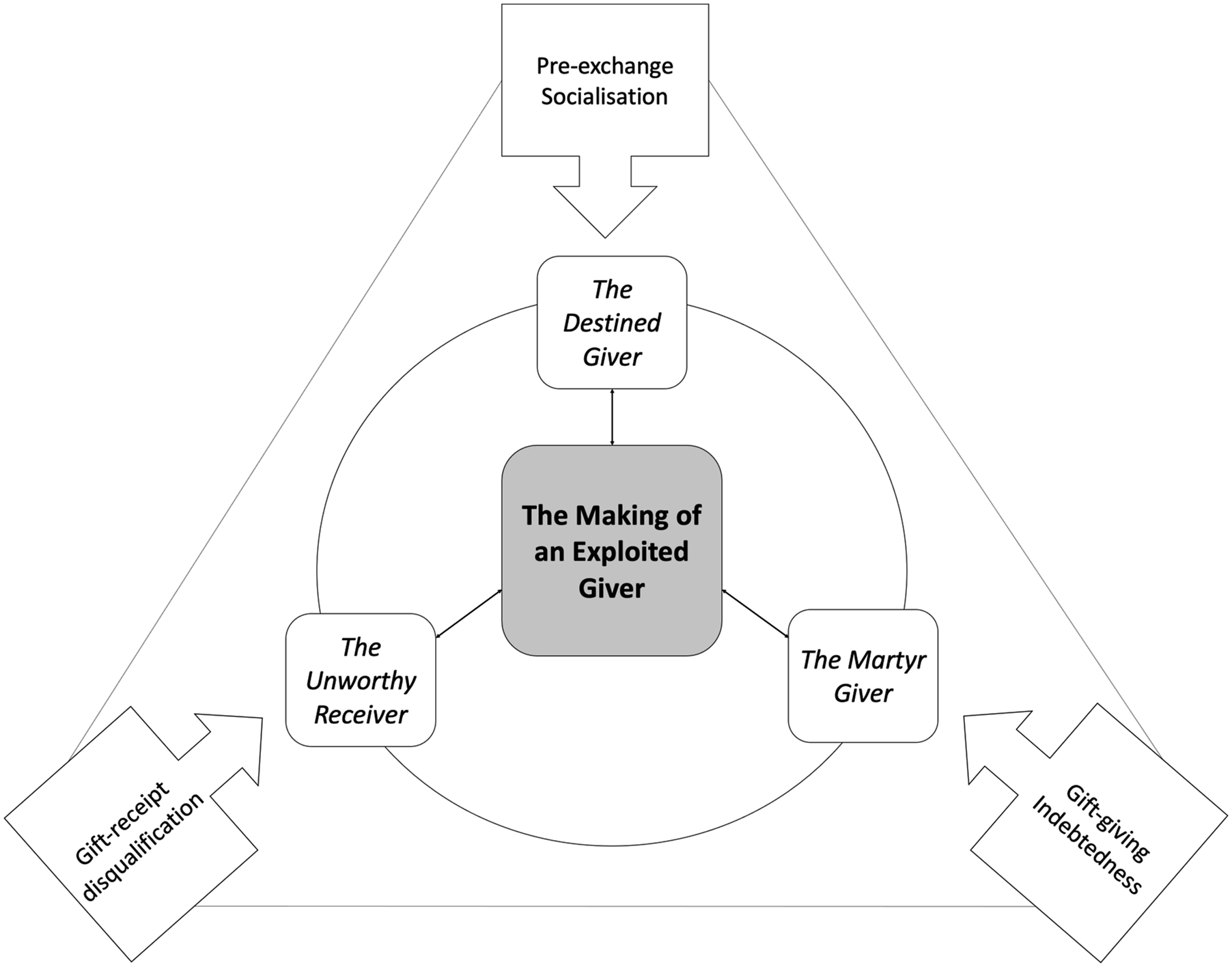
My analysis indicates that sustained family exploitation does not just happen, it is an ideological process of becoming, subject to the discourse of son preference that operates on early childhood socialisation through constant reminder of should-be-obligations in relation to gender-based discrimination. The operation sets a normative script for the future gives and takes in which daughters are projected as the destined giver. Being the unworthy receiver, daughters are framed as the abject, and hence disqualified from particular substantial, if not all, gift-receipts that are perceived to define the structural gender hierarchy where sons are positioned as the haves, the resource rich, and daughters the have-nots, the resource poor. Here, gift-receipt disqualification is also directly linked to biased, selective parental giving. When bias is done strategically as a covert or selective practice of son preference, it is believed to further obligate daughters to repay what they have received with greater reciprocity, and/or to silence daughters for wanting equivalence as they are made to come to terms with the shares that they have already received, that are said to somewhat reflect their self-worth in the eyes of their parents. Gift-giving indebtedness then emerges from the moral obligation to repay what has been received, including the gift of life, which gives rise to the becoming of a martyr giver. Being a martyr giver is clearly highly stressful because daughters are expected and pestered to sacrifice their own personal, relational and social wellbeing to improve everyone else’s in the family, as symbolised in the terminology Fu Di Mo. These findings also extend past research on giver role expressions such as Otnes et al. (1993) and Joy (2001) to incorporate the dark side of giver/recipient role development and expressions in sustained exploitation.
Furthermore, the discourse of Chinese son preference highlights not merely the three interlinked mechanisms that produce specific subject positions to enable sustained exploitation, but also how each mechanism/subject position causes significant affective disturbances in the process, such as insecurity, low self-esteem, feelings of injustice, and even suicidal thoughts. Many of these affective disturbances become tangible in the metaphors mobilised by the commentators and/or the abusers of son preference, ranging from being ‘a guest’/‘an outsider’ at home to ‘old age security’, ‘chicken-shit’ and to ‘a total bullshit’. Besides, they are embedded in the strategic use of rhetoric and choice of terminologies, such as ‘they hope… I should’, ‘bias’, ‘I provide’, ‘because… that’s why…’, ‘Fu Di Mo’, and so forth. Classic symbolic interactionists such as Cooley (1902) and Mead (1934) view the self as a social construction that is crafted through linguistic exchanges with others, and emphasise how interacting with caregivers shapes the developing self (Harter, 2008). In line with the symbolic interactionist perspective, my findings show how the process of othering of daughters takes place through not only giving, receiving, taking and keeping related unequal exchange, but also the materiality of linguistic exchanges that seek to establish an alternative moral norm of reciprocity that upholds the discourse of son preference.
Finally, I show how within the family setting of son preference, multiple moral codes of reciprocity can co-exist and how they can transpire through an affectively charged cycle of pre-exchange socialisation, gift-receipt disqualification, and gift-giving indebtedness. While both having a keen interest in unpacking reciprocity and how it functions in modern society, unlike Sahlins (1965) and Fiske (1991) who emphasise the role of social distance in determining the ways in which one reciprocates, Gouldner’s (1960) thesis on reciprocity focuses more on power differences within the society in determining ‘equivalencies or ‘quantitative variation’ of the benefits exchanged by the parties concerned’ (Marcoux, 2009; Narotzky and Moreno, 2002: 285). To this end, the findings from this study provide a preliminary framework for analysing the becoming and the being of an exploited giver, offering insights into the ways in which power may be distributed and exercised in the family consumption setting to normalise unequal exchange and the related exploitation.
In sum, it is generally acknowledged that the concept of equality rests on the idea of reciprocity (Adloff, 2006; Arnould and Rose, 2016; Simmel, 1950), and vice versa (Belk and Coon, 1993: 399; Gouldner, 1960; Narotzky and Moreno, 2002). Studies have shown failure to reciprocate often leads to discomfort, embarrassment, or the breaking-off of social ties, and those who are able to give more than what they have received are usually awarded with prestige and a higher social status (Malinowski, 1978/2002; Mauss, 1954/2002; Offer, 2012). Yet, adding to the literature on reciprocity’s dark side, the extreme, yet still pervasive case of son preference, provides a window into why people stay in an exploitative relationship in which they feel they are ‘morally’ obligated to give selflessly and in abundance and be relegated as the ‘abject’. It also highlights the affective outcomes and wellbeing consequences of ‘morally’ obligated gift-giving. I argue it is only by exposing the processes of sustained exploitation that we can start to transform it with relevant public and social policy making and advocacies.
Beyond a focus on gender discrimination or the sociocultural construction of women’s sacrificial role in the family consumption system (cf., Fischer and Arnold, 1990; Miller, 1998), there are many other potentially exploitative consumption systems that might expose a similar process as the one examined in this study. For example, death from overworking (Karoshi) has been a constant threat in Japan and contributing to a worrying rise in suicide among overworked employees (Kanai, 2009). In the times of COVID-19, we have witnessed a steep increase of physician suicide (Kingston, 2020). Research on workplace or healthcare consumption system may benefit from an affective focus on how giving and receiving manifest as mechanisms to frame specific subject positions that may lead to sustained exploitation, causing significant emotional, physical and relationship strains. Our preliminary framework investigating the even darker side of gift-giving in sustained exploitation may also illuminate findings in other types of abusive relationships such as toxic couplehood, friendships or workplace-bullying. While sustained exploitation has rarely been a focus of prior consumer and sociological research, it constitutes an important topic to be addressed for it enhances not only our theoretical understandings of gift-giving and unequal exchange, but also how we understand the ways in which sustained exploitation may manifest in the lived experiences of an exploited giver. Resulting findings can help public and social policy makers in identifying the precarities the exploited giver faces and develop relevant intervention programmes such as parent and community education and individual and group counselling services.
Footnotes
Declaration of conflicting interests
The author(s) declared no potential conflicts of interest with respect to the research, authorship, and/or publication of this article.
Funding
The author(s) received no financial support for the research, authorship, and/or publication of this article.
