




Abstract
The COVID-19 crisis has resulted in physical distancing regulations, disrupting traditional practices of establishing and maintaining social relationships. We draw attention to digital nomadism as a mature case of navigating sociality in uncertainty to investigate how the linking value of materiality establishes social proximity without geographic contiguity through physical, virtual, and imagined practices. Using Miller’s (1987) theory of materiality and triangulating data collected from in-depth interviews and netnography, this study details the material constitution of co-presence with others in physical distance. We propose that consumers oscillate between work—instrumental practices of signaling and curating—and play—emotional practices of belonging and indulging—to experience social linking across different spatial and temporal frameworks.
“But what good are roots if you can’t take them with you?” —Gertrude Stein
Introduction
The unfolding of the COVID-19 crisis has fundamentally shaped how consumers navigate their everyday lives (Campbell et al., 2020). When preventative regulations such as physical distancing have disrupted established modes of creating and maintaining relationships with others (Goldsmith and Lee, 2021), alternatives to experiencing a sense of connectedness have become essential. With its political and economic upheavals, the pandemic has reconfigured the imperatives of mediating social proximity (Glăveanu, 2020) since consumers interact and collaborate largely without geographic contiguity.
Amid constraining conditions to engage in kinships, romantic intimacies, friendships, fleeting encounters, and formal networks, co-presence—a form of being together—beyond the corporeal and immediate connection to others has lately gained traction. Pandemic socializing has crossed both spatial and temporal frameworks (Demircioğlu, 2021) in that it shifts toward manifesting virtually and imaginatively, disconnected from shared localities. Physically distant consumers experience an unprecedented dependence on information and communication tools (Watson et al., 2020) to reassemble relationships through the digital. Technologies allow consumers to exchange expressions such as affection, interest, and solidarity via asynchronous and synchronous transmissions of visual and verbatim content (Costa et al., 2022). Additionally, physical distancing has foregrounded the power of a free mind (Heath and Nixon, 2021) as consumer imaginations exploit fantasies of being connected. Mind-wandering transcends the confines of the status quo in isolation by creating an escape into an alternate reality of fiction where consumers re-enact their proximity (Cachopo, 2022). Thus, virtual and imagined forms of co-presence unfolding during the COVID-19 crisis inform nuanced understandings of social linking across spatiality and temporality.
Uncertain times, such as those experienced during the pandemic, also reconfigure consumer relationships with the material and social world (Campbell et al., 2020). Bardhi et al. (2012) and Bardhi and Eckhardt (2017) suggest that consumers exhibit ephemeral, dematerialized, and access-based attachments to objects and pursue transient social connectedness in liquid modernity. Nevertheless, socio-economic crises provoke a return to materiality and sociality as consumers shift back to valuing objects that provide links to others. This observation draws renewed attention to Cova (1997), who accentuates how material products and services assume linking value by mediating social proximity. Accordingly, consumers strive for tribal integration and communal embeddedness. These links crystallize in joint symbolic or ritual commitments and unfold through not merely shared emotions, lifestyles, and belief systems but also consumption practices (Cova and Cova, 2001). In this light, we understand Žižek’s (2020) conception that physical distancing potentially even strengthens relationships between consumers navigating uncertainty. The pandemic’s imperative to perform private and professional sociality without geographic contiguity highlights the relevant role of consumption objects in mediating social links.
This study investigates how the linking value of materiality establishes social proximity through physical, virtual, and imagined practices across physical distance. We introduce an empirical framework that highlights the centrality of material consumption in constituting pandemic socializing practices. Thus, we extend the postulation that “the link is more important than the thing” (Cova, 1999: 64). This study draws upon practice theory (Shove et al., 2012) to unpack consumption practices across physical distance. We ultimately turn to the poster child for mastering life in liquid environments and without geographic contiguity such as mirrored in the upheavals of the pandemic—digital nomads. The cosmopolitanism of digital nomads (Thompson, 2021) provides us with a mature tribal case that produces “a range of identities, practices, rituals, meanings, and even material culture itself” (Cova et al., 2007: 4). Nomadic consumers create a location-independent and oftentimes technology-dependent lifestyle outside of traditional structures (Atanasova and Eckhardt, 2021), which qualifies them as a suitable context for examining material consumption practices to navigate social links across physical distance. After all, while Belk (2020, 5) forwards the question, “has all that is solid melted into thin air?”, digital nomads’ relationships to the material and social world convince us of quite the opposite.
Theory
Materially mediated social connectedness
The capacity of the material world to enable sociality has been studied extensively, from early symbolic views to current assemblage and actor–network perspectives. The former, for example, have conceptualized special possessions as signs of consumers’ attachment to or distinction from others (Belk, 1988; Csikszentmihalyi and Rochberg-Halton, 1981). These studies have foregrounded the active consumer subject that imbues relatively passive objects with social meaning. Going beyond objects as representations of social connectedness, more recent studies have attended to the active role of consumption objects in expressing social relationships (Ahuvia, 2005). For example, Epp and Price (2010) examine the centrality of material culture in families and how focal objects facilitate or hinder interactions between members, moving in or out of a network of people, objects, and practices. Similarly, Türe and Ger (2016) integrate symbolic and material aspects in their study of heirlooms. The authors show how rejuvenated objects accommodate continuity and change as they embody connections to the family’s past, present, and future. Eichinger, Schreier, and Van Osselaer (2021) draw attention to the fundamental role of objects in providing consumers with a sense of groundedness by connecting them to places, people, and past narratives. Focusing even more on the social links established through consumption objects, tribal theory provides another point of departure for investigating the interdependence of materiality and sociality. While most research on tribalism has emphasized the ephemerality, fluidity, and transience of tribal social groupings (Hardy et al., 2013; Skandalis et al., 2016), Diaz Ruiz et al. (2020) apply assemblage thinking to demonstrate how salsa tribes continuously reassemble through specific configurations of human and non-human elements. This relational perspective on tribalism reveals how linking value emerges from dynamic consumer–object interactions, which enable tribal manifestation across time and space. Overall, these studies imply that the enactment of sociality is contingent upon material objects’ capacity to mediate social relationships.
Material objects play an important role in studies on social relationships across physical distance. Research has investigated how consumers stay connected when global mobility disrupts physical co-presence, such as in the case of expatriates (Figueiredo and Uncles, 2015), migrant workers (Cruz and Buchanan-Oliver, 2020), or mobile professionals (Aufschnaiter et al., 2021; Bardhi and Askegaard, 2009). Even though practices of staying connected vary, the centrality of objects in enabling or hindering consumer sociality is evident in these contexts. In addition to facilitating communication with physically distant others, objects such as smartphones, apps, or social networking platforms enable consumers to coordinate social relations across different spatial and temporal frameworks (Figueiredo and Uncles, 2015). When physical encounters with beloved ones are limited, people increasingly rely on staging home-like experiences away from home (Kreuzer et al., 2018). Marketplace resources such as specific brands connect them with people and places from the past (Cruz and Buchanan-Oliver, 2020). The entanglement of social and material resources allows mobile consumers to maintain an embodied and imagined sense of connectedness with others across time and space (Aufschnaiter et al., 2021).
More recently, the COVID-19 crisis and related immobility of people, coupled with physical distancing regulations, calls for the invention of new ways to nurture social relations (Campbell et al., 2020; Sheth, 2020; Watson et al., 2020). Studies into pandemic socializing have revealed that—quite similar to the case of mobile consumers—digital devices and software facilitate connections with others outside the household. Consumers transform formerly physical gatherings into digitally mediated interactions, for example, by organizing “video-aperitifs” (Stenger and Faure-Ferlet, 2021). This virtual co-presence might even substitute physical contact with digital assistants such as Alexa (Kirk and Rifkin, 2020). So far, consumer research has primarily focused on tech-mediated ways of connecting during the pandemic. However, consumers also experience heightened physical closeness with some people. Stay-at-home orders have increased the time people within households spend together, and some even purposefully engaged in “quaranteaming” (Kirk and Rifkin, 2020)—sitting out the pandemic with small groups in a shared place to avoid social isolation. Consumers’ practices revolve around objects, which provide the needed requisites for joint activities (Boström, 2021). Furthermore, photos or souvenirs might induce nostalgic remembering or hopeful imagining of social connectedness (Cachopo, 2022).
While providing insights into how consumers establish social relationships across physical distance, research has largely framed digital and imagined forms of sociality as less favorable than physical links. For example, Epp et al. (2014) observe an experience gap between physical practices and tech-mediated alternatives. However, consumers might feel even more socially connected when being able to combine various forms of being together. Also, research on the enactment of sociality across physical distance has focused on technologies while largely leaving out other aspects of the material world, such as non-digital objects or material environments. As forwarded by Miller and Horst (2012: 12), “there is no such thing as pure human immediacy” because all forms of sociality are materially mediated. Thus, to comprehend relationships beyond physical proximity, we need more detailed investigations into the capacity of the material world to enable social connectedness.
Conceptualizing materiality
Material objects have “a quite remarkable capacity for fading from view, and becoming naturalized, taken for granted, the background or frame to our behavior” (Miller, 2010: 155). In this light, Coole and Frost (2010: 28) point out the importance of attending to “the emergent materialities of contemporary coexistence,” highlighting the material embeddedness of culture. Researchers in disciplines such as anthropology (Miller, 1987) and science and technology studies (Latour, 1993) have developed theories of materiality to account for objects’ capacity to shape consumer–object interactions. These perspectives have foregrounded the co-constitutive relations between subjects and objects, allowing us “to more systematically examine the bodily, imagined, and visual experiences of material things” (Mullins, 2018: 351).
Consumer research has a long history of privileging consumer agency and degrading objects as mere symbols or signs (Bettany, 2018; Borgerson, 2005, 2013). Recent publications increasingly acknowledge the active role of objects. Assemblage thinking or actor–network theory (Bajde, 2013; Canniford and Bajde, 2015) have brought forward different conceptualizations of consumption phenomena as being temporarily constituted by heterogeneous networks of human and non-human components that exist through the enactment of relations. Object-oriented ontologies have moved away from a relational understanding, attending even more to “objects in their own right” (Franco et al., 2022) and thus revealing objects’ hidden features. While these perspectives have produced important new insights into the agency of objects, our cultural perception of consumption and materiality “assumes that people are profound” (Slater and Miller, 2007: 16) in performing sociality across physical distance. Such an understanding allows zooming in on the complex “relationships and meanings that exist between people and the objects they place around them” (Pattison, 2009: 290). Thus, instead of presuming that people just as objects do not exist outside of situational enactments—as in assemblage and actor–network thinking—or that objects exist outside of human experience—as in object-oriented ontologies, we draw from materiality theories (Miller, 1987) to highlight the immanent importance of both—people and materiality.
Miller’s (1987) theory of materiality conceptualizes materiality as a dialectic and recursive relationship between subjects and objects, which constitutes consumer culture and, therefore, allows us to distinguish between subjects and objects without dichotomizing these two elements (Bettany, 2018). Drawing on Miller, Borgerson (2013: 126) defines materiality as co-creations, interactions, and relations between human subjects, or selves, and others. Others, or realms of the not self, include (1) human beings, (2) that which exceeds human being as usually understood, (3) “material” or virtual objects, broadly and variously conceived, as well as, (4) environments and immaterial realms, including the spiritual, but also aspects of technology.
Borgerson (2005, 2013) emphasizes the potential of Miller’s work to foreground concrete material culture and its ability to influence consumers’ social world. Consumer culture theorists have applied Miller’s theory of materiality to explore the centrality of objects in reconfiguring consumers’ practices and multifaceted forms of sociality (Ferreira and Scaraboto, 2016; De Mello et al., 2021; Walther and Schouten, 2016). Our study considers the (im-)material an essential ingredient of any subject-object relation. Thus, it transcends the tangible and helps integrate the virtual and the imagined in theorizing social relations across physical distance.
Methodology
Physical distancing not only permeates consumers' lives amidst the pandemic but also shapes the tribalist cosmopolitanism of digital nomads who leverage material consumption to blur work and leisure in uncertain—liquid—environments (Thompson, 2021). As sources of “new social formations, patterns, and opportunities” (Hannonen, 2020: 336), globalization and digitalization have foregrounded nomadic practices. Digital nomads themselves introduce new forms of connectedness across physical distance (Reichenberger, 2018). Therefore, they serve as a mature case for studying how the linking value of materiality establishes social proximity through physical, virtual, and imagined practices without geographic contiguity.
We applied the circuit of practice as an analytical tool “that is aimed at highlighting the changing relationship between materiality and social practices” (Magaudda, 2011: 15). Our study embraced Shove et al.’s (2012) conceptualization of practices as entangled in tripartite configurations: consumption objects imbued with subjective meanings and performed through embodied activities. Adopting this unit of analysis allowed us to examine how materiality becomes a co-constitutive element of linking practices through its qualities, cultural-symbolic representations, and competencies. We unpacked the role of materiality from a practice-theoretical perspective through “the object-meaning-doing lens” (Godfrey et al., 2022: 231) to understand how digital nomads perform consumption practices to navigate sociality.
Participant profiles.
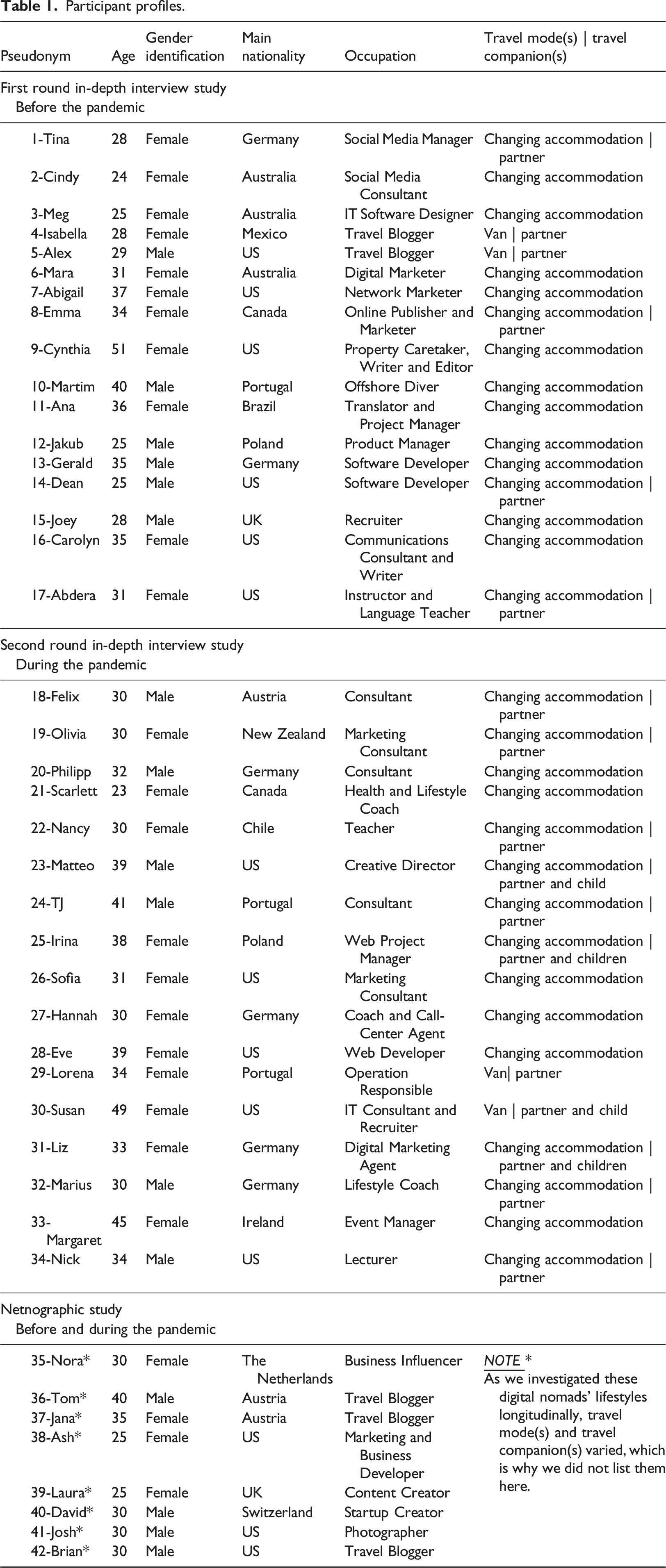
In the first round, we conducted 17 in-depth interviews between August 2018 and June 2019 to understand what material consumption objects digital nomads perceive to be meaningful, valuable, and memorable across physical distance. The dialogues followed a semi-structured guideline inspired by photo-elicitation techniques (Heisley and Levy, 1991). Accordingly, participants provided visuals of important moments (two per participant; 34 in sum) that stimulated in-depth reflections and evoked hidden emotions related to sociality and materiality. In the second round, taking place amidst the pandemic between August 2020 and April 2022, we conducted 17 in-depth interviews covering open grand-tour questions (McCracken, 1988) centering around nomadic consumption practices of work and leisure. The interview guideline evolved according to emerging themes to deepen our understanding of how the material world mediates the link between digital nomads and others. We held all conversations virtually.
Our study also responded to the centrality of digital environments in nomadic consumers’ lives (Bonneau and Aroles, 2021) through netnographic investigation into participants’ online presences (Kozinets, 2020) from August 2018 until August 2021. Personal websites and social media platforms such as Instagram, Facebook, and Reddit as public spaces of self-expression showcase multimedia content of consumption practices. To understand the contextual portrayal of digital nomads, we engaged in unobtrusive observation as we followed their online footprints non-reactively and participated in dialogues and discussion threads where we disclosed our researcher status. This complementary study helped clarify ambiguous results gained from interviews and unveiled additional insights into the nomadic circuit of practice. Our netnographic investigations included longitudinal exploration of eight additional digital nomads’ Instagram profiles (1.932 in sum, showing content published before and amidst the pandemic).
Findings
In our study, we find various consumption objects that assume linking value and enable co-presence with others across physical distance. Our empirical framework highlights the material constitution of social proximity as occurring in a twofold oscillating loop at the interplay between nomadic consumers’ practices of “work” and “play” (Figure 1). First, we show three ways between which digital nomads fluidly switch to become co-present with others: through physical, virtual, and imagined practices. Here, our data foreground the central role materiality plays in sustaining these different forms of being together. Our data reveal that consumption transcends sheer tangible and intangible objects by additionally revolving around spatial sites and complex material assemblages (Table 2). These consumption objects not only mediate but constitute social connectedness. Second, we highlight that digital nomads oscillate between instrumental practices of “work”—signaling and curating—and emotional practices of “play”—belonging and indulging—to navigate sociality. Empirical framework—materially constituted co-presence. Illustrative examples of materially constituted co-presence.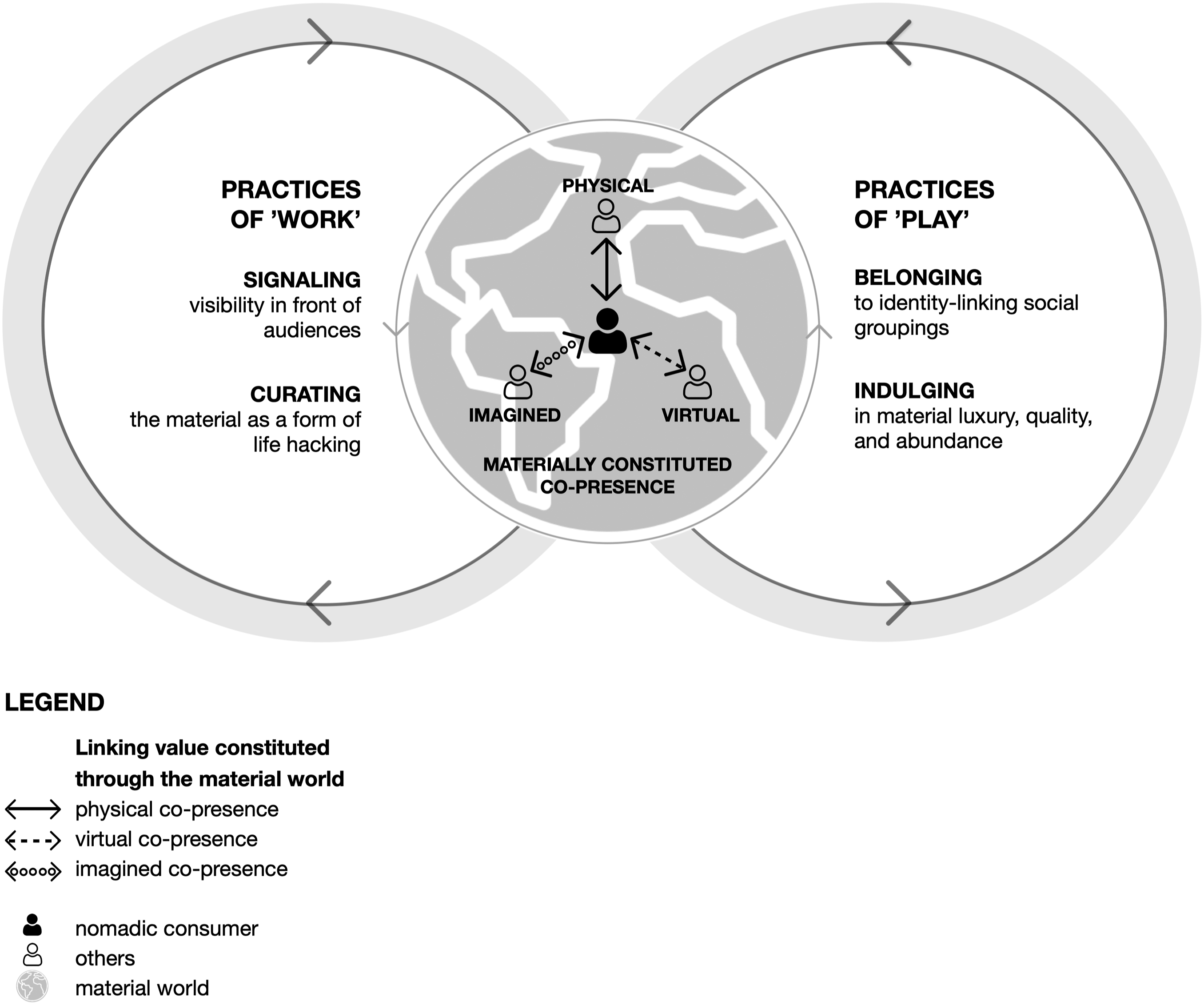
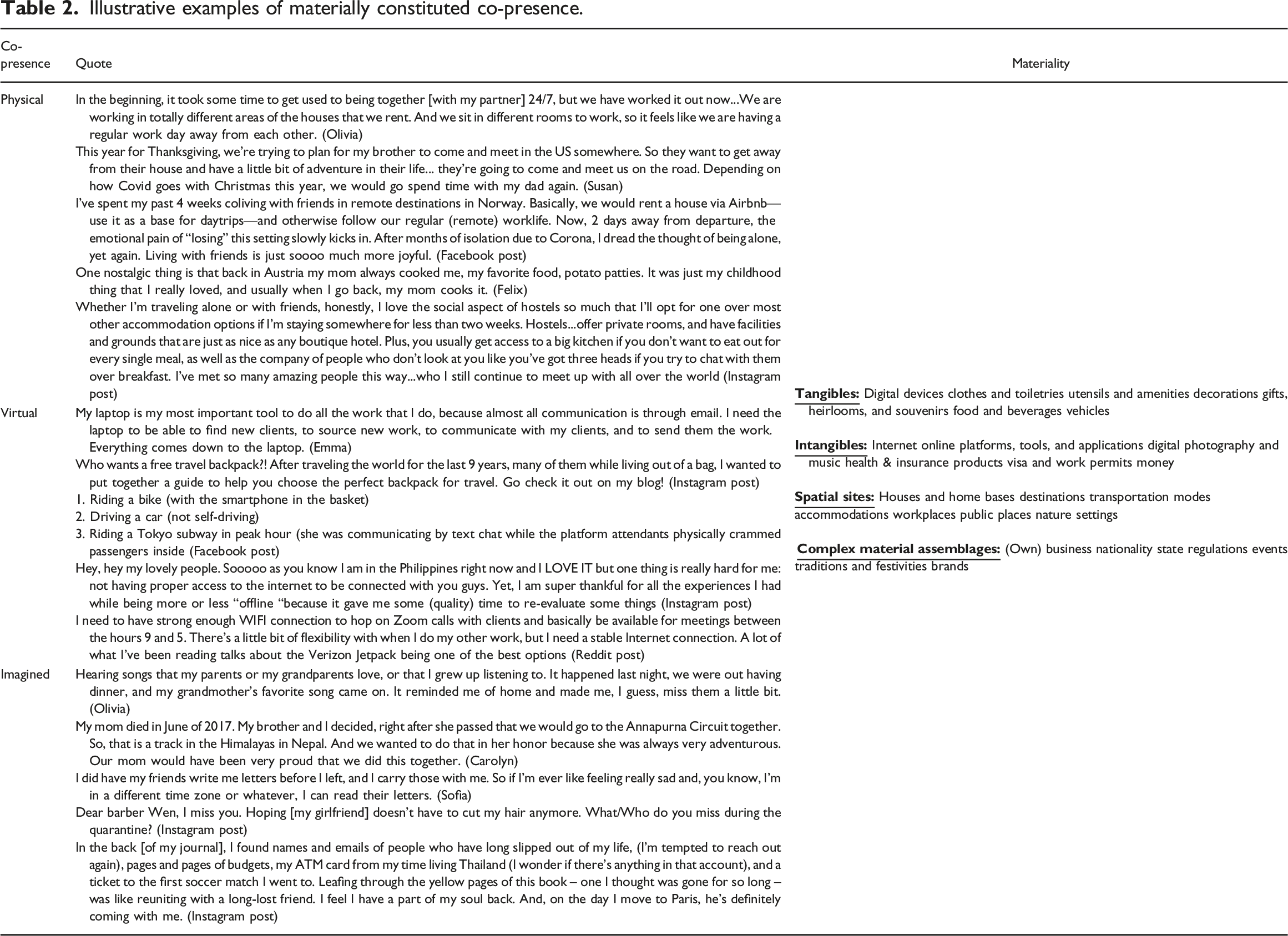
Materially constituted co-presence
Sociality spreads across a spatial and temporal framework—from here to elsewhere and from past over present to future (Aufschnaiter et al., 2021) in physical, virtual, and imagined forms. We find that nomadic consumers alternately establish these forms of co-presence depending on the specific configuration of their social and material world. Whereas prior research has labeled physical co-presence as “the gold standard” (Baldassar et al., 2016: 137–138), our data show that digital nomads sometimes even prefer virtual or imagined co-presence. Thus, the affordances—“action possibilities” (Gibson, 1986)—of these online forms of sociality empower nomadic consumers (Kozinets et al., 2021). They enable decelerated and more concentrated encounters through the commitment to a shared tool or application for social exchange. Digital nomads may also perform sociality in their minds, drawing upon unlimited opportunities to create visual imagery of links to others.
Physical co-presence occurs when nomadic consumers are present in person with others permanently accompanying or temporarily (re-)uniting with them. We find that participants who perpetually travel in company exhibit strong social links to these fellow itinerants becoming surrogate families. Digital nomads establish temporary physical co-presence by returning to home countries or gathering elsewhere, stressing their appreciation of the scarcity underlying these time-limited physical get-togethers (Von Wallpach et al., 2020). Despite involving the physical mobility of at least one consumer, digital nomads do not see reunions as a burdensome obligation but deliberately structure their lives around scheduled occasions. Coincidental encounters with new acquaintances provide an additional source for satisfying participants’ need for sociality. Digital nomads physically meet fellow travelers, who they easily connect with due to their like-mindedness, and residents whose culture they immerse in.
Physical co-presence is materially bound, that is, they occur in a shared material world (Zittoun, 2020). Like other participants, Liz highlights how the relevance of the accompanying family manifests in collective experiences of materiality: A home base is easier for us because the kids have stuff, and it’s already an unusual lifestyle. I always want to give them the basics of toys and stuff…When we move, we usually pack it all up. Ninety percent of the stuff is this kids’ crap. And the rest is cooking stuff.
Despite preferring minimalism, Liz takes along consumption objects to make navigating across physical distance more enjoyable in a family context, bringing in “stuff” as a glue of social bonds. Yet, contrary to singularizing focal objects (Epp and Price, 2010), Liz de-emphasizes the role of objects as “stuff,” stressing the role of “home” as a social space instead. Others establish a mobile home base, giving them even more continuity regarding their material environment. When temporarily visiting their settled contacts, participants appreciate having a place called home—parents’ houses or even self-owned home bases, symbolically connecting digital nomads to others. The social dimension of a home is crucial as a place filled with memories, providing a sense of belongingness (Kreuzer et al., 2018) and an important refuge. Further physical environments for facilitating oftentimes random physical co-presence with others are digital nomad hotspots, such as Bali or the Starbucks café.
Virtual co-presence becomes possible through the affordances of technologies to (re-)unite without being limited by spatial closeness (Baldassar et al., 2016). Our findings reveal that participants use various technologies to establish virtual co-presence with others synchronously or asynchronously through private conversations or public communication on social media platforms. Virtual co-presence can even take the form of ambient co-presence (Madianou, 2016), meaning that social media platforms and portable devices permit participants to keep following up on physically distant others’ everyday life without actively communicating with them. Virtual co-presence supports nomadic consumers in maintaining continuous social connections and enlarging their networks.
Even though virtual encounters do not require a shared physical environment, this does not render the material world less important. Aligned with Madianou and Miller (2013), our findings emphasize the co-constitutive nature of information and communication technologies and social relationships. The variety of these technologies allows participants to perform sociality according to their needs—from direct forms of conversation such as Skype calls to indirect forms of communication such as emails to deliberately keep both a physical and social distance. While research on migrant workers has stressed the lack of knowledge about using technologies as a limiting factor (Cabalquinto, 2018), technology-savvy nomadic consumers feel constrained by the constant search for stable Internet connection. The importance of technologies and the specific configuration of spatial sites are apparent in participants’ accounts of their work-related routines: I use a VPN, meaning that when I’m calling from here, Portugal, on my phone or my laptop, it shows that I’m calling my clients from the UK…It shows…a number which is a city in Southern England despite me being international…I don’t want my clients to think that I am in mainland Europe. So, I use a VPN.
Joey seeks to shorten perceived physical distance with his social contacts by using a virtual private network that permits pretending to be at a fixed location in his home country while traveling.
Consumers also experience imagined co-presence, resulting in a sense of connectedness independent of physical mobility, communication devices, and technologies. While extant consumer research depicts digital nomads as primarily present-oriented (Atanasova, 2021), we find that participants temporarily uncouple from the situated present (Zittoun, 2020) as they use their imaginative power to project themselves into the past and future. Past-oriented imagined co-presence occurs when nomadic consumers miss the proximity to others and thus reminisce about or reflect on bygone social instances. Future-oriented imagined co-presence manifests in daydreaming (Heath and Nixon, 2021). This mind traveling not only compensates for a current lack of sociality but also constitutes a gratifying experience in itself, sometimes not just postponing but even entirely replacing the realization of sociality. Additionally, participants’ imaginations revolve around alternative realities in the form of “as-if” and “what could be” scenarios (Zittoun, 2020) that recompose sociality in a parallel mind-world.
Despite being primarily a mental phenomenon, imagined co-presence involves the material world. Participants share examples of how materiality cues imaginations (Jenkins and Molesworth, 2018) of social links, as in the case of consumption objects imbued with mnemonic value like souvenirs and gifts. Nevertheless, even when not eliciting mental pictures per se, the material contextualizes—sets the scene of—the narrative in nomadic consumers’ imaginations of co-presence with others. Philipp, who expresses the detailed material configurations of the co-living community he plans to join, illustrates the entanglement between imagined sociality and materiality: The place itself is important. [My colleagues/friends and I] agree…the environment will change. We want something sustainable in the long run. A big requirement is, [the house] needs to have a very good infrastructure because we’re all working remotely. There must be very good internet… It’s a blend of complete remoteness in nature, a big piece of land and animals, and pets, plus high tech.
Participants’ recollection of childhood events further exemplifies how consumption objects become woven into the fabric of imagined sociality, involving others but also the material environment of the home. We find that indulging in such memories foregrounds the centrality of complex material assemblages, such as pre-nomadic events or traditional celebrations that nomadic consumers no longer access physically or virtually.
Practices of “work” and “play”
Our study reveals that in physical distance, the linking value of materiality establishes physical, virtual, and imagined co-presence with others through practices of “work” and “play.” These practices derive meaning from instrumental (I) and emotional (E) logics, respectively. Whereas instrumental practices of ‘work’—signaling and curating—reflect strategic purposes to perform sociality, emotional practices of “play”—belonging and indulging—center around aesthetic pleasures of sociality “in the full sense of the word as living emotions, feelings, shared passions” (Maffesoli, 1990; cited in Cova, 1997: 314). Rather than viewing “work” and “play” as dichotomous (Holbrook and Hirschman, 1982), our findings show that nomadic consumers move back and forth between the two in rhythms—in an oscillating manner (Figure 1). 1
Signaling (I) and belonging (E)
Linking value manifests in practices that foreground the social character of digital nomads’ quest to experience sociality through consumption. Materiality allows nomadic consumers to realize different manifestations of social relationships—from instrumental signaling to emotional belonging.
Instrumental signaling
We find that nomadic consumers pursue co-presence with others to present a desired image to an audience (Gandini, 2016)—an anonymous crowd or private and professional contacts with whom they strategically choose to establish sociality. Reminiscent of Eckhardt and Bardhi (2020: 91), who introduce attention as “social capital that represents another central differentiator,” our findings show how digital nomads enjoy taking center stage when materiality enables goal-directed forms of sociality. For example, Eve contends that as the freedom to move has turned into the cultural marker of today’s elite, van-life adventures make her climb the social ladder: When I was making plans to get this van and live the van life [to visit new places], I was meeting so many people that were insanely jealous. They were like, you’re living the perfect life, you are doing everything I wish I would be doing, and your life is freaking awesome. They were putting me on a pedestal, putting me above them.
Digital nomads draw upon materiality to create their personal brand by displaying expertise in lifestyle areas like mobility, nutrition, or sports, as illustrated by vlog tutorials on taking out affordable health insurance. Signaling practices also unfold as nomadic consumers show off—or “brag to [the mates at home] about” (Joey)—their relationship to popular consumption objects—oftentimes brands—that are not easily accessible. Furthermore, digital nomads eagerly express their touchpoints with celebrity-related consumption objects—for example, Brian posting a photo of a bar in Paris where Hemingway used to go. In this vein, participants like TJ direct followers’ focus to (consumption) objects of interest and use the publicity of social media (Arvidsson and Caliandro 2016) to address practices that gain relevance as status symbols: With our [blog] we try to inspire people to travel more and travel slowly. We try to bring this zero-waste movement to traveling…The blog and the Instagram account try to bring some ideas: we travel with our [zero-waste] kit, our water bottle, the non-disposable cutlery, and dishes, and sometimes even some Tupperware. It’s part of our way of travel. And we share that when we can.
Digital nomads perform visibility labor (Abidin, 2016), using their online presence as a stage for advocating change to others or gaining external validation. Nevertheless, in addition to these virtual ways of self-branding, digital nomads embrace parties, company luncheons, and random encounters or imaginations thereof for signaling purposes in physical distance. These practices again revolve around the linking value of conspicuous consumption objects that claim technological superiority or affiliations to the cosmopolite class—like a “traveling artist’[s]…personalized paintings on jeans” (Instagram post).
Emotional belonging
However, rather than exemplifying a fading power of hedonic social attachments across physical distance, our findings strongly reflect digital nomads’ desire to belong. Since nomadic consumers enjoy adhering to collective values and visions, they seek inclusion into aspirational peer groupings of different sizes—nations, communities, cliques, professional teams, and family nuclei—serving as identity anchors. Participants empathize with and care about others, appreciating both diversity and familiarity in performing sociality. We find that despite being physically distant from their countries of origin, digital nomads grow attached to materiality that empowers relationships to non-itinerant others, as TJ describes: I still love to watch the football national team, and I’m Portuguese forever…My biggest regret is being away from family and local friends…The funny thing is, that also happened during COVID, when you are far away physically, you connect more with people that you like. I started to call my parents more often…We became closer, not physically but in terms of relationship.
Belonging practices also reveal that, similar to Eve, digital nomads fight social isolation by establishing mobile home bases like vans or houseboats—or dreaming about those—to (mentally) develop authentic bonds with the nomadic tribe: I take my home with me, and that’s why I got this van…A very important group are the people next to me in their van…They give you a sense of security…If you go to a café every day at four o’clock, you meet the people that are there every day at four o’clock. After a while, the contact is established...I grew attached to social media because oftentimes, you don’t have anybody to talk to or share your stories or adventures with.
Participants humanize consumption objects as substitute travel partners, such as when naming an old backpack, to bridge the time until physical encounters. Social media further allow engaging in belonging practices—as demonstrated by Antonia “taking friends…to places they cannot go to” in Instagram stories. While celebrating the creative autonomy to shape their lifestyle, digital nomads possess or access materiality that offers a liminal space between independence and belongingness. For example, Tina uses a vision board to illustrate her yearning to join a tribal cult where members share a mindset and seek personal growth alike. Nomadic pursuits of belonging to physically distant others challenge Bardhi and Eckhardt’s (2017) notion that communal togetherness no longer serves as an aspirational virtue in uncertainty. Other belonging practices include the continuing involvement with consumption objects, such as birthday cakes, that allow digital nomads to re-enact festivities or establish social routines. Also, digital nomads highlight that the materiality of spatial sites embedded in “the history, the traditions, and customs, the culture” (Instagram post) of shared localities enables escaping from an isolated bubble into belonging to locals or the nomadic tribe.
Curating (I) and indulging (E)
Digital nomads also engage in practices that assume linking value and stress the centrality of consumption objects themselves. Sociality unfolds as nomadic consumers draw upon different manifestations of materiality—from instrumental curating to emotional indulging.
Instrumental curating
Nomadic consumers pursue maximum utility in their material consumption, which crystallizes in the instrumental nature of consumer–object relationships in uncertainty (Bardhi et al., 2012; Bardhi and Eckhardt, 2017) and the concept of strategic curation they rely upon (Atanasova and Eckhardt, 2021). These life hacks, as “individualistic and rational approach[es] of systematization and experimentation” (Reagle, 2019: 3), are oriented toward optimizing the material setup according to social needs. For example, Scarlett—being “such an extrovert”—explains how curating her possessions allows her to meet the dress code of face-to-face events, give back by supporting charitable donations, and dream of becoming a parent: I went [to Europe] with a tiny backpack and six outfits. I got neutral clothes and those you can mix and match. I just figured things out. If I get invited to a fancy event and I need something to wear, I will find a way. Today, I’m going through my clothes and throwing out or donating a ton of them…In the future, we’ll be jetting off to places once a month, but I’ll be at home, too. I don’t want to be just a nanny.
Digital nomads engage in curating practices involving acquiring, borrowing, swapping, rearranging, storing, selling, or disposing of consumption objects to establish social connectedness. Our findings demonstrate nomadic curatorial collections, such as the art of organizing pictures on public Instagram profiles. Curated consumption may further involve the attachment to multifunctional objects, such as zip-off trousers or co-working/living spaces, which “make life more efficient” (Alex) by accommodating shifting social purposes. To rejuvenate outdated consumption objects or those from pre-nomadic lives, digital nomads also employ craftsmanship to alter functional and aesthetic properties. The repurposing of something material with linking value (Türe and Ger, 2016) manifests in the DIY retrofitting of a campervan that is remodeled “to execute [work]…hop on Zoom calls” (Reddit post). Curation practices require self-discipline, which participants cultivate using supporting technologies like time-management apps or spatial arrangements like conference rooms (Cook, 2020). Instead of becoming free from structures, nomadic consumers prioritize material disciplining techniques to perform sociality. Matteo’s account underlines how curating consumption objects coordinates his social roles as father and business owner: Distance didn’t matter. My clients…aren’t here in California anyway. My wife read those Marie Kondo books about decluttering, and we just sold everything. We put the rest in the car, we had a small Dacia. And we decided, let’s live out of AirBnb’s. I set my hours, working out of coffee shops or co-working spaces…We found compact ways to make it work for us.
However, Matteo not only continuously curates his spatial surroundings and temporal availabilities but also teaches his son patterns to replace seasonal clothes and leave behind toys.
Emotional indulging
Digital nomads also engage in indulgent material consumption as they pursue “an option that is considered a treat” (Cavanaugh, 2014: 220) to enrich their lives and those of others through quantitatively more and qualitatively better materiality. These indulging practices rest in the leitmotif that consumers “need some pampering” together (Instagram story), provoking an experience of we-ness across physical distance. On the one hand, digital nomads accumulate objects, as manifested in passport stamps, digital client portfolios, travel destinations, or work permits. On the other hand, participants occasionally desire luxuriousness, such as in the form of couple wellness treatments, VIP tickets for co-working in a castle, or “yet another 5-star accommodation” (Instagram post), a big clawfoot tub in the family’s home base, or premium versions of conference tools. Challenging Bardhi et al. (2012), who stress the waning power of possessions in uncertainty, our findings show that indulging practices crystallize in joint material ownership or access to materiality. For example, Matteo enjoys the linking value of indulgences that constitute an essential counterpart to his otherwise minimalist lifestyle: [Our son] had a certain number of toys, we walked around with a wooden train set, and it was probably the heaviest toy we had. But that was the joy for him, so we carried it around…It was important for us to collect certain things [to] remember some of these places. We get Christmas ornaments everywhere we go. They bring up good memories…Our family gave me ornaments. There’s an attachment to that.
While collecting consumption objects with his family to preserve memories of foreign localities, Matteo indulges in the material world as he receives and gives back materiality from and to others, respectively. Our findings highlight that indulgence centers around these emotionally “transactional” social relationships, such as when making a home for heirlooms or buying exclusive homeschooling supplies for children. The more-is-more logic of indulgent practices further prevails as digital nomads justify their attachment to abundant materiality by highlighting social rationales for becoming deserving. I love living the bougie life… I’m a fancy gal. My house is going to be nice…A lot of my clothes, I don’t need, for sure. I still think I haven’t enough clothes. Make-up, shoes, and anything fashion style, I’ll have an excess of… It’s materialistic, but if I’m doing good for the world, whatever, I can treat myself…I also see myself having nice wardrobes in every single home base where I want to raise my future kids.
Scarlett, working on realizing her ambitious business plan, pursues developing into “at least a millionaire, rather multimillionaire” to provide a financial security net for her future family. Visiting multiple localities within short periods, the health coach feels deserving of material wealth for helping others.
Discussion
This study contributes to scholarship on linking value, sociality, and material culture and reveals how the linking value of materiality establishes social proximity through physical, virtual, and imagined practices across physical distance. In line with Žižek’s (2020: 1) recent observation, we stress that social connectedness may become even more integral in pandemic times when people have been “all bombarded precisely by calls not to touch others but to isolate [themselves], to maintain a proper corporeal distance.” Our findings contrast the emphasis on liquid consumer–object relationships in uncertainty (Bardhi et al., 2012; Bardhi and Eckhardt, 2017) and emphasize the power of the material world not merely to mediate but constitute sociality. We base these arguments on our investigation into a mature case of consumer socializing without geographic contiguity—digital nomadism. To perform private and professional sociality, digital nomads as physically distant consumers oscillate—rhythmically move back and forth—between instrumental practices of “work” and emotional practices of “play.” In this vein, our findings open an exciting avenue for understanding social connectedness across physical distance as movements between functional and hedonic consumption. On the one hand, the COVID-19 crisis has become a vehicle for signaling and curating practices of “work” where consumers strategically leverage materiality—from fitness equipment and TikTok accounts to kitchen tables and own businesses—to establish instrumental co-presence with others. On the other hand, amidst the COVID-19 crisis, consumers have become used to drawing upon consumption objects—from polaroid photos and music to gardens and DIY traditions—that enable establishing emotional co-presence with others through belonging and indulging practices of “play.” With that, as the pandemic imperative to navigate physical distance has fundamentally re-defined the contours of consumers’ social lives (Campbell et al., 2020; Sheth, 2020; Watson et al., 2020), we put forward a comprehensive empirical framework that captures the capacity of instrumental and emotional attachments to materiality in constituting social links.
Our study advances the current understanding of the linking value consumption objects assume as the COVID-19 crisis has introduced unprecedented forms of sociality—“broader interactive repertoires” (Davies, 2020: 19) to experience social proximity. While face-to-face gatherings have long marked a central social touchpoint, consumers amidst the pandemic have started to resort to a more multifaceted material offer that allows a kaleidoscopic mix of being together. Despite—or maybe even because of—physical distancing, they oftentimes prefer the material affordances of virtual and imagined co-presence with others over a shared—corporeal and immediate—spatial and temporal framework. Oscillating consumption practices from instrumental signaling and curating to emotional belonging and indulging illuminate how physical distance allows consumers to instrumentally work on and emotionally play with social links. In conceptualizing the linking value of materiality, this study points to the oftentimes misnamed notion of social distancing that “define[s] sociality simply through its demarcation from that which is outside of it…[and does not] re-think the value of social co-presence itself” (Davies, 2020: 14). After all, our findings initiate a dialogue about how physical distancing (regulations) has given the impetus for welcoming new business partners, seeking validation from others, joining tribal formations, solidifying romantic partnerships, or reuniting as a family nucleus. To borrow Aaron Rose’s words—as shared by nomadic Tina—and relating to yet going beyond our opening statement: “The higher your branches go, the deeper your roots must grow.”
Our empirical framework advances conceptualizations of sociality by picking up Urry’s (2002) suggestion to look beyond corporeal and immediate co-presence with others. Research has contended the prominence of the virtual (Watson et al., 2020) and imagined (Heath and Nixon, 2021) in consumption amidst the COVID-19 crisis. Our investigation into digital nomadism expands these revelations, showing that consumers navigate physical distance through an ever-alternating focus on the physicality, virtuality, and imagination of co-presence with others. In this regard, we unpack the idea of sociality as embedded in physical, virtual, and imagined forms that span across a spatial and temporal framework from here to elsewhere and from past over present to future. The pandemic uncertainty has foregrounded social links as creative manifestations between temporarily returning to, re-connecting with, reminiscing about, or dreaming of others, grounded in instrumental and emotional logics.
Moreover, our empirical framework provides a nuanced account of consumers’ returns to not only social but also material anchors in uncertain socio-economic conditions (Bardhi et al., 2012; Bardhi and Eckhardt, 2017). We draw from Miller’s (2010: 1) approach to materiality, not excluding “stuff as perhaps less tangible, or too transient,” which allows capturing the holistic role of consumption objects to not only assume mediating but also constitutive qualities in the enactment of pandemic sociality. Applying this theoretical understanding to the investigation into digital nomadism allows us to introduce the linking value of materiality—tangible and intangible objects, spatial sites, and complex material assemblages—in physical, virtual, and imagined forms. In this regard, instead of increasing liquefied consumption amidst the COVID-19 crisis (Eckhardt, 2021), we witness a re-solidification of consumer–object relationships in uncertainty where physical distance prevails.
While the COVID-19 crisis has shaken the world into a new normal where physical distancing re-defines social relationships (Žižek, 2020), dislocation and ephemerality have generally become targets for renewed exploration in post-postmodern times (Cantone et al., 2020). Be it the rise of new digital work societies, discourses of environmental activism or migration, resettlement, and diaspora—today’s uncertain socio-economic conditions invite us to reflect on the boundary conditions of corporeality and immediacy. Thus, a noteworthy avenue for future research could be to illuminate the role of linking practices in these alternative contexts. Furthermore, subsequent studies should investigate the spatial and temporal variations—from here to elsewhere and from past over present to future—when physical distance is voluntary versus involuntary, long versus short, or permanent versus temporary. Doing so would allow a more thorough examination of how consumers fluidly switch between physical, virtual, and imagined forms of becoming co-present with others. Adding broader insights into the study of materially constituted sociality across physical distance would help future research to develop a typology of the functions of consumption objects that consumers embody in their doings and ascribe meanings to. In acknowledging “that materiality nowadays seems to ‘bite back’, being even more crucial in shaping consumers’ [sociality] practices” (Magaudda, 2011: 15), we hope to spur a discussion on material consumption in all its complexity resulting in an improved understanding of social linking in times of physical de-linking.
Footnotes
Declaration of conflicting interests
The author(s) declared no potential conflicts of interest with respect to the research, authorship, and/or publication of this article.
Funding
The author(s) received no financial support for the research, authorship, and/or publication of this article.
