




Abstract
In this manifesto, we explore how queer theory can contribute to expanding what we consider legitimate knowledge within marketing research. Previous scholars in marketing and management have highlighted the potential of queer theory, remarking how little it is used within the discipline. Reviewing marketing scholarship that uses queer theory shows how it is mostly applied in relation to the Lesbian, Gay, Bisex, Trans and Queer (LGBTQ+) consumers and contexts, reproducing the same dualism it challenges. To overcome this, we provide a brief outline of the theory, leading to five research avenues that are relevant to marketing: gender and sexuality; phenomenology; desire; failure and methodology. Each of these avenues considers how queer lenses have been and could be applied within our discipline. We stress that the epistemological value of queer theory is in valuing the margins, rejecting dualism and questioning the hierarchies of power within capitalism. In the utopian logic of the manifesto, we do not intend to provide guidelines, but horizons of possibility for marketing and consumer theorisation.
Introduction
“Queerness is not here yet but it approaches like a crushing wave of potentiality” (Muñoz, 2009: 195).
In the fictional scenario outlined by Bode and Østergaard (2013), the unity of the Consumer Culture Theory (CCT) community is endangered by a group of queer theorists contesting the hegemonic logic of the discipline. In this cautionary tale, these queer radical forces remain at the borders of the canon, vocalising an ‘unbecoming’ ideology. Unlike what was envisioned by Bode and Østergaard (2013), the two authors of this paper are not organising the mutiny of radical fringes. Instead, we catalyse our wild and wacky energy to do some ‘carpentry’. Inspired by Ahmed (2006) we are building a table, good for gathering and queer discussion, to which we invite the discipline. Queer theory is an inconclusive tool, perfect for playful creativity that welcomes ‘free-falling, wild thinking and imaginative reinvention’ (Halberstam, 2011: XV). We use this tool and the table we build to rethink some of the scholarship we work with. This manifesto is not here to satisfy a theoretical flare, but to invite the exploration of how we live and consume in the wreckage of the capitalist promise.
The epistemological potential of queer theory resides in the problematisation of the norms that inform heteronormativity (Jagose, 1996), interrogating the inequality produced by the normative alignment of gender, sex and desire (Butler, 1990). This questioning of the hierarchies of sexuality resonates with hierarchies of knowledge, as ‘language of sexuality not only intersects with but transforms other languages and relations by which we know’ (Sedgwick, 2008: 3). Rooted in marginalised bodies, queer theory revisits this exclusion by producing knowledge from the margins, so the experience of the intersex and the drag king illuminate gender production as a whole (Butler, 1990). Management and marketing scholarship have adopted queer theory mainly in relation to the LGBTQ+ community, reproducing the same boundaries it should overcome (Rumens et al., 2019). More, citing queer theory does not make the scholarship queer, and unfortunately, this theory is still one of the missing feminisms in marketing research (Hearn and Hein, 2015; Parsons et al., 2022). Queering marketing studies implies a deeper problematisation of the epistemological stability of the discipline (Parker, 2002), starting from the analysis of heteronormativity and heterosexuality (Rumens et al., 2019; Valocchi, 2005), to a problematisation of hegemonic capitalism, its association with the market (Gibson-Graham, 1996) and with social reproduction (Edelman, 2004).
Here we develop a queer manifesto. Manifestos play with utopian possibilities and therefore offer the queerest form of invitation to think about our lives differently (Muñoz, 2009) and to project ourselves into the future. Our work pays homage to Donna Haraway (2016), who wrote a manifesto as a provocative ode to cyborgs, a reflection on social feminism in which lines between human, animal and machine are blurred. Because of their ability to live at the very edge of boundaries, Haraway’s cyborgs are not unbecoming and apocalyptic, but they instead speak about narratives of survival. We are inspired by this passion for ‘transgressed boundaries, potent fusions and dangerous possibilities (Haraway, 2016: 14), to imagine the future(s) of marketing research.
This manifesto does not operate as a strict guideline, but rather as an imaginative extension of what is acceptable theoretical ground within this discipline. Borrowing from Halberstam (2008), size matters, and marketing still has a tiny archive of queer references applied within the discipline. Diving into the potential of queer theory, we are challenging some of the premises of consumer research, while we try to make room for queer scholars who have not yet been included in marketing and consumer research. This paper adopts a form of intellectual piracy (Parker, 2002) as we do not claim any ownership over queer epistemology, but we rather intend to appropriate some ideas from queer scholars to take over and reroute marketing scholarship.
We start our manifesto by addressing what the theory offers, and how it has been (mis)used in our discipline, resisting the effort of stabilising queer theory through a process of identification (Sedgwick, 1993). We then proceed by stretching its potentiality in five directions, selected as salient both in queer theory and in marketing and consumer research: gender and sexuality; phenomenology; desire; failure; and methodology. Each of these directions acknowledges existing scholarly conversations and applications of queer theory and points at prospective opportunities to queer some of the tenets of our canon.
Queer theory
Queer theory does not reflect a distinctly unified body of work, it is a term employed by various theorists for various purposes. Indebted to gay, lesbian, feminist and other liberatory political movements, as well as to a stratified and interdisciplinary scholarship that preceded the term ‘queer’ (Rubin, 2013) the most frequently cited foremothers of queer theory are Teresa de Lauretis, Judith Butler and Eve Kosofsky Sedgwick. Two books that started the canon, ‘Gender Trouble’ by Judith Butler and ‘Epistemology of the closet’ by Eve Kosofsky Sedgwick, were published in 1990 and never used the term queer. The term appeared a year later in an essay by Teresa De Lauretis (1991) entitled ‘Queer Theory: Lesbian and Gay Sexualities’.
Following that, poststructuralist accounts that ‘focus on the constructed, contingent, unstable and heterogeneous character of subjectivity, social relations, power, and knowledge’ have paved the way for queer theory (Sullivan, 2003: 42–43). Queer is an elusive term, it ‘has had from the start an explicit stake in its own indefinability, its refusal to specify its project intrinsically connected to the sense that its political efficacy depends on its ability to remain open to its own potentiality, to its unknowable manifold futures’ (Jagose, 2009: 159). Even attempting to define what queer theory is, could be seen as an anti-queer endeavour (Sullivan, 2003). Against the confinement of meaning, Sedgwick (1993: 8) famously wrote that queer theory opens the ‘mesh of possibilities, gaps, overlaps, dissonances, and resonances, lapses and excesses of meaning where the constituent elements of anyone’s gender, of anyone’s sexuality aren’t made (or can’t be made) to signify monolithically’.
Two of the most salient aspects of queer theory are its political aim and its theorisation of identity. Queer movements and scholars elaborate on an experience that is theoretical as well as political (Halberstam, 2011; Preciado, 2018). Sellberg (2019) contends that queer has a political mission, at making the private become public and the public, political concern to become private. Likewise, Sullivan (2003) agrees that queer theory is a set of practices and political actions, always transgressive because ephemeral. Embracing queer means understanding it as ‘a turbulent and unsettling term, one with no clear referent and a wide variety of lineages and expressions. It is both a claim to difference and to community, to radical alterity and to political tactics, at one and the same time’ (Parker, 2002: 148). This political legacy is unsurprising looking at how queer theory arises as a political effort to resist the phobia and the social fracture in the aftermath of the AIDS emergency (Sedgwick, 2008), and the condemnation of the oppression of sexual practices and identities that were considered deviant (Rubin, 2013).
Queer theorising has a lot to offer in how we understand identity and how it is (re)produced and performed (Watson, 2005). However, queer identities do not reside in a given set of characteristics: ‘since queer does not assume for itself any materiality or positivity, its resistance to what it differs from is necessarily relational rather than oppositional’ (Jagose, 1996: 99). Thus, it says what it challenges rather than what it asserts; queer theory is a perspective that challenges prevailing and normative ways of understanding gender, sexuality, identity, bodies, and desire amongst others (Sullivan, 2003). This is a point also highlighted by Butler (2008: 320): ‘queer … was never an identity … it was always a critique of identity’. The refusal of normative categories in queer theorising allows for a more fluid understanding of gender and sexuality, built around diversity instead of heteronormativity, the implicit discourse that surrounds the practice of heterosexuality (De Lauretis, 1991). Heteronormativity is a moral system that shapes personal relationships according to heterosexual principles (Gedro and Mizzi, 2014) that have become the hegemonic standard for social and sexual relationships, as evident in much of our discipline.
Research in marketing should problematise how heteronormativity influences the ways in which gender and sexuality are represented and discussed. For example, heteronormative representations of the nuclear family in marketing communications can influence how consumers understand identities and social relationships as exclusively heterosexual (Pirani et al., 2018a). In doing so, queer theory connects with other perspectives such as intersectionality and postcolonial studies, as questioning dichotomies of gender and sexuality unravel their connection with racial politics and privilege. Queer theory is a tool to make sense of why and how much different aspects of identity (i.e., race, class, sexuality, disability, etc.) matter and how power distributes across them. We present five avenues in which queer theory can contribute to defying core hierarchies of marketing knowledge. Each one puts in conversation queer theory with dominant theoretical tenets, aiming to subvert some of the hegemonic knowledge in our field.
Five avenues to queering marketing and consumer research
Queer sexuality and gender
Within marketing, research on the intersection of sexuality, pleasure and transgression has been limited and rather focused on taboo practices and behaviours. Several papers have explored intriguing contexts such as sex toy shopping (Piha et al., 2018; Walther and Schouten, 2016; Wilner and Dinnin Huff, 2017) and pornography consumption (Daskalopoulou and Zanette, 2020; Zanette and Daskalopoulou, 2020), however, these studies follow mainly normative alignments of sex, gender and sexuality. At the same time, mainstream consumer research has largely steered clear of the topic of sexuality and when studied, marketing scholars have mainly focused on the role of sexuality as a marketing segmentation tool or as an indicator of different consumption patterns (Eisend and Hermann, 2020). In turn, while the study of queer sexuality is limited overall in our discipline, it is the most studied domain of queer experience (Bettany et al., 2010). Marketing scholars have used queer theory to study the LGBTQ+ community and how their consumption practices align with or are driven by their sexual identity. Steven M. Kates was one of the first marketing scholars to introduce queer theory in marketing and argue for the usefulness of queer deconstruction as an analytic tool that helps us expose how heteronormativity informs the representation of ‘otherness’ in advertising and marketing communications. Kates wrote extensively about gay advertising and gay consumption practices (Kates, 1999, 2002). Similarly, under the critical marketing lens, queer theory has been used to study identity work in relation to the body and gender (Gurrieri and Cherrier, 2013; Thompson and Üstüner, 2015) and also how gay people (de-)construct symbolic boundaries by belonging to multiple communities (Visconti, 2008) and through the proactive use of clothing as a semiotic marker (Schofield and Schmidt, 2005). However, these studies have not yet taken advantage of its radical potential.
When ‘queer’ is used as a sexual term, it describes a crooked, twisted, bent sexuality (Ahmed, 2006). Queer is therefore used to connote all non-straight and non-normative sexualities (Jagose, 1996), a ‘way of being’ that escapes ‘compulsory heterosexuality’. Adrienne Rich (1993) coined the term ‘compulsory heterosexuality’ to describe heterosexuality as a sexual orientation comprised of institutional ‘taken-for-granted’ rules and practices that guide individuals towards being ‘straight’. Similarly, Ahmed (2006: 85) describes this process as ‘becoming straight’; ‘subjects are required to “tend toward” some objects and not others as a condition of familial as well as social love’. The role of compulsory heterosexuality (Rich, 1993) and its interplay with gender, sexuality and power is one of the main intellectual pursuits of queer theory.
Taking on a queer perspective suggests adopting a critical worldview of how gender and sexualities stabilise into binaries. This perspective invites us to rethink and make space for ‘different’, ‘incoherent’, ‘transgressive’, ‘unstable’ and ‘shifting’ sexual identities that do not belong to individuals per se but are rather shaped by existing discourses and power relations: ‘the reality of sexed bodies and gender and sexual identities are fraught with incoherence and instability’ (Valocchi, 2005: 753). Queer analysis recognises that binaries of women/men, femininity/masculinity, homosexuality/heterosexuality are not givens and aims to move beyond these essentialist classifications (ibid.). A queer understanding opens avenues to study how sexuality is gendered and how gender is sexed in non-normative ways (Gagne and Tewksbury, 2002). Queering sexuality and gender is a process of deconstruction; it suggests recognising that these binaries are not naturally occurring phenomena but rather taking stock of how inequalities and power imbalances are conferred by these classifications, especially for the individuals and practices that do not subscribe to normative expectations and codes/scripts. With a queer theoretical lens, several scholars have shown why these binaries are incapable of capturing, describing, explaining and representing the broad and complicated spectrum of social, cultural and political practices, cues and meanings of sexed bodies and the subjectivities of sexuality and gender (Bunch, 2013; Jagose, 1996). According to Valocchi (2005), this is one important contribution of queer analysis: highlighting the gap between lived experience and ideological fiction.
One way of turning essentialist classifications on their head is by studying ‘deviant’ (sexual) practices, genders and identities that do not fit neatly into one category but are rather hard to classify or seem to occupy multiple categories at the same time and all in all violate heteronormative codes/scripts (Corber and Valocchi, 2003). For example, prosthetic and bio-architectural technologies are used by some consumers to redefine gender and the body as a queer experiment (Preciado, 2018). Thus, the history of sexuality is also the history of technology, of what is available on the market (e.g., sex toys) that produces pleasure and also how these technologies are interpreted by consumers in popular culture.
Applying a queer theoretical lens encourages us to delve into the ‘interrelationships’ and ‘unanticipated manifestations’ of gender and sexuality instead of seeing them as independent or separate elements (Valocchi, 2005). As such, queer theory can help study the experiences of individuals that ascribe to dominant/normative classifications (Halperin, 2002). In addition, queer theory emphasises that sexuality and sexual practices and pleasures cannot be strictly defined by someone’s object choice (Valocchi, 2005). Hence, the classification of women/men or homosexual/heterosexual might not be useful or accurate analytical categories in the study of certain consumption contexts. Queer theory allows the study of such complex sexual practices without pigeonholing preferences and performances within dominant taxonomies. As such, we proclaim that because identities do not exist in dualisms, queer theory must be applied beyond LGBTQ+ contexts and subjectivities.
Queer phenomenology and belonging
Consumer research is itself indebted to an epistemological turn in the understanding of consumers’ subjective perceptions (Bode and Østergaard, 2013). First introduced in our discipline by Thompson et al. (1989: 136), existential phenomenology overturned logical positivism bringing the focus to context-dependent ‘human experience as it is lived’ to study individual meanings applied to consumption. Language, as in participants’ description of their experiences, is the unit of phenomenological analysis (Thompson et al., 1989), not used as text per se, but subjected to researchers’ interpretation.
This paradigm is congenial to the study of consumers’ experiences in context, among which family has worked as a particularly relevant field of enquiry. The trailblasing work of Amber Epp and Linda Price innovated the scholarship on family consumption, showing how changes in family identity influence the orientation towards certain objects and practices (Epp and Price, 2008). Their iconic ‘table paper’ documented how the biography of an object intersects with the biography of the family, where the table becomes a family heirloom (Epp and Price, 2010). This paper offers an intriguing link with Ahmed’s queer phenomenology (2006), in which tables symbolise familial reproduction (the ‘family table’) as well as the dominant line of orientation, where ‘joining the table’ becomes a synonym of assimilation with an orientation (Ahmed, 2006).
In her seminal work on phenomenology, Sara Ahmed (2006) suggests that our embodied experience implies orientation, resulting from the recurring proximity with certain objects. Sexual orientation, as the expected proximity with heterosexual objects and desire, is the point of departure to consider this process of orientation and disorientation. Queer phenomenology ‘means disrupting existing social relations to find new ones: to make things queer is certainly to disturb the order of things’ (Ahmed, 2006: 160). Orientation has two salient features: repetition and progression. Recurring proximity with intended objects of heterosexuality, and conversely recurring distancing from deviant ones, produces a seemingly effortless alignment with heterosexuality (Ahmed, 2006). This alignment also produces a sense of linear progression, where family and children are milestones of a meaningful life, demarking both a straight (heterosexual) subjectivity along with a straight (linear) life-trajectory (Ahmed, 2006). A reproductive family is an integral component to a straight orientation of gender and sexuality. The reproductive family works as ‘a myth of happiness, of where and how happiness takes place, and a powerful legislative device, a way of distributing time, energy, and resources’ (Ahmed, 2010: 45). Seen through intersectional lenses, this alignment engages also with class and race, sustaining family as the ‘bedrock of acceptable social and individual existence according to the straight white middle class’ (Reid, 1993: 198).
Queer phenomenology illuminates the ‘queer slants’ (Ahmed, 2006) that trouble this alignment, its progression and repetition, while turning also to the experiences of those who are ‘out of place’ and are sanctioned for not ‘fitting in’ (Ahmed, 2006). Through personal anecdotes, Ahmed (2006) observes how these (dis-)alignments attract social attention and discipline. Queer phenomenology is therefore the study of body disposition in the social order. Disorienting and reorienting oneself creates new forms of belonging (Ahmed, 2006), and offers ‘opportunities for others to re-imagine the practice of making and building lives’ (Berlant, 2011: 198).
Marketing scholarship has shown some interest in queer phenomenology. Drawing on the work of Butler, Lai et al. (2015) observe how the single subject is ‘othered’ by the dominant heterosexual imagery circulating in the marketplace. Beyond the study of sexual orientation, queer phenomenology guided the study of organisational spaces by looking at how creatives resist hetero/homonormativity in the music industry (Vitry, 2020). Wardrobe decluttering has also been theorised as a form of queer disorientation from clothes that impose certain body ideals, and from a capitalist urge to consume, queering the relationship with consumption in affluent societies (Mellander and Peterson McIntyre, 2021).
An example of applied queer phenomenology is the study of queer kinships, queered by their dis-alignment with the family myth outlined above. Queer kinships range from the study of queer parenting to the study of intersectionality and life course to understand marginalisation and inequality within and around families (Allen and Mendez, 2018). More radically, Edelman (2004) calls for a queer resistance to the principle that organises relationships in serving an ideal future through reproduction. He calls this principle reproductive futurism, defined as a ‘statist ideology that operates by installing pro-procreative prejudice as the form through which desiring subjects assume a stake in a future that always pertains, in the end, to the state, not to them’ (Edelman, 2004: 53). Albeit extreme, disobeying reproduction is a form of queer phenomenology, a misalignment towards an object – the future – that hinders the present liveability of queer lives.
Queer theory challenges existentialist phenomenology (Thompson et al., 1989), now dominant in interpretive consumer research, by looking at how orientation shapes such experiences and the very subjectivities inscribed in the context. The ordering of such subjectivities in normative lines is the context, and it is an integral part of the phenomenological study. Hence, the intelligibility of the subject as such depends on its orientation. Queer phenomenology demands an acknowledgement of these normative lines in shaping consumer experience. More, it adds to the discipline by focusing on language but also on the affective and embodied (re-)alignment consumers are subjected to.
Queer desire
Desire is a core concept in marketing and consumer research, theorised as both unfulfilling longing and a productive force in the market. When theorised as ‘lack’, desire is a negative state that demands fulfilment. In his ‘hedonist theory of consumer behaviour’ (1987: 28), Campbell implies that consumer culture is driven by a romantic vision of desire, where the ever-longing subject could never be satisfied by the idealised object of desire. More recently, the cycle of desire has been theorised as a movement regulated by the tension between seduction and morality, or by stages of anticipation and satiation (Belk et al., 2003, 2020). Conditioned by the object as ‘eternal other’, consumption can only satisfy temporarily a fantasy of wholeness (Wickstrom et al., 2020). Desire as lack contrasts with the ‘deleuzoguattarian’ notion of desire as energy (Coffin, 2021). Deleuze and Guattari’s (1983) notion of desire as ‘productive energy’ drives both self-actualisation and social change. Desire is not an attraction to an object, but a self-fuelling connecting flow that links and sustains individuals as well as systems, de-stabilising structures of power. However, even desire as productive energy can be co-opted by capitalist structures, such as technocapitalism (Kozinets et al., 2017). This threat demands unfettered, radical desires to retain the emancipatory productive energy of desire itself (Kozinets, 2019).
The conversation on queer desire mobilises deviant sexual desire to connect with queer phenomenology, as desire is part of the disposition of the subject within the world (Ahmed, 2006). Desire is a fabricated social field, as normative heterosexuality requires desire to reflect or express gender (Butler, 1990). Hence, the possibility of multiple forms of desire and pleasure are constantly sanctioned and castrated (Preciado, 2018). Subversive and manifold, desire is the force that guides dis-alignments, expanding the possibility of what can be lived beyond the polarities of heteronormativity. Desire is the bastion of queer utopias, defending the effort to ‘desire differently, to desire more, to desire better’ (Muñoz, 2009: 189). Queer desires are an affective movement of the body. Butler (1990) clarifies that the body is not the cause of desire, but rather its occasion, where desire takes place. In her recollection of images of women on horses, Probyn (1995) suggests that the coalescence of queer desire happens in the interpretive movement that puts images in relation with affect and bodily resonance. Images are vectors through which we feel both our body and other bodies.
By conceiving desire as a bodily orientation, queer theory questions two hegemonic tenets of consumer research. First, that desire is a condition of the subject, even the unconscious one, as suggested by psychoanalytic approaches (Coffin, 2021;Wickstrom et al., 2020 ). Second, that desire is compliant with the reproduction of a capitalist agenda, an understanding shared across the polarity of desire as ‘lack’/‘energy’. Instead, queer theory offers to go beyond this dichotomy, as it illuminates the directions of desire, it opposes the tendency to fix it, especially in objects, and it imagines it as a motion and emotion, which connects bodies, images and things (Probyn, 1995).
Queer failure
Marketing has confined failure mostly to dissatisfaction from a failing product or service, emphasising failure as value-destroying (Kjeldgaard et al., 2021). Like Kjeldgaard et al. (2021), we observe how queer theory can point towards failure as a productive resistance against dominant heteronormative and consumerist logic. For instance, failure can be a riotous refusal to be labelled by consumers (Dobscha, 1998), or it can morph into anti-consumption practices that challenge the capitalist circulation of goods, such as dumpster diving (Fernandez et al., 2011). We consider heterotopias poignant examples of queer failure. Any heterotopia ‘allows some form of queering of an environment and a social milieu’ (Ingram, 1997: 464), acting as a disorganising space where it is possible to experiment with the norm. In marketing, heterotopias have been studied as an appropriation of public space against capitalist logic (Roux et al., 2018) and as a creation of spaces for experimentation and political expression (Chatzidakis et al., 2012).
We want to stress that queer theory does not understand failure as a pathway to succeeding, but rather as the refusal ‘to acquiesce to dominant logics of power and discipline’ (Halberstam, 2011: 88). Failure offers ‘a kernel of potentiality’ (Muñoz, 2009: 173), acting as political refusal for social control and as pursuit for a different virtuosity (Halberstam, 2011). Queer failure weaponises unhappiness, since a radical adoption of failure demands a detour from accepted markers of happiness (Ahmed, 2010). Built against these normative standards, unhappiness emerges not as a moral judgement but as a possibility to embrace ‘the finite, the absurd, the silly, and the hopelessly goofy’ of existence (Halberstam, 2008: 187). Hence, queer negativity opposes happiness and optimism, embracing negative politics that include passivity, refusal, vulnerability and despair (Halberstam, 2008). Internalising queer negativity and letting go of what is considered a marker of success can be a painful process (Berlant, 2011), but also a liberating route from a negative idealisation of success (Ahmed, 2010).
Queer failure illuminates how limited is the focus that marketing scholarship has dedicated to queer lives, focusing mostly on ‘happy queers’, the only entitled to occupy the world and advertising (Coffin et al., 2019; Kates, 1999). This occupancy, and the academic attention to the ‘happy queer’, keep on marginalising those queer lives that embody queer politics. More, queer theory invites us to resist the framing of failure as an individual ‘narrative of redemption’ that leads to better practices and instead to focus on systemic failures (Clare, 2019: 3). Queer failure can expand our critical marketing imagination to include failure as a form of productive disobedience, where failing the progress-development-empowerment script, dominant in our research (Bode and Østergaard, 2013), expands the possibility of lived fulfilment.
Queering methodologies
Doing research using queer theory questions the researcher/research participant relationship upon which knowledge production is contingent (Allen, 2010). Within the social sciences, a considerable number of studies have debated the dynamic between the researcher and the researched and have highlighted the effect of power relations/imbalances on knowledge production, as knowledge is ‘specific and contextual and located in relation to the subject positions of its producers’ (Watts, 2006: 401). This perspective raises several questions about the importance of embodied categories of difference (e.g., gender identity, sexuality, disability) in fieldwork. For example, can heterosexual researchers produce knowledge claims about the LGBTQ+ community? Queer theorising and queer methodologies present some important implications for fieldwork and researcher reflexivity in helping to address such questions. Being reflexive as a researcher necessitates being mindful of the implications of your research for yourself and your research participants. Queer reflexivity ‘requires researchers to be more nuanced about how relations of difference manifest themselves over the course of the research process’ (McDonald, 2013: 133).
As such, queer theorising supports that no accounts are more authoritative or more accurate than others (hooks, 1989) by ‘deconstructing’, ‘shifting’ and ‘unstabling’ the embodied categories of difference themselves (Valocchi, 2005) onto which superiority and authoritativeness are ascribed. As such, queering methodologies highlights that when identity is understood as a multifaceted amalgamation of various, unstable and ambiguous elements (e.g., being gay, female, black, able-bodied, middle class) then a particular relationship to knowledge cannot be affirmed or dictated based on one of these categories (Allen, 2010). Thus, queer theorising is not and should not be ‘the proper object of some (queer) subjects and not others’ (Rumens, 2018: 604); a point also highlighted by Rasmussen (2006: 47): ‘sexual and gender identities are only one factor mediating relationships between researcher and participants, and if these are shared, they do not necessarily produce more empathetic or inclusive effects’. Sharing one embodied category of difference with research participants does not automatically make researchers more understanding. Hence, cis heterosexual researchers should avoid making assumptions about shared experiences based on certain ascribed identities because different elements of the researchers’ and the participants’ biographies, such as the intersections of gender, race, disability and class, could influence the power dynamics between them (McDonald, 2013; Rasmussen, 2006). Similarly, Kates (1999: 33) makes an important point about which subjects can be studied with a queer theory lens; he finds that queer deconstruction in consumer research is not only useful for understanding ‘a small minority of marginalised, oppressed consumers’, as queer theorising can provide novel insights about how ‘representations of normative heterosexuality (white, married, procreative, male-female couple, healthy, sexually conservative in practice) pervade advertising and other cultural institutions – even the gay ones’.
Another important dimension of queer reflexivity in the research process is the impact of undisclosed identities such as sexuality (McDonald, 2013). Khanijou and Pirani (2021) and McDonald (2013) discuss their experiences of ‘coming out’ as straight researchers in a homo-normative context and illustrate how both LGBTQ+ and straight-identifying researchers can be put in the ‘closet’ or have their sexual orientation questioned during fieldwork. Both studies also question whether researchers should disclose their identities to research participants and when during the research process: ‘queer reflexivity thus encourages researchers to account for how the acts of disclosing and hiding certain aspects of identities impact the research process, the data collected, and the power dynamics between researchers and participants’ (McDonald, 2013: 133). Finally, queer reflexivity urges researchers to account for how identities evolve and shift during the research process (McDonald, 2013). Unlike other forms of theorising that are based on stable notions of identity (e.g., I am a straight man, and I will be a straight man during and after the research project), queer theory resists ‘treating homo/heterosexual categorization … as a done deal, a transparently empirical fact about any person’ (Sedgwick, 2008: xvi). Researchers’ and research participants’ identities can change during fieldwork and researchers should be open and transparent about how shifting identifications impact the research process. Queer reflexivity, therefore, offers the opportunity to approach data collection differently by questioning the stability of our own identities as researchers and of our research participants’ throughout fieldwork rather than treating them as stable and fixed. Being open to discursive resignification can also impact methodological sense-making in terms of how we categorise and recruit participants on the basis of being heterosexual/homosexual, men/women and so on (deSouza et al., 2016; Rumens, 2018). As such we proclaim that queer reflexivity is essential when engaging with queer theorising, not ‘identity matching’.
Future directions
Queering consumer research.
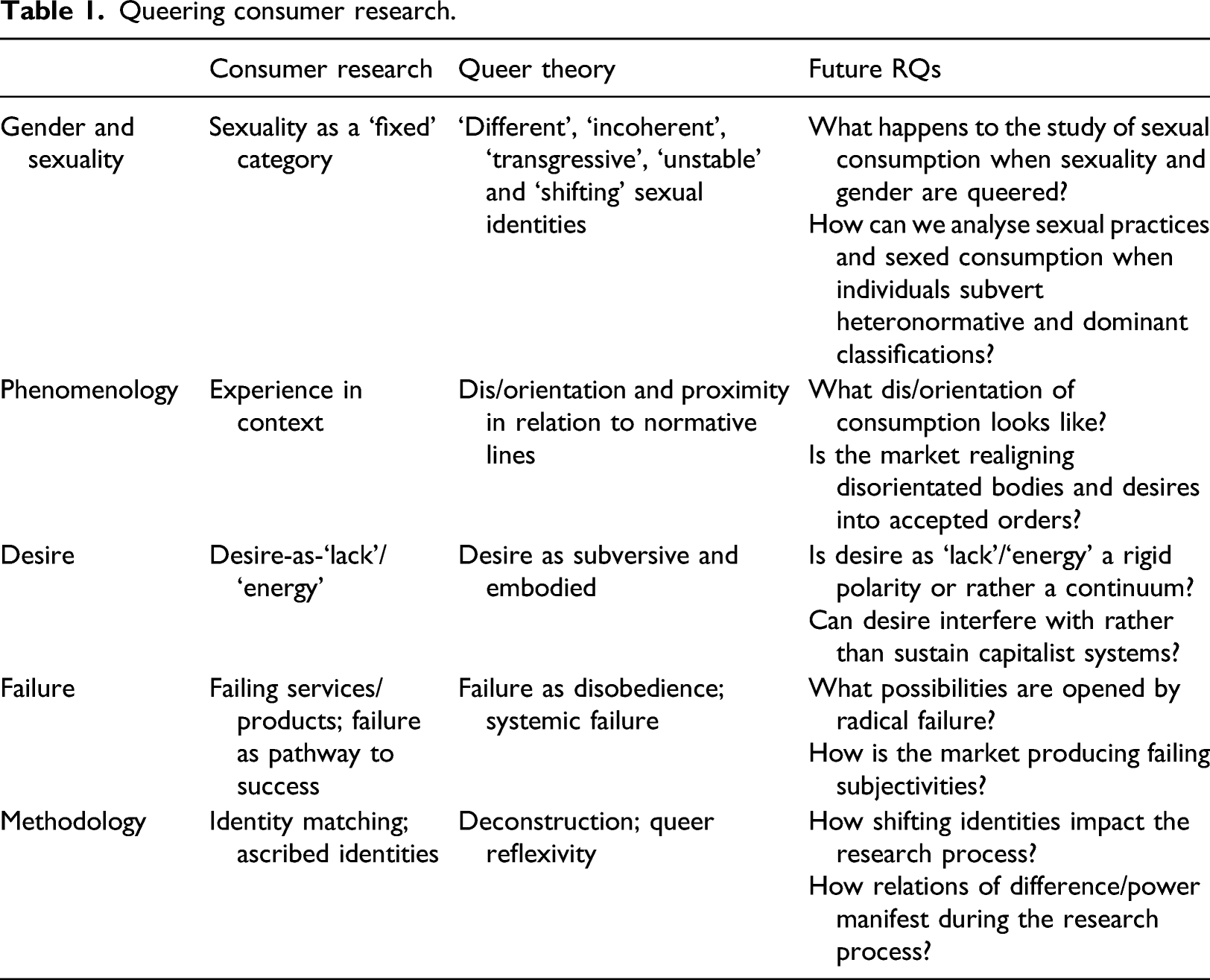
In terms of gender and sexuality, future marketing and consumer research should apply queer theory beyond LGBTQ+ contexts and subjectivities. Queer theorising invites us to challenge the binaries that are taken for granted such as men/women, homosexual/heterosexual and instead focus on understanding the power imbalances and inequalities that are perpetuated by these embodied categories of difference (Bunch, 2013). We invite consumer researchers to explore more topics such as queering beauty and queering bodies (Gurrieri and Cherrier, 2013) that do not focus specifically on the LGBTQ+ community but rather deconstruct/renegotiate the meanings of beauty, sexuality and the everyday experience of consumers.
We offer two potential applications of queer phenomenology. The first is the study of how subjects are queered by their (mis-)alignment to the conventions that govern spaces, including the marketplace, and of the ‘straightening’ practices that reorient deviant experiences. Borrowing from geography, future marketing research could investigate digitally mediated processes of exclusion and surveillance in cashless markets (Elwood, 2020), and how consumers are eluding them. Second, future marketing research could look at consumption within alternative forms of kinship and domesticity (Pirani et al., 2018b), such as queer home-life (Cook, 2014) and more broadly families of choice, moving beyond the dominant nuclear family.
Moving beyond the ‘lack’/‘energy’ dichotomy, we suggest that desire can be theorised as an affective conjunction between bodies and objects, an orientation induced by desired proximity. Hence, desire could be studied as subversive and productive of embodied resistance (Thompson and Üstüner, 2015), a hiccough to the capitalist system, rather than compliant with techno-capitalist innovation (Kozinets et al., 2017). More specifically, studies on visual consumption could be queered by looking at how desire is mobilised in the body in the interaction with images, rather than inscribed in images through gaze (Patterson and Elliott, 2002; Schroeder and Zwick, 2004) or the very composition of images (Kates, 1999). An existing example is the study of bodily reactions to images in technologically mediated visual consumption (Brace-Govan and Ferguson, 2019).
Queer negativity and failure are productive disagreements with the capitalist logic. Most of marketing research focusing on entrepreneurship follows the neoliberal logic of success versus failure and only a few exceptions highlight the detrimental effects of these practices (Ashman et al., 2018). We welcome studies that move beyond such conceptualisations and focus more on alternative forms of working, such as consumption-driven entrepreneurship (Daskalopoulou and Skandalis, 2019). Second, queer failure can be applied to understanding how the wreck of the capitalist promise can realign desire(s) for a sustainable future. In this sense, we point at the queer-infused work of Braidotti which frames desire as a non-entropic energy-flow (Braidotti, 2006), a ‘roar of energy’ emerging from a will to persevere in living collectively (Braidotti, 2020). Queer desire reclaims a radical multiplicity that speaks of collective liveability and endurance (Braidotti, 2006), of tracing desire lines that speak of a plurality of intentions (Ahmed, 2006).
Finally, we envision this manifesto as a first step in queering marketing theory. Doing so queer reflexivity is a useful tool that necessitates examining how embodied categories of difference are revealed (or concealed) during the research process and their impact on the researcher/researched relationship (McDonald, 2013).
A queer manifesto for marketing research
It is 2027, and we are not in a bingo hall. In the past five years, we have gathered online and in person, using the CCT conference as a magic wand to bring attention and money towards those places that taught us about marketing and consumption beyond neoliberal and capitalist terms. Building this queer ‘table’ for discussion was a wonky work of carpentry, and it was a labour of love. We were moved by desire, the desire of making this discipline bearable for us all, the desire for this discipline to be flexible rather than inclusive (Halberstam, 2011). We have turned our attention towards the experiences of those who struggle, cut out by boundaries as well as physical borders. The marketing community convened that we could all afford to fail academia as a devotional marriage to one’s ego (Parker, 2002) and to abort the genuine imposter syndrome (Tourish, 2020) that strangles our careers. We dedicated a prize to Lauren Berlant, to celebrate her legacy, commemorate her loss and keep alive the memento that the tension towards certain forms of happiness inhibits our flourishing. Collective writing has made a comeback (Parsons et al., 2022), and the stars we value are those lightening up the night. We keep being aroused by conversations on how to make life and consumption liveable and sustainable for the queer future that is yet to come. We got less obsessed by family and its permanence through institutional privilege, and more curious about belonging and kinship. We understood that questioning reproductive futurism is not opposing childbirth, but the agenda that hides behind ‘the Child’ (Nelson, 2015). Having your children smiling from the screensaver of your phone and wearing the Leather Flag on your sleeve are now both understood as sexual performances. If queerness is not here yet, we ‘must be always future bound by desire and design’ (Munoz, 2009: 185) to imagine and craft a queer future. The design of our ‘table’ is queer, as it keeps changing, constantly reshaped by discussion. This queer manifesto is not a self-consuming unbecoming, but a toolset to equip the researcher with an inclusive, challenging and at times unsettling frame of inquiry. The directions outlined here should ignite, rather than limit, the scholarly debate. Luckily, there is more to queer.
Footnotes
Declaration of conflicting interests
The author(s) declared no potential conflicts of interest with respect to the research, authorship, and/or publication of this article.
Funding
The author(s) received no financial support for the research, authorship, and/or publication of this article.
