




Abstract
Lesbian, gay, bisexual, transgender (LGBT) tourists are considered one of the most profitable and, at the same time, vulnerable and discriminated-against segments of the industry. However, a more detailed understanding of how heteronormativity (the privileged and normalized view of heterosexuality) constrains their travels is missing. As a result, this study takes a Queer Perspective, investigating the role of heteronormativity in LGBT tourists’ perceived travel constraints. Through 16 interviews with LGBT travelers, intrapersonal, interpersonal, and structural heteronormativity are identified as constraining factors, and relevant subthemes are discussed. Finally, this study makes a step toward denaturalizing heterosexuality in a tourism context by giving a voice to an often-overlooked and scarcely understood tourism segment.
Introduction
Studies have suggested that lesbian, gay, bisexual, transgender (LGBT) individuals whose sexual identity can be easily identified face higher victimization levels and, ultimately, constraints than other groups of travelers (Brunt and Brophy 2006). These are believed to limit and/or prevent them from partaking in travel activities (Weeden, Lester, and Jarvis 2016). A national survey carried out by the British government in 2017 confirmed that most of the severe incidents members of the LGBT community experienced went unreported, especially if these involved people they lived with (94%). Most were not reported because respondents thought the incident as minor, not serious enough, or very common, so that the police would not have taken follow-up actions seriously. When incidents outside the home were reported to the police, almost half (45%) of the respondents were not satisfied with how the police had handled their reports (Government Equalities Office 2019).
Many crimes have roots in homophobic ideologies; therefore, victims are less likely to report them as those ideologies and beliefs might be prevalent also within the police. Willis (2004) identifies intimidation, teasing, bullying, physical assault, and rape as the most common hate crimes against gay men specifically. Verbal harassment and the disclosure of LGBT status without permission are also pervasive (Government Equalities Office 2019; Hughes 2002). This is particularly apparent when traveling. For example, in the Caribbean and Malaysia, where gay men reported attacks and incidents, they were met with indifference or further victimization (Amnesty International 2001).
While this is a persisting issue, the LGBT travel market is increasing rapidly in size and visibility with the advancement of related rights and recognition in many parts of the world (Ro and Olson 2020). Although only estimated at a 7% of the population in the USA, the purchasing power of this segment is appraised as close to 1 trillion USD (Schneider and Aute 2018), and the so-called “pink money” makes the LGBT market a potentially profitable tourism sector (Anastas 2001; Peters 2011; Ram et al. 2019; Waitt, Markwell, and Gorman-Murray 2008). Although the beliefs of an extraordinarily wealthy LGBT market have recently been questioned (Ram et al. 2019), this tourism segment is still perceived as highly lucrative (Ram et al. 2019) and its constraints need to be better understood.
However, a closer and more holistic investigation of the LGBT segment is still lacking (Vorobjovas-Pinta and Hardy 2016). Ginder and Byun (2015) note that there are several potential reasons for this shortcoming. First, the definition of LGBT may be drawn on self-identification, same-sex behavior, same-sex attraction, or any combination thereof; second, political and cultural factors around the world might lead to a bias in the definition; third, most of the related studies focus on white, educated, and affluent gay men, overlooking lesbians, bisexuals, and transgender people and nonwhite segments (Berezan et al. 2015; Ro, Olson, and Choi 2017; Visser 2003, 2013). Other scholars have argued that families and friends are often ignored in related studies, although they play an essential role in the travel experience (Mumcu and Lough 2017; Puar 2002; Visser 2013). Most other related studies focus on LGBT tourist motivations and activities; finding that gay men travel largely to socialize, escape social constraints, and explore their identity (Clift and Forrest 1999; Holcomb and Luongo 1996; Hughes 2002; Ram et al. 2019).
In terms of travel constraints specifically, past studies have investigated “high travel risk” perceived by LGBT travelers and the relationship with their travel behavior, as well as the avoidance of certain places (Mawby 2000; Sönmez and Graefe 1998). For example, in the context of gay men, Hughes (2002) argues that “discomfort” is a typical key travel experience, including the threat of being subjected to verbal abuse; or simply being uncomfortable in the presence of heterosexual people who express their dislike for LGBT travelers. Furthermore, studies have shown that LGBT travelers are more likely than others to face physical risk, as they are often physically and verbally abused (Brunt and Brophy 2006; Hughes 2002). Brunt and Brophy (2006) also suggest that LGBT tourists are more vulnerable to criminal victimization. Thus, it is suggested that the LGBT community faces particular forms of travel constraints, which may or may not match those of heterosexual travelers. The detailed nature of these is anyhow not clear, and related theory is lacking (Ro and Olson 2020). As a result, we take a queer perspective in order to investigate travel constraints for LGBT travelers.
The queer theory critiques that the main constraints that members of the LGBT community face are related to heteronormativity, or the belief that heterosexuality is “normal,” “coherent,” and “beneficial for society” (Berlant and Warner 2000; Warner 1993). The unique context of homosexuality asks for a specific investigation of travel constraints for the LGBT travel community. Particularly in a tourism context, the LGBT community is often confronted with heteronormative social and cultural practices; and how heteronormativity as a travel constraint is constructed in cross-cultural tourism environments is still poorly understood. By understanding how to give a voice to a usually overlooked tourist segment and taking a step toward denaturalizing heterosexuality in a tourism context, this study aims to investigate LGBT tourists’ perceived travel constraints by adopting a queer theory perspective. The exploratory nature of this study will not only allow us to advance further knowledge on heteronormativity in tourism academia but also offer practitioners working with the LGBT community a guideline on how to minimize and mitigate travel constraints.
Literature Review
Constraints and LGBT Travel
Travel constraints are described as factors that restrict the development of a tourism market and limit the potential of tourism destination development (H. J. Chen, Chen, and Okumus 2013), as they are, in fact, “reasons that limit or prevent participation or that explain why people have stopped in taking part in leisure-related activities” (Weeden, Lester, and Jarvis 2016, p. 1069). Most of the literature regarding travel constraints is based on the conceptualization of leisure constraints, proposed by Crawford and Godbey (1987), and modified in 1991 (Crawford, Jackson, and Godbey 1991). In sum, three single models were developed in 1987 and revised to create a single integrated model, which consists of a hierarchical series of constraint levels. This model demonstrates how constraints can affect participation or nonparticipation in leisure activity and how participants’ behavior is affected by these constraints (Crawford, Jackson, and Godbey 1991).
The three categories elaborated are structural barriers: intervening factors between leisure preference and participation, such as family life-cycle stage, economic situation, season, climate, time, availability of opportunity; intrapersonal barriers: individual psychological states and attributes that interact with leisure preference, such as stress, depression, anxiety, religiosity, group attributes, and prior experience; and interpersonal barriers: results of interpersonal interactions or the relationship between individuals’ characteristics, such as the inability to locate a suitable partner to perform a specific activity (Crawford, Jackson, and Godbey 1991). These constraints work hierarchically: first, at the intrapersonal level, second, at the interpersonal level, and last, with structural constraints. If these constraints are absent or negotiable, the individual will be inclined to participate; otherwise, the outcome will be the non-participation.
These constraints have been investigated in several contexts, such as senior travelers (Kazeminia, Del Chiappa, and Jafari 2015; Nyaupane, McCabe, and Andereck 2008), disabled tourists (Lee, Agarwal, and Kim 2012), sports fans (Kim and Chalip 2004), solo female travelers (Wilson and Little 2005), surf tourists (Fendt and Wilson 2012), and various destinations (Khan, Chelliah, and Ahmed 2019; Khan et al. 2020). The model has also been extended with other new dimensions (H.-J. Chen, Chen, and Okumus 2013), or subdimensions (Nyaupane and Andereck 2008), and conceptualized through destination images (H.-J. Chen, Chen, and Okumus 2013; P.-J. Chen, Hua, and Wang 2013) and decision making (Hung and Petrick 2010). For instance, H.-J. Chen, Chen, and Okumus (2013) further develop the original three dimensions of constraints and add a new dimension of unfamiliar cultural constraints, which acts as an inhibitor for only some segments. Nyaupane and Andereck (2008) extend the original leisure constraint theory by adding three subdimensions of cost-, time-, and place-related constraints within structural constraints, and concluded that cost- and time-related constraints are more influential on the tourists’ decision-making process, and when these are overcome, place-related constraint becomes secondary.
Recent studies also explore coping mechanisms and strategies to negotiate and overcome these constraints in various contexts (Lyu, Oh, and Lee 2013; J. Gao and Kerstetter 2016; Livengood and Stodolska 2004; Daniels, Rodgers, and Wiggins 2005). J. Gao and Kerstetter (2016) reveal culturally influenced negotiation strategies by older Chinese females such as “word-of-mouth advertising,” “group travel with friends,” and “finding partners through square dancing” to overcome perceived constraints. In their study on disabled travelers, Daniels, Rodgers, and Wiggins (2005) argue that in order to overcome travel constraints, coordination is required between disabled travelers, social networks, and service providers. Livengood and Stodolska’s (2004) study on post–September 11 America finds that American Muslims use strategies such as being vigilant with surroundings and adjusting travel patterns to adapt to a new environment and avoid discrimination.
However, there is a lack of understanding of the LGBT travel community and the specific constraints they face. Ro and Olson (2020) point out that discrimination and constraint issues are not yet widely researched, and most of the related studies lack empirical evidence. Hall, Timothy, and Duval (2012) highlight that security, risk, and perception of safety are concerns to all tourists, but in light of frequent violence and open discrimination, this is assumed to be even more critical for the LGBT segment (Pritchard et al. 2000). Often this results in the need for gay-friendly havens when traveling, so-called LGBT-friendly destinations (Ram et al. 2019; Weeden, Lester, and Jarvis 2016). On the other hand, this has caused LGBT avoidances of certain destinations because of local cultural and religious factors. Adverse reactions by locals to LGBT tourists have been reported in countries such as Egypt, the Caribbean, and Mexico, as this segment is often seen as a threat to the patriarchal society and national identities (Hughes, Monterrubio, and Miller 2010). Some destinations such as the Caribbean can be perceived as a paradise from heterosexual tourists; however, colonial anti-sodomy laws are still in place in some countries, which deter LGBT tourists from choosing those destinations (Pritchard et al. 1998). Especially in the case of Islamic countries, tourism can be perceived by extremists as a threat to their religion and culture, and there might be hostility toward non-Muslims who challenge their moral and social values (Aziz 1995).
For local people, gay tourism is sometimes also perceived as a threat to other kinds of tourism (Hughes, Monterrubio, and Miller 2010). A study on a Mexican gay destination proved that locals often have a stereotyped vision of homosexuality and made comments suggesting a relationship between homosexuality and drugs, diseases, and child harassment. This shows that the disapproval of homosexuality goes beyond the hate crimes that LGBT people suffer on a personal basis (Hughes, Monterrubio, and Miller 2010).
Destinations also tend to be avoided by LGBT travelers because of contact with fellow-tourists. According to the respondents of Brunt and Brophy’s (2006) study, most homophobic incidents were caused by other holidaymakers rather than locals. Offenders are often single young heterosexual men, generally in groups. Most respondents admitted having to modify their behavior for fear of being subject to discrimination and hate crime (Brunt and Brophy 2006). The avoidance of British holidaymakers was also recorded in the study by Hughes (2002), where respondents pointed out the “rowdy and unruly behavior of single people.”
LGBT tourists also tend to avoid family and child-friendly destinations (Clift and Forrest 1999), as some heterosexual families might express their disapproval toward gay couples (Hughes 2002; Lucena, Jarvis, and Weeden 2015). A study from Poria (2006) confirms that the presence of other people’s children makes LGBT travelers feel less safe. These destinations are even more avoided by LGBT couples with children, as they might disclose their parents’ sexuality or make it more visible, leading to feelings of insecurity and anxiety for the parents; in this case, children can act as constraints. Social interactions usually are one of the most common travel motivations; however, in this situation, they are the cause of distress (Lucena, Jarvis, and Weeden 2015).
For the LGBT segment, in particular, a feeling of risk to personal safety can affect not only the choice of destination but also the behavior while on holiday and the social interaction with other tourists (Hughes 2006). Hughes (2002) proves in his study that some homosexuals do not only try to pass off as straight, some of them are also willing to conceal their sexuality throughout the holiday, out of fear for possible aggressive reactions, while others who believed their behavior or appearance could not have disclosed their sexuality had no problems. The modification of behavior is something that most people have experienced at home and therefore developed the ability to cope with such uncomfortable situations or avoid them (Hughes 2002). However, most of this research lacks a broader theoretical base and focuses mostly on western, middle-class gay men and does not offer a more holistic picture of the LGBT travel segment.
A Queer Perspective on Heteronormativity
In order to understand heteronormativity as constraints for LGBT travelers, this study will adopt a queer perspective. Although the queer theory emerged in the early 1990s, it is not reducible to a single meaning or universal set of doctrines (Rumens, De Souza, and Brewis 2019). Coined by De Lauretis (1991), queer theory as a field of study aims to question and denaturalize heterosexual norms, thoughts, and categorizations. Largely influenced by poststructuralism, feminism, Foucauldian historiography, and HIV activism, queer theory, as a perspective and academic toolkit of critical theory (Ritzer and Stepnisky 2017), is difficult to summarize. Differing from many theories that follow one single theoretical principle, queer theory serves as an umbrella term covering a wide range of critical frameworks, methodologies, and epistemologies. De Lauretis (1991) proposes that queer theory represents critiques such as refusing heteronormative benchmarks to understand sexuality and challenging the understanding of gays and lesbians as a homogenous group to rethink conventional understandings of gender, sexuality, and identity (Foucault 1978; Butler 2011). Depending on the usage, queer theory can have different meanings, and in this study, we use queer theory to question heteronormative stability, which includes LGBT travelers’ encounters of heteronormative constraints and the leisure constraint theory itself. First, questioning the dichotomy and categorization in knowledge inquiry (Hennessy 1993), queer theory offers a theoretical lens to critique and undermine the base structure of some classical theories influenced by modernism. Second, heteronormativity remains the status quo for the holiday space (Lucena, Jarvis, and Weeden 2015), while queer spaces and LGBT travelers in the destination are marginalized. A perspective on queer theory can function as an effective tool to disrupt the normalized view of travel constraints, and centralizes the embodied issues of LGBT travelers, which are often overlooked. Mirroring philosopher Jacque Derrida’s concept of “deconstruction,” it can be described as a reaction to—and thus a deconstruction of—heteronormativity. Berlant and Warner (2000, p. 312) describe heteronormativity as institutions, practical orientations, and structures of understanding, making heterosexuality seem coherent and privileged. Furthermore, it lays heterosexual relationships at the basis of society as a means of reproduction (Warner 1993).
Accordingly, the queer theory developed as a form of protest against heteronormativity regarding activism and theoretical conceptualization (Caudwell 2007). Broadly speaking, queer theory thus reflects a departure from gay and lesbian standards of identity to politics of difference, resistance, and challenge; a critique of identity rather than an identity as such (Butler 2005). Beemyn and Eliason (1996) state that it aims to bring previously silenced sexualities to light, particularly if they do not fit dominant standards of gender and/or sexuality. As such, queer theory seeks to interrogate and transform social norms and power relations and what is considered “normal,” “common sense,” “healthy,” and “natural” (Jagose 1996; Rumens, De Souza, and Brewis 2019; Wiegman and Wilson 2015).
Considering the previously discussed literature on LGBT tourism, it could thus be argued that tourism as a field of study is still deeply rooted in a context of heteronormativity, particularly through its deep embeddedness in different social and cultural norms that are negotiated between host and guest, but also between tourist and tourist. Queer theory, as such, is an efficient theoretical backdrop for understanding how heteronormativity is constructed and in the tourism context and how sexual and gender normativity can be transgressed in the future (Courtney 2014; McDonald 2017; Rumens 2012). Recent studies adopting the leisure constraint theory have been engaging in new interpretations and theory extensions in various situated contexts (J. Gao and Kerstetter 2016; H.-J. Chen, Chen, and Okumus 2013). Apart from the new constraints and subconstraints discussed earlier, Daniels, Rodgers, and Wiggins (2005) argued that themes generated from three constraint dimensions are interactive rather than hierarchical. From the perspective of queer theory, we thus challenge the heteronormative and reproducing applications of the leisure constraint theory. As a theoretical framework, the queer theory provides a critical lens that centralizes LGBT tourists’ cognitive and affective experiences. As a result, we propose a “queer” interpretation and modification of “intrapersonal,” “interpersonal,” and “structural” dimensions.
Research Methods
When discussing LGBT travel, one must first and foremost consider the position of privileging certain gendered identities or positionalities in contemporary culture and the structures and agencies they face (Rogers and Ahmed 2017). The positionality of the researchers is thus of vital importance, referring to the researchers’ placement within a set of relations as well as practices, implicating identification, performativity, or action (Anthias 2002). As this study adopted a constructionist stance in which knowledge is constructed and situated, the researchers needed to take responsibility for their positioning related to the topic through self-reflection (Burck 2005; Guba and Lincoln 1994). It is thus crucial to mention that some of the researchers involved understand the agencies and constraints to travel as an LGBT tourist from personal experience. There is anyhow a lack of personal understanding regarding specific segments, such as transgender travel. This article aims to identify and understand the travel constraints of LGBT travelers through a queer lens, and it follows a qualitative method; as this lends itself effortlessly to exploratory research (Hennink, Hutter, and Bailey 2020). Through the queer theory strand, the study intended to refuse theoretical closure and challenge the heteronormativity in the research design and analysis (X. Gao 2019). More specifically, data were collected between January and April 2019 through semistructured interviews with a focus on how they perceived heteronormativity, allowing interviewees to provide answers with fewer restrictions.
The initial interview guide was developed based on previously discussed literature, starting from the general concepts of “structural” (e.g., family life-cycle stage, economic situation, season, climate, time, availability of opportunity), “intrapersonal” (e.g., individual psychological states and attributes), and “interpersonal barriers” (e.g., interpersonal interactions or the relationship between individuals’ characteristics), respectively (see Crawford, Jackson, and Godbey 1991). Following semistructured questions on these three major themes, additional questions on the interviewees’ understanding of heteronormativity in a travel context were asked. This allowed for a linkage between the previously identified barriers and heteronormativity for the given context.
Before the main phase of interviews, a pilot interview was conducted. The pilot test was useful to determine if there are flaws, limitations, or other weaknesses within the interview design. It also highlighted whether specific questions need to be refined before the implementation of the study (Turner 2010). In this specific case, the researcher realized that the order of some questions resulted unnaturally, and it was then modified. It was also noticed that some questions could be irrelevant, and they only need to be asked if they apply to the participant. The pilot study also revealed that the approach taken should best focus on two factors: first the participants’ personal experiences, and second, their opinion on contemporary LGBT tourism in general. After the pilot interview, the interview guide was updated accordingly. Throughout the main interview phase, modifications to the interview guide and spontaneous follow-up questions were employed if new information arose. It is important to highlight that the previously mentioned core factors (personal experiences and opinions on LGBT tourism) were not modified within the interview guide. As common for semistructured interviews, some of the questions related to the topics were rephrased or followed up on if new information surfaced (Klandermans and Staggenborg 2002). The interviewer was also given consent by each participant to contact them again if some information needed to be clarified. However, the notes were accurate, and the information needed for the research was made available from the first interview.
Although recording interviews is generally the best way to reduce error margins (Opdenakker 2006), the sensitive personal information asked the participants was taken into account. It has been shown that the outcome of an interview with highly sensitive topics might be different if the participant is aware of the recording as they might be more aware and cautious about what they disclose and share (Al-Yateem 2012). As such, the interviewer preferred note-taking and real-time transcripts of key comments over a full audio recording. As some of the identified participants reside in different locations, a number of interviews took place through video calls, while the interviewer was situated in the United Kingdom. Participants were approached on social media such as Facebook, WhatsApp, and Instagram. The use of such a method is increasing among researchers, representing a valid alternative to face-to-face interviews (Deakin and Wakefield 2013).
The sampling for this study consisted of a mix of convenience and snowball sampling. Some of the participants were identified among people from the LGBT community personally known by the interviewer; subsequently, the first participants indicated other candidates who were willing to participate in the study. Regarding the transgender community, there have been difficulties identifying participants; therefore, the interviewer had to contact potential transgender participants through social media. Participants’ ages ranged from 21 to 43 years. To represent every group within the LGBT community equally and avoid bias, four participants per each category were selected, resulting in a total of 16 interviews (see Table 1). Saturation was reached at 16 interviews, with key themes starting to emerge after the first 6 interviews.
Participant Information.
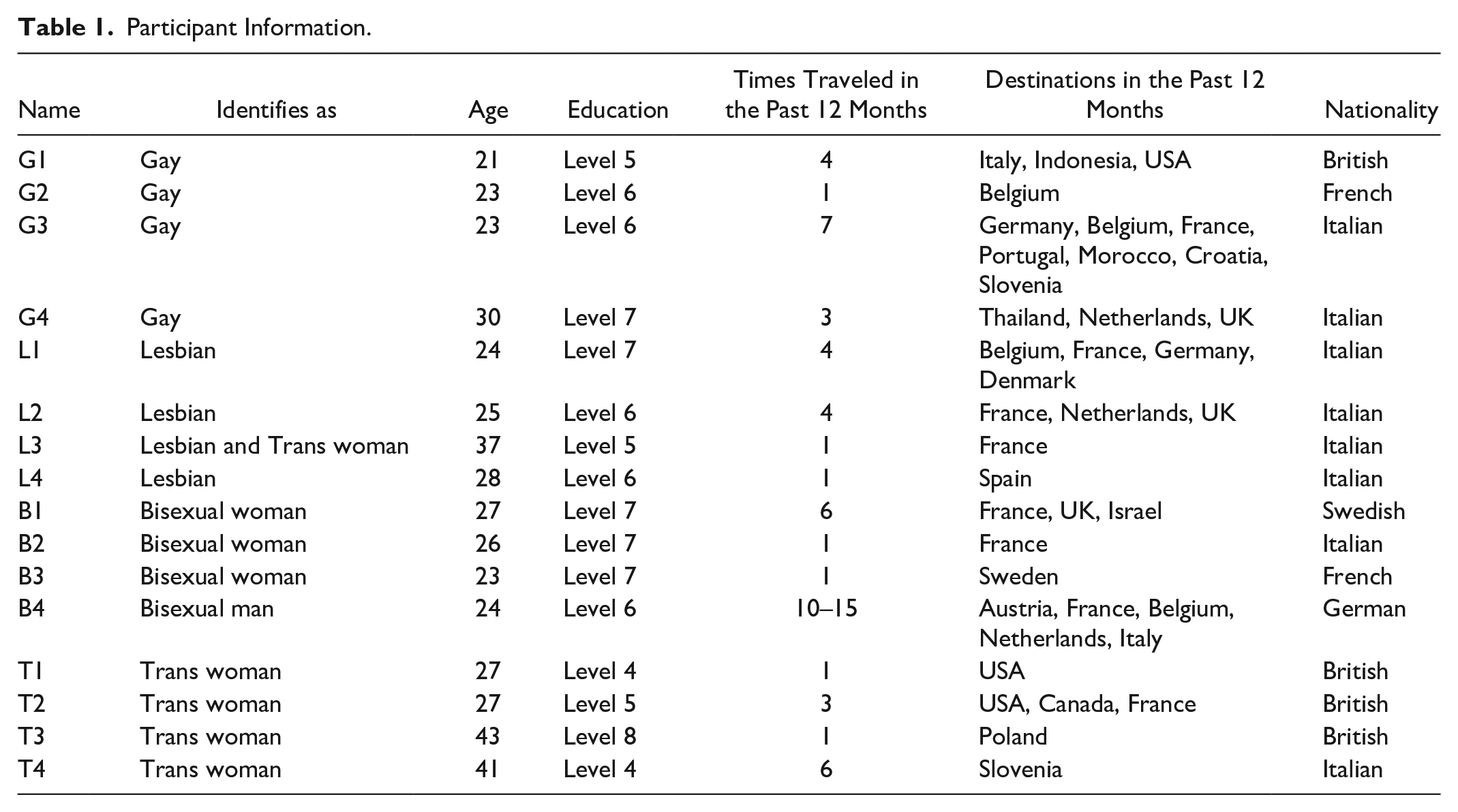
To guarantee anonymity, we name each participant with a letter (L, G, B, T+ number). Each participant was identified as part of the LGBT community and had traveled abroad at least once in the past 12 months. Not all the participants were fluent in English; therefore, the interviews with Italian participants were carried out in Italian. Each interview lasted approximately 30 minutes, with minor variations in time, ranging up to 50 minutes.
The obtained data were transcribed and coded manually through a thematic approach by the lead author. The preliminary coding process identified several themes and subthemes within the constraints highlighted by the participants grouped into “structural,” “intrapersonal,” “interpersonal,” and “others.” The “others” section was discussed with the remaining authors, and it was determined that these were, in fact, constraints that can be grouped into the previously established 3 categories. Next, the heteronormativity section was coded into different themes and grouped into the 3 main constraint themes. One of the authors recoded the data set independently in the research software QDA Miner to heighten the trustworthiness of the data analysis. Finally, the data was reexamined by all researchers conjointly to guarantee its truth value, consistency, and neutrality. The results of this process and relevant findings are presented as follows.
Findings and Discussion
Our findings show that heteronormativity, much like traditional constraints, is encountered hierarchically; on an intrapersonal, interpersonal, and structural level (see Figure 1). The findings are discussed as follows.
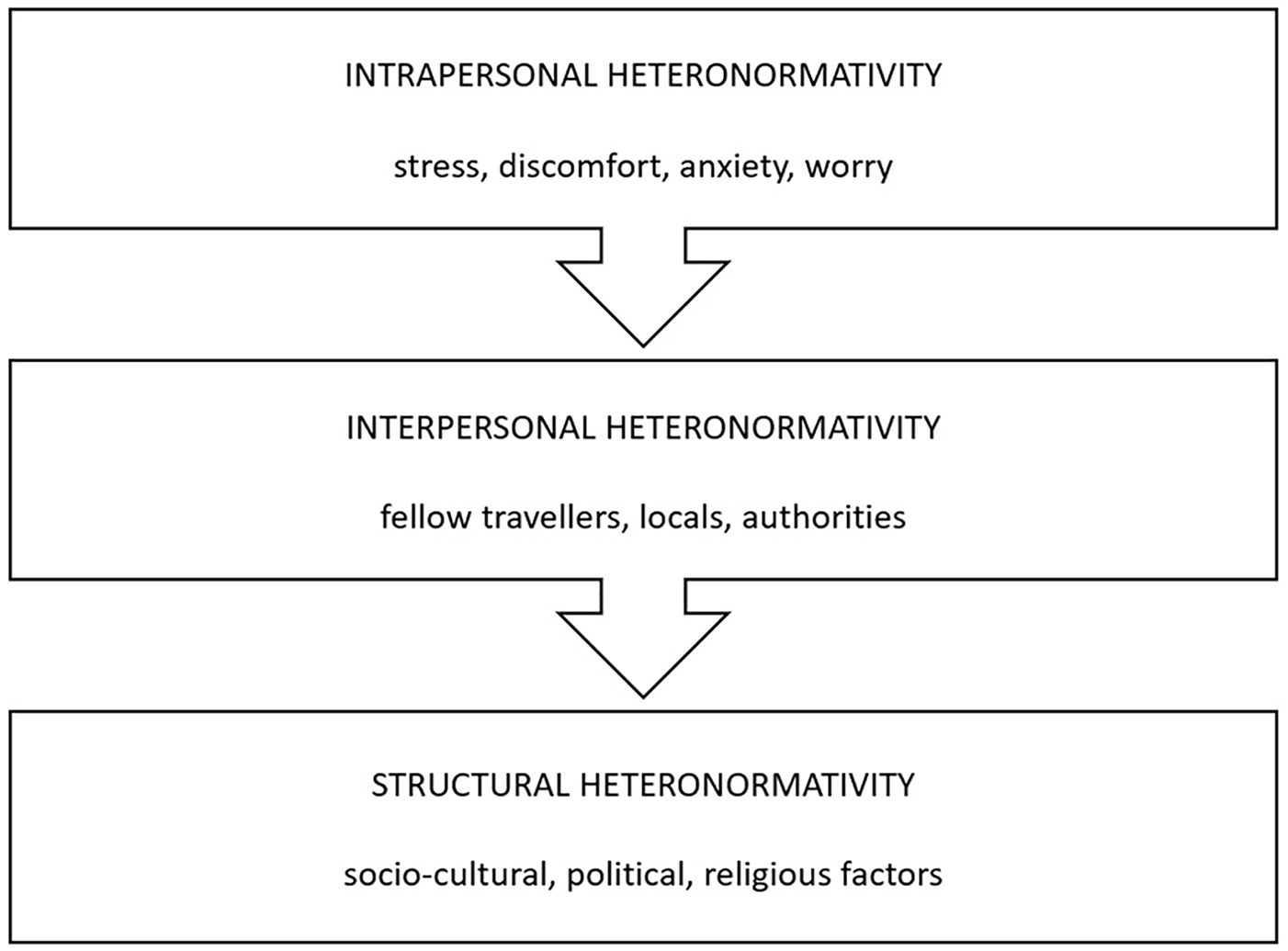
Heteronormativity as travel constraints.
Intrapersonal Heteronormativity
Our findings show that heteronormativity is encountered first on an intrapersonal level, which refers to psychological states and attributes that interact with leisure preferences (Crawford, Jackson, and Godbey 1991). Participants showed cases of negative subjective feelings, in particular, stress, discomfort, anxiety, and worry, related mostly to how their sexuality would be perceived while traveling.
A lot of these negative emotions were appearance-related, in particular, associated with the fact that they might appear as “strange” or “not normal” when traveling. Past studies have found this to be particularly important because of the frequent levels of discrimination and violence that the LGBT community faces (e.g., Kiss et al. 2020; Pritchard et al. 2000). In particular, transgender participants expressed their worry about daily-life issues that might become more serious when traveling, such as “wearing makeup” or “using the bathroom.” Participant T1, for instance, mentioned that an experience scared her to undertake future travel: “When I was in Disneyworld in Orlando I felt in discomfort, even if I know it is quite LGBT friendly. I was scared of other people’s reactions when I needed to use the toilet.” This issue has been discussed by the media in the past few years, especially in the United States. Seventy percent of transgender and gender-nonconforming Americans have reported being denied access, physically assaulted, or verbally harassed in public bathrooms (Johnson 2019). While participants mentioned that these stress factors are part of daily life, it was mentioned that “these are more exacerbated when traveling” as the context is often unfamiliar, and this creates fearful feelings about tourist activities in the first place.
One particular fear was mentioned by a transgender participant related to the airport’s security processes: I worry when going through airports, as a trans woman. You get stopped a lot, and they want to search your body. It is embarrassing to be searched in front of everyone, but if you ask for a private room, they think you are hiding something. I also worry about being ‘clockable’ and about who sits next to me on a plane. I don’t know whether it would be a problem for them to sit next to a transgender woman. (T1)
Transgender travelers tend to be more often stopped at security as their crotch area can highlight in the screen as the body scanner recognizes an anomaly. This can lead to embarrassing situations, where transgender travelers are forced to explain private details in order not to be mistaken for terrorists (Currah and Mulqueen 2011); and our participants expressed their awareness and personal experience with these issues.
Such anxieties have also been reported by previous research (Gorman-Murray, McKinnon, and Dominey-Howes 2014). Many incidents concerning the behavior of airport security guards toward transgender individuals can be found in the major journalistic headlines (Currah and Mulqueen 2011; Olson and Reddy-Best 2019). For T2, it seems it has become a norm to being stopped and checked in the airport, and this situation increased her anxiety when traveling to specific destinations: “When you’re transgender, you tend to be stopped a lot in the airport. I was particularly concerned about my safety when traveling to Dubai.” T3 was worried about the mismatch between her appearance, and the travel document will create troubles when going through immigration: “In my documents, I’m still a man, sometimes I get worried when traveling as the document might be refused or there could be some problem, but I don’t think about it too much.”
While afraid of being judged primarily by appearance was predominant for our transgender participants, other participants mentioned similar fears, although in a more subtle way. Homosexual participants ousted to be afraid to “negotiate their sexuality” when deciding to go on a holiday, particularly as “acceptance in daily life has often been fought for.” In other words, there is a fear of daily life activities, such as showing affection in public when traveling and this “surrender” to heteronormative values is often a cause for anxiety, fear, and deciding not to travel at all.
Finally, intrapersonal heteronormativity for LGBT travelers was expressed as an array of negative subjective feelings, mostly fear, anxiety, shame, or as giving up on personal moral and ethical values.
Interpersonal Heteronormativity
Next, the data shows that there is a degree of interpersonal heteronormativity in LGBT travel. This refers to the relationship between individuals’ characteristics, affecting a joint preference and participation. Fundamentally, this heteronormativity results from interaction with others and, in this case, coexistence with fellow travelers and locals. Constraints were expressed through issues such as verbal and physical confrontation with locals, other (particularly straight and family) tourists, and occasionally, even the authorities.
As suggested by Lucena, Jarvis, and Weeden (2015), social interactions in a travel context are indeed a main cause of distress for the LGBT market. The main concern was ousted to avoid places where mostly straight, and in the worst case drunk, men travel as in some cases, these tend to be verbally and physically aggressive. Single, heterosexual men, particularly in groups, have been identified as threatening to the LGBT segment in an earlier study by Brunt and Brophy (2006), as well as Hughes (2002). Several participants reported feeling threatened by local and non-local heterosexual men, which resonates with an earlier study by Hughes (2002). For example, G1 disclosed: “I tend to avoid certain kinds of straight men that seem aggressive, I can’t explain it, but you just get a feeling that you should be careful about your behavior when they’re around.” Correspondingly, T2 stated: “Big groups of straight guys do not make me feel comfortable; in fact, I tend to avoid bars where straight men are the majority and big sporting events.” As aforementioned, participants perceived drunk straight men in groups as the most dangerous: “I tend to avoid drunk straight men, and when you’re in a club, those that do not drink as it feels like they are lurking and do not belong there” (G2).
These perceptions toward straight men and their view on heteronormativity while traveling are largely determined by past negative interpersonal experiences and reflections. In fact, Brunt and Brophy (2006) mention that most related hate crimes and acts of discrimination stem from tourist-to-tourist interaction. For example, participants reported past experiences of being in similar environments while traveling and the resulting “physical and verbal discrimination” and “harassment on holiday.” Compared with physical attacks, verbal harassments were more commonly experienced. L1, for example, shared that she was highly sexualized by straight men in a club and that this is a danger when being in unfamiliar environments: “I’ve had guys harass me for threesomes in clubs, as they became aware of my sexual orientation.” B1 also shared a similar story of getting verbally abused after harassments: “Once I was with a girl, and a straight man approached us. He tried to touch us, and we told him to go away. So, he started shouting ‘disgusting lesbians’ at us” (B1). Moreover, T3 said that straight men deliberately use miss-gender as an insult: “I’ve faced episodes of verbal harassment, including deliberate miss-gender use.” In extremis, a participant remembered a scenario where this behavior even escalated into crime: “I was in Nice, I took a taxi at night, and three guys harassed me, they punched me, and they stole my stuff. . . . I reported it to the police, but nothing has happened. I’ve also been verbally harassed in clubs” (G2). This is, of course, particularly delicate in situations of travel, where there are further sociocultural and linguistic barriers.
Some participants subsequently showed a lack of confidence in authorities, such as the police. This is not uncommon among sexual minorities, particularly in certain cultural contexts (Brunt and Brophy 2006; Mainiero, Omary, and Norbash 2019). Participant T3 has admitted that “she would not feel comfortable reporting any crimes to the police while in a foreign country,” because “the police might not be on her side and escalate the situation.” It is particularly worrying that heteronormativity has been reported as also rooted in the authorities. Hughes, Monterrubio, and Miller (2010) had mentioned earlier that this could even lead to LGBT tourism being perceived as a threat to other types of tourism in the area; this is also related to the following point.
Finally, participants mentioned that they tend not to choose destinations or participate in activities in which are targeted to families. Avoidance of family-friendly destinations, particularly when a large number of children were present, are also noted in past studies (e.g., Clift and Forrest 1999; Lucena, Jarvis, and Weeden 2015; Poria 2006). This was mainly related to not wanting to “show their sexualities around heterosexual families with young children in certain socio-cultural contexts.” To give an example, L1 compared parents’ attitudes between travel in Italy and Denmark: “I know that in some places adults do not want to show homosexual people to children as they don’t think it’s a good example. I consider Italy to be one of these countries, while I would not pay as much attention in Denmark, for example.” In more detail, T1 explained the discomforts were generated from a parents’ heteronormative gaze rather than the children: “I feel like I’m looked like a sexual predator by parents of children I don’t know, and I fear that they could approach me questioning that I made their children aware of my gender identity.” As a result, participants reported occasionally avoiding travel to family destinations and attractions.
This, however, was not always agreed upon. Other participants even felt more motivated to fight homophobia when in the presence of children, particularly through exposing them through other cultures while traveling: “I actually feel more motivated to be myself, so I can encourage open-mindedness for the next generation” (G1). B1 agreed on the importance of informing on diversity and individuality: “If I’m asked, I try to explain to them that people are different.” Finally, T4 explained not to modify her travel behavior in front of kids: “I don’t feel like I need to avoid kisses. I feel that kids are already exposed to everything from a really young age only by watching TV.” This mirrors the findings of Wong and Tolkach (2017), where activism was identified as an important part of LGBT travel.
Subsequently, interpersonal heteronormativity for LGBT travelers was expressed as being related to locals, tourists, and authorities respectively; particularly if these are represented by straight males and sometimes if alcohol is involved.
Structural Heteronormativity
Last, structural heteronormativity has emerged as intervening factors between leisure preference and participation (Crawford and Godbey 1987). This was found to be related to sociocultural, political, and sometimes religious factors of certain destinations, leading to destination avoidance, behavioral modifications, and the need for a “queer space.”
LGBT travelers in this study emphasized that their sexual orientation or gender identity affects their destination choices, as certain destinations with strong roots in heteronormativity are frequently avoided. Religious and sociocultural factors were often mentioned as problematic. This mirrors Hughes, Monterrubio, and Miller’s (2010) assumption that this is often related to highly patriarchal societies, where heteronormativity is dominant; or societies where law and norms are not accepting of the LGBT segment (Aziz 1995; Mainiero, Omary, and Norbash 2019; Pritchard et al. 1998). One participant mentioned that “I always look at the socioeconomic state of a destination and the level of acceptance of gay people. In the case the country is not accepting, you have two options. Either risk prosecution or avoid being themselves. I would feel uncomfortable visiting Africa and Islamic countries. I’ve traveled to Bali, but I would avoid the rest of Indonesia” (G1). Another mentioned that these factors would be particularly worrying when traveling with a partner, as this would expose his sexual preferences: “If I had to go on holidays with my partner, I would avoid the Middle East; Maybe I’d go, but you need to be more careful. You can’t behave freely with the person you are with” (G4). During the interviews, many participants provided at least one particular country they are avoiding for their high levels of heteronormativity, for example: “I don’t have any travel constraint, but I’d never go to Russia” (T2).
Structural heteronormative constraints on physical appearance were reinforced particularly by the transgender participants, which felt more exposed to judgment. One participant mentioned that “it’s easier for me to tell you where I would go rather than where not. I would go to North and West Europe, Canada, not sure about the US, and maybe Japan. . . . It seems quite open” (T4). T3 did not want to compromise her identity by visiting certain destinations: “As a transgender woman, I could never go to certain countries. You cannot hide who you are; you cannot blend in. I wouldn’t be able to enjoy myself if I know I’m in danger. I would not go to places in Africa, Russia, and South America, which has a very high violence rate against transsexual women” (T3). Another transgender participant even highlighted structural constraints in terms of transition and, subsequently, airline choices: “Being transgender definitely affects your destination or accommodation choice. I would not go to many places in Asia, Dubai, or Russia. I wanted to go to Australia, but I haven’t as most flights stop in the Middle East and countries that are not accepting of trans people” (T1). Frary (2019) recently highlighted that this could be an issue with crossing international borders, where the LGBT community faces discrimination.
Although these concerns were mentioned by most participants, bisexual participants generally had less structural concerns as they were able to negotiate their sexuality, such as B1: “I do not feel restricted to certain countries. I am planning to visit Afghanistan, I have applied for jobs in northern Iraq, and I’ve previously lived in Africa. However, I do feel more privileged compared to other members of the LGBT community. I am quite straight passing, and I am also white.”
Next, structural heteronormativity was mentioned as contexts where there is a need for behavioral modification in LGBT tourists, and there are set rules in place regarding what can or cannot be done. Hughes (2002, 2006) had suggested earlier that behavioral modification on holidays is often the norm for LGBT travelers, particularly for gay men trying to pass off as straight. In the case of participant G3, recalling a past trip: “I’ve traveled to Morocco, and I had to pay attention to the way I talked, and I removed all my earrings. I tried to be more masculine; this doesn’t happen when I travel in Europe” (G3). Similarly, T2 agreed that when she traveled to the UAE, she needed to modify her dressing style and her behavior: “When I was traveling to Dubai, I had to act a lot quieter than I usually am and I also had to dress a bit differently.” Although some participants claimed it is “unfair” to conform, most of them still follow this practice to ensure safety if they choose a destination with this type of structural heteronormativity (Hughes 2002, 2006). However, not being able to be their true selves due to behavioral constraints affects some LGBT travelers’ wellbeing, as mentioned: “When I travel, I try not to wear attention-gathering clothes. When I could, I would just dress as a man, which makes me very sad” (T3). The coping mechanism by modifying behavior was mentioned to be most challenging for the transgender community. Instead of negotiating their sexuality, they need to decide which gender identity to present, which are especially challenging for those who are going through a transition like T1: “When I traveled to Crete at the beginning of my transition I traveled as a boy for fear of discrimination. I did it to feel safer as I didn’t know if I was going to be accepted there, but in the end, everyone was nice to me” (T1).
Finally, structural constraints lead to a need for a queer space when visiting destinations with strongly perceived heteronormativity; the absence of which is seen as a major constraint. Ram et al. (2019), as well as Weeden, Lester, and Jarvis (2016), had labeled these “gay-friendly havens” or “LGBT-friendly destinations” respectively. Queer spaces are a form of queer territoriality, where the sexual practice is largely spatially confined (Bell and Binnie 2004). Queer spaces were first established to guarantee safety to the LGBT community, in a place where judgment does not belong (Hughes 2002). Although experiencing “de-gaying” (Pritchard et al. 2000; Vorobjovas-Pinta 2018; Vorobjovas-Pinta and Hardy 2016) and being criticized of being over-sexualized and neglecting lesbian and transgender communities (Hughes 2002; Vorobjovas-Pinta 2018), queer spaces were seen as helpful to overcome structural heteronormativity by our participants: “I tend to hang out in queered places while traveling. The reasons are a combination of feeling safer, fully express myself, and meet the local LGBT community. Queer life in different places is one of my interests that is reflected in my career in activism” (B1).
On a similar line, Hahm and Ro (2020) suggest that particular spatial-temporal confinements such as events can create a sense of belonging in LGBT travelers. Indeed, our participants reported that they also feel safe and a sense of belonging in these queer spaces: “I go to queer spaces. I do it because traveling has a sense of belonging to this community, and also to feel safer” (G2). L4 confirmed that queer spaces gave her a feeling of a home away from home: “I tend to hang out in queered spaces abroad. I think it’s because I feel more at home and safer.” L1 also actively looked for gay bars when she is traveling as she believed “parties are cooler, and I also feel safer.”
However, B1 adds that in some countries with strong perceived structural heteronormativity, such as Cameroon, going to a queer place “while it makes you feel safer, it also consists of risk because such places are targeted by the local police.” In this case, “a place that was created to allow LGBT community to express themselves becomes a place where people are constrained and harassed due to local laws,” mirroring the previously mentioned distrust in authorities and recent mobilization against LGBT communities in sub-Saharan Africa (Currier and Cruz 2020).
This was also reflected in accommodation choices. It seems many hospitality providers do not specify if they are LGBT friendly. Ro, Olson, and Choi (2017) have mentioned earlier that communicating LGBT-friendly marketing campaigns is indeed not always smooth and successful. As a result, some participants end up with stick on the safer and limited options: “trans-friendly is a massive element that helps to choose accommodation. I know that choosing that hotel people will be cool with who I am. I would be nervous about going to a single-sex hostel, for example, or in a small hotel where the sex on my ID could be a problem. I normally choose well-established hotels, as I believe they offer better customer service” (T3). In contrast, G1 was quite relaxed about choosing accommodations when traveling in Western countries: “I don’t worry too much whether the accommodation is gay-friendly when traveling in western countries as it is assumed that it should be that way. It would be too risky for a business to stand against gay rights in the West, as the level of backlash would ruin them. For example, even if it didn’t happen in the West, Royal Brunei is being boycotted for this reason.”
Conclusion
This study explores heteronormativity as a travel constraint for LGBT travelers through a queer perspective. Findings show intrapersonal, interpersonal, and structural heteronormativity as significant travel constraints, and their nature in this context was further elaborated.
The findings lead to several theoretical contributions. First, this study takes a holistic approach to the LGBT travel segment. Past studies have often focussed on white, middle-class, male, gay travelers when researching the market. This study has effectively shown the heterogeneity of the LGBT market (Wong and Tolkach 2017) by including lesbian, gay, bisexual, and transgender participants. In parts, heteronormativity as a travel constraint was also perceived differently by these subsegments, which opens the doors for a wide range of follow-up studies. For example, future research can effectively divide the LGBT community into different market segments and study their respective needs, motivations, and constraints.
Second, heteronormativity has indeed been identified as the major travel constraint for the LGBT community. The nature of this concept has also been found to follow the hierarchical structure of traditional leisure constraints, namely, intrapersonal, interpersonal, and structural (Crawford and Godbey 1987; Crawford, Jackson, and Godbey 1991). Previous studies have indeed hypothesized and, in parts, empirically shown, that the LGBT travel community faces different and additional constraints when compared to traditional tourist markets. Issues such as security, risk, safety (e.g., Hall, Timothy, and Duval 2012), a need for gay-friendly spaces in problematic sociocultural contexts (e.g., Ram et al. 2019), issues with fellow tourists (e.g., Brunt and Brophy 2006), and avoidance of family destinations (e.g., Clift and Forrest 1999) have been identified in previous studies. This study, however, shows that these are not only risk factors, but that they align as hierarchical constraints expressed through various levels of heteronormativity. This study shows the complex array of travel constraints that the LGBT tourism segment faces, and participants generally agreed that their travel is constrained by several unique risk factors.
Third, the proposed framework showing heteronormativity as travel constrains for the LGBT community (Figure 1) adds a theoretical backdrop to the often fragmented studies of LGBT travel. First, the queer theory is applied in tourism, particularly as a broader tool to question heteronormativity, which arguably is predominant among tourism and travel academia. As such, this study offers not only a descriptive account of travel constraints for LGBT travelers but also opens the door to a wide range of research questioning heteronormative standards in the field. The findings of this study show that through the cross-cultural nature of the tourism industry, acceptance of the LGBT lifestyle is exposed to additional barriers, which in certain cultures are often absent in daily life. Participants mentioned not only their fear of being discriminated but even to break the law and get in conflict with authorities when traveling overseas. While some researchers had suggested this issue in particular for transgender travelers (e.g., Currah and Mulqueen 2011; Johnson 2019), there is a lack of research on, for example, coping mechanisms, travel behaviors, destination avoidance, and psychological impacts of this phenomenon on LGBT tourists.
In addition to contributing to the understanding of LGBT travelers through travel constraints, the study theoretically contributes to the applications of queer theory in tourism studies. Through the lens of the queer theory, we questioned the heteronormative stability of the leisure constraint theory—not only to provide an understanding of heteronormativity as constraints throughout the three dimensions of the leisure constraint theory—but also to investigate the established understanding of each dimension. This opens the doors for studies on and new interpretations of travel constraints. As a further theoretical contribution, we enrich the conversation on how far heteronormativity is predominant as a perspective in tourism institutions, practical orientations, and structures of understanding (Berlant and Warner 2000). Although this study does not intend to present a form of activism, queer theory offers a form of theoretical re-conceptualization of heteronormativity (Caudwell 2007), and it is hoped that this research opens the doors for future studies adopting this paradigm. The findings of this study can inspire a more in-depth investigation of intrapersonal, interpersonal, and structural heteronormativity in a tourism context and could invite scholars from and in different cultural, political, and social backgrounds to hold follow-up studies on these concepts.
Subsequently, there are practical implications of this study. Having identified the LGBT market as arguably highly profitable but also exposed to a high level of constraints, practitioners can use these findings to mitigate and protect tourists from the identified travel constraints. While heteronormativity is an external factor, measures can be taken to protect LGBT tourists’ mental and physical health from major risk factors. Also, it has been suggested that traditional LGBT tour operators were often seen as too sexualized (Southall and Fallon 2011) by the community, but the need for queer spaces in a particularly constraining context found in this study suggests that there is an important opportunity and a significant role for tour operators to play. This would not only allow for better and safer tourist experiences, but also a wider range of travel options in terms of destinations and facilities for the LGBT market. To help tourists overcome some of the most apparent barriers, tour operators could highlight their non-sexualized but more facilitating nature in the process. As indicated by the findings, many of the constraints for this market are rooted in intrapersonal factors, namely, psychological factors that can be mitigated.
This research finally has to recognize several limitations. The exploratory nature of this research and the relatively small sample size should not be taken as able to offer generalizable results. In particular, the complexity of the LGBT segment has been highlighted in past studies, and by sampling lesbian, gay, bisexual, and transgender participants separately, the information gathered by subsegment is limited. Next, the cultural context of this study was largely confined to Western countries. In particular, the paper has Eurocentric views regarding how some of our participants describe the destinations outside of Western Europe. This is potentially a serious bias for our study, as previous research has suggested that issues such as ethnicity and nationality might influence constraints for the LGBT community. There is a need for a larger, more cross-cultural project to gain a better understanding of regard. Future studies could also consider larger, quantitative samples to gain a more holistic understanding of this complex, yet poorly understood, tourist segment.
Footnotes
Declaration of Conflicting Interests
The author(s) declared no potential conflicts of interest with respect to the research, authorship, and/or publication of this article.
Funding
The author(s) received no financial support for the research, authorship, and/or publication of this article.
