



Abstract
Consumer negotiation of authenticity is explored through a netnography of online fans of the reality television series RuPaul’s Drag Race. Suggestion is of a post-postmodern approach to negotiating the authenticity of series narratives consumed, associated authentic identities of consumers, and of supporting interactions of the consumer community. A more reconstructive stance arises from some fans’ occasional frustrations over staging interfering with narrative truth and at times perceived dismissal of meaningful fixed identity. Public performances before and with other online fans help to agglomerate and assert preferred versions of these. This post-postmodern approach is distinct from more deconstructive and typically postmodern attitudes also evident among the fandom, and themselves shown to interact with and be reinvigorated by reconstructions. Highlighted is the complex negotiation of authenticity by consumers overall.
Postmodern authenticity, I’m sorry my dear but you are up for elimination
Authenticity is a term used to denote the genuineness, reality or truth of something (Kennick, 1985). It has been defined in terms of sincerity, innocence and originality (Fine, 2003), as opposed to copied, reproduced or done the same way as an original (Ram et al., 2016). More broadly, Lehman et al. (2019) outline three fundamental perspectives on authenticity as consistency between an entity’s internal values and its external expressions, conformity of an entity to the norms of its social category and connection between an entity and a person, place or time as claimed. From each of these standpoints’ authenticity is implicated in marketing and consumption.
Associated with consumer’s consumption of meaning (Grayson and Shulman, 2000), authentic as meaningful, as opposed to inauthentic as meaningless, has value to consumers, who have been shown, for example, to use brands to make authentic statements of self (Schembri, 2009). Also, to avoid inauthentic brands to protect their desired self (Lee et al., 2009). The distinction between authentic and inauthentic is nonetheless not binary (Olsen, 2002), as illustrated by Hietanen et al.’s (2019) review of the complex interplay of authentic and counterfeit (inauthentic) in consumption. Goulding (2000) illustrates that although a desire for authenticity is widespread among consumers, there are different dimensions to its interpretation.
Thus, authenticity is a notion concerned with what is real and what is fake (Andriotis, 2009), as well as the authentication mechanisms by which these are interpreted (Lau, 2010). In both these respects, authenticity is a culture-specific and context-dependent construct (Stern, 1994). Lehman et al. (2014) note that interpretations of authenticity are embedded within the cultural language of a society. Davis (2012) explains that while the priorities of authenticity remain stable over time, the ways in which people aspire towards authenticity are culturally, historically and materially contingent. Botterill (2007), for example, looks at how advertising messages, including those invoking authenticity in terms of being meaningful, are situated within the broader historical, social and institutional context of modernity.
Consequently, if authenticity is much sought after and negotiated in different and sometimes ambivalent ways (Halewood and Hannam, 2001), then sociocultural surroundings may influence the style of negotiation prioritised. Indeed, Beverland and Farrelly (2010: 853) ‘identify the consumer as an adept, creative, and capable producer of authenticity against a background of seemingly competing societal norms’. Martin (2010: 553) suggests that attempts be ‘to make sense of each assertion or denial of authenticity within the specific social context within which it arises and makes sense’. As such, focus of this article is upon authenticity as a contextual consumer process concerned with negotiating the real and fake, and how this may be influenced by competing postmodern and post-postmodern societal norms. A theory of society, culture and history that tries to broadly define prevailing stances within these as located in particular time cultures (Therborn, 2003), post-postmodernism appears to be increasingly influential within overlapping contemporary pop (i.e. Canavan and McCamley, 2020) and consumer (i.e. Cova et al., 2013) cultures.
Moving beyond the pioneering big picture of the shift towards the post-postmodern, is what Cantone et al. (2020) describe as the task of developing a better understanding of the post-postmodern zeitgeist and to envision how consumer culture has or could change as a result. Exploring authenticity negotiation is another means of renewed conceptualisation of consumption in light of post-postmodernism. Previously, Rose and Wood (2005) have highlighted the starkly different orientations of modern and postmodern authenticity negotiation. The former supposes a more deterministic stance to objectively evaluate and distinguish the authentic and inauthentic (Grayson and Martinec, 2004). The latter involves more deconstructive, subjective and ambiguous interpretations of both (D’Urso et al., 2016). Adding to these, this research article suggests that consumers as adept, creative and capable producers of authenticity may likely be informed by post-postmodern stances. A post-postmodern approach towards authenticity adopts a more reconstructive stance involving agglomerative and assertive communal devices.
Rose and Wood (2005) argue it is important to note that little research attention has been directed toward understanding how consumers negotiate authenticity. Indeed, post-postmodern authenticity has yet to be explored at all, as is the ambition of this article. This article looks therefore at how consumers are negotiating authenticity as informed by competing postmodern and post-postmodern societal norms. The at times contested and perhaps changing interpretations of authentic consumption and associated authentic consumer selves, as well as the consumer community dynamics that support these, are considered here. To do this, the shifting performance and consumption of drag, speaking to broader social trends and dynamics of consumer culture, is reviewed through a netnography of fans of the reality television series RuPaul’s Drag Race.
RuPaul’s drag race
RuPaul’s Drag Race is an American reality television show first aired in 2009. The premise of Drag Race is a competition to be crowned ‘America’s next drag superstar’. This title is awarded to the contestant who best epitomises the show’s mantra of ‘charisma, uniqueness, nerve and talent’. The eponymous RuPaul, a veteran drag queen, has a triple role as host, mentor and judge, alongside a panel of regular and guest critics. These decide who progresses via weekly challenges themed around various traditions and skills of drag. In addition, each week all of the contestants model a themed runway look. Based on the quality of that week’s challenge and couture, a winner is picked. Meanwhile, those judged to be in the bottom two are placed up for elimination. They must compete with each other in a lip-synch battle, miming the words to a well-known song. The winner gets told ‘shantay you stay’, while the loser is asked to ‘sashay away’. After whittling down the opening entrants, a final queen is crowned.
As such, RuPaul’s Drag Race is an example of a serial brand; a term used by Parmentier and Fischer (2015) to refer to two interrelated properties of being episodic and epistemic. Serial brands are issued iteratively with a separation between releases, and this both invites consumers to pay renewed attention when a next instalment is released and leads consumers to expect that there will be something new to pay attention to. Drag Race is also a narrative brand (Russell and Schau, 2014), whereby the core of the brand is its narrative. Initially, a cult programme among a primarily gay audience on the LGBTQ-orientated Logo TV channel, Drag Race has become increasingly mainstream. In March 2017, Drag Race switched to the larger VH1 channel (Stanhope, 2017). At the middle of 2020, there have been 12 seasons of Drag Race, and 5 seasons of Drag Race All Stars, where prominent contestants from previous series return to compete. Various spin-off series have been launched. Worldwide, there are numerous associated stage-shows and drag conventions. Drag Race has spurred the careers of many individual drag performers, each with their own outputs. Thus, a broad product landscape exists because of and beyond the complex multiserial and multi-narrative brand itself.
The Drag Race fandom was selected for study, because its focus on a contemporary reality television programme based around a certain type of media-friendly drag may ostensibly be linked with facets of both postmodernism and post-postmodernism. On the one hand, being consumed is drag, an art-form where men dress as women and vice versa in a typical example of postmodern focus upon and blurring of image, illusion or simulation (Cova, 1996). The subversive humour of drag, a cultural expression of the traditionally disenfranchised, exhibits the ‘cabaret irony behind postmodern kitsch that allows the dark smile to appear now and then’ (Ward, 2012: 472). Emphasis is on the contributions of the frequently marginalised LGBTQ community. Albeit drag has been critiqued as limited in terms of how fluid its racial, sexual or gender stances might be (Strings and Bui, 2014), as indeed has postmodernism more broadly (Offman, 2014).
On the other hand, Drag Race could complement and be read through a post-postmodern theoretical lens. Kirby (2006) invokes reality TV as part of the violent restructuring whereby the terms by which authority, knowledge, selfhood, reality and time are conceived have been altered suddenly and forever by the emergence of new technologies. Kirby argues these restructured the nature of the author, the reader and the text, and the relationships between them. The very name of the reality television genre prioritises and supposes some sense of truthfulness and authenticity are captured and revealed. This is the case even as a show is overtly formatted, edited, packaged and otherwise complexly engineered, in a way reminiscent of the post-postmodern approach to the reality–fantasy paradox (Skandalis et al., 2016).
Thus, Drag Race is a cultural phenomenon that straddles and potentially helps to illustrate the interplay between postmodern and post-postmodern consumer tendencies (as per Skandalis et al., 2016), in this case relating specifically to consumer’s negotiation of authenticity. Where Rose and Wood (2005) study reality television fans to better understand the postmodern orientation towards authenticity negotiation, then a decade and a half later this study does similarly regarding post-postmodern authenticity negotiation. Explored is the simultaneously individual and communal consumer culture identity of Drag Race fans, of authentic selves developed around authentic consumption (as per Coco and Woodward, 2007). Abolhasani et al. (2017) show that evaluations of consumer goods’ authenticity are inevitably interconnected in the construction of an authentic identity. Intention is to extend understanding of the consumption of authenticity by considering how postmodern and post-postmodern consumers interpret serial-narrative brands as authentic and how they use these to create an authentic self (see Napoli et al., 2014).
Two sociocultural–philosophical constructs stand before us: Postmodern and post-postmodern authenticity
As per every episode of Drag Race, therefore, before us stand two philosophical frameworks with resonance in marketing and among the show’s followers. Different modernities, each associated with time-periods, where their characteristic orientations towards truth, reality and meaning, and attendant emphases for the interpretation of these, are prominent, have long been used to contextualise authenticity (i.e. Rose and Wood, 2005), with modern, postmodern, and this article would add post-postmodern, orientations elaborated (see summary in Table 1). It is useful to place modernism, postmodernism and post-postmodernism alongside each other because it has been established that different eras overlap and interact (Therborn, 2003). Rather than a clean and complete break with, modernities emerge from each other (Boje, 2006). Just as postmodernism is intrinsically linked to and informed by modernism, so too post-postmodernism must ‘assess and utilize thematic and stylistic aspects of postmodernism and employ them against the strategies and beliefs of its predecessor to find a path forward’ (Doyle, 2018: 260).
Modernities and authenticity.
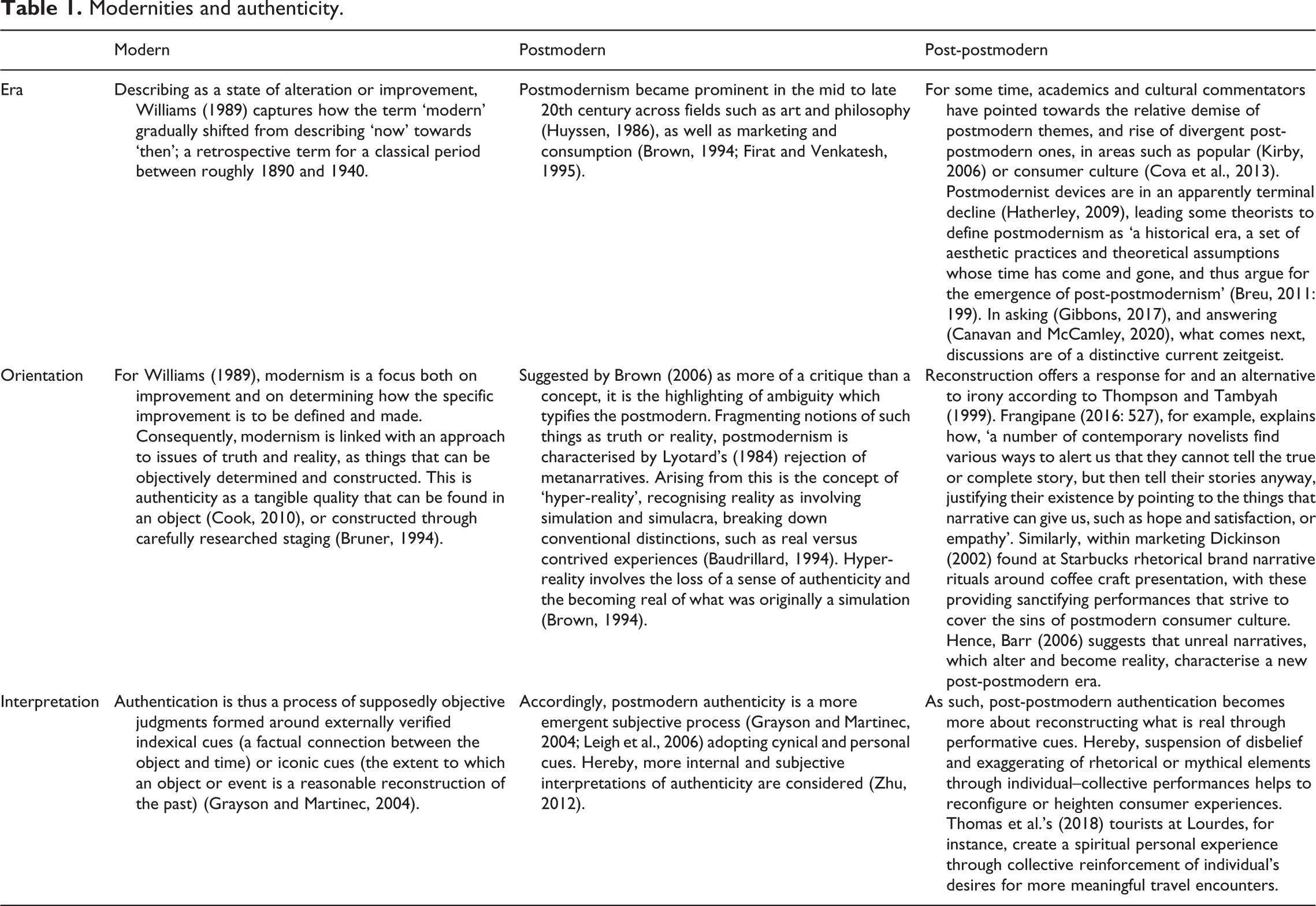
Although they overlay, postmodernism and post-postmodernism have distinctive orientations. Eshelman (2000) argues that while a new time culture borrows in many instances from the old, it breaks with it sharply in other decisive regards. Antonio (2000) describes different modernities as representing the ending of a historical conjuncture when existing sociocultural ideas and practices are challenged. It is this discontinuity which may imply significant differences in relation to consumption. Cova et al. (2013) summarise postmodern and post-postmodern consumption as deconstructive and post-deconstructive, respectively. Elaborating, Skandalis et al. (2019) propose continuums to describe postmodern and post-postmodern consumption stances as foregrounding anti-structural and structural tendencies, respectively, in a way that acknowledges their interactions, yet recognises their differences. Thus, where the former emphasises a pulling apart of social, cultural, political and philosophical issues, such as identity, conduct, ideology or ontology, the latter is more associated with the putting together of these. Postmodernism tends towards disaggregation in negotiating such issues, whereas post-postmodernism inclines towards agglomeration.
This deconstructive or reconstructive emphasis carries through into authenticity. Postmodernism adopts a cynical, critical and deconstructive perspective towards concepts such as truth or reality, self-expression and social norms (Brown, 1994). This ethos is distinct from the modern authenticity stance as one that prioritises objective verification of a definitive truth, and which works to construct authentic narratives or performances from this. Indeed, according to Firat et al. (1995: 40) possibly the main defining difference between modernism and postmodernism is postmodernism’s rejection of the modernist idea that human social experience has fundamental “real” bases. To the contrary, postmodernism posits that social experience is an interplay of myths that produce regimes of truth. According to postmodernism, many of the fundamental modernist ideas regarding the individual, self, freedom, agency, and structure are arbitrary and ephemeral rather than essential and fixed.
Although post-postmodern authenticity has not been approached specifically as such, wider authenticity discourse, which has been reinvigorated over the past decade or so (Knudsen et al., 2016), has picked up an apparent emphasis on reconstructive authenticity through performative mechanisms. Cohen and Cohen (2012), for example, describe hot authenticity as ‘an accumulative, self-reinforcing process: the performative practices by and between visitors help to generate, safeguard and amplify the authenticity of the visited site or event’ (p. 1300). Defined by Zhu (2012: 1496) as ‘instrumental embodiment aroused through the dynamic interaction between individual agency and the external world’, performative authenticity is proposed as complementing (modern) objective and (postmodern) subjective orientations.
If post-postmodernism can be crudely summarised as putting emphasis on purposeful and pragmatic reassembly (Cova et al., 2013), negotiation of fantasy and reality through iterative reassembly (Skandalis et al., 2016), and agglomeration via individual–group performance (Canavan and McCamley, 2020), then this orientation appears to overlap with such recent developments in authenticity discourse. Indeed, Eshelman (2000) summarises post-postmodern performativity as the framing of things already existing in order to transcend or radically reconstruct them, through such things as the use of ritual, dogma or similarly inhibiting frames, in order to transform or transcend existing states of being. The ways in which authenticity may be transformed are explored in the following.
Method
Echoing Bruner (1994), who sought to do similar for postmodernism, a specific case study is used in an attempt to find evidence of post-postmodern traits among contemporary consumers. Considered are online Drag Race fans; a group who collate around their mutual interest in a reality television programme. In order to access and explore this online consumer group, research adopted a netnographic approach. A research tool that takes advantage of the rapidly growing participation in online communities, candour and richness of these (Mkono and Markwell, 2014), these virtual worlds are legitimate as contexts of culture and meaning (Sumiala and Tikka, 2013), and they are becoming more a part of overall and everyday social behaviour (Kozinets, 2015). Wu and Pearce (2014) argue that netnography can be used to explore newly emerging phenomena, such as the post-postmodern authenticity negotiation considered here. Michelle (2009) argues moreover that digital forum’s unsolicited, spontaneous responses potentially offer a clearer picture of how fans actually make sense of reality TV depictions and offer insight into fan-initiated negotiations of meaning and significance.
RuPaul’s Drag Race has become a global success with a passionate fandom active on various social media, but this research has focused specifically on Reddit, a community forum/messaging board. The Rupaul’s Drag Race sub-Reddit (https://www.reddit.com/r/rupaulsdragrace/) has over 325,000 subscribers (as of April 2020); a number that more than doubled over the research period (September 2017–December 2019; a period of time similar to Parmentier and Fischer’s (2015) longitudinal approach to netnography of a reality television community). This platform was chosen for study because it has been described by former contestants in interviews as the place where the most dedicated enthusiasts reside. Data collection consisted of reviewing publically shared posts relating to the Drag Race sub-Reddit; a dedicated collection of active and archived message boards.
A passive approach was taken to netnography in this study, whereby researchers do not reveal their research activity to online participants nor participate in online exchanges, ensuring that participants interact in the relatively uninhibited manner characteristic of online communities (Mkono and Markwell, 2014). Corciolani (2014) demonstrates the advantages of a more active netnography, such as being able to interrogate data in further depth. However, as with Cocker and Cronin’s (2017) similar style netnography, the passive stance does not preclude intimate or extended participation with an online community. Kozinets (2015) additionally criticises the passive approach as having potential ethical drawbacks. Wu and Pearce (2014: 465) nonetheless argue for the uninhibited observations and pragmatic advantages of the passive approach. Reddit is a public forum that can be viewed by outsiders, although in order to post, users have to sign up and create a profile page. Most users adopt pseudonyms and profile pages document Reddit activity rather than personal details. Thus, Reddit is a public forum that lends itself towards user anonymity. Nevertheless, conscious that the notion of social media as public space may be problematic (Jeffrey et al., 2019), personal or identifiable details were removed in order to preserve the anonymity of participants.
Due to the extent of material available on the Drag Race sub-Reddit, keyword searches were used to scan active and archived posts for themes that might relate to postmodern or post-postmodern characteristics. Judgements herein were iterative and subjective, but followed Doyle’s (2018) distinguishing of postmodern and post-postmodern fiction as, respectively, more critical and cynical or post-ironic and sincere, Cova et al.’s (2013) deconstructive and reconstructive stances and Skandalis et al.’s (2019) anti-structure–structure continuum. Archived posts were used to gain an overall feel for the content and dynamic of the Reddit forum. The focus of research, however, was active discussions, which were reviewed fortnightly during the research period. This was done in order to get a flavour of ongoing conversations and current topics within the fandom. As such, research provides a snapshot of a longer running and continuing to evolve community, highlighting topics current at the time.
Researchers did not participate in online exchanges but spent many hours of logging into and reading through forums, accompanied by note taking, screenshots of interesting exchanges and writing up of reflections. These field notes were then transcribed into a word processing programme where they could be thematically coded at the analysis stage. Using Corley and Gioia’s (2004) data structure framework for analysing qualitative research as a guide, data were collated into specific themes, by iterating between emergent patterns in forum conversations and the extant literature. In this way, first-order initial concepts emerged from a back-and-forth approach to field notes and reflections, gradually distilling the number of germane categories. Analysis then moved into more abductive second-order investigation of themes, asking whether emerging themes suggested concepts that might help to describe and explain phenomena being observed (Gioia et al., 2013). These collated into broader groups around themes of interpretation, identity and interaction, related to the consumption of Drag Race narratives, construction of consumer identities and tone of consumer community. Lastly, these themes were reduced into aggregate dimensions of postmodern deconstructive and post-postmodern reconstructive authenticity, by cycling between these and the relevant literature to determine findings, precedents and novelty.
Findings
Findings thus collated into three broad themes that covered much of the online conversation observed and each of which could then be linked to authenticity as either deconstructive or reconstructive in stance. Interpretations of series narratives consumed by fans, and associated experiences of identity of those fans, are significant topics on forums. They are frequently related back to notions of authenticity in terms of truthful or meaningful expressions thereof. Interactions meanwhile related to the wider group dynamics in which these topics were discussed and how these can facilitate particular approaches to negotiating authenticity. These are discussed in the following.
Interpretations
Revealed by research was fan’s extensive engagement with reading and interpreting Drag Race episode and series narratives. Numerous conversation threads analyse storylines and the veracity of events depicted on screen. Much of the interpretation on display is deconstructive, demonstrating awareness of the staging, editing and production that goes into making the programme, with a corresponding pulling apart of these. Typical of this, one user dissects the narrative arc of season 9: Although I’m ok with who won, I gotta say this season was so weird. Sasha didn’t really even get a “winner’s edit.” Traditionally she would have been the 5th place, “gone just before the finals and gets Miss Congeniality” edit. I think they initially wanted Nina, Shea, and Valentina in the top three, with Trinity in the traditional 4th place pageant queen slot and when everything went to hell with Valentina and Nina, they had to change their plans.
Discussions surrounding the controversial contestant PhiPhi O’Hara further illustrate fans’ awareness of screen depictions as complex and partial versions of events. After appearing on series 4, PhiPhi was widely disliked as an overly aggressive competitor. Her subsequent participation in All-Stars 2 was cast as an attempt to rehabilitate her image. When she again came across badly, PhiPhi blamed editing for misrepresenting her. While fans express some sympathy for her claims, they simultaneously consider that PhiPhi is at least partly responsible: Even if the producers had planned a PhiPhi redemption storyline, and cut out all her shady moments, she wrote her own villain edit with that walk out. It would be impossible to edit her as nice then show that exit, it wouldn’t make sense. So, with not shaking Alyssa’s hand, she sealed her own fate.
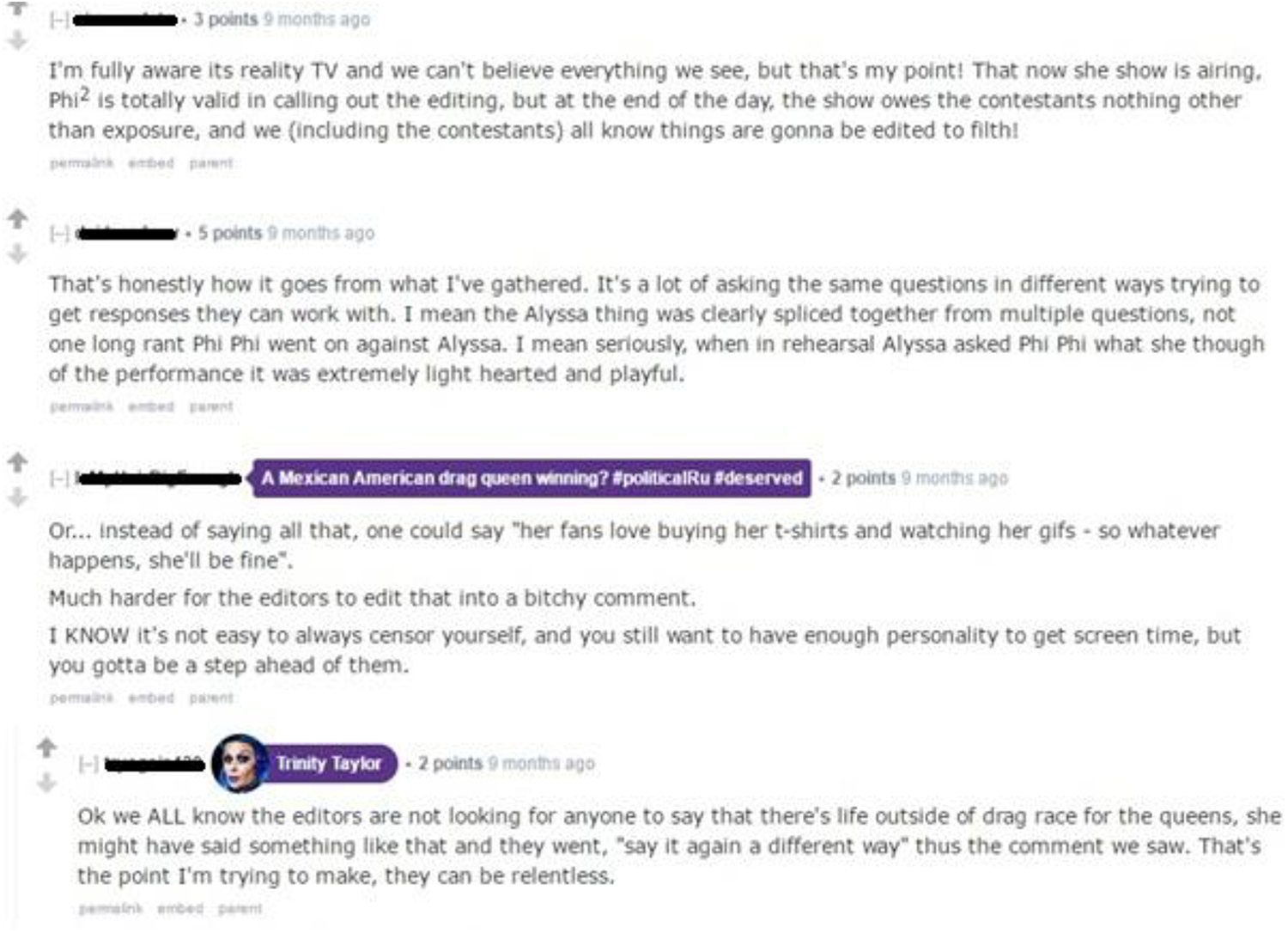
PhiPhi editing.
Thus, understanding is of the selective, partial and contestable staging of Drag Race. This awareness encourages deconstruction but does not undermine widespread enthusiasm for or enjoyment of the program. This follows Bauman (1996), who argued that under postmodernity, the depthless, contingent and baseless nature of reality and truth is more than acknowledged but embraced as a source of play and liberation. Indeed, deconstructing narratives is a source of pleasure for many followers, as articulated in one comment: I love the show. I love how the queens are portrayed, and I dive deep into the “theory” of reality shows and how to deconstruct them. This season is a great one, but I always remember that these people are put in an extreme situation that brings out the best, and worst in peoples underlying character traits. What we see here, is not what they really are, just an exaggerated/heightened version of themselves.
Nonetheless, alongside such typically postmodern stances, findings also revealed some more characteristically post-postmodern orientations towards interpretations of narrative truths. This can be seen around expressed concerns with staging interfering with narrative authenticity. Authenticity is, in this context, a term widely used by fans to suggest real versions of events. This is in the sense of being a pure depiction of what happened during filming, unadulterated by editors who in crafting a commercial television product heighten certain elements. Suggested by one fan is that now sophisticated to the staging going on followers are dissatisfied by it: The show completely fell off the authenticity cliff in Season 5 imo (and it was on its way to the edge in S4). It seems so jarring in S7 both because we’ve had access to a lot of behind-the-scenes T from former queens, and we’ve had a loooong time to spot the tricks and tweaks now and are a lot wiser to it. As a new reality competition show, Drag Race had the opportunity to start honestly and continue that way, to be the first if not the only reality show to not use the manipulative tricks all other reality shows do and just let the queens show their talent and let that be the source of the entertainment. They didn’t.
Hence, rather than an ironic and detached postmodern playfulness, an earnest and invested post-postmodern purposefulness (as per Doyle, 2018) emerges among those fans who hold a sense of an authentic truth existing, out there, somewhere beyond screen depictions, and motivated therefore, to uncover and reconstruct this from the frustrating multiple fragments-interpretations available. Echoed is the post-postmodern manipulation identified by Canavan and McCamley (2020), whereby narratives are engaged, subverted and reassembled in line with desired interpretations of events. Such regenerative reimaginings are nonetheless themselves subject to critique. One commenter, for example, dismisses what they see as a false comparison of events in two different episodes, being used to portray a protagonist in a certain direction: ‘I disagree with you completely, tbh and comparing these two situations still creates a straw man argument that just…doesn’t apply’. Any reconstructive tendencies are henceforth themselves subject to deconstructive critique.
Identities
Forum discussions of sexual and gender identity are prominent, with these being closely associated with the programme for many fans. An emphasis is on postmodern fragmentation allowing for a host of flexible and negotiable roles, identities or selves (Eckhardt and Bardhi, 2019). Forum users describe having their preconceptions of what it means to be a certain sexuality or gender challenged through watching Drag Race. The programme is discussed as exposing to a range of expressions of these, including those previously unfamiliar or stigmatised. Fans pronounce, for example, their new-found respect for characteristics in others or themselves that they may have previously denied or disparaged out of ignorance or fear of association (see Figure 2). A lot of comments relate to increased understanding of sexuality and gender as more nuanced than formerly appreciated. Opportunity is moreover to experiment with different aspects of self and play with identities. Inspired by the show, followers describe trying out drag, for example. Doing so is talked about as fun but also related to self-expression and discovery. Brought to mind is Catterall et al.’s (2005: 493) description that ‘in a postmodern world of endless possibilities and multiple personas, gender becomes another ludic element, indeed it becomes multi-faceted, fluid and mutable, and ultimately an aspect of identity that can be altered at will’.
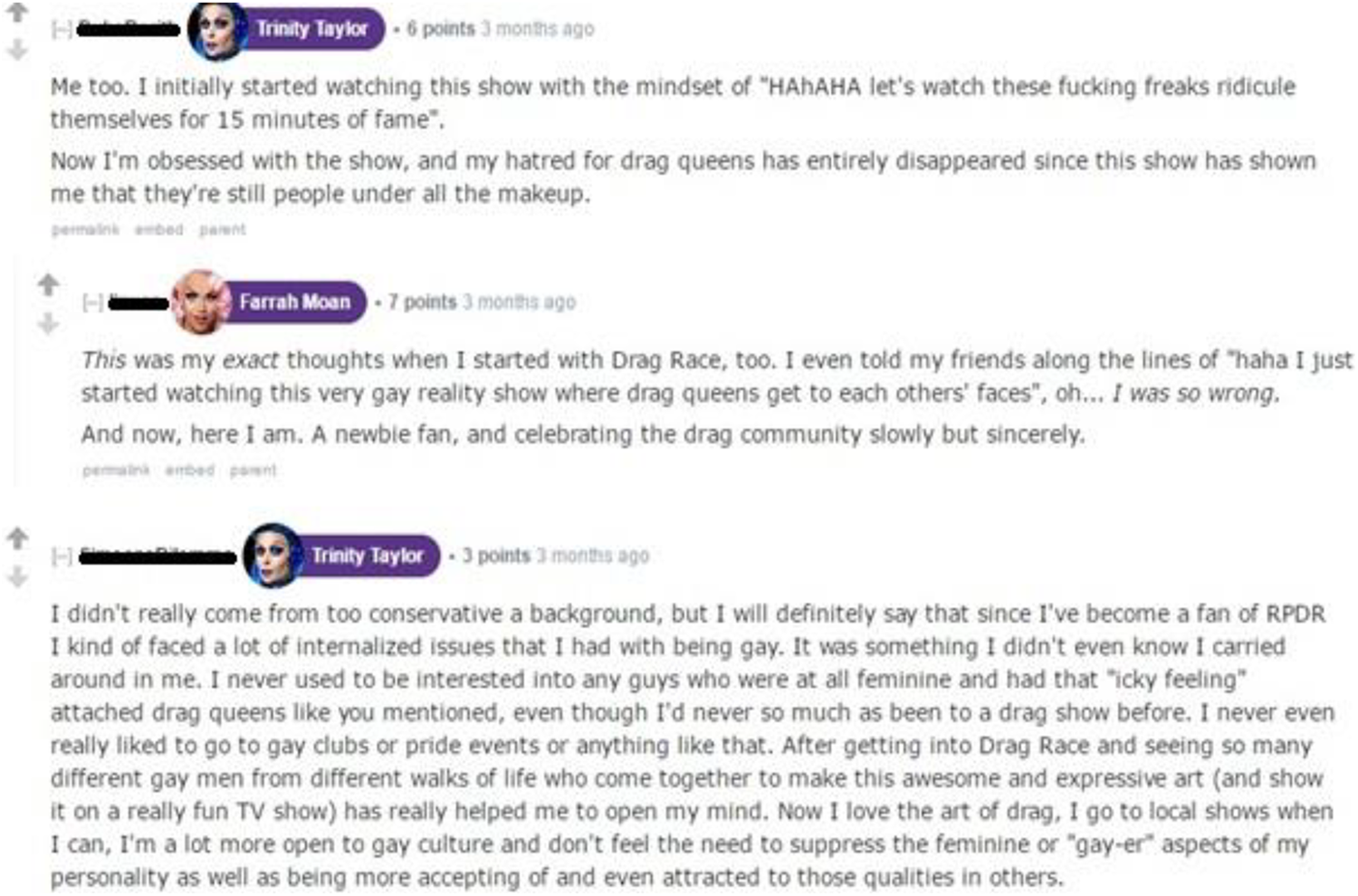
Representing sexuality.
In addition, conversations are around delineations between different identities and associated groups being blurred. One example is the way in which forums are used by heterosexual people to get involved with and ask about gay culture, with one typical discussion thread initiated: ‘Me and my boyfriend are a heterosexual couple and huge fans of drag race. Would it be weird or offensive to show up to a gay bar together for a viewing party?’ Various opinions and advice follow (see Figure 3). Conversations also cover fans introducing their family or friends to the show, and through this to wider gay culture. This is described as helping to build relationships or indeed repair those which had earlier been strained by coming out as gay. Drag Race thus serves as a means of reducing and blurring distinctions between heterosexuality and homosexuality. The consequence of this mutual respect is an oft-referenced ability to be a more authentic self, as one fan writes admiringly of a season 12 contestant: I think the amazing thing about Gigi is she shows everyone watching how powerful it is to just be yourself and that if parents support their children to be whoever they are just look at how confident they can be at such a young age.
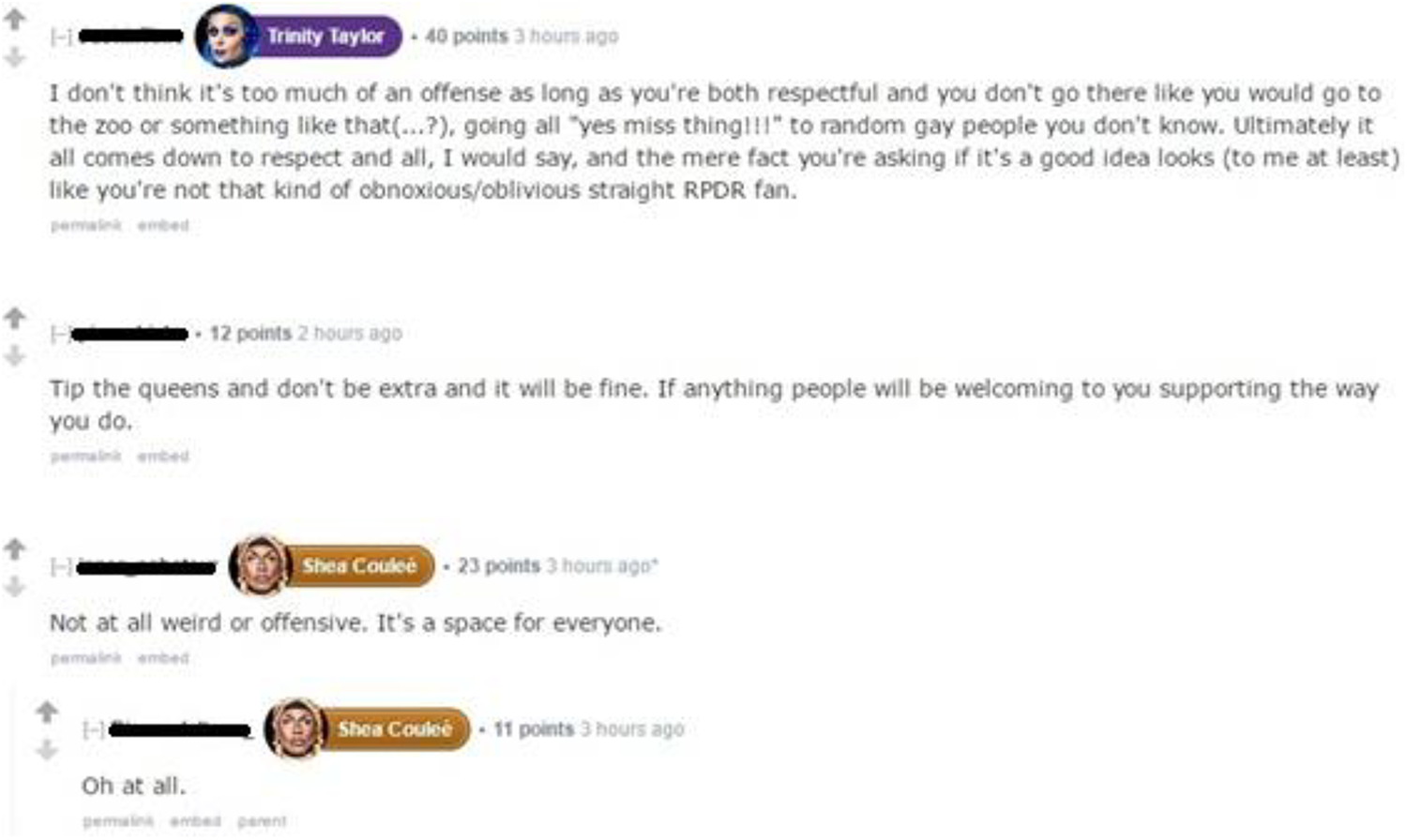
Hetero–homo discussion.
Accordingly, evidence was of Thompson and Tambyah’s (1999: 236) description that ‘postmodernity is a cultural epoch that celebrates the pleasures and freedoms offered by simulacra, hyperrealism, aesthetic pastiches, and bricolage identities’. Nevertheless, research also showed that Drag Race’s blurring of sexuality or gender is seen by some online fans as dismissing deeply felt issues of identity and continuing struggles for equality. As one fan comments in a more deconstructive vein, traditional identifiers have for some been made meaningless and individually adapted: ‘I like queer. I even like fag from my friends. I’m kinda tired of kids today telling me what I can or can’t call myself’. For others, however, fixed identity markers have remained meaningful or been infused with new meanings. The blurring of gender and sexuality markers as non-binary and fluid can be considered insensitive or insulting by those who identify closely with a specific label within these. To illustrate, transgender identities are for some fans uncomfortably linked with or excluded from drag (see Figure 4). Some fans, who identify trans, explain that their individual and cultural struggles for identity recognition can seem to be misunderstood or made light of. Sense in some cases is that authentic self-expression can be inhibited rather than liberated by Drag Race and its following. Offman (2014) notes how postmodern gender-sexuality plurality is not considered inherently progressive by those who do not wish to relinquish the idea of an essential self.
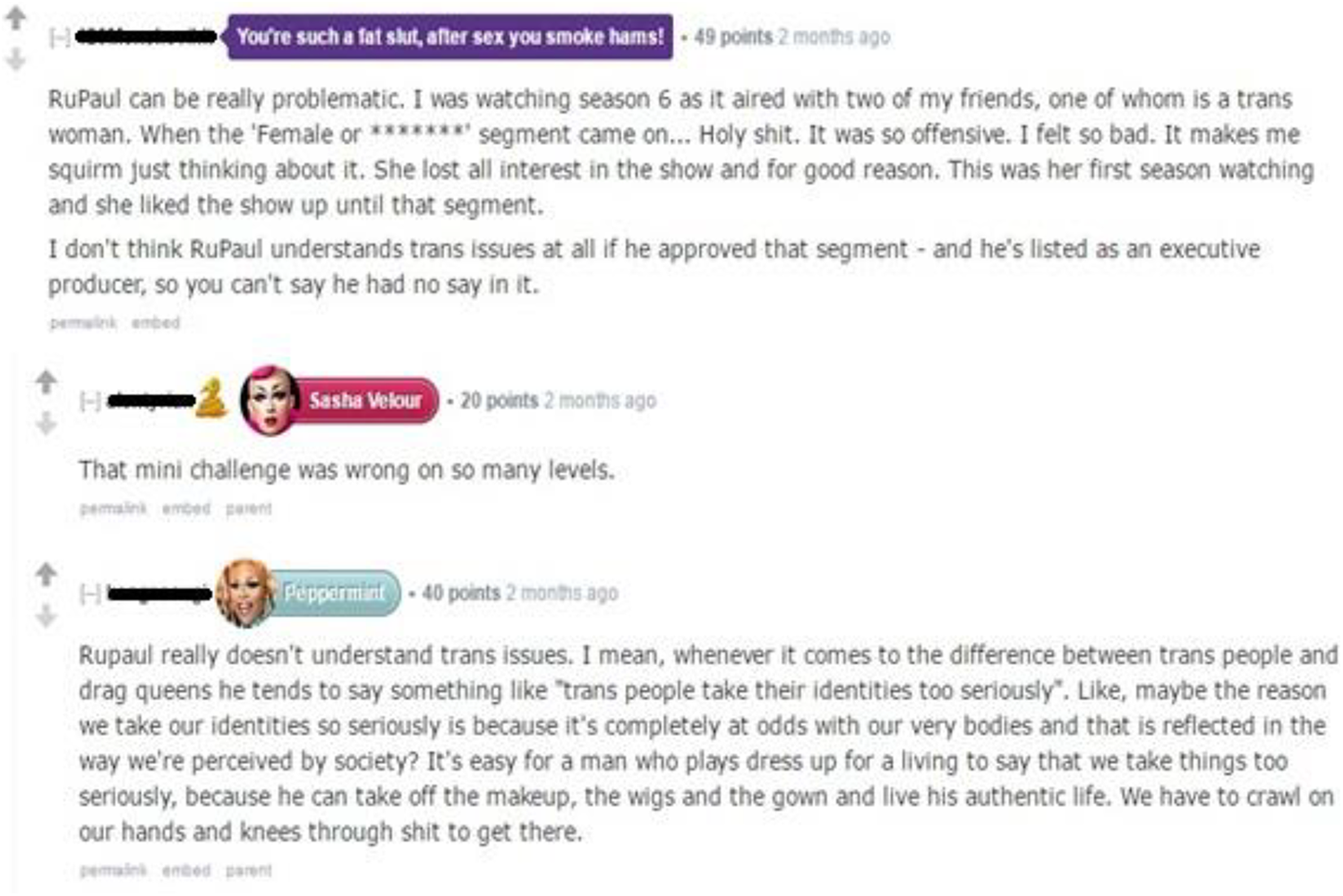
Sincere offence.
As a result, there is some resistance to deconstruction of gender and sexual identity, and instead, at times, a reconstruction of distinctions therein. Some fans identify with an expanding range of gender-sexuality signifiers. In turn, this causes occasional friction with other fans uncomfortable with the notion of identity being more fixed or important: ‘I’m not disrespecting anyone’s identifiers, but like I just don’t see why y’all feel the need for these kind of microscopic level labels. What’s wrong with just being queer and done with it?’ As another commentator explains in reply: ‘We have to fight for trans to be accepted first, before it can just be a part of queer’. Deconstructive and reconstructive approaches to identity meaning are sometimes at cross purposes therefore. An interesting insight from Partner (2008), who compares the competing narratives of Israeli and Palestinian nationality, suggests that a more deconstructive stance of the former, with space for growing self-critique and fluidity, comes from a place of confidence. Meanwhile, ‘the rigidity and mythic investment of the Palestinian narrative may well be a function of the fragility and vulnerability of the national project of the Palestinian people’ (p. 841). Drawing on this, it may be that some Drag Race fans are less confident in their identities and thus less receptive to deconstructive attitudes towards these. Theorists have highlighted that postmodern blurring of categories such as gender, potentially downplays the continued significance of, and undermines attempts to address inequalities around, these (Catterall et al., 2005). Those online fans resisting deconstruction of gender-sexuality identities, and pushing instead for the recognition of these through their definition and assertion, may therefore be indicative of a post-postmodern tendency towards recognising plural yet discreet and at least somewhat deterministic identity positions (see Offman, 2014).
On forums, discussions are additionally of divides being drawn within the Drag Race fandom between authentic and fake fans. Inferences are of those more genuinely immersed in the show and its surrounding culture, as may be signified by such things as identifying as LGBTQ. Increased representation of gay culture encouraging voyeurism and cultural appropriation by outsiders is seen as an issue by some. Thus, one fan states their perspective: ‘The fact is that most drag race fans, commonly the younger/straight ones, use the show as tourism into gay culture, and they really don’t know shit about our culture and history’. Elements of a return to hierarchy emerge therefore in discussions distinguishing between real and fake fans. Hereby, a more post-postmodern deterministic stance (Braidotti, 2005) is used to reconstruct distinctions between authentic and inauthentic followers in a typically X versus Y dynamic (as per Canavan and McCamley, 2020). Thus, such groups as younger, older, newer or straighter fans may be categorised and defined as less authentic in their fandom and even in terms of their overall welcome to participate. Albeit various conversations disagree with attempts to draw divisions between fans. One commenter for instance adds their perspective to a discussion of drag going mainstream: The game is changing and it’s busting out all over. Gay culture/Drag culture belongs to everyone now, it’s part of inclusion in a wider community. Some will hate it and some will embrace it, whether you’re for or against but the genie is out of the bottle and we have a front row seat and this opportunity to support and encourage the genuine traits. Drag will/is evolving, enjoy the ride and take it all in.
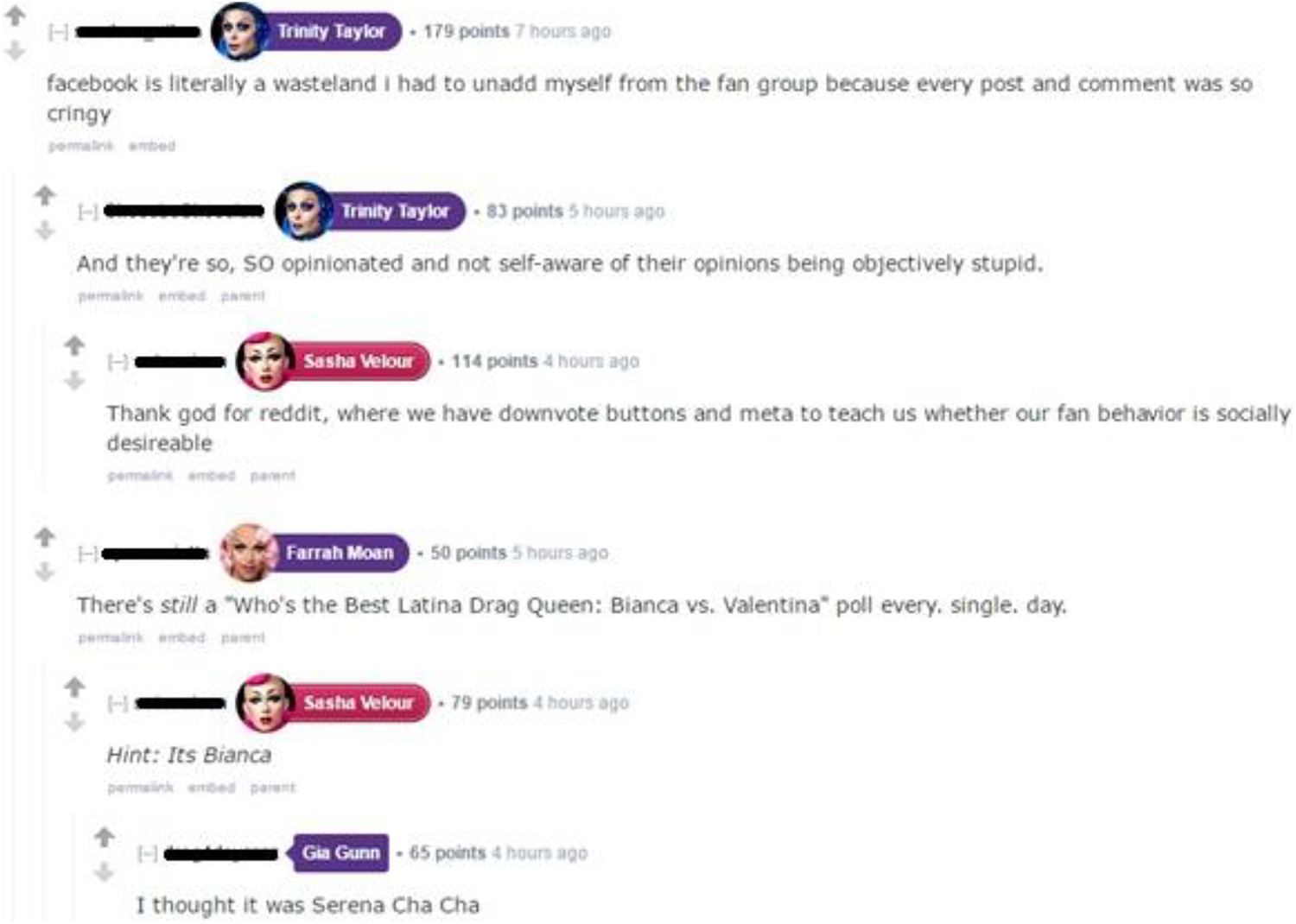
Platform divides.
Interactions
Research additionally provided insight into online community interactions, and in particular the ways these frame and facilitate the deconstructive or reconstructive emphasis placed on Drag Race consumption and consumers. Forums are characterised by particular modes of expression, tone of voice, references and inside knowledge, surrounding a proclivity to discuss series narratives and queer identities. This is typically playful, self-referential, critical and humorous. In-jokes, shared references, irony and teasing, set the tone. Figure 6, for instance, captures part of a thread discussing the ‘Brazilian twink’ (twink being gay slang for a younger man). This refers to an obscure and tongue-in-cheek mythical figure jokingly celebrated for their livestreams of Drag Race that come with added commentary and an oft-repeated self-penned elimination song. Associated conversations ironically mythologise this niche character and in doing so simultaneously parody both this figure and the fandom overall. Fans interact around the Brazilian twink, variously expressing their confusion, schooling each other on the legend, embellishing and taking apart.
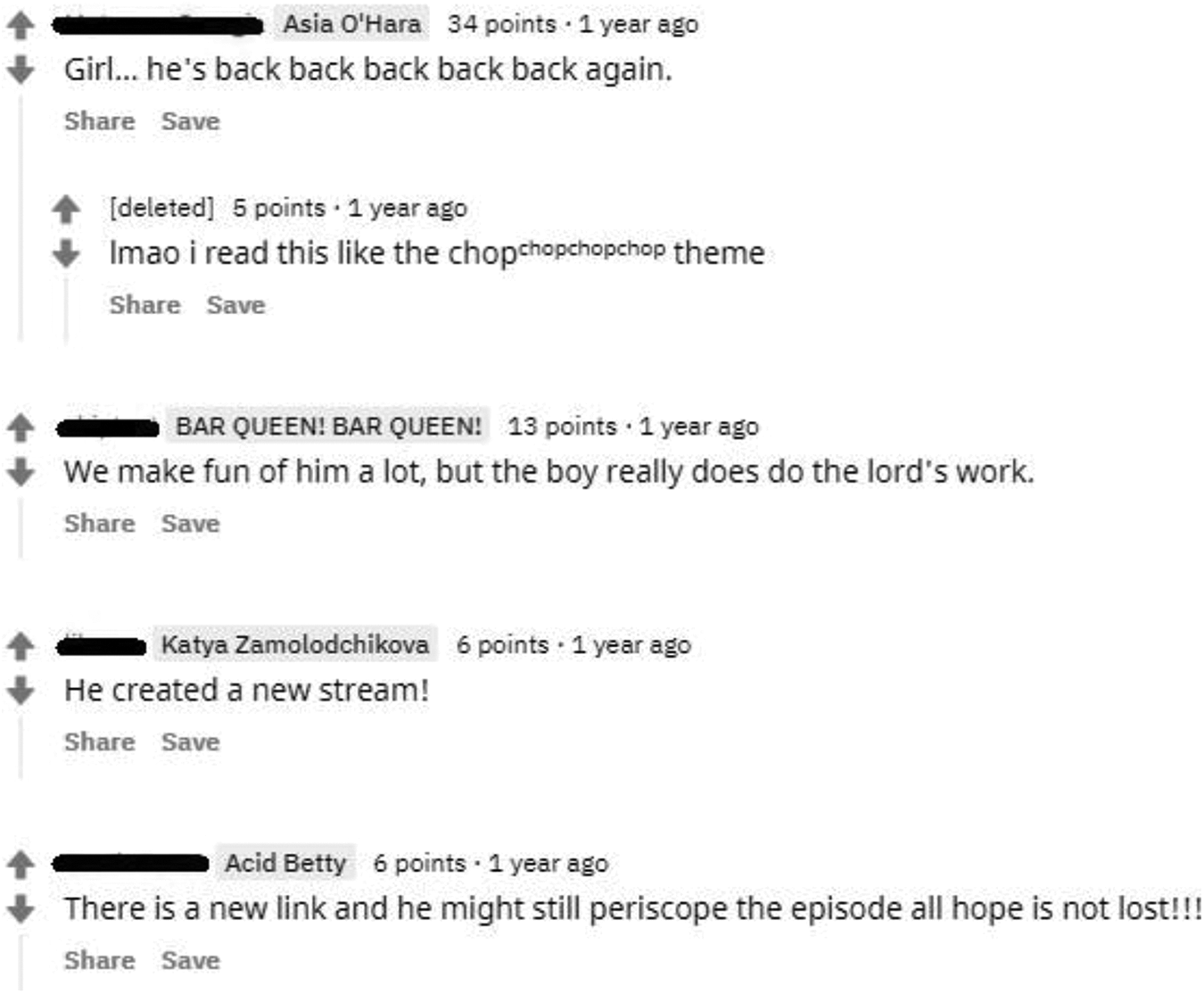
The Brazilian Twink.
A deconstructive approach therefore pervades the Drag Race sub-Reddit. Users parody, pastiche, reinvent, subvert, critique and otherwise pull apart facets of their shared interest and their individual–collective fandom itself. Community is stimulated out of common cynicism, irony and playfulness. Although these fast-paced and highly self-referential modes of exchange can initially seem very specific and exclusive to the outsider, newcomers are welcomed into the forum. Community lore is explained, in-jokes shared and discussion threads are receptive towards new members. Figure 7 highlights, for instance, one novice being introduced to the forum by existing members in typically self-aware and self-deprecating fashion. As such, forums are a space for deconstructing and sharing Drag Race stories and identities. Through shared analysis, critique, cynicism and play, interactions support those fans who find meaning, enjoyment and authenticity through deconstruction of the narratives and identities surrounding Drag Race and its followers. Echoed are Muniz and O’guinn’s (2001), brand communities, as reinventive, playful and plural postmodern spaces for the intersection of brands and consumers.
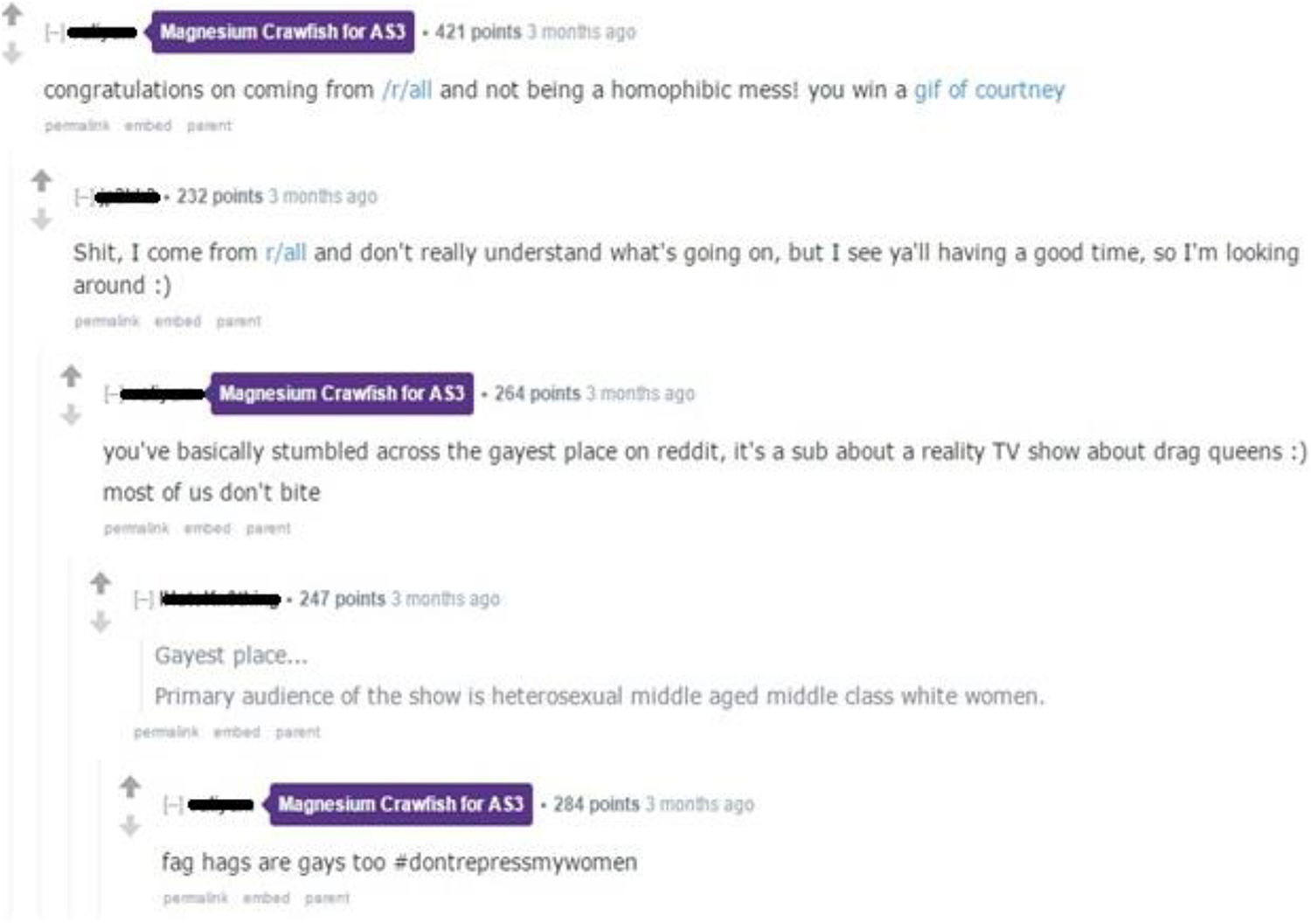
Forum welcome.
Alongside the cynical and deconstructive tone, more sincere and reconstructive tendencies were identified within fan interactions. This was noticeable in the more resource-intensive creative involvement of some fans. There are many shared examples of fan art on Reddit, including paintings, model making, pottery, baking and costume design. Forum members share their admiration for member’s work, appreciating the talent and dedication involved. Handmade objects appear to be a way of demonstrating one’s knowledge, as obscure references and in-jokes inspire many of these pieces, and also of exhibiting creative flair. As such, creative outputs are often used to garner positive attention from other fans. For example, these can help to establish the individual as an authentic fan immersed within the references of the Drag Race community, thus helping to navigate issues around more deterministic identity stances. Moreover, as Figure 8 highlights, creative outputs can be used to solicit connections with contestants themselves, such as at meet-and-greets where chance is to present crafts to queens. Using creative outputs in this way suggests a purposeful use of fabrication, and public displays of this, to help build a fan identity. Link is with Moore’s (2004) analysis of punk consumer subculture, where a response to postmodernism as inauthentic-commercialised and undermining sense of identity, is a search for an alternative expressive sincerity and anticommercial purity, including through independent networks of cultural production. Here, fans as producers as well as consumers seem to similarly help assemble a sense of local community and identity.

Meet and greet material.
Sharing reconstructions before others can thus lead to greater engagement between fans and help to raise the profile of the individual among peers, with a range of potential benefits from doing so. Suggestion is of what Arvidsson and Caliandro (2015) conceptualise as brand publics, where, ‘there is a growing evidence that social media support a publicity-oriented consumer culture, oriented around appearance and visibility rather than identity and belonging, and where value co-creation is structured by private or collective affects, rather than deliberate and common values’ (p. 728). Previously noted is how social media has given rise to a hierarchy based on attention and visibility (Marwick, 2013) and provided new mechanisms to move up and down these (Eckhardt and Bardhi, 2019). Here, some fans seem to be using their public performances of creative skill to derive benefits, such as gained fandom status. Suggestion is therefore of post-postmodern pragmatic and purposeful reconstructions used to help navigate issues around individual and collective identity (as per Skandalis et al., 2016). Also, of what Fordahl (2018) identifies as an emphasis on performance within post-postmodern authenticity, whereby, this comes principally from a convincing performance.
Nonetheless, many pieces of fan art shared are themselves subversive of this process, suggesting that many forum members are unconvinced by these and their associated performances. Users post deliberately poor-quality projects with po-faced seriousness, parodying the language of those fans who share sincerely in a typically postmodern style. Figure 9 captures one such drawing of an iconic moment during the series 9 lip-synch finale, played down as an underappreciated obscure moment from Drag Race. As such, the purported artwork parodies the signalling by more involved fans of their knowledge and talent. Suggested is a postmodern stylistic pastiche in response to post-postmodern essentialist ones (as per Cantone et al., 2020). Subsequent comments suggest other underrated moments the artist could draw (which are in fact similarly iconic events from Drag Race history), sarcastically praise the artistry, ‘This is beautiful, do you mind if I get it tattooed?’, or jokingly accuse the artist of passing off the work as their own, ‘Fake. You didn’t draw this. It’s a photograph. You can tell by the hyper-realistic details’. Thus, a typically deconstructive response to sincere involvement is to subvert and parody this tendency. Fan anti-art is inspired by fan art and becomes itself part of the cultural fabric of the Drag Race fandom. Link is with Parmentier and Fischer’s (2015) identification of less complementary forms of fan art and other material artefacts shared by fans of the reality television show America’s Next Top Model. These are destructive in that they ‘have the potential to destabilize brand identity if they accumulate and heighten its heterogeneity’ (p. 1245), but demonstrated here is that this destruction is itself part of the broader value creation of the Drag Race fan forums.
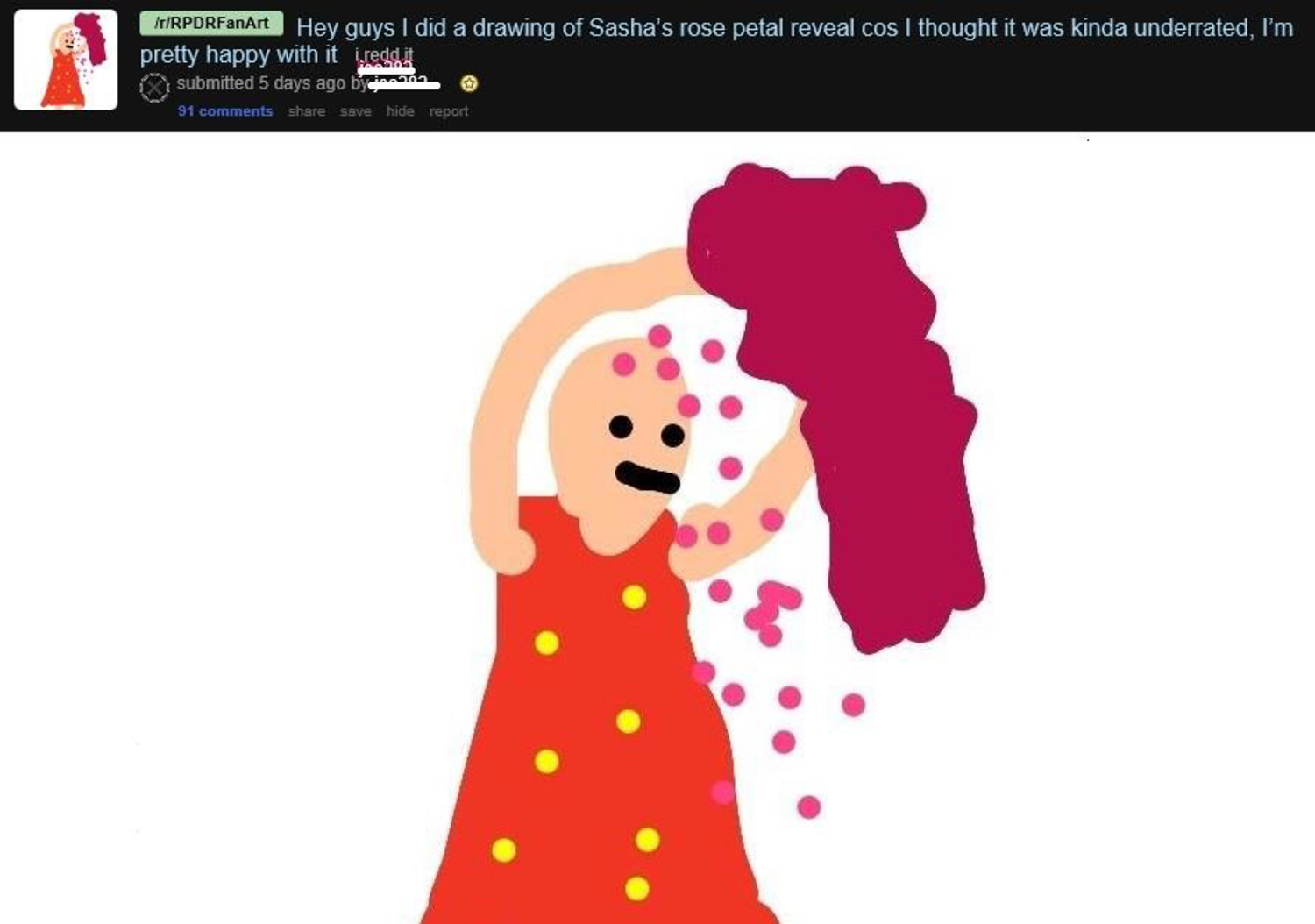
Fan drawing.
The time has come
To paraphrase RuPaul at the denouement of every episode, the time has come for a judgement to be passed on the respective standing of postmodern and post-postmodern authenticity as negotiated among an online consumer community. Via a workroom reading of the literature and a runway look at the Reddit forum performance, it is possible to gain insight into the distinctively deconstructive and reconstructive orientations towards authenticity that simultaneously occur among the fandom relating to interpretations of the narrative brand consumed and associated identities of its consumers. Forum interactions are likewise deconstructive and reconstructive and serve to reinforce respective negotiations of authenticity. Thus, the case has been made for the two compelling contenders who stand before us.
Stage left stands what is identified here as a distinctive post-postmodern approach to authenticity negotiation. This finds meaning in more reconstructive stances, exemplified by alternative narratives produced around the show by online followers. Authenticity of series narratives consumed was a focus for many forum members when discussing Drag Race. Some components or versions or narratives are considered more authentic than others. Where perceived as such these authentic fragments are often agglomerated into larger interpretive pieces. Discovered fragments and supressed truths brought forward are used to construct alternate realities (as per Frangipane, 2016). Meanwhile, inauthentic narratives are countered through elaborations of their failings (as per Canavan and McCamley, 2020). In such ways, reconstruction of truths and of untruths is emphasised.
Likewise, a reconstructive stance could be seen in relation to the authenticity of consumer identities. Some fans take a more deterministic position to identifying genuine consumer collectives (see Braidotti, 2005). Meanwhile, certain deterministic identity traits, such as around sexuality or gender, may similarly be part of authentic individual selves. Where this is the case a number of online fans reject deconstructive blurring of collective or individual markers as undermining their own affiliations with specific identities therein. Instead, more fixed identity traits are focused upon and agglomerated around. Post-postmodernism appears to represent a fixation upon identity fragments and building of the significance of these. As some Drag Race fans seek a more solid location for and expression of their sense of self, contradictions around identities picked up and pulled apart by other fans are not always welcomed and may be resisted (as per Abolhasani et al., 2017).
These post-postmodern tendencies are reinforced through a number of performances that help to resist deconstruction and support reconstruction. In this research, reconstructive performativity may be observed in the public sharing of alternative narratives, thus soliciting reactions and inputs to these that further agglomerate. Fans sharing fan art, meanwhile, may suggest individuals soliciting online attention for identity reconstruction. In highlighting their creativity, for example, fans draw attention to versions of themselves, helping to affirm. Link is with Canavan and McCamley (2020), who identify mediatisation and performing before others as a potentially self-affirming process whereby materials for self-assembly can be obtained and trialled and also as a process that can be used to alter wider external narratives to personal advantage. Equally, among Drag Race fans, performing reconstructions of consumed or consumer authenticity before others is a means of agglomerating and asserting these.
This post-postmodern approach is distinctive from postmodern authenticity, where meaning and pleasure come from deconstructive play around consumer interpretations and associated identities, and where the collective is a means of enhancing this disassembly through mutual parody or pastiche (i.e. Leigh et al., 2006; Napoli et al., 2014). Nevertheless, an accompanying contribution of research is to illustrate that such postmodern deconstructive tendencies remain prevalent among the online fandom reviewed. Highlighted in fan’s questioning and reimagining of show storylines is characteristic antipathy towards notions of truth and reality (as per Brown, 1994). Likewise, fans typically perceive identity as more fluid and exploratory, with Drag Race helping to challenge stereotypes and break hierarchies regards such things as gender or sexuality (as per Firat and Venkatesh, 1995). Supporting these reconstructive stances are iconoclastic and fast paced interactions among online fans. Self-deprecating, satirical and humorous, the Reddit forum is typified by playful parodic deconstruction and pastiche reassembly of group myths and identities. Forum members pull apart not only the materials of Drag Race itself but themselves, each other and the overall community, playing with the resulting fragments. Stage right, therefore, postmodern negotiation of authenticity as finding meaning through deconstruction of truth, self and collective, is present in the anti-structure tendencies of RuPaul’s Reddit followers.
A double crowning
The finale is here. Contribution of research has been to identify and illustrate a distinctive post-postmodern authenticity negotiation. Echoing Allen and Mendick (2013), who explore how young viewers take up, resist and rework discourses of authenticity within reality television programmes, some Drag Race fans analyse and rework dominant postmodern discourses in reconstructive ways. This is exemplified by a characteristically reconstructive emphasis towards consuming brand narratives, determining consumer identities and when performing before other consumers, with the latter used as a means to assert the former. Suggested here by occasional concerns among Drag Race fans for authenticity being lost amidst narrative staging or identity play, that they are increasingly sophisticated to, postmodernism can be frustrating. It may be seen as dismissive towards narrative sleights of hand, or uncaring towards closely held identity fragments, and as such undermine rather than liberate consumer brand enjoyment and associated personal meaning making. Resulting from these authenticity anxieties are an arguably distinctively post-postmodern renegotiation of the concept.
Yet an accompanying contribution of this research is to illustrate that postmodern authenticity may be renegotiated simultaneously. Indeed, this deconstructive orientation appears to be reinvigorated by post-postmodern reconstructive inputs. These stimulate cynical, playful and subversive responses. Reconstructed authentic narratives are pulled apart. Authentic identity meanings and divisions are contested. Authentication via performativity is undermined in a playful and ironic atmosphere where such things as consumer crafts are teased and reinvented. Findings of postmodern vitality are important, for as Breu (2011) argues regarding its purported demise, one danger of a shift in intellectual common sense is that what is rejected can become a caricature that is too easily dismissed. Doyle (2018) recognises that different modernities inspire and react off of each other, and this research serves as a reminder that the old is inspired by and reacts off of the new also.
Inferred, therefore, is Corciolani’s (2014) notion of an authenticity drama as a dialectical process, through which various subjects struggle to negotiate their different views and perspectives on authenticity. Corciolani concludes that by negotiating their conflicting views, consumers come to perceive authenticity in significantly new ways, or as this study would add, in re-enthused old ways. In this way, Gable and Handler (1996) argue that the vernacular concept of authenticity changes very little and that it shows a remarkable resilience because it is under threat and consequently renegotiated. Post-postmodern reconstruction both offers a means of renegotiating authenticity in a new and distinctive way and reinvigorates postmodern deconstructive authenticity negotiation by providing materials and threats of its own. Such renegotiation of authenticity during a time of cultural flux may be unsurprising. Handler (1986) suggests that authenticity is particularly renewed by cultural anxieties. Meanwhile, Rose and Wood (2005) describe authenticity as a process involving the negotiation of its inherent paradoxes and requiring coping, resolution or creative approaches to overcome these.
More than alternative interpretation stances, reconstructive and deconstructive approaches are symbiotic in that they provide resources for fan communities to put together or pull apart. The anxieties caused by proximity of these distinctive stances stimulate overall consumer community adaptation and creativity (as per Beverland and Farrelly, 2010). Skandalis et al. (2019) describe the tensions and contradictions within contemporary consumption, arguing that these do not necessarily need to be actively resolved to construct meaningful or satisfactory consumption experiences. Rather, such tensions can be negotiated or even contribute themselves to the creation of the overall experience. This seems to be happening here, where deconstructive and reconstructive approaches to meaning in relation to consumption of Drag Race are mutually stimulating. Akin to this, Canniford and Shankar (2013) highlight consumers’ use of assemblage to create value, pointing towards such things as efforts to restore the coherence of assemblages. Drawing from this, Parmentier and Fischer (2015) illuminate how consumers can play the opposite role as well, with assemblages frayed over time. In turn, this research suggests that these two processes may be concurrent and mutually supportive, with value coming from the interactions of reconstructive and deconstructive authenticity negotiation approaches.
Consequently, it seems that post-postmodern and postmodern authenticity, shantay you both stay. We have a double crowning of two fierce and fluid orientations towards the negotiation of authenticity. Findings highlight that these at times competing, but often mutually stimulating, orientations, occur in the Drag Race Reddit fandom simultaneously. As shown by Leigh et al. (2006), consumers can find pleasure and meaning in numerous, intertwining conceptualisations of authenticity in its interpretation of reality. Here, this pleasure and meaning is shown to come from a heretofore unappreciated post-postmodern conceptualisation, as well as from a recognisably postmodern one. Yet the pleasure and meaning of both are invigorated by the presence of each other. Thus, postmodern and post-postmodern authenticity are not antithetical (Zhu, 2012). Rather, they offer alternative sources of consumer pleasure and meaning that may together be part of a more complex whole. The charisma, uniqueness, nerve and talent of both deconstructive and reconstructive authenticity orientations deserve celebration together.
It is recognised that fandoms exist in myriad forms and hence netnography is restricted in how much it can reveal (Bird, 2011). A single bounded case study is more about trying to capture the zeitgeist and observe trends and expressions (as per Boulaire and Cova, 2013). Results are henceforth intended to be illustrative and thought-provoking, not generalisable or determining. Robards and Bennett (2011) highlight that the dynamic and fluid nature of the online terrain, and the manifestations of performative identity therein, are issues which require ongoing investigation and revision. It may be interesting to revisit the Drag Race fandom in future, to further gauge how deconstructive–reconstructive negotiations of consumer authenticity are continuing to interact and evolve. Likewise, comparing offline fandoms alongside the virtual represented here might offer further opportunity to further gauge the postmodern or post-postmodern negotiation of authenticity by contemporary consumers.
Footnotes
Declaration of conflicting interests
The author(s) declared no potential conflicts of interest with respect to the research, authorship, and/or publication of this article.
Funding
The author(s) received no financial support for the research, authorship, and/or publication of this article.
