



Abstract
This article explores ‘quarantine art’ – an Instagram challenge of recreating well-known artworks in self-isolation for the consumption of others – to investigate how people come together on social media to form an aesthetic tribe of consumer-producers. Drawing on a mixed-method qualitative approach, it presents netnographic observations and participant interviews subjected to representational and non-representational analyses. The findings illuminate the broad assemblage of visual arts, crafty practices and social media affordances that allow for a new communal expression, an aesthetic form of being together, and an emancipatory embrace of the ancient ‘maternal’ trope. That is, a new type of female subjectivity is brought to the fore – one that, separated from its ancient predecessors burdened by ‘caring for others’, celebrates aesthetic expression, nurturing and caretaking as a means to break down isolation. Overall, this study offers a feminist post-postmodern reading and elaboration of research into consumer tribes and virtual communities gathered around art, culture and aesthetics.
Introduction
During the Covid-19 pandemic, a social media challenge came to be the favourite pastime of a group of people self-isolating in their homes. People hoarded toilet paper and light blue facemasks to reproduce the turban of Johannes Vermeer’s Girl with Pearl Earring (1665). They went through their belongings in the attic to find the yellow curtains for Gustav Klimt’s The Kiss (1907-8) (see image below). And they sharpened their eyeliner pens to achieve that distinctive Frida Kahlo-esque unibrow look. The ‘quarantine art’ challenge – with varying names, accounts and hashtags – refers to a type of Instagram challenge of reproducing well-known artworks, mostly paintings, taking pictures of those, and then adding appropriate hashtags to them so that others can enjoy them and curatorial accounts with the following of hundreds of thousands would find and publish them. After the first Dutch-based indie account @tussenkunstenquarantaine was set up and running, it did not take long for the more professional actors, such as the prestigious Getty Museum in the US, to adopt the concept for their marketing purposes. No wonder: the challenge was remarkably effective in bringing a certain type of social media users to consume (and produce) art together.
There is substantial research into consumer tribes and communities gathered around art, culture and aesthetics: the fluid, floating and open nature of techno gigs (Bennett, 1999), the formalised art-house cinema tribe offering niche films to the broader community (Mamali et al., 2018), the dance and rave parties participants’ identity formation (Goulding et al., 2002), the sense of self and meaning of life among Star Trek enthusiasts (Kozinets, 2001), the creativity and artistic expression of protest camps (Patsiaouras et al., 2018), and especially, the Burning Man festival hypercommunity providing its participants the experiences of sharing, caring, affection and expression (Kozinets, 2002a). Aesthetic tribes and communities are built on people feeling emotions together (Maffesoli, 2007).
In the quest to explore the case of quarantine art, I bridge two thematic areas of consumer research: arts consumption and feminist post-postmodernism. First, the quarantine art challenge is clearly related to the ongoing discussion of arts consumption and production. In this vein, the artist has traditionally been seen as the creator of artworks and cultural products, and the art consumers – if not as passive audiences, then – as active cultural consumers receiving these objects or experiences and transforming them into meaningful experiences (Venkatesh and Meamber, 2006). Marketing literature took notice of Walter Benjamin’s (1936/2008) work on the consumer as a co-producer as a hallmark of modernity. Social media has activated people to become even more active in their arts consumption practices (Burness, 2016; Budge and Burness, 2018; Kozinets et al., 2017; Weilenmann et al., 2013). Moreover, there have been calls for an ‘art historical imagination’ in consumer research (Schroeder, 2012; Schroeder and Borgerson, 2002). Art history grants an access to the current visual and representational systems, and hence, helps to analyse contemporary consumer culture (Schroeder, 2002), offer insights that can unpack the social, political and economic implications of images as well as shed light on their production and consumption (Schroeder, 2006). Focussing on such forms of art as painting and photography can help generate new knowledge about consumers (Belk, 1986).
Secondly, as the data will show, the quarantine art challenge was mostly performed by women. The literature on arts marketing has hardly touched upon the thinly covered history of women in art. For instance, arts marketing has not substantially addressed the question that the artist group Guerrilla Girls asked in 1989 in their work Do women have to be naked to get into the Met. Museum? Consumer Culture Theory (CCT) has concentrated largely on male artists as illustrative examples in the majority of the studies: Andy Warhol (Kerrigan et al., 2011; Schroeder, 1997, 2005), Pablo Picasso (Muniz et al., 2014), Damien Hirst (Preece et al., 2016) and Caravaggio (Drummond, 2006), just to name a few. Of course, these artists are remarkable, and the question of gender may be beside the point in the studies above, but hardly any theoretical links or critical connections have been established between arts and gender in the marketing literature yet. The fields of marketing and CCT are going through enormous changes, and there is an ongoing and urgent need for more feminist theorising (Bettany et al., 2010; Catterall et al., 2000, 2006; Maclaran, 2015), critical analyses on production, reproduction and consumption in terms of gender (Catterall et al., 2005) and decolonisation of marketing (Eckhardt et al., 2021). Feminist post-postmodernism – an approach that foregrounds emergent subjectivities, deconstruction of power and embodied political practices, especially in the context of today’s Europe (Braidotti, 2005) – is a lens particularly pertinent to this study as I share a similar critical take on, for instance, neoliberal postfeminist discourses recently criticised within the field of consumer research (see Rome and Lambert, 2020).
Drawing on and exploring the connections between the fields of arts consumption and feminism in marketing, I investigate what kind of tribe is woven in and around the social media challenge of recreating classical artworks during the Covid-19 pandemic. My exploration of the quarantine art challenge began in March 2020, and I documented and gained insights into the phenomenon with netnographic observations (e.g. taking notes and screenshots of the posted pictures, captions and comments) and interviews with the creators and participants. In combining both representational and non-representational analytical devices (Hill et al., 2014), my analysis of the emergence of a new cultural form in the consumer culture sphere subjects the participants’ experiences in their artistic endeavours to critical post-postmodern deconstruction (Cova et al., 2013) and feminist post-postmodern reading (Braidotti, 2005). I pay particular attention to the ‘ongoing performances of culture’ (Hill et al., 2014: 384) drawing on the movement of cultural, social and technological resources.
In the findings, I illuminate the structures, practices and emerging subjectivities of this particular aesthetic consumer-producer tribe. Finally, I argue that the art consumer-producers are involved in crafty, housework-related ‘reproductive labour’, traditionally marked as ‘maternal’, to nurture the virtual community in the age of social distancing (i.e. nurturing and caretaking). This brings to the fore a new type of female subjectivity in social media, allowing the emancipatory embrace of female artistic expression and the ancient ‘mother’ trope. It is the labour of recreating these artworks and their inhabitation in the artworks that affirm care – and have emancipatory potential and radical micro revolutionary effects. Overall, this study contributes to the CCT literature by bridging arts and feminism, and directing attention to the assemblatic emergence of new consumer practices, subjectivities and cultural forms in social media consumption-production spaces.
Theoretical framework: (Re)producing communities, art and consumer subjectivities
Combining and cutting across the themes of reproduction of communities, art and consumer subjectivities create a point of intersection of concepts that can serve as a starting point for the analysis offered by this article.
Reproduction and aesthetic communities
Repetition is an inherent part of tribal aesthetic: the familiarity of returning to something once known brings a level of intimacy (Maffesoli, 2007). Artworks and human communities – tribes – are connected through what Deleuze and Guattari called ‘sensation’ (1991). In his Deleuzoguattarian analysis of art-making, Rancière (2007: 55–56) notes how an artist weaves ‘together a new sensory fabric by wresting percepts and affects from the perceptions and affections that make up the fabric of ordinary experience’. It could be said that art-making is a craft – a form of weaving – in which various threads, such as the questions of agency and politics, performance and participation, self and gender, are woven together. Historically and today, crafts, and especially those crafts not financially lucrative such as home sewing, knitting and weaving, are considered a ‘feminine’ form of engagement with materials to produce an object. Weaving itself as an art form lays bare the ‘weaving together’ of gender politics, the availability of the subject position of the artist available to a woman, and ways of working with the material such as cloth, thread or felt. At the prestigious Bauhaus institution in Berlin in the 1920s, for instance, weaving was hardly appreciated; it was seen as an unintellectual and applied art, ‘obviously feminine’, and one that merely borrows theories from the ‘proper’ art forms such as architecture and painting (Smith, 2014). In contrast, and much later, cyberfeminists likened weaving and programming to material means for women’s liberation and emancipation (Plant, 1995). This emancipatory, connective opportunity is what Deleuze and Guattari develop in What is Philosophy? (1991), and what Rancière (2007: 56) enunciates well when discussing their thoughts: ‘Weaving this new fabric means creating a form of common expression or a form of expression of the community—namely, “the earth’s song and the cry of humanity”’ (latter part of the quote is from Deleuze and Guattari, 1991: 176).
Moreover, in the consumer research context, it has been suggested that collaborative art-making enhances wellbeing and strengthens communities (Bublitz et al., 2019), and the same has been noticed in the museum sector (Chatterjee and Noble, 2016). Communal art consumption has indeed attracted increasing interest from the perspective of its effects on wellbeing. For instance, Arts on Prescription projects – a creative project facilitated by artists offered for people who are experiencing mental health problems and social isolation – in the UK (Bungay and Clift, 2010) and Scandinavia (Jensen et al., 2017) have been successful in creating a communal therapeutic environment (Stickley and Hui, 2012) and improving the quality of life of the participants (Abell et al., 2017). In all kinds of joint creative projects, people are brought together and connected ‘by a certain sensory fabric, a certain distribution of the sensible, which defines their way of being together; and politics here can be seen as the transformation of the sensory fabric of “being together”’ (Rancière, 2007: 56). Maffesoli (1988/1996: 81) also suggests that life can be seen as a ‘collective work of art’ in which aesthetics contributes to the tribe’s ‘being-together’. In this article, I explore how the modifiable artworks and the modifiable selves are weaving a such fabric of ‘being together’ through the art challenge. I investigate what kind of ‘fabric’ it is, which involves analysing, to use Deleuze and Guattari’s (1991: 176) words, what kind of ‘cry of humanity’ is woven into it.
The reproducible artwork
Reproducing and modifying artworks is not exactly a recent innovation. As Walter Benjamin (1936/2008: 3) noted, ‘[…] the work of art has always been reproducible. What man has made, man has always been able to make again’, and ‘copying was […] done by pupils as an artistic exercise, by masters in order to give works wider circulation, ultimately by anyone seeking to make money’. The alliance between arts and business, therefore, go far back in history, and reproduction has an integral role in it. For instance, Renaissance art patrons ordered portraits of themselves, which financially supported the artists. This also had an effect on artistic styles, not dissimilar to the way in which image management and marketing communications work today (Schroeder and Borgerson, 2002). The ‘aestheticization of everyday life’ and the blurring of the boundaries of art and commerce (Charters, 2006; Cova and Svanfeldt, 1993; Featherstone, 1991; Kerrigan et al., 2009, 2011; Szmigin, 2006; Venkatesh and Meamber, 2008) are visible, for instance, in product design and advertising which borrow ideas from art – while at the same time artists create art inspired by both commerce and the everyday (Kerrigan et al., 2011; Schroeder, 2002, 2005). Reprinting and reproduction of artworks, designs and illustrations are also behind the birth of pop culture and advertising (Berger, 1972).
In the field of art, one of the most parodied paintings, Leonardo da Vinci’s Mona Lisa (1503), has been reproduced numerous times (Hutcheon, 2000). Marcel Duchamp placed a moustache and beard on Mona Lisa’s face already in 1919, and Andy Warhol followed by demonstrating how ubiquitous the image is by replicating it in the sixties. Cindy Sherman continued in the eighties by taking over Mona Lisa’s persona without replicating the actual painting in detail (Untitled #209) and then, in the nineties, Yasumasa Morimura placed his face into the triptych of a naked and pregnant Mona Lisa. Finally, at the beginning of the millennium, the street artist Banksy, added a smiley emoji on her face to cover the iconic, mysterious smile. This kind of witty reproductivity with photography and media imagery is a characteristic of appropriation art (Crimp, 1977, 1980; Evans, 2009) – a vital artistic precedent of the phenomenon being discussed within this paper.
Benjamin (1936/2008; 1934/1998) famously argued that the marriage of technology and art in modernity gives rise to a political possibility, which to mass culture means an emergence of consumers as producers – a larger phenomenon of consumers working as producers and producing content (Cova and Dalli, 2009; Zwick et al., 2008). This is deeply connected to the broadly conceived theme of the reproduction of art, both as acts of art in their own right and as objects of mass culture and various kinds of appropriations. Following this, it has been said that the work of art might be more effective the more spectators it turns into collaborators (Benjamin, 1966/1998). Consumers do demonstrate creativity and create aesthetic products, especially in settings that allow for constrained experiences with clear guidelines for execution, such as weaving, knitting or cooking (Dahl and Moreau, 2007). There still is a noticeable legacy of tradition, as well as institutional power, which frames the cultural production process in terms of the cultural products, such as artworks, created by cultural producers, such as artists, distributed by cultural intermediaries, such as museums, galleries and agents, and finally consumed by cultural consumers transforming the cultural products into meaningful experiences (Venkatesh and Meamber, 2006).
However, in practice, and in digital contexts, the audiences and visitors of art to date have evolved from an anonymous mass to individual participators (Bishop, 2012), and consumers are today taking over tasks traditionally performed by cultural intermediaries (Lee, 2012). Following the typical characteristics of postmodernism, such as fragmentation, remix and simulation (Baudrillard, 1994; Fırat and Venkatesh, 1995; Featherstone, 1991; Jameson, 1983), social media platforms allow for and actively encourage reproduction. Cultural production – the process of creating and transforming cultural products – and visual consumption of images are closer to each other than ever before (Meamber, 2014). Especially, ‘photography activity’ is concerned with art’s dispersal, reproduction and plurality of copies (Crimp, 1977, 1980). The tools of digital photography, for instance, invite and encourage consumers to document their lives, participate in ‘communal photographic exchanges’ and hence become ‘interactive producers and consumers of culture’ (Van Dijck 2008: 62-63).
One of the recent examples of the phenomenon of modifying artworks – in digital contexts, but without the intervention of an actual artist – is the classical art meme trend in which traditional artworks are paired with funny texts and circulated on social media (Piata, 2020). This is a great example of Benjamin’s work of art brought to the digital age: the original and the reproduction are blended inseparable when it comes to digital reproduction (Davis, 1995; see also Schweibenz, 2018). The way selfies are taken in museums with art objects is another way of consuming while modifying artworks: a person is telling a whole new story about themselves and the artwork in that photo (Burness, 2016; Kozinets et al., 2017). Building on all these recent developments, a whole new level was reached during the pandemic in ways consumers started modifying artworks. These reproductive art-making practices and their implications are studied in this paper.
The reproducible self
It is not only art that is not immutable. Critical theory discusses the self and gender as modifiable and created through largely cultural reproduction. Consumption, production and their mergers are closely linked with the formation of the self (Fırat and Venkatesh, 1995; Shankar et al., 2009). The development of the self is also the case in the consumption of art (Goulding et al., 2002; Shankar et al., 2009; Venkatesh and Meamber, 2008). By saying ‘I want to be a machine’, Andy Warhol perhaps enunciated how the self forms in the era of machinic production, including the question of the original and the copy, capitalist production logic and the cult of celebrity. Warhol, after all, was a celebrity and a brand in himself (Schroeder, 2005; Kerrigan et al., 2011). In a more commercial context, advertising has been traditionally regarded as a site for the construction of gender (Maclaran, 2012). Social media, identity performances and impression management are closely affiliated (boyd, 2007; Ellison et al., 2006), and recently in CCT, these associations between technologies and identities have been suggested to be conceptualised as the multiplicity of selves and subjectivities (e.g. Kerrigan and Hart, 2016; Fırat and Dholakia, 2017).
Gender is one element of the fluid self that may be playfully modified in the marketplace (Catterall et al., 2005). Donna Haraway (1984/1991) has invited us to imagine a cyborg as a metaphor for the self, as a collection of both physical and nonphysical affinities – a self that can be created by reproducing, copying and pasting. Rosi Braidotti (2011) has, for her part, proposed conceptualising the artificial future of reproduction and its connection to the (maternal) bodies of women as ‘mothers, monsters, and machines’ – making the connection between the bodily and technological evident. Female metamorphosis has also been a fascinating topic in the field of art and photography. For five decades, Cindy Sherman has studied female identities and their performativity by dressing up and performing as different characters, genders and races in her photos (see Schroeder, 2005; Mulvey, 1991). Yasumasa Morimura has been challenging gender binaries by inserting himself into the place of female models in classical artworks. More recently, and in the social media context, Amalia Ulman set up a whole performance, Excellences & Perfections (2014), in which she played female archetypes for her Instagram followers and challenged the conception of real and fake in the social media context. These artists recreate canonical artworks as part of their artistic practices to present feminist and postcolonial critiques, respectively, of the artistic canon.
Indeed, the fourth wave of feminism in consumer research is entangled with the Internet and social media in its quest for equality (Maclaran, 2015). Already in the early nineties, the cyberfeminism movement discussed the relationship between feminism and technology (Plant, 1995). Notwithstanding cyberfeminism being ‘marketable’, ‘white’ and ‘middle-class’ (see Paasonen, 2005: 205, 224), their strategy of concentrating on irony is very applicable to today’s digital scenes. Irony offers a voice, and a critical position from which to disturb, deconstruct and distance oneself from the restricting power structures of new media, but it comes with a certain degree of ambiguity and messiness (Hutcheon, 2000; Paasonen, 2005). Ironic, parodic performances are ‘[…] major means of creating new levels of meaning – and illusion’ (Hutcheon, 2000: 30). Drag art is an apt example of the new meanings and illusions created through parody. For Butler (1990: 187, see also 1999), the performativity of gender and the self through drag ‘[…] reveals the imitative structure of gender itself—as well as its contingency’. The key issue here is that parodic identities performed in drag do not imitate a gender that is more ‘original’ but actually show how gender is constructed and performed. It has been argued, in relation to performances in the social media context, that women appear very intentional in their choice of strategies of self-representation, and that their activism should not be seen as mere ‘[…] emotionality, identity sermonizing and the political sentimentality of pure spectacle’ (Murray, 2018: 41). The performing self, inhabiting the artworks presented on social media, is the final piece of my sensitising conceptual frame to investigate how people come together on social media to form and nurture a loose aesthetic tribe of consumer-producers.
Method
I apply a mixed-method approach to study the quarantine art phenomenon and the aesthetic tribe forming around it. I follow the ethnographic doctrine which is flexible enough to lend itself as a netnographic practice for investigating social media online communities (Kozinets, 2002b, 2019), and as a reflexive approach to exploring arts and digital media (Hjorth and Sharp, 2014). The latter is relevant considering the arts-related material in this study, and the calls for visual approaches in studying Instagram (Highfield and Leaver, 2016). Netnographic observation and interviewing offer a sturdy representational basis for describing the phenomenon, while more experimental approaches to analysis open new paths for CCT.
My exploration of the quarantine art challenge began in March 2020. The Dutch @tussenkunstenquarantine 1 account was founded right after the Covid-19 pandemic had hit Europe, and quickly amassed over 200,000 followers. I first informally observed the phenomenon unfolding and saved multiple Instagram posts, links and newspaper articles discussing the challenge. When the Getty Museum challenge, Finnish Museum Card challenge and other hashtags 2 (#tussenkunstenquarantaine, #betweenartandquarantine #gettymuseumchallenge, #karanteenitaidetta) for the same purpose were established in a couple of weeks, I became more strategic in the netnographic observation, that is, taking screenshots of the posted pictures, captions and comments. For a while in 2020, it seemed that we might have tackled the pandemic – and the quarantine art challenge was slowly wearing off as people seemed to have lost their interest in reproducing artworks. However, in the winter of 2021, the new virus variants forced people to self-isolate again, spurring a new wave of quarantine artworks.
I then decided to intensify the data collection with qualitative interviewing of the participants who had recreated an artwork to gain deeper insights into their thoughts (Warren, 2002). In March, April and May 2021, I contacted on Instagram Direct – the chat feature that allows sending private messages to other Instagram users – nearly sixty people who had posted a reproduction of an artwork with the above-mentioned hashtags, and asked them for a Zoom interview. Eventually, this led to nine in-depth semi-structured interviews (length from 30 minutes to one hour) – with seven people who had made more than one picture, and two who had made one. It turned out that most of the participants identified as women, around 25 to 60 years old, and they lived in the Netherlands, the UK, Finland, Germany and Russia. For an unknown reason, nobody from the US or Australia replied to my messages. An interview guide led the discussions, with questions concerning the interviewees’ art and social media consumption, and the production of the photos. As an experimental addition to augment the regular interview practice, I considered the posts as ‘objects’ of an object interview (Woodward, 2016), and showed interviewees’ own posts back to them as visual props to generate insights into their production processes, which solicited lively narratives about the meanings they gave to their own reproductions and the sharing of thoughts related to artworks in general. The interviews were recorded with Zoom video and audio on, transcribed and translated if needed. I had a good rapport with the interviewees: for instance, I continued chatting with some of them or corresponding by email after the interviews. As an example, one of them sent me messages months after the interview to share a new artwork they had made.
In addition, I got sixteen replies to a set of open-ended online questions and chatted with some of the respondents on Instagram Direct. The purpose of this ‘interview’ in written form was to gather insights from people who wanted to contribute but were not willing to participate in a Zoom interview. The questions were the same but differently formatted to those of the interviews. These insights complement the interview material, and they are written into the ethnographic narrative. The respondents’ demographics are similar to the interviewees: they identify mainly as women (except for two who identify as men), are around 25 to 60 years old and live in the Netherlands, the UK, Austria, Belgium, Finland, Denmark, Turkey and Italy. The data saturated quickly, and there are no geographical or national differences in replies.
The study is conducted adhering to the ethical rules and guidelines of the researcher’s institution, the Finnish Advisory Board on Research Integrity, and the European Code of Conduct for Research Integrity. All of the informants of the study – both the interviewees and the respondents to the online questions – were informed about the nature of the study and asked for their consent. Although the participation in the quarantine art challenge was thoroughly public, and the tone was fun and humorous instead of sensitive, the data is fully anonymised and the names are pseudonyms to ensure participant safety and privacy. All data (including screenshots of the posts, interview recordings and transcriptions, online question replies, and chat and email discussions) is securely stored on an external hard drive only accessed by the researcher.
The issues related to the use of social media images in research are constantly negotiated. For instance, it has been suggested one could present their visual social media data in the form of screenshots (Kozinets, 2019: 407-409). However, due to the rapid changes in the social media landscape and the ever-increasing concerns of privacy, I have decided to mitigate any issues related to the use and ownership of images by not presenting the original Instagram posts, but showing five new combinations of the original artworks and the reproductions. The original artworks presented in this article belong to the public domain – in the European Union, the UK and the US, the works of art are free of copyright 70 years after the death of the artist. The reproductions of the artworks are received from only one content producer and published with her consent. All of the publicly posted visual data from other producers is available for everyone to see on Instagram through the above-mentioned hashtags and links. The formatting of the image combinations in this article slightly differs from those that were posted on Instagram: the original artwork and the reproduction did not have white space between them, they were cropped to fit and fill the square format of Instagram posts, and sometimes, any ‘excess’ blank space in the original artworks was cut out. As a sidenote, copyright issues were not the main focus of the quarantine art challenge participants, and perhaps many artworks were used and published without considering these issues. This, however, depicts the inaccessible nature of complicated copyright issues for the ordinary consumer-producer, and also, the altering conception of what can be reproduced in digital contexts.
In the analysis, I applied the hybrid understanding of representational and non-representational analytical devices. From the representational viewpoint, I apply Mills’ (2004) feminist and critical theory approach for discourse analysis: as ‘personal is political’, things happening at home during the pandemic could be seen to carry structural meanings. Specifically, I paid attention to the discourses constructing the notion of femininity, such as confessional talk, subject/object dichotomy, discourses centred on the body, and the production of the self (especially, the female self). The ‘actual’ gender of the participants is beside the point: everyone (even heterosexual males) (re)produce discourses (and images) constructing and negotiating femineity and subjectivities related to it (Mills, 2004). In the analysis, I also generated empirical themes from informants’ accounts, which is a suitable method for the meaning-packed field of aesthetic consumption. I then tied the discourses, emergent themes and categories back to existing theory to challenge and elaborate on it. From the non-presentational perspective, I suggest that the empirical material gathered is only one pillar of the study. My proposition is an assemblage in itself. In the analysis, I simultaneously allowed the literature, theoretical and philosophical viewpoints, informants’ accounts, and the aspects of artworks to guide the analysis and conceptualisation. Next, I present the findings of this analysis.
Findings
I start by depicting the aesthetic tribe forming around the consumption-production of the artworks, and the elements that were typically included in the reproductions. I subsequently follow with a section that illustrates the themes and discourses related to the nurturing practices enacted by this particular aesthetic consumer-producer tribe. Finally, I show how the performing consumer self emerges in this overall constellation.
The ongoing formation of the aesthetic tribe through craft and artistic expression
The members of this aesthetic social media tribe share multiple characteristics, first, in terms of their approaches to art consumption and social media use, and, second, their consumption and production processes during the challenge.
Without a doubt, the members of this aesthetic tribe share similar approaches to the consumption and making of art: they can be described as crafty people who occasionally consume visual arts. None of them was a professional artist but they all had rather aesthetic, arts and crafts-related hobbies and interests (e.g. drawing, photography, knitting, glass-making, pottery, dance, opera, yoga and even mermaiding which is swim-dance). They are all relatively frequent museum-goers, their taste in visual art is very diverse (different eras from Ancient Greece to contemporary art were mentioned and styles such as ‘abstract’, ‘very detailed’ and ‘colourful’ were specified), and they enjoy art that ‘resonates in some way’, is ‘close to life’, ‘experiential’ and even ‘primitive’.
The participants are also similar in terms of their social media use: they are not too keen on social media, although they all had accounts on Instagram. If it were not for the public quarantine art challenge, some of the participants would prefer to have their account configured to the private setting. In the discourses on social media, they did not touch upon the social networking aspects typically associated with social media (boyd and Ellison, 2008), and certainly did not raise any flattering viewpoints related to the Instagram influencer culture centred around attention (Marwick, 2015). What they brought up, however, was that some of them use Instagram as a means to document and remember their everyday life (‘diary’ or ‘notebook’), which is in line with the conception of memorising as a function of smartphone photography-making (Van Dijck, 2008). For others, Instagram is a platform to exhibit their creative outputs (whether it is their cooking, crafts or gardening). This is no wonder: Instagram is a profoundly aesthetic and visual platform compared to other social media sites (Leaver et al., 2020).
Throughout the challenge, they, on the one part, had a sense of individuality in terms of art-making, but, on the other part, felt belonging to a community or a tribe. Collaborative projects and content communities are a part of social media (Kaplan and Haenlein, 2010). As Renata said, ‘there is something communal, although, at the same time, there is not much to do with other people [who recreate artworks]. I have not talked to others on Instagram about this, but the fact that you’re part of this joint project is a nice feeling’. Indeed, this challenge followed the social media mode of social connections: it was on the level of likes (‘I would be lying if I claimed it wouldn’t be nice when people like it’ – Elsa) and comments (‘It was really fun to see how many thought it was really funny and many commented ‘great idea’ and it cheered me up’ – Nina). Thus, it can be said that a new type of an aesthetic social media tribe of crafty art lovers was certainly in an ongoing formation on Instagram.
The consumption and production processes during the challenge were similar among the participants, and on their part, were forming the aesthetic community. The process of recreating an artwork always included the consumption of artworks during the planning phase (typically finding new artworks on Google Art, WikiArt and museum archives), and the production of artworks during the execution phase of hunting for clothing, objects and items at home, the crafting of the backdrop from props, and, in many cases, the placement of the self in this crafted setting. It is evident that there must have been a postproduction phase of the images, but that was something they barely mentioned (perhaps, any modification of social media pictures is thought to be embarrassing).
Homes and houses played a central role both in the pandemic and the quarantine art challenge. During the pandemic lockdowns, and depending on each country, people had to stay at home. This made the homes and the objects in them the mise en scène for the photos (see Figure 1). For Deleuze and Guattari :(Deleuze and Guattari, 1991): 186; see also Deleuze, 1981/2003), art ‘begins not with the flesh but with the house’. The house here is both the context and the frame of an artwork. The importance of the structure (Deleuze, 1981/2003) – the home and its objects – was evident in the interviews: the ability to craft a proper setting from the props at home was a crucial part of starting the project. Sarah chose to recreate a certain artwork ‘because I had similar items at home––big bath, green and white fabric, brown box’. Likewise, Leena noted that ‘I had some fabric that I knew I could drape in a similar way’. The props were carefully evaluated in terms of their resemblance to the original work of art, and the similarity of an object in the painting and a mundane home object was enjoyable, inspirational and rewarding: Iris said that ‘it’s largely about a certain colour or a certain element in that artwork that could be immediately grasped, like “hey I can make that object out of that item or that garment there.”’ Home and its objects as a backdrop: a rug and socks as a flower field, a hat as the other person’s hair. Original artwork: Gustav Klimt, The Kiss (1907-8). Public domain artwork. Reproduction: Image courtesy of Tiina Savallampi.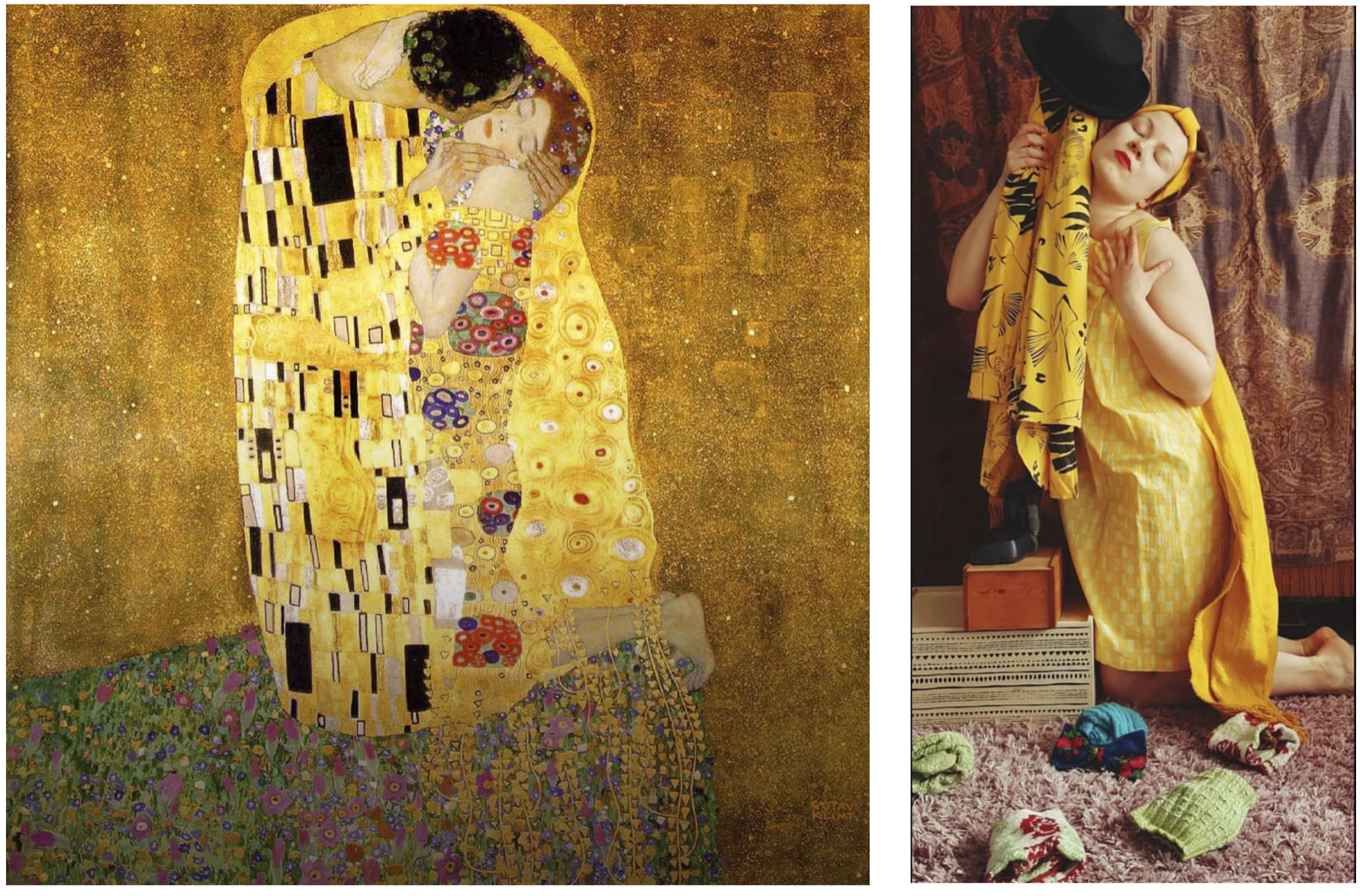
This is reminiscent of constrained creative experiences that consumers enjoy: a model or a visual representation of the target outcome makes it more enjoyable to execute a creative project such as sewing, jewellery-making, or even cooking (Dahl and Moreau, 2007). In many cases, the interviewees did not choose their favourite piece of art but a reasonably replicable work: ‘It’s about our possibilities to execute it, these are not my favourite artworks’, said Hanna. The analytical approach in creating the reproduction was needed to achieve the ultimate goal: for instance, Hanna’s aim was ‘[…] to get as accurate as I could, and be instantly recognisable as the painting’. This aim of creating something to be ‘instantly recognisable as a painting’ brings us back, again, to the Deleuzoguattarian framework, where the idea of an artwork is a compound that ‘must stand up on its own’ (Deleuze and Guattari, 1991: 164). In other words, the composition of the reproduction needs to be evaluated, built and constructed strong enough in itself to deliver an impression or a sensation of a certain kind, which can only partially be attributed to the original artwork.
The inventiveness of staging and the ability to create something novel from mundane, everyday objects, was valued – whether it required work or not. Renata noted that she ‘[…] really loved both the creativity and accuracy that people were able to achieve, even without the proper objects’. The link to housework or crafts at home was obvious here: inventiveness and practicality are the core elements of all kinds of domestic tips, tricks and lifehacks (see Figure 2). Recreating an artwork requires an admirable amount of effort, and most of the participants spent time sourcing or making the right kinds of props. For example, Leena had sent her son-in-law to the store to buy a hobby horse in the middle of the photoshoot session. To buy props was quite rare otherwise: making them oneself was the most accepted way to approach the challenge, as in the craft or DIY scenes buying is deemed almost as cheating (Watson and Shove, 2008). Despite the evident effort in building a setting for artwork, some emphasised how they definitely did not spend too much time on it. For some, the easiness and simplicity of staging were mentioned as a requirement even to start the project: Nina stated that ‘It has to be feasible so that I don’t need to make an enormous effort […]’. These two different ways of talking about the effort, in fact, remind of discourses regarding housework, such as cleaning or cooking. Some are happy to put in the effort and discuss it, but typically the labour part is kept ‘invisible’, especially in terms of its public appreciation, as if the house gets clean without any work, as if work never happens. All in all, the artworks are chosen mostly on practicality (i.e. the ability to reproduce, the level of effort required and inventiveness) rather than pure aesthetics. Inventive use of props: in-ear headphone as an earring. Original artwork: Johannes Vermeer, The Girl with a Pearl Earring (c. 1665). Public domain artwork. Reproduction: Image courtesy of Tiina Savallampi.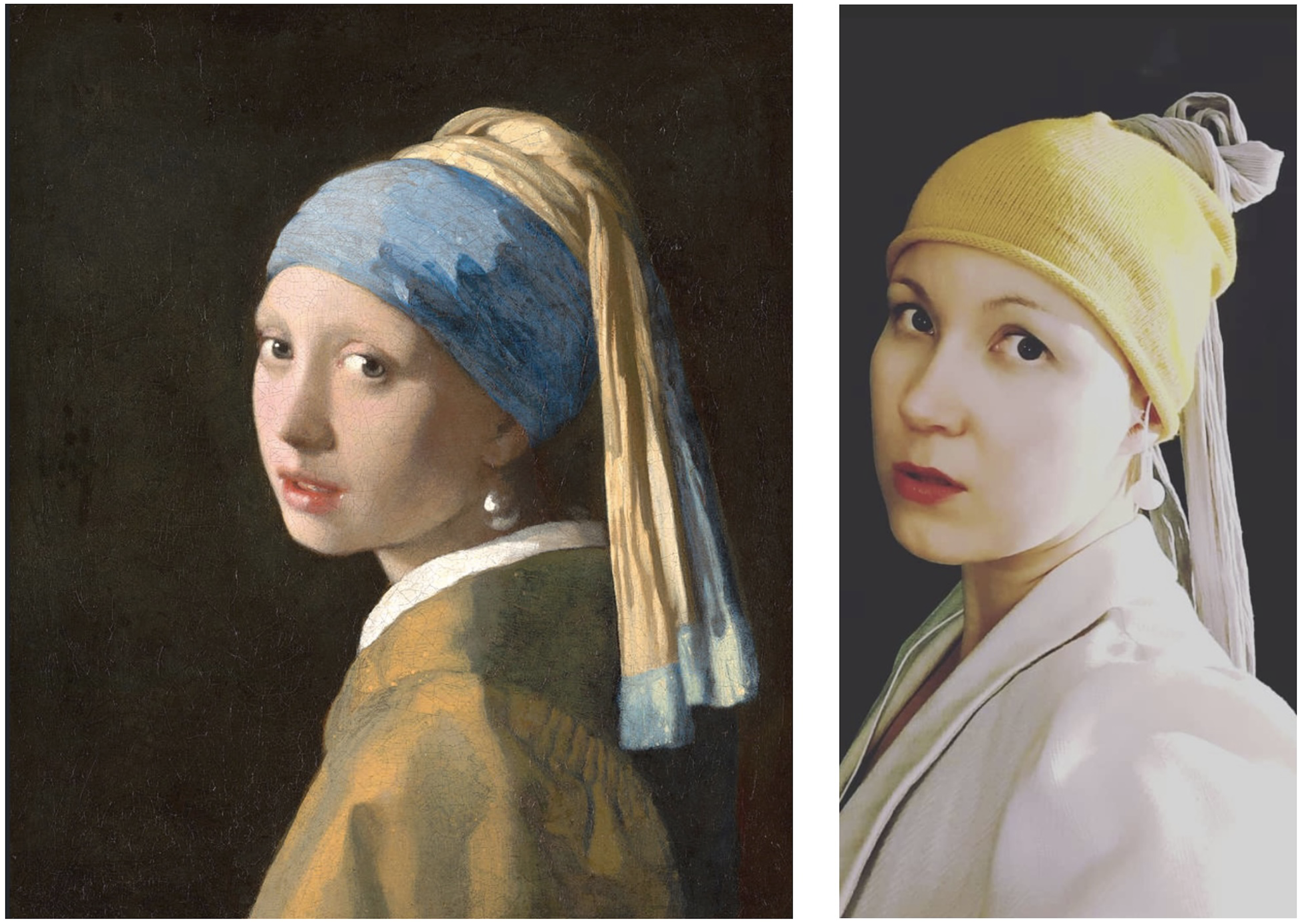
Although for many the starting point was to find suitable props at home, there were some with a more embodied, ‘fleshy’ start. For Deleuze and Guattari (1991: 178), ‘flesh’ is an element of an artwork contributing to the sensation: the people and the characters of the artworks (or, ‘Figures’ as Deleuze (1981/2003) called them). The resemblance or the identification with the characters inspired some to recreate the ‘flesh’ of an artwork. As Iris said, she started by studying the faces, expressions and looks of the characters in the paintings, I see ‘[…] a face that makes me wonder if I could look a little bit like that or if I ever have that kind of look on my face’. Leena described how she got inspired in the project by looking at her friend, ‘I looked at the painting and then I looked at her, she looked exactly the same. I then said, “You know, you look like this, let’s make that quarantine art of you.”’ Similarly, Alina’s father had mentioned a painting of a girl resembling her, and that inspired her to recreate the artwork. In the accounts, similarity was carefully analysed. In order to enhance the similarity, the whole body, the ‘flesh’, was subjected to analysis and morphogenesis: for instance, Sarah noted that she paid attention to the facial expressions of the models of the paintings to figure out what they might have been thinking – just to get that similar look on her own face. Iris pointed out that by twisting their arms in a similar position to a model in a painting, she has become more aware of her body, its postures and capabilities – and it has offered new ways to express herself (see Figure 3). Multiple interviewees noted that postures, angles and faces were the hardest things to master, and they have found themselves disappointed with themselves for not being able to execute something. All this is very close to the ‘pictorial possibility’ of the artworks – –‘[…] that has nothing to do with physical possibility, and that endows the most acrobatic postures with the sense of balance’ (Deleuze and Guattari, 1991: 164). All in all, the similarity was carefully scrutinised, the possibilities analysed and the resemblance executed as well as it was physically possible. The use of body and acrobatic postures. Original artwork: Henri Toulouse-Lautrec: La clownesse assise (1896). Public domain artwork. Reproduction: Image courtesy of Tiina Savallampi.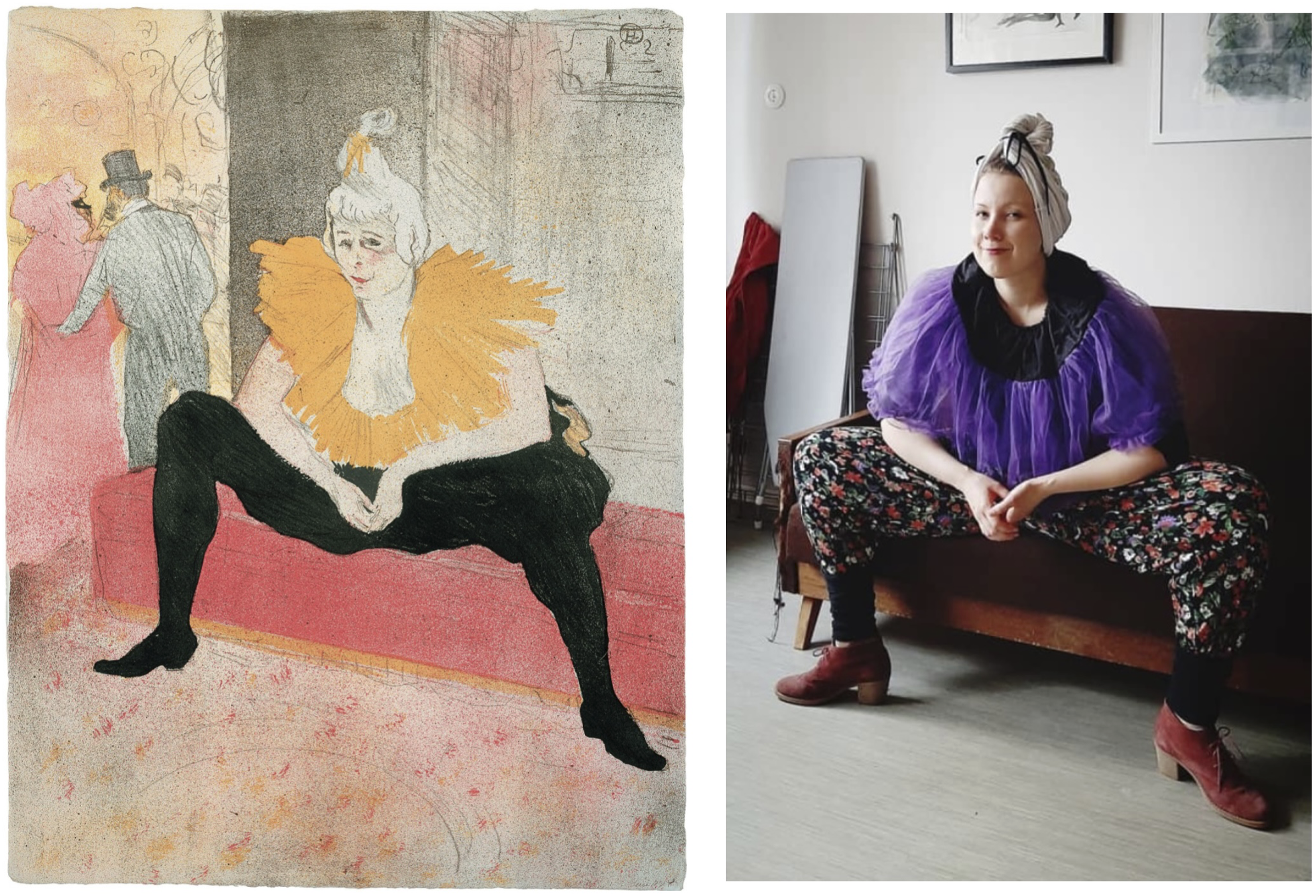
The nurturing practices of the aesthetic tribe
The aesthetic tribe under consideration is not only brought together but also nurtured and nourished through certain practices. In this case, the practices are related to the shared modes of expression. Nearly all of the participants had a communicatory agenda – they all wanted to express something with their recreations. It is not that surprising since the task of an artwork is to offer a form of expression for the community (Deleuze and Guattari, 1991). Three types of expressions nurturing the community emerged in the data: (art) educating themselves or others, joining the conversation about the pandemic and cheering up others.
Firstly, an imaginary art museum was built. Education is one of the key functions of an art museum, along with the important purposes of collection, preservation and presentation: a museum is a place for learning (Falk and Dierking, 2000). This educational aspect was brought up by multiple interviewees. Leena took the position of an educator and speculated that the quarantine art challenge makes ‘[…] those who don’t follow art or aren’t interested in it become more interested […]’, and Hanna explained that ‘This increases the appreciation and interest in art. Now that all those exhibits and museums are closed […] interest will increase when they open’. Indeed, the participants enacted the museum’s educational task. In some cases, they cared about ‘preserving’ artworks: ‘My main message is that the cultural heritage of each period and cultural tradition is important and beautiful’, stated Alina. With this statement, she also referred to her taste, expertise and knowledge – which is reminiscent of the motives of tourists photographing their destinations and what they want to signal with the photos (Schroeder, 2002).
Others thought that it was them learning new things about art, artists, art history – and even themselves (Kozinets et al., 2017). Edvard commented that ‘[…] one of the best aspects of quarantine art [is] that I have come across completely new paintings and artists that I have never heard of before’. Iris even noted she had ‘done some small-scale image analysis’. Renata said, ‘It has made me look at many works of art with very different eyes’, meaning that she was paying more attention to detail in the works and discovered new levels of meaning. Therefore, the participants considered the educational aspects of the challenge as valuable, whether in the position of teachers or pupils. The photographic practices allowed for the agency of the consumer and enabled them to create educational content on their own terms to foster the community.
Secondly, political viewpoints were brought up. Activism and community art are close to each other (Bishop, 2012). Multiple interviewees mentioned that their pictures commented on the Covid-19 situation. This is already visible in the numerous reproductions with face masks, hand sanitisers and toilet paper – all symbols of the pandemic (see Figure 4). In some instances, the participants were straightforward in commenting on the policies related to the pandemic: Leena said that ‘[…] it doesn’t make sense that those elderly people are trapped at home […]’. This comment is close to the idea of an artwork not celebrating ‘[…] something that happened’ but listening to ‘[…] the constantly renewed suffering of men and women, their re-created protestations, their constantly resumed struggle’ (Deleuze and Guattari, 1991: 176-177.) Moreover, it is a ‘cry of humanity’. The political commentary was not restricted to the pandemic. For instance, Iris said that they had been pondering nationalities, cultural heritage and identity politics: “Who can I pretend to be, who I cannot […] I made outside a spontaneous picture of the snow maiden of Russian folklore. When I read more about how it symbolizes Russia, that character in it, then I wondered whether it can be done after all […] if I’m taking something from someone, if I am repeating some symbolic work from another culture.” Commenting the pandemic. Original artwork: Odilon Redon, The Masked Anemone (unknown year). Public domain artwork. Reproduction: Image courtesy of Tiina Savallampi.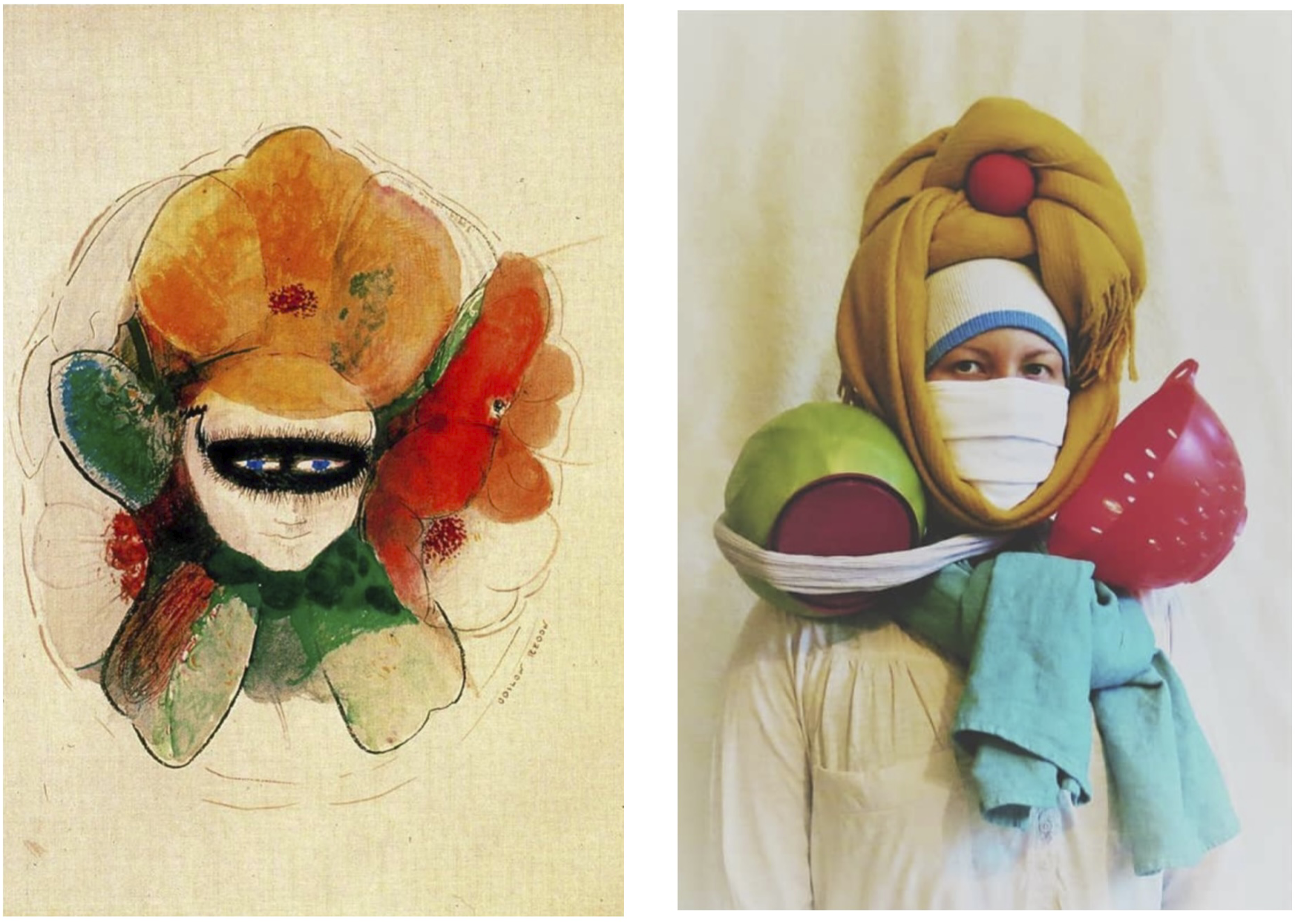
Play and political performance in social movements challenge traditional ways of thinking and invite new participants to join the movement (Shepard et al., 2008). Playful performances in this case were also behind political commentary and expression.
Finally, humour and parody were the primary means of expression that nurtured the aesthetic tribe. In some cases, the only goal was to have fun and bring a smile to others’ faces: ‘This quarantine art is about bringing joy to people. Because it brings joy to me too’, said Nina. For Elsa, ‘[…] the best part is […] when you get comments that people laugh out loud’. Indeed, the comment sections were full of people thanking the creators for their innovative and hilarious efforts, and even ‘saving their day’. The irony or the parody in the photos was also considered inventive. Elsa said that ‘Maybe that humour stood out, I like the way it’s done .. or I mean, the painting’s objects and things are made of some other objects. […] you have the same colour and shape, and it can be just about anything’. Humour is no stranger to pandemic rhetoric: comics were used as a public health communication tool, as visuals and storytelling simplify abstract ideas and are easily shared on social media (Kearns and Kearns, 2020). The virality of these parodic art performances shows that the quarantine art pictures were no exception.
The performing self in the aesthetic tribe
The self and its performance were recurring topics in the interviews. Multiple interviewees explicitly mentioned that they do not take selfies, and they are not interested in self-presentation and sharing their lives on Instagram. This differs from the common understanding of people in social media sharing their lives and presenting themselves (e.g. (boyd, 2007) For instance, Leena distinguishes herself from the conception of sometimes ‘narcissistic’ social media user interested in presenting oneself in a favourable light by saying that ‘[…] on that social media, I’m not someone “look at me […],” no, it’s not my thing at all’. The use of this kind of discourse could be a move to defend oneself – after all, social media is an exceptionally demanding place for women: the belittling (Abidin, 2016) and even scrutinisation, sexualisation and shaming of female bodies are part of the selfie culture (Murray, 2018). Renata makes a sad note of feeling inadequate to post selfies: ‘I had thought I would not appear with my face on Instagram. What’s there in me to photograph if I took selfies—nothing’. Sarah addressed the insecurity of posting even the recreation of an artwork, ‘[I] didn’t feel confident posting my […] recreation in public as it seemed self-indulgent, especially as I’m copying an elegant model […]. I think it’s related to how women are sometimes criticised when they’re perceived as being immodest’. The requirements for women identified by the participants were perceived as impossible to match: one should look good but not flatter oneself too much. However, in most cases, the quarantine art challenge seemed to bring a bit of relief to such constant scrutiny: Leena said that “Maybe it’s easier [to play a character] than posting your own pictures. […] when it has that artwork in it, then you are no longer you in that image […] you never post ugly pictures of yourself. But then when you make art, then it can be an ugly picture and it doesn’t matter at all. […] It’s like a role.”
Elsa continued the pondering, “Earlier I thought I didn’t want to be on Instagram with my own face. But when you got to go crazy and do things with all sorts of props, it somehow faded your own self. […] Although I feel that, on the other hand, it is also fun to show those different sides and different faces. And perhaps to find out how diverse you can be.”
These accounts demonstrate how difficult it is to separate one’s own self from the fetishised female body subjected to projections from outside (Mulvey, 1991). However, it can also be read that the challenge did offer not only an escape from one’s ordinary self and new roles to step into but also an exciting possibility to explore and present different versions of oneself.
Transformations and metamorphoses were a huge topic in the interviews. The challenge offered an opportunity to play a role, and to be someone else. Many of the interviewees said that they found it easier to play a role or a character than be who they are: Leena confessed, ‘I’m not a performer or a speaker anyway, it’s one of my frustrations. But if there is a role, a clown role, then I can be there’. For instance, in the works by Cindy Sherman, the self is an imaginary construct one is free to choose and build by themselves (Crimp, 1980). Alina said that she feels like the women in the artworks, and enjoys playing a character – ‘to be a chameleon in my recreations’. For Sarah, fun and joy were motivations for the metamorphoses: ‘The fun was the most rewarding. It was nice to jump into a completely invented character and come up with a story for the character’. Indeed, inventiveness and creative fabulation are about seeing the possibility of something becoming a ‘giant’ (Deleuze and Guattari, 1991: 171). Nina described her mother-in-law’s transformation process as follows, “It was terribly late at night at probably ten or eleven o’clock that I should have gone to bed, and then grandma was sitting on that couch, and I was browsing them [art catalogues]. Then suddenly that picture came up and I didn’t even know who it was in that picture, that woman. […] I threw my padded vest on her [the grandma] and a little bit of makeup on her face. We didn’t even get her hair properly; we should have combed it a little more.”
To achieve a look of a character in a painting, one typically needed to do one’s hair, makeup and find a costume (see Figure 5), which was already a metamorphosis for some. Nina noted that she enjoyed the contrast of dressing up for the challenge, as she was ‘[…] nothing like that in everyday life; I prefer comfortable clothes’. Multiple interviewees shared the same view and added that they felt the same about wearing makeup. Playing a character – and the use of clothes, hair and makeup. Original artwork: Tsukioka Yoshitoshi, A young woman from Kansei period playing with her cat portrait (1888). Public domain artwork. Reproduction: Image courtesy of Tiina Savallampi.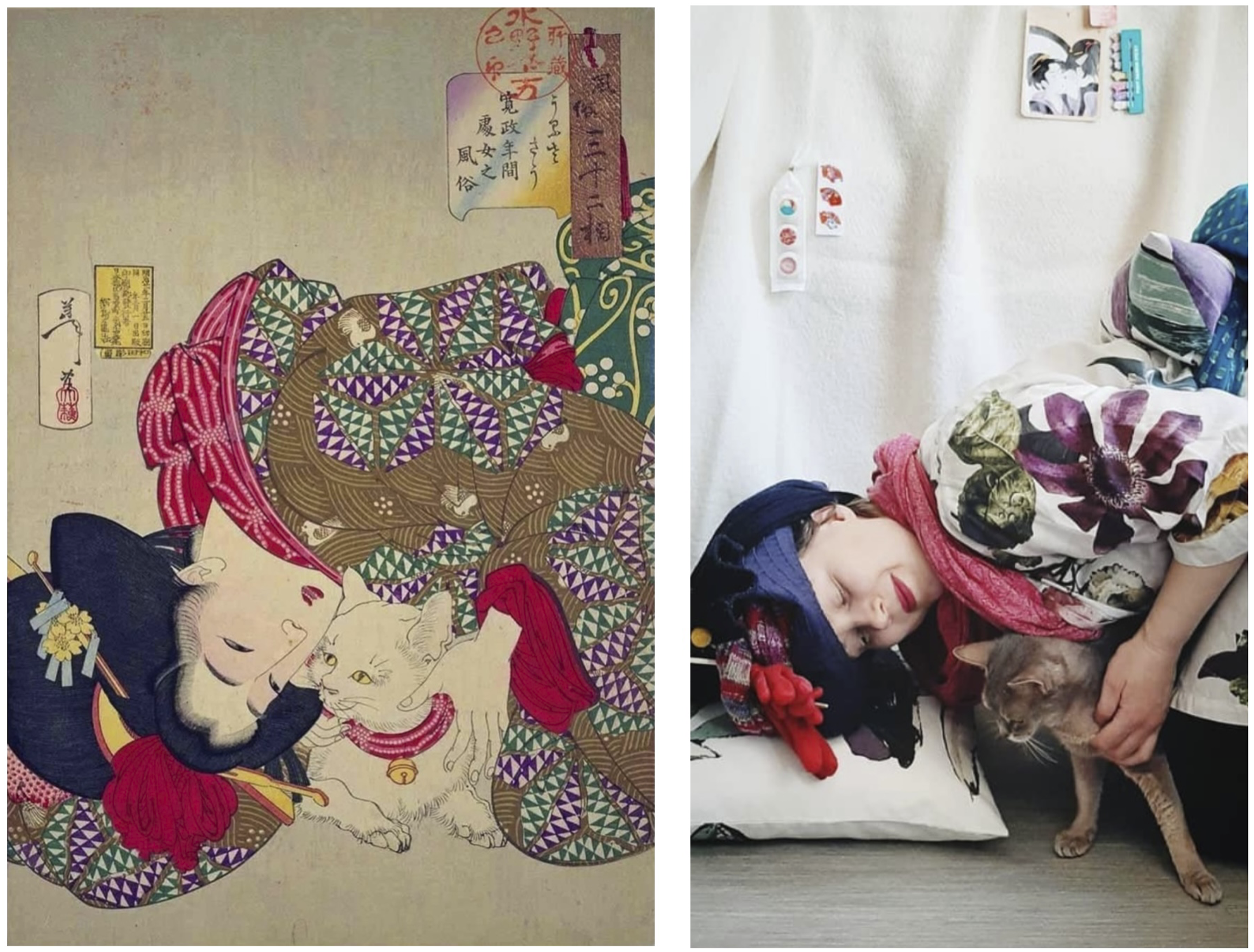
In some instances, the participants played with gender. Hanna described the co-project with her son like this: ‘Last time we did the Mona Lisa. He said he wanted to be Mona Lisa, and I said that obviously, he is Mona Lisa—although he is a boy. So we made the Mona Lisa’. All of the transformations for these performances resemble Butler’s (1990: 187) ideas of drag – a parodic performance that is not about the imitation of an original but the original itself. The recreators of the artworks regard the characters in artworks as ‘original’, but they are open to possible resignification when it comes to their own and their friends’ looks. The image of an ‘original’ character is just the starting point for some similarity and identification, but the ‘flesh’ of the new version of the artwork is as original as the ‘original’. The artworks are inhabited by the fluid selves with transformable flesh – first through the analysis of resemblance, and then the labour on the looks.
Discussion
Drawing on the findings above, I start by describing how recreating artworks and sharing them on social media during the time of pandemic is related to the traditional female forms of labour and ‘maternal’ caretaking. Next, I discuss how the emotional and affective labour performed in the quarantine art challenge weave a loose aesthetic tribe in the midst of a pandemic, affirming care. Finally, I elaborate how such labour on looks in this context helps women inhabit the social media imagery, and contribute to making more space for the continuous flow of female subjectivities. This assemblage of aesthetic community formation, nurturing practices and cultural tropes cutting across ever-evolving subjectivities contributes to – no less than a micro revolution.
Quarantine art as housework, and entering the sphere of the ‘maternal’ caretaking
Despite the apparent aesthetic drive of the quarantine art challenge, the recreated artworks are chosen mostly for practical reasons. As noted in the findings, the possibilities to reproduce the artwork at home, the level of effort and inventiveness, as well as craft and DIY skills, were the conditions for the execution of an artwork. Therefore, the work performed on reproducing artworks places this activity firmly in the context of labour in a domestic setting. Housework and domestic labour are still very gendered: it has traditionally been relegated to women (Catterall et al., 2000), especially to mothers (O’Donohoe et al., 2013; Cappellini and Parsons, 2013; Curasi et al., 2013), and any progress seems to have been undone by the pandemic when women reported having to take on the majority of care work (Sánchez et al., 2021). This unpaid reproductive labour includes taking care of others by feeding, cleaning, fixing, caring and nurturing (Federici, 1974). The creators of the challenge spent a considerable amount of time labouring on the artwork. And if they produced the recreation quickly, they again made sure to highlight how little effort they put into it. So in any case, the amount of work – little or a lot – was constantly a topic addressed. This could be related to how the female labour and the efforts in the household are sometimes downplayed and disregarded (Hochschild 2003, see also Fırat and Dholakia, 2017). Although some of the participants employed the discourses of creativity, imagination and expression in framing their artwork reproduction processes as artistic, it must be noted that creative and artistic work is also laborious (Harvie, 2013). The idea of reproductive labour in this setting affords a critical access to the phenomenon under consideration, and allows us to enter the sphere of nurture, care and even the ‘maternal’.
The topic of reproductive labour is wrapped in the idea of being ‘an act of love’ (Federici, 1974) or ‘labour of love’ (Federici, 2019: 176), both of which refer to the idea of women providing this labour out of love, care and affection. Following, in many ways, upon Federici’s work on care, over the last few decades, the notion of care has been extended and politicised. Care has been put forward as the new modality of being all genders must inhabit to tune themselves to questions of cohabitation with other species and environmental wellbeing (Haraway, 2008). Overall, care – as an affective, ‘maternal’ form of relationality – is manifested in the reproduced artworks, which are a means to care and can be seen as gifts or acts of love. In this, they affirm the caring acts culturally understood as ‘maternal’ as societally indispensable and politically necessary, understanding the ‘maternal’ in the site of the home as valuable, visible and appreciated.
Nurturing an aesthetic tribe through caretaking and gift giving
The expressions and the practices in the reproduction and consumption of artworks – art education, social awareness of the pandemic’s effects and the cheering up of others – contribute to the continuous nourishment of this aesthetic tribe. These practices can be seen as acts of caretaking: they are enacted through emotional and affective labour, and the aim in all of them was to enrich others’ pandemic social media realities. Caring, sharing, humanity and creativity are the building blocks of the social connections in hypercommunities (Kozinets, 2002a). Nurture fosters social relations and makes people connect to each other. However, historically and today, caregiving has placed especially women in precarious positions (Federici, 1974), and made them engaged in emotional and affective labour. Sometimes it has even isolated them into working alone to create others a pleasant environment (Federici, 2019) – especially so in the pandemic context when the work was literally performed in isolation.
In contrast to those harmful modes of caregiving, Federici (2019: 184-185) calls for the creation of ‘[…] new forms of social bonding and cooperation in the reproduction of our everyday life’, and suggests that communication technology should play a role in creating cooperative forms of reproduction, and ‘[…] pave the way to a world where care for others can become a creative task rather than a burden, […] break down the isolation that characterizes the process of our reproduction, creating those solidarity bonds without which our life is an affective desert and we have no social power’. The quarantine art challenge responds to Federici’s calls: as art is seen to influence positively on wellbeing (Bublitz et al., 2019), a funny and parodic reproduction of an artwork shared with others could be considered to have similar effects – at least in the social media context of the gift economy. In a gift economy, giving gifts belongs to ‘[…] the communal realm of emotional bonds, mutuality, caring, and sharing’ (Kozinets, 2002a: 27). Gift giving is also how mothering is enacted (Curasi et al. 2013). So in this context, the recreation of an artwork can be seen as a gift that nurtures and strengthens the bonds between people. Of course, the creators are not just making others feel good, the reciprocity is enacted so that, in exchange for the quarantine art pictures, the creators receive likes and comments, and shares – the currency of social media – and hence feel good about themselves. After all, care for self and others are intertwined (Shaw et al., 2017). The quarantine art challenge could be seen as a collectivisation of reproductive work on social media – a surprising virtual consumption space for creative caregiving, breaking down isolation and nurturing an aesthetic tribe.
The care that sustains and builds connections between people can lead to political possibilities. In virtual tribes or communities of consumption, consumers exchange information and might feel empowered by these interactions – which leads to ‘activist behaviours’ (Kozinets, 1999). In the quarantine art challenge, the care, nurture and knowledge of art were being exchanged. The practice of giving gifts exists outside the market logic, and hence offers an emancipatory escape from the market (Kozinets 2002a). In addition, it could even be said to contribute to creating a community: a ‘gifting society’ the intention behind giving a gift is to reduce social isolation and increase the feeling of community (Kozinets, 2002a). The art educational aspects, political utterances, and humorous images can be seen as gifts that build a more humane world. The whole quarantine art challenge is based on artistic practice in an analytical, reproductive and laborious way, with a clear mission of tackling the pandemic times together. As Rancière (2007: 59) notes, “On the one hand, the ‘community of sense’ woven together by artistic practice is a new set of vibrations of the human community in the present; on the other hand, it is a monument that stands as a mediation or a substitute for a people to come. The paradoxical relationship between the ‘apart’ and the ‘together’ is also a paradoxical relationship between the present and the future.”
In the quarantine art context, it could be imagined that the artistic reproductive practices create space for the future, and also space for other people to inhabit the future. And as Deleuze and Guattari, 1991: 177) write, ‘The victory of a revolution is immanent and consists in the new bonds it installs between people, even if these bonds last no longer than the revolution’s fused material and quickly give way to division and betrayal’. Despite the apt remark of division and betrayal especially in the divided social media context, it still seemed that the challenge was making an exception in terms of the warmheartedness and genuineness of installing bonds between people. That is the true victory of this micro revolution.
The onflow of subjectivities and artworks
The consumer self fluctuates in this aesthetic, tribal assemblage of arts, crafty practices and social media. The quarantine art challenge allowed for a ‘double position’ for a consumer’s subjectivity. Deleuze and Guattari (1991: 164) outlined the different positions of the artwork’s models, characters, personae and creators in the following way: an artwork and the “thing became independent of its ‘model’ from the start, but it is also independent of other possible personae who are themselves artist-things, personae of painting breathing this air of painting. […] What about the creator? It is independent of the creator through the self-positing of the created, which is preserved in itself.”
The ‘double position’ that is suggested here, however, is specifically visible through the combined experience of both being an ‘artist’ and a ‘model’, as is the case with Cindy Sherman and her simultaneous role as the actor in the narrative and the creator of it (Crimp, 1980; Mulvey, 1991). The transformative strategies and drag art execution in the challenge help to separate the consumer-creator and the consumer-character in the artwork. The creator, the ‘artist’ self, of a consumer becomes in the moments of actively recreating artworks. It is also related to the ‘construer’ subjectivity Fırat and Dholakia (2017) suggest emerging in social media contexts.
But the ‘model’ version of subjectivity is based on the participants’ immersion into an artwork (although the inhabitation also requires the analysis of resemblance and then working on the setting and looks) through playing different characters. For instance, Iris said that one is able to ‘indulge in art’, ‘reach a deeper level’ and ‘become a part of the work’ through this challenge, especially if compared to traditional art consumption experiences such as museum visits. This follows the recent developments in the immersion and Instagrammability of the art exhibitions (Kozinets et al., 2017; Burness, 2016; Budge and Burness, 2018). In the classic Baudrillardian (1994) thinking, a person immerses into the postmodern spectacle in which the boundaries of the real and imaginary are blurred: this challenge could be interpreted as an art simulation (which it obviously is to some extent). Thus, also the understandings of ‘authentic’, ‘original’, ‘simulacra’ or ‘copy’ come naturally to the fore in comparing the original artwork and its recreation (La Rocca, 2011; see also Deleuze, 1981/2003). This mix is especially fascinating, and perhaps quite post-postmodern: a painting as an art form is typically conceived as signalling personal expression, a level of originality, and authenticity, while photography is involved in the production of copies (see Crimp, 1980). The analytical and laborious take on oneself does keep these things separated, but the consumer is still oscillating between at least two versions: the analytical consumer-creator and the immersing consumer character. This kind of movement is very close to the ‘creation-consummation’ Maffesoli (2007) describes as the characteristic of aesthetic tribal attitudes. Following Kerrigan and Hart’s (2016) understanding on multiple digital selves being temporal, this movement between inhabitation and independence in the reproductive processes of the quarantine art challenge could open the possibility for the fluidity of subjectivities.
It is the argument I build, that, in this particular quarantine art context, the consumer-creator-performer is reigning the mythical trope of a mother. This is separate from those characters and roles the consumers play in their reproductions. ‘Maternal’ could be one of those figures that are firmly in the cultural, collective unconsciousness based on repetition (Maffesoli, 2007). ‘Mothers’ are familiar to the social media and blogging scenes – the cultural representations of motherhood are many, and the ‘good’, ‘bad’ and even ‘perfect’ mother identities are actively negotiated (Orion-Johson, 2017) – but this ‘mothering’ in this context takes place through the nurturing practices, not through representation. After all, the ‘construer’ subjectivities draw on myths to ‘[…] construe organizations of life without much regard for representation […]’ (Firat and Dholakia, 2017: 13). Becoming-mother is on the level of organisation, and it does not require as extensive bodily metamorphosis as pregnancy would require (Patterson and O’Malley, 2013) – hair and makeup are enough in the quarantine art challenge. By construing, arranging and rearranging the artwork, and even becoming a part of it, one has a huge effect on it, and oneself.
Inhabiting and reproducing artworks – and therefore, the history of art – is an act of emancipation. The history of art is male (Bain, 2005), and women, more often than not, have been mere models for the artworks. This is the case also with the original artworks that were reproduced in the challenge. Moreover, craft has been seen as domestic and subordinate to art. Yet, now in the quarantine art challenge, art’s high status is questioned by bringing it to an entirely domestic environment and subjected to crafty, domestic practices aimed to nurture a community. This is in line with the postmodern blurring of the boundaries of art, commerce and the everyday (e.g. Featherstone, 1991; Cova and Svanfeldt, 1993; Venkatesh and Meamber, 2008; Kerrigan et al., 2009). Furthermore, postmodern and feminist art have served to blur the divisions between high culture and low culture (Mulvey, 1991) – and these canons have been followed in the challenge. Even parody takes part in the rebellion: following the idea of drag (Butler, 1990: 187), the parodic performance questions the originality of the original itself. Hence, in this context, the parodic performance of artworks questions the originality of the works of art, and perhaps their hegemony too. Consumers have agency in terms of the artworks: one could almost say a consumer desires, and ‘almost owns’ the artwork in this kind of liminal virtual space (Denegri-Knott and Molesworth, 2013). Since artworks have become material for cultural modification, they have correspondingly become new spaces for the consumers’ subjectivities to inhabit and become.
Conclusion
Connections between gender and arts consumption have remained somewhat underexplored in CCT, especially in the context of social media spaces inhabited by consumer-producers. This article has aimed to redress this oversight by exploring ‘quarantine art’ to illuminate the emergence of new consumer practices, subjectivities and cultural forms in and around an aesthetic social media tribe. I have analysed the simultaneous arts consumption and social media content production as a form of female labour that nurtures the consumer-producers gathered around the quarantine art challenge. I argue that a new type of female subjectivity has joined the social media onflow of subjectivities: the ‘maternal’ who affirms care through aesthetic expression. This is not the trendiest becoming of subjectivity, but a version that educates, protects and brings joy to others. The return of the maternal archetype is understandable during the pandemic: what else could provide such a soothing comfort than caretaking and nurture? A final proposition to emerge from the study is that the crafty DIY take on content production among this aesthetic social media community juxtaposes high art and crafts, and questions the artificial boundaries between them. This overall assemblage allows for a new expression for a community and an aesthetic form of being together.
Footnotes
Acknowledgements
I would like to express my deepest gratitude to brilliant Olga Goriunova for her insightful comments and suggestions. I would also like to thank the supportive and knowledgeable editors and the anonymous reviewers for their valuable feedback that substantially improved the article.
Declaration of conflicting interests
The author(s) declared no potential conflicts of interest with respect to the research, authorship, and/or publication of this article.
Funding
The author(s) disclosed receipt of the following financial support for the research, authorship, and/or publication of this article: This work was supported by the Kone Foundation and the Finnish Foundation for Economic Education.
