




Abstract
Identified and analyzed in this article are tourist film souvenirs. Associated with the Rickshaw Run adventure tourism experience, these travel artifacts are crafted from video fragments gathered on the road, combined into an organized overall, and shared online. Films are found to structure tourists’ self-imaginings during and post-travel. Filmmaking enables protagonists to roleplay as extraordinary travelers, to selectively assemble clips representing themselves as such, and to solicit external attention thereupon. Agglomerating and asserting tourist fantasies as reality, films prop, produce, and publicize authenticity claims relating to protagonists as extraordinary. Contributing to recent discussions of post-postmodern authenticity, illustrated is how this reconstructive orientation manifests in tourism authentication practices-priorities. Noted are infusions of fantasy into tourism experience, as facilitated by film souvenirs. Considered are practitioner implications of authentication processes that are highly self-centric. Rearrangements of tourists and toured, as captured in films reviewed, highlight opportunities and challenges around enabling tourists’ fantastical self-imaginings.
Introduction
Contribution of this paper is to conceptualize post-postmodern tourist authentication as involving an infusion of fantasy into tourism experience (Figure 1). Authentication processes by which experiences and their associated meanings are identified, confirmed, and valued as authentic (E. Cohen & Cohen, 2012; Zhou et al., 2023), are hereby found to complement the post-postmodern view of authenticity, which conjectures means for tourists to imaginatively authenticate their experiences (Canavan & McCamley, 2021), and that has been found to be highly relevant to some tourists with regard to specific types of authentic content (Wong et al., 2023). Research reviews the use of digital videography and social media by tourists to craft and display travel souvenirs that support and validate their fantasies of being extraordinary. The specific souvenirs identified and analyzed, tourist films, facilitate protagonists’ travel performances, and solicit roadside attention thereupon. Post-travel, films are used to assemble supporting narratives and co-opt others into these. As an authentication device, therefore, film souvenirs structure the imaginative reconstructions of tourists.
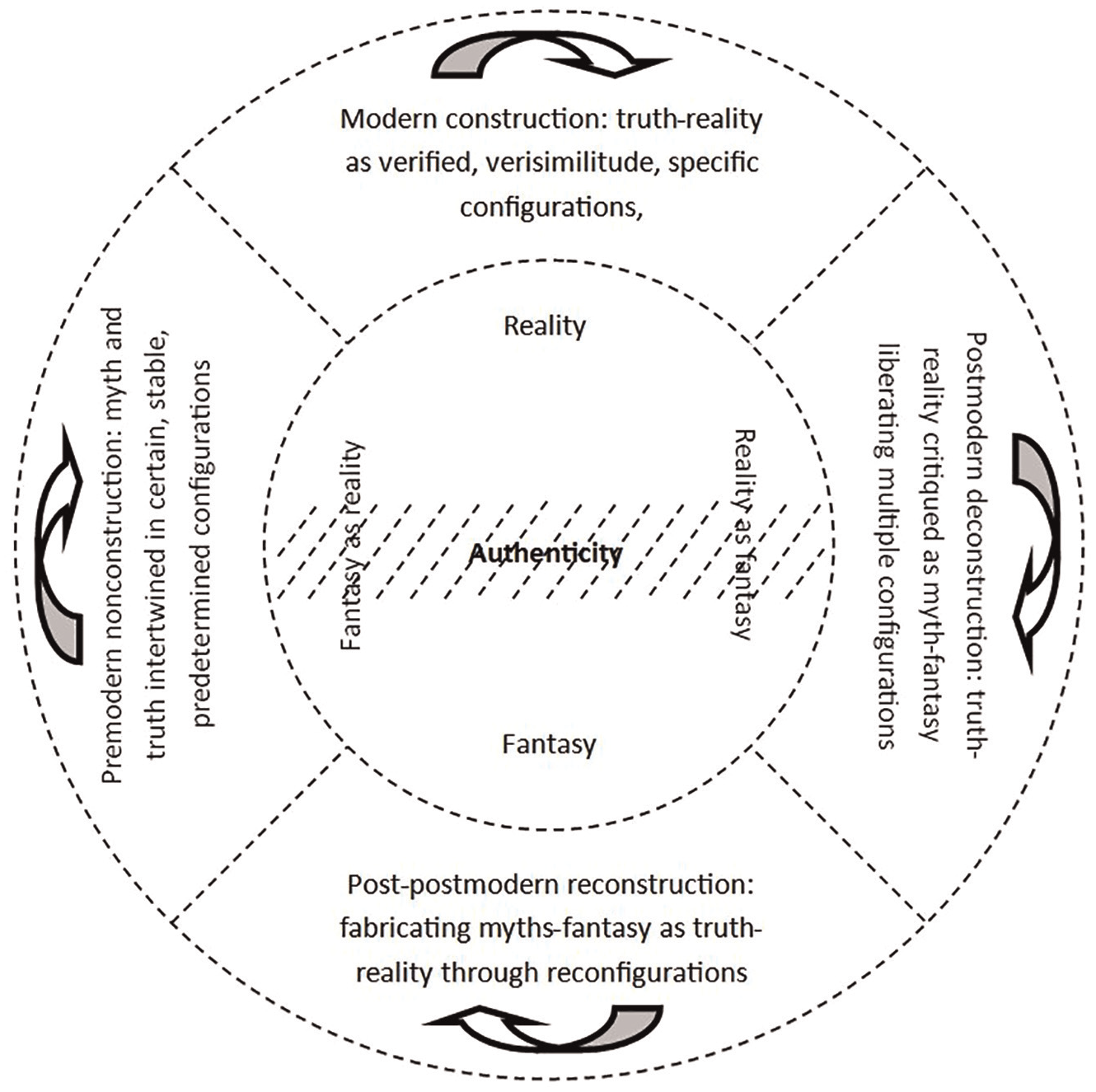
Modernisms and authentication orientations.
At a time when life has increasingly become stagecraft, involving a blending of reality and mass-media experience (Rose & Wood 2005), fantasy proneness has the potential to drive future travel decisions to a much greater extent than before (Li et al., 2021), including tourist responses to authenticity (Wong et al., 2023). A concept that arises from connections and in contexts (Moore et al., 2021), authenticity is informed by prevailing sociocultural emphases (Martin, 2010). As noted by Skandalis et al. (2019), the emergence of a post-postmodern era calls for alternative theoretical discourses for understanding consumption experiences, including those of authentication. However, Wong et al. (2023) argue that the sociocultural factors that condition tourists’ responses to authenticity offerings are under-researched. More broadly, Rickly (2022) notes that research opportunities exist relating to better understanding the social processes that drive authenticity. We also tend to think about authenticity as produced for tourists (i.e., Farrelly et al., 2019), including in relation to authentic souvenir production and perception (i.e., Su et al., 2023), rather than emphasizing the active roles played by tourists in both souvenir (i.e., Anastasiadou & Vettese, 2019) and authenticity (i.e., L. Wang & Alasuutari, 2017) co-productions. In addition, relatively little has been written about new forms and roles souvenirs may take, the importance, or impacts of these (Anastasiadou & Vettese, 2019). Current research on tourist souvenirs also fails to provide a holistic and in-depth perspective on their meanings and their evolution in time and space (Masset & Decrop, 2021).
Addressing these gaps, examined are a novel souvenir form; tourist films made up of clips collected in the act of travel, edited together, and shared online. Reviewed are 18 of these extended (at least 30 minutes long) films, crafted and publicly shared by tourists relating to their participation in the Rickshaw Run adventure tourism event. A contemporary variation on the traditions of purchasing souvenirs and sharing pictures that are both ubiquitous components of traveling and avenues for tourists to express themselves (Boley et al., 2013), the significant level of planning, commitment, and skill involved in tourist film’s production speaks to current trends toward more involved souvenir prosumption (Anastasiadou & Vettese, 2019). Like all souvenirs, films are useful material symbols of travel experience for tourists to disclose self-messages and to construct positive self-representations (Kuhn, 2020). However, they also take advantage of digital photography and social media technologies to produce, perform and publicize self-imaginings. These functions of films make them sophisticated devices for agglomerating and asserting tourist interpretations of reality and meaning (as per Canavan & McCamley, 2021).
Contributing to recent work highlighting the interactions of reality and fantasy (Lovell & Thurgill, 2021), extraordinary and everyday (Skandalis et al., 2024), through which tourists negotiate authenticity, this study identifies tourist-led infusions of fantasy that invoke extraordinary travel personas and extend these into everyday post-travel lives. Previous research has found social media facilitates the capture and sharing of meaningful experiences (Bosangit et al., 2015), telling and retelling of myths (Thomas et al., 2018), and appropriating of authenticity (Kane, 2012). Here, the intersection of social media and souvenirs as meaning-making devices (i.e., Kuhn, 2020; Torabian & Arai, 2016), is shown to similarly empower tourist self-mythologizing. This research draws attention to tourist’s active role in the evocative myths (Andéhn & L’Espoir Decosta, 2021), imagery (Stanley & Wight, 2023), and stories (Prince, 2021), through which authenticity is negotiated. Expanding discussions of the role of social media in authentication processes (i.e., Lugosi, 2016; Salet, 2021; van Nuenen, 2019), findings show that beyond reflecting authenticity, such as place connections perceived by purchasers (Wilkins, 2011), film souvenirs refract authenticity, altering perceptions as desired by their producers. Analysis of film refractions gives insights into the authentication priorities of these particular tourists. In their focus on tourist protagonists, rather than toured surroundings, films are less about the places that souvenir objects typically imaginatively evoke-negotiate (Peters, 2011), and more about the persons expressed. Hence, where past research has considered the deep meanings attached to souvenirs by tourists (Baker et al., 2006), this study contemplates the deep meanings attached to tourists via souvenirs.
Drawing together literature on authentication, modernisms, and souvenirs, this article begins with a framing of the socio-technological mediation processes (Lugosi, 2016), that are here suggested to have made reconstructive post-postmodern authentication more readily accessible for consumers. Tourist souvenirs as items associated with the materialization of cultural meanings, and as such potentially integral to identifying and valuing authenticity, are then discussed. Following this, the literary and visual methods used in identifying and reviewing tourist film souvenirs are outlined. Findings suggest that film’s production, the tourist performances associated with, and the use of films as a publicity device, structure creator’s reconstructions of fantasy as reality. Discussion expands on the theoretical insights as well as opportunities and challenges for tourism practitioners that might be associated with this post-postmodern approach to authentication.
Literature Review
Authentication
Bringing attention to issues of power, politics, and conflicts of interest around how authenticity is produced, thus shifting focus of interest from what authenticity is to what authenticity does (S. A. Cohen & Cohen, 2019), authentication involves judgments of authenticity but also concerns how these are utilized, constructed, and defended (Chatzopoulou et al., 2019). Illustrating such power dynamics, Nagle and Vidon (2021) analyze how authenticity rhetoric is used by outdoor companies to promote and perpetuate particular notions of sustainability. Situating themselves as brokers between people and nature, these companies reinforce the notion that without the “right” gear, one cannot have a truly authentic outdoor experience. Authentication refers to value claims enacted by a network of actors adopting performative techniques through which notions of authenticity may be inscribed (Lugosi, 2016). Involving a complex range of elements linked to discourses beyond the consumed tourism product, notions of authenticity come about through different influences that destabilize, sustain, and reproduce these, in “a multifaceted mesh of materiality, social representations, political discourses, practices and performativity” (Frisvoll, 2013, p. 294).
Authentication as a term relates, therefore, to the sociocultural processes by which something is confirmed as authentic (E. Cohen & Cohen, 2012) and designated value as such (Lugosi, 2016). Understood both epistemologically in terms of knowing what is real or true, and ontologically in terms of being true or authentic (Moore et al., 2021), authenticity refers to simultaneous evaluations of experiences, and existential connections activated via experiences, as well as the sociocultural contexts that frame these (N. Wang, 1999). Cary (2004), for example, describes tourist moments as spontaneous instances of self-discovery and feelings of communal belonging, elicited by serendipity that renders an experience as authentic. Serving as both an object of desire and a will-to-knowledge (Bryce et al., 2017), tourists may both perceive and be inspired by sensations of authenticity (Park et al., 2019), which as a goal involves both object measurement and personal experience (van Nuenen, 2019). Authenticity stimuli and cognition are moreover situated based on cultural background (Wong et al., 2023). Torabian and Arai (2016) find that social networks, preconceived notions, and cultural biases may influence interpretations of souvenir’s objective authenticity for instance.
In this sense authenticity is less a set of discrete properties that distinguish the genuine from the fake, and more an ongoing process of managing a network of contingent relationships (Thompson & Kumar, 2022). Attempting to broadly define these processes E. Cohen and Cohen (2012) propose a hot-cool framework for understanding how experiential-existential authenticity are constructed in tourism. Cool authentication involves more formal expert verification of something as authentic, whereas hot authentication encapsulates incremental participatory processes through which authenticity is confirmed. Illustrating this framework in practice, Lamont (2014) observes sports tourists’ performativity. Their involvement in embodying, venerating, and witnessing “La Tour,” facilitates both a heightened sense of authentic travel experience and experiences of existential authenticity. Hence, blended processes of hot and cool have been found to contribute to experiences of toured surroundings and of self in-and-of those surroundings, as authentic.
Lamont’s (2014) study draws attention to the digital realm as an influential aspect of contemporary tourist authentication processes. Their findings elaborate how acts of mediation, via the collecting of digital evidence, and sharing, via social media, project travel experiences to broader audiences. These acts augment hot authentication by exhibiting imagery to broader social networks, assisting in perpetuating these as authentic. Relatedly, Lugosi (2016) illustrates how various socio-technical arrangements, including social media visibility versus obscurity, co-creatively and cumulatively authenticate and make claims regarding experiential and existential authenticity. Elsewhere, Brooks and Soulard (2022) consider how online platforms, such as Reddit, can be used by individuals to engage in claiming and contesting authenticity. Meanwhile, van Nuenen (2019) suggests that in cultures increasingly driven by algorithms, the authentication process becomes one of aggregate determination, involving normalized averages of serialized individual narratives and unique experiences. As summarized by Rickly (2022), such research inspires necessary thinking around how the social processes of authentication operate in online contexts. This research considers post-postmodern theory as usefully framing authentication contexts that are increasingly technologically saturated (Lugosi, 2016), before evaluating specific souvenirs that arise from.
Post-postmodern Authentication
Modernisms, characterized by distinctive aesthetic practices and theoretical assumptions (Breu, 2011), help to contextualize and conceptualize the authentication processes that connect tourist’s experiences of authenticity with the broader sociocultural contexts that these take place within and are shaped by. Indeed, N. Wang’s (1999) influential three-dimensional articulation of authenticity theorizes objective authenticity, relating to the authenticity of experiences, existential authenticity, relating to the existential potential that may be activated by experiences, and, postmodern authenticity, relating to a characteristically deconstructive stance regarding notions of truth and reality. Authenticity is hereby experienced by tourists through a process of negotiation between object and self, which are also context-specific (Mura, 2015). Subsequently, E. Cohen and Cohen (2012) contend that while objective and existential authenticity denote different types of personally experienced authenticity, postmodern authenticity differs in that it relates implicitly to the process of social construction of the other two types. Yi et al. (2018) affirm the role of postmodern authenticity as a moderator that explains the relationship between perceived and existential authenticity.
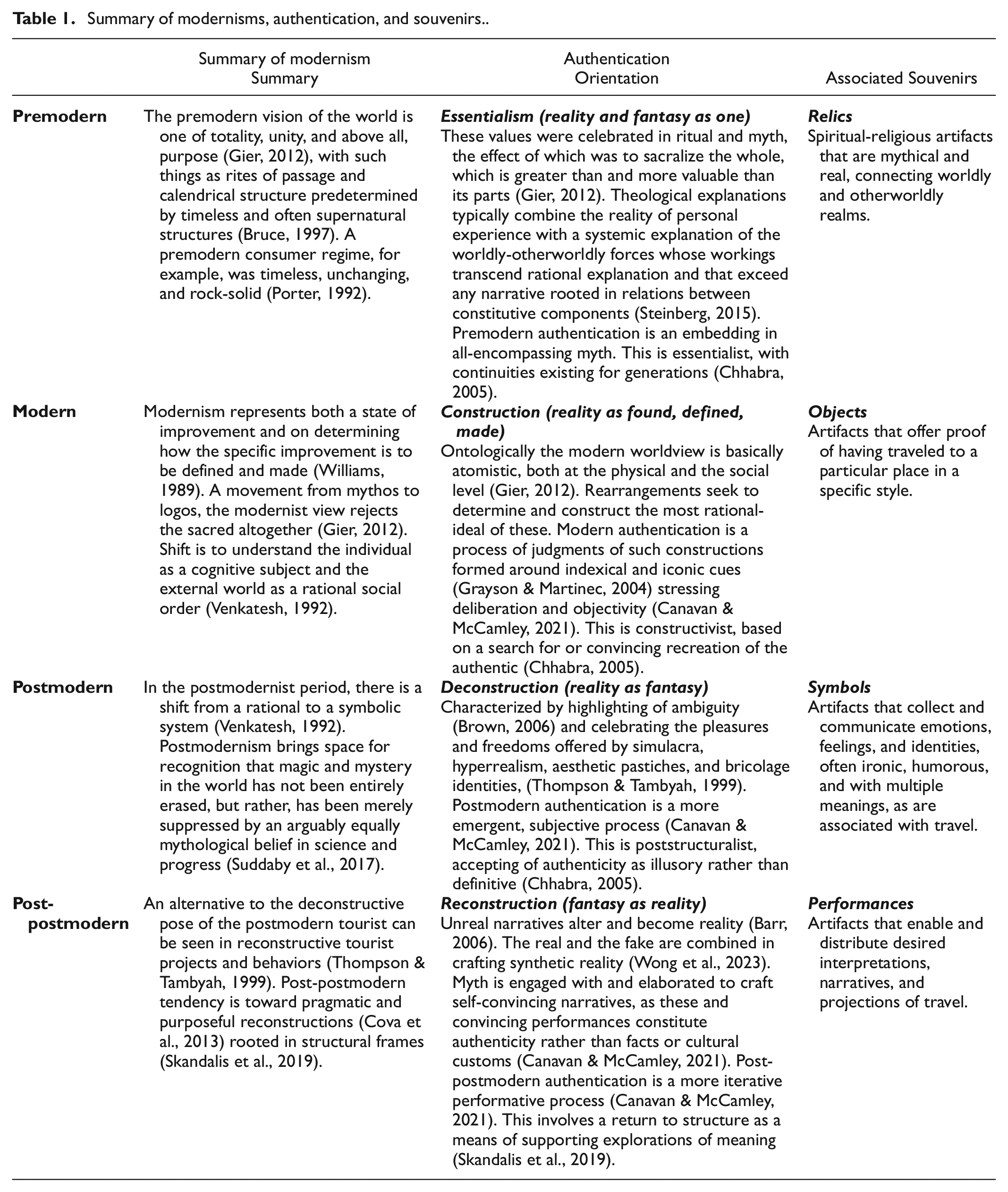
Thus, different modernisms capture stances that may permeate societies and influence prevailing authentication processes. In brief, premodernity represents a myth-infused ethos that does not distinguish reality-fantasy but accepts these as intertwined parts of a constant overall. Premodernism is a worldview characterized by salience of beliefs, actions, and institutions that assume the existence of supernatural entities with powers or processes possessed of moral purpose (Bruce, 1997). Authenticity in this sociocultural framework is an inward journey of connecting self with sacred otherworldliness (Cavanaugh, 2008). Modernity has been linked with constructing reality. Modernism approaches authenticity as something that can be pursued and discovered by tourists and can also be made and presented for them (MacCannell, 1976). Authenticity thusly exists externally to the tourist; a characteristic found within an object such as a product, an event, or a place (N. Wang, 1999). Postmodernity forwards deconstructions of reality as fantasy. Postmodernism appreciates that the real and fantastic reside more in the orientation one has toward one’s surroundings than in the nature of those surroundings (Firat & Dholakia, 2006). Authenticity is hereby understood as the projection of tourist’s beliefs, expectations, preferences, and stereotyped images onto toured objects (N. Wang, 1999).
Relatedly, post-postmodernism associates with reconstructions of fantasy as reality. The post-postmodern prioritizes reconstruction to rethink and remake possibilities of meaning (Doyle, 2018). Authenticity is henceforth an infusion of imagination into tourism performances, heightening belief, suspending disbelief, and making these more real. Citing examples including contemporary pilgrims who suspend religious disbelief to heighten spiritual experiences (Thomas et al., 2018), and surf tourists who disguise negative and elaborate positive aspects of their travel to frame as ethical (Ponting & McDonald, 2013), Canavan and McCamley (2021) highlight an “alterreal” authentication process. Hereby preferred alternative realities are identified before reality is altered to suit this preference. Testing this premise, Wong et al. (2023) find cultural heritage can be infused with the fairytale flânerie that fuel tourists’ imaginations and yearning for fantasies, and which can transcend into a synthesis of heritage with myths often favored by tourists. In their study of urban legends meanwhile, Lovell and Thurgill (2021) identify infusions of imagination allow tourists to experience heightened belief, and the suspension of disbelief, in such myths.
Accordingly, where Cohen (1988, p. 379) articulates authenticity as historically and socially emergent rather than static; “a cultural product, or a trait thereof, which is at one point generally judged as contrived or inauthentic may, in the course of time, become generally recognized as authentic,” post-postmodernism speaks to contemporary emphases that guide such emergence. In particular, discussions of increasingly socio-technological authentication (Lugosi, 2016) might be complemented by post-postmodern theory. Indeed, Kirby (2009) describes new digital and social media technologies as significantly shifting perspectives on the nature of truth and reality and ushering in post-postmodernity. Although recent research has theorized how post-postmodern authentication manifests in relation to tourist experience (Canavan & McCamley, 2021; Skandalis et al., 2024; Wong et al., 2023), gaps remain in understanding who needs this type of authentication, how they utilize, or why. How post-postmodern authentication resonates in tourist behaviors, such as the collecting and displaying of souvenirs that is a ubiquitous element of travel consumption (Lasusa, 2007), remains open-ended.
Souvenir Authentication
Analysis of tourist-produced and publicly shared film souvenirs is anticipated to help identify and interpret such reconstructive post-postmodern authentication mechanisms, as they may arise in relation to tourism. Previously, Hillman (2007) highlights the use of postcards and photography as visual authentication tools, which serve to provide the traveler, and in tun, contacts back home, with proof of travel and traveler presence. Connecting this postcard role with modernism, Rogan (2005) considers their early 20th century success as related to the many layers of meaning, concrete as well as symbolic, invested in these artifacts. Meanwhile, associating with postmodernism, Corkery and Bailey (1994) detect characteristic devices of fragmentation, de-differentiation, and parody in then-contemporary Boston postcards, which illustrate the implosion of heritage, academia, and retail into a multitextured and malleable commodity. This research looks to do similar, but with film souvenirs as an alternative to or extension of the still photography associated with traditional postcards, and that may speak to contemporary socio-technological emphases.
Taking various forms and roles, souvenirs are among the most pervasive elements of the travel experience (Torabian & Arai, 2016). These deeply meaningful (Lasusa, 2007) and self-expressive (particularly digital) items (Boley et al., 2013) are rich in symbolic value (Swanson & Timothy, 2012) and imbued with imagination (Peters, 2011). Souvenirs reflect and contribute to the construction of social identities, serving as markers to selves and others, as transitionary objects that mediate the past and present, the private and public (Pritchard & Morgan, 2003). This souvenir meaningfulness plays a role during travel. Describing as props, Lasusa (2007) explains the act of collecting souvenirs gives a tourist something to do and thereby helps them to maintain a sense of identity while in an unfamiliar location. Souvenir possession illustrates that a person is a tourist and intentionally participates in travel for leisure (Swanson & Timothy, 2012). When tourists purchase or wear novelty T-shirts for instance, they pretend to be less than serious and hence distinguish from their non-travel selves (Gordon, 1986).
Souvenirs are also associated with post-travel structuring of meaning. Evidence of a complex interaction between self and other that is apprehended and enlivened while traveling (Love & Kohn, 2001), collecting and displaying souvenirs is a means of inscribing value to objects, places, actions, and experiences (Lugosi, 2016). Often strategically placed in the home where they can best be seen by family members and visitors (Peters, 2011), displayed souvenirs can be a source of discussion (Masset & Decrop, 2021). For Wilkins (2011, p. 246), this “use of souvenirs as conversation pieces and as evidence of travel experiences clearly reflects the importance of travel experiences in the construction of the self and as status consumption products.” In these ways travel souvenirs help to concretize what was intangible and locate, define, and freeze in time a transitory experience (Gordon, 1986), reconnect travelers to thoughts, feelings, and experiences related to places they have visited (Shtudiner et al., 2019), and trigger an imaginary return to memorable times and places (Peters, 2011).
Effectively, souvenirs are authentication mechanisms in that they “materialise ideological values we hold about ourselves and the symbolic meanings ascribed to travel experience and serve as a medium to represent these values and meanings to others” (Kuhn, 2020, p. 499). Elsewhere, tourism artefacts have been reviewed to gain insights into authenticity practices and authentication processes. For example, Salet (2021) reviews online travel writing as a participatory, pressured, and competitive process of continually combining and redefining authenticity. Continuing, Salet illustrates the various paradoxes of authenticity as an individualistic endeavor that is simultaneously collaboratively (re)written and contextually prosumed. Considering 3D printed souvenirs, meanwhile, Anastasiadou and Vettese (2021) find the transience of these souvenir’s physical state, and performativity of tourists’ engagement with the production process, suggests a personal infusion of aura and enhancement of authenticity. The tourist films reviewed here, are anticipated to link with these discourses around participatory and performative processes underlying contemporary souvenirs and as found in post-postmodern consumer culture. Hence, where a post-postmodern zeitgeist requires a better understanding of how consumer culture has or could change as a result (Cantone et al., 2020), such souvenirs are here evaluated as antecedent and precedent of this cultural shift in relation to consumer authentication.
Summary of modernisms, authentication, and souvenirs.
Research Methods
Identifying Tourist Film Souvenirs
Research focusses upon tourist made and publicly shared films that are all associated with creators’ experiences of the Rickshaw Run; an adventure tourism event organized multiple times per year in the Indian subcontinent by the Adventurists (www.theadventurists.com). This travel brand creates and promotes a range of tourism experiences, all of which involve the use of an incongruous vehicle combined with a distance-location based challenge, typically a non-competitive race. The Rickshaw Run takes the format of a roughly 2-week 2,000 km race between variable start and finish locations. Alternative runs are available across several locations, distances, and timescales. As the title suggests, the race is undertaken in a rickshaw. The eccentricity of doing so is heavily emphasized in associated marketing. Contestants pay a fee to join. For 2024 the fixed cost per rickshaw is £2,095. A maximum of three people can travel per vehicle. With this investment participants gain access to rickshaws, welcome orientation sessions, launch, and finish line parties. Participants are also able to personalize their vehicles. Local artists are commissioned to paint rickshaws to designs submitted by tourists ahead of the event. Accommodation, fuel, food, visas, travel insurance, are all sourced and funded independently.
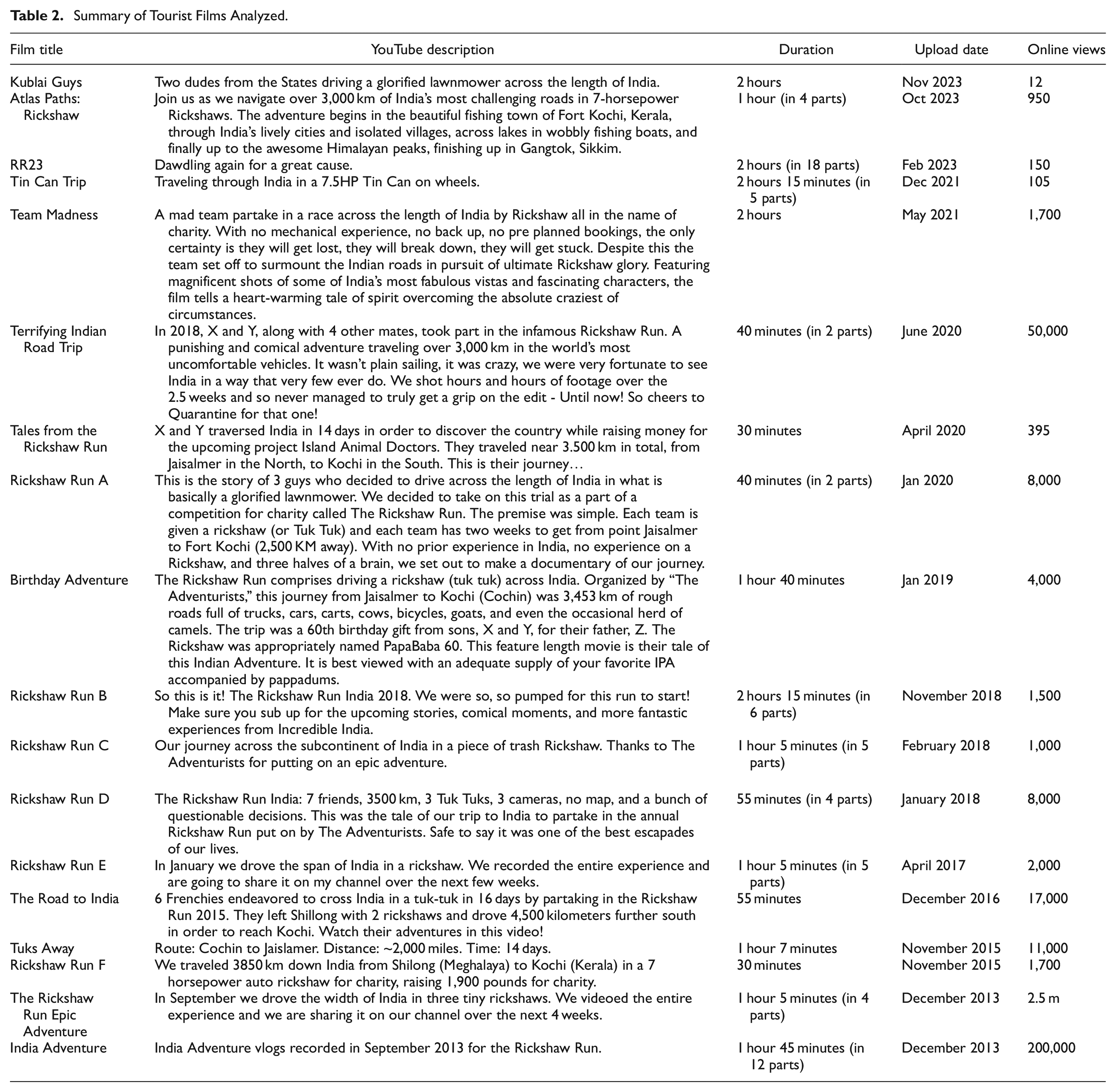
Research originated somewhat serendipitously as one film was being promoted through local news media during early 2021. Interest was piqued, and this film was viewed upon its digital release via the YouTube video sharing platform. Following initial analysis of this first film it was decided to look for comparable others. Similar films associated with the Rickshaw Run were identified via keyword searches in YouTube and snowball linking from one content creator to another via recommended similar videos. Focusing on this event provided parameters for data collection and ensured sample cohesiveness. Prior research has looked to adventure tourism to consider tourist authentication; their playing with reality (Kane & Tucker, 2004), and producing-selling authentic identity via associated blogs (Kane, 2012). The Rickshaw Run was considered to be a similarly interesting experience falling within this tourism niche. In total, 18 films were reviewed between February 2021 and November 2023 (see Table 2). Belk (2011) notes that with online materials it may be necessary to sample rather than try to be exhaustive, and intention was to identify and explore interesting examples rather than systematically search for and collate these, while Decrop (2004) suggests that with interpretive research the focus is not on quantity of information gathered but rather its quality and richness.
Summary of Tourist Films Analyzed.
Essentially documentary style travelogues capturing and recalling the experiences of their tourist protagonists, films foreground the travel self; something that might be expected of professional influencers (and non-professionals inspired by) given the parasocial interactions that occur between travel vloggers and their viewers and how the travel destination is often secondary to the vlogger (Xu et al., 2021). Film souvenirs are assembled from videos and photographs collected while traveling and then uploaded to social media. Requiring significant investment, the act of editing, and uploading an extended length film to YouTube is distinct to that of placing an object within the home or uploading an image to social media. Overarching narrative structures, extended running times, and stylistic devices such as opening titles, suggest a cinematic consciousness in films’ craft that distinguish from other forms of tourist generated videos (i.e., Tussyadiah & Fesenmaier, 2009) or tourist blogs (i.e., Xu et al., 2021), as well as from previously reviewed social media souvenirs (i.e., Boley et al., 2013; Kuhn, 2020). Nonetheless, tourist films are similarly considered souvenirs in the sense of these being wares associated with and reminders of travel experience (Swanson & Timothy, 2012), as well as expressions of self and individuality (Decrop & Masset, 2014).
All of the films reviewed were at least 30 minutes duration, often broken into separate uploads, but nonetheless framed as an overall film. Many shorter digital films associated with the Rickshaw Run were also reviewed. These helped to build a broader sense of this particular tourism experience, those who participate, and the meanings, motivations, and imaginings that might be associated with. Primary focus, however, was longer films, which came to be seen as both a distinctive and an extreme form of tourist digital upload. As such, these films are not considered representative of tourists overall, or even those participating in the Rickshaw Run specifically. Rather, they are presumed to offer a niche form of tourist videographic souvenir offering considerable self-expressive potential for those minded to create and upload. Commonalities observed between longer and shorter video uploads, as well as with tourist’s social media, suggests the issues of authentication able to be explored at length thanks to these extended films, might also percolate more subtly elsewhere.
Analyzing Tourist Film Souvenirs
Adding up to around 19 hours of footage, the 18 films identified offered a breadth and depth of material to watch and re-watch. To interrogate films research drew on literary and visual analysis methods to qualitatively describe, interpret, and examine. These approaches broadly assume that theoretical development can arise from analytical reading of literary texts (Molesworth & Grigore, 2019) in a subjective and interpretive manner (Stern, 1990). Thus, Canavan (2019) develops understanding of tourism-mediated existential authenticity through reading historical novellas featuring travel. Visual methods, meanwhile, are a similarly interpretive approach to analyzing visual rhetoric, referring to a representational system that produces meaning (Borgerson & Schroeder, 2002), and constructs reality as part of the experience (Campelo et al., 2011). Illustrating, Schroeder and Borgerson (2015) analyze visual communication materials of consumer representation, including how people and places are represented, who is represented and who is not, how they are portrayed, and how their interactions are portrayed.
The films reviewed ranged in terms of their upload date, overall length, and number of online views. The oldest that could be found dated to 2013 (the Rickshaw Run first took place in 2006), while the most recent at the time of research was uploaded October 2023. Where available, associated data, such as further videos on uploaders’ profiles, linked social media, YouTube descriptions, and viewer comments, were reviewed. This helped to gain some sense of the background to film uploads and their reception by online audiences. Reactions to films vary widely from c.6,000 comments and c.2.5 million views relating to “Epic Adventure,” to 10 films that each received less than 10 comments. Some films appear to have been produced by professional vloggers, as judged by their online profiles, subscriber numbers, and video views. Others seem to be shared by amateurs. However, other than differences in quality of presentation, such as camera definition or editing techniques, there appeared to be little variation across films in terms of their narrative structures, focus, or tone. Baker et al. (2006) note that souvenirs offer means of conforming to group norms, and it is expected that films’ similarities might both reflect and reinforce event norms.
Subsequently, interpretive thematic analysis was used to review the literary (narratives, conversations, comments) and the visual (images, cinematography) aspects of films. Walters (2016) advocates this approach may be appropriate and valuable in tourism research, where narratives and visual text form the empirical material for interpretation and unpacking the latent cultural meanings in the material is important. Analysis followed Walters’ phased approach to thematic analysis, as well as Braun and Clarke’s (2006) similarly developmental six stages for qualitative data analysis: familiarization, initial interpretation, identification of initial themes, review of thematic categories, definition and naming of emergent themes, and creation of the analytical narrative. Condensed over time from notes made and materials collected around viewing films three themes emerged. Film production related to the craft of films, including the planning and execution of filming, and the building of narratives. Film performances related to the contents of films, with these chiefly being screen representations of protagonists. Film publicity related to films’ consciousness of audiences during filming and distribution.
A number of measures were taken to ensure research quality. Open and detailed description of the study context and the influence of serendipity in identifying this is shared (as per Anastasiadou & Vettese, 2021). In combining theoretical perspectives from authenticity and post-postmodernism, research sought an interdisciplinary triangulation (Decrop, 2004). By drawing on numerous data sources, (films, comments, social media profiles, as well as the on-going multi-year netnography that extended beyond this sub-project), we were able to safeguard the reliability and trustworthiness of our emergent findings (Higgins & Hamilton, 2020). Credibility of data analysis was gained through such triangulation, as well as the prolonged engagement and persistent observation (as per Curtin & Fossey, 2007), which came from reviewing new films and incorporating these into the data analysis over nearly 3 years. As noted by Berbekova et al. (2021), thematic analysis is recursive, flexible, and adaptable, and themes evolved over time as materials were collated, and with new sources identified, in an on-going process. These themes are outlined in the following with screenshots taken from films used to illustrate. Conscious that notions of social media as public space are challenged by acknowledging the ways users utilize platforms for such things as creating, augmenting, and storing memories, as well as communicating with the world (Jeffrey et al., 2022), these screenshots have been edited to pixelate faces. Doing so alongside paraphrasing film’s digital titles and descriptions helps to anonymize the work of film creators and those persons featured therein.
Research Findings
Tourist Film Production
A first theme to arise from watching films related to the production of these artifacts; the methods and materials used in their craft, as well as the format and structure of their narratives. Films examined demonstrate considerable investment in putting together. Varying levels of photographic and editing skill, narrative consistency, and completeness, could be found. All the films reviewed were assembled from group recorded GoPro and phone camera footage, with still photographs often woven throughout. In most cases added captions, maps, and graphics of varying sophistication are used to illustrate routes taken. Musical accompaniment and voiceovers are edited into various films. Professional services such as stock footage and editing assistance are referred to in the end credits and digital descriptions of several films. Stylistically, films all follow similar tropes. Mirroring the marketing literature of the Adventurists, much is made of rickshaws as glorified lawnmowers, roads to be traveled as dangerous, and the endeavor as eccentric. All films adopt a documentary travelogue approach with a cheerfully adventurous tone and narrative arcs following the Rickshaw Run. Preparation for the rally, arriving at the communal start point, and celebrating the finish line are prominent motifs. Narratives are repetitive both within and between films. Protagonists get up early, drive rickshaws, proceed to get too hot or cold. Rickshaws are unreliable and need to be fixed by the roadside. Roads are difficult to navigate, as is finding accommodation and other services.
Similarly consistent emphasis is on presenting protagonists. Team sizes vary between 1 and 3 rickshaws. All the tourists captured on film appear to be white, usually in their 20s or 30s, and mostly male. Where female tourists are part of teams, they tend to receive less screen or speaking time. In each film team members are introduced at the outset with quick summaries of their roles and personal qualities that are then reiterated throughout. In the case of Team Madness for example, self-introductions are “unwavering leadership,” “faultless navigation,” “a light in the darkness,” “grace under pressure,” “guidance and counsel,” and “a touch of stupidity.” Self-descriptions of tourists are as zany, colorful, naïve characters enthusiastically fumbling their way through the event. A deeper sense of contestants’ thoughts, backgrounds, personalities, and so forth, is absent in all the films. These depict simple motifs around individual and team characteristics, camaraderie, and commentary on in-the-moment or recalled experiences. Travel motivation for example, is never explored in any more depth than short descriptions about celebrating a significant birthday or raising money for charity (as is required by the organizers). Generally, films mention other rally teams little. Fleeting encounters occur around mutual gazing at rally checkpoints or shared roadside assistance.
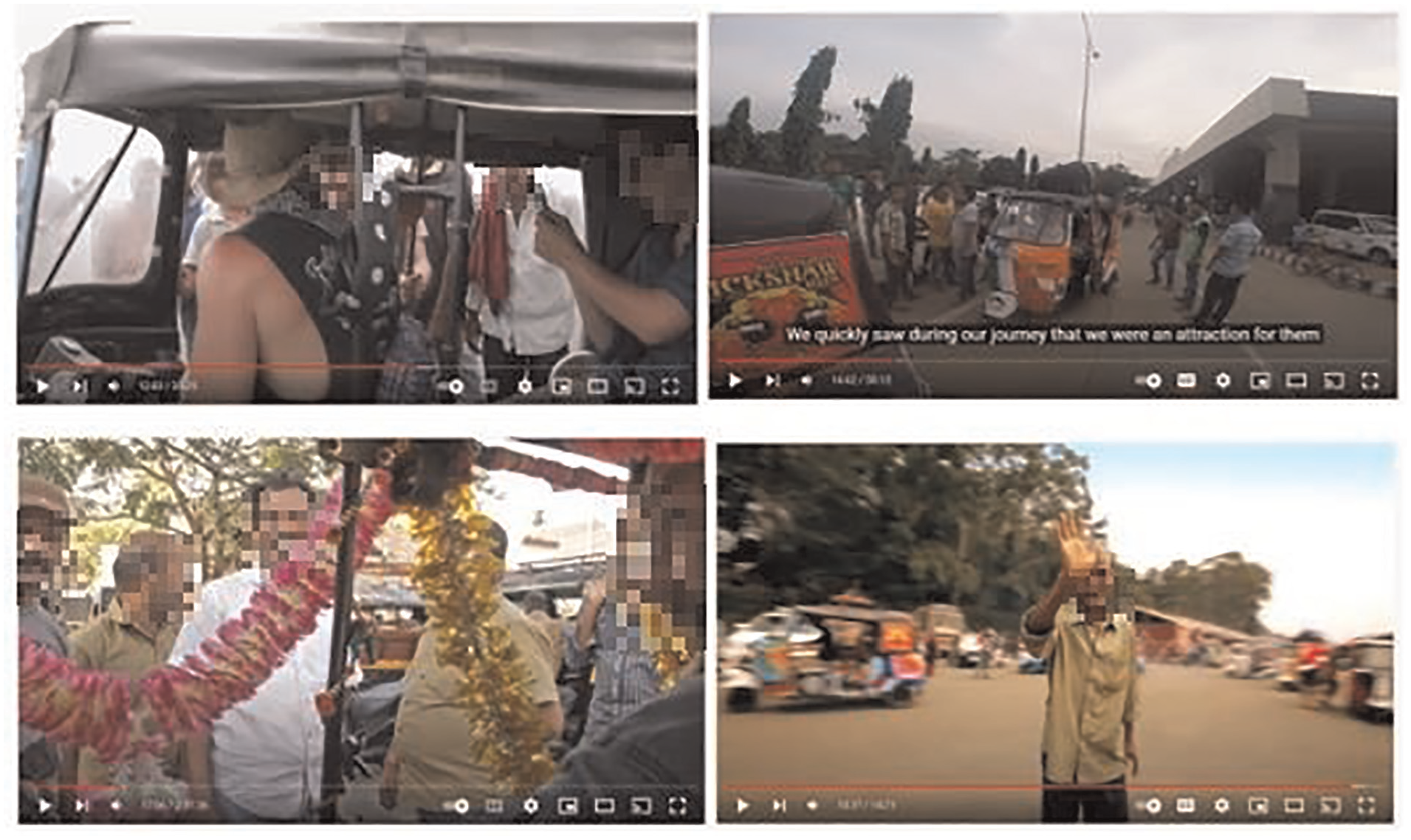
Maintaining the focus on protagonists most of the filming comprises three camera angles; phones in selfie mode looking at the individual holding or turned toward fellow travelers, and GoPro hung from the rear-view mirror recording rickshaw occupants (see Image 1). Epic Adventure for example, begins with an explanation of the intention for all members to document everything via point and shoot camera for the duration of the trip. Most of the subsequent film consists of teammates point and shooting at themselves or each other as they describe themselves and each other in their surroundings. The viewer is therefore largely confined to tourist groups and their rickshaws, watching travelers’ responses to situations they cannot see. Much of the time these reactions are not to external surroundings but to each other. Extensive footage is of team members talking, sleeping, waving at each other, describing their feelings, articulating their character traits, complaining.
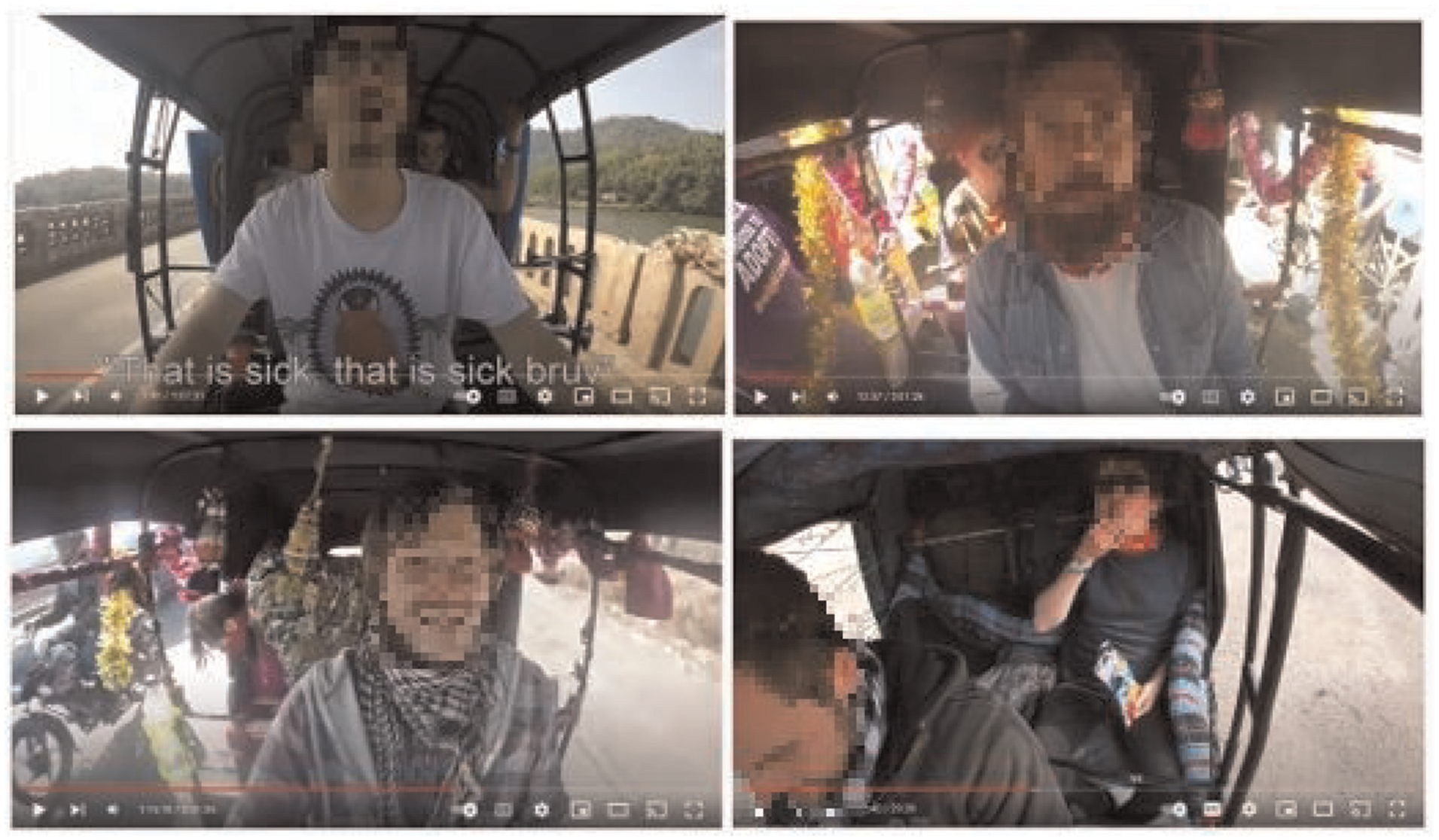
Rear-view mirror camera.
Especially emblematic of this self-centric cinematography, selfie-sticks are used at times for filming (see Image 2). These add slight physical distance between camera and subject, but the subject remains the same. Team Madness describing to camera that they are going to capture a view of the chaotic road, for example, proceed to extend and hold the selfie-stick out of the rickshaw, still facing inward. We can see slightly more of the road, and at one point onto their teammate’s rickshaw driving alongside, but not much of the context beyond as the camera remains trained on the gurning operator. Other films do the same. Elsewhere, cameras are set up at the roadside to record shots of teams driving toward. Tourists lean out of one vehicle to record teammates in another. Angles, equipment, set-up, and lens distance vary therefore, but cameras are invariably almost always looking toward tourists.
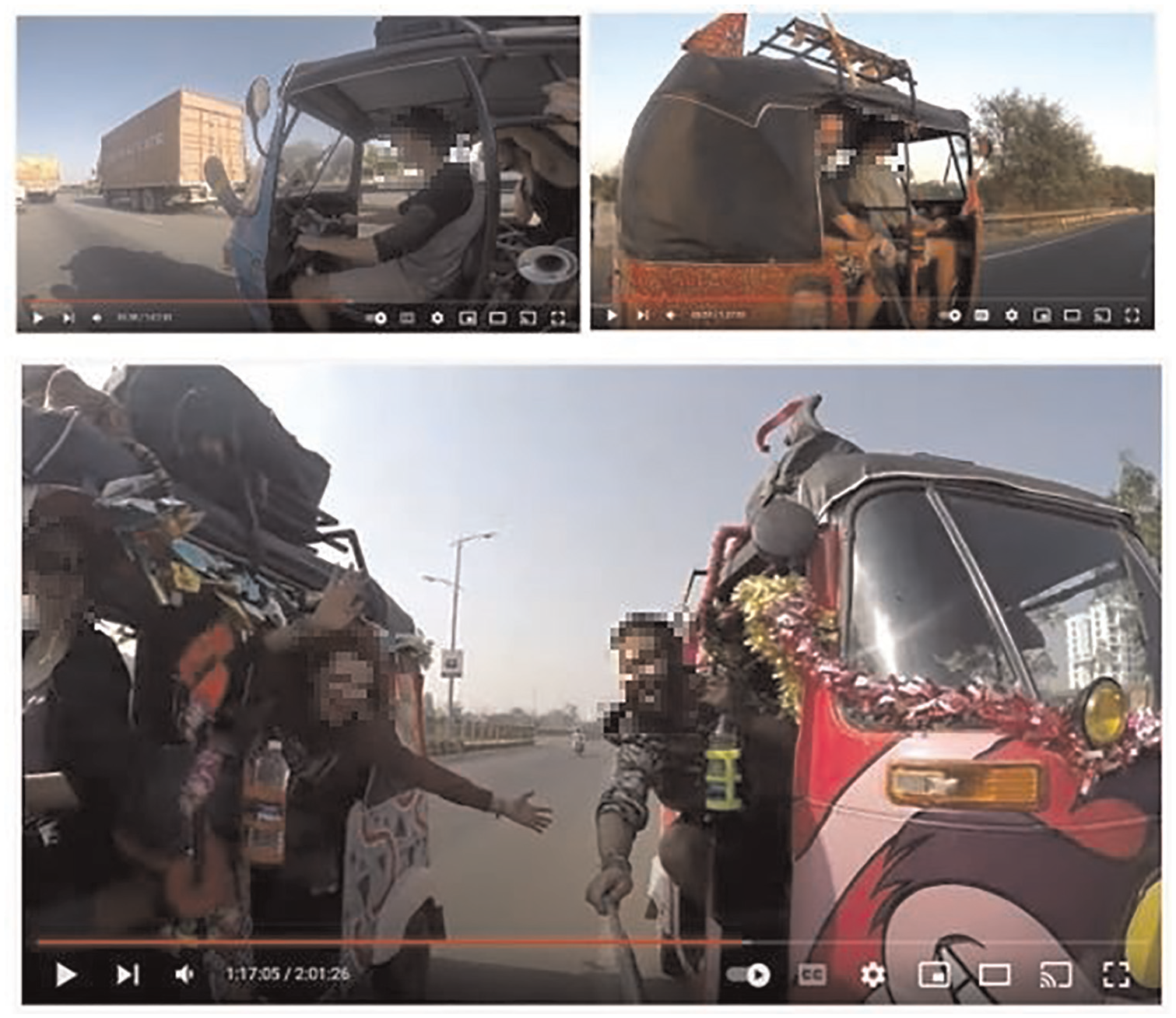
Selfie stick camera.
Tourist Film Performances
Rather than the toured surroundings, or the tourism event itself, therefore, it is tourists’ roles on and reactions to the road that are represented across all films. Thus, a second research theme formed around the consumers depicted on screen. Films are effectively extended and elaborate selfies in their resolute focus on consumer protagonists. This filmic navel-gazing provided ample material from which to observe consumers in the act of travel. Extensive narrative documentation across films is of tourists describing themselves and each other. Then presenting these self-descriptions through visual elements, such as the outré clothing worn (see Image 3) or colorfully designed and accessorized rickshaws driven (see Image 4). Screen presentations of tourists as variations on adventurous, eccentric, and naïve, are emphasized through infusions of humor and drama. Films consistently highlight teams breaking down and getting lost, or elaborate supposed dangers faced on the road. Team Madness for instance, dramatizes what they describe as their getting attacked by rabid monkeys and wild dogs, neither of which are really the case judging from the mild scenes depicting interactions with local wildlife referred to.
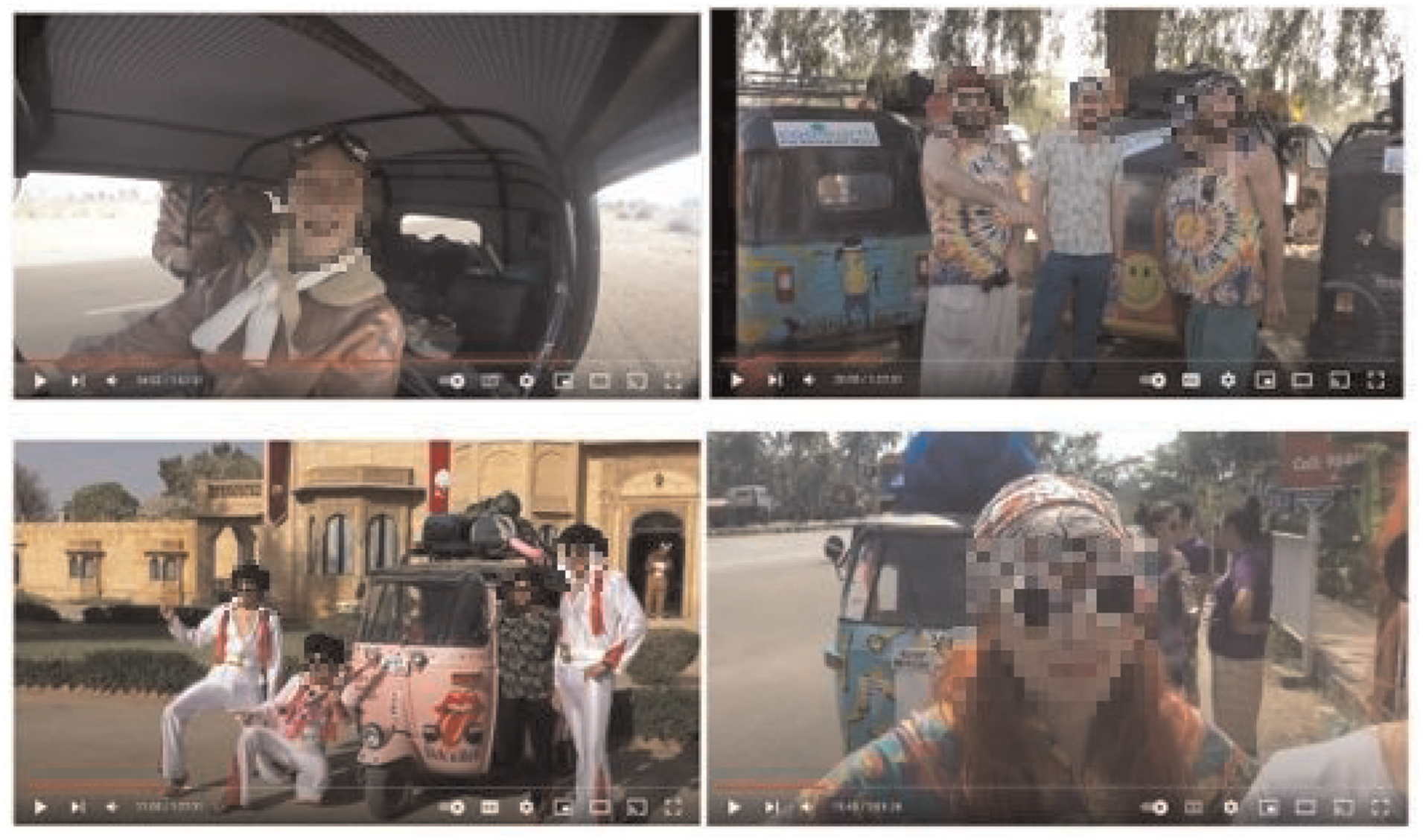
Tourist outfits.
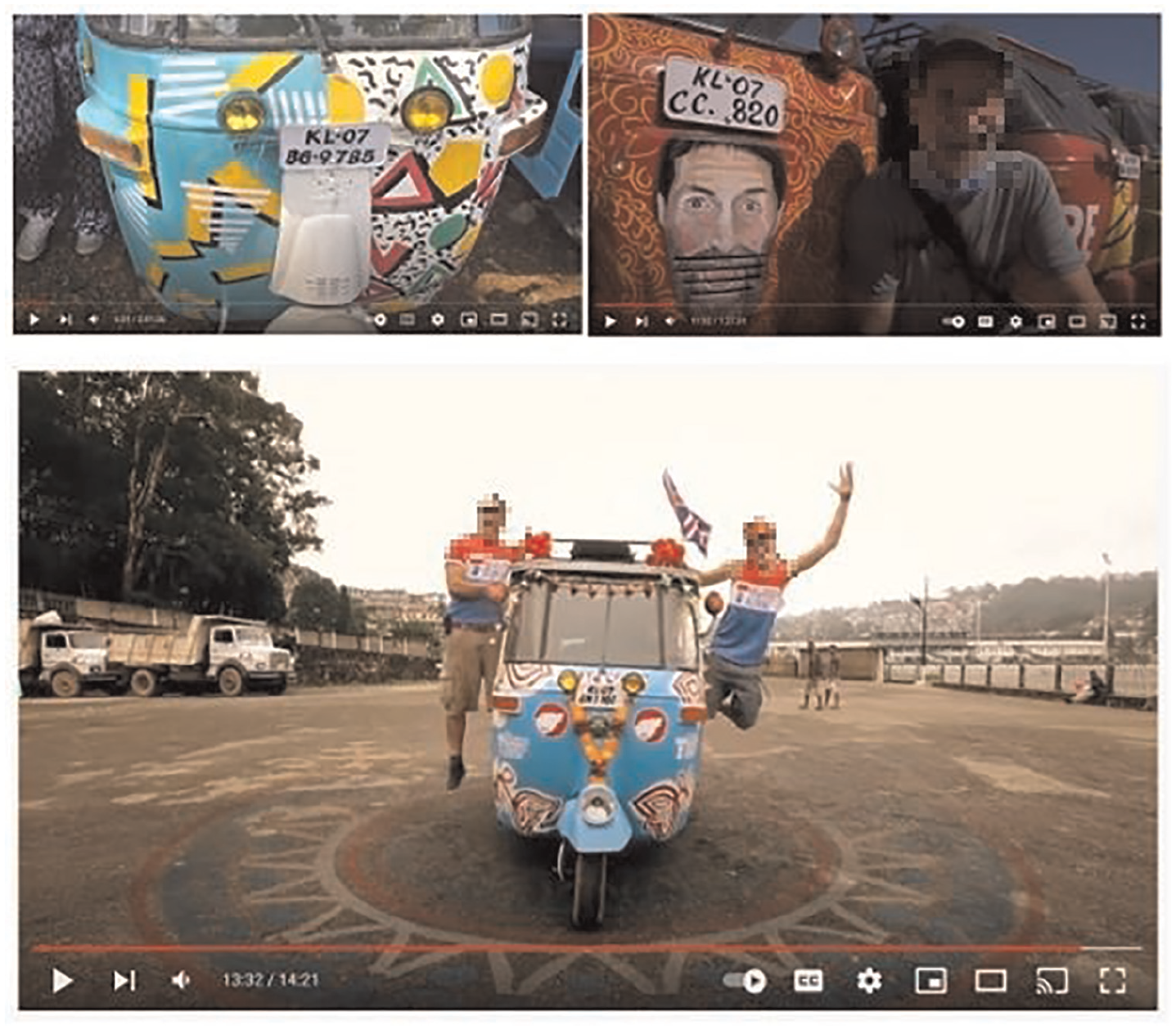
Rickshaw décor.
Consumer surroundings tend to be a stimulus or backdrop for such self-presentations. Local cuisine for instance, features in almost all films in scenes where this is surprisingly tasty or disgusting, referred to and depicted on screen when it triggers reactions from consumers, such as pleasure, or diarrhea. Similarly, instances where local landscapes fail to facilitate consumers are depicted. Often this is taken with good humor, as when roads gridlock, or local people provide counterproductive assistance. However, tourists also react to inconveniences by disparaging their setting. Public toilets are presented with mugged horror. Accommodation quality is joked about. Team hygiene suffers as local facilities are unable to provide a required standard. One team recording getting lost in a village briefly scan with the camera before the narrator summarizes laughing as a “shithole needing demolishing.” Meanwhile, local people are filmed when they appear visually interesting (see Image 5). Those passed on the highway riding unusual or heavily laden vehicles is a repeat motif across films, as are those going about work with rudimentary tools or sat outside primitive buildings. These are interesting scenes. However, shared publicly and with little to no contextualizing information provided, such contents are somewhat voyeuristic.
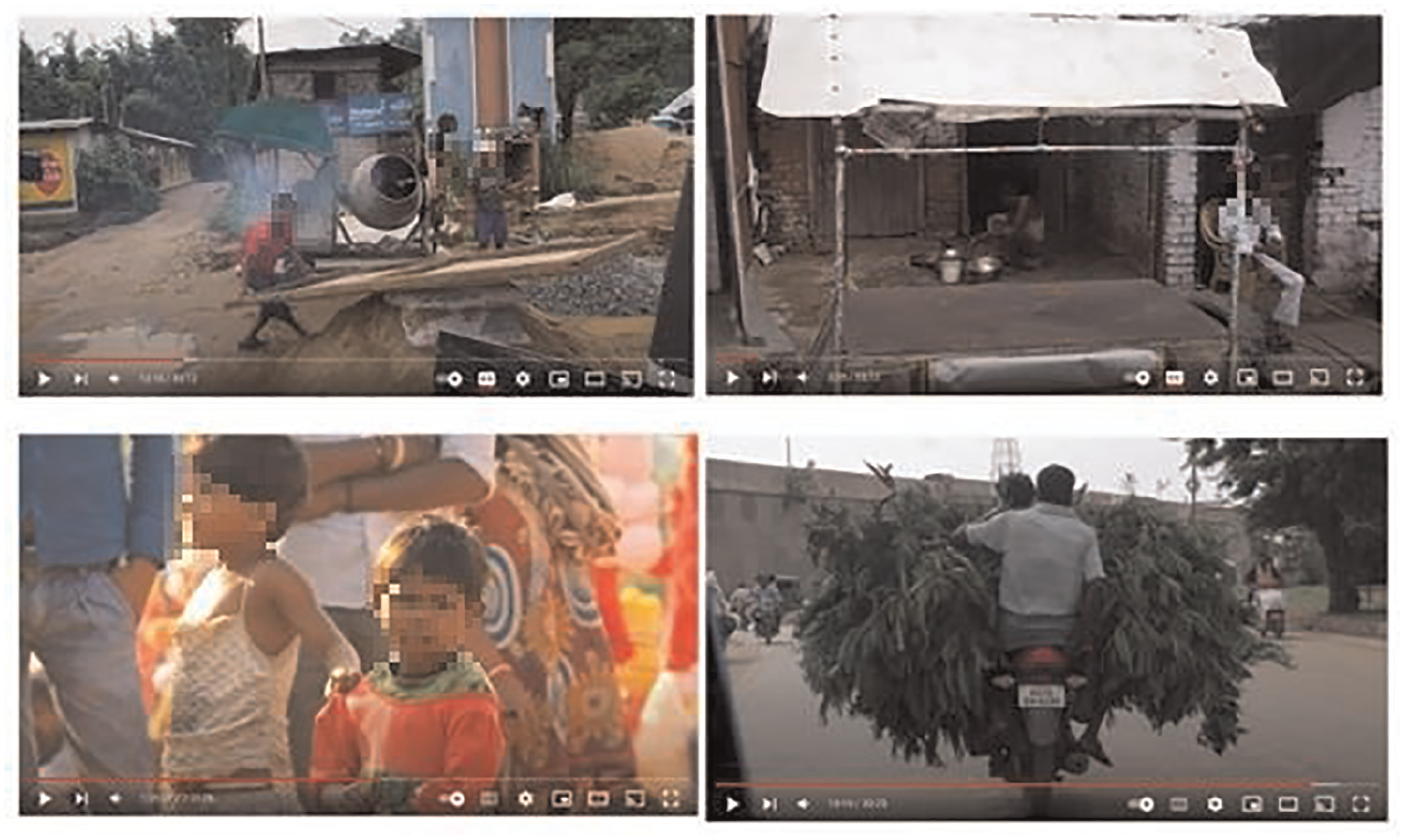
Local people.
Limited and sometimes insensitive contextualization of travel surroundings is nonetheless noteworthy because of their almost total absence elsewhere in films. External surroundings are frequently found only in the corners of frames otherwise centered on tourists. They serve largely as mere backdrops to consumers. A scene in Team Madness for example, follows tourists excitedly driving through what they breathlessly tell the viewer is an abandoned military facility at night. However, the viewer sees little of these surroundings because they are largely shrouded in darkness, glimpsed beyond the protagonists bathed in light from mobile phones. Although the abandoned facility is crucial to setting a dramatic tone trailed at the outset of the film, focus for the scene is on the faces of the tourists reacting with excitement to surroundings that remain shadowed for and unknown to the viewer.
To a large extent toured surroundings are relegated even from this performance-supporting role. Tourists narrating or reacting to external happenings frequently takes up the entire screen. In a dramatic high point of Team Madness, a crash occurs. The cameras join immediately after the event. One zooms briefly in on a bleeding member of the group being comforted at the side of the road, before switching to selfie mode to capture a different teammate describing and reacting to the event. The crash itself is barely registered. We fleetingly see a rickshaw on its side. Another, whether involved or bystander, appears to be driving away. The actual circumstances remain unclear and seem ultimately to be inconsequential. In the next scene the group is back to touring as usual.
Tourist Film Publicity
A final theme to emerge from analysis related to publicity; the attention sought and celebrated by tourists, and the various sources and techniques used to gain. Making and sharing film souvenirs implies a desire among protagonists to be centered in a media format that can be consumed by others. That all films are freely available via YouTube suggests an intention to be viewed by publics and a taking advantage of internet enabled visibility. If film souvenirs solicit attention upon tourists post-travel, meanwhile, by finding new imagined audiences to look upon themselves, then during travel the choices and actions of tourists helps them to stand out before local bystanders. Colorful clothing, regularly needing assistance, the incongruity of driving primitive vehicles that are themselves brightly decorated; the Rickshaw Run allows for exaggerated self-presentations and unexpected cultural contrasts that heighten the visibility and novelty of those taking part. Rickshaws are used as a stage on which to become a spectacle. Incongruous when driven by tourists, especially so when elaborately decorated to order by, and unreliable, hence requiring regular roadside assistance, these vehicles are ideal for soliciting engagement from passers-by.
Recalling attention received on the road is a recurrent motif of all films. Significant screen time is given to depicting local people reacting to (see Image 6) or posing with (see Image 7) tourists. Children excited to observe and interact with travelers is a recurrent image, as is groups of men clustering around curiously while teams are paused at the roadside. Customer service providers including mechanics, hoteliers, shopkeepers, are frequently shown helping rickshaw teams. Police officers are depicted interacting with travelers. Compounding this sense of being paid attention, local press coverage of teams is recounted in Birthday Adventure and Team Madness (see Image 8). In these films tourists read out and react to their appearances in print.
Attention on the road.
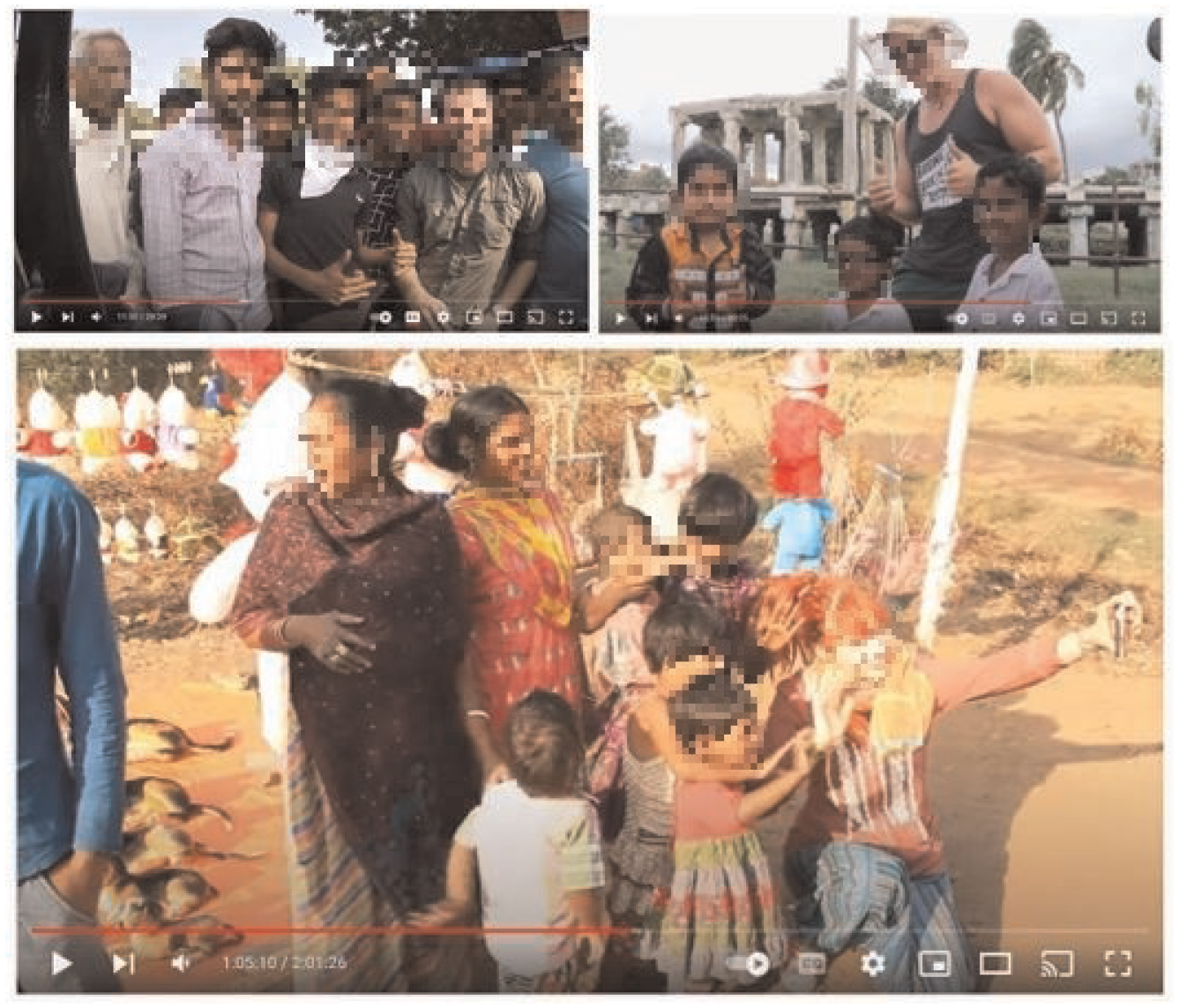
Posing with local people.
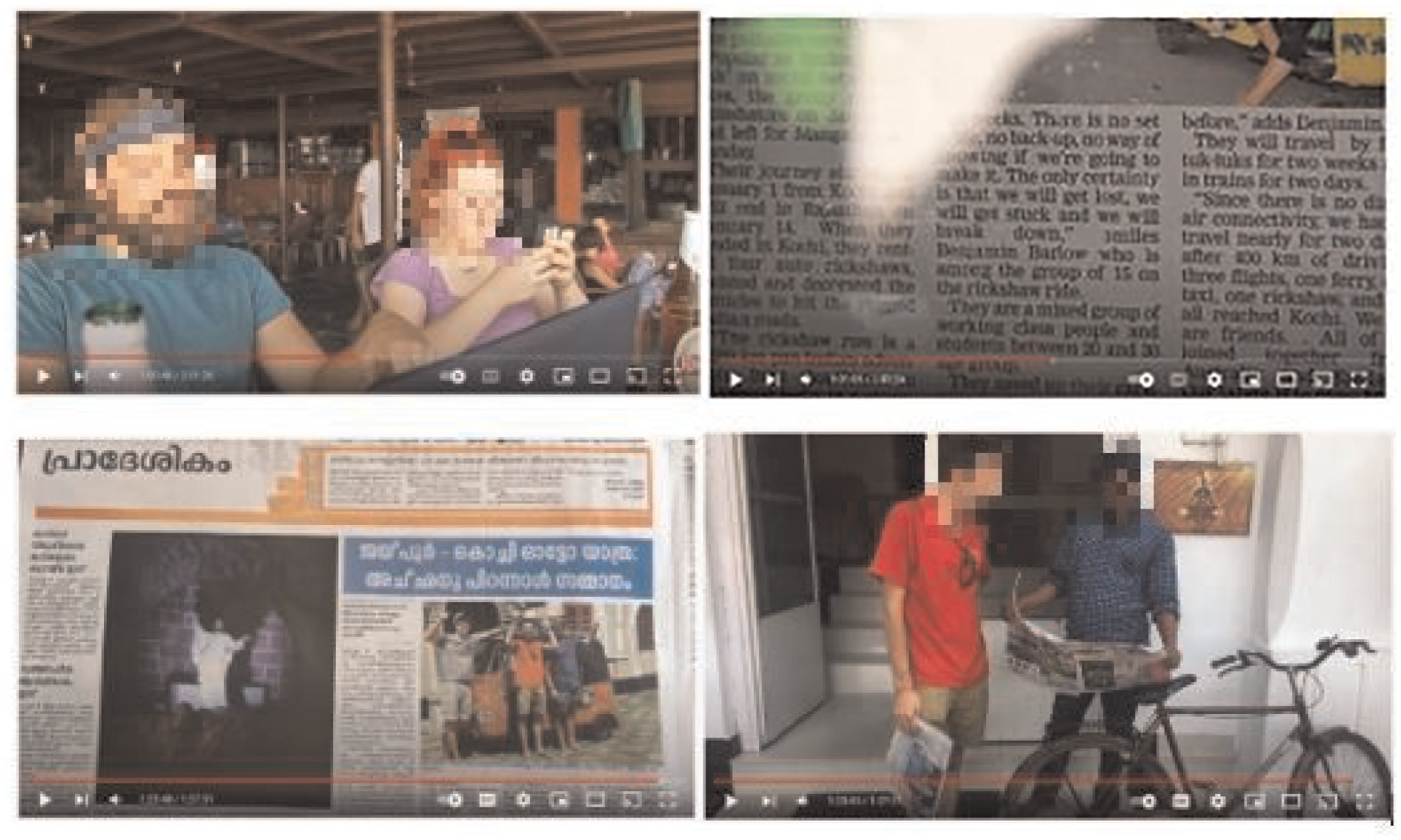
Local press coverage.
Nonetheless, the attention received appears to be more nuanced than screen portrayals typically establish. Occasional glimpses are of tourists setting up photographs with locals, of beggar children following, of unsolicited passengers joining, or of local people taking selfies of themselves with tourists as backdrop. Hints are of tourist impatience with some of these interactions, where tourist is exploited for their financial or entertainment value by local people. Nervousness is parlayed into humor in several incidences of being followed or rickshaws intruded upon by unknown locals. These aspects of encounters, or the alternative explanations of attention received they might provide, are not explored. Films simplistically capture and share attention received, with local people depicted curiously and enthusiastically looking upon tourists.
A further source of attention upon tourists are the tourists themselves. Significant screen time is dedicated to representing group members filming, describing, and praising each other. In a scene toward the end of Team Madness, participants give each other awards. These jokey announcements of made-up titles reiterate the essence of team members as they see themselves and each other. At the finishing line most films are similarly self-congratulatory. Team members shower each other in champagne, pose for collective photographs, and act out their excitement. They create and capture an atmosphere of mutual appreciation, with consumers animating for themselves and each other a sense of achievement. Finally, research noted that tourist films allow consumer desires to be looked at, reacted to, and thought of as special, to remain open-ended. Where tours and the attention gained during these come to an end, then films and the views they might solicit live online long-term. Even those films which gain few views perhaps maintain the possibility that they might go viral and bring mass attention in future. Further adventures are also trailed at the end of several films. Film as souvenir is thus a way to record past attention received in the act of travel, to revisit, reclaim, and further solicit this in the present through public sharing, and even to look forward to it in future. Supported is an open-ended self-conceptualization as a special tourist, be that as a light in the darkness or as a touch of stupidity.
Summary of Findings
Accordingly, tourist film souvenirs reiterate the way in which tourists make use of souvenirs to self-present in a positive way (as per Kuhn, 2020), and to convey self-identity meanings to their broader existence (Decrop & Masset, 2014). However, these travel artefacts are especially sophisticated in their presenting and communicating of desired meanings. Film contents focus on and reiterate tourist identity claims. Protagonists act these out for the self-directed cameras. Audiences are involved to legitimize tourists’ fantasies. For Healy and Beverland (2013), authenticating acts and authoritative performances represent creative strategies by which consumers come to terms with their identity and then draw on that power to reconnect with the world. In this case, the authenticating act of filmmaking, and authoritative performances structured through this, represent creative strategies by which prosumers embellish their identities and then reconnect with a fantasy world. As such, film souvenirs help to understand post-postmodern authentication as involving a reconstructive emphasis, as well as elaborating how this may manifest in and through tourism consumption.
In terms of their production, tourist film souvenirs are themselves reconstructions, made up of clips and images gathered on the road and woven together with varying levels of skill. Screen presentations depict and display travelers and travel in a certain way. Simplistic motifs within and across films are of adventurous and eccentric tourists. In-group bonding and outsider attention are repeatedly shown. Narratives follow the arc of the Rickshaw Run, with recurrent in-the-moment mini-crises typifying journeys. Somewhat chaotic toured surroundings structure these assemblages. Derivative in style and contents, films follow themes and adopt tools established by peers, albeit applying and embellishing to own purposes. These imitative and superficial stylistic traits may support reconstructions by following tried-and-tested themes (see Canavan, 2021). They might also point toward a motivation for reconstructing. Love and Kohn (2001) find the narrowness of the emotional spectrum souvenirs represent, their lack of imagination, and the wan desires they struggle to express, betray agonies of everyday life, which these artifacts can help to reimagine, rework, and retell.
Regards performances, filmmaking enables travelers to inhabit desired noteworthy roles with and before others. Recorded mainly in selfie mode, cameras focused on tourists reacting to their surroundings, not the surroundings themselves, films’ emphasis is on protagonists. As Edensor (2001, p. 74) notes, certain tourist performances are intended to draw attention to the self, thus, “tourism becomes a vehicle for transmitting identity, by undertaking a particular form of travel, in a particular style.” Relatedly, it has been recognized that online identities allow consumers to craft their bodily and sociocultural identity to their own and society’s liking (Biraghi et al., 2021). Similarly, film souvenirs that draw in part on social media, allow protagonists to craft idealized and sought self-imaginings as adventurous travelers. The self-centric and uncritical nature of films infers a hot authentication that is emotionally loaded and based on belief, instead of proof, rendering it more resistant to external criticism (E. Cohen & Cohen, 2012), and as such conducive to the reconstructions therein.
Going beyond this structuring of performativity, film souvenirs additionally collect evidence of the attention received for performances, and in doing so further reiterate the fantasies of those assembling. Making films publicly available via YouTube invites broader audiences to similarly view tourists. Effectively, films act as a publicity device. Arvidsson and Caliandro (2016) note that as the digital photographic dimension has become integral to many areas of consumer practice, this has created a publicity-oriented consumer culture, aligned around appearance and visibility, and involving documentation of the self for the consumption of others. Authenticity is a claim made for something that is accepted by relevant others or not (Peterson, 2005). Films not only make claims around tourists as extraordinary, but also show these as being accepted by various relevant audiences. Again, hot authentication, involving performances and public practices to perpetuate and confirm the sacredness, sublimity, or genuineness of sites, objects, or events (E. Cohen & Cohen, 2012), is recalled in this use of film souvenirs, which not only amplify performances, but also invoke audiences for these.
Discussion
Post-postmodern Authentication
Both familiar in their recording, revisiting, and reinforcing of tourism experiences, and distinctive in their reconstructive emphases around these, tourist film souvenirs represent new media for old practices at the same time as they precipitate new practices (Belk, 2015). Films remain within an established souvenir tradition of collecting, combining, and sharing multiple travel artifacts that function to fulfill various identity construction meanings (Masset & Decrop, 2016). Yet the reconstructive possibilities of digital technologies and social media, synthesized in the film souvenirs analyzed, are particularly sophisticated. Based on prosumption, which assumes a more participatory, creative, fluid, and social view of production-consumption (Cova et al., 2007), filmmaking allows for elaborate and overlapping tourist productions, performances, and publicities to be structured. Complementing Prince’s (2021) theorization of authenticity in relation to ancestral tourism as involving performance that fuses actors, memories, objects, myths, and elements of the landscape into a coherent, meaningful, and desirable story of the self, tourist films support, curate, and share performances of protagonists. These synthesize tourist memories and group dynamics, travel experiences and toured backgrounds, into mythologizing stories around travelers, and also implicate audiences within these, amplifying desired meanings in the process. Effectively, where the perception of authenticity comprises a constant negotiation between the elements of the experience and the actors involved in it (de Andrade-Matos et al., 2022), film souvenirs enhance and extend the negotiating opportunities for actors involved, to frame and disseminate their travel experiences, as desired.
In the films reviewed this authenticity negotiation process is focused on tourist protagonists. Film souvenirs complement an emphasis on performative self-presentations noted in contemporary consumer culture. Limkangvanmongkol (2015) recognizes for example, that in the post-postmodern era communication technologies come into play for processes of self-formation through the performative presentations of online personas. Meanwhile, for Arvidsson and Caliandro (2016, p. 744), “as consumer practices are mediated through the technological nexus of social media and camera enabled smartphones, they tend to become further oriented toward visibility and self-presentation.” Consistently presented on screen as colorful characters who receive plentiful attention as such from local inhabitants, filmmaking supports associated travel performances. Protagonists act out eccentric adventurer roles they see themselves as and aspire to be, for cameras they themselves are directing. Roadside and online audiences are depicted gazing upon the tourists at the center of these films, affirming their fantasies of being noteworthy in doing so. Post-travel, meanwhile, film making reassembles and reiterates self-constructions, before soliciting further external attention upon. In this way film souvenirs assist tourists in their self-imagining and in bringing these fantasies into reality. Elsewhere, Love and Kohn (2001) elaborate that souvenirs can serve as touchstones for performances in which an imagined or appropriated other joins with the self. Meanwhile, Kane (2012) identifies how mountaineers use blogs to produce and sell mythical identities. Films are a similar but expansive format for such tourist playing, claiming, and mythologizing around authenticity.
As such, tourist film souvenirs serve as mythomoteur, described by Andéhn and L’Espoir Decosta (2021) as an evoking of specific contingent meaning through association with meaning-laden mythologies, where the creation of place turns on ability to effectively enact and embody mythology. Here, this creation process is focused on tourists, who enact and embody mythical personas, and associate with sought meanings, via their travel filmmaking. A post-postmodern authentication process is hereby identified in the infusions of imagination into tourist reconstructions. This complements Wong et al’s. (2023) identifying of tourists’ affinity for fairytale fantasy-like experience through alterreal simulacra that can elevate their sensual and emotional needs. Likewise, Derbaix and Gombault’s (2016) description of how imagination creates an authentic experience, as material and immaterial elements facilitate consumers’ imagination through immersion, embodiment, and narrative transportation. Adding to previous theorization of authentication as responding to tourist imagination, as anticipated imagery is evoked on behalf of and validated for tourists, who perceive a destination as more real as a result (Stanley & Wight, 2023), this study notes that anticipated imagery can be evoked by tourists, who can use to be perceived as preferred real (see also Canavan, 2021) as a result. Characteristics of post-postmodernism, including the investment in singular myths, realities, and narratives (Podoshen, 2014), and significance of consumer reconstructions that involve an element of faith made possible by the existence of a collective (Cantone et al., 2020), resonate with this authentication ethos of fantasy as reality. Indeed, the collectively amplified (Thomas et al., 2018), heightening of belief (Cohen-Aharoni, 2017), or suspension of disbelief (Lovell & Thurgill, 2021), previously associated with hot authentication (E. Cohen & Cohen, 2012), might be considered post-postmodern, whereby sensations of experiential-existential authenticity are augmented via imaginative-performative processes.
Contributing to theoretical development, therefore, post-postmodern reconstructive authentication points toward reconfigured arrangements of authenticity fantasies (Knudsen et al., 2016) and negotiation strategies for maintaining these (Canavan & McCamley, 2021). Prior recognition that authenticity perceived by tourists can incorporate both factual and fictional aspects (Li et al., 2021), is expanded upon by illustrating how authenticity projected by tourists can use souvenirs as tool for reconstructively engaging this duality. Hereby, fantasies are made real through structural devices, such as film souvenir making and sharing, that facilitate immersion within and assertion of these. Fantasies are moreover expansive beyond the travel moment. Overlapping with Brooks and Soulard (2022), who identify social media as extending the temporal length of a festival beyond the event itself, film souvenirs exist in online environments, disseminating desired messages out to audiences, and reflecting sought images back onto protagonists, long after the tourism experience itself has ended. Hence, complementing Skandalis et al’s. (2024) conclusion that authenticity is achieved by embracing features of the everyday, as well as temporarily escaping from (i.e., Kim & Jamal, 2007), findings suggest that authenticity can also be achieved through making the everyday extraordinary. Travel serves as a means to roleplay, collect materials, and claim attention, that can then be useful part of consumers’ broader and on-going authentication projects. By drawing on productions, performances, and publicities that assemble as such, relatively mundane tourism experiences and personas are reimagined as extraordinary, with these reconstructions then reflecting back on and similarly infusing tourist’s everyday life.
Practitioner Implications of Post-postmodern Authentication
Alongside extending authentication theory, by recognizing the infusions of fantasy that can rework everyday tourists and their experiences as extraordinary, this study raises a number of interesting insights for tourism practitioners. Moore et al. (2021) summarize that the tourist experiences place as authentic, because of the discovery of new ways of interacting with the place, and experiences themselves, as a result, acting authentically, more fully. Post-postmodern authentication is more about experiencing the imagined self, as acted out in place. The self-directed nature of the authentication observed in tourist films suggest an alternative approach tourists might take to embed themselves beyond the activities of being a tourist, to that outlined by Moore et al. (2021). For Lamont (2014), mediatized accounts of travel encounters contribute to preserving and perpetuating associated myths. Here, the myths repeated and extended via mediatization are less attached to toured places, as Lamont observes, and more to touring selves. Hence, where Lugosi (2016) highlights the role of technology in valuing the places, practices, and objects entangled in the production and consumption of tourism, this research adds the technology enabled valuing of tourists to this mix. Relatedly, van Nuenen (2019) suggests that on tourism review platforms such as TripAdvisor, what is authenticated is the informational self as much as the informational place; effectively, the reviewer not just the reviewed. Meanwhile, Salet (2021) suggests that as the search for authenticity is increasingly catered toward individual differentiation, objective authenticity, and existential authenticity become ideals that are deployed to stand out.
Such a shift toward individual and expositive authentication, suggests opportunities for those able to facilitate. Souvenirs and associated experiences that complement authenticity ideals of standing out, and authentication processes whereby standing out is claimed, may prove valuable to likeminded tourists. Kuhn (2020) recognizes that souvenirs require an active and reflective performance to carefully construct the ideal tourist self and develop strategies to communicate this idealized self appropriately to the social environment. Film souvenirs are ideal for this self-construction and communication in that they can be assembled from various digital materials collected in the act of travel, selectively edited, and shared online. Tourism practitioners can look to provide settings and experiences that generate the materials with which tourist filmmakers can work. They might also look to facilitate audiences for tourists wanting to stand out, such as the “obverse panopticon” coined by Kozinets et al. (2004) to refer to a physical structure designed specifically to enable the consumer’s desire to be observed. In addition, films reviewed were notably similar in their contents, suggesting a comforting conformity is valuable to reconstructive authentication. Accordingly, tourism practitioners might consider their role as not only backdrop or audience providers for tourist’s performances, but also guides for the recurrent motifs and common references that shape these, much as the Adventurists experiential travel agency do in relation to the tourists observed via their film souvenirs in this research.
It may be in the latter role that tourism practitioners can address potential concerns to be inferred in the self-centric tourism depicted in film souvenirs. To a critical observer, films, their protagonists, and practices therein, can come across as highly self-indulgent. Noted by Patsiaouras et al. (2016) is that social media prosumption may turn into a narcissistic act, while Taylor (2020) finds narcissism increases the likelihood of social media usage that simultaneously increases narcissism. Overlapping with Cluley and Dunne’s (2012) depiction of the consumer narcissist-fetishist who refuses to know something that they know only all too well, here, it may be that consumers refuse to know that their claims of travel extraordinariness are all too familiar, using film souvenirs to fetichize both toured and touring. Prior research has highlighted problems associated with tourist ego (MacCannell, 2002). Harris and Magrizos (2023), for example, identify that in their quest for authenticity and legitimacy tourists seek mementos that offer enjoyment and benefits to the ego, status, or self-esteem which often accrue from and stimulate deviant behaviors. Meanwhile, moments of insensitivity toward hosts captured on film point toward the continuing difficulties of accommodating tourist egos. In their repeating tropes of India as vibrantly backward, such captures seem redolent of poverty tourism; the visiting and experiencing of poverty that is territorially assigned to certain areas (Steinbrink, 2012), and that can have ethical issues arising from locals’ ability to collaborate in or consent to (Whyte et al., 2011). However, research has also speculated on the potential for narcissism to be coopted toward more sustainable tourism consumption, if this appears likely to gain likeminded consumers the positive attention they seek (Canavan, 2017).
Overall, this study highlights another facet of authentication, describing a reconstructive, individually led, and directed, ethos. Complex, variable, and contested authenticity practices are informed by the power relations and processes involved in determining who gets to define authenticity (Nagle & Vidon, 2021). Thanks to the reconstructive myth-making potential of digital photography and social media, consumers may have growing sway over defining authenticity. Instead of being shaped more by producers and then consumers (as per Chhabra, 2005), here it is the tourist-protagonist-prosumer who propagates authenticity through their travel choices and associated souvenir co-production. Traditional authenticity brokers, such as attraction managers, destination marketers, or heritage experts, might be conscious of this dynamic. Mythomoteurs of authenticity (Andéhn & L’Espoir Decosta, 2021), appear, thanks to the proliferation of digital photography and social media, to be increasingly in the hands of tourists, and also directed in selfie mode. Hence, where authenticity is emergent through the presentation of a coherent story (Prince, 2021), the ability to create and disseminate travel narratives increasingly lies with and focuses upon tourists themselves. Opportunities may occur around supporting the co-productions of individuals and technology (see Anastasiadou & Vettese, 2019). However, the impacts, ethics, and sustainability of such initiatives may need careful consideration.
Conclusion
Alongside premodern, modern, and postmodern (see Figure 1), post-postmodern theory helps to articulate authentication processes that are continually evolving in that they are constantly destabilized and recreated (Peterson, 2005). In particular, post-postmodern reconstruction and alterreality offers an alternative pathway to postmodern deconstruction and hyperreality. This might be linked with infusions of imagination and suspension of disbelief that can provide tourists with enrichingly off-centered lived fantasy experiences (Lovell & Thurgill, 2021), as human imaginations and fantasies can transcend into synthetic heritage and favored myths (Wong et al., 2023). As such, post-postmodern authentication extends processes of negotiating fantasy-reality that the authenticity concept is built around. As a counterpoint to or alongside the deconstructive postmodern infusion of critique and suspension of belief, this reconstructive orientation may help to balance between structure and anti-structure characteristics and tensions of authentication (Brooks & Soulard, 2022; Skandalis et al., 2019). By infusing tourist experiences with imagination, aura, and belief, post-postmodern authentication contributes to the renewal and overall flexibility of the authenticity concept in tourism.
Limitations and Future Research
Acknowledged is that the Rickshaw Run is a niche form of travel consumption. Likewise, film prosumption may be a niche behavior, even among Rickshaw Run participants. Indeed, only a small number of longer duration films were identified in this research, indicating that most people who take part in this event do not craft or share such souvenirs. Avenues for future research arise, therefore. Analysis of other tourist films associated with different travel experiences, would test whether reconstructive authentication practices are more widespread and similar in ethos. Meanwhile, analysis of those involved in making tourist film souvenirs, would allow for this behavior, underlying motives, and associated meanings, to be interrogated. Moreover, the interpretivist method adopted in this study, might be complemented by more positivist approaches to coding data and developing themes (i.e., Cong et al., 2014). Beyond recommendations to address the limitations of a small sample linked to a specific niche tourism event, as well as inevitable methodology weaknesses, impacts of the self-centric tourism observed in this study on host communities and landscapes might be explored. Where this research has articulated how the post-postmodern may shape contemporary travel authentication, then there remains a gap in understanding the consequences of this.
Footnotes
Declaration of Conflicting Interests
The author declared no potential conflicts of interest with respect to the research, authorship, and/or publication of this article.
Funding
The author received no financial support for the research, authorship, and/or publication of this article.
