



Abstract
Toxic geek masculinity is common in gaming spaces, with racism, homophobia, misogyny, transphobia, and ableism running rampant on live streaming platforms like Twitch. In particular, Twitch has made choices to encode certain features that have empowered the proliferation of toxic behavior, such as attacks by users on users that are intended to harass, abuse, and disrupt, called ‘hate raids’. In 2017, Twitch released a ‘raiding’ feature on their platform, encoding a community practice taken from military tactics that they then marketed as a way of building community through audience sharing. The authors examine how this decision enabled the weaponization of the feature against streamers of historically marginalized identities, amplifying existing toxic geek masculinity. They argue that hate raids are emblematic of increasingly common toxic and abusive online behavior targeting users of marginalized identities, and illustrate how contemporary digital media platforms are not designed with safety or care for many of their users in mind. The authors illustrate that uncritical implementation of platform features, without attention to their affiliated histories and cultural practices, contribute to reinscribing the intertwined matrices of discrimination and control, and further empower toxic geek masculinity.
Introduction
We watch as a Twitch streamer starts her weekly scheduled live stream playing League of Legends. She checks in with her moderators (mods), talks about her morning, and asks her audience members to let her know how they’re doing in the chat. The streamer’s feed buffers, just for a moment, a glitch perhaps – maybe her Wi-Fi cut out. While the stream glitches, the StreamElements bot drops a notification in the live chat: ‘A streamer just hosted the stream for 2,397 viewers! Thank you for the Support!!’ Suddenly the chat explodes with activity, flooded with emotes. On Twitch this is known as a raid – when a streamer directs their audience to another’s channel. The raiders all repeat a single, seemingly innocuous word, and our streamer (seeming confused) asks what it means.
The opening vignette is an anonymized retelling of what is colloquially known as a ‘hate raid’ – a digital mass attack in which humans and bots swarm a livestream, and flood the chat with hateful messages and emotes – unfolding on a female creator’s Twitch channel. Twitch.tv (Twitch) is a livestreaming and broadcasting platform best known for hosting video game and esports content. Initially spun-off as a dedicated gameplay site from the social cam site Justin.tv in 2011 (Taylor, 2018), it now encompasses a variety of user-generated streaming categories. These include: IRL (in real life) events, traditional sports, just chatting, ASMR (videos meant to provoke an autonomous sensory meridian response), arts and crafts, news commentary, and music production. Twitch’s viewership nearly doubled from an average of 1.26 million concurrent viewers in 2019 to 2.12 million at the end of 2020 (Iqbal, 2024). As many scholars have noted, efforts by people to engage socially while distanced physically during the COVID-19 lockdowns drove Twitch’s meteoric rise, as well as that of other livestreaming sites (Brewer et al, 2023; Pearce et al., 2022). As Johanna Brewer et al. (2023: 3) argue, livestreaming at its best offers ‘the possibility for making connections among people, for sparking joy across distance, for presenting oneself in true and empowering ways to the world’. While racism, homophobia, misogyny, transphobia, and ableist rhetoric have long run rampant on Twitch, the force and frequency of hate raids increased significantly in spring 2021 (Han et al., 2023) – hostile responses to Twitch’s expansion. By inundating the raided stream with turbulent and hateful language, symbols, and threats, hate raiders disrupt streamers’ rapport with their audience, and communicate a strong message to their victims: you do not belong here.
Remarkably, raids began on Twitch as ways to build community and cooperation. Like many social media sites, Twitch is a profit-driven platform fueled by the work of its users, only some of whom are compensated. 1 To justify this structure, Twitch, which was bought by Amazon in 2014 for $970 million (Anderson, 2014), sells itself as a platform that enables ‘successful’ users to turn their passion into a profession, where success is determined and enabled via platform-determined metrics: users compete for audience attention and, by doing so, benefit Twitch. Raids represent a rare mode of cooperation amongst live streamers: through a raid, one boosts another streamer’s potential monetization (Gach, 2017; Panneton, 2023: 286). Raids existed as a user practice before Twitch made them a platform feature in 2017: previously, streamers would encourage their audience to move to another creator’s stream as theirs was ending by repeatedly pasting the URL of a fellow streamer’s channel in their chat (Gach, 2017; Jodén and Strandell, 2022). When Twitch automated raids, it thus advertised them as ways for streamers to ‘join the party, grow their channels, and support other creators and communities they care about’ (Petrocelli, 2017). 2
So, if raiding is supposed to be a community-building feature, how did it become so toxic? More pointedly, given that raids are ‘a sudden or vigorous attack or descent upon something for the purpose of appropriation, suppression, or destruction’ (Oxford English Dictionary, nd), why were they ever framed as good? For whom is – or was – raiding cooperative or fun?
To answer these questions, we focus on the relationship between Twitch’s visual and political economies, toxic geek masculinity, and the history of raiding. As we will see, hate raids respond to economic precarity and visual vulnerability, not by building solidarity between streamers and demanding better conditions, but by punishing certain ‘unworthy’ streamers whom they frame as ‘unfairly’ gaining attention. Most simply, they are sadistic forms of enjoyment that feed off visual and economic exposure: they take away whatever tenuous control their targets have by transforming them from would-be player–protagonists to spectacles of mockery; they seek to wreck their targets’ chances for success by weaponizing what all streamers cannot not want – audience attention. Crucially, hate raid perpetrators frame themselves as the ‘true’ victims. Although streamers who fit what Kishonna Gray (2020) has called ‘the default gamer identity’, a form of white geek masculinity (Condis, 2018; Kendall, 2011; Massanari, 2017; Salter, 2018; Salter and Blodgett, 2018), dominate Twitch’s leaderboard, toxic default gamers justify hate raids as a form of defense against the imagined takeover of gaming and livestreaming space by others, whose presence gaming traditionally has erased: people of color, women, and LGBTQ+. 3
Raids, however, precede both Twitch and digital spaces, and hate raids are a disturbing yet predictable episode in this history. Within Western military tradition, raids are described as a form of guerilla warfare, initially enacted by ‘nomads’ or ‘tribes’ in response to colonial expansion (Callwell, 2015[1899]). These tactics, designed to surprise, annoy, and damage colonizers’ stocks, however, soon became appropriated and adopted by colonizing troops, to justify their own ‘savagery’ or deviation from ‘civilized’ war. The raid thus resonates with the ‘frontier logic’ that dominates the internet: from its 1990s cyberspace form to its 2000s ‘tribal 2.0’ form (Byrd, 2014; Chun, 2005). Through raids, toxic males continually take the place of Indians ‘so that the United States and the banks can then play cowboys’ (Byrd, 2014: 59).
Hate raids, as we will see, tie together dreams of empowerment, corporate soft control, discrimination, and hatred. 4 To amplify the potential of live streaming, we need to untie this knot and realize that – until we do – toxicity will remain. Hate is not something we can moderate ourselves out of.
Punishing soft control
II
The streamer stops playing her game and sighs with frustration. As the messages roll in, one user betrays the raiders’ intent by posting an ASCII art phallus. Our streamer appears to be momentarily frozen, save for her eyes, which dart from left to right as she reads the chat. Shock and distress are etched into her features. She holds her hand to her mouth, as if to prevent any panicked words that might inadvertently escape from her mouth. At first, our streamer doesn’t realize she is being raided, confused by what is unfolding on her channel. ‘Wait . . .’ she says, ‘hold on’. She pauses her play, fiddling with something on her screen we can’t see. The flood of comments in her chat continues; another phallic symbol appears; then, a misogynistic term is repeated in the chat over-and-over at breakneck speed. ‘Wait . . . what the –?’ She says again, but this time, her voice shakes.
What drives Twitch, economically and visually?
As mentioned previously, Twitch is a profit-oriented tech company that makes money from user engagement and activity, including hate raids and other forms of harassment. As of 2019, streamers monetize their broadcasts via subscriptions, bits (donations), advertising, sponsorships, on-air competitions, unpredictable rewards for viewers, and channel games (Johnson and Woodcock, 2019b), although, in 2024, Twitch emphasizes bits, subscriptions, ads, and sponsorships as the main strategies (Jackson and Johnson, 2024; Twitch Creator Camp, 2024). Early-stage streamers work to meet a set of achievements, and once having reached a specific goal post, they become Twitch affiliates 5 or even Twitch partners 6 – both of whom can advertise their streams and derive revenue from their viewers and subscribers accordingly. Having integrated a series of tools hardcoded into their platform, Twitch’s promotional materials purport that such tools have been designed to lower the entry barriers to live-streaming and pathways, suggesting that anyone can become a paid Twitch streamer if they put in enough hours and attract enough viewers. While there are many hobby streamers, the platform strongly encourages creators to reach a level where they can monetize their streaming activities.
Twitch’s monetization strategy exemplifies what Tiziana Terranova, writing in the early 2000s, diagnosed as soft control. In her investigation of ‘free labor’ – the freely given and uncompensated work that made the Web 2.0 possible, from America Online (AOL) moderators to users who post their content online for free – she argued that free labor occurs when ‘the knowledgeable consumption of culture [immaterial labor] is translated into productive activities that are pleasurably embraced and at the same time often shamelessly exploited’ (Terranova, 2000: 37). Free labor, she stresses, stems from the ‘desire for affective and cultural production’ (p. 46) that is immanent to capitalism. At the same time, she contends that it cannot be reduced to capitalist exploitation: ‘neither capital nor living labor want a labor force that is permanently excluded from the possibilities of immaterial labor’. The desires of capitalism and living labor diverge, she argues, over control: ‘capital wants to retain control over the unfolding of these virtualities and the processes of valorization’ (pp. 42–43) via ‘soft control’. Soft control sets the conditions for both free labor’s emergence and exhaustion. It creates platforms and ‘exhausts’ free labor burning-out volunteers and by siphoning off certain forms as ‘productive and reproducible’. Geeks writing free software are validated as ‘worthy’; those who participate in salacious TV talk shows are worthless. Twitch’s monetization strategy reveals how corporate soft control has expanded, accelerating user exhaustion and exacerbating the profoundly gendered and raced distinction between worthy and worthless.
Twitch streamers are encouraged to spend a significant time online in order to meet its metrics. As Charlotte Panneton (2023: 277) has noted, Twitch’s assertion that anyone can succeed if they put in the hours has provoked an ethic of ‘grinding’ among live streamers. As she notes: grinding on Twitch is framed as a necessary part of aspirational or serious streaming, requiring the accumulation of hours on-stream, stream-hours watched, concurrent viewership, monthly stream quotas, and strategic on-stream game selection . . . Much like its gaming counterpart, the impetus toward grinding on Twitch is underlined by a long-term incentive, a promise of growth and reward that will make up for the streamer’s dedicated, laborious effort. (p. 277)
Grinding on Twitch and within gaming sites differ, however, in their sociality and modality. As Woodcock and Johnson (2019: 9) note, in contrast to the stereotypical introverted gamer, who is imagined to dominate game spaces, ‘it is the most gregarious, emotionally engaged, and outgoing individuals who find success in live streaming.’ Live streaming and gaming are not the same things. Live streaming adds a new twist to the controversial and now tired distinction between play and narrative that grounds game studies (Aarseth, 2012), for streamers transform gameplay into narrative. By describing and sharing their displayed actions, they create rapport and gain audience attention. That is, although success on Twitch is often attributed to one’s ability to ‘play the visibility game’ – to master the rules of algorithmic recommendation systems which govern platform visibility (Cotter, 2019) – visibility fundamentally depends on surveillant and affective relations between streamers and their audiences (Partin, 2019).
Succeeding on Twitch ‘involves being compelling to watch and friendly to viewers, soliciting donations, building parasocial intimacy with spectators, and engaging audiences through humor’ (Woodcock and Johnson, 2019: 814). As William Partin (2019: 156) argues, it entails a type of affective labor, designed to generate feeling in viewers, and an attendant sense of closeness or association links streamers’, which links streamers to fashion models and to ‘service workers who are expected to always be smiling.’ Just as service workers work for tips, gamers engage in ‘constant relational labor . . . in order to present themselves as “worthy” of donations from viewers . . . [If they fail to] present themselves as deserving or celebrate a large donation adequately, they risk being seen as ungrateful, imperiling their financial relationship with their audience.
Twitch streamers and models – or others who generate income via becoming spectacles – are also linked via their shared visual exposure. At first glance, live streamers, especially gamers, would seem to control the gaze – they are subjects not objects (Figure 1).
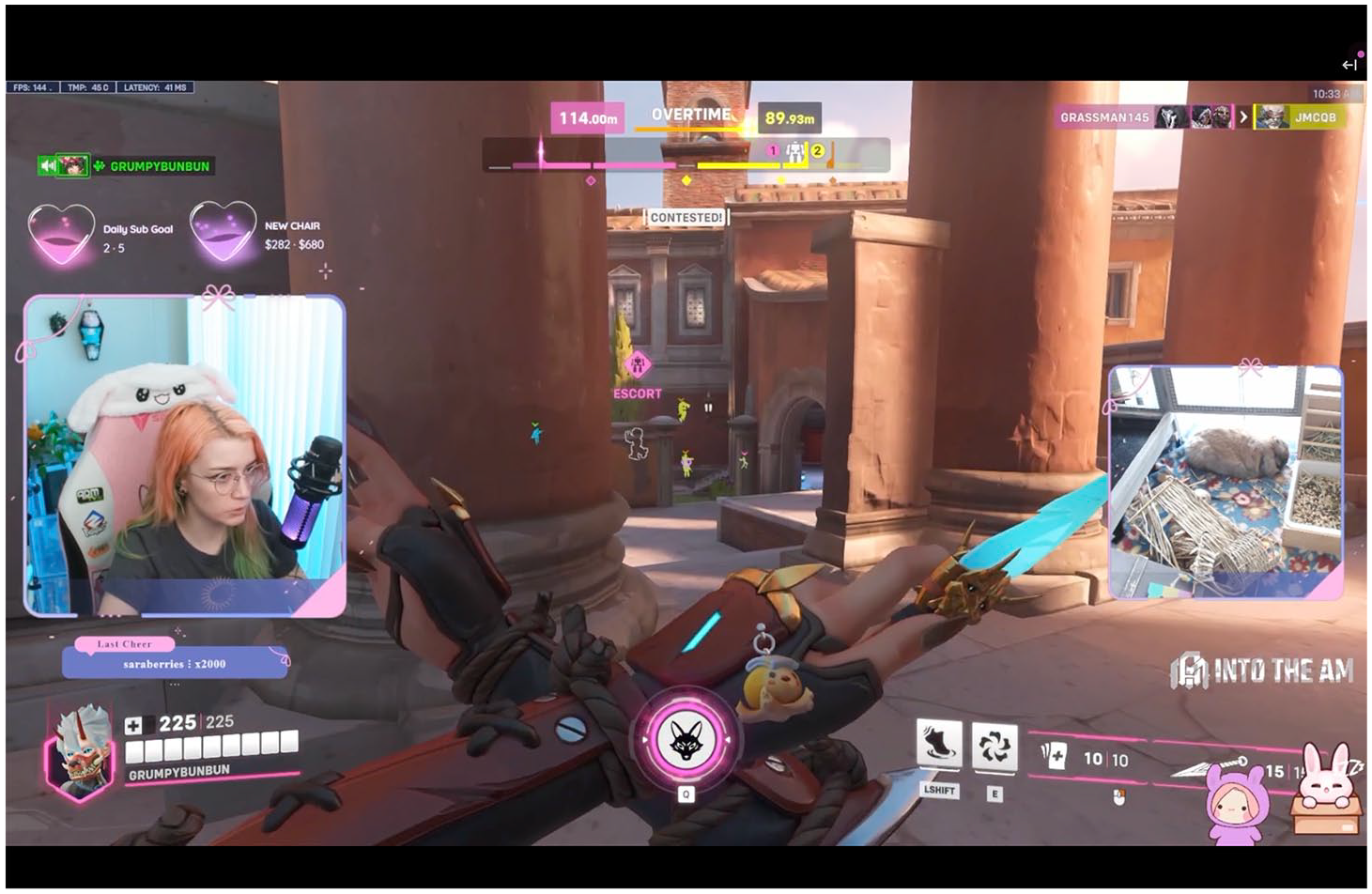
Screenshot of gaming live streaming: Twitch Stream of Into the AM by @grumpybunbunn, September 2024. Reproduced with permission.
They control what their audience sees on the main screen (the game they are playing); they appear in a smaller screen on the side. The streamer and viewer watch the screen together and the streamer’s live commentary sutures the screens together into one continuous live stream. Even streams focused not on gaming but rather commentary or ‘just chatting’ evoke the aesthetic of the radio booth or television studio (see Figure 2).
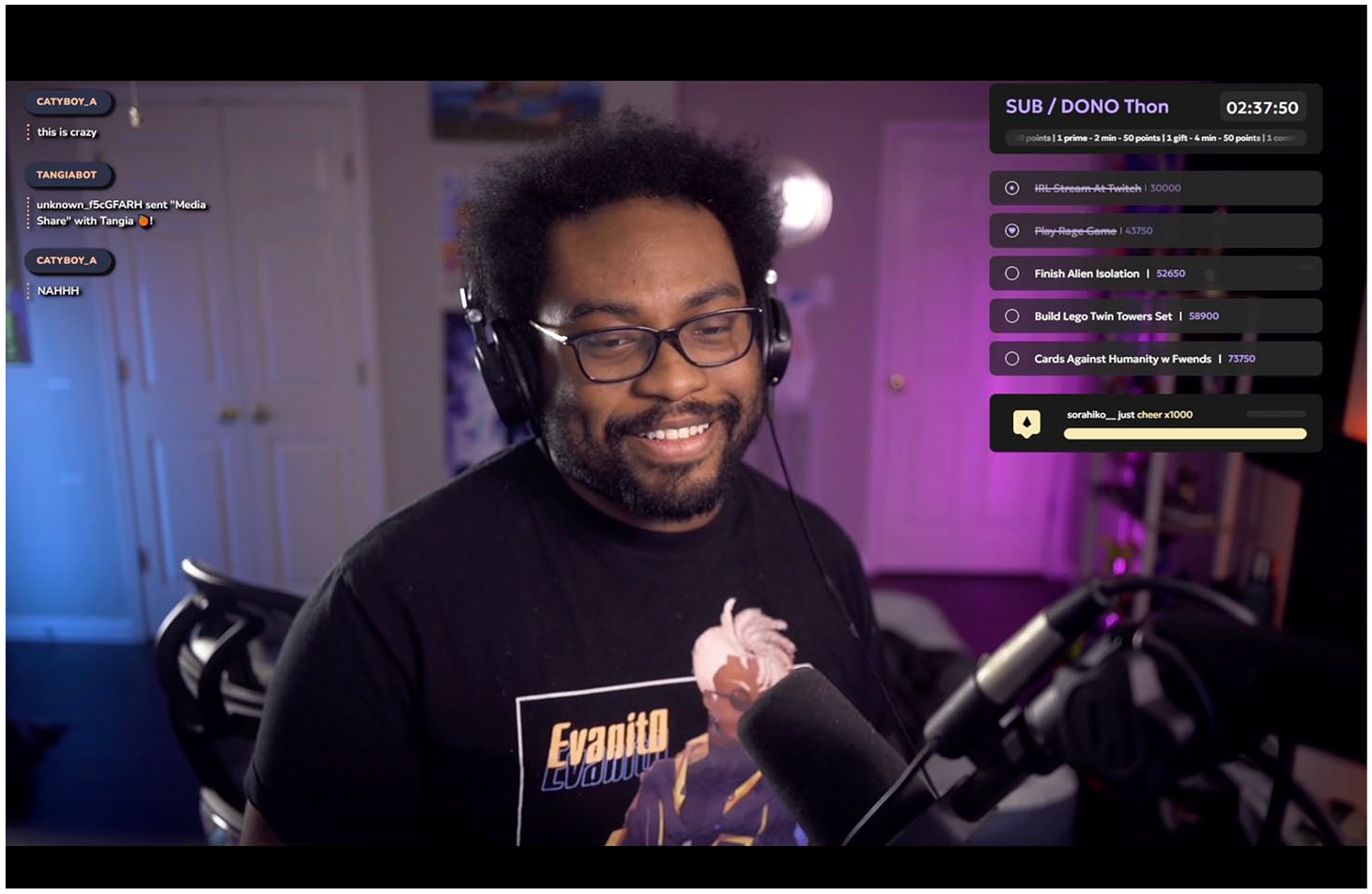
Screenshot from ‘Just chatting’ Twitch Stream by @Evanit0, September 2024. Reproduced with permission.
In this sense, the live streamer seems to resonate with the fatherly gaze or televisual gaze of the morning show TV host who, as Jane Feuer (1983) so influentially argued in her discussion of the ideology of liveness on TV, sets the circuit of address (we see only what the host sees) and creates unity and families where none exist within the televisual living room.
Looking again, however, live streaming is about spectacle and display, both of which are traditionally gendered. As Laura Mulvey (1975: 11–12) has argued in her foundational analysis of voyeurism within classic Hollywood cinema, traditionally, the woman displayed has functioned on two levels: as an erotic object for the characters within the screen story, and as erotic object for the spectator within the auditorium, with a shifting tension between the looks on either side of the screen.
This ‘to-be-looked-at-ness’ disrupts narrative flow, freezing the viewer in erotic contemplation. The male protagonist in contrast appears to control the gaze – we identify with him rather than stare at him. At the same time, Mulvey argues that, in a patriarchal society, the female figure also evokes the threat of castration – that, rather than being like the protagonist, one can be like the spectacle. To deal with this threat, Mulvey argues that the male unconscious either becomes pre-occupied with ‘investigating the woman, demystifying her mystery . . . counterbalanced by the devaluation, punishment or saving of the guilty object’ or turns the woman into a fetish so she ‘becomes reassuring rather than dangerous (hence overvaluation, the cult of the female star)’ (p. 205).
As Rianka Singh and Sarah Banet-Weiser (2022) have pointed out, despite the rising visibility of feminism on internet-based platforms, the historic relationship between women and platforms extends far beyond the digital and is politically fraught. The authors use the example of witch-hunts – which women have primarily been the victims of – as part of a larger project of maintaining the asymmetrical gender relations and position the gallows upon which the accused were hung as a technology of platformed visibility. Importantly, Singh and Banet-Weiser note, it is not the gallows directly enacting the gendered violence necessary for maintaining hegemonic gender relations; rather, the gallows act as a platform upon which the spectacle of hyper-visibility of gender-based violence communicates the consequences of resisting masculine domination.
It would appear that hate raids and other less vigilante forms disciplining ‘others’ online, such as ‘titty policing’, embody the kind of sadistic investigatory relation Mulvey describes. These communal forms seek to ban ‘women streamers whom straight male viewers deem too “sexy” or . . . LGBTQ+ content that is held to different standards of respectability than content about heterosexual sex and romance’ (Brewer et al., 2023: 14). As Zolides (2023: 134) argues, drawing from Scott, toxic community policing alleges that ‘female live streamers . . . [use] sexuality to grow audiences. These women are accused of generating “lower-quality”, sexual content that affects the cultural capital of Twitch, gaming and the genre of live streaming itself’. This ‘gendered gatekeeping’, however, reveals that, if the clear separation between male protagonist and female object once existed, it no longer does. Even as it frames straight male streamers as ‘worthy’ of attention because of their actions, it acknowledges that male and female streamers are acknowledged to compete in this economy for audience attention. Further, these hate raids themselves are forms of attention seeking, as Han et al. (2023, in Zolides, 2023: 133) argue.
This parallel between male and female streamers as attention seekers also points to another important difference between cinema and live streaming that stems from live streaming’s history – the live streamer’s domestic setting. As Bo Ruberg (2023) notes in their alternative history of live streaming, web cam modeling – and 1990s ‘cam girls’ before them – lie at the root of livestreaming and its intimacy. Usually set in the home/bedroom, Ruberg argues that live streaming in all its forms ‘offers viewers a sense of personal access to the inner world of the stream: a view into their personal lives and often, quite generally, their homes’ (p. 36). 7 Most official accounts of live streaming repress this history, disavowing ‘streaming’s erotic implications’ and its monetization (Ruberg, 2023: 29). As Ruberg notes, ‘Twitch as a company has worked the hardest to distance itself from associations with sex work.’
Hate raids, however, are also fundamentally raced and communal. As Catherine Han et al. (2023) have shown in their expansive analysis of hate raids, most hate raids deploy racist epithets, regardless of whom they target. They note that in their analysis of hate raids ‘across 9,664 popular channels on Twitch . . . 98% of hate raid messages consisted of identity-based attacks. However, while the content of these attacks was mostly anti-Black or antisemitic, the raids themselves selected targets indiscriminately with respect to streamer identity’ (133: 2). Intriguingly they described the ‘general, reused hateful content sent en masse as “canned hate”’ (133: 4). They also noted that, even though these epithets did not align with a streamer’s actual identity, attackers may have used ‘Twitch’s streamer tags – a feature streamers use to categorize themselves and their community . . . to discover and attack marginalized-identity streamers: particularly with Black, African American, and LGBTQ+ tags’ (133: 2). So, how can we understand these sadistic, racist, communal acts within this visual and political economy?
To unpack this, we turn to toxic geek masculinity and the difference it makes. As we will see, geek masculinity – although still within patriarchal structures – differs from the types of hypermasculinity underpinning traditional family structures and psychoanalytic family romances. As Slavoj Žižek (1998: 157) once argued, rather than being in the era of corporate Big Brother/Father-masters – we are now in that of ‘small brothers’. Taking Bill Gates as an exemplar, he argues that he exemplifies a ‘postmodern subjectivity’ that promotes the ‘imp of perversity’ – a countercultural edge that is vital to postmodern forms of power (p. 159). What are hate raiders if not a toxic group of little brothers?
The geek difference
III
The archetype of the geek is one that is well worn into the fabric of contemporary cultural texts (Massanari, 2017; Salter, 2018; Woo, 2012). Largely characterized through unpopular interests and niche hobbies which might be perceived as ‘weird’, including an enthusiastic interest in and proclivity for math and science, computing technology, the sci-fi and fantasy genres, fan cultures, and games (i.e. board games, collectable card games, role-playing games, miniatures, and video games), the figure of the geek is primarily articulated as inhabiting the body of a white cisgender male (Kendall, 2011; Woo, 2012).
The ascent of geek masculinity is notable for how it appears to splinter from a more traditional hegemonic expression of masculinity. While the elements of what constitutes the ideal figure of masculinity are not static, in a US context, hyper-masculine values have remained relatively fixed since the mid-20th century and have tended to champion dominance and control, aggression, self-reliance, physical and sexual prowess, violence, cut-throat competition, and mastery of masculine-coded technologies such as guns and cars (Cote, 2020). The figure of the geek thus represents a departure from the hegemonic ideal of ‘hard-bodied’ hyper-masculinity, appearing to re-articulate masculine expression through traits that might also be associated with hegemonic femininity, including sensitivity, socially passive, ‘soft’ bodied, and gentleness (Massanari, 2017). However, even as it repudiates some elements of traditional masculinity, it persists as a white, cisgender, heterosexual, and male-dominated figure (Kendall, 2011; Massanari, 2018). Key to the development and solidification of geek identity is that it is a technologically fused form of masculine subjectivity that requires the maintenance of gendered stereotypes about male technological skill and feminized ineptitude (Murray, 1993). Geek masculinity is marked by ‘marginality and unrecognized privilege’ (Massanari, 2020: 180) which enables them to frame themselves as an underdog, regardless of their actual success. That is, their ‘revenge’ is never complete.
Toxic gamer culture is an evolution of geek masculinity, distinct from trolling, but reliant on the same technological affordances of the internet and computational technology. Gamers mimic many practices informed by internet trolls, although the articulation of raiding in gamer culture is unique, as the practice holds video game-specific connotations and permutations (including the raid game-mechanic wherein a team of players battles a more powerful ‘boss’ or monster). Toxic behavior in gaming communities is often informed by trolling but with a gaming twist: during the Gamergate protests, attacks were articulated through gaming tropes such as ‘leveling up’, ‘grinding’, and ‘defeating the final boss’ (Cross, 2016). The raid mechanic on Twitch, which has deep roots in gaming culture, 8 mimics some of these practices from trolling culture, many of which are used as weapons in a struggle taking place around re-articulating the identity of the gamer following Gamergate.
Toxic geek masculinity buttresses and maintains soft control by blaming ‘others’, rather than corporations, for exploitation. If in Revenge of the Nerds, the ‘dudes’ needed to be avenged, in these spaces, in these online spaces, gendered, raced, and sexualized others rob geeks of their dream. Crucially, as Johnson and Woodcock (2019a) note, early Twitch streamers were not naïve. They both acknowledged how precarious live streaming was as a profession and the likelihood of failure. Intriguingly though, when considering the future of Twitch as a company, however, the opposite was the case, where comments ranged from the generally optimistic to the borderline techno-utopian. This contradiction articulates an important tension observed by professional and aspiring-professional streamers, which we suggest is indicative of a keen understanding of the dynamics of new technologies . . . : innovative companies and inventors can profit tremendously from technologies and new forms of work that leave those actually performing the work or using the technologies ever more precarious or insecure. (p. 348)
To suture this disconnect and maintain dreams of personal opportunity and capitalist expansion, toxic masculinity takes up a so-called tribal position in which geeks are the true victims /‘natives’. As Kunyosying and Soles (2012: Introduction) note: confronted with his cultural centrality and white, masculine privilege – geeks are most frequently represented as white males – the geek seeks a simulated victimhood and even simulated ethnicity in order to justify his [sic] existence as a protagonist in a world where an unmarked straight white male protagonist is increasingly passé.
Raids are key to this simulated ethnicity, in particular its fantasies of colonization, frontiers, cowboys, and natives, that litter the imaginary of the WWW and make Twitch, in the words of an early streamer ‘a Wild West’ (Johnson and Woodcock, 2019a: 336).
Raids
IV
Raiding is not just a behavior of the online age. It has a violent and complicated history as a tactic of war – one initially attributed to ‘tribal’ resistance to colonization and then appropriated by those very colonizers. Raids are fundamentally linked to ‘frontiers’ and the so-called edges of civilization. Glorified by Deleuze and Guattari (1986) as part of the ‘war machine’, raids’ ‘economy of violence’ is that of the hunted animal rather than the hunter (p. 66), of the racially oppressed rather than the oppressor (p. 41), of technological invention within a commercial circuit rather than State or official science (p. 16). Online raids, like the more general ‘tribal 2.0’ logic Jodi Byrd has critiqued, continues this ‘celebration’ of the ‘Indian’, which denies Indigenous history and presence – replacing them with ‘digital nomads’ and hate raiders.
In modern military literature, raids are considered a form of guerrilla warfare, often employed to counter insurgencies by ‘depriving the resistors of their support base and indeed of any reason to go on living’ (Porch, 2013). Despite the allegedly ‘primitive’ and ‘tribal’ roots, raiding is routinely employed by elite army forces in military operations as well as by paramilitary police units in crime investigation and prosecution (Kraska, 2007). Throughout history, raiding emerged as a reactive and therefore tactical response to a perceived threat, effective even in the case of large imbalances in the forces at play, relying on surprise as a key element, and which aim at sabotaging rather than engaging in a direct confrontation, and requiring extensive knowledge of the context.
Military historian Callwell (2015[1899]), amongst others, has argued that raids are a ‘heritage of extended empire’, an ‘epilogue to encroachments into lands beyond the confines of existing civilization’ (p. 5). They are the vestiges of ‘protracted indecisive hostilities’ (p. 7), that is colonial encounters, with ‘formidable nomad races’ (p. 18), such as ‘Red Indians’ (p. 7). Raids, as described in one of the first military manuals to address the strategy, as surprise attacks aimed to ‘capture or to do damage to the enemy’s property by the action of a small force boldly handled’ (p. 244) were seen by European colonial forces as ‘primitive’ warfare. While derided as military strategies employed by ‘savages and semi-civilized races’ (p. 21), these tactics proved to be an effective resistance against European occupations. They were especially good at prolonging conflict since raiders did not allow themselves to be captured or to surrender: ‘restricted by no precedents, governed by no strategic code, embarrassed by no encumbrances, they come and go at will’ (p. 65).
Crucially, while initially used to describe the actions of these nomads, raids quickly became a strategy taken up by colonizers. In particular, the French army experienced the effectiveness of raids during the 1830 invasion of Algeria. For seven years, the French army faced raids by Algerian forces that cut communication, destroyed arsenals, and sabotaged supply lines until, eventually, the French army co-opted the same strategy, calling them razzias, based on the sound of the Arabic word. This represents one of the earliest instances of raiding by European colonial armies and marking a dramatic departure from the French warfare paradigm (Porch, 2013).
Through raids, colonizers not only come to respect and mimic the enemy, they also seek to ‘become’ them. Gilles Deleuze and Felix Guattari’s (1986) discussion of raids as part of what they call the ‘war machine’ makes this clear. Deleuze and Guattari describe the war machine, which encompasses raids, as an external ‘flash’ that does not belong to the state (p. 6) and that wrenches feelings away from the subject, projecting them violently outward into a milieu of pure exteriority that lends them an incredible velocity, a catapulting force: love or hate, they are no longer feelings but affects and these affects are so many instances of the becoming-woman, the becoming-animal of the warrior (the bear, she-dogs). Affects transpierce the body like arrows, they are weapons of war. (p. 9)
Raids, they stress, do not have war as an object, but rather constitute, occupy, and displace space – and by doing so, compose people, a race-tribe (p. 94). Like Callwell, they link the war machine and raids to nomads and race-tribes, describing the marriage of ‘the Celt and the Orient’ as the proper nomad.
Although their prose celebrates the deteritorializing and creative force of the war-machine they also note its dangers, in particular the threat of racism and fascism. They write, ‘for what can be done to prevent the theme of a race from turning into a racism, a dominant and all-encompassing fascism, or into a sect and a folklore, microfascisms?’ (p. 41). To answer this question, they argue that the race-tribe exists only at the level of an oppressed race, and in the name of the oppression it suffers: there is no race but inferior, minoritarian; there is no dominant race; a race is defined not by its purity but rather by the impurity conferred upon it by a system of domination. Bastard and mixed-blood are the true names of race. Rimbaud said it all on this point: only he or she can invoke race who says, ‘I have always been of an inferior race . . . I am of an inferior race for all eternity . . . There I am on the Breton shore . . . I am a beast, a [******] . . . am of a distant race: my ancestors were Norsemen. (p. 42)
Jodi Byrd in The Transit of Empire has offered the most thorough critique of Deleuze and Guattari’s – and indeed that of post-structuralisms more generally – de-historicizing embrace of ‘the Indian’. This appropriation not only sanctions ignorance, but it also cannot work without the trace of colonialism that makes it possible. The ‘tribal’ is a reaction formation within the colonial imaginary. Further, toxic masculinity also reveals the limits of Deleuze and Guattari’s imagined defense of the war-machine against racism. The invocation of inferiority – the becoming racially other does not protect raids from fascism.
Given this, the question that remains is this: what can be done?
Countering raids
V
The streamer’s video feed briefly goes dark, replaced by a static ‘be right back’ image. For a moment, there is silence, the only movement coming from the chat, where the harsh messages from the raiders mingle with concerns from our streamer’s audience. Shortly thereafter, we hear some muffled conversation about securing the chat with her mods and the unmistakable sound of her quietly crying. After four minutes, the streamer returns to the frame. She dons her headphones and looks to the chat, thanking audience members for their support. In her live feed one audience member has donated fifty subscriptions and she thanks them for ‘showering her with love’.
The use and misuse of Twitch’s ‘community-building’ raid feature did build community – in that the community of impacted gamers, streamers, and audiences developed their own tools and methods to counter hate raids, while demanding that Twitch make changes. By the summer of 2021, hate raids targeting marginalized streamers had become such a frequent occurrence, and Twitch had responded so insufficiently, that a small group of streamers organized a collective boycott of the platform through the hashtags #DayOffTwitch and #TwitchDoBetter (D’Anastasio, 2021; Parrish, 2021). After community advocacy for Twitch to ‘do better’, the platform made some small changes to cope with the attacks, including publishing community guidelines and creating ‘AutoMod’ moderation features. However, their response left much to be desired as far as many streamers and their audiences were concerned.
Streamers created their own toolkits and how-to guides to address the problem – with names like ‘Bots & Bigots’, ‘Games & Harassment Hotline’, and ‘Cone of Safety’, as well as a series of chat commands that could be implemented simultaneously with the press of a ‘panic button’ by a streamer or their mods (Parrish, 2021). The panic button activated a sequence of safety settings that typically involves enabling follower-only chat, turning off the feature allowing raids, muting the stream, and switching the video feed to a ‘be right back’ message. Like raiding itself, Twitch then pulled in this informal practice and implemented a feature called shield mode in 2022. Shield mode allows streamers to pre-set a variety of safety settings prior to their stream that can all be turned on at once with the push of a button. These reactive protections do not shield a streamer from the initial blow of a hate raid, meaning a streamer and their community must still first be subjected to such attacks before shutting them down. Crucially the prevalence of hate raids has primed Twitch streamers and their audiences to interpret all raids as attacks. This implicates any of these events as potential threats and illustrates the long-lasting effects of the presence of hate raids on streamers and their audiences.
Despite ongoing maintenance and updates to platform moderation systems, hate raids persist and in some cases have intensified in their abuse. While new moderation features have been noted to help temporarily (Fairfax, 2023), hate raiders have figured out how to subvert the AutoMod algorithms using evolving forms of cloaked language, emojis and, in some cases, even leveraging moderation tools against streamers who already experience abuse (Meisner, 2023). Removing the raid function entirely has not been publicly considered by Twitch. Rather than shut raids down to prevent their abusive use – since raids help Twitch retain viewers’ activity on their platform – Twitch has instead opted to echo freedom of speech rhetoric spouted by other profit-oriented platforms when choosing profits over safety. Streamers control what the audience sees, but Twitch controls everything else. Through their partner and affiliate programs, Twitch has control over who makes money, and through their policies and features they control whose voices are the loudest, or are allowed to speak at all. These same platform affordances and constraint apply to the veneer of empowerment they appear to offer – empowering streamers to protect themselves and their audiences with barely any help from platforms.
The way Twitch has handled hate raids illustrates the intertwined matrices of discrimination, control, and empowerment that make up modern social media platforms especially for those who use or rely on them for economic reasons. As we have illustrated, hate raids show that discrimination is baked into Twitch, through its context in a lineage of gaming and raiding practices. Defensive tactics will be continually rendered useless against this ‘final boss’ if the root causes are reproduced in the default gamer identity and geek masculinity, which permeate platform logics. If Twitch and other similar platforms have no interest whatsoever in preventing these types of attacks, then can anything be done? Given these affordances and constraints, scholars, streamers, and platform developers must ask how might we separate them by taking on the very structure of exploitation that grounds these platforms? It seems like the only hopeful actions are those taken by the targeted communities, in developing their own tools, best practices, and taking collective action to push platforms to do better, and perhaps even remove the raid function.
Footnotes
Funding
The author(s) disclosed receipt of the following financial support for the research, authorship, and/or publication of this article: This research was supported with funding from the Canada 150 Research Chairs program, the Mellon Foundation, and a joint contribution of the UK Economic and Social Research Council and the Canadian Social Sciences and Humanities Research Council.
Notes
Address: Simon Fraser University, 8888 University Dr W, Burnaby, British Columbia BC V5A 1S6, Canada. [email:
Address: University of Illinois Chicago Department of Communication. 1007 W. Harrison St., 1140 BSB Chicago, IL 60607 United States. [email:
Address: Simon Fraser University, 8888 University Dr W, Burnaby British Columbia BC V5A 1S6, Canada. [email:
Address: Simon Fraser University, 8888 University Dr W, Burnaby British Columbia BC V5A 1S6, Canada. [email:
Address: Simon Fraser University, 8888 University Dr W, Burnaby British Columbia BC V5A 1S6, Canada. [email: