



Abstract
From 2018 to 2021, the “egirl” witnessed a radical shift from her origins as a sexualized slur in online gaming. Through critical discourse analysis of news media of this period, this paper interprets this transformation within two primary phenomena: (1) the growth of women game influencers who reclaimed “egirl” slurs in their self-branding and (2) the launch of “Egirl.gg,” a platform for paid gaming companions. I argue that live streaming platform Twitch.tv, and the expansive ecosystems of labor its demand from streamers, were integral to this re-authorization of who can play as themselves in a patriarchal gaming culture. Here, I extend Ergin Bulut’s framework of “ludic authorship” to delineate how stakeholders in game streaming industries masculinize the cultural labor of “authenticity.” The ambivalent embrace of “egirling” via streaming cultural logics further complicates the work of women gamers who must work harder to realize careers in platformed entertainment.
Undaunted by the 2020 deactivation of her accounts on Twitch and YouTube, “Belle Delphine” retains a global following (and infamy) among live streaming enthusiasts. The pink-wigged American cosplayer and self-branded “gamer girl” is active on Twitter, where 1.6 million follow her erotic posing with gaming paraphernalia. Delphine’s Instagram peaked at 4.2 million followers before its unexplained annihilation toward the end of 2020. Counterintuitively, it was here—not on Twitch, the Internet’s leading platform for game livestreaming—that Delphine announced the 2019 business venture that made her a household scandal beyond gaming enthusiasts. Delphine, then nineteen years old, announced she would be selling her own “GamerGirl Bathwater” at US$30 a bottle. In the Instagram post liked by 500,000+ users, Delphine presents herself as caricature of gamer femininity: her trademark wig, game controller, headset, and even her make-up beam pink. Winged liner exaggerates her eyes as she winks from inside of a filled pink bathtub, holding up the signature bottle. Her caption proclaims: “bath water for all you thirsty gamer boys” (Bishop 2019). Despite Delphine’s sporadic “liveness” as a streamer, GamerGirl bathwater catalyzed the attention of millions. Her personal website sold out its initial inventory of GamerGirl water in two days.
Yet customers doubted GamerGirl Bath Water’s “authenticity.” Reddit posts and YouTube videos went viral with attempts to debunk the adequacy of “GamerGirl” biological content in the bottles. A Verge headline asked, “If you bought influencer bathwater, could you test it for DNA? Yes. . .but why?” (Griggs 2019). Such attempts to both verify and vilify the authenticity of Delphine’s “GamerGirl” contents failed to impede demand. As of January 2020, the water’s price on her store inflated to US$250 apiece (Figure 1). The water is still available on her website, alongside other goods ranging from posters of her cosplay to branded “Gamergirl condoms.” Delphine’s self-sexualization and hyperfeminized image refuse the normative associations of game streaming as a masculinized profession. Her career lends context to the storied ascent and reclamation of a slur used to delegitimate the practices of female streamers who self-sexualize: “egirl.” A July 2019 feature for the technology and gaming news website Kotaku dubbed Delphine the “peak self-aware egirl” for her “gaming” of gamer girl stereotypes, turning them into audacious publicity students and ventures. The articles also declared, “Young Women Are Reclaiming the Slur ‘Egirl’” (D’Anastasio 2019). Most creators do not achieve the levels of the notoriety of Delphine or others discussed here. However, many streamers are laboring under the shadow cast by e-girl narratives on legitimacy and livestreaming.
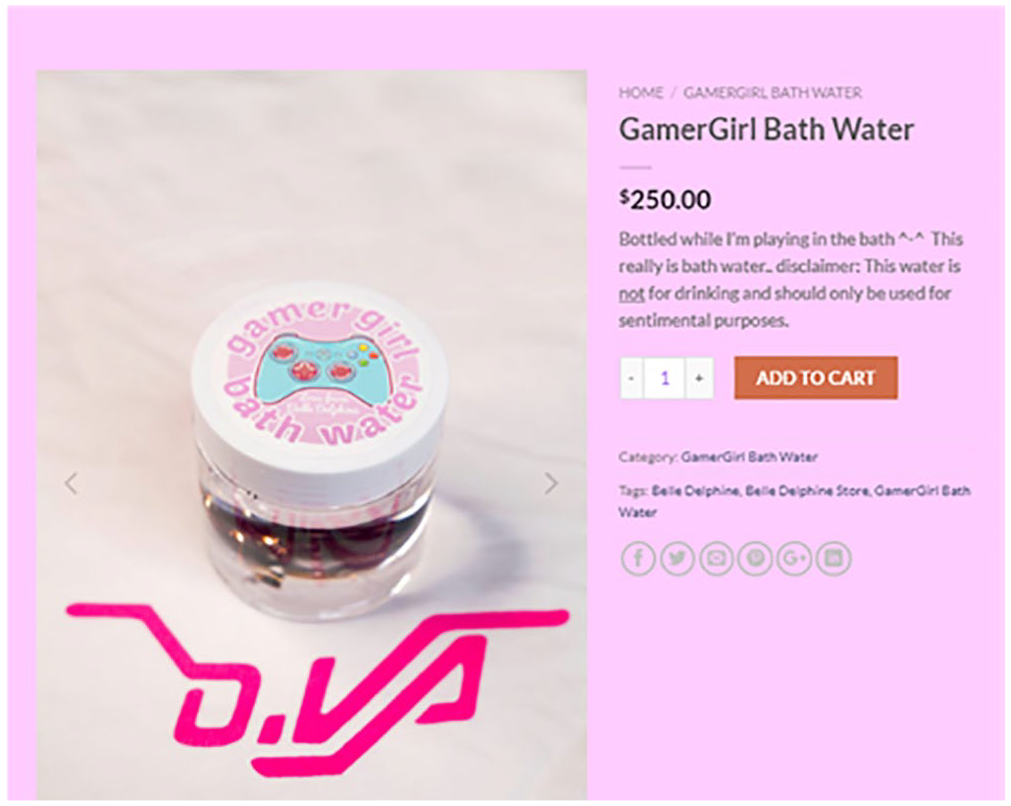
Screenshot from Belle Delphine’s online store (January 2020).
Such headlines, and other elements I survey below, signal how the term “egirl” has become a site of struggle for streamers, spectators, and slur-users alike in online gaming communities: today’s juvenile meme can be tomorrow’s keyword to success. In this essay, I contextualize the ascent of “egirl” vernaculars in popular discourse as a pivotal and gendered reconstruction of “realness,” which itself constitutes a form of social capital in live streaming’s ascent as a cultural labor force. I conclude by suggesting that livestreaming scholarship move its discussions of digital authenticity toward the concerns of Bulut’s (2020) framework of “ludic authorship,” which elaborates how the valorization of specific authenticities in the game industry becomes contingent on gendered narratives of work. Tracing these cultural narratives around “egirls,” I conclude, clarifies how livestreaming has transitioned into a culturally “real” job with highly gendered cultural exclusions.
Egirls in Context
The earlier usages of “egirl” in online vernaculars were not specific to live streaming or even video games. Rather, they related more broadly to the policing female sexuality in digital spaces. On the community-edited archive of online vernacular Urban Dictionary, the oldest entry for “egirl” dates from 2009 and simply declares, “Call her an E girl cause she’s always after the D.” Only a decade later did “egirl” come to describe (mis)use of this sexuality as ludic. The top-rated Urban Dictionary definition from March 2019 reads, “[E]girls are usually girls who play games online and can be found on either twitter or discord, they send nudes/thirst traps or even sell them. . .They can also be found on Twitch, the difference between a normal girl who plays video games and an egirl is that an egirl begs for money or sells herself for it” (“Egirl” 2020). This cross-platform recognition of “egirling” has amplified “egirl” as a popular hashtag for female streamers on Twitch to raise their visibility via memes of themselves, which have risen to new visibility most recently on popular video sharing app TikTok (Grayson 2020).
By 2020, news media registers “egirling” as a form of multiplatform crossover event for content creators. BuzzFeed declared, “TikTok Has Created A Whole New Kind Of Cool Girl” (Strapagiel 2019). Anastasia D’Anastasio’s Kotaku feature on “egirl” reclamation was published months after. Soon afterward, Vox published an extended essay titled “E-girls and e-boys, explained” (Jennings 2019) about the esthetic practices of a multiplatform subculture. The Cut likewise released articles examining the esthetics, practices, and economics of this same “trend.” Among the creators interviewed in Kotaku was Jayden “YourPrincess” Diaz, whose career as a popular Twitch streamer and League of Legends player was undermined by taunts of “e-girl” from her coplayers and audiences alike. For variety streamers like Diaz, the utterance of “egirl” embodies anxieties about online legitimacy, sexualization, and the gendered register of managing digital audiences. For a growing number of other content creators, the term “egirl” is not a slur but a point of lucrative reclamation. Former Twitch streamer Zoie Burgher, who was infamously banned for her bikini-clad streams of Call of Duty, now brands herself as “head egirl in charge” of Luxe Models, a purveyor of erotic content from fellow “egirls.” These are just two ways in which popular discourse might egirls niche: through victimization or valor. To what extent do these headlines reflect the cultural work conditions that gendered slurs (and their reclamation) impose on creators?
Methods
News headlines and memes are the starting point for this project, but they mark the larger narratives of streaming labor that often circulate within popular discourse. As posited by Ruberg and Cullen’s (2020) study of game steamers’ How-To videos, live streaming itself is a frustratingly ephemeral medium for digital scholarship. To date, an unmonetized Twitch streamer may only archive their broadcast for up to two weeks. Ironically, live streaming thus typifies online ethnography’s characterization of online communities as “events” brought together by material and social practices (Hine 2015; Pink et al. 2016). This juxtaposition between live streaming’s ephemerality and its bedrock status in social media entertainment (see Cunningham and Craig 2019) signals the utility of examining live streaming as broad and ongoing vernacular events. Whether used as a slur or celebrated, the utterance of “egirl,” with its signification of a digital girlhood, prompts questions about the visibility of labor (Abidin 2016) to being in character. Wigged or not, donning the “egirl” title enlivens the imagination of your live stream careers long after your channel’s “live” button has turned off.
Query “#egirl” on Instagram, likewise, and you will generate more than 3 million posts from game streamers, TikTok enthusiasts, and make-up artists alike. TikTok memes, like the “egirl” tag, are emerging as important devices for Twitch streamers to reach audiences on other platforms (Grayson 2020). Surveying these networks, I focus on the “paratexts” (Consalvo 2007) produced around watching and writing about “egirls.” These paratexts include dozens of articles, commentary pieces, and other popular media assembled from January 2019 to January 2020. Following Bourdieu (1991), I interpret egirl streaming cultures through critical discourse analysis, locating fields of meaning as built across language and the actors (commentators, journalists, and audiences) who use them. In doing so, I follow approaches like Consalvo and Paul’s (2019) study of the cultural constitution of “real games,” wherein industry-leading sources like Polygon and Kotaku as “non-enthusiast” literature like CNN and Vox co-produce the terrain where egirls are slurred, streamed, and shifted alongside flexible definitions of legitimate work and gaming. Critical discourse analysis and engagement with aforementioned games scholarship allow me to ask how cultural narratives about popular egirls form and how they are reflected in media coverage of streaming platforms.
Authenticity to (Ludic) Authorship
Twitch.tv and its affordances of real-time interaction between players and audiences have garnered rising analysis in the past decade (Consalvo 2017; Johnson and Woodcock 2019; Taylor 2018). From the perspective of Twitch streamers, success begins with neither the mastery of “hardcore” play nor of algorithms and policy. Rather, it begins a mastery of this realness: real-feeling relationships between creators and audiences act as networks of affinity, which instigate views, subscriptions, and other monetized engagement. Whether a streamer broadcasts as “themselves” or “in-character,” Twitch incentivizes its streamers to be visible and present (hence “live” streaming). This demand for visibility positions streamers as valued social influencers, whose ability to curate and sustain themselves as relatable figure is highly valued among brands and audiences (Abidin 2016; Duffy 2015). The ambivalence to homebound egirls as “real” streamers, despite all streaming’s reliance on domestic space, is important to a cultural economy that privileges authenticity. As Duffy (2017) posits, “The presupposition that realness is a gateway to empowerment has found a welcome home on social media” (p. 101). For platformed creators, authenticity becomes itself a platform: an essential “you” that, once accessed through discipline and mindful disclosure to others, serves as the building blocks to the mastery of social and financial success. Know yourself to know others. The realness-making, however, is highly gendered. Consider Senft’s (2008) landmark study of webcam model communities as foundational to streaming studies of microcelebrity and audience management. Consider the gendered language ascribed to persons who get too real: “drama queen” and “attention whore.” From camgirls to egirls, gender is infrastructural, not subcultural, to the legitimation of streaming as work.
Egirls, by caricaturing gamer femininity a la Belle Delphine, challenge the normative masculinization of realness. Writing for Vox, Jennings (2019) said, “To be an e-girl is to exist on a screen, mediated. You know an e-girl by her Twitch presence or the poses she makes on her Instagram, not by what she wears to school.” The Cut observes e-girls as “quicker to embrace their title than others niche groups—almost like they’re signaling their authenticity online” and signals that “tagging a photo of yourself “e-girl” is self-aware, self-promotion (Spelling 2020). The article straddles the ambivalent double-bind that captures women between attention and authenticity in streaming cultures: “This fixation on social media isn’t new to Gen Z, but their hyper-awareness of their online personae might be. This leads to another major through line: others’ idea that egirls are phony and just want attention.” (D’Anastasio 2019). Audience negotiation tactics are raised in relation to how egirls overtly manipulate spectators outside the parameters of acceptable gaming. Vox, for example, describes egirls as “those who walk around masquerading as an average cool teen, yet whose digital selves reveal that they’re part of something much more complicated” (Jennings 2019, n.p.).
These anxieties about attention managing as “real work” extend Baym’s (2018) figuration of relational labor as “ongoing communication with audiences over time to build social relationships that foster paid work” (p. 16). In Polygon, Belle Delphine’s bathwater sale is categorized as “side-hustle,” a “mixture of business and next-level performance art” (Hernandez 2019). This public characterization of Delphine and other self-aware egirls as “trolls” puts pressure on the mainstream demand that game streamer performs authentic connections with their audiences. Egirl labor and its performance anxieties are preluded in Ruberg et al.’s (2019) observation that “within the cultural logics of the Twitch community [they] studied, the one form of capital that breasts repel rather than attract was authenticity” (p. 478). Egirl breasts are more complicated. Self-sexualization in the face that everyone is either “in” on the joke or so mad they cannot look away complicates the idea that straightforward representations of realness are the primary pathway to success as a streamer. Egirls demand an ambivalent relationship to your body as a site of struggle, commodification, and domestication.
Emerging from his study of game developers, Bulut (2020) concept of “ludic authorship” has application to the study of game streaming and the risky, precarious, scrutinized, and highly-feminized labor of egirling. Ludic authorship refers the “narratives of dedication” (p. 64) that uphold a particular vision of the creative worker in games. Historically, this image of the grassroots creative has been ascribed to white, cisgender, and straight man laboring in the masculinized spaces of the garage and domestic space. This relates to and extends Heynen’s (2012) notion of “mystique of architectural authorship,” where commitment to longstanding hours and risk shore up a gendered form of creative heroism (p. 338). The signifiers of grounded, “authentic” creation—the garage, the basement—are recast as spaces for male creativity, much to the sublimation of the feminized work that upholds that space. This investment in the mystique of ludic authorship reproduces what Bulut (2020) describes as “the political terms of who can play and enjoy work as opposed to those who have to work” (p. 38). Like the work of an egirl, ludic authorship crystallizes the “backstage” of authenticity cultures. Producing affinities between streamers and audience in the culture of gaming is not superficially about gender. Rather, as my readings of egirl discourse below illustrate, sharing games for a living is infrastructurally about whose time in the bedroom is valorized as entrepreneurial.
The publicization of private domesticity in live streaming is key to understanding the anxieties abut egirls in gaming. To Ruberg and Lark (2021), domesticity and “bedrooms” are infrastructural to live streaming (p. 13). Orienting egirl work narratives toward the processing of legitimacy through the home, in the ethos of ludic authorship, highlights the organizational anxiety around egirls and other feminized creators. Recently, Kennedy (2020) has suggested the “egirl esthetic” as a TikTok-specific amplifier of girls’ “bedroom cultures,” where feminized creativity built TikTok a household name in COVID-19′s lockdowns. Orienting these bedroom eyes to the PlayStation, through ludic authorship, we can read for bedrooms to see where realness is worked on.
Vox offers this summary of the egirl in place: “They’re not amassing followers by going on vacations to St. Barts or Santorini every other week. More likely, they’re in their bedrooms, alone” (Jennings 2019). Girling contrasts other influencer labor; the webcam travels outdoors. Egirls come to us embedded with access. CNN characterized the egirl persona around TikTok, but as one who “shares solely from her bedroom and vamps up her appearance to embody the title” (Thompson 2020). These articulations of the bedroom as a place of access reinscribes women’s streaming as associated with the bedroom’s connections of erotic, intimacy, but also restoration. As Bulut’s (2020) concept of “ludic authorship” alludes, however, these gendered spaces of creation can elide the issue of whose labor is authenticated outside, such as by the gaming industry. If all streaming is streaming from the bedroom, as Ruberg and Lark posit, streaming studies must reckon with the erotic, affective, gendered and remote work which furnishes the electronic intimacy of platform like Twitch and others.
Digital demand for real connections became ugly in the legacy of the gaming harassment movement GamerGate (Gray et al. 2017). Accusations of being “fake gamer girls” or a “titty-streamers” may prelude violence, harassment or brigades of “boob police” who aim to demonetize women’s channels (Ruberg 2020; Zolides 2021). As scholars turn to streamers to understand widespread issues of digital work, considerations of gender and race in amplifying the precarity of streamers just begun to be articulated (Chan and Gray 2020; Guarriello 2019). Specifically, a widespread paucity of research persists when exploring these imperatives to be “real” among gaming enthusiasts. Understanding the individual experience of racialized and gendered streamers who labor to author an authentic-feeling self is beyond the scope of this paper. Nevertheless, the work of playing as yourself online presents special risks to gendered and racialized streamers, whose lived realities are too easily disbelieved and/or delegitimized by patriarchal gaming cultures.
Yet the rhetoric about “e-girls” in this community highlights how women and other marginalized people are not necessarily passive victims in online harassment events. As Cote (2017) explores, women are active audiences in the gaming community and have long developed strategies to minimize and circumvent harassment, whether it means changing genders while playing or leaving the game altogether. For streamers cognizant of Gamergate’s scrutiny, embracing the “e-girl” label falls somewhere in the middle. You can take a piece of ironic (or unironic) baggage attached to electronic girlhood and beat the oppressors to the punch: Self-brand before (or while) it becomes the basis of social attack. In historicizing the reclamation of “egirl,” I realize terms like “titty streamers” and “fake gamer girls,” even when they are intended to be derogatory, offer a platform for further ludic connections.
“Egirl.gg”: We Never Stream Alone
When I want to look at women playing games on the Internet, I might open Twitch.tv. If I seek more intimacy, however, I might open the website “Egirl.gg,” a service that allows players to browse among the profiles of (mostly) female player and hire their companionship for as little as $5USD/game. From a distance, the platform is not immediately aligned with conventional livestreaming; egirl.gg billed itself simply as “a mysterious organization [that] provides professional game companions” (Figure 2). Its invitation for players to identity as egirls is illustrates two points: (1) “egirls” discourse circulates adjacent to issues of digital labor on new platforms; and (2) readings this labor of realness-making through the “mystique of ludic authorship” shows the wide spreading relevancy of gender in games to the construction of “real jobs.”
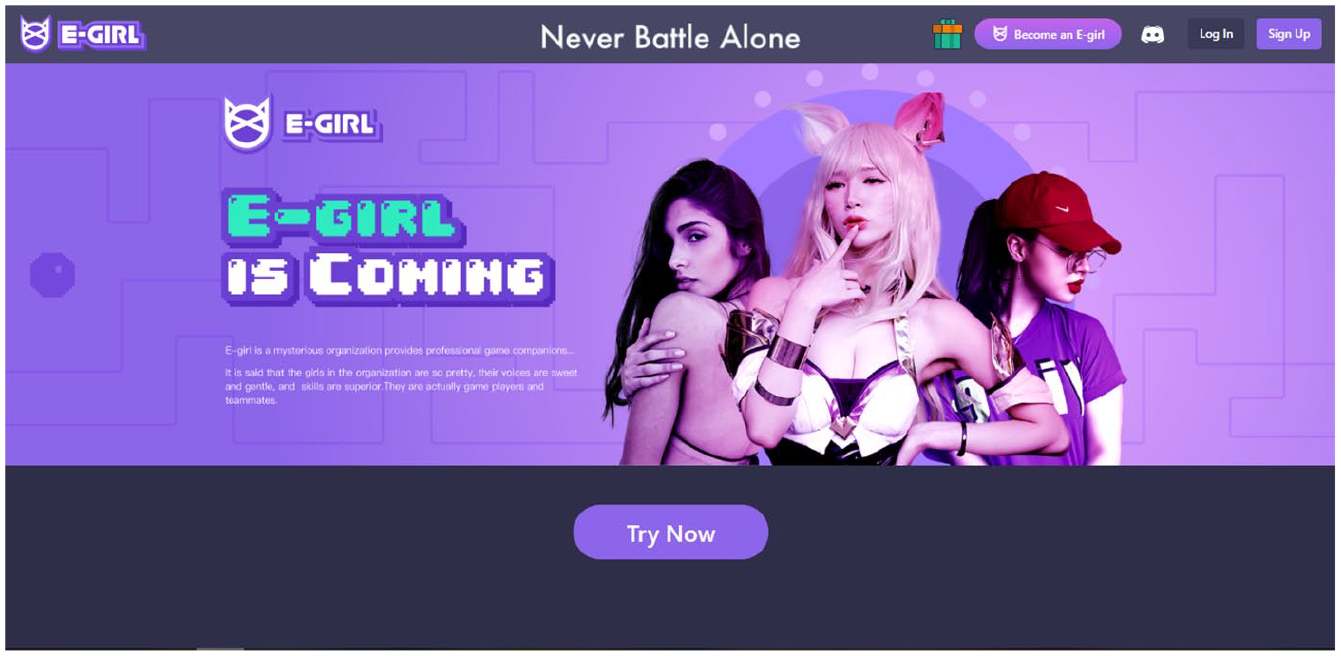
Inaugural launch page for egirl.gg (12 March 2020).
Gendered barriers to “real gamer” authentication extend Consalvo (2007) idea of “gaming capital,” whereby subjectivity-creation demarcates certain ludic identities and practices as gatekeepers of a legitimate gaming experience. Egirl.gg egirls must manage their audiences while also navigating a culture that refuses their legitimacy as “gamers on the basis of gender. Moreover, the jocular response to Egirl.gg puts these creators at risk of being too transactional, which diffuses self-branding claims to their authenticity (Banet-Weiser 2012). The copy of Egirl.gg’s inaugural page registers this anxiety by assuring the client, “These are actually game players and teammates” (Figure 2, emphasis mine).
Based on the model set out by founder Brain Xiong, a Californian student and entrepreneur, egirl.gg intimates and personalized the relational work that conventional live streams do for mass audiences: “They play games with you, they listen to your problem. . .It’s therapy too,” he reported to WIRED. Like the medic fame of Belle Delphine’s bath water, egirl.gg accrued a large following immediately. In one reporter’s assessment, “gamers on Twitter and Facebook couldn’t stop memeing about it” (D’Anastasio 2020). Egirl.gg’s proximity to memes is crucial to the relational labor it prompts. Memes are the critical interfaces between producers, texts, and audiences (Shifman 2013). For Denisova (2019, 3), memes are storytelling artifacts that creators embed with “symbolic rhetorical arguments.” With their polysemic possibilities, memes as the “context-bound viral texts that proliferate on mutation and replication” (p. 10). In the context of livestreaming cultures, memes are usefully because they animate the lines of affinity between streamer and audiences long after the channel has stopped going live.
Egirl.gg does not advertise itself as overtly memey or a streaming platform like Twitch. Yet it mediates live connection through shared vernaculars, like “egirl.” Multiple commentators made esthetic comparison between egirl.gg and Twitch: a purple banner, a leaderboard of contributors, and the ethos of community evoked by its headline, “Never Battle Alone.” The appeal of services provided by “egirl.gg” reflects the relational, gendered, and relationship-building work that circulates in, outside and from within the ethos of Twitch and game streaming: co-playing together (rather than battling alone). Moreover, its model how the site serves as an interlocutor between clients and “egirls,” echoing the freelancing service, Fivver, where Xiong recruited the first generation of workers for egirl.gg (that and the r/egirl subreddit). The playfulness and challenge to mockery embodied by the “Egirl.gg” brand obscures a growing platform economy—from live streaming to freelancing—that sells moderated affinities between streamers. egirl.gg markets egirls through an infrastructure of autonomy: clients and coaches build games, relationships, and also brands with each other. Like a good live stream watcher, or platform aggregator, the Egirl is never playing alone.
Eirl.gg has since rebranded in ways that suggest cognizance to gendered anxieties about realness in gaming ecosystems. In late April 2020, the service retitled itself to “Epal.” An Instagram story from the site stated that it now “provide better service and create a more welcoming and equal community” (@epal.gg n.d.). Even before their rebranding, the Google Doc that served as a guide for Egirl.gg (titled “How to be an egirl/eboy”) put up firm boundaries that refused an adjacency to sex work: “No sexual favors or asking for nudes,” it stated, and egirls’ voice recordings could not include “moaning, asking for sexual favors, desperation, or any other explicit talking” (Epal.gg 2020). The prohibition of overt sexual content suggests the site’s desire to distance from association with sex work. That egirls cannot show “desperation” shows these economies take authenticity seriously, reflecting a cognizance that a direct appeal to being too transactional was antithetical to the services of “egirl-”ing. That urgency, especially economic urgency, has no place in this “mysterious” organization, even as the platform’s employees provide the same coaching labor to their clients. Relatedly, a then self-identified-“egirl” disclosed that “as a college student living in a dorm, she says it’s a great way to earn cash for what she’d be doing anyway” (D’Anastasio 2020).
Conclusion
How can streamers and scholars develop a shared and nuanced syntax to talk about authenticity, autonomy, and aspiration? Hubs for self-titled “egirls” such as Twitch and TikTok (and nascent service like “E-pal”) reflect an microcelebrity ecosystem where the language of realness—or at least believability—is a valued commodity. For authenticity to thrive as a coherent conductor of digital value, its purveyors must invest in the belief that place that exists outside of consumer capitalism. As an object of both reclamation and revulsion by game enthusiasts, the egirl persona offers a flexible genre of authorship for gamers. Yet as Gray and Johnson (2013) remind us, constructions of “authorly” realness industrialized themselves in “direct relation to the commodification of culture and the reification of social identities” (p. 10). Egirls, as complex actors in the work of reclaiming or refusing realness, highlight the need for further studies of live streaming among young people seeking to reclaim both economic and creative agency. Understanding how a word like “egirl” is taken up ambivalently across actor networks helps locate not only sectors of cultural work where women are at risk, but also the ways in which they might reclaim power, such as by refusing interpellation with a laugh.
Footnotes
Declaration of Conflicting Interests
The author declared no potential conflicts of interest with respect to the research, authorship, and/or publication of this article.
Funding
The author received no financial support for the research, authorship, and/or publication of this article.
