




Abstract
This article considers the graphic design history of dance notation. For over 300 years, attempts to develop a unified, consistent notational system for dance have proven an intractable graphic design challenge, with numerous designs entering the field only to fall rapidly out of favour. Whilst a modest critical literature has emerged on dance notation, the subject is rarely considered from a visual design perspective. The authors seek to address this gap, examining the relationship between the visual attributes of dance notation systems and their usage. They argue that the breadth of dance notation systems developed speaks to the difficulty of the graphic design task, and that this instability has, in fact, allowed inscriptive practices within dance to change and evolve as needed, free from the constraints of strict expectations. As a result, the history of dance has seen notational designs shift and morph, persistently reimagined in inventive and varied ways to significant effect. Moving away from existing theoretical approaches to dance notation, the authors offer a new analysis in which dance notation is situated as an inscriptive practice that across its varied history has afforded users the opportunity to document, own, disseminate and create their own ‘models’ of dance.
Introduction
The graphic visualization of dance has rarely, if ever, been produced with the purpose of understanding dance on its own terms. 1 The tools of graphic inscription have been ill-equipped to handle the spatial, temporal, multimodal variables of dance, not to mention its social, cultural and embodied qualities. Dance is profoundly complex and at odds with a system of scientific production that favours inscription, ideally in a quantified form, and dissemination as an immutable two-dimensional output (Latour, 1986). The history of graphic design and dance is thus characterized by partiality, instability and reinvention.
Historically, the intersection of the data graphic and dance has most prominently taken the form of notation. The translation of dance into visual markers facilitates documentation, dissemination and recreation; it is a powerful tool, particularly when used as part of a knowledge system with agreed conventions. The translation of dance into notation requires the creation, or co-opting, of a system for conceptualizing dance. This is not a neutral act. The schematic modelling of action creates affordances that can distort how a dance is performed and understood. A notational schema that emphasizes steps, for example, promotes fragmentation and codification of danced action, as seen in classical ballet. Furthermore, the success of a notation system is not necessarily determined by its ability to accurately communicate dance; instead, socio-technical factors often play a vital role.
For over 300 years, attempts to develop a unified, consistent notational system for dance have proven an intractable challenge, with numerous designs entering the field only to fall rapidly out of favour (Farnell, 2005; Hutchinson Guest, 1989). This article, with a particular emphasis on Western concert dance, surveys graphic design approaches to notation, setting out the schematic underpinnings of well-known systems – such as Labanotation, Beauchamp-Feuillet notation and Benesh Movement Notation – and seeks to explain the relationship between their visual properties and their usage. While it considers the historical design challenge inherent to inscribing three-dimensional motion with precisely defined timings, it also argues for a new approach to conceptualizing dance notation. Rather than framing notational systems as choreographic texts, we instead present them as components within a complex situated dance practice, in which the inscriptive action of notation acts as one of many procedures within the creative production of dance.
How has dance been notated?
The history of dance notation in the Global North is characterized by the emergence and decline of new graphic systems; it is a history of change and, fittingly perhaps, constant motion. Ann Hutchinson Guest, a key theorist on dance notation, sets out a chronology of over 90 systems in her seminal text Choreographics (1989), with a huge number emerging during the 20th century. As she makes clear, these notational systems have not come together as a comprehensive toolkit across diverse applications, nor have they worked in competition as part of a meritocratic marketplace. Rather, they have come and gone, having either failed to gain traction with their intended users or fallen into disuse after a period of popularity. This quality of instability has been noted by various scholars. Mark Franko (2018), who has written extensively on the subject, highlights that their usage has been varied but influential: ‘The role of notation changes dynamically from the Renaissance through the twenty-first century and thus exerts a powerful influence on what we believe dance to be and on how we experience it’ (pp. 163–164).
Frédéric Pouillaude (2017) is less positive about the co-constituting role of notational systems for dance, suggesting that ‘notation appears to be a mere graphic accessory, leaving traces on paper and allowing fixation and archiving, while the essential core of what it aims to inscribe eludes its grasp’. He continues: Although numerous more or less well-developed notation systems have been available in dance since the end of the fifteenth century, it remains a fundamentally oral art form, in which knowledge and dance works seem incapable of being transmitted except from person to person, body to body, via the transparency of present movement. (pp. 163–164)
In the 20th century, two notation systems – Benesh Movement Notation and Labanotation – came to dominate Western dance practice, particularly ballet, but neither represents widely ‘read’ or utilized forms. The ‘orality’ referenced by Pouillaude persists in dance training and rehearsal practices. Despite sustained attempts to develop a unified notation system and various technological innovations, no stable system has emerged. As Arianna Maiorani (2021: 7) notes, ‘notation systems are still very difficult to use and video recording does not really complement it.’ This is in stark contrast to other performing arts. In music, the stave is often credited to Guido d’Arezzo, and has its origins in medieval manuscript production techniques from 800 CE (Haines, 2008; Hiley, 1993: 366–67;). In theatre, the play text is almost as ancient as writing itself. It raises the question, why is dance so difficult to systematically represent?
Dance Notation As A Visual System
For an explanation of this challenge, one might first consider the possibilities and limitations of graphic systems presented as two dimensional displays – the affordances of ‘flatland’, to use Edward Tufte’s (1990) terminology. Notation systems, be they for dance, music or drama, typically seek to map out the work. Dance, as an explicitly spatial practice, might therefore appear a viable practice for ‘mapping’. Amongst the oldest information graphics produced, as seen in Babylonian clay tablets and prehistoric paintings, are maps that delineate territory (Rochberg, 2012). Geographic maps demand certain conceptual leaps – the acceptance of a birds-eye view and the schematization of space – but they are a relatively stable graphic form. 2 This is due, it can be argued, to the comfortable marriage of graphic presentation and real-world content via perceived resemblance in the map, in other words an alignment between graphic presentation and perception of the space depicted (November et al., 2010). The map is a flattened, scaled-down, two-dimensional model of a space, with landmarks highlighted, topological features made explicit and boundaries drawn. The map resembles what you would expect to see, were you to take a birds-eye view of the space. Most instructive here, however, is what the map often fails to effectively depict, namely variation of height and movement. Map projections hide the spherical nature of the earth, positioning opposite sides of the world as left and right, top and bottom; contour lines and relief shading create a sense of vertical undulation, but are of little use for built environments characterized by abrupt changes of building height. Sporadic presences – such as nomadic peoples, temporary events, or the coming and going of the tide – all face misrepresentation or erasure on geographic maps. Those characteristics that are so integral to dance, precise changes of form and movement through three-dimensional space, are the exact properties that static, planar maps most often misrepresent.
Notational systems, like information systems for presenting chronologies, spatialize time as sequences and timelines (Rosenberg and Grafton, 2010). As Daniel Rosenberg and Anthony Grafton argue in their work on graphic presentations of time, chronology is either presented topologically – with events before or after one another – or with a set, measurable scale for time, along which events are marked. Time itself is rarely given emphatic graphic form, but rather functions as an organizational principle for other visual content: the imagery of a graphic novel written in English reads left-to-right and top-to-bottom; the hands of a clock trace a circle. In musical notation, the stave denotes pitch vertically, whilst the horizontal progression of notes shows their position in time. The graphic language of time rarely extends beyond the organizational markers of keylines and panel borders; instead, it determines where elements are located spatially. To put this another way, the conceptual metaphor used in information design, also seen in spoken language, is near exclusively one of time is space; we move through time, be that along timeline vectors or jumping from one frozen moment to another (Forceville, 2016; Forceville and Urios-Aparisi, 2009; Potsch and Williams, 2012). In this context, temporal duration, disparity and succession are expressed via size, extent, proximity and order. 3
Dance is much more than motion. Definitions of dance as fleeting movement through three-dimensional space have been described as reductive and partial; Pouillaude (2017: 198), drawing upon Jean-Georges Noverre’s critique of Beauchamp-Feuillet notation, argues: ‘The essence of dance is in the presence in action of an emotion being expressed.’ He places explicit emphasis on that which cannot be represented, ‘the intimate connection between dancing and presence’ (p. 187). Similarly, André Lepecki (2012: 15) describes dance’s constituent properties as being those of ‘ephemerality, corporeality, precariousness, scoring and performativity’, with ‘movement’ only once mentioned within the context of performance. But, accepting that dance notation has, as a principal goal, the purpose of mapping motion, however partial such an endeavour might be, it would seem to follow that a dance notation system would need to present changes in spatial position through time. This presents a problem as the simultaneous representation of spatial and temporal data requires two spatial metaphors to cohabit the same visual space. Sequential arrangements are a solution, where small, spatial representations are shown repeatedly as panels with temporal jumps implied from one graphic to another. These work because individual elements in the sequence can be depicted with their own self-contained spatial logic (see, for example, linear perspective or isometric designs) without confusing the overarching temporal schema. They are effective for inherently sequential activities, such as instruction manuals for flat-pack furniture, where the order of events matters more than exactly specified timings. For dance notation, however, reducing motion to a sequence with unspecified timings represents a significant limitation and is perhaps a factor in why so few notational systems draw upon figurative imagery of danced action.
An exception, it might be argued, are ‘stick figure systems’, a category noted by Hutchinson Guest (1989) in her analysis of dance notation, where figurative forms are arranged along a timeline, typically featuring a stave with lines indicating heights on the body, that is schematically viewed from the side. Examples include: Saint-Léon Notation, first published in Paris in 1852; Zorn Notation, published in 1887 by Friedrich Albert Zorn in Grammatik der Tanzkuns; Sutton DanceWriting, a subsection of the broader Sutton Movement Writing, created by Valerie Sutton in 1966; and Benesh Movement Notation, developed by Joan and Rudolf Benesh in the 1940s and published in 1955 (Benesh and Benesh, 1977), see Figure 1. In the earliest example shown in Figure 1 – Saint-Léon Notation – stick-figures are clearly depicted. However, by the mid-20th century with the introduction of Benesh Movement Notation, the most widely used notation system of this kind, there remains only an echo of human form; representational cues have largely been replaced by precise, abstracted forms with defined meanings within the system, rendering the design visually unintelligible to the uninitiated user. The underlying logic of Benesh can be derived from a stick-figure mapping of posture and position, but the outcome is necessarily abstracted to achieve exact meaning at a small scale that can be mapped along a precise, measurable timeline synchronized with musical notation. Thus, figurative resemblance is sacrificed to facilitate greater depth and precision of meaning in the marks used. The stick figure form only acts as an underlying schematic for the placement of semi-abstract glyphs.
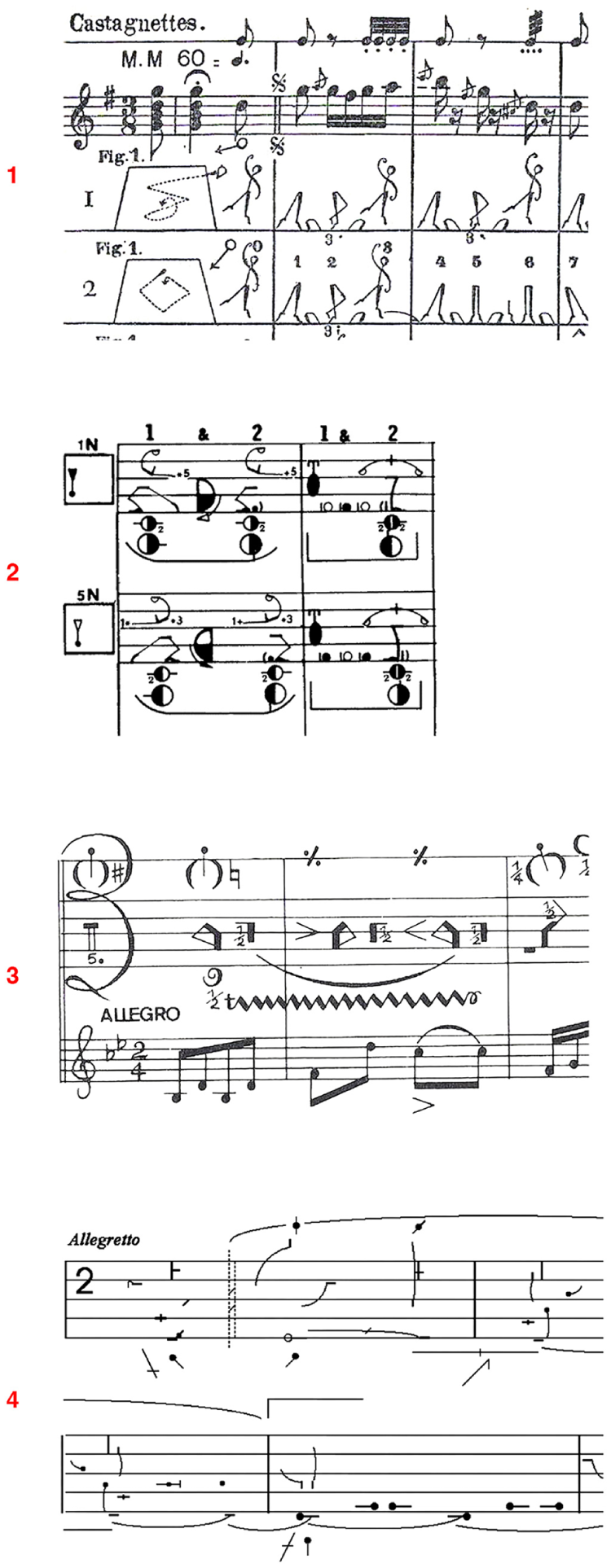
Examples of stick figure notation systems: (1) Saint-Léon Notation, user: Huster, via Wikimedia Commons (https://commons.wikimedia.org/wiki/File:Saint-L%C3%A9on_Dance_Notation.jpg) (1852);(2) Zorn Notation, by Anders Zorn via Wikimedia Commons (https://commons.wikimedia.org/wiki/File:Zorn_Cachucha.jpg, licensed under CC BY-SA 3.0 (https://creativecommons.org/licenses/by-sa/3.0/). (1887);(3) Sutton Dance Writing, (https://www.dancewriting.org/about/what/dw0007.html), licensed under CC BY-SA 3.0 (https://creativecommons.org/licenses/by-sa/3.0/). (1974);(4) Benesh Dance and Movement Notation, by JulietteKando, via Wikimedia Commons (https://commons.wikimedia.org/wiki/File:Benesh.jpg), licensed under CC BY-SA 3.0 (https://creativecommons.org/licenses/by-sa/3.0/) (1955).
For many dance notation systems, as with Benesh, the solution to the problem of competing visual schemas has been to replace visual resemblance with ideographic systems based on abstracted forms, where specific, arbitrary graphic shapes indicate an action or body position, that is then placed on a timeline. Systems that use abstraction in this manner include, for example, Labanotation (1928), Eshkol-Wachmann Movement Notation (EWMN) (1958) and the Loring System of Dance Notation (1955). The benefits of abstract systems are twofold: (1) the graphic forms no longer have to resemble vision, facilitating the production of more space efficient elements (a small circle might be used to depict a gesture, rather than a comparatively complex representational image); and (2) there is more flexibility in how time is presented. The emphasis of the visual system thus shifts from mimetic representation to one entirely of convention. The compromise here is that a notational system based on abstracted forms requires the reader to either learn the meaning of each shape or make use of a visual glossary to interpret the design. Consider, for comparison, the complexity of learning to read and write. The Latin alphabet, whilst a powerful and flexible tool, lacks representational ‘clues’ and demands extensive learning to achieve fluency. Generally, the more disassociated the forms are from the content, the less opportunity there is for a lay reader to gain a quick overview of what is shown.
There are exceptions to this, particularly where pre-existing graphic conventions are used. In a heat map, for example, the data and its presentation are usually abstracted, but it is readily evident where the highest intensity in the data lies, even to a lay reader, due to the use of a well-known colour system. Beauchamp-Feuillet notation, developed in France by Pierre Beauchamp in around 1674 and subsequently published by Raoul-Auger Feuillet in 1700 (Nevile, 2018), is unusual within the history of dance notation in that it draws upon a pre-existing graphic convention; the use of track lines makes a broad overview of the choreography readily legible, since the spatial translation of the dancers is marked as a geographically demarcated ‘route’ across the floor (see, for example, Kellom Tomlinson’s application of Beauchamp-Feuillet notation in Figure 2, which features additional figurative illustrations). Alongside the track lines there is a complex ideographic system of abstracted forms which is used to convey the core choreographic information. Graphically, the Beauchamp-Feuillet notation provided an easy-to-understand indication of where the dancer was meant to be and when they were meant to be there, but what exactly they were meant to be doing is left inscrutable to the uninitiated reader.
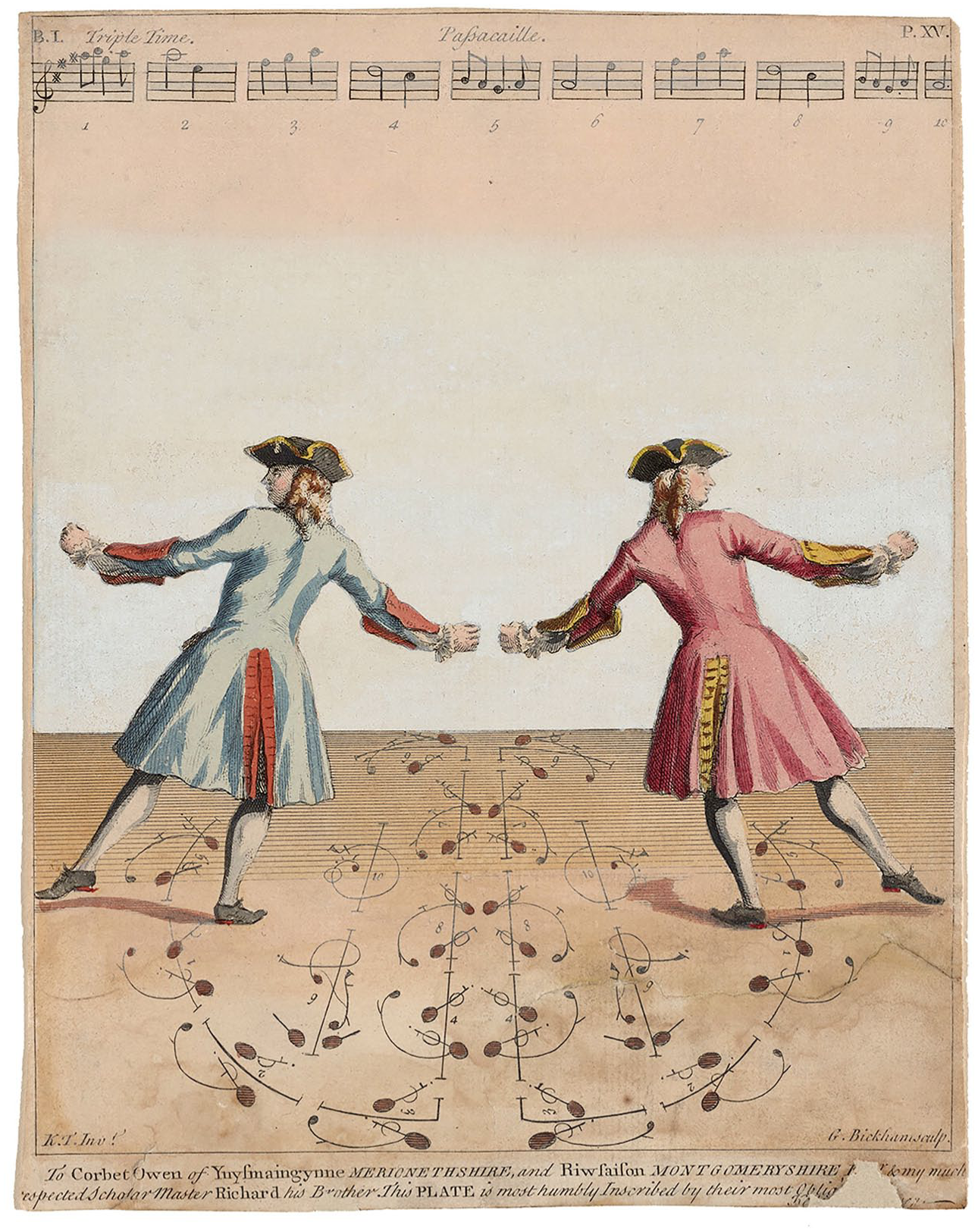
Kellom Tomlinson (Artist), George Bickham (Engraver), selected plate titled ‘Passacaille’ from The Art of Dancing Explained by Reading and Figures, 1735, Jerome Robbins Dance Division, From The New York Public Library. Retrieved from https://digitalcollections.nypl.org/items/f1142bd0-f27a-0132-fc9a-58d385a7b928.
The internal logic of a visual system can help assist comprehension through graphic devices such as repetition and modularity. The benefit is that this means fewer unique associations need to be remembered by users.
4
Labanotation, for example, uses a limited lexicon of shapes that are mirrored to indicate which side of the body is being referred to and are stretched along a vertical timeline to show duration (see Figure 3). Through being highly abstracted, this approach minimizes the quantity of new symbol meanings users need to learn and instead relies on contextual, systemic placement to determine meaning. This minimizes working memory demands by introducing a categorical structure, emphasizing reasoning rather than recall.
5
Whilst highly efficient, in practice Labanotation has been shown to require specialist training to master, with very few dancers able to use it effectively. In most instances where Labanotation, or indeed Benesh, are used, specialist notators are employed. As Pouillaude (2017: 164) argues: While the Western musical tradition internalized its notation system to the point where reading and writing became synonymous with playing and composing, in dance the responsibility for reading and writing was delegated to this third person, alone conversant with and expert in the graphic system of notation.
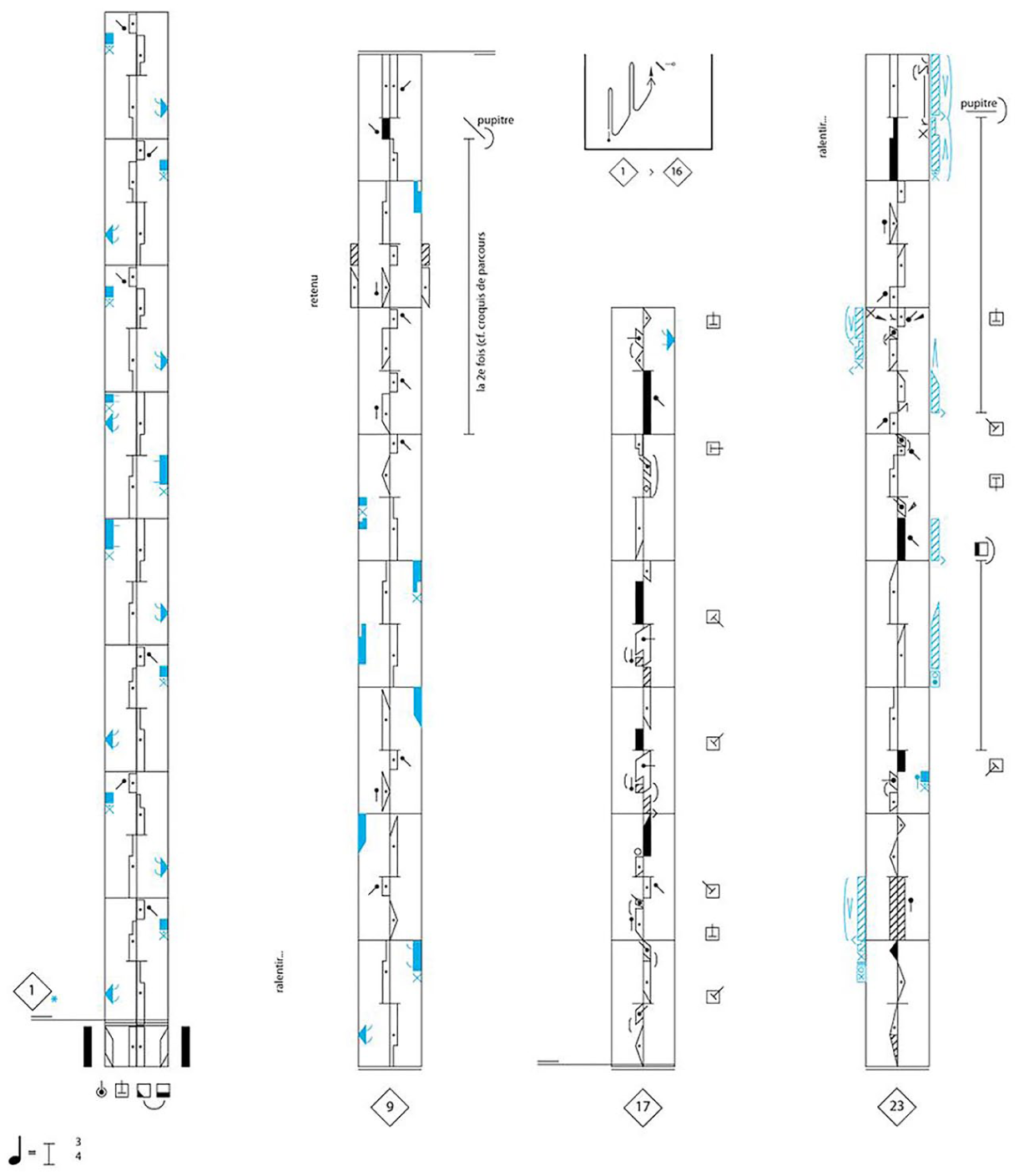
Example of Laban notation by Raphaël Cottin, extract from Sei solo – corrente, 2009 Via Wikimedia Commons (https://commons.wikimedia.org/wiki/File:Sei-solo-courante_Laban-score.jpg) licensed under CC BY-SA 4.0 (https://creativecommons.org/licenses/by-sa/4.0/deed.en).
In the UK, the Royal Ballet employs choreologists for the notation of new works and to assist in revivals of previously notated works. Rehearsals typically demand a complex interplay between a notator, choreographer, repetiteur and senior dancers, alongside other information sources such as video recordings and individuals’ memories of prior performance and training (Wardle, 2023). This is not only because dancers are unable to read the graphic language of dance notation. It is also because of the difficulty of simultaneously dancing and reading notated choreography; the physical demands of one impedes the other. Unlike sheet music use in an orchestra, dance notation is not used as a live guide to the performance.
Why has dance been notated?
The question then arises, what is dance notation actually for? Franko (2018) has argued that notation systems are most usefully understood as types of writing; as such, they have reoriented dance as a ‘text’ in multivariate ways throughout history. He identifies early Renaissance dance notation, in which letters typically represent named steps in the dance and run alongside a musical score, as the starting point of a steadily evolving relationship between notation and dance that is directly informed by philosophies of language and writing. An alternative paradigm through which to conceptualize the history of dance notation is to view it as an inscriptive, rather than textual, practice. This shift draws attention to the affordances of graphic practices (as set out by Bruno Latour, 1986, amongst others) and points to alternative critical avenues that have not previously been applied to dance notation, such as Johana Drucker’s (2014: 4) work on graphesis and ‘the study of the visual production of knowledge’.
Reviewing other inscriptive practices points to the breadth of ways in which dance notation has been used. Written text, for example, is used to transcribe spoken words as an inscription, creating a high-fidelity proxy for spoken language that acts as a document, albeit with the grammatical and linguistic baggage of a writing system and all the additional information provided in its visual presentation (typography, context, editorial format). Oral qualities are largely lost, unlike in musical notation, where pitch and timing are effectively documented. Similar effects are seen in directly indexical inscription practices, such as chemical photography and phonography, in what Offenhuber (2019) describes as ‘autographic visualisations’, where an inscription directly captures traces of real-world action via mechanical means. One possibility then is that the intention of dance notation is to objectively document and record dance. With this comes a concreteness, the permanence of the inscribed mark, and correspondingly the production of a boundary between what has been kept and what has been left behind. In the words of Andrea Bachner (2017: 13), ‘inscription, though sutured into an abstract concept, is radically specific.’ In this conceptualization of inscription, action precedes the production of graphic marks, the dance precedes the notation, and – critically – a decision has to be made about what information is recorded. Latour has argued that inscriptive processes are fundamental to scientific practice, facilitating the translation of action into graphic forms. These ‘immutable mobiles’ allow information to be gathered in a simplified, resilient form that can be moved between contexts without the content changing, so that it can be combined and presented accurately elsewhere (Latour, 1986). This inscriptive drive is perhaps what lay behind the popularity of 18th-century dance manuals. Beauchamp-Feuillet notation, for example, was widely utilized, spreading specific choreographic practices outward from France and across Europe. Central to these manuals’ popularity was the perceived accuracy and veracity of the information provided, affording the owner the possibility of accurately partaking in the fashionable dances of the court (Nevile, 2018).
This ability to move information about real-world actions is fundamental to inscriptive practices and can relate, not only to movement from one place to another, but also to movement through time. The inscription of a dance as documentation allows it to be disseminated, manipulated and replicated in the future, so long as the ability to decipher the notation remains. Dance notation has certainly been used this way; see Hutchinson Guest’s (1989) use of Labanotation to record choreography for posterity, or the extensive and longstanding work of the Dance Notation Bureau, where numerous works are kept as physical and digital records. Notation in these instances affords dance durability, preserving it beyond a performance in a stable form. However, Julia Hudson (2012: 288) notes that, for the dance archive, ‘durability requires picking out which elements of a particular work will be necessary for an accurate memory of that work after its translation to another medium.’ This interpretive space is informed by many factors, including the stability of the choreography from performance to performance, the emphasis on codified ‘steps’ within the dance genre, the correlation between dance and notational details, and the decision making of the notator. Furthermore, the veracity and accuracy of the dance record is not something for which there can necessarily be consensus. For Arike Oke (2017: 200), the authenticity of the dance when transcribed into notation is diminished by the interpretative work of the notator: The choreologists necessarily interpret movement into notation and that notation must be interpreted back, possibly by a different choreologist, to the dancers. The authenticity of a performance based entirely on notation can be challenged on the basis that it is produced via a number of intercessionary interpreters.
Oke argues that the dance archive needs to provide information on the choreographers’ and performers’ impressions of the dance work, alongside those of additional contributors (e.g. stage designer or musicians) and of the ‘audience, theorists, and critics’. Within this context, notation is but one flawed facet of a broader documentary endeavour that has to span a variety of perspectives and potentially disparate conceptions of dance and which can encompass not only the performance but also the development of the choreography across rehearsals and studio work. And yet, despite these accepted limitations, notation has repeatedly been used as an inscriptive practice to document dance.
It is worth noting here that graphic inscription is not only used for documentation. Many inscriptive practices demonstrate how a thing is supposed to be, for the purpose of clarification or concretization. A schematic of a machine provides a map of the components, often in a planimetric or isometric view, representing an idealized version of the machine, free from details such as wear and tear. Here, the purpose of inscription is not documentation, or looking backwards. Instead, the inscription is intended to show how a thing is meant to be, to offer a definition, often with the purpose of fixing or correcting. With this comes an implicit authority, often grounded in an essentialist notion of initial creation; the company that made a product provides the graphic inscription, the instruction manual, that indicates how the product should be. The implication is that, if the product is different to the graphic shown, then it is the product and not the inscription that is at fault. Assembly instructions see this concept extended into an exactingly defined process. In such practices, an audience is presented with an idealized sequential process free from contextual distractions where everything works as seemingly intended (the flat-pack furniture fits together and fittings are never misaligned). Such schematics are forward-looking. Applied to dance notation, this suggests a choreography in which contextual details might diverge but a core set of activities are clearly articulated. Revealing in this context is the inferred hierarchy, where the inscription defines the action, becoming a fixed point against which any variation can be measured.
The notion of exemplification is useful here; it is a property variously cited as a defining characteristic of scientific models (Levy, 2015) and points to the potential of reframing dance notation in this manner. 6 In this approach, notation is a process whereby systematic graphic inscriptions are deployed as a means to reconfigure the activity of dancing as a ‘model’ in which certain characteristics are presented in an exemplified form. The notation system acts as a model for a dance genre (in the case of Beauchamp-Feuillet notation) or for movement itself (as in Labanotation), with a dance score being a sub-model for a specific choreography or dance that is derived from the parent notational model. Exemplification—to show how a thing is supposed to be—requires instantiation of a specific quality of the subject being modelled, but other characteristics can be inaccurate without issue. Idealized models can distort attributes and still function as accurate representations, so long as there is precision in the salient attributes being modelled (Nguyen, 2020). Catherine Elgin (2017) developed this idea, noting that core attributes in a model can be inaccurate and yet ‘epistemically facilitate understanding of phenomena’ (p. 16). She refers to the quality of ‘felicitous, “legitimate” falsehoods’, where inaccurate properties are central to the representation. In the example of dance notation systems, this perhaps goes some way to explain how the codified, idealized dance actions depicted in notation can be critiqued as being at a profound remove from the in-reality action (as per Pouillaude) whilst simultaneously functioning as epistemically connected exemplars that act with veracity and authority. 7
With this authoritative quality comes the opportunity to indicate ownership, as seen in intellectual copyright and patents. The emphasis shifts in this context from defining how a thing should be done to suggesting that, if something has specific properties, as seen in an inscription, then it belongs to someone. The inherent corporeality of dance makes an inscriptive process for copyright complicated, throwing open questions of authorship (Waelde and Whatley, 2018), interpretation (Kraut, 2016; Van Camp, 1994) and fundamental questions of what constitutes the dance (Ravetto-Biagioli, 2021). Notation, in this forum, has acted as one of the means for providing a ‘tangible medium of expression’ (U.S. Copyright Office, 2022) that outlines the creative work, but in so doing has enacted a divide between choreographer, choreography and the dancer.
This division has a long history. It is no coincidence that choreography’s original meaning referred to the practice of notating dance on paper (Foster, 2010: 32). ‘Choreographers’ in the early 18th century were tasked with creating and interpreting dance notation scores, which were known as ‘choreographies’. It was only later that choreography came to mean the composition of a dance, and later still when it became widely adopted to refer to an organizing force within dance practice. This etymological history is instructive, suggesting a complicated relationship between graphic notation and codified dance activities. Notation was a procedural innovation that facilitated dance being recreated and performed again as a set choreography with an externalized score. Dance had traditions, styles and specific ‘dances’ long before notation, but with notation came the possibility of reconfiguring choreography as a ‘score’, separated from an individual dance or the activity of a specific dancer. By this way of thinking, notation worked to further notions of continuity of artistic form from performance to performance, in a manner similar to a reprinted book or a performed symphony. In this dance philosophy, whilst the time, place and performers might change, it is the integrity of the choreography that determines whether it is the same work.
Have dance notation systems failed?
The ‘failure’ of dance notation is, in many ways, a flawed concept. As we have seen, notational systems are necessarily partial, creating a simplified model of real-world activities. Any attempt at creating a notational system for dance requires a schematic visual logic, which is informed by the limitations of static, two-dimensional graphic inscription and results in each notation system having its own lexicon, structure and grammar. What follows is a hierarchy of information, with certain attributes of dance practice emphasized, whilst other elements are given less prominence or removed entirely. As a result, throughout the history of Western concert dance, notation has acted as a co-constituting force, reinforcing certain aspects of dance, particularly in their codification, documentation and dissemination.
Prejudices and limitations are common throughout notation systems. Both Benesh Movement Notation and Labanotation indicate the posture of the dancer – as an individual – changing through time, often in accordance with musical notation. The position the dancer takes on the stage is not detailed in the core notation, nor is their relationship to other performers. 8 Figures are conceptualized as being upright and body-normal, while moving through one posture to another. They are shown from a mirrored perspective (or viewed from directly behind) rather than from above as a way of indicating spatial position. Neither system indicates gradual changes, but instead concentrates on marking where threshold points are met, for example being positioned either up, middle or down, with nothing in between. These details, as technical as they might seem, all act to reinforce a version of dance that is intended to be performed by dancers with normative body types, that has choregraphed steps informed by prior training, and that is seemingly designed to be viewed by an external audience.
That is not, however, to suggest consensus around, or satisfaction with, notational systems and the dance aesthetics they support (Williams, 1999: 29). As has been noted, the history of dance notation is characterized by change and innovation – Farnell (2005) suggests that at least 87 separate movement notation systems have been used in Europe and North America alone. In practice, dance has shown itself to be complex, varied and multifaceted, and what constitutes dance’s intrinsic characteristics have rarely been agreed upon, let alone neatly encapsulated in a stable choreographic score. Nelson Goodman (1976), in Languages of Art, describes literature, music and dance as sharing similar properties, classifying them as ‘allographic’, because they do not typically rely on a unique physical articulation of the work. This is in contrast to ‘autographic’ works, such as paintings, where there is only one ‘original’ instance of the artwork, and any further versions are copies. In examining what qualities determine fidelity from one allographic instance to another, Goodman (1976: 121) suggests that ‘an art seems to be allographic just in so far as it is amenable to notation’, with the novel or poem representing relatively stable allographic forms. Dance’s plurality across cultures and its multimodal features make attempts at notation inevitably limited, both in accuracy, but also in authority. Consider, for example, the emergence of named ballets. Despite the use of notational systems and the seemingly ‘allographic’ nature of repeat performances of named ballets (e.g. the numerous productions of Swan Lake, The Nutcracker or Giselle), the history of ballet is characterized by choreographic iteration, innovation and change. Kenneth Macmillan’s (1965) Romeo and Juliet, to music by Sergei Prokofiev, radically diverged from Leonid Lavrovsky’s (1940) choreography for the Kirov Theatre, which itself was an update of Ivo Váňa-Psota’s (1938) original production featuring, amongst other things, a different, non-tragic, ending. Where repeat print runs of novels rarely see significant variation in core content, many dances have historically evolved and changed.
Notation has therefore been part of an iterative process whereby works evolved and changed, closer, in effect, to the role of the theatrical play text being ‘adapted’ from one production to the next. This points to a looser use of notational systems, one that moves away from the documentary and prescriptive. There is no reason, for example, why notational systems cannot be used speculatively, to prototype, develop and explore creative avenues. In most design domains, sketching and visual exploration are key aspects of a creative process, particularly where prototyping and ideation are quicker and easier than producing a final output. In fact, for Kimbell (2011), such activities and routines, as situated within networks of practice, are where design work typically occurs. This echoes our earlier analysis of the Royal Ballet, where notation was described as part of a broader body of work carried out by multiple agents. This work might be usefully conceptualized as a practice, where the notation acts as a focal point for certain routines and procedures, bringing together a network of human and non-human actors, in the attempt to produce a choreographed performance.
The reorientation of dance production as a complex situated practice throws open further questions. Dance notation systems almost universally focus on motion through time, sometimes in combination with music, but rarely, if ever, with the other accoutrements that come with a staged performance: the costume design, art direction and staging, not to mention the organizational bureaucracy of seating plans and ticketing. If we accept that dance notation is used within an expanded practice from which dance emerges, are other inscriptive practices any less valid or important? There is clear evidence that information design and data visualization have been used historically as tools in the production of staged dances. Adjacent practices to dance, such as costume and stage design, have required the creation of concept drawings, plans, elevations, production charts and cutting patterns. See, for example, Inigo Jones’s costume design for the Masque of Queens (1609), where drawings of the characters are provided, with written details noting costume specifics (Figure 4). These visual materials represent attributes of the dance performance. They are items that constitute dance in some form but are not perceived as dancing itself, qualities that an allographic framing of dance would see relegated to adjacent or paratextual practices around an essential choreographic core. Such a delineation is less clearcut in a practice model of dance, where the emphasis is instead on how situated networks, routines and material activities lead to a dance coming into being. In this context, set designs, costume design, lighting plans and stage directions are all notation of dance practice(s), insomuch as they are graphic inscriptions that play a role in dance being produced. Their value, in this model of dance, is in their affordances, namely what the graphic inscriptions help make happen, even if their impact is not utilitarian or directly tied to a movement-oriented definition of dance. Instead, the emphasis is on how notational systems act as organizational mechanisms, as ‘choreographic thinking tools’ (DeLahunta et al., 2012) or as catalysts for action, that facilitate interaction, manifestation and collaboration. Lepecki (2004: 113) has argued for the intrinsic relationship between inscription and dance, suggesting that ‘writing and dancing participate in the same motion of the trace.’ More pertinently perhaps, DeLahunta et al. (2004) discuss the role of the artists’ notebook in the creative process, as a space for ideation, documentation and reflection, and encompassing the myriad graphic practices associated with dance practice.
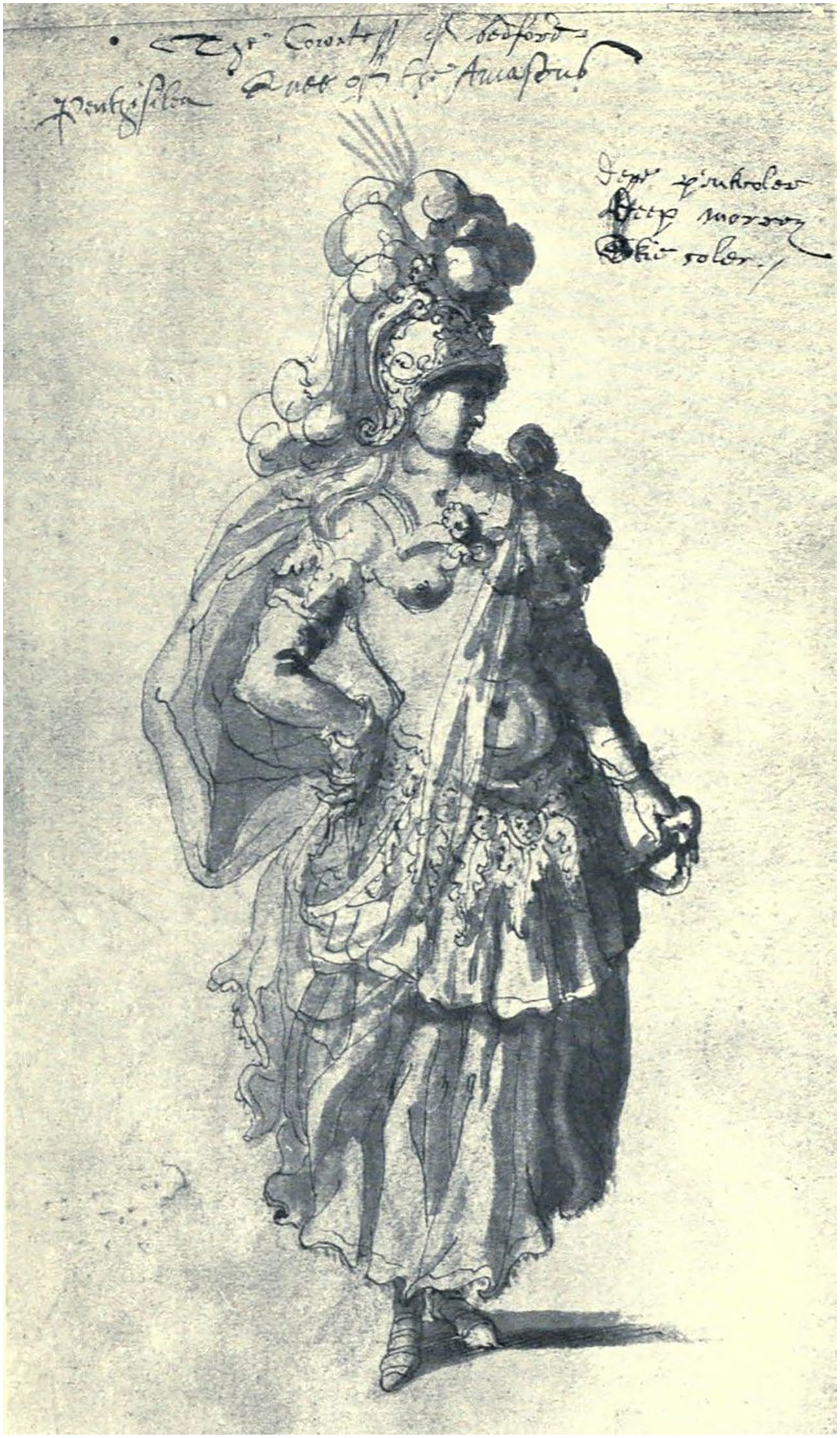
Inigo Jones (1608), costume design for Penthesilea in The Masque of Queens, reproduced in Shakespeare’s England: An account of the life & manners of his age, 1916, Oxford, Clarendon Press. Via Internet Archive, (https://archive.org/details/shakespearesengl02raleuoft/page/n3/mode/2up)
Such a discussion draws attention to the diverse ways in which dance is conceptualized, be that as performance-oriented outcome, as a process-driven practice, or in an expanded space that encompasses staging and art direction as much as motion. This is all without mentioning alternative contexts such as ritualized cultural traditions of dance, dance’s role in the actualization of a social identity, formalized dance education, dance as health activity or explorative choreographic practices.
To understand the impact of notation on dance, it is important to account for the ways in which different systems have done different things for different people at different times, to focus on the ‘agency of situations’ (Erofeeva, 2019: 600). To achieve this, any analysis must simultaneously take into account the affordances of specific inscriptive systems, be that Labanotation or Inigo Jones’s costume designs, whilst also taking a human-centred view that accommodates ‘attachments’, for example Beauchamp-Feuillet notation as directly impacted by Feuillet’s relationship to the French court.
Consider, for example, Rudolf Laban’s first work of dance notation, Dance Writing (Schrifttanz), published in 1928. The development of his notational system was tied to both his frustrations, as a choreographer, with existing systems, but also a commercial imperative. Having suffered a career-ending back injury, he needed to find a way to earn money by teaching dance (Doerr, 2007). He did so in a manner that befitted the cultural milieu (e.g. discourse around structuralist philosophies, the avant-garde design agendas of De Stijl and the Bauhaus) by developing a ‘universal system’ for dance notation. Sociotechnical factors, such as affordable print technologies and the commercial opportunity to open dance schools across Europe, were also critical in the creation of Labanotation. Hutchinson Guest’s archival use of Labanotation half a decade later represents something different entirely, however; notation here is a tool for the formal documentation of choreographies. For Hutchinson Guest, Labanotation not only offers a degree of accuracy deemed appropriate, but also legitimacy, as an accepted inscriptive language for dance. In an attempt to understand the role of dance notation, the direct formal attributes of the inscriptive system are only one part of a larger story; to understand notation means understanding the context – the agency of the situation – on a case-by-case basis. 9
Information design theorist, Edward Tufte (1990: 117), argued in support of universal approaches such as Labanotation: ‘Systems of dance notation translate human movements into signs transcribed onto flatland, permanently preserving the visual instant.’ This notion is refuted here. Not only are notational systems products of their context, but their role is varied and malleable. There are, for example, numerous counterpoints to universal systems, ones that instead embrace partiality and specificity. Experimental works, such as Tania Bruguera’s practice, use simple rules as provocations for performers that deconstruct the systematization of dance that dance notation has so often been a part of. In Bruguera’s performance work Tatlin’s Whisper #5 (2008), two anti-riot police officers enter a gallery on horseback and corral visitors. The performers draw upon tacit somatic knowledge of police training and behaviour. Rather than enforcing a tightly choreographed performance, Bruguera rejects typical hierarchies and performers are given space to perform in line with pre-existing knowledge within a few set conditions. The notation in this work necessarily takes the form of a provocation: perform this task in this location. The participatory nature of the work inherently resists traditional modes of notation and is thus instructive. Notation has often facilitated the authority of the choreographer over the performer, distancing the performance from the ‘work’ itself. This choreographic authority is still evident in open-ended, participatory works, but its nature is different, with a looser hierarchy where decision making is diffuse. This is further complicated in Tatlin’s Whisper #5, in which gallery visitors are themselves choreographed by the performers, via direct, forceful instruction that speaks to ideas of choreopolitics and control (Lepecki, 2013). Similarly, Remy Charlip, a founding member of the Merce Cunningham Dance Company, developed choreographic works that experimented with and challenged notational practices. In Air Mail Dances (1970–onwards), dancers were provided only with simple rough drawings on postcards marking a few key poses, occasionally with a short description. 10 The performers were encouraged to fill the gaps as a shared co-creative endeavour. Such experimental practices are instructive, acting as counterpoints to the universalist claims of well-established dance writing systems.
Conclusion
In this article, we suggest that an analysis of the visual attributes of dance notation highlights their role as procedural elements within complex situated practices with differing affordances determined chiefly by the agency of the situation. This, it has been argued, goes some way to explaining why the history of dance notation is one of the new approaches repeatedly emerging but falling subsequently into disuse.
Explanations for this pattern began by reviewing the graphic attributes of notation systems, noting the inherent complexity of representing multiple stages of physical movement efficiently and accurately against a timeline, in a static, planar graphic representation. The necessity of presenting temporal and spatial information simultaneously was highlighted as a key challenge. The use of abstracted forms to represent specific motions was shown to be a widespread and successful solution for sidestepping this issue, as seen in Beauchamp-Feuillet notation and Labanotation. However, even in examples where symbol design is highly structured, notation literacy has remained low. Compounding this issue was the problem that, in practice, dance notation is also often difficult to read whilst actively dancing, limiting its practical application when compared with, for example, musical notation or the dramatic script. In short, producing a durable, universal dance notation system has proven to be an intractable design problem characterized by partiality and compromise.
Given the ‘failure’ of any specific dance notation system to take hold, what followed was an analysis of what the various systems had achieved. Rather than being viewed as a writing system, dance notation was conceptualized as an inscriptive practice, which had successfully afforded users the opportunity to: (1) document, archive and preserve dance; (2) establish definitive, artistically owned choreographies; (3) disseminate and share dance; and (4) create ‘models’ of dance genres and ‘sub-models’ of dance works that are limited, or indeed inaccurate, but are also able to usefully function as epistemically connected exemplars that act with veracity and authority. The impact of this was framed in historical context and shown to have been multifaceted, with notation impacting how dance genres have developed and how they have been codified (or perhaps modelled) whilst also changing how individual dance works have been produced, with the concepts of the choreographer and choreography taking on distinct, impactful roles.
Exploring this notion further, it was noted that well-known choreographies have not been characterized by consistency but rather that they have evolved and changed despite there being notation in place. Instead of seeing notation as a static end point, it was argued that such systems often work creatively, in a manner akin to sketching and prototyping within a design process. Developing this idea, it was suggested that notation might usefully be thought of as being part of a wide-ranging, complex situated practice, in which the production and use of notation acts procedurally within the creative production of dance activity. Other inscriptive practices, that might equally be considered elements of dance notation – such as drawings produced for costumes, seating plans, or the set design – were thus reconfigured as further procedural inscriptive activities within an expanded conception of dance, that, in some (but not all) contexts, have proven to also be useful and productive elements of dance practice.
The argument concluded by emphasizing context, drawing upon the ‘agency of situations’ as a useful theoretical framework. This approach, which recognizes both the affordances of human and non-human actors within systems and the importance of human ‘attachments’, facilitates the analysis of specific complex situated practices as distinct occurrences. This approach helps draw out the ways in which inscriptive design practices, such as notation, have been used at certain times to catalyse dance activity, without assuming continuity of use, or indeed, function.
Footnotes


Data Availability Statement
Data sharing not applicable to this article as no datasets were generated or analysed during the current study.
Notes
Biographical Notes
ROB TOVEY is a Senior Lecturer in Environmental Graphic Design and Director of Studies for the School of Design and Creative Arts at Loughborough University. His research focuses on real-world applications of graphic design outside the traditional remit of the Graphic Designer, in contexts such as sport, health, memorialization and machine interfaces. He has worked on research projects including Open Flight Deck, Machine Vision in Everyday Life and Covid-19 and Grassroots Memorials.
Address: Loughborough University, Epinal Way, Loughborough LE11 3TU, UK. [ email:
LYNSEY MCCULLOCH is a Senior Research Fellow at the Royal Shakespeare Company in Stratford-upon-Avon, leading a Paul Hamlyn Foundation-funded project on the impact of arts learning. Her research is interdisciplinary, encompassing literature, dance, pedagogy and visual studies. A leading scholar in the history of dance research, she has published numerous articles, key note papers and book chapters and, in 2019, she edited The Oxford Handbook of Shakespeare and Dance (Oxford University Press).
Address: Royal Shakespeare Company, Waterside, Stratford-upon-Avon CV37 6BB, UK. [ email: