



Abstract
The award-winning indie video game Chinese Parents, developed by a mainland China-based studio, has gained significant popularity among both Chinese and Western players owing to its unique narrative and representation of contemporary mainland China. Some of these in-game representations include the strict parenting style, academic pressure on Chinese children, unique Chinese school culture and popular Chinese internet memes. This article applies compositional interpretation, as well as the framework of iconology in visual culture to analyse the representation of contemporary mainland China from a video-game-context graphic communication perspective. Examples of character portraits, background scene illustrations, biaoqingbao meme application and supporting visual elements are selected and analysed to demonstrate how the game incorporates contemporary Chinese culture into the visuals, while also challenging and playing into existing clichés of Chinese culture.
Introduction: video games and (mis)representation of Asian cultures
As a key product of the digital age, the video game has become a form of mainstream media that influences our ways of looking at our world by constructing various representations, including cultural representation (Šisler, 2008: 203). However, representation of Asian cultures in video games is usually limited and, in some contexts, biased and inaccurate. For example, there is a distinct lack of Asian American men in Western racing games, despite their contribution to the street racing culture in the US in the first place (Phi, 2009). In Shellshock: ‘Nam 67 (2004), a game whose directors and main designers were all Westerners, Vietnamese characters are shown as playing ‘the same old roles that the West has for Vietnamese people in popular entertainment: hooker, or gook who gets shot’. Sifu (2022) takes place in modern China and, despite gaining positive reviews on gameplay, it centres around kung fu and martial arts, which are again stereotypical features for Asian characters. The character Mei-Ling Zhou from Overwatch (2016) is a young Chinese climatologist who wields weapons of advanced technology. She does not do kung fu, but her Chineseness is mainly displayed through the traditional patterns on her clothes and her Asian hair stick. This gives the impression that no matter how futuristic the character’s design is, the Asian/Chinese culture background and ethnicity could only be represented through visual elements from traditional cultures. The developers of Sleeping Dogs (2012) took a step forward in realizing that traditional culture is not the only way of representing China and set their game in modern China (Hong Kong). The game accurately depicts the crowded buildings, busy streets and unique ways of interpersonal interaction in post-colonial Hong Kong, although the urban violence representation is exaggerated (Zhang, 2014). Nevertheless, kung fu is still a major aspect of gameplay – protagonists would defeat their enemies with kung fu when they clearly have access to a gun. To summarize, Asian characters in video games have been stereotyped into either specific roles (i.e. kung fu masters), or specific ways of dress (i.e. traditional patterns on clothes) that are often not culturally representative.
The above examples of stereotypical and cliché Asian representations come about as the result of designing games from a Western, non-Asian perspective. This raises questions: would cultural representations in video games be more authentic if they were self-representations or representations of one’s own culture? What aspects of their ethnicity and culture would be highlighted by the people in the group being represented and how are they represented in a video game context? Would that lead to an increased number of contemporary perspectives and representations of what is happening in China in the modern 21st century that minimize the use of traditional and fantasy cultural elements?
With these questions as guidance, the following section gives a quick overview of how Chinese video game studios represent their own people, lives and cultures.
Chinese games that focus on the ‘traditional’
China has adopted international models of development within the cultural sector, including pushing a ‘creative industries’ approach since the mid-2000s (O’Connor and Gu, 2014). Under Xi Jinping, China introduced a national promotion strategy of ‘telling China stories well’ (讲好中国故事) and promoting the Chinese dream to global audiences through the creative industries (Donald et al., 2023; Huang and Wang, 2019; Liu, 2018). Certain ‘national splendid culture traditions’ are encouraged to be portrayed, such as the Four Great Classical Novels. Thus, there is a focus on traditional narratives and a curated ideal China that is promoted through global video games. One of the most popular genres to come from these regulations and push for Chinese stories is the ‘wuxia’ genre. Wuxia is a fantasy genre inspired by Chinese culture (Chew, 2019). Some of the traditional elements of the genre include martial arts, folk religion and mythology set in reimagined fantasy versions of ancient China. The wuxia genre has complex cultural roots but can also veer into stereotypical territory (Chan, 2008). The following section introduces two popular games that represent the wuxia trend and the ‘splendid culture traditions’.
Developed by miHoYo studio based in Shanghai, Genshin Impact (2020) is an action-adventure role-playing game (RPG) set in a fictional fantasy world. The different regions in the game are inspired by various cultures around the world with China represented as the fictional nation, Liyue. In Liyue, there are locations based on real-world landmarks in mainland China, such as Zhangjiajie National Forest Park and Guilin Lijiang National Park (NB Games, 2020). Characters such as Yunjin and Guoba not only represent Chinese culture through their appearance (e.g. Yunjin’s Chinese opera-inspired dress and Guoba’s facial patterns), but also their beliefs and values. For example, Guoba’s background story reflects the importance of food in Chinese culture. Despite the Chinese Government’s often critical attitude towards video games, Genshin Impact has made its way onto the ‘List of key projects for Chinese cultural export between 2021
Similarly, Black Myth: Wukong (2024) is an action RPG based on the well-known ancient Chinese novel Journey to the West, one of the ‘four great classical novels’. Just like the other games mentioned above, Black Myth: Wukong showcases the fantastic world of ancient China through scenery, architecture, Chinese gardens, beautiful weapons and mythical beasts. The mythology aspects as well as the action-based gameplay both signify the game’s utilization of the wuxia genre. The release of this game’s pre-alpha gameplay video has sparked global interest, with the video receiving nearly 2 million views on YouTube within its first month of release (Chan, 2022).
The two games described above rely on traditional aspects of Chinese culture such as historical architecture, traditional dress, wuxia, classical novels and so on. Most of these games are set in an ancient fantasy world context and displaying cues of traditional cultures (which are likely to be the ‘contemporary’ cultures during that ancient period) is inevitable. However, some titles have received criticism due to the over-reliance on clichéd cultural exports that are ‘as synonymous as all the kung fu and wuxia films that make up the bulk of what gets picked up for an international release, reinforcing the narrow Orientalist tropes that appeal to western tastes’ (Wen, 2020). Not only is the reliance on traditional cultural aspects an unintended submission to Orientalism, but it is also a hindrance on representing a modern or contemporary China. In the modern era, most Chinese people do not walk in the streets in traditional robes, live in houses with classic paper windows or drink water from gourds. 1 Thus, the representation of contemporary ways of living as a Chinese person in mainland China is not shown in the above games.
The habit of using visual cues derived from traditional cultures and ancient fantasy aspects to represent China is still dominant in many digital media products, including video games, created by Chinese studios. The overuse of traditional patterns and traditional culture inspired fantasy aspects and the tendency to set the game in ancient China has become a cliché, despite not being seen as stereotypical. Cliché stresses the state of being overused, while stereotypical emphasizes homogeneous categorization and the lack of flexibility (Pickering, 2001). These clichés may also reinforce the ‘kung fu’ stereotype in those who know about the games but have not played them seriously enough to understand the context and details of the said cultures. A superficial impression could lead players to link the cues of traditional cultures, especially the wuxia aspects, to kung fu. This overuse of traditional cultures and fantasy aspects could ‘give people what they want, reveal hidden truths and act as vehicles of memory’ while also advancing ‘political control, meaningless expressions and imposed stereotypical imagery’ (Dann, 2001).
Fortunately, this cliché is recognized by some game developers, like the developers of Sleeping Dogs, who have produced influential titles that are set in a modern or contemporary China instead of ancient China. New One Studio’s The Invisible Guardian (2019) is a well-reviewed game on Steam that is set in modern China, in which the player’s role is as a member of the Underground Communist Party of China during the Second Sino-Japanese War. The game represents Chinese culture from this specific historic period. Although it does contain some traditional culture elements such as mandarin jackets and cheongsam, it is a step forward in that it avoids the cliché of setting the game in ancient China and showcases the lives of Chinese people in the early 20th century. As for games that focus on an even more contemporary China, there is the popular dating sim Mr. Love: Queen’s Choice (2017) developed by Papergames. The game is set in a contemporary urban environment and there is little representation of stereotypical kung fu, wuxia or other traditional Chinese visual cultures. However, apart from a few illustrations of Chinese teaware, Ming dynasty-inspired wooden furniture and Chinese national police uniform, this game rarely includes intentional representations of Chineseness. The universal depictions of city scenes as well as the stylistic otome-game-style character designs would work in any urban settings other than China. 2 Additionally, the game highlights aspects of superpowers and portrays the male protagonists (i.e. the player’s dating subjects) in an over-romanticized manner, meaning that the game does not represent the real lives and personalities of contemporary Chinese people.
This makes Moyuwan Games’s Chinese Parents (2018) a unique cultural artefact that focuses on representing authentic, down-to-earth lives of contemporary Chinese people. Chinese Parents is a game designed to simulate the life of a child in mainland China that is set around the late 20th century and the early 21st century. Similar to Mr. Love: Queen’s Choice, the game hardly includes any predictable, cliché ‘traditional Chinese elements’ but instead is packed with modern lifestyles and references. It is significant because it also incorporates Chinese pop culture internet memes that distinctively show Chineseness in the age of culture globalization. Chinese Parents stands out as a video game because representing the authentic, down-to-earth life of an ‘average’ Chinese person in contemporary mainland China is, as the previous section showed, rather rare in video games. Additionally, this game has received unanticipated international reception and has been reported on by major Western news outlets such as The New York Times (Zhang and Zhong, 2019). Chinese Parents provides rich grounds for cultural and visual analysis.
Gamifying the life of an ‘average Chinese’ person in contemporary mainland china
Chinese Parents is a child-raising simulation game set in contemporary mainland China. The player plays the roles of both the parents and the child, experiencing the average life of a typical one-child Chinese family in contemporary mainland China. The game starts at birth and finishes at the end of the National College Entrance Exam (gaokao, 高考), when the child goes to university and has significantly less interactions with their parents. The game has won several awards including the ‘Local Cultural Representation Award’ at the Indie Live Expo 2020, as well as the ‘Excellence in Innovation’ award in 2018 at IndiePlay (Steam, 2022). The game became popular among the Chinese community due to its accurate portrayal of contemporary life, especially Chinese parenting styles (Zhang and Zhong, 2019). Even though the target audience of the game was Chinese millennials, Chinese Parents gained the attention of Western gamers before it was available in English due to the game’s unique themes and portrayal of different parenting styles in Chinese culture (Chan, 2019). Simulation games, due to their attempted imitation of reality, can be powerful tools for education (Squire, 2003). Life simulation games, such as The Sims series and RealLives (2002), could educate players on contemporary issues in real life such as capitalism and global citizenship (Bachen et al., 2012; Sicart, 2003). Player identification with the game’s characters plays an important role in amplifying affective learning outcomes. When games allow the player to live the lives of people from other countries, they can ‘induce students’ identification with culturally and geographically distal characters, increase students’ sense of global empathy and boost their interest in learning more about the countries in which their characters live’ (Bachen et al., 2012: 452). Although this discovery is based on a classroom setting with students, it can also be applied to general players. Chinese Parents, as a game that steps out from the comfort zone of representing Chinese culture through traditional cultures and martial arts, introduces the following ‘learning outcomes’: (1) to understand the real-life struggles of Chinese children, their school studies and their family; and (2) to encourage Chinese people themselves to realize that many of the modern everyday items they take for granted could also be indicators of their Chinese identity (apart from the traditional cultures). For non-Chinese players, especially Western players who tend to consider Eastern countries as exotic, the game’s portrayal of distal characters and their lives would not just change their perspective on Chinese culture from the traditional culture based Orientalist view to a more globally empathetic contemporary view, but also encourage them to learn more about China. This not only aligns with the current environment where Western countries are inviting growing numbers of Chinese international students and immigrants, but also aligns with the current Chinese government goals of promoting Chineseness globally.
Methodology
The game Chinese Parents has been selected for analysis due to its innovative theme, popularity among players and cultural influence beyond the gaming community. Its unique visual communications of contemporary Chinese life, pop culture, fashion trends, cultural phenomena and internet memes make it an apt artefact for analysis. The game was originally only released in the Chinese language in 2018. However, Western media outlets were reporting on the game before there was an English version released. Only after the popularity of the game in the West was the official English update released in June 2019. It appears that Chinese Parents appealed to Western players even when it only supported Chinese language. This implies that the visuals of this game have played a crucial role in the communication of Chinese culture to players who could not read Chinese and, thus, a breakdown of how the visuals communicate cultural information within the game is worth exploring.
The method of compositional interpretation, proposed by Gillian Rose (2016), has been adapted as the primary approach, focusing on image content and how the images are composed in specific contexts. The analysis framework is based on Panofsky’s (1972) iconology theory in which images are broken down into three layers: the ‘natural’ level, the ‘conventional’ level and the ‘intrinsic meaning of content’ level. This means that the analysis will first describe the selected image as what is seen, then discuss the conventions and connotations involved in the image and, finally, how the image reflects the cultures represented on a wider extent. Although iconology is primarily used to analyse classic Western paintings, it has been argued that the theory applies to contemporary visual texts as long as proper contextual properties of the image are considered to avoid over-interpretation (Howells and Negreiros, 2012). This article selects three categories: character portraits, background scene illustrations and supporting visual elements (small-scale illustrations used as decorations or narration enhancement). 3
Audience interpretation will also be briefly discussed, focusing on different interpretations between Chinese and Western players. Additionally, a short WeChat interview has been conducted with Geyilang Yang, the Art Director of the game, to understand the game developer’s point of view and their intentions behind the visual designs.
Character portraits: design, aesthetics and messages conveyed
From a compositional perspective, bodily image factors that shape a character’s identity are ethnicity, age, gender, body-build, dress and hairstyle. 4 In still images, the character’s body stance could also be a visual symbol for their personality. Owing to the limited length of this article, the following paragraphs will not cover every character in the game, but the selected characters are reflective of the overall character design principles in the game and contain visual elements in appearance, personality and illustrative style that effectively communicate a contemporary Chinese person’s approaches to dress, ways of establishing identity and appreciations for contemporary culture.
In the game, the player cannot choose the gender of their character as this is randomly decided by the game system. The gender of the character can change their relationship with some of the non-playable characters (NPCs). One of these characters is Daisy, featured in Figure 1. When the protagonist is female, Daisy is set to be the protagonist’s childhood best friend.
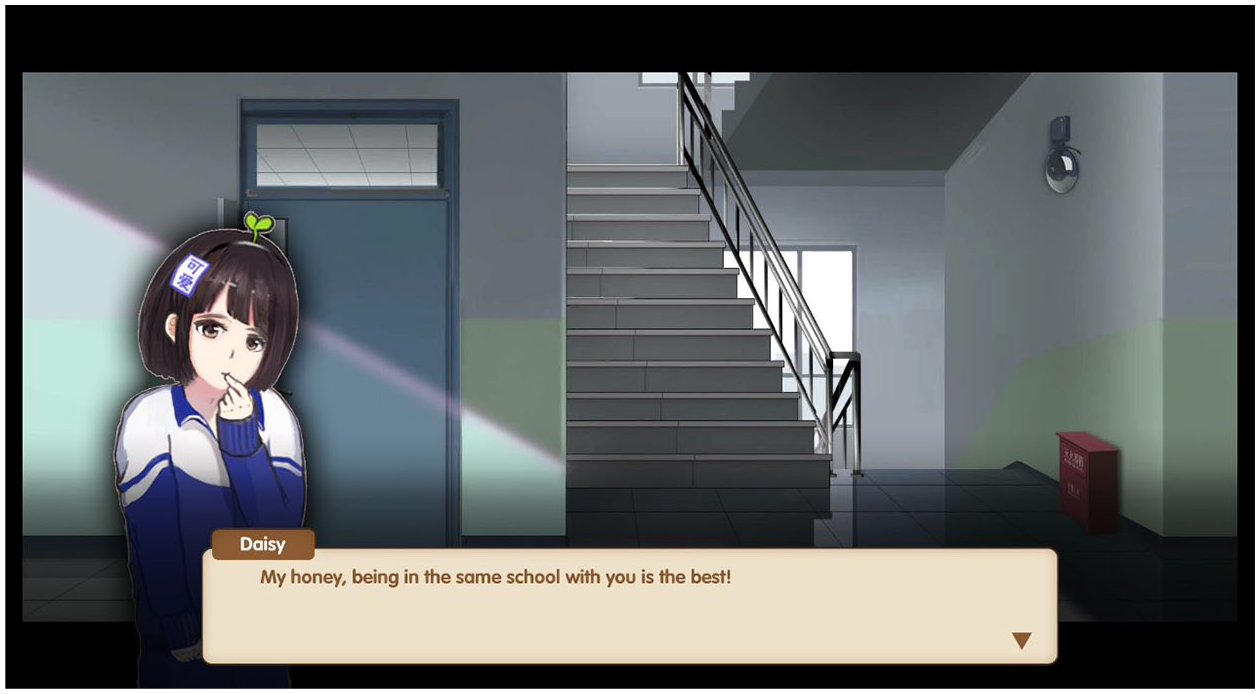
A screenshot from the game featuring Daisy’s half-body portrait illustration in front of a school corridor background illustration. Reproduced with permission.
The character portrait illustration shows that Daisy is a girl with short hair, fair skin, small body build, a narrow face shape and big eyes. She wears a blue-and-white tracksuit top, which turns out to be her school uniform. She is standing in a rather reserved manner, biting her finger in her lips. She tilts her head a little and is slightly shrugging her shoulders. The highlights of the character portrait are the sticker with the Chinese word ‘cute’ written on her fringe and the bud-shaped hairband decoration.
On the ‘conventional’ level, Daisy’s cultural background is shown in her way of dress as well as manners. For example, the tracksuit is a typical style of school uniform in contemporary Chinese primary schools and secondary schools (almost all the other student characters in the game wear the same school uniform). This shows the game artists’ desire to accurately represent Chinese school children’s attire. For Western players, the tracksuit may be confused at first as activewear which does not seem to conform with Daisy’s facial expression and body language that may indicate she is unlikely to be an athletic person. However, players will soon realize that the tracksuit top is part of the school uniform once they discover that all the other characters wear the same style tracksuit tops.
Daisy’s hairstyle is a xue sheng tou (学生头, student hairstyle) that is common among schoolgirls. Although it is hard to tell from a stand-alone character portrait, her hairstyle is a good symbol of her attitude at school when compared to other characters. This is because many Chinese schools have rules on student attire, including rules on hairstyles. For instance, girls are generally advised to keep their hair at or shorter than shoulder length, and to have it as plain as possible. Many schools believe that trendy hairstyles may lead to students spending too much time on grooming and thus negatively influence their studies (Zhang, 2020). Compared to some of the other in-game characters with longer, fancier hair to display their distinctive and rebellious personalities, Daisy’s hairstyle follows the generic hairstyle rules of Chinese school, indicating that she is likely to be a well-behaved, rule-following student. However, she showcases her individuality through hair decorations, on which schools have less restrictions than hairstyle. This includes the worded fringe sticker and the bud-shaped decoration on her hair band. The latter is based on a Chinese internet character Budding Pop, who is an icon of cuteness in Chinese internet culture. The fact that Daisy is wearing the bud-shaped decoration implies that she tries her best to show her cuteness personality within a school environment that has many rules on student dress.
On a deeper cultural level, Daisy represents Chinese schoolchildren’s desire to exhibit individuality through creative means while still following school rules and cultural norms. Although there are rebellious pupils who will do whatever they want, those who are well-behaved tend to find the ‘gaps’ within the school rules – for example, the lack of restriction on hair decorations as compared to hairstyles. Their dress would keep the ‘plainness’ that teachers and parents want, but at the same time display their charm and identity in a low-key manner. When being interviewed and asked about the character designs, the Art Director Geyilang Yang stated that the studio conducted a lot of research into the behaviours of contemporary Chinese school students and the student characters were designed to have both strong personalities and ‘plain features’ at the same time (Yang, 2022). He also stated that the design decisions were made for the target audience of mainland Chinese people who grew up with tracksuit school uniforms and rules on hairstyles. They would be able to both empathize with and identify with the characters as if they were characterizations of the player and their classmates. On the other hand, ‘plain features’, especially the ‘plain’ hairstyles, not only relate to real-life Chinese children but also demonstrate a crucial part of contemporary Chinese school culture that puts emphasis on restricting ways of dress and supressing individualism, thus causing the ‘plainness’. The example of schoolchildren managing to figure out ways to let their individuality shine through this suppression via specific means is a representation of a way of living in collectivist contemporary China: to adapt and ‘co-exist’.
Figure 2 shows the male protagonist sitting in a classroom. The design of the male protagonist changes according to his age range and this screenshot shows him as a pre-teen who is close to finishing primary school. He sits alone in the classroom, supporting his head with his hand, elbows leaning on his knees. Together with a slight frown on his troubled-looking face, his body language depicts the academic pressure of Chinese children at such young age. He wears blue tracksuit bottoms, which are part of his school uniform and has taken off the tracksuit top, revealing a casual T-shirt underneath. The rectangular sleeve badge with two red stripes on his right arm reflects a school culture in contemporary China. This badge symbolizes a student’s position in the Young Pioneers of China. 5 Once the student joins the Pioneers and takes on a certain committee position, they get a sleeve badge like the one shown. The number of red stripes indicates rank, for instance two red stripes imply a higher rank than one red stripe.
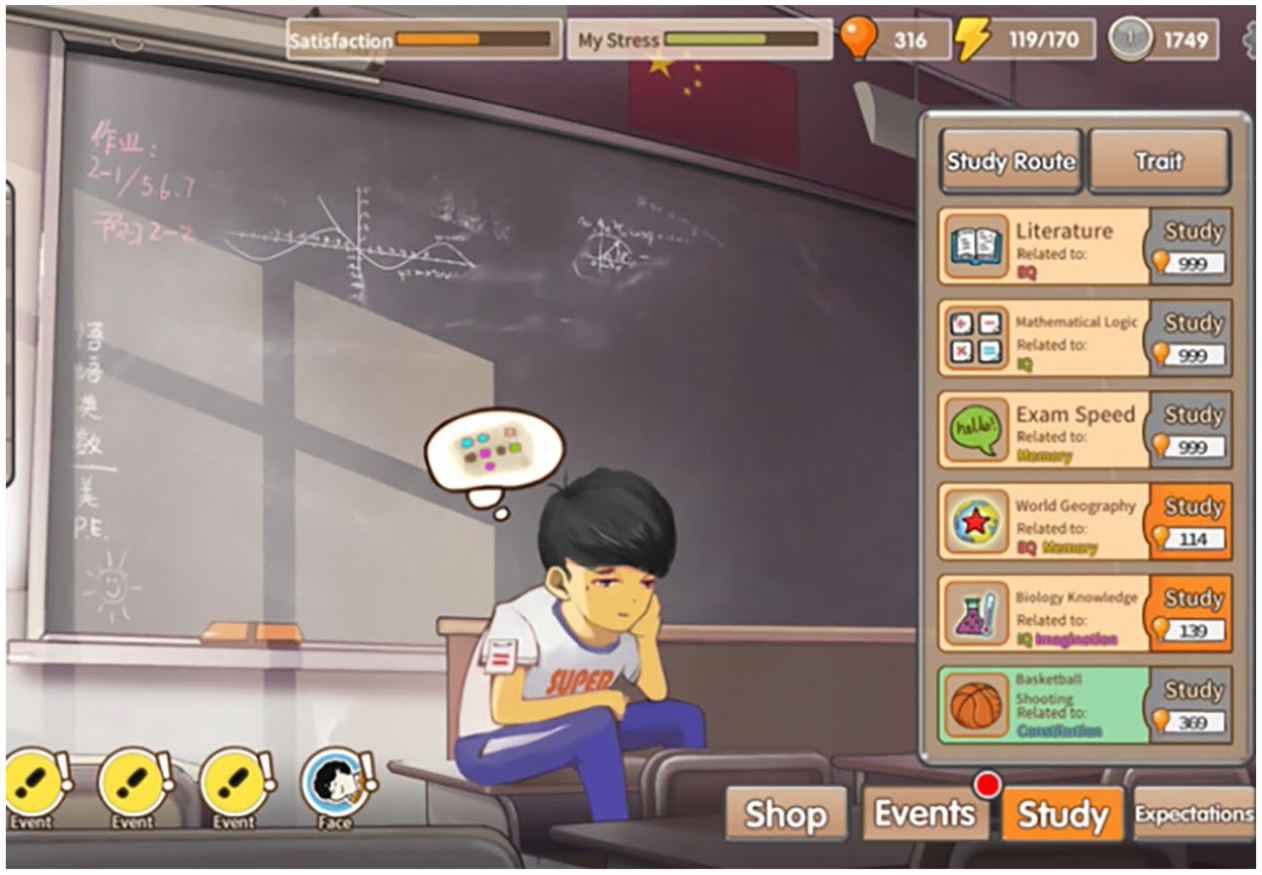
A cropped screenshot showing the male protagonist in a classroom. Reproduced with permission.
Since the game was not primarily aimed towards Western audiences, the addition of the sleeve badge may not have considered interpretations from players outside mainland China. The badge is likely to be very unfamiliar to Westerners. However, the unfamiliarity could provoke interest among Western audiences and encourage further research.
The decision to depict the character wearing the badge could be seen as an effort to represent this particular aspect of contemporary culture but, on a deeper level, it is a reflection of Chinese people’s preference of being in management positions, as well as showing their status and power (i.e. dang guan, 当官). This preference has roots in Chinese history and is still an ongoing trend in contemporary life (Cai, 2014). The badge also indicates that, in contemporary China, bureaucratic systems and officialdom are introduced to children as young as primary school age.
Apart from illustrated images of children and adolescents, the game also includes portraits of parents and other older adults. Figure 3 shows two different character portraits of the father. The illustration on the left (a) is the ‘default’ father portrait the player gets when playing the first generation, and the one on the right (b) is the grown-up version of the protagonist if playing as male. Despite completely different designs, both character portraits imply cultural traits of contemporary Chinese fathers.
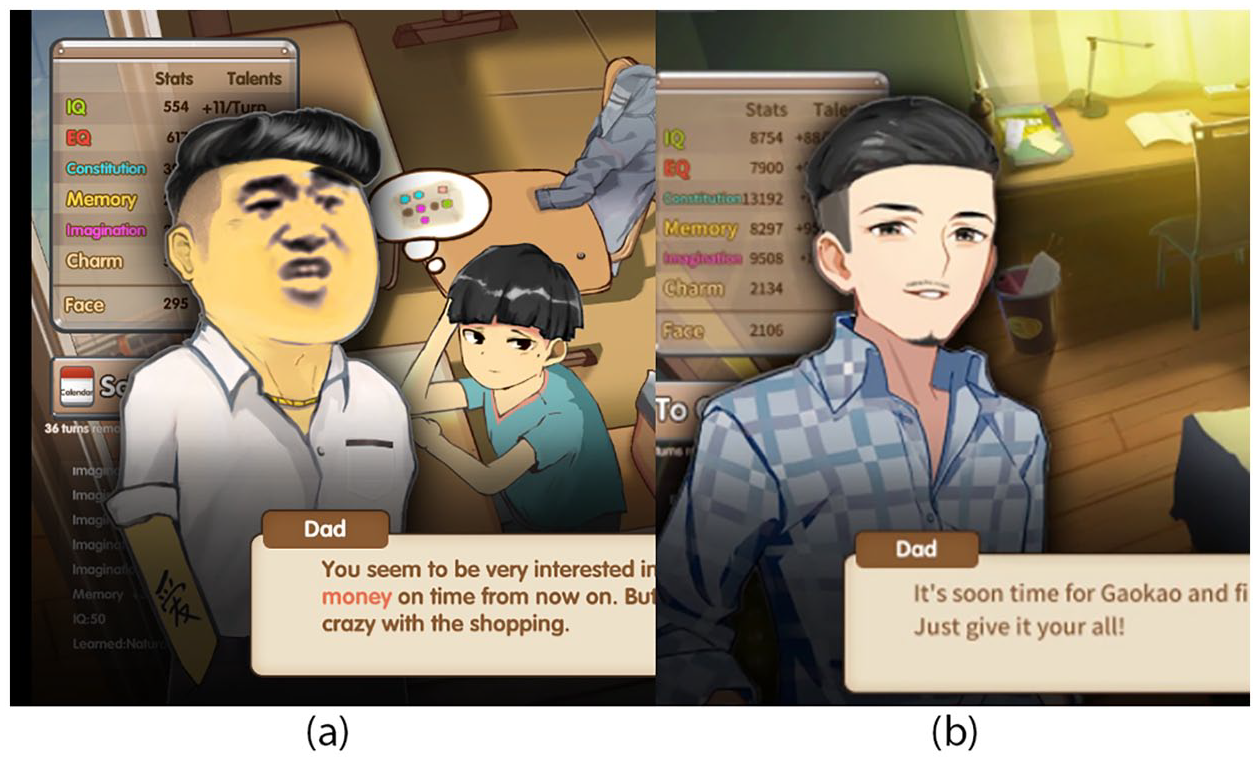
Comparison between the two father illustrations. Reproduced with permission.
Art Director Geyilang Yang stated that the images of the fathers were designed to show the irresponsibility and unreliability of Chinese fathers (Yang, 2022). The character portrait in Figure 3(a) shows the father with a tattoo on his right arm and a thick gold necklace – both of which have cultural meanings on the conventional level. Tattoos are rare in contemporary China, especially among older generations. Due to social stigma, people with tattoos are often associated with crime and are discriminated against in the job market (Wang and Zhang, 2021). The tattoo on this father character indicates that he might be in an unstable job. It also reflects his aloofness towards societal standards and stigma, which could also convey an aloofness towards his family responsibilities. In a Chinese context, gold necklaces are usually considered by younger generations as old-fashioned, tacky jewellery worn by middle-aged people (Doaga, 2021). The father’s gold necklace implies a lack of interest in fashion among middle-aged married Chinese men. Another key visual in this portrait is the face, which is purposely Photoshopped instead of being carefully illustrated. This facial expression originates from a Chinese biaoqingbao meme, which will be discussed in more detail later in this article.
Compared to Figure 3(a), the father portrait in Figure 3(b) is illustrated with better aesthetics and more rigorous human anatomy. Unlike the father from the previous generation, the design of this father does not show any tattoos or gold necklaces. Although the younger generation are more acceptable of tattoos than their parents, at the same time they are also more conscious of the stigma behind tattoos and more concerned about their influence in the family and the workplace, causing them to choose not to get tattoos (Wang and Zhang, 2021). Gold jewellery is not appreciated by younger generations and thus it makes sense for this millennial father not to wear it. In terms of clothing, the character is wearing a check shirt which reflects the ‘check shirt culture’ in contemporary China. There is a stigma that men who wear check shirts are seen as nerdy people working in IT or engineering. Boys in China are encouraged to pursue STEM subjects, resulting in many men working in IT or engineering industries. Influenced by fellow students and co-workers, more and more men in these industries turn to check shirts as their standard fashion. With background knowledge in this, the check shirt on this character could be interpreted as an effective symbol for male identity among Chinese millennials, reflecting three aspects: fashion tastes, job preference and personality.
From a broader cultural perspective, the differences between the two father portraits reflect the change in Chinese men’s attitudes towards family, responsibility and fashion as time progresses. The change from the unreliable tattoo man to the check shirt engineer implies that Chinese men of the new generations are more conscious of supporting their family with proper jobs, as well as their appearance at the workplace (as indicated by the removal of the tattoo). The removal of the golden necklace implies men’s growing awareness of dress and fashion – although they may not spend too much time grooming, as shown in the character wearing a common check shirt, they could indeed be trying to look less tacky.
For non-Chinese players, the hidden meanings behind the tattoo, the gold necklace and the check shirt may not be correctly interpreted due to different cultural stigma and social experience. Therefore, they are not likely to be concerned about cultural messages derived from the two father portraits, but this does not influence their overall experience of contemporary Chinese lives in the game.
Scenes and background art
Background illustrations in Chinese Parents also communicate the lives of contemporary Chinese people. Figure 4 shows screenshots of a contemporary Chinese bedroom (a) and classroom (b).
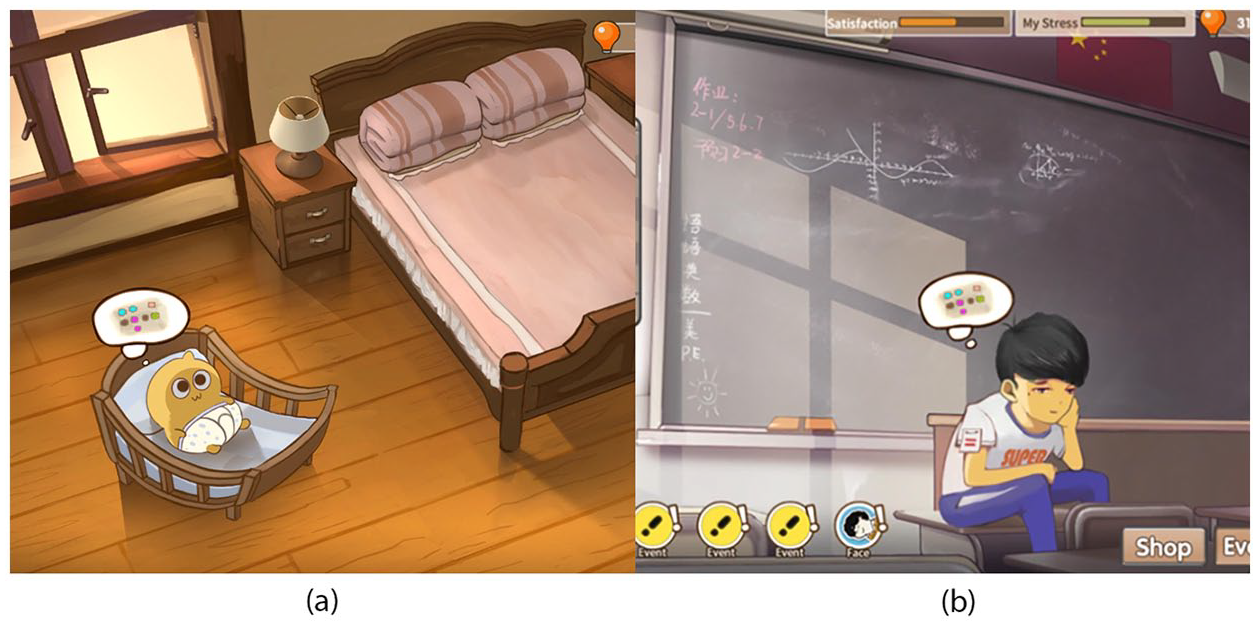
Cropped screenshots of the game featuring a Chinese bedroom and classroom. Reproduced with permission.
In the bedroom, a key visual is the pair of folded up duvets on the bed. Folding up duvets after leaving the bed in the morning is a Chinese custom associated with hygiene and tidiness (Webb, 2013). Rarely practised in Western countries, the images of folded-up duvets convey a crucial aspect of Chinese culture. Similarly, in the classroom, a large blackboard is mounted at the front of the classroom with the daily class schedule written on the side of it. From the crude handwriting it can be inferred that the schedule is written by a duty student (instead of a teacher), which is a common practice adapted in Chinese schools. A Chinese flag can also be seen on top of the blackboard. The Chinese flag is almost a standard decoration for every Chinese classroom and is often placed above the front blackboard.
On the ‘intrinsic’ level of iconology, the contents on the blackboard and the classroom walls reflect not only common school practices and interior design conventions, but also societal expectations for Chinese children. The blackboard schedule implies the existence of a duty student, indicating the importance of taking responsibilities in Chinese children’s upbringing. The Chinese flag above the blackboard means that pupils would inevitably look in the direction of the flag during classes and be reminded of their nationality and culture during their learning. This, in a wider sense, represents that Chinese children are constantly being indoctrinated with the collectivist belief that the aim of studying is for the ‘rise of China’ (为中华崛起而读书).
It has been discussed that the two father portraits in Figure 3 consist of cultural aspects that could be easily picked up by Chinese players, but are unlikely to be picked up by Western players. As for the scenes shown in Figure 4, it is the other way around: the cultural details such as folded duvets are more likely to be disregarded by Chinese players as they are familiar with these aspects in real life and may take them for granted. On the other hand, Western players are likely to feel intrigued seeing the folded-up duvets, the class schedule on the blackboard (if they could read Chinese) and the Chinese flag. The unfamiliarity could lead them to consider these features as unique objects of Chinese culture.
Supporting illustrations: the application of biaoqingbao memes and culture-specific icons
In Chinese social media, there are different types of biaoqingbao. Some are similar to WhatsApp stickers, which often contain a certain character that conveys a specific expression, while others are images that recontextualize photos of exaggerated facial expressions from viral images into visual texts. These are often used to reflect social issues, initiate argument or increase humour/satire by replacing textual communication (Cao, 2021; Jiang and Vásquez, 2020). The sticker-like biaoqingbao images are usually created by professional artists, while the photo-recontextualizations are often made by ‘normal people out of interest’ (Cao, 2021: 254), referring to people who are interested in making these memes but are not professional visual artists. Because they are not made by professionals, the image quality of self-made biaoqingbao images is usually low. However, this low-quality, highly compressed JPG aesthetic has now become an iconic trait of biaoqingbao memes.
In Chinese Parents, the illustrations that consist of biaoqingbao images are deliberately rendered in a simplistic, low-quality art style to match the aesthetics of biaoqingbao memes, while connecting with the player emotionally by showing humorous familiar imagery that can evoke a strong response. In Figure 3(a), for example, a distorted biaoqingbao meme of Jacky Cheung’s facial expression is placed on the father’s face. This facial expression originates from a scene in the movie As Tears Go By (Wong, 1988), in which the character played by Jacky Cheung triumphs over and humiliates his enemy by pointing a gun at him and throwing banknotes onto the ground for him to pick up. In Figure 3(a), the dialogue box shows that the father is willing to give the child pocket money but only a very limited amount. In this scenario, Jacky Cheung’s exaggerated facial expression is recontextualized. The father certainly does not triumph over or humiliate his child but, as the breadwinner of the family giving a small amount of pocket money to his child, it could be read as a reference to the original scene in the movie, as if the father is ‘throwing’ pocket money onto the ground for the child to pick up.
Other popular biaoqingbao images, such as the laughing face of Korean actor Choi Sung-guk and the grinning face of D’Angelo Dinero, can also be found in the supporting illustrations in Chinese Parents. They have all been recontextualized to illustrate stories in the game. These biaoqingbao facial expressions are extremely popular on Chinese social media, meaning that Chinese players will have little difficulty in decoding them. Not only are they placed in appropriate situations to enhance the visual communication of the character illustrations, but they also obviously display the crucial roles of biaoqingbao memes in the lives of people in contemporary mainland China. As for Western players, who are mostly unfamiliar with this biaoqingbao meme culture, it is likely that they would notice and be amused by these low graphic quality, Photoshopped character faces that look out of place. As they progress through the game and notice many of these biaoqingbao faces, they would recognize that this is not a result of accidental cheap illustration designs but a design decision made by the game artists.
The use of biaoqingbao can be seen as a deliberate act of displaying Chinese culture. However, some of the other supporting illustrations, which may not have the obvious intention of communicating culture, could implicitly convey cultural knowledge to Western audiences. Figure 5 shows a screenshot of the class president election result. We can see Chinese characters ‘正’ written on the blackboard. Because it has exactly five strokes and an orderly shape, this Chinese character is usually used as an icon for tally charts in China and is commonly used in school elections. Instead of just describing the election results verbally or numerically, the game’s visual designers have decided to include these tally charts on a blackboard to illustrate the scene of the election. This not only visualizes the election experience for the player but also accurately represents the key cultural aspects of a Chinese school class president election. The scene in this screenshot perfectly describes what happens during a class president election in a Chinese school, where tally charts with the character ‘正’ are written under student names to indicate the number of votes they have received. As a game aimed towards Chinese audiences, the decision to incorporate this type of tally chart may not have taken Western audiences into consideration. However, by relating the graphics to the game content, Western players could work out the meanings behind these Chinese characters and associate them with tally charts, and thus learn about this particular aspect of culture in China.
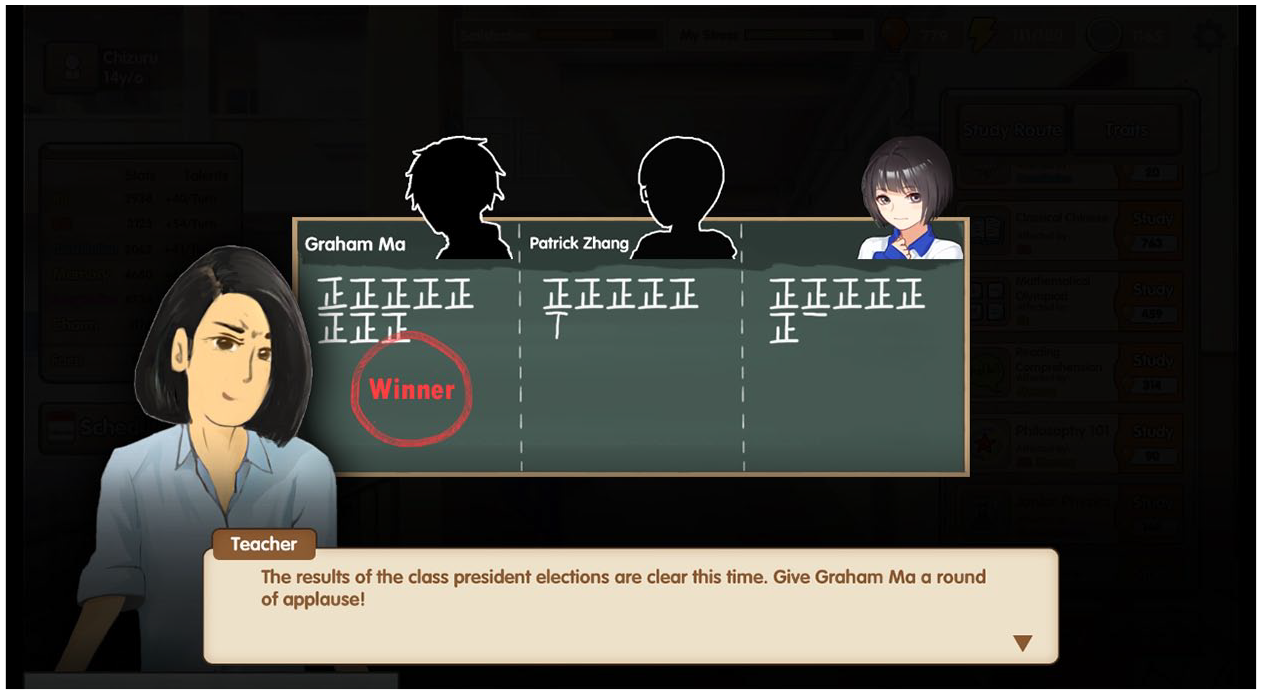
A screenshot from the game featuring a unique Chinese tally chart. Reproduced with permission.
Limitations: addressing cliché but still relying on stereotypes?
Although Chinese Parents minimizes clichéd, traditional-focused representations of Chinese culture, the game does include some questionably stereotypical images. Firstly, the ‘tiger mum’ (a common Western stereotype of Asian parents) is introduced in this game and has been seen as the ‘selling point’ for Western audiences, as indicated in the news report from The New York Times (Zhang and Zhong, 2019). Although the ‘tiger mum’ has been acknowledged by the Chinese themselves, as evidenced by discussions on government official media platforms (CNTV, 2022) and related TV dramas such as Hu Ma Mao Ba (虎妈猫爸, which can be translated as ‘tiger mum and cat dad’) (2015), it is still an over-simplified, homogeneous categorization of a Chinese parent. Much like the stereotypical use of culture used in tourism (Dann, 2001), including this stereotype has attracted Western players to play the game. As they play through the game, players could gradually find out other aspects of contemporary Chinese lives and culture that they are unfamiliar with, alongside the ‘tiger mum’ stereotype. This is a good example of utilizing a stereotype to draw attention initially and conveying more meaningful messages afterwards.
Visual representations that might be considered as stereotypical by players include the student characters’ school uniforms and hairstyles, the check shirts of middle-aged men and the illustrative portrayal of ‘irresponsible’, ‘unreliable’ Chinese fathers. The appearance of school uniforms and hairstyles, however, are determined by the prevalent school rules in China, and therefore the generic visual depictions are not a result of over-simplification but a response to a phenomenon. The connotations behind check shirts, as well as some other aspects of character designs such as the Budding Pop decoration, thick glasses for ‘nerdy’ students and sweatbands for sport-oriented students, are stereotypical symbols. However, these stereotypical designs have little effect on the main objective of the game – to represent the life of a Chinese child living in contemporary China, which has been achieved through many other visual aspects and in-game interactions. The ‘unreliable’ father could be seen as a gender stereotype which may raise criticism, but it has been addressed. The gameplay has a generation/family-tree system that allows the protagonist to have their own family and child, and their child to have their own as well. The stereotypical images of fathers (and mothers) only appear in the first generation and, in the following generations, the personalities of the parents are determined by whom the protagonist is married to. The protagonist will have chances to marry their high school date when they grow up, which can be chosen among the group of classmates with different personalities. For example, marrying the study nerd Hans Jiang and marrying the otaku John Zhu will result in fathers of completely different and distinctive personalities in the next generation, who have more dynamic character traits than the stereotypical father in the first generation. This game system design of enhancing the parents’ personality in the newer generations could encourage players to reflect upon stereotypical images of fathers and mothers in the first generation and potentially change their views on gender roles, responsibilities and identities.
To summarize, the game Chinese Parents does contain some stereotypical representations and this could be seen as its limitation. Nevertheless, these stereotypes are addressed later in the game, are inevitable design decisions resulting from specific social rules in China and/or have minor influence on the communication of the main ideas.
Conclusion
Chinese Parents demonstrates that the culture of an oriental nation is much more than just traditional clichés played out in a fantasy setting. Representing the contemporary lives and cultures of a country that is often seen as the ‘oriental exotic’, such as China, tackles a common superficial Western view that cultures of the oriental countries only involve heritage and traditions. In Chinese Parents, the contemporary lives of Chinese people are displayed through multiple visual factors and even the slightest detail, such as a badge on a sleeve or a tally chart on a blackboard, act as culture signifiers that communicate information to the player. Besides contents, the art style of the game also showcases aspects of pop culture, such as the anime/manga style designs of the character portraits and the application of biaoqingbao memes. All these visual factors illustrate the underrepresented contemporary Chinese culture precisely and appealingly, forming a unique visual identity within the game. By including these visuals, the game succeeds not only in popularity, but also as a cultural artefact.
The popularity of Chinese Parents in both China and the West indicates that not only Chinese players but also Westerners could become interested in the representation of the more contemporary perspective of China. The game successfully attracted Chinese players with life-simulation and nostalgia. By incorporating details of cultures into the illustrations, especially the characters with whom players could identify, the game efficiently conveys messages of culture through visual aspects. The rich varieties of contemporary culture visual representation in this game greatly challenge the excessive representations of traditional Chinese culture in video games.
Overall, this game demonstrates that, when a cultural group represents itself, the people of this group are much more adept at picking up the underrepresented aspects and details, compared to that of a dominant group who wants to represent them. The game serves as a good example and inspiration for designers who aim to exhibit the underrepresented contemporary lives of a country/civilization that has long been represented through traditional (and often clichéd) viewpoints.
Footnotes
Acknowledgements
We would like to thank Dr Melissa Kagen and Professor Sonia Fizek for their helpful comments and feedback on the initial draft of the manuscript.
Declaration of conflicting interests
The authors declared no potential conflicts of interest with respect to the research, authorship and publication of this article.
Funding
The authors received no financial support for the research, authorship and publication of this article.

Notes
Biographical notes
XIYUAN TAN is a Lecturer in Graphic Design at Loughborough University. They teach a broad range of subjects including graphic communication, illustration, visual narratives and practice-based research methods. Their research interests are character design, visual storytelling, visual representation and application of illustration in various contexts.
Address: School of Design and Creative Arts, Loughborough University, Epinal Way, Loughborough LE11 3TU, UK. [ email:
HAILEY J AUSTIN is a Lecturer in Visual Media and Culture at Abertay University in Dundee, Scotland. She teaches and researches global creative industries, specifically comics, zines, video games and board games in the UK, Sweden and China.
Address: Abertay University, Bell Street, Dundee, Scotland DD1 1HG, UK. [ email: