



Abstract
While there is an abundance of research concerning the gendered dimensions of video gaming and online communities, there is a limited focus on gameplay competence. This study examined the relationship between sexism and gendered perceptions of competence in gaming. Three hundred and 85 participants volunteered to take part. Participants were randomly allocated to one of three gendered conditions (female, male or neutral). Participants watched two video game clips within each condition (novice and expert playthroughs). Participants rated the competence and warmth of the players, estimated the number of errors made and completed the Ambivalent Sexism Inventory. The findings indicated that female and neutral clips were perceived as less competent than male clips in both skill levels. This difference was more pronounced in the expert level. Warmth ratings varied significantly across conditions. Hostile sexism predicted lower perceptions of warmth. The study demonstrates the need for inclusive and safe online gaming environments.
Introduction
The world of gaming has become a vast domain. Modern gaming encompasses digital or electronic games that can be played solo or cooperatively on a range of devices (e.g. smartphones) (Veltri, Krasnova, Baumann & Kalayamthanam, 2014). Despite the expanse of the gaming world, the ‘gamer’ identity is still often associated with computer and console-based play. While almost half of the online video gaming population is thought to be female (Entertainment Software Association, 2019), significant barriers remain for women (Fox & Tang, 2014), including perceptions of women’s lesser competence in a seemingly masculine domain (Jenson & de Castell, 2010). The question is, what makes the gaming domain masculine? Expectation States Theory suggests that, within gaming spaces, men occupy a higher status. As a result, male gamers are perceived as more competent than their female counterparts (Fox & Tang, 2014).
The theoretical assumption made by Expectation States Theory has also been supported within the literature. Kuzenkoff and Rose (2012) found that, regardless of performance, controlling an avatar that spoke with a female voice in ‘Halo 3’ elicited three times more negative comments about gameplay compared to an avatar with a male voice. These stereotypical perceptions are not exclusively held by male players. Beavis and Charles (2007) interviewed a team of female gamers that played Counter Strike competitively. Despite the significant skill required to game at a competitive level, the participants still compared their skills to their male counterparts, describing their ability as ‘pretty good for a girl’ (Beavis & Charles, 2007, p. 699). The phenomenon of attaching higher competence to males than females is not only reliant on the actual player. Small decisions such as avatar design can also have an impact. Kaye, Gresty and Stubbs-Ennis (2017) found that participants rated competence more highly when male avatars were used, and that female players with a male avatar were perceived as more competent than those with a female avatar.
The literature clearly suggests that there is an engrained sexism within gaming environments. There have been a few suggestions as to why these perceptions exist. Gerbner and colleagues (2002) suggest that engagement with media in the long-term can have a significant impact on real-world perceptions towards those that are represented by media content. The concept became known as Cultivation Theory (Gerbner, Gross, Morgan & Singnorielli, 2002). Gerbner and colleagues did posit this theory to address media in the form of television or movies, but more recently Cultivation Theory has been applied to the impact video games can have on player attitudes (Behm-Morawitz & Ta, 2014; Festl, Scharkow & Quandt, 2013).
Female representation within video games is well-documented and provides some clear expectations of what females in gaming contexts should encompass (Eden, Maloney & Bowman, 2010; Kowert, Breuer & Quandt, 2017). In a two-part study, Dill and Thill (2007) surveyed university students, asking them to describe what their understanding of a female video game character should look like. Generally, these findings suggested that female characters were to be viewed as sexual objects and should be viewed as less important than the males (Dill & Thill, 2007). When taking these expectations in tandem with Cultivation Theory, exposure to females in gaming environments that are represented in a sexualised or stereotypical way could potentially cultivate negative perceptions.
Cultivation theory may not explain gendered perceptions in gaming domains as comprehensively as other models, considering that there is often limited information available about the gender of the player in online games (e.g. may be interpreted via gamertag used). Models that focus more heavily on gender stereotypes are likely to offer more useful frameworks for exploring associated gendered perceptions of competence. Here, the Ambivalent Sexism Theory deepens our understanding of how these beliefs or perceptions are derived from gender roles and stereotypes (Ramos, Barreto, Ellemers, Moya & Ferriera, 2018). This theory suggests that there are two types of sexism that exist within society; hostile and benevolent sexism (Glick & Fiske, 1996). Hostile sexism reflects more misogynistic views of women, exploring an antagonistic approach to females who are perceived as challenging male power. Benevolent sexism, on the other hand, demonstrates a seemingly positive attitude towards women, but reflects a positive attitude only towards women who are perceived as less competent but warmer than men (Delacollette, Dumont, Sarlet & Dardenne, 2013). Both of these components are reactions to one specific factor; that is, the role women are supposed to take on in society. As highlighted previously, gaming is perceived as a masculine domain, as such, ambivalent Sexism Theory can help explain how the perceived roles of women within this domain can contribute to perceptions of lesser competence.
Whilst Ambivalent Sexism Theory can aid in understanding how gendered perceptions emerge, it has limited capacity to tell us how the beliefs about gender roles are communicated (Ramos et al., 2018). When taken in line with other frameworks, however, a more comprehensive understanding is built. The Stereotype Content Model (SCM), for example, examines interactions between the dimensions of competence and warmth to explain stereotypical behaviour (Cuddy, Fiske & Glick, 2004). Cuddy and colleagues (2004) suggest that the combination of warmth and competence can evoke prejudicial emotions and different types of discriminatory behavioural tendencies including active harm (e.g. attack), passive harm (e.g. derogation, exclusion), helping, and cooperation. For example, groups that are perceived as both incompetent and cold can evoke disgust and are more likely to be the target of passive harm (or antipathy/exclusion). The model enables the examination of perceptions about different groups of women, in this case, female gamers, and the intersections of these dimensions (e.g. female gamers may be perceived as warm but incompetent).
Fiske, Cuddy, Glick and Xu (2002) noted that most female subtypes are typically respected or liked but not both. That is, women groups who are seen as warm but not competent are likely to evoke condescending affection, whereas women who are seen as competent but not warm can elicit envy and resentment (Fiske et al., 2002). Such attributions of females are particularly important for interactive gameplay, the SCM competence/warmth dimensions can be predictive of cooperation and group inclusion (Fiske et al. 2002), which would have significant implications for online gaming communities and interactive play settings. Given this pattern, it is possible that female gamers at different skill levels may be stereotyped differently, as either competent but cold or incompetent but warm.
There are various factors that can determine how perceptions of warmth and competence are placed on females. The dimensions of warmth and competence are often prescriptive, used as a method of describing males and females in their ‘socially accepted’ roles. For example, Prentice and Carranza (2002) asked university students to rate a man, woman or undefined person’s desirable traits. The traits attributed to the woman were mainly warm, for example, warm, kind, cooperative. The male traits were related to competence, ambition and assertiveness. Women’s’ traits in this case focused more on benefits to the collective, whilst the male traits were more autonomous.
These traits perpetuate the beliefs recognised within the Ambivalent Sexism Theory. Ramos and colleagues (2018) identified the link between ambivalent sexism and the traits of warmth and competence. Their studies highlighted that benevolent sexism communicated a view of women as warmer than men. In comparison, hostile sexism communicated women as less warm than men. The similarity between both types of sexism, however, can be found within the perceptions of competence. Both hostile and benevolent sexism viewed women as significantly less competent than men (Ramos et al., 2018). Combining both the SCM and Ambivalent Sexism Theory within this study created an improved understanding of how the preconceived beliefs about females are perpetuated.
Ramos and colleagues’ studies (2018) provide a strong argument for incorporating both theories when examining perceptions of gender competence. Together, the SCM and Ambivalent Sexism build a comprehensive picture of the emergence and subsequent behaviours associated with gender stereotypes. As a result, within the current study, we aim to expand on the literature by systematically examining how the SCM and Ambivalent Sexism Theory frameworks can contribute to our understanding of gender perceptions in online gaming. As highlighted above, the SCM can explain stereotypes in cooperative and interactive play, however there are other variables that can confound exploring these relationships when the participant is also engaged as a player. The study, therefore, will focus on how the SCM can explain perceptions of competence when the participant is an observer, judging players in a single-player game, removing the confound of interactive or team play. Because other team members are removed, there is also the possibility to determine whether individual beliefs out with gaming environments can influence perceptions of gameplay. The implementation of the Ambivalent Sexism Theory helps address this.
There are various methods of manipulating gender in gaming studies. The current study aims to manipulate the perceptions of player gender through the use of voice priming, also known as utterances, consistent with the manipulation used in Kuzenkoff and Rose’s study (2012). Kuzenkoff and Rose also highlighted the possibility that skill level could have an impact on perceptions of competence. As a result, the study reported here will also manipulate skill level to determine whether this will have an impact on gender perceptions. In addition, the study will aim to measure competence both objectively (measuring the number of perceived errors made during gameplay) and subjectively (using the Warmth Competence Scale as designed by Cuddy et al., 2004).
Based on Expectation States Theory, it was hypothesised that video clips depicting female utterances will be perceived as less competent, and as having made more errors compared to male and neutral clips across both skill levels (
Methods
Participants
A total of 385 participants from Australia and Scotland with a mean age of 26.21 (SD = 10.93) volunteered to take part in the study. Of these, 276 identified as female (71.7%), 107 (27.8%) as male and 1 (0.3%) as transgender. Participants were invited to take part of the study via a course credit participation system and social media. One hundred and thirty-one (34%) participants were randomly assigned to the female utterance condition, 127 (33%) to the male utterance condition, 127 (33%) to the neutral utterance condition.
Materials
Video Game Clips
Six video game clips were created for the study. The video game clips depicted a person playing the video game ‘I am bread’, a 2d physics-based platform game. The game was specifically selected because of the gender-neutral character (i.e. a piece of bread) to avoid any possible confounds produced by female/male avatars/characters. Two video game clips were produced, one for the expert level where the player obtained an ‘A+’ rating at the end of the game, and one for the novice level where the player obtained a ‘Fail’ rating. Once the two videos were produced, the clips were edited with the voiceovers of male utterances, female utterances, and no utterances (neutral). The voiceovers were scripted by the researchers, and characterised by utterances that depicted confusion, frustration, surprise, motion, laughter and joy (e.g. ‘oh no’, ‘argh this is way too difficult’, ‘yes!’).
Measures
Perceptions of Competence: Stereotype Content Model
Participants were asked to rate the videos on traits related to competence (e.g. skilful, capable) and warmth (e.g. friendly, sincere) on a 7-point rating scale from 1 = not at all to 7 = extremely as per the SCM developed by Cuddy et al. (2004).
Ambivalent Sexism Inventory
All participants were asked to rate their personal perceptions of the relationships between men and women as per the Ambivalent Sexism Inventory (Glick & Fiske, 2011). The 22-item questionnaire measured both Hostile (e.g. ‘women seek to gain power by getting control over men’) and Benevolent Sexism (e.g. ‘a good woman should be set on a pedestal by her man’) on a 5-point scale from strongly agree to strongly disagree. According to Glick and Fiske (1996), the ASI has good internal consistency, with Cronbach alpha coefficients between 0.73 and 0.85 for Benevolent Sexism and 0.83–0.92 for Hostile Sexism. In the current study, a similar degree of reliability was found for both Benevolent Sexism (α = 0.78) and Hostile Sexism (α = 0.87).
Design and Procedure
Participants were randomly assigned to one of the three gender conditions in a 3 (male, female, neutral utterances) × 2 (expert, novice) mixed design. Gender was manipulated as a between-subjects factor and skill level of players as the within-subjects factor. The study was conducted online via Qualtrics. Participants were provided with an anonymised link via the recruitment flyer. Once the participants had clicked on the link, they were met with an information sheet that indicated the study was exploring gameplay and social groups. Participants were randomly assigned by Qualtrics into one of the three experimental conditions (male, female and neutral) and were asked to rate two video game clips with differing skills levels (i.e. expert and novice). The order of presentation of the video game clips according to skill level was randomised. After watching each video game clip, participants were asked to report the number of mistakes they thought the player made (using a rating scale from 1 to +50) and then asked to rate the ‘player’ on the SCM Scale. Participants were then asked to complete the Ambivalent Sexism Inventory and answer demographic questions. The survey took approximately 20 minutes to complete.
Results
Means and Standard Deviations for Perceptions of Competence, Warmth and Errors Across Gender and Skill Conditions.

Note. Standard deviations appear in parentheses; na = 130; nb = 127; nc = 127.
For competency ratings, an interaction effect was found between gender and skill, [Wilk’s Lambda = 0.98, F (2, 381) = 3.06, p =0.048], with a small effect size [η
2
p
= 0.02]. The interaction indicates that competency ratings differed for male, female, and neutral clips across expert and novice levels. Simple contrasts showed that the expert clips (M = 3.43, SE = 0.06) were rated as significantly more competent than novice clips (M = 5.16, SE = 0.06), Wilk’s Lambda = 0.36, F (1, 381) = 674.23, p ≤ .001, CI [−1.87, −1.61]. Figure 1 shows that female clips were reported as less competent than male clips in both the expert and novice levels, but the difference was significantly more pronounced for the expert level (Mean difference = −0.35, SE = 0.13, p = .018, CI [−.65, −.05]). Female clips were not rated as less competent than neutral clips (p = .890), but neutral clips were rated as significantly less competent than male clips (Mean difference = −0.41, SE =.13, p = .004, CI [−0.71, −0.10]). Demonstrating significant differences in mean competence scores across skill and gender conditions. Note. Errors bar represent 95% CI.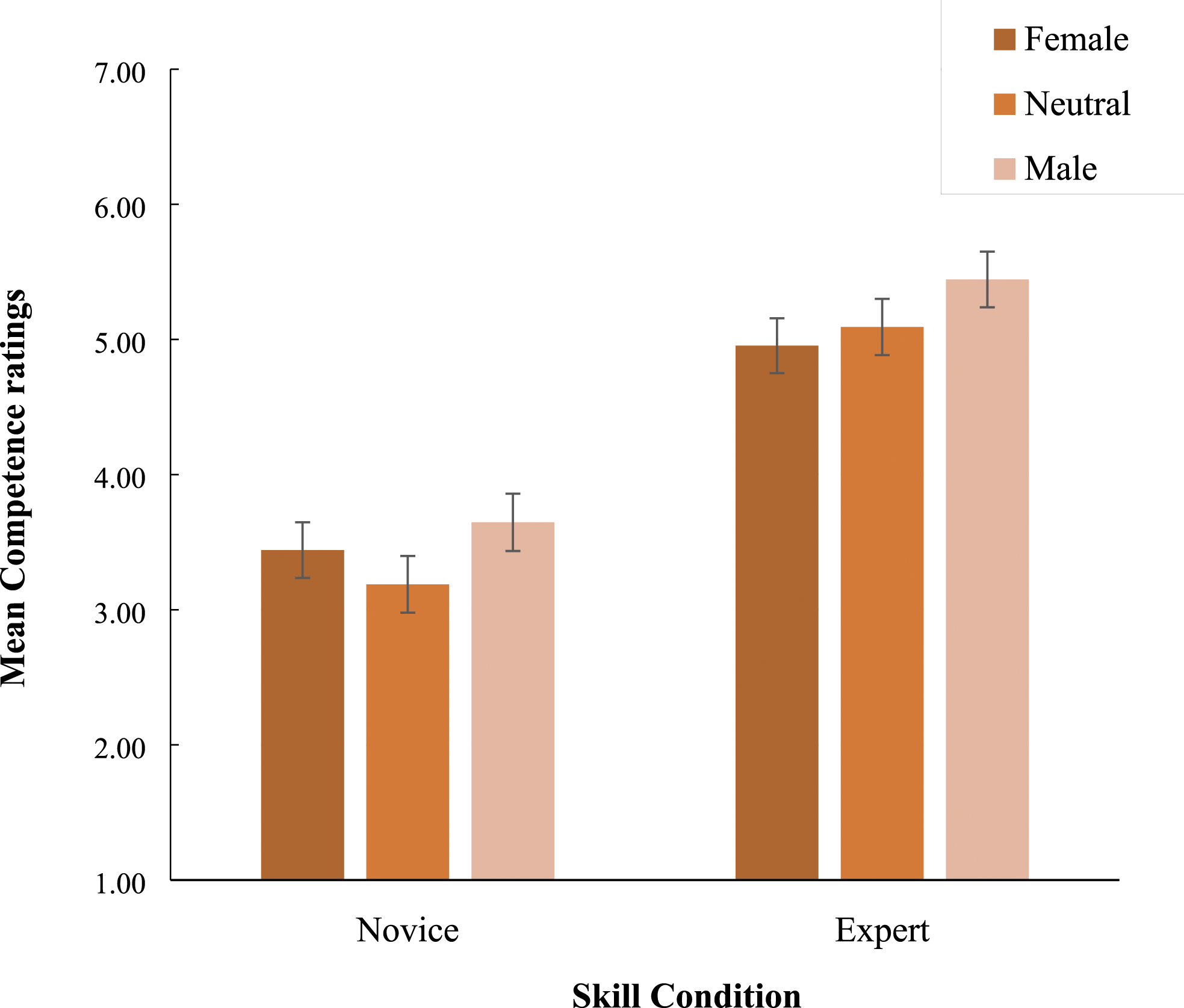
When examining error estimates, a significant main effect for skill level was found, (Wilks’ Lambda = 0.41, F [1, 382] = 541.22, p = .000, η 2 p = 0.59). Here, novice clips (M = 12.50, SE = 0.33) were rated as displaying more mistakes than the expert clips (M = 5.54, SE =0.23) across all gender conditions. Contrary to expectation, however, there was no significant main effect for gender, (F [2, 382] = 1.94, p = .145, η 2 p = 0.01). Participants’ perceptions of errors did not differ significantly across all gender conditions. Additionally, no interaction effect was found between skill level and gender conditions, (Wilks’ Lambda = 1.00, F [2, 382] = 0.28, p = .97, partial η 2 = 0.000)
For ratings of warmth, a significant main effect for skill level was found, (Wilks’ Lambda = 0.863, F [1, 381] = 60.51, p ≤ .001, η 2 p = 0.137). Novice clips (M = 4.25, SE= 0.06) were reported as less warm than the expert clips (M = 4.68, SE = 0.06) across all gender conditions. Ratings of warmth also differed significantly across gender conditions, F (2, 381) = 34.34, p ≤ .001, η 2 p = 0.153. Simple contrasts analysis demonstrated that female clips (M = 4.69, SE = 0.09) were perceived to be less warm than the male clips (M = 4.83, SE = 0.09) but this difference was not significant (mean difference = −0.14, p = .74). Neutral clips (M = 3.89, SE= 0.09) were rated as significantly less warm than both female and male clips (p ≤ .001, CI [−1.09, −0.51]; p ≤ .001, CI [−1.23, −0.64], respectively). The interaction effect between gender condition and skill level was not significant, (Wilks’ Lambda = 0.992, F [2, 381] = 1.60 p = .203, η 2 p = 0.008).
Ambivalent Sexism
Demonstrating Correlation Coefficients Between Gender Conditions, Skill Conditions, Benevolent and Hostile sexism.
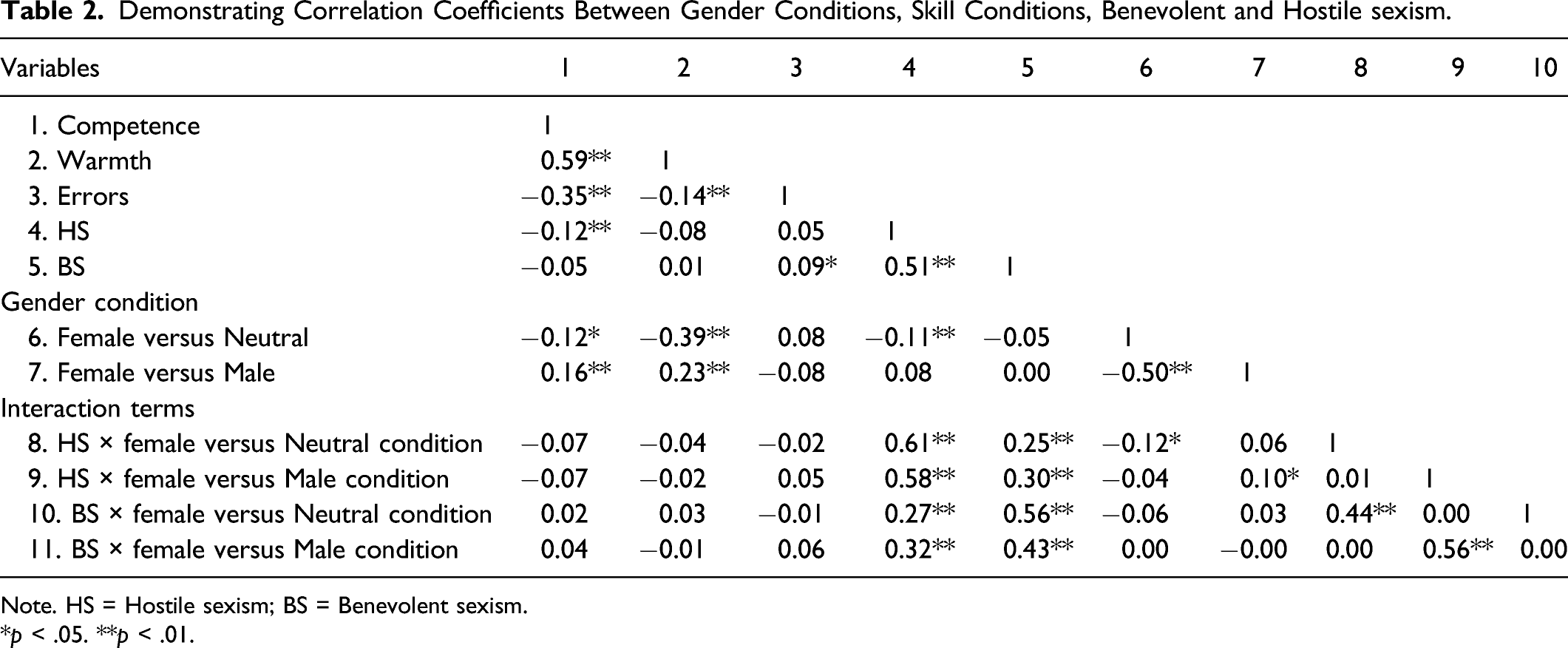
Note. HS = Hostile sexism; BS = Benevolent sexism.
*p < .05. **p < .01.
The relationships between benevolent and hostile sexism and ratings of competence and warmth were investigated using a series of hierarchical multiple regressions. The gender of the participant was entered in the first block, and hostile sexism, benevolent sexism, gender condition, and interaction terms between hostile sexism and gender condition, and benevolent sexism and gender condition were entered in block 2. Interaction terms were included in the regression analysis to examine if perceptions of competence and warmth were conditional of sexist beliefs and gender condition participants were assigned to.
Summary of Regression Analyses for Variables Predicting Perceptions of Competence, Warmth, and Errors Across Skill Levels.
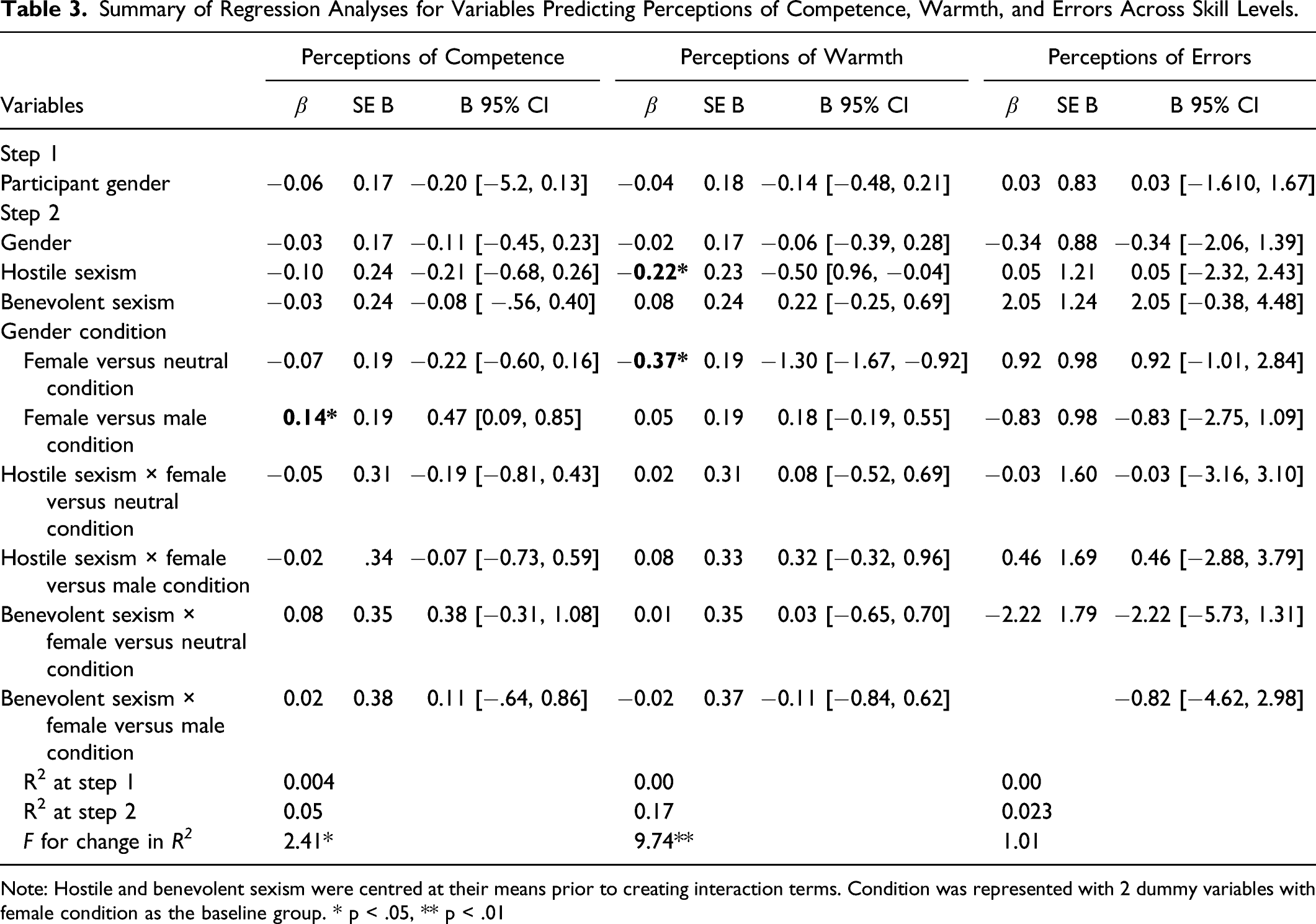
Note: Hostile and benevolent sexism were centred at their means prior to creating interaction terms. Condition was represented with 2 dummy variables with female condition as the baseline group. * p < .05, ** p < .01
Discussion
The study builds upon previous developments in this area by systematically examining the relationship between player gender and perceptions of gaming competence through the SCM and the ASI. In this study, it was found that videos with female utterances were rated as less competent than those with male utterances; providing partial support for
Interestingly,
When taking both error ratings and competency ratings into account, the findings cohere with Kuzenkoff and Rose’s (2012) findings. It is also in line with expectation states theory findings that suggest that women are often seen as less competent (Fox & Tang, 2014; Ivory, 2009; Kaye et al., 2017). Regardless of the performance, more negative feedback was given where the player was perceived to be female. This could suggest the role of gender-based stereotypes in the interpretation of overall performance, rather than perceptions formed during real-time play.
Alternatively, the lack of significant difference in errors could provide further support for the interpretation of stereotypes. The number of errors is an objective measure of competence. This can be seen through the difference in errors across skill condition. The measures of competence, in comparison, are purely holistic and open to interpretation. Whilst skill level would make an objective difference to the number of perceived errors, the perceptions of competence would be further impacted by other subjective factors. This would add support to the argument that the perception of female competence was low even when objective skill was exactly the same.
Contrary to expectations, warmth was rated higher in the voice conditions than in the neutral condition, but the videos with female voices were rated as significantly less warm (
Methodologically, the ratings of warmth within the ‘neutral’ condition could be partially explained by the nature of the stimulus materials. A video without a voice (i.e. neutral clips) may not have provided enough cues to participants to make accurate judgements of warmth. This would suggest that the SCM framework may apply aptly in the context of online gaming, in which stereotypical judgements are often reliant on vocal cues (Ivory, Fox, Waddell & Ivory, 2014)
When measuring the effects of benevolent and hostile sexism on reported scores (
The findings regarding hostile sexism are in conflict with previous research (Ramos et al., 2018). There are a few possibilities as to why this may have been found. The ASI measures clear beliefs around societal norms (for example, a few questionnaire items explore sexism in employment and hiring policy). Whilst that might predict competence and warmth in general society, there may be other factors that influence how these norms are viewed in gaming contexts. It is possible that there are moderating factors that have not been considered in the study, such as identification as a gamer or engagement in cooperative play. It is also possible that societal norms differ significantly in gaming environments. It may be that greater conceptual clarity needed around the functionality of the ASI when measuring sexist beliefs in very specific domains.
Limitations
The results should be interpreted in light of several limitations. The sample was derived from the general and student population rather than a targeted gaming population. Additionally, more than two thirds of the sample were made up of female participants, which is at odds with the near parity of female and male gamers reported to engage in gaming (Entertainment Software Association, 2019). While efforts were taken to neutralise other gender cues, the type of game itself may have had an impact, as previous research indicates that game types might be gendered. For example, Eden et al. (2010) found that puzzle games, such as the one used in this study, could be viewed as more feminine. The voiceovers were scripted as a result of researching videos of relevant gameplay and reviewed within the research team. This may mean that some authenticity may be lost in the final version of the clips, however, this approach was deemed to provide greater control across conditions (e.g. accents of players).
Implications and Future Directions
The findings reported here show that perceptions about women’s ‘inferior’ competence are troublingly persistent. These data are concerning as research suggests these perceptions form a barrier to women’s full digital citizenship and such views may also, in turn, impede women’s gaming performance (Citron & Norton, 2011; Kaye & Pennington, 2016). While women appear to be actively engaging in gaming, a key implication of these findings is that exposure to female players in gameplay may not solely be enough to change entrenched perceptions. As seen in our analysis, there is a lack of conceptual clarity surrounding the role of significant theoretical frameworks in online gaming environments. We would advocate to build upon theoretical frameworks developed for, or tailored to, online gaming social contexts. This is also true of the concept of ‘competence’; efforts would be aided by the exploration and refinement of this concept as it manifests in these environments. Lastly, we would suggest that interventions aimed at online community cultural transformation offer an important avenue for progression.
Conclusion
The aim of the present study was to examine perceptions of competence of female players. As predicted, the findings suggest that our fictitious female players were judged as less competent than male players, and the effect was more pronounced for the expert than the novice skill levels. When we examined perceptions of errors across skill levels, as expected, expert clips were reported to have made less errors than the novice clips. However, there were no significant differences in the number of errors reported for the male, female or neutral clips. Contrary to expectations, sexist attitudes do not seem to be predictive of perceptions of competence, with BS and HS showing no significant associations to competence ratings across all gender conditions. However, hostile sexism was found to be a significant predictor of warmth ratings but not uniquely in the female condition. Overall, our findings suggest that there is still a worrying perception of ‘gaming like a girl’-where female players are judged more harshly simply based on their gender. The findings here, when taken in context with previous research, suggest that it is necessary to further explore the psychological processes underlying stereotypes formed in gaming domains if we wish to promote a more inclusive gaming culture.
Footnotes
Declaration of Conflicting Interests
The author(s) declared no potential conflicts of interest with respect to the research, authorship, and/or publication of this article.
Funding
The author(s) received no financial support for the research, authorship, and/or publication of this article.
